Archives for category: Education Reform

In 1958, Senator John F. Kennedy of Massachusetts published a book titled A Nation of Immigrants. During the years of the Soviet Union’s existence, politicians liked to point out that Communist nations locked their borders to keep people from moving out, while we welcomed those who managed to escape from Communism. It may be hard to remember in a climate where immigrants are demonized and called rapists and murderers, but our nation used to boast of its immigrant heritage.

In this article, Heather Cox Richardson reflects on that heritage and points out that the Republican Party championed immigration. She does not mention the immigration restriction acts of the late 19th and early 20th centuries, which excluded or limited admission of Asians, Italians, Russians, Poles, and others who were not Northern Europeans (Nordics).

In the past days, we have learned that the six maintenance workers killed when the bridge collapsed were all immigrants, natives of Mexico, Honduras, Guatemala, and El Salvador. Around 39% of the workforce in the construction industry around Baltimore and Washington, D.C., about 130,000 people, are immigrants, Scott Dance and María Luisa Paúl reported in the Washington Post yesterday. 

Some of the men were undocumented, and all of them were family men who sent money back to their home countries, as well. From Honduras, the nephew of one of the men killed told the Associated Press, “The kind of work he did is what people born in the U.S. won’t do. People like him travel there with a dream. They don’t want to break anything or take anything.”  

In the Philadelphia Inquirer today, journalist Will Bunch castigated the right-wing lawmakers and pundits who have whipped up native-born Americans over immigration, calling immigrants sex traffickers and fentanyl dealers, and even “animals.” Bunch illustrated that the reality of what was happening on the Francis Scott Key Bridge when it collapsed creates an opportunity to reframe the immigration debate in the United States.

Last month, Catherine Rampell of the Washington Post noted that immigration is a key reason that the United States experienced greater economic growth than any other nation In the wake of the coronavirus pandemic. The surge of immigration that began in 2022 brought to the U.S. working-age people who, Director Phill Swagel of the nonpartisan Congressional Budget Office wrote, are expected to make the U.S. gross domestic product about $7 trillion larger over the ten years from 2023 to 2034 than it would have been otherwise. Those workers will account for about $1 trillion dollars in revenues. 

Curiously, while Republican leaders today are working to outdo each other in their harsh opposition to immigration, it was actually the leaders of the original Republican Party who recognized the power of immigrants to build the country and articulated an economic justification for increased immigration during the nation’s first major anti-immigrant period. 

The United States had always been a nation of immigrants, but in the 1840s the failure of the potato crop in Ireland sent at least half a million Irish immigrants to the United States. As they moved into urban ports on the East Coast, especially in Massachusetts and New York, native-born Americans turned against them as competitors for jobs.

The 1850s saw a similar anti-immigrant fury in the new state of California. After the discovery of gold there in 1848, native-born Americans—the so-called Forty Niners—moved to the West Coast. They had no intention of sharing the riches they expected to find. The Indigenous people who lived there had no right to the land under which gold lay, native-born men thought; nor did the Mexicans whose government had sold the land to the U.S. in 1848; nor did the Chileans, who came with mining skills that made them powerful competitors. Above all, native-born Americans resented the Chinese miners who came to work in order to send money home to a land devastated by the first Opium War.

Democrats and the new anti-immigrant American Party (more popularly known as the “Know Nothings” because members claimed to know nothing about the party) turned against the new immigrants, seeing them as competition that would drive down wages. In the 1850s, Know Nothing officials in Massachusetts persecuted Catholics and deported Irish immigrants they believed were paupers. In California the state legislature placed a monthly tax on Mexican and Chinese miners, made unemployment a crime, took from Chinese men the right to testify in court, and finally tried to stop Chinese immigration altogether by taxing shipmasters $50 for each Chinese immigrant they brought.   

When the Republicans organized in the 1850s, they saw society differently than the Democrats and the Know Nothings. They argued that society was not made up of a struggle over a limited economic pie, but rather that hardworking individuals would create more than they could consume, thus producing capital that would make the economy grow. The more people a nation had, the stronger it would be.

In 1860 the new party took a stand against the new laws that discriminated against immigrants. Immigrants’ rights should not be “abridged or impaired,” the delegates to its convention declared, adding that they were “in favor of giving a full and efficient protection to the rights of all classes of citizens, whether native or naturalized, both at home and abroad.”

Republicans’ support for immigration only increased during the Civil War. In contrast to the southern enslavers, they wanted to fill the land with people who supported freedom. As one poorly educated man wrote to his senator, “Protect Emegration and that will protect the Territories to Freedom.”

Republicans also wanted to bring as many workers to the country as possible to increase economic development. The war created a huge demand for agricultural products to feed the troops. At the same time, a terrible drought in Europe meant there was money to be made exporting grain. But the war was draining men to the battlefields of Stone’s River and Gettysburg and to the growing U.S. Navy, leaving farmers with fewer and fewer hands to work the land. 

By 1864, Republicans were so strongly in favor of immigration that Congress passed “an Act to Encourage Immigration.” The law permitted immigrants to borrow against future homesteads to fund their voyage to the U.S., appropriated money to provide for impoverished immigrants upon their arrival, and, to undercut Democrats’ accusations that they were simply trying to find men to throw into the grinding war, guaranteed that no immigrant could be drafted until he announced his intention of becoming a citizen. 

Support for immigration has waxed and waned repeatedly since then, but as recently as 1989, Republican president Ronald Reagan said: “We lead the world because, unique among nations, we draw our people—our strength—from every country and every corner of the world. And by doing so we continuously renew and enrich our nation…. Thanks to each wave of new arrivals to this land of opportunity, we’re a nation forever young, forever bursting with energy and new ideas, and always on the cutting edge, always leading the world to the next frontier. This quality is vital to our future as a nation. If we ever closed the door to new Americans, our leadership in the world would soon be lost.”

The workers who died in the bridge collapse on Tuesday “were not ‘poisoning the blood of our country,’” Will Bunch wrote, quoting Trump; “they were replenishing it…. They may have been born all over the continent, but when these men plunged into our waters on Tuesday, they died as Americans.”


John Merrow was the PBS correspondent on education for many years. Since he stepped down from this important role, I have discovered that he is quite a wonderful person. I didn’t think so when he burnished Michelle Rhee’s reputation, but he redeemed himself when his last hour-long segment on her delved into the cheating scandal that consumed her final year as chancellor of the DC schools.

But now I know John as a generous friend. When I was suffering in the aftermath of knee surgery, he printed out “Dr. Merrow’s Advice.” Every year, he is committed to riding the same number of miles as his age and thus far he has kept his pledge. He very kindly recommends organizations to receive donations in support of his bike ride, and NPE has been among them. We were very gratified by his recognition and support.

And now he has created an award he calls “TAMPU”—Towards a More Perfect Union. I love the award because its first recipient is Peter Greene, who is one of the best educational thinkers and writers of our time.

He writes at his blog, The Merrow Report:

I’ve always loved the elegant, aspirational phrase, “Toward a More Perfect Union,” found in the opening sentence of our Constitution.  It was our Founding Fathers’ first priority, ahead of establishing justice, ensuring domestic tranquility, providing for the common defense, promoting the general welfare, and securing the blessings of liberty to ourselves and our posterity.

I think it’s time to do more to honor those who in their daily lives attempt to move us “Toward a More Perfect Union.” To that end, and only slightly with tongue in cheek, I suggest we create an award–call it the TAMPU Prize–acknowledging those who are attempting to push the envelope forward.  

While someone else works out the rules and timing, I am jumping the gun and awarding the TAMPU Prize to three remarkable people who are on my mind this week.  Please read on, and please add your own names.

The first TAMPU recipient is from the world of education, Peter Greene. Mr. Greene, whom I do not know, spent 39 years teaching English and now devotes his time to turning over rocks to expose wrong-doing in public education, to celebrate accomplishments, and to make us think.  You can find a lot of his well-researched columns here on Forbes Magazine, but he also blogs regularly at ‘Curmudgucation,’ a word I assume he made up.  

Here’s how Mr. Greene describes himself:  I started out life in New Hampshire and finished growing up in Northwest Pennsylvania. I attended a non-traditional education program that no longer exists at Allegheny College, a small liberal arts college, student taught in Cleveland Heights, and landed my first job in Lorain, Ohio. The year started with a strike and ended with a large workforce layoff, so I came back home, bought a mobile home, and lived in a trailer court while I subbed in three districts.

After a year, I started landing year-long sub jobs with the same school district I had graduated from in the mid-seventies. It was not the plan, but there was a woman… After thirty-some years in that district, I’ve taught pretty much every brand of English we have here, 7-12. But high school is my home; middle schoolers are, as I said back when I taught them, the emotional equivalent of having someone scream in your ears all day. God bless, MS teachers. And now, after thirty-nine total years in the classroom, I’ve retired.

My second recipient is Jessica Craven, a veritable ‘Energizer Bunny’ who’s working to help our democracy survive extremism of all sorts, but particularly MAGA.  She blogs almost every day, with a newsletter she calls “Chop Wood, Carry Water,” a title that carries a message: This is what you do when the chips are down–Get to work!

Click here to begin the “Chop Wood, Carry Water” experience.  Here’s how she introduces herself and her newsletter: 

What goes on here? Well, this newsletter is dedicated to saving democracy, addressing the climate crisis, preserving our freedoms, electing better lawmakers, and, in general, creating a better country—one simple action at a time. As the author, I’m essentially a bundler. Not of donations, but of easy things each of us can do to make a difference. I do these things, too—because I want my kid to grow up in a democracy AND because doing them makes me feel less anxious. My motto? Hope is an action.

I have no idea where Ms Craven lives with her husband, child, cat, and dog. Ms Craven publishes at least six times a week and always tells readers how to get involved.  She makes activism easy, no small feat.   “Chop Wood, Carry Water” is free, but I hope you will do as I do and subscribe ($60 per year). 

My final TAMPU recipient (this time around) is National Book Award recipient Jonathan Kozol, whose new book, “An End to Inequality,” is the 12th in his illustrious career. Now 87, Jonathan burst on the scene in 1967 with “Death at an Early Age,” which I can remember devouring.  His new book–which he says will be his last–is a passionate call for racial justice in education and the larger society.  Never one to call for compromise, he rejects all forms of tokenism.  “There is no such thing as perfectible apartheid. It’s all a grand delusion,” he writes. “Apartheid education isn’t something you can ‘fix.’ It needs to be dismantled.”  For more, see Dana Goldstein’s recent profile of Jonathan in the New York Times.

(Digression: I’ve known Jonathan for a long time, and he kindly wrote a glowing preface to a book of mine, “Choosing Excellence,” back in 2001. Unfortunately, my (inept) publisher misspelled his first name. Jonathon!  When they sent me an advance copy, I saw the error and immediately called the publisher.  “Sorry,” they said, “But the initial printing is only 5,000 copies. We will correct it on the next printing.” 

I explained very calmly that I would sue their asses if they released that printing, and I suggested that they shred those 5,000 copies and reprint it.  Instead, they hired people to paste over the error with a small sticker that spelled his name correctly. Somewhere I have the uncorrected version and a pasted-over version, as well as a clean copy from the second printing.)

So those three, Jessica Craven, Peter Greene, and Jonathan Kozol, are pushing and pulling us toward A More Perfect Union.  Who else deserves our attention?  Make your suggestions here.  

Thanks, 

John

During the past few decades, we have seen the persistence of failed policies in education. Most of them were codified by No Child Left Behind and Race to the Top: give standardized tests; punish teachers and schools where scores are low or do not rise; reward teachers and schools where scores go up. Pay bonuses to teachers if their students’ scores go up. Tie teacher pay to student scores. Close schools with low scores. Turn low-scoring schools over to private management. Give vouchers to parents to send their children wherever they want.

All of these remedies failed. They encouraged cheating and gaming the system. They encouraged educators to avoid schools that enrolled the neediest students. They demoralized teachers who were idealistic and wanted to teach the joy of learning. Test prep became far more important than intellectual curiosity.

All of these are zombie policies. No matter how consistently they fail, policymakers won’t let go of them.

Merit pay is a policy that has been tried since the 1920s. It has never accomplished anything. I summarized the research on merit pay in my last three books: The Death and Life of the great American School System; Reign of Error; and Slaying Goliath. The research is overwhelming: merit pay doesn’t improve education and doesn’t even raise test scores. Yet in true zombie style, it never dies. It should.

John Thompson writes here about the revival of the merit pay zombie in Oklahoma:

As the “mass exodus” of teachers from Oklahoma schools continues, the legislature has rejected an across-the-board pay raise for teachers. Instead, several legislators are searching for a fix for the state’s “flawed” bonus system. If that doesn’t work, maybe Walters’ use of public money to spread his attacks on “on the radical left” will bring educators back to Oklahoma …

Seriously, Walters’ push for his vision of incentive pay prompted some education advocates to ask me to research performance pay. I sure appreciated the oportunity to reread new and older research on the subject.

Twenty-five years ago, I opposed performance pay because there were better ways to improve teacher quality. But I didn’t have major concerns; although its likely benefits would be small, I thought its downsides shouldn’t be a big deal. However, starting with No Child Left Behind and taking off with Race to the Top, test scores were weaponized, and the dangers of performance pay grew dramatically. Output-driven teachers’ salaries, joined at the hip with unreliable and invalid accountability metrics, promoted educational malpractice that undermined meaningful teaching and learning, increasing in-one-ear-out-the-other, worksheet-driven instruction. Teamwork was damaged, trust was compromised, the flight of educators from classroom increased, and the joy of student learning declined significantly.

During that time, I communicated frequently with data-driven analysts working for think tanks, who almost never had experience in urban schools. Their job was to provide evidence that performance pay, and other incentives and punishments, can work. They ignored educators and social scientists who tackled the real policy question – how will those experiments work? 

Sometimes, merit pay produced modest test score gains, but there was no way of determining whether those test scores revealed an increase or a drop in meaningful learning. Neither did they address the overall learning losses due to teachers being pressured to focus on metrics, as opposed to children. In 2012, a Rand study concluded, “most studies have found no effects on student outcomes.” By 2015, the U.S. Department of Education found that large incentives, such as $15,000 per teacher, may attract talent, but:

In addition to creating an environment that lends itself to narrowed pedagogical approaches and teaching to tests (and even cheating on them), this article suggests that merit pay schemes that require teachers to compete with one another may likely undermine positive collaboration.

Around the time of the 2018 Oklahoma teacher walk-out for higher pay, Denver threatened a strike to get rid of performance pay. Chalkbeat explained the complexity of balancing for larger or smaller payments to teachers in diverse classrooms. It went into depth answering the question, “How did a pay system that once seemed to hold so much promise bring teachers to their breaking point?”  The concise conclusion was, “lack of trust.”

Education Week studied the minimal effects of performance pay in Tennessee and Texas, which implemented expensive reward-and-punish, and often short-lived programs. The negative effects of the Houston plan, which State Superintendent Ryan Walters seems to support, are especially relevant for Oklahoma. The Houston teachers’ union president explained, “Performance pay demeans students and undermines teachers, so if the focus is on pay for performance, you’re incentivizing the test-and-punishment model.” Similarly, Education Week cited comprehensive studies that concluded that the relatively more effective programs “avoided an overemphasis on test scores.” But even many or most of the more successful programs were unlikely to survive.

Finally Education Week reported how the $200 million Bill and Melinda Gates Foundation merit pay experiments “did little to boost retention of high-performing teachers,” and it “had little effect on student achievement.”

At the peak of merit pay mandates, and now, Bixby Superintendent Rob Miller explained, “Teacher merit pay is one of the more persistent and seemingly indestructible zombie ideas related to education.” Miller said, “Merit pay for teachers has been tried again and again since the 1920s.” He cited cognitive and social science that explained why performance pay experiments were doomed to fail, as well as numerous evaluations of how it failed in the 21st century.  Miller now asks, “Is it fair to place the primary responsibility on teachers and schools for outcomes strongly affected by factors outside their control?” and answers, “Doing so damages school culture and teacher morale and obstructs meaningful dialogue about school improvement.”

At a time when Ryan Walters is threatening to put the worst of the failed policies of the last twenty years on steroids, I was struck by a recent column by Thomas Dee, a fervent believer in output-driven accountability. Even though he seems to think that teachers were to blame, Dee also seems to acknowledge that performance pay had disappointing results. Now he recommends:

It may be possible to achieve durable political support for a teacher evaluation system if that system focuses narrowly on identifying master teachers and providing them with training and extra pay to coach their peers but takes a more incremental approach toward dismissing underperforming teachers.

Dee’s latest almost brings me back to 25 years ago, before NCLB, when the schools I knew were improving, and a win-win approach to performance pay didn’t seem so problematic. At the urging of the union, the Oklahoma City Public School System briefly implemented the Toledo peer review plan, which included a fair and efficient plan for removing ineffective teachers. The best evidence is that the plan was a reliable method for improving classroom instruction. But, it and so many other promising programs were undercut by corporate school reform.

Maybe I’ll once again be open to a compromise involving constructively built, non-punitive merit pay incentives, once the destructive school cultures advanced by corporate school “reform” have disappeared. But, I won’t hold my breath.  

Shirley Moody-Turner wrote in the Washington post about a forgotten hero of American education: Dr. Anna J. Cooper. Cooper was the principal of the M Street School in the District of Columbia, one of the most successful schools in the city. She insisted on a demanding academic curriculum for her Black students. Despite the school’s success, she was removed on trumped-up charges. The Black community fought back but lost. The M Street School eventually became the celebrated Dunbar High School.

Moody-Turner begins:

In January 1902, Anna Julia Cooper, one of the most highly educated Black women in the country, was appointed the seventh principal of Northwest D.C.’s famed M Street High School, the first and most prestigious public high school for Black education. Black people from around the country aspired to send their children to M Street, and its roster of teachers and graduates read like a Who’s Who of Washington’s Black educational and cultural elite. Under Cooper’s leadership, M Street students won scholarships and gained admissions to top colleges and universities — including Harvard, Brown, Yale and Dartmouth.

But just four years into her tenure, days before the start of a new school year, the White director of Washington high schools convinced the D.C. Board of Education not to reappoint M Street’s acclaimed principal. When Cooper arrived for the first day of school, the school janitor barred Cooper from entering the building. Police officers observed from across the street. They were ordered to arrest Cooper if they deemed she was creating a disturbance. With her students watching from the windows, Cooper — always a model of dignity and decorum — exited the school grounds.

Cooper’s story, now largely forgotten, was part of a wider movement to control the direction of Black public education in the early 20th century. Then, like now, battles over education — and especially the question of who was permitted to lead elite institutions, training the next generation to excel — were proxies in the larger culture wars. Today, with female and minority leaders of universities facing resistance from people who assume they have not earned the right to hold their positions, Cooper’s story is an illuminating one. What happened to her illustrates not only how the tactics around removing such leaders have persisted for more than a century, but also what was at stake — and still is — in the battles over educational access and leadership.

Born enslaved in Raleigh, N.C., in 1858, Cooper began her fight for an equal education early in life. As a student at St. Augustine’s Normal School and Collegiate Institute, she successfully petitioned for the right to take what were designated as “boys” classes, including courses in Greek, Latin, French, science and math. She went on to Oberlin College in Ohio, where she again protested for access to the full curriculum. She graduated Oberlin with a BA and MA in mathematics and began writing, teaching and lecturing around the country on Black civil rights and gender equality. In 1892, she published a book called “A Voice from the South: By a Black Woman of the South,” arguing for Black women’s unique role in the struggles for racial and gender equality, which garnered international acclaim.


In 1887, Cooper was recruited to join the faculty at the famed M Street High School. She taught there for 14 years and served one year as vice principal before agreeing to serve as the school’s principal. She did so, however, at precisely the moment when the sovereignty of Black public schools — M Street, in particular — was under attack.

For decades, the public school system in D.C. was looked to as a shining example of what was possible for Black education. Since 1868, M Street had operated under a Black superintendent, and through a combination of Black political influence, community support, committed teachers and congressional appropriations, the Black community managed to secure the resources and maintain relative autonomy to create a model public school system for Black students in the District.

By the end of the 19th century, however, with the backlash over Reconstruction gains in Black civil and political rights and the national ascendancy of Jim Crow segregation, Black control over Black schools came under attack. In 1900, Congress restructured school oversight in the District so that the Black superintendent — now reassigned to be an assistant superintendent — no longer oversaw M Street High School directly, instead placing it under the supervision of the White director of public high schools, Percy M. Hughes. As Hughes took his post, Cooper took hers.

Hughes was determined to remove her, and he did. He wanted to impose a “colored curriculum” on the school but she insisted on a college prep curriculum. As the author put it, Cooper was “punished for leading.” After she left, she earned a doctorate at the Sorbonne. She later returned to the M Street School as a teacher for another 20 years.

Open the link and read the rest of the story.

The Republican nominee for State Superintendent of Public Instruction is a homeschooling parent who has espoused extremist views, calling for the deaths of Obama, Biden, and other prominent Democrats. She attended the January 6 insurrection at the U.S. Capitol, though she says she did not enter the building. Her opponent in the race is Mo Green, who was educated at Duke University, practiced law, worked at a major foundation, served as school superintendent of Guilford County Schools, and supports public schools.

Ned Barnett, an opinion writer in the North Carolina News & Observer said that Morrow could be elected with Trump at the top of the ballot. Barnett wrote:

A low-turnout primary dominated by the party’s most conservative voters denied the Republican nomination to incumbent Superintendent of Public Instruction Catherine Truitt. The party’s nominee is Michele Morrow, a relatively unknown conservative activist whose caustic social media posts put her not only on the far right, but around the bend.

CNN discovered her incendiary tweets and sent a crew to interview her.

The far-right Republican candidate running to oversee public schools in North Carolina decried “extreme agendas that threaten our children’s future”, after being confronted by reporters over tweets in which she called for the executions of Barack Obama and Joe Biden.“Don’t let extreme agendas threaten our children’s future,” Michele Morrow said on social media on Thursday, posting an address in which she said she was “facing the most radical extremist Democrats [that] have ever run for superintendent in the history of North Carolina”.

But Morrow, who is running for superintendent of public instruction, also had to respond to a CNN crew who confronted her about posts, unearthed by the same network, in which she advocated violence against leading Democrats.

Comments made by Morrow between 2019 and 2021 and reported by CNN included a May 2020 tweet in which Morrow said Obama should be the subject of “a Pay Per View of him in front of a firing squad”, adding: “I do not want to waste another dime on supporting his life. We could make some money back from televising his death.”

In December 2020, when Biden, as president-elect, said he would ask Americans to wear masks against Covid-19 for 100 days, Morrow – a nurse – wrote: “Never. We need to follow the constitution’s advice and KILL all TRAITORS!!!”

Other Democrats that Morrow said should be executed, CNN said, included the Minnesota congresswoman Ilhan Omar; the North Carolina governor, Roy Cooper; former New York governor Andrew Cuomo; the former first lady, senator, secretary of state and presidential nominee Hillary Clinton; and the New York senator Chuck Schumer.

Morrow also called for the executions of Anthony Fauci, a senior public health adviser to Donald Trump during the Covid pandemic, and Bill Gates, the Microsoft founder and vaccination campaigner.

She also promoted slogans and claims associated with the QAnon conspiracy theory….

With a bigot running for Governor of North Carolina on the GOP slate along with an extremist running for state superintendent of schools, this once sane and progressive state is in a heap of trouble unless citizens rise up and demand responsible leadership.

There have been stories in the press recently suggesting that the culture war issues are fading away. Such stories are premature.

Jason Garcia is an investigative reporter in Florida who keeps watch over the daily corruption in politics in his blog “Seeking Rents.” In this post, he tracks the bills that were passed. If you think the Republican majority is moderating its ideology, read this.

Garcia writes:

Two weeks into this year’s session of the Florida Legislature, one of the Big Business lobby’s top priorities seemed to be in trouble.

Republican leaders in the Florida House of Representatives were muscling a bill through their chamber that would, among other things, stop cities and counties across the state from enforcing local laws that require government contractors to pay higher wages or businesses with outdoor workers to follow heat-safety rules.

But the legislation — House Bill 433, which records show was written at least partly by lobbyists for the Florida Chamber of Commerce— faced a more difficult path forward in the Florida Senate.

To have any hope of passing, the Senate version of the bill first had to clear the chamber’s Commerce and Tourism Committee, where Republicans held a slim, 4-2 majority. And one of the Republican members was Sen. Ana Maria Rodriguez of Miami, where more than 28,000 workers were facing potential pay cuts under the bill. Rodriguez is also one of four Republican senators in Tallahassee elected to swing districts with help of spoiler-candidate schemesorchestrated by GOP political strategists using Big Business money.

Even if Senate Bill 1492 somehow survived that stop, it would then have to get through the Senate’s Community Affairs Committee. And the chairperson of that committee — the person who, at least ostensibly, decides which bills to put on the agenda and which to let die without a hearing — was Sen. Alexis Calatayud, another Republican from Miami sitting in a possible tossup seat.

So the Senate sponsor — Sen. Jay Trumbull (R-Panama City) — offered a compromise. He agreed to remove the part of his bill that would have wiped out living wage laws in places like Miami. The scaled-back version of the bill would only stop communities from establishing their own heat-protection rules, which wasn’t something that any city or county had done yet (though Miami has been considering one).

“I felt that for our purposes— in this committee, on this particular bill, today — that it would be better just to have us just talk about the heat issues in the bill,” Trumbull told the committee that day.

The compromise was enough to get SB 1492 through the Senate Commerce and Tourism Committee by a single vote.

The compromise was also enough to get the bill onto the agenda of the Senate Community Affairs Committee — where it once again survived by a single vote.

The compromise was also a fraud.

Because seven weeks later — on the final day of the Legislature’s 60-day session — Republican leaders in the Senate decided to take up the House version of the bill anyway. Just two hours before gaveling this year’s session to a close, the Florida Senate voted 24-15 to pass HB 433, which, though it had been tweaked, largely resembled the legislation that senators had seemingly abandoned before.

(The House bill is actually even worse for workers, because it would also prohibit local communities from passing “fair work week” laws that require businesses to give hourly workers advance notice of their weekly schedules.)

The bait-and-switch ultimately accomplished two goals for Senate Republican leaders.

It helped them sidestep a couple of tough committees in order to pass a priority bill for the Florida Chamber of Commerce, which records show gave more than $400,000 last year to a fund controlled by Senate GOP leadership. 

But it also helped them protect their potentially vulnerable incumbents. Because both Rodriguez and Calatayud were ultimately allowed to vote against the bill — but only after their votes no longer mattered. 

Garcia then lists the other bills that were passed by the Legislature before it recessed.

They included:

Loosening child labor laws (having banned undocumented immigrants, the Legislature had to make it easier for businesses to hire teenagers)

Permit school districts to hire religious chaplains to counsel students in school

Lower the standards for teachers in “classical schools,” the charter schools based on the Hillsdale College curriculum

Extend Florida’s “Stop Woke Act,” which limits teaching about racism or sexism, to education-preparation courses

Reduce regulations on natural gas pipelines, prohibit offshore wind energy, and erase most mentions of climate change from state law.”

Moderation? No.

MacKenzie Scott received billions of dollars in Amazon stock when she divorced Jeff Bezos. Every year, she gives large awards to mostly worthy groups. Up to now, she has not made a gift to a group that supports public schools. She just gave $2 million to a great organization in Austin, Texas.

I confess that I washed my hands of MacKenzie Scott and her advisors in 2022 when I read that she gave $25 million to Teach for America. TFA undermines the teaching profession by sending in amateurs to teach for two years. Worse, TFA has no financial need. It has way more than $300 million in assets and a long list of overpaid executives. With so many worthy and penniless groups struggling to survive, why enrich a bloated TFA?

But here is a good grant, though much smaller than what Scott gave TFA:

Austin Voices for Education and Youth Receives $2 Million Gift From the Yield Giving Open Call


For Immediate Release


Contact: Allen Weeks, Executive Director, Austin Voices


March 19, 2024

Today, MacKenzie Scott’s Yield Giving announced Austin Voices for Education and Youth as one of the Yield Giving Open Call’s awardees working with people and in places
experiencing the greatest need in the United States.

Austin Voices received $2 million.


Founded in 2003, Austin Voices for Education and Youth creates community collaboration to
strengthen families, support kids and improve schools. We believe our public schools can serve
as powerful hubs for bringing neighborhoods, families and students together to increase equity
and achieve positive change.

More information about Austin Voices, including our most recent Impact Report, can be found at http://www.austinvoices.org.


In March 2023, Yield Giving launched an Open Call for community-led, community-focused
organizations whose explicit purpose is to enable individuals and families to achieve substantive
improvement in their well-being through foundational resources.


“Receiving this generous gift from MacKenzie Scott and Yield Giving will allow us to serve more families in Austin, help more kids succeed in schools, and expand the next generation of student and parent leaders. In a time when schools are squeezed for resources, this gift is tremendously helpful,” says Allen Weeks, Executive Director of Austin Voices for Education and Youth.


The Open Call received 6,353 applications and initially planned for 250 awards of $1 million
each. In the Fall of 2023, organizations top-rated by their peers advanced to a second round of
review by an external Evaluation Panel recruited for experience relevant to this cause, and
underwent a final round of due diligence. In light of the incredible work of these organizations,
as judged by their peers and external panelists, the donor team decided to expand the awardee
pool and the award amount.

“We are excited that our partnership with Yield Giving has resonated with so many organizations,” said Cecilia Conrad, CEO of Lever for Change. “In a world teeming with potential and talent, the Open Call has given us an opportunity to identify, uplift, and empower transformative organizations that often remain unseen.”


More information on the Yield Giving Open Call and other initiatives can be found at


http://www.leverforchange.org.


Yield Giving


Established by MacKenzie Scott to share a financial fortune created through the effort of
countless people, Yield Giving is named after a belief in adding value by giving up control. To
date, Yield’s network of staff and advisors has yielded over $16,500,000,000 to 1,900+ non-
profit teams to use as they see fit for the benefit of others.

To learn more, visit
http://www.yieldgiving.com.


Lever for Change


Lever for Change connects donors with bold solutions to the world’s biggest problems—
including issues like racial inequity, gender inequality, lack of access to economic opportunity, and climate change. Using an inclusive, equitable model and due diligence process, Lever for Change creates customized challenges and other tailored funding opportunities. Top-ranked teams and challenge finalists become members of the Bold Solutions Network—a growing global network that helps secure additional funding, amplify YIELD GIVING OPEN CALL AWARDEE TOOLKIT members’ impact, and accelerate social change. Founded in 2019 as a nonprofit affiliate of the John D. and Catherine T. MacArthur Foundation, Lever for Change has influenced over $1.7 billion in grants to date and provided support to more than 145
organizations. To learn more, visit http://www.leverforchange.org.

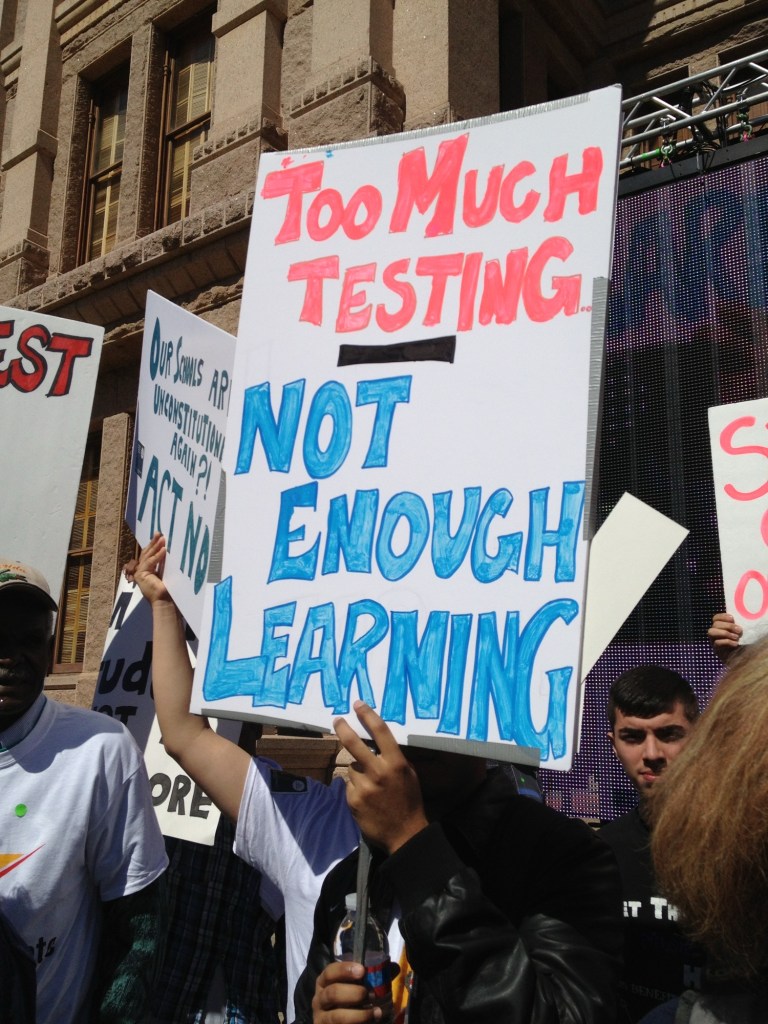
I spoke at Austin Voices for Education and Youth at a rally in front of the State Capitol in 2013
This is Allen Weeks

Mackenzie Scott should give $25 million to Austin Voices for Education and Youth and another $25 million to Community Coices for Education in ZHouston.

John Thompson, historian and teacher, asks who was responsible for the death of Nex Benedict. In this article in The Progressive, he blames the hateful anti-rhetoric of Oklahoma’s elected officials. The officials concluded that Nex committed suicide. Who created the environment in which this child was tormented by classmates?

He writes:

We are learning more about the death of Nex Benedict, a non-binary high school student who died on February 8, the day after they were beaten in the school bathroom in Owasso, Oklahoma. We are also learning about ourselves, as Oklahomans, as we deal with the tragedy. But we are not alone. This bitter attack is a case study in the cruelty being spread across the nation by right-wing extremists. 

Vigils were held across the nation in honor of Nex, who has a Choctaw heritage. The diverse crowd I witnessed at the Oklahoma City vigil was so large that I could barely hear the speakers. We still don’t fully know everything about Nex’s death, but it is clear that it must be viewed within the context of vicious attacks on LGBTQ+ youth by State Superintendent of Public Instruction Ryan Walters and Governor Kevin Stitt as well as the fifty-plus Republican legislative bills attacking LBGTQ+ rights across the country.

Since he was elected in 2019, Governor Stitt has signed laws that restrict access to public school bathrooms; ban health care for transgender people under eighteen; ban transgender girls and women from school sports; and prohibit Oklahomans from obtaining nonbinary gender markers on official documents. He also signed, as the LGTBQ+ rights group GLAAD reported, “an executive order that defunds diversity, equity, and inclusion offices and programs in state agencies, including public colleges.”

Walters has a similar record: He has depicted transgender students as a threat in schools, and approved a permanent rule change that requires schools to get state approval before altering gender markers in a student’s records. Walters has advocated for book bans and described LGBTQ+-themed books as “pornographic material.” He also appointed Chaya Raichik, the founder of anti-LGBTQ+ social media account Libs of TikTok, to the education department’s Library Media Advisory Committee.

Beyond Walters and Stitt, state representatives have also spread hateful rhetoric in recent months. State Senator Tom Woods, for example, called LGBTQ+ Oklahomans “filth” during a panel. Days later, Woods chose to stand by his statement, saying:   

We are a religious state and we are going to fight it to keep that filth out of the state of Oklahoma because we are a Christian state—we are a moral state . . . . We want to lower taxes and let people be able to live and work and go to the faith they choose. We are a Republican state and I’m going to vote my district, and I’m going to vote my values, and we don’t want that in the state of Oklahoma.

Voters in Orange County, California, ousted two culture warriors, making clear their dissatisfaction with the attacks on curriculum, books, teachers, and students.

Howard Blume reports in The Los Angeles Times:

Voters in the city of Orange appear to have ousted two conservative school board members who had spearheaded policies widely opposed by advocates for LGBTQ+ youth in a recall election viewed as a local bellwether for the culture wars in education.


The fiercely contested recall election in the Orange Unified School District intensified with the board majority’s approval in the fall of a parent-notification policy requiring educators to inform parents when a student requests “to be identified as a gender other than that student’s biological sex or the gender listed on the birth certificate or any other official records.”


A legal battle over the issue is playing out as California Atty. General Rob Bonta pursues a court challenge of such policies enacted by a handful of conservative-leaning school boards. His lawsuit asserts that the rules put transgender and gender-nonconforming students in “danger of imminent, irreparable harm” by potentially forcibly “outing” them at home before they’re ready…

The recall came to be an early litmus test on the resonance with voters of issues that have roiled school boards throughout the nation: the teaching of racism and Black history, the rights of LGBTQ+ youth versus the rights of their parents, restrictions on LGBTQ+ symbols and related curriculum, and the removal of library books with sexual content — especially LGBTQ+ content — from school libraries.

The Network for Public Education was happy to see President Biden’s proposed education budget for the next year. In contrast to the Trump administration, which regularly tried to cut federal aid to education, especially to schools that enroll the neediest students, the Biden administration wants to strengthen the federal commitment to education.

I am especially delighted to see an increase in funding for full-service community schools.

NPE released the following statement:

For Immediate Release

The Network for Public Education Applauds President Biden’s FY 2025 Education Budget 

 Given the mandated fiscal restraints, the White House has presented a responsible budget with increases to programs that best serve American children.

Contact: Carol Burris

cburris@networkforpubliceducation.org

(646) 678-4477

The Network for Public Education (NPE) applauds President Biden’s Fiscal Year 2025 budget for the U.S. Department of Education.  At a time when all federal agencies are fiscally restrained, the budget adds welcome increases to programs that benefit American children.

According to NPE’s Executive Director Carol Burris, “This budget is the mirror opposite of budget proposals by the present House leadership that slash funding to children served by critical programs like Title I while proposing an increase to the already bloated Federal Charter School Programs.”

Highlights of the President’s Fiscal Year 2025 budget include:

  • An increase of $200 million for Title I, which provides supplemental financial assistance to schools with a high percentage of children from low-income families.
  • An increase of $200 million to IDEA to support the needs of students with disabilities.
  • An additional $50 million for grants to full-service Community Schools (FSCS).

Building on the recent State of the Union Address, the budget also includes more funding for high-quality learning time, such as high-dose tutoring, preschool grants, career and technical education, and mental health services in schools. It also includes additional funds for programs to increase the number of teachers at a time of unprecedented teacher shortages.

The Federal Charter School Program (CSP), which has seen a decrease in applications since 2016, was cut by $40 million. In its rationale, the Department notes that both State Entities and Charter Management Organizations did not deliver the number of schools promised in their applications.

The Network for Public Education fully supports the decreased funding for the CSP program, which has far outlived its usefulness. The growth in the demand for charter schools during the Bush and Obama years has ended. As the program rapidly expanded, so did the opportunity for grift and fraud. “The Department’s recent demand that the IDEA charter chain return $28 million is just the latest example of how the CSP has been abused,” said Burris. This is the first time an administration has recommended a decrease in the CSP since the program began.

We thank the President and Secretary Cardona for preparing a sound budget that puts students first in a time of fiscal restraint.

The Network for Public Education is a national advocacy group whose mission is to preserve, promote, improve, and strengthen public schools for current and future generations of students.

                                                                   ###