Archives for category: Education Reform

Bob Shepherd is a polymath who worked in the education industry for decades and was recently a teacher in Florida. He spent many years developing standardized tests. He has written often about their poor quality, their lack of reliability and validity.

In this post, he explains why he has reached these conclusions:

The dirty secret of the standardized testing industry is the breathtakingly low quality of the tests themselves. I worked in the educational publishing industry at very high levels for more than twenty years. I have produced materials for all the major textbook publishers and most of the standardized test publishers, and I know from experience that quality control processes in the standardized testing industry have dropped to such low levels that the tests, these days, are typically extraordinarily sloppy and neither reliable nor valid. They typically have not been subjected to anything like the validation and standardization procedures used, in the past, with intelligence tests, the Iowa Test of Basic Skills, and so on. The mathematics tests are marginally better than are the tests in ELA, US History, and Science, but they are not great. The tests in English Language Arts are truly appalling. A few comments about those:

The new state and national standardized tests in ELA are invalid.

First, much of attainment in ELA consists of world knowledge–knowledge of what–the stuff of declarative memories of subject matter. What are fables and parables, in what ways are they similar, and in what ways do they differ? What are the similarities and differences between science fiction and fantasy? What are the parts of a metaphor? How does a metaphor work? What is metonymy? What are the parts of a metonymy? How does it differ from synecdoche? What is American Gothic? What are its standard motifs? How is it related to European Romanticism and Gothic literature? How does it differ? Who are its practitioners? Who were Henry David Thoreau and Mary Shelley and what major work did each write and why is that work significant? What is a couplet? terza rima? a sonnet? What is dactylic hexameter? What is deconstruction? What is reader response? the New Criticism? What does it mean to begin in medias res? What is a dialectical organizational scheme? a reductio ad absurdum? an archetype? a Bildungsroman? a correlative conjunction? a kenning? What’s the difference between Naturalism and Realism? Who the heck was Samuel Johnson, and why did he suggest kicking that rock? Why shouldn’t maidens go to Carterhaugh? And so on. The so-called “standards” being tested cover ALMOST NO declarative knowledge and so miss much of what constitutes attainment in this subject. Imagine a test of biology that left out almost all world knowledge and covered only biology “skills” like–I don’t know–slide-staining ability–and you’ll get what I mean here. This has been a MAJOR problem with all of these summative standardized tests in ELA since their inception. They are almost entirely content free. They don’t assess what students ought to know. Instead, they test, supposedly, a lot of abstract “skills”–the stuff on the Gates/Coleman Common [sic] Core [sic] bullet list, but they don’t even do that.

Second, much of attainment in ELA involves mastery of procedural knowledge–knowledge of what to do. E.g.: How do you format a Works Cited page? How do you plan the plot of a standard short story? What step-by-step procedure could you follow to do that? How do you create melody in your speaking voice? How do you revise to create sentence variety or to emphasize a particular point? What specific procedures can you carry out to accomplish these things? But the authors of these “standards” didn’t think that concretely, in terms of specific, concrete, step-by-step procedural knowledge. Instead, in imitation of the lowest-common-denominator-group-think state “standards” that preceded theirs, they chose to deal in vague, poorly conceived abstractions. The “standards” being tested define skills so vaguely and so generally that they cannot, as written, be sufficiently operationalized, to be VALIDLY tested.  They literally CANNOT be, as in, this is an impossibility on the level of building a perpetual motion machine or squaring the circle. Given, for example, the extraordinarily wide variety of types of narratives (jokes, news stories, oral histories, tall tales, etc.) and the enormous number of skills that it requires to produce narratives of various kinds (writing believable dialogue, developing a conflict, characterization via action, characterization via foils, showing not telling, establishing a point of view, using speaker’s tags properly, etc.), there can be no single question or prompt that tests for narrative writing ability IN GENERAL. This is a broad problem wtih the standardized ELA tests. Typically, they ask one or two multiple-choice questions per “standard.” But what one or two multiple-choice questions could you ask to find out if a student is able, IN GENERAL, to “make inferences from text” (the first of the many literature “standards” at each grade level in the Gates/Coleman bullet list)? Obviously, you can’t. There are three very different kinds of inference–induction, deduction, and abduction–and whole sciences devoted to problems in each, and texts vary so considerably, and types of inferences from texts do as well, that no such testing of GENERAL “inferring from texts” ability is even remotely possible. A moment’s clear, careful thought should make this OBVIOUS. So it is with most of the “standards” on the Gates/Coleman bullet list. And, of course, all this invalidity of testing for each “standard” can’t add up to overall validity, so, the tests do not even validly test for what they purport to test for.

Third, nothing that students do on these exams even remotely resembles what real readers and writers do with real texts in the real world. Ipso facto, the tests cannot be valid tests of actual reading and writing. People read for one of two reasons—to find out what an author thinks or knows about a subject or to have an interesting, engaging, significant vicarious experience. The tests, and the curricula based on them, don’t help students to do either. Imagine, for example, that you wish to respond to this post, but instead of agreeing or disagreeing with what I’ve said and explaining why, you are limited to explaining how my use of figurative language (the tests are a miasma) affected the tone and mood of my post. See what I mean? But that’s precisely the kind of thing that the writing prompts on the Common [sic] Core [sic] ELA tests do and the kind of thing that one finds, now, in ELA courseware. This whole testing enterprise has trivialized responding to texts and therefore education in the English language arts generally. The modeling of curricula on the all-important tests has replaced normal interaction with texts with such freakish, contorted, scholastic fiddle faddle. English teachers should long ago have called BS on this.

He wrote to explain why all standardized tests are not equally invalid:

Standardized tests are not all the same, so talk about “standardized tests” in general tends to commit what linguistic philosophers call a “category error”—a type of logical fallacy. George Lakoff wrote a book about categorization called Women, Fire, and Dangerous Things. He took the title from the classification system for nouns of the indigenous Australian language Dyribal. One of the noun categories in this language includes words referring to women, things with which one does violence (such as spears), phenomena that can kill (fire), and dangerous animals (such as snakes and scorpions). What makes this category bizarre to our ears is that the things in the category don’t actually share significant, defining characteristics. Women and things associated with them are not all dangerous. Speaking of all things balan (this category in the Dyribal language) therefore doesn’t make sense. The same is true of the phrase “standardized test.” It lumps together objects that are DIFFERENT FROM one another in profoundly important ways. Imagine a category, “ziblac,” that includes greyhound buses, a mole on Socrates’s forehead, shoelaces, Pegasus, and the square roots of negative numbers.” What could you say that was intelligible about things in the category “ziblac”? Well, nothing. Talking about ziblacs would inevitably involve committing category errors—assuming that things are similar because they share a category name when, in fact, they aren’t. If you say, “You can ride ziblacs” or “Ziblacs are imaginary” or “Ziblacs don’t exist,” you will often be spouting nonsense. Yes, some ziblacs belong to the class of things you can ride (greyhound buses, Pegasus), but some do not (shoelaces, imaginary numbers), and you can’t actually ride Pegasus because Pegasus exists only in stories. Some are imaginary (Pegasus, imaginary numbers), but they are imaginary in very different senses of the term. And some don’t exist (Pegasus, the mole on Socrates’s forehead), but don’t exist in very different ways (the former because it’s fictional, the latter because Socrates died a long time ago). When we talk of “standardized tests,” we are using such an ill-defined category, and a lot of nonsense follows from that fact.

Please note that there are many VERY DIFFERENT definitions of what “standardized test” means. The usual technical definition from decades ago was “a test that had been standardized, or normalized.” This means that the raw scores on the test had been converted to express them in terms of ”standard scores”–their number of standard deviations from the mean. You do this by starting with the raw score on a test, subtracting the population mean from it, and then dividing the difference by the population standard deviation. The result is a Z-score (or a T-score if the mean is taken to be 50 and the standard deviation is taken to be 10). People do this kind of “standardizing,” or “normalization,” in order to compare scores across students and subpopulations. Let’s call this “Standardized Test Definition 1.” Many measures converted in such a way yield a so-called “bell curve” because they deal with characteristics at that are normally distributed. An IQ test is supposed to be a test of this type. The Stanford 10 is such a Standardized Test, Definition 1.

Another, much broader definition is “any test that is given in a consistent form, following consistent procedures.” Let’s call this “Standardized Test Definition 2.” To understand how dramatically this definition of “standardized test” differs from the first one, consider the following distinction: A norm-referenced test is one in which student performance is ranked based on comparison with the scores of his or her peers, using normalized, or standardized, scores.. One of the reasons for standardized scores as per Definition 1, above, is to do such comparisons to norms. A criterion-referenced test is one in which student performance is ranked based on some absolute criterion—knowledge or mastery of some set of facts or skills. Which kind of scoring one does depends on what one is interested in—how the student compares with other students (norm-referenced) or whether the student has achieved some absolute “standard”—has or has not demonstrated knowledge of some set of facts or some skill (criterion-referenced). So, Standardized Test Type 2 is a much broader category, and includes both norm-referenced tests and criterion-referenced tests. In fact, any test can be looked at in the norm-referenced or criterion-referenced way, but which one does makes a big difference. In the case of criterion-referenced tests, one is interested in whether little Johnny knows that 2 + 2 = 4. In the case of norm-referenced tests, one is interested in whether little Johnny is more or less likely than students in general to know that 2 +_2 = 4. The score for a criterion-referenced test is supposed to measure absolute attainment. The score for a norm-referenced test is supposed to measure relative attainment. When states first started giving mandated state tests, a big argument given for these is that they needed to know whether students were achieving absolute standards, not just how they compared to other students. So, these state tests were supposed to be criterion-referenced tests, in which the reported was a measure of absolute attainment rather than relative attainment, which brings us to a third definition.

Yet another definition of “Standardized Test” is “any test that [supposedly] measures attainment of some standard.” Let’s call this “Standardized Test Definition 3.” This brings us to a MAJOR source of category error in discussions of standardized testing. The “standards” that Standardized Tests, Definition 3 supposedly measure vary enormously because some types of items on standards lists, like the CC$$, are easily assessed both reliably (yielding the same results over repeated administrations or across variant forms) and validly (actually measuring what they purport to measure), and some are not. In general, Math standards, for example, contain a lot more reliably and validly assessable items (the student knows his or her times table for positive integers through 12 x 12) than do ELA standards, which tend to be much more vague and broad (e.g., the student will be able to draw inferences from texts). As a result, the problems with the “standardized” state Math tests tend to be quite different from the problems with the state ELA tests, and when people speak of “standardized tests” in general, they are talking about very different things. Deformers simply assume that is people have paid a dedicated testing company to produce a test, that test will reliably and validly test its state standards. This is demonstrably NOT TRUE of the state tests in ELA for a lot of reasons, many of which I have discussed here: https://bobshepherdonline.wordpress.com/2020/03/19/why-we-need-to-end-high-stakes-standardized-testing-now/. Basically, the state ELA tests are a scam.

Understanding why the state ELA tests are a scam requires detailed knowledge of the tests themselves, which proponents of the tests either don’t have or have but aren’t going to talk about because such proponents are owned by or work for the testing industry. Education deformers and journalists and politicians tend, in my experience, to be EXTRAORDINARILY NAÏVE about this. Their assumption that the ELA tests validly measure what they purport to measure is disastrously wrong.

Which leads me to a final point: Critiques of the state standardized tests are often dismissed by Ed Deformers as crackpot, fringe stuff, and that’s easy for them to do, alas, because some of the critiques are. For example, I’ve read on this blog comments from some folks to the effect that intellectual capabilities and accomplishments can’t be “measured.” The argument seems to be based on the clear differences between “measurement” as applied to physical quantities like temperature and height and “measurement” as applied to intellectual capabilities and accomplishments. The crackpot idea is that the former is possible, and the latter is not. However, t is OBVIOUSLY possible to measure some intellectual capabilities and accomplishments very precisely. I can find out, for example, very precisely how many Kanji (Japanese logograms) you know, if any, or whether you can name the most famous works by Henry David Thoreau and Mary Shelley and George Eliot and T.S. Eliot. If you choose to disdain the use of the term “measurement” to refer to assessment of such knowledge, that’s simply an argument about semantics, and making such arguments gives opponents of state standardized testing a bad name—such folks get lumped together, by Ed Deformers, with folks who make such fringe arguments.
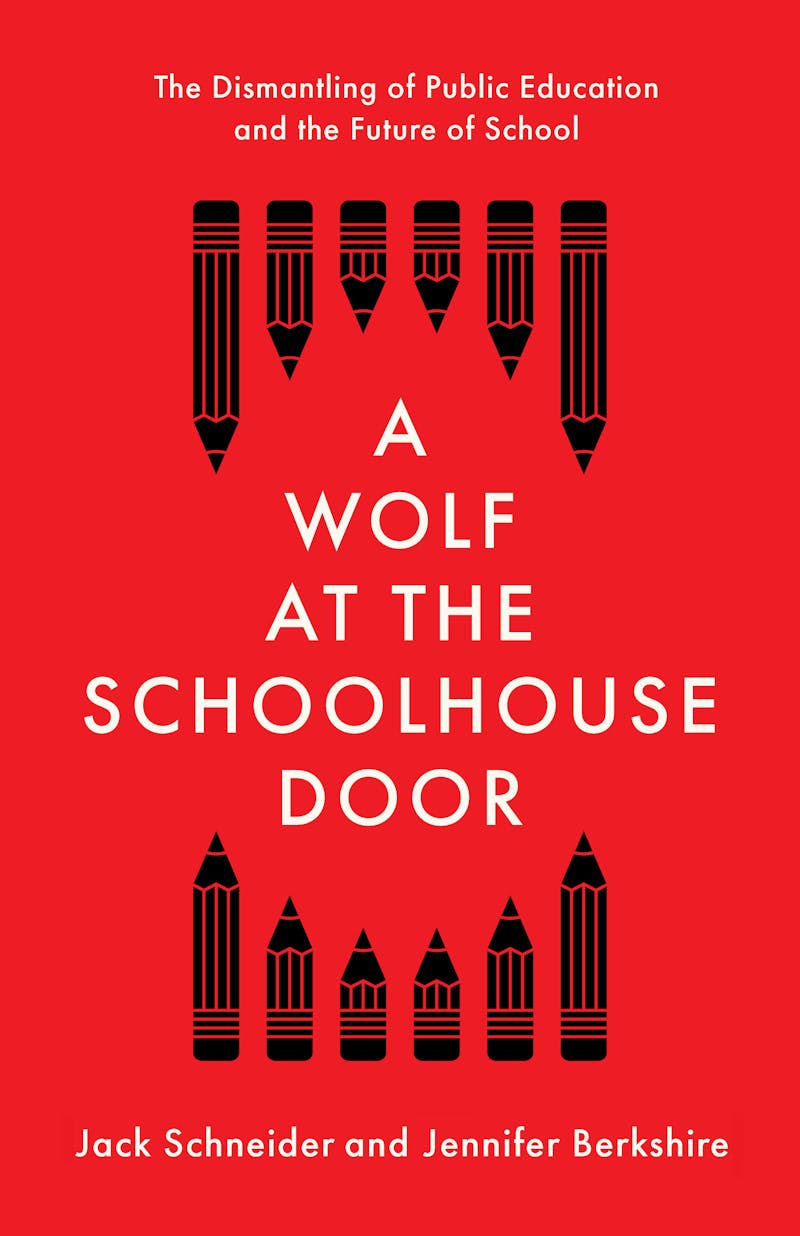
I reviewed A Wolf at the Schoolhouse Door in The New Republic. It is an important book that pulls together all the threads of the privatization movement and shows that their agenda is not to improve education or to advance equity but to destroy public education. The review is here.

Tonight, I will join the authors at a town hall Zoom meeting in Seattle at 9 p.m. EST, 6 p.m. PST. Please join us!

It begins like this:

Two years ago, Margaret Spellings, George W. Bush’s secretary of education, and Arne Duncan, Barack Obama’s secretary of education, wrote an opinion article in The Washington Post lamenting the decline of public support for the bipartisan consensus about education policy that began under Ronald Reagan. Elected officials strongly supported a regime of testing, accountability, and school choice, they wrote, but public enthusiasm was waning due to a lack of “courage” and “political will.”

A Wolf at the Schoolhouse Door: The Dismantling of Public Education and the Future of Schoolby Jack Schneider and Jennifer BerkshireBuy on BookshopThe New Press, 256 pp., $26.99

They were right. Elected officials, educators, and parents were rapidly losing faith in the bipartisan consensus. For a decade, it had failed to produce any improvement on national tests. Parents were opting their children out of the annual testing mandated by federal law; in New York, 20 percent of eligible students refused to take them. Teachers went to court to fight the test-based evaluation methods imposed by Duncan’s Race to the Top. Communities from Los Angeles to Philadelphia were complaining about the growth of charter schools, which diverted funds away from public schools. A year after Spellings and Duncan’s essay appeared, teachers across the nation, from West Virginia to California, went on strike to protest low wages, low funding, and large class sizes, issues that were ignored during the era of bipartisan consensus.

What went wrong? Why did the bipartisan consensus that Spellings and Duncan praised fall apart? In their new book, historian Jack Schneider and journalist Jennifer Berkshire provide a valuable guide to the history and the politics of the rise and fall of the bipartisan consensus. Theirs is indeed a cautionary tale, because they show how Republicans and Democrats joined to support failed policies whose ultimate goal was to eliminate public education and replace it with a free-market approach to schooling. Betsy DeVos was publicly reviled for her contemptuous attitudes toward public schools, but she was not an exception to the bipartisan consensus: She was its ultimate embodiment. She was the personification of the wolf at the schoolhouse door. 

Schneider and Berkshire write that they began the book to answer “a puzzling question: Why had conservative policy ideas, hatched decades ago and once languishing due to a lack of public and political support, suddenly roared back to life in the last five or so years?” Their prime example was private school vouchers, an idea first promoted by Ronald Reagan in the early 1980s and rejected at that time by Congress. Private school vouchers were not the only policy prescription that was recycled from the ashcan of failed ideas. There was also “market-based school choice, for-profit schools, virtual schools,” and deregulation. These ideas were repackaged as innovative while their history and their conservative ideological origins were obscured. True believers, intent on eliminating public schools, built donor networks, cultivated political alliances, and churned out ready-made legislation. A key element in this network-building was the enlistment of billionaires who were enamored of free-market solutions and who opened their wallets to persuade national and state elected officials to inject competition and private-sector solutions into the public education system. 

This is a book you will want to read. Give it to your local school board members and your legislators.

Many of you have asked how to express your indignation and outage about the decision by Acting Assistant Secretary Ian Rosenblum to require all states to administer standardized testing this spring at a time of great stress on students, families, teachers, schools, and communities.

I have repeatedly explained why the federally mandated tests are worthless. The teachers are not allowed to see the questions or the answers that individual students gave. The scores are returned 4-6 months after the tests. The teacher learns nothing about how students are progressing. The tests measure, above all, family income and education. They provide no information of value.

I suggested that you write your members of Congress.

You should also write the author of this absurd decision, Ian Rosenblum. At the moment the Department of Education is leaderless, having no confirmed leaders. Ian was never a teacher. He worked for Education Trust, the pro-testing organization funded by the Gates Foundation.

You might want to remind Ian that standardized tests do not promote equity. The bottom half of the bell curve produced by these tests is dominated by the kids with the highest needs: those whose families are poor, those who are not fluent in English, those with disabilities. They are demoralized year after year by standardized testing. They need smaller class sizes, not tests.

You can contact Ian to express your views at the following email addresses:

Ian.Rosenblum@ed.gov

ianrosenblum@gmail.com

Since the 2020 election, when Republicans won many seats in state legislatures, there has been an explosion of proposed voucher laws, to allow people to get public money to pay for religious schools. David Berliner, one of our nation’s most distinguished researchers of education, explains why funding religious schools with public money is a terrible idea.

Why Religious Schools Should Never Receive a Dollar of Public Funding

David C. Berliner

Regents’ Professor Emeritus

Mary Lou Fulton Teachers College

Arizona State University

I believe in separation of church and state. I think it has done the United States a lot of good to honor Jefferson’s metaphoric and aspirational “wall” between the two. I also believe that money corrupts too many people and too many institutions. Holding those two beliefs simultaneously means 1.) I never want to see any local, state, or federal money used to aide any religious group, and 2.) I don’t want to see any religious group, or affiliated religious organizations, donating to the campaigns of public officials. The latter may be impossible to stop in an era of “dark money.” But the former—government support of religious institutions– is almost always done in public view and is worth stopping now, immediately, as it could easily damage our fragile republic.

Overstated? Hardly! Read on! Few citizens pay attention to the expenditure of public dollars for support of religious schools, but it occurs frequently. It can cost citizens billions of dollars annually, and ends up supporting some horrible things. A contemporary example of this is the criteria for entrance to the Fayetteville Christian School in North Carolina. 

Fayetteville Christian School (FCS) are recipients, in a recent school year, of $495,966 of public money. They get this in the form of school vouchers that are used by students and their families to pay for the students’ religious schooling. The entrance requirements for this school, and other religious schools like it, are quite frightening to me, though clearly acceptable to North Carolinians. From their website, in 2020:1

“The student and at least one parent with whom the student resides must be in agreement with (our) Statement of Faith and have received Jesus Christ as their Savior. In addition, the parent and student must regularly (go to) a local church. (We) will not admit families that belong to or express faith in religions that deny the absolute Deity/Trinity of Jesus Christ as the one and only Savior and path to salvation. …. FCS will not admit families that engage in behaviors that Scripture defines as deviate and sin (illicit drug use, sexual promiscuity, homosexuality (LGBT), etc.)

Once admitted, if the student or parent/guardian with whom the student resides becomes involved in lifestyles contradictory to Biblical beliefs, we may choose to dis-enroll the student/family from the school.” 

So, despite the receipt of public money, the Fayetteville Christian School is really notopen to the public at all! This school says, up front and clearly, that it doesn’t want and will not accept Jews, Muslims, Hindu’s, and many others. Further, although supported by public money, it will expel students for their family’s alleged “sins”. Is papa smoking pot? Expelled! Does your sibling have a homosexual relationship? Out! Has mama filed for divorce? You are gone! The admissions and dismissal policies of this school–receiving about a half million dollars of public funds per yearare scandalous. I’d not give them a penny! North Carolina legislators, and the public who elects them, should all be embarrassed to ever say they are upholders of American democracy. They are not. 

Besides the anti-democratic admission and retention problems in many religious schools, Christian or otherwise, some have serious curriculum problems as well. Those curriculum problems actually terrify me when they occur in publicly supported religious schools. With public money–my money–many of these schools spread ideas that are objectively/scientifically untrue. And some are simply repugnant! 

Do you remember Bobby Jindal? A few years back, Jindal was Governor of Louisiana and even, for a short time, a candidate for president of the United States of America. He pushed hard for publicly supported charter and voucher schools. The curriculum materials in these schools frequently came from one of two sources: Bob Jones University Press (associated with the scandal-ridden university), or from A Beka Book, a publisher of Christian books (now called Abeka). Between them, with the public’s money, these publishers have taught our youth some amazing things, as reported either by Deanna Panor by Alice Greczyn.3

Pan and Greczyn share some very interesting text excerpts. For example, I never learned from the textbooks in my public school that “The majority of slave holders treated their slaves well.” Nor did I ever imagine that “To help them endure the difficulties of slavery, God gave Christian slaves the ability to combine the African heritage of song with the dignity of Christian praise. Through the Negro spiritual, the slaves developed the patience to wait on the Lord and discovered that the truest freedom is from the bondage of sin.”

I also didn’t know that “The Ku Klux Klan in, some areas of the country, tried to be a means of reform, fighting the decline in morality and using the symbol of the cross. Klan targets were bootleggers, wife-beaters, and immoral movies. In some communities it achieved a certain respectability as it worked with politicians.”

I admit that I didn’t exactly get an “A” in my high school algebra course, but I never thought that abstract algebra was too complicated to learn. Perhaps I was wrong. An A Beka book states that “Unlike the ‘modern math’ theorists, who believe that mathematics is a creation of man and thus arbitrary and relative, A Beka Book teaches that the laws of mathematics are a creation of God and thus absolute…A Beka Book provides attractive, legible, and workable traditional mathematics texts that are not burdened with modern theories such as set theory.” (Italics mine.)

Another analyst of Christian school text books, Rachel Tabachnick,4 also informed me of things I never suspected. I simply never knew that “Global environmentalists have said and written enough to leave no doubt that their goal is to destroy the prosperous economies of the world’s richest nations.” This quote is from Economics: Work and Prosperity in Christian Perspective, 2nd ed., A Beka Book, 1999.

Through Tabachnick I also learned that children receiving their education in some Christian schools supported with public money are informed that gay people “have no more claims to special rights than child molesters or rapists.” That quote is from the Teacher’s Resource Guide to Current Events for Christian Schools, 1998-1999, Bob Jones University Press, 1998.

         Writing in Salon Magazine, Wilson5 documents other outrageous claims made in these curricula materials, some of which are purchased with public money for Christian schools in the USA, although these curriculum materials are in use throughout the world:

  • Only ten percent of Africans can read or write, because Christian mission schools have been shut down by communists.
  • God used the ‘Trail of Tears’ to bring many Indians to Christ.
  • It cannot be shown scientifically that man-made pollutants will one day drastically reduce the depth of the atmosphere’s ozone layer.
  • God has provided certain ‘checks and balances’ in creation to prevent many of the global upsets that have been predicted by environmentalists.
  • The Great Depression was exaggerated by propagandists, including John Steinbeck, to advance a socialist agenda. 
  • Unions have always been plagued by socialists and anarchists who use laborers to destroy the free-enterprise system that hardworking Americans have created.

Religious schools should not be subject to much state oversight—I understand that. But many such schools claim to offer curriculum compatible with neighboring public schools, thus allowing their students to move to the public schools should they or their parents request that. For example, it is not uncommon for students in Christian schools to transfer at 6th or 9thgrade to a traditional, public junior or senior high. Or, with a high school degree after years of private Christian education, a student might seek admission to a public college. Since student transfers like these are common, shouldn’t there be more inspection and approval of the curriculum and instruction in private Christian schools? Shouldn’t Christian schools, or Jewish or Islamic or any other school receiving public money, be inspected regularly by some agency of the government so they can be certified not to be teaching anti-democratic, anti-scientific, and anti-communitarian values? We have enough strife in this country without paying for schools whose values and curriculum are antithetical to our increasingly secular democracy. 

Am I overreaching? Although ordinarily private schools should not be subject to public scrutiny, if they accept public funds and if they are teaching age-inappropriate or anti-democratic content to their students shouldn’t the public know? Shouldn’t all public funds be subject to some kind of public audit? 

         For example, Rawls6 cites an adult whose memory of sixth grade instruction in a Christian school was still quite vivid. The teacher “passed around shocking photographs of dismembered babies to teach about abortion.” Sometimes abortion in Christian schools is compared to the holocaust. Other times elementary school students have been taken to local and state abortion protests, even to national events in Washington DC. Some schools regularly take their students to abortion clinics to protest. Are public expenditures for curriculum materials and activities like were just cited appropriate? Shouldn’t we know what is taught and learned in schools supported by public funds?     

Naturally, as part of their anti-abortion campaign, many Christian schools worry a lot about sex. So, they pass along unsubstantiated claims about condom failure and the horrible and life-long consequences of sex outside of marriage. It is often public money that supports curriculum and instruction of this type. Should that be the case? Should the state, often with comingled federal funds, support schools with anti-abortion programs when many state courts, and the Supreme Court, has ruled that abortion is legal? I have absolutely no issues with debate about abortion issues in upper grade levels, but should schools be providing anti-abortion education for our youth with public funds? 

Pregnancy, as might be expected, is often greeted with expulsion for girls at Christian schools. I certainly don’t know anyone who recommends teen parenthood, but if it occurs, shouldn’t the mother be helped, not thrown out of school? Wouldn’t that be the Christian thing to do? 

To accommodate the fact of teen motherhood, a public high school I visited proudly showed me a classroom-cum-nursery, allowing teen mothers a safe place to leave their infants while attending classes to earn their high school diplomas. In fairness, one might ask if that is a proper role of a public school. I believe, as do many Americans, that preparation for successful adulthood is the mission of our public schools—even if it entails these kinds of accommodations to keep youth in school and help them to graduate.7

         Another curriculum question is this: Is it appropriate for American education to promote lessening tensions between nations and religions? I think so. But public funds support Christian schools that teach “[T]he darkness of Islamic religion keeps the people of Turkey from Jesus Christ as their savior.” They teach that “[O]ver 500 people saw the resurrected Jesus Christ, [but] no one witnessed Mohammed’s supposed encounters with the angels.” And they teach that Islam is “fanatically anti-Christian.” 3 

         Finally, I want to point out the almost unanimous call to end corporal punishment of minors by the UN and by psychologists and other social scientists. Because of this I ask, should public money be used to support schools that still engage in corporal punishment? Sadly, both Christian and public schools, particularly in the Southern United States, approve of and still engage in spanking, or “paddling.”8

Although physical punishment of children has not disappeared in contemporary times, it appears to be more prevalent in Christian schools than in public schools because many of them operate on the principle of “spare the rod spoil the child.” Codes of conduct for many Christian schools say it is their obligation to use physical punishment, citing Proverbs 23: 13 and 14, among other biblical sources. There they are told “do not withhold discipline from a child; if you strike him with a rod, he will not die. If you strike him with the rod, you will save his soul…” 

Thus the “rod,” switch, or paddle, along with other harsh punishments to ensure proper child rearing, is recommended in many Christian advice books for Christian parents.So it is not surprising that more physical abuse takes place in fundamentalist Christian schools than in public schools. For example, in 2007, a Chicago Christian school was sued for injury and surgical costs after forcing a 14-year-old boy to kneel in place for nine days, causing a hip injury. In 2011, a Christian school teacher in Orlando was arrested on charges of beating a boy at her home with a rusted broom handle.6 And in 2015, at the Christian based Zarephath Academy in Jacksonville, Florida, a cell phone video shows male students holding down a female student, while her teacher paddled her in front of the whole class. The horrible offence the student committed? Running in the cafeteria!10

         Conclusion: There are certainly debates to have about the admissions and retention policies, qualifications of teachers, and especially the curricula used in all our schools—public, private, charter, religious or secular. We, the American people, settle controversial debates about issues like these in public forums. We rely on an open press, and we settle these debates through citizen voting and in our courts. Public oversight of public funds is part of the American tradition. 

Frequently, oversight of public funding is carried out by inspector generals. In fact, the first inspector general of the USA was appointed, in part, because General Washington had an ill-trained army for the task he had ahead. So, our very first inspector general was charged with identifying an educational problem, and asked to rapidly fix it! 

Now, literally thousands of people work for various offices of federal, state, and (occasionally) municipal inspector generals. Each are typically responsible for identifying fraud, waste, abuse, and criminal activity involving public funds, programs, and operations. But outside of the federal government, few inspector generals are devoted to education, even though roughly 45 percent of all state budgets, and 45 percent of all local budgets are used to support educational activities11. Thus, there is little oversight of how educational dollars are spent, and some of that spending has turned out to be scandalous!12 Just as bad, I think, is that there is even less concern about what is taught and what is learned in secular charter and private schools, or religious schools, that receive public money. This is not how it should be. I certainly would rest easier if there were inspectors spending a bit more time in the field overseeing what is taught and what is learned in our schools, in addition to their worries about how public money is spent. In particular, we need to examine religious institutions receiving public funds, so that the public has the information needed to maintain Jefferson’s wall, as best we can. 

In fact, if I made law, I would see to it that no private school– religious or not—ever received a dime of public money! Such schools can too easily sow seeds of separateness, privilege and dissension, hindering the achievement of one of our nations most cherished goals: e pluribus unum. Out of our many, one!

1.   Fayetteville Christian Church, Admissions. Retrieved February 8, 2021 from https://www.fayettevillechristian.com/copy-of-criteria-1

2.   Pan, D. (2012, August 7). 14 Wacky “Facts” Kids Will Learn in Louisiana’s Voucher Schools. Retrieved February 13, 2021 from https:/www.motherjones.com/kevin-drum/2012/08/photos-evangelical-curricula-louisiana-tax-dollars

3. Greczyn, A. (2020, Blog of June 7). Christianity’s Role in American Racism: An Uncomfortable Look at the Present and the Past.

Retrieved February 2, 2021 from https://www.alicegreczyn.com/blog/christianitys-role-in-american-racism

4. Tabachnick, R. (2017, January17) Vouchers/Tax Credits Funding Creationism, Revisionist History, Hostility Toward Other Religions. Talk to Action. Retrieved February 18, 2021 from: http://www.talk2action.org/story/2011/5/25/84149/9275

5. Wilson, B. (2012, June 19). Shocking Christian school textbooks:Thousands of Louisiana students will receive state voucher money to attend religious schools. What will they learn? Retrieved February 7, 2021 from: https://www.salon.com/2012/06/19/shocking_christian_school_textbooks_salpart/

6. Rawls, K. (2015, January 12). 10 Frightening Things Happening at Conservative Christian Schools That May Be Funded With Your Tax Dollars. AlterNet. Retrieved January 29, 2021 from https://www.alternet.org/2015/01/10-frightening-things-happening-conservative-christian-schools-may-be-funded-your-tax/

7. It is worth noting here that public schools frequently do spend our public money counseling such students and their families, while private schools frequently do not. It is a simple fact that all sorts of “problem” students, the more costly ones, not just the sexually active or pregnant, are frequently expelled from charter and private schools of all kinds, and sent to genuine public schools. Moreover, most charter and voucher schools frequently find ways not to accept special education students, either. Thus, the public schools incur educational expenses that most charter and voucher schools receiving public money do not. So public schools face budgeting challenges that private schools receiving public money do not. Thus, when one hears that charter or voucher schools are more cost efficient than “wasteful government schools,” these facts must be kept in mind.

8. So common has been physical punishment that the precise size and thickness of paddle to be used has often been codified, eg., specifying the type wood, length of paddle, thickness of paddle, etc. Moreover, there is a likely reason that paddling is more common in Southern schools. Severe paddling was used to punish slaves so as to not leave any scars. A whip-scared slave was of less value than an unscared one, because the scars indicated an uncompliant slave and/or a runaway slave. Severely paddled slaves, it was believed, obeyed their masters better–as is desired of children by many adults.

9.  Berliner, D. C. (1997). Educational psychology meets the Christian      right: Differing views of children, schooling, teaching, and learning.  Teachers College Record, 98, 381-416. 

10. Retrieved February 10, 2021 from: https://www.news4jax.com/news/2015/03/10/video-shows-girl-held-down-paddled-in-school/

11. The Condition of Education, National Center for EducationalStatistics (2020).  Retrieved February 20, 2021 from https://nces.ed.gov/programs/coe/indicator_cma.asp

12. Berliner, D. C. (2022, in press). The Scandalous History of Schools That Receive Public Financing, But Do Not Accept the Public’s Right of Oversight. In Berliner, D.C. and Hermanns, C. (Eds.), Public Education: The Cornerstone of American Democracy. New York. Teachers College Press.

UPDATE TO NEWS RELEASE: 50,000 signatures submitted to SBE-parents, educators urge waiving standardized testing

NEWS RELEASE                      

California Teachers Association                                                                                                                                                                                                                        February 22, 2021

1705 Murchison Drive                                                                                   

Burlingame, CA 94010

www.cta.org

Contact: Claudia Briggs cbriggs@cta.org

FOR IMMEDIATE RELEASE

Educators Call on State Board of Education to Seek Waiver from U.S. Department of Education Suspending Standardized Testing for Current School Year
More than 40,000 concerned parents and educators sign petition echoing concerns over undue pressure on students, technology inequities, and data reliability; call for focus on other supports in response to pandemic


BURLINGAME 
— The California Teachers Association (CTA) has submitted a letter to the State Board of Education (SBE) urging the California Department of Education (CDE) to submit a waiver requesting the U.S. Department of Education (USDOE) to suspend standardized testing for the 2020-21 school year. In the February 22, 2021, letter to the SBE, CTA cites problems with both feasibility of administration, useability and reliability of resulting data, and the cruelty of putting students, families, and educators through high stakes assessments in the middle of a pandemic. If submitted and approved, the waiver would suspend summative assessments required under the Every Student Succeeds Act (ESSA), normally conducted in the spring.

Most California students are still engaged in distance learning, and many students still lack reliable internet bandwidth and access or inconsistent learning and testing environments. Educators have also expressed concerns about the validity and comparability of a statewide test administered under widely varying and largely uncontrolled circumstances. CTA is advocating for the suspension of high stakes tests that will take away precious instructional time and put unnecessary additional stress on students and their families.

CTA has also sent a letter to Acting U.S. Secretary of Education, Phil Rosenfelt, urging the USDOE to issue assessment waivers to states as soon as possible, reiterating educator concerns about the harm that standardized testing in the middle of a pandemic would cause.

“Given widespread inequities in student access to technology and the internet, as well as the concerns both educators and parents have about the value of any data gathered from traditional annual testing in the midst of a global pandemic, we firmly believe testing would be detrimental to students, and of little use to teachers and school districts,” said CTA President E. Toby Boyd. “These factors lead us to urge policy makers to instead focus on providing support to students in distance learning and their safe return to physical classrooms instead of on assessments of little value.”

petition by the California Teachers Association calling for the suspension of state standardized testing has so far gathered 40,000 signatures from parents and educators who are deeply concerned about the continuation of normal testing during this most challenging school year. That petition is being shared with the SBE and the USDOE.

More background on these letters, standardized testing, and CTA’s position on suspending testing this year can be found here

###

The 310,000-member CTA is affiliated with the 3-million-member National Education Association.

Claudia Briggs, Communications Assistant Manager, California Teachers Association (EST 1863)

916.325.1550 (office) | 916.296.4087 (cell) | cbriggs@cta.org

The California Teachers Association exists to protect and promote the well-being of its members; to improve the conditions of teaching and learning; to advance the cause of free, universal, and quality public education; to ensure that the human dignity and civil rights of all children and youth are protected; and to secure a more just, equitable, and democratic society.

Michael Fullan has written an excellent analysis of the best way to redesign school systems after the pandemic. This paper deserves the time it takes to read. Don’t read just the bullet points. Read it all.

Fullan recognizes that the pandemic has shaken up many assumptions about the status quo. He persuasively argues that the status quo in education is “driven” by failed ideas.

He writes:

The four new wrong drivers are not completely wrong. It is just that if left alone they take us in a negative direction. Let’s name them and give them nicknames (in parentheses).

  1. Academics Obsession (selfish)
  2. Machine Intelligence (careless)
  3. Austerity (ruthless), and
  4. Fragmentation (inertia).

    They have been operating for 40 years,
    and with ever-growing intensity. Together they are the ‘bloodless paradigm’, lacking care, empathy, and civic awareness – the things that make us humans. The new right drivers, by contrast, capture and propel the human spirit. Again these are offered with nicknames.

What does he propose instead?

  1. Wellbeing and Learning (essence)
  2. Social Intelligence (limitless)
  3. Equality Investments (dignity), and
  4. Systemness (wholeness).
    They are the human paradigm and presently constitute a work in progress. We have barely begun to tap their potential.

    ƒ
    Fullan’s provocative paper deserves your full attention. The path we have taken in education for the past four decades has exhausted whatever promise it might have had. After the past two decades of legislated testing, accountability, competition, and privatization, we see few of any signs of improvement. The more we stick with the status quo, the more rancid it is. It is time for fresh thinking. Here is a good place to begin to think anew.

Civil rights groups, led by the Southern Education Foundation, are opposing the voucher legislation proposed by Republicans in Georgia.

SEF leads opposition to education savings account bill introduced in Georgia legislature

One of the first pieces of legislation introduced in the Georgia legislature in 2021 was the Georgia Educational Scholarship Act (HB60), a bill that would divert taxpayer dollars to private schools. In February, SEF and nine other education and equity-focused organizations sent a letter to the Georgia House Committee on Education expressing concerns that HB60 would divert funds from public education at a time when schools can least afford to lose it, and further perpetuate inequities.

SEF prepared analysis of the bill and a backgrounder on academic outcomes and participation requirements for similar tax credit scholarship programs across the country.

SEF’s Legislative and Research Analyst also provided testimony to the Senate Education and Youth Committee on SB47, a proposed expansion of the state’s existing special needs voucher program.

Two years ago, the voters of Arizona overwhelmingly rejected an expansion of vouchers, by 65% to 35%. The pro-voucher side was funded by Charles Koch, Betsy DeVos, and other enemies of public schools. The voters said a resounding NO to voucher expansion!

Yet, this week the Arizona Legislature passed legislation to expand vouchers, approving what the voters rejected. Apparently, the word “democracy” is not in the Republican legislators’ dictionary. The voters expressed their will in no uncertain terms. The legislators ignored them.

The Arizona Senate approved a massive expansion of Arizona’s school voucher program Monday, just two years after voters decisively repealed a similar expansion of school vouchers to all students. 

The Senate passed the bill on a 16-14 party-line vote, with all 16 Republicans voting for the measure. It will now be sent to the House of Representatives. 

Empowerment Scholarship Accounts allow parents eligible to take funds from public schools and spend them on private school. The bill would expand the program, which currently serves only 9,700 students, making it available to an exponentially larger group. 

Bill sponsors contend the voucher expansion will benefit only low-income students from so-called Title I schools, which receive funding for disadvantaged students to close educational gaps.

But SB 1452 would also allow any student who lives in the boundary of a Title I school to be eligible for an empowerment scholarship account. The students would merely have to attend the school and would not need to be low-income themselves to qualify. 

More than 1,300 of the 2,000 district schools in Arizona — about 65% — are Title I schools, and even wealthy districts include some Title I schools.

Another account adds this:

The proposal from Glendale Republican Sen. Paul Boyer, SB1452, would make all children attending schools with a high percentage of low-income families or who qualify for free or reduced-price lunches eligible for the state’s voucher program. The program allows parents to take state funding and pay for religious or other private education and education costs. 

If the Republican-controlled House also approves the measure and it is signed by Gov. Doug Ducey, a school choice supporter, about 800,000 of Arizona’s 1.1 million K-12 students would qualify to use state money to attend private schools, up from about 256,000 currently. Despite the current eligibility, only about 9,700 children currently use state vouchers to pay for private or home schooling costs.

So, of the 256,000 students eligible for vouchers, only 9,700 use them. That’s less than 4% who want vouchers.

Dare I mention yet again that there is a sizable body of evidence showing that kids who leave public schools to use vouchers are set back in their academic achievement?

Steve Chapman is a member of the editorial board of The Chicago Tribune. He wrote here what I was thinking. Trump did profound damage to our democracy, and a majority of Republicans endorsed his vicious attack on our Capitol and on democracy itself. He spent months complaining that the Presidential election was “rigged,” unless he won, in which case it would be valid. When he lost the election decisively, he refused to concede and launched a barrage of lawsuits, all claiming “voter fraud.” His lawyers never produced any proof of fraud, his obeisance Attorney General told him there was not enough fraud to change the outcome of the election, his director of election cyber security told him the election was fair (and was fired for it). YetTrump and his lackeys continued to rage about fraud, even though all his lawsuits were thrown out. He couldn’t even get a win from judges he appointed, which baffled him. Unwilling to admit defeat, he summoned his MAGA followers to DC on January 6, promising them a “wild” day.

Wild, it was, beginning with an incendiary 70-minute speech by Trump, urging the mob to March on the Capitol and “fight like hell” or lose their country. They did as he instructed. They broke through police lines. They were enraged and violent, beating the po’ice who tried to keep them out of the Capitol, which had not been invaded since the war of 1812. They sacked and ransacked the Capitol, while members of Congress, assembled to certify Joe Biden’s election, were hurriedly evacuated. There were only minutes between the physical evacuation of the legislators and the rush of the mob into their chambers. We can only speculate what would have happened if they had seized Mike Pence, Nancy Pelosi, and other members of Congress. It might have been a bloody massacre. Trump watched the horror on television and did nothing to call off his followers. How close we came to a violent coup!

The whole world was watching as our democracy hung in the balance.

Was Donald Trump responsible? Of course he was. Mitch McConnell admitted as much after he voted to acquit him because he was a “private citizen.” This is the same McConnell who refused to start the trial while Trump was still in office.

The seven Republicans who voted to defend our democracy instead of licking Trump’s soiled boots deserve our thanks: Mitt Romney of Utah, Susan Collins of Maine, Lisa Murkowski of Alaska, Richard Burr of North Carolina, Bill Cassidy of Louisiana, Ben Sasse of Nebraska, and Pat Toomey of Pennsylvania. Some of them, like Liz Cheney of Wyoming, were condemned by the leaders of their state Republican Party, for daring to defend the Constitution and their oath of office.

This is what Steve Chapman wrote (in part):

One of the most familiar lessons of the Donald Trump era is that no matter how bad today is, tomorrow can always be worse. We learned over and over that there is no bottom to his capacity for outrageous conduct, and there is no limit to his party’s tolerance for it.

Jan. 6 was one of the greatest catastrophes in the history of the American republic. An incumbent president who had decisively lost his reelection roused his deranged disciples to launch a massive attack on the U.S. Capitol in an effort to keep him in office. It was an attempted coup, nothing less. Lives were lost, members of Congress and their aides were traumatized, and the president who instigated the attack took pleasure in it.

But Saturday’s Senate vote to acquit Trump in his impeachment trial was worse. Forty-three duly elected representatives of the people of their states chose to ignore or rationalize his shocking blitzkrieg. They repudiated their sworn duty to “support and defend the Constitution of the United States against all enemies, foreign and domestic.”

No American president has been so openly contemptuous of the constraints of the Constitution as Trump. He decided long ago to treat any defeat at the polls as the result of fraud, regardless of the reality. If the democratic processes of our system did not give him what he wanted, he would wage war on them. And he did — starting months before Americans went to the polls and continuing for months afterward.

Any elected government can be hijacked by a skilled and ruthless demagogue. But in the design of our system, Congress is supposed to serve as a counterweight to the president, jealous of its prerogatives and independent of the executive branch. The impeachment power is the ultimate check, allowing legislators to remove any president who abuses his office.

But the impeachment power now has about as much importance as the Third Amendment — which forbids quartering of soldiers in private homes during peacetime. Trump’s second acquittal leaves no doubt that for most Republican members of Congress, party comes before country, now and forever...

Congressional Republicans, with a handful of noble exceptions, are more than willing to excuse the inexcusable if it comes from a president who shares their partisan affiliation. Maybe they are afraid of the political consequences they would face for breaking with Trump. Maybe they think what he did to advance the GOP agenda — tax cuts, deregulation, conservative judges — is bigger than what he did to sabotage constitutional government.

Maybe some even relish the idea of right-wing extremists terrorizing elected officials to advance Republican policies. Whatever the motive, the damage is deep and possibly irreparable.

The danger produced by this dismal outcome is not so much that Trump will run again in 2024. Chances are good that by then, he will be indicted and convicted for at least one felony, whether for tax evasion, campaign finance violations, solicitation of election fraud or other crimes. He would have trouble running for president from a correctional institution. Likewise if he decides to flee to a country that has no extradition treaty with the U.S.

The real significance of the Senate’s refusal to convict Trump is that it normalizes behavior that once would have been anathema to either political party. It assures his followers that he did nothing wrong. It eats away at the foundation of our form of government. It invites a future Republican president — shrewder and more disciplined than Trump — to install himself permanently in the White House.

It may sound impossible in a republic as long-lasting and resilient as ours. But since Jan. 6, a lot of things that seemed impossible have come to pass. And they have inflicted a wound on our democracy that may never heal.

Donald Trump should face the full force of the law for his multiple crimes. He may be convicted for interfering with the election in Georgia, for tax evasion in New York, or for many other crimes. But he escaped punishment for violating his oath of office and unleashing a blood-thirsty mob on his Vice-President and the members of Congress, a crime that sits at the feet of the 43 senators too spineless to hold him accountable.


SB 48 Will Be Heard at 3:30 p.m. on 2/17/21 in the Senate Appropriations Subcommittee on Education Your Voice is Needed!
What you can do . . .
1) Make calls and/or send emails – We are urging all those connected to Pastors for Florida Children to contact the members of the Senate Appropriations Subcommittee on Education and encourage them to vote “NO” on this bill! We are hoping to flood their offices with calls/emails up until the committee discussion on SB 48 at 3:30 p.m. on 2/17. If you live within the districts of any of the Senators on the subcommittee, be sure to indicate that in your call/email. Ask your family members, friends and colleagues to contact them as well. Below is some more information as well as talking points about the bill: 
SB 48 is moving through the legislative process and will divert more tax dollars away from public schools and further remove public oversight, transparency and accountability. If passed, SB 48 would expand eligibility for school-voucher programs, consolidate existing choice programs and allow parents to use taxpayer-backed education savings accounts for private schools and other costs.
Private schools that take state scholarships also do not have to meet state standards for teacher qualifications, facilities, curriculum or finances. Also, within the last calendar year, evidence has been presented that private schools that accept state money are currently able to discriminate against some of the state’s students without any repercussions.
SB 48 will outsource the oversight of Florida’s $1 billion voucher program to private organizations that will profit from the program expansion. There is no local oversight from elected officials and private organization audits are also reduced from annually to every three years.
The almost 3 million schoolchildren in Florida deserve better! Every child in Florida deserves to have access to a high quality education as is mandated by the Florida Constitution. 
Senate Appropriations Subcommittee on Education Members and Contact Information:Chair Doug Broxson (R)broxson.doug@flsenate.gov850-487-5001@DougBroxson
Vice Chair Manny Diaz (R) — *Bill Sponsordiaz.manny@flsenate.gov850-487-5036@SenMannyDiazJr
Sen. Janet Cruz (D)cruz.janet@flsenate.gov850-487-5018@SenJanetCruz
Sen. Audrey Gibson (D)gibson.audrey@flsenate.gov850-487-5006@SenAudrey2eet
Sen. Joe Gruters (R)gruters.joe@flsenate.gov850-487-5023@JoeGruters
Sen. Travis Hutson (R)hutson.travis.web@flsenate.gov850-487-5007@TravisJHutson
Sen. Kathleen Passidomo (R)passidomo.kathleen@flsenate.gov850-487-5028@Kathleen4SWFL
Sen. Tina Polsky (D)polsky.tina@flsenate.gov850-487-5029@TinaPolsky
Sen. Tom Wright (R)wright.tom.web@flsenate.gov850-487-5014@SenTomWright
2) Get Educated – The League of Women Voters of Florida hosted a Lunch & Learn program dedicated solely to the detriments that this legislation will cause, featuring Rev. Rachel Gunter Shapard, one of the co-founders of Pastors for Florida Children. If you would like to view it to learn more about SB 48 click here. If you were not able to attend the webinar hosted by Public Funds Public Schools entitled “Fighting Voucher Legislation in 2021: An Update on State Voucher Bills and Tools to Oppose Them,” you can view the recording here. The webinar featured representatives of Public Funds Public Schools (PFPS), the Network for Public Education (NPE), and the National Coalition for Public Education (NCPE). It is worth your time!
3) Write an Op-Ed – if you are a writer, we need you! It is imperative that we tell the other side of the story. Privatizers are bringing in parents and students who have benefited from vouchers to testify before legislative committees, but the problem is that private school students only represent 10% of the school-age population in Florida. We need to help amplify the stories of students who attended voucher schools and due to a negative experience had to return to public schools, or of public schools that are in underfunded that are doing incredible work, but need more resources to make a truly transformative impact. Contact us if you would like to write an Op-Ed. 
4) Make a connection – If you know of students who have utilized a voucher “scholarship” who had a negative experience and had to return to a public school, please connect us to them! Now more than ever it is imperative to share the other side of the story. 
Sincerely,
Rev. James T. GoldenChair, Social Action Committee,Florida African Methodist Episcopal Church
Rev. Joyce Lieberman Executive/Stated Clerk,Synod of South Atlantic – Presbyterian Church (USA)
Rev. Rachel Gunter ShapardRegional Vice President, Together for Hope – Black BeltContact us:pastorsforflchildren@gmail.com ‌  ‌
Pastors for Florida Children | PO Box 488 Bradenton, FL 34206 Phone: Unsubscribe johnson.cfj@gmail.comUpdate Profile | Customer Contact Data NoticeSent by pastorsforflchildren@gmail.com powered byTry email marketing for free today!

— 
Charles Foster Johnson, Pastor, Bread Fellowship of Fort WorthExecutive Director, Pastors for Texas ChildrenP.O. Box 471155Fort Worth, TX 76147
(c)210-379-1066
www.pastorsfortexaschildren.comwww.charlesfosterjohnson.com