Jan Resseger keeps a steady focus o what matters most in a decent society: the well-being of children. Trump and his minions don’t care. Not about children. Not about the rule of law. Not about democracy. Trump cares about greed and self-enrichment. He seems to care about his children. He cuts them in on the grift. His youngest son Barron is said to be worth $150 million. But he doesn’t care about yours.
The fact that he just issued guidance on childhood vaccinations, which reduces mandated vaccines and puts America’s most vulnerable at risk of serious illness and death, tells you all you need to know about this scientifically ignorant man.
Maggie Haberman and Jonathan Swan’s important new book, Regime Change, explores how the second Trump administration functions—the cast of characters, their relationships, and their operational style. A reader is also exposed, however, to the President’s and the administration’s big policy concerns—imposing tariffs, ridding the country of immigrants, ending nuclear weapons in Iran, proclaiming that everything is more affordable, and ending the public’s fixation on Jeffrey Epstein. These issues have also been widely covered broadly in the news.
Here are topics that do not appear at all in Regime Change‘s index: children, public education, CHIP, SNAP, Head Start, or Child Care. There is not even a mention of Trump’s tuition tax credit private school vouchers launched in the “One Big Beautiful Bill.” The issue of birthright citizenship is mentioned in the index only as a subhead under immigration, and in the book itself birthright citizenship is covered only in one sentence describing its proposed elimination by an early Trump executive order. In the index, there is only one page citation to the U.S. Department of Education itself, but the reference is to brief coverage of the administration’s attempt to eradicate “diversity, equity, and inclusion” at Harvard University.
The lack of regular news coverage—particularly in the local newspapers—about Trump’s damaging public education policy and the administration’s failure to protect children’s well-being and children’s rights does not, however, mean that these issues have been untouched by Trump administration policy. For those of us who do not need CHIP or SNAP, who can afford quality child care and preschool, whose children attend well-funded public schools, whose families have been citizens for generations, however, there is minimal exposure to the Trump administration’s threats to the institutions on which vulnerable families and children depend.
Just this past week the Trump administration took two steps that, if they do come to pass, will seriously impact some of our society’s most vulnerable children—poor children benefiting today from Head Start, and the children of immigrants from whom the President is once again trying to steal the protection of birthright citizenship. First Focus on Children’s President Bruce Lesley has identified what he calls the Trump administration’s “organized abandonment” of the needs and rights of our society’s most vulnerable children.
The Trump administration attempted to destroy Head Start. At the end of last week, the Trump administration formally proposed new federal administrative guidance to deregulate the quality of Head Start programs that currently serve 700,000 children across the United States. The destruction of Head Start had been predicted early last week but on Thursday in a notice in the Federal Register, the administration formally proposed radically diminishing 133 pages of rules that have shaped Head Start since it was established in 1965 as a centerpiece of Lyndon Johnson’s War on Poverty. The Center on Law and Social Policy explains that the proposed new rules are being disguised by the administration with language describing “an effort to ‘streamline,’ ‘enhance,’ and ‘modernize’” the program. Politico‘s Mackenzie Wilkes reports: “The Heritage Foundation has long called for the elimination of Head Start, but the conservative group published a report last month saying the program should be deregulated in many of the ways the proposed rule suggests while ‘officials work to end the program.’ ”
The Associated Press‘sMoria Balingit outlines the changes the new rules would prescribe: “Head Start… is currently governed by more than 100 pages of regulations… (which) require centers to have low staff-to-student ratios and a research-backed curriculum, among other things, and they ensure centers are providing wraparound services that are critical to children in poverty, including medical and dental screenings and parent coaching. The proposal would toss out nearly all of that rule book. Education Week”s Elizabeth Heubeck adds: “The new proposal would require (that) all classroom instruction be conducted in English, except for immersion programs operated on Native American tribal lands. An estimated 30-35% of children enrolled in the Head Start program are dual language learners.” The program would also exclude many non-citizen children and children in some immigrant families.
While Congress establishes federal departments and the specific offices within the departments, the legislative branch has no power over the executive branch’s right to establish formal administrative rules and guidance. It is possible that the rules announced in last week’s Federal Register can be challenged in court, and it is also possible, of course, that public outrage might cause the Trump administration to modify the new rules during the 60 day period when the public is invited to submit public comments before the rule becomes final. A future President, of course, could replace the Trump administration’s new rules.
President Trump signed two new executive orders to undermine birthright citizenship. Last Thursday, The Washington Post‘s Isaac Arnsdorf, Justin Jouvenal, and David Nakamura reported: “President Donald Trump took another stab at restricting automatic citizenship for people born in the United States after the Supreme Court rejected his earlier attempt. In two executive orders signed Thursday, Trump reached for different legal maneuvers to test the limits of the 14th Amendment’s guarantee of birthright citizenship. The first order said children would be ineligible if born to ‘alien enemies,’ members of foreign terrorist organizations, or foreign lobbyists. The second order said children of people who fraudulently request tourist visas for the purpose of giving birth in the U.S. would not become citizens… The new orders marked a fresh effort to… deliver on a campaign promise by expanding the categories of people who the administration argues fall outside the constitutional guarantee.”
The reporters quote legal experts who doubt that the first executive order could survive a legal challenge: “An estimated 15 million undocumented immigrants live in the U.S., while only a few thousand people are foreign lobbyists registered with the Justice Department. No significant populations of U.S. residents are designated as alien enemies or foreign terrorists, making that provision largely symbolic.”
The reporters attribute the second executive order to White House Deputy Chief of Staff, Stephen Miller, who has made stopping “birth tourism” a priority. They provide data to demonstrate that what is called “birth tourism” is relatively infrequent. “In 2024, fewer than 10,000 babies were born in the U.S. to people with foreign addresses, out of 3.6 million total live births.”
None of the legal experts the reporters quote believes that either of these executive orders would be upheld by the U.S. Supreme Court or would challenge in any way what Chief Justice John Roberts declared in his June 30, 2026 decision in Trump v. Barbara: “Children born in the United States to parents unlawfully or temporarily present are “subject to the jurisdiction” of the United States and are citizens at birth under the Fourteenth Amendment’s Citizenship Clause.”
First Focus on Children’s Bruce Lesley believes that both of last week’s executive orders are seriously misguided: “The legal question isn’t simply what the government thinks about immigration. It’s whether an innocent child can lose fundamental rights grounded in the Constitution because of something government officials allege about a parent’s conduct and intent… The latest effort to gut a fundamental constitutional operating principle since our nation’s founding has been written clearly in the Constitution since 1868, is being sold to the public with pathetic history and legal arguments the Supreme Court itself rejected 128 years ago and early this year. Every administration has the authority to enforce immigration laws. However, none has the authority to rewrite the Constitution… by redefining which babies they deem are precious and which are pushed into the shadows of our society.”
Although there has obviously been some news coverage of the week’s public policy initiatives impacting our society’s children, the well-being of our children is neither the top policy concern for officials in the Trump administration nor the top story for the reporters who track the administration’s agenda. Because the needs of children are definitely not the primary lens through which the Trump administration views and conceptualizes our society’s important needs, it is especially important to watch for news about children’s welfare, their rights, and the enormous institution of public schools that serves the mass of our children
Indiana once took pride in its public schools. Not any more. Since the Republican Party took charge of state government, public schools have been neglected and underfunded.
Sixteen years ago, Republicans assumed full control of Indiana’s state government, holding the governor’s office and winning majorities in the House and the Senate. Since achieving this trifecta, the Republican supermajority has systematically cut funding and programs that made this state work for the people who live here.
Nowhere has this been more apparent than the state’s complete neglect of public schools for nearly two decades. Since taking power, the Republican supermajority has done everything in its power to undermine public education, and Indiana’s children are worse off for it.
Let me explain where years of Republican education policy have gotten us. Last month, the Network for Public Education released a report revealing Indiana ranks 45th out of 50 states in support of public education. Last year, only 31.2% of students showed proficiency on both the math and ELA sections of the ILEARN test. More than half of fourth graders can’t read proficiently, and nearly seven-in-ten eighth graders aren’t proficient in math.
A record number of school districts across the state — nearly 40 — have turned to ballot referenda to secure the money they need this year because the state won’t properly fund them and has cut their local funding sources. These are the results of Republicans chipping away at Indiana’s public school funding for years.
Consider where their priorities lie. More than 87% of Hoosier children attend traditional public schools. Yet year after year, the supermajority pours its energy and political capital into expanding charter schools and private school vouchers for the children of families who were, in most cases, never going to need the state’s help in the first place. The legislature has made it clear: they have no issue abandoning working-class Hoosiers in favor of giving an extra leg up to the most fortunate among us.
When Indiana first opened the door to charter schools and voucher programs, lawmakers sold it as a lifeline for children of color and children in poverty whose assigned schools were failing them. But once the door was propped open, my Republican colleagues expanded it year after year, extending vouchers to families making well over six figures. If this were truly about rescuing kids who’d been failed by the system, it would have stayed targeted at the kids who needed rescuing. Instead, it grew into a subsidy for everyone but the working-class families the program was designed to serve.
None of this is by accident. The supermajority was warned by Democrats, education professionals and concerned Hoosiers of the consequences that their policies would inflict on our schools. It is the direct, foreseeable and self-inflicted result of almost two decades of choices made by men and women who have mistaken their own supermajority for a mandate to neglect the children they were elected to serve.
Districts across the state are being forced to ask voters to approve referenda to raise their own local property taxes just so schools can keep the lights on and pay their teachers. Let’s not pretend this educational belt-tightening is born of necessity. Indiana has nearly $4 billion in surplus and reserve funds, which is more than enough to return to our previous, robust support of public education. Our schools and the children attending them are being asked to make do with less while the state sits on more money than it knows what to do with.
null
I do not say this lightly, and I do not say it out of partisan loyalty. I say it as a man who spent nearly 20 years as a school principal and six years as a teacher before I ever spent a day in the Statehouse. I have seen firsthand what happens when a school has what it needs, and I have seen what happens when it doesn’t.
I am telling you, plainly: Indiana’s Republican supermajority has had 16 years to prove it knows the difference too. It does not. If it did, we would not rank 45th in the nation for public school support. We would not be watching our children fall further behind their peers in other states while the people entrusted with fixing it offer nothing but superficial, special-interest-backed policies that don’t address the underlying issues.
This is where years of unchecked Republican domination have gotten us: two decades of failure and of backs turned on the generation that makes up the future of this state, this nation and the world beyond.
For 16 years, they have stood before us and promised that this would finally be the year public education in Indiana gets fixed. And for 16 years, they have failed to deliver on that promise. The only question left is how much longer Hoosiers are willing to take their word for it and allow more children to fail academically
Article IX, Section 1 of the Florida constitution:
a) The education of children is a fundamental value of the people of the State of Florida. It is, therefore, a paramount duty of the state to make adequate provision for the education of all children residing within its borders. Adequate provision shall be made by law for a uniform, efficient, safe, secure, and high quality system of free public schools that allows students to obtain a high quality education and for the establishment, maintenance, and operation of institutions of higher learning and other public education programs that the needs of the people may require.
Article I, Section 3;
Religious Freedom
There shall be no law respecting the establishment of religion or prohibiting or penalizing the free exercise thereof. Religious freedom shall not justify practices inconsistent with public morals, peace or safety. No revenue of the state or any political subdivision or agency thereof shall ever be taken from the public treasury directly or indirectly in aid of any church, sect, or religious denomination or in aid of any sectarian institution.
The Florida state constitution explicitly requires that the state provide a free public education for all children. It explicitly forbids the use of any public funds for religious schools. In 2012, then Governor Jeb Bush promoted a referendum to change the constitution and allow vouchers for religious schools. Florida voters resoundingly said NO. But the voice of the people did not dissuade Bush and his friends.
Florida now has a full/blown universal voucher system where the state funds children who attend religious schools, private schools, even home schools, regardless of family income. Most of the children who use vouchers were already in nonpublic school.
The state now spends billions of dollars every year on charter schools and vouchers. Many charter schools operate for profit. Their lobbyists work in tandem with the legislature, which seems eager to defund public schools.
Ironically, Jeb Bush used to boast that Florida was successful because of its toughs count ability. Yet this is the same governor who pushed through vouchers, even though voucher schools have NO accountability.
Go figure.
Stephanie Vanos wrote the following article for the Orlando Sentinel. She is a member of the Orange County School Board, where her children are enrolled.
She wrote:
There is an alarming misuse of public funds in Florida that isn’t just unfair and irresponsible, it undermines our state’s constitutional obligation to provide a high-quality, uniform education for every child and erodes trust in the very system meant to serve all of Florida’s children.
The taxpayer-funded voucher program has created a shadow educational system, one where billions in taxpayer funds move with little oversight, leaving families and communities in the dark about how their money is spent. This lack of accountability and transparency has created a fractured, unequal education landscape, robbing students of stability and opportunity no matter where they go to school.
Approximately $5 billion in taxpayer money is being siphoned away from our traditional public schools into voucher systems. Private schools that accept vouchers are held to a tiny fraction of the standards our public schools must meet, if any at all. Nearly a quarter of all state funding for education is now drained by voucher programs that serve only 15.3% of Florida’s students and overwhelmingly benefit families who were already paying to send their child to private school. How is this fiscally responsible?
The consequences of this system are clear in Orange County, where my kids go to school.
This year, our county was forced to close seven public schools and cut hundreds of positions despite the district earning high grades. An estimated $315 million of education money will be diverted from Orange County Public Schools to vouchers just this year. These closures and loss of funding are a direct result of a state system that puts politics and profits ahead of students.
Traditional public schools across the state are held to incredibly high standards on how and what they teach students, who they hire, how they report grades and more. However, the taxpayer-funded voucher program and charter schools are not held to the same standards and measures of accountability despite receiving public tax dollars.
Charter schools, deemed public schools by law, sometimes serve an unmet need in a community, and may operate transparently under a fully nonprofit model. In some cases, they can benefit our larger communities. However, charter schools operate with far fewer requirements and accountability measures than traditional public schools, and far too many are franchise operations, run by for-profit management companies that benefit affiliated for-profit entities with our tax dollars.
I posted the link to Carol Burris’s terrific article about school choice yesterday but was unable to copy the text. Carol sent the text to me.
Here it is:
Advocates of a rightwing, billionaire-funded campaign to replace public education with a privatized education marketplace have been candid about their goals and disciplined in pursuing them. A new reportfrom the organization I lead, the Network for Public Education, provides an accounting of how far state lawmakers across the nation, in both red and blue states, have advanced this campaign and have put at grave risk access to the current system of education that is free and available to all families.
For nearly a decade, the Network for Public Education has issued statehouse-by-statehouse report cards holding legislators accountable for how they treat public schools and the children who depend on them. And over the years, we have seen a ramp up in school privatization and continuous neglect of public school students and teachers.
This 2026 Report Card is our most expansive to date, evaluating all fifty states and the District of Columbia across four categories: privatization of public education, protections for homeschooled students, school funding, and conditions for teaching and learning based on thirty-nine factors. Some of those factors include charter school expansion, discrimination, and student-to-teacher ratio.
In 2022, when we issued our second report card, ten states achieved 80 percent or more of a possible 102 points. By 2024, the number of states achieving 80 percent of all possible points had dropped to four. Two years later, only two states, Nebraska and Vermont, hit the 80 percent mark.
Over the past four years, privatization efforts have seen heightened success across the country. Voucher programs (which began in the mid-1990s) have expanded from twenty-seven programs in 2022 to seventy-three programs in thirty-four states as of 2026, with multiple programs in several states. Vouchers pay for tuition at both secular and religious schools, and in some states, the purchase of goods and services by homeschoolers and microschoolers. Schools accepting vouchers also typically face little of the academic, financial, or civil rights accountability required of public schools, and many can reject or expel students based on disability, religion, sexual orientation, or academic record. And because voucher amounts frequently fall short of full private school tuition, the benefits flow disproportionately to families who could already afford private school without public dollars.
Charter schools, which began in 1992 as experimental schools controlled by school districts, have been privatized to include large chains of schools, some of which span across multiple states. Nearly one in five charter school students attends a charter run by a for-profit corporation. It is an unstable sector of schooling, with more than one in four closing by year five.
Only Nebraska and Kentucky are now the only remaining states free of both charter schools and state voucher programs. But the 2026 report card reveals a troubling and consistent pattern beyond the expansion of school privatization. The states most aggressively redirecting public funds toward private alternatives—charter schools, voucher programs, and home schools—are the same states that fund privatization at the direct expense of investment in public schools.
In fact, our analysis found a strong and statistically significant negative relationship between the expansion of privatization and other indicators of public school support. Privatization and public school disinvestment, it turns out, go hand in hand.
Seventeen states earned a grade of F, meaning they failed to meet even 40 percent of the thirty-nine standards we set for responsible stewardship of public schools. Standards that included equitable school funding, teacher satisfaction, protections for homeschooled students, and class size. Florida ranked dead last, scoring just fourteen out of 102 possible points, with Arizona following closely behind. These are not struggling states making hard choices with thin budgets. They are states that have made deliberate decisions to defund neighborhood schools while directing public money toward private alternatives with minimal oversight, weak accountability, and documented records of fraud and mismanagement.
The appeal of “school choice,” in which families are permitted to use state funds that would’ve been otherwise spent on public education on non-traditional programs like charter or private schools, is easy to understand. The promise of options and tailored education sounds reasonable in the abstract. But in practice, choice works best for families with the time, information, and flexibility to navigate it, and whose children the private school is willing to choose. For a family in rural Florida or a child with complex disabilities whose needs most private schools won’t accommodate, the marketplace of options is theoretical. The public school is the only institution legally required to educate every child who walks through the door. When it is weakened through funding cuts, the diversion of students and dollars, or a hollowed-out teaching workforce, the consequences fall hardest on the children least able to find alternatives.
Meanwhile, many of these states that have expanded privatization are the same states that fail to uphold school policies that support teaching and learning.
You cannot systematically eliminate teachers’ job protections, freeze wages, and inject heavy political pressure into classrooms, then be surprised when talented people leave the profession. States like Arizona and Florida, which we rank at the bottom for teacher working conditions, are the same states reporting severe shortages of teachers and the highest rates of underqualified instructors. That is a direct consequence of policy choices, not a demographic inevitability.
The top of the rankings offers a useful counterpoint. States like Nebraska and Vermont demonstrate that it is possible to adequately fund public schools, support teachers as professionals, and resist privatization pressure. The distance between them and the bottom-ranked states reflects not differences in wealth or circumstance, but differences in political priorities.
None of this means public school systems are beyond criticism. They have real failures and persistent inequities worth addressing. But the solution is not to defund the institution and redirect money to private alternatives that face no equivalent accountability. Charter schools limit enrollment. Voucher schools can turn away students. Education savings accounts, which give taxpayer funds to parents to buy private services in lieu of public schooling, can be misused with little consequence. Public schools cannot do any of these things—and that constraint is precisely what makes them worth protecting.
What happens next depends on whether parents, teachers, and the communities built around our public schools engage with the same urgency as forces on the right wing who work to dismantle them.
Where should a billionaire send his or her children to school? Surely not the public schools, where they would rub shoulders with kids who are from all kinds of backgrounds.
The arrival of wealth has encouraged the opening of new schools for the super-rich.
Will the super-rich be satisfied with an AI-driven school at a time when educators are becoming skeptical of the educational value of AI?
Will elite families line up to enroll their privileged children in a charter chain designed originally for impoverished children in Harlem? Will their progeny flourish in a “no excuses” setting where test scores are king?
The story says:
A controversial billionaire-backed artificial intelligence school is planting a new flag in Miami Beach.
Alpha School, which has no traditional teachers, only two hours of core learning per school day and $65,000 annual tuition, just paid $19 million for the former one-acre home of the Papillon Montessori campus at 1021 Biarritz Drive in Normandy Isle, according to Miami-Dade property records and the city of Miami Beach. Without teachers, students take part in workshops led by adults called “guides.”
The transaction closed in June. By August, Alpha Miami Beach, a K-8 school with one of the highest tuitions in Miami-Dade, is scheduled to open for the 2026-27 school year. For comparison, annual tuition at Ransom Everglades School is about $54,300, while Gulliver Prep charges about $56,000.
The three-building campus, which can accommodate as many as 250 students, has operated as a Montessori school since 1999. Property records indicate the school sold the campus after facing a foreclosure lawsuit. The complex comes with a swimming pool, hydroponic garden, koi pond and outdoor classrooms.
Alpha School Miami, which already operates a campus across from Tropical Park in west Miami-Dade, now brings its educational model to one of South Florida’s wealthiest communities.
“We are very excited and happy to support this new school,” Miami Beach Planning Director Deborah Tackett told an Alpha representative during a city meeting where the school pledged it would comply with all existing restrictions governing the property. For Miami Beach, the acquisition represents more than a real estate transaction. It also reflects a broader trend in which wealthy newcomers are fueling demand for elite schools, concierge healthcare, private clubs and other services catering to high-income families.
The school did not respond to requests for comment.
The driving force behind Alpha is billionaire software entrepreneur and principal investor Joe Liemandt of Austin, Texas, who says the company’s mission is nothing less than reinventing education through artificial intelligence. Liemandt, founder of Trilogy Software and ESW Capital, is worth $6 billion, according to Forbes.
Influx of wealth drives private school demand
The purchase of the old Montessori campus is another sign that the influx of affluent families into South Florida is reshaping not only the luxury real estate market but also the institutions that serve it.
Many of the billionaires relocating themselves or their company headquarters to the region have chosen Miami Beach as home. Finding upscale private schooling for their children has become an issue.
Ken Griffin, the billionaire founder and CEO of the hedge fund Citadel, has said South Florida needs more top-tier schools to continue attracting wealthy families to the area. He has been a leading voice in encouraging other billionaires and business leaders to move to South Florida.
Griffin, who moved from Chicago to Miami along with Citadel’s global headquarters in 2022, has donated $50 million to expand the New York-based Success Academy charter school network into South Florida.
Andy Ansin, a real estate developer and the owner of WSVN/Channel 7, is another wealthy South Floridian looking to expand private schooling in Miami-Dade.
Ansin told the Miami Herald he is in the process of purchasing land in the northeastern part of the county. He plans to work with a school operator to turn the parcel into the site of a new private school on par with Ransom Everglades and Gulliver Prep.
“We really need a top private school in the northeastern part of the county,” Ansin said. “There’s tremendous demand.”
An alum of Ransom Everglades, Ansin served on the school’s board for 15 years. During that time, Ansin said families from New York would tell him, “‘Well, we’re only going to move to Miami if our kids can get into Ransom.’” He realized Miami-Dade needed more private schools, he said.
Ansin said he cannot disclose the exact location of the site, and he does not yet know which school will operate on the site. He said he wants to partner with a well-regarded school operator, and he would be interested in a school that focuses on “modern-day learning practices,” like teaching with AI.
To the north, real estate billionaire and Miami Dolphins owner Stephen M. Ross is getting involved in private education in Palm Beach County.
Related Ross, a West Palm Beach-based real estate firm founded by Ross, recently announced it is backing a West Palm Beach campus of the prestigious Pine Crest School. The private school already has campuses in Fort Lauderdale and Boca Raton.
Alpha’s AI curriculum raises eyebrows
Alpha’s arrival in Miami Beach comes as the controversial school rapidly expands nationwide. The hallmark of Alpha’s curriculum is its use of artificial intelligence to help students master the required academic curriculum in about two hours a day, co-founder MacKenzie Price said in a school podcast on YouTube.
Price is an Austin, Texas, mother who grew disenchanted with public schools and joined forces with Liemandt to open Alpha School.
Liemandt says Alpha is unique. It combines AI with learning science to teach students about 10 times faster than traditional instruction. Under the model, students spend roughly two hours each day working with an AI tutor on core academics before shifting not to the 3Rs, but the 4Cs — critical thinking, communication, collaboration and creativity. The school does not require an admissions test.
Students take part in workshops on leadership, entrepreneurship, financial literacy, public speaking and teamwork led by their “guides.”
Ultimately, Liemandt says he hopes to create an AI-powered learning platform that can be delivered on a tablet costing less than $1,000 and reach 1 billion children worldwide. He says he has committed $1 billion to the effort.
Education experts say AI has the potential to personalize instruction. Critics, however, argue that students still benefit from traditional classroom interaction, teacher-led instruction and social learning.
Andy Spears reports that the Walmart billionaires are supporting MAGA Marsha Blackburn in the race for Governor of Tennessee.
The Waltons of Arkansas are totally committed to eroding public schools and privatizing public funding, so Blackburn is promising to expand state support for vouchers.
Spears writes:
The youngest son of Walmart founder Sam Walton is now on the Marsha Blackburn bandwagon.
The latest campaign financial report indicates that pro-Blackburn Team Tennessee PAC received $100,000 from Walton in the last reporting period.
The Walton family has long supported private school discount coupons – otherwise known as school vouchers. These schemes divert funds from working-class families to wealthy families to use as tuition discounts at private schools.
Walton joins payday predators Advance Financial, Pennsylvania billionaire and privatization advocate Jeff Yass, the CEO of Jimmy John’s, and General Motors in supporting Blackburn and her reverse Robinhood economic and education agenda.
Blackburn has pledged to further expand Tennessee’s $300 million school voucher scheme if the 74-year-old career politician wins the Governor’s race.
When I first started blogging in 2012, the number of people reading the blog astounded me. Every day, between 15,000-25,000 people read what I wrote.
Most of the referrals to the blog were coming through Facebook.
Then, in 2016 or so, there was a precipitous and inexplicable drop. Something happened but I don’t know what. I know I offended some powerful people, but that was my job. I still have had more than 43 million page views since 2012, so I shouldn’t complain.
But something similar happened to Judd at Popular Information.
He writes:
“Here are the facts:
In 2021, 34,594 people subscribed to Popular Information after seeing our reporting on Google, Facebook, and Twitter (now X).
We are more than halfway through 2026, and just 932 people have subscribed to Popular Information from those same platforms.
“Our work is better than it was five years ago. (We were recently awarded the David Nyhan Prize for Public Policy Journalism by Harvard’s Shorenstein Center.)
“But the billionaires who control Google, Facebook, and X have made the decision to choke off traffic to independent outlets like Popular Information. They are not interested in building an audience for stories like the one you are about to read.”
The algorithm changed. Someone knows, but I don’t. It changed for my blog, around the time that I began opposing Trump. Now the algorithm has changed for Judd.
Mike Simpson posts amazing memes on Twitter and BlueSky. He calls himself “Big Education Ape.” He makes the point with his illustrations.
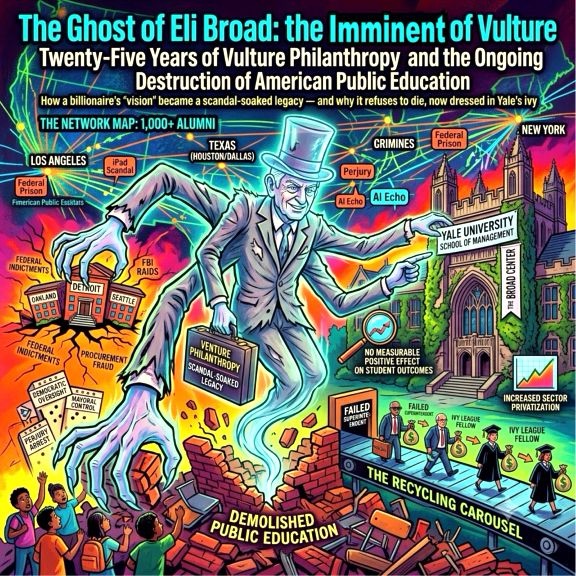
Here is one of his best: THE GHOST OF ELI BROAD: TWENTY-FIVE YEARS OF VULTURE PHILANTHROPY AND THE ONGOING DESTRUCTION OF AMERICAN PUBLIC EDUCATION.
I wasn’t able to copy some tables and graphics. Please open the link to read the post in full.
Eli Broad was one of the billionaires who was eager to tear apart public education and remake it. I referred to him, the Waltons, and the Gates Foundation as “the Billionaires Boys Club,” which was chapter 10 of my book The Death and Life of the Great American School System: How Testing and Choice Are Undermining Education.
Eli Broad’s distinctive contribution to the corporate reform movement was his Broad Academy, where aspiring superintendents were “trained” with his ideas. All expenses were paid, and trainees got to hobnob with others. They also had the Academy’s help in job placement; many “graduates” of the Broad Academy were placed as superintendents in big-city districts, imbued with the ideology that schooling was a business, that low-performing schools should be closed and replaced by charter schools. Eli and his wife Edythe were both graduates of the Detroit Public Schools, but they were not grateful for what they learned.
In 2009, when I was writing the book, I was not aware that the Billionaire Boys Club had many more members and that some were women. There was Alice Walton, Betsy DeVos, the Koch brothers, John Arnold, Joel Greenberg, Daniel Loeb, Jeff Yass, and many more. I posted a far longer list of the super-rich underwriting the privatization of public money in my book Slaying Goliath.
I once was invited by Eli Broad to meet at his gorgeous apartment in New York City, overlooking Central Park. He wanted to know why I was critical of his efforts. He told me that he knew nothing about teaching or curriculum, but he knew a lot about business management and organization. His belief was that public schools could improve by better management.
Mike Simpson performs a public service here by updating the legacy of Eli Broad.
He writes:
How a billionaire’s “vision” became a scandal-soaked legacy — and why it refuses to die, now dressed in Yale’s ivy
There’s a particular kind of audacity required to spend a quarter-century systematically dismantling public education, leave a trail of federal indictments, billion-dollar procurement disasters, and devastated communities in your wake — and then get your name engraved on a building at Yale University. That, in essence, is the story of Eli Broad, the Broad Academy, and its reincarnation as The Broad Center at Yale School of Management. If you were hoping the death of Eli Broad in 2021 would finally close this chapter of American education history, well — ghosts don’t follow rules. And this one has a $100 million endowment.
Part I: Venture Philanthropy — When Billionaires Play School
Let’s start with the concept that makes all of this possible: “venture philanthropy.” It sounds benign — even noble. In practice, it means a billionaire who made his fortune in housing construction (KB Home) and insurance (SunAmerica) decided he understood public education better than educators, parents, communities, or — heaven forbid — children.
Eli Broad’s core thesis, launched formally in 2002 with the Broad Superintendents Academy (BSA), was elegantly simple and catastrophically wrong: public school systems are just badly managed corporations, and what they need is corporate managers.
Not teachers. Not child psychologists. Not community leaders. Corporate managers. Preferably ones with MBAs, military command experience, or backgrounds in supply-chain logistics. Because nothing says “I understand the developmental needs of a seven-year-old” quite like a background in restructuring defense procurement contracts.
The curriculum reflected this philosophy with almost comedic precision:
10% — Actual education: pedagogy, curriculum, child development
90% — Corporate operational reform: fiscal optimization, data-driven accountability, labor relations, and what the Academy euphemistically called “reform accelerators” — which, translated from the original MBA-speak, meant privatization strategies
The program was free to participants — tuition, travel, lodging, all covered. Because when you’re deploying an ideological army, you don’t charge the soldiers.
Part II: Yale Said “Yes” — And Charged It to Prestige
In 2019, the Eli and Edythe Broad Foundation committed $100 million to Yale University to transform the independent, unaccredited Los Angeles operation into The Broad Center at Yale School of Management. The transition was completed in 2020, and the unaccredited LA entity was quietly sunsetted — like a getaway car abandoned after the heist.
The rebranding was masterful. Suddenly, the same ideological pipeline that had produced federal convicts, FBI raid subjects, and a generation of “disruptors” who disrupted primarily the educational lives of low-income children of color was now operating under the imprimatur of one of the world’s most prestigious universities.
The center today operates two flagship tracks, both tuition-free:
The 2026–27 MMS cohort is already being assembled, per the center’s own Instagram, described as “leaders committed to reimagining” public education — which, given the network’s history, should be read as a threat as much as a promise.
Beyond the programs themselves, the center has launched an aggressive data aggregation initiative — a centralized repository hosted on GitHub tracking superintendents across more than 10,000 of the nation’s 13,000 public school districts, aggregating over 180,000 data points across 23 states. The stated goal is academic research. The unstated goal, critics argue, is mapping the vacancy pipeline for the next generation of Broad placements.
Part III: The Damage Ledger — Twenty-Five Years of “Disruption”
Let’s be precise about what the word “disruption” meant in practice. A landmark 2022 longitudinal study published in Educational Evaluation and Policy Analysis tracked two full decades of Broad Academy graduates and delivered findings that would be devastating — if anyone in the venture philanthropy world were capable of embarrassment:
No statistically significant positive effects on district spending, student completion rates, or test scores
Broad-trained superintendents had 18% shorter tenures than non-Broad peers in equivalent districts
The only statistically significant footprint left behind? A sustained, measurable trend toward increased charter school enrollment and sector privatization
In other words, after 25 years and hundreds of millions of philanthropic dollars, the Broad Academy’s measurable legacy in public education was: more charter schools and shorter superintendent tenures. That’s it. That’s the product.
The Human Cost
The abstract numbers become concrete when you look at specific communities:
Oakland & Detroit saw aggressive charter expansion and centralized fiscal management that critics argued deepened structural deficits and fractured community trust for generations.
Chicago experienced the largest single wave of school closures in modern U.S. history — 50 neighborhood schools shuttered in 2013 under Broad-network-affiliated Barbara Byrd-Bennett — triggering federal civil rights complaints alleging the closures disproportionately harmed low-income students of color.
Seattle watched Broad graduate Maria Goodloe-Johnson (BSA Class of 2003) get fired in 2011 following a state audit revealing $1.8 million in public funds funneled into a contracting program that provided little to no actual services — with investigators concluding she exercised a “severe lack of oversight” despite early warnings.
Part IV: The Scandal Hall of Fame — From Procurement Fraud to Federal Prison
Here is where the story transitions from ideologically troubling to criminally spectacular.
John Deasy — The iPad That Broke LAUSD
Deasy (BSA Class of 2006) championed a $1.3 billion initiative to put Apple iPads loaded with Pearson software into the hands of every LAUSD student. The rollout failed within days — students bypassed security filters almost immediately — but the procurement scandal was far worse than the technical failure.
Internal records revealed that Deasy and his deputies had close personal and professional ties to Apple and Pearson executives prior to the bidding process, raising serious allegations of a rigged procurement cycle. The FBI seized boxes of district records. Deasy resigned in 2014. The district eventually abandoned the program and settled for millions in refunds.
His post-resignation career? He was immediately hired by the Broad Center as a Superintendent-in-Residence — coaching the next generation of urban leaders. Because in this ecosystem, failure is a credential.
Barbara Byrd-Bennett — The Federal Prison Graduate
Byrd-Bennett’s career arc is the Broad model in miniature: leave Cleveland in fiscal distress, leave Detroit in structural chaos, get hired as a “turnaround expert” in Chicago, execute the largest school closure wave in American history, then get indicted on 20 counts of federal mail and wire fraud.
Federal investigators proved she steered $23 million in no-bid contracts to SUPES Academy and Synesi Associates — the very consulting firms she had worked for immediately before taking the CPS helm. Internal emails laid bare her motive with a candor that would be almost admirable if it weren’t so brazen: she needed the money because she had “tuitions to pay and casinos to visit.”
In exchange, she was promised a 10% kickback disguised as future consulting fees funneled into trust funds for her twin grandsons. She pleaded guilty and was sentenced to four and a half years in federal prison.
Robert Runcie — The Perjury Arrest
Runcie (BSA Class of 2009) took over Broward County Public Schools — the nation’s sixth-largest district — and oversaw a culture of severe administrative bid-rigging around an $800 million capital bond program, with independent investigations revealing contracts steered to pre-selected corporate entities.
Following the 2018 Parkland school shooting, which exposed deep systemic lapses in district safety infrastructure, a statewide grand jury investigation led to Runcie’s arrest by the Florida Department of Law Enforcement on felony perjury charges in April 2021 — prosecutors proving he lied under oath about communications regarding procurement contracts.
He resigned in exchange for a $743,000 separation agreement. Paid by taxpayers.
Alberto Carvalho — The AI Echo of the iPad Disaster
If the Deasy iPad scandal was the defining Broad-era procurement catastrophe of the 2010s, Alberto Carvalho’s LAUSD tenure became its 2020s technological sequel — almost as if the universe decided one billion-dollar tech procurement disaster per decade wasn’t sufficient.
Carvalho, a celebrated figure on the corporate-reform speaking circuit who regularly headlined Broad Center leadership panels, aggressively championed a contract with “AllHere,” a tech startup contracted to build a multi-million dollar AI student-chatbot tool for LAUSD. The project collapsed into total insolvency. The startup’s founder was indicted for fraud. Federal investigators traced systemic steering of contracts that bypassed traditional public bidding protections.
In early 2026, FBI agents raided Carvalho’s personal residence and district offices. He was placed on paid administrative leave and subsequently resigned — a modern, tech-era echo of the Deasy iPad scandal, separated by exactly one decade and approximately zero lessons learned.
Part V: The Carousel — How Failed Superintendents Get Recycled
One of the most structurally revealing features of the Broad model is what happens after a superintendent fails. In a normal accountability framework, catastrophic failure — federal indictment, FBI raids, mass community protests, historic labor strikes — would end careers.
In the Broad ecosystem, it typically accelerates them.
The recycling mechanism operates in three predictable stages:
Stage 1 — The Soft Landing: Departing executives are caught by the philanthropic safety net. Foundations like Broad, Walton, or Gates place them into well-funded “fellow,” “executive coach,” or “senior advisor” roles at charter management organizations or policy think tanks. The local political dust settles. The national network maintains their status.
Stage 2 — The Headhunter Buffer: National executive search firms — operating with screening frameworks that prioritize corporate operational metrics over community approval or longevity — present the executive to a new school board in another state as a “courageous, battle-tested change agent.” The fact that the “battle” was largely against the parents and teachers of the previous district is presented as a résumé enhancement.
Stage 3 — The Next Major District: Re-hired at a higher salary, with stronger contractual protections, and a golden parachute clause ensuring that the next failure will also be financially comfortable.
Mike Miles left Dallas ISD under multiple internal investigations and extreme executive turnover, founded a charter network, and was then directly appointed by the Texas Education Agency — which had dissolved Houston ISD’s elected school board — to run the entire Houston district with even fewer democratic constraints than before.
Jean-Claude Brizard left Rochester under a 95% teacher vote of no confidence, was immediately recruited to lead Chicago Public Schools (the nation’s third-largest system), triggered the historic 2012 Chicago Teachers Strike within 17 months, was pushed out with a $250,000 buyout, and transitioned smoothly into senior advisory roles at national education foundations.
The pattern is not a bug. It is the feature.
Part VI: Buying the Boardroom — How Venture Philanthropy Captured School Governance
The Broad playbook cannot function under genuine democratic oversight. A superintendent who closes 50 neighborhood schools, eliminates teacher tenure protections, and converts public schools into privately managed charter networks will be fired by an elected school board that answers to the community — unless that school board has been pre-selected to not do that.
The solution was elegant and corrosive: buy the school board elections.
Because local school board races historically required minimal campaign capital, the injection of billionaire wealth fundamentally altered the political landscape. The money flows not directly to candidates (which faces statutory limits) but through Independent Expenditure Committees and Super PACs — allowing unlimited spending on sophisticated polling, negative television ads, and targeted digital saturation.
In Los Angeles, Eli Broad, the Walton family, and allied donors regularly poured $5 million to $10 million per election cycle into LAUSD board races — specifically to achieve a “pro-reform majority” that would protect executives like John Deasy and later Austin Beutner (a former investment banker with no education background whatsoever) from community accountability.
In Oakland, independent groups funded by the California Charter Schools Association outspent local parent-teacher associations 10-to-1, successfully seating board members who routinely approved charter petitions and fiscal consolidation plans drafted by Broad Residency staff embedded in the central office.
When even this proved insufficient — when local civic resistance made winning democratic elections too expensive or unpredictable — the network pivoted to eliminating the elections entirely:
Chicago: Mayoral control legislation allowed Mayor Rahm Emanuel to single-handedly install Broad executives without board confirmation.
Houston: The Texas Education Agency dissolved the elected school board entirely and replaced it with a state-appointed body, allowing direct installation of Mike Miles.
Detroit: The short-lived Education Achievement Authority bypassed the traditional school board to implement a centralized, non-unionized reform experiment under Broad graduate John Covington.
The structural message is unambiguous: the corporate management model and democratic accountability are incompatible. When democracy gets in the way, the solution is to remove democracy.
Part VII: The Network Map — 1,000 Alumni and Counting
The Broad Network now comprises more than 1,000 alumni spanning major urban school districts, charter management organizations, state education agencies, and venture philanthropy foundations — with its heaviest concentrations precisely where the playbook finds the most fertile ground:
California remains the densest hub, with alumni embedded throughout LAUSD, Oakland Unified, and San Diego Unified central offices, as well as major CMOs like KIPP SoCal, Aspire Public Schools, and Green Dot.
Texas has become the fastest-growing hub, with Houston ISD under state-appointed Miles serving as the current flagship experiment, alongside significant placement within Dallas ISD, Fort Worth ISD, the Texas Education Agency, and massive charter entities like KIPP Texas and IDEA Public Schools.
New York serves as the “soft landing” capital of the network — hundreds of alumni operating within Wall Street-adjacent education foundations, charter advocacy groups, and elite national search firms headquartered in Manhattan.
Illinois and Pennsylvania — Chicago and Philadelphia specifically — remain high-density environments where teams of Broad Residents are embedded in central operations managing financial stabilization, facilities restructuring, and school assignment data systems.
Meanwhile, the network has largely migrated out of direct superintendencies — where the political friction is high and the tenure is short — and into the broader ecosystem where influence is durable and accountability is minimal: senior director roles at the Gates Foundation, the Walton Family Foundation, and the Chan Zuckerberg Initiative; high-level education consultancies like Watershed Advisors and Instruction Partners; and, of course, The Broad Center at Yale SOM itself, where the current MMS cohort is being trained to carry the philosophy forward.
Part VIII: Yale — Laundering a Legacy in Ivy
Let us be direct about what the Yale partnership accomplishes that the standalone Los Angeles operation never could: institutional legitimacy laundering.
The Broad Academy, operating independently, was unaccredited, ideologically transparent, and easy to critique. Its graduates were called “Broadies” — a term used by both allies and critics — and the pipeline was visible enough that parent groups, teachers’ unions, and education researchers could track, document, and organize against it.
The Broad Center at Yale SOM is something different. It is now embedded within one of the world’s most prestigious academic institutions, granting an Ivy League master’s degree, hosting fellows in New Haven, and publishing peer-reviewed research. The same corporate management philosophy that produced federal convictions and FBI raids now arrives in urban school districts wearing a Yale credential.
The center’s new data aggregation initiative — tracking superintendents across more than 10,000 districts, aggregating 180,000+ data points — is framed as academic research. Critics see it as something more operational: a comprehensive national vacancy map for the next generation of Broad placements, now with the algorithmic sophistication that the original Los Angeles operation could only dream of.
The 2025-26 Fellowship cohort of 17 fellows is already gathering in New Haven for weeklong modules at Yale SOM. The 2026-27 MMS cohort is being assembled. The pipeline flows.
The Synthesis: What Twenty-Five Years Actually Taught Us
Here is what a quarter-century of Broad-style education reform has empirically demonstrated:
The Promise: The Reality
Corporate management improves district outcomes/No measurable positive effect on test scores, graduation rates, or spending efficiency”
Disruptors” bring needed change/18% shorter tenures; accelerated community fracture
Charter expansion improves options/Statistically significant increase in privatization; no demonstrated academic gains
Data-driven accountability improves teaching/Curriculum narrowing; teaching to the test
Free consulting support helps districts/Permanent embedding of private ideology on public payroll
School board reform improves governance/Systematic dismantling of democratic accountability
The most damning verdict is not the federal indictments — though those are damning. It is not the FBI raids — though those are spectacular. It is not even the $23 million in no-bid kickback contracts or the billion-dollar iPad disasters.
It is this: after 25 years, hundreds of millions in philanthropic investment, and the placement of Broad-trained executives in over 160 school systems, there is no credible empirical evidence that any of it helped a single child learn to read better.
What it did produce — measurably, statistically, reproducibly — was more charter schools, shorter superintendent tenures, and a revolving door of well-compensated executives cycling between urban districts, consulting firms, and Ivy League fellowship programs while the communities they “disrupted” rebuilt themselves from the wreckage.
Epilogue: The Ghost That Won’t Be Exorcised
Eli Broad died in April 2021. His foundation subsequently announced it would spend down its assets and close. The Los Angeles operation was already gone, folded into Yale two years prior.
And yet — the ghost persists. It persists in the 2026-27 MMS cohort assembling in New Haven. It persists in the 180,000 data points tracking superintendent vacancies across 10,000 districts. It persists in the career of Mike Miles, currently running Houston ISD under state protection from democratic accountability. It persists in the aftermath of Alberto Carvalho’s FBI-raided departure from LAUSD — a scandal so structurally identical to the Deasy iPad disaster of 2014 that it reads less like history repeating and more like history plagiarizing itself.
The Broad Center at Yale SOM is not a reformed version of the Broad Academy. It is the Broad Academy with better branding, an Ivy League address, and a GitHub repository. The philosophy is identical. The network is intact. The pipeline flows.
The only thing that has genuinely changed is the zip code — from Los Angeles to New Haven — and the price tag of the credential being handed to the next generation of disruptors preparing to be deployed into the public schools of America.
Eli Broad may be gone. But his ghost has tenure.
And unlike the superintendents he trained, it shows no signs of an early exit.
Sources:
: The Broad Center institutional history, curriculum breakdowns, alumni scandal documentation, EEPA 2022 longitudinal study findings, and school board funding mechanics — as documented in comprehensive public education policy research and investigative reporting compiled in the source brief above.
: EdSource — “FBI raid of Los Angeles Superintendent Carvalho’s home, office may be linked to student AI chatbot” (2026) — edsource.org
: Los Angeles Times — “How probe into failed startup led to LAUSD superintendent investigation” (March 1, 2026) — latimes.com
: Yale School of Management — “The Broad Center Announces 2025-26 Cohort of the Fellowship for Public Education Leadership” — som.yale.edu
Master Source List: The Ghost of Eli Broad & The Broad Center at Yale
🏛️ The Broad Center at Yale SOM — Official Sources
$CITETitleSourceLinkThe Case of Broad Superintendents— Full EEPA Longitudinal Study (2022) Educational Evaluation and Policy Analysis / Tom Dee tom-dee.github.io — EEPA-Broad.pdf New Study: Broad Supes Made No Difference, Other Than Increasing Charter Schools Diane Ravitch’s Blogdianeravitch.net
🗞️ Investigative Journalism & Policy Criticism
$CITETitleSourceLink Critics Target Growing Army of Broad Leaders Education Week edweek.org The Broad Foundation’s Impact on Public Schools Facebook — Oakland Parent Sharon Higgins Analysis facebook.com — Broad Foundation Analysis
⚖️ Barbara Byrd-Bennett — Federal Conviction (Chicago)
$CITETitleSourceLink Former Chief Executive of Chicago Public Schools Sentenced to More Than Four Years in Prison U.S. Department of Justice — Official Press Release justice.govBarbara Byrd-Bennett — Full Coverage Archive WTTW Chicago Public Media news.wttw.com Barbara Byrd-Bennett — Wikipedia Overview Wikipediaen.wikipedia.org
⚖️ Robert Runcie — Broward County Perjury Arrest
$CITETitleSourceLinkFDLE Arrests Broward County Schools Superintendent Robert Runcie for Perjury Florida Department of Law Enforcement — Official Release fdle.state.fl.us Former Broward Superintendent Robert Runcie Avoids Trial — Perjury Charge Dropped CBS News Miami cbsnews.com/miami State Drops Perjury Charge Against Former Broward Schools Superintendent Miami Herald miamiherald.comPerjury Charge Dropped Against Ex-Broward Schools Superintendent NBC Miami nbcmiami.com
🤖 Alberto Carvalho — LAUSD FBI Raid & AllHere AI Scandal
$CITETitleSourceLinkFBI Raid of Los Angeles Superintendent Carvalho’s Home and Office May Be Linked to Student AI ChatbotEdSource edsource.org How Probe Into Failed Startup Led to LAUSD Superintendent Investigation Los Angeles Times latimes.com
📌 Quick Citation Reference Guide
For the article sections, citations map as follows:
Broad Center Yale programs → , , ,
EEPA 2022 empirical study → ,
General Broad criticism & history → ,
Byrd-Bennett federal conviction → , ,
Runcie perjury arrest → , , ,
Carvalho FBI raid / AllHere AI → ,
⚠️ Research Note: Several additional primary sources — including the original EEPA journal publication, the Jeffrey Hubbard California Supreme Court ruling, the Maria Goodloe-Johnson state audit, and the Jean-Claude Brizard Chicago strike documentation — are recommended for deeper verification. Additional searches can be run to surface those specific primary documents on request.
It is a well-established fact that the school choice movement was created in the South in the 1950s to protect segregation. After the Brown decision of 1954, whites resisted desegregation with e Rey strategy they could dream of. One such was to offer vouchers to every student to attend the school of their choice. The predictable result was to protect segregated schools.
In this century, voucher promoters sell them as parental choice, “saving poor kids from failing public schools,” etc.
But unless an effort is made to enrcuage racial integration, choice will lead to segregation.
Halley Potter of The Century Foundationwrote this report. I urge you to open the link and read it in full.
Potter wrote:
In rural Northampton, North Carolina, a private Christian school called Northeast Academy is 99 percent White in a county that’s 40 percent White. It receives about half of its tuition from taxpayers, through the state’s private school voucher program. Northeast is one of a number of private schools known as “segregation academies,” because they were founded during desegregation so that White parents could avoid having their children educated in an integrated setting.
Segregation academies ought to be a thing of the past, but they could experience a resurgence—paid for with taxpayer dollars—under the new federal private school voucher scheme enacted as part of the One Big Beautiful Bill Act (OBBA). Bringing back segregation academies using taxpayer dollars is part of the Trump administration’s radical two-pronged approach to undermine public education. The first tactic in the Trump administration’s plan to undercut public school systems is to dramatically reduce the federal role in education by dismantling federal programs, reducing oversight, attempting to cut federal funding for K–12 schools, and working to close the U.S. Department of Education. The second tactic is actively working toward privatization through an unprecedented federal private school voucher program.
How the Voucher Plan Would Work . . .
In July 2025, OBBA established a new federal tax credit—known as the Education Freedom Tax Credit—that, in effect, serves as a private school voucher program. The program allows individuals, beginning January 1, 2027, to contribute up to $1,700 per year toward private entities known as scholarship granting organizations (SGOs) and receive a dollar-for-dollar return of their money in the form of a federal tax credit. SGOs then would then be able to decide how to distribute the funds as scholarships to applicant students for them to spend on education. There is no cap on the size of such scholarships, and no limit on the number of individuals that can claim the tax credit. While recipient students may be able to use scholarship funds to pay for some things like tutoring or activity fees at public schools, because public schools are essentially free, it is anticipated that the vast majority of these funds will go toward private school enrollment.
There are very few requirements of SGOs in the statute, and it appears that any organization in a participating state that meets the criteria will be allowed to participate. SGOs must give scholarships to ten or more students who do not all attend the same school, must spend at least 90 percent of the income on scholarships, must give priority to students who received scholarships the previous year and to siblings, cannot earmark funds for a particular student, and must ensure that students come from families earning no more than 300 percent of the area median gross income. Essentially everything else will likely be up to the SGO, as the program’s regulations are not expected to add additional guardrails. It appears an SGO could, for example, be set up to fund scholarships to Christian schools only. Because private schools are not subject to all of the same civil rights laws as public schools, SGOs could also likely discriminate against students based on disability or sexual orientation.
While starting the process with individual donations gives the program the veneer of a charity operation, this is a ruse. All this does is mask who is truly bearing the cost of the program. In actuality, the donors to SGOs bear no cost, as they are later fully reimbursed by the federal government through the dollar-for-dollar tax credit. The federal government—using taxpayer dollars sent to the supposed donors—bears the entire cost of the program. Estimates of the cost to taxpayers range from around $4 billion to over $50 billion annually.
Moreover, the U.S. Department of the Treasury’s language regarding the tax credit program is very misleading. Their fact sheet states: “A recent report estimates that the Education Freedom Tax Credit will generate an additional $24 billion in education funding annually.” That makes it sound like this is a revenue-creating program rather than one that bears a huge federal cost.
States and the District of Columbia have to decide annually whether or not to opt out of or into the voucher program. As of July 6, 2026, twenty-nine states had indicated that they plan to opt in for the first year of the program. However, federal regulations guiding the program are not expected until September. Further complicating matters, at least eighteen states will have new governors and the District of Columbia will have a new mayor when the program launches in 2027 because of term limits, and that number could be as high as thirty-six after this fall’s elections.
. . . To Increase Segregation and Undermine Public Education
Diverse learning environments that bring students of different racial and socioeconomic backgrounds together are one of the most powerful educational tools we have. Integrated schools help encourage critical thinking, boost academic achievement, and build the skills for working across lines of difference that are essential for our democracy. The growth of private school voucher programs threatens to roll back progress on integration, limit educational opportunity, and further fracture the educational landscape by race and class.
As state leaders and advocates weigh whether or not to opt into the federal voucher program, they should consider the evidence on how the program could deepen inequality and further racial and socioeconomic divides. New analysis in this piece shows that in some metro areas in states that are still deciding whether to opt out of or into the federal voucher program, private schools already drive more than 40 percent of the racial segregation in schools.
The Segregationist History of Private School Vouchers
Private school enrollment nationwide is disproportionately White and wealthy. As of 2021, 9 percent of American schoolchildren attended private schools. Sixty-five percent of private school students are White, compared to 45 percent of public school students. Private school students are about twice as likely as public school students to come from higher-income households, and private school attendance is concentrated among the highest earners.
Private school voucher programs were started by segregationists across the South in the 1950s and 1960s as part of efforts by Southern leaders engaged in “massive resistance” to avoid integrating their schools in the wake of the 1954 Brown v. Board of Education ruling. Many communities opened all-White private schools, which became known as segregation academies. Local governments slashed public school funding and instead created public subsidies for these private schools—including voucher programs to reimburse tuition as well as tax credits.
The courts eventually struck down many of those voucher programs tied to segregation academies, but current voucher programs still show troubling patterns of segregation. Roughly 300 private schoolsthat were founded as segregation academies still receive money from publicly funded voucher programs. Most voucher money goes to students who are already attending private schools, and data has shown that private schools tend to raise their tuition after the introduction of voucher programs. For example, when Iowa started a new voucher program in 2023–24, two-thirds of vouchers went to students who were already attending private schools. By 2026, tuition at some of the state’s largest private high schools had grown by as much as 50 percent. It is important to note that vouchers typically do not cover the full cost of tuition, making private schools still out of reach for most low-income families, and so the voucher programs tend to function mostly as cost-reducing schemes for wealthier families sending their children to private schools. In Arizona, for example, half of all voucher recipients come from the wealthiest quartile of zip codes.
There are some private school voucher programs that target low- to middle-income students and enroll mostly students of color, such as the Milwaukee Parental Choice Program, the oldest operating school voucher program in the United States. However, research shows that even students in these programs, which arguably have the highest potential for integration, by and large did not give students greater access to integrated schools.
Furthermore, some voucher programs that started out serving mostly students of color have now seen an increase in White students in recent years. When North Carolina’s private school voucher program launched in 2014, for example, a majority of students receiving vouchers were Black, and just 27 percent were White; however, as the program expanded incrementally from one serving only low-income students to one with no income limits, the percentage of vouchers going to White students grew to 73 percent, in a state where only 51 percent of school-aged children are White. A 2024 investigation by ProPublica into North Carolina’s private school voucher program found thirty-nine schools that fit the profile of segregation academies that were receiving public money through voucher programs.
The new federal private school voucher program specifies that participation is open to families earning up to 300 percent of area median gross income, which means it would be open to roughly 90 percent of students nationwide. With near universal eligibility, the federal program could easily be susceptible to similar patterns of segregation, disproportionately benefiting White students and furthering segregation between public and private schools.
About a dozen years ago, I heard from Ted Dintersmith. I didn’t know anything about him other than that he was a venture capitalist who was interested in education reform. My hackles went up, because the term “venture capitalist who was interested in education reform” immediately conjured up images of Democrats for Education Reform,” a faux group that is dedicated to charter schools, Teach for America, evaluating teachers by student test scores, and union-busting.
When I thought about the people in this category, I thought about very wealthy men like Ravenal Boykin Curry IV, Whitney Tilson, John Perry, Ken Griffin, Jeff Yass, Daniel Loeb, Arthur Rock, Joel Greenblatt, Bruce Rauner, and Paul Tudor Jones. They are financiers who have committed millions to the cause of privatizing public schools. They are united in their contempt for public schools, teachers, and unions.
So I was wary of Ted and suspicious of his motives. And I pushed him aside, thinking he was part of the cabal of know-it-all entrepreneurs with a zeal to reform (privatize) public schools.
So, I now publicly admit that I was wrong. Ted has traveled the country, visiting schools and listening. He knows how hard teachers work, and he admires them. He has teamed up with some savvy people, like Tony Wagner and the late Sir Ken Robinson, to produce films and write books.
When I recently read his latest article, I realized that I had completely misjudged Ted. He doesn’t want to destroy public schools or privatize them. He wants to make them better. He wants students to love school and learn what they need to know to make informed choices.
He has seen some good charter schools (as I have), but he knows that a few hundred charter schools won’t lead to the transformation of tens of thousands of public schools. And–my thought–to the extent that charter schools defund public schools, they create more problems, more inequities.
So, I hereby apologize to Ted Dintersmith for prejudging him and for lumping him with the Billionaire Boys Club, those who see school transformation as a hobby.
When you read this post you will see that he doesn’t have all the answers, but he is asking the right question.
He writes:
About these notes: Always Monday. Always short. Always free. Always about civil society’s future. At times, interesting. If this was forwarded to you, subscribe here.
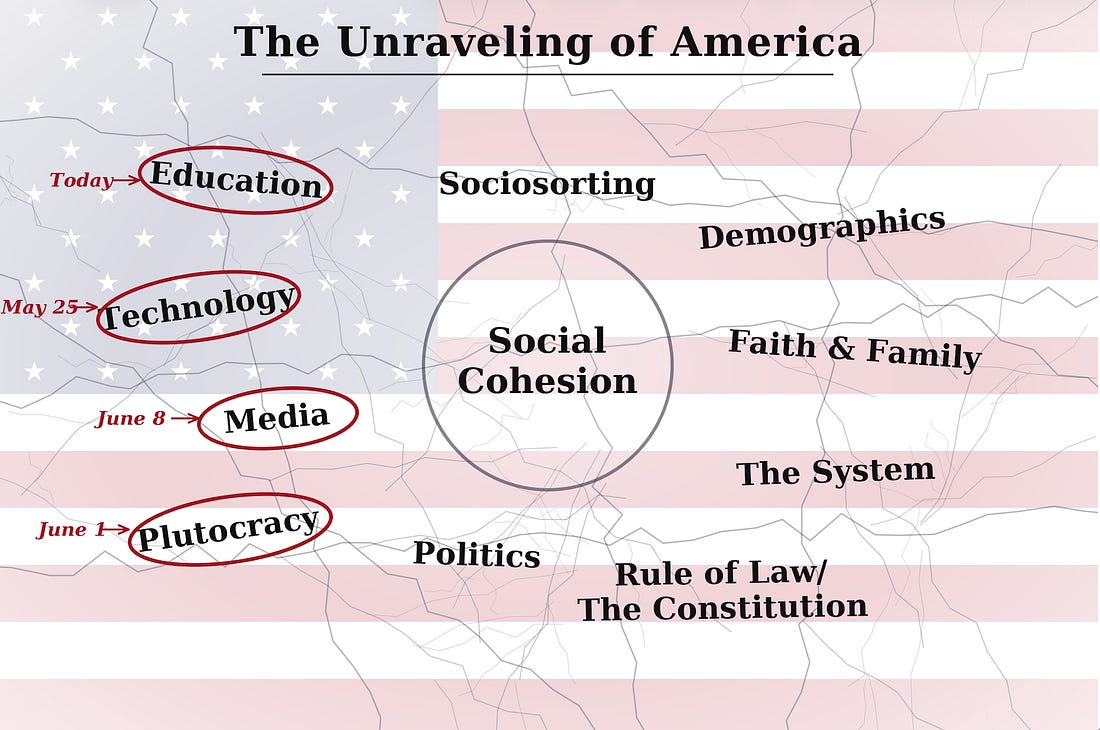
First, thanks for your feedback on my recent posts. My goal of late is to explore the various factors causing America to unravel. Toward a systems model of the forces undermining America’s democracy, moral compass, and social cohesion. Today, education.
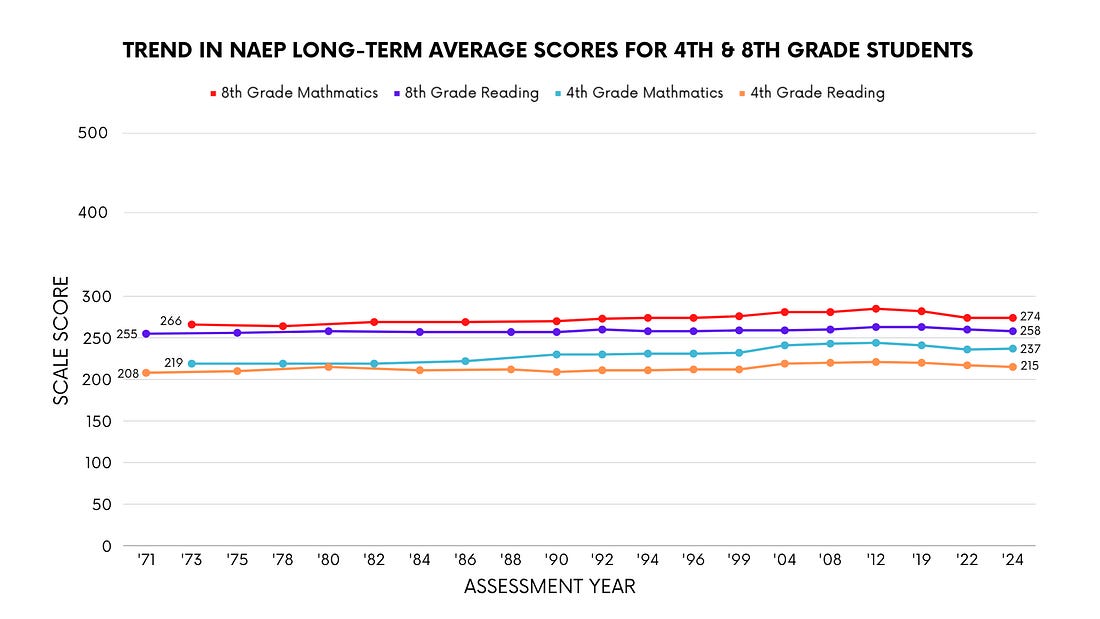
For five decades, U.S. education policy has been driven by two goals: test scores and college. The No Child Left Behind Act in 2002. Then in 2010, Common Core. Obama’s rallying cry: “By 2020, the United States will once again lead the world in college completion.” Our all-consuming education focus. With massive collateral damage.
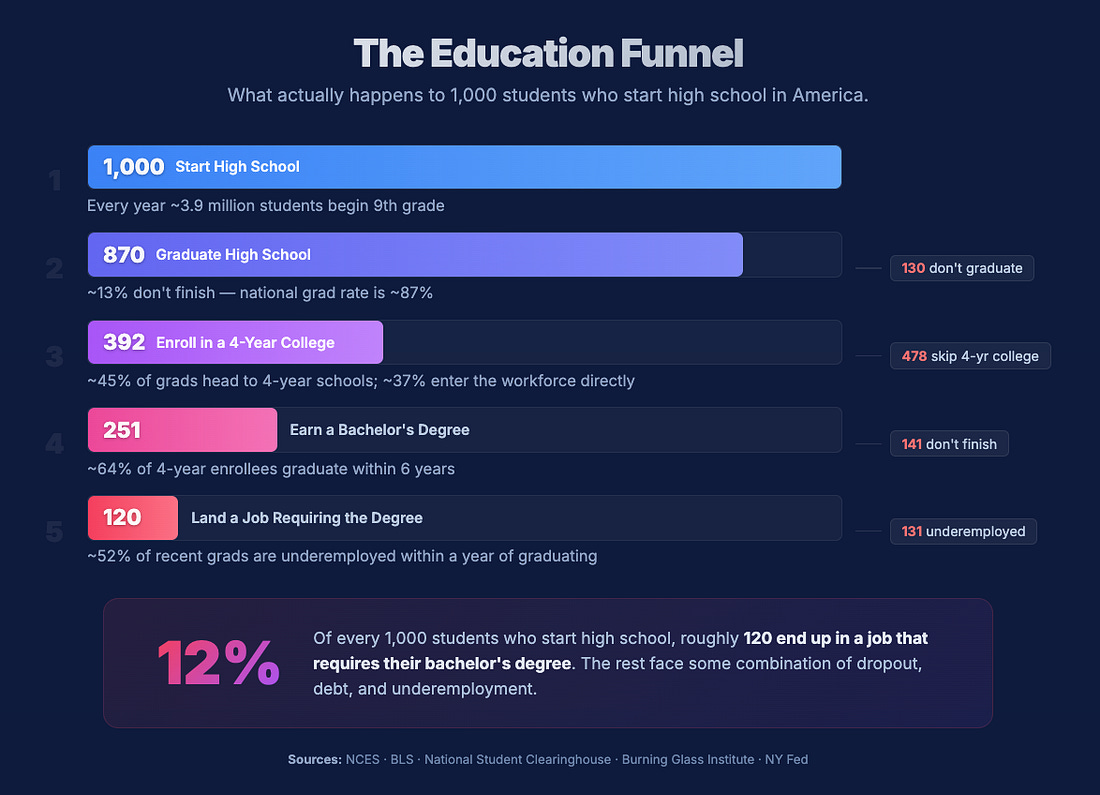
Let’s start with the funnel. While the college path works out well for some, most end up on the wrong side of education’s Bell Curve. Over half go directly to career, lacking a hirable skill and often with gutted self-esteem. Of those heading off to college, half don’t finish. Of those who graduate, half don’t get any kind of dream job. A system that’s produced some 43 million adults burdened by $1.8 trillion of student loan debt.
With a boost from Harvard-educated JFK, America grew to equate a prestigious college degree with human worth. This equivalence worked its way into news stories, movies, television shows, commercials . . . and labor markets. Prestige employers (that’s you, Goldman Sachs and McKinsey) made an elite college degree the essential hiring criterion. Less glamorous companies (that’s you, Sherwin-Williams) made a college degree mandatory for promotions. Rich families push their kids from the womb toward an Ivy+ degree. Poor families want the same for their kids. University research teams (that’s you, Georgetown) produce skewed studies touting a massive $1.2 million earnings lift for college grads. The Federal government opens the spigot for readily-obtained, impossible-to-shake student loans.
We’d like to think that America’s education system levels the playing field, but it does the opposite. The SCOTUS 1973 San Antonio Independent School District v. Rodriguez says it’s just fine for U.S. public schools to be largely funded by local property taxes. Rich kids are showered with resources’; poor kids show up to school hungry. Test scores point to an education ‘achievement gap’ that gets pinned on our teachers – not America’s staggering income inequality. The system’s winners feed elite colleges that educate more students from the richest 1% of families than from the bottom 50%. For more, read Paul Tough’s book The Inequality Machine.
With college placements as the measure of success, America’s K12 schools became college-ready test-prep institutions. Pit kids in dog-eat-dog competitions: class rank, SAT scores, AP scores, college placement. A barrage of state- and Federally-mandated multiple-choice exams that rank kids, teachers, schools, districts, and states. Clear marching orders for K12 schools – train kids to perform well on multiple-choice exams and get them off to some college.
To this day, America relies on two numbers to define the education quality of a school, district, state, nation, and human. Math and reading scores. That’s it. Don’t believe me? Just note what journalists write and what policymakers cite. We’ve pushed generations of young Americans to get those damn test scores up. No worries if we short-change career-based learning, civics, history, and art. No worries if we disenage kids and demoralize teachers. No worries if a relentless focus on rote learning crushes a child’s curiosity, creativity, joy, and agency. No worries if kids get the soul-sucking message that what matters in life is outcompeting others on pointless tasks. Education priorities that encapsulate the classic definition of insanity – doing the same thing over and over, expecting different results.
So many reforms, so little change
During their formative K12 years, America’s kids take more than 100 standardized exams. These cost-minimizing exams are expressly designed to be graded by a computer. And if a computer can grade a task, it can do that task. In every sense, we push kids to develop rote skills that machines handle flawlessly. Already, AI aces every assignment and exam required to graduate magna cum laude from Harvard. Reading exams call for regurgitating what’s put in front of you – perfect training for conspiracy-absorbing adults. Math exams are tied to esoteric micro-procedures (e.g., factoring polynomials) that adults never use. Yet we chase these scores, for decades, making no progress, ignoring Goodhart’s Law: “Any measure that becomes a target ceases to be a good measure.”
There you have it. America’s colossal education botch. Train kids to perform rote tasks. Crush out the essential human traits of curiosity, audacity, creativity, agency, and joy. Standardize what’s taught and tested to produce data that ranks and sorts — rather than helping each child develop their distinctive human potential. Most get a chronic ‘you lack proficiency’ message in a system that heaps advantage on the affluent. Botched priorities, paving the way to our current nightmare. A populace unable and unwilling to critically analyze the torrent of lies coming from the White House. A populace that holds its nose to vote for a convicted felon who rails on the ‘educated elite.’ A boiling cauldron of resentment, corruption, and anti-science vitriol. As to how this has worked out, read David Brooks’ fascinating How the Ivy League Broke America.
I don’t offer these views on education casually. For the past fifteen years, I’ve immersed myself in this world. I’ve visited hundreds of schools, and convened thousands of conversations, all across America. I celebrate the bright spots in my books (What School Could Be: Insights and Inspiration from Teachers Across America) and films (Most Likely to Succeed and Multiple Choice). But I’ve seen the failure. Failure caused by an obsolete system and failed accountability measures. Our classroom teachers are heroes. It’s not easy to fight the system, but many do. Give special thanks to the teachers in your life, who persevere despite being shortchanged on pay, respect, and trust. They endure in an entrenched system that has churned out generations of young adults ill-prepared for career, citizenship, and life. A system sowing the seeds for democracy’s collapse.
Three Bold Ideas
Career-Based Learning for All: My recent film Multiple Choice showcases a mainstream public school district that immerses all high-school kids in career-based learning across a range of skills (e.g., carpentry, welding, healthcare, cybersecurity, digital media, AI). Better for the career-bound and, a bit surprisingly, better for the college-bound. The key is making career-based learning essential for all kids, not just ‘those’ kids who don’t resonate with academic curriculum.
Finland: America can learn much from Finland. Their remarkable education progress resulted from a budget crisis that forced them to choose between data and educator excellence. They dumped all standardized tests and focused on developing outstanding classroom teachers – better training, more pay, loads of respect. Finnish kids spend comparatively little time on ‘school’; even high-schoolers have just six hours of class time and homework during the school week. Lots of time for play and exploration. A well-educated populace. For more, read Pasi Sahlberg’s Finnish Lessons.
Accountability: Base accountability on a child’s growing ability to create and carry out initiatives that help make their world better. Portfolios of purpose, not a checklist of counterproductive numbers. Check out New York’s Performance Standards Consortium or read Tony Wagner’s Mastery.
Bonus Idea: Long talked about, America would be well-served if every high school graduate engaged in public service — lifting up their community while developing important skills. Those going on to college bring maturity and real-world experience to years often wasted on beer pong. Those eschewing the college path are off and running with purpose and skills. Young Americans across all demographics in a melting pot that bridges our current demographic and political divides.