Archives for category: Education Industry

Politico reports great news for America’s public schools. The Senate Parliamentarian, Elizabeth MacDonough, removed the private school voucher part of Trump’s “One Big Ugly Bill,” because it runs afoul of the Byrd Rule. The Byrd Rule prevents the inclusion of extraneous issues that are not directly related to fiscal issues. She also ruled that the Senate’s effort to protect religious colleges from an onerous tax on their endowment had to be removed from the bill. Here is the official history and definition of the Byrd Rule, which applies only in the Senate.

Juan Perez Jr. writes:

A Republican proposal to enact a multibillion-dollar private school tax credit program would be subject to a 60-vote threshold if it is included in conservatives’ domestic policy megabill, the Senate parliamentarian advised early Friday in a significant challenge to what would be a sweeping federal school choice program.

Senate Parliamentarian Elizabeth MacDonough also determined that an effort to carve religious schools — including Hillsdale College in Michigan — out of a planned expansion of the federal college endowment tax does not meet the Senate Byrd rule’s criteria for the filibuster-skirting reconciliation process, according to Senate Budget Democrats.

Republicans on the Senate Finance Committee had proposed a permanent, $4 billion annual tax credit for individuals who donate to organizations that support educational expenses including private-school tuition, which was projected to cost $26.046 billion between 2025 and 2034, according to estimates from the Joint Committee on Taxation.

The tax credit scholarship plan, which is based on the Educational Choice for Children Act, would allow scholarships to students whose families make up to 300 percent of the area median gross income.

The committee also aimed to soften the blow of expanded taxes on private college and university endowments compared to a House-passed tax bill, though many qualifying private schools would still be in line to pay a tax rate of up to 8 percent of their net annual investment income.

It’s not yet clear if Republicans would try to rework some of the tax provisions that MacDonough found violated the Byrd rule, effectively blocking their inclusion in a GOP-only reconciliation measure. Republicans have successfully tweaked other proposals to the parliamentarian’s liking, but her rulings this week certainly helped upend GOP senators’ efforts to bring their fiscal package up for a vote.

Stephen Dyer is a public policy expert, a specialist in school finance, and a former legislator in Ohio. He warned 11 years that vouchers would drive the state budget over a fiscal cliff. The court decision a few days ago proves that he was right on target.

Let this be a warning to all the other states that are adopting vouchers (without the consent of the governed, in every case).

He writes:

Proponents have claimed for years that Ohio and U.S. Supreme Court cases from the program’s infancy allows for explosive growth. Judge Jaiza Page warns, “Not so fast.” Just like I did 11 years ago.

Dyer wrote the following 11years ago:

“Overall, the state is sending nearly $144 million to private schools this year. In 2010-2011, that number was $78.85 million — nearly half the amount. Makes you wonder whether the case upholding Ohio’s Vouchers in 2002 would have the same outcome today. Also makes me want to kind of find out.” — Stephen Dyer on 10th Period blog, Jan. 25, 2014

Now he writes:

I guess we found out Tuesday, didn’t we?

To be clear, I had no idea that anyone would actually file a lawsuit against Ohio’s unconstitutional Voucher system when I wrote that on Blogspot 11 years ago (though I really did want someone to do that). But given the Ohio and U.S. Supreme Court’s rulings on vouchers at the turn of the century, I did question whether the state’s explosive funding of vouchers actually was justified under those rulings.

Guess who else agreed with me? Franklin County Judge Jaiza Page. While I focused in 2014 on the 2002 U.S. Supreme Court case Zelman v. Simmons-Harris, Judge Page focused on the 1999 Ohio Supreme Court case Simmons-Harris v. Goff

Goff reached a similar conclusion as Zelman — that given the program’s then-small educational footprint, both in terms of kids and money — it did not interfere with Ohio’s overall ability to educate its public school students, so the program (which at the time only included Cleveland) was ok.

However, when Goff was decided, the Cleveland Voucher Program cost $5.7 million. The just-passed state budget allocated $2.5 billion over the biennium to the current program.

And that’s where voucher proponents got waaaay out over their skis. I realized this 11 years ago. But now, it’s even more obvious. The programs examined by the U.S. and Ohio Supreme Courts at the turn of the century look very different from the current budget hog Judge Page examined.

And she made that factual difference really clear in her ruling:

“As to the thorough and efficient challenge, the court ultimately held, “[w]e fail to see how the School Voucher Program, at the current funding level, undermines the state’s obligation to public education.” (Emphasis added.) Id. From this language, the Court concludes that the Goff court foresaw a renewed challenge to a larger scholarship or voucher program like EdChoice as an unconstitutional state supported system of private schools. Goff warned that a system that does not create but supports nonpublic schools in a way that jeopardizes the thoroughness and efficiency of the State’s system of public schools violates Article VI Section 2 of the Ohio Constitution.”

Added to this is this incredible fact that was brought out in the court case: 

Not a single penny of voucher money goes to a single parent or student. It goes directly to private, mostly religious schools.

Let me repeat that for those of you in the back:

Not a single penny of voucher money goes to a single parent or student. It goes directly to private, mostly religious schools.

That’s right. This whole money-following-the-kid/parental-choice narrative that voucher proponents are still spilling out is complete, utter Grade A Bullshit.

In 1999, the money did go to parents and kids. Page was quite concerned about this payment change because the Ohio Constitution bans state establishment of religious schools. And if state money flows directly to religious schools that rely heavily on taxpayer subsidies (she mentioned that some private schools have 75% or more of their kids on vouchers), that is establishment and unconstitutional.

“By bestowing participating private religious schools with complete control over prospective students’ participation, the “school choice” here is made by the private school, not “as the result of independent decisions of parents and students.””

It’s as if the original creators of the Voucher program carefully crafted the legislation to pass judicial muster. Then when they got a favorable ruling, the gloves came off.

Oh yeah. One more thing: Not a single penny of the nearly $9 billion we will have spent on vouchers since 1997 has ever been audited. So we have no idea how the money on this unconstitutional program has actually been spent.

But I digress.

Luckily for Ohio’s 1.5 million public school kids, Judge Page recognized the program’s current reality rather than voucher proponents’ fictional account.

Just as your friendly neighborhood blogger did 11 years ago.

Not to brag. 

Well, maybe a little!

Matt Barnum and Richard Rubin of The Wall Street Journal describe the harm that Trump’s One Big Ugly Budget Bill will do to public schools.

They wrote:

Republicans’ tax-and-spending megabill would give the school-choice movement a major, long-sought victory—and deliver an unusually generous tax break to wealthy taxpayers.

The bill includes a new way for taxpayers—whether they are parents or not—to direct tax dollars to private-school scholarships instead of the Treasury. There is an extra twist: It could deliver virtually risk-free profits to some savvy investors.

The proposal has excited school-choice advocates, infuriated public school leaders and stunned tax experts.

“Overnight, this would give millions of students access to the school of their choice,” said Tommy Schultz, CEO of the American Federation for Children, an advocacy group pushing the provision. “This is a revolution within the tax code.”

The American Federation for Children is the far-right wing group created by Betsy DeVos to promote charter schools and vouchers.

The incentive is structured as a dollar-for-dollar federal tax credit. Give to a charity known as a scholarship-granting organization and you would get the same amount subtracted from your federal tax bill. 

It is equivalent to redirecting your taxes to a scholarship-granting organization (SGO), with the benefit capped at 10% of adjusted gross income or $5,000, whichever is greater. That is a far better deal than what is offered by normal charitable donations, which generally just reduce your taxable income and only if you itemize deductions….

For people with appreciated stock, the proposal could be even more attractive than a dollar-for-dollar credit, potentially creating net profits. 

Consider someone who bought a stock for $100 that is now worth $1,100. Selling that stock would trigger capital-gains taxes of up to $238. But under the bill, he could donate the $1,100 stock to an SGO. The government would give $1,100 back and he wouldn’t pay capital-gains taxes. 

He could then buy the same $1,100 stock on the open market. The result? He’s better off than when he started, spending nothing to erase a potential capital-gains tax liability. 

“In terms of something that is deeply offensive to basic tax logic, it’s hard to beat this,” said Lawrence Zelenak, a law professor at Duke University who expects donors to line up every Jan. 1 to take advantage. “Unless you actively hate the charity, you would want to do it…”

A federal program would expand private-school tuition subsidies into states such as New York and California that have resisted school choice programs….

The House bill caps credits at $5 billion annually, which would climb by 5% in subsequent years if the program is heavily used. That bill would run from 2026 through 2029. The Senate version released Monday includes $4 billion annually, starting in 2027 but without an expiration date. 

The credit would mark a significant injection of resources to private education as the Trump administration separately seeks to cut federal grants for public schools. Still, it would pale in comparison to funding for public schools, which receive several hundred billion dollars annually, mostly from state and local governments. 

Democrats hope the breadth of the policy changes will prompt the Senate parliamentarian to determine that it’s out of bounds for the budgetary fast-track process Republicans are using.

Public school advocates say the program would benefit better-off families at religious private schools. “The federal government needs to fund the neighborhood school that serves children from every walk of life,” said Sasha Pudelski, a lobbyist with the school superintendents’ association.

Opponents also say the idea has been rejected by voters. In November, three states voted down school-choice ballot measures.

Note: not only were vouchers defeated in three states last November, voters have rejected vouchers in every state referendum since 1967.

The new tax credit could become a model for Congress to direct money to other causes through the tax code, said Carl Davis, research director at the Institute on Taxation and Economic Policy, a progressive group that criticizes the plan.

Civil rights laws prohibit certain forms of discrimination in schools that receive federal funding, but it isn’t likely this would apply to private schools that benefit from the proposed tax credit, said Kevin Welner, a research professor at the University of Colorado Boulder. The House bill includes a provision barring discrimination against students with disabilities in school admissions; the Senate version doesn’t. 

State voucher plans do not bar discrimination in voucher-receiving schools. They can and do discriminate at will. Some require that families are members of their faith. Some bar LGBT students and families. Some bar students with disabilities. Some bar students with low test scores.

Trump’s funding of school choice is the fever dream of Christian nationalists. With one blow, they eliminate the separation of church and state, they get funding for religious schools, and they gut civil rights laws that barred discrimination.

It also permits the revival of school segregation, under the once-discredited banner of school choice. White Southerners who don’t like “race mixing” have dreamed of this day since May 17, 1954.

Joyce Vance is a former federal prosecutor for North Alabama. She writes an important blog called Civil Discourse, where she usually explains court decisions and legal issues. Today she turns to education.

Today I’m recovering from the graduation tour, one in Boulder and one in Boston in the last two weeks, and getting back into the groove of writing as I continue to work on my book (which I hope you’ll preorder if you haven’t already). The graduations came at a good moment. 

Watching my kids graduate, one from college and one with a master’s in science, was an emotional experience—the culmination of their years of hard work, sacrifice, and growth, all captured in a single walk across the stage. They, like their friends, my law students, and amazing students across the county, now enter society as adults. Even beyond the individual stories of hardships overcome and perseverance, witnessing these rites of passage makes me feel profoundly hopeful. The intelligence and commitment of the students—many of whom are already tackling big problems and imagining new, bold solutions—gives me a level of confidence about what comes next for our country. In a time when it’s easy to get discouraged, their commitment and idealism stands as a powerful reminder that they are ready to take on the mess we have left them. 

The kids are alright, even though they shouldn’t have to be. Talking with them makes me think they will find a way, even if it’s unfair to ask it of them and despite the fact that their path will be more difficult than it should be. Courage is contagious, and they seem to have caught it. Their educations have prepared them for the future we all find ourselves in now.

As students across the country prepared to graduate this year, Trump released his so-called “skinny budget.” If that’s how they want to frame it, then education has been put on a starvation diet—at least the kind of education that develops independent thinkers who thrive in an environment where questions are asked and answered. Trump pitches the budget as “gut[ting] a weaponized deep state while providing historic increases for defense and border security.” Defense spending would increase by 13% under his proposal.

The plan for education is titled, “Streamline K-12 Education Funding and Promote Parental Choice.”Among its provisions, the announcement focuses on the following items:

  • “The Budget continues the process of shutting down the Department of Education.” 
  • “The Budget also invests $500 million, a $60 million increase, to expand the number of high-quality charter schools, that have a proven track record of improving students’ academic achievement and giving parents more choice in the education of their children.”

As we discussed in March, none of this is a surprise. Trump is implementing the Project 2025 plan. In December of 2024, I wrote about how essential it is to dumb down the electorate if you’re someone like Donald Trump and you want to succeed. A rich discussion in our forums followed. At the time I wrote, “Voters who lack the backbone of a solid education in civics can be manipulated. That takes us to Trump’s plans for the Department of Education.” But it’s really true for the entirety of democracy.

Explaining the expanded funding for charter schools, a newly written section of the Department of Education website reads more like political propaganda than education information: “The U.S. Department of Education announced today that it has reigned [Ed: Note the word “”reigned” is misspelled] in the federal government’s influence over state Charter School Program (CSP) grant awards. The Department removed a requirement set by the Biden Administration that the U.S. Secretary of Education review information on how states approve select entities’ (e.g., private colleges and universities) authorization of charter schools in states where they are already lawful authorizers. This action returns educational authority to the states, reduces burdensome red tape, and expands school choice options for students and families.”

There are already 37 lawsuits related to Trump’s changes to education. Uncertainty is no way to educate America’s children. Cutting funding for research because you want to score political points about DEI or climate change is no way to ensure we nurture future scientists and other thinkers and doers…

I am reminded again of George Orwell’s words: “The most effective way to destroy people is to deny and obliterate their own understanding of their history.” The historians among us, and those who delve into history, will play a key role in getting us through this. Our love and understanding of history can help us stay grounded, understanding who we are, who we don’t want to become, and why the rule of law matters so damn much to all of it….

Thanks for being here with me and for supporting Civil Discourse by reading and subscribing. Your paid subscriptions make it possible for me to devote the time and resources necessary to do this work, and I am deeply grateful for them.

We’re in this together,

Joyce

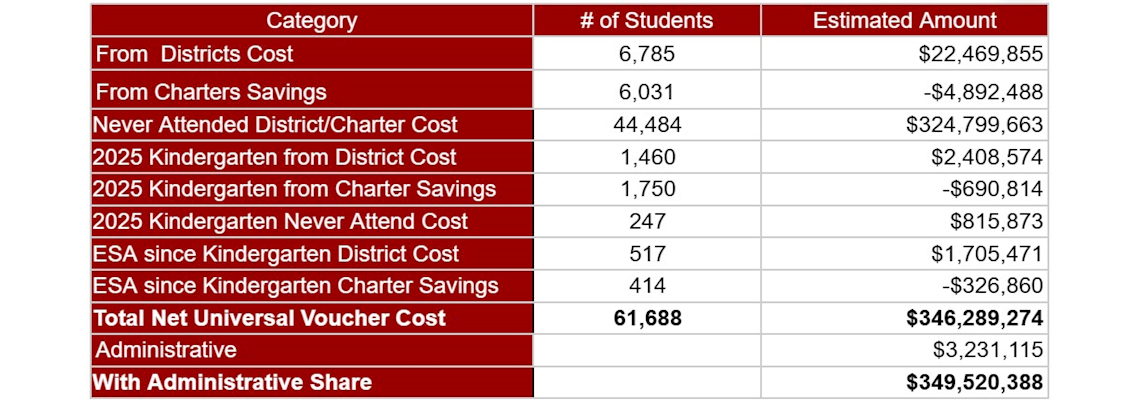
The Grand Canyon Institute has been tracking the growth and cost of vouchers and charter schools in Arizona for several years. The vast majority of students who take vouchers (almost 3/4). But this year, a larger share were drawn from district schools and charter schools.

The report contains a number of excellent graphics. Open the lin to see them.

This is the Grand Canyon Institute release:

FOR IMMEDIATE RELEASE

Cost of Universal ESA Vouchers

Contact: Dave Wells, Research Director, dwells@azgci.org or 602.595.1025 ex. 2.

Summary of Findings

  • 73% of Universal ESA voucher enrollees have never attended district or charter schools (including adjustments for students entering Kindergarten).
  • In FY2025, however, net new Universal ESA voucher enrollees primarily came from charter and district schools.
  • While the total cost of the overall ESA program in FY2025 is expected to be $872 million, the net cost after adjusting for where students would have otherwise attended is $350 million for those in the universal ESA voucher program. This represents a slight increase from the $332 million estimated by the Grand Canyon Institute last year.

The Grand Canyon Institute (GCI) estimates a $350 million net cost to the state’s General Fund in FY2025 (July 2024-June 2025) for the universal component of Arizona’s Empowerment Scholarship Account (ESA) voucher program based on a student’s school of origin. This represents a slight increase over the estimated FY2024 cost of $332 million. The estimate assumes basic student funding weights. 

The Joint Legislative  Budget Committee currently estimates the total annual cost of the ESA program to be $872 million, which includes the original targeted program and the universal component. Because student-level data on the universal program is not separated out by the Arizona Dept. of Education, GCI must estimate the origin of universal program enrollees. GCI’s estimate reflects the net cost the state would have incurred if the universal ESA voucher program did not exist. Almost every single child in the original targeted program had to attend a district or charter school for at least 45 days before enrolling in the program. GCI uses historical data on where the targeted students had come from previously, dating back to FY2017, along with current data on where all ESA students have left district or charter schools to estimate the distribution of students across district and charter schools for the original targeted program and the remainder are allocated to the universal program. 


In FY2025, the net growth in the universal ESA vouchers was 7,660 of the total enrollment of 61,688. GCI estimates that 73% of ESA universal voucher recipients never attended a district or charter school, slightly lower than the rate of 80% in FY2025. This includes estimates for kindergarten students using ESA universal vouchers. 

The primary driver of the change in FY2025 was a significant increase in the portion of net new enrollees from district and charter schools. GCI examined the marginal changes since last year and estimates that nearly half the net gain in universal participants of 7,660 from FY2024Q2 to FY2025Q2 came via Kindergarten. Analyzing changes in the portion of students previously attending a district or charter school, GCI estimates that less than 10% never attended (or would have never attended for Kindergarten) while half came from charter schools and just over 40% came from districts.

This change helped lessen the growth of the net cost of the program. GCI presumes that Kindergarten students do not have a record of prior attendance but would mirror the same distribution.  Given that charter school enrollment is about one-fourth of district enrollment, charter schools have been significantly disproportionately impacted by the Universal ESA program.

Despite the change in FY2025, the majority of participants in the universal ESA program never attended a district or charter school should be self-evident. For FY2025, the Quarter 3 Executive and Legislative ESA report identifies that of the total 87,602 students enrolled in the ESA voucher program (targeted and universal), regardless of when they first enrolled, only 33,942 students  moved from charter or district schools to an ESA. Virtually all targeted participants must first enroll in a district or charter school first. The universal program does not require prior attendance. 

Access the full report here.

The Grand Canyon Institute, a 501(c) 3 nonprofit organization, is a centrist think tank led by a bipartisan group of former state lawmakers, economists, community leaders and academicians. The Grand Canyon Institute serves as an independent voice reflecting a pragmatic approach to addressing economic, fiscal, budgetary and taxation issues confronting Arizona.

Jan Resseger is a social justice warrior who fights for the underdog. She describes here how Trump’s budget enacts the fever dreams of evangelicals and billionaires. He would change federal aid from its historic purpose–equitable funding–and turn it into school choice, diverting funds from the poorest children to those with ample resources. Since 1965–for 70 years–federal education funding for public schools has enjoyed bipartisan support. Trump ends it.

She writes:

Earlier this week, Education Week‘s Mark Lieberman released a concise and readable analysis of the likely impact for public education of two pieces of federal funding legislation: the “Big, Beautiful” tax and reconciliation bill currently being debated in the U.S. Senate to shape public school funding beginning right now in FY 2025, and also President Trump’s proposed FY 2026 federal budget for public schooling in the fiscal year that begins October 1st.

Trump’s  FY 2026 budget proposal saves Head Start.

Lieberman shares one important piece of positive news about Trump’s treatment of Head Start in next year’s federal budget: “Some programs survived the cut—including Head Start.” In early May, the Associated Press‘s Moriah Balingit reported: “The Trump administration apparently has backed away from a proposal to eliminate funding for Head Start… Backers of the six-decade-old program, which educates more than half a million children from low-income and homeless families, had been fretting after a leaked Trump administration proposal suggested defunding it… But the budget summary… did not mention Head Start. On a call with reporters, an administration official said there would be ‘no changes’ to it.”

Federal funding for U.S. public schools looks bleak.

Lieberman’s assessment of federal public education funding is not so encouraging.  Overall, “The administration is aiming to eliminate roughly $7 billion in funding for K-12 schools in its budget for fiscal 2026, which starts Oct. 1. Several key programs will be maintained at today’s funding level, without an increase: “Flat funding amounts to a de-facto cut given inflation. The administration is proposing to maintain current funding levels for key programs like Title I-A for low-income students ($18.4 billion), the Individuals with Disabilities Education Act, Part B for special education ($14.2 billion) and Perkins grants for K-12 and postsecondary career and technical education ($1.4 billion).”

What has been historically a key purpose of federal public education funding—to compensate for vast inequity in the states’ capacity and the states’ willingness to fund public education—is being compromised.  Lieberman explains that much of federal funding, “is currently geared toward supporting special student populations including English learners, migrants, students experiencing homelessness, Native students, and students in rural schools. Longstanding federal programs that support training for the educator workforce; preparing students for postsecondary education; reinforcing key instructional areas like literacy, civics, and the arts… would disappear. A new K-12 grant program would offer a smaller pool of funds to states and let them decide whether and how to invest in those areas. And for the first time, all federal funding for special education would flow to states through a single funding stream…. Experts view Trump’s budget as part of an effort to roll back a half-century of effort by the federal government to help make educational opportunities more consistent and equitable from state to state and district to district.”

The “Educational Choice for Children Act,” an alarming federal school voucher bill, is hidden inside the “Big Beautiful” bill.

Lieberman worries about the enormous tuition tax credit voucher plan embedded deep in the weeds of the “Big, Beautiful” tax and reconciliation bill now being considered in the U. S. Senate: “Separate from the federal budget process, Congress is currently advancing a massive package of tax changes, including a proposal for a new tax-credit scholarship program that fuels up to $10 billion a year in federal subsidies for private K-12 education. Annual spending on that program could approach the amount the Trump administration is proposing to cut from elsewhere in the education budget.”  The voucher proposal is called the Educational Choice for Children Act (ECCA).

In a separate analysis of the “Big, Beautiful” bill as the House passed it in late May, Lieberman describes this proposed ECCA tuition-tax-credit voucher program: “House lawmakers narrowly approved a sweeping legislative package with $5 billion in annual tax credits that fuel scholarships and related expenses at K-12 private schools. The federal subsidies would come in the form of dollar-for-dollar tax credits for individuals and corporations that donate to largely unregulated state-level organizations that give out scholarship funds for parents to spend on private educational options of their choosing. Any student—even in states that have resisted expanding private school choice—from a family earning less than 300 percent of the area median gross income would be eligible to benefit from a scholarship paid for with a federally refunded donation.”

Lieberman adds: “No other federal tax credit is as generous. The Internal Revenue Service doesn’t currently supply tax credits worth the full donation amount for any cause, as the private school choice scholarship credit would do. The federal government currently offers tax credits on donations for disaster relief, houses of worship, veterans’ assistance groups, and children’s hospitals at roughly 37 percent of the donated amount.  A $10,000 donation to those causes would yield a tax credit of $3,700.  By contrast, under the proposed legislation, if a taxpayer donates $10,000 to a scholarship (voucher)-granting organization, the IRS would give them a tax credit of $10,000.”

The Institute for Taxation and Economic Policy’s Carl Davis explains that because these federal school vouchers are primarily a tax shelter, they might appeal to wealthy people who are not even supporters of school privatization: “The tax plan…  includes a provision granting extraordinarily generous treatment to nonprofits that give out vouchers for free or reduced tuition at private K-12 schools. While the bill significantly cuts charitable giving incentives overall, nonprofits that commit to focusing solely on supporting private K-12 schools would be spared from those cuts and see their donors’ tax incentive almost triple relative to what they receive today. On top of that, the bill goes out of its way to provide school voucher donors who contribute corporate stock with an extra layer of tax subsidy that works as a lucrative tax shelter. Essentially, the bill allows wealthy individuals to avoid paying capital gains tax as a reward for funneling public funds to private schools.” “We estimate the bill would reduce federal tax revenue by $23.2 billion over the next 10 years as currently drafted, or by $67 billion over the next ten years if it is extended beyond its four-year expiration date… As currently drafted, the bill would facilitate $2.2 billion in federal and state capital gains tax avoidance over the next 10 years.”

The Brookings Brown Center on Education Policy’s Jon Valant warns that the vouchers are so deeply buried in the “Big, Beautiful” bill that lots of people would not be aware of the plan’s existence until after it is passed: “The Educational Choice for Children Act (ECCA) continues to move, quietly, towards becoming one of America’s costliest, most significant federal education programs. Now part of the One Big Beautiful Bill, ECCA would create a federal tax-credit scholarship program that’s unprecedented in scope and scale.  It has flown under the radar, though, and remains confusing to many observers…  ECCA’s stealthiness is partly due to the confusing nature of tax-credit scholarship programs. These programs move money in circuitous ways to avoid the legal and political hurdles that confront vouchers.”

Valant explains how tax-credit vouchers work: “Tax-credit scholarship programs like ECCA aren’t quite private school voucher programs, but they’re first cousins. In a voucher program, a government gives money (a voucher) to a family, which the family can use to pay for private school tuition or other approved expenses. With a tax-credit scholarship, it’s not that simple. Governments offer tax credits to individual scholarship granting organizations (SGOs). These SGOs then distribute funds… to families.”

Valant creates a scenario that shows how this tax credit program could help the wealthy and leave out poorer families. A rich donor, Billy, donates $2 million in stock to an SGO: “Billy’s acquaintance, Fred, lives in the same town as Billy, which is one of the wealthiest areas in the United States. In fact, Fred set up the SGO, looking to capture ECCA funds within their shared community… Like Billy, Fred doesn’t particularly care about K-12 public education… It might seem that Fred’s SGO couldn’t distribute funds to families in their ultra-wealthy area, since ECCA has income restrictions for scholarship recipients. That’s not the case. ECCA restricts eligibility to households with an income not greater than 300% their area’s median income. In Fred and Billy’s town, with its soaring household incomes, even multimillionaire families with $500,000 in annual income are eligible… So, Fred is looking to give scholarship money to some wealthy families in his hometown.”

Valant summarizes the result if the “Big, Beautiful” bill is enacted: “This bill would introduce the most significant and costliest new federal education program in decades. It has virtually no quality-control measures, transparency provisions, protections against discrimination, or evidence to suggest that it is likely to improve educational outcomes. It’s very likely to redirect funds from poor (and rural) areas to wealthy areas.”

When enrollments declined, EPIC virtual charter schools in Oklahoma reacted like any other business: management shrunk the workforce and cut the salaries of those who were not laid off. The remaining teachers found themselves wondering if the charter model itself was flawed.

KFOR in Oklahoma City reported the story:

OKLAHOMA CITY (KFOR) — After Epic Charter Schools laid off hundreds of employees Tuesday, the teachers left behind say they’ve been given no answers, and some are now questioning whether the charter system that they work for truly puts students first.

Those teachers say they don’t know who is in charge, how the school plans to move forward, or whether their jobs are truly safe. At least one teacher says the chaos has her rethinking the charter-school model entirely—and what it means for students.

News 4 reported that more than 350 Epic Charter Schools employees were blindsided on Tuesday with an email informing them that they were being let go….

The state-funded online charter school laid off 357 employees Tuesday, including 83 teachers and nearly 300 administrators.

“We know that there are guidance counselors affected, transition coordinators,” a current Epic teacher said.

The teacher told News 4 that Epic did not inform teachers that the district layoff included eliminating the roles of every principal, leaving teachers unclear about who they now answer to.

“We would love to know. We are very interested in what that looks like,” she said. “And we have not been told any information on how do you have a school without a principal?”

While this teacher still has her job—that has come at a price.

“They cut our pay again two weeks ago,” she said.

She said the new pay scale dropped teachers’ base salaries to $40,000 a year.

“I was hired with the agreement that $60,000 a year would be base pay,” she said. “That’s quite a significant pay cut.”

Jon Valant is doing a great job as Director of the Brown Center on Education Policy at the Brookings Institution in Washington, D. C. He keeps close tabs on federal legislation. What follows is an excellent analysis of Trump’s legislation to use federal funds to underwrite the privatization of federal education funding. The potential for fraud, waste, and abuse is huge, he writes.

He writes:

  • The Educational Choice for Children Act (ECCA) would create a $5 billion federal tax-credit scholarship program through a tax shelter for wealthy individuals.
  • The bill would provide minimally regulated scholarship-granting organizations with a great deal of discretion over how federal education funds are spent.
  • A hypothetical scenario illustrates the possibility of waste, fraud, and discriminatory behaviors.

The Educational Choice for Children Act (ECCA) continues to move, quietly, towards becoming one of America’s costliest, most significant federal education programs. Now part of the One Big Beautiful Bill Act, ECCA would create a federal tax-credit scholarship program that’s unprecedented in scope and scale. It has flown under the radar, though, and remains confusing to many observers.

Recently, a colleague and I showed how ECCA is poised to redistribute funds from poor and rural communities to wealthy and non-rural communities. A study from the Urban Institute drew similar conclusions. Since those pieces were published, ECCA—then a standalone bill—has passed through the House of Representatives and now moves to the Senate. ECCA’s fate remains uncertain, which makes this as good a time as any to examine its potential implications.

How would ECCA work?

ECCA’s stealthiness is partly due to the confusing nature of tax-credit scholarship programs. These programs move money in circuitous ways to avoid the legal and political hurdles that confront vouchers. Tax-credit scholarship programs like ECCA aren’t quite private school voucher programs, but they’re first cousins.  

In a voucher program, a government gives money (a voucher) to a family, which the family can use to pay for private school tuition or other approved expenses. With a tax-credit scholarship, it’s not that simple. Governments offer tax credits to individuals and/or corporations that donate to scholarship-granting organizations (SGOs). These SGOs then distribute funds (“scholarships”) to families.

The U.S. already has 22 tax-credit scholarship programs, but they’re relatively modest, state-level programs. ECCA is different. ECCA would create a massive, federal tax-credit scholarship program, operating across all 50 states, with a current price tag of about $5 billion in the first year (down from $10 billion in the bill’s earlier draft). It offers an extremely generous tax credit. Individuals get a full, 1:1 tax credit (not just a deduction) for their contributions, which fully offsets their contributions. In other words, these “donors” don’t actually give up any money—hence the quotation marks. On top of that, ECCA allows individuals to donate marketable securities (e.g., stocks) rather than cash. This provides an avenue to treat ECCA as a tax shelter and avoid paying capital gains taxes. More on that in a moment.

Most students would be eligible for a scholarship, with the exception of those from households that earn more than three times their area’s median gross income. (More on that in a moment, too.) The list of qualified expenses covers everything from private school tuition to online educational materials.

Rather than go through all of the bill’s details, let’s take a look at a scenario that illuminates what this program could do. Remarkably, this scenario appears—to my eye, at least—fully compliant with the House bill (even if the characters are a bit overstated).

A hypothetical scenario to illustrate some of ECCA’s risks

A ‘donor’ who benefits from ECCA’s tax shelter

Let’s imagine a billionaire, Billy, who couldn’t care less about K-12 education but cares a whole lot about his own wealth. Billy hears about ECCA from an acquaintance who tells him about how much money Billy could save by “donating” to an SGO. Billy’s adjusted gross income (AGI) was $20 million last year. That means, according to ECCA, that he’s eligible to donate $2 million to an SGO this year (10% of his AGI).

Let’s walk through the math for Billy’s donation. Billy is looking to give $2 million in stock shares to an SGO. He bought these shares a few years ago for $1 million and then they doubled in value. That means that Billy’s earnings are subject to long-term capital gains tax if he sells the stock. With his AGI, that would be 23.8% in federal taxes plus another 4.7% or so in state taxes (depending on where he lives). In other words, if Billy sold the stocks today and kept the funds for himself, he’d owe about $285,000 in combined federal and state taxes on his $1 million in earnings (28.5% of $1 million).

By donating the $2 million in stock to an SGO, not only does Billy get his entire $2 million back as a tax credit; he also dodges those capital gains taxes. He’s a billionaire who is $285,000 wealthier for having made this supposed donation. (For a detailed illustration of how this works—and some nice figures—I’d recommend this piece from the Institute on Taxation and Economic Policy.)

A scholarship-granting organization with extraordinary leeway in how to direct ECCA funds

Now, let’s get back to that SGO. Billy’s acquaintance, Fred, lives in the same town as Billy, which is one of the wealthiest areas in the United States. In fact, Fred set up the SGO, looking to capture ECCA funds within their shared community—and, just maybe, for himself. Like Billy, Fred doesn’t particularly care about K-12 education. He does have a penchant for fraud, though, along with a strong distaste for Republicans.

It might seem that Fred’s SGO couldn’t distribute funds to families in their ultra-wealthy area, since ECCA has income restrictions for scholarship recipients. That’s not the case. ECCA restricts eligibility to households with an income not greater than 300% of their area’s median income. In Fred and Billy’s town, with its soaring household incomes, even multimillionaire families with $500,000 in annual income are eligible. In more modest (and rural) areas, the cutoffs aren’t nearlyso high.

So, Fred is looking to give scholarship money to some wealthy families in his hometown. Notably, ECCA doesn’t limit the amount of money that he can give to any one recipient. ECCA just requires that he provide scholarships to at least two students—who, between them, attend at least two different schools—and that he not earmark the funds for any particular student. Fred offers students $100,000 apiece for supplemental tutoring. That might seem like a lot, but, hey, this is high-end tutoring.

A vendor with little oversight or accountability

In fact, Fred stipulates that the funds must be spent at a new tutoring shop, High-End Tutoring, just created by his buddy, a former teacher. ECCA seems to allow that. ECCA also allows Fred to take a nice cut for himself for running the SGO: 10% of the SGO’s total receipts.

No one really knows the arrangement that Fred and his tutoring friend have, if they have one, because there are hardly any transparency or accountability provisions in ECCA (aside from a requirement to obtain annual financial and compliance audits). We also won’t know if High-End Tutoring provides any educational value, because that’s not part of ECCA either. ECCA’s proponents have claimed there’s accountability to the SGO donors, who want to see their generous donations being put to good use. Billy, though, is enjoying his $285,000 money grab and content to leave Fred alone until it’s time for next year’s donation.

An invitation to discriminate—and an attempt to keep local and state governments from intervening

Fred does have one requirement of his own for High-End Tutoring that he doesn’t need to hide. High-End Tutoring isn’t going to serve any children of Republican parents. All students must complete an attestation form—stating that they and their parents are progressive—before receiving any tutoring services from this publicly funded vendor. Across town, another SGO leader is formally excluding LGBTQ+ children and children of LGBTQ+ parents from their pool of scholarship recipients.

ECCA, in its current form, seems to allow all of this, as objectionable as it may seem. And it’s not just an issue with SGOs funding tutoring companies or other supplemental services. Similar issues could arise with private schools, especially in states without strong anti-discrimination protections.

From hypotheticals to reality

The scenario above might seem ridiculous or caricatured, and to some extent it probably is. But the point is, it’s allowable under the proposed legislation, and we should be realistic about how much fraud, waste, and bad behavior a program like ECCA would invite.

Should we not expect wealthy stockowners to jump at the opportunity to exploit ECCA’s tax shelter? Is it unreasonable to think that many of these wealthy donors will look to benefit their own communities through their donations? Have we not seen bad actors creep in when governments offer large checks with hardly any accountability or strings attached?

This isn’t some tiny, insignificant program either. This is a $5 billion federal program that, because of a “high-use calendar year” provision in ECCA, is almost certain to grow 5% annually. In fact, the cost is likely to be considerably higher than thatdue to the foregone capital gains tax revenue. That’s not quite the size of the behemoth federal K-12 programs—Title I ($18.4 billion in FY 2024) and IDEA ($15.5 billion)—but it’s not all that far off.

And let’s be clear about cost, because ECCA certainly isn’t paid for by the contributions of generous donors. Tax credits are would-be revenue that the IRS is no longer collecting. That money is coming from somewhere else in the budget, whether it’s cuts in education spending, cuts to Medicaid or other social services, tax hikes, or increased debt.

This bill would introduce the most significant and costliest new federal education program in decades. It has virtually no quality-control measures, transparency provisions, protections against discrimination, or evidence to suggest that it’s likely to improve educational outcomes. It’s very likely to redirect funds from poor (and rural) areas to wealthy areas.

And, in its current form, ECCA leaves a whole lot of room for waste, fraud, and abuse.

Secretary of Education Linda McMahon released her budget proposal for next year, and it’s as bad as expected.

Carol Burris, executive director of the Network for Public Education, reviewed the budget and concluded that it shows a reckless disregard for the neediest students and schools and outright hostility towards students who want to go to college.

We know that Trump “loves the uneducated.” Secretary McMahon wants more of them.

Burris sent out the following alert:

Image

Linda McMahon, handpicked by Donald Trump to lead the U.S. Department of Education, has just released the most brutal, calculated, and destructive education budget in the Department’s history.

She proposes eliminating $8.5 billion in Congressionally funded programs—28 in total—abolishing 10 outright and shoving the other 18 into a $2 billion block grant. That’s $4.5 billion less than those 18 programs received last year.

Tell Congress: Stop McMahon From Destroying Our Public Schools

And it gets worse: States are banned from using the block grant to support the following programs funded by Congress:

  • Aid for migrant children whose families move frequently for agricultural work
  • English Language Acquisition grants for emerging English learners
  • Community schools offering wraparound services
  • Grants to improve teacher effectiveness and leadership
  • Innovation and research for school improvement
  • Comprehensive Centers, including those serving students with disabilities
  • Technical assistance for desegregation
  • The Ready to Learn program for young children

These aren’t just budget cuts—they’re targeted strikes

McMahon justifies cutting support for migrant children by falsely claiming the program “encourages ineligible non-citizens to access taxpayer dollars.” That is a lie. Most migrant farmworkers are U.S. citizens or have H-2A visas. They feed this nation with their backbreaking labor.

The attack continues for opportunity for higher education:

  • Pell Grants are slashed by $1,400 on average; the maximum grant drops from $7,395 to $5,710
  • Federal Work-Study loses $1 billion—an 80% cut
  • TRIO programs, which support college-readiness and support for low-income students, veterans, and students with disabilities, are eliminated
  • Campus child care programs for student-parents are defunded

In all, $1.67 billion in student college assistance is gone—wiped out on top of individual Pell grant cuts. 

Send your letter now

And yet, McMahon increased funding for the federal Charter Schools Program to half a billion dollars for a sector that saw an increase of only eleven schools last year. Meanwhile, her allies in Congress are pushing a $5 billion private school and homeschool voucher scheme through the so-called Educational Choice for Children Act (ECCA).

And despite reducing Department staff by 50%, she only cuts the personnel budget by 10%.

This is not budgeting. It is a war on public education.

This is a blueprint for privatization, cruelty, and the systematic dismantling of opportunity for America’s children.

We cannot let it stand.

Raise your voice. Share this letter: https://networkforpubliceducation.org/tell-congress-dont-let-linda-mcmahon-slash-funding-for-children-college-students-and-veterans-to-fund-school-choice/  Call Congress.

Let Congress know that will not sit silently while they dismantle our children’s future.

Thank you for all you do,

Carol Burris

Network for Public Education Executive Director

Peter Greene nails one of the many flaws of school choice. The choice movement hurtles forward despite its record of failure to fulfill any of its promises but one: It provides choice. Not necessarily good choice or better choice. Just choice.

Greene writes:

When researcher Josh Cowen is talking about the negative effects of school vouchers on education, he often points at “subprime” private schools— schools opened in strip malls or church basements or some other piece of cheap real estate and operated by people who are either fraudsters or incompetents or both.

This is a feature, not a bug. Because as much as choice advocates tout the awesomeness of competition, the taxpayer-funded free market choice system that we’ve been saddled with has built in perverse incentives that guarantee competition will be focused on the wrong things.

The free market does not foster superior quality; the free market fosters superior marketing. Now, the marketing can be based on superior quality, but sometimes it’s just easier to go another way.

The thing about voucher schools is that quality is not what makes them money. What makes them money is signing people up.

That’s it. Voucher school operators don’t have to run a good school; they just have to sell the seats. Once the student is signed up and their voucher dollars are in the bank, the important part of the transaction is over. There is no incentive for the school to spend a pile of money on doing a good job; all the incentive is for the school to come up with a good marketing plan.

Betsy DeVos liked to compare the free market for schools with a row of food trucks, which was wrong for a host of reasons, but one was the market speed. Buy lunch at a food truck, and you become part of the marketing very quickly. Within minutes, you are either a satisfied customer telling your friends to eat there, or warning everyone to stay away. Reputations are built quickly.

But for schools, the creation of a reputation for quality takes a long time, time measured in years. The most stable part of the voucher school market is schools that already have their reputation in place from years of operation. But if you are a start-up, you need to get that money for those seats right now. If you are a struggling crappy private school with a not-so-great reputation, you don’t have time to turn that around; you’ve got to up your marketing game right now.

So the focus (and investment) goes toward marketing and enrollment.

Won’t your poor performance catch up with you? Maybe, but the market turns over yearly, as students age out and age in to school. And you don’t have to capture much of it. If you are in an urban center with 100,000 students and your school just needs to fill 100 seats, disgruntled former families won’t hurt you much– just get out there and pitch to the other 99,900 students. And if you do go under, well, you made a nice chunk of money for a few years, and now you can move on to your next grift.

This is also why the “better” private schools remain unavailable to most families holding a voucher. If a reputation for quality is your main selling point, you can’t afford to let in students who might hurt that record of success.

Meanwhile, talk to teachers at some of the less-glowing private and charter schools about the amount of pressure they get to make the student numbers look good.

Because of the way incentives are structured, the business of a voucher school is not education. The business of the voucher school is to sell seats, and the education side of the business exists only to help sell seats. Our version of a free market system guarantees that the schools will operate backwards, an enrollment sales business with classrooms set up with a primary purpose of supporting the sales department, instead of vice versa.

Charter schools? The same problem, but add one other source of revenue– government grants. Under Trump, the feds will offer up a half a billion dollars to anyone who wants to get into the charter biz, and we already know that historically one dollar out of every four will go to fraud or waste, including charter businesses that will collect a ton of taxpayer money and never even open.

“Yeah, well,” say the haters. “Isn’t that also true for public schools”

No, it is not. Here’s why. Public schools are not businesses. They are service providers, not commodity vendors. Like the post office, like health care in civilized countries, like snow plows, like (once upon a time) journalism, their job is to provide a necessary service to the citizens of this country. Their job should be not to compete, but to serve, for the reasons laid out here.

And this week-ass excuse for accountability– if you do a bad enough job, maybe it will make it harder for your marketing department– has been sold as the only accountability that school choice needs.

School choice, because its perverse incentives favor selling seats over educating students, is ripe for enshittification, Cory Doctorow’s name for the process by which operators make products deliberately worse in order to make them more profitable. The “product” doesn’t have to be good– just good enough not to mess up the sales. And with no meaningful oversight to determine where the “good enough” line should be drawn, subprime voucher and charter schools are free to see just how close to the bottom they can get. It is far too easy to transform into a backwards business, which is why it should not be a business at all.

If your foundational belief is that nobody ever does anything unless they can profit from it (and therefor everything must be run “like a business”) then we are in “I don’t know how to explain that you should care about other people” territory, and I’m not sure what to tell you. What is the incentive to work in a public education system? That’s a whole other post, but I would point to Daniel Pink’s theory of motivation– autonomy, mastery and purpose. Particular a purpose that is one centered on making life better for young human beings and a country better for being filled with educated humans. I am sure there are people following that motivation in the school choice world, but they are trapped in a model that is inhospitable to such thinking.