Archives for category: Disruption

Jennifer Berkshire, keen-eyed commentator on the nation’s schools and their detractors, writes that the doomsayers are up in arms again. After 25 (or 40) years of nonstop “reform,” their lamentations are once again in style. Note that the lamentors never blame the failure of the “reforms” they imposed. No. It’s the students, the teachers, the public schools, anyone else but not themselves.

Berkshire writes:

The kids are dumb and getting dumber. They can’t add or read the books they are no longer assigned, rousing themselves from their stupid stupors only to demand extra time on tests or another (now meaningless) A. The schools are collapsing, thanks to weakened standards and something called “cargo cult equity.” Just how bad is it out there? Today’s kids are the equivalent of the subprime mortgage-backed securities that blew up the economy in the lead up to the Great Recession. (Yes, somebody actually made this argument).

I could keep going, but you get where this is heading. Also, we are only a few days into the new year and I am already exhausted. The point, reader, is that we find ourselves in the throes of a full-blown public education panic. But why now? And why does this one feel different? I kick off 2026 with a look at a story that is all but guaranteed to keep telling itself in the months ahead.

America’s oldest pastime

If you’re new to the great American pastime of bemoaning the state of the nation’s schools then perhaps you’re unaware that we’ve been doing this since at least the ‘70’s. By which I mean the 1870’s. If the railroad collapse that triggered the Panic of 1873 feels startlingly familiar in our own bubbly AI economy, so too will feel the ensuing laments about the schools. They were too expensive. They used to teach reading well, but no longer. They had too many administrators. And if you’ve been following the ‘women ruin everything’ discourse, this was also the time when teaching became a female-documented occupation. Related? You tell me. Over the past 250 years, complaints “that the public schools of today are inferior to those of a generation or two ago” have resurfaced as reliably as measles or whooping cough.

Too many of the wrong kids are in college

Several years ago, education historian Jack Schneider and I wrote an op-ed in which we argued that the GOP was using education culture war to appeal to vastly different constituencies, including rural voters enflamed over CRT and litter boxes and affluent moderates obsessed with getting their kids into elite institutions. Alas, our bleak prediction about the realigning power of this emerging coalition turned out to be premature, but only in the K-12 world. Today, the powerful backlash movement that is upending higher education is based on just such an unlikely coalition, united in the belief that there are too many of the wrong kids in college. As one wry observer noted on X: “Half the education posts are like ‘my kid has a 5.3 GPA and invented $5 insulin and got rejected from DeVry’ and half are ‘60% of freshmen do not know enough math to read the numbers on their classroom doors.’”

Or how about this one? “The Atlantic is Fox News but for high SES liberals worried their kids spot at a UC will be taken by some Latino kid from the Central Valley.” Touché! As Trump et al continue to expand the definition of “wrong kids” [immigrants, non-white students, protestors, poor students, women], affluent parents with an eye on the Ivies, not to mention the pundit class, are proving all too willing to play footsie with them.

Billionaires gonna billionaire

Here’s a question for you, reader: what was your favorite example of a billionaire purchasing state-level education policy in 2025? Mayhaps it was hedge funder Ken Griffin’s purchase of the state legislature in Florida. Or hedge funder Jeff Yass’ purchase of Texas governor Greg Abbott. Or maybe you prefer a more bespoke intervention, like when billionaire Lauren Overdeck rented mobile billboards to warn New Jersey parents that their kids aren’t that smart.

Nobody knows anything

“I Don’t Know What to Think About America’s Declining Test Scores and Neither Should You” was the title of a great post last year by teacher and writer Michael Pershan. Digging into the surging remedial math program at University of California San Diego that fueled roughly one billion hot takes, Pershan patiently pointed out the contradictory nature of the data regarding student achievement in California. Even as student math skills were supposedly declining, state test scores were increasing. Or take Los Angeles, one of the few bright spots in the post-pandemic recovery landscape. During the last golden age of education reform, roughly 15 minutes ago, the progress of LA’s students would have merited its own fawning press treatment. No longer. Today, the story is decline and failure, and while this is a global phenomenon that includes adults, why let a little complexity get in the way of a hot take? The emergence of our ‘hot take’ economy, by the way, in which content entrepreneurs are handsomely rewarded for their “obtuse penchant for moral and ideological incuriousity” (and pay no price for 1) being wrong or 2) contradicting themselves) is a major driver of our current round of public education panic.

Neoliberalism is gone (but not forgotten)

Every year I ban myself from using the word “neoliberalism,” and, well, you can see how that’s going. The story of education decline and collapse that’s now sweeping the land typically goes something like this. Back when we had accountability, standards and choice, things were going great, but then [insert teachers, unions, progressives, lazy kids here] did [insert bad thing here] and the result is [insert calamity here.] But if you’ve been paying attention to education politics for more than 15 minutes then you know that that story is not just partial but wildly inaccurate.

For example, did you know that grassroots opposition to the Common Core standards on the right blew up, not just the era of bipartisan accountability, but helped deliver the current occupant into the White House? The result is that we’re now in an in-between-state, in which the vision of market-minded education reform that has held sway for the last THIRTY YEARS is exhausted while no clear alternative has emerged to take its place. For a compelling explanation of how the crack up of education policy relates to our larger political disintegration, check out this essay by Matt Wilka and Kent McGuire, “A Democratic Vision for Public Schools.”

The neoliberal paradigm has cracked, but it has not crumbled. And this instability marks our current transition period, which has brought much graver threats to American democracy. The confluence of economic pain, demographic change, and new media has proved fertile ground for authoritarian leaders to champion resistance to government.

Human capitalists vs. the chainsaw

Of all of the reading I’ve done in the last month, it was this piece that stopped me in my tracks. The author, a used-to-be copy writer now being replaced by AI, asks an AI chat bot for career advice, to which he is instructed to pick up a chainsaw. I’ll stop here as I want you to read it yourself, but suffice it to say that the author uses his experience to take aim at two sacred cows of the neoliberal era: 1) that more and better education is the answer to our economic woes and 2) that the remedy for worker dislocation is retraining. (For evidence of our muddled moment, consider that the New York Times ran, in addition to the chainsaw op-ed, a Sal Kahn ripped-from-the-time machine argument for worker re-training and a good old-fashioned education-as-boot-straps editorial, all in the same month.)

What does this have to do with our current round of public education panic? For the past three decades, bipartisan education reform has been pitched as an alternative to economic redistribution. Why impose higher taxes on the wealthy when going after the teachers unions is so much more satisfying? But as downward mobility comes for a larger and larger segment of the workforce, that sales pitch has officially run out of steam. The big question now is ‘whither the Democrats?,’ who, to paraphrase the great Tom Frank, have long seen every economic problem as an education problem. Will they seize the populist economic mantle, as even James Carville is prodding them to do? Or will the centrist zombie rise again, flogging the exhausted case that “[e]ducation reform is the seed corn of economic prosperity”? My money is on the chainsaw…

Race science is back

What single silver bullet would cause US test scores to soar like a SpaceX rocket? If you answered ‘kicking out all of the immigrants,’ you would be quoting Trump advisor Stephen Miller. While the claim is measurably preposterous, it’s indicative of the roaring return of race science during Trump 2.0. But Goebbels envy isn’t the only reason for the obsessive fixation on IQ these days. For a forthcoming essay on the Democrats’ populism bind, I’ve been revisiting education historian Michael Katz’s 1987 Reconstructing American Education. In his survey of 100 years of education reform promises and disappointment, Katz identified a familiar pattern. Once the hypes and hopes of addressing an astonishing array of societal ills through the schools inevitably fall short, “hereditarian theories of intelligence reemerge” like clockwork.

Here’s Katz:

As so often in American history, education had been deployed as the primary weapon to fight poverty, crime and social disorder, and, as before, schools were unable to alleviate these great problems whose structural origins lie in the distribution of power and resources.

Katz was surveying the wreckage of the War on Poverty era, its optimism curdling into mainstream social science claims that 1) because IQ was largely inherited and racially determined 2) efforts to boost achievement through the schools were doomed to failure. Today we’re in a similar moment, the exuberant claims of the last education reform era (see above) crashing into the chasm of economic inequality. Katz argued that the only way to challenge genetic arguments, by the way, was to acknowledge “the structural origins of social problems and the inherently ineffectual nature of the reforms that have been attempted.” Sound familiar?

Too many of the wrong kids are in college

Several years ago, education historian Jack Schneider and I wrote an op-ed in which we argued that the GOP was using education culture war to appeal to vastly different constituencies, including rural voters enflamed over CRT and litter boxes and affluent moderates obsessed with getting their kids into elite institutions. Alas, our bleak prediction about the realigning power of this emerging coalition turned out to be premature, but only in the K-12 world. Today, the powerful backlash movement that is upending higher education is based on just such an unlikely coalition, united in the belief that there are too many of the wrong kids in college. As one wry observer noted on X: “Half the education posts are like ‘my kid has a 5.3 GPA and invented $5 insulin and got rejected from DeVry’ and half are ‘60% of freshmen do not know enough math to read the numbers on their classroom doors.’”

Or how about this one? “The Atlantic is Fox News but for high SES liberals worried their kids spot at a UC will be taken by some Latino kid from the Central Valley.” Touché! As Trump et al continue to expand the definition of “wrong kids” [immigrants, non-white students, protestors, poor students, women], affluent parents with an eye on the Ivies, not to mention the pundit class, are proving all too willing to play footsie with them.

Billionaires gonna billionaire

Here’s a question for you, reader: what was your favorite example of a billionaire purchasing state-level education policy in 2025? Mayhaps it was hedge funder Ken Griffin’s purchase of the state legislature in Florida. Or hedge funder Jeff Yass’ purchase of Texas governor Greg Abbott. Or maybe you prefer a more bespoke intervention, like when billionaire Lauren Overdeck rented mobile billboards to warn New Jersey parents that their kids aren’t that smart.

THERE IS MORE! OPEN THE LINK TO FINISH THE ARTICLE. And open the link to see the links to sources.
Heather Cox Richardson does a masterful job of drawing together the wildly disparate events of the past several days. Trump seems to be doing a good job of distracting the public, as he generates crises and then jumps into them.

HCR writes:

The news has seemed to move more and more quickly in the last week.

The story underlying all others is that the United States Congress passed a law requiring the Department of Justice to release all the Epstein files—the files from the Federal Bureau of Investigation’s investigation into the activities of sex offender Jeffrey Epstein—no later than December 19, and it has not done so.

Epstein and President Donald J. Trump were close friends for many years, and the material the Department of Justice (DOJ) has released suggests that Trump was more closely tied to Epstein’s activities than Trump has acknowledged. Although Trump ran in 2024 on the promise of releasing the Epstein files, suggesting those files would incriminate Democrats, his loyalists in the administration are now openly flouting the law to keep them hidden.

Despite the clear requirement of the Epstein Files Transparency Act that they release all the files by December 19, to date they have released less than 1% of the material.

Another part of the backstory of the past week is that the Supreme Court on December 23, 2025, rejected the Trump administration’s argument that it had the power to deploy federalized National Guard troops in and around Chicago, a decision that seemed to limit Trump’s power to use military forces within the United States.

Yet another part of the backstory is that on New Year’s Eve, Republicans on the House Judiciary Committee released a 255-page transcript of former special counsel Jack Smith’s December 17 closed-door testimony before the committee. In that testimony—under oath—Smith said that his office had “developed proof beyond a reasonable doubt that President Trump engaged in a criminal scheme to overturn the results of the 2020 election and to prevent the lawful transfer of power. Our investigation also developed powerful evidence that showed that President Trump willfully retained highly classified documents after he left office in January of 2021, storing them at his social club, including in a ballroom and a bathroom. He then repeatedly tried to obstruct justice to conceal his continued retention of those documents.”

With pressure building over the Epstein files and Jack Smith’s testimony, and with the Supreme Court having taken away Trump’s ability to use troops within the United States, the administration went on the offensive.

Only a week ago, on January 3, the military captured Venezuelan president Nicolas Maduro and his wife, Cilia Flores. After months of suggesting that he was determined to end what he called “narco-traffickers,” Trump made it clear as soon as Maduro was in hand that he wanted control of Venezuela’s oil.

Then, on January 6, the fifth anniversary of the attack on the U.S. Capitol by Trump supporters determined to keep Trump in office despite Democratic presidential candidate Joe Biden’s majority of 7 million votes, Trump’s White House rewrote the history of January 6, 2021, claiming that the rioters were “peaceful patriotic protesters” and blaming the Democrats for the insurrection.

That same day, after the Supreme Court had cut off the administration’s ability to federalize National Guard soldiers and send them to Democratic-led cities, the administration surged 2,000 federal agents to Minneapolis in the largest federal immigration enforcement operation ever launched.

The next morning, ICE agent Jonathan Ross shot and killed 37-year-old Renee Good, and the administration responded by calling Good a domestic terrorist.

On Thursday, January 8, as protests broke out across the country, Republicans in both chambers of Congress began to push back against the administration. In the House, Representatives Ro Khanna (D-CA) and Thomas Massie (R-KY), the leading sponsors of the Epstein Files Transparency Act, asked U.S. District Judge Paul Engelmayer to appoint “a Special Master and an Independent Monitor to compel” the DOJ to produce the Epstein files as the law requires. The House also passed a measure to extend the Affordable Care Act tax credits for three years.

The Senate advanced a bill to stop the Trump administration from additional attacks on Venezuela without congressional approval. And, just two days after Trump had reversed the victims and offenders in the January 6, 2021, insurrection, suggesting that Capitol Police officers had been among the offenders, the Senate unanimously agreed to hang a plaque honoring the police who protected the U.S. Capitol on January 6, 2021. Congress passed a law in March 2022 mandating that the plaque be hung, but Republicans until now had prevented its installation.

Friday was a busy day at the White House.

On Friday, Trump threatened Greenland, saying that he was “going to do something on Greenland, whether they like it or not.”

Trump’s threat against a North Atlantic Treaty Organization (NATO) ally has had American lawmakers and foreign allies scrambling ever since. In a joint statement, the leaders of Denmark, France, Germany, Italy, Poland, Spain, and the United Kingdom said that “Greenland belongs to its people.” Senator Chris Murphy (D-CT) released a video explaining that “what you are essentially talking about here is the United States going to war with NATO, the United States going to war with Europe. You’re talking about the U.S. and France being at war with each other over Greenland.”

Trump’s threats against Greenland came at a meeting with oil executives. When he attacked Venezuela to capture Maduro, Trump told reporters that United States oil companies would spend billions of dollars to fix the badly broken infrastructure of oil extraction in that country. But apparently the oil companies had not gotten the memo. They have said that they are not currently interested in investing in Venezuela because they have no idea how badly oil infrastructure there has degraded and no sense of who will run the country in the future.

What oil executives did suggest to Trump on Friday was that they would quite like to be repaid for their losses from the 2007 nationalization of their companies from the sale of Venezuelan oil Trump has promised to control. ConocoPhillips, for example, claims it is owed about $12 billion. “We’re not going to look at what people lost in the past, because that was their fault,” Trump told them. “That was a different president. You’re going to make a lot of money, but we’re not going to go back.”

Yesterday the government made public an executive order President Donald J. Trump signed on Friday, declaring yet another national emergency—his tenth in this term, by my count—and saying that any use of the revenue from the sale of Venezuelan oil to repay the billions of dollars owed to oil companies “will materially harm the national security and foreign policy of the United States.”

Specifically, the executive order says, such repayment would “interfere with our critical efforts to ensure economic and political stability in Venezuela” and, by extension, jeopardize U.S. foreign policy objectives including “ending the dangerous influx of illegal immigrants and the flood of illicit narcotics;…protecting American interests against malign actors such as Iran and Hezbollah; and bringing peace, prosperity, and stability to the Venezuelan people and to the Western Hemisphere more generally.” So, it appears, Trump wants to retain control of the money from the sale of Venezuelan oil.

Tonight Federal Reserve Chair Jerome Powell said he is under federal criminal investigation related to his congressional testimony about a $2.5 billion renovation of historic Federal Reserve buildings. On Friday the Department of Justice served the Federal Reserve grand jury subpoenas.

Powell, whom Trump appointed, released a video noting that he has kept Congress in the loop on the renovation project and saying that complaints about renovations are pretexts. Trump is threatening criminal charges against Powell because the Fed didn’t lower interest rates as fast as Trump wanted, instead working in the interest of the American people. “This is about whether the Fed will be able to continue to set interest rates based on evidence and economic conditions—or whether instead monetary policy will be directed by political pressure or intimidation.” Powell vowed to “continue to do the job the Senate confirmed me to do, with integrity and a commitment to serving the American people.”

The Federal Reserve is designed to be independent of presidents to avoid exactly what Trump is trying to do. The attempt to replace Powell with a loyalist who will give Trump control over the nation’s financial system profoundly threatens the stability of the country. Senator Thom Tillis (R-NC), who sits on the Senate Finance Committee, appeared to have had enough. He posted that “[i]f there were any remaining doubt whether advisers within the Trump Administration are actively pushing to end the independence of the Federal Reserve, there should now be none. It is now the independence and credibility of the Department of Justice that are in question.” He said he would “oppose the confirmation of any nominee for the Fed—including the upcoming Fed Chair vacancy—until this legal matter is fully resolved.”

Kyle Cheney of Politico observed that it is “[h]ard to overstate what a remarkable statement this is from a Republican senator…accusing the Trump White House of weaponizing DOJ to control the Fed.”

Over a picture of the demolished East Wing of the White House, conservative lawyer George Conway noted: “I also must say that it’s a bit rich that Trump and his DOJ think it’s a good idea to gin up a bullshit investigation about supposed illegalities in….{checks notes}…renovating a federal building.”

On social media tonight, Trump posted a portrait of himself with the title: “Acting President of Venezuela.”

Notes:

https://www.cnbc.com/2026/01/10/what-the-big-oil-executives-told-trump-about-investing-in-venezuela.html

https://www.whitehouse.gov/presidential-actions/2026/01/safeguarding-venezuelan-oil-revenue-for-the-good-of-the-american-and-venezuelan-people/

https://www.whitehouse.gov/j6/

https://substack.com/redirect/119b4481-d7a5-4e79-bec9-06b8e6aeee1a?j=eyJ1IjoicmxzOCJ9.pJwy2TTXEYwSmvNpP_gTSRSciwi41pWVFZ9UBZrPJHY

https://www.mainepublic.org/politics/2026-01-09/sen-king-says-its-nonsense-that-u-s-needs-to-own-greenland-for-national-security

https://www.cnbc.com/2026/01/12/fed-jerome-powell-criminal-probe-nyt.html

https://www.federalreserve.gov/newsevents/speech/powell20260111a.htm

https://substack.com/redirect/2fda544c-e56d-42cb-96dd-7c8ea01feacd?j=eyJ1IjoicmxzOCJ9.pJwy2TTXEYwSmvNpP_gTSRSciwi41pWVFZ9UBZrPJHY

https://substack.com/redirect/109f24be-066d-4312-8c2a-2a4a48fbcc7a?j=eyJ1IjoicmxzOCJ9.pJwy2TTXEYwSmvNpP_gTSRSciwi41pWVFZ9UBZrPJHY

https://www.politico.com/news/2026/01/08/17-republicans-vote-to-restore-lapsed-obamacare-subsidies-00717497

https://www.cbsnews.com/news/trump-republican-senators-venezuela-war-powers/

https://www.pbs.org/newshour/politics/2000-federal-agents-sent-to-minneapolis-area-to-carry-out-largest-immigration-operation-ever-ice-says

https://www.politico.com/live-updates/2026/01/08/congress/senate-unanimous-approves-jan-6-plaque-law-enforcement-00717799

https://www.congress.gov/bill/119th-congress/house-bill/4405/text

https://www.theguardian.com/us-news/2026/jan/06/epstein-files-release-justice-department

Bluesky:

chrismurphyct.bsky.social/post/3mc4iyclym222

gtconway.bsky.social/post/3mc73ftktkj2w

gtconway.bsky.social/post/3luuiczrpis2e

federalreserve.gov/post/3mc6san2usk2g

justinwolfers.bsky.social/post/3mc6wyjaqwk2g

muellershewrote.com/post/3mc6vzhk2dk2o

kyledcheney.bsky.social/post/3mc6xpvvtez26

In an interview with The New York Times, President Trump explained his hostility towards the civil rights laws meant to end discrimination against racial minorities and women and to expand opportunities for them in the workplace and in education.

He believes that civil rights protections have hurt white men. That is the rationale for his aggressive campaign to purge policies of DEI (diversity, equity, and inclusion) from all institutions receiving federal funding.

Trump is indifferent to the long history of slavery, racism, Jim Crow laws, bigotry, and segregation that harmed minorities, especially African Americans. He is equally indifferent to the long history of sexism and misogny that restricted the careers of women.

Erica Green reports:

President Trump said in an interview that he believed civil rights-era protections resulted in white people being “very badly treated,” his strongest indication that the concept of “reverse discrimination” is driving his aggressive crusade against diversity policies.

Speaking to The New York Times on Wednesday, Mr. Trump echoed grievances amplified by Vice President JD Vance and other top officials who in recent weeks have urged white men to file federal complaints with the Equal Employment Opportunity Commission.

When asked whether protections that began in the 1960s, spurred by the passage of the Civil Rights Act, had resulted in discrimination against white men, Mr. Trump said he believed “a lot of people were very badly treated.” 

“White people were very badly treated, where they did extremely well and they were not invited to go into a university to college,” he said, an apparent reference to affirmative action in college admissions. “So I would say in that way, I think it was unfair in certain cases.”

He added: “I think it was also, at the same time, it accomplished some very wonderful things, but it also hurt a lot of people — people that deserve to go to a college or deserve to get a job were unable to get a job. So it was, it was a reverse discrimination.”

Trump’s approach is calibrated to appeal to white men who blame their grievances on laws that protect racial minorities and women.

Carrying out Mr. Trump’s agenda is the Equal Employment Opportunity Commission, which was formed in 1965 under the Civil Rights Act. The commission’s chair, Andrea Lucas, issued a striking video message last month underlining the agency’s new posture.

“Are you a white male who has experienced discrimination at work based on your race or sex?” Ms. Lucas said in the video posted on X. “You may have a claim to recover money under federal civil rights laws. Contact the E.E.O.C. as soon as possible. Time limits are typically strict for filing a claim.”

“The E.E.O.C. is committed to identifying, attacking, and eliminating ALL forms of race and sex discrimination — including against white male applicants and employees,” she said.

In the video, Ms. Lucas pointed white men to the commission’s F.A.Q. on “D.E.I.-related discrimination,” which notes that D.E.I. “a broad term that is not defined” in the Civil Rights Act.

The Equal Employment Opportunity Commission is the nation’s primary litigator of workplace discrimination, and for decades has been a resource for minorities, women and other groups who have historically faced discrimination. But Ms. Lucas has endeavored to make it one of Mr. Trump’s most powerful tools against D.E.I., with a particular focus on remedying perceived harms against white men.

Trump has combatted DEI in universities by threatening to cut off the funding of institutions that implement affirmative action for students and faculty and that have programs to encourage minorities.

ProPublica published this article by Megan O’Matz and Jennifer Smith Richards in October, but I somehow missed it. It’s still relevant because it nails the personnel that Trump and wrestling entrepreneur Linda MacMahon installed at the U.S. Department of Education. The common thread among them: they want to privatize public schools, and they want to emphasize the Christian mission of schools.

It starts:

The department is not behaving like an agency that is simply winding down. Even as McMahon has shrunk the Department of Education, she’s operated in what she calls “a parallel universe” to radically shift how children will learn for years to come. The department’s actions and policies reflect a disdain for public schools and a desire to dismantle that system in favor of a range of other options — private, Christian and virtual schools or homeschooling.

Over just eight months, department officials have opened a $500 million tap for charter schools, a huge outlay for an option that often draws children from traditional public schools. They have repeatedly urged states to spend federal money for poor and at-risk students at private schools and businesses. And they have threatened penalties for public schools that offer programs to address historic inequities for Black or Hispanic students….

To carry out her vision, McMahon has brought on at least 20 political appointees from ultraconservative think tanks and advocacy groups eager to de-emphasize public schools, which have educated students for roughly 200 years.

Among them is top adviser Lindsey Burke, a longtime policy director at The Heritage Foundation and the lead author of the education section in Project 2025’s controversial agenda for the Trump administration.

In analyzing dozens of hours of audio and video footage of public and private speaking events for McMahon’s appointees, as well as their writings, ProPublica found that a recurring theme is the desire to enable more families to leave public schools. This includes expanding programs that provide payment — in the form of debit cards, which Burke has likened to an “Amazon gift card” — to parents to cobble together customized educational plans for their children. Instead of relying on public schools, parents would use their allotted tax dollars on a range of costs: private school tuition, online learning, tutors, transportation and music lessons.

Although more than 80% of American students attend public schools, Burke predicted that within five years, a majority would be enrolled in private choice options. The impact of their policies, she believes, will lead to the closure of many public schools.

Accountability, once a watchword for conservatives, won’t be needed in the future that McMahon and Burke are building.

As tax dollars are reallocated from public school districts and families abandon those schools to learn at home or in private settings, the new department officials see little need for oversight. Instead, they would let the marketplace determine what’s working using tools such as Yelp-like reviews from parents. Burke has said she is against “any sort of regulation….

Advocates for public schools consider them fundamental to American democracy. Providing public schools is a requirement in every state constitution.

Families in small and rural communities tend to rely more heavily on public education. They are less likely than families in cities to have private and charter schools nearby. And unlike private schools, public school districts don’t charge tuition. Public schools enroll local students regardless of academic or physical ability, race, gender or family income; private schools can selectively admit students.

Karma Quick-Panwala, a leader at the Disability Rights Education and Defense Fund, which advocates for disabled students, said she wants to be optimistic. “But,” she added, “I’m very fearful that we are headed towards a less inclusive, less diverse and more segregated public school setting.”

McMahon has welcomedeaders of extremist rightwing groups into the Department, like Moms for Liberty and Parents Defending Education.

Little attention was paid to the conservative education activists in the front row [at McMahon’s confirmation hearings] from Moms for Liberty, which has protested school curricula and orchestrated book bans nationwide; Defending Education (formerly Parents Defending Education), which has sued districts to fight what it calls liberal indoctrination; and the America First Policy Institute, co-founded by McMahon after the first Trump administration.

Now two people who once served at Defending Education have been named to posts in the Education Department, and leaders from Moms for Liberty have joined McMahon for roundtables and other official events. In addition, at least nine people from the America First Policy Institute have been hired in the department.

AFPI’s sweeping education priorities include advocating for school vouchers and embedding biblical principles in schools. It released a policy paper in 2023, titled “Biblical Foundations,” that sets out the organization’s objective to end the separation of church and state and “plant Jesus in every space.”

The paper rejects the idea that society has a collective responsibility to educate all children equally and argues that “the Bible makes it clear that it is parents alone who shoulder the responsibility for their children.” It frames public schooling as failing, with low test scores and “far-left social experiments, such as gender fluidity…”

AFPI and the other two nonprofit groups sprang up only after the 2020 election. Together they drew in tens of millions of dollars through a well-coordinated right-wing network that had spent decades advocating for school choice and injecting Christianity into schools.

Ultrawealthy supporters include right-wing billionaire Richard Uihlein, who, through a super PAC, gave $336,000 to Moms for Liberty’s super PAC from October 2023 through July 2024.

Defending Education and AFPI received backing from some of the same prominent conservative foundations and trusts, including ones linked to libertarian-minded billionaire Charles Koch and to conservative legal activist Leonard Leo, an architect of the effort to strip liberal influence from the courts, politics and schools.

Maurice T. Cunningham, a now-retired associate professor of political science at the University of Massachusetts, studied the origins and connections of parents’ rights groups, finding in 2023 that the funders — a small set of billionaires and Christian nationalists — had similar goals.

The groups want “to undermine teachers unions, protect their wealthy donors from having to contribute their fair share in taxes to strengthen public schools, and provide profit opportunities through school privatization,” he concluded. The groups say they are merely trying to advocate for parents and for school choice. They didn’t discuss their relationship with donors when contacted by ProPublica.

These groups and their supporters now have access to the top levers of government, either through official roles in the agency or through the administration’s adoption of their views.

Tiffany Justice, one of the co-founders of Moms for Liberty, is optimistic about the plans of MacMahon:

Asked what percentage of children she imagines should be in public schools going forward, Justice, who is now with The Heritage Foundation’s political advocacy arm, told ProPublica: “I hope zero. I hope to get to zero….”

McMahon’s tenure also has been marked by an embrace of religion in schools. She signaled that priority when she appointed Meg Kilgannon to a top post in her office.

Kilgannon had worked in the department as director of a faith initiative during the first Trump term and once was part of the Family Research Council, an evangelical think tank that opposes abortion and LGBTQ+ rights.

She has encouraged conservative Christians to become involved in what she’s described as “a spiritual war” over children and what they’re being taught in public schools.

Open the link to read the article in full.

Stephen Miller is a case study in himself. He is a paradox. His family came to the U.S. over a century ago, for the same reason millions of other immigrants arrived: to find freedom, safety, and opportunity. Like so many other families from Eastern Europe, his family was impoverished. They worked and succeeded.

They were immigrants.

Surely Stephen knows his family history, but he is nonetheless hostile to immigrants today. He wants to kick out those that are here and bar those who haven’t made it inside the nation’s gates.

He isn’t just hostile to immigrants. He hates them.

Robert Reich writes here about Stephen Miller, a man totally lacking in empathy or gratitude:

Friends,

Trump’s Chief Bigot, Stephen Miller, said on Fox News this month that immigrants to the United States bring problems that extend through generations. 

“With a lot of these immigrant groups, not only is the first generation unsuccessful,” Miller claimed. “You see persistent issues in every subsequent generation. So you see consistent high rates of welfare use, consistent high rates of criminal activity, consistent failures to assimilate.”

In fact, the data show just the opposite. The children and grand children and great grandchildren of most immigrants are models of upward mobility in America. 

In a new paper, Princeton’s Leah Boustan, Stanford’s Ran Abramitzky, Elisa Jácome of Princeton, and Santiago Pérez of UC Davis, used millions of father-son pairs spanning more than a century of U.S. history to show that immigrants today are no slower to move into the middle class than immigrants were a century ago. 

In fact, no matter when their parents came to the U.S. or what country they came from, children of immigrants have higher rates of upward mobility than their U.S.-born peers. 

Stephen Miller’s great great grandfather, Wolf-Leib Glosser, was born in a dirt-floor shack in the village of Antopol, a shtetl in what is now Belarus. 

For much the same reasons my great grandparents came to America — vicious pogroms that threatened his life — Wolf-Leib came to Ellis Island on January 7, 1903, with $8 in his pockets. Though fluent in Polish, Russian and Yiddish, he understood no English. 

Wolf-Leib’s son, Nathan, soon followed, and they raised enough money through peddling and toiling in sweatshops to buy passage to America for the rest of their family, in 1906 — including young Sam Glosser, Stephen Miller’s great grandfather.

The family settled in Johnstown, Pennsylvania, a booming coal and steel town, where they rose from peddling goods to owning a haberdashery, and then owning a chain of supermarkets and discount department stores, run by Sam, and Sam’s son, Izzy (Stephen Miller’s maternal grandfather).

Two generations later, in 1985, came little Stephen — who developed such a visceral hate for immigrants that he makes up facts about them that have no bearing on reality. 

In a little more than eleven months, Stephen and his boss have made sweeping changes to limit legal immigration to America. 

On his first day back in office, Trump signed an executive order declaring that children born to undocumented immigrants and to some temporary foreign residents would no longer be granted citizenship automatically. 

The executive order, which was paused by the courts, could throw into doubt the citizenship of hundreds of thousands of babies born each year. Miller and his boss want the Supreme Court to uphold that executive order. 

After the horrific shooting of two National Guard members on August 26, by a gunman identified by the authorities as an Afghan national, Trump halted naturalizations for people from many African and the Middle Eastern countries. 

Trump is also threatening to strip U.S. citizenship from naturalized migrants “who undermine domestic tranquillity.” He plans to deport foreigners deemed to be “non-compatible with Western Civilization” and aims to detain even more migrants in jail or in warehouses — in the U.S. or in other countries — without due process.

In addition to the unconstitutionality of such actions, they stir up the worst nativist and racist impulses in America — blaming and scapegoating entire groups of people.

As they make their case to crack down on illegal and legal immigration, Miller and Trump have targeted Minnesota’s Somali community — seizing on an investigation into fraud that took place in pockets of the Somali diaspora in the state, to denounce the entire community, which Trump has called “garbage.”

Let’s be clear. Apart from Native Americans, we are all immigrants — all descended from “foreigners.” Some of our ancestors came here eagerly; some came because they were no longer safe in their homelands; some came enslaved.

Almost all of us are mongrels — of mixed nationalities, mixed ethnicities, mixed races, mixed creeds. While we maintain our own traditions, we also embrace the ideals of this nation.

As Ronald Reagan put it in a 1988 speech

You can go to Japan to live, but you cannot become Japanese. You can go to France to live and not become a Frenchman. You can go to live in Germany or Turkey, and you won’t become a German or a Turk. But … anybody from any corner of the world can come to America to live and become an American. A person becomes an American by adopting America’s principles, especially those principles summarized in the “self-evident truths” of the Declaration of Independence, such as “life, liberty, and the pursuit of happiness.” 

Reagan understood that America is a set of aspirations and ideals, more than it is a nationality.

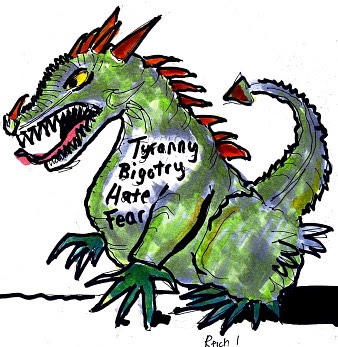
Miller and Trump want to fuel bigotry. Like dictators before him, Trump’s road to tyranny is paved with stones hurled at “them.” His entire project depends on hate.

America is better than Trump or his chief bigot. 

We won’t buy their hate. To the contrary, we’ll call out bigots. We won’t tolerate intolerance. We’ll protect hardworking members of our community. We’ll alert them when ICE is lurking.

We will not succumb to the ravings of a venomous president who wants us to hate each other — or his bigoted sidekick.

Heather Cox Richardson reviews the events of the weekend. One update: the Vice President of Venezuela, Delcy Rodriguez, initially gave a defiant speech declaring that Maduro was still the President of Venezuela. But she later remarked that the best response to the new situation was to be “cooperative,” implying that she has had conversations with Rubio and has agreed to hold Venezuela together by remaining in office. Her statement late Sunday included this: “We extend an invitation to the U.S. government to work together on a cooperation agenda, oriented toward shared development, within the framework of international law, and to strengthen lasting community coexistence.”

Trump and Marco Rubio may have learned a lesson from our disastrous invasion of Iraq, where U.S. forces removed everyone–civilian and military– associated with Saddam Hussein, who built a powerful resistance. Apparently they intend to “run” Venezuela by using the current regime to do their bidding.

Most frightening fact about this event is that Trump and his close associates believe they can take military action anywhere in the world without consulting Congress, as the Constitution requires. They treat Congress and the Constitution as useless appendages, not worthy of even a nod. So long as the Republicans who control Congress accept Trump’s disdain, they may as well go home and stop pretending that they matter.

Trump said after Maduro’s removal that he’s still determined to take Greenland away from Denmark, because we need it for our “national security.” Rubio issued a warning to Cuba, implying that it was in our sights. Trump is now reveling in the successful capture of Maduro and Venezuela. Who’s next?

Richardson wrote:

Secretary of State Marco Rubio took the administration’s message about its strikes on Venezuela to the Sunday talk shows this morning. It did not go well.

Asked by George Stephanopoulos of ABC’s This Week under what legal authority the U.S. is going to run Venezuela, as President Donald J. Trump vowed to do, Rubio served up a lot of words but ultimately fell back on the idea that the U.S. has economic leverage over Venezuela because it can seize sanctioned oil tankers. Seizing ships will give the U.S. power to force the Venezuelan government to do as the U.S. wants, Rubio suggested. This is a very different message than Trump delivered yesterday when he claimed that the people standing behind him on the stage—including Rubio—would be running Venezuela.

When Stephanopoulos asked Rubio if he was, indeed, running Venezuela, Rubio again suggested that the U.S. was only pressuring the Venezuelan government by seizing sanctioned oil tankers, and said he was involved in those policies. When Kristen Welker of NBC’s Meet the Press also asked if Rubio was running Venezuela, Rubio seemed frustrated that “People [are] fixating on that. Here’s the bottom line on it is we expect to see changes in Venezuela.” Historian Kevin Kruse commented: “Yeah, people are fixating on a Cabinet Secretary being given a sovereign country to run because the president waged war without congressional approval and kidnapped the old leader. Weird that they’d get hung up on that.”

When Stephanopoulos asked why the administration thought it didn’t need congressional authorization for the strikes, Rubio said they didn’t need congressional approval because the U.S. did not invade or occupy another country. The attack, he said, was simply a law enforcement operation to arrest Maduro. Rubio said something similar yesterday, but Trump immediately undercut that argument by saying the U.S. intended to take over Venezuela’s oil fields and run the country.

Indeed, if the strikes were a law enforcement operation, officials will need to explain how officers managed to kill so many civilians, as well as members of security forces. Mariana Martinez of the New York Times reported today that the number of those killed in the operation has risen to 80.

Rubio highlighted again that the Trump administration wants to control the Western Hemisphere, and he went on to threaten Cuba. Simon Rosenberg of The Hopium Chronicles articulated the extraordinary smallness of the Trump administration’s vision when he wrote: “We must also marvel at the titanic idiocy of our new ‘Donroe Doctrine’ for it turns America from a global power into a regional one by choice. I still can’t really believe they are going through with this for it is so batsh*t f-ing crazy, and does so much lasting harm to our interests.”

Shortly after Trump told reporters yesterday that Venezuela’s former vice president, now president, Delcy Rodríguez is “essentially willing to do what we think is necessary to make Venezuela great again,” Rodríguez demanded Maduro’s return and said Venezuela would “never again be a colony of any empire, whatever its nature.” Indeed, U.S. extraction of Maduro and threats to “run” Venezuela are more likely to boost the Maduro government than weaken it.

In a phone call today with Michael Scherer of The Atlantic, Trump threatened Rodríguez, saying that “if she doesn’t do what’s right, she is going to pay a very big price, probably bigger than Maduro.” Tonight on Air Force One, Trump told reporters that the U.S., not Rodríguez, is in charge of Venezuela.

Trump also told Scherer that he does indeed intend to continue to assert U.S. control in the Western Hemisphere, telling Scherer that “we do need Greenland, absolutely. We need it for defense.” Greenland is part of the North Atlantic Treaty Organization (NATO), meaning it is already part of U.S. national defense.

Although he ran for office on the idea of getting the U.S. out of the business of foreign intervention, Trump embraced the idea of regime change in Venezuela, telling Scherer: “You know, rebuilding there and regime change, anything you want to call it, is better than what you have right now. Can’t get any worse.” He continued: “Rebuilding is not a bad thing in Venezuela’s case. The country’s gone to hell. It’s a failed country. It’s a totally failed country. It’s a country that’s a disaster in every way.”

At Strength in Numbers, G. Elliott Morris noted that military intervention in Venezuela is even more unpopular with the American people “than Trump’s tariffs and health care cuts.” In September, only 16% of Americans wanted a “U.S. invasion of Venezuela,” with 62% against it. A December poll showed that 60% of likely voters opposed “sending American troops into Venezuela to remove President Maduro from power.” Only 33% approved. Even support for strikes against the small boats in the Caribbean could not get majority support: 53% opposed them while only 42% approved.

“By the time American forces touched Venezuelan soil early Saturday morning,” Morris writes, “Trump had already lost the public.”

But officials in the administration no longer appear to care what the American people want, instead simply gathering power into their own hands for the benefit of themselves and their cronies, trusting that Republican politicians will go along and the American people will not object enough to force the issue. The refusal of the Department of Justice to obey the clear direction of the Epstein Files Transparency Act seems to have been a test of Congress’s resolve, and so far, it is a gamble the administration appears to be winning.

Morris notes that a December CBS poll showed that 75% of Americans, including 58% of Republicans, correctly believed a president must get approval from Congress before taking military action against Venezuela. The president did not get that approval. By law, the president must inform the Gang of Eight before engaging in military strikes, but if an emergency situation prevents that notification, then the president must inform the Gang of Eight within 48 hours. The Gang of Eight is made up of the top leaders of both parties in both chambers of Congress, as well as the top leaders from both parties on the House and Senate Intelligence Committees.

Representative Jim Himes (D-CT) who as ranking member of the House Intelligence Committee is a member of the Gang of Eight, told CBS’s Margaret Brennan this morning that neither he nor House minority leader and fellow Gang of Eight member Hakeem Jeffries (D-NY) had been briefed on the strikes. Himes said: “I was delighted to hear that Tom Cotton, chairman of the Senate Intelligence Committee, has been in regular contact with the administration. I’ve had zero outreach, and no Democrat that I’m aware of has had any outreach whatsoever. So apparently we’re now in a world where the legal obligation to keep the Congress informed only applies to your party, which is really something.”

Senate minority leader Chuck Schumer (D-NY)—also a member of the Gang of Eight—told reporters that he hadn’t been briefed either and that the administration had deliberately misled Congress in three classified briefings before the strikes. In those briefings, officials assured lawmakers that the administration was not planning to take military action in Venezuela and was not pursuing regime change. “They’ve kept everyone in the total dark,” he said.

Nonetheless, Himes told Brennan that he thought Trump’s Venezuelan adventure would not go well: “We’re in the euphoria period of…acknowledging across the board that Maduro was a bad guy and that our military is absolutely incredible. This is exactly the euphoria we felt in 2002 when our military took down the Taliban in Afghanistan in 2003, when our military took out Saddam Hussein, and in 2011, when we helped remove Muammar Gaddafi from power in Libya. These were very, very bad people, by the way, much, much worse than Maduro and Venezuela, which was never a significant national security threat to the United States. But we’re in that euphoria phase. And what we learned the day after the euphoria phase is that it’s an awful lot easier to break a country than it is to actually do what the president promised to do, which is to run it…. [L]et’s let my Republican colleagues enjoy their day of euphoria, but they’re going to wake up tomorrow morning knowing what? My God, there is no plan here any more than there was in Afghanistan, Iraq, or in Libya.”

Representative Ted Lieu (D-CA) was more direct: “The U.S. attack on Venezuela is illegal,” he posted. “Congress never authorized this use of military force. I will vote to stop it. This is insane. Health care costs and food prices are surging. Trump’s response is we’re going to run another country. Batsh*t crazy.”

Jeff Bryant, a veteran education journalist, dissects he plan to destroy public schools. Governor Ron DeSantis and the Legislature has unleashed the for-profit vultures to pick the bonds and funds of the state’s public schools. Not because the charges are better schools, but because the rightwingers have close ties to members of the legislature. Want to open a charter school? Want the state to pay all your expenses? Come on down to the Sunshine State!

This article was produced by Our Schools. Jeff Bryant is a writing fellow and chief correspondent for Our Schools. He is a communications consultant, freelance writer, advocacy journalist, and director of the Education Opportunity Network, a strategy and messaging center for progressive education policy. His award-winning commentary and reporting routinely appear in prominent online news outlets, and he speaks frequently at national events about public education policy. Follow him on Bluesky@jeffbinnc.

The letters started coming in October 2025. In the first wave, according to the Florida Policy Institute (FPI), “at least 22 school districts in Florida” got letters alerting them that charter school operators, including a for-profit charter school management company based in Miami, intended to use a state law recently enacted to open new charter schools on the campuses of existing public schools beginning August 2027.

In Broward County, a South Florida district that includes Fort Lauderdale, the Mater Academy charter school chain, operated by for-profit charter management company Academicaclaimed space in 27 public schools. Mater Academy claimed space in nearly 30 schools in Hillsborough County, home to Tampa Bay, “along with more than a dozen [schools] in Pinellas [County] and six in Pasco [County],” Tampa Bay Times reported. In Sarasota County, Mater claimed space in three public school campuses.

At least two more charter chains—New York-based Success Academy and New Jersey-based KIPP NJhave joined in the campaign.

“So far, 480 schools in 22 counties have received 690 ‘letters of intent’ from charter school organizations expressing their intent to occupy space in public school buildings,” FPI’s Norin Dollard told Our Schools in late November. When schools receive letters from multiple charter organizations, it’s first come, first served, she explained, and the timeline for schools to respond is incredibly short—just 20 days.

Once the charter occupies part of the public school, Dollard explained, it operates rent free, and the public school district becomes responsible for much of the charter’s costs, including those for services charters don’t customarily provide, such as bus transportation and food service, as well as costs for school support services like janitorial, security, library, nursing, and counseling. Even any construction costs the charters might incur have to be covered by the public school.

This new law will force some public schools to convert to charter schools, said Damaris Allen, “and that’s intentional.” Allen is the executive director of Families for Strong Public Schools, a public schools advocacy organization that is rallying opposition to the law.

The letters have caught the attention of national news outlets, including the Washington Post, which reported, “The Florida law is an expansion of a state program called ‘Schools of Hope,’ which was set up to allow certain charters to operate in areas with low-performing local public schools. The new law allows ‘Schools of Hope’ operators to take over space at any public school that’s under capacity, regardless of whether it is high- or low-performing.”

“The expansion of the Schools of Hope idea has been on a slippery slope,” Dollard explained, “much like school vouchers have been in the state.” Originally, in 2017, schools identified for Schools of Hope transition from public governance to charter management were very narrowly defined as persistently underperforming schools. That changed in 2019 when the legislature altered the definition of low-performing to target more schools and added schools in so-called opportunity zones—government-designated areas selected for economic development—as open territory for charters. Now, the new law allows charter schools to take over “underused, vacant, or surplus” space in traditional public schools and operate free of charge.

As the reach of the Schools of Hope idea morphed, so did its rationale. According to a 2025 op-ed by former Florida Governor Jeb Bush, the program was originally conceived as an “initiative that incentivizes high-quality charter operators to open schools for students trapped in failing ones.” The aim now, according to Bush, is to solve the “problem” of underutilized space in existing public schools.

With school enrollments in steep decline in nearly every district in the state, fear of a potential mass charter school industry takeover of public school spaces—along with the costs local districts will incur—looms over district leaders across the state and strikes them as a clear existential threat.

Other consequences of colocating more charters in public schools have not been well-thought-out, according to Allen. For instance, on the issue of school safety, public schools have undertaken a number of measures to protect against school shootings, such as converting buildings to single-point entry. Charter schools don’t have to do that. So what happens when a charter operation moves into a building and doesn’t comply with the single-point entry? Also, the state legislature created new rulesfor public school libraries in 2022. Charters don’t have to follow those rules. How is that going to work in a colocation?

Allen fears the daunting challenges of charter colocations will cause some school boards and communities to sell school buildings or convert them to district-operated charters rather than give in to charter schools run by outside, for-profit companies.

And while proponents of Florida’s Schools of Hope program see it as a way to expand education options for students and families, critics point to evidence that Florida charter schools, which one expert called “a shitstorm,” need stricter oversight rather than a free rein. And, regardless of the outcomes, they warn that the idea is sure to get promoted as an “education innovation” that other Republican-dominated states will likely adopt.

A warning sign, not a model

When Nancy Lawther, a retired college professor of French, got involved in public schools advocacy, she became very skeptical about the oft-told narrative about the need for more education options because “too many poor children are trapped in failing public schools.” After all, in Dade County, Miami, where she lives, the public system has an A rating by the state despite having a challenging student population that is overwhelmingly Hispanic, with many living in households earning less than the state’s median income.

Her skepticism only increased when she first heard about expanding the Schools of Hope program to more schools, especially when she saw the results from the first schools taken over.

The original “Schools of Hope” weren’t individual schools; it was a whole district. In 2017, the Jefferson County school board voted in favor of participating in a pilot project for the new Schools of Hope initiative. The board’s approval to join the pilot meant that the district was required to turn over the management of their schools to a “high-performing” charter management company, which, in this case, happened to be Somerset Academy, another charter chain managed by the for-profit Academica management company.

But the results of the pilot would be a warning sign about the abilities of charter management firms to improve the education outcomes of public schools. As a 2025 op-ed for the Orlando Sentinel recounted, “[T]axpayers saw higher costs, stagnant results, and constant staff churn. By 2022, the takeover collapsed. Local leaders called it ‘an absolute disaster.’ The state had to step in with a $5 million bailout just to get the district running again.”

A 2024 account of the pilot in the Tallahassee Democrat reported, “[F]rom 2017 to 2022,… [Jefferson County] remained troubled by students’ lagging academic performance and mounting disciplinary issues, like fighting that in one case led to the arrest of 15 students. … [And] the school district was still getting a D grade” from the state.

Nevertheless, after Florida lawmakers expanded the Schools of Hope program in 2019, which has cost more than $300 million as of 2025, “There are only about a dozen Schools of Hope in Florida. In 2024, eight of them got C or D grades,” pointed out the Bradenton Times.”

‘All about market share’

Given its track record of failure, Lawther suspects that expanding Schools of Hope has nothing to do with improving education outcomes or making better use of publicly funded school buildings.

Indeed, Sarasota County, one of the districts targeted for charter colocations, has been an A-rated system since the state created the grading system in 2004, according to the district website.

Also, in districts where there are enrollment slides, there are few signs that demand for charters will soak up excess building capacity. According to a 2025 analysis of Sarasota County by Suncoast Searchlight, “The number of charter schools has grown in recent years, but the share of students at charters has not shifted much.” And building utilization rates of the different sectors are nearly identical—82 percent for public schools and 84 percent for charters, WUSF stated. “Some of the lowest-performing charters are barely a third full.”

Mater Academy, the charter operator using the Schools of Hope law to claim space in Sarasota public schools, does not currently operate a school in the district.

“This is all about market share,” Lawther said. “It’s about getting an advantage over charter operators that are not Schools of Hope providers, and independent charters that can’t compete in a market geared to the large chains,” like those operated by Academica.

Further, while enrollments in Florida charter schools continued to grow, it has shown signs of slowing down—from 3.7 percent in 2024 to 2.6 percent in 2025—and the number of charter schools decreased, from 739 in 2023-2024 to 732 in 2024-2025.

Also, the charter industry in the state faces many more privately-operated competitors. “Expansions of voucher programs are creating a more competitive market for charter schools,” Lawther noted, “and private schools, microschools, and homeschooling are growing forms of school choice.”

Indeed, charter schools no longer appear to be the fastest-growing form of school choice in the state.

After the Republican-led Florida legislature passed a bill in 2023 that did away with income requirements for families to receive state-sponsored school vouchers, the share of state funding diverted from the public system—which, technically, includes charters—to private schools and homeschooling doubled from 12 percent in 2021 to 24 percent in 2025, WUSF reported. In the school year 2023-2024, the number of vouchers, often called “scholarships,” given out to help families pay for private school tuition and homeschooling increased by approximately 142,000 students, according to Next Steps, a school choice advocacy group.

Florida has also experienced a 46 percent increase in homeschooling over the past five years, WEAR statedin 2025. And the state has freed up 50,000 new community facilities to serve as microschools, according to the Center for American Progress.

It would seem that in this increasingly competitive education landscape, the Florida charter school industry could use a new competitive angle like the one offered by Schools of Hope. “Officially, charter school advocates say Schools of Hope is an amazing opportunity to expand parent choice,” Dollard said, “but unofficially, this is an incredibly lucrative business opportunity.”

An industry in decline?

The charter school industry’s desire for new business strategies that enable charter operators to seize public school classrooms—or even whole buildings—is not confined to Florida.

In Indiana, for years, public school districts have been required to notify the state, within 10 days, when one of their buildings becomes vacant and to make the building available to lease to a charter school for $1 per year or sell the building to a charter operator outright for $1.

In Ohio’s 2025 approved budget, a new provision allows the state to force school districts to close some public school buildings and sell those properties to charter or private schools “at below market value,” Ideastream Public Media reported.

Arkansas is also likely to adopt a Schools of Hope-like measure, Allen speculated, because its state secretary of education Jacob Oliva served in Florida. Oliva was Florida’s state education chancellor during the failed Schools of Hope pilot in Jefferson County.

One market condition that’s likely behind these increasingly aggressive charter school industry is land grab, as revealed in a 2025 analysis by the National Center for Charter School Accountability (NCCSA). According to the report, charter school closings have been accelerating nationwide, while the pace of new charter openings has slowed significantly during the same time.

“[T]he 2023-24 school year saw just 12 more open charter schools than during the previous year,” the report found. This is “a dramatic departure” from the heydays of industry growth when “[t]he number of charter schools increased by 421” between 2010 and 2011.

Charter school enrollment growth has also stalled, according to the report, increasing by 0.1 percentage point—from 7.5 percent to 7.6 percent of total charter enrollment—between 2020 and 2023.

In the most recent school years, based on official data from 2022-2023 and 2023-2024, NCCSA found, “Most states experienced declines or stagnation [in charter school market share], and preliminary indicators suggest that, once the 2024 data is finalized, the trend will likely worsen.”

North Carolina offers a clarifying example of the significant headwinds that the charter school industry now faces.

In the Tar Heel state, charter schools have enjoyed widespread support among state lawmakers and private investors. The state legislature has made dramatic changes to state laws regarding charters, including loosening regulations and fast-tracking approval of new schools. And a 2024 analysis by the Charlotte Observer found “at least $279 million in private equity investments in North Carolina charter schools since 2013.”

Despite this support, the number of charter schools in North Carolina declined in 2024-2025, from 211 to 208 in 2023-2024, according to an industry spokesperson. And many of the newest charter schools to open in the state have not fared well. “State data show that only about 26 percent of new charter schools in the past five years met or exceeded their enrollment projections,” NC Newsline reported, “and more than half of those that missed the mark are now closed or never opened.”

The report’s findings revealed that although charters tend to locate in low-income neighborhoods, they serve far fewer children from low-income families, fewer children who are English learners, and fewer children with disabilities, resulting in leaving traditional public schools with elevated needs and higher costs.

Critics of the Schools of Hope law noted that these industry shifts, as well as a historical tendency for education policies enacted in Florida to get picked up in other Republican-dominated states, will spur other states to adopt similar policies, regardless of any evidence that they might harm public schools.

“More generally,” Baker added, “Florida charter schools are a shitstorm, both underserving higher need populations and underperforming with those they do serve.”

‘A shitstorm’

Among the critics of Florida’s Schools of Hope legislation is Bruce Baker, a professor and chair of the department of teaching and learning at the University of Miami and an expert on charter schools and public school finances.

“I’m, of course, deeply concerned with granting preferential access to any charter operator, at the expense of a fiscally strapped school district,” Baker wrote in an email. “I’m more concerned when it may present a slippery slope regarding control over land and buildings that should—by the [state] constitution, which supersedes this regulatory change—be solely under the authority of the local boards of education elected by the taxpayers who financed those facilities and continue to maintain them. It becomes even more problematic if this eventually creates an avenue to transfer ownership. That would be a particularly egregious violation of local board authority and private taking of public assets. We aren’t there yet, but it’s a concern.”

Baker’s assessment of charter schools in the Sunshine State is evident in his 2025 report, which looks at the impacts of the industry on school funding adequacy, equity, and student academic outcomes across the state, and, more specifically, in the Miami-Dade district.

Also, charters, despite having an advantage of educating less challenging and less costly student populations, underperform public schools on state assessments while “serving otherwise similar student populations.” This finding holds statewide and in Miami-Dade.

The report concludes that Florida charters are “compromising equity, eroding efficiency, and producing poor educational outcomes for those it serves.”

Given these findings, the report recommends that state lawmakers “[i]mpose a moratorium on charter school expansion, including the Schools of Hope Program.” It also calls for “new regulations for evaluating existing charter operators,” stronger vetting of new charter operators, and stricter enforcement of regulations about charter school student outcomes.

Schools of nope

Several district school superintendents across Florida have urged their communities to oppose the state’s Schools of Hope charter school expansion in public school buildings. When the state’s current education commissioner defended the Schools of Hope law in his address at a 2025 conference for school board members and district leaders and suggested it could be used to shut down whole districts, the audience roundly booed him.

Grassroots groups such as Families for Strong Public Schools have held events to educate the public about the negative impacts of charter colocations. A coalition that includes the United Teachers of Dade, NAACP Miami-Dade Branch, the Miami-Dade County Council of PTA/PTSA, and others has formed to protest charter colocations. And a senator in the state legislature has introduced a bill to repeal the Schools of Hope expansion.

Much of the opposition has rallied under the banner of “Schools of Nope” and is organizing call-ins and an email campaign targeting state legislators.

Opposition organizers like Damaris Allen see this as a do-or-die moment in the state. “Either we win this fight, or it’s the death of public schools in Florida,” she said.

The National Trust for Historic Preservation, a private nonprofit tasked by Congress with helping preserve historical buildings, sued the Trump administration for tearing down the East Wing of the White House and asked a federal judge for an emergency stop-work order. The judge did not stop work on the new ballroom, but he did order the White House to get approval from the necessary agencies.

In his eagerness to build his gigantic ballroom, Trump bypassed the normal review process for making changes to a historic building.

Trump knew that if he went through the legally-required process, it would take years to get the necessary approvals, and some busybody preservationists might tell him to scale back his grand plans. The new ballroom–at 95,000 square feet– will be almost double the size of the entire White House–which is 55,000 square feet.

So he followed his personal motto: “Stop me if you can.”

Without asking permission he demolished the East Wing. It is gone, finished.

Now he will take his plans to the National Capital Planning Commission, which will hold hearings starting January 8.

Ordinarily, the NCPC review is rigorous and involves multiple hearings before a shovel touches the ground, reviewing esthetic and environmental issues.Trump expects to get done in a few months what customarily takes years of review before any work begins.

The 12-member NCPC will not pose a problem. The Washington Post reported:

The NCPC is led by Will Scharf, the White House staff secretary and Trump’s former personal lawyer, whom the president appointed as commission chair in July, and its members tilt toward Trump. The president appointed two other White House officials to the body, and the commission also includes nine seats apportioned to sitting Cabinet secretaries and other local and federal officials.

Trump’s grandiose plan must also win the approval of the U.S. Commission on Fine Arts. That should not be a problem either, because in October, Trump fired all six members of the Commission. That Conmission (if Trump has appointed new members) will review the proposed ballroom that will replace the East Wing and also Trump’s plan to build an Arc d’Trump.

It’s clear sailing with no dissents anticipated.

This is an important development. Our nation needs at least two sensible political parties. A two-party system with vigorous third parties is healthy for our democracy.

When one of our two major parties is captured by an extremists cult, it’s a very bad sign. When that cult revels in cutting ties with our historic allies, in brutalizing immigrants and even citizens who look like immigrants (brown skin color), in sending troops to American cities, in killing people on boats that might or might not be transporting drugs instead interdicting them, in abandoning civil rights laws, and in treating the president as a king to be obeyed and worshipped, that cult is not a normal participant in American politics because it is not bound by the Constitution.

Thus, in my opinion, it is very good news that sane conservatives are abandoning the Heritage Foundation–whose leader was the architect of Project 2025–and joining forces with Mike Pence.

Pence is a conservative through and through, and I disagree with him on most issues. But in 2020, he refused Trump’s direct order to join the insurrection by refusing to certify Biden’s election. Pence certified Biden’s election and was reviled by MAGA for following the Constitution, not Trump. They chanted “Hang Mike Pence” on January 6, 2021, and even built a scaffold outside the U.S. Capitol. Trump shrugged with indifference, and the mob searched for Pence.

Politico wrote about the splintering at the Heritage Foundation.

More than a dozen staffers at The Heritage Foundation are leaving the conservative think tank to join a nonprofit led by former Vice President Mike Pence as the embattled organization continues to reel from ongoing turmoil.

Advancing American Freedom — founded by Pence in 2021 “to defend liberty and advance policies that build a stronger America” — announced Monday that three senior officials who led the legal, economic and data teams at Heritage would be joining the group next year, along with several members of their teams.

This is good news for the conservative Republican Party and good news for our democracy. Genuine conservatives can’t abide the extremism of MAGA.

I’ll be watching to see what Liz Cheney and Adam Kinzinger do in the future.

I’m confused. Yesterday afternoon, the U.S. Supreme Court ruled that Trump could not send the National Guard to Chicago. Okay.

But a few minutes later, he mobilized the Louisiana National Guard and ordered it to New Orleans, where serious crime is declining. Jeff Landry, the Republican Governor of Louisiana, was delighted that Trump was sending in the Guard.

Questions:

If the president can’t send the Guard to Chicago, why can he send it to New Orleans?

If Governor Landry thought that New Orleans needed the National Guard, why didn’t he mobilize them himself? Maybe it’s because the federal government will pay part of the costs. But if the need was urgent, it seems the Governor would have acted without delay.

Answers?