I have frequently criticized Bill Gates for his half-baked efforts to “reform” American public schools, all of which have done terrible damage to the schools.
Now Elon Musk is sticking his nose into elections in other countries, and Bill Gates is calling him out.
Bill Gates doesn’t like how Elon Musk has involved himself in the politics of foreign countries such as the UK and Germany.
“It’s really insane that he can destabilize the political situations in countries,” Gates said in an interview with the UK newspaper The Times published Saturday.
Musk has become increasingly vocal about his views on UK and German politics in recent weeks.
Earlier this month, Musk called for the removal of British Prime Minister Keir Starmer. The TeslaCEO accused Starmer of not doing enough to prevent the rape of girls when he was Britain’s chief prosecutor from 2008 to 2013.
And on Saturday, Musk spoke virtually at a campaign rally for the Alternative for Germany, Germany’s far-right party. Germany is set to hold national elections in February.
In December, Musk said in an op-ed for Welt am Sonntag, a prominent German newspaper, that the AfD was “the last spark of hope for this country.” He also praised the party for its “controlled immigration policy.”
“I think in the US foreigners aren’t allowed to give money. Other countries maybe should adopt safeguards to make sure superrich foreigners aren’t distorting their elections,” Gates told The Times.
Musk’s political influence has increased significantly following President Donald Trump‘s victory in November. Musk spent at least $277 million backing Trump and other GOP candidates in last year’s elections.
That bet has since paid off for Musk, who called himself Trump’s “first buddy.” The billionaire has joined Trump on calls with world leaderssuch as Turkish President Tayyip Erdogan.
Gates previously criticized Musk for his obsession with going to Mars. Gates said he would rather spend money on vaccines than on rockets. Go, Bill!
If only WE had laws limiting the contributions of billionaires to political campaigns!
Governor Gavin Newsom has been fighting a two-front war: the devastating fires in Los Angeles and the massive amount of disinformation about the state’s efforts.
One widespread rumor is that Governor Newsom cut the state’s firefighting budget by $100 million in the year before the LA fires.
Politifact reviewed the facts. As usual, it’s complicated. Newsom did cut the fire budget by $100 million at the same time that the overall fire budget increased. If you want to see how this happened, read the report in full.
Here is the conclusion.
Cal Fire’s budget and spending have grown
Cal Fire’s total base wildfire protection budget has nearly tripled over the past 10 years (from $1.1 billion in 2014‑15 to $3 billion in 2023‑24), according to a March analysis by the Legislative Analyst’s Office before the 2024-25 budget was approved.
Cal Fire’s overall budget also has increased, with its combined budget for fire protection, emergency fire suppression, resource management and fire prevention more than doubling over the past 10 years from $1.7 billion in 2014‑15 to $3.7 billion in 2023‑24. (Newsom’s office sent us similar information showing budget increases.)
The number of staff members working in fire prevention have similarly grown during that same decade rising from 5,756 to 10,275.
Another way to look at Cal Fire is through expenditures rather than the budgeted amount because it’s not unusual for the state to dip into other pots of money to spend more than budgeted for addressing fires.
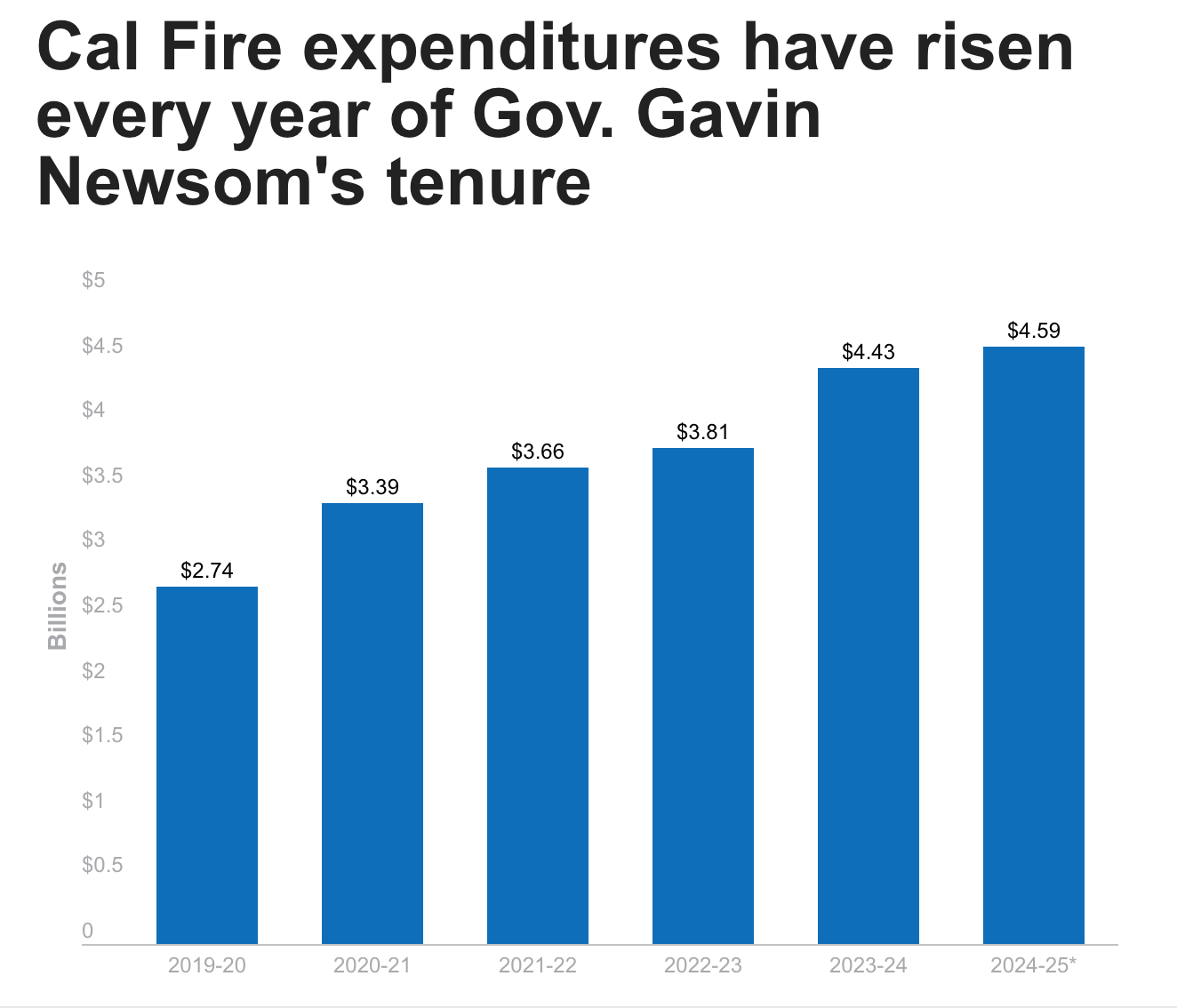
The legislative analyst’s office estimated total Cal Fire expenditures have risen during Newsom’s tenure:
* The 2024-25 amount does not yet reflect additional costs being incurred for the current Los Angeles-area wildfires.
Source: California Legislative Analyst’s office estimate, not adjusted for inflation, provided to PolitiFact
When I worked in George H.W. Bush’s administration from 1991-92 as Assistant Secretary of Education, I quickly learned about the importance of the Department’s Inspector General. He or she is nonpolitical, a guardian of the Department’s integrity, a watchdog. The IG is a crucial safeguard against corruption. Trump fired a bunch of them Friday night.
He acts as though he is a king or a dictator and the laws do not apply to him.
We have all earned a break for this week, but as some of you have heard me say, I write these letters with an eye to what a graduate student will need to know in 150 years. Two things from last night belong in the record of this time, not least because they illustrate President Donald Trump’s deliberate demonstration of dominance over Republican lawmakers.
Last night the Senate confirmed former Fox News Channel weekend host Pete Hegseth as the defense secretary of the United States of America. As Tom Bowman of NPR notes, since Congress created the position in 1947, in the wake of World War II, every person who has held it has come from a senior position in elected office, industry, or the military. Hegseth has been accused of financial mismanagement at the small nonprofits he directed, has demonstrated alcohol abuse, and paid $50,000 to a woman who accused him of sexual assault as part of a nondisclosure agreement. He has experience primarily on the Fox News Channel, where his attacks on “woke” caught Trump’s eye.
The secretary of defense oversees an organization of almost 3 million people and a budget of more than $800 billion, as well as advising the president and working with both allies and rivals around the globe to prevent war. It should go without saying that a candidate like Hegseth could never have been nominated, let alone confirmed, under any other president. But Republicans caved, even on this most vital position for the American people’s safety.
The chair of the Senate Armed Services Committee, Roger Wicker (R-MS), tried to spin Hegseth’s lack of relevant experience as a plus: “We must not underestimate the importance of having a top-shelf communicator as secretary of defense. Other than the president, no official plays a larger role in telling the men and women in uniform, the Congress and the public about the threats we face and the need for a peace-through-strength defense policy.”
Vice President J.D. Vance had to break a 50–50 tie to confirm Hegseth, as Republican senators Lisa Murkowski of Alaska, Susan Collins of Maine, and Mitch McConnell of Kentucky joined all the Democrats and Independents in voting no. Hegseth was sworn in early this morning.
That timing mattered. As MSNBC host Rachel Maddow noted, as soon as Senator Joni Ernst (R-IA), whose “yes” was secured only through an intense pressure campaign, had voted in favor, President Trump informed at least 15 independent inspectors general of U.S. government departments that they were fired, including, as David Nakamura, Lisa Rein, and Matt Viser of the Washington Post noted, those from “the departments of Defense, State, Transportation, Labor, Health and Human Services, Veterans Affairs, Housing and Urban Development, Interior, Energy, Commerce, and Agriculture, as well as the Environmental Protection Agency, Small Business Administration and the Social Security Administration.” Most were Trump’s own appointees from his first term, put in when he purged the inspectors general more gradually after his first impeachment.
Project 2025 called for the removal of the inspectors general. Just a week ago Ernst and her fellow Iowa Republican senator Chuck Grassley co-founded a bipartisan caucus—the Inspector General Caucus—to support those inspectors general. Grassley told Politico in November that he intends to defend the inspectors general.
Congress passed a law in 1978 to create inspectors general in 12 government departments. According to Jen Kirby, who explained inspectors general for Vox in 2020, a movement to combat waste in government had been building for a while, and the fraud and misuse of offices in the administration of President Richard M. Nixon made it clear that such protections were necessary. Essentially, inspectors general are watchdogs, keeping Congress informed of what’s going on within departments.
Kirby notes that when he took office in 1981, President Ronald Reagan promptly fired all the inspectors general, claiming he wanted to appoint his own people. Congress members of both parties pushed back, and Reagan rehired at least five of those he had fired. George H.W. Bush also tried to fire the inspectors general but backed down when Congress backed up their protests that they must be independent.
In 2008, Congress expanded the law by creating the Council of Inspectors General on Integrity and Efficiency. By 2010 that council covered 68 offices.
During his first term, in the wake of his first impeachment, Trump fired at least five inspectors general he considered disloyal to him, and in 2022, Congress amended the law to require any president who sought to get rid of an inspector general to “communicate in writing the reasons for any such removal or transfer to both Houses of Congress, not later than 30 days before the removal or transfer.” Congress called the law the “Securing Inspector General Independence Act of 2022.”
The chair of the Council of Inspectors General on Integrity and Efficiency, Hannibal “Mike” Ware, responded immediately to the information that Trump wanted to fire inspectors general. Ware recommended that Director of Presidential Personnel Sergio Gor, who had sent the email firing the inspectors general, “reach out to White House Counsel to discuss your intended course of action. At this point, we do not believe the actions taken are legally sufficient to dismiss” the inspectors general, because of the requirements of the 2022 law.
This evening, Nakamura, Rein, and Viser reported in the Washington Post that Democrats are outraged at the illegal firings and even some Republicans are expressing concern and have asked the White House for an explanation. For his part, Trump said, incorrectly, that firing inspectors general is “a very standard thing to do.” Several of the inspectors general Trump tried to fire are standing firm on the illegality of the order and plan to show up to work on Monday.
The framers of the Constitution designed impeachment to enable Congress to remove a chief executive who deliberately breaks the law, believing that the determination of senators to hold onto their own power would keep them from allowing a president to seize more than the Constitution had assigned him.
In Federalist No. 69, Alexander Hamilton tried to reassure those nervous about the centralization of power in the new Constitution that no man could ever become a dictator because unlike a king, “The President of the United States would be liable to be impeached, tried, and, upon conviction of treason, bribery, or other high crimes or misdemeanors, removed from office; and would afterwards be liable to prosecution and punishment in the ordinary course of law.”
But the framers did not anticipate the rise of political parties. Partisanship would push politicians to put party over country and eventually would induce even senators to bow to a rogue president. MAGA Senator John Barrasso of Wyoming told the Fox News Channel today that he is unconcerned about Trump’s breaking the law written just two years ago. “Well, sometimes inspector generals don’t do the job that they are supposed to do. Some of them deserve to be fired, and the president is gonna make wise decisions on those.”
Newsweek reports that school officials and students in Bridgeport are planning to stand up for their fellow students who are immigrants. Meanwhile, the students are protesting in the best way possible, holding posters that say: “WE ARE ALL ILLEGALS.” The kids are alright.
A school district in Connecticut is defying President Donald Trump‘s order to allow Immigration and Customs Enforcement (ICE) agents to go to sensitive locations.
Bridgeport Public Schools announced on Tuesday guidelines designed to protect students in the event of an attempted raid by ICE agents at any of its schools.
Newsweek has contacted the White House via email for comment outside of normal office hours.
Why It Matters
Trump has begun implementing sweeping immigration reforms and is preparing to target millions of undocumented immigrants. The school district’s stance signals the emergence of grassroots opposition to the administration’s plans to initiate the largest mass deportation operation in U.S. history.
What To Know
Bridgeport Public Schools’ announcement came after the acting director of the Department of Homeland Security (DHS) issued a directive on January 21 ending the policy that ICE agents would not conduct actions in or near “sensitive” areas, such as churches, hospitals or schools.
Interim school superintendent Dr. Royce Avery reaffirmed that the school district’s immigration enforcement guidelines remain in place. Avery said that ICE agents and other government officials are prohibited from entering school buildings, boarding buses or attending school events without prior written approval from the superintendent.
“Every student in Bridgeport, regardless of their immigration status, has the right to feel secure and supported in our schools,” he said.
Avery did not say if any ICE raids were planned in Bridgeport. He added that Bridgeport Public Schools does not collect or store information about students’ immigration status, ensuring their privacy is protected….
What People Are Saying
Interim school superintendent Dr. Royce Avery said in a press release: “I became an educator to advocate for all students, and I will ensure their rights and privacy are upheld. Our schools will remain a safe space where all students can learn, grow, and succeed without fear or discrimination.”
Acting Secretary of Homeland Security Benjamine Huffman said in a statement: “This action empowers the brave men and women in CBP [Customs and Border Protection] and ICE to enforce our immigration laws and catch criminal aliens—including murders and rapists—who have illegally come into our country. Criminals will no longer be able to hide in America’s schools and churches to avoid arrest. The Trump Administration will not tie the hands of our brave law enforcement and instead trusts them to use common sense.”
Janet Murguía, president and CEO of Latino civil rights and advocacy organization UnidosUS, told Newsweek: “Many of the president’s proposed executive orders, however, are strictly punitive measures such as changing enforcement targets to include schools, churches and hospitals, and are designed to inflict pain on the most vulnerable—families, children and even the sick and injured.”
The U.S. Supreme Court announced yesterday that it will rule on whether Oklahoma taxpayers should pay for a religious charter school. The Court has been inching closer to shattering the wall of separation beteeen church and state. Its 6-3 rightwing majority seems to be eager to find a case where they can rule that states that refuse to pay tuition at religious schools are denying freedom of religion.
Is this the case?
If the Court does decide that Oklahoma must pay tuition for students at religious schools, the majority will have to stop claiming that they are Originalists, bound by the original intent of those who wrote the Constitution. It has never been the policy of any state to pay tuition at any religious school. The Supreme Court has issued a long line of decisions that rule against taxpayer responsibility for religious school tuition.
The effects of such a ruling would be to reduce funding for public schools, which enroll 85-90 percent of all students, to promote racial and religious segregation, and to endorse discrimination since religious and private schools are exempt from federal laws requiring the admission of students without regard to race, religion, gender, or disability.
The Supreme Court agreed on Friday to consider a high-profile case that could open the door to allowing public dollars to directly fund religious schools.
The widely watched case out of Oklahoma could transform the line between church and state in education, and it will come before a court whose conservative majority has broadly embraced the role of religion in public life.
The case centers on a proposal for the nation’s first religious charter school, St. Isidore of Seville Catholic Virtual School. The school would be online, and its curriculum would embed religious teachings throughout lessons, including in math and reading classes.
As a charter school, it would be run independently from traditional public schools. But public taxpayer dollars would pay for the school, and it would be free for students to attend.
The question of whether the government can fully finance a religious school has proved especially divisive within the school choice movement and across Oklahoma. Some conservative Christian leaders, including Gov. Kevin Stitt and Ryan Walters, the firebrand state superintendent who has sought to require teaching from the Bible in public schools, have backed St. Isidore’s creation.
They urged the Supreme Court to take up the case, believing the conservative-leaning court would decide in the school’s favor.
A coalition of religious leaders, advocates of public schools and some other state Republicans say the proposal is unconstitutional. Oklahoma’s Republican attorney general, Gentner Drummond, argued it would “open the floodgates and force taxpayers to fund all manner of religious indoctrination, including radical Islam or even the Church of Satan.”
After St. Isidore was approved by a state board in June 2023 in a narrow 3-to-2 vote, the Oklahoma Supreme Court blocked its creation. The justices wrote in a majority opinion that the school would “create a slippery slope” that could lead to “the destruction of Oklahomans’ freedom to practice religion without fear of governmental intervention.”
Still, as more Republican state legislatures move to support school vouchers and other options for parents to use public money to educate their children in private schools, including religious schools, some legal experts believe that charter schools would become another major arena in the debate.
Justin Driver, a professor at Yale Law School, said that a Supreme Court decision that allows religious charter schools “would represent nothing less than a sea change in constitutional law.”
“It is difficult to overstate the significance of this opinion for our constitutional order and the larger American society,” Mr. Driver said.
The case will present new education questions for the U.S. Supreme Court’s 6-to-3 conservative majority, which has shown an openness to religion in the public sphere. Justice Amy Coney Barrett, a member of the conservative bloc, recused herself from the case but did not explain why.
In a 2022 ruling, the court ruled that a high school football coach had the right to pray on the field after his team’s games.
Other recent cases have barred Maine and Montana from excluding religious schools from state tuition programs or scholarships to students in private schools. Chief Justice John G. Roberts Jr. wrote in both cases that states are not required to support religious education, but that those that opt to subsidize private schools cannot discriminate against religious ones.
Supporters of St. Isidore argue that blocking a religious charter school from receiving funding violates the First Amendment’s protection of religious freedom. Jim Campbell, the chief legal counsel for Alliance Defending Freedom, a legal group representing the Oklahoma state charter board, praised the court’s decision to hear the case.
“Oklahoma parents and children are better off with more educational choices, not fewer,” Mr. Campbell said in a statement. “There’s great irony in state officials who claim to be in favor of religious liberty discriminating against St. Isidore because of its Catholic beliefs.”
The school was initially set to open in August and would be managed by the Roman Catholic Archdiocese of Oklahoma City and the Diocese of Tulsa. Leaders of the school say it would accept students of all faiths.
But opponents say that it would run into conflict with the constitutional prohibition on government establishment of religion, infringing on religious freedom. “Converting public schools into Sunday schools would be a dangerous sea change for our democracy,” several organizations, including Americans United for Separation of Church and State, said in a joint statement on Friday.
For decades, the hybrid nature of charter schools — sharing features of both public schools and private institutions — has made it difficult for courts to determine how different education issues should apply to them, according to Preston Green, a professor at the University of Connecticut who studies educational law.
Still, Mr. Green said he believes St. Isidore’s argument “could be very attractive” to the conservative justices — and that if the court ultimately sides with the charter school, “the implications are potentially huge.”
In the movement to remove barriers to funding religious education, “charter schools are really the next frontier,” Mr. Green said. “And it doesn’t end here.”
The article focuses on one community college that they targeted, North Idaho College, which may lose its accreditation, not because of academic or financial problems but because its board is in chaos.
The extremists target all public education. They think education is indoctrination. They think it’s dangerous, even vocational and technical education.
Here are a few illustrative paragraphs:
The charter violations that kicked off this accreditation scandal four years ago never had anything to do with academics. The two-year community college offers a solid education and features the top nursing program in the state. Their finances are stable too. No, NIC might go under because the Board of Trustees has existed in a state of toxicity, chaos, and dysfunction ever since the far right gained a board majority four years ago.
It is difficult to overstate how catastrophic disaccreditation would be for the people of North Idaho. With a price tag 65 percent lower on average than four-year state institutions, community colleges place higher education within reach of the least advantaged Americans; over a third of their students make less than $20,000 per year. At NIC, 57 percent of students receive financial aid. Local businesses depend on the college for employee training on everything from office software to forklift operation. High school students can enroll in dual credit programs, which let students get a head start on their first year of college and allow homeschoolers to obtain official transcripts….
How could this happen? The problem goes far beyond a three-person majority on the trustee board of a small community college. NIC and many other institutions are in danger because, over the last decade and a half, a core group of extremists has slowly taken over the Idaho Republican Party in the same way that a parasitic wasp slowly takes over its host. This required no astroturfing or Koch-fueled cash infusions, just a regular, everyday indifference to hyperlocal politics. The tactic is underway elsewhere, but Idaho got a head start. This crisis is what happens when insurgency bears fruit….
The consequences of that agenda go far beyond NIC’s accreditation crisis. Idaho’s abortion laws are among the strictest in the country; citing difficulty recruiting doctors given the risk of criminalization, two hospitals havealready closed their labor and delivery departments, leaving many rural Idahoans hours from maternal care. Armed militia members have shown up in the children’s section of libraries looking for pornography, and libraries are limiting service due to legislation that holds librarians criminally liable for books deemed inappropriate. Idaho’s primary and secondary schools are literally falling apart; it spends less per student than any other state and ranks 43rd in education quality.
This “parasitic wasp” is at work in other red states.
In October 2020, near the end of his first term, Trump imposed a new classification for career civil servants called Schedule F. It was intended to strip job security from career civil servants so they could be replaced by Trump loyalists. One of Joe Biden’s first actions was to eliminate Schedule F.
Trump pledged during his 2024 campaign to implement Schedule F. He calls the Civil Service “the deep state.” He believes that career bureaucrats slow-walked or impeded some of his most extreme ideas. And he is on his way, with full control of the Executive branch, both Houses of Congress, and (usually) the Supreme Court.
By implementing Schedule F, Trump would gain control of 50,000 jobs that are now held by civil servants. He and his deputies could replace them with MAGA loyalists.
The creation of the Civil Service was considered a very important reform and has been sacrosanct for more than a century. Before the Civil Service Commission was created in 1883, government jobs were handed out based on party affiliation. This was known as “the Spoils System.” The saying went “to the victor goes the spoils.” Win the election and appoint the people of your own party, who will be loyal to you.
Trump wants a return to the Spoils System, so he can appoint Trump loyalists. He wants to turn the clock back more than a century.
The first comprehensive merit-based civil service system was put in place by the Pendleton Civil Service Reform Act of 1883, which created the United States Civil Service Commission. The Act ended the Spoils System by specifying that merit – qualifications measured by testing – is the basis of hiring decisions. For the first time, appointments were open to all citizens, made based on merit, and were given to the best qualified applicants. The Act also protected incumbents from being thrown out of office simply because of a change in the Presidency, providing tenure protection for employees and ensuring their political neutrality. Initially, only about 10.5% of Federal jobs were included in the competitive civil service system. By the end of the century, approximately 42% were included; by the early 1900s, it was over 60%; and by 1952, over 90% of Federal jobs were included in the civil service system.
Merit-based civil service systems followed in the states and at the local level. The first state civil service law was enacted under the leadership of then-Assembly Member Theodore Roosevelt and then-Governor Grover Cleveland in New York in 1883. Teddy Roosevelt also served as a commissioner on the United States Civil Service Commission and was a staunch supporter of the civil service during his presidency, leading to a period of major government expansion and further reforms of the civil service system. Roosevelt is known as the “Father” of modern civil service….
After World War II, the rise of collective bargaining in the public sector and the civil rights movement affected the civil service system, bringing the ideas of Equal Employment Opportunity, affirmative action, and equal pay for equal work into the world of personnel administration. The Civil Rights Act of 1964, Equal Pay Act of 1963, Age Discrimination in Employment Act of 1967, Rehabilitation Act of 1973, and the Americans With Disabilities Act of 1990 all marked the growing inclusiveness of public personnel policies and procedures. These movements clearly spoke to the fundamental civil service ideal that appointments are based on merit established by competitive processes, not on any other factors.
By the 1970s, a new civil service reform movement began with the goal of making civil service more responsive to the personnel needs of executives and managers. While the first reforms begun in the late nineteenth century established the principles of competitiveness and merit, they also created a significant separation between management and personnel administration.
Managers had little control over personnel issues and their day to day operational needs were often stymied by overly restrictive civil service rules. Despite the decentralization of civil service systems during the Roosevelt era, personnel offices still retained significant control and managers continually found there were significant barriers to effectively attracting, retaining, evaluating, disciplining, rewarding, and terminating employees.
The Civil Service Reform Act of 1978 was designed to address these issues at the Federal level. The Act abolished the Civil Service Commission and created the Office of Personnel Management in its place. Agency chief executives were given direct policy control over personnel functions and the purpose of the civil service system moved from a regulatory function to a service orientation in order to better support organizational and leadership efforts.
Civil service processes were streamlined and simplified; the merit system restated and expanded to include an employee’s abilities, education, experience, and job performance; and the emphasis turned to recruitment, career advancement, performance based compensation, and performance appraisal. The Act also created the Senior Executive Service, which is designed to help attract and retain high level senior executives outside of the civil service system. Many of these changes were mirrored at the state and local levels.
This latest reform movement lost momentum under President Reagan during the early 1980s and many of the same concerns brought to light during the 1970s regarding the responsiveness of civil service systems continue to exist today.
The primary goal of the civil service system has been and continues to be to ensure that appointments to government jobs are based on merit and ability as determined through a competitive process. The principles of civil service specify that the most qualified person be appointed to the job; that appointments not be based on any other factors such as political activity or patronage; and that incumbents are protected from the political whims of elected officials. This primary purpose of civil service has remained constant throughout the various historical movements that have changed and shaped civil service over the last 200 years.
Adapted from the website for the U.S. Office of Personnel Management (www.opm.gov) and The New Public Personnel Administration by Nigro, Nigro, and Kelloug
Gary Rayno, veteran journalist in New Hampshire, reports on the Legislature’s pending decision on expanding vouchers. It is astonishing that any state is still considering universal vouchers, in light of what we have learned from the experience of every state that has done so.
We know now that the overwhelming majority of vouchers are used by students already enrolled in private and religious schools. In other words, they are for the most part a subsidy for families already able to pay tuition.
We know now that universal vouchers bust the state budget by offering to pay private school tuition.
We know now (see Josh Cowen’s recent book The Privateers) that when poor kids leave public schools for voucher schools, their academic performance declines, often dramatically.
We know now, based on state referenda, that the public opposes vouchers.
Gary Rayno writes about what’s happening in New Hampshire:
The advocates for opening the state’s school voucher program, Education Freedom Accounts, to all students in the state regardless of their parents’ income did a massive public relations and organization effort before the public hearing last week on House 115, which would remove the salary cap from the four-year old program.
While many parents with their children turned out for the public hearing that needed three rooms in the Legislative Office Building to hold the attendees, the people responding electronically —many posting testimony — on the bill were opposed by a more than four-to-one margin, 3,414-791.
Groups like the Koch Foundation funded by Americans for Prosperity sent out at least three email “urgent” messages to its followers encouraging supporters to attend the public hearing.
Department of Education Commissioner Frank Edelblut sent out a press release the day before the public hearing with the headline “New Hampshire’s cost per pupil continues upward trend,” indicating the state’s average per-pupil cost increased from $20,323 last school year to $21,545 this school year and noting the enrollment has been trending down.
In his press release he also noted the average national cost per pupil at $15,591, while noting that New Hampshire’s largest school districts were the cheapest with Manchester at $17,734, Nashua at $18,270, Bedford at $18,498 and Concord at $23,159, while rural Pittsburg, at the very top of the state, has the highest cost at $44,484.
“The taxpayers of New Hampshire have worked hard to support students, families and our public schools, increasing funding by more than $400 million since 2021, resulting in a record high cost per pupil,” Edelblut said. “New Hampshire remains dedicated to continuing efforts to expand educational opportunities and pathways to help every child succeed in a fiscally responsible approach. The persistent trend of declining student enrollment combined with rising costs creates substantial financial strain on school districts, taxpayers and communities, necessitating new and creative approaches to educating our children in a system that can be sustained over the long term.”
In other words these skyrocketing public education costs cannot be sustained, and efforts like the EFA program is the wave of the future for taxpayers and students, although the program offers no guarantees the state money flowing into the program is being used for what it was intended or wisely by parents.
He does not mention that New Hampshire is either 49th or 50th in financial support for K to 12th grade public education, while cities and towns are picking up over 70 percent of the costs of public education and yet their residents are the ones approving the budgets that increased per-pupil spending.
Edelblut also doesn’t mention that the state downshifted the obligation of hundreds of millions of dollars over the last 15 years to school districts, municipalities and counties when it stopped paying 35 percent of the retirement costs for employees, or that he has failed over the last five years to request additional money for the special education catastrophic aid program although costs have been rising substantially further downshifting millions more in costs to local school districts.
And the public hearing on the bill was held on one of the earliest days in the session, which says the Republican leadership wants to separate this bill from the state budget as much as possible.
A trend of declining revenues, the drying up of the federal pandemic aid and past surpluses, along with the elimination of the interest and dividends tax, which is a huge benefit to the state’s wealthiest residents, and business tax rate cuts will make difficult work for lawmakers and new Gov. Kelly Ayotte, who gives her first budget address next month.
The GOP leadership doesn’t want to discuss the $100 million in new expenses in HB 115 when budget discussions hit snags over what to fund.
During the public hearing, a number of parents brought their children with them to talk about the wonderful things they have been able to accomplish by using the state taxpayer money for alternative education settings.
Many also trashed public schools saying they failed their children although the public schools continue to serve about 90 percent of the state’s students.
Some of the parents noted public schools don’t align with their beliefs or political philosophies, which really says they do not want their children to be exposed to different beliefs or cultures.
David Trumble of Weare noted that some of the private and religious schools don’t take LGBTQ+, special education or English-as-a-second language students.
“There is nothing universal about universal vouchers. The only universal option is the public schools because they accept every single child and give every one of them a good education. That is why you have a constitutional duty to fund them. You have no obligation to fund the private schools,” Trumble told the House Education Funding Committee.
“Our first obligation is to fund the public schools.”
Under the EFA program, 75 percent of the students did not attend public schools when they joined the program, meaning that neither the school districts nor the state was paying for their education, their parents were.
In other states where universal vouchers have been approved almost all of the new money goes to families currently sending their children to private or religious schools or being homeschooled, which is a new expense to those states just as it would be in New Hampshire, where the potential for additional costs is over $100 million annually.
The money for New Hampshire EFA program comes from the Education Trust Fund which also provides almost all of the state education aid to public schools including charter schools.
The trust fund once had over a $200 million surplus, but ended the last fiscal year June 30, 2024 at $159 million, and is projected to drop to $125 million at the end of this fiscal year.
If the bill passes, it won’t be long before money is drained and the squeeze is on public education because of the new education system set up by the legislature that many told the committee last week lacks accountability and transparency.
Many of the people in opposition to the bill said the state first needs to meet its constitutional obligation to pay for an adequate education for the state’s children before setting up any new program costing hundreds of millions of dollars.
But universal vouchers are not only a priority for New Hampshire Republicans, it is a priority at the national level as well.
It continues a movement begun in the late 1950s and 1960s advised by James Buchanan, an economist from the University of Chicago, who was influenced by Frank Knight as was Milton Friedman.
The plan was to both develop more conservative Republicans through the education system and through state legislatures.
One of the targets was public education and reforming it into a private system where if you have the money you can receive a good education, but if you don’t, well too bad.
While the EFA program was touted as helping lower income parents find an alternative education setting for their children who did not fare well in a public education environment, it has essentially been a subsidy program for parents whose children were already in private and religious schools or homeschooled.
Many of the parents speaking in favor of expanding the EFA program said they wanted every child to experience what they experienced.
Rep. Ross Berry, R-Weare, told the committee why should the EFA program be means tested, when public schools don’t require wealthy parents to pay for their children to attend.
That was one of the catch phrases uttered several times during the hearing along with “support for the student not the system.”
Someone had distributed the talking points.
But several opponents noted the program would not help eliminate educational inequity, it would exacerbate it, because a lower-income parent would not be able to afford to send their child to one of the private schools where the average tuition is over $20,000 with a $5,200 voucher, while those already able to send their child to a private school will be able to cut their costs by the same amount.
Once again New Hampshire is a great place to live if you have money, if you don’t, not so much.
The EFA program is part of the push for individual rights over the common good. You see it in education where parents want to remove their child from those who do not have the same beliefs or philosophies, you also see in health care with the establishment of specialty and boutique practices where if you have the money you receive the best care, and in the judicial system where if you have enough money you never have to be accountable for your crimes.
If HB 115 passes, and it probably will, the legislature will have created a situation where the public schools including charter schools will face operating with less state aid, not more as the courts said the state needs, and that will impact many sectors including businesses who will not know if the state has a sufficiently educated workforce or not.
The state should not want businesses asking that question.
Distant Dome by veteran journalist Garry Rayno explores a broader perspective on the State House and state happenings for InDepthNH.org. Over his three-decade career, Rayno covered the NH State House for the New Hampshire Union Leader and Foster’s Daily Democrat. During his career, his coverage spanned the news spectrum, from local planning, school and select boards, to national issues such as electric industry deregulation and Presidential primaries. Rayno lives with his wife Carolyn in New London.
Greg Olear is simply amazing. Read the post here and perhaps you will agree. He is wise, smart, learned, insightful, and inspiring. I know of no other writer who weaves together politics, literature, and history as seamlessly as Olear. He writes at Substack and charges no fee.
Dear Reader,
The great British historian Eric Hobsbawm wrote an indispensable series of books in which he divides the 20 decades after the French Revolution into historical “ages.” The period from the 1789 storming of the Bastille to the uprisings sweeping across Europe in 1848 he termed the Age of Revolution. Eighteen forty-eight until the end of the Great Boom circa 1875 is the Age of Capital. The Age of Empire spanned from the mid-1870s until the start of the Great War in 1914. And the “short twentieth century,” a term he coined, was dubbed the Age of Extremes, and ran from the assassination of the archduke until 1991.
Ever since I discovered his books in 2012, the year of his death, I’ve often wondered what Hobsbawm would have called the fifth historical “age”—the one that began in 1991. That was the year of the first Gulf War, and the banishment from Saudi Arabia of Osama bin Laden that kickstarted his Al Qaeda movement; the mysterious death of Robert Maxwell—friend to the British royal family, mentor to Jeffrey Epstein, business partner of the Russian mobster Semion Mogilevich, and Israeli spy—who fell off his yacht off the coast of the Canary Islands; the repeal of the apartheid laws in South Africa, where Errol Musk made his fortune; the rollout of the WorldWideWeb; and the breakup of the Soviet Union—on Christmas, no less, capitalism’s holiest of holy days.
Today, a mere 24 hours and change before we hand the federal government off to a hateful confederacy of Nazis, mobsters, Opus Dei weirdos, white Christian nationalists, and billionaire dorks, I think I know not only the name of the period after the Age of Extremes, but also its termination date. As I type this, we are living in the last few hours of the Age of Unreality. It ends tomorrow at noon.
Something else happened in 1991, you see—something that likely eluded Eric Hobsbawm. Producers at MTV were developing a TV show that would begin filming in February of 1992. It was called The Real World: New York. It was the first reality TV show—or, at least, the seminal reality TV show of the subsequent reality TV explosion. Riding the reality TV wave was a British producer named Mark Burnett, who would give us Survivor in 2000, and, four years later, what wound up being the most historically significant reality TV show of all time, The Apprentice.
Although I confess to having enjoyed a few seasons of The Surreal Life, back when our eldest son was a baby—Flavor Flav does not disappoint!—I have never liked reality TV shows, encouraging, as they often do, the very worst of human behavior. I don’t like meanness. I don’t like ruthlessness. I don’t like watching anyone being voted off the island. I don’t like when people are fired. I don’t like talentless humans. I don’t like Kardashians. Most of all, I don’t like the unscripted-but-very-much-scripted fluff that has replaced actual shows written by actual writers. By encouraging us to believe in a heavily-retouched fictional universe presented as the real world—or, I suppose, The Real World—reality TV has left us more susceptible to Russian disinformation, to deep fakes, to conspiracy theories, to manufactured media narratives, to tech-bro charlatans, to pseudo-scientific arguments against vaccines, and to mendacious politicians who have supercharged lying to a form of warfare.
I have often grumbled, half in jest, that reality TV would bring about the end of Western civilization. I did not think it would also bring about the end of Western democracy. To paraphrase Don DeLillo: Reality TV has given us Joe Rogan; that alone warrants its doom.
(Is this the real life? Is this just fantasy? Freddie Mercury died in—when else?—1991.)
One of the most significant, world-altering events in this Age of Unreality was, of course, 9/11. In response to the WTC attacks, the FBI shifted its focus from transnational organized crime, which was already operating in the United States and growing more powerful by the day—a genuine threat to our society—to Islamic extremist terrorism, which involved not very many crazy people mostly living in caves far, far away from New York. In response to 9/11, we have to subject ourselves to TSA search before boarding an airplane. In response to 9/11, Bush and Cheney launched a long and expensive war on Saddam Hussein, who had nothing whatsoever to do with the attacks, while simultaneously cutting taxes for their wealthy benefactors—two actions that, in tandem, starved the U.S. treasury and put the country so far into the red that it may never recover. In Britain, meanwhile, Tony Blair’s blind loyalty to Bush—a foreshadowing, perhaps, of Joe Biden’s blind loyalty to Bibi Netanyahu—paved the way for BREXIT and the series of hapless prime ministers that followed the disastrous decision to LEAVE.
Five days after 9/11, Anthony Lane, the New Yorker’s savagely witty film critic, published what remains one of the finest pieces of writing on the attacks, a short essay called “This Is Not a Movie.” I go back and revisit it every once in a while, when the mood strikes me. Reading it now, I see that Lane perfectly articulates the paradox of the Age of Unreality, the uneasy blur between fact and fiction, when he comments on “the degree to which people saw—literally saw, and are continuing to see, as it airs in unforgiving repeats—that day”—that is, September 11, 2001—“as a movie.” He notes that the elapsed time between the initial hijackings and the collapse of the north tower was “a little over two hours;” the length of a summer blockbuster disaster film.
Lane writes:
We are talking…of the indulgence that will always be extended to an epoch blessed with prosperity—one that has the leisure, and the cash, to indulge its fancies, not least the cheap thrill of pretending that the blessing could be wiped out. What happened on the morning of September 11th was that imaginations that had been schooled in the comedy of apocalypse were forced to reconsider the same evidence as tragic. It was hard to make the switch; the fireball of impact was so precisely as it should be, and the breaking waves of dust that barrelled down the avenues were so absurdly recognizable—we have tasted them so frequently in other forms, such as water, flame, and Godzilla’s foot—that only those close enough to breathe the foulness into their lungs could truly measure the darkening day for what it was.
There are echoes of this in the fires that have ravaged Los Angeles. Looking at those horrific images, it is impossible not to describe the fiery scenes as something from a movie—or, rather, a limited series, because, unlike with 9/11, the L.A. fires did not confine themselves to a movie-length running time. They began last Tuesday, almost two full weeks ago, and are still ongoing. If 9/11 was, as Lane suggests, a disaster film come to life, the fires are a combination of disaster film and horror movie: not just the fires themselves but the hundred-mile-an-hour winds and the dread of the fires spreading. Only those close enough to breathe the foulness into their lungs could truly measure the darkening days for what they are. My heart breaks for everyone in L.A., even as I know I can never fully understand their ordeal.
The fires are not a movie, just like 9/11 was not a movie. The fires are all too real.
As a country, we have not even begun to comprehend the extent of the damage, or its impact on all those hundreds of thousands if not millions of people in the Pacific Palisades and Altadena and beyond, much less the effect the fires will have nationally, culturally, societally—not least because the recovery will ultimately be overseen by an incoming administration not much known for its compassion, its competence, or its love for Hollywood.
The last paragraph of Lane’s essay is achingly, hauntingly beautiful. Many, many people wrote about 9/11 in the days that followed it, and it always struck me as both unlikely and somehow appropriate that a film critic would offer the purest take:
To be forced to disdain the ideal in favor of the actual is never a pleasant process. Even at its worst, however, it can deliver a bitter redemption. We gazed upward, or at our TV screens, and we couldn’t believe our eyes; but maybe our eyes had been lied to for long enough. Thousands died on September 11th, and they died for real; but thousands died together, and therefore something lived. The most important, if distressing, images to emerge from those hours are not of the raging towers, or of the vacuum where they once stood; it is the shots of people falling from the ledges, and, in particular, of two people jumping in tandem. It is impossible to tell, from the blur, what age or sex these two are, nor does that matter. What matters is the one thing we can see for sure: they are falling hand in hand. Think of Philip Larkin’s poem about the stone figures carved on an English tomb, and the “sharp tender shock” of noticing that they are holding hands. The final line of the poem has become a celebrated condolence, and last Tuesday—in uncounted ways, in final phone calls, in the joined hands of that couple, in circumstances that Hollywood should no longer try to match—it was proved true all over again, and, in so doing, it calmly conquered the loathing and rage in which the crime was conceived. “What will survive of us is love.”
Larkin, the poet who wrote that line—and who is, like Lane, British—was not at all a sentimental sort. His stuff is gloomy, sourpuss, almost defeatist. Throughout his poems we see a struggle between, on the one hand, recognizing the futility of life, and on the other, being paralyzed by the fear of death. It is his poem “This Be The Verse,” about how our parents “fuck us up,” that the pub owner quotes, somewhat incongruously, in Ted Lasso:
Man hands on misery to man. It deepens like a coastal shelf. Get out as early as you can, And don’t have any kids yourself.
Sunny stuff, right? Larkin’s entire worldview is neatly encapsulated in this line from “Aubade,” a title that indicates this is a poem about the dawn:
And so it stays just on the edge of vision, A small unfocused blur, a standing chill That slows each impulse down to indecision. Most things may never happen: this one will, And realisation of it rages out In furnace-fear when we are caught without People or drink. Courage is no good: It means not scaring others. Being brave Lets no one off the grave. Death is no different whined at than withstood.
The antecedent of the “it” in the first line is “death.” But we may just as well substitute “Trump,” and the lines work just as well: the standing chill, the furnace-fear and the rage, the necessity of other people and a good stiff drink, the futility of courage.
The poem that Lane quotes is called “An Arundel Tomb.” At Arundel, a medieval British town, is the tomb of Richard FitzAlan, the tenth Earl of Arundel, who died in 1371, and that of his second wife, Eleanor of Lancaster, who predeceased him by a few years. The tomb is capped by stone statues of the couple, who are, surprisingly, holding hands:
Side by side, their faces blurred, The earl and countess lie in stone,
Larkin, a dour librarian and bemoaner of the decline of civilization who seems not to have believed in love (even as he juggled three women for most of his adult life), calls bullshit on this romantic display:
They would not think to lie so long. Such faithfulness in effigy Was just a detail friends would see: A sculptor’s sweet commissioned grace
In other words, while the holding of stony hands has stood the test of time, the love it represents was probably a figment of the artist’s rosy imagination. (Note the double meaning of “lie.”)
How soon succeeding eyes begin To look, not read. Rigidly they
Persisted, linked, through lengths and breadths Of time. . .
Until,
Now, helpless in the hollow of An unarmorial age. . . Only an attitude remains:
Time has transfigured them into Untruth. The stone fidelity They hardly meant has come to be Their final blazon, and to prove Our almost-instinct almost true: What will survive of us is love.
Larkin is saying that what the statues represent isn’t real—that our “almost-instinct” is to believe in the much-ballyhooed power of love, and that the “stone fidelity” of the earl and his wife is so compelling as to make said love-power “almost true.” Almost true is not true; almost true is AI true—a lie we want badly to believe in. The entire poem is him expressing his deep, nasty cynicism. The oft-quoted last line is intended to be ironic—a fitting epitaph for our Age of Unreality.
Even so, what survives of Larkin is “What will survive of us is love.” And I like to think, as Lane does, that, whatever the poet’s intention, the Arundel sentiment is real.
The Age of Unreality began in 1991, when all the ingredients of the historical cocktail were thrown into the shaker: the fall of the Soviet Union, the rise of the Russian mafia, the ascendance of Jeffrey Epstein, the dawn of reality TV, the end of apartheid, and the last time that a coalition of Western democracies repulsed an attempt by a despot to invade a sovereign nation—thus upholding the tenets of the Westphalian order. Out of that cocktail shaker, cold as ice, was poured Jeffrey Epstein and Semion Mogilevich, Elon Musk and Peter Thiel, Vladimir Putin and Donald Trump.
Tomorrow, that mindfuck age draws to a close, and a new one begins. What it has in store for us is anyone’s guess. Will the last barriers between fantasy and reality be worn away, or, as Lane poetically puts it, have our eyes been lied to for long enough? Will democracy really die, as the fascism scholars have been warning us for years, or will the Trump power-grab finally wake up the American people and restore our love of liberty? Will generative AI destroy all art, or will a new analog artistry emerge? What will happen to our beloved Hollywood, to which Trump has named meathead Sylvester Stallone, rightwing wacko Jon Voigt, and radical Catholic weirdo Mel Gibson his MAGA “ambassadors?”
I take some small solace in knowing that we’ve been here before. As Hobsbawm notes in The Age of Capital, the United States in the late nineteenth century—the America Trump wants us to return to—was marked by
the total absence of any kind of control over business dealings, however ruthless and crooked, and the really spectacular possibilities of corruption both national and local—especially in the post-Civil War years. There was indeed little that could be called government by European standards in the United States, and the scope for the powerful and unscrupulous rich was virtually unlimited. In fact, the phrase ‘robber baron’ should carry its accent on the second rather than the first word, for, as in a weak medieval kingdom, men could not look to the law but only to their own strength—and who were stronger in a capitalist society than the rich? The United States, alone among the bourgeois world, was a country of private justice and armed forces….
Our current crop of robber barons is orders of magnitude worse than its forebears—but maybe the abject awfulness of these despicable people will make their reigns shorter, their fall more humiliating, and their historical impact less profound.
Even so, for all my optimistic tendencies, I fear tomorrow as surely as Larkin feared death, which he describes as
The sure extinction that we travel to And shall be lost in always. Not to be here, Not to be anywhere, And soon; nothing more terrible, nothing more true.
Death is permanent and absolute, but dictatorships are neither; moreover, Donald isn’t a dictator yet, and may well never be. Even as I have witnessed the poltroonish capitulation of our political leaders, our robber barons, our media figureheads, even our Snoop Doggs, I have faith that we will somehow find a better way, that we will repulse this ugly MAGA incursion, that the moral arc of the universe will bend towards justice, that the better angels of our nature will prevail. My faith will be tested, surely. But it will remain.
Nothing more true than this: What will survive of us is hope.
Heather Cox Richardson is wise not to put titles on her posts. They combine several topics. But this day’s posting has a common thread: the next four years will see a changed focus: from the public interest to private greed. Please read it all!
She writes:
Shortly before midnight last night, the Federal Trade Commission (FTC) published its initial findings from a study it undertook last July when it asked eight large companies to turn over information about the data they collect about consumers, product sales, and how the surveillance the companies used affected consumer prices. The FTC focused on the middlemen hired by retailers. Those middlemen use algorithms to tweak and target prices to different markets.
The initial findings of the FTC using data from six of the eight companies show that those prices are not static. Middlemen can target prices to individuals using their location, browsing patterns, shopping history, and even the way they move a mouse over a webpage. They can also use that information to show higher-priced products first in web searches. The FTC found that the intermediaries—the middlemen—worked with at least 250 retailers.
“Initial staff findings show that retailers frequently use people’s personal information to set targeted, tailored prices for goods and services—from a person’s location and demographics, down to their mouse movements on a webpage,” said FTC chair Lina Khan. “The FTC should continue to investigate surveillance pricing practices because Americans deserve to know how their private data is being used to set the prices they pay and whether firms are charging different people different prices for the same good or service.”
The FTC has asked for public comment on consumers’ experience with surveillance pricing.
FTC commissioner Andrew N. Ferguson, whom Trump has tapped to chair the commission in his incoming administration, dissented from the report.
Matt Stoller of the nonprofit American Economic Liberties Project, which is working “to address today’s crisis of concentrated economic power,” wrote that “[t]he antitrust enforcers (Lina Khan et al) went full Tony Montana on big business this week before Trump people took over.”
Stoller made a list. The FTC sued John Deere “for generating $6 billion by prohibiting farmers from being able to repair their own equipment,” released a report showing that pharmacy benefit managers had “inflated prices for specialty pharmaceuticals by more than $7 billion,” “sued corporate landlord Greystar, which owns 800,000 apartments, for misleading renters on junk fees,” and “forced health care private equity powerhouse Welsh Carson to stop monopolization of the anesthesia market.”
It sued Pepsi for conspiring to give Walmart exclusive discounts that made prices higher at smaller stores, “[l]eft a roadmap for parties who are worried about consolidation in AI by big tech by revealing a host of interlinked relationships among Google, Amazon and Microsoft and Anthropic and OpenAI,” said gig workers can’t be sued for antitrust violations when they try to organize, and forced game developer Cognosphere to pay a $20 million fine for marketing loot boxes to teens under 16 that hid the real costs and misled the teens.
The Consumer Financial Protection Bureau “sued Capital One for cheating consumers out of $2 billion by misleading consumers over savings accounts,” Stoller continued. It “forced Cash App purveyor Block…to give $120 million in refunds for fostering fraud on its platform and then refusing to offer customer support to affected consumers,” “sued Experian for refusing to give consumers a way to correct errors in credit reports,” ordered Equifax to pay $15 million to a victims’ fund for “failing to properly investigate errors on credit reports,” and ordered “Honda Finance to pay $12.8 million for reporting inaccurate information that smeared the credit reports of Honda and Acura drivers.”
The Antitrust Division of the Department of Justice sued “seven giant corporate landlords for rent-fixing, using the software and consulting firm RealPage,” Stoller went on. It “sued $600 billion private equity titan KKR for systemically misleading the government on more than a dozen acquisitions.”
“Honorary mention goes to [Secretary Pete Buttigieg] at the Department of Transportation for suing Southwest and fining Frontier for ‘chronically delayed flights,’” Stoller concluded. He added more results to the list in his newsletter BIG.
Meanwhile, last night, while the leaders in the cryptocurrency industry were at a ball in honor of President-elect Trump’s inauguration, Trump launched his own cryptocurrency. By morning he appeared to have made more than $25 billion, at least on paper. According to Eric Lipton at the New York Times, “ethics experts assailed [the business] as a blatant effort to cash in on the office he is about to occupy again.”
Adav Noti, executive director of the nonprofit Campaign Legal Center, told Lipton: “It is literally cashing in on the presidency—creating a financial instrument so people can transfer money to the president’s family in connection with his office. It is beyond unprecedented.” Cryptocurrency leaders worried that just as their industry seems on the verge of becoming mainstream, Trump’s obvious cashing-in would hurt its reputation. Venture capitalist Nick Tomaino posted: “Trump owning 80 percent and timing launch hours before inauguration is predatory and many will likely get hurt by it.”
Yesterday the European Commission, which is the executive arm of the European Union, asked X, the social media company owned by Trump-adjacent billionaire Elon Musk, to hand over internal documents about the company’s algorithms that give far-right posts and politicians more visibility than other political groups. The European Union has been investigating X since December 2023 out of concerns about how it deals with the spread of disinformation and illegal content. The European Union’s Digital Services Act regulates online platforms to prevent illegal and harmful activities, as well as the spread of disinformation.
Today in Washington, D.C., the National Mall was filled with thousands of people voicing their opposition to President-elect Trump and his policies. Online speculation has been rampant that Trump moved his inauguration indoors to avoid visual comparisons between today’s protesters and inaugural attendees. Brutally cold weather also descended on President Barack Obama’s 2009 inauguration, but a sea of attendees nonetheless filled the National Mall.
Trump has always understood the importance of visuals and has worked hard to project an image of an invincible leader. Moving the inauguration indoors takes away that image, though, and people who have spent thousands of dollars to travel to the capital to see his inauguration are now unhappy to discover they will be limited to watching his motorcade drive by them. On social media, one user posted: “MAGA doesn’t realize the symbolism of [Trump] moving the inauguration inside: The billionaires, millionaires and oligarchs will be at his side, while his loyal followers are left outside in the cold. Welcome to the next 4+ years.”
Trump is not as good at governing as he is at performance: his approach to crises is to blame Democrats for them. But he is about to take office with majorities in the House of Representatives and the Senate, putting responsibility for governance firmly into his hands.
Right off the bat, he has at least two major problems at hand.
Last night, Commissioner Tyler Harper of the Georgia Department of Agriculture suspended all “poultry exhibitions, shows, swaps, meets, and sales” until further notice after officials found Highly Pathogenic Avian Influenza, or bird flu, in a commercial flock. As birds die from the disease or are culled to prevent its spread, the cost of eggs is rising—just as Trump, who vowed to reduce grocery prices, takes office.
There have been 67 confirmed cases of the bird flu in the U.S. among humans who have caught the disease from birds. Most cases in humans are mild, but public health officials are watching the virus with concern because bird flu variants are unpredictable. On Friday, outgoing Health and Human Services secretary Xavier Becerra announced $590 million in funding to Moderna to help speed up production of a vaccine that covers the bird flu. Juliana Kim of NPR explained that this funding comes on top of $176 million that Health and Human Services awarded to Moderna last July.
The second major problem is financial. On Friday, Secretary of the Treasury Janet Yellen wrote to congressional leaders to warn them that the Treasury would hit the debt ceiling on January 21 and be forced to begin using extraordinary measures in order to pay outstanding obligations and prevent defaulting on the national debt. Those measures mean the Treasury will stop paying into certain federal retirement accounts as required by law, expecting to make up that difference later.
Yellen reminded congressional leaders: “The debt limit does not authorize new spending, but it creates a risk that the federal government might not be able to finance its existing legal obligations that Congresses and Presidents of both parties have made in the past.” She added, “I respectfully urge Congress to act promptly to protect the full faith and credit of the United States.”
Both the avian flu and the limits of the debt ceiling must be managed, and managed quickly, and solutions will require expertise and political skill.
Rather than offering their solutions to these problems, the Trump team leaked that it intended to begin mass deportations on Tuesday morning in Chicago, choosing that city because it has large numbers of immigrants and because Trump’s people have been fighting with Chicago mayor Brandon Johnson, a Democrat. Michelle Hackman, Joe Barrett, and Paul Kiernan of the Wall Street Journal, who broke the story, reported that Trump’s people had prepared to amplify their efforts with the help of right-wing media.
But once the news leaked of the plan and undermined the “shock and awe” the administration wanted, Trump’s “border czar” Tom Homan said the team was reconsidering it.



 Diane Ravitch's blog