Archives for category: Democracy

Tim Slekar has been active in the fight against privatization of public education for more than a decade. He has created videos, written articles, posted on blogs, and recently he has run a regular radio show. He’s always fighting for public schools, teachers, and students against the long and ugly arm of corporate reform.

He writes:

Dear Advocates for Democracy and Education,

As BustEDpencils expands to a daily radio show on Civic Media, we’re not just talking about education; we’re championing the cornerstone of a healthy democracy—robust public schools. Our show is a clarion call to defend and rejuvenate public education, the bedrock of informed citizenship and democratic engagement.

By tuning in daily, you’re not just listening; you’re actively participating in safeguarding our public schools. Each episode is a step towards a more informed, democratic society, where public education is celebrated and protected as a vital public good.

And we’re not stopping at the airwaves. We’re planning to bring the heart of our message into your communities with live appearances. These events will be more than just talks; they’ll be rallies for public education, celebrating its critical role in maintaining a thriving democracy.

Join this urgent mission. Tune in, engage, and prepare to welcome us into your community. Together, let’s ensure that public education remains a pillar of our democratic society.

In Solidarity for Public Education and Democracy,

Tim and Johnny

P.S. Every listener, every conversation, every community we visit is crucial in our fight to preserve and enhance public education. This journey is about more than just a radio show; it’s about nurturing the very roots of our democracy.

Timothy D. Slekar PhD
412-735-9720
timslekar@gmail.com
https://civicmedia.us/shows/busted-pencils

This story by Michael Hardy was published by the Texas Monthly. It goes to the heart of serious problems in today’s journalism: is the Internet destroying the audience for daily newspapers? Can daily newspapers survive? The Baltimore Sun was just purchased by the rightwing Sinclair Network, which already owns a large number of local radio stations. Can newspapers be independent when they are owned by billionaires with a political agenda?

Billionaire Jeff Bezos bought The Washington Post but he doesn’t seem to have imposed his political views on the newspaper. Billionaire Rupert Murdoch famously bought The New York Post, the Wall Street Journal, and Fox News. He has pushed his properties to match his politics.

The Los Angeles Times was purchased by a billionaire doctor, Dr. Patrick Soon-Shiong, in 2018. He has not imposed his politics, but he has ordered drastic layoffs in newsroom personnel, which led to a one-day walkout last Friday by the newsroom guild, the first such work stoppage in the newspaper’s 142-year history. The pending layoffs would be the third round of cuts since June.

This is not a good sign for the health of our democracy.

The death of major newspapers over the past few decades has created “news deserts,” regions where there are no newspapers. It is more important than ever to support local journalism, which provide the sole source of information about local events, school board elections and meetings, elections, and local government.

Into the gap comes a new form of journalism, the nonprofit newspaper. Most such enterprises are supported by subscribers, advertisers, and foundation gifts. I support the Mississippi Free Press, which does an amazing job of covering news in the state. I also support the Texas Observer, which is a low-budget newspaper whose scrappy staff is known for investigative journalism. (I also subscribe to The Texas Tribune and The Texas Monthly).

In some cases, even the nonprofits depend on billionaires to keep them afloat. As this story shows, relying on billionaires can be hazardous. In some cases, their gifts come with long strings attached.

In a recent issue of The Texas Monthly, Michael Hardy reported what happened to a new nonprofit journal called the Houston Landung.

In its mission statement, the nonprofit Houston Landing describes itself as an “independent, nonpartisan news organization devoted to public service journalism,” one that “offer[s] solutions to pressing problems” and “holds the powerful accountable.” Its stories are free to read, and its website runs no ads or clickbait. Its vision of an independent, well-funded outlet built on rigorous investigative reporting attracted some of the city’s brightest journalism stars after its soft launch two years ago with financial backing from the philanthropic American Journalism Project and Houston billionaires John Arnold and Richard Kinder.

Among its first hires were Houston Chronicle investigations editor Mizanur Rahman, who became the Landing’s editor in chief (and helped write the mission statement), and the Chronicle’s Pulitzer Prize–winning reporter Alex Stuckey, who became the Landing’s top investigative journalist. Rahman and Stuckey helped build a newsroom of about thirty editors, reporters, photographers, and web designers that routinely punched above its weight, producing major stories about an epidemic of deaths in Harris County jails and a plague of stopped trains in Houston’s East End. Since the website’s official debut in June, it has regularly scooped the competition—including Texas Monthly—on stories ranging from the state takeover of Houston ISD to predatory lending at the Colony Ridge development north of Houston.

The Landing’s success made it all the more shocking when, on Monday morning, Rahman and Stuckey were summarily fired by CEO Peter Bhatia, a fifty-year newspaper veteran and former Detroit Free Press editor in chief who had been in the job for less than a year. Bhatia is longtime friends with Landing board member Jeff Cohen, a senior advisor at Houston philanthropy organization Arnold Ventures—a major funder of the Landing—and a former Chronicle editor in chief. The six-member board of directors appears to have brought Bhatia in to shake things up at the website. (None of the Landing’s six board members agreed to interview requests for this story; the author of this story worked briefly under Cohen at the Chronicle in 2017 and did sporadic freelance copy writing for the Arnold Ventures website from 2019 to 2020.)

“Over recent months I’ve become concerned about whether or not we were fully engaged in the process of being effective in the digital spaces,” Bhatia told Texas Monthly this week. “We’ve been putting out a newspaper on a website. There’s been some really good journalism and some high-impact stuff, for sure. But after a lot of conversations with Mizanur, I reached the conclusion that we had to make a change if we’re going to be as effective as we can in the digital space.” A document prepared for the November meeting of the Landing’s board and obtained by Texas Monthly showed that the site exceeded its 2023 goal for annual page views (1.5 million) and was within striking distance of its goal for unique visitors (1 million). For comparison, the nonprofit San Antonio Report, founded in 2012, claims 500,000 monthly page views.

Stuckey told Texas Monthly that she was blindsided by her firing. Just two weeks earlier, she had received a glowing performance review and a 3 percent pay raise. In a recording of Monday’s termination meeting provided by Stuckey, Bhatia can be heard saying he has “enormous respect for you as a journalist . . . you are an investigative reporter of the highest level.” But, he explains, there is no place for her in the “comprehensive reset” he believes is necessary at the Landing.

“If you had ever come to me and said, ‘I want you to revamp how you do stories,’ I would have done that in a heartbeat,” Stuckey tells him.

“It’s not my job to do that,” Bhatia replies. “It’s the editor’s job.”

“So I’m getting cut off at the knees because you felt that Mizanur didn’t do that?”

“Well, you can jump to that conclusion.”

At the end of the meeting, human resources director Susie Hermsen offered Stuckey three months of severance pay if she signed a nondisparagement agreement. Stuckey refused. “I believe in transparency,” she can be heard saying in the recording. “This is insanity, and I am absolutely not signing anything.”

The Landing’s newsroom was similarly dumbfounded by the firings. Much of the staff converged upon the organization’s sixth-floor office, in Houston’s Montrose neighborhood, on Monday to show solidarity with Rahman and Stuckey. Later, the staff wrote a collective letter to the Landing’s board of directors warning of “significant damage to employee retention and recruitment” and predicting that “the optics of such a massive restructuring during a moment of forward momentum will hurt our fundraising and financial efforts.”

Bhatia acknowledged that the newsroom was in open revolt against his leadership. “I have no illusion that some people are going to leave over this, and I respect that,” he told Texas Monthly. The Landing’s managing editor, John Tedesco, will temporarily take over for Rahman while Bhatia leads a search for a new editor in chief. Tedesco told me that he disagrees with the decision to fire Rahman and Stuckey and fears that “this turmoil will cause our best and brightest journalists to look for the nearest exit ramp.”

The Landing is one of dozens of local nonprofit newsrooms that have sprung up around the country in the past couple of decades. Often funded by a combination of wealthy donors, foundation grants, NPR-style membership drives, and paid events, these nonprofits have been touted as a supplement or even a replacement for declining local newspapers. But some observers worry that such publications are beholden to the whims of their billionaire patrons. (Texas Monthly is a for-profit magazine whose chairman is Houston billionaire Randa Duncan Williams.)

Where did the staff go wrong? Did they write anything critical of charter schools (billionaire John Arnold has poured many millions into promoting charters)? Or did they praise pensions for public service workers (another of Mr. Arnold’s pet peeves)? Or was it something that stepped on the toes of the other billionaire funder, Mr. Kinder? The publication was launched with $20 million, so it would not have been a financial issue.

This is what Thomas Jefferson said about the importance of a free press:

Jefferson believed that a free press was necessary to keep government in check. He wrote that if he had to choose between “a government without newspapers or newspapers without a government, I should not hesitate a moment to prefer the latter”:

The people are the only censors of their governors: and even their errors will tend to keep these to the true principles of their institution. To punish these errors too severely would be to suppress the only safeguard of the public liberty. The way to prevent these irregular interpositions of the people is to give them full information of their affairs thro’ the channel of the public papers, & to contrive that those papers should penetrate the whole mass of the people. The basis of our governments being the opinion of the people, the very first object should be to keep that right; and were it left to me to decide whether we should have a government without newspapers or newspapers without a government, I should not hesitate a moment to prefer the latter. But I should mean that every man should receive those papers & be capable of reading them.

Leonie Haimson is a tireless advocate for better public schools and reduced class sizes. She leads a small but powerful organization called Class Size Matters. I am a member of her board (unpaid, of course, as she is).

CSM is powerful because Leonie is tireless. She attends meetings of the City Council, the Panel on Education Policy (I.e., the Board of Education); she testifies at City Council hearings and goes to Albany to testify when the education committees meet. She finds lawyers to work pro bono and files lawsuit to seek more funding for the schools. She works with parent groups to support or oppose the latest decision by the mayor. She meets with elected representatives. She writes op-Ed’s for the local press. She almost single-handedly collapsed Bill Gates’ inBloom, which hoped to collect personally identifiable information about every student in every state. She scrutizes the budget of the NYC public schools, even more intensely than those who are paid to do it. She once blocked a bad deal that saved the city $600 million, by exposing the sordid record of the contractor.

The elected officials in Albany are now considering whether to renew mayoral control of the public schools. Michael Bloomberg persuaded the Legislature to give him control soon after he was elected in 2001. He promised all sorts of miraculous improvements. He would be accountable, he said.

Leonie testified recently at a hearing on mayoral control and explained that mayoral control did not increase accountability. In fact, it decreased accountability. No one listened to parents. One of Bloomberg’s chancellors (his second, who lasted only 90 days) mocked parents who expressed their grievances at a public hearing.

The mayor hired a lawyer with no experience in education to be the schools’ chancellor. He did not trust educators and surrounded himself with people from the corporate sector.

The mayor had a majority of appointments on the city’s “Panel on Education Policy,” a toothless replacement for its Board of Education. When the members of the Panel threatened to reverse one of his decisions, he fired the disobedient appointees on the spot and replaced them with others who served his wishes.

The mayor could do whatever he wanted, regardless of the views of teachers, parents, students, communities. Beloved public schools that served the neediest of students were closed and replaced with small schools that did not accept the neediest of students. He opened scores of charter schools that were free to reject or exclude students they did not want, then crowed about their test scores. (Now a private citizen, Bloomberg continues to give hundreds of millions to charter schools; no big deal for him, as his assets exceed $60 billion).

Leonie stands on a solid foundation of knowledge, experience, and persistence. Sometimes I think she wins battles because the electeds don’t want her to pester them anymore.

She is the undisputed champion of reduced class sizes.

More power to her!

Regular readers of this blog may have noticed (or not) that I never mention artificial intelligence. I think it’s ominous. I don’t like simulations of real people. I don’t like technology that can write even better than most humans. I prefer to deal directly with humans, not fakes.

Artifial intelligence may be deployed as a deceptive weapon in the upcoming elections.

2024 is a crucial year in our politics. On the ballot in the primaries and in the general election will be candidates who are offering theocracy, dictatorship, or democracy. They will use AI to woo and confuse voters.

New Hampshire blogger and former state senator Jeanne Dietsch has posted a warning about deep fake videos. The video she posts is titled “This Is Not Morgan Freeman.” The face is Morgan Freeman, the voice is Morgan Freeman. But it is not Morgan Freeman.

She also offers a warning about the three factions that are competing in New Hampshire.

She writes:

Elected officials no longer act as individuals. They vote as teams. In NH we have three types of teams:

  • “LIBERTY” CANDIDATES who do not believe in majority rule or public services. They want to privatize education, public lands and government services. They believe the only behaviors that should be illegal are theft and bodily harm. People may make fentanyl, pollute the water supply, sell body parts, or do anything else on their private property. That includes corporations that want to buy up state forests to lumber or entire swaths of housing to rent.
  • FASCIST & THEOCRATIC CANDIDATES also want to replace democracy with minority rule. Unlike liberty candidates, they want stricter laws set by a dictator or by religious leaders. Their goal is to control society, as in Putin’s Russia or a Christian version of Iran.
  • PRO-DEMOCRACY CANDIDATES may disagree on how large government should be and many other issues. However, they will stand up against those who support lawlessness or dictatorship. They will ensure we regularly hold fair elections. They believe in the rule of law.

Political parties no longer define the teams in this state. Undeclared voters outnumber either party by a third. In 2020, the “liberty” team temporarily took over the NH House Republican Caucus. Even though they were a minority of the 400 House members, they controlled the agenda. Pro-democracy legislators in both parties were powerless.

The story in DC is similar. The functions of the American republic are being held hostage by a small minority.

Will we fall for the deep fakes? Will we be deceived by AI? Or will we protect our democracy?

A new commenter on the blog ssserted recently that real scholars don’t express their views about current events. Our reader “Democracy” here excerpts a recent article by a genuine scholar, David Blight of Yale University. Professor Blight is an eminent scholar of African American history, who recently edited a volume of Frederick Douglass’s writings for the Library of America. The following excerpt cited was published in the New York Review of Books.

Incidentally, the Washington Post reported that Trump responded to Nikki Haley’s concern about his age by saying that he took a mental test of 35-40 questions where he was shown a picture of a giraffe, a tiger, whale, and he correctly identified the whale. It sounds like a test for little children or non-English speakers.

Democracy wrote to the blog:

David Blight, historian from Yale, recently called Trump woefully “ignorant” about history, and, in essence a liar.

But Trump IS the current Republican Party, and here’s Blight on that:

“Changing demographics and 15 million new voters drawn into the electorate by Obama in 2008 have scared Republicans—now largely the white people’s party—into fearing for their existence. With voter ID laws, reduced polling places and days, voter roll purges, restrictions on mail-in voting, an evisceration of the Voting Rights Act of 1965, and a constant rant about ‘voter fraud’ without evidence, Republicans have soiled our electoral system with undemocratic skullduggery…The Republican Party has become a new kind of Confederacy.”

“This new Confederacy is regional and rural. It knows what it hates: the two coasts, diverse cities, marriage equality, certain kinds of feminism, political correctness, university ‘elites,’ and ‘liberals’ generally. It is racial and undemocratic. It twists American history to its own ends, substituting ‘patriotism’ for scholarship and science. It has weaponized ‘truth’ and rendered it oddly irrelevant. It has brought us almost to a new 1860, an election in which Americans voted for fundamentally different visions of a proslavery or an antislavery future.”

You can see all of this in Trump’s words and actions, and it’s parroted in turn by his minions, and his supporters, and by his lawyers.

Trump has proved himself to be a serial liar, racist, misogynist, and seditious traitor to the Constitution and the republic. The Republican Party is his enabler.

I believe that a liberal arts education is the heart and soul of what it means to be an educated person. No matter what job or career or profession you aim for, you are not educated unless you have studied history, literature, the arts and sciences. These are the studies that prepare you for citizenship and for a full life. Can you understand the world if you know little about history? Can you understand political debates about medicine and health if you never studied science? Are you prepared to understand the breadth and depth of the human spirit if you have never learned about art and music?

I think not. Oddly, it seems to me, cutting the humanities is an elitist path, a decision that students in rural areas don’t need or deserve a full education that tends to their mind, their heart, and their soul.

Sadly, The Daily Yonder reports, public colleges and universities in rural areas are slashing courses and majors in the humanities, favoring instead the courses that prepare students for jobs and careers.

Part of the decision is based on declining enrollments, but the state budget for piublic higher education is being cut even wen the stat’s coffers are overflowing. Governors prefer to cut taxes—income taxes or property taxes—rather than invest in the future of their state.

Elaine C. Povich of Stateline reports:

MORGANTOWN, W.Va. — Taya Sullivan, 20, is a freshman at West Virginia University, double majoring in neuroscience and Spanish. She also has a campus job in a linguistics lab, building on her majors and earning money she needs to continue her studies.

Next semester, both her Spanish major and her job will be gone.

Sullivan has been caught up in the university’s decision to eliminate its foreign language majors. The school is axing 28 majors altogether, ranging from undergraduate languages such as French and Russian to graduate majors in math and higher education. It also is cutting 12% of its professors.

Administrators say they’re responding to a budget shortfall, declining enrollment, flagging student interest in humanities courses, and pressure from parents who want their kids to be prepared for good-paying jobs after graduation.

“Are we going to revert back to ‘normal?’ No, we will have a new normal,” said West Virginia University President Gordon Gee in an interview with Stateline. “We are going to be much more oriented toward listening to the people who pay our bills — parents, students, legislators and others. And they very much want to see universities, particularly land grant institutions like ours, become engines of creativity and economic development.”

Many lesser-known public colleges nationwide have begun cutting back on the humanities, but West Virginia University is the “tip of the spear” for flagship state universities, Gee said.

Similar reductions are only expected to grow across the country, particularly in rural areas where campus budgets are lower, enrollments are more likely to be falling, and where the pressure for career-oriented majors may be greater. But critics argue that such changes in emphasis will sap states of intellectual firepower, leaving them with fewer leaders and citizens who are well-rounded.

In West Virginia, the cuts have prompted student demonstrations, a faculty resolution and objections from some lawmakers. Gee is unmoved.

“The budget [deficit] was only an accelerant; it’s change or die,” he said. “We are the first to jump off the cliff. I could make a living from calls from other university presidents to ask, ‘How are you doing it?’ We are having to change. We can no longer be everything to everyone. We’ve got to make choices.”

Other state universities, especially rural ones, are making similar choices. Missouri Western State University has eliminated dozens of majors and minors including English, history, philosophy, political science, economics, sociology, art, Spanish and French. Eastern Kentucky University shut theater programs and economics. The State University of New York at Potsdam is also cutting degree programs, including in art history, dance, French, Spanish and theater.

More cuts could be coming. The Board of Regents for the University of Kansas system announced in June it is reviewing proposals to eliminate programs at the six state universities. The review is meant “to ensure that programs meet student demand, improve student affordability, support Kansas communities and help meet the state’s workforce needs.” A decision is expected in 2024 on which programs to cut or consolidate, said Matt Keith, spokesperson for the Kansas Board of Regents.

Humanities courses such as languages, history, arts and literature are particularly vulnerable nationwide. Schools are more inclined to emphasize business, science, math and technology studies, which could lead to more high-paying jobs.

Students also appear to be turning away from the humanities: Data from the U.S. Department of Education’s National Center for Education Statistics shows that the percentage of bachelor’s degrees conferred by four-year institutions in the humanities dropped from 16.8% of all degrees in the 2010-11 school year to 12.8% in 2020-2021.

State budget reductions and schools’ funding shortfalls also have contributed to cuts, particularly in rural states. State spending on higher education fell in 16 of the 20 most rural states between 2008 and 2018, when adjusted for inflation, according to a Hechinger Report analysis of data from the Center on Budget and Policy Priorities, a research and policy institute that advocates for left-leaning tax policies.

Higher education funding per student declined by more than 30% in Alabama, Louisiana, Mississippi, Oklahoma and Pennsylvania during that period. In Kansas, it went down by nearly 23%.

State budget problems accounted for some of the reductions, but in other cases lawmakers preferred to spend available dollars on roads or K-12 education.

Even when state budgets were flush following a huge outlay of federal funds during the Covid-19 pandemic, many states, including West Virginia, opted for tax cuts rather than investments in higher education. In March, West Virginia Republican Governor Jim Justice signed a law immediately reducing the income tax by an average of 21.25%…

WVU English professor Adam Komisaruk, who also directs graduate studies in the English department, says the larger question is what state universities want to be.

“Is our mission as a university simply to respond to market forces and popular prejudice, and to make educational decisions based on supply and demand? Or are we committed to providing a robust and diverse exposure to modes of thought that will allow our students to become knowledgeable, responsible, ethical engaged members of society?

“If we want to run a vocational training program, fine. But you can’t pretend you are a liberal arts full institution committed not only to our land grant mission to serve the people of the state but also committed to modern ideas of liberal education and broad-based knowledge. You can’t have it both ways.”

Rural students can be particularly affected by university cuts, said Andrew Koricich, executive director for the Alliance for Research on Regional Colleges and an associate professor at Appalachian State University in North Carolina. As West Virginia is a mostly rural state, a higher proportion of its students come from rural areas.

“A lot of states are shifting more toward looking at higher education not just as a public good but as a cost-benefit calculation. Then it becomes a value judgment whether rural students deserve the same education as urban institutions and students,” Koricich said.

Thom Hartmann continues to amaze me, with his steady production of powerful articles. This one is especially important for the readers of this blog, whose primary purpose is to strengthen and protect our public schools.

Thom Hartmann writes:

In 1776, British economist Adam Smith published The Wealth of Nations, a book that laid out the principles that modern economies have operated under for centuries (with the exception of the Reagan Revolution years of 1981-2021). In addition to arguing for a strong domestic manufacturing base and high taxes on the wealthy, Smith pointed out that one of the things that most directly constitutes the wealth of a nation is its educated workforce and well-informed populace (as a result of that education).

From Thomas Jefferson creating the first tuition-free American college (the University of Virginia), to Horace Mann’s advocacy of public schools in the late 19th century, right up until 1954, this was an uncontroversial position. It’s why every developed country on Earth has a vibrant public school system and — with the exception of the US since Reagan ended free college in California — most developed countries offer free or near-free college to their citizens.

But in 1954, the US Supreme Court upset the education apple cart by declaring in their Brown v Board case that “separate but equal” schools, segregated by race, were anything but “equal.” That decision fueled two movements that live on to this day.

The first was the rightwing anti-communist movement spearheaded by the John Birch Society, which was heavily funded back then by Fred Koch, the father of Charles and David Koch. They put up billboards across the country demanding that Americans rise up and “Impeach Earl Warren,” who was then the Chief Justice of the Supreme Court, for requiring “communist” racial integration of our schools.

The second was the private, all-white “academy” movement that has morphed over the years into charter schools and the “school choice” movement of today. It received a major boost when the white supremacist co-founder of neoliberalism, Milton Friedman, published a widely-read and influential article in 1955explicitly calling for what he called “education vouchers” to fund all-white private schools to “solve the national crisis” the Court had created.

In 1958 when the Virginia Supreme Court went along with the US Supreme Court’s Brown v Board decision and ordered that state’s schools desegregated, the governor shut downevery public school in the state. Prince Edward County’s schools were still closed in 1964, when they were finally ordered to open by the courts.

Hundreds of “segregation academies” opened across the South; in Mississippi, for example, 41,000 white students left public schools to attend these academies in just the one year of 1969. Parents had to pay the tuition themselves, but they were willing to do so to avoid their children having to interact with Black, Hispanic, or Asian kids.

The turning point for the Republican Party was 1964, when President Johnson and a Democratic Congress passed and signed into law the Civil Rights Act. Shortly thereafter, one Southern Democratic politician after another changed party affiliation to the GOP so they could continue to argue against “forced integration” of public schools.

The Republican war on public schools burst into the open with the Reagan Revolution, when Education Secretary Bill Bennett oversaw a 30 percent cut in federal aid to public schools following Reagan’s promise to abolish the Department altogether. Every Republican running for president since has made a similar promise or claimed the need to end the Education Department.

Bill Bennett wasn’t shy about explaining why it was necessary to gut public schools, after the Supreme Court had ordered they must be racially integrated. Bennett wanted to privatize public education — as did Trump’s former Education Secretary, billionaire Betsy DeVos — and is probably most famous for his statement that gives us a clue as to why this idea of ending public education is so persistent in the GOP:

“If you wanted to reduce crime,” Bennett said on the radio, “you could, if that were your sole purpose; you could abort every Black baby in this country, and your crime rate would go down.”

LISTEN NOW · 0:17

Could it be that it’s all about keeping white children away from Bennett’s Black babies? Is simple racism what’s animating the GOP’s antipathy toward public education?

One clue is that the idea of ending public education in America goes back even farther than Bennett or Reagan to a single moment and a single court decision. 

When I was born, in 1951, Republicans loved public schools. Republican President Dwight Eisenhower led the charge to build gleaming new public schools all across the United States: I attended one, as did perhaps a majority of my generation.

But then came the Supreme Court, with their Brown v Board decision.

In 1957, President Eisenhower ordered the Little Rock, Arkansas, public schools desegregated. The “Little Rock Nine” — nine Black children trying to desegregate Little Rock Central High School — became nationally famous when Governor Orval Faubus prevented them from entering the school that fall, provoking Eisenhower to call up federal troops to escort the children to class.

Faubus called a referendum — an election — and the good citizens of Little Rock voted 19,470 to 7,561 to shut down their entire school system rather than comply with Eisenhower’s order. That, in turn, led back to the Supreme Court, which, in the fall of 1958, ruled unanimously in Cooper v Aaron that the Brown v Board desegregation order was, in fact, now the law of the land for public education.

In response, whites-only private schools and “academies” began springing up across the nation, many run by all-white churches. (Jerry Falwell tried, in 1966, to open an all-white school; in 1980 he became Reagan’s main advisor on merging the white supremacist faction of evangelical Christians — also triggered by Brown v Board — into the GOP.)

Thus, in 1958 the governor of Virginia closed all the public schools in racially mixed Warren County, Norfolk, and Charlottesville; Prince Edward County’s public schools remained closed for a full five years.

While that’s the foundational history of what has become the GOP’s war on public education, for most of the past 40 years Republicans have merely claimed vague libertarian principles when they try to explain what they ironically call “school choice.”

It wasn’t until Donald Trump gave them permission — and showed them how politically potent it could be — to unleash their inner racists that the GOP went public with overt white supremacy as a core value for the party.

While Critical Race Theory (CRT) was a little-known 1993 analysis of structural racism pioneered by Kimberlé Crenshaw and Derrick Bell taught only in law school, rightwing influencer Christopher Rufo popularized the term with an appearance on Tucker Carlson’s Fox “News” show.

From there, it echoed around the GOP for a few months before catching fire across rightwing hate radio, podcasts, and Fox. Pretty soon white supremacist militia members were showing up at school board meetings threatening members that “we know where you live.”

Republicans anxious to stoke the fears of their white racist base began inveighing against teaching CRT in public schools — even though such a thing had never happened — and passing laws so loosely worded as to bar any meaningful teaching or classroom discussion of America’s racial history.

All-white private schools funded with taxpayer dollars have become the darlings of Republicans. In most cases these schools don’t need to flout the law by declaring their segregated status: Black, Asian, and Hispanic parents most often simply aren’t interested in enrolling their children in schools that proudly proclaim they will not allow a drop of “CRT,” true American history, or real science education in their classrooms.

The issue of privatizing public schools came up in Arizona in 2018 with a statewide ballot initiative that would extend free school vouchers to every student in the state: it was defeated by voters by a 2:1 ratio. Writing for The Arizona Republic, columnist Laurie Roberts was unambiguous in her description of the state’s voters’ horror at the ballot initiative:

“Actually, they didn’t just reject it. They stoned the thing, then they tossed it into the street and ran over it. Then they backed up and ran over it again.”

Republicans in the heavily gerrymandered state, though, didn’t much care about the will of the voters. Appealing exclusively to their white racist “Christian” base, they pushed what was essentially that same proposal through the GOP-controlled state legislature and it was signed into law last year by Republican then-Governor Doug Doocey.

In giving every student in the state the ability to opt out of public education with a taxpayer-funded voucher, Doocey established a new benchmark in the war against racially integrated public schools that was matched this year by Florida, Arkansas, Iowa, and Utah.

Legislation to gut public schools and replace them with vouchers for private schools have failed in six states so far (Georgia, Texas, IdahoVirginiaKentucky, and South Dakota), but Republicans are not letting go. This year voucher bills were introduced in at least 24 states.

The fact that most of the nation’s public school teachers are union members has given Republicans another good reason, in their minds, to do everything possible to destroy public schools. As Trump’s former Secretary of State Mike Pompeo claimedlast year, in the minds of Republicans the American Federation of Teachers’ President Randi Weingarten is “the most dangerous person in the world.”

Republicans also love the fact that voucher programs mostly subsidize upper-income families, while educationally ghettoizing the children of low-income parents. Vouchers almost never cover all the costs of attending a private school, so they primarily serve as a government handout to the mostly upper-middle-class white families who already wanted to send their kids to today’s version of the segregation academies.

Once the public schools are largely dead, Republicans will begin lobbying to “reduce spending” by cutting the amount allocated for the vouchers, locking the emerging two-tier status of publicly funded education into place.

For the moment, though, private schools are a booming industry as a result of the GOP’s embrace of Friedman’s vouchers. In Florida, for example, they have virtually no rules or standards for the over-one-billion-dollars the state shovels into its private schools: while public schools must disclose their graduation rates, how they spend their money, and let anybody examine their curriculum, private academies have no such rules in many Republican-controlled states, even though they’re receiving public monies.

Many private schools across the country operate with untrained and uncertified “teachers,” have no clear standards for graduation, and refuse to teach “controversial” subjects like evolution, climate science, and the racial history of America.

Which brings us to organized religion, the other recipient of big bucks because of the school voucher movement. Schools affiliated with churches are now raking in billions every month across the US, and Republicans — who continue to push for unconstitutional things like mandatory public school prayer — pander daily to fundamentalists who don’t want their kids exposed to science or history.

Six corrupt Republicans on the Supreme Court legalized this practice of shoveling taxpayer funds to churches and religious schools in their notorious Carson v Makin decision last year. As Justice Sonya Sotomayor wrote in her dissent:

[In just five short years this Court has] “shift[ed] from a rule that permits States to decline to fund religious organizations to one that requires States in many circumstances to subsidize religious indoctrination with taxpayer dollars.” This decison “continues to dismantle the wall of separation between church and state that the framers fought to build.”

Which is exactly what the GOP wants. As SenDem recently wrote for Daily Kos:

“Laura Ingraham claimed that ‘a lot of people are saying it’s time to defund government education or at least defund it by giving vouchers to parents.’ Fox’s Greg Gutfeld similarly declared that private school vouchers are needed because public schools are ‘a destructive system’ and described teachers as ‘KKK with summers off.’

“Sen. Marco Rubio of Florida has called public schools ‘a cesspool of Marxist indoctrination.’ Donald Trump declared, ‘public schools have been taken over by the radical left maniacs.’ And Rep. Marjorie Taylor Greene of Georgia called them taxpayer-funded indoctrination centers that need to end, which is a bit ironic since she is the poster child for the necessity of funding public education.”

Sweden has been flirting with libertarianism for a few decades and was the first developed country to offer American-style school vouchers to all kids so they could attend private, for-profit public schools. Just a month ago, their government proclaimed the experiment a disaster and is trying to figure out how to shut down the private schools and re-establish a public education system.

Public schools were the great social and economic leveler for the last century of American history; Republicans want to end that and instead advantage wealthy children over their lower-income peers, particularly those whose skin is darker than Trump’s spray tan.

Public schools (and free college) made it possible for America to produce an explosion of invention and innovation throughout the mid-20th century; now other countries are surpassing us, as the dumbing-down of our kids has become institutionalized in Red state after Red state.

And public schools gave many students their first experience of interacting with people who look different from them and grew up under different circumstances, awakening many young people to the discrimination and unfairness inherent in how America has historically treated minorities.

All of which explains why Republicans so badly want to put an end to public education in America.
Jennifer Rubin is a regular columnist for the Washington Post. She was originally hired to give the view from the right, having arrived with excellent conservative credentials and a law degree. But Trump changed her political outlook, and she is a clear-eyed critic of Trump and an admirer of Biden.

She wrote recently that the biggest mistake of the media in covering Trump was treating him like a normal President or a normal candidate, rather than recognizing that he is a cult leader.

After missing the significance of the MAGA movement in 2016, innumerable mainstream outlets spent thousands of hours, gallons of ink and billions of pixels trying to understand “the Trump voter.” How had democracy failed them? What did the rest of us miss about these Americans? The journey to Rust Belt diners became a cliché amid the newfound fascination with aggrieved White working-class Americans. But the theory that such voters were economic casualties of globalization turned out to be false. Surveys and analyses generally found that racial resentment and cultural panic, not economic distress, fueled their affinity for a would-be strongman.


Unfortunately, patronizing excuses (e.g., “they feel disrespected”) for their cultlike attachment to a figure increasingly divorced from reality largely took the place of exacting reporting on the right-wing cult that swallowed a large part of the Republican Party. In an effort to maintain false equivalence and normalize Trump, many media outlets seemed to ignore that the much of the GOP left the universe of democratic (small-d) politics and was no longer a traditional democratic (again, small-d) party with an agenda, a governing philosophy, a set of beliefs. The result: Trump was normalized and a false equivalence between the parties was created.

Instead of reporting Trump’s wild assertions as legitimate arguments, media outlets should explain how Trump rallies are designed to instill anger and cultivate his hold on people who believe whatever hooey he spouts. How different are these events from what we see in grainy images of European fascist rallies in the 1930s? (When Trump apologists insist that tens of millions of people cannot be part of a cult, it’s critical to remember mass fascist movements that swept entire populations.) The appeals to emotion, the specter of a malicious enemy, the fear of societal decline, the fascination with violence and the elation just to be in the presence of the leader are telltale signs of frenetic fascist gatherings. Trump’s language (“poisoning the blood”) even mimics Hitler’s calls for racial purity.


Even as Trump shows his authoritarian colors and his rants become angrier, more unhinged and more incoherent, his followers still meekly accept inane assertions (e.g., convicted Jan. 6, 2021, rioters are “hostages,” magnets dissolve in water, wind turbines drive whales insane). More of the media should be covering this phenomenon as it would any right-wing authoritarian movement in a foreign country.


Though polls continue to show Trump’s iron grip on his followers, mainstream outlets spend far too little attention on why and how MAGA member cling to demonstrably false beliefs, excuse what should be inexcusable conduct and treat him as infallible. Outlets should routinely consult psychologists and historians to ask the vital questions: How do people abandon rationality? What drives their fury and anxiety? How does an authoritarian figure maintain his hold on followers? How do ideas of racial purity play into it? Media outlets fail news consumers when they do not explain the authoritarian playbook that Trump employs. Americans need media outlets to spell out what is happening.


“Authoritarian, not democratic dynamics, hold the key to Trump’s behavior as a candidate now and in the future,” historian Ruth Ben-Ghiat wrote. “The main goals of his campaign events are not to advance policy proposals but rather to prop up his personality cult, circulate his lies, and emotionally retrain Americans to see violence as positive and even patriotic…”

A message from a mentally sound, serious leader (President Biden) cannot be equated with the message of an authoritarian who seeks absolute power through a web of disinformation and, if need be, violence. (When the media doesn’t grasp this, we get laughable headlines such as: “Clashing Over Jan. 6, Trump and Biden Show Reality Is at Stake in 2024.”)


Instead of probing why MAGA followers, despite all evidence to the contrary, deny that Trump was an insurrectionist and a proven liar, pollsters insist on asking Trump followers which candidate they think might better handle, for example, health care. The answer for Republicans (Trump! Trump!) has nothing to do with the question (Trump never had a health-care plan, you recall), and the question has nothing to do with the campaign.


The race between an ordinary democratic candidate and an unhinged fascist is not a normal American election. At stake is whether a democracy can protect itself from a malicious candidate with narcissistic tendencies or a rational electorate can beat back a dangerous, lawless cult of personality. Unfortunately, too many media outlets have not caught on or, worse, simply feign ignorance to avoid coming down on the side of democracy, rationality and truth.

No matter how many times he is caught lying, no matter how many top-secret documents he squirreled away, no matter how lavishly he praises dictators, no matter how many porn stars he has partied with, no matter how many millions he took from foreign governments during his term, no matter how many criminal counts he faces, no matter how many times he was indicted, the base of the GOP loves him.

Trump owns the Republican Party. It used to be the party of “family values,” but that pretense has been tossed aside. Trump, a thrive-married philanderer, has never talked about family values.

Dana Milbank went to Iowa to see for himself, and he saw the devotion of the MAGA crowd.

INDIANOLA, Iowa — They lined up for hours, some of them, in the minus-38-degree wind chill to see their candidate. It was the only rally Donald Trump was giving in the state in the TV days before Monday’s caucuses, so for the MAGA faithful, this was the golden ticket.


For the lucky 500 Trump followers admitted to the event space, the Trump campaign played a video reminding voters that Trump had already come in first place in the God primary.


“And on June 14, 1946, God looked down on his planned paradise and said, ‘I need a caretaker.’ So God gave us Trump,” the narrator proclaimed.


“God said, ‘I need somebody willing to get up before dawn, fix this country, work all day, fight the Marxists, eat supper, then go to the Oval Office and stay past midnight. … So God made Trump.”
“‘I need somebody with arms strong enough to rassle the deep state and yet gentle enough to deliver his own grandchild.’ … So God gave us Trump.”


And then it came to pass, a few minutes later, that this midwife-turned-prophet took the stage in the ballroom, and he spake thus to his flock:


“We’ve got a crooked country,” run by “stupid people,” “corrupt,” “incompetent,” “the worst.”
Trump, in the gospel according to Trump, was the victim of “hoaxes,” “witch hunts,” “lies,” “fake indictments,” “fake trials,” judges who “are animals,” a “rigged election,” “rigged indictments,” and a “rigged Department of Justice where we have radical left, bad people, lunatics.”


The nation’s capital, Washington, D.C., “is a rat-infested, graffiti-infested shithole,” he said, with swastikas all over the national monuments.

His opponents, the prophet Trump continued, are “Marxists,” “communists,” “fascists,” “liars, cheaters, thugs, perverts, frauds, crooks, freaks, creeps,” “warmongers” and “globalists.”
Immigrants are like a “vicious snake,” whose “bite is poisonous,” he told them, and there is an “invasion” at the border by “terrorists,” “jailbirds” and “drug lords.”


“Our country is dying,” he informed them. And, by the way, “You’re very close to World War III.”
Have a nice day!


It was, in short, a slightly updated version of the rage, paranoia, victimhood, lies and demonization that propelled Trump’s popularity over the past eight years. Yet there was something else Trump said in his appearance here at Simpson College, south of Des Moines, that, I’m sorry to say, seems reasonably accurate.


“MAGA is taking over,” he told his chilled but enraptured supporters. “On the fake news, they say MAGA represents 44 percent of the Republicans. No, no. MAGA represents 95 percent of the Republican Party.”


His numbers might be off, but the observation is true. Iowa’s Republican presidential caucuses Monday night were an overwhelming triumph for Trump, who in early results was more than 30 points ahead of his nearest competitor and getting more votes than the rest of the field combined. The voters had shown that there essentially is no Republican other than a MAGA Republican…

Nikki Haley points out that she polls better against Biden than the others, and it’s true. Were she the nominee, Republicans would likely win the presidency in a landslide. But this Republican electorate wants something different.


They want a guy who talks about being a “dictator” on day one, echoes Hitler in his rhetoric about ethnic minorities, demands absolute immunity from legal liability and threatens “bedlam” if he’s prosecuted.


They want a guy who, after all these years, still derides “Barack Hussein Obama” and “Pocahontas” Elizabeth Warren, as he did in Indianola on Sunday. They want a guy who threatens, as president, to “direct a completely overhauled DOJ to investigate every radical, out-of-control prosecutor because of their illegal, racist … enforcement of the law.”

And they want a man who promises: “We will demolish the deep state. We will expel the warmonger … We will drive out the globalists. We will cast out the communists, Marxists and fascists. We will throw off the sick political class that truly hates our country. We will rout the fake news media. And we will evict Crooked Joe Biden from the White House.” The crowd, in their MAGA caps and Trump 47 jerseys, cheered their candidate and broke into spontaneous chants of “Trump!” and “USA!”

Let there be no more excuses made that Republican voters haven’t been given an alternative. They had a choice — and they chose Trump.

Iowa is an atypical state. It is overwhelmingly white and has a large number of evangelicals. Let’s see how other states vote.

Despite his paranoia, despite his character—or because of them— Trump swept 51% of the vote in Iowa.

However. CBS News reported that less than 15% of registered Republicans turned out in the bitter cold to cast a vote.

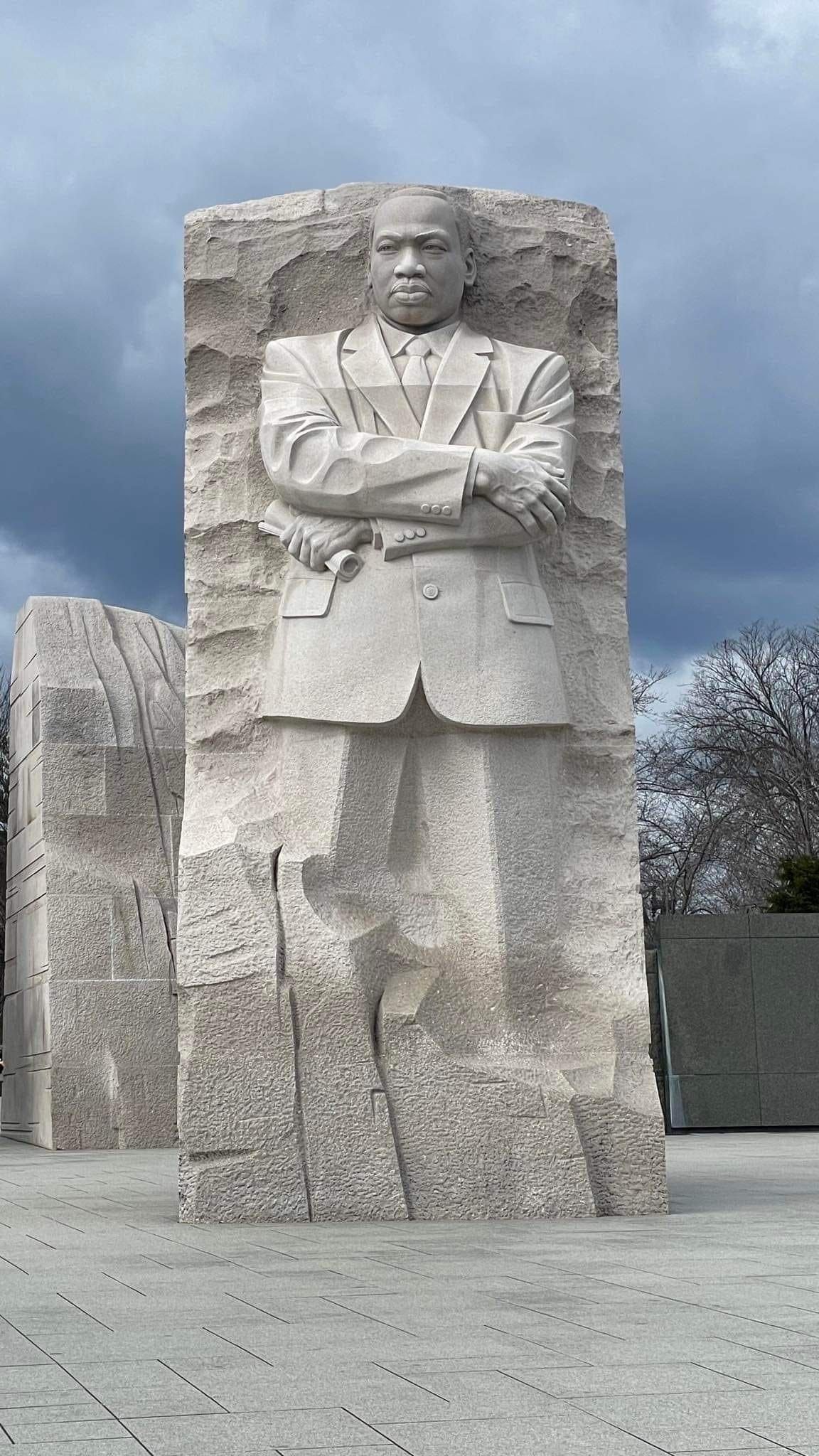
Heather Cox Richardson wrote this beautiful tribute to Dr. King. I knew I had to share it with you. Please subscribe. I read that she has a million paying subscribers. She deserves her good fortune.

You hear sometimes, now that we know the sordid details of the lives of some of our leading figures, that America has no heroes left.

When I was writing a book about the Wounded Knee Massacre, where heroism was pretty thin on the ground, I gave that a lot of thought. And I came to believe that heroism is neither being perfect, nor doing something spectacular. In fact, it’s just the opposite: it’s regular, flawed human beings choosing to put others before themselves, even at great cost, even if no one will ever know, even as they realize the walls might be closing in around them.

It means sitting down the night before D-Day and writing a letter praising the troops and taking all the blame for the next day’s failure upon yourself, in case things went wrong, as General Dwight D. Eisenhower did.

It means writing in your diary that you “still believe that people are really good at heart,” even while you are hiding in an attic from the men who are soon going to kill you, as Anne Frank did.

It means signing your name to the bottom of the Declaration of Independence in bold print, even though you know you are signing your own death warrant should the British capture you, as John Hancock did.

It means defending your people’s right to practice a religion you don’t share, even though you know you are becoming a dangerously visible target, as Sitting Bull did.

Sometimes it just means sitting down, even when you are told to stand up, as Rosa Parks did.

None of those people woke up one morning and said to themselves that they were about to do something heroic. It’s just that, when they had to, they did what was right.

On April 3, 1968, the night before the Reverend Doctor Martin Luther King Jr. was assassinated by a white supremacist, he gave a speech in support of sanitation workers in Memphis, Tennessee. Since 1966, King had tried to broaden the Civil Rights Movement for racial equality into a larger movement for economic justice. He joined the sanitation workers in Memphis, who were on strike after years of bad pay and such dangerous conditions that two men had been crushed to death in garbage compactors.

After his friend Ralph Abernathy introduced him to the crowd, King had something to say about heroes: “As I listened to Ralph Abernathy and his eloquent and generous introduction and then thought about myself, I wondered who he was talking about.”

Dr. King told the audience that, if God had let him choose any era in which to live, he would have chosen the one in which he had landed. “Now, that’s a strange statement to make,” King went on, “because the world is all messed up. The nation is sick. Trouble is in the land; confusion all around…. But I know, somehow, that only when it is dark enough, can you see the stars.” Dr. King said that he felt blessed to live in an era when people had finally woken up and were working together for freedom and economic justice.

He knew he was in danger as he worked for a racially and economically just America. “I don’t know what will happen now. We’ve got some difficult days ahead. But it doesn’t matter…because I’ve been to the mountaintop…. Like anybody, I would like to live a long life…. But I’m not concerned about that now. I just want to do God’s will. And He’s allowed me to go up to the mountain. And I’ve looked over. And I’ve seen the promised land. I may not get there with you. But I want you to know tonight, that we, as a people, will get to the promised land!”

People are wrong to say that we have no heroes left.

Just as they have always been, they are all around us, choosing to do the right thing, no matter what.

Wishing you all a day of peace for Martin Luther King Jr. Day 2024.

[Image of the Martin Luther King Jr. Memorial in Washington, D.C., by Buddy Poland.]