Archives for category: Democracy

Jim Hightower is a Texan who represents the best of the state. He blogs at “Jim Hightower’s Lowdown.” This is a terrific post.

In my view, the greatest of America’s “Founding Fathers” was not Washington or Jefferson – nor, technically, he wasn’t even an American. Rather, he was a British immigrant and itinerate agitator for real democracy, enlightenment, and universal human rights.

He was Thomas Paine, a prolific, profound, persuasive, and widely popular pamphleteer in the movement for American Independence. With plain language and genuine passion for the cause, Paine’s 47-page pamphlet, Common Sense, was so compelling in its support of the Revolution that it was passed around from person to person – and even read aloud in taverns! But Paine wasn’t content with democratic rhetoric – he actually believed in an egalitarian society, and his post-revolution writings (including Age of Reason, and Agrarian Justice) unabashedly demanded that the new hierarchy of US leaders fulfill the promise of democracy.

Even before the War for Independence, Paine called for slaves to be freed and slavery prohibited. After the war, he terrified most of the gentlemen of means who’d signed the Declaration of Independence by insisting that non-landowners be eligible to vote and hold office (John Adams was so appalled by this that he decried Common Sense as a “crapulous mess”).  But Paine just kept pushing, calling for women’s suffrage, progressive taxation, state-funded childcare, a guaranteed minimum income, universal public education, strict separation of church and state, and adoption of some of the democratic principles of the Iroquois Nation.

This is Jim Hightower saying… Don’t tell small-minded, right-wing demagogues like Ron DeSantis and Greg Abbott – but Thomas Paine was WOKE! Some 250 years before their push to impose autocracy, plutocracy, and theocracy over us, this revolutionary founder championed social justice and economic fairness. As one historian noted, “we are today all Paine’s children,” for he imbued America’s destiny with democratic impulse and aspiration.

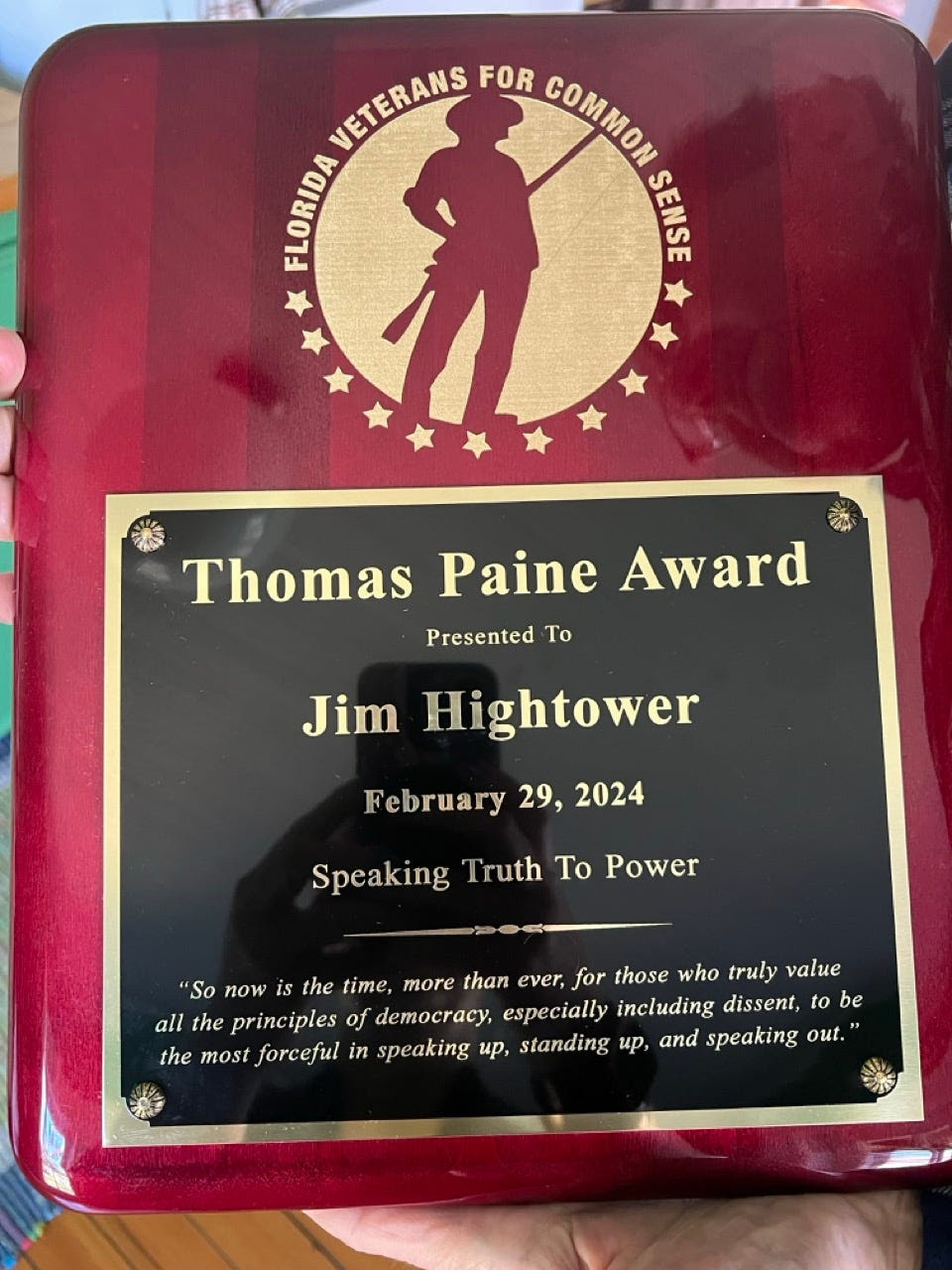
PS, from the staff— Hightower was recently give the Thomas Paine award by the Florida Veterans for Common Sense, where he learned a ton about Paine that he never knew. Hence the inspiration for this commentary! Thanks FLVCS!

Jim Hightower’s Lowdown is a reader-supported publication. To receive new posts and support my work, consider becoming a free or paid subscriber.

Subscribed

Thanks again for being a paid subscriber to the Lowdown. If you like the work we do here, please consider referring your friends— you’ll earn credits towards your own subscription when they sign up. 

Refer a friend

Or consider giving the gift of agitation! A Lowdown subscription makes a great gift:

Give a gift subscriptionLIKECOMMENTRESTACK

© 2024 Jim Hightower
PO Box 40446 Austin TX 78704 
Unsubscribe

Start writing

Voters in Orange County, California, ousted two culture warriors, making clear their dissatisfaction with the attacks on curriculum, books, teachers, and students.

Howard Blume reports in The Los Angeles Times:

Voters in the city of Orange appear to have ousted two conservative school board members who had spearheaded policies widely opposed by advocates for LGBTQ+ youth in a recall election viewed as a local bellwether for the culture wars in education.


The fiercely contested recall election in the Orange Unified School District intensified with the board majority’s approval in the fall of a parent-notification policy requiring educators to inform parents when a student requests “to be identified as a gender other than that student’s biological sex or the gender listed on the birth certificate or any other official records.”


A legal battle over the issue is playing out as California Atty. General Rob Bonta pursues a court challenge of such policies enacted by a handful of conservative-leaning school boards. His lawsuit asserts that the rules put transgender and gender-nonconforming students in “danger of imminent, irreparable harm” by potentially forcibly “outing” them at home before they’re ready…

The recall came to be an early litmus test on the resonance with voters of issues that have roiled school boards throughout the nation: the teaching of racism and Black history, the rights of LGBTQ+ youth versus the rights of their parents, restrictions on LGBTQ+ symbols and related curriculum, and the removal of library books with sexual content — especially LGBTQ+ content — from school libraries.

Journalist and former teacher Nora de la Cour writes in Jacobin about the Red State attacks on public schools, the schools that enroll 90% of America’s children.

She writes:

A new report ranks US states in terms of how well their legislatures are protecting public schools and the students who attend them. From expanding charters to launching illiberal attacks on kids and families, a worrying number of states failed the test.

State legislatures play an enormous role in making public school systems functional and safe. (SDI Productions / Getty Images)

On February 8, sixteen-year-old nonbinary sophomore Nex Benedict died of causes that have yet to be explained to the public. The day before, Nex had told a police officer they were beaten by three schoolmates in a bathroom at their Oklahoma high school. Sue Benedict, Nex’s grandmother and adoptive parent, told the Independent that Nex suffered from identity-based bullying, beginning shortly after Oklahoma governor Kevin Stitt signed a lawforcing trans students to use bathrooms that match the sex listed on their birth certificates.

In addition to the bathroom ban, Stitt has signed several other laws targeting trans youth. There are currently fifty-four other anti-LGBTQ bills before the Oklahoma legislature. While the exact cause of Nex’s death remains unverified, it’s clear that the violence preceding it occurred in an increasingly hostile environment for LGBTQ youth in the state of Oklahoma.

According to the American Medical Association and the National Institutes of Healthbathroom bans put vulnerable kids at risk for serious harm. And even when anti-LGBTQ laws don’t pass, researchindicates that young people are adversely affected by proposed legislation that puts their safety and humanity up for debate, fueling a climate of tension and suspicion which can exacerbate bullying behavior and mental health issues. Per 2019 data, majorities of LGBTQ kids have experienced harassment or bullying in school, leading to increased absences and potentially dire long-term consequences. But LGBTQ students in schools with LGBTQ-inclusive curriculum and policies are more likely to feel safe and report that their peers accept them.

In other words, adults — from educators to social media personalities to lawmakers — set a tone that appears to be highly determinative of whether school is a place where kids like Nex can safely be themselves.

This pattern is hardly restricted to LGBTQ issues. State-level legislation shapes the societies in which kids live and schools operate. For this reason “Public Schooling in America,” the latest data-packed national report card from the Network for Public Education (NPE), focuses on the extent to which each state legislature protects young people, both in and out of public school systems.

While the previous two NPE report cards have focused primarily on school privatization, this one goes further, connecting the dots between seemingly distinct attacks on public schooling that are advancing as part of the push for Christian nationalism: charter and voucher expansion, publicly funded homeschooling, defunding of public schools, and illiberal restrictions on kids and educators.

Using a points system based on how statehouses treat the above topics, NPE awarded “A” grades to five states, both red and blue, that demonstrate a strong commitment to students and democratically governed public schools: 1) North Dakota, 2) Connecticut, 3) Vermont, 4) Illinois, and 5) Nebraska. Seventeen states — all but two of which are governed by a Republican trifecta— earned “F” grades. The poorest scoring of these “F” states will come as no surprise to anyone paying attention to school privatization or the anti-LGBTQ laws curtailing kids’ and educators’ rights: 47) Arkansas, 48) North Carolina, 49) Utah, 50) Arizona, and 51) Florida.

Ultimately the report underscores a critical point: while schools are directly tasked with prioritizing child well-being and student safety, they don’t perform these duties in a vacuum. State legislatures play an enormous role in making public school systems functional and safe — or, in many cases, severely undermining them.

Privatization: Vouchers and Charters

Vouchers, which subtract taxpayer dollars from public education and turn them over to privately operated schools and service providers (including for-profit and religious schools), have notched considerable statehouse wins in recent years. In 2023 alone, seven states launched new voucher plans, while others made existing programs available to wealthy families who have never sent their kids to public schools.

Significantly, while voucher programs’ costs to taxpayers have mushroomed since 2000, bathing state budgets in red ink, overall private school enrollment actually decreased from 11.38 percent in 1999 to 9.97 percent in 2021. That’s because vouchers are mostpopular among privileged parents whose kids were already attending private schools. These privatization schemes may be propping up academically impoverished religious schools, but they are not incentivizing an exodus from public education.

Vouchers take various forms, including traditional vouchers or tuition grants, tuition tax-credit scholarship programs (TTCs), and education savings accounts (ESAs), which turn large sums of public money over to parents with virtually no strings attached. With all vouchers, and ESAs in particular, there are few or no safeguards to prevent fraud or ensure that kids are actually learning core subjects.

Vouchers are a preferred tool of religious extremists seeking state-funded Christian education, but most state constitutions have clauses prohibiting public funding of religious institutions. ESAs and TTCs are designed to evade these restrictions by funding families rather than schools (ESAs), or allowing people to donate to private school scholarships instead of paying their taxes (TTCs). Generally speaking, voucher-funded private schooling is rife with discrimination that would be illegal in public school systems. A 2023 report by the Education Voters of Pennsylvania, for example, found that 100 percent of surveyed voucher schools have policies that overtly discriminate against kids based on LGBTQ identity, disability status, academic ability, religion, pregnancy or abortion history, or other factors.

Vouchers have made splashier headlines than charter schools of late, as Republicans abandon the decades-old bipartisan education reform truce. But Christian nationalists have also been using charter schools to press their agenda, with a significant increase in right-wing “faith-friendly,” “classical,” or “back-to-basics” charter schools (and at least one officially religious church-run charter school on track to open in Oklahoma). Another in-depth report from NPE documents this rise, noting that these charter schools, which market themselves to conservative white families, are nearly twice as likely to be run by for-profit corporations as the charter sector at large.

The growth of online charter schools, which have terrible academic track records, and charter schools run for a profit has continued apace. Thirty-five states allow for-profit corporations to manage nonprofit charter schools, and in six states (Arizona, Florida, Michigan, Nevada, Ohio, and West Virginia), for-profits manage over 30 percentof all charter schools. Fraud and mismanagement result in the frequent shuttering of publicly funded charter schools, sometimes leaving families in the lurch mid–school year. Since 2019, NPE has been collecting news stories of charter school malfeasance and abrupt closures (charter churn). Thirteen states have racked up at least fifty such reports: California takes the prize for one hundred and eighty charter scandal stories, and Pennsylvania comes in second.

Though often cleverly referred to as “public,” charter schools are not equally accessible by all kids. In School’s Choice, researchers Wagma Mommandi and Kevin Welner show how charter schools use branding and promotional strategies to sway enrollment toward students with more resources and fewer needs than the general population.

In an even more blatant example of the nonpublic nature of charter schools, NPE points to the phenomenon of workplace charters. Under Florida law, such schools are permitted to restrict enrollment to the children of a specific firm’s employees — functioning as a form of labor discipline reminiscent of the last century’s coal “company towns.” At the Villages Charter School (VCS)’s six campuses, parental employment is verified monthly. If a VCS parent hates working at the Villages (a large, highly profitable retirement community) and wants to quit, they had better be prepared to upend their kids’ educational and social lives.

Homeschooling

The number of homeschooling families spiked during the COVID-19 pandemic and has continued to rise. Journalists at the Washington Post found a 51 percent increase over the past six years in states where it’s possible to track homeschooling trends. Once a practice found mainly among fundamentalist Christians in rural areas, it is now the fastest growing education sector.

Thirteen states directly subsidize homeschooling through vouchers or tax credits. A flourishing tech-based industry (including charter schools for homeschooling families) has emerged to cash in on these state subsidies, with parents putting taxpayer dollars to questionable uses. In Arizona, a proliferation of news stories has documented homeschooling families spending ESA money on things like LEGO setssnowboarding trips, ninja training, and aeroponic indoor gardens. Very few states have regulations in place to ensure that homeschooled children are receiving basic academic instruction. In fact, most states allow parents to issue a diploma with no verification of student learning.

Culture warriors like Chaya Raichik have used the slippery concept of “grooming” to gin up fears about adults hurting kids in public schools. In reality, because public schools are governed by strict child safety laws including background checks and mandated reporting, they are much more likely to detect and prevent abuse than minimally regulated private schools and totally unregulated homes. Eleven states don’t even require parents to report that they’re homeschooling their kids, while fourteen more just require a onetime notice with no follow-up. Only Pennsylvania and Arkansas conduct any form of background check on homeschooling parents.

The Coalition for Responsible Home Education has cataloged about one hundred and eighty horrific stories of homeschooled children suffering and even dying from neglect, abuse, and torture in their educational settings. Nicole and Jasmine Snyder, for example, experienced things like having their heads bashed against a wall, being forced to stand in a dark hallway for long stretches, and having urine and feces smeared on their faces as punishment for potty accidents. They starved to death in 2016 and 2017, weighing five and ten pounds respectively. Because they were homeschooled, no one outside the family had any idea the abuse was happening. Their murders were not revealed until 2021.

Public School Financing

Researchers have clearly established the relationship between school funding and student learning outcomes. And because school funding enables everything from adequate staff-to-student ratios to heating, ventilation, and air conditioning (HVAC) systems to essential structural repairs, it’s undeniably a student safety issue.

To rank school funding, NPE looked at the following metrics from the Education Law Center, which issues an annual school funding report: funding levels (cost-adjusted, per-pupil revenue from state and local sources), funding distribution (how states allocate funds to high-needs schools serving economically disadvantaged students), and funding effort (the relationship between a state’s GDP and its investment in schools). They also looked at average teacher salaries, adjusted for each state’s cost of living.

The states that earned the most points for funding public education and narrowing resource discrepancies were New York, New Jersey, and Wyoming. Florida lost every single available point for school funding, while Arizona, Idaho, and Nevada lost all but one. Washington, DC, Maine, New Hampshire, and Vermont all stand out for having exceptionally low teacher pay despite relatively high per-pupil spending.

It’s important to recognize that numerous GOP-controlled states are in the process of defunding their public schools — through spending cuts and policies that drain public coffers by enabling skyrocketing voucher costs coupled with generous tax cuts for corporations and the wealthy. If this experiment is allowed to continue, it will ultimately disfigure the landscape of community life and civic participation.

Freedom to Teach and Learn

Because the right-wing attacks on students and educators have ramped up in conjunction with efforts to defund public schools and boost private alternatives, this NPE report card includes a new category, Freedom to Teach and Learn, which encompasses a range of factors pertaining to student safety and well-being: laws protecting LGBTQ students in public schools, corporal punishment bans, censorship and curriculum bans, collective bargaining for teachers, and teacher quality…..

[Please open the link to read the rest of this important article.]

When I learned about this list of honorees, I thought it was a joke. It’s not.

An award named for Justice Ruth Bader Ginsberg, an icon of liberalism and feminism, will be presented to a surprising list of men and women by the Opperman Foundation at the Library of Congress.

The Hill posted this story:

A prestigious honor named after liberal Supreme Court Justice Ruth Bader Ginsburg and originally established to recognize “women of distinction” is being awarded this year to a surprising group of multiple genders that includes Rupert Murdoch, Elon Musk and Martha Stewart, among others.

The Ruth Bader Ginsburg Leadership Award, also known as the RBG Award, will be presented by the Dwight D. Opperman Foundation at an April 13 gala at the Library of Congress, ITK can reveal.

In addition to conservative media mogul Murdoch, Tesla CEO and X owner Musk, and lifestyle guru Stewart, the award will be given to actor Sylvester Stallone and financier Michael Milken.

First established in 2020 as a recognition solely for women, previous recipients of the RBG Award have included Queen Elizabeth II, singer Barbra Streisand and fashion designer Diane von Furstenberg.

But this year, organizers expanded the award named after the liberal leader of the Supreme Court to include “trailblazing men and women” who “have demonstrated extraordinary accomplishments in their chosen fields.”

Dwight D. Opperman Foundation chair Julie Opperman said in a statement that Ginsburg “fought not only for women but for everyone.”

The Supreme Court justice, a champion of women’s rights, died in 2020 at 87.

“Going forward, to embrace the fullness of Justice Ginsburg’s legacy, we honor both women and men who have changed the world by doing what they do best,” Opperman said.

Who are Murdoch and Musk “fighting for”?

Cameron Vickrey is communications and development director for Fellowship Southwest; she previously worked for Pastors for Texas children. She is a pastor, her father was a pastor, her husband is a pastor. She believes in separation of church and state. She believes in the importance of public schools. She does not want to impose her views on others.

She wrote recently:

Any time you are quoted on Twitter, you have to brace yourself for the subsequent comments. Especially if Pastors for Children is the one quoting you.

Their Twitter account is a favorite of trolls (education reformers, neo-libertarians and Christian nationalists) who believe that God is not in the public schools and the only way forward is to tear it all down.

So, I knew there would be pushback when I said this, and it was referenced in a tweet: “If you can, send your children to public schools … because it’s not just about my kids, it’s about what’s good for all kids.”

The replies were predictable and entertaining, although plenty were also disturbing.

Some comments satirically quoted what Jesus definitely did not ever say, like: “‘Let Romans indoctrinate your children.’ – Jesus.” Or, “‘Send your kids to government schools so they will worship the state.’ – Jesus.”

These don’t bother me. Their absurdity speaks louder than any rebuttal would. But there were two Twitter comments that I do want to address.

This one, although asked in the manner of how the Pharisees questioned Jesus, warrants an honest reply: “What is your spiritual justification for this?”

Without knowing exactly to what this question refers, I’m going to assume it’s the claim that as Christians, we should send our children to public school.

Theologically, I believe that God loves every child equally and abundantly. We have denied some children their share of this abundant life by hoarding privileges like education.

If I really believe, and I do, that God loves other peoples’ children the same way that God loves my children and wants the same abundance for their lives, then I should make sure my desire for my children’s success doesn’t come at the expense of someone else’s children.

Now, how could where I send my kids to school ever affect another child’s success or opportunity?

Unfortunately, at least in Texas, public schools are paid for by property taxes and distributed largely by something called average daily attendance funding. So, if you live in a neighborhood with lower property tax rates and lower cost of housing, that school will receive a smaller share of the public education dollars from the state.

Now, there are work-arounds to this, called recapture (a.k.a Robin Hood). But there are many inequities that haven’t been addressed in our funding system, and it’s simply obvious to anyone driving around that the wealthier the neighborhood is, the nicer the school is.

If that school is lower-income, lower-performing or simply hasn’t had a renovation bond passed on their behalf in a few decades, then it’s likelier that families who are zoned there and can opt out will do so.

Because schools receive a certain number of dollars per child counted present each day (or an average of the days), if your child isn’t counted there, then the school is missing out on that money. And if, instead, your child is attending a different public or charter school, that money goes with them.

It’s especially tough for schools who see a mass exodus of students across a few years, like when a shiny new charter school opens nearby. The neighborhood public school might lose a few students from each of their classrooms, but not enough to consolidate classes or reduce any overhead costs.

Essentially, their income is reduced while their expenses stay the same, and they are financially pinched. When a school is financially pinched, it has to cut enrichment programming, the same programs the new charter schools often advertise — like fine arts, gardening or STEM — thereby lowering the quality of that schools’ education.

So, yes, it really does matter to other children which school you choose.

Let’s say you are now with me in supporting our neighborhood public schools. That brings me to the next tweet I want to address: “Any church that follows God doesn’t hesitate to call out the demonic forces within public education. Public Education seeks to separate children from God at almost every turn. Millstones for thy necks.”

Although it is very tempting to accept this challenge and call out the demonic forces within public education, which I absolutely can do [hint: candidates for school boards who don’t seem to care about education], I am going to try to follow Jesus and resist.

God is in all schools with all children. If you are wondering, here’s where I’ve specifically seen God in neighborhood public schools:

  • God is in the kindergarten teacher who nurtures the little ones and patiently listens to their endless commentary on life.
  • God is in the fifth-grade teachers who play guitar, build robots and order class snakes for their students who are otherwise not as engaged.
  • God is in the elementary school that also serves as the regional school for the deaf and hard of hearing, and in the hearing-kids who learn sign language to talk with their classmates.
  • God is in the schools when nearby church members participate in mentoring programs and form friendships with kids who don’t have very many adult role models.
  • God is in the schools when volunteers come to deliver food for the weekend to kids who can’t otherwise depend on food being in their home.
  • God is in the middle school girl who makes room for a new student at her lunch table.
  • God is in the discussions that happen in middle and high school English and history classes, where kids learn to listen to one another and respect each others’ opinions.
  • God is in the moment of silence observed at the beginning of each day after the pledges of allegiance, when many children bow their heads to pray.

If you still believe that God isn’t in the public schools, then maybe that’s exactly where God is calling you to go.

This brief news clip provides a sharp contrast between Biden and Trump.

Biden talks about substance and issues. Trump mocks Biden’s stutter. We are reminded of the event in 2016 when Trump ridiculed a journalist with a disability.

I loved President Biden’s State of the Union speech. He was feisty and sharp. It eas gratifying to see President Biden engage the loud-mouth Republicans who interrupted him. That’s always a risky move in a nationally televised speech, because you never know how it will turn out. But Biden pounced at the opportunity to engage in repartee with his challengers from the Republican side. He showed his quick intelligence and mental sharpness. And did it with a smile.

Thom Hartman agreed. He wrote:

— State of the Union: Dark Brandon shows up & proves he’s still capable of kicking Republican ass. With the exception of rightwing hate media, reviews of President Biden’s SOTU speech Thursday night have been universally positive. He was on fire, filled with energy, and repeatedly went off-script to take on the classless Republicans who heckled and harassed him throughout the speech. Most amazing was how Republicans in the audience refused to applaud lines like, “We will not bow down to Putin” and his call for removing lead pipes to “stop the brain damage they’re causing our children.” The GOP has nearly totally become the party of Putin, and appears to even love lead poisoning America’s kids. They even booed their own legislation to secure the southern border! This is way beyond partisanship: something is really wrong, corrupt, rotten, and bizarre within the party now that it’s been completely taken over by a racist, hateful, orange-faced psychopath. And Senator Katie Britt’s effort to rehearse her tryout for the Scarlett O’Hara role in a high-school performance of Gone With The Wind just made the crisis within the party even clearer: did she really expect people to believe her “American carnage” riff and lies about the border? Now it’s up to us normal people to take our country back and restore sanity to our political processes. Double-check your voter registration, particularly if you live in a Red state, at vote.org

In case you missed the story, Alabama Senator Katie Britt was caught in a big fat lie when she gave the Republican response to Biden’s address. She claimed that she met a Mexican woman who had been the victim of sex-trafficking since she was 12, and this happened on Biden’s watch in the United States. An independent journalist named Jonathan Katz did the research on when Britt went to the border and whom she met with. He documented that the Mexican woman she met described events that happened in MEXICO, not the U.S., between 2004-2008, when George W. Bush was president. Why did she lie? She made no mention of the recent Alabama state court decision making it a crime to dispose of frozen IVF specimens, on the grounds that these embryos are unborn children.

— Russians are intervening in the election! The New York Times is reporting on a series of new “newspaper” sites that are popping up across America. With names like D.C. Weekly, the New York News Daily, the Chicago Chronicle and the Miami Chronicle, Russian disinformation experts have put up what are pretending to be American newspapers. They steal content from local papers and national news sites like Reuters, then toss in the occasional pro-Putin, anti-Ukraine, anti-Democrat articles. So far, there’s been no response from our government to this blatant attempt to influence the 2024 election by misleading American voters, and doing anything may be difficult as they’re hosted on Russian servers and outside the reach of US law. Putin was deeply involved in the 2016 election on behalf of Trump — to the point that Robert Mueller indicted nearly two dozen Russians for election interference — and they tried again with a major social media presence in 2020. With Ukraine in the balance (and Medvedev saying last week that they would be taking part of Poland next) expect Moscow to be vigorous in their efforts to get their agent, Trump, back into the White House. 

The New York Times reported on Trump’s agenda to limit, exclude, and expel immigrants if he is re-elected. Of course, he would revive his ban on immigration from Muslim-majority nations. And he would create massive detention centers. Millions of undocumented immigrants would be deported. The headline sums it up: “Sweeping Raids, Giant Camps, and Mass Deportations.

The story, written by Charlie Savage, Mafmggir Haberman, and Jonathan Swan, is chilling. Forget that poem on the base of the Statue of Liberty. Forget the “golden door.” The door will be closed.

Former President Donald J. Trump is planning an extreme expansion of his first-term crackdown on immigration if he returns to power in 2025 — including preparing to round up undocumented people already in the United States on a vast scale and detain them in sprawling camps while they wait to be expelled.

The plans would sharply restrict both legal and illegal immigration in a multitude of ways.

Mr. Trump wants to revive his first-term border policies, including banning entry by people from certain Muslim-majority nations and reimposing a Covid 19-era policy of refusing asylum claims — though this time he would base that refusal on assertions that migrants carry other infectious diseases like tuberculosis.

He plans to scour the country for unauthorized immigrants and deport people by the millions per year.

To help speed mass deportations, Mr. Trump is preparing an enormous expansion of a form of removal that does not require due process hearings. To help Immigration and Customs Enforcement carry out sweeping raids, he plans to reassign other federal agents and deputize local police officers and National Guard soldiers voluntarily contributed by Republican-run states.

To ease the strain on ICE detention facilities, Mr. Trump wants to build huge camps to detain people while their cases are processed and they await deportation flights. And to get around any refusal by Congress to appropriate the necessary funds, Mr. Trump would redirect money in the military budget, as he did in his first term to spend more on a border wall than Congress had authorized.

In a public reference to his plans, Mr. Trump told a crowd in Iowa in September: “Following the Eisenhower model, we will carry out the largest domestic deportation operation in American history.” The reference was to a 1954 campaign to round up and expel Mexican immigrants that was named for an ethnic slur — “Operation Wetback.”

The constellation of Mr. Trump’s 2025 plans amounts to an assault on immigration on a scale unseen in modern American history. Millions of undocumented immigrants would be barred from the country or uprooted from it years or even decades after settling here.

And here is a policy that should get the attention of Arab-Americans who are thinking of voting for Trump because of Biden’s support for Israel:

In a second Trump presidency, the visas of foreign students who participated in anti-Israel or pro-Palestinian protests would be canceled. U.S. consular officials abroad will be directed to expand ideological screening of visa applicants to block people the Trump administration considers to have undesirable attitudes…

Similarly, numerous people who have been allowed to live in the country temporarily for humanitarian reasons would also lose that status and be kicked out, including tens of thousands of the Afghans who were evacuated amid the 2021 Taliban takeover and allowed to enter the United States. Afghans holding special visas granted to people who helped U.S. forces would be revetted to see if they really did.

Trump’s chief advisor on immigration policy is Stephen Miller, who endorses draconian policies to ban and oust immigrants.

Miller told the Times:

“Any activists who doubt President Trump’s resolve in the slightest are making a drastic error: Trump will unleash the vast arsenal of federal powers to implement the most spectacular migration crackdown,” Mr. Miller said, adding, “The immigration legal activists won’t know what’s happening.”

I received

Earlier this week, Donald Trump swept through the Republican Super Tuesday presidential primaries (with the exception of Vermont). His one major opponent has dropped out, putting the most dangerous president in American history one step closer to returning to the White House.

The primary is over. This is it. The election will once again be between Joe Biden and Donald Trump. And, frighteningly, at this point most polls have Trump in the lead.

The question we now face is a simple one. How do we defeat Trump and his right-wing extremist allies in the House and Senate? How do we elect more Progressives to Congress?

And, frankly, the answer is complicated by the reality that the Democratic establishment is ill-prepared to do that. They have relatively little support within the working class. Their support among the Latino community is declining. And they are even seeing a drop In support from the Black community – historically the Democrats strongest base of support. Their support among young people is declining. The Democrats are also weak in terms of generating grass-roots activism or excitement. 

We have to do things differently. 

While most Democrats will focus their attention on Trump’s indictments, his insults and outrages, our job is to be laser-focused in reminding people of the fraud and pathological liar for working people we all know Trump to be.

For instance: 

This is a president, Donald Trump, who said he was going to provide health care to everyone, yet tried to throw 32 million people off of health care and has pledged to continue to try and accomplish that goal. 

This is a president who said he was going to stand up for working families and who promised to pass tax reform legislation designed to help the middle class, yet 83 percent of his tax benefits go to the top 1 percent.

This is a president who promised to take on the pharmaceutical companies. He said they were “getting away with murder.” Yet, drug prices continue to soar and he appointed a drug company executive as the Secretary of Health and Human Services.

This is a president who promised to take on the greed of Wall Street, but then proceeded to appoint more Wall Street titans to high positions than any president in history.

This is a president who appointed vehemently anti-labor members to the National Labor Relations Board (NLRB). 

This is a president who believes climate change is a “hoax”, and appointed agency leaders and judges who consistently undermined our ability to move toward sustainable energy and protect the environment.

This is a president who said he would do “everything in my power to protect our LGBT citizens,” yet went out of his way to attempt to deny them from getting the health care they need and allow discrimination against them in the workplace.

This is a president who brags about his role in overturning Roe v. Wade and denying reproductive rights to millions of women across the country.

This is a president who said that if he won that America would be respected again around the world, yet as a result of his anti-democratic and incompetent policies has succeeded in significantly lowering the respect that people all over the planet have for the United States, all while embracing right-wing authoritarian rulers around the world. 

This is a president who not only rejected his own defeat and attempted to incite an insurrection to stop Congress from certifying the election, but worked overtime to make it harder for people to vote and easier for billionaires to buy the outcomes of elections. I happen to believe that if Trump is elected once again this November, the 250 year old experiment of modern democracy in this country may very well come to end. 

The truth is, Donald Trump sold out the working families of this country once, and if he wins again all of the anti-worker, anti-democratic policies he pursued during his first term will only be magnified. He is a menace to working people whose rejection of climate science threatens the future of this planet. We have to appreciate how unbelievably severe the current moment is.

This is not the message most Democrats trying to defeat Trump will communicate, but it one we must relentlessly remind the working people of this country about ahead of November’s elections.

So there it is. A lot of important work ahead of us.

Thom Hartmann has written a new book titled The Hidden History of Monopolies: How Big Business Destroyed the American Dream. He has decided to offer it for free, a chapter at a time, on his blog.

He writes:

Because the Founders set up America to be resistant to the coercive and corruptive influence of monopoly and vested interest, the monopolists didn’t have any direct means of taking over the American government. So, two processes were necessary.

First, they knew that they’d have to take over the government. A large part of that involved the explicit capture of the third branch of government, the federal judiciary (and particularly the Supreme Court), which meant taking and holding the presidency (because the president appoints judges) at all costs, even if it required breaking the law; colluding with foreign governments, monopolies, and oligarchs; and engaging in massive election fraud, all issues addressed in previous Hidden History books.

Second, they knew that if they were going to succeed for any longer than a short time, they’d need popular support. This required two steps: build a monopoly-friendly intellectual and media infrastructure, and then use it to persuade people to distrust the US government.

Lewis Powell’s 1971 memo kicked off the process.

Just a few months before he was nominated by President Richard Nixon to the US Supreme Court, Powell had written a memo to his good friend Eugene Sydnor Jr., the director of the US Chamber of Commerce at the time.32 Powell’s most indelible mark on the nation was not to be his 15-year tenure as a Supreme Court justice but instead that memo, which served as a declaration of war against both democracy and what he saw as an overgrown middle class. It would be a final war, a bellum omnium contra omnes, against everything FDR’s New Deal and LBJ’s Great Society had accomplished.

It wasn’t until September 1972, 10 months after the Senate confirmed Powell, that the public first found out about the Powell memo (the actual written document had the word “Confidential” at the top—a sign that Powell himself hoped it would never see daylight outside of the rarified circles of his rich friends). By then, however, it had already found its way to the desks of CEOs all across the nation and was, with millions in corporate and billionaire money, already being turned into real actions, policies, and institutions.

During its investigation into Powell as part of the nomination process, the FBI never found the memo, but investigative journalist Jack Anderson did, and he exposed it in a September 28, 1972, column in the Washington Post titled, “Powell’s Lesson to Business Aired.” Anderson wrote, “Shortly before his appointment to the Supreme Court, Justice Lewis F. Powell Jr. urged business leaders in a confidential memo to use the courts as a ‘social, economic, and political’ instrument.”33

Pointing out that the memo hadn’t been discovered until after Powell was confirmed by the Senate, Anderson wrote, “Senators . . . never got a chance to ask Powell whether he might use his position on the Supreme Court to put his ideas into practice and to influence the court in behalf of business interests.”34

This was an explosive charge being leveled at the nation’s rookie Supreme Court justice, a man entrusted with interpreting the nation’s laws with complete impartiality. But Anderson was a true investigative journalist and no stranger to taking on American authority or to the consequences of his journalism. He’d exposed scandals from the Truman, Eisenhower, Johnson, Nixon, and Reagan administrations. In his report on the memo, Anderson wrote, “[Powell] recommended a militant political action program, ranging from the courts to the campuses.”35

Powell’s memo was both a direct response to Franklin Roosevelt’s battle cry decades earlier and a response to the tumult of the 1960s. He wrote, “No thoughtful person can question that the American economic system is under broad attack.”36

When Sydnor and the Chamber received the Powell memo, corporations were growing tired of their second-class status in America. The previous 40 years had been a time of great growth and strength for the American economy and America’s middle-class workers—and a time of sure and steady increases of profits for corporations—but CEOs wanted more.

If only they could find a way to wiggle back into the minds of the people (who were just beginning to forget the monopolists’ previous exploits of the 1920s), then they could get their tax cuts back; they could trash the “burdensome” regulations that were keeping the air we breathe, the water we drink, and the food we eat safe; and the banksters among them could inflate another massive economic bubble to make themselves all mind-bogglingly rich. It could, if done right, be a return to the Roaring Twenties.

But how could they do this? How could they persuade Americans to take another shot at what was widely considered a dangerous “free market” ideology and economic framework that had crashed the economy in 1929?

Lewis Powell had an answer, and he reached out to the Chamber of Commerce—the hub of corporate power in America—with a strategy. As Powell wrote, “Strength lies in organization, in careful long-range planning and implementation, in consistency of action over an indefinite period of years, in the scale of financing available only through joint effort, and in the political power available only through united action and national organizations.” Thus, Powell said, “the role of the National Chamber of Commerce is therefore vital.”37

In the nearly 6,000-word memo, Powell called on corporate leaders to launch an economic and ideological assault on college and high school campuses, the media, the courts, and Capitol Hill. The objective was simple: the revival of the royalist-controlled “free market” system. As Powell put it, “[T]he ultimate issue . . . [is the] survival of what we call the free enterprise system, and all that this means for the strength and prosperity of America and the freedom of our people.”

The first front that Powell encouraged the Chamber to focus on was the education system. “[A] priority task of business—and organizations such as the Chamber—is to address the campus origin of this hostility [to big business],” Powell wrote.38

What worried Powell was the new generation of young Americans growing up to resent corporate culture. He believed colleges were filled with “Marxist professors” and that the pro-business agenda of Harding, Coolidge, and Hoover had fallen into disrepute since the Great Depression. He knew that winning this war of economic ideology in America required spoon-feeding the next generation of leaders the doctrines of a free-market theology, from high school all the way through graduate and business school.

At the time, college campuses were rallying points for the progressive activism sweeping the nation as young people demonstrated against poverty, the Vietnam War, and in support of civil rights. Powell proposed a list of ways the Chamber could retake the higher-education system. First, create an army of corporate-friendly think tanks that could influence education. “The Chamber should consider establishing a staff of highly qualified scholars in the social sciences who do believe in the system,” he wrote.39

Then, go after the textbooks. “The staff of scholars,” Powell wrote, “should evaluate social science textbooks, especially in economics, political science and sociology. . . . This would include assurance of fair and factual treatment of our system of government and our enterprise system, its accomplishments, its basic relationship to individual rights and freedoms, and comparisons with the systems of socialism, fascism and communism.”

Powell argued that the civil rights movement and the labor movement were already in the process of rewriting textbooks. “We have seen the civil rights movement insist on re-writing many of the textbooks in our universities and schools. The labor unions likewise insist that textbooks be fair to the viewpoints of organized labor.”41 Powell was concerned that the Chamber of Commerce was not doing enough to stop this growing progressive influence and replace it with a pro-plutocratic perspective.

“Perhaps the most fundamental problem is the imbalance of many faculties,” Powell pointed out. “Correcting this is indeed a long-range and difficult project. Yet, it should be undertaken as a part of an overall program. This would mean the urging of the need for faculty balance upon university administrators and boards of trustees.” As in, the Chamber needed to infiltrate university boards in charge of hiring faculty to make sure that only corporate-friendly professors were hired.

Powell’s recommendations targeted high schools as well. “While the first priority should be at the college level, the trends mentioned above are increasingly evidenced in the high schools. Action programs, tailored to the high schools and similar to those mentioned, should be considered,” he urged.

Next, Powell turned to the media, instructing that “[r]eaching the campus and the secondary schools is vital for the long-term. Reaching the public generally may be more important for the shorter term.” Powell added, “It will . . . be essential to have staff personnel who are thoroughly familiar with the media, and how most effectively to communicate with the public.” He advocated that the same system “applies not merely to so-called educational programs . . . but to the daily ‘news analysis’ which so often includes the most insidious type of criticism of the enterprise system.”

Following Powell’s lead, in 1987 Reagan suspended the Fairness Doctrine (which required radio and TV stations to “program in the public interest,” a phrase that was interpreted by the FCC to mean hourly genuine news on radio and quality prime-time news on TV, plus a chance for “opposing points of view” rebuttals when station owners offered on-air editorials), and then in 1996 President Bill Clinton signed the Telecommunications Act of 1996, which eliminated most media-monopoly ownership rules. That same year, billionaire Rupert Murdoch started Fox News, an enterprise that would lose hundreds of millions in its first few years but would grow into a powerhouse on behalf of the monopolists.

From Reagan’s inauguration speech in 1981 to this day, the single and consistent message heard, read, and seen on conservative media, from magazines to talk radio to Fox, is that government is the cause of our problems, not the solution. “Big government” is consistently—more consistently than any other meme or theme—said to be the very worst thing that could happen to America or its people, and after a few decades, many Americans came to believe it. Reagan scare-mongered from a presidential podium in 1986 that “the nine most terrifying words in the English language are: I’m from the government and I’m here to help.”

Once the bond between people and their government was broken, the next steps were straightforward: Reconfigure the economy to work largely for the corporate and rich, reconfigure the criminal justice system to give white-collar criminals a break while hyper-punishing working-class people of all backgrounds, and reconfigure the electoral systems to ensure that conservatives get reelected.

Then use all of that to push deregulation so that they can quickly consolidate into monopolies or oligopolies.