Archives for category: Democracy

Ashana Bigard is a native of New Orleans and a parent. This is her warning to the parents and other citizens of Houston.

She writes:

“My prayers are with you, Texas. My memories are with you too. The day after Katrina hit New Orleans, my family and I made the 17 hour car ride to Houston. The people of Texas welcomed us, opening their homes and helping us out with clothing, even financial assistance. As a native New Orleanian, I wish that I could do the same for you now. But what’s happened in my city and to its schools serves as a cautionary tale to residents of Houston. Reeling from the disaster, our communities were scattered like the four winds. I returned from Houston, many of us did, but the New Orleans we left doesn’t belong to us anymore.

“Rents have quadrupled as gentrification remakes whole neighborhoods, pushing out long-time residents. Nearly half of the children here now live in poverty, and job security is worse, salaries lower. The sense that we’re doing worse than before Katrina is borne out in the data: Black New Orleanians have 18% less wealththan we did in 2005.

“My prayers are with you, Texas. But my warnings are too.

“1. Be wary of elites with big plans. Even as Katrina’s waters were receding, a handful of local elites were making plans for taking over the city’s schools. In the years following the storm, more than $76 billion came to the city of New Orleans. Yet the native population is poorer than we were before Katrina; we have 18% less wealth than we did in 2005. It became obvious early on that the money for New Orleans wasn’t making it into the hands of native New Orleanians. Huge sums of money demand oversight, accountability, and, most importantly, a vision for how exactly investment will help the people who need it most. All parts of your community must be allowed to participate fully in the rebuilding of their own city.

“2. Trauma can’t be “disciplined” out of kids A hurricane is a deeply traumatic experience for children and trauma cannot simply be “disciplined” out of kids. New Orleans is now full of schools with “college prep” in their names, but their strict rules, harsh discipline and fixation on a culture of compliance have more in common with prison than with college. The “new” and “innovative” approach to educating kids that swept through our city after Katrina seems to start from the assumption that what children need to be successful is to be treated like adult criminals. We’ve had multiple incidents of children as young as five being handcuffed in schools, even arrested. Students who can’t afford the uniforms that are now mandatory at virtually every school in New Orleans are suspended, often for long periods of time. As an advocate for children in the schools, I’m regularly reminded that our post-Katrina schools in New Orleans intersect with the criminal justice system starting in the earliest grades, and ensnaring parents too. Louisiana, after all, that incarcerates a higher percentage of its residents than any other state. I wonder why that is?

“3. Don’t let your teachers get swept away Three months after Katrina, 7,500 school employees, including 4,000 teachers, were fired. Many of them had lost their homes to the hurricane. New Orleans lost the core of its Black middle class, and our schools lost adults who were connected to the city and its culture. What happens when all of your teachers are fired? You have a teacher shortage. New Orleans now imports its teachers: recent college grads from programs like Teach for America, who are entrusted with our kids’ development after receiving less training than what we require from workers at a nail salon.

“4. Your culture isn’t a liability to be overcome Beware of people who see your culture as a liability. The culture and soul of our city is music, arts and drama. Yet the people who came to “fix” New Orleans viewed the city and its culture as the source of our problems that they had to help us overcome. That mean schools without art, music or drama, in a city whose culture draws people from all over the world. Think about that. Without arts in the schools where will the next generation of performers come from? The arts are also an important way for kids to deal with trauma in a city that’s seen so much of it. Our kids desperately needed art, music and drama—yours will too.”

But that’s not all she writes. Read it all. Share the wisdom.
I am really tired of hearing politicians say we must “unite” the country. They claim to know how to bridge the divisions. No, they don’t and they can’t.

When I see white men (and a few white women) marching with torches and chanting hateful slogans; when I see them threatening blacks and Jews and others they hate; when I see the president saying that these marchers and charters include “many very fine people,” I know that unity is impossible.

This is the most talked-about video on Charlottesville.

There are no grounds for unity with self-proclaimed Nazis and KKK.

Nope.

They have free speech rights. But their hateful views must be exposed, condemned, and vilified.

We can turn the other cheek, but we must not let their views multiply, because they are inherently divisive and destructive. When they rally, surround them with reminders and symbols of what we believe, what American soldiers have fought and died for: freedom, equality, democracy, justice for all, the equal worth and dignity of all people.

Do not meet their violence with violence, as that is the confrontation they hope for.

Meet their vehemence with decency and courtesy, as this young woman in Boston did.

Meet their violence with swift justice.

We can never unify with those who hate our ideals.

The Los Angeles blogger Red Queen in LA writes here about the negative consequences of avoidance.

She writes:

““…I’m not the angry racist they see in that photo… .”

“But if not you then who?

“Because someone is. Someone has been weighing in to ranks swelling with violence, bursting with hatred. A large bunch of angry folks brandished fire and fury last Friday and unleashed the overt toppling of constitutional rights, collective self-esteem and statues.

“And that same attitude which disavows culpability for provoking violence also apparently assumes innocence toward any other collective action: marching, mobbing, voting.

“It’s not just Blacks Who Matter, it is also very much true that we all of us matter, in all our actions: we do.

“When you shriek words of hate, it matters. When you wield weapons of war, it matters. When you vote or fail to do so, it matters.

“And denying so seems to be the degenerate end of that long, inexorable drain on economic power and citizenly prerogative that has increasingly marked America’s 99%.

“We have morphed into a citizenry that will not vote, will not participate in community organizations, repudiates culpability for the mob we comprise.”

This is what the Koch brothers and the DeVos family wants. An acquiescent, uninvolved citizenry.

This is how democracy dies.

William Mathis is managing director of the National Education Policy Center and vice-chair of the Vermont Board of Education.

Mathis writes here about the inherent flaws of today’s standardized tests.

“They claim to measure “college and career readiness.” Yet, it takes no particular insight to know that being ready for the forestry program at the community college is not the same as astrophysics at MIT. Likewise, “career ready” means many different things depending upon whether you are a health care provider, a convenience store clerk, or a road foreman.

“The fundamental flaw is pretending that we can measure an educated person with one narrow set of tests. There is no one universal knowledge base for all colleges and careers. This mistake is fatal to the test-based reform theory.

“When the two test batteries (PARCC and SBAC) are put to the test, they don’t score very well. Princeton based Mathematica Policy Research compared PARCC test scores with freshman grade point average and found only 16 percent could be predicted (in the best case) by the math test and less than 1 percent by the English Language Arts score. The SBAC doesn’t have such a validity study but they say it “appears in their crystal ball.” (p.72 1). Since the future of schools and children are in the balance, this is no place for murky crystal balls…

“In the current latent traits fad, here’s how the tail has to wag:

“Knowledge can only have one line from easiest to hardest, children within a grade are equally distributed within and across all classrooms, and that all children learn the same things in the same way, in the same order and at the same time. As any parent of two or more children can tell you, that is not reality.

“Another fatal tail wagging is that no matter how important the item, if it doesn’t fit the latest test fad, it is tossed out. The result is that the test drifts off in space. This problem is made worse when politicians dangle money in front of test experts to do things with tests that cannot and should not be done, says Shavelson.

“If we redesigned our measures to address what our state constitutions and citizens tell us is important, we would concentrate on the skills that define success as a citizen, worker and human being. These which include clear and effective communication, creative and practical problem-solving, informed and integrative thinking, responsible and involved citizenship, and self-direction.

“This is not to say that standardized testing should be eliminated. It is the single uniform measure across schools. But the very standardized attributes that make them valuable cause harm to those things that are truly important for our children, and our communities.

“Since the “recommended” SBAC tests’ standards are currently set to fail about two-thirds of students, the data will wrongly and dishonestly provide fodder for school critics. In high scoring states, a mere half of students will be declared failures even though they would rank in the top 10 percent of the world. The test scores measure neither college nor careers nor success in life. They simply float free in monolithic space radiating glossy ignorance but as far as informing us about our schools, they are a cold, silent and misleading void.”

I have only one disagreement with Mathis’ keen analysis.

Given the pervasive misuse of standardized tests, our nation would benefit by having a moratorium on standardized testing of three to five years, during which time we might figure out how and when to use them, how to educate without them, and why test scores not the purpose of going to school.

It is no secret that everything in the public sector is under assault by the forces of privatization and greed. Public schools, public infrastructure, public libraries, public airport, everything that is funded and controlled by public authorities is up for grabs. Given that all three branches are controlled by the same party and that the Supreme Court will increasingly lean to the right, it is important that citizens take action.

Here is a manual for direct and nonviolent action written by a veteran of the struggles of the 1960s.

One thing is easier now: to create virtually instant mass protests, as was done by the admirable Women’s March the day after Trump’s inauguration. If one-off protests could produce major changes in society we would simply focus on that, but I know of no country that has undergone major change (including ours) through one-off protests. Contesting with opponents to win major demands requires more staying power than protests provide. One-off protests do not comprise a strategy, they are simply a repetitive tactic.

Fortunately, we can learn something about strategy from the U.S. civil rights movement. What did work for them in facing an almost overwhelming array of forces was a particular technique known as the escalating nonviolent direct action campaign. Some might call the technique an art form instead, because effective campaigning is more than mechanical.

Since that 1955-65 decade we’ve learned much more about how powerful campaigns build powerful movements leading to major change. Some of those lessons are here.

The manual is short. It offers valuable lessons about how to organize a resistance movement.

There are many fronts on which this current struggle will be and is being waged. For readers of this blog, the central issue is the survival of public schools, democratically controlled and governed.

The privatization movement is well organized and well funded. The entering wedge for privatization is the misuse of testing to defame teachers and schools. The entry point for privatization is charter schools. Then cyber charters, then vouchers. It is a continuum. The goal is to take tax money away from public schools and direct it to privately managed schools, private schools, religious schools, and tax dodges for the wealthy whose money is then used to support vouchers.

The Network for Public Education is dedicated to preserving and improving public schools. We are not satisfied with them as they are today. For one thing, they are burdened by the detritus of No Child Left Behind, Race to the Top, and the Every Student Succeeds Act. We must fight for them or lose them. The time is now.

Join NPE at its annual conference in Oakland, California, in mid-October. Meet your allies. We will join together to support our schools and our democracy.

Tom Ultican, a teacher of math and physics in Southern California, sat in on two local school board meetings recently. People argued. They disagreed. They berated board members. They made their voices heard. Democracy is inefficient and messy. Sometimes people win even though their ideas seem half-baked.

So-called self-described reformers think that the way to get rid of dissension is to get rid of local school boards. They like mayoral control and state control. They like private management. They don’t like democracy. It is messy.

Katherine Stewart, author of the book “The Good News Club: The Christian Right’s Stealth Assault on America’s Children,writes in the New York Times about the historical origins of attacks on democratic public schools.

When the DeVos crowd and rightwing think tanks refer to “government schools,” they are drawing their rhetoric from a dark and ugly history, tainted by racism, anti-Catholicism, and hatred of democracy itself.

Trump, DeVos, the religious right, and conservatives today promote “school choice” so children do not have to attend “government schools.” But where did this language come from?

She writes:

Before the Civil War, the South was largely free of public schools. That changed during Reconstruction, and when it did, a former Confederate Army chaplain and a leader of the Southern Presbyterian Church, Robert Lewis Dabney, was not happy about it. An avid defender of the biblical “righteousness” of slavery, Dabney railed against the new public schools. In the 1870s, he inveighed against the unrighteousness of taxing his “oppressed” white brethren to provide “pretended education to the brats of black paupers.” For Dabney, the root of the evil in “the Yankee theory of popular state education” was democratic government itself, which interfered with the liberty of the slaver South.

One of the first usages of the phrase “government schools” occurs in the work of an avid admirer of Dabney’s, the Presbyterian theologian A. A. Hodge. Less concerned with black paupers than with immigrant papist hordes, Hodge decided that the problem lay with public schools’ secular culture. In 1887, he published an influential essay painting “government schools” as “the most appalling enginery for the propagation of anti-Christian and atheistic unbelief, and of antisocial nihilistic ethics, individual, social and political, which this sin-rent world has ever seen.”

But it would be a mistake to see this strand of critique of “government schools” as a curiosity of America’s sectarian religious history. In fact, it was present at the creation of the modern conservative movement, when opponents of the New Deal welded free-market economics onto Bible-based hostility to the secular-democratic state. The key figure was an enterprising Congregationalist minister, James W. Fifield Jr., who resolved during the Depression to show that Christianity itself proved “big government” was the enemy of progress.

Drawing heavily on donations from oil, chemical and automotive tycoons, Fifield was a founder of a conservative free-market organization, Spiritual Mobilization, that brought together right-wing economists and conservative religious voices — created a template for conservative think tanks. Fifield published the work of midcentury libertarian thinkers Ludwig von Mises and his disciple Murray Rothbard and set about convincing America’s Protestant clergy that America was a Christian nation in which government must be kept from interfering with the expression of God’s will in market economics.

Someone who found great inspiration in Fifield’s work, and who contributed to his flagship publication, Faith and Freedom, was the Calvinist theologian Rousas J. Rushdoony. An admirer, too, of both Hodge and Dabney, Rushdoony began to advocate a return to “biblical” law in America, or “theonomy,” in which power would rest only on a spiritual aristocracy with a direct line to God — and a clear understanding of God’s libertarian economic vision.

Rushdoony took the attack on modern democratic government right to the schoolhouse door. His 1963 book, “The Messianic Character of American Education,” argued that the “government school” represented “primitivism” and “chaos.” Public education, he said, “basically trains women to be men” and “has leveled its guns at God and family.”

These were not merely abstract academic debates. The critique of “government schools” passed through a defining moment in the aftermath of the Brown v. Board of Education decision of 1954, when orders to desegregate schools in the South encountered heavy resistance from white Americans. Some districts shut down public schools altogether; others promoted private “segregation academies” for whites, often with religious programming, to be subsidized with tuition grants and voucher schemes. Dabney would surely have approved.

Religious fundamentalists and evangelicals today have picked up the use of the term “government schools.” DeVos funds the leading fundamentalist organizations that see the public schools as godless. Religious groups are suing in states like Indiana to allow religious activities within the public schools. Secularism is their enemy.

When these people talk about “government schools,” they want you to think of an alien force, and not an expression of democratic purpose. And when they say “freedom,” they mean freedom from democracy itself.

The advocates of “school choice” bask in this tradition. Recall that Reed Hastings, founder of Netflix, looked forward to the day when there were no more elected school boards. Advocates for private management of schools funded with public money–such as ALEC (the American Legislative Exchange Council)–hail mayoral control, state takeovers, and privatization, anything to undermine and destroy democratic control of public schools.

Remember this history. It matters.

Rob Reich,Director of the Center for Rthics in Society at Stanford University, warns that big money is using the guise of philanthropy to advance their personal agenda and bypass democratic institutions.

https://qz.com/1035084/philanthropists-dont-deserve-our-gratitude-says-a-stanford-ethicist/

“Exceptionally wealthy people aren’t a likeable demographic, but they have an easy way to boost personal appeal: Become an exceptionally wealthy philanthropist. When the rich use their money to support a good cause, we’re compelled to compliment their generosity and praise their selfless work.

“This is entirely the wrong response, according to Rob Reich, director of the Center for Ethics in Society at Stanford University.
Big philanthropy is, he says, “the odd encouragement of a plutocratic voice in a democratic society.” By offering philanthropists nothing but gratitude, we allow a huge amount of power to go unchecked.

“Philanthropy, if you define it as the deployment of private wealth for some public influence, is an exercise of power. In a democratic society, power deserves scrutiny,” he adds.

“A philanthropic foundation is a form of unaccountable power quite unlike any other organization in society. Government is at least somewhat beholden to voters, and private companies must contend with marketplace competition and the demands of shareholders.
But until the day that government services alleviate all human need, perhaps we should be willing to overlook the power dynamics of philanthropy—after all, surely charity in unchecked form is better than nothing?

“In extreme situations, such as a major disaster, Reich is supportive of donations from philanthropic organizations. But he’s strongly against private donors providing public goods on a longer-term basis, which he says contributes to a cycle whereby the state expects to provide less and philanthropists are relied on to pay for more and more. And a democratically elected government should be a far better provider of long-term services than wealthy individuals.”

That is precisely the reason that Bridge International Academies, the for-profit provider of low-cost schools in Africa is doing harm: it enables the state to do less and to shirk its responsibility to provide free, universal public education to all.

Jennifer Berkshire asks a crucial question: Just how far right can Betsy DeVos go before the public rises up to quash her extremist agenda?

Never in modern history has there been a more unpopular, more polarizing Cabinet member. She is unpopular because her goal of defunding public education and showering public funds on religious and private schools is unpopular.

To understand what DeVos wants, you need only look at what ALEC wants. Arizona tops the ALEC report card, because it is the Wild West of school choice. Whereas Massachusetts is usually considered the best state in the nation for education quality and excellent teachers, it ranks far behind Arizona on the ALEC report card, at #32. To ALEC and DeVos, Arizona is #1, despite its low graduation rate (25 points below that of Massachusetts), its teacher shortage, and its perennially underfunded public schools. You see, Arizona has more choice than Massachusetts, and choice is a far higher goal to ALEC and DeVos than school quality.

The DeVos-ALEC project (shared by the Koch brothers and others on the fringe right) is the destruction of not just public schools and unions, but of the middle class and the American Dream of social mobility.

“DeVos wasn’t listed among the ALEC headliners this year, a line-up heavy on conservative has-beens like Newt Gingrich, William J. Bennett and Jim DeMint. But among this crowd she’s regarded as a conquering heroine. That’s because the right-wing in Michigan just realized a decades-long dream and a top priority for the DeVos family: not only did they succeed in making Michigan, the cradle of industrial unionism, a right-to-work state, they also killed teacher pensions. New teachers in the Mitten state, where teacher salaries dropped for the last five years in a row, will now fund their own retirement. ALEC called the move a win for teachers and taxpayers, but didn’t mention the part where taxpayers will have to cough up at least $255 million to “fix” a problem that the anti-public school crowd largely created. Ending teacher pensions, one of the last remaining benefits the state’s once-powerful teachers unions could offer their members, will only hasten the unions’ demise. In the words of the old Mastercard commercial: “priceless.”

“In a new book that examines the work of ALEC and other corporate lobbies in all fifty states (“The One Percent Solution: How Corporations Are Remaking America One State at a Time“), economist Gordon Lafer argues that the singular fixation upon crushing teachers unions is about much more than mere money. In virtually every community, schools represent the largest employer, providing something that is increasingly underheard of these days: decent wages, good benefits and the prospect of a retirement that doesn’t involve collecting cans. The presence of these large employers—schools, public universities, hospitals—raises the expectations of the public about what’s possible, Lafer argues. “ALEC’s vision of the future is actually really bleak,” Lafer told me recently. “That’s why so much of their legislative focus is on limiting what people are entitled to, especially in education.” The relentless effort to rid the world of teachers pensions, says Lafer, is also about lowering the expectations of everyone else.

“ALEC’s agenda for remaking public education in all 50 states can be distilled down to a single word: unpopular. Actually, make that two words: extremely unpopular. There is no constituency for blowing up the schools, swelling class sizes, replacing teachers with tablets and lowering the standards of who can teach. There is no real constituency for shifting money away from public schools to private religious institutions, which is why ALEC-backed voucher programs in states like Wisconsin and Indiana mostly benefit students who’ve never attended public schools. The key to enacting a deeply unpopular agenda, as any ALEC-ster worth her salt can attest, is to keep the public as far away from it as possible, which is why DeVos’ hat tip to local control in her speech was so laughable. The states where ALEC has come closest to realizing its dream of defunding schools, shifting public monies into private coffers and crushing teacher unions are also the ones where efforts to preempt local democracy and shrink the voting franchise are in full flower.”

Berkshire doesn’t let Democrats off the hook. Party leaders have been enablers of the attacks on public schools (think Arne Duncan, Andrew Cuomo, Dannell Malloy, Rahm Emanuel, Cory Booker). Berkshire writes:

“The irony is, of course, that the school privatization experiment that’s well underway in Denver has been the work largely of “progressive” education reformers, Democrats for Education Reform chief among them. The local teachers union is weak and getting weaker, not because of DeVos and the right wing but because of anti-union Democrats. DeVos isn’t a fan of the Denver model—charter choice, in her view, is a weak substitute for the real deal: publicly funded vouchers for private religious schools. Her visit to Denver shone a spotlight on ALEC’s extreme education agenda. Now it’s up to Democrats who’ve embraced school privatization themselves to explain how they’re different.”

Charters were on the ballot last November in Massachusetts, where the public rejected their expansion by a resounding margin of 62-38%.

Vouchers have been put on state ballots many times. The public has never supported them. DeVos and her husband sponsored a voucher referendum in Michigan in 2000, and it was overwhelmingly defeated, by a vote of 69-31%. The most powerful antidote to the DeVos privatization project is the vote. Like the Wicked Witch in the Wizard of Oz, who melted, her libertarian dream dissolves when tested at the ballot box.

Parents and educators in Arizona are gathering signatures to throw water on their legislature’s efforts to expand vouchers. They need to collect 120,000 signatures to do so (the legal requirement is 75,000, but organizers know that they must have far more than the minimum to withstand legal challenges.)

DeVos and ALEC threaten our democracy, and the only tool that can beat them is the method of democracy: the vote.

If you don’t like what DeVos wants to do to your schools, get active. Join the Network for Public Education. Join your state and local citizens’ groups (NPE can connect you). Practice the arts of democracy to save democracy. Participate. Vote.

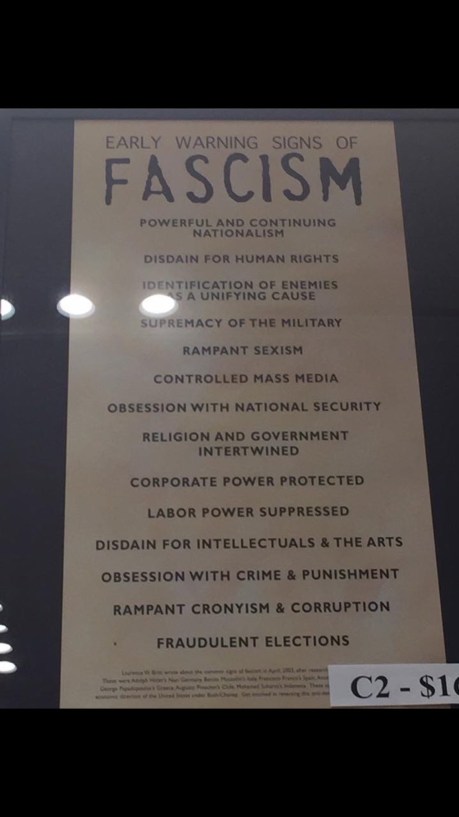
museum

Sound familiar?

Read it again.

Think about it.

Which side are you on?

Snopes says the poster was once available in the gift shop of the Holocaust Museum.

Snopes says:

The list was originally created by Laurence Britt in 2003, for an article published by Free Inquiry magazine (a publication for secular humanist commentary and analysis). While subsequent postings of the list often attribute it to “Dr. Laurence Britt,” the author said that he was not actually a doctor (nor did he claim to be). Britt himself said that he could be more accurately described as an amateur historian

It quotes this note about the poster:

Laurence W. Britt wrote about the common signs of fascism in April 2003, after researching seven fascists regimes. Those were Adolf Hitler’s Nazi Germany, Benito Mussolini’s Italy, Francisco Franco’s Spain, Antontio de Oliveira Salazar’s Portual, George Papadopoulos’s Greece, August Pinochet’s Chile, Mohamed Suharto’s Indonesia. These signs resonate with the political and economic direction of the United states under Bush/Cheney. Get involved in reversing this anti-democratic direction while you still can!