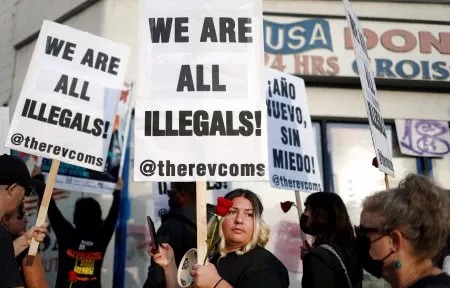
Newsweek reports that school officials and students in Bridgeport are planning to stand up for their fellow students who are immigrants. Meanwhile, the students are protesting in the best way possible, holding posters that say: “WE ARE ALL ILLEGALS.” The kids are alright.
A school district in Connecticut is defying President Donald Trump‘s order to allow Immigration and Customs Enforcement (ICE) agents to go to sensitive locations.
Bridgeport Public Schools announced on Tuesday guidelines designed to protect students in the event of an attempted raid by ICE agents at any of its schools.
Newsweek has contacted the White House via email for comment outside of normal office hours.
Why It Matters
Trump has begun implementing sweeping immigration reforms and is preparing to target millions of undocumented immigrants. The school district’s stance signals the emergence of grassroots opposition to the administration’s plans to initiate the largest mass deportation operation in U.S. history.
What To Know
Bridgeport Public Schools’ announcement came after the acting director of the Department of Homeland Security (DHS) issued a directive on January 21 ending the policy that ICE agents would not conduct actions in or near “sensitive” areas, such as churches, hospitals or schools.
Interim school superintendent Dr. Royce Avery reaffirmed that the school district’s immigration enforcement guidelines remain in place. Avery said that ICE agents and other government officials are prohibited from entering school buildings, boarding buses or attending school events without prior written approval from the superintendent.
“Every student in Bridgeport, regardless of their immigration status, has the right to feel secure and supported in our schools,” he said.
Avery did not say if any ICE raids were planned in Bridgeport. He added that Bridgeport Public Schools does not collect or store information about students’ immigration status, ensuring their privacy is protected….
What People Are Saying
Interim school superintendent Dr. Royce Avery said in a press release: “I became an educator to advocate for all students, and I will ensure their rights and privacy are upheld. Our schools will remain a safe space where all students can learn, grow, and succeed without fear or discrimination.”
Acting Secretary of Homeland Security Benjamine Huffman said in a statement: “This action empowers the brave men and women in CBP [Customs and Border Protection] and ICE to enforce our immigration laws and catch criminal aliens—including murders and rapists—who have illegally come into our country. Criminals will no longer be able to hide in America’s schools and churches to avoid arrest. The Trump Administration will not tie the hands of our brave law enforcement and instead trusts them to use common sense.”
Janet Murguía, president and CEO of Latino civil rights and advocacy organization UnidosUS, told Newsweek: “Many of the president’s proposed executive orders, however, are strictly punitive measures such as changing enforcement targets to include schools, churches and hospitals, and are designed to inflict pain on the most vulnerable—families, children and even the sick and injured.”
Imagine this: The Episcopal Bishop of Washington, D.C. spoke directly to Trump and his family at the National Prayer Service and called on him to be more like Jesus. Trump found this admonition very insulting and called on her to apologize. Maybe he will sign an executive order commanding her apology.
He will have to find a different church, one where hatred, vengeance, and cruelty are celebrated.
Donald Trump had a bad, failed day yesterday, which is too bad for him because you never get back the second day of your second term in office. Poof, gone. Only 1459 to go! Will they be failures too? Probably.
There was a prayer service at the National Cathedral on Tuesday, and Trump and Melania attended (this time not dressed as the Babadook), along with JD and Usha Vance and members of the Trump crime family and all kinds of others. And one of America’s greatest heroes, Mariann Edgar Budde, the Episcopalian bishop for Washington DC, decided to speak truth to power, softly and carrying a big stick, and that stick was J-E-S-U-S.
(That’s right, go with it, Jesus was a stick. “Go find the Lord!” you could say if you threw it for your dog. “Where did he go? Go get him!”)
Silliness aside, what Budde did was use her homily to ask this man, this vile, foul man, this Stupid Hitler of a man, this 34-times-convicted felon of a man, this pathetic grievance monkey child of a man, this amoral clown, to have mercy on the vulnerable.
Let me make one final plea. Mr. President. Millions have put their trust in you and as you told the nation yesterday, you have felt the providential hand of a loving God. In the name of our God, I ask you to have mercy upon the people in our country who are scared now. There are gay, lesbian and transgender children in Democratic, Republican and independent families, some who fear for their lives. And the people, the people who pick our crops and clean our office buildings, who labor in poultry farms and meatpacking plants, who wash the dishes after we eat in restaurants and work the night shifts in hospitals. They, they may not be citizens or have the proper documentation, but the vast majority of immigrants are not criminals. They pay taxes and are good neighbors. They are faithful members of our churches and mosques, synagogue, wadara and temples. I ask you to have mercy, Mr. President, on those in our communities whose children fear that their parents will be taken away and that you help those who are fleeing war zones and persecution in their own lands to find compassion and welcome here. Our god teaches us that we are to be merciful to the stranger. For we were all once strangers in this land. May God grant us the strength and courage to honor the dignity of every human being, to speak the truth to one another in love and walk humbly with each other and our God, for the good of all people, good of all people in this nation and the world. Amen.
Oh man, she really stepped in it, didn’t she? She showed Jesus to those Nazis and asked them to have mercy on people who are scared.
Nazis hate it when you show them Jesus.
Trump is DEMANDING an apology. Can you believe the nerve of that insolent woke bitch bishop exhorting him to love his neighbor?
“Nasty in tone, and not compelling or smart.” “A very boring and uninspiring” service! Yeah, we bet there were some tiny-handed little tyrants in first-century Nazareth who sounded like that too. Wonder what they were convicted of 34 times….
“Despite a landslide victory in the fall for Donald Trump, the left is still vowing to resist the president with the same level of drama, hysteria that we’ve all come to expect. This morning, a so-called bishop politicizing an inaugural prayer service. Instead of offering a benediction for our country, for our president, she goes on the far-left, woke tirade in front of Donald Trump and JD Vance, their families, their young children. She made the service about her very own deranged political beliefs with a disgraceful prayer full of fearmongering and division.”
Oh no, won’t somebody think of JD Vance’s children, hearing stories about Jesus, and probably being like “Wow, that sure doesn’t sound like my dad!”
Also bless Hannity’s heart, jerking himself and his president off by calling it a “landslide.” We all know the truth. (Almost nobody watched the inauguration by the way, 27 percent fewer than Joe Biden’s.)
You hear sometimes, now that we know the sordid details of the lives of some of our leading figures, that America has no heroes left.
When I was writing a book about the Wounded Knee Massacre, where heroism was pretty thin on the ground, I gave that a lot of thought. And I came to believe that heroism is neither being perfect, nor doing something spectacular. In fact, it’s just the opposite: it’s regular, flawed human beings choosing to put others before themselves, even at great cost, even if no one will ever know, even as they realize the walls might be closing in around them.
It means sitting down the night before D-Day and writing a letter praising the troops and taking all the blame for the next day’s failure upon yourself in case things went wrong, as General Dwight D. Eisenhower did.
It means writing in your diary that you “still believe that people are really good at heart,” even while you are hiding in an attic from the men who are soon going to kill you, as Anne Frank did.
It means signing your name to the bottom of the Declaration of Independence in bold print, even though you know you are signing your own death warrant should the British capture you, as John Hancock did.
It means defending your people’s right to practice a religion you don’t share, even though you know you are becoming a dangerously visible target, as Sitting Bull did.
Sometimes it just means sitting down, even when you are told to stand up, as Rosa Parks did.
None of those people woke up one morning and said to themselves that they were about to do something heroic. It’s just that when they had to, they did what was right.
On April 3, 1968, the night before the Reverend Doctor Martin Luther King Jr. was assassinated by a white supremacist, he gave a speech in support of sanitation workers in Memphis, Tennessee. Since 1966, King had tried to broaden the Civil Rights Movement for racial equality into a larger movement for economic justice. He joined the sanitation workers in Memphis, who were on strike after years of bad pay and such dangerous conditions that two men had been crushed to death in garbage compactors.
After his friend Ralph Abernathy introduced him to the crowd, King had something to say about heroes: “As I listened to Ralph Abernathy and his eloquent and generous introduction and then thought about myself, I wondered who he was talking about.”
Dr. King told the audience that if God had let him choose any era in which to live, he would have chosen the one in which he had landed. “Now, that’s a strange statement to make,” King went on, “because the world is all messed up. The nation is sick. Trouble is in the land; confusion all around…. But I know, somehow, that only when it is dark enough, can you see the stars.” Dr. King said that he felt blessed to live in an era when people had finally woken up and were working together for freedom and economic justice.
He knew he was in danger as he worked for a racially and economically just America. “I don’t know what will happen now. We’ve got some difficult days ahead. But it doesn’t matter…because I’ve been to the mountaintop…. Like anybody, I would like to live a long life…. But I’m not concerned about that now. I just want to do God’s will. And He’s allowed me to go up to the mountain. And I’ve looked over. And I’ve seen the promised land. I may not get there with you. But I want you to know tonight, that we, as a people, will get to the promised land!”
People are wrong to say that we have no heroes left.
Just as they have always been, they are all around us, choosing to do the right thing, no matter what.
Wishing you all a day of peace for Martin Luther King Jr. Day 2025.
Greg Olear is simply amazing. Read the post here and perhaps you will agree. He is wise, smart, learned, insightful, and inspiring. I know of no other writer who weaves together politics, literature, and history as seamlessly as Olear. He writes at Substack and charges no fee.
Dear Reader,
The great British historian Eric Hobsbawm wrote an indispensable series of books in which he divides the 20 decades after the French Revolution into historical “ages.” The period from the 1789 storming of the Bastille to the uprisings sweeping across Europe in 1848 he termed the Age of Revolution. Eighteen forty-eight until the end of the Great Boom circa 1875 is the Age of Capital. The Age of Empire spanned from the mid-1870s until the start of the Great War in 1914. And the “short twentieth century,” a term he coined, was dubbed the Age of Extremes, and ran from the assassination of the archduke until 1991.
Ever since I discovered his books in 2012, the year of his death, I’ve often wondered what Hobsbawm would have called the fifth historical “age”—the one that began in 1991. That was the year of the first Gulf War, and the banishment from Saudi Arabia of Osama bin Laden that kickstarted his Al Qaeda movement; the mysterious death of Robert Maxwell—friend to the British royal family, mentor to Jeffrey Epstein, business partner of the Russian mobster Semion Mogilevich, and Israeli spy—who fell off his yacht off the coast of the Canary Islands; the repeal of the apartheid laws in South Africa, where Errol Musk made his fortune; the rollout of the WorldWideWeb; and the breakup of the Soviet Union—on Christmas, no less, capitalism’s holiest of holy days.
Today, a mere 24 hours and change before we hand the federal government off to a hateful confederacy of Nazis, mobsters, Opus Dei weirdos, white Christian nationalists, and billionaire dorks, I think I know not only the name of the period after the Age of Extremes, but also its termination date. As I type this, we are living in the last few hours of the Age of Unreality. It ends tomorrow at noon.
Something else happened in 1991, you see—something that likely eluded Eric Hobsbawm. Producers at MTV were developing a TV show that would begin filming in February of 1992. It was called The Real World: New York. It was the first reality TV show—or, at least, the seminal reality TV show of the subsequent reality TV explosion. Riding the reality TV wave was a British producer named Mark Burnett, who would give us Survivor in 2000, and, four years later, what wound up being the most historically significant reality TV show of all time, The Apprentice.
Although I confess to having enjoyed a few seasons of The Surreal Life, back when our eldest son was a baby—Flavor Flav does not disappoint!—I have never liked reality TV shows, encouraging, as they often do, the very worst of human behavior. I don’t like meanness. I don’t like ruthlessness. I don’t like watching anyone being voted off the island. I don’t like when people are fired. I don’t like talentless humans. I don’t like Kardashians. Most of all, I don’t like the unscripted-but-very-much-scripted fluff that has replaced actual shows written by actual writers. By encouraging us to believe in a heavily-retouched fictional universe presented as the real world—or, I suppose, The Real World—reality TV has left us more susceptible to Russian disinformation, to deep fakes, to conspiracy theories, to manufactured media narratives, to tech-bro charlatans, to pseudo-scientific arguments against vaccines, and to mendacious politicians who have supercharged lying to a form of warfare.
I have often grumbled, half in jest, that reality TV would bring about the end of Western civilization. I did not think it would also bring about the end of Western democracy. To paraphrase Don DeLillo: Reality TV has given us Joe Rogan; that alone warrants its doom.
(Is this the real life? Is this just fantasy? Freddie Mercury died in—when else?—1991.)
One of the most significant, world-altering events in this Age of Unreality was, of course, 9/11. In response to the WTC attacks, the FBI shifted its focus from transnational organized crime, which was already operating in the United States and growing more powerful by the day—a genuine threat to our society—to Islamic extremist terrorism, which involved not very many crazy people mostly living in caves far, far away from New York. In response to 9/11, we have to subject ourselves to TSA search before boarding an airplane. In response to 9/11, Bush and Cheney launched a long and expensive war on Saddam Hussein, who had nothing whatsoever to do with the attacks, while simultaneously cutting taxes for their wealthy benefactors—two actions that, in tandem, starved the U.S. treasury and put the country so far into the red that it may never recover. In Britain, meanwhile, Tony Blair’s blind loyalty to Bush—a foreshadowing, perhaps, of Joe Biden’s blind loyalty to Bibi Netanyahu—paved the way for BREXIT and the series of hapless prime ministers that followed the disastrous decision to LEAVE.
Five days after 9/11, Anthony Lane, the New Yorker’s savagely witty film critic, published what remains one of the finest pieces of writing on the attacks, a short essay called “This Is Not a Movie.” I go back and revisit it every once in a while, when the mood strikes me. Reading it now, I see that Lane perfectly articulates the paradox of the Age of Unreality, the uneasy blur between fact and fiction, when he comments on “the degree to which people saw—literally saw, and are continuing to see, as it airs in unforgiving repeats—that day”—that is, September 11, 2001—“as a movie.” He notes that the elapsed time between the initial hijackings and the collapse of the north tower was “a little over two hours;” the length of a summer blockbuster disaster film.
Lane writes:
We are talking…of the indulgence that will always be extended to an epoch blessed with prosperity—one that has the leisure, and the cash, to indulge its fancies, not least the cheap thrill of pretending that the blessing could be wiped out. What happened on the morning of September 11th was that imaginations that had been schooled in the comedy of apocalypse were forced to reconsider the same evidence as tragic. It was hard to make the switch; the fireball of impact was so precisely as it should be, and the breaking waves of dust that barrelled down the avenues were so absurdly recognizable—we have tasted them so frequently in other forms, such as water, flame, and Godzilla’s foot—that only those close enough to breathe the foulness into their lungs could truly measure the darkening day for what it was.
There are echoes of this in the fires that have ravaged Los Angeles. Looking at those horrific images, it is impossible not to describe the fiery scenes as something from a movie—or, rather, a limited series, because, unlike with 9/11, the L.A. fires did not confine themselves to a movie-length running time. They began last Tuesday, almost two full weeks ago, and are still ongoing. If 9/11 was, as Lane suggests, a disaster film come to life, the fires are a combination of disaster film and horror movie: not just the fires themselves but the hundred-mile-an-hour winds and the dread of the fires spreading. Only those close enough to breathe the foulness into their lungs could truly measure the darkening days for what they are. My heart breaks for everyone in L.A., even as I know I can never fully understand their ordeal.
The fires are not a movie, just like 9/11 was not a movie. The fires are all too real.
As a country, we have not even begun to comprehend the extent of the damage, or its impact on all those hundreds of thousands if not millions of people in the Pacific Palisades and Altadena and beyond, much less the effect the fires will have nationally, culturally, societally—not least because the recovery will ultimately be overseen by an incoming administration not much known for its compassion, its competence, or its love for Hollywood.
The last paragraph of Lane’s essay is achingly, hauntingly beautiful. Many, many people wrote about 9/11 in the days that followed it, and it always struck me as both unlikely and somehow appropriate that a film critic would offer the purest take:
To be forced to disdain the ideal in favor of the actual is never a pleasant process. Even at its worst, however, it can deliver a bitter redemption. We gazed upward, or at our TV screens, and we couldn’t believe our eyes; but maybe our eyes had been lied to for long enough. Thousands died on September 11th, and they died for real; but thousands died together, and therefore something lived. The most important, if distressing, images to emerge from those hours are not of the raging towers, or of the vacuum where they once stood; it is the shots of people falling from the ledges, and, in particular, of two people jumping in tandem. It is impossible to tell, from the blur, what age or sex these two are, nor does that matter. What matters is the one thing we can see for sure: they are falling hand in hand. Think of Philip Larkin’s poem about the stone figures carved on an English tomb, and the “sharp tender shock” of noticing that they are holding hands. The final line of the poem has become a celebrated condolence, and last Tuesday—in uncounted ways, in final phone calls, in the joined hands of that couple, in circumstances that Hollywood should no longer try to match—it was proved true all over again, and, in so doing, it calmly conquered the loathing and rage in which the crime was conceived. “What will survive of us is love.”
Larkin, the poet who wrote that line—and who is, like Lane, British—was not at all a sentimental sort. His stuff is gloomy, sourpuss, almost defeatist. Throughout his poems we see a struggle between, on the one hand, recognizing the futility of life, and on the other, being paralyzed by the fear of death. It is his poem “This Be The Verse,” about how our parents “fuck us up,” that the pub owner quotes, somewhat incongruously, in Ted Lasso:
Man hands on misery to man. It deepens like a coastal shelf. Get out as early as you can, And don’t have any kids yourself.
Sunny stuff, right? Larkin’s entire worldview is neatly encapsulated in this line from “Aubade,” a title that indicates this is a poem about the dawn:
And so it stays just on the edge of vision, A small unfocused blur, a standing chill That slows each impulse down to indecision. Most things may never happen: this one will, And realisation of it rages out In furnace-fear when we are caught without People or drink. Courage is no good: It means not scaring others. Being brave Lets no one off the grave. Death is no different whined at than withstood.
The antecedent of the “it” in the first line is “death.” But we may just as well substitute “Trump,” and the lines work just as well: the standing chill, the furnace-fear and the rage, the necessity of other people and a good stiff drink, the futility of courage.
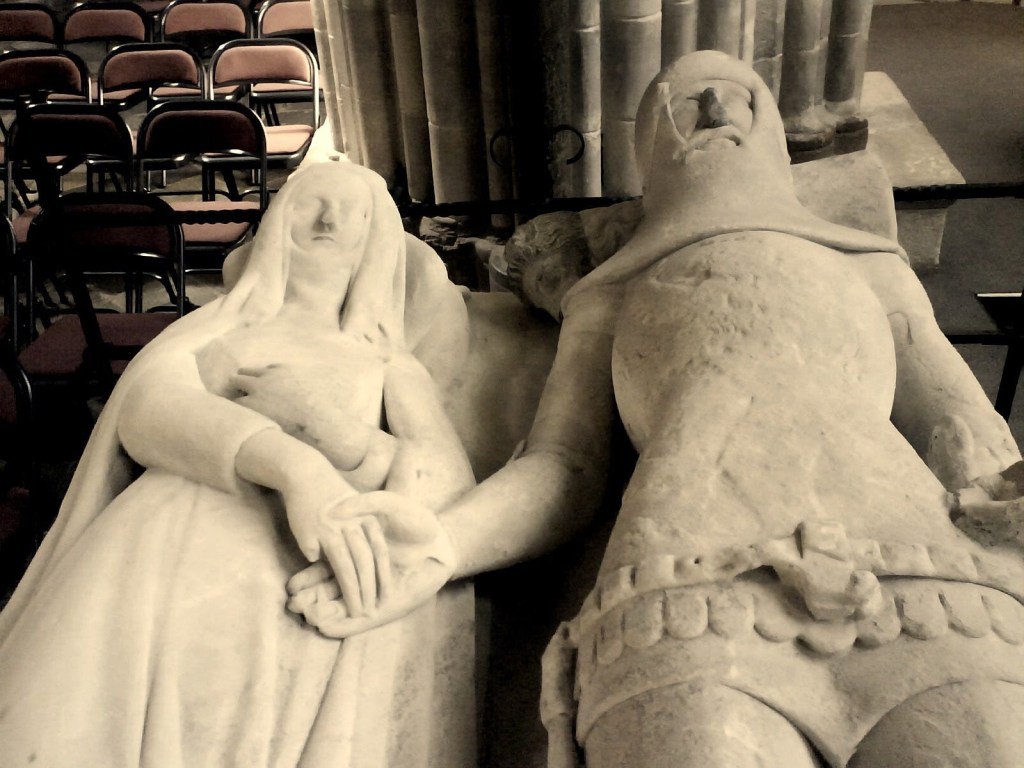
The poem that Lane quotes is called “An Arundel Tomb.” At Arundel, a medieval British town, is the tomb of Richard FitzAlan, the tenth Earl of Arundel, who died in 1371, and that of his second wife, Eleanor of Lancaster, who predeceased him by a few years. The tomb is capped by stone statues of the couple, who are, surprisingly, holding hands:
Side by side, their faces blurred, The earl and countess lie in stone,
Larkin, a dour librarian and bemoaner of the decline of civilization who seems not to have believed in love (even as he juggled three women for most of his adult life), calls bullshit on this romantic display:
They would not think to lie so long. Such faithfulness in effigy Was just a detail friends would see: A sculptor’s sweet commissioned grace
In other words, while the holding of stony hands has stood the test of time, the love it represents was probably a figment of the artist’s rosy imagination. (Note the double meaning of “lie.”)
How soon succeeding eyes begin To look, not read. Rigidly they
Persisted, linked, through lengths and breadths Of time. . .
Until,
Now, helpless in the hollow of An unarmorial age. . . Only an attitude remains:
Time has transfigured them into Untruth. The stone fidelity They hardly meant has come to be Their final blazon, and to prove Our almost-instinct almost true: What will survive of us is love.
Larkin is saying that what the statues represent isn’t real—that our “almost-instinct” is to believe in the much-ballyhooed power of love, and that the “stone fidelity” of the earl and his wife is so compelling as to make said love-power “almost true.” Almost true is not true; almost true is AI true—a lie we want badly to believe in. The entire poem is him expressing his deep, nasty cynicism. The oft-quoted last line is intended to be ironic—a fitting epitaph for our Age of Unreality.
Even so, what survives of Larkin is “What will survive of us is love.” And I like to think, as Lane does, that, whatever the poet’s intention, the Arundel sentiment is real.
The Age of Unreality began in 1991, when all the ingredients of the historical cocktail were thrown into the shaker: the fall of the Soviet Union, the rise of the Russian mafia, the ascendance of Jeffrey Epstein, the dawn of reality TV, the end of apartheid, and the last time that a coalition of Western democracies repulsed an attempt by a despot to invade a sovereign nation—thus upholding the tenets of the Westphalian order. Out of that cocktail shaker, cold as ice, was poured Jeffrey Epstein and Semion Mogilevich, Elon Musk and Peter Thiel, Vladimir Putin and Donald Trump.
Tomorrow, that mindfuck age draws to a close, and a new one begins. What it has in store for us is anyone’s guess. Will the last barriers between fantasy and reality be worn away, or, as Lane poetically puts it, have our eyes been lied to for long enough? Will democracy really die, as the fascism scholars have been warning us for years, or will the Trump power-grab finally wake up the American people and restore our love of liberty? Will generative AI destroy all art, or will a new analog artistry emerge? What will happen to our beloved Hollywood, to which Trump has named meathead Sylvester Stallone, rightwing wacko Jon Voigt, and radical Catholic weirdo Mel Gibson his MAGA “ambassadors?”
I take some small solace in knowing that we’ve been here before. As Hobsbawm notes in The Age of Capital, the United States in the late nineteenth century—the America Trump wants us to return to—was marked by
the total absence of any kind of control over business dealings, however ruthless and crooked, and the really spectacular possibilities of corruption both national and local—especially in the post-Civil War years. There was indeed little that could be called government by European standards in the United States, and the scope for the powerful and unscrupulous rich was virtually unlimited. In fact, the phrase ‘robber baron’ should carry its accent on the second rather than the first word, for, as in a weak medieval kingdom, men could not look to the law but only to their own strength—and who were stronger in a capitalist society than the rich? The United States, alone among the bourgeois world, was a country of private justice and armed forces….
Our current crop of robber barons is orders of magnitude worse than its forebears—but maybe the abject awfulness of these despicable people will make their reigns shorter, their fall more humiliating, and their historical impact less profound.
Even so, for all my optimistic tendencies, I fear tomorrow as surely as Larkin feared death, which he describes as
The sure extinction that we travel to And shall be lost in always. Not to be here, Not to be anywhere, And soon; nothing more terrible, nothing more true.
Death is permanent and absolute, but dictatorships are neither; moreover, Donald isn’t a dictator yet, and may well never be. Even as I have witnessed the poltroonish capitulation of our political leaders, our robber barons, our media figureheads, even our Snoop Doggs, I have faith that we will somehow find a better way, that we will repulse this ugly MAGA incursion, that the moral arc of the universe will bend towards justice, that the better angels of our nature will prevail. My faith will be tested, surely. But it will remain.
Nothing more true than this: What will survive of us is hope.
Sherrilyn Ifill is a law professor who holds an endowed chair at Howard University. She is a former president and director-counsel of the NAACP Legal Defense Fund.
In this post, she offers sage advice about how to recharge your batteries and re-engage in the struggle for a better society. She wrote this piece soon after the 2024 election. It’s good advice.
….But ours is a subtle strength Potent with centuries of yearning,
Of being kegged and shut away In dark forgotten places. We shall endure To steal your senses In that lonely twilight Of your winter’s grief.
-Pauli Murray, To the Oppressors (1939)
The truth is that things are going to get very bad. America has gone over the cliff’s edge. How hard we land in the ravine below remains to be seen. But we are one week in, and things are already quite dire. Trump’s first round of cabinet nominees, and his insistence that his picks be installed without a vote of Congress is a defining moment. It demonstrates that there will be no bottom with this Administration.
Donald Trump and his coterie of supporters are firmly in control of the most powerful and wealthy country in the world. And because they are in charge of this country – which perhaps undeservedly, has stood as an example throughout much of the world as a symbol of freedom, equality, ethics, the rule of law and democracy – other countries will fall in our wake.
I am saying this now because I have always tried to be honest in my writings and analysis about this country. I say all of this because I have been able over the years to encourage my clients, my colleagues, my staff, my family and community to believe that we can fight and win. I have infected other people with my unshakeable optimism about what we can accomplish to transform this country.
I am going to keep fighting. It’s what I do. But I do not want to lead you astray. Because I do think that many of us – especially those of us in communities likely to be targeted by this Administration – need to see this moment as one in which we are focused on surviving this difficult time. I have faced the fact that we will not be able to move much forward in the next few years. In fact, I expect things to become so dire over the next two years, that we will scarcely recognize the country we live in. I expect that fear and cruelty will become part of our daily diet. We will hear the frightening sound of silence, as those who speak out most boldly against the excesses of the incoming administration, against its policies, against Musk and against Russia, find themselves at cross-purposes with a vindictive and cruel administration with almost unimaginable power to control communications, law, and the sense of reality itself.
Perhaps it won’t be that bad. But we are here in some measure, because far too many failed to imagine that the worst could happen. I have written already about “the nadir,” and I believe we must face it.
And so, our goal now must be first and foremost to survive this dark period with as much of our values, dignity, integrity, work, financial stability and physical and mental health intact as possible. We must also work to protect our families and communities, and to hold in place our most trusted and needed institutions, a modicum of the rule of law, our constitutional commitment to equality and to free expression. As I have said in earlier pieces, this is “planting time.” Planting is work. That work must be aimed at building ideas, theories, paradigms, institutions, skills, practices, and alliances that we can seed now for a future harvest – a fulsome and lush democracy that will reflect the very best of us.
We are not “watching the Trump show” this time. We’ve seen it already. We can dip in every now and then, but we must not become paralyzed watching the train wreck. We will, of course, push back against injustice, and defend our rights and citizenship when necessary in the courts. We will demand that congressional representatives, our Governors and our Mayors, act to protect our democratic rights. Even when we know they will not stand up for what is right, we must not be silent. We must not make it easy for them to be cowards or to take our rights. We must still call, write and email our representatives and show up at town halls and meetings. Remember that those who have fought for us over these past years are tired too. Let them see us in these spaces and hear from us.
But our primary work must be first and foremost to work in our communities – both physical and ideological. To build them up and to share time and ideas with those committed to democracy and justice. We each need a curriculum of local service.
We also need a personal curriculum that will allow us to contribute to the building of the future we dream of for ourselves and our families. That means that our core work must be to commit during this time to do less watching, and more learning and more growing. We need to become better citizens for the democracy we want. That means we must dedicate time to expanding our thinking and our knowledge, and to building up our democratic imagination. That means our work is to imagine, to ally, to experiment, restore, befriend, study, read, write, serve, and create. Every one of us. Even as chaos swirls around us.
I encourage you to show your children and grandchildren real things – nature, animals, how things are built, how to cook from scratch. Teach them cursive writing, so that they have a signature all their own. Take them to live concerts and theater. Go on field trips. Infuse their lives with memories of things that are true and concrete.
If you teach, use primary documents in your teaching, take your students to historic sites, listen to audio of oral arguments and speeches so that they will feel confident in their understanding of history, and know that history was made by human beings not machines.
If you litigate, do it with the expectation that you will win. And act like it. Show out. Be excellent and remain confident. Those who can still feel shame – whether those at your opponents table or those on the bench – will feel it when you hold the standard high. And your clients will never forget it.
If you organize, never stop. Plant those seeds deep in our communities.
If you hold office. Hold it. Do not give up your power. Use your voice. Master every rule. Make a record. I repeat. Make a record–so that the truth might be known.
To protect ourselves and our loved ones, there are also pragmatic things we must do. I’ve thought of a few:
Save some cash. And keep enough in the house for gas and food for a week.
Let yourself imagine what you would do if you lost your job in terms of finding new employment, paying rent/mortgage for several months, and start building what you need to be able to meet that moment if it comes.
Get needed vaccinations in case new HHS policies result in changes or delays in their development or availability. Stock up on COVID tests, and get the most recent COVID booster. Purchase Plan B if it’s available in your area.
Think about tightening security on your electronic devices. Be more thoughtful about social media, and even return to making phone calls and writing letters in some instances. I know it’s old school, but actually memorize the phone numbers of at least two loved ones.
Gird yourself spiritually, through your faith or other meditative practices, as we are all likely to hear or confront many disturbing and ugly interactions. Experience art, go on walks, dance, play Spades, Dominoes, Scrabble. We need resilience.
Walk away when you need to walk away. Challenge when you need to. Try to always have back up.
Take the bystander training offered by groups https://righttobe.org/ so that when you see outrages committed against members of your community or against strangers, you will have practice in how you might intervene or respond.
Get an online subscription to a news service from another country so that you have a reliable sense of what’s going on in the world, and how this country is being perceived.
Are your taxes paid, or more importantly, filed?
Is your passport up-to-date?
If you have money to give – then give to your local library, the food pantry, homelessness services. But also give to cultural institutions. Get a library card and a membership to a museum. Give to organizations working to hold back the worst that this administration may dish out – the NAACP Legal Defense Fund, the ACLU, the National Women’s Law Center, and so many others.
I am going to write more in this space. I hope you’ll subscribe and even pay a nominal fee to sustain the writing. I’m right here, going through this with all of you. And for me there is beauty in our shared walk. Let’s do this together.
The Contrarian will be a central hub for unvarnished, unbowed, and uncompromising reported opinion and analysis that exists in opposition to the authoritarian threat. Our pre-election warnings that Donald Trump posed an unprecedented threat to our democracy were often treated as alarmist. However, the election of an openly authoritarian figure who traffics in conspiracies, lies, unconstitutional schemes and un-American notions, has moved the United States to an inflection point. The future of our democracy, and what Lincoln called “the last best hope of earth” hangs in the balance. And yet corporate and billionaire media and too many in the political establishment persist in downplaying the threat and seeking to accommodate Trump and his radical agenda. We refuse to follow the herd.
Unlike most corporate or billionaire media, The Contrarian will not offer Trump the benefit of the doubt. We will not normalize him. We will not engage in false equivalence. We will not excuse enablers in the media, government or business. We will not infantilize his supporters nor treat them as victims; we will confront them with the consequences of their presidential pick.
Trump is no ordinary politician and will be no ordinary president so the response must be extraordinary. His insane pronouncements—be it a premature and utterly false declaration that the New Orleans terrorist had just come over the border or a threat to annex the Panama Canal and Greenland—cannot be ignored or treated as hyperbole. They reveal a warped mind and dangerous agenda that would take America down the road of other authoritarian states such as Viktor Orbán’s Hungary.
We will not be distracted by shiny objects or phony scandals. Instead, we will call out Trump and his fellow bad actors’ dangerous, unconstitutional and immoral actions and vile rhetoric. We will put them in the context of American history and international authoritarian movements. We will call on a range of experts from psychology, sociology, political science, international relations and other fields to inform the discussion and analysis.
We do not call Trump a dictator—yet. That is because a conscientious pro-democracy movement determined to expose, denounce and counteract Trump’s authoritarian impulses has time to act, to preserve our pluralistic democracy. The Contrarian seeks to be in the vanguard of that effort. To that end, we will summon the opponents of authoritarianism from all walks of life—the media, the arts, government, academia, business, sports, culture, labor and civil society—to join a grand coalition, a national front for freedom, decency, democracy, justice, self-determination, and diversity.
The urgency of the task before us cannot be overstated. We have already entered the era of oligarchy—rule by a narrow clique of powerful men (almost exclusively men). We have little doubt that billionaires will dominate the Trump regime, shape policy, engage in massive self-dealing, and seek to quash dissent and competition in government and the private sector. As believers in free markets subject to reasonable regulation and economic opportunity for all, we recognize this is a threat not only to our democracy but to our dynamic, vibrant economy that remains the envy of the world.
Although the task before us is deadly serious, we emphatically believe that joy, humor, and most of all community are essential to preserving a free people. We will offer all three. We also realize the danger of preaching to the choir and failing to reach outside our bubble. We will offer a platform that includes multi-generational, fresh voices from whatever venue or field who can contribute to our endeavor. We are building a community of passionate defenders of democracy who are fed up with equivocation, timidity, and resignation.
We could not be more excited to begin this journey. Our irreverence, candor and refusal to pull punches may offend establishment politicians, campaign insiders, and complicit media. We hope so. Throughout all our work, we pledge to live up to our credo: Not Owned by Anybody.
Jennifer Rubin explains why she gave up her column at The Washington Post, previously one of the most prestigious positions in American journalism. Billionaire Jeff Bezos, one of the richest men in the world, with assets exceeding $200 billion, has bent his knee to kiss the ring of Trump. To stay in Trump’s good graces, he has censored the editorial board, even an editorial cartoonist. The Post is hemorrhaging great journalists. Bezos bought one of the nation’s greatest newspapers and is destroying it.
Corporate and billionaire owners of major media outlets have betrayed their audiences’ loyalty and sabotaged journalism’s sacred mission — defending, protecting and advancing democracy.
The Washington Post’s billionaire owner and enlisted management are among the offenders. They have undercut the values central to The Post’s mission and that of all journalism: integrity, courage, and independence. I cannot justify remaining at The Post. Jeff Bezos and his fellow billionaires accommodate and enable the most acute threat to American democracy—Donald Trump—at a time when a vibrant free press is more essential than ever to our democracy’s survival and capacity to thrive.
I therefore have resigned from The Post, effective today. In doing so, I join a throng of veteran journalists so distressed over The Post’s management they felt compelled to resign.
The decay and compromised principles of corporate and billionaire-owned media underscore the urgent need for alternatives. Americans are eager for innovative and independent journalism that offers lively, unflinching coverage free from cant, conflicts of interest and moral equivocation.
Which is why I am so thrilled to simultaneously announce this new outlet, The Contrarian: Not Owned by Anybody. The Contrarian will offer daily columns, weekly features, podcasts and social media from me and fellow pro-democracy contrarians, many of whom have decamped from corporate media, others who were never a part of it. I am launching this endeavor with my cofounder, Norm Eisen. Founding contributors will include Joyce Vance, Andy Borowitz, Laurence Tribe, Katie Phang, George Conway, Olivia Julianna, Harry Litman (who recently resigned from the LA Times for reasons similar to mine for leaving the Post), and Asha Rangappa, among many other brilliant voices. We will provide fearless and distinctive reported opinion and cultural commentary without phony balance, euphemisms or gamified political punditry.
The need for upstart outlets has never been more acute. The contradiction between, on the one hand, the journalistic obligation to hold the powerful accountable and, on the other, the financial interests of billionaire moguls and corporate conglomerates could not be starker.
ThePost’s own headline last month warned: “Trump signals plans to use all levers of power against the media; Press freedom advocates say they fear that the second Trump administration will ramp up pressure on journalists, in keeping with the president-elect’s combative rhetoric.” And yet ThePost’s owner quashed a presidential endorsement for Trump’s opponent, forked over $1M for Trump’s inauguration through Amazon, and publicly lauded Trump’s agenda.
None of us could imagine Katharine Graham sending LBJ or Nixon a $1M check. It would have been, as it is now, a fundamental betrayal of a great American newspaper. Defense of the First Amendment is incompatible with funding or cheerleading for the very person who seeks to “drastically undermine the institutions tasked with reporting on his coming administration.”
ThePost’s downfall is hardly unique. ABC, Mark Zuckerberg’s Meta and corporate-owned cable TV networks (which have scrambled to enlist Trump-friendly voices) are catering to powerful interests, and have profound corporate conflicts. Instead of guarding their independence, they join financial leaders, politicians and other public figures currying favor with Trump and his orbit.
Through classic anticipatory obedience—a dangerous but all too familiar pattern—they normalize the authoritarian menace. If Trump has taken “attacks on the press to an entirely new level, softening the ground for an erosion of robust press freedom,” as The Post reported, it is because he finds insufficient resistance. Instead, owners whose outlets he targets quite literally rewarded him.
In closing, I want to reiterate that I have been honored to work for over fourteen years alongside the finest writers and editors in journalism. Above all, I was blessed to work for The Post under the Graham Family ownership and Fred Hiatt’s leadership of the editorial section. My admiration for their collective integrity, dedication to craft, courage, patriotism, and decency is boundless. But when new leaders sully the reputation of institutions entrusted to them and the fate of democracy is in the balance, we all must reevaluate our careers and our obligations to the world’s most essential nation.
History calls us all.
I treasure the readers who have stuck with me over the years. I invite them and all those interested in defeating authoritarianism as well as writers and content creators to join this exciting new venture in defense of democracy. Forward!
My first big assignment as a journalist was covering President Jimmy Carter’s 1995 visit to Rwanda, a doomed mission that brought him little acclaim.
Carter didn’t fight disease, promote democracy or negotiate peace to make headlines. He did the work quietly and diligently to make the world a better place. His life was a master class in a leadership style firmly out of fashion but will hopefully return.
I was in my third month as the Associated Press and Voice of America stringer in Kigali, Rwanda’s capital. A civil war between an ethno-fascist Hutu government and rebels from the Tutsi minority had culminated in the 1994 genocide that slaughtered 1 million people, most of them Tutsi civilians, in 100 days.
The Tutsi-led rebels drove the Hutu leadership and 1.2 million of their followers into neighboring Zaire, rnow known as Democratic Republic of the Congo. Insurgents from the Zairian refugee camps were still killing 300 people a week in Rwanda more than a year later.
I trailed Carter through Rwanda and the Zairian refugee camps. His Secret Service detail was minimal, yet he moved through these dangerous places with a confidence, kindness and humility that only comes from tremendous inner strength.
He spoke to political leaders, genocide victims, refugees and me with the same courtesy and respect. He knew Mobutu would probably never agree to a peace deal, but unlike most famous people, he didn’t allow the likelihood of failure to stop him from trying.
Carter wanted to negotiate a deal between the new Tutsi-led Rwandan government and Zaire’s dictator Mobutu Sese Seko, whose murderous misrule had made him a pariah.
“These leaders know that I’m their last chance to rejoin the international community,” Carter told me while driving to a church where the skeletons of the dead were displayed as a genocide memorial. He laughed and added, “If Jimmy Carter gives up on you, there’s no one else coming.”
Carter met with Mobutu, and he agreed to a summit with the Rwanda foreign minister. Diplomats knew Mobutu had cancer and hoped he might cut a deal to boost his legacy.
Carter’s staff asked me to join the trip to Mobutu’s palace in Gbadolite, Zaire. I watched Mobutu turn the summit into a farce. Eighteen months later, Rwanda overthrew him, installed a new president and forced the refugees home. The old dictator died in exile. Carter kept lobbying for world peace.
I saw the former president many more times over my 11 years in Africa. His foundation, the Carter Center, monitored elections and fought preventable diseases like river blindness, guinea worm and other neglected tropical diseases. Carter’s work saved tens of millions of people from suffering, but he never made a big deal out of it.
No one can accomplish so much without steely determination. Too often, I hear people describe Carter as the weak and bumbling caricature that President Ronald Reagan created to win the 1980 election. Folks should stop confusing courtesy for weakness.
After the Watergate scandal and the Vietnam debacle, Carter, in 1976, offered an alternative to Richard Nixon’s imperial presidency. He practiced what has become known as servant leadership, the theory that a leader’s primary duty is ensuring subordinates have the tools they need to accomplish their mission.
In the Army, my brigade commander instilled servant leadership in me when I joined his staff as a newly minted sergeant in 1986. He explained that junior enlisted members did not serve me because I outranked them; my rank meant I was responsible for their success, and the colonel promised to hold me accountable if they failed.
The term servant leadership is hackneyed, but it captures valuable techniques that have caught on in the business world. It emphasizes listening, empathy, persuasion, stewardship and community building while discouraging egotism and authoritarianism.
The greater good comes first, not any individual.
While president, Carter rejected much of the pomp at the White House. His speeches focused on addressing problems, not promoting himself. Despite attending the U.S. Naval Academy and serving in the nuclear navy, he was never a warrior-king style leader, which American voters tend to favor.
Humility does not do well in the current culture, where conspicuousness is valued. Politicians must constantly self-promote while denigrating their rivals. Compromise is considered a failure, and vulgarity is considered clever.
The strongest people I’ve encountered in the most difficult places don’t puff up their chests. They don’t need others to bow before them. People with inner strength don’t use cruelty to prove their power.
Here’s hoping kindness makes a comeback, courtesy becomes cool, and strength is demonstrated by lifting people up, not knocking them down.
Adam Kinzinger had a promising career in the Republican Party. A decorated veteran, he served in Iraq and Afghanistan. He was elected to Congress from Illinois in 2010 and left Congress in 2023. He was one of ten Republucans who voted to impeach Trump for his role in the insurrection. He was one of two Republican members of Congress who served on the January 6 Commission, along with Liz Cheney. Both of their political careers are over unless the GOP breaks free of Trumpism.
For four years, a massive machine of deception has worked tirelessly to transform the greatest political tragedy of our time — the bloody January 6 attack on the U.S. Capitol — into what Donald Trump now calls a “day of love.” As the machine’s chief operator, Trump is determined to make the truth the ultimate casualty of that tragedy. It is up to us to defend it.
No crime in history has been documented more thoroughly than the January 6 attack. More than 1,000 cameras captured the day’s events, and much of that footage was used to charge over 1,600 people with crimes related to the riot. Around 1,000 have been convicted.
As a member of the House committee that investigated the attack, I reviewed the key footage repeatedly and listened closely to the officers who fought against the mob. More importantly, the world watched the tragedy unfold in real time as news networks broadcast the events minute by minute. Since then, we have all seen the images of Trump supporters clad in helmets and tactical gear waging medieval combat against police officers. We’ve witnessed the assaults with our own eyes.
The truth of January 6 is so well established that even people who weren’t there have felt the moral injury of seeing their fellow citizens surge violently into the Capitol. Like September 11, January 6 was a national trauma. The key difference, however, is that this attack was incited by the sitting President of the United States and carried out by our own citizens.
Although the story is familiar, it must be repeated every time January 6 is mentioned. That day was the culmination of Trump’s months-long campaign of lies designed to convince the world that the 2020 election he lost had been rigged. He and his allies spread rumor after rumor, filed and lost lawsuit after lawsuit. Still, conspiracy theories flooded the media and the internet, stoking the anger of Trump’s most fervent supporters.
No evidence of widespread corruption was ever found. Nevertheless, Trump and his followers continued to push these lies in countless ways. Then, as Congress prepared to certify the election results, he summoned his supporters to Washington, D.C., and all but ordered the attack to disrupt the certification process. More than 140 officers were injured. Five people died.
In the immediate aftermath, only a handful of political extremists denied what had occurred. Even Trump, the King of Lies, initially called it a “heinous attack” and a “calamity,” warning that lawbreakers “will pay.” However, in the weeks that followed, false claims of leftist agitators began to spread. Fringe lawmakers described members of the mob as mere tourists who had been granted access to the Capitol. By March, Trump echoed the notion that rioters had been “ushered” into the building. By 2022, he began to express sympathy for those charged with crimes, and with his encouragement, his followers began portraying these attackers as martyrs.
Trump, the most brilliant and malicious propagandist in American history, relentlessly repeated the lie that January 6 wasn’t an attack but a “simple protest” gone wrong — not a violent attempt to disrupt the democratic process. Each statement advanced the falsehood in small, calculated increments. This is how reality is corrupted. Today, a majority of Republicans claim the people who stormed the Capitol were engaged in “legitimate civil discourse,” while one-third of Americans question whether Joe Biden won the 2020 election fairly.
In the tragic context of Trump’s potential return to power, we should expect him to fulfill his promise to pardon most, if not all, of those convicted for their actions on January 6. He will justify these pardons with even more lies, which millions will accept as truth.
Yet a greater number of us still believe in the facts captured on video, documented in the January 6 Committee’s report, and upheld in the courts. As rational citizens, we are obligated to speak out when lies are spread. We must continue to do so until the day Trump’s propaganda is obliterated and the truth prevails — as it will, in time.
Ann Tolnaes is a brilliant cartoonist who resigned from The Washington Post when her latest cartoon was cancelled. It depicted the media and tech oligarchs bowing and scraping to Trump, including the owner of The Washington Post, Jeff Bezos.
The editor of the opinion section said he killed the cartoon because the paper had run a story on the same topic, and the cartoon was repetitious. I found that hard to believe because cartoons typically comment on stories in the news; they don’t break news.
He also said she had been invited to return. We will see what happens. The whole episode was widely publicized and is a stain on the newspaper’s reputation, especially since Jeff Bezos intervened and canceled the paper’s endorsement of Kamala Harris in the closing days of the campaign.
For another telling of this important story, read the article by Mike Peterson in The Daily Cartoonist about the controversy and about Ann Tolnaes’s importance. He reprints several of her cartoons, explains how to order a book of her cartoons (bypassing Amazon), and suggests we show our support by subscribing to her Substack blog. I just subscribed.
Thanks to reader John Ogozalek for directing me to this insightful commentary.



 Diane Ravitch's blog