Archives for category: Courage

The Justice Department recently released a lengthy report on the massacre of 19 students and two teachers in Uvalde, Texas, on May 24, 2022.

The report concluded that teachers and students have more training about how to react to an active shooter than the nearly 400 law enforcement officers who converged on the school. No one was sure who was in charge. The children had been trained to be silent, and they were. The officers assumed that the silence meant that the shooter was barricaded in an empty classroom, despite numerous 911 calls by terrified students. For over an hour, no one confronted the killer. The mistakes cost lives. When the killer was dead, the medical response to the situation was bizarre. Dead children were placed in ambulances, while children with gunshot wounds were loaded onto school buses.

ProPublica and the Texas Tribune published and summarized the findings:

UVALDE, Texas — Law enforcement agencies across the country should immediately prioritize active shooter training, U.S. Attorney General Merrick Garland said Thursday as he released a scathing report about the handling of the 2022 massacre in Uvalde, Texas, in which lives could have been saved if training protocols had been followed.

The Justice Department’s long-anticipated report about the shooting found that “cascading failures of leadership, decision-making, tactics, policy and training” led to the bungled response, which Garland said should never have happened. Nineteen children and two teachers were killed on May 24, 2022.

“Had law enforcement agencies followed generally accepted practices in an active shooter situation and gone right after the shooter to stop him, lives would have been saved and people would have survived,” Garland said during a news conference on Thursday.

The report’s findings about the failure to follow protocol and the lack of sufficient training to prepare officers for a mass shooting largely mirrored the flaws revealed in a Texas Tribune, ProPublica and FRONTLINE investigation published last month that found that states require students and teachers to receive far more training to prepare them for a mass shooting than they require for the police. At least 37 states require schools to conduct active-shooter-related drills, nearly all on an annual basis. But Texas is the only state that mandates that all of its police officers complete repeated training, at least 16 hours every two years. That requirement was implemented after the Uvalde shooting.

Garland said the report was produced in an effort to offer lessons that would hopefully better prepare law enforcement across the country to respond to future mass shootings. It offered recommendations that included requiring all agencies in a region to train together and providing officers across the country with at least eight hours of active shooter training annually.

The vast majority of at least 380 officers from about two dozen local, state and federal agencies who responded to the school had never trained together, “contributing to difficulties in coordination and communication,” the report stated.

“Our children deserve better than to grow up in a country where an 18-year-old has easy access to a weapon that belongs on the battlefield, not in a classroom,” Garland said. “And communities across the country, and the law enforcement officers who protect them, deserve better than to be forced to respond to one horrific mass shooting after another. But that is the terrible reality that we face. And so it is the reality that every law enforcement agency in every community across the country must be prepared for.”

Mo Canady, executive director of the National Association of School Resource Officers, said in an interview that he appreciates the emphasis the Department of Justice placed on widespread active-shooter training. Still, Canady said he is frustrated that leaders have not already learned that “25-year-old lesson” after the shootings at Columbine High, Sandy Hook Elementary and Marjory Stoneman Douglas High School.

Since the 1999 Columbine shooting, law enforcement officers have been trained to prioritize stopping the shooter. The report stated that everything else, including officer safety, should be secondary, adding that efforts to engage the shooter “must be undertaken regardless of the equipment and personnel available.”

“We’ve got to understand what the priorities are and, quite frankly, I see there are not a lot of priorities greater than keeping students safe at school,” Canady said.

Kimberly Mata-Rubio, whose 10-year-old daughter Lexi was killed in the shooting, said she hopes the report’s findings lead to action, that “the failures end today and that local officials do what wasn’t done that day, do right by the victims and survivors of Robb Elementary: terminations, criminal prosecutions and that our state and federal government enacts sensible gun laws…”

The district attorney and the Texas Department of Public Safety have fought the release of records related to the shooting, prompting news organizations, including ProPublica and the Tribune, to sue. A Travis County district judge ruled in the newsrooms’ favor last month, but DPS appealed. The agency did not respond to requests for comment about the Justice Department’s report.

Texas Gov. Greg Abbott, who initially praised the response and later said he was misled, released a statement thanking the Justice Department. He said the state has already adopted some of the recommended measures and would review others.

The report, which offers the most comprehensive account to date from authorities about the shooting, echoes many findings from a probe released by a state House committee two months after the shooting…

The report noted that the “misguided and misleading narratives, leaks, and lack of communication about what happened on May 24 is unprecedented and has had an extensive, negative impact on the mental health and recovery of the family members and other victims, as well as the entire community of Uvalde.”

The previous mayor of Uvalde requested the federal review days after the shooting when it became clear that the response was flawed. The review was led in part by Sheriff John Mina of Orange County, Florida, who was the incident commander during the 2016 Pulse Nightclub massacre in Orlando.

An outside review of that incident found that Florida officers, who waited three hours to take down the shooter, mostly followed best practices, although it stated that the law enforcement agencies in Orlando should update their training and policies.

In multiple after-action reviews, including the Pulse report, authors opted not to criticize significant law enforcement delays during mass shootings, according to an analysis of more than three dozen of these reports by ProPublica, the Tribune and FRONTLINE.

The Uvalde report was far more critical, finding failures in leadership, command and coordination.

It stated that officers wrongly treated the situation as a barricaded suspect incident instead of one in which a shooter was an active threat to children and teachers. Officers should “never” treat an active shooter with access to victims as a barricaded suspect — especially in a school, where there is a “high probability” of potential victims and innocent civilians being present, the report stated.

Officers had multiple indicators that should have made it clear they were facing an active shooter, including 911 calls from children and teachers pleading for help, a dispatcher’s announcement minutes after officers arrived that students were likely in the classroom with the shooter, and an Uvalde school police officer announcing that his wife had called to tell him she had been shot, according to the report.

Gupta condemned the medical response, saying that after police breached the classroom and killed the gunman, dead victims were placed in ambulances while children with bullet wounds were put on school buses. Many of those findings were revealed in a 2022 investigation by the Tribune, ProPublica and The Washington Post that determined medical responders did not know who was in charge and that two students and a teacher who later died still had a pulse when they were rescued from the school.

In its blistering criticism of responding officers, the report said that supervisors from various law enforcement agencies “demonstrated no urgency” in taking control of the incident, which exacerbated communication problems and added to overall confusion.

Uvalde school district Police Chief Pete Arredondo, who was listed as the incident commander in the district’s active-shooter plan, had the “necessary authority, training and tools” to lead the response but did not provide “appropriate leadership, command and control,” the report found. Arredondo could not be reached for comment Thursday through his attorney. He has previously defended his actions and those of others involved in the response.

Beyond that, no leader from any of the other responding agencies “effectively questioned the decisions and lack of urgency” demonstrated by Arredondo and Uvalde Police Department Acting Chief Mariano Pargas, who both arrived at the school within minutes of the first round of gunfire. The report listed Uvalde County Sheriff Ruben Nolasco, Uvalde County Constables Emmanuel Zamora and Johnny Field, and an unidentified Texas Ranger as examples of such leaders.

“Responding officers here in Uvalde, who also lost loved ones and who still bear the emotional scars of that day, deserved the kind of leadership and training that would have prepared them to do the work that was required,” Garland said.

The report also found that key officers, including Pargas, had no active shooter or incident command training despite, in some instances, having decades of law enforcement experience. Nolasco, the sheriff, also had no active shooter training and “minimal” incident command training.

Ruby Bridges was chosen as the first child to integrate a public school in New Orleans. Six years old, she walked to school surrounded by federal marshals. After Norman Rockwell illustrated the photo, it became an iconic image as “The Problem We All Live With.”

Ruby Bridges was interviewed by Stephen Colbert, and it was a moving interview. He asked her if she was afraid when she saw the crowds of screaming white parents outside the school. She said, “No, I thought it was a Mardi Gras event.” When she entered the school, the crowd rushed in and withdrew their children, leaving her the only student in the school.

It’s a wonderful short interview, and she is a very impressive woman.

Leonie Haimson is a tireless advocate for better public schools and reduced class sizes. She leads a small but powerful organization called Class Size Matters. I am a member of her board (unpaid, of course, as she is).

CSM is powerful because Leonie is tireless. She attends meetings of the City Council, the Panel on Education Policy (I.e., the Board of Education); she testifies at City Council hearings and goes to Albany to testify when the education committees meet. She finds lawyers to work pro bono and files lawsuit to seek more funding for the schools. She works with parent groups to support or oppose the latest decision by the mayor. She meets with elected representatives. She writes op-Ed’s for the local press. She almost single-handedly collapsed Bill Gates’ inBloom, which hoped to collect personally identifiable information about every student in every state. She scrutizes the budget of the NYC public schools, even more intensely than those who are paid to do it. She once blocked a bad deal that saved the city $600 million, by exposing the sordid record of the contractor.

The elected officials in Albany are now considering whether to renew mayoral control of the public schools. Michael Bloomberg persuaded the Legislature to give him control soon after he was elected in 2001. He promised all sorts of miraculous improvements. He would be accountable, he said.

Leonie testified recently at a hearing on mayoral control and explained that mayoral control did not increase accountability. In fact, it decreased accountability. No one listened to parents. One of Bloomberg’s chancellors (his second, who lasted only 90 days) mocked parents who expressed their grievances at a public hearing.

The mayor hired a lawyer with no experience in education to be the schools’ chancellor. He did not trust educators and surrounded himself with people from the corporate sector.

The mayor had a majority of appointments on the city’s “Panel on Education Policy,” a toothless replacement for its Board of Education. When the members of the Panel threatened to reverse one of his decisions, he fired the disobedient appointees on the spot and replaced them with others who served his wishes.

The mayor could do whatever he wanted, regardless of the views of teachers, parents, students, communities. Beloved public schools that served the neediest of students were closed and replaced with small schools that did not accept the neediest of students. He opened scores of charter schools that were free to reject or exclude students they did not want, then crowed about their test scores. (Now a private citizen, Bloomberg continues to give hundreds of millions to charter schools; no big deal for him, as his assets exceed $60 billion).

Leonie stands on a solid foundation of knowledge, experience, and persistence. Sometimes I think she wins battles because the electeds don’t want her to pester them anymore.

She is the undisputed champion of reduced class sizes.

More power to her!

Regular readers of this blog may have noticed (or not) that I never mention artificial intelligence. I think it’s ominous. I don’t like simulations of real people. I don’t like technology that can write even better than most humans. I prefer to deal directly with humans, not fakes.

Artifial intelligence may be deployed as a deceptive weapon in the upcoming elections.

2024 is a crucial year in our politics. On the ballot in the primaries and in the general election will be candidates who are offering theocracy, dictatorship, or democracy. They will use AI to woo and confuse voters.

New Hampshire blogger and former state senator Jeanne Dietsch has posted a warning about deep fake videos. The video she posts is titled “This Is Not Morgan Freeman.” The face is Morgan Freeman, the voice is Morgan Freeman. But it is not Morgan Freeman.

She also offers a warning about the three factions that are competing in New Hampshire.

She writes:

Elected officials no longer act as individuals. They vote as teams. In NH we have three types of teams:

  • “LIBERTY” CANDIDATES who do not believe in majority rule or public services. They want to privatize education, public lands and government services. They believe the only behaviors that should be illegal are theft and bodily harm. People may make fentanyl, pollute the water supply, sell body parts, or do anything else on their private property. That includes corporations that want to buy up state forests to lumber or entire swaths of housing to rent.
  • FASCIST & THEOCRATIC CANDIDATES also want to replace democracy with minority rule. Unlike liberty candidates, they want stricter laws set by a dictator or by religious leaders. Their goal is to control society, as in Putin’s Russia or a Christian version of Iran.
  • PRO-DEMOCRACY CANDIDATES may disagree on how large government should be and many other issues. However, they will stand up against those who support lawlessness or dictatorship. They will ensure we regularly hold fair elections. They believe in the rule of law.

Political parties no longer define the teams in this state. Undeclared voters outnumber either party by a third. In 2020, the “liberty” team temporarily took over the NH House Republican Caucus. Even though they were a minority of the 400 House members, they controlled the agenda. Pro-democracy legislators in both parties were powerless.

The story in DC is similar. The functions of the American republic are being held hostage by a small minority.

Will we fall for the deep fakes? Will we be deceived by AI? Or will we protect our democracy?

Dan Marburger, who served for almost three decades as principal of the Perry High School, died of the wounds he sustained after being shot by a high school student on January 4.

The high school student killed an 11-year-old sixth grader and wounded several others, then killed himself.

Mr. Marburger gave his life to save the lives of students.

In this country, “gun rights” have more protection than the lives of students, teachers, and principals. Don’t believe those politicians who say they protect “life” but oppose gun control. This is a contradiction or outright hypocrisy. Anyone who values life must demand gun control.

Governor Kim Reynolds ordered state flags to be flown at half-mast. Surely, she also offered thoughts and prayers. Maybe. Don’t count on her to inquire why a high school student had a deadly weapon or to act to make sure that buyers of guns undergo background checks, take training in gun safety, are required to own gun safes, and are subject to red flag laws. But none of that will happen. Expect that she will propose arming teachers and other adults in the school. Metal detectors. Probably, she’ll spend some money on mental health.

But not limiting access to guns.

Heather Cox Richardson wrote this beautiful tribute to Dr. King. I knew I had to share it with you. Please subscribe. I read that she has a million paying subscribers. She deserves her good fortune.

You hear sometimes, now that we know the sordid details of the lives of some of our leading figures, that America has no heroes left.

When I was writing a book about the Wounded Knee Massacre, where heroism was pretty thin on the ground, I gave that a lot of thought. And I came to believe that heroism is neither being perfect, nor doing something spectacular. In fact, it’s just the opposite: it’s regular, flawed human beings choosing to put others before themselves, even at great cost, even if no one will ever know, even as they realize the walls might be closing in around them.

It means sitting down the night before D-Day and writing a letter praising the troops and taking all the blame for the next day’s failure upon yourself, in case things went wrong, as General Dwight D. Eisenhower did.

It means writing in your diary that you “still believe that people are really good at heart,” even while you are hiding in an attic from the men who are soon going to kill you, as Anne Frank did.

It means signing your name to the bottom of the Declaration of Independence in bold print, even though you know you are signing your own death warrant should the British capture you, as John Hancock did.

It means defending your people’s right to practice a religion you don’t share, even though you know you are becoming a dangerously visible target, as Sitting Bull did.

Sometimes it just means sitting down, even when you are told to stand up, as Rosa Parks did.

None of those people woke up one morning and said to themselves that they were about to do something heroic. It’s just that, when they had to, they did what was right.

On April 3, 1968, the night before the Reverend Doctor Martin Luther King Jr. was assassinated by a white supremacist, he gave a speech in support of sanitation workers in Memphis, Tennessee. Since 1966, King had tried to broaden the Civil Rights Movement for racial equality into a larger movement for economic justice. He joined the sanitation workers in Memphis, who were on strike after years of bad pay and such dangerous conditions that two men had been crushed to death in garbage compactors.

After his friend Ralph Abernathy introduced him to the crowd, King had something to say about heroes: “As I listened to Ralph Abernathy and his eloquent and generous introduction and then thought about myself, I wondered who he was talking about.”

Dr. King told the audience that, if God had let him choose any era in which to live, he would have chosen the one in which he had landed. “Now, that’s a strange statement to make,” King went on, “because the world is all messed up. The nation is sick. Trouble is in the land; confusion all around…. But I know, somehow, that only when it is dark enough, can you see the stars.” Dr. King said that he felt blessed to live in an era when people had finally woken up and were working together for freedom and economic justice.

He knew he was in danger as he worked for a racially and economically just America. “I don’t know what will happen now. We’ve got some difficult days ahead. But it doesn’t matter…because I’ve been to the mountaintop…. Like anybody, I would like to live a long life…. But I’m not concerned about that now. I just want to do God’s will. And He’s allowed me to go up to the mountain. And I’ve looked over. And I’ve seen the promised land. I may not get there with you. But I want you to know tonight, that we, as a people, will get to the promised land!”

People are wrong to say that we have no heroes left.

Just as they have always been, they are all around us, choosing to do the right thing, no matter what.

Wishing you all a day of peace for Martin Luther King Jr. Day 2024.

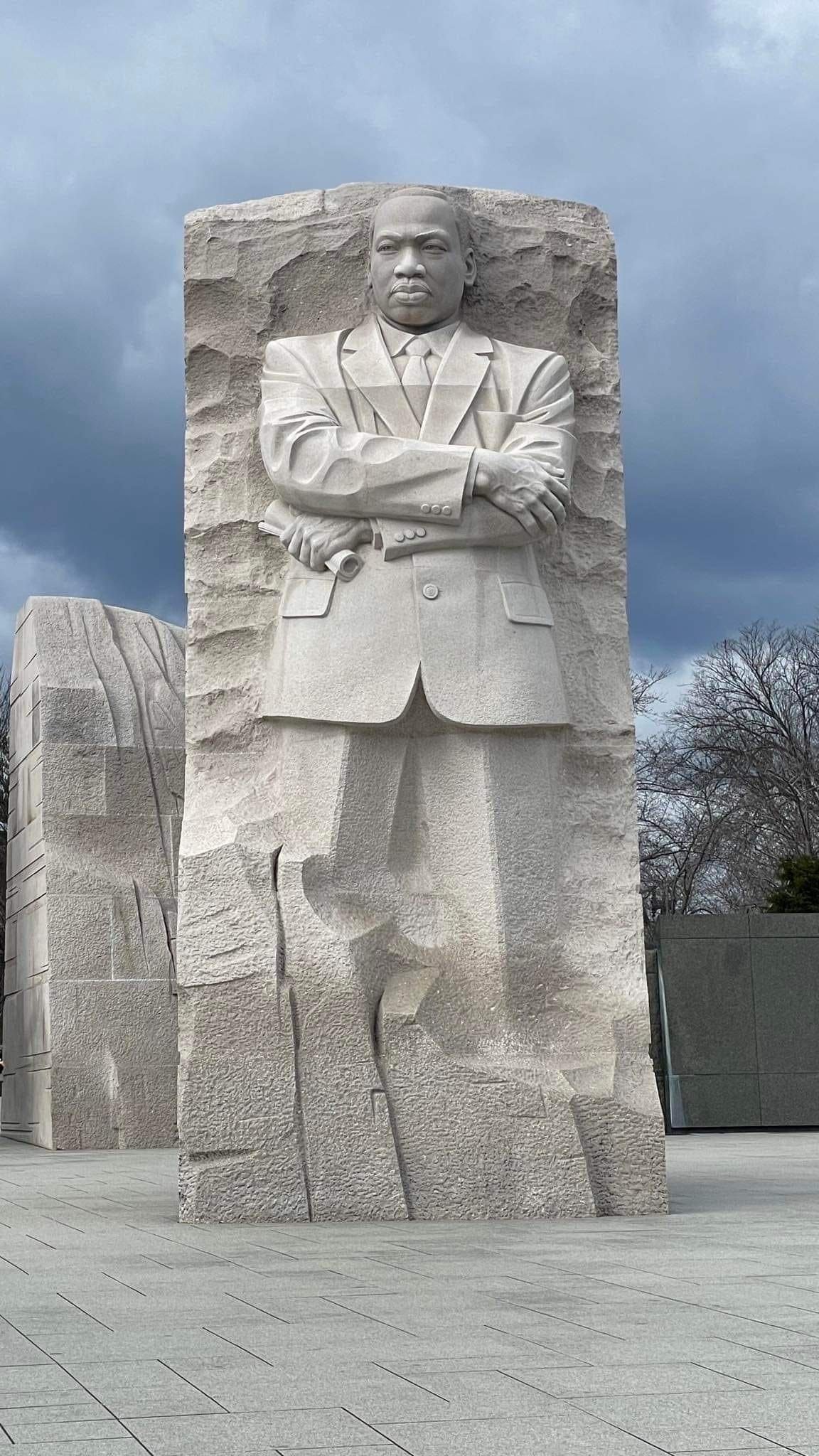
[Image of the Martin Luther King Jr. Memorial in Washington, D.C., by Buddy Poland.]

One of the biggest obstacles to waking up the public is that most people have no knowledge of the privatization movement. They don’t understand that the attacks on teachers and public schools are part of a long-range plan to destroy public education as a community asset and turn it into an individual consumer choice, like choosing what kind of milk you want when you go grocery shopping (as Florida Governor Jeb Bush memorably said at the 2012 Republican Convention). The culture wars over LGBT issues, trans kids, and critical race theory are part of the same plan to sow distrust of a valued community institution.

This story appeared in Vanity Fair. It was written by Laura Pappano and produced by The Hechinger Report. It brings the controversy to an audience that is not immersed in education politics. Laura Pappano is the author of School Moms: Parent Activism, Partisan Politics and the Battle for Public Education, to be published by Beacon Press in January 2024. By the way, I just subscribed to a digital edition of Vanity Fair for only $1 a month. There is an educator price of only $8 a year. What a bargain for a publication with excellent content like this story.

Pappano writes:

In Priest River, Idaho, the moms seated at the conference table on Election Day were worried. They had good reason: Their poll watchers at voting sites—grange halls on dirt roads, community centers hardly larger than a bungalow—suggested things were not going their way.

There were no formal exit polls conducted in West Bonner County, where the school district covers 781 square miles over timbered hills and crystalline lakes in the north Idaho panhandle. But Dana Douglas, a fit and forceful blonde sipping on an Americano and a water bottle boosted with electrolytes (she was teaching spin at 6 p.m.) had been poll-watching at Edgemere Grange Hall, and she had her indicator for how voters were casting their ballots: “Anyone who said, ‘Hello, good morning’” was in their camp. “Anyone with a scowl” who would not look her in the eye was in the other.

“It’s going to be a battle,” she said at the table. Sitting beside her, Candy Turner, a retired elementary school teacher who had brought Ziploc bags of pear slices and dried cranberries for the hours ahead, agreed. “I think we are in trouble based on what I saw.”

After Election Day, headlines in key locales all around the country spoke of moms fighting extremists in local school board races and winning. But even as some celebrated “flipping” their school boards back, far-right groups like Moms for Liberty remain. As the organization declared in an email blast in which they claimed winning 50 new school board seats: “WE ARE JUST GETTING STARTED!”

Some people overlook school board skirmishes, seeing them as trivial. For Turner, Douglas, and many in the West Bonner County School District, they are anything but. It’s not about Democrats versus Republicans (Turner is a registered Democrat; Douglas is “a proud conservative Republican”). It’s about the viability of public education in their community.

This is not hyperbole. The national infection facing public schooling—the tug-of-war between education professionals and extremist culture warriors—has brought chaos and damage to West Bonner County. After this past school year ended, the superintendent acknowledged that 31% of teachers, counselors, and education leaders left the district, and scores of parents pulled their children, opting for homeschooling, online learning, or enrolling in another district. Buildings are infrequently cleaned; an elementary school principal reported at an October school board meeting that mice were running over children’s feet and hallways smelled of urine.

What has happened in West Bonner County offers a warning to public school supporters elsewhere. Douglas, Turner, and others are fighting to restore normalcy to an institution that should not be up for grabs—but is.

“We’ve been the canary in the coal mine,” Margaret Hall, the current school board chair who faced a far-right challenger, said on the eve of the November election. Hall, a soft-spoken but firm force, has served on the board for eight years, even through chemotherapy treatments for cancer. “What has to happen,” she said, “is people have to wake up and decide, ‘We don’t want someone to come in and tell us what we want. We want to decide ourselves.’”

Idaho is a conservative state and Bonner County is even more so, with registered Republicans outnumbering Democrats by almost seven to one (statewide it’s closer to five to one). Despite the nation’s bitter party politics, residents of this county have traditionally exercised a neighborly pragmatism in which the kids—or, as Douglas prefers, “our babies”—come first.

People filled in the gaps when it came to local needs, from sending groceries home with some children over weekends to teachers helping students brush their teeth or spending extra hours with struggling readers. But that spirit is now being tested by extremists who see a soft target in a stressed school district. Suddenly, the far-right’s anti-public-education catchphrases blared regularly on the national stage have become wedged into the local lexicon.

For example, “transgenderism” (described by one candidate as “boys in girls bathrooms, boys in girls sports, ‘gender-affirming care,’ and related absurdities”) became a top issue in this November’s school board race. One candidate for reelection, Troy Reinbold, a nonchalant figure who has attended meetings in cutoff shorts and exited mid-agenda without explanation, touted his work on “the strongest transgender policy in Idaho schools” and opposition to “social emotional learning,” which he called “a precursor to critical race theory.”

Hall, for her part, abstained in an August vote on a school district policy that would require teachers and staff to “refer to students by their biological sex” and students to use bathrooms and locker rooms corresponding to their genders assigned at birth, along with bar transgender girls from girls’ sports teams. She said it was confusing, poorly written, and not vetted by the board’s legal counsel (instead it was reviewed by the anti-LGBTQ Christian legal advocacy group, Alliance Defending Freedom). Hall’s campaign signs were later tagged with rainbow stickers. The policy ended up passing 4-0.

How a place that had long treated differences with a live-and-let-live ethos adopted the intolerant tone of national politics is anyone’s guess. Some blame an influx of newcomers. Bonner County, like the rest of Idaho, is growing, and over the past decade, the tally of registered voters has risen almost 50% to nearly 32,000.

But who they are and why some of them don’t support public education is a more complicated question. It’s possible that Idaho’s lax COVID-19 rules lured extremists, survivalists, and those lacking a communal impulse. There’s also a broader arc at play in a state economy that’s forced people to shift from work in local sawmills to commuter jobs that get them home later and leave them reliant on others to keep civic life running—a common pattern in 21st-century America. But Priest River, where the district is headquartered, is close-knit, populated by descendants of the six Naccarato brothers, who came from Italy to build the Great Northern Railroad in the late 1800s and stayed. That includes many mom organizers like Candy Naccarato Turner.

Priest River police chief Drew McLaindates the start of recent drama to the school board vote to rescind the English Language Arts curriculum from the well-established education publisher McGraw Hill. It had been swiftly and unanimously approved in June 2022 and was delivered to replace the curriculum that was out of print. But far-right activists objected, complaining that it included aspects of social emotional learning. Such instruction—on skills like “self-confidence, problem-solving, and pro-social behavior,” as McGraw Hill described the curriculum on its website—is a bugaboo for conservative ideologues. And on August 24 of last year, with one member missing, the board voted 3-1 to return the texts to the publisher.

The decision got the attention of moms like Douglas, Turner, and others. Whitney Hutchins,a new mother who graduated from West Bonner County schools in 2010 and whose family has operated a resort on Priest Lake for generations, started attending school board meetings. Ditto for Jessica Rogers, a mom of three daughters who had served on the curriculum committee and was upset by the reversal. Others, too, wondered what was happening.

After all, for years the meetings had been quiet affairs at the district’s storefront office on Main Street in a room with aged wood floors, folding chairs and tables, and a capacity of 34. By late 2022, such serenity was a thing of the past. People started lining up three to four hours in advance, which McLain said forced him to close Main Street for safety. Quickly, the gatherings got more and more unruly. First, McLain sent one officer, then several. At times, he called on the sheriff for backup.

Things escalated even further when Jackie Branum, who was hired as superintendent in the summer of 2022, proposed a supplemental levy, which sets a chosen amount as property tax to support local schools’ operating costs, and a four-day school week to address financial issues—then abruptly resigned. The board approved the shorter week, angering many parents. Then it appointed Susie Luckey, a popular elementary school principal, as interim superintendent until June. By May, the board had put a levy before voters that would provide roughly one-third of the district’s budget.

Supplemental levies in Idaho, which ranks 50th nationally in public school funding, had long been used for capital projects and are now essential for operations. But residents suddenly sorted into “for” and “against” factions. Signs sprouted along rural roads; arguments raged on Facebook. The levy failed by 105 votes out of 3,295 cast. Parents expressed concern at a public meeting that the district would cut sports and extracurricular activities; some worried about teacher retention. Not to mention: The district still had no permanent superintendent.

In a swift but puzzling process, the school board eventually announced two finalists for superintendent. One was Luckey. The other was a far-right former elected politician who worked for the Idaho Freedom Foundation by the name of Branden Durst. Durst was an unusual choice given his lack of school experience and the IFF’s hostility to public education. (In 2019, the president of the IFF called public schools “the most virulent form of socialism (and indoctrination thereto) in America today,” adding, “I don’t think government should be in the education business.”)

Then again, it wasn’t Durst’s first go-around: In 2022, the Democrat turned Republican ran for state superintendent of public instruction. He lost the GOP primary but in Bonner County beat his two challengers with 60% of the vote. Among the donors to his campaign were IFF leaders and a local resident who had opposed the McGraw Hill curriculum.

It is unclear how Durst, an abrasive outsider from 420 miles south in Boise, was so quickly ushered into contention. Jim Jones, former Idaho attorney general and a former justice of the Idaho Supreme Court, points to the IFF. He said the organization aims to “discredit and dismantle” public schools throughout the state, “starting with West Bonner County School District.”

Jones also credits the IFF for helping extremists Keith Rutledge and Susan Brown get elected to the West Bonner County School Board in November 2021 in a low-turnout race. It was a pivotal election—but people didn’t realize it then. In hindsight, Douglas said residents “got lazy and complacent and we didn’t get to the polls and put people in the district that valued public education.”

By early 2023, Rutledge and Brown—along with Reinbold, who revealed himself as a fellow extremist—had become a majority voting bloc on the five-person school board. Hall, the school board chair who works on climate change mitigation and who readily references the Idaho education code, and Carlyn Barton, a mother and teacher who describes herself as a “common sense constitutional conservative,” were at odds with the other three.

Durst’s candidacy earlier this year turned up the heat on divisions both on the board and in the community. School board meetings were packed. Militia started showing up. And while the Second Amendment is cherished in Idaho, residents were alarmed to find men donned in khaki with walkie-talkies—and presumably guns—present for conversations on children’s education.

“The militia should not be at school board meetings,” argued McLain, the police chief who claimed that one grandfather “was so pissed at the militia” that he arrived drunk with a rifle. “It’s been frustrating,” he added. “If you told me I had the choice of a school board meeting or a bank robbery, I would be way less stressed going to the bank robbery.”

Following multiple contentious meetings with Hall and Barton, who pressed board members to reconsider Durst’s candidacy, in late June, he was selected by a 3-2 vote. After his hiring was finalized, Barton charged that “the direction of our board has turned into a fascist dictatorship with an agenda which is far from our conservative point of view.”

From the moment he slid into the superintendent’s maroon Naugahyde-upholstered chair in the West Bonner County School District office, Durst seemed to relish his position of power. There was serious work to do—like negotiating a teacher contract—but he appeared far more interested in burnishing his reputation, describing his takeover as “a pilot” that others could learn from.

This was a chance, he told me in multiple interviews, to use the district to test his “ideas that are frankly unorthodox in education,” including some rooted in his Christian values. He wanted intelligent design taught alongside evolution in biology classes. He was working to have a Christian university offer an Old Testament course to high school students at a Baptist church near their school. He hoped the district would adopt curricula developed by the Christian conservative college Hillsdale in Michigan.

Durst also cast himself as a model for how non-educators could take charge of a school district. He boasted that national far-right figures were in touch and encouraged him not to “screw this up.” As he put it, “I broke into the club. I got a superintendency without having to go through the traditional process of doing it.” Indeed, he had not been a school principal, administrator, or classroom teacher.

That lack of process was a major problem for the state Board of Education, which in August gave the district notice it was not in compliance with Idaho law, a determination that jeopardized tax dollars critical for funding the schools. A letter sent to Rutledge, the chair at the time, cited budget irregularities, missed school bus inspections, concerns about discipline rates of special education students, and the failure to file forms to access federal funds. But the main issue, the state’s board said, was the district’s “decision to employ a non-certified individual as superintendent.” Durst had sought emergency certification but was rebuffed by the state.

All of the uncertainty and division grew so dire that teachers found themselves struggling to carry on, leaving many no choice but to give notice. “It breaks my heart that I had to leave,” Steph Eldore, a fixture at Priest Lake Elementary School for 26 years, told me over tears in late August. With her daughter starting high school, Eldore and her husband, Ken, who had been director of facilities and capital improvements for 16 years, quit the district, finding jobs and enrolling their daughter elsewhere.

By the end of summer, 27 teachers had retired or resigned, along with 19 other staff members, including the director of special education, a school principal, and three counselors. Families followed. By fall, school district enrollment was down to 1,005 students, 100 less than projected. Even McLain, the police chief, had rented a place in Sandpoint, about half an hour from Priest River, and enrolled his two high school–aged children there. “We call ourselves the Priest River refugees,” he said. Sergeant Chris Davis, the district’s school resource officer, similarly said his daughter has opted to finish high school online. All in all, the Lake Pend Oreille School District in Sandpoint, whose permanent levy offers steady funding, reported 43 student transfers from West Bonner County School District.

All of the uncertainty and division grew so dire that teachers found themselves struggling to carry on, leaving many no choice but to give notice. “It breaks my heart that I had to leave,” Steph Eldore, a fixture at Priest Lake Elementary School for 26 years, told me over tears in late August. With her daughter starting high school, Eldore and her husband, Ken, who had been director of facilities and capital improvements for 16 years, quit the district, finding jobs and enrolling their daughter elsewhere.

By the end of summer, 27 teachers had retired or resigned, along with 19 other staff members, including the director of special education, a school principal, and three counselors. Families followed. By fall, school district enrollment was down to 1,005 students, 100 less than projected. Even McLain, the police chief, had rented a place in Sandpoint, about half an hour from Priest River, and enrolled his two high school–aged children there. “We call ourselves the Priest River refugees,” he said. Sergeant Chris Davis, the district’s school resource officer, similarly said his daughter has opted to finish high school online. All in all, the Lake Pend Oreille School District in Sandpoint, whose permanent levy offers steady funding, reported 43 student transfers from West Bonner County School District.

Others, of course, remained. As the school year began, the West Bonner County School District 83 (“Strive for Greatness”) Facebook page was active with notices of cross-country races, soccer games, and picture day. But behind the sheen of normalcy were problems. A shortage of bus drivers led the district to cancel or combine routes. Many students’ commute times doubled, upsetting parents whose young children got home after dark, while other students had no bus transportation at all. There were also issues with school cleanliness. Kylie Hoepfer, a mom of a fourth grader, took on cleaning mouse turds on the bleachers at her daughter’s volleyball game. “I had heard about the mice problem but sweeping it all up was pretty gross,” she recalled.

The biggest hurt for families, however, was the loss of seasoned teachers. The district hired new ones, but a number of them soon quit. Trinity Duquette, a 1997 graduate of the high school, said her 8th-grade daughter “is on her third language arts teacher this year,” each with different styles and expectations. “They have been assigned essays and had a turnover in the midst of the assignment.”

For Paul and Jessica Turco, who built strong bonds with their son’s special education teachers who have since left the district, the loss “was like breaking up a family.” They said it was weeks into the school year before the new teachers read their son’s Individualized Education Program, the written plan outlining his learning needs. “It was like he was starting from the very beginning rather than a stepping stone from where he left off the prior year,” said Jessica. And it’s showing. “We have been dealing with constant outbursts,” she added, and “when he comes home from school, he doesn’t want to talk about his day.”

While watching the disruption, Hutchins, the new mom whose soft features belie a fierce frankness, made a decision: She and her husband were moving to Spokane, Washington. “I’m not going to raise my daughter here,” she said, curling into a leather chair at her family’s resort. Hutchins’s brother is gay. Watching his experience in school had been painful, and the hostility toward LGBTQ+ students seemed to be growing worse. “This is horrible to say,” Hutchins said after Durst’s hiring, “but the right-wing extremists, they are taking over our community.”

She wasn’t the only one thinking that—but not everyone was in a position to leave. Rogers, the mom of three who was on the curriculum committee, and her husband had recently built a home with sweeping views of Chase Lake. There was no moving away. So, she got involved at the school, first as a volunteer, then as a paraprofessional, and, more recently, teaching technology. Initially, she hadn’t wanted to get political, but soon, it no longer felt like a choice.

Back in late 2022, after the school board rescinded the McGraw Hill curriculum and voted for a four-day week, parents like Paul and Jessica Turco reached out to Turner, the retired elementary school teacher, who dialed up Douglas, the Election Day poll-watcher. “I called Dana and said, ‘The kids want some help,’” Turner recalled.

Although Douglas grew up over the state line in Newport, Washington, she married her high school sweetheart from Priest River and now bled Spartan orange. They had built a thriving family business, sent two children through the local schools, and had grandchildren enrolled. She understood that what she saw happening was at odds with what she stood for.

“I am a Republican. I am a Christian conservative,” said Douglas. “But I am 100% pro–public education, and I am pro–every child, and I will do anything for this community to embrace everyone and to love everyone.”

She, Turner, and others, including Hutchins, Rogers, and the Turcos, began meeting. How to take back the district? It started with the school board and, said Douglas, included a notion that should seem obvious: “getting people who value public education” to serve.

By the summer of 2023, they had collected signatures for a recall vote of Rutledge and Brown, the board’s chair and vice chair respectively. The group’s slogan—“Recall, Replace, Rebuild”—blossomed on signs in downtown storefronts, in yards, and banners posted in fields. The group collected endorsements, video testimonials, and built a website. By the time they were days out from the August 29 vote, their numbers had swelled. Over 125 people gathered in the wood-beamed great room at the Priest Lake Event Center for what was part rally, part check-in: Who could pick up “WBCSD Strong” T-shirts? Who would hold signs at key spots ahead of the vote?

Recalls usually fail. But in West Bonner County, the result was resounding. With a 60.9% turnout, Rutledge and Brown were recalled by a wide margin. But then, after the election but before votes were officially certified, Rutledge and Brown posted notice of a board meeting for Friday, September 1, at 5 p.m., just before Labor Day weekend. The top agenda items—“Dissolve Current Board of Trustees” and “Turn Meeting Over to the Superintendent”—raised alarms.

“I read the agenda and I was irate,” said Katie Elsaesser, a mom of two and a lawyer whose office is near the school district office. “I immediately started calling people.” She texted her husband that she would miss their son’s soccer game, then drafted a complaint, finishing at 2 a.m. In the morning, she drove to the district court in Sandpoint. One hour and fifteen minutes before the meeting was to take place, Elsaesser got a ruling to halt it. McLain delivered the news to the crowd in the high school cafeteria. “You would think I scored a touchdown,” he said.

In another strange twist after the recall, the board could not hold several meetings because Reinbold failed to show. Without a quorum, which required three present members, business halted. Finally, after a former school board chair alerted county officials, the sheriff agreed to investigate. Reinbold reappeared, and in mid-October, the board finally filled the vacant seats with two people who supported the recall.

With his options running thin, on September 25, 2023, Durst announced plans for “an amicable and fair exit.” For the fourth time in less than two years—since a longtime superintendent retired in June 2022—the district was again seeking a new leader. Hall reached out to Joseph Kren, a former principal at the high school who had also served as superintendent in a nearby district. Kren was enjoying retirement—he got Hall’s call at 9:30 p.m. before he was to wake at 3:30 a.m. to go elk hunting. He would agree to a 90-day contract (the four-day week means it runs through March).

His appointment was greeted with relief. Kren, a serious-faced former wrestler, is religious but not ideological. On the sixth day of his new job, occupying the same spot Durst had just vacated, Kren showed me the silver-colored crucifix he had hung above his desk. Kren was clear that his faith “has guided [him]” but has “never gotten in the way.”

Growing up with a brother who was deaf, Kren said, has made him attuned to matters of inclusion and accommodation, which he called “a legal and moral responsibility.” His only agenda was to put things right. By Thanksgiving, he told me, the district had corrected state compliance issues, and he was working to add bus drivers. With so many turnovers, he acknowledged “disruptions can and do occur.” But his plan, he said, was steady: to “roll up [his] sleeves and work alongside” staff and to make “firm, consistent, morally sound decisions based in fact and the law.”

The November 2023 election would be pivotal. With the two school board replacements set—picked by the recall supporters who lived in the two school zones that had been represented by Rutledge and Brown—the other three zones’ seats were on the ballot. The pro-recall crowd wanted to boot Reinbold and reelect Hall and Barton. The election, in essence, would decide which side had a majority.

But each had challengers. Hall faced Alan Galloway, a sharp-jawed army veteran and cattle rancher who opposed “transgenderism,” efforts “to impose the outlawed teaching of CRT through SEL or any other ‘trojan horse’ scheme,” and a levy. He circulated a controversial letter with inflammatory claims, including that Hall had “failed our children by delaying action related to bullying, dress codes and Pornography within our schools.”

Barton faced Kathy Nash, who had pushed to rescind the curriculum, was treasurer of the Bonner County Republican Central Committee, and connected to far-right figures at the state level. Two of the far-right candidates shared a campaign treasurer and campaign finance reports show some of the same people donating to the three far-right candidates.

In other words, there were teams. Jim Kelly,Nash’s campaign manager, said Nash would bring scrutiny to school finances—and provide representation to those wounded by the recall. Kelly told me, “The big concern for Kathy, and for a lot of us, is that the school board is going to be 100% lopsided,” if the candidates he backed, whom many would consider far-right, were not elected. “People are objecting that there will not be a conservative voice.”

And yet, Nash’s opponent, Barton, was a conservative Christian. As was Reinbold’s challenger, Elizabeth Glazier, whose website described her as a “Proud Republican & Conservative Christian” who opposed the four-day week and the hiring of Durst. The race was not conservatives against liberals or Republicans against Democrats. It was, as locals told me, a referendum casting those who cared that students had books, buses, and teachers with a decent wage, against those who embraced extremist rhetoric.

At various polling places on Election Day, far-right campaign volunteers were overheard promising that Nash and Reinbold would keep boys out of girls’ bathrooms.

For parents who rely on the public schools, this kind of allegation was maddening. “It’s just paranoid bull honkey,” said Jacob Sateren, a father of eight (six in the schools). We met at a coffee shop across from the junior high on Election Day shortly after he had voted. Sateren, who’d turned a challenging childhood into a successful adulthood building pole barns, laughs when people call him “a woke liberal.” (His Facebook profile features an American flag emblazoned with the Second Amendment, he pointed out.)

He finds charges that schools are “indoctrinating” children absurd. “I haven’t had any of my kids come home and talk about any crazy weird stuff. And even if they did, if you are an involved parent, it doesn’t really matter. If teachers at the school are teaching my kids something I disagree with, it’s my job to be paying enough attention to catch it,” he said. “I don’t know why people get worked up. There is always going to be stuff you disagree with.”

On the day before the vote, under steady rainfall, Hutchins, Rogers, and another volunteer placed signs along Route 57 across from Priest Lake Elementary School, a polling station. Rogers’s youngest daughter skipped while twirling a child-sized umbrella. “A lot of people are very confident of Margy winning—we are not,” said Rogers, referring to Hall by her nickname.

There was good reason for concern. In the end, Hall did best Galloway by a 60-40 margin. But as Douglas and Turner had feared, Nash defeated Barton, and Reinbold won over Glazier. Retaking the district would not be quick or easy. Yet having a majority on the board offered relief. “We can rebuild,” said Douglas.

Hall, however, was concerned about the division that had eroded support for public education in the first place. The question on her mind was how to bring calm. On the eve of the election, she had made a soup with red lentils, ginger, and coconut milk, which she ladled into small ceramic bowls. As she sat at her dining table talking and eating, she rose periodically to let her dog, Cinco, outdoors, accompanying him with a flashlight. Because of a defect at birth, he now has only three legs; there were cougars and a pride of mountain lions in the dark woods.

Between trips, she shared her idea of creating random seating assignments at the round tables in the high school cafeteria where school board meetings were now held, a strategy for encouraging residents on each side to sit together and actually converse. “How tired are people of the fighting and name-calling and bashing?” There was much work to do—a new levy needed, a curriculum people agreed on, teacher contracts, luring families back—but she told me it started with “trying to work as a team, to balance perspectives.”

The day after the election, with the reality of the mixed board clear, Hall offered a sober assessment. “My work,” she said, “is definitely cut out for me.”

This story about West Bonner was produced by The Hechinger Report, a nonprofit, independent news organization focused on inequality and innovation in education. Sign up for the Hechinger newsletter. Laura Pappano is the author of School Moms: Parent Activism, Partisan Politics and the Battle for Public Education, to be published by Beacon Press in January 2024.

Commonweal is a liberal Catholic magazine. It publishes thoughtful articles without deference to Church dogma. This article is an excellent example; Luke Mayville of Idaho explains why vouchers are bad for the common good, bad for society. This is a bold stance to take in a Catholic publication. The usual deep-pocketed voucher advocacy groups pumped money into Idaho to promote universal vouchers (vouchers for all without income limits). They were unsurpringly opposed by the Idaho Education Association and the Democratic Party, which saw the danger to public schools. Even State Senate Republicans opposed them because of concerns about cost and accountability.

Luke Mayville explains the secret of Idaho’s success in rejecting vouchers: grassroots organizing.

Mayville writes:

Ever since Milton Friedman’s 1955 essay “The Role of Government in Education,” economic libertarians have dreamed of privatizing America’s system of public schools. In place of a school system that is publicly funded, democratically governed, and accessible to all, policy entrepreneurs have sought to transform American education into a commodity—something to be bought and sold in a free market.

In the push to privatize education, the tip of the spear has always been school vouchers—policies that extract funds from public schools in order to subsidize private-school tuition. Milwaukee established the nation’s first voucher program in 1990. In the following twenty-five years, voucher experiments were rolled out in fits and starts, often meeting with stiff public resistance. Voucher advocates gained significant footholds in Ohio, Washington D.C., Indiana, and elsewhere, but lacked the power to fundamentally transform the nation’s public-school system.

The cause has gained unprecedented momentum during the past five years. In their book A Wolf at the School House Door (2020), Jennifer Berkshire and Jack Schneider sounded the alarm about “an increasingly potent network of conservative state and federal elected officials, advocacy groups, and think tanks…backed by deep-pocketed funders,” all of them committed to dismantling public education as an institution. The new assault on public education intensified in the pandemic era, as voucher advocates seized the opportunity of mass school closures to propose—and in many cases enact—sweeping privatization schemes. In states across the country, the voucher agenda went hand in hand with efforts to sow distrust in public education by claiming, usually without evidence, that schools had become centers for critical race theory, “gender ideology,” and other forms of “social-justice indoctrination.” Meanwhile, voucher proponents were energized by landmark decisions of the United States Supreme Court, most notably Espinoza v. Montana in 2020 and Carson v. Makin in 2022, both of which appeared to remove constitutional obstacles to the use of public dollars for private religious education.

The nationally coordinated push to privatize public education is one of the most corrosive developments in American life. While Catholics and members of other faith communities have rightly cherished private parochial education, they, too, have strong reasons to support America’s public schools even if their own children do not attend them. It is an essential feature of the mission of public education to affirm the dignity of every child and to prepare each child to be a full participant in civic and economic life. As Berkshire and Schneider put it, public education “is our collective effort to realize for all young people their full human potential, regardless of circumstance.”

Fortunately, the coordinated attack on public education has met strong resistance from educators, students, parents, and citizens in several states across the country. During the 2023 legislative session here in Idaho, legislators presented a long series of voucher bills. One proposal sought to enact universal “education savings accounts” (ESAs) that would be available to every Idaho family—including the affluent. Other bills proposed tax-credit schemes or more targeted approaches. Every single proposal failed. Remarkably, Idaho remains voucher-free even as the voucher movement has enacted sweeping legislation in Arizona, Florida, West Virginia, Iowa, Arkansas, and elsewhere.

Grassroots organizing has been indispensable in Idaho’s fight against vouchers. A strong coalition of educators, parents, and advocacy organizations—including Reclaim Idaho, an organization I cofounded—has proved to be an effective counterweight to the voucher movement’s deep-pocketed lobbying efforts.

A recent poll by the Idaho Statesman found that public opinion in Idaho is dead set against vouchers, with 63 percent opposed and just 23 percent in support. The mission of organizers has been to translate widespread public opposition into effective political action. To that end, we’ve organized in communities across this vast state and helped citizens become defenders of public schools and sharp critics of voucher schemes. We’ve helped local advocates understand and articulate the arguments against vouchers that resonate most with the public: that vouchers are fiscally reckless, costing far more than advertised; that voucher programs tend to diminish student achievement and discriminate against students with disabilities; and that voucher programs are especially harmful for rural communities where no private-school options exist.

In local efforts to resist vouchers, grassroots organizing can harness the power of personal stories. The voucher movement has attempted to tell their own personalized story by evoking images of poor, marginalized children who’ve been “trapped” in failing public schools. The promise of “school choice” is to give struggling parents the choice to move their children into private schools that better fit their needs. However, as more states adopt voucher programs, the vast majority of voucher funds are flowing not to students who’ve left public schools but to private-school students who were never in public schools to begin with. A total of 89 percent of voucher funds in New Hampshire, 80 percent in Arizona, and 75 percent in Wisconsin have gone to students already enrolled in private schools, and these students disproportionately belong to affluent families living in suburban and urban areas.

The “school choice” story is mostly a fiction, and grassroots organizing can refocus the conversation on personal stories that paint the full picture. When people get organized on the voucher issue, the question can suddenly shift from “Do families deserve more choice?” to “Why would we pull scarce funds from our public schools—especially in rural areas—in order to subsidize tuition for affluent suburban families?” During testimony before the Idaho Senate Education Committee on a bill to create universal ESAs, a public-school supporter named Sheri Hughes phoned in to testify remotely from Challis—a mountain town of 922 people located 190 miles from the state capital. “I know the power and strength of consolidated public money for education, especially in rural Idaho,” Hughes said. She told the committee that her grandfather had served on the Challis school board and helped build the town’s first high school, that her mother—also a school-board member—helped get the high school rebuilt after the 1983 Challis earthquake. “Based on Arizona’s ESA Voucher experience,” Hughes went on, “the money proposed to be removed off the top of Idaho’s education funding budget would take an estimated 17–20 percent of funding away from Challis schools—in an area with no private alternative choices, and where home-school students still access public-school resources for proctoring, band, sports, special ed, and other extracurricular activities.”

Please open the link and learn how Idaho parents and teachers and citizens organized to beat back the out-of-state money behind vouchers.

Robert Hubbell wrote about two women who refused to be intimidated by the MAGA cult: Ruby Freeman and her daughter Shaye Moss. Despite death threats and harassments, they stood their ground. Guiliani will appeal the verdict.

He writes:

Jury Awards Ruby Freemen and Shaye Moss $148 million in damages against Rudy Giuliani for defamation.

The damages award of $148 million against Rudy Giuliani encapsulates the madness, frustration, and perseverance that define the lives of millions of activists during the American era of The Big Lie. It is tempting to characterize Giuliani’s defamation of Ruby Freeman and Shaye Moss and their hard-won victory as a metaphor for Trump’s political arc over the last seven years.

But what happened to Freeman and Moss is not a metaphor. It is the cold, hard reality that slaps each of us in the face every day as we are assaulted by lies heaped upon lies. Not everyone is a direct victim of the lies like Freeman and Moss, but we are all victims, nonetheless.

The point of the lies is not (only) to injure Trump’s enemies, it is to erode trust in the system until there are no guardrails left—hoping to create chaos in which the most depraved believe they have an advantage over those still ruled by conscience, decency, and fealty to the rule of law.

Trump and his enablers tell outlandish lies because they know that media outlets will dutifully repeat the lies in headlines and news alerts, reserving tepid skepticism for paragraphs buried deep in their coverage. 

Direct victims like Freeman and Moss are viewed as expendable collateral damage. Their names and addresses are shared in dark corners of the web so Trump’s followers can make threats even he dares not voice (in public).

The full weight of Trump’s malevolent organization was directed at Freeman and Moss. But they did not buckle. Two women who were motivated to help fellow Georgians vote in a free and fair election stood their ground. 

Their reputations were smeared by the sitting President of the United States, the Georgia legislature, Fox News, One America Network, Steve Bannon, Rudy Giuliani, and millions of users on Twitter, Facebook, and other social media platforms. 

A preacher and a rap star’s publicist teamed up to urge them to falsely confess to non-existent crimes—saying it was the only way to stop the ugly death threats. The FBI’s unhelpful response was to advise them to “Move out of your homes.”Despite tens of thousands of vile threats, no one was arrested, investigated, charged with crimes, or sued for defamation.

At least not at first.

But the guardrails held. Because Ruby Freeman and Shaye Moss stood their ground. 

Because they stood their ground, Democrats on the January 6 Committee allowed them to tell their story to the nation.

Because they stood their ground, the rap star’s publicist and the preacher were indicted in Fulton County, Georgia for “solicitation of false statements and influencing witnesses.

Because they stood their ground, the former president was indicted for lying about the 2020 election. The indictment specifically alleged that the former president was responsible for the campaign to smear Freeman and Moss—lies that were part of his conspiracy to defraud the United States. (See indictment, ¶ 26.)

Then, Freeman and Moss sued Rudy Giuliani for defamation. He did his best to derail and delegitimize the civil claim for damages. But he failed. The guardrails held. All because Ruby Freeman and Shaye Moss stood their ground.

Two women who wanted to help people vote in Georgia stood their ground against fancy lawyers and paid liars, a depraved president and corrupt legislators, and a news ecosystem determined to sell as much soap for as long as possible by repeating the baseless claims about Freeman and Moss.

Two women who stood their ground. That is all it took for the guardrails to hold.

It was not easy. Their stance took courage and faith. They suffered mightily. But they persevered. They are heroes of American democracy.

There can be nothing more hopeful than their example—and their victory—to remind us of the power within each of us to maintain the guardrails of democracy. Those who sow chaos in the hope that the most depraved among us will win by brute force are wrong.

People are drawn to those who promote conscience, decency, and fealty to the rule of law—especially during times of turbulence and distress.

Ruby Freeman and Shaye Moss prevailed over Giuliani (and Trump) the moment they reported for work on November 3, 2020—because they joined tens of thousands of other Americans in becoming the guardrails of democracy that ensured a free and fair election.


Concluding Thoughts.

Every American who is taking action to defend democracy is like Ruby Freeman and Shaye Moss. The work may not seem glamorous. But counting ballots in Georgia on November 3, 2020, was tedious work—until it became a nation-defining moment that tipped the balance of a contested election.

We will never know which letter, text, door knock, or donation will become a tipping point. But some of them surely will. Indeed, because a tipping point always sits atop every action that preceded it, every letter, text, door knock, or donation contributes to the tipping point. Like Ruby Freeman and Shaye Moss, you are part of the guardrails of democracy.


S

Robert Kagan wrote a gloomy essay in The Washington Post on November 30 predicting that if Trump is re-elected, he will establish a dictatorship. On December 7, he wrote another essay on how to stop Trump. The bottom line, he contends, is that Republicans must stop him. They know the danger he poses, and they alone have the credibility with Republican voters to convince them that Trump is unfit for office.

Kagan knows well that all of the other candidates for the Republican nomination (except Chris Christie) have stated that they would vote for Trump even if he is convicted of federal crimes.

But his formula to defeat Trump is to assume that Nikki Haley is best positioned to compete with Trump. He believes that the others should endorse her and that she should denounce Trump. She should make clear that Trump is unelectable because of his refusal to accept the election of 2020 and the likelihood that he will be convicted in one of his many trials.

If Republicans agree that Trump is damaged goods, he will lose a large section of his voters—not his MAGA cult, but other Republicans.

Kagan writes:

The first step is to consolidate all the anti-Trump forces in the Republican Party behind a single candidate, right now. It is obvious that candidate should be Nikki Haley and not because she’s pro-Ukraine but because she is clearly the most capable politician among the remaining candidates and the performer with the best chance, however slim, of challenging Trump. All the money and the endorsements should shift to her as quickly as possible. Yes, Ron DeSantis is likely too selfish and ambitious to drop out of the race, but if everyone else does and the remaining money and support all flow to Haley, he will quickly become irrelevant….

Trump supporters fall into roughly three categories. The great majority are completely committed to what former New Jersey governor Christine Todd Whitman has called the “cult” of Trump. They are out of reach for Haley. Another smaller group has no problem with Trump, so long as he can beat President Biden and the Democrats next year. This faction is undoubtedly reassured by polls that say that Trump can win, so the possibility that Haley can also beat Biden is irrelevant to them. They prefer Trump, and there is no reason for them to rethink their position so long as Trump remains clearly electable. Finally, there is a small percentage of Republicans who say they will support Trump unless he is convicted; recent polls suggest these people make up roughly six percent of GOP voters in some of the key swing states…

If she is serious about trying to stop Trump, however, there is only one way to cut into his mammoth majority, and that is by raising doubts about Trump’s electability. The way to do that is to warn those Republicans still capable of listening that a Trump presidency really does pose a risk to our freedom and democracy and the Constitution. That is what will be required to win over the small percentage of Republicans who are still willing to drop Trump if he is convicted. And if Haley can begin to reel in those voters, she can begin to raise doubts in the minds of those who are supporting Trump because they think he can defeat Biden and the Democrats in November. In short, the way to beat Trump is to make him seem unelectable, and the way to make him seem unelectable is to show that he is unacceptable.

Trump will campaign on the claim that he is a victim of political persecution by the Biden asministration. If he becomes the nominee, the Republican Party will echo his claims. They will insist that the American judicial system is corrupt.

Think about that precious small percentage of Republicans who now say they would not support Trump if convicted. They are actually saying a lot more than that. These are Republicans who still regard the justice system as important and legitimate, who consider special counsel Jack Smith’s charges worthy of a jury trial and legitimate, and who for the moment think a guilty verdict, were it to come, would be legitimate. Can we count on them maintaining those views over the coming weeks and months if all they hear from Republican leaders and conservative media is that the trials are illegitimate acts of persecution? Do the people hoping to be saved by the courts think that these voters will conclude on their own that the trials are legitimate when their entire party is saying they’re not?

As Trump remakes himself into a victim of persecution, will Haley and other Republicans still insist that they will support Trump if he is the nominee? In doing so, they will be tacitly agreeing, and certainly not refuting, the claim that Biden is a dictator and Trump is being persecuted. By the time the trials get underway, that will be the standard Republican talking point. Today, it is just the most devoted Trumpers, but before long, we will see even respectable Republicans “raising questions” about the prosecutions, to the point where the entire court proceeding will be delegitimized in the eyes of the ordinary Republican voter.

What effect will that have on that small percentage of Trump supporters who now say they would drop their support if he were convicted? Those who cling to the hope that the trials will bring Trump down need to understand that the number of Republicans willing to abandon Trump because of a conviction, already small today, is going to be much smaller come spring. As the Trump narrative gains traction and becomes the baseline Republican position, Haley will become a footnote as Republicans of all stripes rally to the martyrdom of Trump…

What they need to hear right now (and for the rest of the campaign) is that they are right, that the Biden administration is not a dictatorship, that the trials are not an abuse of power, and that if Trump is convicted, justice will have been done. And they do not need to hear this from Democrats and Post columnists. They need to hear it from their fellow Republicans, from Republicans they admire. At some point, some leading Republicans are going to have to display the courage to defend the justice system even though that will put them in direct conflict with Trump and his supporters.

We probably can’t expect Haley to take the lead in making the case for Trump’s unacceptability, even though she should. But other Republicans certainly can. It is no secret what people such as Sen. Mitt Romney (R-Utah) and Senate Minority Leader Mitch McConnell (R-Ky.) think about Trump. Romney’s biography is filled with whispered comments by leading Republicans privately indicating their fear and loathing of Trump. But today, those Republicans remain in their coward’s crouch, hoping to survive as they have the past eight years — by keeping their heads down, by waving off Trump’s threats and dictatorial behavior. Romney, who once had the courage to vote to convict Trump for trying to overthrow the government in 2021, now tells us “at some point you stop getting worried about what he says.” At this moment, Trump and his supporters are engaged in an attempt to obliterate history right before our eyes, to say that down is up and up is down, and that instead of destroying democracy Trump is saving democracy from the Biden tyranny, and that this is what the trials are about. And this is Romney’s response? The people who want to put their faith in the good judgment of Republican voters are counting on those voters to come to the right conclusion themselves while even their most respected Republican leaders are too frightened to defend the justice system against Trump. That is a lot of faith indeed.

But imagine a different scenario. Imagine that Republicans who know Trump poses a threat of dictatorship suddenly discovered their courage and began speaking out, and not just one or two but dozens of them — current and former elected officials, former high-ranking officials from the Trump and past Republican administrations. Imagine if the wing of the Republican Party that still believes in defending the Constitution identified itself that way, as “Constitutional Republicans” implacably opposed to the man who blatantly attempted to subvert the Constitution and has indicated his willingness to do so again as president.

Then the Republican primary campaign would become a struggle between those defending the Constitution and those endorsing its possible dismantlement at the hands of a dictator. That small percentage of Republicans who now say they would drop Trump if convicted would remain in play, and those now sticking with Trump because he can beat Biden might have reason to start questioning that assumption. It would not take a lot of speeches, or well-placed interviews, or appearances on Sunday shows, by the right people to change the conversation. But that, it seems to me, is the only chance Haley has of giving Trump a run for his money in the primaries.

If Haley can’t beat Trump in the primaries, he thinks she should launch a third party campaign.

Could this coalition come into being? Yes. But it will require extraordinary action by a number of important individuals. People will have to take risks and make sacrifices, but is it asking too much? The risk of standing up today will not be nearly as great as it might be after January 2025. Does McConnell really want to go down in history as the silent midwife to a dictatorship in America? Can Romney not see that it is his destiny to lead the way at this critical moment in America’s history. Did Paul Ryan sell his soul for a Fox board seat? All these people went into public service for a reason. Wasn’t it to rise to an occasion such as this? Former Wyoming congresswoman Liz Cheney shouldn’t have to fight this alone. For people such as Condoleezza Rice and James Baker and Henry Paulson Jr., what was the point of acquiring all this experience and respectability, if not to use it at this moment of national peril? Why are Sens. John Barrasso (R-Wyo.) and John Cornyn (R-Tex.) defending Trump when they must know he is a threat to American democracy and the Constitution? Where is Georgia Gov. Brian Kemp, the man who courageously pushed back against Trump’s effort to steal the 2020 election? Where are all those officials who learned firsthand what a danger Trump was and who have occasionally said it out loud, people such as former attorney general William Barr and former White House chief of staff Gen. John Kelly? Where is former vice president Mike Pence, who single-handedly saved our system of government almost three years ago? Was that his last act? And for that matter, where is former president George W. Bush, who is well known to be appalled by Trump? A word from him would go a long way to emboldening others. What a service he could perform for his country.

Kagan says that stopping Trump would not take a miracle. It would take courage.

How likely is that?

He concludes:

Some readers of my last essay asked fairly: What can an ordinary citizen do? The answer is, what they always do when they really care about something, when they regard it as a matter of life and death. They become activists. They get organized. They hold peaceful and legal rallies and marches. They sign petitions. They deluge their representatives, Republican or Democrat, with calls and mail, asking them to speak up and defend the Constitution. They call out their political leaders, state and local, and give them courage to stand up as well. Americans used to do these sorts of things. Have they forgotten how? At the risk of sounding Capra-esque, if every American who fears a Trump dictatorship acted on those fears, voiced them, convinced others, influenced their elected officials, then yes, that could make a difference. Another ship is passing that can still save us. Will we swim toward it this time, or will we let it pass, as we have all the others? I am deeply pessimistic, but I could not more fervently wish to be proved wrong.