David Yaffe-Bellany of The New York Timesreported on a startling development in Dubai that will enrich the Trump family by hundreds of millions of dollars. Is it a conflict of interest? Of course. Will it matter to the Republican leaders in Congress? No. Has there ever been a President who used his office for financial gain so brazenly? No. Trump is #1.
Gaffe-Bellamy writes:
Sitting in front of a packed auditorium in Dubai, a founder of the Trump family cryptocurrency business made a brief but monumental announcement on Thursday. A fund backed by Abu Dhabi, he said, would be making a $2 billion business deal using the Trump firm’s digital coins.
That transaction would be a major contribution by a foreign government to President Trump’s private venture — one that stands to generate hundreds of millions of dollars for the Trump family. And it is a public and vivid illustration of the ethical conflicts swirling around Mr. Trump’s cryptofirm, which has blurred the boundary between business and government.
Zach Witkoff, a founder of the Trump family crypto firm, World Liberty Financial, revealed that a so-called stable coin developed by the firm, would be used to complete the transaction between the state-backed Emirati investment firm MGX and Binance, the largest crypto exchange in the world.
Virtually every detail of Mr. Witkoff’s announcement, made during a conference panel with Mr. Trump’s second-eldest son, contained a conflict of interest.
MGX’s use of the World Liberty stablecoin, USD1, brings a Trump family company into business with a venture firm backed by a foreign government. The deal creates a formal link between World Liberty and Binance — a company that has been under U.S. government oversight since 2023, when it admitted to violating federal money-laundering laws.
And the splashy announcement served as an advertisement to crypto investors worldwide about the potential for forming a partnership with a company tied to President Trump, who is listed as World Liberty’s chief crypto advocate.
“We thank MGX and Binance for their trust in us,” said Mr. Witkoff, who is the son of the White House envoy to the Middle East, Steve Witkoff. “It’s only the beginning.”
Mr. Witkoff and Eric Trump were speaking on a panel at Token2049, a major crypto conference in the United Arab Emirates, where more than 10,000 digital currency enthusiasts have gathered for a week of networking. It was the latest stop in an international tour by Mr. Witkoff, who visited Pakistan last month with his business partners to meet the prime minister and other government officials. Eric Trump, who runs the family business, has spent the week in Dubai, where he announced plans to back a Trump-branded hotel and tower.
There is more.
This is a gift article so you should be able to read it in full even without a subscription.
Before Trump was elected, Elon Musk was being investigated by multiple federal agencies. After Trump’s election, Musk persuaded Trump to put him in charge of a cost-cutting operation called “Department of Government Efficiency,” which was tasked with cutting the budgets or shuttering multiple federal agencies.
Musk and his team of hackers were ruthless in closing agencies that did not like. They shut down USAID, which provided food and medicine to the world’s neediest families and children.They terminated scientific research on a large number of university campuses and in the NIH, which sponsors critical research into cures for deadly diseases. They defunded large and small.
But there is one kind of project they not defund: anything that pays federal funds to Elon Musk.
More than that, Musk had a very lucky break. His good friend Trump, to whom he gave nearly $300 million for the 2024 election, is unlikely to prosecute his pal Elon.
Elon Musk and his companies faced at least $2.37 billion in potential federal fines and penalties the day President Trump took office, according to a congressional report released Monday that highlights the possible conflicts of interest posed by the billionaire’s cost-cutting work in government.
The 43-page memo by the minority staff of the Senate’s Permanent Subcommittee on Investigations, led by Sen. Richard Blumenthal (D-Conn.), is the most exhaustive attempt yet to detail Musk’s alleged conflicts as an advisor to Trump and chief promoter of his team called the Department of Government Efficiency, or DOGE. Based on publicly available documents, media reports and the committee’s own calculations, the memo found that as of Jan. 20, Musk and his companies were “subject to at least 65 actual or potential actions by 11 different federal agencies” and that 40 of those created $2.37 billion in potential liabilities.
“Mr. Musk has taken a chainsaw to the federal government with no apparent regard for the law or for the people who depend on the programs and agencies he so blithely destroys,” the memo stated. “The through line connecting many of Mr. Musk’s decisions appears to be self-enrichment and avoiding what he perceives as obstacles to advancing his interests.”
The memo notes that Musk’s companies have received more than $38 billion in government contracts, loans, subsidies and tax credits going back more than 20 years. And it notes that SpaceX, as of Friday, had $10.1 billion in federal contracts.
“President Trump could not have chosen a person more prone to conflicts of interest,” states the memo, which calls on the president, executive departments and regulatory agencies to “take coordinated action to address Elon Musk’s threat to the integrity of federal governance.”
To no one’s surprise, the white Hohse press office indignantly insisted that Musk had no conflicts of interest.
The committee found that Tesla created most of the potential penalties for Musk — a cumulative $1.89 billion — due to investigations, lawsuits and other issues involving eight agencies.
The largest single liability was a potential $1.19-billion fine due to a reported criminal investigation opened by the Department of Justice into allegedly false or misleading statements made by Musk and the company about its Autopilot and Full-Self Driving Features since as early as 2016.
The Times previously reported the National Highway Traffic Safety Administration is probing the Full-Self Driving technology after reports of four collisions in low-visibility conditions, including one in which a pedestrian was killed.
However, doubts have been raised about the Justice Department’s commitment to any prosecution. The memo notes that in February the department dismissed a lawsuit it filed against SpaceX for allegedly discouraging asylum seekers and refugees from applying for jobs or hiring them because of their citizenship status. It calculated the lawsuit could have exposed SpaceX to $46.1 million in liabilities.
The second single largest liability of $462 million facing Musk also involved Tesla. It arose out of a 2023 lawsuit filed by the Equal Employment Opportunity Commission for the company’s alleged toleration of widespread racial harassment of Black employees at its Fremont, Calif., factory. Tesla has denied the allegations. In January, Trump fired two Democratic commissioners and the agency’s general counsel.
How likely is it that any of these charges will go to trial?
He’s using the White House to get rich from anonymous investors—and it’s hardly even a news story.
Imagine that Joe Biden, just as he was assuming office, had started a new company with Hunter Biden and used his main social media account to recruit financial backers, then promised that the most generous among them would earn an invitation to a private dinner with him. Oh, and imagine that these investors were all kept secret from the public, so that we had no idea what kinds of possible conflicts of interest might arise.
Samuel Corum/Sipa/Bloomberg/Getty Images
Take a minute, close your eyes. Let yourself see Jim Jordan’s face go purple in apoplexy, hear the moral thunder spewing out of Jesse Watters’s mouth, feel the shock (which would be wholly justified) of the New York Times editorial board as it expressed disbelief that the man representing the purported values and standards of the United States of America before the world would begin to think it was remotely OK to do such a thing. The media would be able to speak of nothing else for days. Maybe weeks.
Yet this and more is what Donald Trump just did, and unless you follow the news quite closely, it’s possible you’ve not even heard about it. Or if you have, it was probably in passing, one of those second-tier, “this is kind of interesting” headlines. But it’s a lot more than that. As Democratic Senator Chris Murphy noted Wednesday: “This isn’t Trump just being Trump. The Trump coin scam is the most brazenly corrupt thing a President has ever done. Not close.”
Trump announced this week that the top 220 buyers of his $Trump (strump, as in strumpet) meme coin between now and mid-May will be invited to an exclusive dinner on May 22 (“a night to remember”) at his golf club outside Washington, D.C. The Washington Post and other outlets have reported that in the days since the announcement, “buyers have poured tens of millions of dollars” into the coin; further, that the holders of 27 crypto wallets have acquired at least 100,000 coins apiece, “stakes worth about a million dollars each.” Holders of crypto wallets are anonymous, if they want to be, so the identities of these people (or businesses or countries or sovereign wealth funds or whatever they might be) are unknown and will presumably remain so until the big dinner or, who knows, maybe for all time.
It’s also worth noting that Trump launched this meme coin just a few days before inauguration. Its value quickly shot up to around $75. It steadily declined through the first month of his presidency, and by early April, as Americans grew weary of a president who was tanking the economy, it had fallen to $7.14.
Mind you, a meme coin is a thing with no intrinsic value. It’s just some … thing that somebody decides to launch based on hype because they can get a bunch of suckers to invest in it. As Investopedia gingerly puts it: “Most meme coins are usually created without a use case other than being tradable and convertible.” It should come as no surprise that some meme coins are tied to right-wing politics. Elon Musk named his Department of Government Efficiency after his favorite meme coin, dogecoin (which, in turn, was indeed named after an actual internet memein which doge is slang for a Shiba Inu dog).
So, to go back to my opening analogy—this isn’t even like Joe and Hunter Biden starting a company from the White House. A company is a real thing. It makes a product or provides a service. It files papers with the Securities and Exchange Commission. It pays taxes. It employs people. Assuming that it’s a good corporate citizen and that it exists at least in part to solve some problem or offer the public some innovation, it contributes to the general welfare.
Not so a meme coin. It’s just a hustle. It may make certain investors rich, but it does the world no good whatsoever.
So stop and think about this. First, Trump, preparing for the presidency, purportedly busy thinking about how many millions of people he’s going to deport and how he’s going to bring “Jina” to its knees and how he’s going to hand eastern Ukraine to Putin and how he’s going to cut Meals on Wheels, for Chrissakes, takes time out from all that to stop and think: Now, how can I profit from returning to the White House? So he launches, naturally, the griftiest Christmas present ever.
It starts out great. Then its value drops by 90 percent. So in April, while he’s illegally deporting legal U.S. residents to El Salvador and roiling the world’s financial markets, he stops and takes the time to think: Hey, what happened with my meme coin? I had better figure out a way to goose this grift. So he comes up with this dinner. As well as showing just how tawdry his mind is, how he just automatically and intrinsically thinks it’s his right to make a buck from the presidency, it’s unspeakably corrupt. (One small silver lining here is that after peaking Wednesday at almost $15, it’s now under $12.)
Who knows who these “investors” are? Will we ever know? Inevitably, on May 22, people will be invited to that dinner. Will we know the guest list? Will the list be sanitized? Will a few Russian oligarchs be among the top 220 but send surrogates to keep their identity hidden?
This doesn’t create the “appearance” of corruption or set up the “potential” for conflict of interest. It is corruption, and it’s a standing conflict of interest. Patently, and historically. Chris Murphy is right: This is the most corrupt thing any president has ever done, by a mile.
What are the others? Watergate? It was awful in different ways, but of course Trump is worse than Richard Nixon in all those ways too. Teapot Dome? Please—a tiny little rigged contract, and it didn’t even involve Warren Harding directly, just his interior secretary. Credit Mobilier? Run-of-the-mill bribes by a railroad company, again not involving President Grant directly, just his vice president.
And yes, I’ve been thinking this week of the Lincoln Bedroom scandal. In 1995–96, the Clintons invited a lot of people to spend a night in the famous chamber. Many of them made large donations to the Democratic Party. It was unseemly. But it wasn’t illegal. And it certainly didn’t line the Clintons’ personal pockets. But if you were around at the time, you remember as I do the swollen outrage of Republicans about how relentlessly corrupt the Clintons were.
Today? Crickets.
Finally: Before we leave this topic, I want you to go to GetTrumpMemes.com and just look at those illustrations of Trump. There’s a big one in the middle of him with his fist raised, echoing the image from his attempted assassination. Then off to the right, there’s Trump seated at the head of a dining table.
In both, he looks about 50. The artist has airbrushed a good quarter-century off his face, in terms of jowl fat and wrinkles and accumulated orange pancake. And in the dominant, middle image … what do we think Trump’s waist size is, about 46, 48? This Trump is about a 34. Maybe even a svelte 32. It’s hysterically funny. These are probably the most creepily totalitarian images of Trump I’ve ever seen, and yes, I understand, that’s a big statement. But even Stalin’s visual hagiographers didn’t try to make him look skinny.
I digress. Let’s keep our eyes on the real prize here. This May 22 dinner is a high crime and misdemeanor. A president of the United States can’t use the office to enrich himself in this way, from potentially anonymous donors for whom he might do favors. This is as textbook as corruption gets.
New York Times and Washington Post, put your best investigative reporters on this and place their stories on your front pages. MSNBC, hammer on this—you haven’t been. Democrats, talk about this every day, several times a day. Do not let Trump’s sewer standards jade us. Make sure the people know.
Robert Reich has been a champion of democracy throughout the Trump era. An economist, he knows that we are crippled as a nation by escalating income inequality. He describes here how Viktor Orban provided a model for Trumpism and what we should do to resist our headlong plunge into oligarchy, authoritarians, and ultimately full-blown fascism. h/t to Retired Teacher, who called my attention to this article.
Reich writes:
Friends,
A few days ago I had breakfast with my old friend John Shattuck, who, as president of Central European University in Budapest, saw firsthand how Viktor Orbán took over Hungary’s democracy and turned it into an authoritarian state.
When Trump was elected in 2016, Trump endorsed Orbán, and Orbán started attacking universities — forcing the Central European University out of Hungary.
John believes Trump is emulating Orbán’s playbook. (Steve Bannon once declared that “Orbán was Trump before there was Trump.”)
Orbân’s playbook has 10 parts, according to John:
One: Take over your party and enforce internal party discipline by using political threats and intimidation to stamp out all party dissent.
Two:Build your base by appealing to fear and hate, branding immigrants and cultural minorities as dangers to society, and demonizing your opponents as enemies of the people.
Three: Use disinformation and lies to justify what you’re doing.
Four: Use your election victory to claim a sweeping mandate — especially if you don’t win a majority.
Five:Centralize your power by destroying the civil service.
Six: Redefine the rule of law as rule by executive decree. Weaponize the state against all democratic opponents. Demonize anyone who doesn’t support the leader as an “enemy of the people.”
Seven: Eliminate checks and balances and separation of powers by taking over the legislature, the courts, the media, and civil society. Target opponents with regulatory penalties like tax audits, educational penalties such as denials of accreditation, political penalties like harassment investigations, physical penalties like withdrawing police protection, and criminal penalties like prosecution.
Eight: Rely on your oligarchs — hugely wealthy business and financial leaders — to supervise the economy and reward them with special access to state resources, tax cuts, and subsidies.
Nine: Ally yourself with other authoritarians like Vladimir Putin and support his effort to undermine European democracies and attack sovereign countries like Ukraine.
Ten:Get the public to believe that all this is necessary, and that resistance is futile.
John noted that Orbán’s influence now reaches across Europe.
In Austria, a political party founded by former Nazis will be part of a new coalition government this year headed by a leader who has close ties to Russia and opposes European support for Ukraine. A similar nationalist far-right government has taken over next door in Slovakia.
Europe’s three biggest countries, Italy, France and Germany, have all swung toward the far-right, but so far they remain democracies.
Italy has a nationalist government headed by Prime Minister Giorgia Meloni, who’s followed parts of the Orbán playbook but has been pushed toward the center and has softened her position on immigration and Ukraine.
In France, the far-right party of Marine Le Pen won last year’s parliamentary elections, but a coalition of opposition parties, prodded by Emmanuel Macron, united to deny her party a parliamentary majority. Their resistance will be tested by new elections in June.
In Germany, the center-left government headed by Olaf Scholz fell at the end of last year. In late February, parliamentary elections took place that determined whether the far-right Alternative for Germany (AfD) party would become part of a new government. Viktor Orbán, Elon Musk, and JD Vance all endorsed the AfD before the elections, but it came in second with just under 20 percent of the vote, and polls show that 71 percent of Germans believe that the AfD is a threat to democracy because of its overt connections to the Nazi past.
Poland, the biggest new democracy in Eastern Europe, at first adopted but is now resisting the Orbán model. A far-right government elected in 2015 almost destroyed the independence of the Polish judiciary, but opposition parties united to defend the courts and defeated the government in 2023, replacing it with a centrist regime headed by Donald Tusk, with a strong commitment to restore Polish democracy.
What lessons can be drawn from all this?
John believes that the best way to respond to Orbán’s right-wing populism is by building coalitions for economic populism based on health care, education, taxes, and public spending.
He points to historical examples of this, like the American Farmer-Labor coalition that brought together urban workers, white farmers, and Black sharecroppers and led to the Progressive Movement and the New Deal in the 20th century. Today there’s an urgent need for a new populist movement to attack economic inequality.
John says that defending democracy should itself be a populist cause.In the Orbán playbook, the national flag was hijacked by the authoritarian leader. John believes that the flag of American democracy must be reclaimed as a symbol of the rule of law, a society built on human rights and freedoms, and international alliances and humanitarian values.
When these soft-power democratic assets are destroyed, a huge void opens up — to be filled by authoritarians like Xi Jinping and Vladimir Putin, who are the ultimate political models for Viktor Orbán and Donald Trump.
John urges that we pro-democracy anti-Trumpers move quickly with protests, lawsuits, and loud resistance. He says that those who believe Democrats should just play dead and wait for the 2026 midterm elections are profoundly wrong. Speed is essential.
I was struck by John’s optimism. He believes that the U.S. is better situated than Hungary to resist authoritarianism. We are 30 times bigger and infinitely more diverse, and our diversity is the source of our economic and cultural strength. The U.S. has an enormous and active civil society, a judiciary that remains mostly independent, a free and open if partially captured and manipulated media, and a constitution that guarantees the rights of the people to challenge and change their government.
Trump won less than 50 percent of the vote in last fall’s election, and his approval rating is well below that in recent polls.
National polls show that70 percent of Americans today see democracy as a core American value.Resistance to the assault on democracy is not only possible, John says, but it’s essential — and it can work, as shown by the growing number of successful lawsuits that have been brought against Trump’s flood of executive decrees and the rising tide of grassroots mobilization by civil society groups across the country who are organizing demonstrations and lobbying legislators to stand up for democracy.
For two and a half centuries, Americans have fought to expand the right to vote, to achieve equal protection, to oppose intolerance and political violence, to gain freedom of speech and religion, to guarantee due process of law.
These goals may now seem to be blocked by Trump, but the U.S. is not Germany in the 1930s nor Hungary in 2025. Americans across the country are beginning to resist. John believes American democracy will emerge stronger for our efforts.
Jason Garcia is an investigative reporter in Florida who has had plenty to investigate during the regime of Ron DeSantis. His blog is called “Seeking Rents.” This is a post you should not miss.
The governor acts like a dictator, and the Republican-dominated legislature doesn’t stop him. Remember the takeover of New College? It was the only innovative, free-thinking public institution of higher education in the state. It was tiny, only 700 students. But DeSantis took control of the college’s board, hired a new president (a crony) and set about destroying everything that made it unique. He issued one executive order after another for the entire state to crush DEI and assure the only permissible thought mirrored his own. He attacked drag queens and threatened to punish bars and hotels that allowed them to perform. He created a private army, subject only to his control. He selected politicians to run major universities. He imposed thought control on the state. Fascism thrives in Florida.
Thus far, he has gotten away with his gambits. But Garcia doesn’t think he will get away with this one.
He writes:
A simmering scandal erupted Friday afternoon when the Tampa Bay Times, Miami Herald and Politico Florida revealed that the administration of Gov. Ron DeSantis orchestrated a $10 million payment last fall to a charity founded by the governor’s wife — which then turned around and gave the money to groups that helped finance the governor’s campaign against a proposed constitutional amendment to legalize marijuana in Florida.
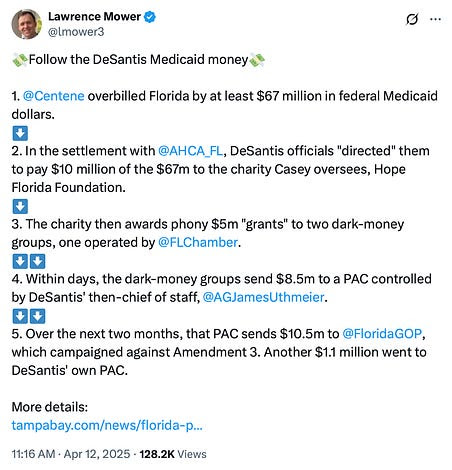
In a nutshell: The DeSantis administration pressured a major state contractor to make a $10 million donation to the Hope Florida Foundation, the controversial charity spearheaded by First Lady Casey DeSantis. It was part of a settlement negotiated with Centene Corp., after the state’s largest Medicaid contractor overbilled the state by at least $67 million.
Days later, Hope Florida transferred that $10 million to a pair of dark-money nonprofits. The state-backed charity gave $5 million each to “Save Our Society From Drugs,” an anti-marijuana group founded by a late Republican megadonor, and “Secure Florida’s Future,” a political vehicle controlled by executives at the Florida Chamber of Commerce, the Big Business lobbying group.
And days after that, Save Our Society From Drugs and Secure Florida’s Future gave a combined $8.5 million to “Keep Florida Clean,” a political committee — chaired by Ron DeSantis’ then-chief of staff — created to oppose Amendment 3, the amendment on last year’s ballot that would have allowed Floridians to use marijuana recreationally rather than solely for medicinal reasons.
It’s a daisy chain that may have transformed $10 million of public money — money meant to pay for health insurance for poor, elderly and disabled Floridians — into funding for anti-marijuana campaign ads.
But at least one prominent GOP lawmaker — Rep. Alex Andrade, a Pensacola Republican who has been presiding over hearings into Hope Florida — told the Times and Herald that the transaction chain “looks like criminal fraud by some of those involved.”
Clearly, this looks very bad. But it is also by no means an isolated incident.
In fact, this is part of a larger pattern of potential abuses that Ron DeSantis committed last fall when he chose to turn the power of state government against two citizen-led constitutional amendments that appeared on the November ballot: Amendment 3 and Amendment 4, which would have ended Florida’s statewide abortion ban.
Consider what we already know about how DeSantis financed his campaigns against the two amendments using public money taken from taxpayers — and private money taken from donors who got public favors from the governor.
Five state agencies directly funded television commercials meant to weaken support for the marijuana and abortion-rights ballot measures. We still don’t know the full extent of their spending, although Seeking Rents has estimated the total taxpayer tab at nearly $20 million. We also know that the DeSantis administration commandeered money for anti-marijuana advertising from Florida’s share of a nationwide legal settlement with the opioid industry — money that was supposed to be spent combatting the opioid addiction crisis.
At the same time, another nonprofit funded by Florida taxpayers poured at least $5 million into television ads attempting to soften Florida’s image on women’s healthcare at a time when Florida’s near-total abortion was under intense attack. It was the Florida Pregnancy Care Networks’ first-ever TV ad campaign. And its commercials, which were overseen by DeSantis administration staffers, complemented the state agency ads against the abortion-rights amendment — right down to using the same slogan.
Last June, after DeSantis vetoed legislation that would have strictly regulated the state’s hemp industry, CBS News Miami revealedthat industry executives and lobbyists promised to raise $5 million in exchange for the veto for the governor to spend on his campaign against Amendment 3. “Our lobby team made promises to rally some serious funding to stand with him on this,” a hemp industry representative wrote in one message that included a bank routing number for the Republican Party of Florida. “We have to pay $5 million to keep our end of the veto,” a hemp executive wrote in another message.
In the closing weeks of the campaign, records show that the Big Tobacco giant Philip Morris International gave $500,000 to DeSantis’ personal political committee — which was also chaired by the governor’s then-chief of staff and which DeSantis was using to campaign against both Amendment 3 and Amendment 4. Shortly after the election, the DeSantis administration handed Philip Morris a lucrative tax break, ruling that the company could sell a new line of electronically heated tobacco sticks free of state tobacco taxes.
There’s a reason why the DeSantis administration made sure to extract a promise of legal immunityfrom the organization that sponsored Amendment 4 as part of a legal settlement negotiated after the election.
DeSantis’ tactics worked. Though Amendments 3 and 4 each won majority support from Florida voters — 55.9 percent for recreational marijuana, 57.2 percent for abortion rights — both fell short of the 60 percent support needed to amend the state constitution.
But, suddenly, it looks like this may not be over — at least not for Ron DeSantis.
What’s more, the House also unveiled a sweeping ethics reform package last week that would, among other things, explicitly expose senior government officials to criminal penalties if they interfere with elections.
That particular legislation would also prohibit state employees from soliciting money for political campaigns — an idea that emerged after DeSantis aides got caught squeezing lobbyistsfor more donations to their boss’ political committee ahead of a possible Casey DeSantis campaign for governor….
Ron DeSantis bet his political future on beating the marijuana and abortion-rights amendments. And he won both of those battles.
But it may turn out that he ultimately lost the war.
Wishful thinking? I hope not.
To give you an idea of how far/right the legislature is, Garcia lists some of the bills that are currently moving through the legislative process:
House Bill 549: Requires all new public school textbooks to refer to the Gulf of Mexico as the “Gulf of America.” Passed the Senate by a 28-9 vote. (See votes) Previously passed the House of Representatives by a 78-29 vote. (See votes) Goes to the governor.
House Bill 575: Replaces Gulf of Mexico with “Gulf of America” in state law. Passed the Senate by a 28-9 vote. (See votes) Previously passed the House of Representatives by a 78-27 vote. (See votes) Goes to the governor….
House Bill 1517: Allows someone to file a wrongful death lawsuit seeking lost wages on behalf of an embryo or fetus. Passed the House of Representatives by a 79-32 vote. (See votes)…
House Bill 7031: Cuts the state sales tax rate from 6 percent to 5.25 percent. Passed the House of Representatives by a 112-0 vote. (See votes)
House Bill 123: Allows a traditional public school to be converted into a charter school without the consent of the teachers who work at the school. Passed the House Education & Employment Committee by an 11-4 vote. (See votes)
Trump is turning all his dogs loose on Harvard. He can’t believe Harvard is standing up to his threats, and he is determined to crush the nation’s most prestigious research university.
Whatever happened to small government? Republicans used to believe that the federal government should leave the private sector alone. Trump believes in big government, big enough to interfere in every institution, even into private medical decisions. He wants to be the emperor.
Clearly, he never read the U.S. Constitution. He knows nothing about checks and balances. Nor did he read Dr. Seuss’s Yertle the Turtle; Yertle wanted to be the master of all he could see. Read it to see what happened to him.
CNN reports:
Department of Homeland Security Secretary Kristi Noem is threatening to strip Harvard University of its ability to enroll international students if it doesn’t turn over records on international students’ “illegal and violent activities,” the agency said Wednesday.
Noem “wrote a scathing letter demanding detailed records on Harvard’s foreign student visa holders’ illegal and violent activities by April 30, 2025, or face immediate loss of Student and Exchange Visitor Program (SEVP) certification,” DHS said in a news release.
The certification allows universities to issue forms to admitted international students that they can then use to apply for visas to enter the United States, according to DHS.
CNN has reached out to DHS for additional information.
A Harvard spokesperson said in a statement that the university is aware of the letter, but they stand by their previous statement that they “will not surrender its independence or relinquish its constitutional rights.”
Trump hates Harvard. It refuses to follow his orders. Harvard’s President Alan Garber flatly refused to let the Trump goons take control of the university. Trump wants to show Harvard who is in charge. He said Harvard should lose its tax-exempt status. This is an unprecedented show of force. The president is not allowed to interfere with IRS decisions. But he appointed a new IRS leader. Nobody says no to Trump. But Harvard said no.
When Harvard’s President, Alan Garber, resolutely refused to accept the Trump administration’s demand to oversee its curriculum, its admissions, and its hiring practices, Trump was furious. He lashed out and threatened to revoke Harvard’s tax-exempt status. By law, the President is not allowed to direct the IRS to investigate anyone. But lo and behold, the IRS commissioner absurdly claimed that it was already investigating Harvard, the nation’s most prestigious university. Sure.
Academic freedom hangs in the balance. Big government wants to control what universities teach, who they admit, and who they hire.
This is the worst attack on the independence of universities since the McCarthy era. it is actually more dangerous than McCarthy, who picked out individual professors. This is the President of the United States declaring war on America’s universities.
The Internal Revenue Service is weighing whether to revoke Harvard’s tax exemption, according to three people familiar with the matter, which would be a significant escalation of the Trump administration’s attempts to choke off federal money and support for the leading research university.
President Trump on Tuesday publicly called for Harvard to pay taxes, continuing a standoff in which the administration has demanded the university revamp its hiring and admissions practices and its curriculum.
Some I.R.S. officials have told colleagues that the Treasury Department on Wednesday asked the agency to consider revoking Harvard’s tax-exempt status, according to two of the people, who spoke on the condition of anonymity to describe internal conversations.
An I.R.S. spokeswoman declined to comment. The Treasury Department did not respond to a request for comment.
Federal law bars the president from either directly or indirectly requesting the I.R.S. to investigate or audit specific targets. The I.R.S. does at times revoke tax exemptions from organizations for conducting too many political or commercial activities, but those groups can appeal the agency’s decision in court. Any attempt to take away Harvard’s tax exemption would be likely to face a legal challenge, which tax experts expect would be successful.
Harrison Fields, a White House spokesman, said the I.R.S.’s scrutiny of Harvard began before the president’s social media post.
“Any forthcoming actions by the I.R.S. are conducted independently of the President, and investigations into any institution’s violations of their tax status were initiated prior to the President’s TRUTH,” Fields said in a statement, referring to Mr. Trump’s website Truth Social.
In a statement, Harvard said there is no legal basis for rescinding its tax status.
“Such an unprecedented action would endanger our ability to carry out our educational mission,” the university said. “It would result in diminished financial aid for students, abandonment of critical medical research programs, and lost opportunities for innovation. The unlawful use of this instrument more broadly would have grave consequences for the future of higher education in America.”
Even an attempt at changing Harvard’s tax status would signify a drastic breach in the independence of the I.R.S. and its historic insulation from political pressure.
The Trump administration has cleared out much of the agency’s senior leadership in the last few months, installing allies to temporarily serve as the commissioner and its top lawyer. Its newest acting commissioner, Gary Shapley, was an I.R.S. agent who has said that the investigation into the taxes of Hunter Biden, former President Joseph R. Biden Jr.’s son, was not aggressive enough.
Anand Giridhadaras is a brilliant thinker and writer. He did all of us a service by seeing a therapist to get advice about how to survive the return of Trump, the Abuser-in-Chief. His blog is called “The Ink,” where this post appeared.
We’ve gotten ourselves into an abusive relationship, and it’s one we can’t escape.
The abuser in question is Donald Trump. And by abuse, we’re not talking about abuse of power, real as that may be. We’re talking about emotional abuse, doled out by a narcissist with an unstoppable need to rebuild the world in his image and to use the most powerful office in human history as a treatment center for his wounded ego.
Whether Trump suffers from a real disorder — malignant or traumatic narcissism has been floated — is a matter of debate among psychiatrists and psychologists. Most professionals have refused to make a diagnosis without a clinical interview (the so-called “Goldwater rule”), though before the 2024 election 225 experts felt Trump presented clear enough signs that they published an open letterwarning of his threat to the nation since, in their estimation, if it quacked like a duck, it was a duck:
Trump exhibits behavior that tracks with the American Psychiatric Association’s Diagnostic and Statistical Manual’s (DSM V) diagnostic criteria for “narcissistic personality disorder,” “antisocial personality disorder,” and “paranoid personality disorder,” all made worse by his intense sadism, which is a symptom of malignant narcissism. This psychological type was first identified by German psychologist Erich Fromm to explain the psychology of history’s most “evil” dictators.
We’ve talked often in the newsletter about the way autocrats can build support even without offering anything to their supporters by way of real material improvements, playing on the same deep emotional needs exploited by abusers within relationships and families.
Earlier this year we also looked back to Erich Fromm’s work to understand how Trump’s cultlike appeal depended on a bond of mutual emotional dependence between abuser and abused and against a threatening world — a bond Fromm called “group narcissism.”
“Even if one is the most miserable, the poorest, the least respected member of a group, there is compensation for one’s miserable condition in feeling ‘I am a part of the most wonderful group in the world. I, who in reality am a worm, become a giant through belonging to the group,”
The situation today is even more complex — and dire — than most expected early in the campaign, as Trump competes for power and attention with fellow narcissists: the oligarchs. And chief among them is the shadow president, Elon Musk, whose sense of his own omnipotence and importance is even stronger than Trump’s, and his vision of the future far more dystopian, and his disregard for humanity even more total.
To better understand the situation facing Americans (and, to be honest, everyone around the world) our Nastaran Tavakoli-Far talked to therapist Daniel Shaw about how we can use the techniques that have helped people survive cults, abusive relationships, and toxic families to face and process and maybe even transcend the second Trump administration.
As someone who’s done a lot of reporting on topics involving narcissists and cults, something that’s really striking to me is that the advice given to the people suffering is to get out, go “no contact,” or have as little contact as possible. If you need to speak to this problematic individual do it via a lawyer, you know that kind of thing of just staying as emotionless as possible and not getting involved.
Now, what I always wonder is, because I think a lot of people when they look at Trump and MAGA, I mean a lot of people have said to me, “This is similar to what happened in my family.” A lot of these dynamics, if you’ve been exposed to narcissism, it’s actually very relatable to a lot of people.
But this isn’t a situation where you can go “no contact” because these are the people in power. You’re in a situation where you actually have to engage with these people. You can’t just leave the cult and try and heal. So what is your advice in this sort of scenario?
Stay sane, stay humane, and don’t isolate, would be the three phrases I would use.
Going “no contact” is sometimes a very good idea, but not always. And it’s also an idea that’s been turned around by abusive narcissists who isolate victims from their own families. You know, it’s the same thing that happens in Jehovah’s Witnesses. If you criticize the community, you are disfellowshipped and nobody, not your children, your spouse, your parents, or anybody is allowed to ever talk to you.
In terms of going “no contact” in a political situation, well, you don’t have that option. What are you going to do if, for example, the government benefits that you’ve paid into the system are suddenly turned off and there’s no more Social Security? Are you just going to say “Well, I’m not going to have anything to do with that bad president who just did that to me?” Or are you going to get involved in whatever way possible to fight against it?
Going “no contact” in this situation could be enabling the perpetrator, enabling the autocrat and I think that’s important to understand. If we’re enabling the autocrat, we’re complicit in the autocrat’s abuse.
So what can we do right now? If I wanted to ask for some practical advice?
One of the things that I’ve taken to heart about the current situation is the advice of Timothy Snyder, the historian who has studied the rise and fall of democracies and autocracies in Eastern Europe. One of the things he says is to not submit in advance.
Now, in the case of traumatizing narcissists, having managed a successful seduction they will begin to then create more dependence and they do that paradoxically through becoming more belligerent and belittling and more humiliating or shaming. What that does is create a state of constant intimidation at the same time increasing the sense of dependence the victim has on the narcissist.
In the current situation, it’s clear that everyone who is an opponent of the Trump administration is meant to feel horrified, shocked, belittled, and intimidated. That is what I believe is important: not to submit to the intention to terrify, intimidate, and make people feel powerless and small. So not to submit to that means that I don’t allow myself to be paralyzed with fear. I don’t allow myself to be boiling with rage, and I don’t isolate myself. I remember and connect to what I love about being in the world, about being a person, what I love about other people, and to the people who love me. Staying connected, not isolating, and not allowing yourself to drown in fear or rage is not submitting in advance.
So that’s my sense of what’s important right now.
You mentioned staying sane and about keeping connections. This time around it seems a lot of people are either kind of checking out or not checking the news every day. A lot of people are saying “I just want to do something positive in my community or be there for my family.” and things like that. What do you think about that? Why aren’t people protesting?
Right. I think everybody got exhausted, those who voted against Trump were exhausted by the amount of energy and effort spent hoping to elect Harris. I do limit my exposure so that I can keep my sanity for the time being. I don’t think that’s wrong and I encourage people who need to do that to do it.
So staying sane and humane, having those connections, and speaking up, speaking to our political representatives and pushing them.
People who care about these issues, who do not want to enable autocracy in this country or in general, exist at every level of society, and each of us has a certain amount of power.
I speak primarily to other psychotherapists but some of my ideas can be useful in thinking about the political, so I try to speak where possible within my community. Each of us has a community, and if we can be vocal within our communities at least we can hope to make an impact, even on one person.
Groups will form that we may want to lend our support to, either financial support or volunteer support. I’m currently supporting Democracy Docket, for example, where Mark Elias has been conducting so many successful lawsuits against a lot of abuses of government. I am not a millionaire elite, so I make small donations on a regular basis. People can do that.
People can volunteer, they can protest and demonstrate. All of these things are happening. They will happen, I believe, to a greater extent.
We may be under the threat of martial law in Trump’s world. We’re under the threat of having the National Guard tear-gas us if we take to the streets. He’s already demonstrated that he will do that and he’s saying he’ll do it again. But to whatever extent possible we need to speak, whatever our community might be, no matter how small. If you hold beliefs about injustice, it’s worth speaking out.
So what, exactly, is a traumatizing narcissist?
The traumatizing narcissist is a person who — for various reasons, based on their developmental history — has developed what starts out as a fantasy of omnipotence.
Did you ever buy a lottery ticket? That’s a fantasy of omnipotence. We all have them. It was said by Freud that we start out as babies with a sense of omnipotence because everybody adores us. And that we have to grow up and lose that sense of omnipotence so that we don’t become narcissists.
A traumatizing narcissist doesn’t lose that infantile omnipotence. They go through some kind of traumatic humiliation growing up, and that leads them to the fantasy that they can be the most powerful person in the world and nobody can hurt them or humiliate them or make them feel small or weak. As that fantasy becomes a delusion, they start to be absolutely convinced of their superiority, of their infinite entitlement, and of their greatness.
Some traumatizing narcissists focus on an individual or a family. There they can exercise their delusion of omnipotence over a small group of people or over just one person. But their delusion can be so powerful that it invites others to join in. Often the delusion makes them charismatic and persuasive. They can become, in some cases, autocratic politicians. In other cases, they can become gurus, or they can become internet influencers. They have so much conviction in their own delusion of their own omnipotence that they persuade others to join.
Could you briefly describe the kind of people who join in? Who get into these kinds of relationships?
When people speak to me about having been in this kind of a relationship, they’re often full of shame and trying to understand what’s wrong with them. What I’ll say is, “Well, you were being vulnerable, which is very human.”
There is nobody who volunteers to be groomed and the traumatizing narcissist grooms people. We don’t volunteer for that. Some people may be more vulnerable to grooming than others but I’ve seen some very together, high-functioning people who got groomed by traumatizing narcissists, it’s not about being weak or unstable as a person. Look at Bernie Madoff, who convinced some of the most wealthy, creative, high-functioning people in the world that they should give him all their money.
I was very inspired when I left the cult I had been part of when I was younger by Erich Fromm’s book Escape from Freedom. He tried to understand what was happening in Germany which led people to believe that Hitler was a savior.
I think in a similar vein, people believe that Donald Trump is a savior, and part of the problem is that they are only being exposed to the information that Donald Trump wants them to have, which is the propaganda that is funded by millions and millions and millions of dollars by fossil fuel oligarchs and digital oligarchs. There is extraordinary support for Trump as the CEO and them as the board of directors of the new world they think they’re creating. It’s frightening because it is like they read Orwell’s 1984 and decided the hero was Big Brother.
I would call these people malignant narcissists rather than traumatizing narcissists because they’re not just narcissistic, they’re also sociopathic and they believe that there is no law that they should have to obey, that they make the laws.
Sorry, when you say these people, do you mean Trump, or do you mean Trump and the tech bros and fossil fuel bros?
The group of elites who support autocrats. The autocrat and the elites that support the autocrat are people who see themselves as a superior race of people, entitled to rule over everyone else. Their solution for poor people is to create a jail system.
One of the major thinkers in the tech world has proposed that poor people be made into biofuel, that the prison system could become a factory for creating biofuel out of human beings. These things sound unbelievable. But they are being said publicly.
Yes, that’s the person. He’s extremely influential over Vice President JD Vance, and Peter Thiel is a big disciple of his, as are quite a few other billionaires in the tech world.
So we have an elite oligarchy in support of an autocrat. But why do people view Donald Trump as a savior?
There are a lot of reasons. But what Erich Fromm said is that people are afraid of freedom. They are uncertain of how to be free. And when they feel that there is a powerful leader, it’s like that becomes a magical person who they can feel safe and protected by. The allure of somebody promising absolute total protection, who seems very strong and very powerful and very certain, that is a very powerful allure.
To be a free person means that you have to provide yourself with a sense of safety and you have to create safety in your community.
Petula Dvorak of the Washington Post wrote about the efforts by the Trump administration to rewrite American history. Trump wants “patriotic history,” in which evil things never happened and non-white people and women were seldom noticed. In other words, he wants to control historical memory, sanitize it, and restore history as it was taught when he was in school about 65 years ago (1960), before the civil rights movement, the women’s movement, and other actions that changed what historians know and teach.
Dvorak writes:
A section of Arlington National Cemetery’s website highlighting African American military heroes is gone.
The participation of transgender and queer protesters during the LGBTQ+ uprising at New York’s Stonewall Inn was deleted from the National Park Service’s website [nps.gov] about the federal monument.
And the Smithsonian museum in Washington, which attracts millions of visitors who enter free each year, will be instructed by Vice President JD Vance to remove “improper ideology.”
In a series of executive orders, President Donald Trump is reshaping the way America’s history is presented in places that people around the world visit.
In one order, he declared that diversity, equity and inclusion efforts “undermine our national unity,” and more pointedly, that highlighting the country’s most difficult chapters diminishes pride in America and produces “a sense of national shame.”
The president’s orders have left historians scrambling to collect and preserve aspects of the public record, as stories of Black, Brown, female or LGBTQ+ Americans are blanched from some public spaces. In some cases, the historical mentions initially removed have been replaced, but are more difficult to find online.
That rationale has galvanized historians to rebuke the idea that glossing over the nation’s traumas — instead of grappling with them — will foster pride, rather than shame.
Focusing on the shame, they say, misses a key point: Contending with the uglier parts of U.S. history is necessary for an honest and inclusive telling of the American story. Americans can feel pride in the nation’s accomplishments while acknowledging that some of the shameful actions in the past reverberate today.
“The past has no duty to our feelings,” said Chandra Manning, a history professor at Georgetown University.
“History does not exist to sing us lullabies or shower us with accolades. The past has no obligations to us at all,” Manning said. “We, however, do have an obligation to the past, and that is to strive to understand it in all its complexity, as experienced by all who lived through it, not just a select few.”
That is not to say that the uncomfortable weight of difficult truths isn’t a valid emotion.
Postwar Germans were so crushed by the burden of their people’s past, from the horrors of the Nazi regime to the protection of war criminals in the decades after the war, that they have a lengthy word for processing it: vergangenheitsbewältigung, which means the “work of coping with the past.” It has informed huge swaths of German literature and film and has shaped the physical way European cities create memorials and museums.
America’s version of vergangenheitsbewältigung can be found across the cultural landscape. From films to books to classrooms and museums, Americans are learning more details about slavery in the South, the way racism has affected everything from baseball to health care, and how sexism shaped the military.
Trump, however, looks at the U.S. version of vergangenheitsbewältigung differently. “Over the past decade, Americans have witnessed a concerted and widespread effort to rewrite our Nation’s history, replacing objective facts with a distorted narrative driven by ideology rather than truth,” said the executive order targeting museums, called “Restoring Truth and Sanity to American History.”
That is what “fosters a sense of national shame,” he says in his order.
Historians take exception to that. “I would argue that it’s actually weird to feel shame about what people in the past did,” Georgetown history professor Katherine Benton-Cohen said. “As I like to tell my students, ‘I’m not talking about you. We will not use ‘we’ when we refer to Americans in the past, because it wasn’t us and we don’t have to feel responsible for their actions. You can divest yourself of this feeling,’” she said.
Germans also have a phrase for enabling a critical look at their nation’s past: die Gnade der spät-geborenen, “the grace of being born too late” to be held responsible for the horror of the Nazi years.
Benton-Cohen said she honed her approach to this during her first teaching job in the Deep South in 2003, when she emphasized the generational gap between her students and the history they were studying.
“They could speak freely of the past — even the recent past, like the 1950s and 1960s, because they weren’t there,” she said. “They were free to make their own conclusions. It was exciting, and it worked. Many told me it was the first time they had learned the history of the 1960s because their high schools — both public and private — had skipped it to avoid controversy. We did fine.”
Trump hasn’t limited his attempt to control how history is presented in museums or memorials. Among the first executive orders he issued was “Ending Radical Indoctrination in K-12 Schooling.” Another one sought to eliminate diversity, equity and inclusion in the nation’s workplaces, classrooms and museums. His version of American history tracks with how it was taught decades ago, before academics began bringing more diverse voices and viewpoints into their scholarship.
Maurice Jackson, a history professor at Georgetown University who specializes in jazz and Black history, said Black Americans have fought hard to tell their full story.
Black history was first published as “The Journal of Negro History” in 1916, in a townhouse in Washington when academic Carter G. Woodson began searching for the full story of his roots. A decade later, he introduced “Negro History Week” to schools across the United States, a history lesson that was widely cheered by White teachers and students alongside Black Americans who finally felt seen.
“Black history is America’s history,” Jackson said. And leaving the specifics of the Black experience out because it makes some people ashamed gives an incomplete picture of our nation, he said.
After Trump issued his executive orders, federal workers scrambled to interpret and obey them, which in some cases led to historical milestones being removed, or covered up and then replaced.
Federal workers removed a commemoration of the Tuskegee Airmen from the Pentagon website, then restored it. They taped butcher paper over the National Cryptologic Museum’s display honoring women and people of color, then uncovered the display.
Mentions of Harriet Tubman in a National Park Service display about the Underground Railroad were removed, then put back. The story of legendary baseball player Jackie Robinson’s military career was deleted from the Department of Defense website, then restored several days later.
Women known as WASPs risked their lives in military service — training and test pilots during World War II for a nation that didn’t allow them to open a bank account — is no longer a prominent part of the Pentagon’s digital story.
George Washington University historian Angela Zimmerman calls all the activity. which happened with a few keystrokes and in a matter of days, the digital equivalent of “Nazi book burnings.”
In response, historians — some professional, some amateur — are scrambling to preserve information before it is erased and forgotten.
The Organization of American Historians created the Records at Risk Data Collection Initiative, which is a callout for content that is in danger of being obliterated
This joins the decades-long work of preserving information by the Internet Archive, a California nonprofit started in 1996 that also runs the Wayback Machine, which stores digital records.
Craig Campbell, a digital map specialist in Seattle, replicated and stored the U.S. Geological Service’s entire historical catalogue. His work was crowdfunded by supporters.
“Historical maps are critical for a huge range of industries ranging from environmental science, conservation, real estate, urban planning, and even oil and gas exploration,” said Campbell, whose mapping company is called Pastmaps. “Losing access to the data and these maps not only destroys our ability to access and learn from history, but limits our ability to build upon it in so many ways as a country.”
After astronomer Rose Ferreira’s profile was scrubbed from, then returned, to NASA’s website, she posted about it on social media. In response, an online reader created a blog, Women in STEM, to preserve stories such as Ferreira’s.
“Programs that memorialize painful truths help ensure past wrongs are never revived to harm again,” Rep. Steven Horsford (D-Nevada), said on X, noting that presidents are elected to “run our government — not rewrite our history.”
Authoritarian leaders have long made the whitewashing of history a tool in their regimes. Joseph Stalin expunged rivals from historic photographs. Adolf Hitler purged museums of modernist art and works created by Jewish artists, which he labeled “degenerate.” Museums in Mao Zedong’s China glorified his ideology.
While this may be unfamiliar to Americans, Georgetown University history professor Adam Rothman says that in the scope of human history, “these are precedented times.”
It’s not yet clear what the real-world effect of Trump’s Smithsonian order will be or exactly how it will be carried out. Who will determine what exhibits cause shame and need to be removed? What will the criteria be? Will exhibits that discuss slavery, for instance, be eliminated or altered?
“Our nation is an ongoing experiment,” says Manning, the Georgetown history professor, who has written books about the Civil War. “And what helps us do that now in 2024 compared to 1776 is that we do have a shared past.
“Every single human culture depends upon, grows out of, and is shaped by its past,” she said. “It is the past that has shaped all of us, it is our past that contains the bonds that can really hold us together.”
It’s what makes the study — and threat to — American history unique among nations. Benton-Cohen said that is what she sees happen with her students.
“The American striving to realize the democratic faith and all the difficulties it entailed and challenges overcome should inspire pride, not shame,” she said. “If you feel shame, as the kids would say, that’s a ‘you’ problem. That’s why I still fly the flag at my house; I’m not afraid of the American past, I’m alive with the possibilities — of finding common cause, of fighting for equality, of appreciating our shared humanity, of upholding our freedoms.”
Joyce Vance was US Attorney for Northern Alabama and a steady voice of reason. She wonders in this post what it will take to awaken Republicans to Trump’s erosion of the Constitution and our rights.
She writes:
Why doesn’t any of this break through? Why do Republicans still support Trump?
The reporting in The Atlantic on the Signal chain? The voter suppression executive order Trump issued…? The foul-ups in deporting supposed gang members who turn out not to be? Why aren’t Americans out on the streets protesting in massive numbers like we have seen people in other countries doing—Israel, Georgia, Turkey, South Korea, and others? In part, it’s because a large number of people who are Trump supporters just don’t care. Their guy can do anything, and they don’t care. They’ll believe any lie, and they’ll ignore any horrible; they’re all in for Trump for reasons the rest of us still struggle to understand.
The question is, how many of the rest of us are there? By that I mean Americans who, regardless of party affiliation, still care about truth and democracy. Those words are no longer just philosophical notions to be bandied about, an elite construct. They are the reality of what we are fighting a rearguard action to try and save.
Statistics from the last election provide reason for some optimism. Donald Trump won with 49.9% of the popular vote. Although he has claimed he has a mandate for a radical transformation of government, the numbers just don’t back that up. And they don’t suggest there’s a mandate for putting out military information on a Signal chain being used on personal phones, rather than on secured government systems. If there ever truly was a mandate for Trump, the reality is, it’s evaporating day by day as egg prices stay high and people lose their jobs. And now, there’s this, a cavalier disregard for the safety of our troops, lax security with one member of the Signal group apparently in Russia while communications were ongoing, what looks like an effort to do an end run around government records retention procedures.
Will the Atlantic story break through? It should. Trump’s Vice President, his Secretary of Defense, his CIA director, his DNI, all put American pilots in harm’s way. If that’s not enough for Senate Republicans to break ranks with Trump, especially those on subcommittees that have oversight into military and intelligence community operations, it’s hard to imagine what would be.
Why use Signal in the first place when American leaders have some of the most secure communications technology in the world available to them? Is it just for convenience? If so, that’s sloppy, and they should be committing to do better, not arguing over whether the information was classified or not. (But if it looks like a duck…)
The truth is that by going to Signal, they avoided leaving a paper trail. No annoying records that could be unearthed down the road. Remember Trump’s first impeachment? It came about in large part because after the call where he threatened Ukraine’s president with withholding security aid if he wouldn’t announce his country was investigating Joe Biden for financial misconduct, records of the call were buried inside a classified information system where they didn’t belong. That was what got the ball rolling. It was about trying to hide records of an official call that everyone knew was wrong.
As far as we know at this point, there was nothing improper about the attack on the Houthis. So why were high-ranking members of the Trump administration communicating off the books? How pervasive is the practice, and who knows/authorizes it? We are a government of the people. Transparency isn’t optional. There are rules about public records that have to be followed, and this president who likes to operate in secret and at the margins of our laws has frequently tried to skirt them.
It’s hard to imagine that the Signal chain for the Houthi attack was just a one-off, that they only went to Signal for this moment. Is this how this new government is operating routinely—off the books, in a hidden fashion designed to avoid scrutiny and accountability?
It may seem like a minor point with everything else that’s going on, but this is how autocrats work, not how a democracy operates. That’s the danger we are now facing, and this is another marker on the path to tyranny.
Calls are mounting for Hegseth and others to resign. Anyone who would engage in this kind of behavior and then argue that it was not improper rather than apologizing and promising to do better should leave government, whether voluntarily or not. But they should never have been confirmed in the first place. There is a cancer on the heart of the presidency, to quote from the Watergate era, and it’s infecting all of us.