Back in 2010, Secretary of Education Arne Duncan rolled out his Race to the Top program to reform American education. The U.S. Department of Education offered a total of $5 billion to states. To be eligible to compete for a part of the huge prize money, states had to agree to authorize charter schools, to adopt the Common Core (not yet finished), and to evaluate teachers based on the test scores of their students.
The requirement to change teacher evaluation was heated. Duncan scoffed at critics, saying they were trying to protect bad teachers and didn’t want to know the truth.
In 2012, three noted scholars claimed that teachers who raised test scores raised students’ lifetime incomes; President Obama cited this study, led by Harvard economist Raj Chetty, in his State of the Union address. It seemed to be settled wisdom that teachers who raised test scores were great, and teachers who did not should be ousted.
In 2014, the American Statistical Association warned about the danger of evaluating teachers by the test scores of their students. The ASA statement said that most studies of this method find that teachers account for 1-14% of the variation in test scores. The greatest opportunity for improvement, they said, was to be found in system-level changes.
The Gates Foundation poured hundreds of millions of dollars into districts willing to test value-added methodology, and eventually gave up. Teachers were demoralized, teachers avoided teaching in low-income districts. Overall improvements were hard to find.
Arne Duncan was a true believer, as was his successor, John King, and they never were willing to admit failure.
Teachers never liked VAM. They knew that it encouraged teaching to the test. They knew that teachers in affluent districts would get higher scores than those in less fortunate districts. Sometimes they sued and won. But in most states, teachers continued to be evaluated in part by their students’ scores.
But in New York state, the era of VAM is finished. Dr. Betty Rosa, the chancellor of the New York State Board of Regents, reached an agreement with Melinda Person, president of New York State United Teachers, to draft a new way of evaluating teachers that moves away from students’ standardized test scores.
New York state education leaders and the teachers’ union have announced an agreement to change how New York school teachers and principals are evaluated, and move away from the mandated reliance on standardized test scores.
State Education Department Commissioner Betty Rosa and New York State United Teachers President Melinda Person hand-delivered their drafted legislation Wednesday to lawmakers to create a new system that doesn’t use students’ test performance to penalize educators. The state teacher evaluation system, known as the Annual Professional Performance Review, or APPR, was modified in the 2015 budget to place a greater importance on scores.
“It’s connecting research to practice and developing strategies to ensure that teachers have the best tools and principals to make sure our young people are getting the best quality education,” Rosa told reporters Wednesday in the Legislative Office Building.
When NYSUT elected president Person last year, she said her first task was to change the teacher evaluation system, and state lawmakers said with confidence Wednesday it will happen this session.
The proposed law, which has not officially been introduced in the Legislature, would remove the requirement to base evaluations on high-stakes tests. School districts would have eight years to transition, but could make the changes faster than the required deadline.
Person argued it will support new teachers who are often burdened by the required paperwork under the current model.
“This would be a fair and a just system that would support them in becoming better educators, which is ultimately what they want to do anyway,” Person said.
The proposal was negotiated in agreement with state superintendents, principals, school boards, the PTA, Conference of Big 5 School Districts and other stakeholders. The issue has been contentious for union and education leaders for years, and both state Education Committee chairs in the Legislature said they’re thrilled with the agreement.
“That’s such a nice thing in Albany,” said Senate Education chair Shelley Mayer, a Democrat from Yonkers. “Who can do that? Who gets agreement? It’s very hard around here.
“It takes a woman to do it,” Assembly Education chair Michael Benedetto replied with a smile.
Benedetto, a Bronx Democrat, was a classroom teacher for decades and recalled how feedback helps educators develop when done in the proper way.
“It’s like anything else — we want stability in our lives, we want to know where we’re going, how we’re going to be rated and what we’re going to be rated on, as a teacher, as a professional,” the assemblyman said.
Lawmakers will review the proposal and draft legislation in the coming weeks.
Remembering how strident were the supporters of VAM, it’s kind of wonderful to hear the collective sigh of relief in Albany as it fades away.
Maurice Cunningham is a retired professor of political science at the University of Massachusetts. He became expert on the subject of Dark Money in education while covering a state referendum on charter school expansion in Massachusetts in 2016. He noted at the time that the funding on behalf of authorizing more charter schools came from billionaires, many of them out of state. He noticed that while the charter expansion was overwhelmingly opposed by PTAs and local school boards, one parent organization, the “National Parents Union,” supported it. He checked into the NPU’s financials and discovered it had received large grants from the Walton Foundation. Walton is one of the biggest funders of charters in the nation. The referendum went down to a decisive defeat. But NPU carries on, advancing the cause of privatization.
Cunningham is the author of Dark Money and the Politics of School Privatization.
NPU will hold its national conference starting April 9 in D.C. Maurice hopes that reporters will ask the following questions:
National Parents Union’s “#ParentPower2024.”
Some Questions for Journalists.
National Parents Union (NPU), a Koch and Walton funded phony “parents” groups, will hold its #ParentPower2024 meeting this week. For any journalists covering the meeting, here are some questions you should ask.
1. A “union?” Can National Parents Union (NPU) name another “union” that accepts millions of dollars in donations from such notorious anti-union billionaires as the Walton family ($4,466,000 to affiliated Massachusetts Parents United (MPU) and NPU), John Arnold (his City Fund gave $1,028,500 in 2021-2022), and Charles Koch ($350,000 through a joint venture with the Waltons called the Vela Education Fund)?
2. All in the Family. Across NPU and the allied Massachusetts Parents United, Rodrigues and her husband Tim Langan compensated themselves $661,775 in 2022. What justifies paying them 22 percent of 2022 total revenues?
3. Organizing? NPU’s 2022 tax return lists $31,616 in expenditures for “community Organizing EV.” Why is so little spent on community organizing?
4. Sinking Financials. NPU and MPU went from $5,307,190 combined contributions in 2021 to $3,015,449 in 2022. What explains the steep decline in donations?
5. Rising Salaries. At NPU, despite contributions dropping in 2022 from 2021 levels, salaries rose from $1,729,503 to $2,035,201. Why?
6. Gravy Train Leaving the Station. NPU’s financial position is deteriorating while leadership compensation remains high. Why?
7. Dueling Boards of Directors? NPU lists one set of board of directors on its website and an almost entirely different board as part of its annual report to the Massachusetts Secretary of State’s Corporations division. Which is the real board?
8. I Came to Say I Cannot Stay, I Really Must Be Going. Since NPU was founded in 2020 at least twenty-twodifferent individuals have been listed as board members, some with tenures as short as a few months. Why does the board turn over so much?
9. Three Card Monte. In 2020, MPU made a grant to NPU of $170,000 for “contributions held for National Parents Union, Inc.” In 2021, MPU made a grant to NPU of $959,837 for “contributions held for National Parents Union, Inc.” In 2022, MPU made a grant to NPU of $167,622 for “contributions held for National Parents Union, Inc.” Why are such large sums being funneled through MPU? Is MPU concealing NPU’s donors?
10. Ghost members. Recently Rodrigues tweeted that NPU has “1600 affiliated organizations” but there is no proof of that and NPU has never provided a public accounting of affiliates. The only independent study of NPU’s claims in 2020 showed members were in the charter school industry. Why has NPU never released a list of its “affiliated organizations?
11. Bonus Round. Rodrigues and co-founder Alma Marquez were “elected” as president and treasurer in January 2020 for three year terms. Those terms have ended, why has there been no election of new officers? Marquez disappeared in just a few months and was replaced with Rodrigues’s husband, Tim Langan. What happened to Marquez?
During the past few decades, we have seen the persistence of failed policies in education. Most of them were codified by No Child Left Behind and Race to the Top: give standardized tests; punish teachers and schools where scores are low or do not rise; reward teachers and schools where scores go up. Pay bonuses to teachers if their students’ scores go up. Tie teacher pay to student scores. Close schools with low scores. Turn low-scoring schools over to private management. Give vouchers to parents to send their children wherever they want.
All of these remedies failed. They encouraged cheating and gaming the system. They encouraged educators to avoid schools that enrolled the neediest students. They demoralized teachers who were idealistic and wanted to teach the joy of learning. Test prep became far more important than intellectual curiosity.
All of these are zombie policies. No matter how consistently they fail, policymakers won’t let go of them.
Merit pay is a policy that has been tried since the 1920s. It has never accomplished anything. I summarized the research on merit pay in my last three books: The Death and Life of the great American School System; Reign of Error; and Slaying Goliath. The research is overwhelming: merit pay doesn’t improve education and doesn’t even raise test scores. Yet in true zombie style, it never dies. It should.
John Thompson writes here about the revival of the merit pay zombie in Oklahoma:
As the “mass exodus” of teachers from Oklahoma schools continues, the legislature has rejected an across-the-board pay raise for teachers. Instead, several legislators are searching for a fix for the state’s “flawed” bonus system. If that doesn’t work, maybe Walters’ use of public money to spread his attacks on “on the radical left” will bring educators back to Oklahoma …
Seriously, Walters’ push for his vision of incentive pay prompted some education advocates to ask me to research performance pay. I sure appreciated the oportunity to reread new and older research on the subject.
Twenty-five years ago, I opposed performance pay because there were better ways to improve teacher quality. But I didn’t have major concerns; although its likely benefits would be small, I thought its downsides shouldn’t be a big deal. However, starting with No Child Left Behind and taking off with Race to the Top, test scores were weaponized, and the dangers of performance pay grew dramatically. Output-driven teachers’ salaries, joined at the hip with unreliable and invalid accountability metrics, promoted educational malpractice that undermined meaningful teaching and learning, increasing in-one-ear-out-the-other, worksheet-driven instruction. Teamwork was damaged, trust was compromised, the flight of educators from classroom increased, and the joy of student learning declined significantly.
During that time, I communicated frequently with data-driven analysts working for think tanks, who almost never had experience in urban schools. Their job was to provide evidence that performance pay, and other incentives and punishments, canwork. They ignored educators and social scientists who tackled the real policy question – how will those experiments work?
Sometimes, merit pay produced modest test score gains, but there was no way of determining whether those test scores revealed an increase or a drop in meaningful learning. Neither did they address the overall learning losses due to teachers being pressured to focus on metrics, as opposed to children. In 2012, a Rand study concluded, “most studies have found no effects on student outcomes.” By 2015, the U.S. Department of Education found that large incentives, such as $15,000 per teacher, may attract talent, but:
In addition to creating an environment that lends itself to narrowed pedagogical approaches and teaching to tests (and even cheating on them), this article suggests that merit pay schemes that require teachers to compete with one another may likely undermine positive collaboration.
Around the time of the 2018 Oklahoma teacher walk-out for higher pay, Denver threatened a strike to get rid of performance pay. Chalkbeat explained the complexity of balancing for larger or smaller payments to teachers in diverse classrooms. It went into depth answering the question, “How did a pay system that once seemed to hold so much promise bring teachers to their breaking point?” The concise conclusion was, “lack of trust.”
Education Week studied the minimal effects of performance pay in Tennessee and Texas, which implemented expensive reward-and-punish, and often short-lived programs. The negative effects of the Houston plan, which State Superintendent Ryan Walters seems to support, are especially relevant for Oklahoma. The Houston teachers’ union president explained, “Performance pay demeans students and undermines teachers, so if the focus is on pay for performance, you’re incentivizing the test-and-punishment model.” Similarly, Education Week cited comprehensive studies that concluded that the relatively more effective programs “avoided an overemphasis on test scores.” But even many or most of the more successful programs were unlikely to survive.
Finally Education Week reported how the $200 million Bill and Melinda Gates Foundation merit pay experiments “did little to boost retention of high-performing teachers,” and it “had little effect on student achievement.”
At the peak of merit pay mandates, and now, Bixby Superintendent Rob Miller explained, “Teacher merit pay is one of the more persistent and seemingly indestructible zombie ideas related to education.” Miller said, “Merit pay for teachers has been tried again and again since the 1920s.” He cited cognitive and social science that explained why performance pay experiments were doomed to fail, as well as numerous evaluations of how it failed in the 21st century. Miller now asks, “Is it fair to place the primary responsibility on teachers and schools for outcomes strongly affected by factors outside their control?” and answers, “Doing so damages school culture and teacher morale and obstructs meaningful dialogue about school improvement.”
At a time when Ryan Walters is threatening to put the worst of the failed policies of the last twenty years on steroids, I was struck by a recent column by Thomas Dee, a fervent believer in output-driven accountability. Even though he seems to think that teachers were to blame, Dee also seems to acknowledge that performance pay had disappointing results. Now he recommends:
It may be possible to achieve durable political support for a teacher evaluation system if that system focuses narrowly on identifying master teachers and providing them with training and extra pay to coach their peers but takes a more incremental approach toward dismissing underperforming teachers.
Dee’s latest almost brings me back to 25 years ago, before NCLB, when the schools I knew were improving, and a win-win approach to performance pay didn’t seem so problematic. At the urging of the union, the Oklahoma City Public School System briefly implemented the Toledo peer review plan, which included a fair and efficient plan for removing ineffective teachers. The best evidence is that the plan was a reliable method for improving classroom instruction. But, it and so many other promising programs were undercut by corporate school reform.
Maybe I’ll once again be open to a compromise involving constructively built, non-punitive merit pay incentives, once the destructive school cultures advanced by corporate school “reform” have disappeared. But, I won’t hold my breath.
It has always been a goal of the billionaires who fund privatization to block accountability and democracy. Eli Broad once memorably said that he prefers to invest in districts under mayoral control so he doesn’t have to deal with the public. The public asks questions and wants to know who is making decisions about their children’s education. So much simpler to have one person to handle problems.
The charter school lobby has persistently fought public oversight and accountability. They are more than willing, even eager, to take public money. But they don’t like public officials asking questions about how the money was spent.
The big battle over public oversight is happening right now in Colorado. All the major right wing groups—the Koch machine, ALEC, Philip Anschutz (producer of “Waiting for Superman”) are there, battling against public schools.
On March 7, three Colorado legislators introduced a charter school accountability bill to establish improved guidelines for authorizing and renewing charter schools by local school districts. The bill would strengthen the authority that elected school boards have regarding their governance of charter schools, and it also provides citizens with expanded information about the operations of charter schools in their districts.
According to its backers and public education advocacy groups, this is the first major legislation to prescribe more charter school accountability since the first Charter Schools Act was passed in 1993. Current state legislation often limits local control over the charter school approval process, funding requirements, and waivers from state legislation. Given that nearly two-thirds of the state’s 64 counties experienced an “absolute decline in the under-18 population over the last decade,” the charter school accountability bill would empower local school boards to address the overall enrollment needs of the district. While charter schools primarily utilize taxpayer dollars for their funding, many charter schools allow private interests to invest in their growth and development, which can create potential conflicts of interest.
Pro-charter school organizations don’t agree with this legislative effort to increase accountability as they believe this bill would “kill” charter schools. Republicans have been especially vocal in their opposition to this bill, even though the bill promotes increased local control over charter schools. The pro-charter organizations hired over 30 lobbyists to oppose the bill. Lobbying can be expensive, but the organizations opposing the bill have connections to several billionaire-funded foundations.
American for Prosperity and Advance Colorado issued a press release on X stating the bill would “mark the beginning of the end of charter schools in Colorado,” and together, the two groups “would work overtime to make sure the bill was soundly defeated.” According to the Colorado Times Recorder, Advance Colorado is a conservative dark money group said to be funded by billionaire Phil Anschutz. Formerly known as Unite Colorado, Advance Colorado has “given over $17 million to support major Republican political groups and efforts in Colorado.” Colorado Dawn, another dark money group headed by State Board of Education member Steve Durham and Colorado state Sen. Paul Lundeen, gave millions to Ready Colorado, which also has lobbyists opposing this bill.
The upcoming lobbying effort in Colorado’s legislature is not unique, as similar high-paid lobbying efforts occur wherever there is significant charter school legislation. In Nashville, a local news reporter exposed who 67 pro-charter lobbyists worked for during legislative hearings on several charter bills in 2022. In the video that accompanied his report, Phil Williams highlighted the direct connections that the pro-charter lobbyists have with billionaires. His investigative report documented that “Americans for Prosperity is linked to billionaire Charles Koch,” and they also “received funding from billionaire Bill Gates and the Walton family of Walmart fame.”
As in Tennessee, the Colorado lobbyists will meet frequently with legislators to convince them this bill is not necessary. The legislators will need to weigh the benefits of the bill with the concerns of those who participate in a massive letter-writing campaign initiated by the lobbying organizations to oppose the legislation. The bill’s backers hope this will be the legislators’ opportunity to update 30-year-old legislation and begin to ensure increased local control and accountability for the millions of taxpayer dollars that fund the charter schools educating 15% of the state’s K-12 student population.
The Capital Prep Charter chain was created by Dr. Steve Perry. Dr. Perry hates teachers’ unions. He boasts that all the students in his charters graduate and go to college. His chain won the Yass Prize as a semi-finalist for its accomplishments. Jeff Yass is a billionaire in Pennsylvania who supports Trump, opposes abortion, and funds charter schools and vouchers. You may recall that Yass gave Texas Governor Greg Abbott $6 million to pass voucher legislation.
Students and families affiliated with Capital Prep, co-founded by Diddy, claim the entertainment mogul’s charter school did a disservice to children who attended.
Diddy co-launched the East Harlem school with Dr. Steve Perry in 2016, and in 2018 pledged $1 million for its expansion into the Bronx. However, last November Capital Prep cut ties with him amid his ongoing sexual assault lawsuits.
Now adding to the mounting controversy around the Bad Boy Records founder, a new report fromThe Cut reveals many issues with Capital Prep, including the accusation that Diddy had no involvement with the school beyond photo ops, guest appearances, and the school’s grand opening in 2016.
Fourteen sources told The Cut about alleged frequent violence at Capital Prep, along with “unstable” leadership, and frequent teacher resignation. These issues were most apparent at the height of the pandemic during both virtual learning and when students, including those who were unhoused, returned for in-person classes in 2021. According to The Cut, teachers began to not show up for virtual classes, and by the end of 2020, 80 percent of teachers had left Capital Prep altogether.
When students did return to school after quarantine, some were enrolled in courses they had previously taken, or were “sitting in the cafeteria receiving no instruction for hours.” Dysfunction among teachers reflected on the student body, especially upperclassmen who were unable to transfer their credits or enroll in college due to ineligible transcripts.
“Darnell’s transcripts had classes he’d never taken, passing classes that he never took, failing classes that he was never in,” one parent, Shirley Payne, said about inaccuracies found on her son’s transcripts.
“I thought if Diddy is funding and attaching his name to something, it would be run very tightly, that he was going to give our kids what he didn’t have at that age,” parent Shakemia Harris said. Harris’ daughter Madison was enrolled at Capital Prep as an 11-year-old in 2017.
In addition to the many academic issues, violence during the school day was reportedly ongoing. Fights were rampant when the school nearly doubled in size, expanding to include a tenth grade, and again when Capital Prep relocated to 129th and Madison. Not only was the area more violent than its previous East 104th Street address, but Capital Prep began locking out students who were late, ultimately causing families to protest the disorderly conditions. In addition it violence between students, cops were called on students for things like uniform violations.
A new report ranks US states in terms of how well their legislatures are protecting public schools and the students who attend them. From expanding charters to launching illiberal attacks on kids and families, a worrying number of states failed the test.
State legislatures play an enormous role in making public school systems functional and safe. (SDI Productions / Getty Images)
On February 8, sixteen-year-old nonbinary sophomore Nex Benedict died of causes that have yet to be explained to the public. The day before, Nex had told a police officer they were beaten by three schoolmates in a bathroom at their Oklahoma high school. Sue Benedict, Nex’s grandmother and adoptive parent, told the Independent that Nex suffered from identity-based bullying, beginning shortly after Oklahoma governor Kevin Stitt signed a lawforcing trans students to use bathrooms that match the sex listed on their birth certificates.
In addition to the bathroom ban, Stitt has signed severalotherlaws targeting trans youth. There are currently fifty-four other anti-LGBTQ bills before the Oklahoma legislature. While the exact cause of Nex’s death remains unverified, it’s clear that the violence preceding it occurred in an increasingly hostile environment for LGBTQ youth in the state of Oklahoma.
According to the American Medical Association and the National Institutes of Health, bathroom bans put vulnerable kids at risk for serious harm. And even when anti-LGBTQ laws don’t pass, researchindicates that young people are adversely affected by proposed legislation that puts their safety and humanity up for debate, fueling a climate of tension and suspicion which can exacerbate bullying behavior and mental health issues. Per 2019 data, majorities of LGBTQ kids have experienced harassment or bullying in school, leading to increased absences and potentially dire long-term consequences. But LGBTQ students in schools with LGBTQ-inclusive curriculum and policies are more likely to feel safe and report that their peers accept them.
In other words, adults — from educators to social media personalities to lawmakers — set a tone that appears to be highly determinative of whether school is a place where kids like Nex can safely be themselves.
This pattern is hardly restricted to LGBTQ issues. State-level legislation shapes the societies in which kids live and schools operate. For this reason “Public Schooling in America,” the latest data-packed national report card from the Network for Public Education (NPE), focuses on the extent to which each state legislature protects young people, both in and out of public school systems.
While the previous two NPE report cards have focused primarily on school privatization, this one goes further, connecting the dots between seemingly distinct attacks on public schooling that are advancing as part of the push for Christian nationalism: charter and voucher expansion, publicly funded homeschooling, defunding of public schools, and illiberal restrictions on kids and educators.
Using a points system based on how statehouses treat the above topics, NPE awarded “A” grades to five states, both red and blue, that demonstrate a strong commitment to students and democratically governed public schools: 1) North Dakota, 2) Connecticut, 3) Vermont, 4) Illinois, and 5) Nebraska. Seventeen states — all but two of which are governed by a Republican trifecta— earned “F” grades. The poorest scoring of these “F” states will come as no surprise to anyone paying attention to school privatization or the anti-LGBTQ laws curtailing kids’ and educators’ rights: 47) Arkansas, 48) North Carolina, 49) Utah, 50) Arizona, and 51) Florida.
Ultimately the report underscores a critical point: while schools are directly tasked with prioritizing child well-being and student safety, they don’t perform these duties in a vacuum. State legislatures play an enormous role in making public school systems functional and safe — or, in many cases, severely undermining them.
Privatization: Vouchers and Charters
Vouchers, which subtract taxpayer dollars from public education and turn them over to privately operated schools and service providers (including for-profit and religious schools), have notched considerable statehouse wins in recent years. In 2023 alone, seven states launched new voucher plans, while others made existing programs available to wealthy families who have never sent their kids to public schools.
Significantly, while voucher programs’ costs to taxpayers have mushroomed since 2000, bathing state budgets in red ink, overall private school enrollment actually decreased from 11.38 percent in 1999 to 9.97 percent in 2021. That’s because vouchers aremostpopular among privileged parents whose kids were already attending private schools. These privatization schemes may be propping up academically impoverished religious schools, but they are not incentivizing an exodus from public education.
Vouchers take various forms, including traditional vouchers or tuition grants, tuition tax-credit scholarship programs (TTCs), and education savings accounts (ESAs), which turn large sums of public money over to parents with virtually no strings attached. With all vouchers, and ESAs in particular, there are few or no safeguards to prevent fraud or ensure that kids are actually learning core subjects.
Vouchers are a preferred tool of religious extremists seeking state-funded Christian education, but most state constitutions have clauses prohibiting public funding of religious institutions. ESAs and TTCs are designed to evade these restrictions by funding families rather than schools (ESAs), or allowing people to donate to private school scholarships instead of paying their taxes (TTCs). Generally speaking, voucher-funded private schooling is rife with discrimination that would be illegal in public school systems. A 2023 report by the Education Voters of Pennsylvania, for example, found that 100 percent of surveyed voucher schools have policies that overtly discriminate against kids based on LGBTQ identity, disability status, academic ability, religion, pregnancy or abortion history, or other factors.
Vouchers have made splashier headlines than charter schools of late, as Republicans abandon the decades-old bipartisan education reform truce. But Christian nationalists have also been using charter schools to press their agenda, with a significant increase in right-wing “faith-friendly,” “classical,” or “back-to-basics” charter schools (and at least one officially religious church-run charter school on track to open in Oklahoma). Another in-depth report from NPE documents this rise, noting that these charter schools, which market themselves to conservative white families, are nearly twice as likely to be run by for-profit corporations as the charter sector at large.
The growth of online charter schools, which have terrible academic track records, and charter schools run for a profit has continued apace. Thirty-five states allow for-profit corporations to manage nonprofit charter schools, and in six states (Arizona, Florida, Michigan, Nevada, Ohio, and West Virginia), for-profits manage over 30 percentof all charter schools. Fraud and mismanagement result in the frequent shuttering of publicly funded charter schools, sometimes leaving families in the lurch mid–school year. Since 2019, NPE has been collecting news stories of charter school malfeasance and abrupt closures (charter churn). Thirteen states have racked up at least fifty such reports: California takes the prize for one hundred and eighty charter scandal stories, and Pennsylvania comes in second.
Though often cleverly referred to as “public,” charter schools are not equally accessible by all kids. In School’s Choice, researchers Wagma Mommandi and Kevin Welner show how charter schools use branding and promotional strategies to sway enrollment toward students with more resources and fewer needs than the general population.
In an even more blatant example of the nonpublic nature of charter schools, NPE points to the phenomenon of workplace charters. Under Florida law, such schools are permitted to restrict enrollment to the children of a specific firm’s employees — functioning as a form of labor discipline reminiscent of the last century’s coal “company towns.” At the Villages Charter School (VCS)’s six campuses, parental employment is verified monthly. If a VCS parent hates working at the Villages (a large, highly profitable retirement community) and wants to quit, they had better be prepared to upend their kids’ educational and social lives.
Homeschooling
The number of homeschooling families spiked during the COVID-19 pandemic and has continued to rise. Journalists at the Washington Post found a 51 percent increase over the past six years in states where it’s possible to track homeschooling trends. Once a practice found mainly among fundamentalist Christians in rural areas, it is now the fastest growing education sector.
Thirteen states directly subsidize homeschooling through vouchers or tax credits. A flourishing tech-based industry (including charter schools for homeschooling families) has emerged to cash in on these state subsidies, with parents putting taxpayer dollars to questionable uses. In Arizona, a proliferation of news stories has documented homeschooling families spending ESA money on things like LEGO sets, snowboarding trips, ninja training, and aeroponic indoor gardens. Very few states have regulations in place to ensure that homeschooled children are receiving basic academic instruction. In fact, most states allow parents to issue a diploma with no verification of student learning.
Culture warriors like Chaya Raichik have used the slippery concept of “grooming” to gin up fears about adults hurting kids in public schools. In reality, because public schools are governed by strict child safety laws including background checks and mandated reporting, they are much more likely to detect and prevent abuse than minimally regulated private schools and totally unregulated homes. Eleven states don’t even require parents to report that they’re homeschooling their kids, while fourteen more just require a onetime notice with no follow-up. Only Pennsylvania and Arkansas conduct any form of background check on homeschooling parents.
The Coalition for Responsible Home Education has cataloged about one hundred and eighty horrific stories of homeschooled children suffering and even dying from neglect, abuse, and torture in their educational settings. Nicole and Jasmine Snyder, for example, experienced things like having their heads bashed against a wall, being forced to stand in a dark hallway for long stretches, and having urine and feces smeared on their faces as punishment for potty accidents. They starved to death in 2016 and 2017, weighing five and ten pounds respectively. Because they were homeschooled, no one outside the family had any idea the abuse was happening. Their murders were not revealed until 2021.
Public School Financing
Researchers have clearly established the relationship between school funding and student learning outcomes. And because school funding enables everything from adequate staff-to-student ratios to heating, ventilation, and air conditioning (HVAC) systems to essential structural repairs, it’s undeniably a student safety issue.
To rank school funding, NPE looked at the following metrics from the Education Law Center, which issues an annual school funding report: funding levels (cost-adjusted, per-pupil revenue from state and local sources), funding distribution (how states allocate funds to high-needs schools serving economically disadvantaged students), and funding effort (the relationship between a state’s GDP and its investment in schools). They also looked at average teacher salaries, adjusted for each state’s cost of living.
The states that earned the most points for funding public education and narrowing resource discrepancies were New York, New Jersey, and Wyoming. Florida lost every single available point for school funding, while Arizona, Idaho, and Nevada lost all but one. Washington, DC, Maine, New Hampshire, and Vermont all stand out for having exceptionally low teacher pay despite relatively high per-pupil spending.
It’s important to recognize that numerous GOP-controlled states are in the process of defunding their public schools — through spending cuts and policies that drain public coffers by enabling skyrocketing voucher costs coupled with generous tax cuts for corporations and the wealthy. If this experiment is allowed to continue, it will ultimately disfigure the landscape of community life and civic participation.
Freedom to Teach and Learn
Because the right-wing attacks on students and educators have ramped up in conjunction with efforts to defund public schools and boost private alternatives, this NPE report card includes a new category, Freedom to Teach and Learn, which encompasses a range of factors pertaining to student safety and well-being: laws protecting LGBTQ students in public schools, corporal punishment bans, censorship and curriculum bans, collective bargaining for teachers, and teacher quality…..
[Please open the link to read the rest of this important article.]
John Thompson, historian and retired teacher in Oklahoma, explains what happened when “reformers,” led by Secretary of Educatuon Arne Duncan, advocated for school closures.
He writes:
When non-educators watch Abbott Elementary, the television comedy, they are likely to find it hilarious, but I suspect it takes a teacher to fully understand the accuracy of its portrayal of the weird corporate reforms imposed on Philadelphia schools. But, recent research helps explain why many of even the most fervent advocates for test-driven, competition-driven school turnarounds now acknowledge their failures (even though they don’t apologize for them.).
The third-year premiere of Abbott gave a shout out to the respected journal, Chalkbeat. And, Chalkbeat is again reporting on failed turnarounds in Philadelphia, Tennessee, and elsewhere, as well as why former supporters of school takeovers are repudiating the reward-and-punish method for rapid, transformative change.
Chalkbeat analyzed the Philadelphia mandate, the 2010 Renaissance Initiative. It “strove to turn around about 10% of Philadelphia’s low-performing district schools by ceding them to charter organizations that promised to do better.” By 2023, however, “the Renaissance charter schools as a group mostly performed worse in standardized tests for elementary and middle schoolers than the district averages.”
Donna Cooper, executive director of Children First explained, “The goal was to prove that charters would work with any kid, not just about parents who were highly motivated to enter a lottery, and to show that a neighborhood school turned over to a charter organization would do better than if run by the school district.” But, “As far as I can tell, the data didn’t result in that.”
Similarly, “Chris McGinley, who served on both the School Reform Commission that oversaw the district while it was under state control and the Board of Education,” said “‘It was a bad idea poorly implemented.’”
Chalkbeat quoted a second-grade teacher who said, “All the disruption was even more unsettling for her students, … many of whom have already had to deal with trauma in their lives. The staff turnover, she feared, reinforced feelings that adults weren’t there for them.” And a Renaissance principal now says, “He is not a fan of charter conversion as a school reform strategy.” “‘I think it’s offensive … ‘A lot of these measures were experimenting with communities of color.”’
According to the Chalkbeat analysis, “these schools started out well below district and state averages in English Language Arts and math performance,” but “none of the schools are performing particularly well today. For instance, one charter school’s “achievement scores have remained persistently low;” its “math proficiency is at 1%.”
It explained “Other takeaways include the importance of giving families an early seat at the table when making changes and seeking more collaboration among state and local officials throughout the process.” And, because of “its heavy-handed takeover of neighborhood schools and broken promises on performance, the ASD also hasn’t endeared itself to a city with a highly charged racial history.”
The quotes from Tennessee’s Achievement School District (ASD) superintendent Chris Barbic were especially important. I’ve long been frustrated by the refusal of true-believers like Barbic who ignored the research which explained why those turnarounds were likely to fail. But Barbic says that “18 months in as he sat in a classroom and [he] saw the ASD’s systems weren’t working.”
Barbic told Chalkbeat, “’The way the ASD was set up, it had a lot more sticks than carrots.’” Moreover, “while the state-run district was positioned to act quickly, Barbic acknowledged ‘we were probably too aggressive on the sticks and not thinking about what other options there were besides doing nothing, using charters, or running the schools ourselves.’” He then “acknowledged that, ‘building grassroots support and collaborating with partners over time is ultimately more effective,’” and “’We’re in a world today where top-down just doesn’t work.’”
These massively funded bets on rapid turnarounds were based on the corporate reform hypothesis that creative destruction would lead to transformational improvements that could be scaled up. It earned the ridicule of Abbott Elementary, students, educators, and researchers. It’s good that more corporate reform advocates are admitting that their experiment failed. But that doesn’t undo the chaos which resulted in serious harm to the students it sought to help.
Today, however, the MAGA crowd is sowing discord and mistrust for political reasons. Extremists like Oklahoma’s State Superintendent Ryan Walters are using the worst of their punitive tactics to spread hatred. They are disrupting schools and other institutions in order to reelect Donald Trump. The rightwing seeks to burn down the barn without having any interest in rebuilding it. Their assault on public education is just one of their weapons for undermining democracy.
So, the history documented by Chalkbeat and satirized by Abbott Elementary is especially important today. It’s time to clearly spread the word about the inherent dangers of massive school closures and other punitive measures regardless of whether its goal is creative disruption, or disruption as a tool for destruction.
I served on the National Assessment Governing Board from 1998-2004. NAGB is the governing agency for NAEP, the federal test. I was appointed by President Bill Clinton. I learned about the inner workings of standardized testing, much of which made me skeptical of it.
I have often observed that critics of public schools assume that NAEP Proficient is the same as “grade level,” when in fact NAEP warns readers explicitly in every score report that NAEP Proficient is NOT “grade level.” In fact, NAEP Proficient represents mastery of what was tested, which I would characterize as an A or A-.
In 2010, when the anti-public school documentary “Waiting for ‘Superman’” was released, I reviewed it forThe New York Review of Books and criticized it for confusing NAEP Proficiency with grade level, then claiming that most American kids can’t read, all because of their terrible public schools, their terrible teachers and those awful unions. The way to a better future, the documentary claimed, was charter schools. Not true. Even Secretary of Education Miguel Cardona has repeated this erroneous claim. Apparently neither he nor his speech writers reads NAEP reports with care and no one has briefed them.
I have explained this confusion on several occasions on the blog. I even called the Commissioner of the National Center on Education Statistics and proposed that NAEP Proficient be renamed “NAEP Mastery,” to clarify its meaning. She sounded enthusiastic about the idea (which came from a reader of this blog) but nothing changed.
One of the most bearish statistics for the future of the United States is this: Two-thirds of fourth graders in the United States are not proficient in reading,” wrote Nicholas Kristof in The New York Times.
Kristof’s piece in 2023 can be traced back to a similar claim by Emily Hanford in 2018: “More than 60 percent of American fourth-graders are not proficient readers, according to the National Assessment of Educational Progress, and it’s been that way since testing began in the 1990s,” including a surprisingly ineffective graphic.
Open the link to see this and other graphics.
The student reading proficiency Big Lie grounded in misrepresenting or misunderstanding NAEP is likely one of the most complicated Big Lies of Education.
In media and political rhetoric, first, the terms “reading proficiency” and “grade level reading” are commonly jumbled and used inappropriately as synonyms.
Achievement levels such as “basic” and “proficient,” such as used in NAEP for reading, are misleading and complicated for most people not familiar with technical terminology.
NAEP “basic” is approximately grade level (although even that claim is problematic since no standard exists in the US for “proficient” or “grade level”), and “proficient” on NAEP is high:
Another important graph. Open the link.
Hanford’s and Kristof’s Big Lie, then, is a combination of blurring NAEP achievement levels with grade level reading achievement and manufacturing a reading crisis with that misinformation.
Ironically, NAEP grade 4 reading scores for a decade show that 2/3 of students are reading at or above grade level, the inverse of the false crisis claims of the media:
Open the link for the graph.
This is an excellent expose, which everyone should read. The claim that most kids read below grade level is foundational to the claim that public schools are in crisis. Its a Big Lie.
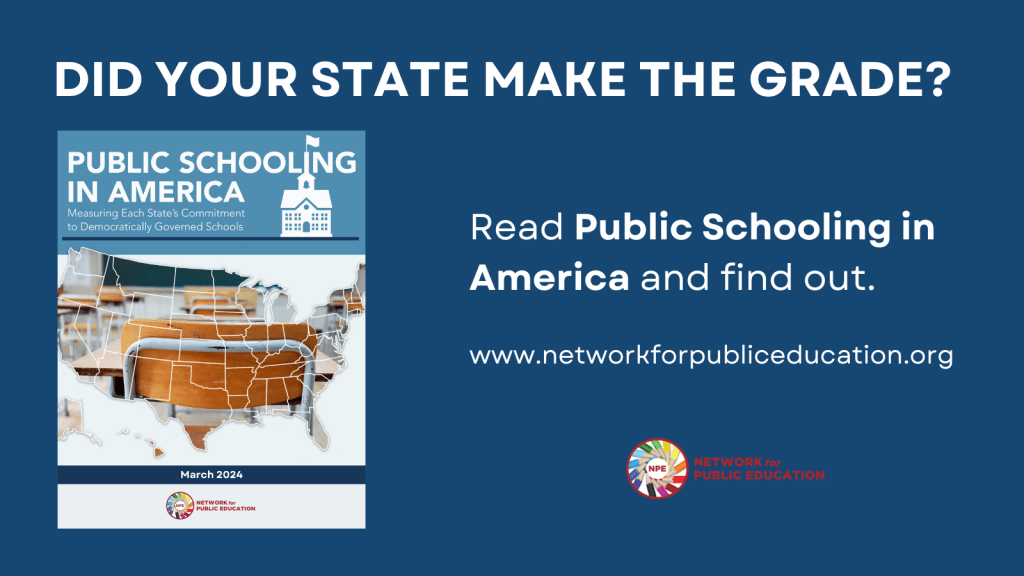
The Network for Public Education released a report card today grading the states on their support for democratically-governed public schools. Which states rank highest in supporting their public schools? Open the report to find out.
Measuring Each State’s Commitment to Democratically Governed Schools
EXECUTIVE SUMMARY
Neighborhood public schools remain the first choice of the overwhelming majority of Ameri- can families. Despite their popularity, schools, which are embedded in communities and gov- erned by elected neighbors, have been the target of an unrelenting attack from the extreme right. This has resulted in some state legislatures and governors defunding and castigating public schools while funding alternative models of K-12 education.
This 2024 report, Public Schooling in America: Measuring Each State’s Commitment to Democratically Governed Schools, examines these trends, reporting on each state’s commit- ment to supporting its public schools and the children who attend them.
What We Measure
We measure the extent of privatization in each state and whether charter and voucher laws promote or discourage equity, responsibility, transparency, and accountability. We also rate them on the strength of the guardrails they place on voucher and charter systems to protect students and taxpayers from discrimination, corruption and fraud.
Recognizing that part of the anti-public school strategy is to defund public schools, we rate states on how responsibly they finance their public schools through adequate and equitable funding and by providing living wage salaries for teachers.
As the homeschool movement grows and becomes commercialized and publicly funded, homeschooling laws deserve public scrutiny. Therefore, we rate states on laws that protect children whose families homeschool.
Finally, we include a new expansive category, freedom to teach and learn, which rewards states that reject book bans, and the use of unqualified teachers, intolerance of LGBTQ stu- dents, corporal punishment, and other factors that impinge on teachers’ and students’ rights.


 Diane Ravitch's blog