Archives for category: Corporate Reform

Brett Shipp of Spectrum News posted a video asserting that the Texas charter schools in the network founded by Mike Miles sent millions of dollars to Miles’ Colorado charter schools. His report was amply documented.

Miles was imposed as superintendent of the Houston Independent School District after the state took control of HISD, based on the low performance of ONE school, Wheatley High School. Miles was selected by State Superintendent Mike Morath, who served on the Dallas school board when Miles was superintendent for three years and failed to meet any of his lofty goals. Neither Morath nor Miles is an educator. Morath was in the software business, and Miles was in the military before joining Eli Broad’s Superintendent Academy, which emphasized top-down management and disruption.

Ana Hernandez, a Houston legislator, wrote Mike Morath to call for an investigation of Miles. Morath is unlikely to conduct a serious probe since he chose Miles. The State Attorney General Ken Paxton is under indictment for corruption, so he’s not likely to dig deep into Morath’s choice; Morath was picked by Governor Gregg Abbott.

Sam Gonzalez Kelly of The Houston Chronicle reported that Miles denounced Shipp’s charges:

HISD’s appointed Superintendent Mike Miles is vehemently denying reports that his former charter network, Third Future Schools, illegally used money from its Texas campuses to subsidize its schools in Colorado. 

Miles, in a late night email to “friends, partners and board members,” wrote that the story by Spectrum News in Dallas “badly misunderstands, or worse, intentionally misrepresents the financial practices of Third Future Schools.” The story, by reporter Brett Shipp, who covered Miles during his tenure as Dallas ISD superintendent, accuses Third Future Schools of charging fees to its Texas network to subsidize one of its campuses in Colorado, and reported that Third Future Schools Texas had run a deficit due to debts to “other TFS network schools and to TFS corporate.”

The Spectrum report cites recordings of TFS corporate board and investor meetings, as well as the charter network’s financial records. The Houston Chronicle’s review of the documents confirmed that TFS Texas had sent funds to Colorado campuses, which a charter school finance expert said is generally permitted by state law.

“While I have not worked at the Third Future Schools network for more than a year, I find the piece irresponsibly inaccurate, and I cannot let this kind of misinformation go uncorrected,” Miles wrote. 

Miles wrote that Third Future Schools “was always a responsible steward of every public dollar received” and that school finances were approved by local school boards and partner districts. He acknowledged that Texas schools paid “administrative fees” to the central Third Future office, which is headquartered in Colorado, to provide network-wide supports in areas, including finance and human resources, but said that such payments are common practice for charter networks.

“Spectrum News either intentionally or, through gross incompetence, mischaracterized these common place financial arrangements between charter schools and the charter management organizations that support them,” Miles wrote. 

Neither Spectrum nor Shipp immediately responded to requests for comment. 

Spectrum’s story immediately prompted outrage among HISD community members and some elected officials, who are demanding the superintendent’s resignation and a federal investigation over the charter network’s use of Texas taxpayer money in Colorado schools. 

The Texas Education Agency said in a statement Tuesday that it was aware of Spectrum’s report and was reviewing the matter.

The “charter school finance expert” consulted by The Houston Chronicle worked for the state charter school association. It is not clear that state law allows charter schools in Texas to send Texas public funds to its offices or other charters in Colorado.

A few days ago, I joined a discussion with Dr. Tim Slekar and Dr. Johnny Lupinacci about the current state of public education. It was aired on their show “Busted Pencils,” which is dedicated to teachers, students, and public schools.

We talked about charters, vouchers, testing, and how to get involved. Everyone can stand up for what they believe.

The founding myth of the corporate reform movement is the rebirth and transformation of the public schools of New Orleans after Hurricane Katrina in 2005. Most of the city’s public schools suffered physical damage because of the horrendous storm. Large numbers of the students and teachers were scattered after the storm. The state of Louisiana moved in aggressively: it lowered the bar at which a school was deemed to be failing. It took control of most of the public schools and turned them over to charter operators. It fired all of the teachers, most of whom were African-American, disbanding the teachers’ union. The charter operators hired large numbers of Teach for America recruits. The media hailed the experiment in privatization as a success story. Numerous states followed the lead of New Orleans, turning over their lowest-performing schools to charter operators. Michigan created the Education Achievement Authority. Tennessee created the Achievement School District. North Carolina and Nevada launched similar but smaller experimental districts. All of them failed.

Now comes a report that the nearly all-charter New Orleans district did not live up to its hype.

Dr. Barbara Ferguson 
Research on Reforms, Inc. 

April 2024

Following Hurricane Katrina, a newly enacted state law identified schools that scored below the state average as failing and subject to take-over. The state then took-over 107 of New Orleans’ 120 public schools and turned them into charter schools. Last year’s scores showed that 56 of New Orleans’ 68 public schools had scores below the state average.*

Thus, after nearly twenty years, over 80% of New Orleans schools are still below the state average. This charter school experiment has been a failure.

Of the five worst performing high schools taken-over, only one now scores above the state average. Two are still below the state average. Another was closed and then reopened as a campus to expand the Willow selective admission charter school. The status of the other, Walter Cohen, is unclear. Recall that the New Orleans College Prep Charter took-over Cohen High School, operating its selective charter school on one floor, while leaving the failing Cohen students on the other floors. Thus, we learned that the take-over of a failing school simply meant taking-over the building, not the failing students in the building.

Of the five highest performing high schools taken-over, they continue to be the highest performing except for one, McDonogh #35, which is now below the state average. These schools, except for McDonogh #35, collectively received over $5 million in Charter School Grant Funds. The five worst performing high schools received nothing in Charter School Grant Funds following the takeover.The Louisiana law, which termed charter schools “an experiment,” also stated that they were to “serve the best interests of at-risk” children and youth.

But the legislative auditor found in 2022 that for the past six years, more than 1 in 5 charter schools failed to meet requirements on enrollment of children from low-income families.

Louisiana’s “state takeover” law required schools below the state average to be taken-over. Thus, half of the schools should have been taken-over because half are below the state average and half are above. Yet, only the New Orleans’ schools below the state average were taken-over. Targeting New Orleans seems to again be popular with our new governor.

Research on Reforms, Inc. consistently reported on the status of the state-takeover through its website and a published book, “Outcomes of the State Takeover of the New Orleans Schools.” This will be the final of its outreach, which ends with hope that our legislature will one day enact laws that provide equity and excellence in education for our New Orleans children and youth.

Barbara Ferguson, Attorney and Co-founder 
Charles Hatfield, Co-founder 
Research on Reforms, Inc.

Comments to 

bferguson@researchonreforms.org

Research On Reforms Website

Indiana has plunged headlong into privatization of its-once-beloved public schools.

Fortunately, there is a knowledgeable candidate for Governor who has promised to stop the destruction of public education.

Jennifer McCormick is a career educator who began as a special education teacher, then became a language arts teacher, a principal and a district superintendent.

She was elected Indiana State Superintendent of Public Instruction in 2016; she ran as a Republican. She served out her four-year term and switched parties in 2021.

McCormick wrote on Twitter:

Indiana GOP’s school privatization efforts have diverted 1.6B of tax dollars away from public schools, and the majority of communities do not have families and/or private schools participating. As governor, I will champion for Indiana to pause funding school privatization.

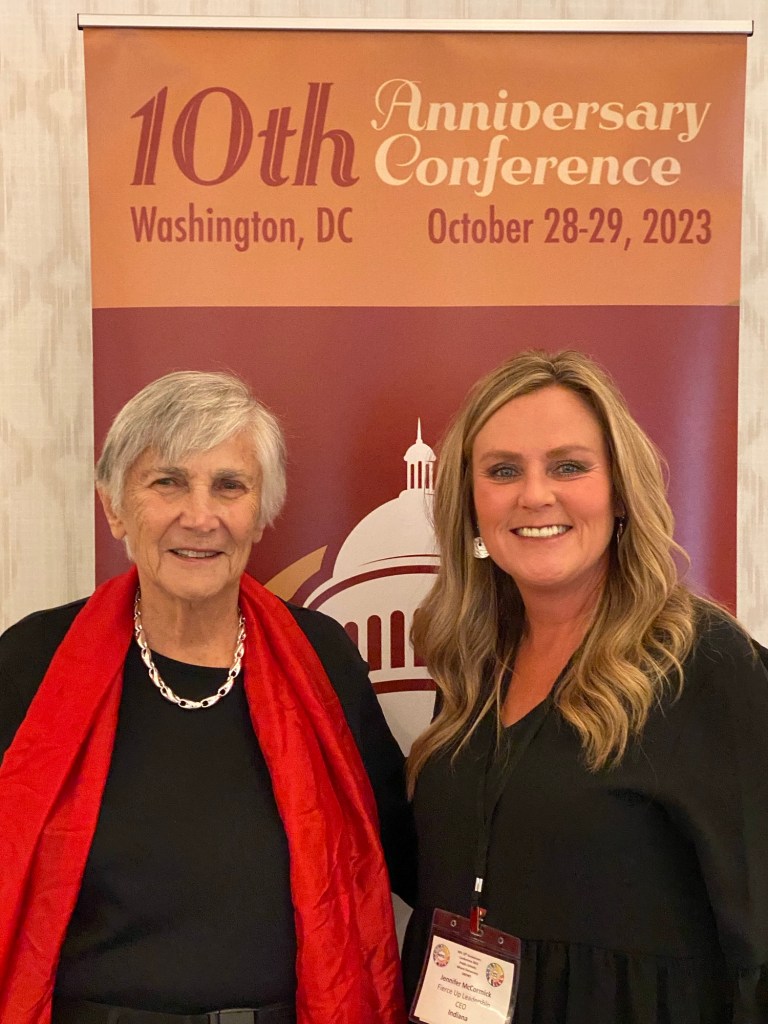
At the NPE conference in D.C. in 2023, JenniferMcCormick and me.

Tim Slekar is a fearless warrior for public schools, teachers, and students. I will be talking to him about Slaying Goliath and the struggle to protect public schools from the depredations of billionaires and zealots.

This Thursday on Civic Media: Dive Back into “Slaying Goliath” with Diane Ravitch

Grab your pencils—BustEDpencils is gearing up for a no-holds-barred revival of Diane Ravitch’s game-changing book, *Slaying Goliath*, live this Thursday on Civic Media. 

Launched into a world on the brink of a pandemic, *Slaying Goliath* hit the shelves with a mission: to arm the defenders of public education against the Goliaths of privatization. But then, COVID-19 overshadowed everything. Despite that, the battles Diane described haven’t paused—they’ve intensified. And this Thursday, we’re bringing these crucial discussions back to the forefront with Diane herself.

This Thursday at 7pm EST on BustEDpencils, we’re not just revisiting a book; we’re reigniting a movement. Diane will dissect the current threats to public education and highlight how *Slaying Goliath* still maps the path to victory for our schools. This isn’t just about reflection—it’s about action.

**It’s time to get real. It’s time to get loud. It’s time to tune in this Thursday at 7 PM EST on Civic Media.**

If you believe that without a robust public education system our democracy is in jeopardy, then join us. Listen in, call in (855-752-4842), and let’s get fired up. We’ve got a fight to win, and Diane Ravitch is leading the charge.

Mark your calendars and fire up Civic Media this Thursday at 7pm Central. 

Dr. Julian Vasquez Heilig is a noted scholar of charter schools, with experience as a parent of a charter school student and board member of a charter school. He is Provost and Vice-President for Academic Affairs at Western Michigan University. And, he is a founding board member of the Network for public Education!

Recently, Dr. Heilig testified before the House Committee on Education and the Workforce. He explained that the research on charters shows that they are no more successful than public schools, they close frequently, they have high teacher turnover, and they promote segregation. In addition, they exacerbate the problems of the public schools by choosing the students they want and diverting resources.

Dr. Heilig called for more accountability for charters and the need for democratic oversight.

The Republican majority of the Committee called three witnesses. The Democrats were allowed only one, and they chose Dr. Heilig.

They chose well. His testimony is succinct and excellent.

Tom Ultican, retired teacher in California, smells a scam in the making. The science behind “the Science of Reading” movement is not very scientific, he writes. Publishers and vendors are preparing to cash in on legislative mandates that force reading teachers to use only one method to teach reading despite the lack of evidence for its efficacy. Ultican zeroes in on the role of billionaire Laurene Powell Jobs as one of the key players in promoting SofR.

He writes:

Laurene Powell Jobs controls Amplify, a kids-at-screens education enterprise. In 2011, she became one of the wealthiest women in the world when her husband, Steve, died. This former Silicon Valley housewife displays the arrogance of wealth, infecting all billionaires. She is now a “philanthropist”, in pursuit of both her concerns and biases. Her care for the environment and climate change are admiral but her anti-public school thinking is a threat to America. Her company, Amplify, sells the antithesis of good education.

I am on Amplify’s mailing list. April third’s new message said,

“What if I told you there’s a way for 95% of your students to read at or near grade level? Maybe you’ve heard the term Science of Reading before, and have wondered what it is and why it matters.”

Spokesperson, Susan Lambert, goes on to disingenuously explain how the Science of Reading (SoR) “refers to the abundance of research illustrating the best way students learn to read.”

This whopper is followed by a bigger one, stating:

“A shift to a Science of Reading-based curriculum can help give every teacher and student what they need and guarantee literacy success in your school. Tennessee school districts did just that and they are seeing an abundant amount of success from their efforts.”

A shift to SoR-based curriculum is as likely to cause harm as it is to bring literacy success. This was just a used-car salesman style claim. On the other hand, the “abundance of success” in Tennessee is an unadulterated lie. National Assessment of Education Progress (NAEP) tracks testing over time and is respected for education testing integrity. Tennessee’s NAEP data shows no success “from their efforts.” Their reading scores since 2013 have been down, not a lot but do not demonstrate an “abundance of success”.

NAEP Data Plot 2005 to 2022

Amplify’s Genesis

Larry Berger and Greg Dunn founded Wireless Generation in 2000 to create the software for lessons presented on screens. Ten years later, they sold it to Rupert Murdoch and his News Corporation for $360 million. Berger pocketed $40 million and agreed to stay on as head of curriculum. Wireless Generation was rebranded Amplify and Joel Klein was hired to run it.

Murdoch proposed buying a million I-pads to deliver classroom instruction. However, the Apple operating system was not flexible enough to run the software. The android system developed at Google met their needs. They purchased the Taiwanese-made Asus Tablets, well regarded in the market place but not designed for the rigors of school use. Another issue was that Wireless Generation had not developed curriculum but Murdoch wanted to beat Pearson and Houghton Mifflin to the digital education market place … so they forged ahead.

In 2012, the corporate plan was rolling along until the wheels came off. In Guilford County, North Carolina, the school district won a Race to the Top grant of $30 million dollars which it used to experiment with digital learning. The district’s plancalled for nearly 17,000 students in 20 middle schools to receive Amplify tablets. When a charger for one of the tablets overheated, the plan was halted. Only two months into the experiment, they found not only had a charger malfunctioned but another 175 chargers had issues and 1500 screens were kid-damaged.

This was the beginning of the end.

By August of 2015, News Corporation announced it was exiting the education business. The corporation took a $371 million dollar write-off. The next month, they announced selling Amplify to members of its staff. In the deal orchestrated by Joel Klein, who remained a board member, Larry Berger assumed leadership of the company.

Three months later, Reuters reported that the real buyer was Laurene Powell Jobs. She purchased Amplify through her LLC, the Emerson Collective. In typical Powell Jobs style, no information was available for how much of the company she would personally control.

Because Emerson Collective is an LLC, it can purchase private companies and is not required to make money details public. However, the Waverley Street Foundation, also known as the Emerson Collective Foundation, is a 501 C3 (EIN: 81-3242506) that must make money transactions public. Waverly Street received their tax exempt status November 9, 2016.

SoR A Sales Scam

The Amplify email gave me a link to two documents that were supposed to explain SoR: (Navigating the shift to evidence-based literacy instruction 6 takeaways from Amplify’s Science of Reading: The Symposium) and (Change Management Playbook Navigating and sustaining change when implementing a Science of Reading curriculum). Let’s call them Symposium and Navigating.

Navigating tells readers that it helps teachers move away from ineffective legacy practices and start making shifts to evidence-based practices. The claim that “legacy practices” are “ineffective” is not evidence-based. The other assertion that SoR is evidence-based has no peer-reviewed research backing it.

Sally Riordan is a Senior Research Fellow at the University College London. In Britain, they have many of the same issues with reading instruction. In her recent research, she noted:

“In 2023, however, researchers at the University of Warwick pointed out something that should have been obvious for some time but has been very much overlooked – that following the evidence is not resulting in the progress we might expect.

“A series of randomised controlled trials, including one looking at how to improve literacy through evidence, have suggested that schools that use methods based on research are not performing better than schools that do not.”

In Symposium, we see quotes from Kareem Weaver who co-founded Fulcrum in Oakland, California and is its executive director. Weaver also was managing director of the New School Venture Fund, where Powell Jobs served on the board. He works for mostly white billionaires to the detriment of his community. (Page 15)

Both Symposium and Navigating have the same quote, “Our friends at the Reading League say that instruction based on the Science of Reading ‘will elevate and transform every community, every nation, through the power of literacy.”

Who is the Reading League and where did they come from?

Dr. Maria Murray is the founder and CEO of The Reading League. It seems to have been hatched at the University of Syracuse and State University of New York at Oswego by Murray and Professor Jorene Finn in 2017. That year, they took in $11,044 in contributions (EIN: 81-0820021) and in 2018, another $109,652. Then in 2019, their revenues jumped 20 times to $2,240,707!

Jorene Finn worked for Cambria Learning Group and was a LETRS facilitator at Lexia. That means the group had serious connections to the corporate SoR initiative before they began.

With Amplify’s multiple citations of The Reading League, I speculated that the source of that big money in 2019 might have been Powell Jobs. Her Waverly Street Foundation (AKA Emerson Collective Foundation) only shows one large donation of $95,000,000 in 2019. It went to the Silicon Valley Community Foundation (EIN: 20-5205488), a donor-directed dark money fund.

There is no way of following that $95 million.

The Reading League Brain Scan Proving What?

Professor Paul Thomas of Furman University noted the League’s over-reliance on brain scans and shared:

“Many researchers in neurobiology (e.g., Elliott et al., 2020; Hickok, 2014; Lyon, 2017) have voiced alarming concerns about the validity and preciseness of brain imaging techniques such as functional magnetic resonance imaging (fMRI) to detect reliable biomarkers in processes such as reading and in the diagnosis of other mental activity….

“And Mark Seidenberg, a key neuroscientist cited by the “science of reading” movement, offers a serious wcaution about the value of brain research: “Our concern is that although reading science is highly relevant to learning in the classroom setting, it does not yet speak to what to teach, when, how, and for whom at a level that is useful for teachers.”

“Beware The Reading League because it is an advocacy movement that is too often little more than cherry-picking, oversimplification, and a thin veneer for commercial interests in the teaching of reading.”

The push to implement SoR is a new way to sell what Amplify originally called “personalized learning.”This corporate movement conned legislators, many are co-conspirators, into passing laws forcing schools and teachers to use the SoR-related programs, equipment and testing.

SoR is about economic gain for its purveyors and not science based.

When politicians and corporations control education, children and America lose.

To read an earlier post by Tom Ultican on this topic, see this.

Governor Ron DeSantis signed a bill limiting the ability of non-parents to initiate book bans. That’s a step forward since any crank was free to challenge any book under previous law. But, the same law made it easier to close public schools and hand them over to the charter industry.

TALLAHASSEE — After more than 1,200 objections were filed to library books and other materials last school year, Gov. Ron DeSantis on Tuesday signed a bill to limit challenges by nonparents or guardians.

The wide-ranging bill (HB 1285) also includes changes designed to ease the process of charter schools taking over operations at traditional public schools that are failing.

The part of the measure dealing with book challenges came after the Republican-controlled Legislature and DeSantis approved measures that ramped up scrutiny of library books and classroom materials, leading to highly publicized disputes.

More than half of the 1,218 book objections during the 2022-2023 school year occurred in two counties, Clay and Escambia, according to a Senate staff analysis. The objections resulted in the removal of 186 books in the two counties.

The bill will require that any “resident of the county who is not the parent or guardian of a student with access to school district materials may not object to more than one material per month.”

During an event Monday, DeSantis said that some people who filed mass objections to books made a “mockery” of the process.

“The idea that someone can use the parents’ rights and the curriculum transparency to start objecting to every single book, to try to make a mockery of this, is wrong. And you had examples where books were put under review that are just normal books that have been in education for many, many years,” DeSantis said.

Meanwhile, parts of the bill related to underperforming public schools would “add some oomph” to the state’s process of allowing charter schools to take over operations, DeSantis said.

Under state law, if a school receives consecutive D or F grades based on various performance criteria, the school is given two years to improve to a C under what’s known as a “turnaround plan.” If the school’s grade doesn’t make such an improvement, one option is for the school to close and reopen as a charter school.

The bill signed Tuesday will speed up converting traditional public schools to charter schools under such circumstances, by giving districts a deadline to execute charter contracts. For schools reopening as charters, districts would have to execute contracts by Oct. 1 of the following school year, and charter organizations would assume “full operational control” by July.

Ed Johnson is a systems thinker and consultant in Atlanta. He cares passionately about the public schools of his city and keeps watch over the actions of the Atlanta Public School Board. Johnson is an adherent of the work of W. Edwards Deming; he believes in thinking of about how to change systems, not in quick fixes or the panacea of the day. In this letter to the Atlanta Public School Board, he takes them to task for their commitment to 50CAN, a school privatization group that was started in Connecticut as ConnCAN and funded largely by the Sackler family.

Ed Johnson writes:

“Join GeorgiaCAN for an informative session on the vision of Atlanta Public Schools!  Gain insights from APS Board member [Dr.] Ken Zeff as he shares his perspective and engages in a parent discussion regarding APS’s vision.  Let’s unite as a community to ensure that our children and the APS community have the resources and support necessary to pave the way for a brighter future.”

—GeorgiaCAN

 We now know GeorgiaCAN is a state-level affiliate of 50CAN, do we not?

 We now know 50CAN stands for 50-State Campaign for Achievement Now, do we not?

 We now know GeorgiaCAN, as a 50CAN affiliate, pushes destroying public education and public schools with school choice, charter schools, and vouchers, do we not?

 We now know, in December 2019, we had AJC parroting and giving prominent voice to GeorgiaCAN spouting free market school choice ideology, do we not?

 We now know, in August 2023, we had Atlanta school board members Katie Howard, District 1, and Erika Mitchell, District 5 and current school board chair, involved with GeorgiaCAN, do we not?

 And we now know, in September 2023, we had The King Center giving the 50CAN CEO a platform for some inscrutable reason, do we not?

 So, let’s consider Ken Zeff in the way The King Center was considered last September:

 50CAN evolved from ConnCAN (Connecticut CAN).  ConnCAN was funded pretty much wholly by Sackler Family fortunes earned as ill-gotten profits from over-prescribed sales of Oxycontin by the family’s Purdue Pharma.  Because of such greed for profits, hundreds of thousands of people in the U.S. and worldwide have died, and continue to die, from opioid addiction.

 As with similar other organizations and their local operatives—for example, The City Fund and its local operatives, Ed Chang leading reformED Atlanta—it is fairly well-known that 50CAN and its state-level operatives aim to dismantle hence destroy public education as the common good that is foundational to sustaining democracy, so as to transform destroyed public schools into privatized and commodified schools composing competitive education marketplaces.  Think Milton Friedman and the “invisible hand of the market.”

 It is also fairly well-known that 50CAN, like similar other organizations, has advanced its aim to destroy public education by expressly targeting and catalyzing Black communities to demand school choice and charter schools that will magically deliver “achievement now.”

 In effect, 50CAN and such others “politrick” Black communities into facilitating their own destruction and that of their own children.  Again, while “It takes a village to raise a child,” it also takes a village to destroy a child.

 The usual assumption is that charter schools transformed from destroyed public schools are inherently better than “failing public schools.”  This is a lie, plain and simple.  It is impossible for charter schools to be inherently better or worse than “failing public schools.”  Because entropy is a fact of life, our public schools need improvement, have always needed improvement, and always will need improvement.  Reality offers charter schools no grace from the entropy fact of life.

 To assert that charter schools are inherently better than “failing public schools” is like asserting members of a certain group of human beings are inherently superior to members of other groups of human beings, based solely on expressions of variation in some few arbitrarily-chosen human physical features said to signify “race,” which is another lie.

 Charter schools do, however, appeal to certain retributive justice, behaviorally emulative, and selfish consumerist mindsets for which improvement-thinking has always been meaningless, at worst, and theoretical, at best.  50CAN knows this, and so uses it to catalyze Black communities to demand “achievement now.”  “Instant pudding,” the late, great systems thinker W. Edwards Deming (1900-1993) might say.

 Consequently, “Our children can’t wait!” has been a decades-long handy refrain that has always begged easy, quick, learningless change but never improvement with knowledge, which requires learning and unlearning.

 Unfortunately, systems thinking teaches through a nonviolence lens that the more often easy, quick, learningless change happens, the less improvement becomes possible; then, the less improvement becomes possible, the less sustainable democracy becomes; then, the less sustainable democracy becomes, the more societal dysfunctions develop and emerge, after a time, in Black communities and elsewhere; then, the more societal dysfunctions show up, the more the refrain, “Our children can’t wait!”

 It is all a destructively vicious, self-reinforcing feedback loop that 50CAN and similar other destroyers of public education are happy to catalyze in Black communities, in particular, and to support its playing out, if only continually, but continuously, ideally.

 With systems thinking, it really is not hard to understand why some out-of-control-for-the-worse aspects of violent crime in City of Atlanta involving ever more “Black” teenaged children and younger other persons in Black communities has become such a challenge.

 Currently, Atlanta’s culture predictably produces a homicide every 2.3 +/- 4.0 days, while predictably producing an aggravated assault every 3.7 +/- 10.7 hours.

 These are realities Atlanta Police Department data reveal when viewed through a Deming kind of systems thinking lens instead of through a financial accounting-style lens that invariably creates an incomplete or false narrative that the media and others then report as fact.

 Although some are quite capable to look below the performative surface, or show stage, of the proverbial iceberg and down into its greater depths to see and know Dr. Martin Luther King, Jr., was also a profound systems thinker, systems thinking seems generally absent in Black culture; certainly, children labeled “Black” seem never to learn about this deeper and critically important aspect of Dr. King.

 All too often the children learn to conserve racism and so-called white supremacy rather than learn to help humanity relieve itself of these scourges.  The children learn and internalize racial categorization, the false narrative at the heart of racial violence.  It seems the children never learn to internalize an understanding of human variation, the truth at the heart of nonracial nonviolence.

 It is quite puzzling that some fight and rail against racism, all the while conserving it and the “race” lie racism needs in order to exist, in truth.

 Therefore, a question for The King Center must be, why is The King Center giving a platform to 50CAN?

 50CAN and GeorgiaCAN, private organizations known to be about making “Beloved Community” a virtual impossibility, in all respects.

 Given this, we now know Dr. Ken Zeff lied when he swore, in taking the Oath of Office the Charter of the Atlanta Independent School System requires, “I will be governed by the public good and the interests of said school system,” do we not?

 Being involved with GeorgiaCAN necessarily and unavoidably means Dr. Ken Zeff exercises, well, the “choice” to be governed by a private goodand the interests of GeorgiaCAN, hence 50CAN.

 In a discussion during this month’s regularly scheduled school board meeting, Dr. Ken Zeff voluntarily professed quite enthusiastically to being a school choice proponent.

 Well, he was at least honest about it—something we might appreciate, when some other Atlanta Board of Education members have shown they are not so honest about their being in the school choice camp.


Ed Johnson

Advocate for Quality in Public Education

Atlanta GA | (404) 505-8176 | edwjohnson@aol.com

Jan Resseger reports on dramatic changes in Chicago, which has been a Petri dish for corporate school reform for at least two decades. The last mayoral election pitted Paul Vallas, an Uber reformer against Brandon Johnson, a teacher and member of the Chicago Teachers Union. Johnson is now beginning to unravel the damage done by Arne Duncan, Rahm Emanuel, and the business leadership.

Resseger writes:

Right now we are watching in real time as Chicago tries to figure out how to undo the consequences of a catastrophic, two-decades long experiment in marketplace school reform.

Chicago’s Board of Education has voted to implement an important first step in Mayor Brandon Johnson’s proposed school district overhaul: the elimination of student based budgeting.

Mayor Johnson seeks to restore equal opportunity across a school district that has become marked by magnet schools, charter schools, elite and selective public schools, struggling neighborhood schools, and neighborhoods without a a public high school or even a traditional public elementary school.

Johnson has prioritized major changes in the Chicago Public Schools, whose problems became especially obvious in June of 2013, when Mayor Rahm Emanuel closed 50 neighborhood public schools because, as he claimed, they were under-enrolled. Eve Ewing, a University of Chicago sociologist explains that, “80 percent of the students who would be affected were African American… and 87 percent of the schools to be closed were majority black.” (Ghosts in the Schoolyard, p. 54)

Chicago was an early experimenter with school reform. Brandon Johnson, the city’s elected mayor, leads Chicago’s schools as part of the 1994 mayoral governance plan imposed on the public schools by Mayor Richard M. Daley and the Illinois legislature. The Chicago Public Schools adopted universal, districtwide school choice, and the launch in 2004 of Renaissance 2010 (led by Arne Duncan) that involved the authorization of a mass of new charter schools and the subsequent closure of so-called failing neighborhood public chools. Chicago adopted a strategy called “portfolio school reform,” described in a National Education Policy Center brief: “The operational theory behind portfolio districts is based on a stock market metaphor—the stock portfolio under the control of a portfolio manager. If a stock is low-performing, the manager sells it.  As a practical matter, this means either closing the school or turning it over to an charter school….”

Then in 2014, Mayor Emanuel added a districtwide funding plan called student based budgeting. In a 2019 report, Roosevelt University professor Stephanie Farmer explained: “Student Based Budgeting fundamentally remade the approach to funding public schools. Student Based Budgeting is akin to a business model of financing public schools because funds are based on student-consumer demand and travel with the student-consumer to the school of their choice.  (The plan contrasts with)… the old public good approach to financing public schools that ensured a baseline of education professionals in each school.”

Because it is known that aggregate school test scores correlate primarily with poverty and wealth, it was predicable that student based budgeting would put schools in Chicago’s poorest neighborhoods on a race to the bottom, leading to schools with tragically limited programming for the city’s most vulnerable students and more school closures.  Farmer concludes: “Our findings show that Chicago Public Schools’ putatively color-blind Student Based Budgeting reproduces racial inequality by concentrating low budget public schools almost exclusively in Chicago’s Black neighborhoods. The clustering of low budget schools in low-income Black neighborhoods adds another layer of hardship in neighborhoods experiencing distress from depopulation, low incomes, and unaffordable housing.”

In late March of this year, WBEZ’s Sarah Karp reported that the Board of Education voted to launch a new plan to determine how much each school has to spend on teachers and programming: “Chicago Public Schools is officially moving away from a school funding formula that pitted schools against each other as they competed for students… District officials… announced (on March 21, 2024) they are implementing a formula that targets resources for individual schools based on the needs of students, such as socioeconomic status and health. They will abandon student based budgeting—a formula unveiled a decade ago under former Mayor Rahm Emanuel that provided a foundational amount of money based on how many students were enrolled…. Under the needs-based formula, every school will get at least four foundation positions, including an assistant principal, plus core and ‘holistic teachers.’… Schools will then get additional funding based on the opportunity index, which looks at barriers to opportunity including race, socioeconomic status, education, health and community factors.”

While undoing a market-based scheme for school funding and operations is clearly a moral imperative, the challenges appear daunting.  Karp continues: “This change was expected as Mayor Brandon Johnson and others have sharply criticized student based budgeting. However, it was unclear how it would play out, especially as the district faces a $391 million deficit for the next school year.  The shortfall is the result of federal COVID relief funds running out… District officials offered no information at a Board of Education meeting… on how the district will fill the budget hole.”

In addition to the threat of a serious financial shortfall, another challenge is the outcry from parents who have over the past two decades become a constituency for charter schools, magnet schools and selective high schools.  Mayor Johnson has tried to reassure parents: “(L)et me assure people that—whether its a selective enrollment school or magnet school—we will continue to invest in those goals… (A)ll I’m simply saying is that where education is working in particular at our selective enrollment schools and our magnet schools, my position is like any other parents in Chicago: that type of programming should work in all of our schools. And that has not been the case. Neighborhood schools have been attacked, they have been demonized, and they’ve been disinvested in, and Black and brown parents overwhelmingly send their children to those schools. So it’s not just demonizing and disinvesting in Black and brown schools, it’s demonizing and disinvesting in Black and brown people—and not under my administration.”

Although school choice plans like Chicago’s were originally premised on the idea of providing more choices for those who have few, in her profound book, Ghosts in the Schoolyard, Eve Ewing explains that families in Chicago do not have equal access in today’s school system based on school choice: “While choosing the best option from a menu of possibilities is appealing in theory, researchers have documented that in practice the ‘choice’ model often leaves black families at a disadvantage. Black parents’ ability to truly choose may be hindered by limited access to transportation, information, and time, leaving them on the losing end of a supposedly fair marketplace.” (Ghosts in the Schoolyard, p. 23) Families dealing with poverty and its challenges are more likely to select a neighborhood school within walking distance of their home.

Mayor Johnson and his school board are facing a fraught political battle in the midst of severe budget challenges. Chicago school reform has exacerbated inequality. The families whose children remain in traditional neighborhood schools that have been undermined by school choice and student based budgeting have watched their their schools lose staff and programs their children need. At the same time, families who have benefited from charter schools, magnet schools and selective-enrollment high schools have now become strong supporters of the programs they have come to take for granted.

Mayor Johnson has been very clear, however, about what the past two decades of portfolio school reform, school choice and student based budgeting have meant for Chicago: “What has happened in the city of Chicago is selective enrollment schools go after students who perform academically on paper.  It’s a very narrow view of education. Let’s also ensure that other areas of need are also highlighted and lifted up.  That’s arts, our humanities, technology, trades…  It’s not like we’re asking for anything radical. We’re talking about social workers, counselors, class sizes that are manageable. We’re talking about full wraparound services for treatment for families who are experiencing the degree of trauma that exists in this city.”