Archives for category: Civil Rights

When I learned about this list of honorees, I thought it was a joke. It’s not.

An award named for Justice Ruth Bader Ginsberg, an icon of liberalism and feminism, will be presented to a surprising list of men and women by the Opperman Foundation at the Library of Congress.

The Hill posted this story:

A prestigious honor named after liberal Supreme Court Justice Ruth Bader Ginsburg and originally established to recognize “women of distinction” is being awarded this year to a surprising group of multiple genders that includes Rupert Murdoch, Elon Musk and Martha Stewart, among others.

The Ruth Bader Ginsburg Leadership Award, also known as the RBG Award, will be presented by the Dwight D. Opperman Foundation at an April 13 gala at the Library of Congress, ITK can reveal.

In addition to conservative media mogul Murdoch, Tesla CEO and X owner Musk, and lifestyle guru Stewart, the award will be given to actor Sylvester Stallone and financier Michael Milken.

First established in 2020 as a recognition solely for women, previous recipients of the RBG Award have included Queen Elizabeth II, singer Barbra Streisand and fashion designer Diane von Furstenberg.

But this year, organizers expanded the award named after the liberal leader of the Supreme Court to include “trailblazing men and women” who “have demonstrated extraordinary accomplishments in their chosen fields.”

Dwight D. Opperman Foundation chair Julie Opperman said in a statement that Ginsburg “fought not only for women but for everyone.”

The Supreme Court justice, a champion of women’s rights, died in 2020 at 87.

“Going forward, to embrace the fullness of Justice Ginsburg’s legacy, we honor both women and men who have changed the world by doing what they do best,” Opperman said.

Who are Murdoch and Musk “fighting for”?

The adoption of voucher programs has been a boon for religious schools. Schools that were financially troubled are now thriving with public subsidies for their students as well as an influx of new students.

This article by reporter Holly Meyer on the Associated Press newswire describes the good fortune of religious schools but does not mention the copious research demonstrating the failure of vouchers.

The Miami Archdiocese’s superintendent of schools says Catholic education is increasingly in demand in South Florida, now that all K-12 students regardless of income are allowed to use taxpayer-funded programs to pay for private school tuition.

Against the backdrop of favorable decisions by the conservative-majority U.S. Supreme Court, Florida was among nine states that expanded school voucher programs last year. So many families have signed up for the taxpayer-funded tuition reimbursements, some states are already exceeding their budgets….

The movement gained momentum amid fallout from pandemic-era school restrictions, debates on how transgender students should participate in school life, and wars over books and curriculum related to race and LGBTQ+ issues….

Some long-running religious schools are now planning for a fuller future after the wave of policy wins for the so-called school choice movement. Others hope voucher expansion comes to their state.

“We are moving into growth mode,” said Jim Rigg, superintendent of the Miami Archdiocese’s 64 schools. Accelerated by the state’s private school scholarship program, enrollment has risen for the last four years, reaching its highest peak in over a decade, he said….

Nearly 80% of private school families choose religious ones, according to P. George Tryfiates, public policy and legal affairs vice president for the Association of Christian Schools International. The association represents about 2,200 U.S. schools.

In a statement, he said Christian schools are, among other things, “a refuge from the cultural wars over sexuality.”

Voucher programs do not include accountability measures nor do they ban discrimination. Religious Scholls are not required to comply with federal laws so they may ban students with disabilities and students of religions different from the sponsor.

Most vouchers are used by students already enrolled in religious schools.

The voucher movement is a not subtle way of gutting civil rights protections.

Robert Hubbell is outraged by the Supreme Court’s latest decision regarding the insurrection clause (Section 3 of the Fourteenth Amendment). The conservative majority on the Court usually claim to be “originalists” who scrutinize the language in the Constitution and divine the intent of those who wrote it.

In this case, the language was crystal clear. Any officer of the federal government who swore an oath to defend the Constitution and then participated in an insurrection against the Constitution was disqualified from running again for office. But the majority said that the official who had engaged in insurrection must first be subject to a Congressional vote; that language is not in the Constitution although there is specific language about the vote needed to remove the disqualification.

Hubbell was furious that Clarence Thomas was allowed to vote in this case since his wife was an active participant in the plot to overturn the election. He should have recused himself but that would require an ethical compass that the justice lacks.

Here is an excerpt from Hubbell’s post. You should open the link and read it in full.

He writes:

The most important lesson from Monday’s disqualification ruling is that the Supreme Court is broken beyond repair. The reactionary majority made that fact abundantly clear by unilaterally amending the Constitution to remove the Insurrection Clause from the 14th Amendment. 

Those sworn to protect the Constitution are dismantling it. The protectors of the Constitution have become its adversary in order to protect a failed insurrectionist who has promised a second effort to overthrow the Constitution. (“I said I want to be a dictator for one day.”)

There are many reasons to ensure that Donald Trump is not elected to the presidency in 2024. Rehabilitating and reforming the Court is chief among them. Sadly, reforming the Court is below the radar for most voters. But the lawless reactionary majority has already denied women the full protection of the liberty clause of the 14th amendment; it is refusing to enforce the clear intent of the 14th to ensure that descendants of enslaved people have a meaningful right to vote and equal protection under law. And the logical force of the Dobbs opinion strongly suggests that the Court will withdraw existing protections for same-sex marriage, contraception, and “inter-racial” marriages.

Monday’s opinion is a clear warning to all Americans that the threat to their liberties is immediate and real. Those who seek to protect existing liberties (and reclaim those already abrogated Court) must vote as if their freedoms depend on the outcome of the 2024 election—because they do! 

The Court has abandoned the Constitution; the last line of defense is the American people exercising their most fundamental right—the right to elect their representatives, who can (in turn) enlarge the Court and limit its jurisdiction.

There is abundant evidence that many Americans are not inspired by either presidential candidate or feel betrayed, forgotten, or ignored by the political process. But one candidate will seek to defend their freedoms by preserving and enforcing the Constitution (in part, by reforming the Court). The other has promised to overturn the Constitution “for one day”—which means “overturn the Constitution” period. The duration of a suspension of the Constitution is irrelevant.

Feelings of anger and upset over Monday’s ruling are understandable and warranted. But the most appropriate response is to redouble our efforts to defeat Trump. Nothing else matters. If we achieve that goal, we can work to advance all other goals. If we do not, we will be at the mercy of a renegade majority on the Court and an out-of-control, aspiring dictator for four years.


What happened?

On Monday, the Court overruled the Colorado Supreme Court’s decision removing Trump from the Colorado primary ballot. The opinion is here: 23-719 Trump v. Anderson (03/04/2024).

The ruling was ostensibly 9-0 with three justices writing a concurring opinion that reads like a dissent and a concurrence by Amy Coney Barrett that criticized the overreach of reactionary majority. In fact, as explained below, the ruling was 5-4, meaning that Justice Thomas’s refusal to recuse himself (as required by statute and rule) was outcome-determinative. Justice Thomas’s corruption saved Donald Trump’s slot on the Colorado ballot.

Distilled to its essence, the US Supreme Court’s ruling in Trump v. Anderson removed the Insurrection Clause from Section 3 of the 14th Amendment.


How did the Court effectively remove the Insurrection Clause from the 14th Amendment?

The 14th Amendment creates a self-executing disqualification for insurrectionists who previously took an oath to support the Constitution. The self-executing nature of that disqualification is consistent with other provisions of the 14th Amendment (equal protection, due process) that are likewise self-executing—as are other qualifications on the presidency (such as age, citizenship, and tenure of residency in the US).

Despite the plain language of the 14th Amendment—which creates a bar to holding federal office based on the conduct of the insurrectionist standing alone—the Court ruled that the Insurrection Clause is ineffective unless Congress affirmatively passes legislation that conforms to narrow prescriptions of the Court’s opinion in Trump v. Anderson.

The reactionary majority ignores that Section 3 of the 14th Amendment speaks to the role of Congress in enforcing the Insurrection Clause. It says that Congress can remove an insurrectionist’s disqualification by a two-thirds vote. But under the Court’s ruling in Trump v. Anderson, Congress can prevent any disqualifications of insurrectionists by simply refusing to pass the enabling legislation prescribed by the reactionary majority.

As Justice Sotomayor wrote in her concurring opinion,

It is hard to understand why the Constitution would require a congressional supermajority to remove a disqualification if a simple majority could nullify Section 3’s operation by . . . declining to pass implementing legislation.

As George Conway noted on Monday on MSNBC, the reactionary majority arrived at its conclusion by simply ignoring the language of the Constitution. The reactionary majority regularly uses the text of the Constitution as a cudgel when they want to deny liberties embraced by the language of the Constitution. But when they seek to ensure that a failed insurrectionist and aspiring dictator remains on the ballot, they act as if the text of the Constitution does not exist.

A reader wrote to me after the issuance of the opinion and asked, “What can we do?” My answer is this:

Elect Democrats. Reform the Court. Defend the Constitution. Preserve Democracy.


Paul Bowers used to be the education reporter for the Charleston News & Courier. I contacted him when I was trying to understand some issues that he wrote about. Paul left his newspaper job (I think someone in the local power elite complained about his honest reporting on the privatizers). After he left, he started a blog called Brutal South. Now he works as communications director for the South Carolina ACLU. As you can imagine, he’s always busy, always pushing back against book bans, attacks on voting rights, and more.

In this post, he wrestles with his Christian faith. He’s covered so many Christian faith leaders who espouse hateful views that he has had to question his own views. He feels sure that the Jesus he believes in would not agree with them.

I urge you to read the post. I’m quoting just the beginning and the ending.

He writes:

On weekday mornings the coffee shop is clustered with pods of the men. The men are holding forth — loudly — about the virtues of intermittent fasting, the meaning of the Egyptian plagues, and the Bible’s clear teaching on matters of human sexuality.

I used to be part of the pods, but now I sit alone. I eavesdrop. Some days when I listen to them reading from their Bible commentaries I hear an encouraging word, and I miss the feeling of spiritual fellowship. Most days I hear nonsense and remember why I’m in no hurry to return to church.

Last year the great Mississippi songwriter Andrew Bryant released one of my favorite albums, Prodigal, building on the theme that he’s “like the prodigal who never left at all.” He still lives in Mississippi; I still live in South Carolina. When he sings about living on the far side of the creek from the faith community that raised him, I understand him to mean it’s a walkable distance, a permeable barrier. I find myself similarly situated.

I’ve left two churches in my adult life, a theologically conservative one by choice and a theologically progressive one because its leaders left and the congregation ceased meeting. I still see people from both churches often. My family and I never intend to leave our town, so this will likely be the case for the rest of our lives….

I don’t have Christian fellowship anymore, but I do have solidarity. They’re not the same thing.

It would be fair for you to ask if I still believe in God at all. I do, though I would no longer try to convince you one way or the other. I find myself in the position the writer John Jeremiah Sullivan described once: “My problem is not that I dream I’m in hell … It isn’t that I feel psychologically harmed. It isn’t even that I feel like a sucker for having bought it all. It’s that I love Jesus Christ.”

I do love Jesus, and I love the people I know who follow him. Lately I’ve seen Christians with the ash of mortification on their foreheads giving benedictions to the frightened families of trans kids; pledging to fight our Christian governor’s labor union-bashing tactics to the gates of hell; and speaking out against the death penalty — our modern crucifixion — even for people who murdered their family members.

Nietzsche called the way of Jesus “slave morality” and he wasn’t completely wrong, but I think he misread the faith of enslaved people. If the gospel narrative is true then I want to be on the side of Jesus and not the Roman empire, of Moses and not Pharaoh, of Harriet Tubman and not Robert E. Lee. I want to walk justly and love my enemies and fight for liberation always. I’m with the crucified people, as Ignacio Ellacuría put it. There are nonreligious people following this path just as well as the faithful, but for better or worse I will always have a religious impulse in me. A part of me will always seek the Spirit even if it never comes.

This coming Friday I’ll speak at an event hosted by faith leaders in Greenville, focused on how we can carry out the sacred work of hospitality by fighting for housing justice. We pursue this work in the heart of so-called Trump Country, in the shadow of the Moral Majority, amid the ferment of white Christian nationalism and even Christian fascism. We walk as believers, against other believers, ostensibly praying to the same god.

Twenty-five of the nation’s leading historians submitted an amici curiae brief in support of the decision by Colorado’s Supreme Court to disqualify Donald Trump as a candidate for the Presidency. The signers are scholars of the Reconstruction era, when the Fourteenth Amendment was written. They address with admirable clarity the issues in the case.

The issue they did not address is the one the Supreme Court justices focused on: can one state remove a candidate from its ballot? Would this create incentive for Trump states to remove Biden? Would this lead to chaos, a Trump specialty?

This is the language at the center of the case:

Fourteenth Amendment Equal Protection and Other Rights

  • Section 3 Disqualification from Holding OfficeNo person shall be a Senator or Representative in Congress, or elector of President and Vice-President, or hold any office, civil or military, under the United States, or under any State, who, having previously taken an oath, as a member of Congress, or as an officer of the United States, or as a member of any State legislature, or as an executive or judicial officer of any State, to support the Constitution of the United States, shall have engaged in insurrection or rebellion against the same, or given aid or comfort to the enemies thereof. But Congress may by a vote of two-thirds of each House, remove such disability.

The lower court in Colorado ruled against disqualification on the grounds that the President of the United States is not “an officer” of the federal government. As it happens, the issue was discussed by members of Congress when they wrote Section 3 of the Fourteenth Amendment.

Some of Trump’s defenders claim that Congress never passed any enabling legislation. This issue was debated by Congress at the time.

The brief is interesting reading.

Thom Hartmann is at his best in this column. He writes about the current GOP obsession with a “Christian America” and compares it to what the Founding Fathers wrote about the role of religion in their new nation. Added to the current pandering is the fact that we now have a Supreme Court majority of six-three that elevates “religious freedom” above the Constitutional prohibition of “establishment” of religion. That means trouble for those of us who do not want to live in a theocracy.

He writes:

Monday, in addition to being Martin Luther King Jr.’s birthday, was National Religious Freedom Day. But what does that mean, and for whom? What would the “Christian America” that Trump and Speaker Mike Johnson are calling for look like?

When I was a kid, my parents and our pastor taught me that Jesus specifically, and religion more generally, was all about peace, love, and people caring for each other. That’s what’s explicitly at the core of Jesus’ most famous and clear teachings at the Sermon On The Mount and in the Parable of the Goats and Sheep.

But the Republican Party, thirsting for more voters in the 1980 Reagan vs Carter election, realized that Southern Baptists had helped give the White House to Carter in 1976 (he’s a Southern Baptist). If they could just peel those voters away from Carter and the Democratic Party, they believed they could win big.

The issue the Reagan campaign decided to use to bring religious voters to Republicans in that election was abortion, a topic Jesus never discussed.

Up until that election, both former Governor Reagan and former CIA Director Bush had been open supporters of a woman’s right to choose; in the run-up to the primaries Reagan became an unabashed foe of abortion, and George H.W. Bush changed his position on the issue when he joined the ticket in 1980.The legacy of those decisions has brought us Trump, Qanon, and badly damaged large parts of what’s left of Christianity in America (church attendance is collapsing). It’s turned both religion and politics into armed camps. At the founding of our Republic, if there was any one topic that the Framers of the Constitution were mostly in agreement about, it was the importance of keeping religion separate from government.

More recently, even uber-Catholic Antonin Scalia wrote, in the 1990 Employment v Smith case rejecting Native Americans’ petition to overrule federal regulations and legally use peyote (an outlawed substance) for religious purposes:

“The rule respondents favor would open the prospect of constitutionally required religious exemptions from civic obligations of almost every conceivable kind ranging from compulsory military service to the payment of taxes; to health and safety regulation such as manslaughter and child neglect laws, compulsory vaccination laws, drug laws, and traffic laws; to social welfare legislation such as minimum wage laws, child labor laws, animal cruelty laws, environmental protection laws, and laws providing for equality of opportunity for the races. The First Amendment’s protection of religious liberty does not require this. …

“To permit this would be to make the professed doctrines of religious belief superior to the law of the land, and in effect to permit every citizen to become a law unto himself.”

Don’t tell today’s Republicans that’s a bad thing, though: Scalia’s list is a good summary of many of the realms they’re currently targeting. The six Catholic extremist Republicans on the Court appear anxious to overturn any final semblance of secular primacy in law, using religion as their excuse.

It’s gotten so absurd and frankly obscene that a reporter recently spoke with a woman at a Trump rally sporting a crucifix and a tee-shirt that said “Hang Joe Biden For Treason”; she was essentially arguing that Jesus would be all in favor of watching Biden’s execution.

Monday was Religious Freedom Day because it commemorated the publication of Jefferson’s Virginia Statute for Religious Freedom. That early publication (he was 33) not only asserted that all citizens should be free to practice whatever religion they wanted but, more importantly, that nobody should be persecuted for holding either a religious belief or no religious belief.

Jefferson thought it was more important than his having been a two-term president: when he wrote his own epitaph, he only included his authorship of the Declaration of Independence, his founding America’s first free university (University of Virginia), and his Statute for Religious Freedom.

Jefferson and Madison had a philosophical debate over which would be more dangerous: a religious individual who wants to bring religion into government like Christian nationalist Mike Johnson, or the government endorsing or subsidizing any particular religious group or belief like Trump is promising.

Jefferson (a Deist) was worried about religious leaders (a letter of his is *footnoted below) corrupting government; Madison (a Christian) was more worried about government corrupting his beloved religion.

For example, on February 21, 1811, President Madison vetoed a bill passed by Congress that authorized government payments to a church in Washington, DC to help the poor. Faith-based initiatives were a clear violation, Madison believed, of the doctrine of separation of church and state, and could lead to a dangerous transfer of both money and political power to religious leaders.

In Madison’s mind, caring for the poor was a public and civic duty — a function of government — and must not be allowed to become a hole through which churches could reach and seize political power or the taxpayer’s purse.

Funding a church to provide for the poor would establish a “legal agency” — a legal precedent — that would break down the walls of separation the Founders had put between church and state to protect Americans from religious zealots gaining political power.

Thus, Madison said in his veto message to Congress, he was striking down the proposed law:

“Because the bill vests and said incorporated church an also authority to provide for the support of the poor, and the education of poor children of the same;…” which, Madison said, “would be a precedent for giving to religious societies, as such, a legal agency in carrying into effect a public and civil duty.”

James Madison, the Father of the Constitution, flatly rejected government supporting religion in any way whatsoever, noting in a July 10, 1822 letter to Edward Livingston:

“We are teaching the world the great truth, that Governments do better without kings and nobles than with them. The merit will be doubled by the other lesson: the Religion flourishes in greater purity without, than with the aid of Government.”

He added in that same letter:

“I have no doubt that every new example will succeed, as every past one has done, in showing that religion and Government will both exist in greater purity the less they are mixed together.”

Now we see that both were right, although Madison probably had the edge: when the GOP offered evangelicals political power and big money in 1980, it so corrupted many conservative Christian churches that they’ve today put Trump above Jesus.

It’s gotten so bad that fully a third of evangelicals polled said they supported violence to advance political goals, which is quite literally the opposite of Jesus’ telling the Pharisees:

“Render to Caesar the things that are Caesar’s, and to God the things that are God’s.”

Not to mention his extensive preaching about nonviolence. He was MLK’s role model, for G-d’s sake.

Instead, Trump’s followers are busily sharing memes of him as their savior, while Speaker Johnson and his fellow travelers on the Supreme Court are working as hard as they can to open the doors (and money) of government to religious leaders.

Religion has a lot to offer people and often fulfills a basic need to stand in awe of creation, to feel at one with everything and everyone. Every culture all the way back to the Neanderthals have engaged in religious rituals, particularly around funerals: no tribe or group has ever been found that entirely lacked what could be described as religious rituals.

But, as our founders pointed out, religion should be separated from government as far as possible. Jefferson’s Virginia Statute says it explicitly:

“No man shall be compelled to frequent or support any religious worship, place, or ministry whatsoever, nor shall be enforced, restrained, molested, or burthened in his body or goods, nor shall otherwise suffer, on account of his religious opinions or belief; but that all men shall be free to profess, and by argument to maintain, their opinions in matters of religion, and that the same shall in no wise diminish, enlarge, or affect their civil capacities.”

Instead, Republicans are exploiting that religious urge built into us humans to cynically pander for the votes of those people who’ve put religion at the center of their lives.

They’re reinventing America as a country where religion dictates women’s healthcare, specifies who can marry whom, and destroys the lives of people who weren’t born heterosexual.

They’re promoting movies/vids portraying Trump as the incarnation of Jesus, a bizarre sort of Second Coming worthy of North Korean propaganda.

They’re using religion as an excuse for bigotry, a rationale for government tax subsidies of churches that promote Republicans from the pulpit, and a weapon to wield against those they condemn as being insufficiently pious.

In the process, they’re harming both religion and our government.

Ruby Bridges was chosen as the first child to integrate a public school in New Orleans. Six years old, she walked to school surrounded by federal marshals. After Norman Rockwell illustrated the photo, it became an iconic image as “The Problem We All Live With.”

Ruby Bridges was interviewed by Stephen Colbert, and it was a moving interview. He asked her if she was afraid when she saw the crowds of screaming white parents outside the school. She said, “No, I thought it was a Mardi Gras event.” When she entered the school, the crowd rushed in and withdrew their children, leaving her the only student in the school.

It’s a wonderful short interview, and she is a very impressive woman.

Regular readers of this blog may have noticed (or not) that I never mention artificial intelligence. I think it’s ominous. I don’t like simulations of real people. I don’t like technology that can write even better than most humans. I prefer to deal directly with humans, not fakes.

Artifial intelligence may be deployed as a deceptive weapon in the upcoming elections.

2024 is a crucial year in our politics. On the ballot in the primaries and in the general election will be candidates who are offering theocracy, dictatorship, or democracy. They will use AI to woo and confuse voters.

New Hampshire blogger and former state senator Jeanne Dietsch has posted a warning about deep fake videos. The video she posts is titled “This Is Not Morgan Freeman.” The face is Morgan Freeman, the voice is Morgan Freeman. But it is not Morgan Freeman.

She also offers a warning about the three factions that are competing in New Hampshire.

She writes:

Elected officials no longer act as individuals. They vote as teams. In NH we have three types of teams:

  • “LIBERTY” CANDIDATES who do not believe in majority rule or public services. They want to privatize education, public lands and government services. They believe the only behaviors that should be illegal are theft and bodily harm. People may make fentanyl, pollute the water supply, sell body parts, or do anything else on their private property. That includes corporations that want to buy up state forests to lumber or entire swaths of housing to rent.
  • FASCIST & THEOCRATIC CANDIDATES also want to replace democracy with minority rule. Unlike liberty candidates, they want stricter laws set by a dictator or by religious leaders. Their goal is to control society, as in Putin’s Russia or a Christian version of Iran.
  • PRO-DEMOCRACY CANDIDATES may disagree on how large government should be and many other issues. However, they will stand up against those who support lawlessness or dictatorship. They will ensure we regularly hold fair elections. They believe in the rule of law.

Political parties no longer define the teams in this state. Undeclared voters outnumber either party by a third. In 2020, the “liberty” team temporarily took over the NH House Republican Caucus. Even though they were a minority of the 400 House members, they controlled the agenda. Pro-democracy legislators in both parties were powerless.

The story in DC is similar. The functions of the American republic are being held hostage by a small minority.

Will we fall for the deep fakes? Will we be deceived by AI? Or will we protect our democracy?

In case you have not read the Amendments to the Constitution lately, you will learn something new in this post. Michael Meltsner wrote in The American Prospect that Section 2 of the Fourteenth Amendment is as important as the well-discussed Section 3 (which says that a person who has taken the oath of office and engaged in an insurrection may not run for federal office). As I hope you know, Amendments 13, 14, and 15 were written in the aftermath of the Civil War and were meant to abolish slavery, guarantee equal rights to all Americans, and establish the right to vote.

Here is Section 2:

Representatives shall be apportioned among the several states according to their respective numbers, counting the whole number of persons in each state, excluding Indians not taxed.

Meltsner wrote:

Attention in recent days has been paid to the Colorado Supreme Court’s ruling that Donald Trump can be barred from the presidential ballot for participating in an insurrection as ordered by Section 3 of the 14th Amendment. Maine’s secretary of state has also ruled Trump out. But under the radar, a separate case involving that amendment has been working through the courts, which would be just as impactful for the outcome of the 2024 elections.

About a year ago, I reported in the Prospect on a pending lawsuit filed on behalf of a citizens group by former Department of Justice lawyer Jared Pettinato. The suit asks that the Census Bureau be required to enforce Section 2 of the 14th Amendment, enacted in 1868 to strip congressional representation from states that disfranchise voters. The text applies to general methods states adopt that keep people from voting and is not limited to racial discrimination. The proportional loss of congressional representation would also reduce the votes that states would get in the Electoral College.

The Section 2 case is now moving toward resolution. Briefs have been filed, and oral argument is expected shortly before the court of appeals in Washington, D.C.

Cases involving the two constitutional provisions of the 14th Amendment have major differences and striking similarities. Neither has been authoritatively interpreted.

On a structural level, enforcing Section 2 for the first time would conceivably sanction and thus potentially eliminate the web of restrictions and hurdles that keep substantial numbers of citizens from casting a vote. Some states would lose representatives, and electoral votes, to states that make it easier to vote. In contrast, the Section 3 insurrection issue is individualized, dealing only with a former president whose misdeeds are unique in American history.

But in both cases, the courts are being asked to render decisions that could change the political balance of power, outcomes that involve judicial intervention similar to the much-criticized Bush v. Gore decision that determined the presidency in 2000.

Finally, the odds are that the Colorado case will be reversed by the Supreme Court, while the future of the citizens group challenge under Section 2, while a long shot, is far from settled.

In the Section 2 case, a trial court decided that the plaintiffs lacked legal standing, in large part because they hadn’t sufficiently shown that specific states would certainly lose and gain seats. But Pettinato’s complaint alleges at least one concrete disfranchisement scenario (and others are obvious).

Wisconsin’s 2011 voter ID law prevented 300,000 registered voters who lacked identification from casting a ballot, according to U.S. District Court Judge Lynn Adelman. This finding was accepted as true on appeal, and should be accepted as true at this stage of the Section 2 litigation. As 300,000 registered voters is approximately 9 percent of Wisconsin’s total registrants, the complaint reasons that Wisconsin should lose 9 percent of its representatives, equal to one member of Congress and one electoral vote. Another state would gain that representative.

It may be significant that DOJ lawyers have now injected a new defense in their brief in the court of appeals, a move that often signals a belief that the theory relied on in the lower court is ultimately unpersuasive.

It’s amazing that, given the central role courts construing constitutional texts play in our public life, the terms of operationalizing the 135 words of Section 2 have never been settled in over 150 years. The few lawsuits brought under its terms have almost all found ways to avoid enforcement. Only one case, which I filed in the 1960s when I was first assistant counsel at the NAACP Legal Defense Fund, had a different and unusual outcome. In that case brought by a group led by feminist and civil rights leader Daisy Lampkin, the judges unanimously took remedying disfranchisement by enforcing Section 2 seriously, but stayed their hand because they supposed the Voting Rights Act of 1965 might make enforcing it unnecessary.

Regardless of the outcome in the court of appeals, the Supreme Court will be asked to decide whether the Constitution’s explicit remedy for disfranchisement has life or should be ignored. The Court has many tools that can be used to continue the tradition of nonenforcement. Standing to sue doctrine allows avoiding decisions on the merits; but with respect to Section 2, continued use of it in case after case amounts to saying that what the Constitution says doesn’t matter. For a judiciary that roams across the scope of American life in its decisions, such an outcome can only be seen as random, and thus really political, decision-making. And deciding the Section 3 case to allow Trump back onto the ballot while avoiding a decision in the Section 2 case would have clear political overtones.

Plus, failing to recognize the vitality of Section 2 will surely raise the specter of hypocrisy, as conservative justices have often looked to the original understanding of constitutional texts to justify decisions, an approach that would bring the 1868 disfranchisement remedy to the present day.

Here is another view of Section 2: https://constitution.findlaw.com/amendment14/annotation12.html#

Heather Cox Richardson wrote this beautiful tribute to Dr. King. I knew I had to share it with you. Please subscribe. I read that she has a million paying subscribers. She deserves her good fortune.

You hear sometimes, now that we know the sordid details of the lives of some of our leading figures, that America has no heroes left.

When I was writing a book about the Wounded Knee Massacre, where heroism was pretty thin on the ground, I gave that a lot of thought. And I came to believe that heroism is neither being perfect, nor doing something spectacular. In fact, it’s just the opposite: it’s regular, flawed human beings choosing to put others before themselves, even at great cost, even if no one will ever know, even as they realize the walls might be closing in around them.

It means sitting down the night before D-Day and writing a letter praising the troops and taking all the blame for the next day’s failure upon yourself, in case things went wrong, as General Dwight D. Eisenhower did.

It means writing in your diary that you “still believe that people are really good at heart,” even while you are hiding in an attic from the men who are soon going to kill you, as Anne Frank did.

It means signing your name to the bottom of the Declaration of Independence in bold print, even though you know you are signing your own death warrant should the British capture you, as John Hancock did.

It means defending your people’s right to practice a religion you don’t share, even though you know you are becoming a dangerously visible target, as Sitting Bull did.

Sometimes it just means sitting down, even when you are told to stand up, as Rosa Parks did.

None of those people woke up one morning and said to themselves that they were about to do something heroic. It’s just that, when they had to, they did what was right.

On April 3, 1968, the night before the Reverend Doctor Martin Luther King Jr. was assassinated by a white supremacist, he gave a speech in support of sanitation workers in Memphis, Tennessee. Since 1966, King had tried to broaden the Civil Rights Movement for racial equality into a larger movement for economic justice. He joined the sanitation workers in Memphis, who were on strike after years of bad pay and such dangerous conditions that two men had been crushed to death in garbage compactors.

After his friend Ralph Abernathy introduced him to the crowd, King had something to say about heroes: “As I listened to Ralph Abernathy and his eloquent and generous introduction and then thought about myself, I wondered who he was talking about.”

Dr. King told the audience that, if God had let him choose any era in which to live, he would have chosen the one in which he had landed. “Now, that’s a strange statement to make,” King went on, “because the world is all messed up. The nation is sick. Trouble is in the land; confusion all around…. But I know, somehow, that only when it is dark enough, can you see the stars.” Dr. King said that he felt blessed to live in an era when people had finally woken up and were working together for freedom and economic justice.

He knew he was in danger as he worked for a racially and economically just America. “I don’t know what will happen now. We’ve got some difficult days ahead. But it doesn’t matter…because I’ve been to the mountaintop…. Like anybody, I would like to live a long life…. But I’m not concerned about that now. I just want to do God’s will. And He’s allowed me to go up to the mountain. And I’ve looked over. And I’ve seen the promised land. I may not get there with you. But I want you to know tonight, that we, as a people, will get to the promised land!”

People are wrong to say that we have no heroes left.

Just as they have always been, they are all around us, choosing to do the right thing, no matter what.

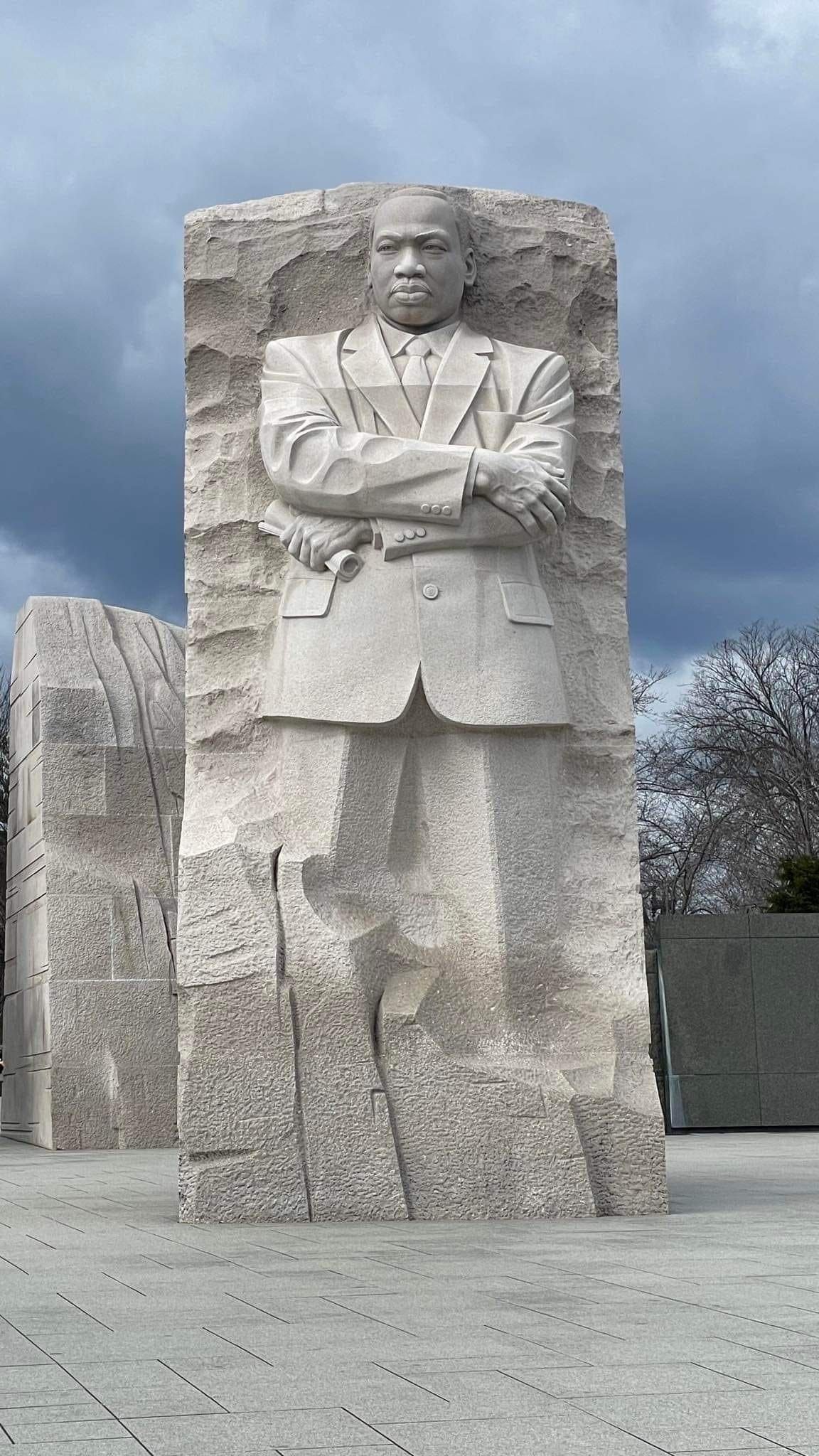
Wishing you all a day of peace for Martin Luther King Jr. Day 2024.

[Image of the Martin Luther King Jr. Memorial in Washington, D.C., by Buddy Poland.]