Archives for category: Civics

Civics education in Texas has been turned into textbook study by a 2021 law that bans student interaction with elected officials. Apparently, the Republicans who control state government want to keep students in the dark about getting involved in civic action. Participation is a feature of civic education, but it’s illegal in the Lone Star State.

The Guardian reports:

The defining experience of Jordan Zamora-Garcia’s high school career – a hands-on group project in civics class that spurred a new city ordinance in his Austin suburb – would now violate Texas law.

Since Texas lawmakers in 2021 passed a ban on lessons teaching that any one group is “inherently racist, sexist or oppressive”, a little-noticed provision of that legislation has triggered a massive fallout for civics education across the state.Being the only one leaves a mark: a Black mother on the long shadow of school segregation

Tucked into page 8 is a stipulation outlawing all assignments involving “direct communication” between students and their federal, state or local officials – short-circuiting the training young Texans receive to participate in democracy itself.

Zamora-Garcia’s 2017 project to add student advisers to the city council, and others like it involving research and meetings with elected representatives, would stand in direct violation.Since 2021, 18 states have passed laws restricting teachings on race and gender. But Texas is the only one nationwide to suppress students’ interactions with elected officials in class projects, according to researchers at the free expression advocacy group Pen America.

The Miami Herald reported today on Governor DeSantis’ plans to cleanse higher education in the state. Conservatives are creating “civics” institutes as a vehicle for patriotic indoctrination, not as a means to think critically about how to improve democracy. Censorship, which DeSantis practices, would be condemned in any genuine civics class.

Gov. Ron DeSantis on Tuesday announced a package of major reforms to Florida’s higher education system, including tighter controls on faculty tenure, the establishment of “civics institutes” at three universities and prohibitions on diversity, equity and inclusion programs.

Speaking at a news conference in Bradenton, the governor unveiled a plan that would allow university boards of trustees and presidents to conduct reviews of tenured faculty members “at any time,” in addition to the periodic reviews that now take place. Regarding university presidents in particular, he proposes “reestablishing their authority over the hiring process.”

Currently, according to a flier distributed by the governor’s staff, “faculty committees can tie the hands of university presidents and bind them to only consider a small pool of recommended candidates.”

And under a heading in the flier that reads “Education not indoctrination,” he proposes changes in standards and course content “to ensure higher education is rooted in the values of liberty and western tradition.” His plan would require schools to “prioritize graduating students with degrees that lead to high-wage jobs, not degrees designed to further a political agenda.”

The proposal also would prohibit state schools from “supporting campus activities or programs that promote divisive concepts like DEI and CRT.” The letters refer to diversity, equity and inclusion programs and critical race theory.

In addition, he proposes establishing “world-class civics institutes” at the University of Florida, Florida International University and Florida State University. The institutes, according to the flier, would develop courses and curricula “that can be used to educate the next generation on the values of liberty and constitutionalism.”

The flier included information on the governor’s higher education budget proposals as well. He proposes $100 million for “recruitment and retention of highly qualified faculty at state universities” and $15 million for faculty and student recruitment at New College of Florida, where he recently appointed six conservative members to the board of trustees.

The New College board meets Tuesday for the first time since the appointments.

Read more at: https://www.miamiherald.com/article271870522.html#storylink=cpy

John Merrow’s title is sarcastic. Of course he wants you to read banned books, and he is deeply concerned about the large number of eligible voters—especially young people—who don’t bother to vote.

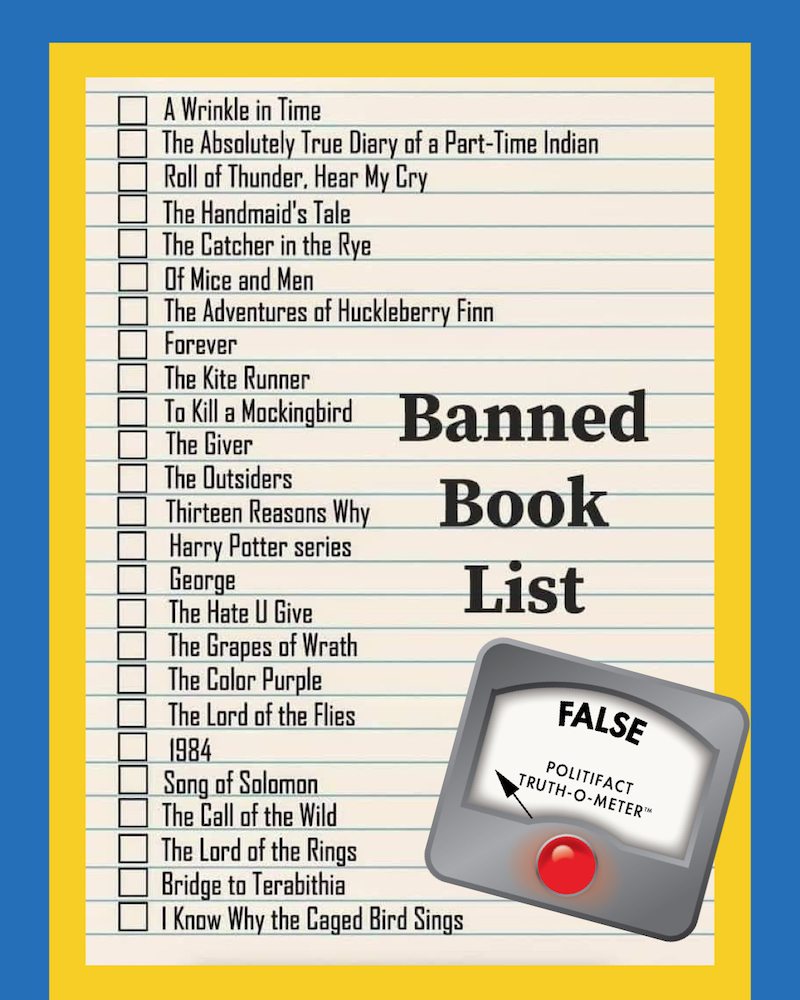
When someone on Twitter posted a list of 25 popular books that Florida Governor Ron DeSantis had supposedly banned from the state’s public schools, people went crazy. The list included Harper Lee’s “To Kill a Mockingbird,” Alice Walker’s “The Color Purple” and Madeleine L’Engle’s “A Wrinkle in Time.”

Below is a screenshot of the list. How many of these books have you read? Have your children read most of them? What on earth is going on in Florida?

People familiar with DeSantis’s efforts to restrict classroom discussion of controversial topics had no trouble believing that he would try to prevent young people from reading controversial or challenging books. If DeSantis did draw up a list, these books might well be on it.

But the list is a fake, a clever satire.

Many people were fooled, including teacher union President Randi Weingarten and “Star Wars” actor Mark Hamill. Hamill’s screenshot of the list amassed more than 100,000 likes and 24,000 retweets.

(Add my name to the list of those who were taken in.)

Like all good satire, that fake list of banned books is rooted in truth, because book banning is real and growing. Florida school districts have banned around 200 books, according to a report published by PEN America, a nonprofit that tracks book banning in the U.S. Pen America ranks Florida third among US states for banning books, trailing only Texas and Pennsylvania.

We are in the midst of a pandemic of book banning, so it’s hard to imagine any title that would never be banned by some zealous or timid school board or ignorant legislator.

One way to stop this outbreak of censorship is to get active, vote, attend school board meetings, run for school board. Passivity and complaining is a losing strategy.

Time to turn back the rising tide of incipient fascism.

Ron DeSantis has ranted about “indoctrination” in the classroom, meaning instruction about the brutal facts of racism in American history. He promoted legislation to stop anti-racist teaching, which he calls WOKE.

Florida teachers are now subject to state-sponsored indoctrination. This is thought control.

Several South Florida high school educators are alarmed that a new state civics initiative designed to prepare students to be “virtuous citizens” is infused with a Christian and conservative ideology after a three-day training session in Broward County last week. Teachers who spoke to the Herald/Times said they don’t object to the state’s new standards for civics, but they do take issue with how the state wants them to be taught. “It was very skewed,” said Barbara Segal, a 12th-grade government teacher at Fort Lauderdale High School. “There was a very strong Christian fundamentalist way toward analyzing different quotes and different documents. That was concerning.”

The civics training, which is part of Gov. Ron DeSantis’ Civics Literacy Excellence Initiative, underscores the tension that has been building around education and how classrooms have become battlegrounds for politically-contentious issues.

In Florida, DeSantis and the Republican-led Legislature have pushed policies that limit what schools can teach about race, gender identity and certain aspects of history. Those dynamics came into full view last week, when trainers told Broward teachers the nation’s founders did not desire a strict separation of state and church, downplayed the role the colonies and later the United States had in the history of slavery in America, and pushed a judicial theory, favored by legal conservatives like DeSantis, that requires people to interpret the Constitution as the framers intended it, not as a living, evolving document, according to three educators who attended the training.

“It is disturbing, really, that through these workshops and through legislation, there is this attempt to both censor and to drive or propagandize particular points of view,” said Richard Judd, 50, a Nova High School social studies teacher with 22 years of experience who attended the state-led training session last week.

A review of more than 200 pages of the state’s presentations show the founding fathers’ intent and the “misconceptions” about their thinking were a main theme of the training. One slide underscored that the “Founders expected religion to be promoted because they believed it to be essential to civic virtue.”

Without virtue, another slide noted, citizens become “licentious” and become subject to tyranny. Another slide highlights three U.S. Supreme Court cases to show when the “Founders’ original intent began to change.”

That included the 1962 landmark case that found school-sponsored prayer violated the establishment clause of the First Amendment, which Judd said trainers viewed as unjust. At one point, the trainers equated it to the 1892 U.S. Supreme Court decision that upheld the constitutionality of racial segregation under the “separate but equal” doctrine. [Editor’s note: I think they mean Plessy v. Ferguson of 1896, which upheld separate-but-equal segregation by race.]

“Ending school prayer was compared to upholding segregation,” Judd said. In other words, he said, trainers called both those rulings unjust. On slavery, the state said that two-thirds of the founding fathers were slave owners but emphasized that “even those that held slaves did not defend the institution.”

This is one of the slides shown during the Florida Department of Education’s training series for civics and government teachers. DeSantis’ administration has spent nearly $6 million to train public school teachers across the state on how to teach civics as part of the governor’s initiative. The first training sessions were June 20-22, at Broward College in Davie. Teachers are in Hillsborough County are training this week. The civics training is the latest effort in a long line of education policies that aims to fight what DeSantis and conservative education reformers say are “woke ideologies” in public schools. It also provides a snapshot of how national groups, including Hillsdale College, a politically influential private Christian college in southern Michigan, are working with the DeSantis administration to reshape education in the state.

The goal is to put a greater emphasis on civics than on socially divisive issues such as race and gender identity, which DeSantis has said is an effort to reorient teaching away from “indoctrination and back towards education.” But to several educators who went through the state’s training it felt like a broader effort to impose a conservative view on historical events. “We are constantly under attack, and there is this false narrative that we’re indoctrinating children, but that is nothing compared to what the state just threw in new civic educators’ faces. That’s straight-up indoctrination,” said Segal, a 46-year-old teacher with 19 years of experience.

Read more at: https://www.miamiherald.com/news/local/education/article262941378.html#storylink=cpy

We live in an age when politicians, advertisers, and others develop and distribute fake news to sell their wares. It’s more important than ever for people to have the digital skills to check the accuracy of what they see online.

A recent study conducted by Stanford University researchers reached a sobering conclusion. Most students don’t know how to fact-check what they see online.

The University published the following survey of the results:

A new national study by Stanford researchers showing a woeful inability by high schoolers to detect fake news on the internet suggests an urgent need for schools to integrate new tools and curriculum into classrooms that boost students’ digital skills, the study’s authors say.

In the largest such study undertaken, researchers from Stanford Graduate School of Education devised a challenge for 3,446 American high school students who had been carefully selected to match the demographic makeup of the American population.

Rather than conduct a standard survey, in which students would self-report their media habits and skills, the research team came up with a series of live internet tasks. The results, published online this week in the journal Educational Researcher, highlight what the researchers say is an urgent need to better prepare students for the realities of a world filled with a continual flow of misleading information.

“This study is not an indictment of the students—they did what they’ve been taught to do—but the study should be troubling to anyone who cares about the future of democracy,” said Joel Breakstone, director of the Stanford History Education Group and the study’s lead author. “We have to train students to be better consumers of information.”

In one of the study’s tasks, students were shown an anonymously produced video that circulated on Facebook in 2016 claiming to show ballot stuffing during Democratic primary elections and asked to use Internet-enabled computers to determine whether it provided strong evidence of voter fraud.

Students tried, mostly in vain, to discover the truth. Despite access to the internet’s powerful search capabilities, just three of the study’s more than three thousand participants — less than one tenth of one percent – were able to divine the true source of the video, which actually featured footage of voter fraud in Russia.

In another task, students were asked to vet a website proclaiming to “disseminate factual reports” about climate change. Ninety-six percent failed to discover the publisher’s ties to the fossil fuel industry. Overall, the researchers found that students were too easily swayed by relatively weak indicators of credibility—a website’s appearance, the characteristics of its domain name, the site’s “About” page, or the sheer quantity of information available on a website, irrespective of the quality of that information.

“Regardless of the test, most students fared poorly, and some fared more poorly than others,” said Sam Wineburg, the Margaret Jacks Professor of Education at Stanford, who co-authored the paper. “It presents a concerning picture of American students’ ability to figure out who produced a given story, what their biases might have been, and whether the information is reliable. More troubling still is how easy it is for agents of disinformation to produce misleading—or even deliberately false stories—that carry the sheen of truth. Coupled with the instantaneous and global reach of today’s social media, it does not bode well for the future of information integrity.”

The researchers suggested potential remedies that might right the ship, including teaching students strategies based on what professional fact checkers do–strategies that have been shown in experiments to improve students’ digital savvy.

“It would be great if all students knew how to take advantage of the full web and had complete command of advanced skills like Boolean operators, but that’s a lot to ask,” Wineburg said. “If you want to teach kids to drive a car, first you have to teach them to stop at red lights and not cross double lines, before learning how a catalytic converter works. As the study shows, a lot of these kids aren’t stopping at red yet.”

It is possible to develop students’ digital literacy skills, Wineburg said. Given the risk to our democracy, it will be critical for schools to integrate these skills into all subjects, from history to math, and at every grade level.

“The kids can do it,” Wineburg said. “We must help get them there.”

The study was funded by The William and Flora Hewlett Foundation.

Dana Milbank believes that Republicans are terrified of restoring civics education for fear that the younger generation will learn how our government is supposed to work.

He wrote in the Washington Post:

Pretty much everything the Trump-occupied Republican Party has been doing these days violates the basic tenets of democracy that American schoolchildren are taught.

But the Trumpy right has come up with an elegant remedy to relieve the cognitive dissonance: They want to cancel civics education. If the voters don’t know how the government is supposed to function, they’ll be none the wiser when it malfunctions — which has been pretty much all the time.

First, Republican officials indulged President Donald Trump’s four years of sabotaging the rule of law and democratic norms.

Then, a majority of Republican lawmakers voted to overturn the election results and President Biden’s victory.

Then, they voted to excuse Trump’s role in fomenting a violent insurrection against Congress.
Then, some moved to whitewash the insurrection itself, pretending the deadly attack was just a “normal tourist visit.”

And, finally, they purged the No. 3 House Republican, Liz Cheney of Wyoming, for refusing to embrace Trump’s “big lie” about a stolen election.

How do they get away with such fundamental violations of America’s democratic traditions? Well, maybe it’s because only a quarter of U.S. students are proficient in civics, according to the National Assessment of Educational Progress. And apparently, the right wants to keep it that way.

A bipartisan bill in Congress sponsored by Republican Sen. John Cornyn of Texas and Republican Rep. Tom Cole of Oklahoma (Disclosure: My wife’s stepmother, Rep. Rosa DeLauro of Connecticut, is one of the bill’s Democratic sponsors), would authorize $1 billion a year in grants to pay for more civics and history programs that teach children “to understand American Government and engage in American democratic practices as citizens and residents of the United States.” It’s as American — and as anodyne — as apple pie.

But, as The Post’s Laura Meckler reported over the weekend, “Conservative media and activists are pelting the Republicans who support the bill to abandon it. They call the grant program a ‘Trojan horse’ that would allow the Biden administration to push a liberal agenda.”

Conservative writer Stanley Kurtz told Breitbart News that the bill would promote a “woke education” and a “Marxist-based philosophy” in which “teachers are forced to indoctrinate students with ideas like ‘systemic racism,’ ‘white privilege,’ and ‘gender fluidity.’ ” Kurtz wrote in National Review that the civics bill will promote a curriculum “built around radical Critical Race Theory.”

In reality, the civics bill does no such thing. The “Civics Secures Democracy Act” specifically states that it doesn’t “authorize the Secretary of Education to prescribe a civics and history curriculum.” That’s up to state and local leaders.

But the plain text of the bill didn’t stop Kurtz and his allies from spinning a conspiracy theory, based on their objections to another, unrelated grant program. (For that program, the Biden administration cited the New York Times’s “1619 Project” in touting the importance of teaching about the consequences of slavery.) So, now, it’s a safe bet that congressional Republicans will in large numbers oppose a bill promoting nothing more nefarious than civil discourse, voting, jury duty and volunteering.

Perhaps the Republicans would look more favorably on a civics bill if it mandated a curriculum that better reflects the way they’ve been governing. To assist them, I’ve combed through the civics questions for fourth-graders asked by the National Assessment of Educational Progress, and substituted answers more consistent with recent events than the outdated, “correct” answers.

Which event is Rosa Parks associated with?
Strike “A boycott of the buses in Montgomery, Alabama,” and substitute: “An ANTIFA plot to destroy the suburbs.”

July 4 is a national holiday that celebrates the day when . . .
Strike “the American colonies declared their independence” and insert “the Continental Army took over the airports.”

The purpose of the United Nations is to . . .
Strike “promote international peace and security” and insert “lead a takeover of the U.S. government by globalist pedophiles.”

Usually United States citizens elect a President by . . .
Strike “secret ballot on Election Day” and insert “Storming the Capitol and bludgeoning police officers with flagpoles.”

Which of the following ideas is in the summary of the Declaration of Independence?
Strike “People in the United States should have some control over the government” and insert “People in the United States should not wear face masks.”

What are the two main political parties in the United States?
Strike “Democrats and Republicans” and insert “Republicans and Far-Left Radical Socialists who are Against God.”

Who decides whether a law follows the Constitution or not?
Strike “The Supreme Court” and insert “Rudy Giuliani.”

Who is currently the President of the United States?
Strike “Joseph Biden” and insert “Donald Trump.”

Two decades ago, George W. Bush spoke the immortal words, “Rarely is the question asked: Is our children learning?” The survival of Trump’s Republicans depends on the answer being a resounding “no.”
Joel Westheimer is American-born but lives in Canada, where he teaches Democracy and Education at the University of Ottawa.

He writes:

The attack on the U.S. Capitol building was shocking but not a surprise to those studying extremism in the United States where support for democracy has been plummeting.

In 1995, just one in sixteen Americans agreed with the idea that it would be “good” or “very good” for the military to run the country rather than elected democratic officials. Today, one in five agree.

Nearly one in four Americans think democracy is a bad way to run the country and would like to live under a political system in which a strong leader could make decisions without being bothered with elections or interference from congress. But as someone who studies the role of schools in democratic societies, what keep me up at night is the finding that almost half of millennials share that view.

Democracy, it seems, is not self-winding.

Public schools in the United States were founded on the idea that democracy could not work if citizens were not taught the principles and habits of democratic life. But in the same period that support for democracy has declined, that founding purpose of schooling has shifted—you could say that it was hijacked—by the standards and accountability movements of the last two decades.

Most school districts now emphasize preparing students for standardized assessments in math and literacy at the same time that they shortchange the social studies, history, and even the most basic forms of citizenship education.

The obsession with standardized testing in only two subject areas and the relentless pressure on schools to cover more and more material means lessons that develop the attitudes, skills, knowledge, and habits necessary for a democratic society to flourish are crowded out.

Finnish educator Pasi Sahlberg calls this kind of school reform GERM (for Global Education Reform Movement). It’s like an epidemic, he says, that “spreads and infects education systems through a virus. It travels with pundits, media and politicians. Education systems borrow policies from others and get infected. As a consequence, schools get ill, teachers don’t feel well, and kids learn less.”

When the testing tail wags the school reform dog, democracy loses. Why would we expect adults, even senators or members of Parliament, to be able to intelligently and compassionately discuss different viewpoints in the best interests of their constituents if schoolchildren never or rarely get that opportunity in school? When policymakers focus obsessively on learning metrics, teachers are forced to reduce their teaching to endless lists of facts and skills, unmoored from their social meaning.

Like most educators, I have nothing against facts. But, democratic societies require more than citizens who are fact-full. They require citizens who can think and act in ethically thoughtful ways.

A well-functioning democracy needs schools that teach students to recognize ambiguity and conflict in factual content, to see human conditions and aspirations as complex and contested, and to embrace debate and deliberation as a cornerstone of democratic societies.

More than 100 years ago, the philosopher John Dewey wrote that democracy must “be born anew every generation, and education is its midwife.”

We will all be glad when the global Covid-19 pandemic is brought under control. But there is another virus that threatens the United States that is fed by a toxic combination of disinformation and conspiracy theories. Luckily, the vaccine is already available: education. But public schools need to be allowed and encouraged to reclaim their democratic mission. We can no longer take democracy for granted.

Joel Westheimer is University Research Chair in Democracy & Education at the University of Ottawa and author of What Kind of Citizen? Educating Our Children for the Common Good.

joelwestheimer.org  |   joelwestheimer@mac.com  |  (613) 265-8077

References for assertions and quotations:

John Dewey, Plan of organization of the university primary school, 1895. In J. Boydston, Early works of John Dewey 1882-1898, vol. 5. Carbondale, IL: Southern Illinois University Press, 1972. Pages 223-243.

World Values Survey: Round Seven – Country-Pooled Datafile. http://www.worldvaluessurvey.org/WVSDocumentationWV7.jsp

Pasi Sahlberg, How GERM is infecting schools around the world. The Washington Post. [blog: The Answer Sheet web log by Valerie Strauss], June 29, 2012. http://www.washingtonpost.com/blogs/answer-sheet/post/how-germ-is-infecting-schools-around-the-world/2012/06/29/gJQAVELZAW_blog.html

Andrea Gabor argues that the violent storming of Congress is reason to revive civics in schools. Clearly, she writes, many Americans do not understand the norms of a democratic government (including, I would add, Trump and most of the elected representatives of the Republican Party).

Last week’s attack on the U.S. Capitol may have been incited by President Donald Trump and right-wing politicians, but it was supported by millions of their followers. News reports and public opinion polls make it clear that many Americans believe evidence-free assertions by Trump and his allies of massive voter fraud in the November election and their lies about the power of public officials to overturn the result.

The riot was just the latest and most appalling evidence that a wide swath of the American public doesn’t understand democratic norms. That’s why it should serve as a sputnik moment for an ambitious revival of civics instruction along with expanded training in news literacy.

Nobody’s claiming that the violent extremism on display on Jan. 6 owes its rise mainly to the decades-long de-emphasis of U.S. classroom civics. But it should be a clue that civics is too important to relegate to a semester or two of high school or to sacrifice to other curricular goals. It needs to be woven throughout the K-12 curriculum and go beyond rote instruction in the three-branch structure of the U.S. government, how a bill becomes law and the ins-and-outs of the electoral college.

Last week, educators nationwide were forced to throw out lesson plans and help students make sense of the day’s events. On Twitter, teachers reported students coming to class hungry for answers about everything from the 25th-Amendment process for declaring a president unable to perform his duties to why the Capitol police were more forceful last summer during the Black Lives Matter protests. In Matt Wood’s seventh-grade civics class at Leman Middle School in suburban Chicago, students analyzed images and words used by the news media to describe the Capitol attack — insurrection, coup, insurgency, protest — to determine which ones were most accurate.More fromCall the Senate Vote on Trump’s Removal and Be Done With ItA Breakup Plan to Save Intel and Preserve National SecurityTrump Will Try to Make His Impeachment About Free SpeechThe Pentagon Must Learn to Do More With Less

At a time of heightened political polarization, wrestling with the events of Jan. 6 is a potential minefield for both teachers and students. Teachers need help from civics experts to figure out how to navigate it.

Some districts in Florida thought they could avoid potential blowback from parents by telling educators to avoid discussing the Capitol riot at all, even though Florida has a decade-old civics graduation requirement. That didn’t stop students from pressing teachers for answers. On Twitter, some students, including an eighth grader in Virginia, agonized about how a class discussion had unleashed racist attacks from classmates.

Illinois’s five-year-old civics mandate requires the discussion of “current and controversial issues” and provides an object lesson in how a robust commitment to civics can prepare schools and educators to help students make sense of the things they see on the news. (Illinois was among 11 states that previously had no civics mandate.)

As part of Illinois’s professional developmentofferings, teachers can take weekly civics webinars. Last week, about 50 educators, including math and dance teachers as well as librarians and administrators, joined a webinar on “strategies for using current and controversial issues in the classroom,” which quickly focused on the Capitol attack. It offered resources on voter fraud and how presidential pardons work, as well as the importance of engaging “student voice.”

Participants were encouraged to handle thorny debates by drawing distinctions between “settled” and “open” issues. For example, the constitutional right to abortion has been “settled” by the Supreme Court but efforts to limit or eliminate it remain “open.” Although debating abortion might be “uncomfortable,” noted a Naperville high school social studies teacher during the webinar, doing so teaches students that “civic peace exists because we can hold oppositional views in the same community.”

Counterintuitively, encouraging debate can help teachers avoid political minefields. When one webinar participant argued that teachers should “condemn” the insurgents and denounce them for racism, Wood, whose Chicago-area school is ethnically and politically diverse, countered that having students help guide discussions by encouraging them to ask questions helps to protect teachers from community blowback. It also gives students a greater stake in the conversation.  

For years, civics has been neglected in favor of math and English, subjects with federally mandated annual tests. A new study found that the vast majority of California students “attend schools in districts that do not articulate a substantial focus on civic education.” Most American high school and college students also have trouble judging the credibility of news stories they read online.

Discussion of current events should begin as early as kindergarten, argues Steve Masyada, a civics expert at the University of Central Florida. And schools should begin teaching American history and civics in early grades.

Maryland is one of the few states to embed civics in social studies learning standards for all grades, and to establish a community service graduation requirement.

In Illinois, high-school students have been instrumental in drafting new legislation, including a 2016 school-discipline law and, most recently, a pending bill to observe daylight savings time all year. In earlier grades, students work on community improvement projects and participate in mock U.N. and legislative sessions.

Doubling down on civics and news literacy will require ratcheting back costly and time-consuming annual standardized tests — though a high school test could measure student knowledge and news literacy gleaned over time. One bonus: Mastering the background knowledge needed to understand history and civics is likely to make students better readers, while civics projects would help produce more engaged citizens.

Schools everywhere should be offering after-hours civics classes for families. The federal government should consider sponsoring an advertising campaign aimed at disseminating bite-sized lessons on how to distinguish fact from fiction online. That would be a fitting way to mark the end of Trump.

Brianna Keilar of CNN speaks here about the post-insurrection efforts to rewrite history by those who were complicit in nurturing the mob and amplifying their grievances.

For months before the election, Trump warned that it would be rigged. He said that if he lost, it was proof that it was rigged. The only “fair” election, he warned, was one that he won. You may recall that in 2016, he repeatedly predicted a “rigged” election, but since he won, it wasn’t rigged.

Since the election, he has been obsessed by the certainty that the election was “rigged,” “stolen,” and the greatest political crime in American history. His campaign team filed 60 or so lawsuits, which failed in state and federal courts, including twice at the U.S. Supreme Court. It didn’t matter whether the judges were appointed by Democrats or Republicans, even Trump himself. There was no evidence of widespread election fraud. Even Trump’s Attorney General Bill Barr said do.

But nothing could stop the slander against the election. Trump created a “Stop the Steal” movement of his most ardent cultists. His message was echoed by elected officials like Ted Cruz abd Josh Hawley, who hope to win the loyalty of the Trump base.

Trump summoned his cult to Washington in January 6 to rally them one more time to stop the certification of Joe Biden’s victory. He urged them to march to the Capitol, and he unleashed the Monster.

So far, five people have died because of the Trump-inspired insurrection. We can be grateful that the death toll was not greater and that the domestic terrorists did not set fire to the seat of our national government.

In the aftermath of the insurrection, some say “this is not who we are.” We are not haters, looters, thugs, and vandals. Sadly, this is who some of us are.

What do we do? We don’t appease the mob by holding hearings about blatant lies. As Mitt Romney said, what we owe the American people is the truth. They won’t get the truth from those who seek political gain by telling lies that stoke rage. When Trump’s hoax was twice tossed out by a Supreme Court dominated by six conservatives, including three he appointed, that should have ended the post-election battle. It didn’t because Trump and his enablers had an agenda that did not include the truth.

The deep divisions that Trump exploited won’t be healed anytime soon. As educators, we must remember that the first obligation of public schools is to develop good citizens. Not compliant citizen, not indoctrinated citizens, but citizens who are knowledgeable about our government and our institutions; citizens who can weigh evidence, listen to opposing views, and think critically about their decisions. We need citizens who can tell the difference between facts and propaganda. In rebuilding a functional democracy, we need education more than ever. Civic education is obviously not all that is needed for active participation in society, but it is crucial to sustain our democracy and strengthen it. As Ted Cruz and josh Hawley demonstrate, intellect is not enough when it becomes a tool of the unscrulous.

What matters most, I believe, is a combination of knowledge and character. People who knowingly lie do not have it. People who are driven by greed and ambition do not have it. Our Founding Fathers understood full well that men are not angels, and they created a Constitution of elaborate checks and balances to protest us from the predators who seek power by any means necessary. We have been reminded during these past four years that our democracy must be renewed in every generation. Its promise of equal justice for all is far from real and for too many, a false promise.

We must continue to work towards a better, fairer society. That work begins with truth-telling. We must demand it from our elected officials and practice it in our daily lives. That’s a start.


If you have a few minutes to do some research, you might wonder about the connections among these three links:

First is from the extreme rightwing group called the American Legislative Exchange Council (ALEC), funded by DeVos, Charles Koch, and major corporations. ALEC has 2,000 members who are state legislators. They get a free trip every year to a posh resort, where ALEC gives them model legislation to introduce in their state to promote the libertarian, anti-regulation, anti-government agenda.

Second is an article in the conservative journal Education Next about “reimagining civic education for the digital age.” It promotes the organization iCivics, a digital platform to teach civics.

Third, read about the award by the Trump Administration’s National Endowment for the Humanities and Betsy DeVos’s U.S. Department of Education of $650,000 to the curriculum and advocacy group iCivics and several university partners, to design a “roadmap” to guide teachers, publishers, and state officials on how to create integrated history and civics content.

The Trump administration, we know, is very concerned about instilling patriotism. Here is their ALEC-approved program for teaching civics. Frankly, I had forgotten that the NEH still existed.