Archives for category: Childhood

In this post, Jan Resseger discusses Marilyn Robinson’s essay about the new cruel politics in Iowa, which appeared in the New York Review of Books. Iowans are “free” to work for less. Their children are “free”to attend religious schools at public expense and “free” to work at dangerous jobs. This new definition of freedom risks a future of harm to children and general ignorance.

Resseger encourages everyone to learn about the Iowa regression:

In Dismantling Iowa, in the November 2, 2023 New York Review of Books, Marilynne Robinson examines Governor Kim Reynolds’ Iowa as the microcosm of the conservative Republican attack on the rights of children and on the promise of K-12 and university education. Robinson is a novelist and retired professor of creative writing at the University of Iowa; she has been an artist-in-residence at a number of other colleges. Her style contrasts with the writing of policy wonks, but she comes to the same conclusions. Her comments are about today’s politics in Iowa but at the same time reflect on the politics of other states like Florida and Wisconsin and Ohio.

Robinson begins with a bit of history—the sudden rightward turn of states once known for their progressivism. She defines a “liberal” education, the foundational principle of progressive colleges established in the nineteenth century by abolitionists across the Midwest: “American higher education is of the kind historically called liberal, that is, suited to free people, intended to make them independent thinkers and capable citizens. ‘Liberal’ comes from the Latin word liber, meaning ‘free.’ Aristotle, a theorist on this subject of incalculable influence until recently, considered education a natural human pleasure, essential to the perfecting of the self, which he says it is in our nature to desire. Obviously when he taught there was no thought of economic utility that would subordinate learning to the purposes of others, to the detriment of individual pleasure or self-perfection. Training in athletics, music, then philosophy were to be valued because they are liberating.” “(W)e are in a period when the value of education is disputed. Regrettably, it has become expensive enough to be regarded by some as a dubious investment of time and money. Its traditional form and substance do not produce workers suited to the present or the future economy—as these are understood and confidently imagined by its critics.”

At the K-12 level, Robinson prefers free public education to school privatization exemplified by Iowa’s new publicly funded private school tuition vouchers. She examines the provision of education through the lens of equality, one of the principles our society has historically endorsed, but which Robinson believes Governor Reynolds and her legislature have sacrificed: “The governor has been very intent on achieving equality as she understands it for Iowa students. She and her legislature have provided a grant of public money for every child who is approved by the state to attend a private school, the money to be released when the child is accepted there… It should be noted that ‘private’ in this context can mean religious in some—or any—sense of the word. The constitutional issues that might arise from this use of public money seem to be of no concern. As for the character of these schools… the implicit promise seems to be that contact with ideas and people some find problematic can be avoided, that they can be and will be excluded on what are called religious grounds. So public money will be used to deprive some children of the kind of education the governor deems beneficial while other children are deprived of the education that comes with encountering a world not yet structured around polarization.”

Will the state protect the rights of students receiving state support for private school? “State governments can intervene in public schools, hector, threaten, and substantially control them. Private schools are too disparate to be the objects of sweeping denunciation…Now that state money will come into such private schools as there are in Iowa—forty-one of the ninety-nine counties don’t have even one—it will be interesting to see if the governor and her like have a comparable interest in interfering with them. These schools can be selective, which is a positive word now, though the honor and glory of public education is that it does not select… An element in all this is the fact that we have let the word ‘public’ seem to mean something like ‘second-rate.’ This is very inimical to the open and generous impulses that make a society democratic.”

Robinson explores some other legislative actions Iowa has undertaken supposedly to provide freedom from regulation for Iowa’s parents and children: “Consistent with this current ‘conservative’ passion for dismantling things, including gun laws… the governor and the legislature of Iowa are stripping away legal limits on child labor… All this is being done in the name of freedom. It is always fair to ask when rights are being claimed whether they impinge on others’ rights. The question certainly arises here. We know that the employment of children does not reliably bring out the best in employers… Migrant children, unprotected or worse, work under sometimes intolerable conditions… (I)t is jarring that Iowa children will… do work previously prohibited as dangerous, at hours previously prohibited as incompatible with their schooling. They are making the most of a new opportunity, according to the governor, to ‘develop their skills in the workforce.’ Not incidentally, they will also be easing the labor shortage from which the state suffers. The minimum wage in Iowa is $7.25. In Illinois it is $13.00, in Missouri $12.00, in South Dakota $10.80. Surely these figures suggest another possible solution to the shortage of workers, a better way to compete with surrounding states than to expose children to the possibility of injury, or to the costly lack of a high school diploma. There is much talk about choice in Iowa, but many children will find that, for them, important possibilities have been precluded.”

What about the culture wars in public schools? “(T)he Iowa governor and her legislature have launched a campaign to embarrass the public grade schools. Of course there is now great perturbation about what can or cannot be included in their libraries. This intrusion of the state government on traditionally more or less autonomous communities has the tenor of a moral crackdown. New laws have been enacted to bring unruly librarians to heel. Educational standards for new librarians have been lowered. The governor says, of course, that the legislation ‘sets boundaries to protect Iowa’s children from woke indoctrination.’ It is as if parents zipping up their five-year-old’s jacket feel a qualm of fear because of potential classroom exposure to sinister ideas, not because their state now allows permitless concealed and open carry.”

Please open the link to finish the article.

Child labor laws have been in place for more than a century. Republican-controlled states are weakening so that children are “free” to earn some money. Florida is the latest state to entertain the idea that children need “freedom” to work, not protection from dangerous working conditions. This is not progress. This is turning back the clock.

The Orlando Sentinel reported:

A proposed Republican bill to loosen child labor laws in Florida is part of a national trend aimed at repealing or weakening workplace protections for young people that have been in place for more than 100 years.

The bill could worsen graduation rates and hurt lower-income families, experts said, and could also be a way to replace some immigrant labor as Florida and other GOP-led states continue to crack down on undocumented workers.

“Are we willing to return to a world where we accept that children of the poorest families are working more than full-time jobs under hazardous conditions?” said Jennifer Sherer, director of the Economic Analysis and Research Network at the nonprofit Economic Policy Institute.

State Rep. Linda Chaney, though, said in a statement that her bill “intends to provide teenagers with the flexibility to work whatever hours they deem fits best with their schedule and financial goals.”

“Families are struggling in the worst economy in decades and I want to do what I can to help by providing opportunity,” said Chaney, R-St. Petersburg. “Government should not be in the way of people wanting to learn skills and make a living.”

The bill (HB 49) would remove all work guidelines for 16- and 17-year-olds, including the current requirements that they can’t work more than eight hours on school nights and more than 30 hours a week during the school year.

It also prevents local governments from passing ordinances stricter than state law.

In addition, the measure includes what Sherer called a “confusing” change to the language about 14- and 15-year-olds.

Where the current law states 14- and 15-year-olds “shall not” work before 7 a.m. or after 7 p.m. for more than 15 hours a week during the school year, or more than three hours per day on school days, the bill would replace “shall not” with “may not.”

Sherer said it was unclear whether the proposed language revision was meant to make work standards for younger teens “optional” rather than mandated.

Terri Gerstein, a fellow at the Center for Labor and a Just Economy at Harvard Law School who testified before Congress earlier this year about child labor, said she couldn’t see any other reason to change it.

“To me, as a normal human being, ‘shall not’ and ‘may not’ sound like the same thing, right?” Gerstein said. But, she added, “‘shall’ is obligatory and ‘may’ is optional. … I can only infer that there’s something nefarious [going on], because otherwise, why would you change the language? It makes no sense…”

Child labor laws were one of the premier achievements of the Progressive Era of the early 1900s, when presidents Theodore Roosevelt and Woodrow Wilson helped usher in major changes to social and public policy at the state and national levels.

Florida passed laws at the time to protect children working in cigar factories and in agriculture. But now, it’s the 16th state in the past few years to have legislation filed to roll back those protections, Sherer said.

“Those are state laws that have often been in place for over a century,” Sherer said. “States began regulating child labor before the federal government did. And they play a really important role in regulating certain aspects of child labor protections that the federal government doesn’t cover.”

The most notable rollback was in Arkansas, where Republican Gov. Sarah Huckabee signed the Youth Hiring Act that repealed a Progressive Era law requiring employers to verify a child’s age, acquire a permit and get parental consent for 14- and 15-year-olds to work.

“The Governor believes protecting kids is most important, but this permit was an arbitrary burden on parents to get permission from the government for their child to get a job,” Sanders’ communications director Alexa Henning told NPR.

Iowa also passed “what is probably the most extreme bill on child labor,” Sherer said, weakening guidelines on which work is considered too dangerous for minors.

“We know that certain jobs have proven dangerous and even fatal more often for youth and teens,” Sherer said. “That’s why those restrictions were put in place decades ago. So it’s a real slippery slope.”

The changes came as the Federal Labor Department has reported a significant increase in child labor violations over the past five years, Gerstein said, including minors working the night shift or being employed at places such as poultry processing plants and construction sites.

A meat-processing plant in Minnesota paid $300,000 in penalties after an investigation showed it employed children as young as 13, while a Michigan meat plant owner pleaded guilty to employing a 17-year-old in a dangerous job. The boy’s hand was severed by a meat grinder.

This is the only post today. Read as much of it as you have time for. The report is a valuable reminder that Ed-tech is oversold and even dangerous. It has its uses, for sure. But it should never replace teachers or parents.

UNESCO released a major blockbuster report warning about the dangers of relying too much on education technology. The author of the report was Mark West. The title of the report is An Ed-Tech Tragedy? Educational Technologies and School Closures in the Time of COVID-19.

An alternate link: https://teachertaskforce.org/sites/default/files/2023-09/2023_UNESCO_An-ed-tech-tragedy_Educational-technologies-and-school-closures-in-the-time-of-COVID19_EN_.pdf

The puzzle at the heart of the document is the clash between learned experience and the imperatives of greed. We learned during the pandemic about the risks of becoming dependent on ed-technology as the main driver of instruction. As we reflect on the period from March 2020 to now, we can discern the damage that occurred to students when their teachers were replaced by virtual instruction: boredom, learning loss, mental health issues, loneliness, lack of socialization with their peers, lack of personal interaction with teachers.

Yet with most people believing that the pandemic (or the worst of it) lies in the past, ed-tech corporations are focused on selling more of what has already failed. Why would we want to expand what has demonstrably proved inadequate and harmful to students?

You probably will take a long while to read the full report, but do read the summary and conclusions to whet your appetite. The overview concludes that the global reliance on ed-tech was necessary in the circumstances, but was a tragedy. Children need human teachers. They need people who look them in the eye and encourage them. Education is not a mechanical process; people are not widgets.

The UNESCO report reviews the global evidence of the harm caused by dependence on ed-tech:

[The report] exposes the ways unprecedented educational dependence on technology often resulted in unchecked exclusion, staggering inequality, inadvertent harm and the elevation of learning models that place machines and profit before people.

The summary says:

An Ed-Tech Tragedy? documents how widespread school closures and the hard pivot to remote learning with connected technology during the COVID-19 pandemic resulted in numerous unintended and undesirable consequences.

Although connected technology supported the continuation of education for many learners, many more were left behind. Exclusion soared and inequities widened. Achievement levels fell, even for those with access to distance learning. Educational experiences narrowed. Physical and mental health declined. Privatization accelerated, threatening education’s unique standing as a public good and human right. Invasive surveillance endangered the free and open exchange of ideas and undermined trust. Automation replaced human interactions with machine-mediated experiences. And technology production and disposal placed new strains on the environment.

Visions that technology could form the backbone of education and supplant school-based learning – in wide circulation at the outset of the health crisis – had promised better outcomes. Ed-tech proponents held that the immense challenges of school closures could be met with technology and that deeper technology integration would transform education for the better. But these high hopes and expectations unraveled when ed-tech was hurriedly deployed to maintain formal education as COVID-19 tore across countries.

An Ed-Tech Tragedy? recounts this tumultuous period, documenting the actions and decisions taken by governments, schools and technology companies. The publication contrasts the promises of ed-tech with the realities of what ed-tech delivered as a response to school closures that impacted over 1.6 billion learners and stretched intermittently from the beginning of 2020 to the end of 2022. The evidence and analysis highlight trends observed across countries and zoom in on the specificities of local experiences, creating a global mosaic of what students, teachers and families experienced when connected technology was elevated as a singular portal to teaching and learning.

Aimed at general and specialist audiences alike, this publication shows how the abrupt and deep changes brought about by the recourse to remote digital learning during the pandemic continue to ripple through the education sector even as schools have fully reopened. It questions whether more and faster integration of technology is desirable for learners, teachers and schools and if ed-tech is, as it is often billed, a key ingredient of educational resilience.

An Ed-Tech Tragedy? posits that new principles are needed to forge more humanistic directions for ed-tech development and use. In-person schooling and teaching should be guaranteed even as technologies improve and connectivity becomes more ubiquitous. Governments need to anchor this guarantee in the legal architecture upholding the right to education, especially for young learners. Moreover, future applications of ed-tech must show greater concern for holistic student well-being. While academic learning is central to education, it is not the only component. Ed-tech needs to support the multiple individual and collective purposes of education, from socio-emotional and personal development, to learning to live together, with the planet, as well as with technology.

In detailing what happened when ed-tech was deployed in response to pandemic school closures, as well as questioning why ed-tech was often elevated as a singular solution, this publication clarifies how the education community can move beyond merely reacting to technological change and instead play a more assertive role steering the digitalization of education towards the more holistic goals of education to shape inclusive, just and sustainable futures.

The future of education needs to be a humanistic one. The lessons extracted from what is premised here as an ed-tech tragedy illuminate the ways technology can better foster education that teaches and revitalizes human values, strengthens human relationships and upholds human rights.

Ed-tech was supposed to solve a problem but it created other problems.

An Ed-Tech Tragedy? examines the many ways that the hurried embrace of technology solutionism steered responses to a global education challenge directly towards ed-tech. Along the way, the logic of technology solutionism changed understandings of educational problems to be solved. The analysis presented here helps reveal, for example, how technological solutions deployed during school closures took a narrow view of education and focused almost exclusively on furthering the academic progress of students in pared-down curricular subjects. This meant that little attention was paid to other education goals, such as fostering curiosity and inquiry and supporting physical health, mental well-being and social and emotional learning. This analysis also shows how ed-tech, originally cast as a solution to maintain learning continuity in the face of widespread disruptions to schooling, has more recently been positioned as a tool to help reverse learning loss. This ‘loss’, however, grew out of the deficiencies of technology-dependent remote learning to preserve the pace of academic learning that would have been typical without school closures stemming from the pandemic. The problem that ed-tech initially set out to solve morphed from assuring the continuity of learning to remedying lost learning. The way the problem was reframed while maintaining connected technology as the centrepiece of the solution is an example of technology solutionism at work.

Recognizing the chaotic pivot from in-school learning to technology-facilitated distance learning as having a tragic arc provides a forceful rebuttal to a growing consensus that the education sector somehow ‘advanced’, ‘leapfrogged’, ‘catapulted’ or ‘disrupted’ itself to a better future when it deployed technology on a massive scale as an interim measure to confront a crisis. The evidence overwhelmingly points in the opposite direction: education became less accessible, less effective and less engaging when it pivoted away from physical schools and teachers and towards technology exclusively. ‘Tragedy’ in this sense signals regression – a denigration of the status quo,rather than a desired evolution. The narrative that ed-tech should be or must be a central component of ‘building education back better’ warrants new scrutiny after a careful examination of the experiences during the pandemic.

The invocation of tragedy also facilitates awareness that connected technologies, despite their growing reach, power and potential, remain tools in a repertoire of many others to construct stronger, more agile and more flexible education systems that can respond and adapt to disruption. Other tools include strengthened teacher training and support; enhanced school leadership and pedagogical management of schools; curricular renewal; smaller class sizes; and improved physical resources and infrastructure for schools and classrooms. Crises that necessitate the prolonged closure of schools and demand heavy or total reliance on technology have been exceedingly rare historically. Future crises may present entirely different challenges. The trauma of the pandemic has, in many circles, functioned to elevate technology as an almost singular solution to assure educational resilience by providing flexibility in times of disruption. Investments to protect education wrongly shifted away from people and towards machines, digital connections and platforms. This elevation of the technical over the human is contradictory to education’s aim to further human development and cultivate humanistic values. It is human capacity, rather than technological capacity, that is central to ensuring greater resilience of education systems to withstand shocks and manage crises.

Overall, the pandemic is a case study in how technology in its current iterations is not yet a suitable foundation for actualizing the diverse goals that communities assign to education. Expectations that technology may, in time, help further increase the reach, improve the quality and strengthen the agility of education are valid. For now, though, the experiences since early 2020 have shown it to be an alarmingly brittle solution – one incapable of effectively responding to widespread and extended school shutdowns. For far too many students, it was a solution that either never started in earnest or quickly broke down. The sudden shift to ed-tech also accelerated a concerning transfer of authority away from teachers, schools and communities and towards private, for-profit interests. Additionally, the censorship, data extraction, advertising, top-down control, intimidation and surveillance that so often characterize current models of digital transformation have made education less free and, arguably, less capable of facilitating critiques of and positive changes to the status quo. [emphasis added by DR.]

Countries made massive investments to digitalize education through much of the COVID-19 pandemic. But it remains far from clear whether these investments will improve education over the longer term and make it an engine of just, inclusive and sustainable development, especially when compared with conventional school-based and teacher-facilitated education. The digital transformation of education may yet be a force for beneficial change. But the logic of technological solutionism and its associated business models currently steering this transformation, led largely by the commercial technology entities that are remaking so many aspects of society, tend to treat education and knowledge as private commodities and not as global public goods that provide collective as well as individual benefits.

It is hoped that this analysis and its use of tragedy as a metaphor might moderate the discourse and popular view that the pandemic has ‘unshackled’ education systems and ‘launched’ them into desirable futures characterized by greater technology use. Documenting the severity and scope of the many negative consequences of ed-tech responses during the health crisis inverts the triumphalist narratives that accompany many descriptions of technology deployments to address the educational disruption caused by school closures. A critical examination of the assumptions of technology solutionism and a review of the existing evidence provide a corrective and a counterargument to notions that more, deeper and accelerated use of technology is uniformly positive for education…

Throughout the review that follows, considerable evidence illustrates how the rush to distance and remote learning with ed-tech accelerated the privatization of education in many contexts. While some countries and localities managed a shift to digital learning with limited privatization of the educational experience, a defining characteristic of the technology-centric response to the educational disruptions of the pandemic tended to be the elevation of for-profit, private ed-tech companies. In addition to considering the ways reliance on ed-tech impacted educational inclusion, equity and quality, this publication also explores the complex and often symbiotic links between ed-tech and the privatization of education during the pandemic.The rush to distance and remote learning with ed-tech accelerated the privatization of education.

Most such reports tend to summarize the status quo. This one challenges it. It’s time to take stock before the Ed-tech industry takes control of our most precious asset: our children.
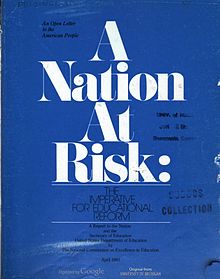
Nancy Bailey criticizes the ongoing campaign to raise academic expectations and academic pressure on children in kindergarten. She traces the origins of this misguided effort on the Reagan-era publication “A Nation at Risk” in 1983.

Although the gloomy claims of that influential document have been repeatedly challenged, even debunked*, it continues to control educational discourse with its assertion that American schools are failing. “A Nation at Risk” led to increased testing, to the passage of George W. Bush’s No Child Left Behind in 2002, to the creation of Barack Obama’s Race to the Top in 2009, to the release of the Common Core standards in 2010.

Despite nearly a quarter century of focus on standards and testing, policymakers refuse to admit that these policies have failed.

And nowhere have they been more destructive than in the early grades, where testing has replaced play. Kindergarten became the new first grade.

But says Bailey, the current Secretary of Education wants to ratchet up the pressure on little kids.

She writes:

In What Happened to Recess and Why are our Children Struggling in Kindergarten, Susan Ohanian writes about a kindergartner in a New York Times article who tells the reporter they would like to sit on the grass and look for ladybugs. Ohanian writes, the child’s school was built very deliberately without a playgroundLollygagging over ladybugs is not permitted for children being trained for the global economy (2002, p.2).   

America recently marked forty years since the Reagan administration’s A Nation at Risk: The Imperative for Educational Reform which blamed schools as being eroded by a rising tide of mediocrity that threatens our very future as a Nation and a people.

Berliner and Biddle dispute this in The Manufactured Crisis: Myths, Fraud, and the Attack on America’s Public Schools. They state that most of these claims were said to reflect “evidence,” although the “evidence” in question either was not presented or appeared in the form of simplistic, misleading generalizations (1995, p. 3)

Still, the report’s premise, that public schools failed, leading us down the workforce path of doom, continues to be perpetuated. When students fail tests, teachers and public schools are blamed, yet few care to examine the obscene expectations placed on the backs of children since A Nation at Risk.

Education Secretary Cardona recently went on a bus tour with the message to Raise the Bar in schools. Raising the bar is defined as setting a high standard, to raise expectations, to set higher goals.

He announced a new U.S. Department of Education program, Kindergarten Sturdy Bridge Learning Community.

This is through New America, whose funders include the Bill and Melinda Gates Foundation, the Waltons, and others who want to privatize public education. Here’s the video, Kindergarten as a “Sturdy Bridge”: Place-Based Investments, describing the plan focusing on PreK to 3rd grade. This involves Reading by 3rd and the Campaign for Grade Level Reading.

Cardona says in the announcement:

Getting kindergarten right has to be top of mind for all of us, because what happens there sets the stage for how a child learns and develops well into their elementary years and beyond. 

Ensuring that kindergarten is a sturdy bridge between the early years and early grades is central to our efforts both to Raise the Bar for academic excellence and to provide all students with a more equitable foundation for educational success. The kindergarten year presents an opportunity to meet the strengths and needs of young learners so they can continue to flourish in the years to come.

Raise the bar? Kindergarten is already the new first grade. What will it be now? Second? Third? Fourth? What’s the rush? How is this developmentally sound? One thing is for sure: there will still be no idle time for children to search for ladybugs.

Few bear the brunt of A Nation at Risk,as do early learners whose schools have been invaded by corporate schemes to force reading and advanced learning earlier than ever expected in the past.

If kindergartners aren’t doing well after all these years of toughness, higher expectations, and an excruciating number of assessments, wouldn’t it seem time to back off, instead of raising the bar higher?

Editor’s note:

*James Harvey and I will discuss the distortions contained in the “Nation at Risk” report at the Network for Public Education conference on Oct. 28-29 in Washington, D.C. James Harvey was a high-level member of the staff that wrote the report. He has written about how the Reagan-era Commissuon in Excellence in Education “cooked the books” to paint a bleak—but false—picture of American public schools. Please register and join us!

Mother Jones published an alarming report about the revival of child labor, based on the work of the Food and Environment Reporting Network. Promoted by Republican governors despite federal law, child labor has become increasingly dangerous. Children are hired to replace adult immigrants and to keep costs low.

If you’ve eaten a burger and fries recently, there’s a chance that the potatoes were picked by middle schoolers, working through the school day in a field in Idaho. The steer that became the beef patty may well have been killed at a slaughterhouse where teenagers work, and the bone saws used to process the meat could easily have been cleaned by a 13-year-old, wearing a bulky hard hat and oversized gloves. It’s also quite possible that the burger was grilled, flipped and assembled by a child working at McDonald’s on a school night, far later than federal law allows.

This sort of child labor—culled from thousands of examples in U.S. Department of Labor investigations—has been mostly illegal in the U.S. since the 1930s, but that hasn’t stopped a surprising number of companies from engaging in it. In February, the department announced that the nation is experiencing a sharp rise in child labor violations across all industries; since 2018, the agency has documented a 69-percent increase in children who were employed illegally.

A FERN analysis of investigation data released by the Department of Labor’s Wage and Hour Division (WHD)—which is tasked with enforcing federal child labor laws—found that more than 75 percent of recent violations were committed by employers in the food industry. The agency uncovered more than 12,000 child labor violations in the nation’s food system—out of 16,000 total violations across all industries—between Jan. 1, 2018 and Nov. 23, 2022, the most recent date for which data were publicly available. Investigators found minors working illegally at vegetable farms in Texas and Florida, at dairy farms in Minnesota and New Hampshire and at poultry plants in Alabama and Mississippi. Children are involved in every step of the food supply chain, working illegally from farm to table…

Supermarkets and other food and beverage stores were well represented, too, responsible for 7.7 percent of the violations. In one particularly egregious example, from 2021, a 16-year-old supermarket worker in Clarksburg, Tennessee, was tasked with cleaning out a meat grinder, even though federal law prohibits employers from having minors clean or operate them. As the boy reached into the machine, the grinder switched on and ripped off half of his arm.

Who could have imagined that states and employers today would be rolling back protections for children enacted in the 1930s?

Mike Miles doesn’t think children need recess. As a military man, he thinks recess is a waste of time. But he backed down to parent pressure to allow recess. Great to have an authoritarian superintent who makes all decisions (not). Satisfying to see that at least once, he listened to parents.

Houston ISD Superintendent Mike Miles announced on Tuesday that he is changing the recess schedule at schools under the New Education System to allow for more unstructured play time for kids in response to a push from parents.

All students in pre-K through fifth grade classrooms in the 85 NES and NES-aligned schools will now have a single 30-minute recess period each day, according to the district, an increase compared to a former schedule that included two shorter breaks for the lower grades and no recess in fifth grade.

LATEST NEWS: HISD superintendent dissolves autism support team under special education restructuring plan

“Teachers shared that they believe these modifications will limit lost learning time and maximize high-quality instruction, and we’ve heard from many families that they value unstructured free play time for their students,” Miles said in a statement. “We were able to make these changes without sacrificing high-quality instruction time and we believe this will enhance the environment in our schools and support student achievement.”

The change marks a big win for an HISD parent advocacy group called Free Play Houston, whose members have written letters, met with administrators and orchestrated an email campaign in recent weeks in an effort to push for more recess time for NES students, pointing out that shortening recess time may stand in violation of state law and HISD board policies.

“We are overjoyed that a child’s right to play will be respected and valued this school year,” the organization said in a statement on Tuesday, thanking those who emailed HISD leadership about the issue. “Houstonians have long known that all children need an unstructured play time during their school day. Decades of research shows that recess not only promotes social and emotional skills that become fundamental learning tools, but that recess also benefits students by improving their memory, attention, and concentration.”

Before these changes, the latest version of the NES master schedule allowed for one 15-minute recess in the morning and one 15-minute break in the afternoon for kindergarden through fourth grade students, with no additional time built in for getting students to and from the playground, according to Brooke Longoria, co-founder of Free Play Houston and an HISD parent.

Additionally, the former schedule included no recess for fifth grade students, with district administrators saying their physical movement needs would be met through Dyad programming like martial arts, dance and spin bikes, along with PE class.

SCHOOL SAFETY: Houston-area schools struggle to comply with new law requiring armed officer at every campus

The modification appears to be the first time the new state-appointed superintendent has responded to community pushback by changing course.

Steve Nelson is a retired educator. In this post, he contrasts the demands of the fake “parental rights” folk with a genuine agenda for the rights of parents and children:

As is true in many aspects of current American politics, the right wing conservatives dominate the discourse on education. As is also true in other aspects of current American politics, it seems not to matter that they are wrong – terribly wrong – and are gradually unraveling the critically important institution of public education.

The assault is on two broad fronts:

*The persistent efforts to privatize education through charter and voucher schemes, accompanied by defunding traditional public schools and diverting support to all manner of incompetent opportunists.

*An overlapping campaign to bring more Christianity into publicly-funded education and remove any and all references to race, gender, sexuality and normal functions of the human body.

In service of these goals they have successfully captured the PR realm, with groups like the attractively named Moms for Liberty. Who wouldn’t love moms or liberty?

The most damage is being done with legislation at the local and state level. Right-wingers have taken control of school boards and many gerrymandered state legislatures. Once again, these zealots have seized the PR reins by using the inarguably appealing mantra of “parental rights.” What parents want their rights taken away? So, the significant body of laws and policies that already protect the rights of parents is being absurdly enhanced with laws and policies that give parents the “right” to dictate what books children can read, what bathrooms children can use, and what public health measures can be exercised. They also claim the right to micromanage curricula, thereby ensuring that a white, Eurocentric, Christian, heteronormative experience is enjoyed by all. Ozzie and Harriet are applauding from the grave.

We liberals and progressives have done a piss poor job of responding in kind. Lots of folks (like me!) opine passionately to minuscule effect, given that our readers are in the hundreds or, rarely, thousands. There are politicians and pundits who argue against the nefarious work of this loud, conservative minority, but we are seldom, if ever, on the offensive.

We too need slogans and initiatives with catchy names that capture the imagination.

Perhaps:

*Moms for Keeping Crazy Moms Out of Our Schools and Libraries.

*Parents for the Rights of Teachers to Teach Without Nut-bag Interference

*Citizens for Keeping God Safe in Our Churches and Out of Our Politics

*Parents of Black and LGBTQ Students Who Won’t Take This Shit Anymore

Nelson then lists an educational bill of rights that the overwhelming majority of parents and teachers would likely endorse:

Then, if and when we can get the crazies under control, the parents in the majority can address the actual needs of children. What might happen if a grassroots effort gathered momentum and demanded that schools and school systems adopt this Bill of Rights?

Bill of Educational Rights

The undersigned insist that our school(s) and all teachers:

Open the link to read Steve Nelson’s Bill of Educational Rights.

Would you endorse these principles?

Stephen Owens was raised in an evangelical Christian family. He writes a blog call Common Grace, Common Schools. He is the Education director at the Georgia Budget and Policy Institute. He sends his own children to public schools. In this post, he explains why many homeschooling Christians fear public schools. I posted only half the essay. Please open the link to read the other half.

Owens writes:

The Washington Post had an article that feels tailor-made to produce schadenfreude in progressive circles. Titled The revolt of the Christian home-schoolers, the reporter detailed the experiences of a couple that chose to send their kids to public school after rethinking their own upbringing in closed, homeschool Christian communities. White evangelical readers will not be shocked by most of what’s written, as I believe most of us worshipped next to families that tsk-tsked mundane cultural experiences such as Halloween, dating, or public education.

Some folks almost gleefully shared the summary quote from the father, Aaron Beall: “People who think the public schools are indoctrinating don’t know what indoctrination is. We were indoctrinated.” After reading the piece I’m struck by my own ignorance of how many people’s experience with homeschooling is similar to the Beall’s. I’ve encountered dozens of (current and former) homeschool families in the churches I attended, the private school where I worked, and even in the real world! (That last part is a joke—homeschooled children become adults and usually don’t want to be labeled with the mean stereotypes of the schooling any more than those people who went to private or public school). The families I’ve encountered fall on a spectrum ranging from “act typical of any public/private school people” to “believed Song of Solomon was smut” but I’ve yet to meet anyone as extreme in their beliefs as who this article is describing.

Now you might say that the close-knit nature of these communities would explain both the siloed thinking and the reason that people like me haven’t met many of them, and that’s fair. I want to, however, make sure not to paint with too broad of a brush even as I think through some of my own concerns around homeschooling. If you’re considering keeping your children from communal schooling, I’ve framed this post as a series of questions for you.

What are you scared of?

Like the article’s subjects, at the root of many people’s decision to homeschool is the desire to limit exposure. On some level every parent practices guarding the minds of their children—oh that I was more aware of this when I took my then-four-year-old on the Monster Mansion(née Monster Plantation) ride. The tricky part is that just because some things seem scary it doesn’t make them evil.

So what are we scared of? Curriculum? Other people? The story people like those in the WaPo article tell about public schools is that they’re filled with Godless liberals who push students (purposefully or accidentally) into leaving the faith of their parents. Children, by comparison, are treated like clean sponges that will soak up any and all ideas without discrimination. I think the both conceptions are comically far from reality and the second specifically runs counter to scripture.

There are enough public schools in the U.S. that I’m sure you’ll find individual instances of a teacher preaching some faith other than Christianity, but I would bet $1,000,000 there are many more instances of Christian public school teachers influencing students. The teachers (Christian or not) I have met are, to the person, unwilling to use precious minutes of class time trying to evangelize to students—jeopardizing their jobs at the same time.

The pupils of these teachers are also not clean slates waiting to be written upon. The Bible states clearly that we are all born wicked. From that birth we spend the first few years developing rapidly—physically, mentally and spiritually. By the time your child enters kindergarten their brain has already developed 90 percent. They have deep imprints of how to handle stress, joy, want and plenty. The idea that your child’s school teacher will be able to quickly undo what your child has learned in the home makes no sense.

Peter Greene writes about the debut of the Indiana faction of “Moms for Liberty,” which issued a statement quoting Adolph Hitler: “He alone who OWNS the youth, GAINS the future”

Over the next 24 hours, they kept rephrasing their statement over and over, to make clear that they weren’t actually endorsing Hitler or taking inspiration from his quote. After a few contortions, they sort of clarified what they meant, I think. Your local public school is controlled by the government, so your local public school is a manifestation of Nazism.

This would be funny if it weren’t so stupid.

Ninety percent of Americans went to public schools. Are we assume then that ninety percent of Americans are fascists? Are all of us public school graduates controlled by the evil U.S. government? By Biden? Trump? Obama? Bush 1 or 2? Clinton? Reagan?

Did we get controlled when we were in school or later? For me, that means my mind went into control-mode during the era of Truman and Eisenhower. Which one am I controlled by? Or is it both?

It’s especially ironic for Moms4L to accuse anyone of “mind control” since it is they who are enthusiastically censoring what teachers may teach and banning books. If anyone is promoting mind control, it’s Moms for Liberty! It’s they who have adopted the tactics of the Storm Troopers.

A note to Moms for Liberty:

The goal of public schools is to teach children to think for themselves. The goal of religious schools is indoctrination.

We have heard a lot from Ron DeSantis and his friends about their wish to protect children from “grooming.” They say that sexual predators are trying to “sexualize” children.

Instead of attacking hardworking teachers, the governor should ban child beauty pageants.

Florida is the epicenter of these child-exploitation events.

Look at the children in the photos: they are being groomed to be sex objects! They are being groomed to satisfy the lust of pedophiles!

How can DeSantis rant about grooming and WOKEness while ignoring an industry devoted to the sexualization of little girls?

Hypocrite!