The Trump administration, enabled by complicit Republicans in Congress, has betrayed our Constitution repeatedly.
Such as, sending troops to peaceful cities, against the wishes of their elected officials.
Allowing masked ICE agents to snatch people from their homes, their workplaces, and the streets without a warrant.
Allowing ICE agents to use unnecessary force.
Taking “the power of the purse” away from Congress, whose Republican majority has willingly abandoned its Constitutional role.
Establishing tariffs based on Trump’s whims, not only disrupting the global economic order, but hurting American farmers and increasing inflation for all Americans.
Enriching himself and his family by making real estate deals with foreign powers, selling crypto to receive tribute of billions of dollars, selling Trump merchandise, and accepting a gift of a $400 million jet plane from a foreign power (an act forbidden as an emolument by the Constitution).
Politicizing the Justice Departnent as a personal Trump vendetta campaign against those his enemies.
Purging veteran career civil servants who won’t bend their knee to Trump.
Twisting civil rights enforcement to be the opposite of the law’s intent. Instead of protecting people of color and other minorities who have suffered from generations of discrimination, civil rights protection now applies to whites, who allegedly suffer whenever any institution tries to help minorities advance (DEI).
Firing any government lawyers who were assigned to investigate his criminal activities.
The list goes on and on.
Trump acts as if he is a king. The U.S. Supreme Court, dominated by six conservatives, have granted him “absolute immunity” from prosecution for anything he does as President. Nothing in the U.S. Constitution allows this grant of royal power.
And that is why we must show to express the wishes of the people: NO KINGS!
In part two of Hannah Rosin’s podcast about former Oklahoma State Superintendent Ryan Walters, Walters consistently responded to criticisms of his actions by calling them lies. My take on podcast part one is here.
And spoiler alert! Rosin closes with recent headline-grabbing stories about Walters, setting the stage for his latest assault on public education.
First, in August it was learned that his ideology test for teachers started with: “What is the fundamental biological distinction between males and females?”
Second, Walters ordered all public schools to observe a moment of silence in honor of the death of Charlie Kirk. Now, the “State Department of Education says it’s investigating claims that some districts did not comply.”
Third, “Walters announced a plan to create chapters of Turning Point USA—the conservative organization co-founded by Kirk—at every Oklahoma high school.”
So, it is not surprising that Walters responded to Rosin’s questions by attacking teachers’ unions which he said, “have been one of the most negative forces in recent American history. I’ve never seen anything like it—the ideology they’ve pushed on kids. It’s unfathomable to me that they did that.”
Rosin and Walters started part two with a discussion about his new curriculum, that has been paused by the Oklahoma Supreme Court, which has “dozens of references to Christianity,” and “an instruction to high-school history students to identify discrepancies in the 2020 election.
Walters then described the 2020 election as “one of the most controversial, the most controversial election in American history.
Rosin pushed back, citing Walters’ mandate to “Identify discrepancies in election results,” which, of course, challenges the true facts about the election.
Rosin then brought up the controversy where board members saw nude pictures on TV during the board meeting.
Walters’ replied, “they’re outrageous liars.”
He then claimed that the board members brought up that “whole concoction” in order to stop the approval of “a new private school that has American values … [they] tried to hijack the board. They tried to hijack the agenda, the vote, everything else.”
Walters’ also attacked “radical gender ideology.”
Walters’ curriculum also focused on identifying “the source of the COVID-19 pandemic from a Chinese lab and the economic and social effects of state and local lockdowns.”
Rosin then interviewed a teacher who in 2016 told his majority Latino students something he would never say now: “’I would never vote for something that would bring harm to you.’” Which, he said, put his students at ease.”
The teacher is now debating about whether he can post a picture of John Lewis, with the quote, “When you see something that is not right, not fair, not just, you have to speak up.”
Rosin again spoke with Summer Boismier who lost her license due to having The Fault in Our Stars, The Hate U Give, and the Twilight saga among the 500 books in her classroom. Boismier has “applied to more than 300 positions—with zero offers.” She now calls herself “educational kryptonite”
In conclusion, Walters says:
I went to war with a group that has an unlimited amount of money, nearly an unlimited amount of political power, that had bought off so many elected officials, that have bought off so many different interest groups. And we took on an education establishment of administrators, school-board associations, teachers’ unions.
More than a think tank. We’re more than an action tank. We’re a battle tank that’s battering the entrenched power of left-wing government union bosses who represent a permanent lobby for bigger government, higher taxes, and radical social agendas.
Walters claims he’ll lead the war for:
Educators’ real freedom, freedom from the liberal, woke agenda that has corrupted public education. We will arm teachers with the tools, support, and freedom they need, without forcing them to give up their values
By the way, there are about 4 million teachers in the U.S. And when I last checked the Teacher Freedom web site, they proclaimed that they represented 2,748 teachers, presumably, in the nation. Now I can’t find their numbers on the site. So, I wonder whether Walters’ army is up to the task of defeating public school educators and their norms.
And, at least according to the Tulsa World, Walters is being replaced by Lindel Fields, a retired CareerTech administrator, who it is hoped will “calm the waters.”
John Thompson, retired teacher and historian in Oklahoma, listened to a two-part podcast about Oklahoma education by Hanna Rosin of The Atlantic. He reports on what he heard, based on his in-depth knowledge of politics and education in his state.
What’s been happening to American public schools lately is different: more coordinated, more creative, and blanketing the nation. Pressure on what kids learn and read is coming from national parents’ movements, the White House, the Supreme Court.
Rosin further explains that Ryan Walters “has pushed the line further than most.”
Walters recently announced an ideology test for new teachers moving to Oklahoma from “places like California and New York.” And, although the Oklahoma Supreme Court has issued a temporary stay on Walters’ standards, he’s “tried to overhaul the curriculum, adding dozens of references to Christianity and the Bible and making students ‘identify discrepancies in 2020 elections results.’”
The first of two podcasts review how Walters has “already succeeded in helping create a new template for what public schools can be.” Part two will go even deeper into how “Walters and a larger conservative movement seem to be trying to redefine public schools as only for an approved type.” As he said, “If you’re going to come into our state … don’t come in with these blue-state values.”
Rosin starts with Walters’ “Office of Religious Liberty and Patriotism,” and his claim, “For too long in this country, we’ve seen the radical left attack individuals’ religious liberty in our schools. We will not tolerate that in Oklahoma.” He said this in a video sent to school administrators who were supposed to play it for every student and every parent.
This mandate, however, is the opposite of his approach when he was an award-winning “woke” middle school teacher. Rosin interviewed two of Walters students, Shane and Starla, about his “parodies,” that were called, “little roasts.”
Shane, a male conservative, compared Walters’ “little roasts,” such as “Teardrops on My Scantron,” to those of Jimmy Kimmel.
Starla, a lesbian. said of her teacher, “He was woke! (Laughs.) He was a woke teacher.” And she praised his teaching about the civil rights movement.
Rosin reported that today’s Ryan Walters is “unrecognizable” in comparison to the teacher they knew. And, “Shane compared it to how you’d feel about your dad if he remarried a woman you didn’t like.”
In 2022 , when running for State Superintendent, pornography was Walters’ issue. He strongly supported HB 1775, which was a de facto ban on Critical Race Theory. It forbid teaching things like, “an individual, by virtue of his or her race or sex, is inherently racist, sexist or oppressive, whether consciously or unconsciously.”
Walters’ top target was a high school teacher, Summer Boismier, who, in response, covered her bookshelves with butcher paper. But she also posted a QR code for a Brooklyn library, which had books that Walters said were pornography. Boismier resigned, but Walters successfully asked the Oklahoma State Board of Education to revoke her teaching certificate. He said, “There is no place for a teacher with a liberal political agenda in the classroom. Ms. Boismier’s providing access to banned and pornographic material to students is unacceptable and we must ensure she doesn’t go to another district and do the same thing.”
After being labeled a pedophile, Boismier started to get serious threats. Then the Libs of TikTok started a campaign against alleged gay teachers who were supposedly “groomers,” prompting bomb threats.
Then, as Rosin explained, “state Democrats called for an impeachment probe, and Walters leaned in harder.” For instance, Walters ramped up his campaign against teachers unions who he called a “terrorist organization.”
Walters also claimed that a “civil war” was being fought in our schools.
Rosin reported on how Walters gained a lot of attention “when he said teachers could cover the 1921 Tulsa Race Massacre, where white Tulsans slaughtered hundreds of Black people, but they should not, quote, ‘say that the skin color determined it.””
Then, “Walters accused the media of twisting his words. He said that “kids should never be made to feel bad or told they are inferior based on the color of their skin.”
In 2024, Rosin recalled, Walters “directed all Oklahoma public schools to teach the Bible. And in an appearance on Fox News, Walters talked about displaying the Ten Commandments.” He claimed, “What we’ve seen in America are the Democrats, the teachers’ unions have driven God out of schools, and Americans, Oklahomans, President Trump want God back in the classroom.”
Trump responded on Truth Social, “Great job by Oklahoma State Superintendent Ryan Walters on FoxNews [sic] last night. Strong, decisive, and knows his ‘stuff.’” And, “I LOVE OKLAHOMA!”
There was pushback when it was learned that “one of the few Bibles that met Walters’ criteria is the “God Bless the USA Bible.” It was “endorsed by Lee Greenwood and President Trump. It sells for $59.99.”
As the first part of the podcast came to an end, it reviewed Walters’ recent setbacks.
The U.S. Supreme Court stopped Oklahoma’s plan for the nation’s first publicly funded religious charter school. The Oklahoma Supreme Court has paused the Bible plan. And the special test by Prager U. for teachers from California, New York, and other “woke” states, faces legal challenges.
And Walters was lambasted after sexually explicit images of naked women were seen on a screen inside his office.
Part two will give Walters a chance to tell his side of the story. Rosin previews his response by quoting him: “Yeah, they’re outrageous liars.”
Our reader Christine Langhoff discovered an excellent analysis of the “compact” that the Trump administration has offered to several universities. A “compact” usually refers to an equitable agreement between two parties. The Trump “compact” is a harsh threat: sign or die.
Christine writes:
Here’s UCLA Law professor Joseph Fishkin on the so-called compact the administration want universities to accept.
Any lawyer—really, any careful reader—who makes it through even the first paragraph of the document can see that this is incorrect. The “compact” is quite explicit: Universities that do not sign on to this thing thereby “elect[] to forego federal benefits.” What benefits? Well, that same first paragraph lists quite a few specific “benefits”: “(i) access to student loans, grant programs, and federal contracts; (ii) funding for research directly or indirectly; (iii) approval of student and other visas in connection with university matriculation and instruction; and (iv) preferential treatment under the tax code,” which means 501(c)(3) status. This compact is a “reward” in exactly the same sense that it is “rewarding” to purchase protection from the Mafia. The compact is an open, explicit threat.
It nonetheless does represent a tactical shift on the part of the Trump Administration. The Trump team’s goal has not changed. They want an unprecedented—and flagrantly unconstitutional—degree of government oversight and control over American universities. So far they are having some trouble obtaining it. Their initial strategy, to roll up the sector from the top, starting with Harvard, through bespoke negotiated dealmaking with individual schools, has turned out to be slower going—and I suspect, simply more labor-intensive—than I am guessing they expected. (I use the rollup metaphor to evoke how a monopolist takes over a sector by buying out one firm after another, gaining more leverage over holdouts as they go. So far it has not worked.) Meanwhile, federal district courts have dealt a series of significant blows to the government’s ability to, for example, arbitrarily withdraw federal scientific research grants. So the administration is pivoting to a new tactic, which seems to be to roll up the higher ed sector from what you might call the upper middle. Instead of starting at the very top with the high-stakes confrontation with Harvard and working their way down, the new tactical approach is to start with whichever prestigious schools seem likeliest—for various reasons—to be amenable to the government’s overtures. It is no accident that many of the schools May Mailman’s team first approached about this “compact” have interim presidents, who are inherently weak, sometimes because a prior president was successfully forced out through political agitation by the right.
In the post at 9 a.m. today, two scholars of racism and equity explained that Trump’s scrubbing of museums, national parks, and other federal facilities is an attempt to capture control of the culture and erase the place of Blacks, women, and anyone else who is not a straight white male.
But, as scholar Julian Vasquez Heilig writes here, Trump and his commissariat cannot control the popular culture. In time, we can hope, his mean-spirited efforts to revise history will become a bad joke, a cruel joke, a stupid joke. He and all those who carry out his orders will become a public laughing stock.
Vasquez Heilig writes on his blog Cloaking Inequity:
The Super Bowl has always been more than football. It is a ritual, a spectacle, a national performance. It’s where America tells the world who it thinks it is, and who it wants to be. Which is why the announcement that Bad Bunny will host the halftime show is far more significant than a musical lineup change. It’s a cultural earthquake.
I remember the first time I heard Bad Bunny. It was December 6, 2019, at La Concha Hotel in San Juan. In the downstairs lounge, the beat of reggaetón was shaking the walls, and I pulled out Shazam to figure out what it was. The song was Vete. The room was electric, filled with Puerto Ricans singing every word in Spanish, unapologetically themselves. That night, it hit me: Bad Bunny was not just making music in San Juan, he was celebrating culture. He wasn’t crossing over into the mainstream by adapting; he was dragging the mainstream toward him. He refused to translate, refused to dilute, and now he is everywhere—on playlists, on charts, SNL, in crowded places from San Juan to New York to Madrid.
That’s why his Super Bowl moment matters so much. It is not just a performance, it is the culmination of a global movement that began in places like that basement lounge in Puerto Rico. What felt local then is now universal. Bad Bunny’s rise shows how culture flows upward, from the margins to the center, from overlooked communities to the biggest stage in the world. For millions of us, this is affirmation. For the right wing, it is destabilization. Because when the halftime show belongs to Bad Bunny, it proves that America is no longer just what they imagine it to be. It is bigger, louder, and more diverse than great again nostalgia can contain.
Jay-Z, Kendrick Lamar, and the New Halftime Era
The NFL’s halftime choices haven’t shifted by accident. When the league came under fire for its treatment of Colin Kaepernick and broader criticisms about racial injustice, it needed credibility. Enter Jay-Z and Roc Nation. The NFL tapped him to advise and help curate halftime shows.
The results have been undeniable. Kendrick Lamar’s halftime performance last year was a watershed moment—unapologetically Black, politically charged, and culturally defining. That performance sparked widespread discussion, and even a blog post I wrote about it entitled “TV Off”: What Kendrick Lamar Was Really Saying at the Super Bowl drew more than 100,000 readers in just a few days. Clearly, the hunger to talk about representation and ownership of the halftime stage is real.
Now with Bad Bunny taking the baton, the NFL is making another cultural statement, whether it fully realizes it or not (I think it does). The league’s biggest platform is no longer reserved for the safe, predictable acts of yesterday. It’s becoming a stage where hip hop, reggaeton, and the voices of communities once marginalized are front and center.
Bad Bunny and the Right’s Panic
For decades, the halftime show was dominated by choices that reinforced a narrow image of America: classic rock icons, country stars, or pop acts who wouldn’t ruffle feathers but had wardrobe malfunctions. Bad Bunny shatters that mold. His performance won’t be a side act, it is the show. Spanish won’t be a novelty; it will be central.
This is exactly why the right wing panics. To them, football Sundays and Super Bowls have long been “their” cultural territory. They’ve wrapped the game in patriotic rituals, military flyovers, and moments of silence for conservative heroes. When someone like Bad Bunny steps into the spotlight, it disrupts their monopoly. It forces a new definition of America—one that is multilingual, multicultural, and undeniably Latino. That’s what makes his halftime role so radical: after focusing on the Black experience with Kendrick, this year signals that Latino identity is no longer peripheral. It’s woven into the fabric of America’s biggest stage.
Why ICE Wants to Loom Over the Moment
It might sound absurd that ICE wants to connect itself to the Super Bowl halftime show, but immigration enforcement has always thrived in the shadows of visibility. When Latino joy and success are celebrated so publicly, ICE apparently feels the need to remind America of its terrorizing power.
Bad Bunny performing at the Super Bowl is a triumph of belonging. But ICE’s assaults, raids, arrests, kangaroo courts, and deportations are constant reminders that belonging is conditional on politics. While millions watch a Puerto Rican superstar, ICE agents are throwing mothers and journalists to the ground, spraying pepper liquid into the eyes of Americans who dare to ask questions, arresting elected politicians at the behest of Washington politicians after turning off their body cameras, and authorized by the Supreme Court to detain people simply for looking Latino and poor.
The contradiction is sharp: on the world’s stage, Latino identity is being widely celebrated; on America’s streets, it’s criminalized. ICE doesn’t need to show up at the stadium—it already shows up in our daily life. Its existence ensures that even at moments of cultural triumph, there’s a purposeful shadow of fear and terroristic threats.
Danica Patrick’s Tone-Deaf Criticism
And then, inevitably, a silly critic emerges from the sidelines. This time it’s Danica Patrick, who dismissed Bad Bunny’s hosting role. Her comments were more than unhelpful, they were stupid.
Patrick should know better. She carved her own career by getting along in a male-dominated sport, where every step forward was a battle for representation. She knows the symbolic weight of breaking barriers. For her to turn around and mock or diminish Bad Bunny’s presence is hypocritical at best, willfully ignorant at worst.
Bad Bunny isn’t there to tick a diversity box, he’s there because he is one of the most influential artists alive— maybe THE most. The incredible success of his shows that he did for his most recent album this past summer ONLY in Puerto Rico is proof that the center of American culture is shifting. Criticizing that isn’t just a matter of taste. It’s a refusal to accept reality.
The Lions, Charlie Kirk, and Who Gets Tribute
The battle over cultural ownership in America doesn’t stop at the Super Bowl. It plays out every Sunday on the NFL field. When conservative commentator Charlie Kirk was assassinated, the league encouraged teams to hold moments of silence in his honor. Most complied. But the Detroit Lions, along with a few other teams, did not.
That decision matters. It was a quiet but deliberate act of boundary-setting, a refusal to let every NFL broadcast become a political ritual sanctifying right-wing political ideology. By declining the tribute, the Lions reminded us that not every form of patriotism must come prepackaged with conservative allegiance. It wasn’t loud or defiant. It was subtle and deeply symbolic. Sometimes resistance isn’t what you do, it’s what you decline to perform and participate.
The Lions’ restraint connects to the same cultural realignment symbolized by Bad Bunny’s Super Bowl performance. Both moments reject the idea that American culture belongs to a single tribe. They push back against the notion that sports, music, or patriotism must orbit one political pole. They insist, instead, that culture belongs to everyone, not just the loudest or the angriest voices claiming to defend it.
The Double Standard of Protest
Of course, this tension between culture, power, and dissent has long been visible in the NFL. When Colin Kaepernick knelt during the national anthem to protest police brutality, he was branded a traitor by many of the same voices now demanding “respect” for Charlie Kirk. His silent, dignified act of conscience was recast as an attack on America itself.
The outrage was never really about the flag. It was about control. It was about who is allowed to define what counts as “patriotic.” Kaepernick’s kneeling was an act of moral courage, but it exposed how fragile America’s cultural gatekeepers truly are when confronted with truth. They could not tolerate a protest that revealed their own comfort with injustice and brutality.
Meanwhile, state violence continues daily without the same moral outrage from the right-wing. ICE officers violently throw mothers and journalists to the ground without cause. They pepper-spray citizens in their eyeballs for daring to ask questions in a conversation. They arrest and detain American citizens in raids not for crimes but for looking poor, brown, or foreign. These acts have not provoked right-wing primetime outrage or public boycotts. Their hypocrisy is staggering.
A man kneeling quietly for justice was vilified. Agents brutalizing families are ignored. The problem has never been the method of protest, it has always been their morality. Silence in the face of injustice is acceptable; silence against injustice is not. The Lions’ quiet refusal and Kaepernick’s quiet protest share something profound: both disrupted the script of cultural obedience. Both reminded us that resistance isn’t always loud. Sometimes it’s the refusal to play along.
The Supreme Court’s Enabling Role
And looming behind all of this is the judiciary. Recent Supreme Court rulings have expanded law enforcement’s power, narrowing protections under the Fourth Amendment and giving politicians more leeway to persecute immigrants using federal data. Justice Brett Kavanaugh has been the lead in the right-wing judicial majorities that have handed law enforcement broad authority to stop, question, and detain anyone with minimal cause. Its new rulings have created the legal cover that now makes racial profiling essentially legal.
Racial profiling has happen illegally before and the new legal result empowered by the Supreme Court is the same: citizens living under suspicion, families living in fear, communities targeted not for what they’ve done but for how they look. The Supreme Court has enabled ICE brutality in the same way NFL owners enabled the blackballing of dissent, by creating structures that justify exclusion and violence while insisting neutrality.
The Bigger Picture: Who Owns the Stage?
So what do Bad Bunny, Kendrick Lamar, Jay-Z, Danica Patrick, ICE, the Lions, Charlie Kirk, and Brett Kavanaugh all have in common? They are all part of the “fight, fight, fight” (see new Trump $1 coin) over who gets to define American culture.
The right wing has long claimed the NFL as its territory: its rituals, its tributes, its symbols of patriotism. But culture evolves. It cannot be contained. From Detroit to San Juan to Los Angeles, new voices are shaping the narrative. Bad Bunny’s halftime show, Kendrick’s explosive performance, and even the Lions’ silent refusal all tell the same story: football does not belong exclusively to one political ideology. Neither does America.
The real question is whether we are willing to see that America’s identity is bigger than its old rituals. Are we willing to admit that inclusion is not a threat but a fact? Because culture doesn’t wait for permission. It claims the stage. And this year, that stage will belong to Bad Bunny.
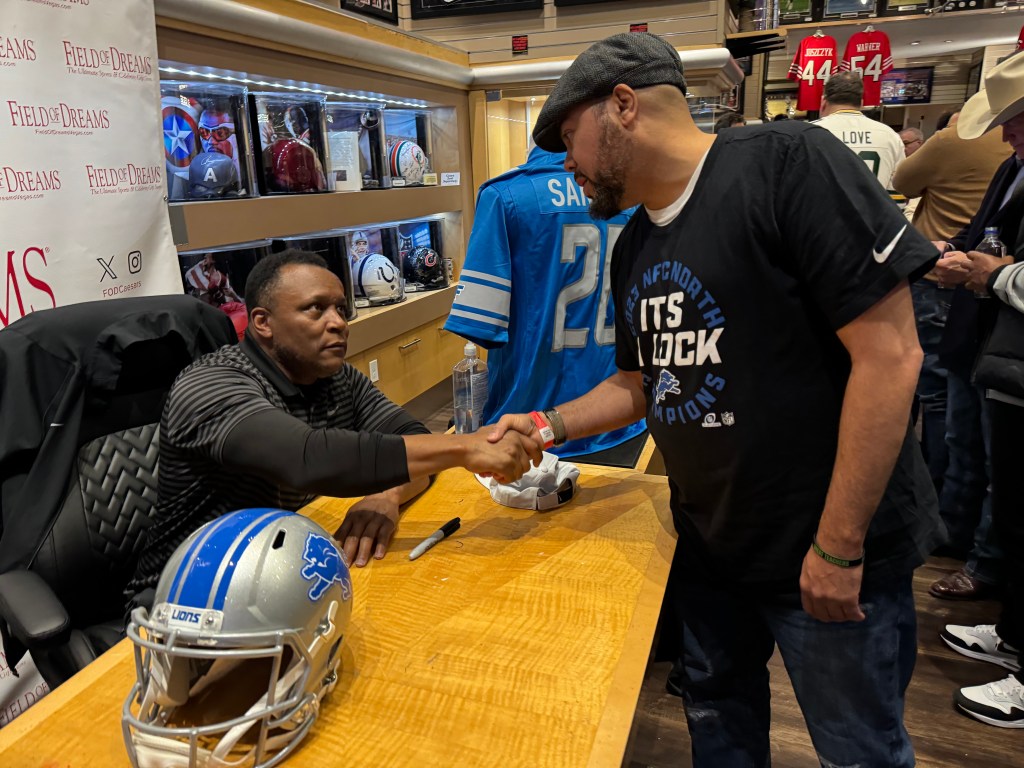
Julian Vasquez Heilig is a professor, writer, and a legit lifelong Detroit Lions fan since 1981. He attended the NFC Championship in San Jose two years ago to support his Cardiac Cats and last year’s playoff loss to the Washington Commanders at Ford Field. He was also at the official Lions partners party during the NFL Draft in Detroit, where he met Robert Porcher and Jason Hanson. Over the years he’s spotted Billy Sims in Times Square, endured the heartbreak of the Lions’ 0–16 season, and treasures his personally autographed Barry Sanders helmet. Beyond education and equity, Julian dabbles in writing about sports, culture, and society.
Two scholars–Kimberlé Crenshaw and Jason Stanley–explain why Trump is censoring exhibits at the Smithsonian. He has also imposed censorship of signage and exhibits at other federal sites, including national parks. He has enlisted the U.S. Department of Educatuon to organize rightwing groups to create a “patriotic” civics course.
Kimberlé Crenshaw is an American civil rights advocate and a scholar of critical race theory. She is a professor at the UCLA School of Law and Columbia Law School, where she specializes in race and gender issues
Jason Stanley is the Bissell-Heyd Chair in American Studies in the Munk School of Global Affairs & Public Policy at the University of Toronto and the author of Erasing History: How Fascists Rewrite the Past to Control the Future
Trump and his far-right cabal are l trying to revise history and memory. Unless he abolishes or rigs future elections, all this tinhorn fascist censorship will be swept away by his successors. He will rightly be judged, when that day comes, as the closest thing this country has ever seen to having a dictator. He will be portrayed in the Smithsonian and the textbooks as a buffoon and a tyrant.
In a letter sent to Smithsonian secretary, Lonnie G Bunch III, on 12 August, the Trump administration announced its plan to replace all Smithsonian exhibits deemed as “divisive” or “ideological” with descriptions deemed as “historical” and “constructive”. On 21 August, just nine days later, the White House published a list of said offending fixtures – the majority of which include exhibits, programming and artwork that highlight the Black, Latino and LGBTQ+ perspectives on the American project. Included in his bill of particulars was an exhibit that rightly depicts Benjamin Franklin as an enslaver, an art installation that acknowledges race as a social construct and a display that highlights racist voter suppression measures, among others.
The assault on the Smithsonian comes wrapped, as it were, as part of a broader attack on democracy, scenes of which we see playing out every day. The federal occupation of Washington DC, the crackdown on free speech on campus, the targeting of Trump’s political opponents, the gerrymandering of democracy – these are interwoven elements of the same structural assault. So with many fires burning across the nation, concerned citizens who are answering the call to fight the destruction of democracy may regard his attack on history and memory as a mere skirmish, a distraction from the herculean struggle against fascism unfolding in the US. But this is a mistake. Trump’s attack on American museums, education and memory, along with his weaponization of racialized resentment to package his authoritarian sympathies as mere patriotism, is a critical dimension of his fascist aims. The fight for democracy cannot avoid it, nor its racial conditions of possibility.
Fascism always has a central cultural component, because it relies on the construction of a mythic past. The mythic past is central to fascism because it enables and empowers a sense of grievance by a dominant racial or ethnic group whose consent is crucial to the sustainability of the project. In Maga world, the mythic past was pure, innocent and unsullied by women or Black leaders. In this kind of politics, the nation was once great, a byproduct of the great achievements of the men in the dominant racial group. In short, the assault on the Smithsonian and, more broadly, against truthful history and critical reflection is part of the broader fascist attack on democracy.
From this vantage point, racial equality is a threat to the story of the nation’s greatness because only the men of the dominant group can be great. To represent the nation’s founding figures as flawed, as any accurate history would do, is perceived, in this politics, as a kind of treason.
The success of the fascist dismantling of democracy is predicated on the widespread systematic failure to see the larger picture. The anti-woke assault that is a key pillar of Trumpism is part of that failure, partly due to the racial blinders and enduring ambivalence of too many in positions of leadership in the media and elsewhere. Those who sign on to the attack on “wokeness” but regard themselves as opponents of the other elements of the fascist assault are under the mistaken assumption that these projects can be disaggregated. In fact, the dismantling of democracy and of racial justice are symbiotically entangled. To support one is to give cover for the others.
It is no coincidence that this ‘proper’ ideology Trump exposes is constitutive of a more well-known strand of fascism – nazism
It is clear that the Trump administration understands this relationship and fully weaponizes racist appeals as a foundational piece of its fascist agenda. And if this was once the quiet part, it is now pronounced out loud in official government documents. In an executive order issued on 27 March 2025 titled “Restoring Truth and Sanity to American History”, Trump reveals that his mandate to ban “improper ideologies” targets core commitments repudiating a scientific racism that historically naturalized racial hierarchy thereby neutralizing resistance. According to Trump, the problem with the Smithsonian American Art Museum’s exhibit The Shape of Power: Stories of Race and American Sculpture was that it promoted the idea that “race is a human invention”.
The understanding that race is a social construct as opposed to a biological fact is perhaps the most fundamental advance in repudiating enslavement, genocide and segregation. Rejecting the idea that racial inequality is natural or pre-ordained – a claim that grounded enslavement and dispossession in America – forms the cornerstone of the modern commitment to a fully inclusive democracy. Trump’s declaration that this cornerstone is “improper” is an effort to turn the clock back, upending the entire American postwar project. It is no coincidence that this “proper” ideology Trump exposes is constitutive of a more well-known strand of fascism – nazism. How else can we understand why Maya Angelou was purged from the Naval Academy library while Adolf Hitler remains?
The fight against fascism in the US must be as robust in its embrace of racial equality as Trump’s embrace of outdated ideas about race and racism. The defense of memory, of truthful history, of telling the whole American story rather than ascribing agency in history to the deeds of “great men” is vital to the American democratic project. A pro-democratic education fosters the agency of its citizens by teaching about social movements that overturned entrenched hierarchies which blocked democratic equality and imposed racial tyranny. The story of how ordinary Americans lived and struggled and remade America is essential knowledge in developing and sustaining a multiracial democracy. The Smithsonian has been a vital institution in making this knowledge accessible to the masses. The National Museum of the American Latino and the National Museum of the American Indian, for example, provide artifacts and perspectives about the nation’s westward expansion that challenge the myth of unoccupied territory and manifest destiny. The National Museum of African American History and Culture brings forward the global scale of enslavement as well as its infusion across national institutions, culture and politics.
A reader who uses the name Quickwrit parses the Constitutionnand finds that Trump is doing today exactly what King George did to the colonists.
Quickwrit writes:
WHAT TRUMP IS DOING TODAY is the very same thing that our Declaration of Independence lists as the violations of liberty that triggered our Declaration of Independence. Take a look:
The King used armed forces to control American cities and towns, without first asking permission from the legislatures; quoting the Declaration, it says: “He has kept among us, in times of peace, Standing Armies without the Consent of our legislatures.” Just like King Trump sending armed National Guard units into our cities today.
The King replaced local police with his armed forces. The Declaration says: “He has affected to render the Military independent of and superior to the Civil Power.
The King’s armed forces were protected from killing civilians: “For protecting them, by a mock Trial from punishment for any Murders which they should commit on the Inhabitants of these States.” People die today in ICE custody, and nothing happens.
The King ignores civil courts: “He has obstructed the Administration of Justice by refusing his Assent to Laws for establishing Judiciary Powers.”
“He has made Judges dependent on his Will alone for the tenure of their offices.”
“He has erected a multitude of New Offices, and sent hither swarms of Officers to harass our people.”
“He has forbidden his Governors to pass Laws of immediate and pressing importance, unless suspended in their operation till his Assent should be obtained.” Today, not only do governors of Red States do nothing without Trump’s approval, neither does Congress.
The Declaration also says that we also declare our independence from the King for his:
“cutting off our Trade with all parts of the world’ (just like Trump’s tariffs);
“depriving us in many cases of the benefit of Trial by Jury” and “transporting us beyond Seas to be tried for pretended offences” (just like Trump deporting people without trial to be imprisoned in foreign nations).
The Declaration says Americans are breaking away because the King has opposed immigration that is vital to America’s economic growth, by “obstructing the Laws for Naturalization of Foreigners; refusing to pass others to encourage their migrations hither.” Already in 1740, laws had been passed to grant “natural born” citizenship status to immigrants who lived there for seven consecutive years.
The King has also been “redistricting” Americans out of their right to representation: “He has refused to pass Laws for the accommodation of large districts of people, unless those people would relinquish the right of Representation in the Legislature, a right inestimable to them and formidable to tyrants only.” Just like the redistricting going on today.
Americans today truly need to read the history of our Revolution and what went into and is actually in our Declaration of Independence and our Constitution. Read the ACTUAL WRITINGS of our Founding Fathers, not just listen to or read the “analyses” of political talking heads on today’s TV and social media.
That kind of reading takes time, and too few Americans today are willing to spend the time.
Disney announced that it was bringing back the Jimmy Kimmel show, starting tomorrow.
He was suspended for saying that the killer of Charlie Kirk was a MAGA adherent. He was wrong. No one knows the motive of Tyler Robinson, who had not been identified or arrested when Kimmel spoke.
If everyone who made a mistake was suspended from the screen, not many people would be left. The news could be announced by robots using AI. Comedians would disappear.
Disney released this statement:
“Last Wednesday, we made the decision to suspend production on the show to avoid further inflaming a tense situation at an emotional moment for our country,” the Walt Disney Company, ABC’s parent company, said in a statement.
“It is a decision we made because we felt some of the comments were ill-timed and thus insensitive,” the statement said. “We have spent the last days having thoughtful conversations with Jimmy, and after those conversations, we reached the decision to return the show on Tuesday.”
The outcry against Kimmel’s suspension was so loud that Disney backed down. His removal was seen as a test of the guarantee of free speech in the First Amendment to the Constitution.
Public protest mattered!!
Now what about the teachers, members of the military, and others who have been suspended or fired for not saying the “right” words about the murder of Charlie Kirk? The suppression of speech has been widespread and over-the-top, based on political passions and prejudice.
Larry Ellison, founder of Oracle, has recently been contending with Elon Musk for the title of world’s richest man. Both have wealth in the neighborhood of $350-400 billion. I mean, really, who cares? I can think of so many ways they could do something good for others with all that moola-boola, but no! They are on a power trip. Instead of feeding hungry children or endowing a hospital or funding wells in African villages, they buy self-aggrandizing toys.
Elon Musk wants to build a rocket to Mars and control the world’s satellite communications systems.
Larry Ellison bought CBS. He’s a friend of Donald Trump. CBS cancelled Stephen Colbert’s show. Colbert ridicules Trump. His show will be on the air until May so he has months in which to make jokes about Trump.
Larry Ellison is already a major stakeholder in CBS and Paramount. Now CNN, HBO and a major share of TikTok are in his sights. If all goes as anticipated, this tech billionaire, already one of the richest men in the world and a founder of Oracle, is poised, at 81, to become one of the most powerful media and entertainment moguls America has ever seen.
For the rest of us, the effect of Mr. Ellison’s gambit could be every bit as consequential, if not more so, than what happened a generation ago when Rupert Murdoch brought his brand of Down Under snark and cynicism to create what has become Fox News, intensifying our political polarization.
Mr. Ellison’s expected incursion into Hollywood and Big Media, if successful, could also go well beyond what other tech moguls like Jeff Bezos and Marc Benioff have attempted through their acquisitions of The Washington Post and Time magazine, respectively. For those men, the acquisitions were more like expensive hobbies.
Mr. Ellison is up to something very different: transforming himself into a media magnate. Along with his son, David, he could soon end up controlling a powerful social media platform, an iconic Hollywood movie studio and one of the largest content streaming services, as well as two of the country’s largest news organizations. Given Mr. Ellison’s friendship with, and affinity for, Donald Trump, an increasingly emboldened president could be getting an extraordinarily powerful media ally — in other words, the very last thing our country needs right now.
This consolidation of the news media is not good for democracy. What will freedom of the press mean if billionaires control the news?
Charlie was an unrepentant white supremacist. He was a male chauvinist who believed that a woman’s place was in the home, raising children and deferring to the authority of her husband. He was a proud and unrepentant bigot. He should not have been murdered. Political violence is poison to a democracy, which should rely on persuasion, not repression, censorship, or violence.
Coates reminds us that if Charlie’s views prevailed, we would abandon the rights of everyone who was not a straight white Christian male. That’s a majority of us.
Coates wrote:
Before he was killed last week, Charlie Kirk left a helpful compendium of words—ones that would greatly aid those who sought to understand his legacy and import. It is somewhat difficult to match these words with the manner in which Kirk is presently being memorialized in mainstream discourse. New York Times columnist Ezra Kleindubbed Kirk “one of the era’s most effective practitioners of persuasion” and a man who “was practicing politics in exactly the right way.” California governor Gavin Newsom hailed Kirk’s “passion and commitment to debate,” advising us to continue Kirk’s work by engaging “with each other, across ideology, through spirited discourse.” Atlantic writer Sally Jenkinssaluted Kirk, claiming he “argued with civility” and asserting that his death was “a significant loss for those who believe engagement can help bridge disagreements.”
The mentions of “debate” and “engagement” are references to Kirk’s campus tours, during which he visited various colleges to take on whoever come may. That this aspect of Kirk’s work would be so attractive to writers and politicians is understandable. There is, after all, a pervasive worry, among the political class, that college students, ensconced in their own bubbles, could use a bit of shock therapy from a man unconcerned with preferred pronouns, trigger warnings, and the humanity of Palestinians. But it also shows how the political class’s obsession with universities blinds it to everything else. And the everything-else of Kirk’s politics amounted to little more than a loathing of those whose mere existence provoked his ire.
It is not just, for instance, that Kirk held disagreeable views—that he was pro-life, that he believed in public executions, or that he rejected the separation of church and state. It’s that Kirk reveled in open bigotry. Indeed, claims of Kirk’s “civility” are tough to square with his penchant for demeaning members of the LGBTQ+ community as “freaks” and referring to trans peoplewith the slur “tranny.” Faced with the prospect of a Kamala Harris presidency, Kirk told his audience that the threat had to be averted because Harris wanted to “kidnap your child via the trans agenda.” Garden-variety transphobia is sadly unremarkable. But Kirk was a master of folding seemingly discordant bigotries into each other, as when he defined “the American way of life” as marriage, home ownership, and child-rearing free of “the lesbian, gay, transgender garbage in their school,” adding that he did not want kids to “have to hear the Muslim call to prayer five times a day.” The American way of life was “Christendom,” Kirk claimed, and Islam—“the sword the left is using to slit the throat of America”—was antithetical to that. Large “dedicated” Islamic areas were “a threat to America,” Kirk asserted, and New York mayoral candidate Zohran Mamdani was a “Mohammedan,” with Kirk supposing that anyone trying to see “Mohammedism take over the West” would love to have New York—a “prior Anglo center”—“under Mohammedan rule.”
Kirk habituallyrailed against “Black crime,” claiming that “prowling Blacks go around for fun to go target white people.” He repeated the rape accusations against Yusef Salaam, a member of the exonerated Central Park Five who is now a New York City councilman, calling him a “disgusting pig” who had gotten away with “gang rape.” Whatever distaste Kirk held for Blacks was multiplied when he turned to those from Haiti. Haiti was, by Kirk’s lights, a country “infested with demonic voodoo,” whose migrants were “raping your women and hunting you down at night.” These Haitians, as well as undocumented immigrants from other countries, were “having a field day,” per Kirk, and “coming for your daughter next.” The only hope was Donald Trump, who had to prevail, lest Haitians “become your masters.”
The point of this so-called mastery was as familiar as it was conspiratorial—“great replacement.” There was an “anti-white agenda,” Kirk howled. One that sought to “make the country more like the Third World.” The southern border was “the dumping ground of the planet,” he claimed, and a magnet for “the rapists, the thugs, the murderers, fighting-age males.” “They’re coming from across the world, from China, from Russia, from Middle Eastern countries,” he said, “and they’re coming in and they’re coming in and they’re coming in and they’re coming in…”
You can probably imagine where this line of thinking eventually went.
“Jewish donors,” Kirk claimed, were “the number one funding mechanism of radical open-border, neoliberal, quasi-Marxist policies, cultural institutions, and nonprofits.” Indeed, “the philosophical foundation of anti-whiteness has been largely financed by Jewish donors in the country.”
Kirk’s bigotry was not personal, but extended to the institution he founded, Turning Point USA. Crystal Clanton, the group’s former national field director, once texted a fellow Turning Point employee, “I HATE BLACK PEOPLE. Like fuck them all … I hate blacks. End of story.” One of the group’s advisers, Rip McIntosh,once published a newsletter featuring an essay from a pseudonymous writer that said Blacks had “become socially incompatible with other races” and that Black culture was an “un-fixable and crime-ridden mess.” In 2022, after three Black football players were killed at another college, Meg Miller, president of Turning Point’s chapter at the University of Missouri, joked (“joked”) in a social media message, “If they would have killed 4 more n-ggers we would have had the whole week off.”
Kirk subscribed to some of the most disreputable and harmful beliefs that this country has ever known. But it is still chilling to think that those beliefs would be silenced by a gunshot. The tragedy is personal—Kirk was robbed of his life, and his children and family will forever live with the knowledge that a visual record of that robbery is just an internet search away. And the tragedy is national. Political violence ends conversation and invites war; its rejection is paramount to a functioning democracy and a free society. “Political violence is a virus,” Klein noted. This assertion is true. It is also at odds with Kirk’s own words. It’s not that Kirk merely, as Klein put it, “defended the Second Amendment”—it’s that Kirk endorsed hurting people to advance his preferred policy outcomes…
Mere weeks before his death, Kirk reveled in Trump’s deployment of federal troops to DC. “Shock and awe. Force,” he wrote. “We’re taking our country back from these cockroaches.” And in 2023, Kirk told his audience that then president Joe Biden was a “corrupt tyrant” who should be “put in prison and/or given the death penalty for his crimes against America.”
What are we to make of a man who called for the execution of the American president, and then was executed himself? What are we to make of an NFL that, on one hand, encourages us to “End Racism,” and, on the other, urges us to commemorate an unreconstructed white supremacist? And what of the writers, the thinkers, and the pundits who cannot separate the great crime of Kirk’s death from the malignancy of his public life? Can they truly be so ignorant to the words of a man they have so rushed to memorialize? I don’t know. But the most telling detail in Klein’s column was that, for all his praise, there was not a single word in the piece from Kirk himself.

 Diane Ravitch's blog