Archives for category: Biden

The federal government has to raise the ceiling on the debt or face a default on its bonds, which would set off a national and international crisis. Congress has raised the debt ceiling many times in the past, including three times during Trump’s term.

An extraordinary part of the national debt was generated during Trump’s four years in office, according to ProPublica, especially his 2017 tax cut for the 1% and corporations:

One of President Donald Trump’s lesser known but profoundly damaging legacies will be the explosive rise in the national debt that occurred on his watch. The financial burden that he’s inflicted on our government will wreak havoc for decades, saddling our kids and grandkids with debt….The growth in the annual deficit under Trump ranks as the third-biggest increase, relative to the size of the economy, of any U.S. presidential administration, according to a calculation by a leading Washington budget maven, Eugene Steuerle, co-founder of the Urban-Brookings Tax Policy Center. And unlike George W. Bush and Abraham Lincoln, who oversaw the larger relative increases in deficits, Trump did not launch two foreign conflicts or have to pay for a civil war.

Republicans do not want to raise the debt ceiling. President Biden challenged them to come up with their own plan. They did. It involves cuts of 22% to everything but Social Security, Medicare, and defense spending.

Dana Milbank wrote in the Washington Post:

Jen Kiggans had the haunted look of a woman about to walk the plank.

The first-term Republican from Virginia barely took her eyes off her text Wednesday as she read it aloud on the House floor. She tripped over words and used her fingers to keep her place on the page.
The anxiety was understandable. Like about 30 other House Republicans from vulnerable districts, she was about to vote in favor of the GOP’s plan to force spending cuts of about $4.8 trillion as the ransom to be paid for avoiding a default on the federal debt.

“I do have serious concerns with the provision of this legislation that repeals clean-energy investment tax credits, particularly for wind energy,” she read. “These credits have been very beneficial to my constituents, attracting significant investment and new manufacturing jobs for businesses in southeast Virginia.”

Directing a question to the Republicans’ chief deputy whip, Guy Reschenthaler (Pa.), she asked for “the gentleman’s assurance that I will be able to address these concerns as we move forward in these negotiations and advocate for the interests of my district.”

The gentleman offered no such assurance. “I support repealing these tax credits,” he replied, offering only the noncommittal promise to “continue to work with the gentlewoman from Virginia, just like we will with all members.”

Kiggans then cast her vote to abolish the clean-energy credits her constituents find so “beneficial.”
House GOP leaders are celebrating their ability to pass their debt plan, even though it has no chance of surviving the Senate nor President Biden’s veto pen. But the bill’s passage has achieved one thing that cannot be undone: It has put 217 House Republicans on record in favor of demolishing popular government services enjoyed by their constituents.

In Kiggans’s Virginia, the legislation she just backed would strip tax incentives that go to the likes of Dominion Energy, which is building a $9.8 billion offshore wind project in her district. She also voted to ax solar and electric-vehicle incentives for hundreds of thousands of Virginians, and tax breaks projected to bring $11.6 billion in clean-power investment to the commonwealth.

In addition, the bill she supported sets spending targets that require an immediate 22 percent cut to all “non-defense discretionary spending” — that’s border security, the FBI, airport security, air traffic control, highways, agriculture programs, veterans’ health programs, food stamps, Medicaid, medical research, national parks and much more. If they want to cut less than 22 percent in some of those areas, they’ll have to cut more than 22 percent in others.

According to an administration analysis of what the 22 percent cuts translate to, Kiggans is now on record supporting:


Shutting down at least two air traffic control towers in Virginia.


Jeopardizing outpatient medical care for 162,300 Virginia veterans.


Throwing up to 175,000 Virginians off food stamps and ending food assistance for another 25,000 through the Special Supplemental Nutrition Program Women, Infants and Children.


Cutting or ending Pell Grants for 162,900 Virginia college students.


Eliminating Head Start for 3,600 Virginia children and child care for another 1,300 children.


Adding at least two months to wait times for Virginia seniors seeking assistance with Social Security and Medicare.


Denying opioid treatment for more than 600 Virginians.


Ending 180 days of rail inspections per year and 1,350 fewer miles of track inspected.


Kicking 13,400 Virginia families off rental assistance.


Similar calculations can be made for the other 30 House Republicans targeted by Democrats in the 2024 elections who joined Kiggans in walking the plank. Since enactment of the clean-energy credits Republicans have now voted to repeal, for example, clean-energy projects worth some $198 billion and 77,261 jobs have moved forward in districts represented by Republicans, according to the advocacy group Climate Power…

Trump’s huge deficits funded tax cuts for the rich. Biden’s deficits are investments in the future and lifelines for struggling people.

The Republicans’ draconian plan with its deep cuts passed by one vote.

But this week, they jammed their giant, secretly negotiated debt-limit bill through the Rules Committee on a party-line vote — at 2:19 a.m. And they did it with a “deem-and-pass” rule.


Even then, after all the reversals and surrenders, the bill came within one vote of failing. The lawmaker who cast the final, deciding vote? Rep. George Santos (R-N.Y.).


How apt that this legislation, built on one broken promise after another, should be carried over the finish line by the world’s most famous liar.

Jennifer Rubin is a columnist for the Washington Post. Originally, she was hired to express conservative views. Her column was called “Right Turn.” But when Trump was elected, she flipped. She realized that the Republican Party had lost its principles and stood for nothing other than slavishly obeying Trump’s whims and passing tax cuts for the 1%.

In this column, she calls out Senator Dick Durbin for acquiescing to the obsolete tradition of allowing one home-state Senator to block the President’s nomination to a federal judgeship. Democrats play by the unwritten rules, but Republicans ignore them. Democrats allowed Trump to nominate totally unqualified federal judges and joined in confirming them (e.g., the zealous anti-abortion extremist in Amarillo, Texas, who recently slapped a national ban on the main abortion pill because he disapproved of the Federal Drug Administration’s rigorous approval process).

But Republicans withhold their approval of well-qualified judicial nominees. And now, with Senator Dianne Feinstein home on sick leave, the Judiciary Committee is not approving any of President Biden’s nominees and will not give their approval to Senator Feinstein’s request to be removed temporarily from the committee.

Rubin wrote recently:

Senate Judiciary Committee Chairman Richard J. Durbin (D-Ill.) seems spectacularly ill-suited for an era when democracy is at risk, when Republicans observe no rules of decorum and when the federal judiciary’s credibility is crumbling.

Far too restrained and deferential, Durbin has refused to alter practices such as the “blue slip,” which allows home-state senators to nix the president’s judicial nominees, although he has beseeched Republicans not to abuse the practice. Durbin also hasn’t yet conducted hearings on the disastrous effects of the Supreme Court’s ruling in Dobbs v. Jackson Women’s Health Organization and related abortion bans, nor has he held hearings on a mandatory ethics code for judges — although he has promised hearings on revelations about Justice Clarence Thomas’s failure to disclose luxurious travel gifts and real estate sales. Then again, Senate Democrats as a whole haven’t pushed Durbin, so one cannot blame him alone for his timidity.

Caroline Fredrickson and Alan Neff recently wrote about blue slips for Just Security:

“The blue slip is an opaque — and inherently obstructionist — Senate tradition that allows a single Senator in any State to block a presidential nominee to the District Courts in their electoral patch merely by withholding their consent to consideration of the nominee in Committee. Like the filibuster, the blue slip allows Senators to halt Senate action without ever having to explain themselves to their Senate colleagues, their constituents, or the public, even if it means more criminal and civil cases languish unresolved on federal trial-court dockets for longer periods.”

Durbin could end this practice at any time, removing another abuse of minority-party power in the Senate. It’s one that has been spectacularly abused by Republicans, who have pushed through grossly unqualified, unfit nominees nominated by Republican presidents and yet nixed perfectly acceptable judges nominated by Democratic presidents…

Last week, Carl Hulse wrote for the New York Times:

“Then last week, Sen. Cindy Hyde-Smith, Republican of Mississippi, served notice to the Judiciary Committee that she would not allow the nomination of Scott Colom, a candidate for a court vacancy in the state, to move forward, citing his past political support from the left, among other reasons. Her stance endangered the confirmation of Mr. Colom, a popular Black Democratic state prosecutor who had the backing of Roger Wicker, the other Republican senator from the state, as well as leading Mississippi Republicans including two former governors, Haley Barbour and Phil Bryant.”

Durbin had previously promised he would respect blue slips unless the decision to withhold the blue slip was based not on the nominee’s qualifications but on race, gender or sexual orientation.

Apparently, this didn’t qualify in his eyes.

Durbin’s appeals to shameless Republicans have accomplished nothing. Instead, he has allowed Republicans to run amok. Is it any surprise that when they were asked to approve the request from Sen. Dianne Feinstein (D-Calif.) to be removed from the committee, they balked? Plainly, they know they have nothing to fear from Durbin.

Committee Democrats can, if they choose, push Durbin to end the blue slip practice. They also could demand a hearing on Supreme Court ethics, on book banning, and on the effects of Dobbs and abortion bans. They might even hold hearings on corruption in the prior administration or on domestic terrorism. They could hold hearings on nationwide injunctions and single judge divisions, which allowed for Judge Matthew J. Kacsmaryk’s abysmal ruling on the abortion drug mifepristone.

All these would be appropriate uses of oversight power — unlike House Republicans’ stunts. They’ve done none of that.

Voters, court reformers, progressive advocacy groups, donors and even Vice President Harris — a former committee member who is strenuously working to keep the plight of women denied abortions in the news — could all apply pressure. Democrats cannot attend to the threats to democracy if they play by Marquess of Queensberry rules and apply to Republicans’ nonexistent good faith.

The voters elected a Democratic Senate and Democratic president; they have a right to expect swift confirmation of qualified nominees when democracy remains vulnerable. Voters have a right to expect Senate investigations into questionable actions at the Supreme Court and elsewhere.

Durbin and his fellow Democrats need to learn to play hardball.

Columnist Thom Hartmann warns of the dangerous overreach by Congressman Jim Jordan, enabled by House Speaker Kevin McCarthy. Jordan and other House radicals intend to spend the next two years investigating government employees, in hopes of discrediting the Biden administration and critics of Traitor Trump.

He writes:

This column could get me thrown in jail.

And the fact that I’m even thinking that way is the entire point of Jim Jordan’s new Select Subcommittee on the Weaponization of the Federal Government, a subcommittee of the Judiciary Committee which Jordan chairs.

This is the same Congressman Jordan who voted to overthrow democracy and make Trump America’s first dictator on January 7th, 2001, who finally admitted he talked with Trump several times during the insurrection, and then defied the January 6th Committee’s request to tell them and America what Trump was doing on that fateful day.

He and his fellow fascist seditionists want Americans to be afraid of them, particularly Americans who may be in a position to identify their crimes and hold them to account.

Frankly, I’d be pretty low on their list. Just like the notorious Republican Senator Joe McCarthy back in the 1950s, Jordan and his buddies appear focused on using their power to intimidate those who have actual legal power. Like the FBI, IRS, regulators, and elected officials.

But it would be foolhardy to think they won’t go after members of the press. Or whatever they’re calling people like me these days: “fake news,” “lamestream media,” or the Lügenpresse in the original German.

The Committee will have the power to pry-bar their way into ongoing investigations, terrorizing agencies and government employees looking into Republican participation in the attempted coup of January 6th and the weeks around it.

They’ve even acquired, in yesterday’s vote, the power to access and use top-secret information normally reserved to the highly-vetted members of the House Permanent Select Committee on Intelligence.

Sources and methods. How the FBI knows which seditionist Members of Congress were involved in giving tours or conspiring with Proud Boys. Secrets Putin or the Saudi’s would pay billions for, as they apparently already have with Jared Kushner and Donald Trump.

As congressman Ruben Gallego said yesterday, it’s “as if we gave the mafia the right to investigate the Southern District of New York attorney’s office.”

Congressman Adam Schiff calls it The Coverup Committee. He’s right, but it’s worse than just that.

They’ve proclaimed their desire to intimidate the FBI, the Capitol Police, America’s spy agencies, and any politician who might show the temerity to suggest traitors should be held accountable for their treason.

We’ve seen this movie before, complete with the bombast, threats, lies, and bullying. And it tells us a lot about what we can expect over the next two years.

On February 9, 1950, an obscure first-term Senator who’d lied about his military service to get elected, Joe McCarthy, gave the first speech of a 5-city tour before a Republican women’s group in Wheeling, West Virginia. Apparently wanting to stir up some buzz, he pulled a random piece of paper from his pocket, waved it theatrically, and claimed it was a list of “205 known communists” who worked at the State Department.

Americans were worried about communists then, with some justification. The “communist miracle” was widely acknowledged under Stalin as just another form of brutal anti-democratic tyranny. Stalin had starved four million Ukrainians to death in what was known as the Holdomor, while he was imprisoning his own citizens in brutal gulags. The Soviet Union had exploded their first nuclear weapon just six months earlier, and that June North Korea, with help from the USSR, would invade South Korea.

By the end of McCarthy’s tour that month, reaching Salt Lake City, he’d reduced his claim to 57 communists in the State Department; in other cities he’d claimed the number was 81. It’s entirely possible he simply couldn’t keep track of his own lies.

In any case, no such list existed. Right up to the day he drank himself to death, May 9, 1957, McCarthy never was able to name a single communist in the State Department. But his demagogic claim got him on the front pages of newspapers across America.

McCarthy and his right-hand man Roy Cohn (later Donald Trump’s mentor) terrorized people working in the US government.

Being dragged before his Permanent Subcommittee on Investigations was a career-ender: over 2000 government employees lost their jobs because of his baseless accusations and innuendo.

In 1950, The Progressive magazine called McCarthy:

“[A]n ambitious faker living by his wits and guts, a ruthless egotist bent on personal power regardless of the consequence to his country, a shrewd and slippery operator with the gambler’s gift for knowing when and how to bluff.”

Even average Americans trembled before McCarthy, who was stepping into the anti-communist game late.

Three years earlier the “Hollywood Ten” (Alvah Bessie, Herbert Biberman, Lester Cole, Edward Dmytryk, Ring Lardner, Jr., John Howard Lawson, Albert Maltz, Samuel Ornitz, Adrian Scott, and Dalton Trumbo)— none of them particularly rich or famous — had all been sent to prison for a year for refusing to acknowledge subpoenas and submit to public interrogation by McCarthy’s peers on the House Un-American Activities Committee (HUAC).

Their crime? Most were writers and one, Ring Lardner Jr., had written an op-ed very much like this one in which he noted:

“One of the first acts of the Republicans who took control of Congress in 1946 (for the first time in 20 years) was to convert a temporary committee [HUAC], which had been investigating fascist sympathizers during the war, into a permanent [committee] concentrating on the … left…”

Off he went to prison.

And now, today, Jim Jordan and his colleagues have that same power of subpoena that was so bluntly wielded by McCarthy and his Republican collaborators when I was a kid.

We’ve been hearing about changes that the Republicans are making here and there in Congress since they’ve seized power, but now the full picture is coming into focus. I worried and warned about this two years ago in my book The Hidden History of American Oligarchy.

For example, back in April of 2009 the FBI/DHS issued a report titled: “Rightwing Extremism: Current Economic and Political Climate Fueling Resurgence in Radicalization and Recruitment.” It had been prepared during the presidency of George W. Bush, but Obama was now president when it was released and the reaction from the right was immediate.

John Boehner said the report was “offensive and unacceptable” and was particularly outraged that it used the word “terrorist” to, in Boehner’s words, “describe American citizens who disagree with the direction Washington Democrats are taking our nation.”

That mild response caused Obama to essentially pull the report.

But imagine if such a report were issued today by the FBI. Jordan’s new committee could call before it — as McCarthy did in the 1950s — the actual government employees who’d done the research and written it.

Their careers would be destroyed, their homes and families under constant death threat, their lives turned upside down.

It would be a long time before any other federal employee would dare expose terrorism on the American right.

This is how fascists behave. It’s how they’ve behaved throughout history. It’s how they get what they want.

Unless you confront them with overwhelming resistance, you can’t negotiate with them; they keep taking more and more right up to the point of using violence.

I hope I’m wrong, but everything I’m seeing tells me this is exactly the direction Republicans in the House are moving.

We’ve entered the new McCarthy era, and Kevin is doing everything he can to empower Jordan as the new Joe.

Only this time the goal isn’t just feeding the ego of an alcoholic narcissist: it’s to end democracy in the United States.

Historian Heather Cox Richardson describes the sharp contrast between the two parties: the Democrats are looking to the future, building platforms for innovation, new industries, and economic growth, while the Republicans are mired in stale culture war issues—campaigning for more restrictions on abortion, despite public opinion, and relitigating the 2020 election.

She writes:

At Georgetown University’s School of Foreign Service today, Commerce Secretary Gina Raimondo spoke on “The CHIPS Act and a Long-term Vision for America’s Technological Leadership.” She outlined what she sees as a historic opportunity to solidify the nation’s global leadership in technology and innovation and at the same time rebuild the country’s manufacturing sector and protect national security.

Congress passed the CHIPS and Science Act in August 2022 by a bipartisan vote, directing more than $52 billion into research and manufacturing of semiconductor chips as well as additional scientific research. Scientists in the U.S. developed chips, and they are now in cars, appliances, and so on. But they are now manufactured primarily in East Asia. The U.S. produces only about 10% of the world’s supply and makes none of the most advanced chips.

That dependence on overseas production hit supply chains hard during the pandemic while also weakening our national security. The hope behind the CHIPS and Science Act was that a significant government investment in the industry would jump-start private investment in bringing chip manufacturing back to the U.S., enabling the U.S. to compete more effectively with China. In the short term, at least, the plan has worked: by the end of 2022, private investors had pledged at least $200 billion to build U.S. chip manufacturing facilities.

Today, Raimondo framed the CHIPS and Science Act as an “incredible opportunity” to enable the U.S. to lead the world in technology, “securing our economic and national security future for the coming decades.” In the modern technological world, “it’s the countries who invest in research, innovation, and their workforces that will lead in the 21st century,” she said.

Raimondo described the major investment in semiconductor technology and its manufacture as a public investment in the economy that rivals some of the great investments in our history. She talked of Abraham Lincoln’s investment in agriculture in the 1860s to cement the position of the U.S. as a leader in world grain production, Franklin Delano Roosevelt and Harry S. Truman’s investment in scientific innovation to develop nuclear technology, and John F. Kennedy’s investment in putting a man on the moon.

Each of those massive investments sparked scientific innovation and economic growth. Raimondo suggested that “the CHIPS and Science Act presents us with an opportunity to make investments that are similarly consequential for our nation’s future.”

The vision Raimondo advanced was not one of top-down creativity. Instead, she described the extraordinary innovation of the silicon industry in the 1960s as a product of collaboration between university scientists, government purchasing power, and manufacturing. Rather than dismissing manufacturing as a repetitive mechanical task, she put it at the heart of innovation as the rapid production of millions and millions of chips prompted engineers to tweak manufacturing processes a little at a time, constantly making improvements.

“This relentless pace of lab-to-fab[rication] and fab-to-lab innovation became synonymous with America’s tech leadership,” she said, “doubling our computing capacity every two years.” As the U.S. shipped manufacturing jobs overseas, it lost this creative system. At the same time, inability to get chips during the pandemic hamstrung the U.S. economy and left our national security dependent for chips on other countries, especially China.

Reestablishing manufacturing in the U.S. will spark innovation and protect national security. It will also create new well-paying jobs for people without a college degree both in construction and in the operations of the new factories. With labor scarce, Raimondo called for hiring and training a million women in construction over the next decade, as well as bringing people from underserved communities into the skilled workforce to create “the most diverse, productive, and talented workers in the world.”

Raimondo warned that the vision she laid out would be hard to accomplish, but “if we—as a nation—unite behind a shared objective…and think boldly,” we can create a new generation of innovators and engineers, develop the manufacturing sector and the jobs that go with it, rebuild our economy, and protect our national security.

Just “think about what’s possible 10 years from now if we are bold,” she said.

Later, Raimondo told David Ignatius of the Washington Post: “This is more than just an investment to subsidize a few new chip factories…. We need to unite America around a common goal of enhancing America’s global competitiveness and leading in this incredibly crucial technology.… Money isn’t enough. We all need to get in the same boat as a nation.”

Part of the impetus for the bipartisan drive to jump-start the semiconductor industry is lawmakers’ determination to counter the rise of China, which has invested heavily in its own economy. As the U.S. seeks to swing the Indo-Pacific away from its orientation toward China, Raimondo will travel to India next month to talk about closer economic ties between the U.S. and India, including collaboration in chip manufacturing as India, Japan, and Australia are launching their own joint semiconductor initiative.

For the Biden administration, the investment in chips and all the growth and innovation it promises to spark, especially among those without college degrees, is also an attempt to unite the nation to move forward. Theirs is a heady vision of a nation that works together in a shared task, as Lincoln’s United States did, or FDR’s, or JFK’s.

Their orientation toward the future, growth, and prosperity is a striking contrast to the vision of today’s Republicans, who look backward resolutely and angrily to an imagined past. In the short term, many of them continue to relitigate the 2020 presidential election, long after the Big Lie that Trump won has been debunked and the rest of the country has moved on.

In the New York Times yesterday, Luke Broadwater and Jonathan Swan reported that one of the reasons House speaker Kevin McCarthy handed access to more than 40,000 hours of video from the U.S. Capitol from January 6, 2021, to Fox News Channel personality Tucker Carlson was that McCarthy had promised the far right that he would revisit that event but did not want to have the Republican Congress tied to the effort. His political advisors say swing voters want to move forward.

In the longer term, today’s Republicans are out of step with the majority of Americans on issues like LGBTQ rights, climate change, gun safety, and abortion. Although Republicans are pushing draconian laws to end all abortion access, today Public Religion Research Institute (PPRI), a nonprofit, nonpartisan organization, released a report showing that 64% of Americans say that abortion should be legal in most or all cases, while only 25% say it should be illegal in most cases and only 9% say it should be illegal in all cases. Less than half the residents in every state and in Washington, D.C., supported overturning the 1973 Roe v. Wade decision legalizing abortion, as the Supreme Court did with the Dobbs v. Jackson Women’s Health decision of last June.

In a speech in Des Moines, Iowa, yesterday, Senator Tim Scott (R-SC) echoed Trump’s “American Carnage” inaugural address with his description of today’s America as one full of misery and hopelessness. Florida governor Ron DeSantis traveled this week to New York City, Philadelphia, and Chicago to insist those Democratic-led cities were crime-ridden, although as human rights lawyer Qasim Rashid pointed out, Florida has a 19% higher rape rate, 66% higher murder rate, and 280% higher burglary rate than New York.

Another study released yesterday by the Anti-Defamation League, which specializes in civil rights law, noted that domestic extremist mass killings have increased “greatly” in the past 12 years. But while murders by Islamic extremists, for example, have been falling, all the extremist killings in 2022 were committed by right-wing adherents, with 21 of 25 murders linked to white supremacists.

President Biden’s poll numbers are up to 46% in general and 49% with registered voters. Perhaps more to the point is that in Tuesday’s four special elections, Democrats outperformed expectations by significant margins.

There are many reasons for these Democratic gains—abortion rights key among them—but it is possible that voters like the Democrats’ vision of a hopeful future and a realistic means to get there rather than Republicans’ condemnation of the present and vow to claw back a mythological past.

To read her footnotes, open the link.

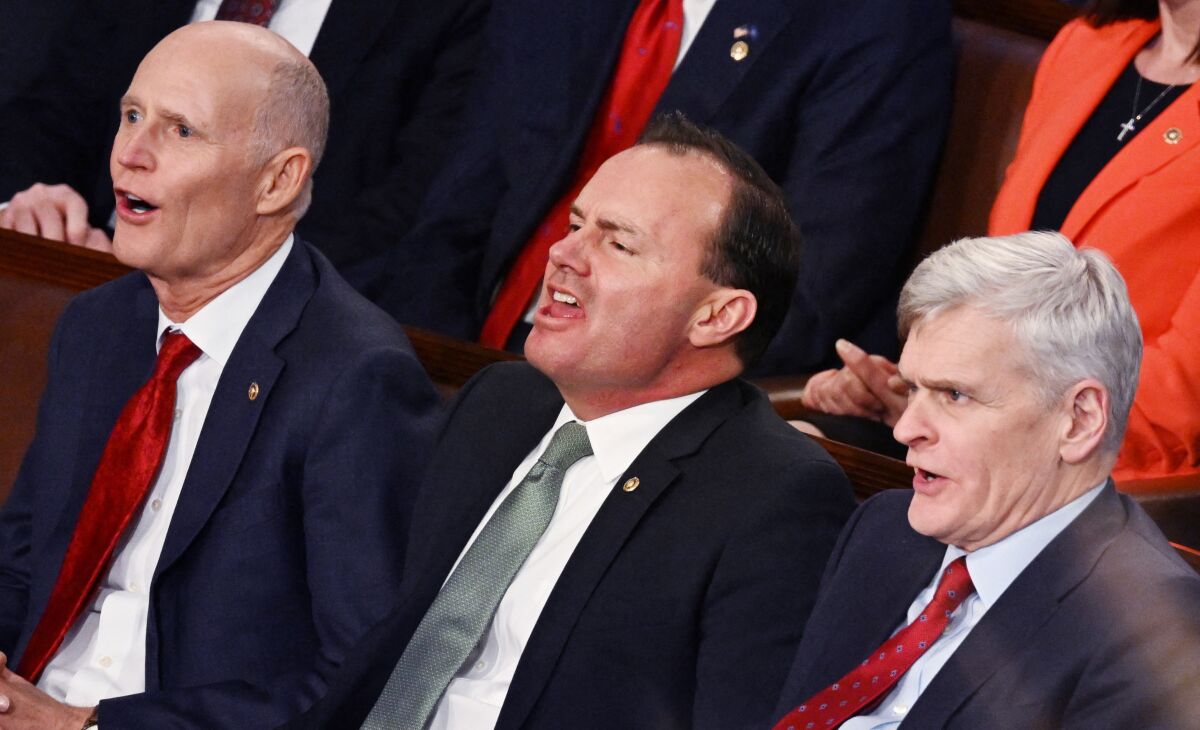
During President Biden’s State of the Union address, he said that Republicans want to cut Social Security and Medicare, and the Republican side of the chamber erupted in jeers and shouts of “liar!” Two of those loudly jeering—Senators Rick Scott of Florida and Mike Lee of Utah—had explicitly made those proposals. Biden then masterfully got the Republican caucuses in both Houses to declare their support for both big entitlement programs.

Michael Hiltzik, business columnist for the Los Angeles, sets the record straight about the Republican stance on Social Security.

From left, U.S. Sens. Rick Scott and Mike Lee jeer.

From left, GOP Sens. Rick Scott of Florida and Mike Lee of Utah jeer during the State of the Union address when President Biden accused Republicans of wanting to cut Social Security. Both senators have proposed exactly that.

(Andrew Caballero-Reynolds / AFP/Getty Images)

Hiltzik writes:

President Biden has congressional Republicans all asquirm as he conducts a post-State of the Union speech national tour.

Why? Because Biden has doubled down — or as Fox News has it, “tripled down” — on his assertion during the speech that the GOP has been planning to cut Social Security.

Not so, they say. Never happened. Sens. Mike Lee (R-Utah) and Rick Scott (R-Fla.) were even caught on camera during the speech wearing “Who, me?” expressions of injured innocence.

It will be my objective to phase out Social Security, to pull it out by the roots.

— Sen. Mike Lee (R-Utah), during his 2010 campaign for the Senate

Unfortunately for them, we have the evidence, as does Biden. Cutting Social Security along with Medicare has been part of the Republican platform for decades.

As I’ve reported before, they often hide their intentions behind a scrim of impenetrable jargon, plainly hoping that Americans won’t do the necessary math to penetrate their subterfuge.

Let’s take a jaunt through the GOP approach to Social Security and Medicare.

Start with their description of these programs as “entitlements,” which they’ve tried to turn into a dirty word. The truth is that they are entitlements, in the sense that most Americans have been paying into these programs for all their working lives, mostly through the payroll tax. So, yes, they’re “entitled” to receive benefits in return.

Republicans, including former Senate Majority Leader Mitch McConnell (R-Ky.), have consistently blamed the federal debt on “entitlements” — never mind that their 2017 tax cut for the wealthy has blown a multitrillion-dollar hole in the budget.

They know they’re on thin ice with the public when they talk about benefit cuts, which is why Sen. Joni Ernst (R-Iowa) once recommended discussing their ideas only “behind closed doors.”

Now we can turn to the specifics of Lee’s and Scott’s plans. In widely circulated videos from Lee’s first successful Senate campaign in 2010 he can be seen and heard stating as follows: “It will be my objective to phase out Social Security, to pull it out by the roots.” He said that was why he was running for the Senate, and added, “Medicare and Medicaid are of the same sort. They need to be pulled up.”

As for Scott, his 12-point “Rescue America” plan, issued last year, included a proposal to sunset all federal legislation after five years. “If a law is worth keeping, Congress can pass it again.” The implications for Social Security and Medicare, which were created by federal legislation, were unmistakable — so much so that the proposal made Republican officeholders’ skin crawl.

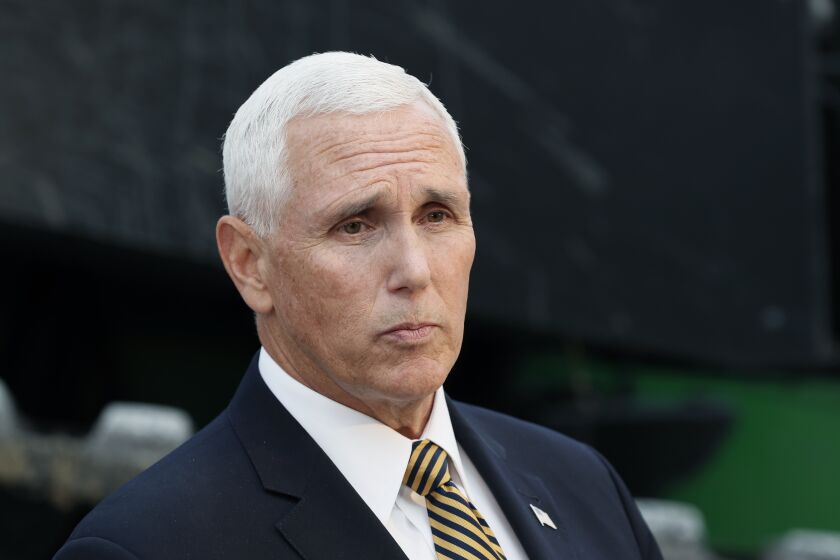
Vice President Mike Pence speaks to reporters during a visit to the Manning Farms, Wednesday, Oct. 9, 2019, in Waukee, Iowa. (AP Photo/Charlie Neibergall)

Column: Mike Pence, would-be president, has a plan to kill Social Security. It will cost you

McConnell disavowed the proposal on the spot and has continued to do so, telling a home-state radio host after the Biden speech that the sunset provision is “not a Republican plan.That was the Rick Scott plan.”

That said, it’s a priceless foil for Biden. When Republicans brayed during his speech that he was lying about it, he offered to make Scott’s manifesto available to anyone who called his office for it. At one of his subsequent appearances, a copy of Scott’s plan was placed on every seat.

The GOP can’t easily wriggle away from its intentions. Let’s examine the fiscal 2023 budget proposal issued by the Republican Study Committee, a key policy body, last June under the title “Blueprint to Save America.”

This plan would increase the Social Security full retirement age, which today is 66 or 67 (depending on one’s year of birth), to 70 by 2040. According to Kathleen Romig, the Social Security expert at the Center on Budget and Policy Priorities, this would translate into a 20% cut in lifetime benefits compared with current law.

As I’ve reported before, raising the full retirement age is a Trojan horse that would affect all retirees across the board, but harm Black workers, lower-income workers and those in physically demanding jobs the most.

It would create particular hardships for those choosing to retire early and collect their benefits prior to their full retirement age.

Doing so exacts a lifetime reduction in monthly benefits, based on a formula aimed at equalizing the lifetime benefit among those who retire early, those who wait until their full retirement age, and those who defer collecting until that age (they receive a bump-up in benefits for every year they delay, topping out at age 70).

Raising the full retirement age to 70, Romig calculates, would mean that retirees who start collecting at the minimum age of 62 would receive only 57% of their full benefit….

The Republican Study Committee also would make it harder for disabled workers to qualify for benefits, and would lengthen the period before those who are disabled and younger than 65 qualify for Medicare to five years from two. This falls into the category of balancing the budget on the backs of the most vulnerable members of society.


As for Medicare, the Republican Study Committee proposes raising the eligibility age, currently 65, so it matches the Social Security retirement age. It also would transfer many more Medicare accounts to private insurance. The committee claims this would save money.

The rest of his incisive analysis is behind a paywall, unfortunately. He demonstrates beyond doubt that Republicans have wanted for years to put these big programs on the chopping block, which are lifelines for senior citizens. They have no objections, however, to cutting the taxes of the wealthiest. That was Trump’s biggest accomplishment: tax cuts for those with the most.

Heather Cox Richardson’s post includes a story that has been under-reported about the train derailment in East Palestine, Ohio, that released massive toxic fumes. The Trump administration repealed an Obama regulation that imposed braking rules on trains carrying toxic materials. The trail industry lobbied to kill the regulation.

She writes:

President Joe Biden hit the road today to continue the push to highlight the successes of his administration’s investment in the economy. In Lanham, Maryland, at the International Brotherhood of Electrical Workers (IBEW) Local 26, he celebrated the economic plan that “grows the economy from the bottom up and the middle out, not the top down.”

He praised union labor and said that the nation’s investment in green energy would mean “good-paying jobs for electricians, plumbers, pipefitters, laborers, carpenters, cement masons, ironworkers, and so much more. And these good jobs you can raise a family on.” “It’s a stark contrast to our Republican friends, who are doubling down on the same failed politics of the past. Top-down, trickle-down economics is not much trickle down…to most kitchen tables in America,” he said.

He reiterated that he would lay out his budget on March 9 and that he expected the Republicans to lay out theirs, so people can compare the two. Biden maintains that his policy of investing in infrastructure and putting money in the hands of ordinary Americans will nurture the economy and reduce the deficit as growth brings in more tax dollars. Meanwhile, he said, the Republican tax cut of 2017 has already added $2 trillion to the federal deficit.

Good economic news is putting wind under Biden’s wings. The economy continues to perform better than expected in 2023. Retail buying increased 3% in January, and the job market remains strong. The administration today highlighted another series of large private sector investments in American manufacturing: Boeing announced that Air India has contracted to buy more than 200 aircraft; Ford announced it will build a $3.5 billion factory in Marshall, Michigan, to make advanced batteries for electric vehicles; and Texas Instruments announced it will build an $11 billion semiconductor plant in Lehi, Utah.

Biden emphasized that these investments would provide “good-paying jobs that [Americans] can raise a family on, the revitalization of entire communities that have often been left behind, and America leading the world again in the industries that drive the future.”

Biden accused the Republicans of proposing measures that would raise the deficit, which is already rising again. The Congressional Budget Office today projected a much higher deficit for 2023 than it did in May 2022 because of new laws, mandatory spending for Social Security and Medicare, and higher interest rates in place to combat inflation. The CBO notes that “spending substantially exceeds revenues in our projections even though pandemic-related spending lessens. In addition, rising interest rates drive up the cost of borrowing. The resulting deficits steadily increase the government’s debt. Over the long term, our projections suggest that changes in fiscal policy must be made to address the rising costs of interest and mitigate other adverse consequences of high and rising debt.”

This is precisely what Republicans have been complaining about with regard to the Democrats’ recent laws to rebuild infrastructure and invest in the economy, while ignoring that their own tax cuts have also added mightily to the deficit. Republicans want to address the rising deficit with spending cuts; Biden, with taxes on wealthy Americans and corporations.

Biden appears to be trying to turn the nation to a modern version of the era before Reagan, when the government provided a basic social safety net, protected civil rights, promoted infrastructure, and regulated business. Since the 1980s, the Republicans have advocated deregulation with the argument that government interference in the way a company does business interrupts the market economy.

But the derailment of fifty Norfolk Southern train cars, eleven of which carried hazardous chemicals, near East Palestine, Ohio, near the northeastern border of the state on February 3 has powerfully illustrated the downsides of deregulation. The accident released highly toxic chemicals into the air, water, and ground, causing a massive fire and forcing about 5,000 nearby residents in Ohio and Pennsylvania to evacuate. On February 6, when it appeared some of the rail cars would explode, officials allowed the company to release and burn the toxic vinyl chloride stored in it. The controlled burn sent highly toxic phosgene, used as a weapon in World War I, into the air.

Republican Ohio governor Mike DeWine has refused federal assistance from President Biden, who, he said, called to offer “anything you need.” DeWine said he had not called back to take him up on the offer. “We will not hesitate to do that if we’re seeing a problem or anything, but I’m not seeing it,” he said.

Just over the border, Pennsylvania governor Josh Shapiro, a Democrat, said that Norfolk Southern had botched its response to the accident. “Norfolk Southern has repeatedly assured us of the safety of their rail cars—in fact, leading Norfolk Southern personnel described them to me as ‘the Cadillac of rail cars’—yet despite these assertions, these were the same cars that Norfolk Southern personnel rushed to vent and burn without gathering input from state and local leaders. Norfolk Southern’s well known opposition to modern regulations [requires] further scrutiny and investigation to limit the devastating effects of future accidents on people’s lives, property, businesses, and the environment.”

Shapiro was likely referring to the fact that in 2017, after donors from the railroad industry poured more than $6 million into Republican political campaigns, the Trump administration got rid of a rule imposed by the Obama administration that required better braking systems on rail cars that carried hazardous flammable materials.

According to David Sirota, Julia Rock, Rebecca Burns, and Matthew Cunningham-Cook, writing in the investigative journal The Lever, Norfolk Southern supported the repeal, telling regulators new electronically controlled pneumatic brakes on high-hazard flammable trains (HHFT) would “impose tremendous costs without providing offsetting safety benefits.” Railroads also lobbied to limit the definition of HFFT to cover primarily trains that carry oil, not industrial chemicals. The train that derailed in Ohio was not classified as an HHFT.

Nonetheless, Ohio’s new far-right Republican senator J. D. Vance went on the Fox News Channel show of personality Tucker Carlson to blame the Biden administration for the accident. He said there was no excuse for failing infrastructure after the passage last year of the Bipartisan Infrastructure Bill, and said that the administration is too focused on “environmental racism and other ridiculous things.” We are, he said, “ruled by unserious people.”

He also issued a statement saying that “my office will continue to work with FEMA” over the issue, although FEMA, the Federal Emergency Management Agency, has not been mobilized because Ohio governor DeWine has not requested a federal disaster declaration.

Notes:

https://www.whitehouse.gov/briefing-room/speeches-remarks/2023/02/15/remarks-by-president-biden-on-the-economy-7/

https://www.cnn.com/2023/02/15/politics/biden-maryland-economy-speech/index.html

https://www.bloomberg.com/news/articles/2023-02-15/us-economy-keeps-charging-ahead-adding-pressure-on-fed-to-hike

https://www.whitehouse.gov/briefing-room/statements-releases/2023/02/15/icymi-biden-boom-continues-another-week-of-massive-private-sector-investments-in-american-manufacturing/

https://www.cbo.gov/publication/58940

https://www.washingtonpost.com/nation/2023/02/04/east-palestine-ohio-train-derailment/

https://www.washingtonpost.com/climate-environment/2023/02/15/ohio-train-derailment-toxic-chemicals/

https://apnews.com/article/biden-politics-district-of-columbia-us-republican-party-kevin-mccarthy-744d501534e43e8823fee135faf6d46e

https://www.nbcnews.com/politics/2024-election/biden-escalates-fight-social-security-medicare-frustrating-republicans-rcna70104

https://www.foxnews.com/us/ohio-skyline-lit-up-fireball-black-plumes-smoke-toxic-chemicals-released-derailed-train

https://www.levernews.com/rail-companies-blocked-safety-rules-before-ohio-derailment/

https://www.newsweek.com/donald-trump-blame-ohio-train-derailment-1781163

https://www.theguardian.com/us-news/2023/feb/11/ohio-train-derailment-wake-up-call

https://www.marketwatch.com/story/ohios-dewine-says-he-has-not-taken-up-biden-on-offer-of-anything-you-need-in-wake-of-train-derailment-disaster-adf4c949

https://www.cleveland.com/news/2023/02/sen-sherrod-brown-blasts-trump-administration-for-rail-safety-cuts-after-ohio-derailment.html

https://www.axios.com/2023/02/15/cbo-deficit-debt-ceiling-2023


David Dayen writes in The American Prospect about President Biden’s efforts to limit corporate power and spur competition.

Dayen begins:

On July 9, 2021, President Joe Biden signed one of the most sweeping changes to domestic policy since FDR. It was not legislation: His signature climate and health law would take another year to gestate. This was a request that the government get into the business of fostering competition in the U.S. economy again.

Flanked by Cabinet officials and agency heads, Biden condemned Robert Bork’s pro-corporate legal revolution in the 1980s, which destroyed antitrust, leading to concentrated markets, raised prices, suppressed wages, stifled innovation, weakened growth, and robbing citizens of the liberty to pursue their talents. Competition policy, Biden said, “is how we ensure that our economy isn’t about people working for capitalism; it’s about capitalism working for people.”null

The executive order outlines a whopping 72 different actions, but with a coherent objective. It seeks to revert government’s role back to that of the Progressive and New Deal eras. Breaking up monopolies was a priority then, complemented by numerous other initiatives—smarter military procurement, common-carrier requirements, banking regulations, public options—that centered competition as a counterweight to the industrial leviathan.

It’s been a year and a half since Biden signed the executive order; its architect, Tim Wu, has since rotated out of government. Not all of the 72 actions have been completed, though many have. Some were instituted rapidly; others have been agonizing. Some agencies have taken the president’s urging to heart; others haven’t. But the new mindset is apparent.

Seventeen federal agencies are named specifically, tasked with writing rules, tightening guidelines, and ramping up enforcement. I wrote to each agency, asking how they have complied with the order; all of them answered but one (the Federal Deposit Insurance Corporation, whose role is admittedly tangential). Even Cabinet departments that weren’t mentioned wrote in to explain their approach to competition. Clearly, agencies are aware of the emphasis being put on reorienting their mission.

Bringing change to large bureaucracies is often likened to turning around a battleship. One way to get things moving is to have the captain inform every crew member of the intention to turn the battleship around, counseling them to take every action from now on with that battleship-turning goal in mind. The small team that envisioned and executed the competition order put the weight of the presidency behind it, delivering a loud message to return to the fight against concentrations of power. It’s alarming and maybe a little disconcerting that you have to use a high-level form of peer pressure to flip the ship of state. But that battleship is starting to change course.

TIM WU WAS THE FIRST OF THE TRIUMVIRATE of Wu, Khan, and Kanter (a motto emblazoned on mugs by advocates) to actually get appointed in the Biden administration, joining the National Economic Council (NEC) to work on competition policy in early March 2021. Hiring the author of The Curse of Bigness signaled the administration’s strong anti-monopoly thrust. Khan (Lina, chair of the Federal Trade Commission) and Kanter (Jonathan, heading the Justice Department’s Antitrust Division) would arrive later.

The competition order was released four months after Wu’s appointment, but in reality, it was laid out over the previous five years. In that time, a collection of policymakers, journalists, lawyers, politicians, and experts, sometimes known as the New Brandeis movement, warned of the dangers of economic concentration. Wu, Khan, and Kanter were part of this crusade, and prior to the 2020 election, they and others strategized about how to reinvigorate competition policy if Democrats took the presidency.

This is an unusual story about an accomplishment or series of accomplishments that have gone unnoticed. Read on to the end.

Think of the most extreme, most vitriolic, least responsible members of the GOP caucus in the House of Representatives. Think of the ones who defended the insurrection. Think of those who encouraged the effort to overturn our government. Speaker Kevin McCarthy just put them on the most important committee in the House, the one that will conduct investigations for the next two years.

Hunter Biden’s laptop! Hunter Biden’s Laptop! Jewish space lasers! QAnon! Pedophiles! The entire Biden family (unlike the Trump family) enriching themselves on your dime (please don’t bring up the $2 billion that the Saudis gave Jared Kushner after Biden took office!) Hunter Biden’s laptop! The hundreds of classified documents that Trump fought to hold onto for over a year, first claiming they were planted by the FBI, then claiming they were his personal property, and the small number of documents that Biden immediately turned over! Trump good, Biden bad! Laptop!

The New York Times reported:

WASHINGTON — They were deeply involved in President Donald J. Trump’s efforts to overturn the 2020 presidential election results. They have come to the defense of people being prosecuted for participating in the deadly storming of the Capitol on Jan. 6, 2021. Some have called for violence against their political enemies online, embraced conspiracy theories or associated with white supremacists.

Several of the most extreme Republicans in Congress and those most closely allied with Mr. Trump have landed seats on the Oversight and Accountability Committee, the main investigative organ in the House. From that perch, they are poised to shape inquiries into the Biden administration and to serve as agents of Mr. Trump in litigating his grievances as he plots his re-election campaign.

Their appointments are the latest evidence that the new Republican majority is driven by a hard-right faction that has modeled itself in Mr. Trump’s image, shares his penchant for dealing in incendiary statements and misinformation, and is bent on using its newfound power to exact revenge on Democrats and President Biden.

Many of the panel’s new Republican members — including Representatives Marjorie Taylor Greene of Georgia, Paul Gosar of Arizona, Lauren Boebert of Colorado and Scott Perry of Pennsylvania — are among Mr. Trump’s most devoted allies in Congress. Their appointments underscore that, while the former president may be a shrunken presence in the current political landscape, he still exerts much control over the base of his party.

In a remarkable bipartisan move, Congress passed a budget bill to finance the federal government until September 2023. Heather Cox Richardson describes the political maneuvering behind its passage. Republicans in the House wanted to wait until the new Congress is seated. They hold a slim majority. With Kevin McCarthy courting the MAGA caucus, who knows if the House would ever agree on a budget.

Jim Jordan—the Trump lackey from Ohio who seldom wears a jacket— keeps tweeting snide comments about the budget. But he never mentions that half the budget—$850 billion—is defense spending. I enjoy tweeting that fact to him.

Heather Cox Richardson wrote yesterday:

Today, by a vote of 225 to 201, the House passed the 4,155-page omnibus spending bill necessary to fund the government through September 30, 2023. The Senate passed it yesterday by a bipartisan vote of 68–29, and President Joe Biden has said he will sign it as soon as it gets to his desk.

The measure establishes nondefense discretionary spending at about $773 billion, an increase of about $68 billion, or 6%. It increases defense spending to $858 billion, an increase of about 10%. Defense funding is about $45 billion more than Biden had requested, reflecting the depletion of military stores in Ukraine, where the largest European war since World War II is raging, and the recognition of a military buildup with growing tensions between the U.S. and China.

Senators Patrick J. Leahy (D-VT) and Richard C. Shelby (R-AL) and Representative Rosa L. DeLauro (D-CT) hammered out the bill over months of negotiations. Leahy and Shelby are the two most senior members of the Senate Appropriations Committee, and both are retiring at the end of this session. Shelby told the Senate: “We know it’s not perfect, but it’s got a lot of good stuff in it.”

House Republicans refused to participate in the negotiations, tipping their hand to just how disorganized they are right now. House minority leader Kevin McCarthy (R-CA) insisted that the measure should wait until the Republicans take control of the House in 11 days. This reflects the determination of far-right extremists in the party to hold government funding hostage in order to get concessions from the Democrats.

But their positions are so extreme that most Republicans wanted to get the deal done before they could gum it up. Indeed, right now they are refusing to back Republican minority leader McCarthy for speaker, forcing him to more and more extreme positions to woo them. Earlier this week, McCarthy publicly claimed that if he becomes House speaker, he will reject any bill proposed by a senator who voted yes on the omnibus bill. After the measure passed the House, McCarthy spoke forcefully against it, prompting Representative Jim McGovern (D-MA) to say: “After listening to that, it’s clear he doesn’t have the votes yet.”

The measure invests in education, childcare, and healthcare, giving boosts to the National Institute of Health and the Centers for Disease Control and Prevention and investing in mental health programs. It addresses the opioid crisis and invests in food security programs and in housing and heating assistance programs. It invests in the Environmental Protection Agency and the National Park Service and makes a historic investment in the National Science Foundation. It raises the pay for members of the armed forces, and it invests in state and local law enforcement. It will also provide supplemental funding of about $45 billion for Ukraine aid and $41 billion for disaster relief. It reforms the Electoral Count Act to prevent a plan like that hatched by former president Donald Trump and his cronies to overturn an election, and it funds prosecutions stemming from the January 6, 2021, attack on the U.S. Capitol.

“A lot of hard work, a lot of compromise,” Senate majority leader Chuck Schumer, (D-NY) said. “But we funded the government with an aggressive investment in American families, American workers, American national defense.” Schumer called the bill “one of the most significant appropriations packages we’ve done in a really long time.”

And so, members of Congress are on their way home, in the nation’s severe winter storm, for the winter holiday.

Please open the link and read the rest of her post.

Heather Cox Richardson has a very funny post about Trump’s big surprise announcement and the reactions to it. you have to open the link and scroll to the bottom to see her choice selection of tweets. One came from an insurrectionist who said, “And I’m going to jail for this?”

Yesterday, former president Trump took to his Truth Social media platform to announce that he would be making “a MAJOR ANNOUNCEMENT” today. Since he recently threw his hat in the ring for president in 2024, there was a great deal of speculation about what political move this would be.

When it came today, it turned out that his announcement was for digital trading cards with images of him as a superhero…available for $99 apiece. Radio personality John Melendez promptly called them “Broke’mon cards.”

Ron Filipkowski, a former federal prosecutor and Republican who now monitors right-wing extremism, tweeted: “All I can say is that those of us who have lost friends, fought with relatives, resigned positions, been called traitor, left our party, all because we saw very clearly what a con-man, huckster and fraud this man is, have never felt more vindicated.”

The reduction of the former president to a cartoon grifter seems likely to have political repercussions. Right-wing media personality Baked Alaska, who is facing six months in jail after pleading guilty to parading, demonstrating or picketing inside a Capitol building for his participation in the January 6 attack on the U.S. Capitol, tweeted: “i can’t believe i’m going to jail for an nft salesman,” with a sad face emoji.

You gotta read the rest.