Archives for category: Accountability

Disney announced that it was bringing back the Jimmy Kimmel show, starting tomorrow.

He was suspended for saying that the killer of Charlie Kirk was a MAGA adherent. He was wrong. No one knows the motive of Tyler Robinson, who had not been identified or arrested when Kimmel spoke.

If everyone who made a mistake was suspended from the screen, not many people would be left. The news could be announced by robots using AI. Comedians would disappear.

Disney released this statement:

“Last Wednesday, we made the decision to suspend production on the show to avoid further inflaming a tense situation at an emotional moment for our country,” the Walt Disney Company, ABC’s parent company, said in a statement.

“It is a decision we made because we felt some of the comments were ill-timed and thus insensitive,” the statement said. “We have spent the last days having thoughtful conversations with Jimmy, and after those conversations, we reached the decision to return the show on Tuesday.”

The outcry against Kimmel’s suspension was so loud that Disney backed down. His removal was seen as a test of the guarantee of free speech in the First Amendment to the Constitution.

Public protest mattered!!

Now what about the teachers, members of the military, and others who have been suspended or fired for not saying the “right” words about the murder of Charlie Kirk? The suppression of speech has been widespread and over-the-top, based on political passions and prejudice.

There was a time long ago when the FCC would block the merger of two major television networks. Too much consolidation is not healthy for democracy. But under Brendan Carr, the prospect of a megabillionaire buying two networks is possible because he’s a friend of Trump.

The most stunning revelation occurs in the last paragraph.

Oliver Darcy writes on his invaluable Status blog:

Inside the halls of Hudson Yards, and across CNN’s bureaus worldwide, staffers have been anxiously whispering about the suddenly real possibility of yet another corporate takeover. The network, which has already changed ownership twice in the past decade and weathered multiple leadership shakeups, may soon be thrust into another period of upheaval as the Ellison family prepares a bid for Warner Bros. Discovery, the David Zaslav–led conglomerate that owns CNN. 

An Ellison takeover would be unlike anything CNN has seen in its 45-year history. Since acquiring Paramount, David Ellisonhas sought to steer CBS News into more Donald Trump-friendly waters, installing a MAGA-leaning ombudsman to review complaints of bias and moving to acquire Bari Weiss’ The Free Press with plans to install her as editor in chief, or something close to it. WBD already dialed back CNN’s aggressive, Jeff Zucker-led Trump reporting when it took over the network as its parent company in 2022, but an Ellison regime could go much further. In such a scenario, it’s likely that the anti-woke, anti-D.E.I. Weiss, who has spent years bashing the mainstream press, would not only wield influence at CBS News, but would ultimately be handed editorial authority at CNN itself. 

According to nearly a dozen current employees and people familiar with the mood inside CNN, that prospect has unnerved network staffers, who harbor deep unease at the idea of reporting to Weiss. The fears have only deepened by the expectation that Ellison would pursue cuts if he merges CBS News and CNN—which I understand would be the plan should he acquire WBD—to eliminate redundancies.

Mark Thompson, CNN’s chief executive, has certainly picked up on the palpable fear in his newsroom, and has spent the past week attempting to steady the ship. I’m told that he has spoken privately with senior staff and on Monday phoned into the company-wide morning editorial meeting from London, urging calm and focus. When the Ellison family’s plan leaked to the press last week, Thompson also addressed the matter in an all-staff memo, signaling the seriousness in which CNN’s leadership is digesting the situation.

“News about potential consolidation and where our broader sector is headed is an everyday part of our industry,” Thompson said in the memo, obtained by Status. “I therefore suggest that you take this story and any subsequent similar ones with a sense of proportion. The best way we can safeguard CNN’s future as an outstanding independent global news provider is to take our own destiny in our hands and execute our own strategy as energetically and successfully as we can. Our predecessors never let speculation about changes of parent company ownership–and there were more than a few–distract them from the task of building a successful CNN and I don’t think we should either.”

Still, Thompson’s reassurances have hardly erased the anxiety, given that an Ellison takeover would be no ordinary change of corporate hands, a la AT&T’s purchase of the WarnerMediaassets. Many staffers were already worried by WBD’s existing plan to spin off CNN and other linear networks into a separate company by early next year, which would be led by notorious cost-cutter Gunnar Wiedenfels. “Keep calm and carry on doesn’t cut it in this context,” one staffer told me this week. “People are very worried,” said another, noting that Weiss “seems to have a lot of preconceived and incorrect notions about CNN.” A third added bluntly, “No one knows what the hell to expect.”

“It’s quite something for an organization that has constantly been on pins and needles for several years now, wondering what new change will come next,” that staffer continued, underscoring the constant uncertainty.

There’s also a strong sense of déjà vu. CNN is preparing to launch its second standalone streamer next month, as we previously reported, just three years after Zaslav pulled the plug on CNN+ following the WBD takeover. Thompson stressed in his memo last week that CNN’s streamer will launch “on time and on budget,” no matter the speculation swirling around the company. “Indeed, we plan to double down on the whole digital plan and execute it as soon as we can,” he told staff in his memo. But if Ellison gains control, the fate of CNN’s digital strategy could be rewritten, just as it was when Zaslav gained the keys to the castle.

Of course, the necessary caveats do apply. The Ellison family may be preparing a bid, but they have yet to submit a formal offer. It also goes without saying that if the family does make a play for WBD, corporate transactions take time to shake out. And even if the WBD board immediately accepts an offer, it would still take several months to close and then more time for the Ellison family to determine next steps for the company’s pile of assets. Nevertheless, WBD’s board may not ultimately have much of a say in the matter, given its members have a fiduciary responsibility to shareholders. If they receive a good offer, it’s difficult to see how they’d reject it.

In truth, CNN’s future may soon be beyond the control of both Thompson and Zaslav. While Zaslav may hope to gin up interest from rival bidders, it’s hard to imagine there are other companies that would wish to swallow WBD’s entire portfolio of assets whole, never mind whether they have the ability or desire to outbid the Ellison family, which is said to be preparing a cash offer after seeing their wealth surge nearly $100 billion last week. For CNN staffers who never quite adjusted to WBD ownership and might still yearn for the Zucker years, the reality is sobering: yet another transformation may soon be on the horizon, one that could redefine the network’s identity in a much more significant way.

The Ellison family saw its wealth surge by nearly $100 billion in the last week. Think about it.

The Idaho state legislature passed a $50 million plan to subsidize vouchers. The usual arguments for vouchers–choice and competition–don’t apply in a largely rural state. The primary beneficiaries will be wealthy families whose children are already enrolled in private schools. The biggest losers will be rural schools, which desperately need upgrades.

Parents in Idaho are taking their challenge to the state courts, based on the explicit language of the State Constitution. The editorial board of the Idaho Statesman agrees with the parents.

Here is its editorial on the subject:

“(I)t shall be the duty of the legislature of Idaho, to establish and maintain a general, uniform and thorough system of public, free common schools.” — Article IX, Section 1, Idaho Constitution

A coalition of public school advocates announced Wednesday that it is asking the Idaho Supreme Court to rule that a refundable tax credit for families who send their kids to private schools is a violation of the Idaho constitution’s education clause.

We say it’s about time.

And just in time, since House Bill 93, which was passed last legislative session, allows families to start applying for the credits in January.

The law set aside up to $50 million for the tax credits.

We would much rather see that $50 million go toward the public education system, hiring more teachers, more counselors, repairing derelict school buildings and properly funding special education, which has an $80 million shortfall, according to the Office of Performance Evaluations.null

We have enumerated many times before the reasons vouchers for private schools is a terrible idea.

Most voucher schemes in other states started out like Idaho’s — small, limited and targeted. But state after state, the vouchers grew and are blowing holes in state budgets everywhere.

Many of these vouchers go to wealthy families who already have the means to pay for private school, and the vouchers merely subsidize part of the cost of a private school tuition.

The vouchers are open to fraud, waste and abuse.

There’s no accountability built into Idaho’s voucher system.

The Idaho Supreme Court won’t be interested in such policy discussions, but justices will be interested in hearing what we think is a valid constitutional argument.

One word, in particular, provides their best legal challenge: “uniform.”

In essence, by providing a refundable tax credit to families to send their children to a private school, the Legislature is establishing a second school system that isn’t the same as the public education system. It’s not uniform.https://f0fd809050f339b050a5948ada000ea9.safeframe.googlesyndication.com/safeframe/1-0-45/html/container.html?n=0

We are compelled by the testimony Wednesday of one mother who said her children were denied entry to a public school based on their religion. A public school can’t do that.

The argument is not without precedent.

A district court judge in Salt Lake City halted Utah’s education savings account programearlier this year, according to Idaho Education News. The state’s teachers’ union argued that the Utah Constitution bars state dollars from funding an education system that’s not free or open to all students.

The same could be said for Idaho’s voucher scheme.https://f0fd809050f339b050a5948ada000ea9.safeframe.googlesyndication.com/safeframe/1-0-45/html/container.html?n=0

In June, an Ohio state judge struck down that state’s voucher program, ruling that the program created a separate, unfunded, nonpublic system and funneled public money to private religious institutions. That, the judge ruled, violated constitutional mandates to fund a single public school system.

In 2024, the South Carolina Supreme Court struck down a 2023 law that created a private school voucher system. The court said the law illegally funneled state public funds to private schools, which is prohibited by the state constitution. The decision said vouchers undermine the state’s mandate to support public schools for all students.

We find it particularly appropriate that Idaho’s organizers announced this legal challenge on Constitution Day. Yes, it’s referring to the U.S. Constitution, but Idaho legislators should hold Idaho’s Constitution in equally high regard.

How we wish Idaho legislators would honor it all the time, not just when it’s convenient or when they want to change the constitution’s clear meaning to fit their agenda.https://f0fd809050f339b050a5948ada000ea9.safeframe.googlesyndication.com/safeframe/1-0-45/html/container.html?n=0

Where are all of Idaho’s “original meaning,” “not a living document” conservatives in this state when it comes to the state constitution’s education clause?

Because, if you read the Idaho Constitution plainly, vouchers just don’t pass muster.

Let’s hope the Idaho Supreme Court sees it the same way.

Statesman editorials are the opinion of the Idaho Statesman’s editorial board. Board members are opinion editor Scott McIntosh, opinion writer Bryan Clark, editor Chadd Cripe, newsroom editors Dana Oland and Jim Keyser and community members John Hess, Debbie McCormick and Julie Yamamoto

MSNBC broke the bombshell story: before the 2024 election, undercover FBI agents handed a paper bag with $50,000 cash to Tom Homan. They heard that Homan was soliciting bribes. The meeting was filmed.

The investigation of Homan for corrupt activities was quashed by Trump’s Department of Justice, presumably with the full knowledge of Attorney General Pam Bondi and FBI Director Kash Patel.

Carol Leonnig and Ken Dilanian of MSNBC reported:

In an undercover operation last year, the FBI recorded Tom Homan, now the White House border czar, accepting $50,000 in cash after indicating he could help the agents — who were posing as business executives — win government contracts in a second Trump administration, according to multiple people familiar with the probe and internal documents reviewed by MSNBC.

The FBI and the Justice Department planned to wait to see whether Homan would deliver on his alleged promise once he became the nation’s top immigration official. But the case indefinitely stalled soon after Donald Trump became president again in January, according to six sources familiar with the matter. In recent weeks, Trump appointees officially closed the investigation, after FBI Director Kash Patel requested a status update on the case, two of the people said. 

It’s unclear what reasons FBI and Justice Department officials gave for shutting down the investigation. But a Trump Justice Department appointee called the case a “deep state” probe in early 2025 and no further investigative steps were taken, the sources say. 

On Sept. 20, 2024, with hidden cameras recording the scene at a meeting spot in Texas, Homan accepted $50,000 in bills, according to an internal summary of the case and sources. 

The federal investigation was launched in western Texas in the summer of 2024 after a subject in a separate investigation claimed Homan was soliciting payments in exchange for awarding contracts should Trump win the presidential election, according to an internal Justice Department summary of the probe reviewed by MSNBC and people familiar with the case. The U.S. Attorney’s office in the Western District of Texas, working with the FBI, asked the Justice Department’s Public Integrity Section to join its ongoing probe “into the Border Czar and former Acting Director of Immigration and Customs Enforcement Tom Homan and others based on evidence of payment from FBI undercover agents in exchange for facilitating future contracts related to border enforcement.”

Homan, who served as acting director of Immigration and Customs Enforcement early in Trump’s first term, openly claimed during the 2024 campaign that he would play a prominent role in carrying out Trump’s promised mass deportations.

Asked for comment about MSNBC’s exclusive reporting, the White House, the Justice Department and the FBI dismissed the investigation as politically motivated and baseless.

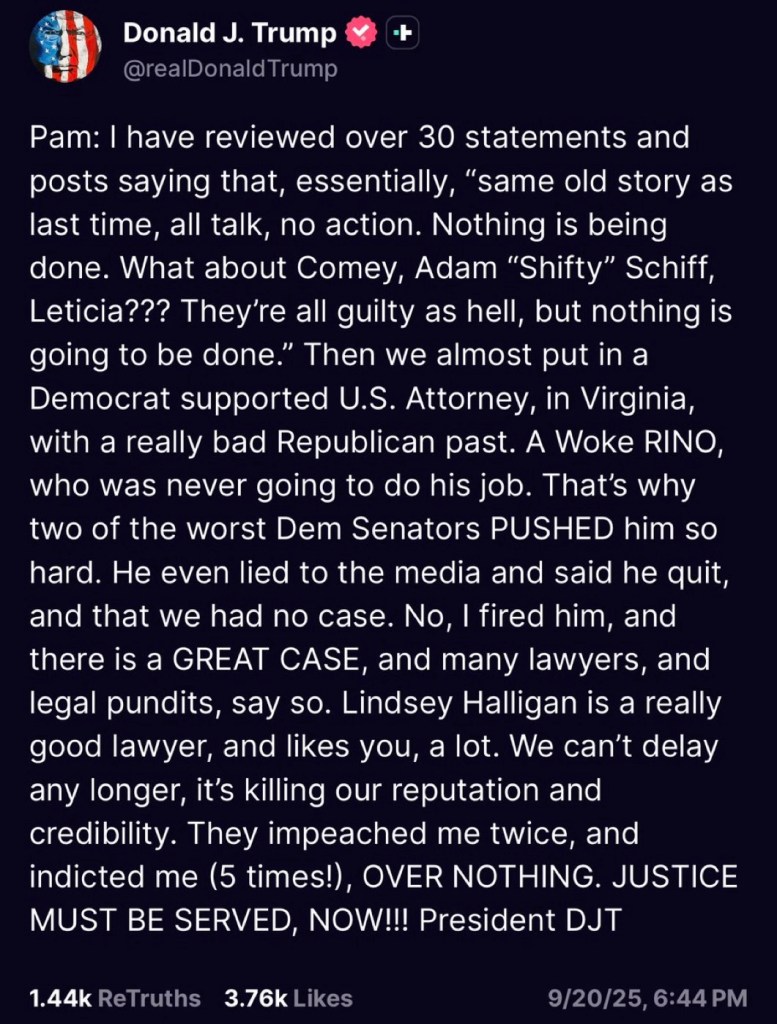
The New Republic tells the shameful story of Trump’s decision to fire Eric Siebert, the U.S. Attorney for the Eastern District of Virginia for his failure to find evidence to indict New York State Attorney General Letitia James.

Trump has said repeatedly that he wants to bring retribution on his enemies. His Attorney General Pam Bondi has protected and obliged him, not only by not releasing the unredacted Epstein files, but by firing any lawyers who worked on Trump investigations while he was out of office.

Trump is determined to prosecute Letitia James, the New York Attorney General, James Comey, and Adam Schiff.

He assigned Erik Siebert, the U.S. Attorney for the Eastern District of Virginia, the job of prosecuting Letitia James. Trump hoped to get her criminally prosecuted for mortgage fraud, for having obtained a mortgage on a vacation home, getting a favorable rate by claiming it as her home. Unfortunately, the case fell apart when evidence emerged that she had not claimed her second home as her primary residence.

Trump was furious at Siebert.

Siebert announced that he had resigned since the President didn’t want him. Trump quickly contradicted him and said Siebert had not resigned, he was fired. Trump promptly announced a replacement, a conservative Republican, Mary “Maggie” Cleary.

Just last night, Trump expressed his frustration that there had not yet been indictments of his enemies.

The New Republic wrote before Siebert’s ouster:

Trump is set to remove Erik Siebert, the U.S. attorney for the Eastern District of Virginia, for being faithful to facts, evidence, and guidelines governing good prosecutorial conduct, rather than fully corrupting his office to target Trump’s enemies.

That’s not a rhetorical cheap shot. It’s what Trump is actually doing, per ABC:

President Donald Trump is expected to fire the U.S. attorney for the Eastern District of Virginia after his office was unable to find incriminating evidence of mortgage fraud against New York Attorney General Letitia James, according to sources.

Federal prosecutors in Virginia had uncovered no clear evidence to prove that James had knowingly committed mortgage fraud when she purchased a home in the state in 2023, ABC News first reported earlier this week, but Trump officials pushed U.S. Attorney Erik Siebert to nevertheless bring criminal charges against her, according to sources.

Nixon tried to hide his plots against his enemies. Trump says the quiet parts out loud.

What are they guilty of? Criticizing Trump and–in the case of Schiff and James– trying to hold him accountable.

John Kuhn is the superintendent of schools in Abilene, Texas. He was hired by the Abilene school board in April 2024. He previously served as superintendent in three small districts in Texas. The Abilene board introduced him this way

Dr. John Kuhn brings 27 years of proven experience in public education to Abilene ISD. Prior to joining the Abilene ISD team, Dr. Kuhn most recently served as Superintendent of Schools for Mineral Wells ISD. He has also served as superintendent of Perrin-Whitt CISD and as a high school principal, assistant principal, teacher, and bus driver in the Mineral Wells and Graford Independent School Districts.

I met John Kuhn at a conference of the Network for Public Education about a dozen years ago. At that time, he was superintendent of the Perrin-Whitt Distrist, which has about 320 students, half of whom are economically disadvantaged.

John is one of the most eloquent champions of public education that I’ve ever met. I remember him saying, “Send me the kids you don’t want. Send me the kids who don’t speak English. Send me the kids who are struggling to learn. Send me the kids with disabilities. I’m in a public school and we will teach them all.” Or words to that effect. I’m hoping he will be a keynote speaker at our next conference in Houston in April 2026. He’s the leader we need!

He posted this letter on his Facebook page and it drew a massive response and national attention.

Gosh where to begin? I’m eligible to retire in January, and I don’t want to because I feel like I owe the good people who hired me and this great community at least a few years of blood sweat and tears. I work for a great school board in a city I’ve absolutely fallen in love with. But holy moly do I want to pack it in right now. The burden is heavy.

Yesterday I spent hours at an update listening to the impacts on teachers and admins at public schools of bill after bill passed by our lege. Did you know that one bill says teachers are going to be required to catalogue every book in their classrooms? Kindergarten teachers have hundreds of tiny books. With what time? When?

Did you know that another bill says nurses can’t provide any health care whatsoever and counselors can’t provide any emotional support whatsoever without a written permission slip from parents? The bill language is so poorly written that—despite what it clearly says in black and white English—the bill author sent out a clarification saying nurses can provide a band-aid to a kid who is bleeding. He wouldn’t have to send out a clarification if they wouldn’t pass dumb bills—but legislators have been convinced by political groups who hate public schools that everyone inside them are wicked, evil people.

Did you know about the other new bill that says school administrators who work on the side as refs or one-act-play judges at any school anywhere are subject to a $10k fine per offense for working those jobs if they each individually don’t present a contract to their school board.

That doesn’t apply to me, but I know tons of APs and principals who ref and judge student drama contests. In fact, there’s a huge shortage of both, so if they didn’t do it, we’d be in an even bigger bind in trying to put on games. Again, the bill author had to put out a “clarification” claiming the bill doesn’t mean what it clearly says.

Because they refused to listen to the input of our educator groups—groups, by the way, that they are trying to get defunded because they consider them “taxpayer funded lobbyists” for representing school districts and municipalities.

There is a political movement to pull the teeth of local officials at schools and on city councils and county commissioners courts so that all we have is centralized state leadership. So local yokels like yours truly have to be continually demonized and legislated into submission.

I haven’t even talked about vouchers draining our public schools of resources so those education dollars can go toward private schools that aren’t subject to the crushing bureaucracy. I haven’t event talked about the new testing bill—the one that replaces STAAR with the 3x per year Death STAAR that, like its predecessor tests is solely owned and controlled by the TEA commissioner and is not norm-referenced so Texas student results can be compared to other states, which would keep things honest and prevent the manipulation of student results for political narrative-building.

Anyway, I go to a conference all day listening to this stuff the day after Republican Charlie Kirk is murdered and months after a Democratic state senator is murdered, and I just keep thinking, is it worth it? I can retire and keep to myself until I die of old age. I can just fish every single day. I can travel. I can camp. I can sleep in.

And I get to my hotel room and find some social media commenter calling my teachers “demons” because they assigned an chapter of the amazing book Extremely Loud and Incredibly Close as a reading passage for a freshman honors English class. This is a book written in the voice of a nine-year-old boy who lost his dad on 9/11 in the terrorist attack on the twin towers. It’s an award winning book. But the passage has the word “shit” in it. And it has a vulgar term that I’m told the teacher was unfamiliar with it. And it has a crude joke about talking butts, which I was a nine-year-old boy and that’s the kind of crudeness we giggle at, so the author was pretty spot on. It also has the word “pussy” but that was what the kid called his cat, but the Facebook post highlighted it as part of making a case that this book was inappropriate.

Thing is, it’s likely valid that this book should be restricted to older kids—17 and 18 year olds. It’s worth noting that this was assigned to only the honors kids because the other passage that the class was reading—also related to 9/11–was at too easy a reading level. So these poor teachers are trying to find something for advanced kids to read, and they don’t have time, and they’re making a good faith effort to push kids to Meets and Masters because they care (and if our A-F grade is too low, there is outrage over that too). And they pick this award-winning book. They decide one “shit” is tolerable. They aren’t offended by the word “pussy” because it literally isn’t a bad word in the context. They get it approved by a colleague.

And they are called “DEMONS.” (Ironically, in the comments of the outrage post, they’re also called “assholes,” which is literally worse than “anus,” which is one of the words the parent highlighted and took offense to, but nobody scolded the commenter for that vulgarity. What’s good for the goose… Commenters also typed “wtf” and “WTH,” which mean “what the fuck” and “what the hell” but nobody accused them of “grooming” children. Selective outrage, anyone.

Who needs this? Is everybody serious? Does everyone just feel absolutely compelled to post their moral superiority online by attacking perceived enemies they’ve never met or shared a meal with.

Our country is no longer capable of living in community. We’ve been driven to our corners. It is barely possible to be a public servant anymore. I totally get why our city manager retired.

My teachers aren’t demons. They may have made a mistake in assigning this book to 15-year-olds rather than 17-year-olds, and for that there are people online saying they need to be fired. Today Incredibly Loud and Extremely Close is likely temporarily coming off our library shelves while we review our book challenge policies. Read the book. It’ll make you cry.

We can’t win in public ed anymore. This is absolutely ridiculous. If I make it to December, it’s gonna be a miracle. I don’t need your sympathy replies, either. I’ll hang it up when I have to for my family and my health, and I’ll stick it out if I feel like I want to. In the meantime, I just want you to know I’m sick of politicians playing divisive politics and leaving local public servants to clean up the mess. Public schools are apolitical entities with the job of teaching kids to think critically and become awesome humans. We aren’t perfect. We have missteps, because we are human organizations. But don’t call my teachers DEMONS while you cuss in the comments.

Scott Maxwell is my favorite opinion writer at The Orlando Sentinel. He always makes sense, in a state led by a Governor and Leguslature that make no sense at all.

In this column, he asks a straightforward question: Why is there no accountability for school vouchers? Why are taxpayers shelling out money for substandard schools? Why is money diverted from public schools to pay for schools where the curriculum is based on the Bible, not facts?

Maxwell writes:

Florida recently joined about a dozen states in passing new rules that say participants in the Supplemental Nutrition Assistance Program, formerly known as food stamps, can’t use their vouchers on junk food.

I think that makes sense to most people. This program, after all, is supposed to provide “nutrition” to people in need, most of whom are children, elderly or people with disabilities.
Basically, if taxpayers are providing $330 a month for basic food needs, that money shouldn’t be used on Red Bull and Oreos.

So now let’s take that a step further.

Taxpayer money also shouldn’t be used to send students to the junk-food equivalent of school — places that hire “teachers” without degrees, use factually flawed curriculum or that hand out A’s to every kid, regardless of what they actually learn, just to make their parents feel better.

Just like with food stamps, taxpayers have a right to know that the money they’re providing for schools is actually funding a quality education.

Yet in Florida that is not the case. Here, the voucher-school system is the Wild West with a lack of accountability and scary things funded with your tax dollars.

The Orlando Sentinel has documented this mess for years through its “Schools without Rules” investigation that found taxpayer-funded voucher schools where:


• “Teachers” lacked degrees or any kind of basic teaching certification
• Finances were so disastrous that schools actually shut down in the middle of the school year, stranding families and students
• Science classes taught students that dinosaurs roamed the earth alongside man, and history lessons claimed slavery and segregation weren’t really all that bad

• Administrators refused to admit students with disabilities or who had gay parents
• Parents filed complaints that included “Cleaning lady substituting for teacher,” “They don’t provide lunch and they don’t even have a place to eat” and “I don’t see any evidence of academics”

I don’t care how pro-school choice you are, tax dollars shouldn’t fund that kind of nonsense.

Some of these fly-by-night schools set up in strip malls seem to thrive because they tell parents what they want to hear — that their kids who were struggling in public schools magically became straight-A students at voucher schools with little to no standards or legitimate measures of success.

Well, that’s the educational equivalent of junk food. And taxpayers wouldn’t fund that kind of nonsense if the state enacted basic accountability measures.

Namely, all voucher-eligible schools should be required to:

• Publish graduation rates and nationally accepted test scores
• Hire teachers who are certified or at least have a college degree
• Disclose all the curriculum being taught
• Ban discrimination

Most good schools already do this. Think about it: what kind of reputable school wouldn’t agree to hire qualified teachers? Or wouldn’t want the public to see what kind of test scores their students produce?

If you want to send your kid to a school that’s unwilling to clear those ground-level hurdles, you shouldn’t expect taxpayers to fund it.
Similarly, if you want to run a school that refuses to serve kids in wheelchairs or who are gay, you shouldn’t fund your discrimination with money that belongs to the people against whom you’re discriminating.

In Florida, some of the worst voucher schools are faith-based. But so are some of the best. Parents and taxpayers deserve to see the difference — the test scores that show whether students are actually learning.

Many faith-based schools embrace science and history. But some try to replace proven facts with their own beliefs or opinions, using “biology” books that claim evolution data is false and “history” books that try to put sunny spins on slavery and segregation.

The people who defend — and profit off — Florida’s unregulated voucher system usually cite “freedom” and “parental rights” as a justification for unfettered choice. But you know good and well that virtually every other taxpayer-funded system has sensible guardrails.

You can’t take Medicaid money to a witch doctor or a psychic “healer.” And just like we don’t give parents the “choice” to use SNAP vouchers to buy their kids Snicker bars, they don’t deserve the “freedom” to take money meant to provide a quality education to a school that can prove it’s providing one.


Basic transparency and accountability measures are needed for any program to be effective. So whenever you hear anyone protesting them, you have to wonder what it is they don’t want you to see.

This may be the most important article you will read today.

Richard Rothstein has had a distinguished career as a journalist who writes about social science, most notably, achievement gaps, housing segregation, and the impact of poverty on academic performance. He has long been a fellow at the Economic Policy Institute and before that was education editor of The New York Times.

Rothstein writes here about the origins of the belief that teachers are directly responsible for student academic performance. If students score poorly on tests, goes the theory, it’s because their teachers have low expectations for them. In the case of black students, teachers’ racism is likely to explain their low expectations. From this perspective, No Child Left Behind and Race to the Top made perfect sense. The teachers needed high expectations or needed to be fired.

Rothstein writes:

Social psychologist Robert Rosenthal died at the age of 90 last month. He was best known for his 1968 book, Pygmalion in the Classroom, co-authored by Lenore Jacobson, an elementary school principal in South San Francisco.

No book in the second half of the 20th century did more, unintentionally perhaps, to undermine support for public education, and thus diminish educational opportunities for so many children, especially Black and Hispanic children, to this day. The book and its aftermath put the onus solely on teacher performance when it came to student achievement, disregarding so many critically important socioeconomic factors—at the top of the list, residential segregation.
How did it do that?

The book described an experiment conducted in Ms. Jacobson’s school in 1965. The authors gave pupils an IQ test and then randomly divided the test takers into two groups. They falsely told teachers that results showed that students in one of the groups were poised to dramatically raise their performance in the following year, while the others would not likely demonstrate similar improvement.

At the end of that year, they tested students again and found that the first and second graders in the group that was predicted to improve did so on average, while those in the other group did not. The book, as well as academic articles that Dr. Rosenthal and Ms. Jacobson published, claimed that the experiment showed that teacher expectations had a powerful influence on student achievement, especially of young children. Pupils whose teachers were told were more likely to improve then apparently worked harder to meet their teachers’ faith in them.1

Some psychologists were skeptical, believing that the experimental design was not sufficiently rigorous to support such a revolutionary conclusion. Even the reported results were ambiguous. Teacher expectations had no similar impact on children in grades three through six. Similar experiments elsewhere did not confirm the results even for first and second graders.2

Nonetheless, the book was very influential.
In the decades after Pygmalion, other studies examined teacher expectations. They showed that teachers have greater expectations of higher achieving students but couldn’t determine whether the teacher attitudes helped to cause better pupil performance. Perhaps teachers only developed those expectations after seeing that students were higher achieving.3 Only an experimental study, like Pygmalion, could establish causality, but contemporary ethical standards would often prohibit such experiments, requiring, as they must, lying to teachers about their students’ data.

Minority children in the South San Francisco school where Rosenthal and Jacobson experimented were Mexican-origin, not African American. Yet ignoring how scanty the evidence was, education policymakers concluded from their research that the Black-white gap in test scores at all grade levels resulted from teachers of Black children not expecting their pupils to do well. And that, they reasoned, should be an easy problem to solve—holding teachers accountable for results would force them to abandon the racial stereotypes that were keeping children behind.

The accountability movement grew in intensity during the Bill Clinton administration, while in Texas, Governor George W. Bush implemented a mandatory standardized testing program whose publicized results, he thought, would force teachers to improve by shaming them for the lower scores of their poorer Black and Hispanic pupils.

In 2000, Bush was elected president; his campaign promised to demolish teachers’ “soft bigotry of low expectations.” During his first year in office, he led a bipartisan congressional majority to adopt the “No Child Left Behind Act” that required every state to conduct annual standardized testing in reading and math for pupils in the third through eighth grades. 

Shortly after the bill was signed, I met with the congressional staffer who had been primarily responsible for writing the legislation. She predicted that within two years, the publication of test scores would so embarrass teachers that they would work harder, with the result that racial differences in academic achievement would evaporate entirely.

Nothing of that sort has happened. Although test performance of both Black and white students has improved somewhat, the gap is not much different than it was two decades ago. But the public reputation of our teaching force has continued to deteriorate, as a conclusion spread that failure to equalize test results could be remedied by gimmicks like naming a school’s classrooms for the Ivy League colleges that teachers expected their students to attend.4 

Enthusiasm for charter schools escalated from a belief that operators could choose teachers with higher expectations, yet charter schools have not done any better (and in many cases worse) in closing the gap, once the sector’s ability to select students less likely to fail (and expel students who do) is taken into account.5

In 2008, I taught an education policy course for master’s degree candidates, many of whom had taught for two years in the Teach for America (TFA) program. It placed recent college graduates without teacher credentials in schools for lower-income Black and Hispanic students.

Funded heavily by private philanthropies, TFA embraced the low-expectations theory of below-average performance. Prior to their teaching assignments, TFA corps members were required to attend a summer institute whose curriculum featured a unit entitled “The Power of My Own Expectations” and required them to embrace the “mindset” of “I am totally responsible for the academic achievement of my students.”

None of my master’s degree students claimed that in their two years of teaching, their high expectations actually produced unusually high achievement. But most were so immunized against evidence and experience that they enrolled in a graduate program with the intention of creating new charter schools infused with high expectations. Only a few wondered what had gone wrong with their theory, besides having goals that still weren’t high enough.

Certainly, there are teachers with low expectations and harmful racial stereotypes, and it would be beneficial if those who can’t be trained to improve were removed from the profession. But I’ve visited many schools serving disadvantaged students. Most teachers I observed, white and Black, were dedicated, hard-working, engaged with their students, and frustrated about the social and economic challenges with which children daily came to school. I don’t claim that my observations were representative; I was more likely to be invited to visit schools that took great pride in their efforts, despite conditions they struggled to overcome.

No matter how high their expectations, teachers can’t do much about:

*their pupils’ higher rates of lead poisoning that impact cognitive ability;

*more frequent asthma—the result of living with more pollution, near industrial facilities, in less-well maintained buildings with more vermin in the environment—that may bring them to school drowsy from being awake at night, wheezing;

*neighborhoods without supermarkets that sell fresh and healthy food;

*stress intensified by being stopped and frisked by police without cause, and a discriminatory criminal justice system that disproportionately imprisons their fathers and brothers for trivial offenses;

*frequent moves due to rising rents, or landlords’ failure to keep units in habitable condition;

*absenteeism from a need to stay home to care for younger siblings while parents race from one low-wage job to another;

*poor health from living in neighborhoods with fewer primary care physicians or dentists;

*lower parental education levels that result in less academic support at home, combined with less adequate access to technology, a problem exacerbated since the pandemic;6

*and many other socioeconomic impediments to learning.7

Not every Black child suffers from these deprivations that affect their ability to take full advantage of the education that schools offer. But many do. Concentrating disadvantaged pupils in poorly resourced schools in poorly resourced and segregated neighborhoods overwhelms instructional and support staffs.

Such realities contributed to my conclusion that residential segregation, not low teacher expectations, was the most serious problem faced by U.S. education. It is what led to my recent books, The Color of Law, and its sequel (co-authored by my daughter, Leah Rothstein), Just Action; How to challenge segregation enacted under the Color of Law.

Robert Rosenthal’s Pygmalion theory set the stage for a national willingness to deny educational disparities’ true causes: the unconstitutional and unlawful public policies that imposed racial segregation upon our nation.

Footnotes:

1. Robert Rosenthal and Lenore Jacobson. 1968. Pygmalion in the Classroom: teacher expectation and pupils’ intellectual development. (New York: Holt, Rinehart, and Winston). For a technical summary by the authors, see. Rosenthal and Jacobson, “Pygmalion in the Classroom.” The Urban Review 3, September, 1968: 16-20.

2. See “Pygmalion in the Classroom.” The Urban Review 3, September, 1968, footnote on p. 19.

3. For example, see Thomas L. Good, Natasha Sterzinger, and Alyson Lavigne. 2018. “Expectation Effects: Pygmalion and the initial 20 years of research.” Educational Research and Evaluation 24 (3-5): 99-123.

4. See, for example, Richard Rothstein. 2010. “An overemphasis on teachers.” Commentary, Economic Policy Institute, October 18. 

5. Martin Carnoy, et al. 2005. The Charter School Dust-Up. (Washington, D.C.: The Economic Policy Institute).

6. In early 2020, I wrote that the pandemic would widen the achievement gap. The consequences turned out to be worse than I could have imagined. Teacher expectations had nothing to do with it. Richard Rothstein. 2020. “The Coronavirus Will Explode Achievement Gaps in Education.” Shelterforce.org, April 13.

7. Richard Rothstein. 2004. Class and Schools. Using social, economic, and educational reform to close the black–white achievement gap. (Washington, D.C.: The Economic Policy Institute).

The text of this post was originally published on January 30, 2024 on the Working Economics Blog of the Economic Policy Institute.

People who did not express genuine grief at the murder of Charlie Kirk are in serious trouble. Some have been fired or suspended. Some have been harassed for their views. Before anyone attacks me for acknowledging this phenomenon, let me point out that I did deplore his murder while making clear that I share none of his views.

Reuters reported on the efforts to ferret out and punish those who did not react to Charlie’s assassination in the correct manner.

At least 15 people have been fired or suspended from their jobs after discussing the killing online, according to a Reuters tally based on interviews, public statements and local press reports. The total includes journalists, academic workers and teachers. On Friday, a junior Nasdaq employee was fired over her posts related to Kirk.

Others have been subjected to torrents of online abuse or seen their offices flooded with calls demanding they be fired, part of a surge in right-wing rage that has followed the killing.

Some Republicans want to go further still and have proposed deporting Kirk’s critics from the United States, suing them into penury or banning them from social media for life.

“Prepare to have your whole future professional aspirations ruined if you are sick enough to celebrate his death,” said conspiracy theorist Laura Loomer, a prominent ally of President Donald Trump and one of several far-right figures who are organizing digital campaigns on X, the social media site, to ferret out and publicly shame Kirk’s critics.

CNN reported that there is a coordinated campaign to punish those who speak ill of Charlie on social media.

Indeed there is. It’s called “Expose Charlie’s Murderers” on Twitter, and it invites everyone to report the names and screenshots of anyone who posted sentiments critical of Charlie or comments applauding his murder.

The website opens with this message:

Charlie Kirk was murdered.

Is an employee or a student of yours supporting political violence online?

Look them up on this website.

Send information on anyone celebrating Charlie’s death.

Follow us on X/Twitter: @forcharliekirk1

ATTENTION:
This website will soon be converted into a searchable database of over 30,000 submissions, filterable by general location and job industry. This is a permanent and continuously-updating archive of Radical activists calling for violence.

This is the largest firing operation in history.

Since his admirers on all ends of the political spectrum have expressed admiration for his commitment to discussion, debate, and dissent, it is ironic that not only his friends but government officials like Pete Hegseth are searching social media for people they can punish for saying “the wrong thing” (e.g. criticizing Charlie’s views or not mourning his death).

Charlie, a high school graduate, was contemptuous of higher education, which he believed was controlled by leftwing, anti-American ideologues. On Twitter, before his killer was identified, several of Charlie’s admirers speculated that the murderer had been indoctrinated by Marxists and Communist professors at college. Such comments led to snarky responses about the political leanings of the faculty teaching electrical technology (how to be an electrician) at Dixie Technical College in Utah.

Freedom of speech is a basic right, guaranteed in the First Amendment. Even abhorrent views are protected speech; it’s the abhorrent views that need protection, not those that offend no one.

Jamelle Bouie is one of the best, most interesting opinion writers for The New York Times. As a subscriber to that newspaper, I signed up for Bouie’s newsletter, which is where these thoughts of his appeared.

Jamelle Bouie writes:

Virtually every person of note in American politics has, rightfully, condemned the horrific killing of Charlie Kirk and expressed their deep concerns about the growing incidence of political violence in the United States. Wherever we stand politically, we all agree that he should still be alive.

There has been less agreement about Kirk’s life and work. Death tends to soften our tendency to judge. And sudden, violent death — especially one as gruesome and shocking as this one — can push us toward hagiography, especially in the immediate wake of the killing.

So it goes for Kirk.

“Charlie inspired millions,” President Trump said in an Oval Office speech on Wednesday. “He championed his ideas with courage, logic, humor and grace.”

“The best way to honor Charlie’s memory,” Gov. Gavin Newsom of California declared, “is to continue his work: engage with each other, across ideology, through spirited discourse.”

Kirk’s approach, wrote the editors of Politico’s Playbook, “was to persuade, to use charm and charisma and provocation and the power of argument to convince people of the righteousness of his cause.”

There is no doubt that Kirk was influential, no doubt that he had millions of devoted fans. But it is difficult to square this idealized portrait of Kirk as model citizen with the man as he was.

Kirk’s eulogists have praised him for his commitment to discourse, dialogue and good-faith discussion. Few if any of them have seen fit to mention the fact that Kirk’s first act on the national stage was to create a McCarthyite watchlist of college and university professors, lecturers and academics. Kirk urged visitors to the website to report those who “discriminate against conservative students and advance leftist propaganda in the classroom.”

The list, which still exists, is a catalog of speech acts in and outside the classroom. The surest way to find yourself on the watchlist as an academic is to disagree, publicly, with conservative ideology, or even acknowledge ideas and concepts that are verboten among the far right. And the obvious intent of the list is made clear at the end of each entry, where Kirk and his allies urge readers to contact the schools and institutions in question. Targets of the watchlist attest to harassment and threats of violence.

The Professor Watchlist is a straightforward intimidation campaign, and you can draw a line directly from Kirk’s work attacking academics to the Trump administration’s all-out war on American higher education, an assault on the right to speak freely and dissent.

To speak of Kirk as a champion of reasoned discussion is also to ignore his frequent calls for the state suppression of his political opponents.

“‘Investigate first, define the crimes later’ should be the order of the day,” Kirk declared in an editorial demanding the legal intimidation of anyone associated with the political left. “And for even the most minor of offenses, the rule should be: no charity, no goodwill, no mercy.”

Speaking last year in support of Trump’s plan for mass deportation, Kirk warned that the incoming president would not tolerate dissent or resistance. “Playtime is over. And if a Democrat gets in our way, well, then Matt Gaetz very well might go arrest you,” he said.

It is also important to mention that Kirk was a powerful voice in support of Trump’s effort to “stop the steal” after the 2020 presidential election. His organization, Turning Point USA, went as far as to bus participants to Washington for the rally that devolved into the Jan. 6 riot attack on the Capitol.

And then there is Kirk’s vision for America, which wasn’t one of peace and pluralism but white nationalism and the denigration of Americans deemed unworthy of and unfit for equal citizenship.

On his podcast, Kirk called on authorities to create a “citizen force” on the border to protect “white demographics” from “the invasion of the country.” He embraced the rhetoric of white pride and warned of “a great replacement” of rural white Americans.

“The great replacement strategy, which is well underway every single day in our southern border, is a strategy to replace white rural America with something different,” he said last year. “You believe in God, country, family, faith, and freedom, and they won’t stop until you and your children and your children’s children are eliminated.”

Kirk also targeted Black Americans for contempt. “Prowling Blacks go around for fun to go target white people — that’s a fact,” he said in 2023. Kirk was preoccupied with the idea of “Black crime,” and on the last episode of his show before he was killed, he devoted a segment to “the ever-increasing amount of Black crime,” telling his audience, falsely, that “one in 22 Black men will be a murderer in their lifetime” and that “by age of 23, half of all Black males have been arrested and not enough of them have been arrested.”

Kirk told his listeners that Justice Ketanji Brown Jackson of the Supreme Court “is what your country looks like on critical race theory,” that former Vice President Kamala Harris was “the jive speaking spokesperson of equity,” and that the Rev. Dr. Martin Luther King Jr. “was awful.”

“I have a very, very radical view on this, but I can defend it, and I’ve thought about it,” Kirk said at a 2023 event. “We made a huge mistake when we passed the Civil Rights Act in the 1960s.”

This is just a snippet of Kirk’s rhetoric and his advocacy. He also believed that there was no place for transgender people in American society — “We must ban trans-affirming care — the entire country,” he said in 2024 — and has denounced L.G.B.T. identities as a “social contagion.”

It is sometimes considered gauche, in the world of American political commentary, to give words the weight of their meaning. As this thinking goes, there might be real belief, somewhere, in the provocations of our pundits, but much of it is just performance, and it doesn’t seem fair to condemn someone for the skill of putting on a good show.

But Kirk was not just putting on a show. He was a dedicated proponent of a specific political program. He was a champion for an authoritarian politics that backed the repression of opponents and made light of violence against them. And you can see Kirk’s influence everywhere in the Trump administration, from its efforts to strip legal recognition from transgender Americans to its anti-diversity purge of the federal government.

We can mourn Kirk. We can send prayers to his friends and family. We can take stock of the gravity of this event. We can — and should — do all of this and more without pretending he was something, as a public figure, that he was not.