Things are looking bad these days. We have a rightwing lunatic as President who thinks he’s a king. We are entangled in a war with religious fanatics who are gleefully tearing down the global economy by closing passage through a crucial, narrow waterway. We have a Congress that is supine and subservient to our Mad King. Prices of everything are spiraling up because of aforementioned war.
Time for some cheerful news! Watch this brief clip made by the four astronauts aboard Artemis 2, which has already gone further into space than anyone else. They passed the old record of near 250,000 miles, and they will see the dark side of the moon. That’s happening about now.
Heather Cox Richardson reviews Trump’s erratic behavior since he started a war against Iran. He repeatedly announces that he has won the war, that negotiations are going well, and then threatens Iran with obliteration. Is this incoherence “the art of the deal” or is something else going on?
Remember the days when foreign policy was debated by experienced diplomats of the National Security council behind closed doors? When policies were the result of deliberation, not announced at 3 am on social media by the President, acting alone to vent his grievances? Remember when negotiations were led by the Secretary of State, not the President’s son-in-law?
That’s the way it used to be done. That’s the way it’s done in other countries. In the U.S., today, in the Trump era, one man makes policy in the middle of the night, depending on his whim.
At 8:03 this morning, Easter Sunday, President Donald J. Trump’s social media account posted: “Tuesday will be Power Plant Day, and Bridge Day, all wrapped up in one, in Iran. There will be nothing like it!!! Open the F*ckin’ Strait, you crazy b*stards, or you’ll be living in Hell—JUST WATCH! Praise be to Allah. President DONALD J. TRUMP”
There are many things that could be going on with this ultimatum, which actually doesn’t sound like Trump’s usual style, in the same way the post of yesterday morning didn’t.
The post appears to be threatening to commit war crimes by attacking civilian infrastructure, and it appears to suggest Trump is considering using tactical nuclear weapons. He emphasized the production of such weapons in his first administration. He seemed to encourage this interpretation in an interview with Rachel Scott of ABC News today. She said Trump “told me the conflict should be over in days, not weeks but if no deal is made he’s blowing up the whole country with ‘very little’ off the table. ‘If [it] happens, it happens. And if it doesn’t, we’re blowing up the whole country,’ he said. I asked if there’s anything off limits. ‘Very little,’ he said.”
In 2023 a book by New York Times Washington correspondent Michael Schmidt alleged that in 2017, when Trump was warning North Korean leader Kim Jong-un on social media that North Korea would be “met with fire and fury and frankly power, the likes of which this world has never seen before,” behind closed doors he was talking about launching a preemptive strike against North Korea and of using a nuclear weapon against the country and blaming someone else for the strike .
Schmidt reports that Trump’s White House chief of staff at the time, retired U.S. Marine Corps General John Kelly, brought military leaders to try to explain to Trump why that would be a bad idea and finally got him to move away from the plan by telling him he could prove he was the “greatest salesman in the world” by finding a diplomatic solution to his fight with the North Korean leader.
In his own book about that period, journalist Bob Woodward wrote: “The American people had little idea that July through September of 2017 had been so dangerous.”
But Trump’s secretary of state Mike Pompeo told Woodward: “We never knew whether it was real or whether it was a bluff.”
And that is another way to look at the post from Trump’s social media account: that he is panicked that he has not been able to bully other countries into fixing the mess he created by attacking Iran and precipitating the closure of the Strait of Hormuz, and is now simply trying to bully Iran. In The Guardian last Monday, Sidney Blumenthal noted that Trump “has declared ‘victory’ more than eight times,” says he has “won” more than ten times, and said Iranian forces have been “obliterated” or suffered “obliteration” more than six times. Blumenthal noted Trump is now threatening to “obliterate” Iran’s power grid and has used the words “decimate” or “decimation” at least six times.
Trump’s crazy post does, after all, push back yet again the deadline for his threats to rain destruction on Iran, which he then extended again in another post at 12:38 P.M. saying: “Tuesday, 8:00 P.M. Eastern Time!”
This dynamic was not lost on Allison Gill of Mueller, She Wrote, who noted: “It was March 23rd. Then March 27th. Then March 30th. Then he gave that weird address on April 1st. [N]ew deadline April 4th. Then April 6th at 7 AM. Then April 7th at 8 PM. And now another address tomorrow at 1 PM. The chaos is intentional.” She also noted that his deadlines and his abandonment of them often seem tied to the rhythms of the stock market.
In an interview with Barak Ravid of Axios today shortly after this morning’s post, Trump reiterated that “if they don’t make a deal, I am blowing up everything over there” but also said the U.S. is “in deep negotiations” with Iran and that he thinks a deal can be reached. Trump told Ravid that his envoys Steve Witkoff and Jared Kushner—not Secretary of State Marco Rubio—are talking with the Iranians. Sources told Ravid that mediators from Pakistan, Egypt, and Türkiye are facilitating the talks.
But Iranian officials are refusing to deal with Witkoff and Kushner after they apparently misunderstood earlier negotiations and instead told Trump the talks weren’t going well before he launched strikes. Neither Witkoff nor Kushner is a trained diplomat, and both have deep financial ties to the Middle East. Notably, Saudi Arabia’s Crown Prince Mohammed bin Salman (MBS), who urged Trump to start the Iran war, has invested at least $2 billion in Kushner’s private equity firm.
On March 13, Rob Copeland and Maureen Farrell of the New York Times reported that Kushner is trying to raise $5 billion or more for his private equity firm from Middle East governments at the same time as he is also supposed to be negotiating peace in the region.
But Stephen Kalin, Eliot Brown, and Summer Said of the Wall Street Journal reported today that the closure of the Strait of Hormuz has already cost the Saudis about $10 billion, and the grand plans of MBS were already falling short of money. Some of those plans were U.S. investments. The reporters note that even before the war, the Saudi’s sovereign-wealth fund, the same one that invested in Kushner’s private equity firm, had sold much of its U.S. stock portfolio. Last year, MBS promised to invest up to $1 trillion in the U.S. Those investments are now under review.
Regardless of the inspiration for Trump’s post, by itself it tells a very clear story. The Federal Bureau of Investigation’s former assistant director for counterintelligence Frank Figliuzzi posted: “The American president has lost his mind.”
Journalist Steven Beschloss wrote: “This is an actual post. This is not funny. This is beyond desperate. This is a deeply unwell man who doesn’t belong anywhere near the levers of power. Every member of his cabinet and Congress is complicit in not demanding his removal now.”
Senator Chris Murphy (D-CT) posted: “If I were in Trump’s Cabinet, I would spend Easter calling constitutional lawyers about the 25th Amendment. This is completely, utterly unhinged. He’s already killed thousands. He’s going to kill thousands more.”
The 25th Amendment establishes a process through which a majority of the Cabinet and the Vice President, or another body Congress designates, can remove a president deemed “unable to discharge the powers and duties of his office.”
Murphy was not the only one thinking along those lines. Hollie Silverman of Newsweekreported that on the prediction market platform Kalshi, which allows traders to buy “yes” or “no” shares on the question “Will the 25th Amendment be used during Trump’s presidency?” “yes” has moved in recent days from 28.6% to 35.1%.
You’re currently a paid subscriber to Letters from an American. If you need help receiving Letters, changing your email address, or unsubscribing, please visit our Support FAQ. You can also submit a help request directly.SHARELIKECOMMENTRESTACK
John Thompson, retired teacher and historian in Oklahoma, was stunned by some survey results released about parents’ opinions on education. He took a deep dive, read the raw data, and discovered that the survey was conducted by ExcelInEd, Jeb Bush’s organization. Excel promotes high-stakes accountability for public schools but no accountability whatsoever for voucher schools, which they also promote.
ExcelinEd has familiar game plan: they use inaccurate NAEP statistics to defame public schools, demand more accountability to crush the morale of principals, teachers, and parents, then insist that vouchers and charters are the way forward. As Josh Cowen showed in his book The Privateers, voucher schools get far worse results than public schools, and numerous studies have shown that charter schools are usually no better than public schools and often much worse.
Thompson writes:
Patricia Levesque, the executive director of ExcelinEd, recently wrote a commentary about a survey of 500 Oklahoma parents, claiming that more than 80% of them want “a state testing and accountability system to measure student achievement, and they expect honesty and accuracy about their children’s grade level performance.”
So, I took a dive into the survey. My reading of it was very different than Levesque’s.
In some ways, the survey she described is consistent with the Education Department parent survey that State Superintendent Lindel Fields released. But Levesque’s interpretation of the results was very different than Fields’ analysis of the state’s parent feedback.
The survey Levesque cited found that 74% of parents want a pay raise for teachers, and another 74% say we spend too little on education. Her study found that 80% of parents were very or somewhat satisfied with their school but, for some reason, it adds, “While overall positive, this fails to hit the common 95% satisfaction sought in commercial endeavors.”
While 78% of parents support retention by 3rd grade of students who don’t read on “level,” parents estimate that about 83% students read at or above grade level; and 78% are confident in the way their schools teach reading.
FYI, in 1998, 80% of Oklahoma 8th graders read at that level, but now about 59% do. My reading of the research, and classroom experience, attributes the subsequent decline to the way that No Child Left Behind and the Race to the Top undermined the teaching of History, Science, Arts, and of the background knowledge that is essential for reading comprehension; huge funding cuts; COVID; and Ryan Walters; as well as the rise of social media.
Yes, 83% of the survey are supportive of student testing, which is no surprise. But, the study doesn’t dig into the difference between testing for tracking student progress, as opposed to high-stakes testing. After all, there is great support for testing for diagnostic purposes, as opposed to the reward-and-punish testing that has been rampant since the NCLB was enacted.
Conversely, the Education Departments’ parent survey seems to be calling for schools to tackle the crucial issues that they were forced to ignore, as districts invested in high-stakes test-prep.
When Superintendent Fields explained that the results of statewide surveys of educators and parents, informed the budget priorities he is seeking. Superintendent Fields reported, “Early literacy, support systems to improve behavior and mental health resources and teacher recruitment and retention are among the top three concerns for all groups surveyed.”
The parents survey included repeated calls for teaching critical thinking skills, and media literacy; identifying misinformation; and early grade emphasis on literacy.
It explained that parents “highlighted the importance of both academic and life skills, emphasizing the need for students to be well-prepared for real-world challenges.”
Parents said that misinformation is very prevalent, and children need to be taught how to tell fact from fiction. They understand that learning how to be critical consumers of information is “literally the foundation of a successful life.” They know that social media and A.I. can make kids “susceptible to conspiracy theories and propaganda.”
What I didn’t see in the parents’ responses was calls for data-driven accountability; online, as opposed to personal tutoring for 3rd graders; or simple “miracles.”
What I saw was a desire to return to personal connections. I saw goals that would require more support for educators, as well as requiring cooperation with social workers, health providers, and mentors that are necessary for preparing children for a full life in the 21st century.
Stephen Dyer, former legislator, current budget watchdog, warns that Ramaswamy wants to close some of Ohio’s institutions of higher education and make the cost of college even higher for the families of Ohio.
Vivek’s proposal to close public colleges follows years of Republican disinvestment in higher education and public education. Rising costs cause enrollments to decline. Declining enrollments are then an excuse to close colleges.
Why does Ohio want a less-educated public?
Please open the link to his excellent article to read the footnotes.
Dyer writes:
They’re hoping you don’t notice.
Notice that for 30 years, Ohio Republicans have slowly starved higher education funding, which has made the $1 million promise of a college education less attainable for middle-class families.
They’re hoping you fall for the anti-college mythology — they waste money, are giving kids diplomas for basket weaving, are full of hippies. Whatever. They don’t care. Just buy it, already!
They want you to blame anyone but them, even though it’s all their fault.
A personal note. I’m a tuition-paying parent for a public university student.
It’s now more expensive to send my son to Ohio State as an in-state resident than it was for my parents to send me to Tufts University in the 1990s.
Yeah. That’s crazy.
But that cost hike wasn’t because Ohio State is so inefficient or concerned with basket weaving majors that I’m paying through the nose for my son’s education¹.
Nope.
Ohio Republicans made this happen. They’ve steadily made the unattainably expensive college degree a reality since they started dominating the statehouse and Governor’s mansion in 1994. In fact, it seems the two things they’ve consistently done from a public policy perspective is de-fund both public K-12 education and higher education.
So, for example, in 1979, 11.6% of the state budget went to pay for the State Share of Instruction (SSI) — the direct funding portion of the state’s higher education budget that essentially subsidizes in-state tuition (it does more than that, but trying to keep it simple). That was the highest proportion on record.
Next year, it will be 4.7% — the lowest on record.
If the state committed as much of the state budget to SSI next year as it did in 1979, the state would be providing $3.2 billion more just to SSI.
How much is that, you ask?
In the 2024-2025 school year, the total tuition collected by all 2-year and 4-year public higher education institutions by all students, in-state and out-of-state, was $3.6 billion.
That’s right.
If Ohio had maintained the same commitment to its college students that it did in 1979, we could have tuition free — or essentially free — 2- and 4-year public universities for every Ohio resident … and then some.
But we don’t even have to go back to 1979. If you went back to the last time the percentage of SSI funding went up under Gov. Ted Strickland in the 2009-2010 school year, you’d have another $1.6 billion. Or if you went back to the first year Republicans had complete governmental control — 1994-1995, you’d have $1.8 billion.
Wanna bet whether Ohio’s public 4-year institutions would be facing an “enrollment crisis” if tuition were reduced this much, Vivek?
Yet for some reason, Ramaswamy seems to want to make closing University of Akron and Kent State University — and the elimination of tens of thousands of jobs — a tentpole of his gubernatorial bid.
As a former stat legislator who used to represent parts of Summit and Portage counties — where those two universities reside — I’m gonna say that’s certainly a strategy.
A fucking stupid one.
But it’s a strategy.
This is not rocket science. As state commitment drops, the burden placed on college students and their families increases. The correlation is strong, as my buddy Claude pointed out here²:
Notice there’s a little blip in the percentage during the FY10 and FY11 years. Just as a reminder, those were the only two years of a politically divided legislature and Democratic Governor.
As an aside, you’ll recognize a similar blip on the state share of public K-12 education funding during this same period — the only year on record that more state than local property tax funding paid for Ohio’s public schools.
By the way, did I mention this all good stuff happened in a budget I helped negotiate during the height of the Great Recession? Please excuse my shameless public policy prowess plug (and alliteration).
Every other year on that chart, Ohio Republicans controlled every lever of power. And the pattern is clear:
Defund the state funding stream that makes college affordable for working families
Make that option far less affordable for those same families
Then when fewer students attend the universities that rely on first-generation students (Kent State and University of Akron come to mind, don’t they Vivek?), blame the universities
Count on everyone both not noticing the steady drain of resources while they get hooked by the “out-of-touch” higher education narrative
Call on the schools to stop focusing on educating our students and instead become corporations’ training arms
Or, in the case of the Ohio GOP’s billionaire gubernatorial candidate, shut them down
This is all Republicans’ fault. They didn’t have to do this. There wasn’t some crisis that forced them to divest from SSI since they took power.
In fact, according to the most recent Grapevine report, while student share of higher education cost has gone up since 1980, it’s been by 18 percentage points nationally.
In Ohio, that increase has jumped 24 points.
The average Ohio student has to come up with 57 percent of their higher education cost. The national average is 39 percent — still way too high for a country that has to rely on innovation to dominate the world economy.
But Ohio is 46 percent worse than that.
In only 10 states do families have to pay a higher share of the higher education freight than Ohioans.
Since 1980, Ohio has cut its appropriations for higher ed overall by 14.8 percent. The national average over that period was a 13 percent increase.
Look. I know Vivek wants to shutter two of the state’s main economic and intellectual engines because they struggle with enrollment. But that struggle isn’t because of what he says — inefficiency, lack of excellence (whatever that is), etc.
I think that spending 30 years dropping the share of the state budget going to subsidize tuition below 5 percent for the first time ever might explain why fewer kids go to college in Ohio than they used to and why enrollment at first-generation universities — whose students typically come from working-class backgrounds — has struggled to grow.
Yeah.
That sure as hell seems more likely than whatever the fuck Vivek is imagining under his Jimmy Neutron hair.
A reader who identifies as “Retired Teacher” explains the best way to teach reading. The best way is to start by understanding that there is no single way to teach reading. The best way is to assess what’s right for the students in front of you. Some need help in phonics; some don’t. Some are already fluent readers and need challenging and engaging stuff to read.
RT writes:
Most competent reading teachers are effective when they diversify instruction based on the needs of the learner. Generally, the first step in effective reading instruction is to assess students. What often results in elementary classrooms is that teachers often end up placing students into a group with other students with similar needs. Some students arrive in kindergarten reading fluently. They have clearly mastered phonics so there is no need to spend time on phonics lessons the student does not need. Both Diane Ravitch and myself grew up in the “See, Say” era of reading instruction. We didn’t learn phonics. We deduced the sound system from reading it. This method will not work for many students, but there are some that would be successful with this approach.
All learners have strengths and weaknesses. Other students may have other issues like a difficulty with auditory discrimination, and teachers should have the freedom to adjust instruction based on the needs of students. By the way a student with auditory discrimination or memory problems will struggle and flounder in a science of reading environment. This student may have to write the word in order to basically memorize it.
I am a certified reading teacher. I have taught many struggling students, most of whom were English language learners, to read successfully and fluently in English. Part of the reason for positive results was due to the assessing and addressing what the student needed to understand and apply the skill and become a good reader. There is no magic to this process. It is called diversifying instruction, and many competent teachers adjust teaching to meet student needs. Whatever method is used, it needs to meet students’ needs, offer the student a degree of success through application, and be engaging. Professional teachers should have the freedom to adjust instruction without government interference.
Trump stacked the Commission with lackies, some with no relevant experience.
After Judge Leon’s decision, Trump made clear that he would not be deterred. The ballroom, he insisted, was a matter of national security.
“Unless and until Congress blesses this project through statutory authorization, construction has to stop!” the judge wrote in his ruling, which was punctuated by 19 exclamation points.
The Justice Department has filed a notice of appeal, and Mr. Trump has shown a reluctance to bring the project to Congress, where it would face an uncertain fate.
Instead, he has pointed to a portion of the judge’s ruling that allowed “construction necessary to ensure the safety and security of the White House” to continue.
The president has begun arguing that the project is a matter of national security.
“We have bio defense all over,” Mr. Trump told reporters in the Oval Office this week. “We have secure telecommunications and communications all over. We have bomb shelters that we’re building. We have a hospital and very major medical facilities that we’re building. We have all of these things. So that’s called, I’m allowed to continue building.”
So the ballroom is actually part of the national defense system, and no court judgment will stop it.
I am reposting this commentary because the original post this morning did not include a link to the full post.
Denny Taylor is an accomplished scholar and author. She is Professor Emeritus of Literacy Studies at Hofstra University and has earned a long list of awards. She now has a Substack blog that is worth your time. In this post, she goes into detail about the origins of the “Science of Reading” and the poor quality of research on which it is based.
Taylor wrote this post to caution against a federal mandate based on flawed claims. Congress is currently considering HR 7890 Science of Reading Act of 2026. As she shows, it would be absurd if it passes. Congress should not tell teachers how to teach, nor should state legislatures.
The Science of Reading Act of 2026 – H. R. 7890is a catastrophic mistake for three reasons. First, it makes early 20th century phonics instruction the law of the land. Second, the NRP “5 pillars of reading instruction” are not based on science. Third, H. R. 7890does not prepare children to live and thrive in a digital society that is filled with unforeseen hazards and dangers. We must think anew and act anew – before it’s too late.
H. R. 7890 “Evidence-Based Literacy Instruction Aligned to the Science Of Reading” is Not Based On Science
The six-year qualitative as well as the quantitative forensic analyses provides evidence that the scientific foundation undergirding the teaching of reading in America’s public schools is irreparably flawed. The “evidence-based literacy instruction aligned to the Science of Reading” that is described in the new federal Science of Reading Act – 2026 (H. R. 7890) is a political construct not a scientific one.
Nevertheless, Congress is in the process of making “fidelity” to the “Science of Reading” the law in all 50 states.
H. R. 7890, the Science of Reading Act – 2026 was unanimously approved by the House Education and Work Force Committee on March 17, 2026. It will amend the Elementary and Secondary Education Act of 1965 to prioritize funds to promote the use of H. R. 7890. The legislation also aligns with U.S. Education Secretary Linda McMahon’s priorities for literacy improvement, but the Right-wing ideologs behind H. R. 7890 are far more formidable than McMahon.
H. R. 7890 Eliminates Reading and Writing Activities which Provide Opportunities for Children to Actively Engage with Meaningful Texts
The Science of Reading Act of 2026 will also officially prohibit the use of the “three-cueing” system in literacy instruction in U.S. public schools. My own pedagogical practices always begin with close observation of children who use many cues to read and write when they are not restricted by authoritarian “Science of Reading” laws that have already been enacted in most states.
H. R. 7890 will have the effect of eliminating reading and writing activities which provide opportunities for children to think. In such circumstances their thinking can be divergent and/or convergent, linear or lateral, abstract or concrete. Often it is meta-cognitive as they discuss with their teachers how they arrived at the meaning of a word. Often the clues are phonetic, and the sentence confirms their reasoning. All these pedagogical opportunities for teachers to support the learning of children are not understood by the public or by Congress. If they were, people would rally against passing the Science of Reading Act of 2026, and Congress would not pass H. R. 7890.
The Research Evidence for H. R. 7890 was Established Based on the False Findings of the 2000 National Reading Panel Report
Through dog whistles, lies, and tropes, the Right convinced people in many sectors of U.S. society that the “five pillars” of reading instruction that the NRP presented to Congress provided solid scientific evidence on how children should be taught to read. The publishers of reading programs that now call themselves technology companies, most prominently McGraw-Hill and HMH, marketed the findings of the NRP creating a bonanza in profits so large that Platinum Equity now owns McGraw-Hill and Veritas Capital now owns HMH.
Draw back the curtain and it is possible to document in minute detail how a false narrative about the National Reading Panel came to be accepted as the unquestionable scientific evidence for the massive changes in reading instruction that has taken place in U.S. public schools.
The “five pillars of reading instruction” and the Science of Reading have become embedded in the knowledge base of people in every sector of U.S. society. I asked AI “what are the five pillars of reading instruction?” AI responded:
The 5 pillars of reading instruction—phonemic awareness, phonics, fluency, vocabulary, and comprehension—are essential, evidence-based components for developing proficient readers. Defined by the National Reading Panel, these pillars provide a structured framework for teaching decoding, accuracy, and understanding in reading instruction.
The AI response is an accurate rendition of the official narrative that the nation has been deceived into believing through an Right wing initiatives gaining traction in the 1990s that have gaslighted the public through the use of dog whistles, lies and tropes. One of the think tanks on the Right that has had an unprecedented influence of how children are taught to read in public schools is the Thomas B. Fordham Institute (then the Thomas B. Fordham Foundation) advocated for a shift toward scientifically based reading research and explicit phonics instruction in 2002. The Fordham Institute established the National Council of Teacher Quality (NCTQ) that I have written about in previous Substack posts. NCTQ states that it is a “nonpartisan research and advocacy group.” Nothing could be further than the truth. NCTQ’s evaluations of U.S. teacher preparation programs, are flawed, unscientific, and ideologically driven.
Enforced by State Laws, the Five Pillars have Become the Structural Framework of Reading Instruction in Public Schools Across America
Once the Science of Reading Act of 2026 is signed into federal law one of the education goals of the Heritage Foundation will have been achieved. It is relevant that Mike Pence has been accused of “abandoning its principles” and transforming the Heritage Foundation from a traditional conservative organization into an enforcer for “big-government populism” and “America First” extremism. The forensic analysis has documented the initiative undertaken by the Right to control reading instruction in U.S. public schools, especially how Lindsey Burke has led the Right’s initiative to “reshape” public education. Burke spent 17 years at the Heritage Foundation where she was a principal author of the Education Section of Project 2025. She transitioned to the Department of Education where she serves as McMahon’s Deputy Chief of Staff for Policy and Programs. Burke is attributed by leaders on the Right with “reshaping” – her word — reading instruction in public schools. Parenthetically, Burke is also associated with the Thomas B. Fordham Institute and NCTQ. She is featured on the Fordham Institute website in a podcast entitled, “Trump’s education agenda, with Lindsey Burke” (January 31, 2024). NCTQ is the focus of the October 19, 2025, Substack post entitled, “NCTQ Pressures State Governments, Rejects Teacher Preparation Programs, Dictates To School Districts, Discredits Reading Researchers, Bans Their Books, And Vilifies Teachers.“
Paul Thomas is a professor at Furman University. He has taken a leading role in refuting claims for the “science of reading.”
There are many successful ways to teach reading. some children arrive at school knowing how to read, because a parent read with them every day. Phonics is important. The joy of reading is important. Comprehension is important. Legislatures should not mandate one way to teach.
If you pay attention to the non-stop moral panicking around reading fanned by mainstream media, you may have seen this click-bait headline: Did New York blow $10 million on reading instruction that doesn’t work?
The article repeats tired and misleading (often false) stories about the failures of balanced literacy, NAEP reading scores, the “success” of Mississippi and Louisiana, the promise of structured literacy, and the National Reading Panel as well as the one research study on phonics that is linked.
Let’s consider these:
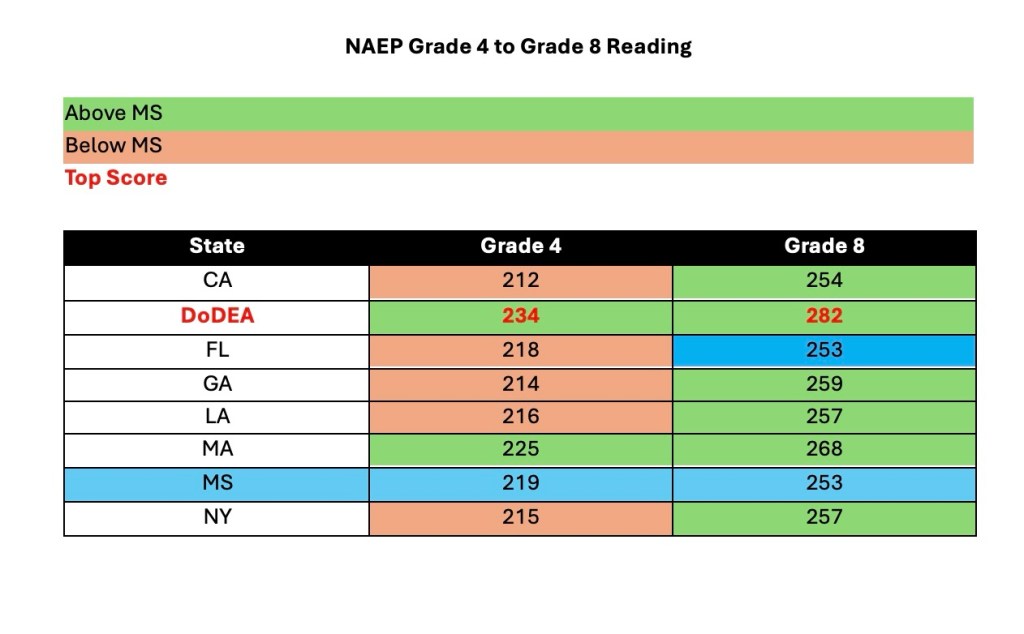
*No scientific studies identify a reading crisis in the US causally linked to balanced literacy, reading programs, lack of phonics instruction, or inadequacy of teacher education. (Aydarova, 2025; Reinking, Hruby, & Risko, 2023).
*The media hyper-focuses only on grade 4 NAEP reading scores, but notice how the story changes once we consider grade 8—states behind MS in grade 4 catch and pass MS by grade 8 (primarily because MS inflates their grade 4 scores by excessive grade retention, like FL):
*Structured literacy (scripted curriculum) is whitewashing the reading curriculum and restricting teacher autonomy and professionalism. (Khan, et al., 2022; Parsons, et al., 2025; Rigell, et al., 2022).
*The linked research suggests it replicates findings of the NRP; however, the NRP did not prove systematic phonics outperformed whole language or was a silver bullet. As Diane Stephens explains about the findings on phonics: “Minimal value in kindergarten; no conclusion about phonics beyond grade 1 for ‘normally developing readers’; systematic phonics instruction in grades 2-6 with struggling readers has a weak impact on reading text and spelling; systematic phonics instruction has a positive effect in grade 1 on reading (pronouncing) real and nonsense words but not comprehension; at-risk students benefit from whole language instruction, Reading Recovery, and direct instruction.” Further, while the article quotes from the research report, it doesn’t include this much more tentative hedge: “These findings suggest that SL approaches may yield larger positive effects on student learning compared to BL approaches.” At best, structured literacy is no better or worse than whole language or balanced literacy, but to be clear, there is no “settled science” that is works.
But the bigger problem is not that mainstream media continues to repeat misinformation, but that it fails to offer the full story.
Note that the “literacy experts” quoted in the article are supporting structured literacy programs (scripted curriculum), and some of those experts are co-authors of those programs.
Further, these experts are promoting a different teacher training program than the one being attacked in the article, and many states are spending 10s of millions of dollars on that program—LETRS. (My home state of SC a few years ago allocated $11 million for one year, for example.)
What’s missing in this story?
There are two high-quality studies that were released in 2025 on the effectiveness of LETRS, but so far, there have not been click-bait scare headlines about those findings:
*A review (Rowe & Thrailkill, 2025) of reading policy in North Carolina concludes:
Despite LETRS’ claim that it helps educators “distinguish between the research base for best practices and other competing ideas not supported by scientific evidence” (Lexia Learning, 2022, p. 4), we noticed a pattern of misinterpretation, selective inclusion, and omission of literacy research. LETRS is a prime example of a common problem with the deployment of research for educational policy and instructional decision-making, in that multiple claims are not substantiated by a close reading of the original research cited (cf. Hodge et al., 2020).
*And Gearin, et al. (2025) found:
[Abstract] We investigated whether Language Essentials for Teachers of Reading and Spelling: 3rd Edition (LETRS) was related to student reading ability by comparing the average third-grade reading achievement of schools that used LETRS to that of schools that used exclusively other professional development experiences in the context of Colorado’s Read Act. Guided by What Works Clearinghouse Standards, we conducted a quasi-experiment with propensity score matching and an active comparison group. We supplemented our primary intent-to-treat analysis with three sensitivity analyses designed to demonstrate the robustness of our claims. Effect estimates for completing a LETRS volume on educator knowledge ranged from 0.82 to 0.94. Students’ third-grade reading achievement did not statistically differ for schools that adopted LETRS compared with other professional development experiences in any model, suggesting that LETRS was comparable to the other programs at improving third-grade reading achievement at the school level.
The “science of reading” movement is a political, ideological, and market-based attack on teachers and public education, and the only people profiting off yet another moral panic are the media, political leaders, education reformers, entrepreneurs, and of course, the education market place.
The full story is never covered, because the real story about reading simply isn’t that profitable.
PublicSchoolsFirstNC reacted with outrage at the decision of the North Carolina Supreme Court, overturning the Leandro Decusion of 1994.
The long-awaited North Carolina Supreme Court ruling on the state’s landmark Leandro school funding case is out.
PRESS ALERT: NC Supreme Court Dismisses Case, Does Not Enforce State Constitution
For immediate release: April 2, 2026
In a reversal of its 2022 ruling, which required lawmakers to fund public schools according to the Leandro Comprehensive Remedial Plan (designed to bring lawmakers into constitutional compliance on school funding), the current court majority “dismissed the case” ruling that a 2017 NC Trial Court ruling was made in error and all subsequent Leandro rulings are invalid.
More than thirty years of fact finding and four prior NC Supreme Court rulings had established that the North Carolina State (legislative and executive branches) had not fulfilled its obligation to North Carolina’s students.
Statewide, students’ right to a sound basic education under the North Carolina State Constitution had been violated, affirming the initial 1994 claim that became the landmark Leandro case. These facts were not disputed.
The North Carolina State Constitution clearly states that all children across our state, no matter their circumstances or background, are entitled to a sound basic education funded by the state. While the court’s decision is disappointing and shocking in the degree to which it removes the courts from responsibility, it does NOT absolve legislators of their legal duty to adequately fund public schools.
Individually and collectively, we must take action to remind our lawmakers of their responsibility to abide by the state constitution’s requirement to ensure our children’s civil and human rights by fully funding a free, uniform public education.
In her dissent, Justice Anita Earls writes that, “The Court today betrays these constitutional commitments.
The majority dismisses North Carolina’s landmark constitutional education rights litigation with prejudice and with no relief for any injured party because no plaintiff formally filed an amended pleading to challenge the current statewide funding system. In other words, the majority concludes that it will not order the State to correct the way it has harmed public school students, even in very low-wealth school districts like Hoke County, and even as two previous Courts concluded that the State is failing to adequately educate students and must act to fix the public education system. In reaching that decision, the majority relies on a hyper-technicality that is not even lawful grounds to dismiss these proceedings and was not argued by any party. Specifically, no party asked this Court to dismiss this case because it was an improper “facial” challenge. The majority’s narrow holding rests on stunning and unsupported assertions.”
PSFNC agrees! The ruling today highlights the judicial and legislative neglect facing our public schools. They have been operating the entire school year without a 2025-26 budget even though their operating costs have increased. Later this month, the legislative short session begins. North Carolina’s students can wait no longer.
PSFNC calls on all North Carolinians to urge legislators to fulfill their obligations—fully fund public schools including Leandro, pay teachers professional, competitive salaries, and invest in the future of our children.
Media Contact: Heather Koons, Communications Director
Supporters of public schools in North Carolina have relied on the Leandro decision for more than three decades as they demanded fair funding of the schools. The North Carolina Supreme Court, now with a Republican majority, just overruled Leandro, which was decided in 1994. The new decision ruled that courts can’t tell the legislature to spend money.
For 32 years, North Carolina leaders have struggled to define what it means when the state constitution says “equal opportunities shall be provided for all students.” The long-running Leandro school lawsuit has seen the courts go back and forth on what the courts can do to provide a “sound basic education” for North Carolina’s 1.5 million public school students. Thursdays ruling by the N.C. Supreme Court marks the latest and potentially final chapter in that fight….
T. Keung Hui of the North Carolina News & Observer wrote:
The North Carolina Supreme Court has overturned a 2022 decision that allowed judges to order the transfer of hundreds of millions of taxpayer dollars to fund public schools.
In a decision released on Thursday, the Supreme Court’s Republican majority ruled that state courts do not have the constitutional authority to order the spending of state dollars for schools. The decision was 4-3 with Republican Associate Justice Richard Dietz joining the two Democratic justices in dissenting.
The decision reverses a 2022 ruling by the former Democrat majority that the courts can require state officials to transfer funds to try to provide students with their constitutional right to a sound basic education. The court dismissed the lawsuit, apparently putting an end to the nearly 32-year-old court case.
“As this litigation comes to a close a few weeks shy of its thirty-second anniversary, we are reminded of these principles from our prior cases: In our constitution, the people established a tripartite system of government,” Chief Justice Paul Newby wrote in the majority ruling.
“In doing so, the people did not vest the judicial branch with the power to resolve policy disputes between the other branches of government or to set education policy. We would be especially ill-equipped to resolve such questions in any event.”
Decision disappointment for school supporters
The long-delayed ruling had been expected after the 2022 elections flipped the court majority to Republicans. The court’s Republican majority then agreed to block the money transfer and rehear the case over the objections of the Democratic justices.
“Today’s decision is disappointing — but not surprising,” Keith Poston, president of the Wake Ed Partnership, said in a statement Thursday. “The Court ruled on process, not whether students are getting what they need. That responsibility now sits squarely with state leaders. The needs in our schools haven’t changed—and neither has the urgency to act.”
It has been 770 days since oral arguments were heard in February 2024. The lengthy wait for the new ruling had raised questions.
This year’s Supreme Court election won’t shift the court’s majority. Only Democratic Associate Justice Anita Earls, who is running against GOP state Rep. Sarah Stevens, will be on the midterm ballot
The decision comes at a turning point in how the state funds education. A report released in December by the Education Law Center ranked North Carolina last in the nation in school funding effort and 50th out of the 50 states and the District of Columbia in funding level.
State Republican legislators fought the judicial money transfer, arguing that only the General Assembly can order state dollars to be spent. Democratic lawmakers have supported the 2022 court decision.
“Today’s decision rightly recognizes the constitutional role of the North Carolina General Assembly, since the state Constitution entrusts sole appropriations authority to the legislature,” Demi Dowdy, a spokesperson for House Speaker Destin Hall, said in a statement Thursday. “House Republicans remain committed to investing in public education, including through our budget proposal to raise starting teacher pay to $50,000 and provide 8.7% average raises to our public school teachers.”




 Diane Ravitch's blog