Archives for the month of: January, 2026

Anne Applebaum, journalist and historian, writes frequently about European politics. She has been a member of the Washington Post editorial board and is now a contributor to The Atlantic, where this article appeared. She won a Pulitzer Prize for her book Gulag: A History.

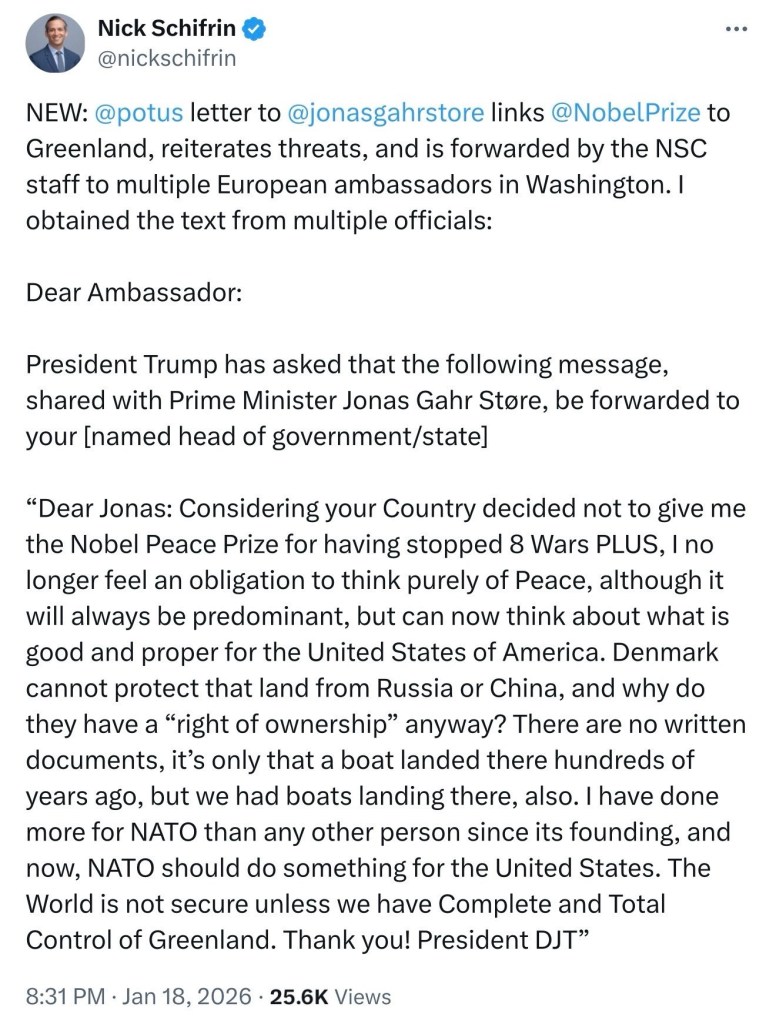
She writes here about his latest missive, in which he said he was going to take Greenland (from Denmark) because he didn’t win a Nobel Peace Prize (awarded by the Nobel Committee in Norway.)

Let me begin by quoting, in full, a letter that the president of the United States of America sent yesterday to the prime minister of Norway, Jonas Gahr Støre. The text was forwarded by the White House National Security Council to ambassadors in Washington, and was clearly intended to be widely shared. Here it is:

Dear Jonas:

Considering your Country decided not to give me the Nobel Peace Prize for having stopped 8 Wars PLUS, I no longer feel an obligation to think purely of Peace, although it will always be predominant, but can now think about what is good and proper for the United States of America. Denmark cannot protect that land from Russia or China, and why do they have a “right of ownership” anyway? There are no written documents, it’s only a boat that landed there hundreds of years ago, but we had boats landing there, also. I have done more for NATO than any person since its founding, and now, NATO should do something for the United States. The World is not secure unless we have Complete and Total Control of Greenland. Thank you! President DJT

One could observe many things about this document. One is the childish grammar, including the strange capitalizations (“Complete and Total Control”). Another is the loose grasp of history. Donald Trump did not end eight wars. Greenland has been Danish territory for centuries. Its residents are Danish citizens who vote in Danish elections. There are many “written documents” establishing Danish sovereignty in Greenland, including some signed by the United States. In his second term, Trump has done nothing for NATO—an organization that the U.S. created and theoretically leads, and that has only ever been used in defense of American interests. If the European members of NATO have begun spending more on their own defense (budgets to which the U.S. never contributed), that’s because of the threat they feel from Russia.

Yet what matters isn’t the specific phrases, but the overall message: Donald Trump now genuinely lives in a different reality, one in which neither grammar nor history nor the normal rules of human interaction now affect him. Also, he really is maniacally, unhealthily obsessive about the Nobel Prize. The Norwegian Nobel Committee, not the Norwegian government and certainly not the Danish government, determines the winner of that prize. Yet Trump now not only blames Norway for failing to give it to him, but is using it as a justification for an invasion of Greenland.

Think about where this is leading. One possibility, anticipated this morning by financial markets, is a damaging trade war. Another is an American military occupation of Greenland. Try to imagine it: The U.S. Marines arrive in Nuuk, the island’s capital. Perhaps they kill some Danes; perhaps some American soldiers die too. And then what? If the invaders were Russians, they would arrest all of the politicians, put gangsters in charge, shoot people on the street for speaking Danish, change school curricula, and carry out a fake referendum to rubber-stamp the conquest. Is that the American plan too? If not, then what is it? This would not be the occupation of Iraq, which was difficult enough. U.S. troops would need to force Greenlanders, citizens of a treaty ally, to become American against their will.

For the past year, American allies around the world have tried very hard to find a theory that explains Trump’s behavior. Isolationism,neo-imperialism, and patrimonialism are all words that have been thrown around. But in the end, the president himself defeats all attempts to describe a “Trump doctrine.” He is locked into a world of his own, determined to “win” every encounter, whether in an imaginary competition for the Nobel Peace Prize or a protest from the mother of small children objecting to his masked, armed paramilitary in Minneapolis. These contests matter more to him than any long-term strategy. And of course, the need to appear victorious matters much more than Americans’ prosperity and well-being.

The people around Trump could find ways to stop him, as some did in his first term, but they seem too corrupt or too power-hungry to try. That leaves Republicans in Congress as the last barrier. They owe it to the American people, and to the world, to stop Trump from acting out his fantasy in Greenland and doing permanent damage to American interests. He is at risk of alienating friends in not only Europe but also India, whose leader he also snubbed for failing to nominate him for a Nobel Prize, as well as South Korea, Japan, Australia. Years of careful diplomacy, billions of dollars in trade, are now at risk because senators and representatives who know better have refused to use the powers they have to block him. Now is the time.

In case you are wondering why Trump has been threatening to invade Greenland, even though it violates international law and is sure to destroy NATO, the answer is here. In this note, which was circulated to European leaders, Trump explains. He’s threatening to seize Greenland because he didn’t win a Nobel peace Prize.

Do you think he will calm down now that Venezuela’s Maria Machado gave him her Nobel Peace Prize?

Do you think the Nobel Prize Committee (which is not controlled by the government of Norway) will be bullied into giving a Nobel Peace Prize next year to mollify him? Bullying seems to be an essential part of “the art of the deal.”

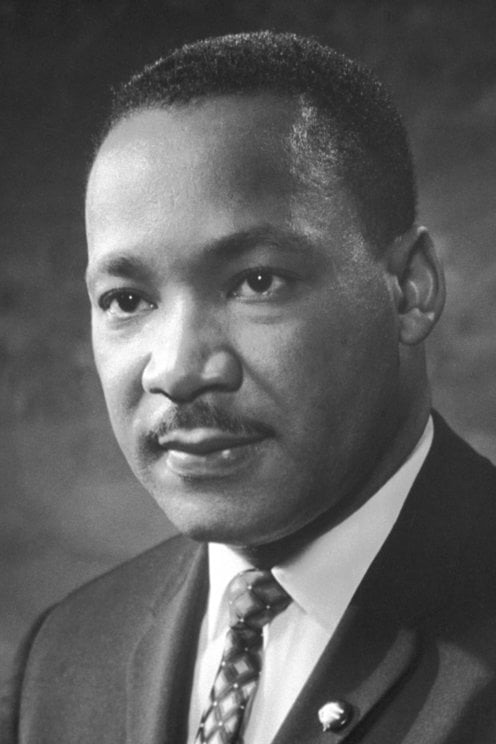
In 1964, Dr. Martin Luther King Jr. won the Nobel Peace prize. At the time, he was the youngest person ever to receive the award, at age 35.

The Nobel Peace Prize 1964 was awarded to Martin Luther King Jr. “for his non-violent struggle for civil rights for the Afro-American population”

The Nobel Foundation Archive

Is Trump more jealous of Dr. King or Barack Obama?

I say “Obama,” because I expect that Trump doesn’t know that Dr. King won the award.

Dr. King’s “Letter from a Birmingham Jail” was written in April 1963. Dr. King wrote in response to a public statement by Birmingham religious leaders who called on Dr. King to be patient and not to engage in demonstrations that would provoke resistance.

This context in which he wrote the letter appears on the website of The Martin Luther King, Jr. Research and Education Institute at Stanford University.

In April 1963 King and the Southern Christian Leadership Conference (SCLC) joined with Birmingham, Alabama’s existing local movement, the Alabama Christian Movement for Human Rights (ACMHR), in a massive direct action campaign to attack the city’s segregation system by putting pressure on Birmingham’s merchants during the Easter season, the second biggest shopping season of the year. As ACMHR founder Fred Shuttlesworth stated in the group’s “Birmingham Manifesto,” the campaign was “a moral witness to give our community a chance to survive” (ACMHR, 3 April 1963). 

The campaign was originally scheduled to begin in early March 1963, but was postponed until 2 April when the relatively moderate Albert Boutwell defeated Birmingham’s segregationist commissioner of public safety, Eugene “Bull” Connor, in a run-off mayoral election. On 3 April the desegregation campaign was launched with a series of mass meetings, direct actions, lunch counter sit-ins, marches on City Hall, and a boycott of downtown merchants. King spoke to black citizens about the philosophy of nonviolence and its methods, and extended appeals for volunteers at the end of the mass meetings. With the number of volunteers increasing daily, actions soon expanded to kneel-ins at churches, sit-ins at the library, and a march on the county building to register voters. Hundreds were arrested. 

On 10 April the city government obtained a state circuit court injunction against the protests. After heavy debate, campaign leaders decided to disobey the court order. King declared: “We cannot in all good conscience obey such an injunction which is an unjust, undemocratic and unconstitutional misuse of the legal process” (ACMHR, 11 April 1963). Plans to continue to submit to arrest were threatened, however, because the money available for cash bonds was depleted, so leaders could no longer guarantee that arrested protesters would be released. King contemplated whether he and Ralph Abernathy should be arrested. Given the lack of bail funds, King’s services as a fundraiser were desperately needed, but King also worried that his failure to submit to arrests might undermine his credibility. King concluded that he must risk going to jail in Birmingham. He told his colleagues: “I don’t know what will happen; I don’t know where the money will come from. But I have to make a faith act” (King, 73). 

On Good Friday, 12 April, King was arrested in Birmingham after violating the anti-protest injunction and was kept in solitary confinement. During this time King penned the Letter from Birmingham Jail” on the margins of the Birmingham News, in reaction to a statement published in that newspaper by eight Birmingham clergymen condemning the protests. King’s request to call his wife, Coretta Scott King, who was at home in Atlanta recovering from the birth of their fourth child, was denied. After she communicated her concern to the Kennedy administration, Birmingham officials permitted King to call home. Bail money was made available, and he was released on 20 April 1963. 

In order to sustain the campaign, SCLC organizer James Bevel proposed using young children in demonstrations. Bevel’s rationale for the Children’s Crusade was that young people represented an untapped source of freedom fighters without the prohibitive responsibilities of older activists. On 2 May more than 1,000 African American students attempted to march into downtown Birmingham, and hundreds were arrested. When hundreds more gathered the following day, Commissioner Connor directed local police and fire departments to use force to halt the demonstrations. During the next few days images of children being blasted by high-pressure fire hoses, clubbed by police officers, and attacked by police dogs appeared on television and in newspapers, triggering international outrage. While leading a group of child marchers, Shuttlesworth himself was hit with the full force of a fire hose and had to be hospitalized. King offered encouragement to parents of the young protesters: “Don’t worry about your children, they’re going to be alright. Don’t hold them back if they want to go to jail. For they are doing a job for not only themselves, but for all of America and for all mankind” (King, 6 May 1963). 

In the meantime, the white business structure was weakening under adverse publicity and the unexpected decline in business due to the boycott, but many business owners and city officials were reluctant to negotiate with the protesters. With national pressure on the White House also mounting, Attorney General Robert Kennedy sent Burke Marshall, his chief civil rights assistant, to facilitate negotiations between prominent black citizens and representatives of Birmingham’s Senior Citizen’s Council, the city’s business leadership. 

The Senior Citizen’s Council sought a moratorium on street protests as an act of good faith before any final settlement was declared, and Marshall encouraged campaign leaders to halt demonstrations, accept an interim compromise that would provide partial success, and negotiate the rest of their demands afterward. Some black negotiators were open to the idea, and although the hospitalized Shuttlesworth was not present at the negotiations, on 8 May King told the negotiators he would accept the compromise and call the demonstrations to a halt. 

When Shuttlesworth learned that King intended to announce a moratorium he was furious—about both the decision to ease pressure off white business owners and the fact that he, as the acknowledged leader of the local movement, had not been consulted. Feeling betrayed, Shuttlesworth reminded King that he could not legitimately speak for the black population of Birmingham on his own: “Go ahead and call it off … When I see it on TV, that you have called it off, I will get up out of this, my sickbed, with what little ounce of strength I have, and lead them back into the street. And your name’ll be Mud” (Hampton and Fayer, 136). King made the announcement anyway, but indicated that demonstrations might be resumed if negotiations did not resolve the situation shortly. 

By 10 May negotiators had reached an agreement, and despite his falling out with King, Shuttlesworth joined him and Abernathy to read the prepared statement that detailed the compromise: the removal of “Whites Only” and “Blacks Only” signs in restrooms and on drinking fountains, a plan to desegregate lunch counters, an ongoing “program of upgrading Negro employment,” the formation of a biracial committee to monitor the progress of the agreement, and the release of jailed protesters on bond (“The Birmingham Truce Agreement,” 10 May 1963). 

Birmingham segregationists responded to the agreement with a series of violent attacks. That night an explosive went off near the Gaston Motel room where King and SCLC leaders had previously stayed, and the next day the home of King’s brother Alfred Daniel King was bombed. President John F. Kennedy responded by ordering 3,000 federal troops into position near Birmingham and making preparations to federalize the Alabama National Guard. Four months later, on 15 September, Ku Klux Klan members bombed Birmingham’s Sixteenth Street Baptist Church, killing four young girls. King delivered the eulogy at the 18 September joint funeral of three of the victims, preaching that the girls were “the martyred heroines of a holy crusade for freedom and human dignity” (King, “Eulogy for the Martyred Children,” 18 September 1963). 

Footnotes

“The Birmingham Truce Agreement,” 10 May 1963, in Eyes on the Prize, ed. Carson et al., 1991. 

Douglas Brinkley, “The Man Who Kept King’s Secrets,” Vanity Fair (April 2006): 156–171.

Eskew, But for Birmingham, 1997. 

Hampton and Fayer, with Flynn, Voices of Freedom, 1990. 

King, Address delivered at mass meeting, 6 May 1963, FRC-DSI-FC

King, Eulogy for the Martyred Children, 18 September 1963, in A Call to Conscience, ed. Carson and Shepard, 2001.

King, Shuttlesworth, and Abernathy, Statement, “For engaging in peaceful desegregation demonstrations,” 11 April 1963, BWOF-AB.

King, Why We Can’t Wait, 1964.

Shuttlesworth and N. H. Smith, “Birmingham Manifesto,” 3 April 1963, MLKJP-GAMK. Back to Top

Stanford

The Martin Luther King, Jr. Research and Education Institute

Dr. Martin Luther King Jr. was one of the greatest Americans of the 20th century. He was a brilliant thinker and an inspiring speaker. He led the Civil Rights movement to its greatest triumphs. He changed America for the better.

I can’t even imagine what he would say about events today. Trump has disparaged Dr. King and the Civil Rights movement. He has appointed people who oppose civil rights laws to enforce them. He is doing his best to erase the role of Blacks in American history. His goal seems to be to Make America White Again.

In the long arc of history, I predict that Dr. King will be forever remembered as a hero and a visionary. Trump will be remembered as a fool who damaged our democracy and prospects for world peace.

*******************************

Dr. Martin Luther King Jr. joined a campaign against racism, segregation, and inequality in Birmingham in the spring of 1963. Working with local groups, Dr. King participated in demonstrations against these evils, defying Alabama’s law banning mass demonstrations. He was arrested on April 12, 1963, and released on April 20, 1963.

While imprisoned, he wrote “Letter from a Birmingham Jail” as a response to Birmingham religious leaders who urged him to back off and moderate his actions.

The letter was sent to publications in the North and was republished by several outlets. One of them was The New Leader, a democratic socialist magazine where I was working as an editorial assistant. Shortened versions of his letter appear in high school history textbooks. This complete version appears on the website of the Stanford Institute of the Martin Luther King Jr. Research and Education Center at Stanford University.

The best thing you can do on this day, set aside to honor his memory, is to read his words and try to act on them.


Dr. King wrote to them on April 1963:

My Dear Fellow Clergymen:

While confined here in the Birmingham city jail, I came across your recent statement calling my present activities “unwise and untimely.” Seldom do I pause to answer criticism of my work and ideas. If I sought to answer all the criticisms that cross my desk, my secretaries would have little time for anything other than such correspondence in the course of the day, and I would have no time for constructive work. But since I feel that you are men of genuine good will and that your criticisms are sincerely set forth, I want to try to answer your statement in what I hope will be patient and reasonable terms.

I think I should indicate why I am here in Birmingham, since you have been influenced by the view which argues against “outsiders coming in.” I have the honor of serving as president of the Southern Christian Leadership Conference, an organization operating in every southern state, with headquarters in Atlanta, Georgia. We have some eighty five affiliated organizations across the South, and one of them is the Alabama Christian Movement for Human Rights. Frequently we share staff, educational and financial resources with our affiliates. Several months ago the affiliate here in Birmingham asked us to be on call to engage in a nonviolent direct action program if such were deemed necessary. We readily consented, and when the hour came we lived up to our promise. So I, along with several members of my staff, am here because I was invited here. I am here because I have organizational ties here.

But more basically, I am in Birmingham because injustice is here. Just as the prophets of the eighth century B.C. left their villages and carried their “thus saith the Lord” far beyond the boundaries of their home towns, and just as the Apostle Paul left his village of Tarsus and carried the gospel of Jesus Christ to the far corners of the Greco Roman world, so am I compelled to carry the gospel of freedom beyond my own home town. Like Paul, I must constantly respond to the Macedonian call for aid.

Moreover, I am cognizant of the interrelatedness of all communities and states. I cannot sit idly by in Atlanta and not be concerned about what happens in Birmingham. Injustice anywhere is a threat to justice everywhere. We are caught in an inescapable network of mutuality, tied in a single garment of destiny. Whatever affects one directly, affects all indirectly. Never again can we afford to live with the narrow, provincial “outside agitator” idea. Anyone who lives inside the United States can never be considered an outsider anywhere within its bounds.

You deplore the demonstrations taking place in Birmingham. But your statement, I am sorry to say, fails to express a similar concern for the conditions that brought about the demonstrations. I am sure that none of you would want to rest content with the superficial kind of social analysis that deals merely with effects and does not grapple with underlying causes. It is unfortunate that demonstrations are taking place in Birmingham, but it is even more unfortunate that the city’s white power structure left the Negro community with no alternative.

In any nonviolent campaign there are four basic steps: collection of the facts to determine whether injustices exist; negotiation; self purification; and direct action. We have gone through all these steps in Birmingham. There can be no gainsaying the fact that racial injustice engulfs this community. Birmingham is probably the most thoroughly segregated city in the United States. Its ugly record of brutality is widely known. Negroes have experienced grossly unjust treatment in the courts. There have been more unsolved bombings of Negro homes and churches in Birmingham than in any other city in the nation. These are the hard, brutal facts of the case. On the basis of these conditions, Negro leaders sought to negotiate with the city fathers. But the latter consistently refused to engage in good faith negotiation.

Then, last September, came the opportunity to talk with leaders of Birmingham’s economic community. In the course of the negotiations, certain promises were made by the merchants–for example, to remove the stores’ humiliating racial signs. On the basis of these promises, the Reverend Fred Shuttlesworth and the leaders of the Alabama Christian Movement for Human Rights agreed to a moratorium on all demonstrations. As the weeks and months went by, we realized that we were the victims of a broken promise. A few signs, briefly removed, returned; the others remained. As in so many past experiences, our hopes had been blasted, and the shadow of deep disappointment settled upon us. We had no alternative except to prepare for direct action, whereby we would present our very bodies as a means of laying our case before the conscience of the local and the national community. Mindful of the difficulties involved, we decided to undertake a process of self purification. We began a series of workshops on nonviolence, and we repeatedly asked ourselves: “Are you able to accept blows without retaliating?” “Are you able to endure the ordeal of jail?” We decided to schedule our direct action program for the Easter season, realizing that except for Christmas, this is the main shopping period of the year. Knowing that a strong economic-withdrawal program would be the by product of direct action, we felt that this would be the best time to bring pressure to bear on the merchants for the needed change.

Then it occurred to us that Birmingham’s mayoral election was coming up in March, and we speedily decided to postpone action until after election day. When we discovered that the Commissioner of Public Safety, Eugene “Bull” Connor, had piled up enough votes to be in the run off, we decided again to postpone action until the day after the run off so that the demonstrations could not be used to cloud the issues. Like many others, we waited to see Mr. Connor defeated, and to this end we endured postponement after postponement. Having aided in this community need, we felt that our direct action program could be delayed no longer.

You may well ask: “Why direct action? Why sit ins, marches and so forth? Isn’t negotiation a better path?” You are quite right in calling for negotiation. Indeed, this is the very purpose of direct action. Nonviolent direct action seeks to create such a crisis and foster such a tension that a community which has constantly refused to negotiate is forced to confront the issue. It seeks so to dramatize the issue that it can no longer be ignored. My citing the creation of tension as part of the work of the nonviolent resister may sound rather shocking. But I must confess that I am not afraid of the word “tension.” I have earnestly opposed violent tension, but there is a type of constructive, nonviolent tension which is necessary for growth. Just as Socrates felt that it was necessary to create a tension in the mind so that individuals could rise from the bondage of myths and half truths to the unfettered realm of creative analysis and objective appraisal, so must we see the need for nonviolent gadflies to create the kind of tension in society that will help men rise from the dark depths of prejudice and racism to the majestic heights of understanding and brotherhood. The purpose of our direct action program is to create a situation so crisis packed that it will inevitably open the door to negotiation. I therefore concur with you in your call for negotiation. Too long has our beloved Southland been bogged down in a tragic effort to live in monologue rather than dialogue.

One of the basic points in your statement is that the action that I and my associates have taken in Birmingham is untimely. Some have asked: “Why didn’t you give the new city administration time to act?” The only answer that I can give to this query is that the new Birmingham administration must be prodded about as much as the outgoing one, before it will act. We are sadly mistaken if we feel that the election of Albert Boutwell as mayor will bring the millennium to Birmingham. While Mr. Boutwell is a much more gentle person than Mr. Connor, they are both segregationists, dedicated to maintenance of the status quo. I have hope that Mr. Boutwell will be reasonable enough to see the futility of massive resistance to desegregation. But he will not see this without pressure from devotees of civil rights. My friends, I must say to you that we have not made a single gain in civil rights without determined legal and nonviolent pressure. Lamentably, it is an historical fact that privileged groups seldom give up their privileges voluntarily. Individuals may see the moral light and voluntarily give up their unjust posture; but, as Reinhold Niebuhr has reminded us, groups tend to be more immoral than individuals.

We know through painful experience that freedom is never voluntarily given by the oppressor; it must be demanded by the oppressed. Frankly, I have yet to engage in a direct action campaign that was “well timed” in the view of those who have not suffered unduly from the disease of segregation. For years now I have heard the word “Wait!” It rings in the ear of every Negro with piercing familiarity. This “Wait” has almost always meant “Never.” We must come to see, with one of our distinguished jurists, that “justice too long delayed is justice denied.”

We have waited for more than 340 years for our constitutional and God given rights. The nations of Asia and Africa are moving with jetlike speed toward gaining political independence, but we still creep at horse and buggy pace toward gaining a cup of coffee at a lunch counter. Perhaps it is easy for those who have never felt the stinging darts of segregation to say, “Wait.” But when you have seen vicious mobs lynch your mothers and fathers at will and drown your sisters and brothers at whim; when you have seen hate filled policemen curse, kick and even kill your black brothers and sisters; when you see the vast majority of your twenty million Negro brothers smothering in an airtight cage of poverty in the midst of an affluent society; when you suddenly find your tongue twisted and your speech stammering as you seek to explain to your six year old daughter why she can’t go to the public amusement park that has just been advertised on television, and see tears welling up in her eyes when she is told that Funtown is closed to colored children, and see ominous clouds of inferiority beginning to form in her little mental sky, and see her beginning to distort her personality by developing an unconscious bitterness toward white people; when you have to concoct an answer for a five year old son who is asking: “Daddy, why do white people treat colored people so mean?”; when you take a cross county drive and find it necessary to sleep night after night in the uncomfortable corners of your automobile because no motel will accept you; when you are humiliated day in and day out by nagging signs reading “white” and “colored”; when your first name becomes “nigger,” your middle name becomes “boy” (however old you are) and your last name becomes “John,” and your wife and mother are never given the respected title “Mrs.”; when you are harried by day and haunted by night by the fact that you are a Negro, living constantly at tiptoe stance, never quite knowing what to expect next, and are plagued with inner fears and outer resentments; when you are forever fighting a degenerating sense of “nobodiness”–then you will understand why we find it difficult to wait. There comes a time when the cup of endurance runs over, and men are no longer willing to be plunged into the abyss of despair. I hope, sirs, you can understand our legitimate and unavoidable impatience. You express a great deal of anxiety over our willingness to break laws. This is certainly a legitimate concern. Since we so diligently urge people to obey the Supreme Court’s decision of 1954 outlawing segregation in the public schools, at first glance it may seem rather paradoxical for us consciously to break laws. One may well ask: “How can you advocate breaking some laws and obeying others?” The answer lies in the fact that there are two types of laws: just and unjust. I would be the first to advocate obeying just laws. One has not only a legal but a moral responsibility to obey just laws. Conversely, one has a moral responsibility to disobey unjust laws. I would agree with St. Augustine that “an unjust law is no law at all.”

Now, what is the difference between the two? How does one determine whether a law is just or unjust? A just law is a man made code that squares with the moral law or the law of God. An unjust law is a code that is out of harmony with the moral law. To put it in the terms of St. Thomas Aquinas: An unjust law is a human law that is not rooted in eternal law and natural law. Any law that uplifts human personality is just. Any law that degrades human personality is unjust. All segregation statutes are unjust because segregation distorts the soul and damages the personality. It gives the segregator a false sense of superiority and the segregated a false sense of inferiority. Segregation, to use the terminology of the Jewish philosopher Martin Buber, substitutes an “I it” relationship for an “I thou” relationship and ends up relegating persons to the status of things. Hence segregation is not only politically, economically and sociologically unsound, it is morally wrong and sinful. Paul Tillich has said that sin is separation. Is not segregation an existential expression of man’s tragic separation, his awful estrangement, his terrible sinfulness? Thus it is that I can urge men to obey the 1954 decision of the Supreme Court, for it is morally right; and I can urge them to disobey segregation ordinances, for they are morally wrong.

Let us consider a more concrete example of just and unjust laws. An unjust law is a code that a numerical or power majority group compels a minority group to obey but does not make binding on itself. This is difference made legal. By the same token, a just law is a code that a majority compels a minority to follow and that it is willing to follow itself. This is sameness made legal. Let me give another explanation. A law is unjust if it is inflicted on a minority that, as a result of being denied the right to vote, had no part in enacting or devising the law. Who can say that the legislature of Alabama which set up that state’s segregation laws was democratically elected? Throughout Alabama all sorts of devious methods are used to prevent Negroes from becoming registered voters, and there are some counties in which, even though Negroes constitute a majority of the population, not a single Negro is registered. Can any law enacted under such circumstances be considered democratically structured?

Sometimes a law is just on its face and unjust in its application. For instance, I have been arrested on a charge of parading without a permit. Now, there is nothing wrong in having an ordinance which requires a permit for a parade. But such an ordinance becomes unjust when it is used to maintain segregation and to deny citizens the First-Amendment privilege of peaceful assembly and protest.

I hope you are able to see the distinction I am trying to point out. In no sense do I advocate evading or defying the law, as would the rabid segregationist. That would lead to anarchy. One who breaks an unjust law must do so openly, lovingly, and with a willingness to accept the penalty. I submit that an individual who breaks a law that conscience tells him is unjust, and who willingly accepts the penalty of imprisonment in order to arouse the conscience of the community over its injustice, is in reality expressing the highest respect for law.

Of course, there is nothing new about this kind of civil disobedience. It was evidenced sublimely in the refusal of Shadrach, Meshach and Abednego to obey the laws of Nebuchadnezzar, on the ground that a higher moral law was at stake. It was practiced superbly by the early Christians, who were willing to face hungry lions and the excruciating pain of chopping blocks rather than submit to certain unjust laws of the Roman Empire. To a degree, academic freedom is a reality today because Socrates practiced civil disobedience. In our own nation, the Boston Tea Party represented a massive act of civil disobedience.

We should never forget that everything Adolf Hitler did in Germany was “legal” and everything the Hungarian freedom fighters did in Hungary was “illegal.” It was “illegal” to aid and comfort a Jew in Hitler’s Germany. Even so, I am sure that, had I lived in Germany at the time, I would have aided and comforted my Jewish brothers. If today I lived in a Communist country where certain principles dear to the Christian faith are suppressed, I would openly advocate disobeying that country’s antireligious laws.

I must make two honest confessions to you, my Christian and Jewish brothers. First, I must confess that over the past few years I have been gravely disappointed with the white moderate. I have almost reached the regrettable conclusion that the Negro’s great stumbling block in his stride toward freedom is not the White Citizen’s Counciler or the Ku Klux Klanner, but the white moderate, who is more devoted to “order” than to justice; who prefers a negative peace which is the absence of tension to a positive peace which is the presence of justice; who constantly says: “I agree with you in the goal you seek, but I cannot agree with your methods of direct action”; who paternalistically believes he can set the timetable for another man’s freedom; who lives by a mythical concept of time and who constantly advises the Negro to wait for a “more convenient season.” Shallow understanding from people of good will is more frustrating than absolute misunderstanding from people of ill will. Lukewarm acceptance is much more bewildering than outright rejection.

I had hoped that the white moderate would understand that law and order exist for the purpose of establishing justice and that when they fail in this purpose they become the dangerously structured dams that block the flow of social progress. I had hoped that the white moderate would understand that the present tension in the South is a necessary phase of the transition from an obnoxious negative peace, in which the Negro passively accepted his unjust plight, to a substantive and positive peace, in which all men will respect the dignity and worth of human personality. Actually, we who engage in nonviolent direct action are not the creators of tension. We merely bring to the surface the hidden tension that is already alive. We bring it out in the open, where it can be seen and dealt with. Like a boil that can never be cured so long as it is covered up but must be opened with all its ugliness to the natural medicines of air and light, injustice must be exposed, with all the tension its exposure creates, to the light of human conscience and the air of national opinion before it can be cured.

In your statement you assert that our actions, even though peaceful, must be condemned because they precipitate violence. But is this a logical assertion? Isn’t this like condemning a robbed man because his possession of money precipitated the evil act of robbery? Isn’t this like condemning Socrates because his unswerving commitment to truth and his philosophical inquiries precipitated the act by the misguided populace in which they made him drink hemlock? Isn’t this like condemning Jesus because his unique God consciousness and never ceasing devotion to God’s will precipitated the evil act of crucifixion? We must come to see that, as the federal courts have consistently affirmed, it is wrong to urge an individual to cease his efforts to gain his basic constitutional rights because the quest may precipitate violence. Society must protect the robbed and punish the robber. I had also hoped that the white moderate would reject the myth concerning time in relation to the struggle for freedom. I have just received a letter from a white brother in Texas. He writes: “All Christians know that the colored people will receive equal rights eventually, but it is possible that you are in too great a religious hurry. It has taken Christianity almost two thousand years to accomplish what it has. The teachings of Christ take time to come to earth.” Such an attitude stems from a tragic misconception of time, from the strangely irrational notion that there is something in the very flow of time that will inevitably cure all ills. Actually, time itself is neutral; it can be used either destructively or constructively. More and more I feel that the people of ill will have used time much more effectively than have the people of good will. We will have to repent in this generation not merely for the hateful words and actions of the bad people but for the appalling silence of the good people. Human progress never rolls in on wheels of inevitability; it comes through the tireless efforts of men willing to be co workers with God, and without this hard work, time itself becomes an ally of the forces of social stagnation. We must use time creatively, in the knowledge that the time is always ripe to do right. Now is the time to make real the promise of democracy and transform our pending national elegy into a creative psalm of brotherhood. Now is the time to lift our national policy from the quicksand of racial injustice to the solid rock of human dignity.

You speak of our activity in Birmingham as extreme. At first I was rather disappointed that fellow clergymen would see my nonviolent efforts as those of an extremist. I began thinking about the fact that I stand in the middle of two opposing forces in the Negro community. One is a force of complacency, made up in part of Negroes who, as a result of long years of oppression, are so drained of self respect and a sense of “somebodiness” that they have adjusted to segregation; and in part of a few middle-class Negroes who, because of a degree of academic and economic security and because in some ways they profit by segregation, have become insensitive to the problems of the masses. The other force is one of bitterness and hatred, and it comes perilously close to advocating violence. It is expressed in the various black nationalist groups that are springing up across the nation, the largest and best known being Elijah Muhammad’s Muslim movement. Nourished by the Negro’s frustration over the continued existence of racial discrimination, this movement is made up of people who have lost faith in America, who have absolutely repudiated Christianity, and who have concluded that the white man is an incorrigible “devil.”

I have tried to stand between these two forces, saying that we need emulate neither the “do nothingism” of the complacent nor the hatred and despair of the black nationalist. For there is the more excellent way of love and nonviolent protest. I am grateful to God that, through the influence of the Negro church, the way of nonviolence became an integral part of our struggle. If this philosophy had not emerged, by now many streets of the South would, I am convinced, be flowing with blood. And I am further convinced that if our white brothers dismiss as “rabble rousers” and “outside agitators” those of us who employ nonviolent direct action, and if they refuse to support our nonviolent efforts, millions of Negroes will, out of frustration and despair, seek solace and security in black nationalist ideologies–a development that would inevitably lead to a frightening racial nightmare.

Oppressed people cannot remain oppressed forever. The yearning for freedom eventually manifests itself, and that is what has happened to the American Negro. Something within has reminded him of his birthright of freedom, and something without has reminded him that it can be gained. Consciously or unconsciously, he has been caught up by the Zeitgeist, and with his black brothers of Africa and his brown and yellow brothers of Asia, South America and the Caribbean, the United States Negro is moving with a sense of great urgency toward the promised land of racial justice. If one recognizes this vital urge that has engulfed the Negro community, one should readily understand why public demonstrations are taking place. The Negro has many pent up resentments and latent frustrations, and he must release them. So let him march; let him make prayer pilgrimages to the city hall; let him go on freedom rides -and try to understand why he must do so. If his repressed emotions are not released in nonviolent ways, they will seek expression through violence; this is not a threat but a fact of history. So I have not said to my people: “Get rid of your discontent.” Rather, I have tried to say that this normal and healthy discontent can be channeled into the creative outlet of nonviolent direct action. And now this approach is being termed extremist. But though I was initially disappointed at being categorized as an extremist, as I continued to think about the matter I gradually gained a measure of satisfaction from the label. Was not Jesus an extremist for love: “Love your enemies, bless them that curse you, do good to them that hate you, and pray for them which despitefully use you, and persecute you.” Was not Amos an extremist for justice: “Let justice roll down like waters and righteousness like an ever flowing stream.” Was not Paul an extremist for the Christian gospel: “I bear in my body the marks of the Lord Jesus.” Was not Martin Luther an extremist: “Here I stand; I cannot do otherwise, so help me God.” And John Bunyan: “I will stay in jail to the end of my days before I make a butchery of my conscience.” And Abraham Lincoln: “This nation cannot survive half slave and half free.” And Thomas Jefferson: “We hold these truths to be self evident, that all men are created equal . . .” So the question is not whether we will be extremists, but what kind of extremists we will be. Will we be extremists for hate or for love? Will we be extremists for the preservation of injustice or for the extension of justice? In that dramatic scene on Calvary’s hill three men were crucified. We must never forget that all three were crucified for the same crime–the crime of extremism. Two were extremists for immorality, and thus fell below their environment. The other, Jesus Christ, was an extremist for love, truth and goodness, and thereby rose above his environment. Perhaps the South, the nation and the world are in dire need of creative extremists.

I had hoped that the white moderate would see this need. Perhaps I was too optimistic; perhaps I expected too much. I suppose I should have realized that few members of the oppressor race can understand the deep groans and passionate yearnings of the oppressed race, and still fewer have the vision to see that injustice must be rooted out by strong, persistent and determined action. I am thankful, however, that some of our white brothers in the South have grasped the meaning of this social revolution and committed themselves to it. They are still all too few in quantity, but they are big in quality. Some -such as Ralph McGill, Lillian Smith, Harry Golden, James McBride Dabbs, Ann Braden and Sarah Patton Boyle–have written about our struggle in eloquent and prophetic terms. Others have marched with us down nameless streets of the South. They have languished in filthy, roach infested jails, suffering the abuse and brutality of policemen who view them as “dirty nigger-lovers.” Unlike so many of their moderate brothers and sisters, they have recognized the urgency of the moment and sensed the need for powerful “action” antidotes to combat the disease of segregation. Let me take note of my other major disappointment. I have been so greatly disappointed with the white church and its leadership. Of course, there are some notable exceptions. I am not unmindful of the fact that each of you has taken some significant stands on this issue. I commend you, Reverend Stallings, for your Christian stand on this past Sunday, in welcoming Negroes to your worship service on a nonsegregated basis. I commend the Catholic leaders of this state for integrating Spring Hill College several years ago.

But despite these notable exceptions, I must honestly reiterate that I have been disappointed with the church. I do not say this as one of those negative critics who can always find something wrong with the church. I say this as a minister of the gospel, who loves the church; who was nurtured in its bosom; who has been sustained by its spiritual blessings and who will remain true to it as long as the cord of life shall lengthen.

When I was suddenly catapulted into the leadership of the bus protest in Montgomery, Alabama, a few years ago, I felt we would be supported by the white church. I felt that the white ministers, priests and rabbis of the South would be among our strongest allies. Instead, some have been outright opponents, refusing to understand the freedom movement and misrepresenting its leaders; all too many others have been more cautious than courageous and have remained silent behind the anesthetizing security of stained glass windows.

In spite of my shattered dreams, I came to Birmingham with the hope that the white religious leadership of this community would see the justice of our cause and, with deep moral concern, would serve as the channel through which our just grievances could reach the power structure. I had hoped that each of you would understand. But again I have been disappointed.

I have heard numerous southern religious leaders admonish their worshipers to comply with a desegregation decision because it is the law, but I have longed to hear white ministers declare: “Follow this decree because integration is morally right and because the Negro is your brother.” In the midst of blatant injustices inflicted upon the Negro, I have watched white churchmen stand on the sideline and mouth pious irrelevancies and sanctimonious trivialities. In the midst of a mighty struggle to rid our nation of racial and economic injustice, I have heard many ministers say: “Those are social issues, with which the gospel has no real concern.” And I have watched many churches commit themselves to a completely other worldly religion which makes a strange, un-Biblical distinction between body and soul, between the sacred and the secular.

I have traveled the length and breadth of Alabama, Mississippi and all the other southern states. On sweltering summer days and crisp autumn mornings I have looked at the South’s beautiful churches with their lofty spires pointing heavenward. I have beheld the impressive outlines of her massive religious education buildings. Over and over I have found myself asking: “What kind of people worship here? Who is their God? Where were their voices when the lips of Governor Barnett dripped with words of interposition and nullification? Where were they when Governor Wallace gave a clarion call for defiance and hatred? Where were their voices of support when bruised and weary Negro men and women decided to rise from the dark dungeons of complacency to the bright hills of creative protest?”

Yes, these questions are still in my mind. In deep disappointment I have wept over the laxity of the church. But be assured that my tears have been tears of love. There can be no deep disappointment where there is not deep love. Yes, I love the church. How could I do otherwise? I am in the rather unique position of being the son, the grandson and the great grandson of preachers. Yes, I see the church as the body of Christ. But, oh! How we have blemished and scarred that body through social neglect and through fear of being nonconformists.

There was a time when the church was very powerful–in the time when the early Christians rejoiced at being deemed worthy to suffer for what they believed. In those days the church was not merely a thermometer that recorded the ideas and principles of popular opinion; it was a thermostat that transformed the mores of society. Whenever the early Christians entered a town, the people in power became disturbed and immediately sought to convict the Christians for being “disturbers of the peace” and “outside agitators.”‘ But the Christians pressed on, in the conviction that they were “a colony of heaven,” called to obey God rather than man. Small in number, they were big in commitment. They were too God-intoxicated to be “astronomically intimidated.” By their effort and example they brought an end to such ancient evils as infanticide and gladiatorial contests. Things are different now. So often the contemporary church is a weak, ineffectual voice with an uncertain sound. So often it is an archdefender of the status quo. Far from being disturbed by the presence of the church, the power structure of the average community is consoled by the church’s silent–and often even vocal–sanction of things as they are.

But the judgment of God is upon the church as never before. If today’s church does not recapture the sacrificial spirit of the early church, it will lose its authenticity, forfeit the loyalty of millions, and be dismissed as an irrelevant social club with no meaning for the twentieth century. Every day I meet young people whose disappointment with the church has turned into outright disgust.

Perhaps I have once again been too optimistic. Is organized religion too inextricably bound to the status quo to save our nation and the world? Perhaps I must turn my faith to the inner spiritual church, the church within the church, as the true ekklesia and the hope of the world. But again I am thankful to God that some noble souls from the ranks of organized religion have broken loose from the paralyzing chains of conformity and joined us as active partners in the struggle for freedom. They have left their secure congregations and walked the streets of Albany, Georgia, with us. They have gone down the highways of the South on tortuous rides for freedom. Yes, they have gone to jail with us. Some have been dismissed from their churches, have lost the support of their bishops and fellow ministers. But they have acted in the faith that right defeated is stronger than evil triumphant. Their witness has been the spiritual salt that has preserved the true meaning of the gospel in these troubled times. They have carved a tunnel of hope through the dark mountain of disappointment. I hope the church as a whole will meet the challenge of this decisive hour. But even if the church does not come to the aid of justice, I have no despair about the future. I have no fear about the outcome of our struggle in Birmingham, even if our motives are at present misunderstood. We will reach the goal of freedom in Birmingham and all over the nation, because the goal of America is freedom. Abused and scorned though we may be, our destiny is tied up with America’s destiny. Before the pilgrims landed at Plymouth, we were here. Before the pen of Jefferson etched the majestic words of the Declaration of Independence across the pages of history, we were here. For more than two centuries our forebears labored in this country without wages; they made cotton king; they built the homes of their masters while suffering gross injustice and shameful humiliation -and yet out of a bottomless vitality they continued to thrive and develop. If the inexpressible cruelties of slavery could not stop us, the opposition we now face will surely fail. We will win our freedom because the sacred heritage of our nation and the eternal will of God are embodied in our echoing demands. Before closing I feel impelled to mention one other point in your statement that has troubled me profoundly. You warmly commended the Birmingham police force for keeping “order” and “preventing violence.” I doubt that you would have so warmly commended the police force if you had seen its dogs sinking their teeth into unarmed, nonviolent Negroes. I doubt that you would so quickly commend the policemen if you were to observe their ugly and inhumane treatment of Negroes here in the city jail; if you were to watch them push and curse old Negro women and young Negro girls; if you were to see them slap and kick old Negro men and young boys; if you were to observe them, as they did on two occasions, refuse to give us food because we wanted to sing our grace together. I cannot join you in your praise of the Birmingham police department.

It is true that the police have exercised a degree of discipline in handling the demonstrators. In this sense they have conducted themselves rather “nonviolently” in public. But for what purpose? To preserve the evil system of segregation. Over the past few years I have consistently preached that nonviolence demands that the means we use must be as pure as the ends we seek. I have tried to make clear that it is wrong to use immoral means to attain moral ends. But now I must affirm that it is just as wrong, or perhaps even more so, to use moral means to preserve immoral ends. Perhaps Mr. Connor and his policemen have been rather nonviolent in public, as was Chief Pritchett in Albany, Georgia, but they have used the moral means of nonviolence to maintain the immoral end of racial injustice. As T. S. Eliot has said: “The last temptation is the greatest treason: To do the right deed for the wrong reason.”

I wish you had commended the Negro sit inners and demonstrators of Birmingham for their sublime courage, their willingness to suffer and their amazing discipline in the midst of great provocation. One day the South will recognize its real heroes. They will be the James Merediths, with the noble sense of purpose that enables them to face jeering and hostile mobs, and with the agonizing loneliness that characterizes the life of the pioneer. They will be old, oppressed, battered Negro women, symbolized in a seventy two year old woman in Montgomery, Alabama, who rose up with a sense of dignity and with her people decided not to ride segregated buses, and who responded with ungrammatical profundity to one who inquired about her weariness: “My feets is tired, but my soul is at rest.” They will be the young high school and college students, the young ministers of the gospel and a host of their elders, courageously and nonviolently sitting in at lunch counters and willingly going to jail for conscience’ sake. One day the South will know that when these disinherited children of God sat down at lunch counters, they were in reality standing up for what is best in the American dream and for the most sacred values in our Judaeo Christian heritage, thereby bringing our nation back to those great wells of democracy which were dug deep by the founding fathers in their formulation of the Constitution and the Declaration of Independence.

Never before have I written so long a letter. I’m afraid it is much too long to take your precious time. I can assure you that it would have been much shorter if I had been writing from a comfortable desk, but what else can one do when he is alone in a narrow jail cell, other than write long letters, think long thoughts and pray long prayers?

If I have said eanything in this letter that overstates the truth and indicates an unreasonable impatience, I beg you to forgive me. If I have said anything that understates the truth and indicates my having a patience that allows me to settle for anything less than brotherhood, I beg God to forgive me.

I hope this letter finds you strong in the faith. I also hope that circumstances will soon make it possible for me to meet each of you, not as an integrationist or a civil-rights leader but as a fellow clergyman and a Christian brother. Let us all hope that the dark clouds of racial prejudice will soon pass away and the deep fog of misunderstanding will be lifted from our fear drenched communities, and in some not too distant tomorrow the radiant stars of love and brotherhood will shine over our great nation with all their scintillating beauty.

Yours for the cause of Peace and Brotherhood,

Martin Luther King, Jr.
Norman Batley hosts a podcast called “Life Elsewhere with Norman B.” He is based in Tampa, Florida. The program is widely distributed through WMNF and NPR. He asks great questions, and I was thrilled to be invited to be on his show.

I hope you will listen.

John Thompson, historian and retired teacher, reports on the latest education news from Oklahoma: the Chamber of Commerce is intent on reviving the failed test-and-punish agenda of the Bush-Obama years, plus the so-called “Mississippi Miracle,”which is credited with amazing results in reading.

John writes:

Once again, attacks on under-funded Oklahoma public schools are examples of the threats the nation’s schools face. Yes, we’ve gotten rid of State Superintendent Ryan Walters, but I’m more worried about today’s  “accountability-driven” mandates, such as those pushed by the Chamber of Commerce. 

On the other hand, our public schools have a history of receiving support from holistic, bottom-up efforts by a variety of excellent social work agencies, nonprofits, volunteers, and innovative educators.

These partners remind me of 1990’s, when student performance was growing. The head of the Oklahoma City Public School System curriculum department dropped into my History classroom, saying that she had been watching me teach, and I might like to try something new. She suggested that I start the year with the 20th century to get my kids hooked on history. Then, around Thanksgiving, we would return to the beginning of the subject, and reteach the 20th century.

It was a brilliant approach, supported by cognitive science. And it showed inner city students respect by nurturing meaningful, challenging instruction. The result was that my kids worked from bell-to-bell, from day one to their graduation day, learning how to learn.

I doubt that would be allowed today, when “everyone” is pressured to be on the “same page,” often requiring the same type of data-driven instruction.

Then, as the No Child Left Behind Act of 2001 approached, our principal gave us aligned and paced curriculum guidelines; They are now pervasive. She said that she knew we wouldn’t use it, but rather than throwing it away, we should keep it handy in case a top administrator visited the class.

Before NCLB, we had the autonomy to adjust our lessons in order to promote in-depth learning. For instance, when my students came to class carrying Ralph Ellison’s The Invisible Man, which they were reading in their English class, I would quickly change my schedule. Our History class would learn about Ellison’s childhood in Oklahoma City, and how his famous “Battle Royal” scene was inspired by a cruel joke that was played on him when he applied for a job.  

And, around that time, the bipartisan MAPS for Kids succeeded in saving the OKCPS from a financial collapse by raising taxes.  MAPS for Kids listened to educators, parents, top national education and cognitive science researchers, and students; it called for the meaningful instruction which treated high-challenge kids with the same respect and opportunities that are bestowed on students in the exurbs.  

I was in the room when MAPS and OKCPS leaders agreed that educators should receive a clear message – their job is to teach the Standards of Instruction, not to standardized tests.

I was then in the room when top district administrators were supposed to reveal the agreement to a committee of principals. The committee chair started with summaries of ridiculous policies that had been imposed over the years. Principals replied with absurd, but hilarious stories, about the tumultuous effects of non-educators’ political demands. 

But, the administrator then said that we would have to dramatically expand standardized testing. 

When I pushed back, a highly respected administrator put her hands on my shoulders, and said, “John, I’ve always  said you don’t make a hog heavier by weighing it. But this is politics. We have no choice.”

When NCLB and subsequent corporate school reforms were implemented, the supposed goal was using top-down, accountability mandates to rapidly transform schools serving our poorest children of color. But in my experience, those were the students who were most damaged by output-driven reforms that forced teachers to be “on the same page” when teaching the same lessons.

I didn’t have the expertise to get involved in the debates over aligned and paced instruction in pre-k and elementary schools, but the idea that it should be forced on high-challenge secondary students was absurd. Educators pushed back as much as we could, but our resistance was condemned as “low expectations.” And reformers who blamed us Baby Boomers for making “excuses,” sought to replace us with young teachers, such as those in Teach for America, who were trained in the culture of data-driven accountability

Reformers also brought frequent benchmark testing into schools. Lacking explicit stakes, benchmarks could have created a culture of testing for diagnostic, not accountability, purposes. In my experience, however, the test prep culture, combined with more frequent tests, further undermined the teacher autonomy required for holistic instruction.  

Today, the campaign for the “Science of Reading,” now known as the “Mississippi Miracle,” is driven by “extensive use of formative and benchmark assessments to track student progress and inform instructional differentiation.” The American Federation of Teachers’ president Randi Weingarten supported much or most of the “Science of Reading” but she “doesn’t advocate for what we have found so disrespectful: scripted curricula or ‘teacher proof’ programs.”

And we face new threats when, as is happening in Oklahoma,” the ideology-driven, reward-and-punish parts of the “Mississippi Miracle,” are combined with the Moms for Liberty’s focus on “back to basics” foundational skills and phonics.

Despite the lack of evidence that the Miracle increases long-lasting reading comprehension, as opposed to short-term test gains for 4th graders, Oklahoma’s Chambers remain committed to retention based on reading test scores, like we did in 2015-2016 when we were second to Mississippi in retaining k-3rd grade students. They ignore that tragic results which seemed likely to occur in 2004and in 2012, and 2015 when Oklahoma briefly required the passing of four End-of-Instruction tests to graduate from high schools.  

But, I would remind the Chamber of its call for recruiting and retaining high-quality teachers in order to attract and retain business investors for Oklahoma. After all, the best way to attract high-quality teachers, and parents of students, is to allow for high-quality, holistic teaching and learning, not make them work in a 21st century version of a Model T assembly line.

Paul Thomas was a teacher in South Carolina for many years; he is now a professor of education at Furman University. He believes that the movement to mandate “the science of reading” is a fraud, as is the so-called “Mississippi Miracle.” The key to the alleged miracle, he says, is holding back third-graders with low reading scores. That is the magic bullet, not the reading curriculum.

In this post, he compares the claims for SOR with research.

He writes:

Journalists and politicians are both drawn to and depend on compelling stories.

Regretfully, whether or not those stories are factually true is less and less important, and in some cases, what makes the stories compelling is over-simplification while the truth is complicated or often not clearly defined.

The stories told about education have a long history of being trapped in compelling but false claims. Currently, the most popular and compelling education story is about reading proficiency among US students; this story is grounded in a very compelling story about reading reform in Mississippi, identified as reform labeled the “science of reading.”

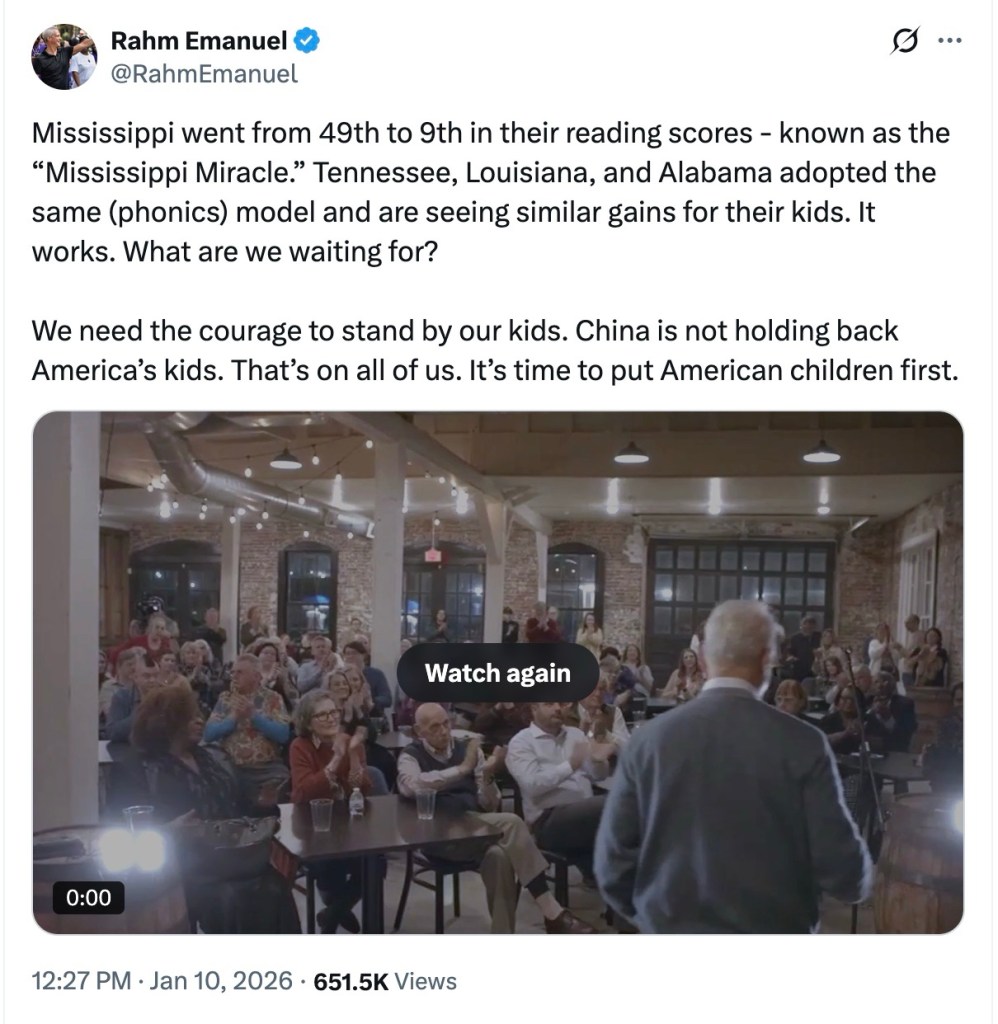
The repetition of the so-called Mississippi “miracle” has occurred dozens of times since 2019—and here are just two of the most recent:

Rahm Emanuel on Twitter:

And yet another article in The New York Times: How Mississippi Transformed Its Schools From Worst to Best.

Everything about the Mississippi story fits perfectly into the larger stories that Americans love.

So there is now a recurring accusatory question: If high-poverty poverty state with a large proportion of Black students can radically improve reading proficiency among their students, why don’t all states adopt that policy?

From that, it gets uglier because the implication and direct accusations that follow are damning: The education establishment, bolstered by teachers unions, simply don’t think poor and Black students can learn; the education establishment uses poverty as an excuse and will not let go of the soft bigotry of low expectations.

Throughout the stories being told about reading, teachers, and education, there is a discouraging pattern: The stories are not supported by the evidence (ironically, the stories behind the “science of reading” lack scientific research), and in many cases, the evidence contradicts the story being told.

Is poverty an excuse for student achievement and is teacher quality/knowledge a major reason students underachieve?

Poverty, inequity, and other out-of-school factors are the primary cause factors in measurable student achievement (test scores), accounting for 60% or more of those scores.

Teacher quality impacts measurable student achievement at rates of about 1-14%.

Research:

If you want to read the research that directly contradicts the received wisdom about how to teach reading, open the link.

Paul Krugman, a Nobel Prize winner in economics, wrote regularly for The New York Times. Now he writes a blog at Substack. In this post, he characterizes the deepening dysfunction of our president, Donald Trump.

Things are not going well politically for Donald Trump. The polls show him underwater on every major issue. And while he insists that these are fake, it’s clear that he knows better. He recently lamented that the Republicans will do badly in the midterms and even floated the idea that midterms should be canceled.

And as January 6th 2021 showed, Trump simply can’t stand political rejection. He will do anything, use any tool or any person at his disposal, to obliterate the sources of that rejection.

So as we head into the 2026 midterm season, the best way to understand U.S. policy is that it’s in the pursuit of one crucial objective: Propping up Trump’s fragile ego.

What was the motivation for the abduction of Nicolás Maduro? It wasn’t about drugs, which were always an obvious pretense. By Trump’s own account it wasn’t about democracy. Trump talks a lot about oil, but Venezuela’s heavy, hard-to-process oil and its decrepit oil infrastructure aren’t big prizes. The Financial Timesreports that U.S. oil companies won’t invest in Venezuela unless they receive firm guarantees. One investor told the paper, “No one wants to go in there when a random fucking tweet can change the entire foreign policy of the country.”

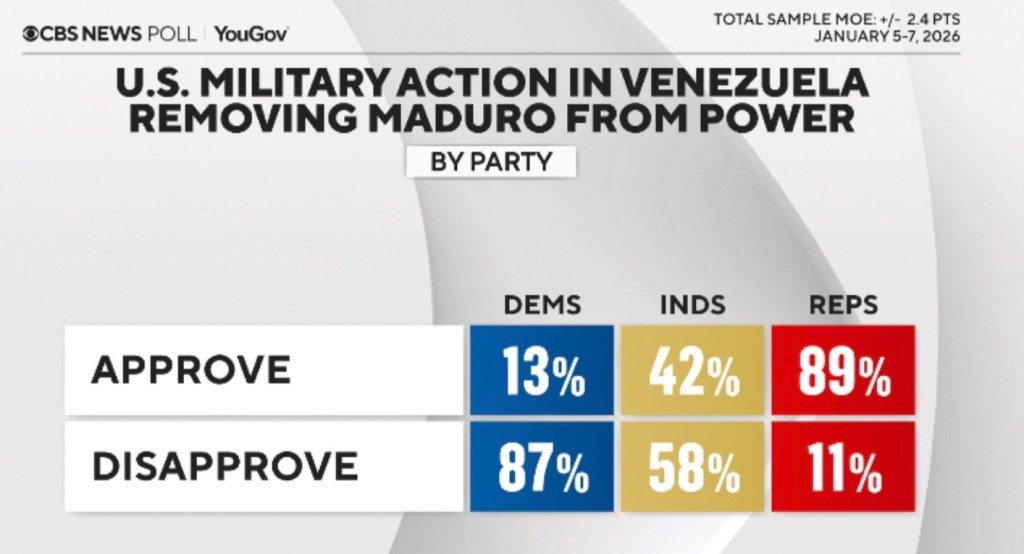
The real purpose of the abduction, surely, was to give Trump an opportunity to strut around and act tough. But this ego gratification, like a sugar rush, won’t last long. Voters normally rally around the president at the beginning of a war. The invasion of Iraq was initially very popular. But the action in Venezuela hasn’t had any visible rally-around-the-flag effect. While Republicans, as always, support Trump strongly, independents are opposed:

And now the story of the moment is the atrocity in Minneapolis, where…an ICE agent killed Renee Nicole Good by shooting her in the head.

Trump and his minions responded by flatly lying about what happened. But their accounts have been refuted by video evidence which show an out-of-control ICE agent gunning down a woman who was simply trying to get away from a frightening situation. Yes, MAGA loyalists will fall into line, preferring to believe Trump rather than their own lying eyes. But public revulsion over Good’s murder and Trump’s mendacity are high and growing.

A president who actually cared about the welfare of those he governs would have taken Good’s killing as an indication that his deportation tactics have veered wildly and tragically off course. He would have called for a halt of ICE actions and made sure there would be an objective and timely federal investigation into this national tragedy.

But for Trump, ICE’s violent lawlessness is a feature, not a bug. Sending armed, masked, poorly trained, masked and out-of-control armed thugs into blue cities is, in effect, a war on Americans, just as January 6thwas a war on American institutions. In effect, Trump would rather savage his own people than be held accountable for his actions.

So in Trump’s mind, Renee Nicole Good’s murder is at most collateral damage, in service to his insatiable need to dominate and feel powerful — so insatiable that he is attempting to create an alternate reality, claiming that that Good ran over an agent although there is irrefutable video evidence that she didn’t.

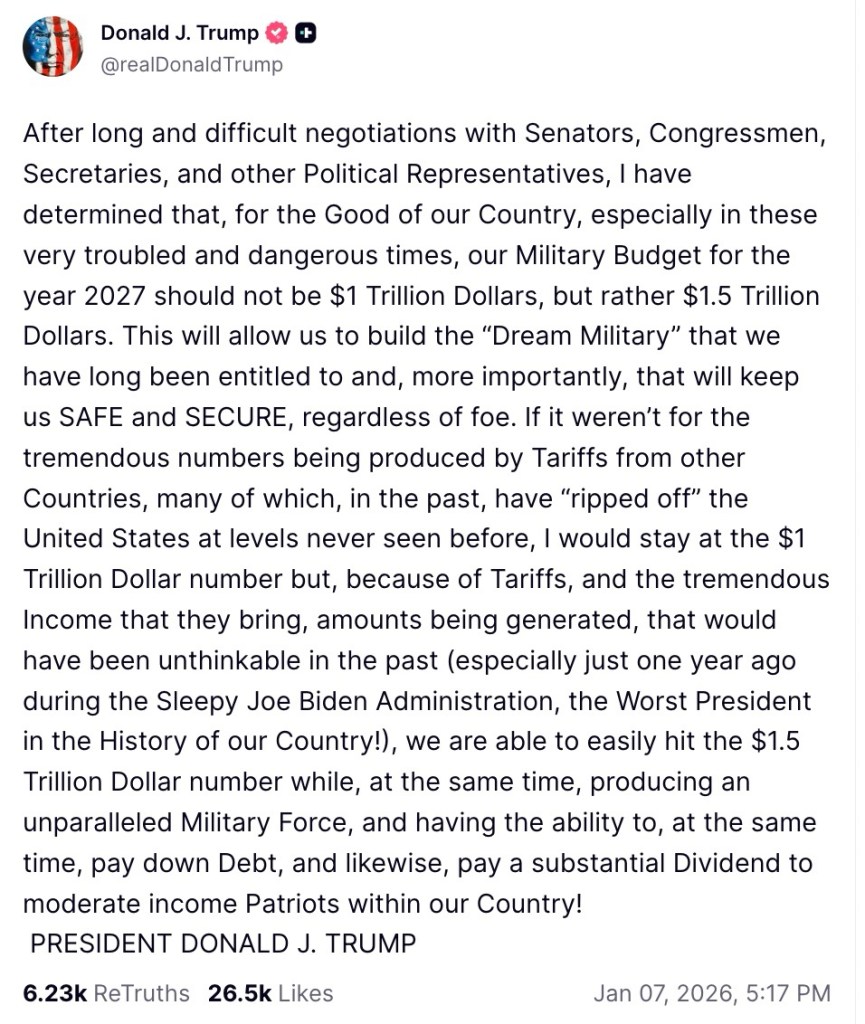
And when one set of lies doesn’t work, he switches tactics – changing the topic, deflecting, and spouting even more lies. Thus, just hours after Good’s death, Trump proclaimed that he was seeking a huge increase in military spending:

It’s a near certainty that Trump’s assertion that he arrived at an immediate 50% increase in the military budget after “long and difficult negotiations” is yet another lie. There’s been no indication whatsoever that a massive increase in defense spending was on anyone’s agenda before he suddenly posted about it on Truth Social.

So what was that about? Given the timing, it’s clear that Trump’s announcement was yet another exercise in self-aggrandizement, as well as an attempt to grab the headlines away from Good’s killing. But what’s also important to realize from Trump’s announcement is that he is now clearly conflating the size of the US military with his ego. Evidently the sugar rush of Maduro’s capture has left him wanting more and more military validation, particularly as his poll numbers tank.

So here’s a warning to the US military: if you continue to indulge the sick fantasies of this man, he will drag this country into more and deeper international morasses to feed his need for glory. Do what Admiral Alvin Holsey, an honorable man, did – stand down and refuse an illegal order. Here’s a warning to the Republicans: if you continue to allow this man to perpetrate war against his own people with impunity through the actions of ICE, you will be remembered as cowards and hypocrites. Here’s a warning to all his other enablers: if you do not do something to stop this madman, you will go down in history as traitors to this country.

And here’s a warning to those directly perpetrating Trump-directed atrocities: He will not be in power forever, and I expect and hope that you will be held accountable, personally, and prosecuted to the full extent of the law.

The Trump administration is making life harder for young parents, says blogger “Home of the Brave.” Trump’s boasts about the economy don’t help families who are struggling to pay for groceries and to buy a home. Trump has even slashed funding for in vitro fertilization, which some families need to have children.

Donald Trump has dubbed himself “the fertilization president” and stacked his administration with self-described pro-natalists—most notably JD Vance—who say they’re concerned with increasing America’s birth rates. Trump has bragged, falsely and bizarrely, about being the “father of IVF” and said on the campaign trail that “we want more babies.”

Here’s the reality beyond the rhetoric: Trump’s presidency is a disaster for new parents and young families. If you’re looking to start a family today, Trump’s making that harder. And if you’re a new parent, Trump’s going out of his way to make that harder, too. Here are just some of the ways they’re doing it:

1.) Cutting funding for family planning.

Trump’s DOGE cuts have gutted federally-funded IVF programs. In April, the Centers for Disease Control and Prevention eliminated its Assisted Reproductive Technology Surveillance program, firing six researchers who tracked IVF effectiveness nationwide. People involved with the program told NBC News it was “a tremendous resource” and called its closure an “immediate loss.”

According to the Cleveland Clinic, since 1978 more than 8 million children have been born thanks to IVF, making it the most common type of fertility treatment available, and one of the most effective. Roughly 5 percent of couples experiencing infertility turn to the treatment, and it can offer life-changing results. For millions of Americans, IVF is their best hope for starting a family.

Far from being the “father of IVF,” Trump has made the treatment harder to get for ordinary Americans. When he originally came out in favor of IVF, many of Trump’s social conservative allies in the Republican Party were outraged, calling on him to “walk back” his remarks. They can rest easy now that they know that—as in so many other cases—Trump was lying.

2.) Driving housing costs through the roof.

Houses have become costlier year over year due to limited housing supply. With fewer houses on the market, demand from buyers—especially growing families—outpaces supply. This imbalance drives up prices, freezing out younger and less established homebuyers. To combat this, there’s bipartisan agreement on the need for millions of units worth of new home construction—and fast.

But Trump’s policies are making it harder to build anything. A large portion of the lumber used in American home construction comes from Canada. Steel, another critical building material, is imported predominantly from Japan. Trump has imposed steep tariffs on both countries, making the foundational materials needed to build homes more expensive, which drives up production costs and increases the final price. Regular American families bear the brunt of these increases.

On top of that, as many as 30 percent of construction workers in the United States are immigrants, and Trump’s campaign against immigration is shrinking the available labor supply for construction projects. Masked ICE agents are conducting jump-out raids on unsuspecting contractors and construction workers, in some cases trapping them on freezing cold job sites for hours. As a result, the construction industry is starting to see worsening labor shortages.

Trump built his image on being a real estate magnate, promising on the campaign trail that his administration would be “cutting the cost of a new home in half.” Instead, he’s the biggest obstacle to young parents and new families getting a roof over their heads.

3.) Making everything your child needs more expensive.

Any parent will tell you that you’re always buying something for your kids: babies grow out of clothes constantly, toddlers break toys, you’re forever restocking diapers and formula. It’s a never-ending cycle that is hard to budget for even in the best of times. Trump’s tariffs have made essential baby items—clothes, formula, cribs, strollers, car seats, toys—even more expensive than they already were.

Prices for toddler clothes have gone up 3.3 percent in recent months, according to the Bureau of Labor Statistics, whose non-political and widely-respected commissioner Trump recently fired for reporting accurate statistics. Other baby essentials have experienced similar jumps thanks to Trump’s tariffs. The Baby Center, a digital resource for parents, wrote that, unless diapers and other goods “are excluded from the tariffs, prices could increase … because manufacturing equipment, packaging, and materials may all be imported.”

Despite Trump’s “America First” monomania, we can’t source every single part of every single baby product here in the United States. It would make everything prohibitively expensive and undercut businesses’ bottom lines. And even if businesses were onboard with this scheme, it would take years or decades to re-shore all the necessary components to US soil. This is what happens when Trump’s economic illiteracy meets reality….

Trump has boasted about his lack of involvement in his children’s lives. He said tasks like changing the kids’ diapers were “just not for me” and he admitted in 2005 that he “won’t do anything to take care of” his children. According to Vanity Fair, his son Don Jr. told him, “You don’t love us! You don’t even love yourself. You just love your money.”

The pattern is clear: The “fertilization president” and “father of IVF” is systematically making it harder and more expensive for American families to have and raise children. He’s gutted IVF programs, driven up housing costs, made baby essentials more expensive, and even taxed parents’ coffee—all while breaking his campaign promises.

American parents shouldn’t have to suffer because Trump was a lousy dad and an even worse president.

Jan Resseger reminds us of the purpose of public education by quoting Derek Black’s new book Dangerous Learning, in which he writes that “public schools are the place where children—regardless of status—share a common experience, come to appreciate the public good, and prepare for equal citizenship. The purpose of public education has always been to sustain a republican form of government.” The Trump administration does not want to “sustain a Republican form of government.” It blabbers on about parents’ rights, not the common good. It is determined to destroy the U.S. Department of Education because it protects the rights of students, especially the most vulnerable. Ironically, the claims for “parents’ rights,” has been turned into a battering ram against students’ rights.

Jan writes:

In his newest book, Dangerous Learning, constitutional law scholar Derek Black explores one of the most basic reasons our public schools, our society’s most extensive and inclusive civic institution, are essential: they are an enormous system whose promise is to serve the needs and protect the rights of nearly 50 million children and adolescents.  Justice cannot be achieved solely through the protection of parents’ rights, by which parents vie to advance their own children’s needs.

Black writes: “As rhetoric, educational freedom sounds good.  As a practical matter, it falls well short of freedom for all. It does not even attempt to ensure that private education works for children. At best, it is agnostic toward the school environments students enter. At worst, it uses public funds to facilitate patterns and values that America has spent the past half century trying to tame…  Public schools to be sure, are far from perfect. They have never fully met the needs of all students and all communities. But those shortcomings are clearly understood as problems to fix. They are seen as bugs, not features, of public education, which has operated for two centuries on the premise that public schools are the place where children—regardless of status—share a common experience, come to appreciate the public good, and prepare for equal citizenship. The purpose of public education has always been to sustain a republican form of government. And public schools are the only place in society premised on bridging the gaps that normally divide us—race, wealth, religion, disability, sex, culture, and more. The founders of the American public education system believed that rather than inhibiting liberty, a common public education is essential to it.” (Dangerous Learning, pp. 182-183)

Widespread educational justice across the nation cannot be achieved solely through the laws of the states. At the federal level, Brown v. Board of Education, and federal laws like the 1964 Civil Rights Act, and the Individuals with Disabilities Education Act have for three quarters of a century been tools by which the federal government could challenge and rectify injustice in public schools.  In 1979, the U.S. Department of Education was founded to pull together many of the programs designed to increase opportunity for children in states whose public schools had failed to protect their educational rights due to their race, ethnicity, or disability—the work of the Office for Civil Rights, and programs supporting English language learners and special education for disabled students, for example.  The Education Department also increased investment in school districts which states had inadequately funded—Title I for school districts serving concentrations of poor children, for example, and grants for Full-Service Community Schools and 21st Century After-School Programs.

The Trump administration has, however, avoided acknowledging the history of educational injustice as the President has consistently promoted the goal of shutting down the U.S. Department of Education and “returning education to the states.”  When she was confirmed as Education Secretary last March, Linda McMahon declared: “President Trump pledged to make American education the best in the world, return education to the states where it belongs, and free American students from the education bureaucracy through school choice. I intend to make good on that promise.”  McMahon has laid off staff whose positions were created by Congress, threatened to send specific programs to other federal departments, and cancelled a raft of specific, congressionally allocated grant funding —all contrary to federal law. Many of these threats have been temporarily stayed by the courts; others are quietly moving forward.

Last week, McMahon took a new step to weaken the Department’s reach—by agreeing to waive federal rules that prescribe how federal funding can be spent and allowing states to combine at their discretion funding from specific federal grant lines. For the Associated Press, Colin Binkley explained: “The Trump administration is giving Iowa more power to decide how it spends its federal education money, signing off on a proposal that is expected to be the first of many as conservative states seek new latitude from a White House promising to ‘return education to the states.’ Iowa was the first state to apply for an exemption from certain spending rules.”  Binkley describes Education Secretary McMahon’s justification for giving Iowa control of spending federal dollars from four different grant programs: “McMahon told The Associated Press that the new flexibility will free up time and money now devoted to ensuring compliance with federal rules. With fewer strings attached, states can pool their federal dollars toward priorities of their choosing, including literacy or teacher training….”

For K-12 DiveKara Arundel lists four separate programs established by the federal Every Student Succeeds Act whose funding streams Iowa has been permitted to combine: Title II, Part A—Supporting Effective Instruction; Title III, Part A—English Language Acquisition; Title IV, Part A—Student Support and Academic Enrichment; and Title IV, Part B—21st Century Community Learning Centers (after-school programs). Arundel describes Iowa’s Republican Governor Kim Reynolds expressing gratitude for giving her state more freedom: “Iowa Gov. Kim Reynolds, speaking at the press conference, said the state is ‘confident that we can do even more by reallocating compliance resources. Iowa will begin shifting nearly $8 million and thousands of hours of staff time from bureaucracy to actually putting that expertise and those resources in the classroom.’ “

Several writers, looking at the modesty of last week’s Iowa waiver to consolidate grants are not yet anticipating that the Iowa situation bodes massive deregulation of federal funding.  Education Week’s Mark Lieberman explains: “The waiver approval appears to mark the first time since the 2015 passage of the Every Student Success Act that the federal government has used its authority under that law to allow a state to consolidate funding. But, in contrast with proposals the state put forward roughly a year ago, the new federal approval touches only 5% of Iowa’s overall allocation of federal education funds, the part that’s set aside for the state education agency. The bulk of federal dollars that flow to school districts each year—$900 million worth—will retain their current structure and spending and reporting requirements.”

Binkley reassures the public: “Iowa’s new plan leaves Title I funding untouched.”

Lieberman quotes Anne Hyslop, who now leads All4Ed, and who worked in the Department during the Obama administration: “This announcement could signal an acknowledgment from the department that its legal authority to flatten discrete funding programs and implement unrestricted block grants without congressional approval is limited, said Anne Hyslop… It also foreshadows an uphill battle for other states aiming to convert federal education funding to block grants, including Indiana, which submitted a request for that flexibility, along with relief from certain school accountability requirements in October.”

Chalkbeat’s Erica Meltzer adds States already control most aspects of education. Federal funding makes up about 10% of overall education spending, and those dollars do come with restrictions and reporting requirements that aim to ensure money is spent appropriately… Iowa’s waiver doesn’t allow districts to consolidate most of their federal funding, which would have represented a much larger pot of money.

However, the reporters acknowledge that, in the context of the Trump administration’s goal to return education to the states, the Department may increasingly grant waivers that limit federal oversight.  Will Iowa’s waiver be the first step as the Department of Education reduces guardrails that protect students’ civil rights?

Meltzer reports that the new waiver, “does allow Iowa school districts to take advantage of a 1999 federal provision called  Ed-Flex to roll over more money year over year to make it easier to invest in big-ticket items and longer-term strategies….”  Lieberman adds: “Separate from the waiver approval, McMahon also simultaneously announced she’s approved Iowa to join 10 other states currently participating in the department’s Ed-Flex program, which gives state education agencies the authority to waive certain spending regulations for individual districts… The 10 states currently participating are Delaware, Georgia, Indiana, Kansas, Massachusetts, North Carolina, Pennsylvania, Texas, Vermont and Wisconsin. Iowa is the first state to gain the distinction since McMahon became secretary.”

Meltzer concludes by cautioning readers: “(T)he Education Department still needs to ensure money is being appropriately spent, which is more challenging after massive layoffs.” She quotes Hyslop worrying: “(T)he U.S. Department of Education right now lacks the capacity to do meaningful oversight of how this program is being implemented or the waiver process in general.”

Specifically, Meltzer warns that one of the federal grants Iowa was allowed to merge supported English language instruction, a step that could well reflect the Trump administration’s attack on immigrants or its anti-DEI initiatives: “Advocates are particularly concerned that Iowa’s new block grant consolidates Title III funds that are required to go to English learners…. The Trump administration laid off most of the staff at the Education Department who support those students, and rescinded a guidance document considered to be the ‘bible’ in that field.” She quotes the Education Trust’s Nicholas Munyan-Penney: “I think of red tape equaling protections for students… We want to make sure that students have access to the protections and resources they need to be successful.”

Will 2026 be the year that the Department of Education expands the use of waivers to undercut the federal oversight of funds that protect equality of educational opportunity across our nation?  We will need to watch carefully as the chaotic education policy in McMahon’s Department of Education continues into its second year.