Peter Greene writes here about two basic facts: 1) vouchers are unpopular; and 2) because they are unpopular, their supporters call them something else, not vouchers. There have been more than 20 state referenda on vouchers. None passed. So voucher advocates had to become creative and come up with new names for them.
In Florida, the state constitution forbids spending public money on religious schools. So Jeb Bush, a fervent voucher guy, became creative. He proposed a referendum to remove that wording from the state constitution in 2012. The referendum was titled “The Religious Freedom Amendment.” Opponents of vouchers cried foul, but the misleading title remained. Others had to vote against “religious freedom” to oppose vouchers. Some were undoubtedly fooled, but the Religious Freedom Amendment was defeated anyway; only 44% supported it. Nonetheless, the Florida legislature enacted vouchers, ignoring the referendum failure, and in the past year, removed all income limits. As in every other state with universal vouchers, the majority of students applying for vouchers were already enrolled in private and religious schools.
Peter Greene writes:
Voucher supporters have one major problem: school vouchers are unpopular.
The term doesn’t test well. Measure of public support is iffy– if you ask people if they would like every student to have the chance to ride to a great school on their own pony, people say yes, but if you ask a more reality-based framing (“should we spend education dollars on public schools or subsidies for some private schools”) the results look a bit different.
But one clear measure of public support for vouchers is this; despite all the insistence that the public just loves the idea, no voucher measure has ever been passed by the voters in a state. All voucher laws have been passed by legislators, not voted in by the public.
Voucher supporters have developed one clear strategy– call them something else.
The basic school voucher idea is simple– the state takes money that it was going to spend on public education (either after that money has been paid in taxes, or by having someone trade a “contribution” to a voucher fund in exchange for tax credit) and giving it to parents, who in turn can go out and buy education services on their own.
They’re not taxpayer-funded vouchers–they’re “tax credit scholarships.” They’re not vouchers– they’re an Education Freedom Account. And if you want to get in a twitter battle, go ahead and call education savings accounts “vouchers,” because part of the whole point of education savings account was to create an instrument that was both a super-voucher and not-something-we’ll-call-a-voucher-at-all-so-stop-doing-that-dammit.
I expect that behind the curtain there have been folks fervently doing messaging testing on other names for vouchers, and from the results around the nation, we can deduce that words that tested well were “education” and “freedom” and “scholarship.” Also, “empowerment” is coming on strong. States with education savings accounts have the chance to play with the initials ESA.
You can mad lib your way to a voucher program of your own. Education Freedom Scholarship Opportunity Program! Family Freedom Education Scholarships! Family Freedom Empowerment Education Scholarship Opportunity Choice Program Plan! Just don’t call it a voucher.
But a voucher by any other name still smells the same. It’s a payoff to parents so that they’ll exit public education, a false promise of education choice, a redirection of public taxpayer dollars into private pockets, an outsourcing of discrimination, a public subsidy for private religious choices, a means of defunding and dismantling public education as we understand it in this country, a transformation of a public good into a market-based commodity. Call it what you like. There isn’t enough air freshener in the world to make it smell like a rose.
Michigan, under Republican control for years, has given free rein to charter schools and has long been overrun with unaccountable for-profit schools. But the Governor, Gretchen Whitney, is now a Democrat, and the elected State Board of Education is no longer controlled by Republicans. The State Board took a shocking step this week. It resolved that charter schools should be held to the same rules as public schools.
The State Board of Education approved a resolution during its meeting today calling for legislation to open charter schools to be treated more like public schools in the state of Michigan.
Mitchell ROBINSON’s resolution made the agenda and asked the state Legislature to create and pass laws that would put charter schools under the approval of the Michigan Department of Education and make them more transparent by opening them up to the Freedom of Information Act and Open Meetings Act.
The resolution also asked for legislation that would require charter schools to follow many of the same requirements as public schools, such as bidding for vendors, requirements that no child be excluded from enrolling, not refusing transfer students if space is open, require teachers and administrators to hold certificates, and mandate contracts for management organizations be published online.
“So charter schools are technically public schools, so they should be expected to follow regulations regarding transparency, as all publicly funded schools are,” Robinson said.
However, he said many charter schools are dominated by politically-motivated special interest groups, those looking to be education reformers, and “predatory for-profit organizations.”
He said he’s looked at the charter school system in Michigan and found that they make up one-third of all the local education agencies in the state and are not accountable to the communities.
“I see no evidence of innovation in this service sector,” he said.
He said the public school system struggles to adequately fund itself, not even adding the charter system that also pulls funding for the 363 schools across 285 districts.
“This is financially irresponsible,” he said.
The sole no vote against the resolution came from Tom McMILLIN, a Republican board member.
He argued that charter schools fill in gaps in education and were already fully transparent with the public funding they received.
“These charter schools give parents choices. They fill up for a reason,” McMillin said.
He said the teachers and administrators were already required to be certified.
“What this would do is simply force charter schools to not open, which is what some people want,” McMillin said.
Marshall BULLOCK II pointed to troubles with charter schools in the Detroit area closing without warning or opening in a struggling district that could have the “unintended consequence” of splitting a neighborhood.
“That is how you destroy a neighborhood,” Bullock said.
McMillin called it “perverse” to not give parents a choice and “force them, based on their zip code, to a failing school.” He placed the problem at the feet of the state superintendent.
Tiffany TILLEY asked that the board hear a presentation to look at what other states are doing in terms of charter schools.
“Michigan has become kind of like the Wild Wild West when it comes to charter schools,” Tilley said.
She said you can’t have “thousands” of charter schools with no transparency and continue to maintain a well-funded system, but putting a limit on the number of charters schools could help.
“We do need to change the laws and this has gone on for a very long time,” she said.
Now if only the Michigan legislature would ban for-profit charters! No public school operates for profit. The “profit” is inevitably taken from students and teachers. It’s wrong.
Politico revealed today that the Gerald R. Ford Foundation decided not to offer its annual award to Liz Cheney because its board was afraid that Trump would retaliate against them. He could, if elected, cancel its tax-exempt status or take other actions. I do not recall any time when independent organizations self-censored because they were afraid of a presidential candidate’s wrath. Meanwhile Congress continues to refuse to consider arming Ukraine because Trump told Republicans not to. Zelensky called Trump personally and invited him to Ukraine, but Trump didn’t say yes or no. He avoided the draft during the Vietnam War with five deferments (bone spurs). It’s unlikely he would visit Ukraine. Putin wouldn’t like it. And he doesn’t like to be in danger.
Politico wrote:
Former Indiana Gov. MITCH DANIELS will receive the 2024 Gerald R. Ford Medal for Distinguished Public Service after Trump critic LIZ CHENEY was rejected for the award because the board of the Ford Presidential Foundation was worried that Trump would retaliate against the organization if he’s reelected, Daniel Lippman reports.
The foundation has not publicly announcedthat Daniels will be getting the award, but Lippman obtained an email from foundation executive director GLEAVES WHITNEY to the trustees announcing that the organization “will be conferring our foundation’s highest award on Governor Daniels following our board meeting in Washington D.C. on Monday, June 3, 2024, at the Willard Hotel.”
The award comes after two other peopleturned down the prize, and there was an extended back and forth about whether giving Cheney the award would jeopardize the foundation’s tax-exempt status, according to a resignation letter that photographer and foundation trustee DAVID HUME KENNERLYwrote yesterday that Playbook broke this morning. Daniels and the foundation did not immediately respond to requests for comment. Adam Wren contributed reporting for this item
Our reader who calls him/herself “Democracy” left the following well-documented comment about Putin and Trump. Trump laughs at any suggestion that Putin helped him best Hillary Clinton, calling it a “witch hunt,” “a hoax,” or just “Russia, Russia, Russia!” He says he was cleared by the Mueller Report. Democracy says otherwise.
He or she writes:
The Supreme Court is “undemocratic” in that its members are not elected.
Yet, it is part of a larger democratic system crafted by the Founders in the Constitution. Its members (and all federal court judges) are appointed by the president – who is elected – and subject to confirmation by a majority of the Senate (also elected). It has the power of judicial review, which in simplified terms is “the power of an independent judiciary, or courts of law, to determine whether the acts of other components of the government are in accordance with the constitution.”
In the case of the Colorado Supreme Court’s decision to declare Trump an insurrectionist and remove him from the ballot per the direct wording of Section 3 of the 14th Amendment, the US Supreme Court abdicated its responsibility. It turned its collective back on the Constitution, led by the core conservatives on the Court.
What I find MOST undemocratic about THIS Court is that fully one-third of it — in my view — is illegitimate. These members — Gorsuch, Kavanaugh and Barrett — were appointed by a president* who knowingly and willingly took LOTS of help from Russian intelligence agencies to win* the 2016 presidential election.
David Cole put it like this in describing the Mueller Report in the New York Review of Books:
“Robert Mueller’s report lays out in meticulous detail both a blatantly illegal effort by Russia to throw the 2016 presidential election to Donald Trump and repeated efforts by Trump to end, limit, or impede Mueller’s investigation of Russian interference. Trump’s efforts included firing or attempting to fire those overseeing the investigation, directing subordinates to lie on his behalf, cajoling witnesses not to cooperate, and doctoring a public statement about a Trump Tower meeting between his son and closest advisers and a Russian lawyer offering compromising information on Hillary Clinton.”
“The Mueller report describes extensive contacts between the Trump campaign and the Russians, many of which Trump campaign officials lied about. And it finds substantial evidence both ‘that the Russian government perceived it would benefit from a Trump presidency and worked to secure that outcome, and that the Campaign expected it would benefit electorally from information stolen and released through Russian efforts.’… Russian intelligence agency hackers targeted Hillary Clinton’s home office within five hours of Trump’s public request in July 2016 that the Russians find her deleted e-mails. And WikiLeaks, which was in close touch with Trump advisers, began releasing its trove of e-mails stolen by the Russians from Clinton campaign chairman John Podesta one hour after the Access Hollywood tape in which Trump bragged about assaulting women was made public in October 2016.”
“Trump has repeatedly dismissed the investigation as a ‘witch hunt.’ But Mueller found “sweeping and systematic” intrusions by Russia in the presidential campaign, all aimed at supporting Trump’s election. He and his team indicted twenty-five Russians and secured the convictions or guilty pleas of several Trump campaign officials for lying in connection with the investigation, including campaign chairman Paul Manafort, top deputy Rick Gates, campaign advisers Michael Flynn and George Papadopoulos, and Trump’s personal lawyer Michael Cohen. Trump’s longtime friend Roger Stone faces multiple criminal charges arising out of his attempts to conceal his contacts with WikiLeaks. If this was a witch hunt, it found a lot of witches.”
“The report establishes beyond doubt that a foreign rival engaged in a systematic effort to subvert our democracy…the Russians referred to their actions as ‘information warfare.’ One would think that any American president, regardless of ideology, would support a full-scale investigation to understand the extent of such interference and to help ward off future threats to our national sovereignty and security. Instead, Mueller’s report shows that Trump’s concern was not for American democracy, but for saving his own skin.”
“The report rests its determinations of credibility on multiple named sources and thoroughly explains its reasoning. Its objective ‘just the facts’ approach only underscores its veracity…the results are devastating for Trump…Trump directed White House Counsel Don McGahn to fire the special counsel…after this was reported by The New York Times, Trump instructed McGahn to lie about it. Trump lambasted Attorney General Sessions for recusing himself from overseeing the investigation…Trump repeatedly pressured Sessions to ‘unrecuse’ himself.…He interceded to delete from a statement about his son’s meeting with a Russian lawyer any reference to the lawyer’s offer to provide compromising information on Hillary Clinton. He encouraged important witnesses, including Cohen and Manafort, not to cooperate with the investigation.”
“No reasonable reader can come away from the report with anything but the conclusion that [Trump]repeatedly sought to obstruct an investigation into one of the most significant breaches of our sovereignty in generations, in order to avoid disclosure of embarrassing and illegal conduct by himself and his associates.”
Jane Mayer described the 2016 election in the New Yorker like this:
“Kathleen Hall Jamieson, a professor at the University of Pennsylvania, since 1993, has directed the Annenberg Public Policy Center and in 2003 she co-founded FactCheck…She is widely respected by political experts in both parties…her conclusion is that it is not just plausible that Russia changed the outcome of the 2016 election—it is ‘likely that it did.’…Russian trolls created social-media posts clearly aimed at winning support for Trump from churchgoers and military families…according to exit polls, Trump outperformed Clinton by twenty-six points among veterans; he also did better among evangelicals than both of the previous Republican nominees, Mitt Romney and John McCain…During the weeks that the debates took place, the moderators and the media became consumed by an anti-Clinton narrative driven by Russian hackers.”
Volume V of the Senate Intelligence Committee Report on the 2016 election stated that,
“the Russian government engaged in an aggressive, multifaceted effort to influence, or attempt to influence, the outcome of the 2016 presidential election…Manafort’s presence on the Campaign and proximity to Trump created opportunities for Russian intelligence services to exert influence over, and acquire confidential information on, the Trump Campaign. Taken as a whole, Manafort’s highlevel access and willingness to share information with individuals closely affiliated with the Russian intelligence services, particularly Kilimnik and associates of Oleg Deripaska, represented a grave counterintelligence threat…”
“Russian President Vladimir Putin ordered the Russian effort to hack computer networks and accounts affiliated with the Democratic Party and leak information damaging to Hillary Clinton and her campaign for president. Moscow’s intent was to harm the Clinton Campaign, tarnish an expected Clinton presidential administration, help the Trump Campaign after Trump became the presumptive Republican nominee, and undermine the U.S. democratic process…While the GRU and WikiLeaks were releasing hacked documents, the Trump Campaign sought to maximize the impact of those leaks to aid Trump’s electoral prospects. Staff on the Trump Campaign sought advance notice about WikiLeaks releases, created messaging strategies to promote and share the materials in anticipation of and following their release, and encouraged further leaks. The Trump Campaign publicly undermined the attribution of the hack-and-leak campaign to Russia and was indifferent to whether it and WikiLeaks were furthering a Russian election interference effort.”
The New York Times reported the Volume V release like this:
“The report by the Senate Intelligence Committee, totaling nearly 1,000 pagesprovided a bipartisan Senate imprimatur for an extraordinary set of facts: The Russian government disrupted an American election to help Mr. Trump become president, Russian intelligence services viewed members of the Trump campaign as easily manipulated, and some of Trump’s advisers were eager for the help from an American adversary…the report showed extensive evidence of contacts between Trump campaign advisers and people tied to the Kremlin — including a longstanding associate of the onetime Trump campaign chairman Paul Manafort, Konstantin V. Kilimnik, whom the report identified as a ‘Russian intelligence officer.’…Mr. Manafort’s willingness to share information with Mr. Kilimnik and others affiliated with the Russian intelligence services ‘represented a grave counterintelligence threat,’ the report said…The Senate investigation found that two other Russians who met at Trump Tower in 2016 with senior members of the Trump campaign — including Mr. Manafort; Jared Kushner, the president’s son-in-law; and Donald Trump Jr., Trump’s eldest son — had ‘significant connections to Russian government, including the Russian intelligence services.’…”
The BBC reported this in the summer of 2018 after Trump met with Putin in Helsinki:
“After face-to-face talks with Russian President Vladimir Putin, Mr Trump contradicted US intelligence agencies and said there had been no reason for Russia to meddle in the vote. Trump was asked if he believed his own intelligence agencies or the Russian president when it came to the allegations of meddling in the elections.
‘President Putin says it’s not Russia. I don’t see any reason why it would be,’ he replied.
US intelligence agencies concluded in 2016 that Russia was behind an effort to tip the scale of the US election against Hillary Clinton, with a state-authorised campaign of cyber attacks and fake news stories planted on social media.”
Trump is not just an insurrectionist. He was – and is – a clear and present counterintelligence danger to the security of the United States.
The members of the Court have to know this. Rather than act on what they know to be true, they ducked their heads and pretended otherwise.
Federal Judge Royce Lamberth in D.C. has sentenced those convicted of committing crimes during the January 6 insurrection, most of them for violently assaulting police officers. He objects to those (like Trump) who insist on calling them “hostages” and “patriots.” Almost as shocking is the fact that Republican members of Congress who ran for their lives on January 6 sit silently as Trump praises their attackers. Trump has treated them as heroes and promised to pardon all of them.
D.C. District Judge Royce C. Lamberth delivered a tongue-lashing last week during the sentencing of a participant in the Jan. 6, 2021, riot convicted of multiple crimes. He railed against downplaying the insurrection and specifically condemned the effort to elevate convicted criminals to the status of “hostages.”
It was not the first time Lamberth tried switching off MAGA’s national gaslighting exercise. In a January sentencing memo for another Jan. 6 participant convicted of serious felonies, he declared:
“I have been shocked to watch some public figures try to rewrite history, claiming rioters behaved “in an orderly fashion” like ordinary tourists, or martyrizing convicted January 6 defendants as “political prisoners” or even, incredibly, “hostages.” …
“Protestors” would have simply shared their views on the election — as did thousands that day who did not approach the Capitol. But those who breached and occupied the Capitol building and grounds halted the counting of the electoral college votes required by the Twelfth Amendment.
He continued, “This was not a protest that got out of hand. It was a riot; in many respects a coordinated riot, as is clear from cases before me. … Although the rioters failed in their ultimate goal, their actions nonetheless resulted in the deaths of multiple people, injury to over 140 members of law enforcement, and lasting trauma for our entire nation.” He concluded, “This was not patriotism; it was the antithesis of patriotism.”
Rubin points out that
Trump has not only reimagined Jan. 6 as a glorious event but promised to pardon those involved. Just Security compiled a list of the criminals who would be let out of jail if he spared convicts and those incarcerated awaiting trial. Tom Joscelyn, Fred Wertheimer and Norman L. Eisen calculated that, as of March 23 (the day after Trump reportedly vowed to set “these guys free”), there were 29 inmates in custody related to Jan. 6, “including defendants who are either awaiting trial or post-conviction.”
These include 27 “charged with assaulting law enforcement officers in the U.S. Capitol or on its grounds,” of which 20 have either been convicted or pleaded guilty. The violence involved should shock Americans:
One convicted felon helped lead the assault on police guarding the Capitol’s external security perimeter, an “attack [that] paved the way for thousands of rioters to storm the Capitol grounds.” Another inmate allegedly threw “an explosive device that detonated upon at least 25 officers,” causing some of the officers to temporarily lose their hearing. “For many other officers that were interviewed,” an FBI Special Agent’s statement of facts reads, “it was the most memorable event that day.”
Other January 6th inmates held in D.C.: “viciously ripped off” an Metropolitan Police Department (MPD) officer’s mask; assaulted officers “with an electro-shock device;” allegedly sprayed multiple police officers with a pepper spray; “struck an MPD officer with a long wooden pole multiple times;” and allegedly used a “crutch and a metal pole” as “bludgeoning weapons or projectiles against” a “line of law enforcement officers.”
At its most basic level, Trump’s support of Jan. 6 criminals should demolish the notion that Trump and MAGA followers “stand with the blue” or represent the “law and order” party. Trump called these people to the Capitol, fired them up and urged them on to the Capitol. Facing trial himself for the events of Jan. 6, he wants to let out of jail the foot soldiers he enlisted to attack democracy.
Trump admires criminals who attacked officers of the law. They are not hostages. They are criminals.
Two different juries in Michigan convicted the parents of a school shooter. James and Jennifer Crumbley were both found guilty of involuntary manslaughter and were sentenced to 10-15 years in prison. Their son Ethan murdered four other students and wounded several others and a teacher at Oxford High School in Oxford, Michigan.
James purchased the firearm for his son on Black Friday, four days before the shooting. The next day, Jennifer took her son to the firing range for target practice. “Mom & son day testing out his new Xmas present,” she wrote afterward on social media. The parents failed to properly secure the firearm, as James Crumbley hid it in their bedroom but did not use any locking device, the prosecution argued.
In addition, the trials focused on a pivotal meeting between school employees, Ethan and his parents on the morning of the shooting. Ethan had been called into the school office after he made disturbing writings on a math worksheet, including the phrases “blood everywhere” and “my life is useless” and drawings of a gun and bullet.
The school employees recommended the parents immediately take him out of class and get him mental health treatment, but they declined to do so, saying they had work. The Crumbleys also did not mention to the school the recent gun purchase. Afterward, Ethan was sent back to class. About two hours later, he took the gun out of his backpack and opened fire at the school.
This was apparently the first time that parents have been held accountable for their child’s crimes.
Do you approve? I do.
Do you think other parents might be more responsible in the future? I wish so but I doubt it. I recall that the mother of the Sandy Hook murderer bought him an AR-15, took him to target practice to teach him how to use it. He was mentally ill. She was the first one he killed on the day of the massacre. He shot her in the face while she was still in bed. He then went to Sandy Hook Elementary School and killed 26 people, including 20 children, ages 6 and 7, and six staff members.
Nonetheless, parent accountability for the crimes of their minor children is a step forward. In a sane country, access to deadly weapons would be restricted. In most of this country, there are no limits on buying and carrying guns, thanks to the Republican Party and the Supreme Court, the NRA and the Federalist Society.
Dave Wells, research director of the Grand Canyon Institute, a nonpartisan research center in Arizona, released the following statement:
Phoenix —The Grand Canyon Institute expresses deep distress over the implications for women’s health and rights in response to the Arizona Supreme Court’s decision to uphold a territorial-era law from 1864 that bans nearly all abortions. This ruling poses a significant threat to reproductive freedom and will have profound economic consequences for individuals and families across the state.
While the immediate harm will be experienced by women denied access to healthcare, today’s decision will have negative repercussions for all Arizonans. An analysis published in January 2024 by the Institute for Women’s Policy Research (IWPR) sheds light on the ongoing impact of abortion restrictions, highlighting the negative impacts of such policies on economic prosperity in addition to women’s health. Women constitute a considerable segment of the workforce; restrictions on healthcare access harm not only women and their families but also have adverse effects on local economies.
This research emphasizes, in the two years before Roe was overturned, the economic toll of abortion restrictions (e.g., required ultrasound), estimating an average annual cost of $173 billion to the United States economy due to reduced labor force participation, earnings levels, and increased turnover among women. This figure understates the substantial economic repercussions of post-Roe abortion bans. Arizona already was facing an average annual economic loss of $4.5 billion, equivalent to 1% of the state’s GDP due to its restrictive measures.
If reproductive health restrictions were removed, almost 597,000 additional women would join the nation’s labor force each year. The national GDP would experience an increase of nearly 0.7%, and employed women aged 15 to 44 would collectively earn an extra $4.3 billion annually.
“By allowing a 160-year-old law to take precedence over the 15-week law passed two years ago, the Arizona Supreme Court has condemned pregnant people to healthcare restrictions reminiscent of an era when slavery remained Constitutionally endorsed” states Dave Wells, research director of the Grand Canyon Institute. “The Court’s decision will also have significant economic consequences for the state. Our previous restrictive abortion laws already result in an economic cost of $4.5 billion annually, this cost will certainly increase going forward and will be felt by all Arizonans.”
The Grand Canyon Institute emphasizes the importance of safeguarding reproductive rights. As an organization deeply committed to advancing evidence-based policymaking, we are actively engaging in research to further understand the detrimental effects of abortion restrictions on the Arizona economy. This is an area of research we are currently prioritizing, recognizing the profound economic implications of restrictive reproductive health policies.
The Grand Canyon Institute, a 501(c) 3 nonprofit organization, is a centrist think tank led by a bipartisan group of former state lawmakers, economists, community leaders and academicians. The Grand Canyon Institute serves as an independent voice reflecting a pragmatic approach to addressing economic, fiscal, budgetary and taxation issues confronting Arizona.
Arizona’s Supreme Court struck down the state’s abortion law. The law that will go into effect was passed in 1864, before Arizona became a state. Were those the good old days, when women had no rights and couldn’t vote? Do Republicans believe in liberty for men only?
The Arizona Supreme Court on Tuesday upheld a 160-year-old abortion ban that could shutter abortion clinics in the state, saying the law that existed before Arizona became a state could be enforced going forward.
The ruling indicated the ban can only be prospectively enforced and the court stayed enforcement for 14 days. But it’s already causing political earthquakes….
The pre-statehood law mandates two to five years in prison for anyone aiding an abortion, except if the procedure is necessary to save the life of the mother. A law from the same era requiring at least a year in prison for a woman seeking an abortion was repealed in 2021.
Enforcement would mean the end of legal abortions in Arizona, though some providers said they will continue offering abortions at least for a time — likely through May — because of a prior court ruling. And, the state’s top Democrats have taken steps to thwart that enforcement. Reproductive rights activists say it means Arizona women can expect potential health complications.
Democratic Gov. Katie Hobbs issued an executive order last year giving all power to enforce abortion laws to the state attorney general. The current attorney general, Democrat Kris Mayes, has vowed not to enforce any abortion bans. But her decision and Hobbs’ order could be challenged by one of the state’s county attorneys.
The decision was 4-2, with Justices John R. Lopez IV, Clint Bolick, James P. Beene and Kathryn H. King in the majority. Lopez wrote the majority opinion, while Vice Chief Justice Ann A. Scott Timmer penned a dissent. Chief Justice Robert M. Brutinel joined Timmer.
I recognized the name of Clint Bolick. He used to be director of litigation at the Goldwater Institute. A libertarian, he led the legal fight for school choice. I can’t reconcile his libertarianism with his opposition to women’s freedom to choose whether to have a child.
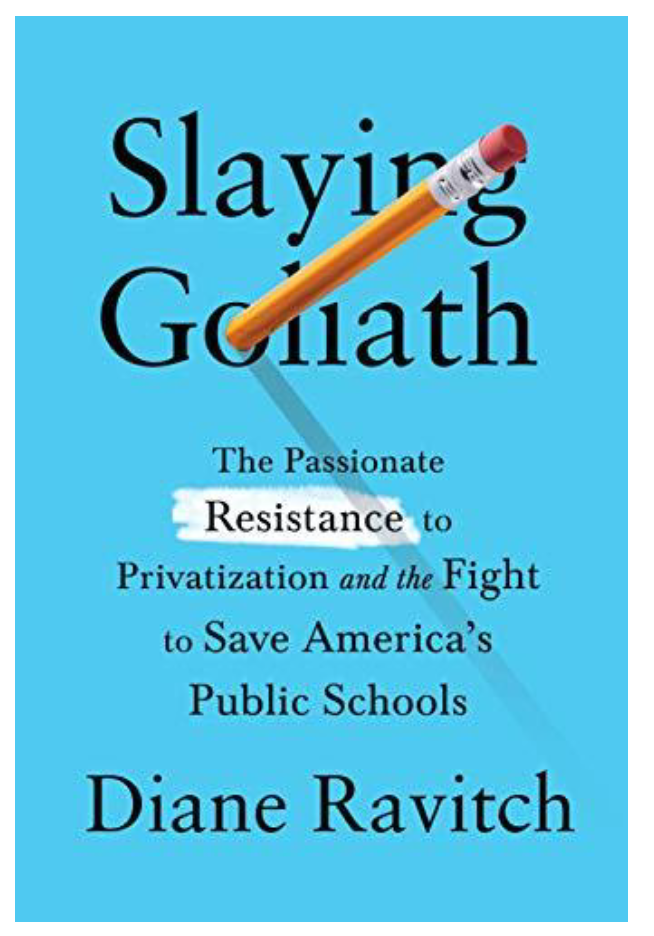
Forgive me for posting two reviews of my last book, which was published on January 20, 2020.
As I explained in the previous post, I did not see either of these reviews until long after they appeared in print. Slaying Goliath appeared just as COVID was beginning to make its mark, only a few weeks before it was recognized as a global pandemic. In writing the book, I wanted to celebrate the individuals and groups that demonstrated bravery in standing up to the powerful, richly endowed forces that were determined to privatize their public schools through charters or vouchers.
America’s public schools had educated generations of young people who created the most powerful, most culturally creative, most dynamic nation on earth. Yet there arose a cabal of billionaires and their functionaries who were determined to destroy public schools and turn them into privately-managed schools and to turn their funding over to private and religious schools.
Having worked for many years inside the conservative movement, I knew what was happening. I saw where the money was coming from, and I knew that politicians had been won over (bought) by campaign contributions.
Publishing a book at the same time as a global pandemic terrifies the world and endangers millions of people is bad timing, for sure.
But the most hurtful blow to me and the book was a mean-spirited review in The New York Times Book Review. The NYTBR is unquestionably the most important review that a book is likely to get. Its readership is huge. A bad review is a death knell. That’s the review I got. The reviewer, not an educator or education journalist, hated the book. Hated it. I found her review hard to read because she seemed to reviewing a different book.
I was completely unaware that Bob Shepherd reviewed the review. I didn’t see it until two or three years after it appeared. He wrote what I felt, but I, as the author, knew that it was very bad form to complain, and I did not.
I am almost four years late in discovering this review by two scholars for whom I have the greatest respect: David C. Berliner and Gene V. Glass.
I was happy to read this review because Slaying Goliath had a checkered fate. It was published in mid-January 2020. I went on a book tour, starting in Seattle. By mid-February, I made my last stop in West Virginia, where I met with teachers and celebrated the two-year anniversary of their strike, which shut down every school in the state.
As I traveled, news emerged of a dangerous “flu” that was rapidly spreading. It was COVID; by mid-March, the country was shutting down. No one wanted to read about the fight to save public schools or about its heroes. The news shifted, as it should have, to the panicked response to COVID, to the deaths of good people, to the overwhelmed hospitals and their overworked staff.
To make matters worse, the New York Times Book Review published a very negative review by someone who admired the “education reform” movement that I criticized. I thought of writing a letter to the editor but quickly dropped the idea. I wrote and rewrote my response to the review in my head, but not on paper.
Then, again by happenstance, I discovered that Bob Shepherd had reviewed the review of my book in The New York Times. He said everything that I wish I could have said but didn’t. His review was balm for my soul. Shepherd lacerated the tone and substance of the review, calling it an “uniformed, vituperative, shallow, amateurish ‘review.’” Which it was. His review of the review was so powerful that I will post it next.
Then, a few weeks ago, I found this review by Berliner and Glass.
The review begins:
Reviewed by Gene V Glass and David C. Berliner Arizona State University, United States
They wrote:
In a Post-Truth era, one must consider the source.
In this case, the source is Diane Rose Silvers, the third of eight children of Walter Silverstein, a high school drop-out, and Ann Katz, a high school graduate. The Silvers were a middle-class Houston family, proprietors of a liquor store, and loyal supporters of FDR.
After graduation from San Jacinto High School, she enrolled in Wellesley College in September, 1956. Working as a “copy boy”for the Washington Post, Diane met Richard Ravitch, a lawyer working in the federal government and son of a prominent New York City family. They married on June 26,1960, in Houston, two weeks after Diane’s graduation from Wellesley. The couple settled in New York City, where Richard took employment in the family construction business. He eventually served as head of the Metropolitan Transit Authority and Lieutenant Governor in the 2000s, having been appointed by Democratic Governor David Paterson.
Diane bore three sons, two of whom survived to adulthood. Diane and Richard ended their 26-year marriage in 1986. She had not been idle. For a period starting in 1961, Diane was employed by The New Leader, a liberal, anti-communist journal. She later earned a PhD in history of education from Columbia in 1975 under the mentorship of Lawrence Cremin.
Diane was appointed to the office of Assistant Secretary of Education, in the Department of Education by George H. W. Bush and later by Bill Clinton. In 1997, Clinton appointed her to the National Assessment Governing Board (NAGB), on which she served until 2004.
Ravitch worked “… for many years in some of the nation’s leading conservative think tanks.




 Diane Ravitch's blog