Archives for the month of: April, 2024

Chris Tomlinson, a columnist for The Houston Chronicle, writes here about the audacious, mendacious plan of Lt. Governor Dan Patrick to destroy public schools. Patrick was a talk-show host like Rush Limbaugh before he entered politics. In Texas, the Lt. Governor has more power than the Governor, so his actions must be closely scrutinized.

Dan Patrick hates public schools. He wants to abolish them and replace them with vouchers.

Tomlinson explains Dan Patrick’s malevolent plan:

Lt. Gov. Dan Patrick’s fantasy of abolishing property taxes would set the state up for financial failure and end public education as we know it by placing a greater burden on low- and medium-income Texans.

The most powerful man in Texas politics wants you to believe he’s looking out for homeowners, but there’s always an unacknowledged goal for significant initiatives like this one. You need only look at who deposited $3 million in Patrick’s campaign account and who gave the record $6 million donation to Gov. Greg Abbott to boost private religious schools.

As lieutenant governor, Patrick appoints the leaders of Senate committees, sets their agendas and decides whether a piece of legislation gets a vote. Patrick also rewards senators who appease him and punishes those who don’t with his fat campaign war chest.

Last week, the lite guv ordered the Senate Finance Committee to “determine the effect on other state programs if general revenue were used to fully replace school property taxes, particularly during economic downturns.”

Rising property taxes are directly correlated to the growing cost of housing in Texas. When home or apartment values go up, so do taxes, and the two combined create a crisis across the country.

Median property taxes in Texas rose 26% between 2019 and 2023, according to data from real estate research firm CoreLogic, and first reported by Axios, an online news agency. In four years, the median payment rose to $4,916 from $3,900 as property values nationwide grew 40%.

Texas has crazy property taxes due to a convoluted system that protects the wealthy and pushes the burden of paying for government services onto low- and middle-income families.

To understand how and why, Texans must remember that we pay for schools through property taxes levied by school districts. The state is forbidden from collecting a property tax, so the Legislature depends primarily on sales taxes and severance taxes levied on oil and gas production.

The Texas Constitution also forbids an income tax, perpetuating the myth Texas is a low-tax state. The wealthy, who spend less of their income on retail purchases and real estate, get off easier than in other states. But the half of Texans who struggle to make ends meet pay a higher proportion of their income in sales and property taxes.

Most states rely on the proverbial three-legged stool of income, property and sales taxes to fairly charge families and businesses based on their ability to pay. Texas relies on only two legs, and Patrick is talking about kicking away one of them.

Patrick’s command comes less than a year after the Legislature took $18 billion from sales taxes and oil and gas severance taxes to pay down school taxes. Most of that money came from high crude oil and natural gas prices and a roaring economy that generated huge sales tax returns. The move marked the first tax reduction paid by most property owners in decades.

Ending property taxes is part of the Republican Party of Texas platform, but it would require collecting $73.5 billion from the remaining leg of the stool, the sales tax.

The state sales rate is 6.25%, while local authorities can collect up to 2% more. The Texas Taxpayers and Research Association in 2018 calculated the sales taxes would need to reach 25% to replace property taxes.

Right-wing fantasists will point at Texas’ colossal budget surplus last year as proof that lawmakers will only need to raise sales taxes a tiny bit. However, anyone who’s lived in Texas for a decade or more knows the fossil fuel business goes through boom-and-bust cycles.

During a bust in 2011, Texas lawmakers slashed school funding by $4 billion. When the money runs out, the Republicans who control every lever of power in Texas do not hesitate to sacrifice public education to avoid raising taxes. Even with last year’s windfall, they refused to give teachers a raise.

This is where school vouchers and property taxes collide. The billionaires backing Abbott and Patrick believe public schools are Marxist, woke indoctrination factories. They want to give parents vouchers to choose Christian nationalist indoctrination factories exempted from state or federal oversight.

The vouchers, though, are insufficient to cover private school tuition, so families must pay the difference. The GOP hopes to create a system in which the state pays a defined amount and normalizes parents’ paying the rest.

Don’t be fooled by promises of lower taxes; this is about killing public schools by underfunding them and shifting more of the burden onto young families and off the wealthy.

This malicious proposal could be politically palatable. There are some five million public school students in Texas. There are more than six million privately owned homes. The population of Texas is majority-minority, like the public school students. The Republican-dominated legislature is overwhelmingly white. Do the math. The people with the power, the people who pay the most property taxes, are white. Do they want to pay property taxes for other people’s children?

Award-winning opinion writer Chris Tomlinson writes commentary about money, politics and life in Texas. Sign up for his “Tomlinson’s Take” newsletter at houstonhchronicle.com/tomlinsonnewsletter or expressnews.com/tomlinsonnewsletter.

Our reader is a retired union worker who follows economic and political news closely. He lives on long Island in New York. He wrote this comment in response to Jonathan V. Last’s article about the media’s insistence on saying that good economic news is “bad for Biden.” His response: “It’s about time!”

Joel wrote:

What we call MSM is owned by very wealthy people whose interests will not be hurt by a Trump re-election. Tax cuts for the wealthy don’t trickle down and never have, but they go into his and their pockets . But even a more benign explanation is that Trump is good for the business of the Washington Post , the New York Times , CNN… All with increased readership and thus advertising sales. Generated by the buffoon.

The jobs report was released on Friday the 5th showing a remarkable stretch of below 4% unemployment not seen since ” we partied like it was 1965″ . Showing millions of more Jobs created on top of all the Jobs recovered since the Covid recession. Jobs recovered in record time for any recovery. After a recession business close employees who were employed have moved on it took from 2010 till 2017 to just recover the Jobs lost in the great recession.

The US has a higher growth rate and lower inflation than almost the entire G20. We have been told by the MSM (not just Right Wing Media ) that the 10s and 10s of millions who either went to work or changed jobs during the recovery, don’t really care about easily getting a Job and changing Jobs for better paying Jobs. Don’t care that the real (inflation adjusted) median wage actually exceeded inflation by a few dollars a week. That most of those raises went to non-supervisory workers. In other words the working class. Not the upper middle class and the wealthy. What they care about we were told was inflation that subsided almost as quickly as it arose. Inflation that was due to supply shortages of Labor and Materials generated by Covid shut downs at home and overseas. By autocrats overseas manipulating oil prices to see an autocrat elected in America. Not due to the typical wage price spirals of the past. Inflation that saw corporations because of the hysteria generated in the media feel free to boost profits by raising prices far and beyond any increase in Labor or material costs.

Laughing in many Corporate Board Rooms that the people have been duped to expect inflation and we are going to give it to them as corporate profits rose to record levels not seen since WW2 and profits still are near record highs. I thought I could sleep after Biden was elected. Garland dispelled that hope quickly. So on Sunday the 7th two days after the employment report , I am up at 4AM. I tuned to CNN . They ran a story I thought was about the fantastic employment report that quickly turned to “but this may not be good for Biden”. And then for the next 8 minutes of perhaps a 10 minute segment diverted to the”oh but inflation”story.

I will say this again !!!! when Reagan declared morning in America inflation was 4.3% not 3.5% as now. Un-employment was still at 7.8% not 3.8% as now . Mortgage rates were at 13% not 7%. Biden compared to the Reagan administration should be declared the second coming by the media.

But it gets worse. As I pointed out by November of 2021 and several times since on this Blog and elsewhere. The media was hyping inflation beyond any reality. The National price of Gas before Putin was $3.21 a gallon as people went back to living their lives after Vaccinations and Oil fields had not fully opened!!!!!. Yet the NY Times , CNN and PBS found people who used a 1000 gallons of milk or Gas a week to highlight the impacts of inflation . Worse the Picture in the NY Times on line was of a station that had to be in the Pacific off the Coast of California with gas at $5.99. As their own writer Niel Irwin pointed out the price of Gas was CHEAPER than it was for 4 whole years from 2011 till 2014 when the Euro crisis tanked oil prices. Pointed out that workers were working significantly fewer hours to fill that tank than in 2011-14 when the National Average never went below $3.60 and went as high as $3.90.

So imagine me waking up two Sundays ago to see the picture on that CNN segment with gas prices at $5.39 a gallon . The National Price was $3.50 . I had paid $303 a gallon in Trumplandia Long Island (Commack ) on the Friday before. I had paid $3.13 a gallon in Hicksville LI to fill my wife’s car the day before the Employment report . I rewound the TV and paused the TV to snap a picture of the $5.39 cent gas on my cell phone. The following Thursday I filled up in Elmont Long Island at an Exxon station cash or credit $3.15. Long Island is not Texas it has new Wind Mills going up , not oil wells and refineries. The inflation report that rattled Wall Street last week was a whopping 3.5% up 2/10ths from its recent lows in December of 2023 . Not exactly historically high and food inflation was 1.2% year over year .

But again the other day Niel Irwin now writing for Axios (?) came to the rescue with an interesting tidbit. This gets a little nerdy. As Krugman points out rents are responsible for 1/3 of the Consumer price index. The US Labor Department computes rents with a factor no or few other Foriegn Economies do “Owner Equivalent Rent”. Something that does not exist in the real world and no body ever actually pays. It is what you would have to pay to rent your own home. If you had to rent it. But I don’t rent my own house I own it (and the mortgage is free and clear ). Neil Irwin pointed out that back in January the BLS changed the way it computes this fictional cost. It added 5% more single family homes and thus 5% fewer less expensive multi family homes and condos to the mix. As detailed in an Email from the Bureau of Labor Statistics that soon got deleted.  Now this may be a perfectly legitimate statistical change from their view point . But it is like declaring Ketchup a vegetable . Forcing you to compare apples to oranges.

Rent increases across the Nation have moderated significantly . “BLS data on rents for new tenants out today(4/17) show they rose just 0.4% over the last four quarters, marking the slowest pace of advance since 2010. The largest and most important component of the consumer price index is likely soon to follow them lower.” Dean Baker WELL MORE BAD NEWS FOR BIDEN

The next frontier of the abortion debate is rapidly approaching. It is the movement to legislate that life begins at the instant of conception, and that fetuses in the womb (or stored in a tank in an In Vitro Fertilization clinic) are human beings, with the same rights as other human beings. Thus, to kill a fetus for any reason (e.g., to save the life of the mother, or because the pregnant girl is a 10-year-old victim of rape, or because the fetus has fatal abnormalities) is murder.

Are fetuses “natural persons?” Some people think so. They have the right to believe whatever they want, but they should not have the right to impose their beliefs on others.

But they are trying.

One-third of states have laws defining “fetal personhood.” In Georgia, individuals can claim a $3,000 tax deduction for an unborn child. The deduction applies even if there is a stillbirth or miscarriage. State auditors may have to dig into medical records to verify claims.

Critics complain that the state of Georgia is hypocritical: “This was not necessarily a good faith attempt to support people in pregnancy because, at the same time as this was being passed, we were still fighting to expand Medicaid coverage for pregnant people beyond 60 days after delivery,” [Kwajelyn Jackson, executive director of the Feminist Women’s Health Center in Atlanta] said. She also stressed the need to improve Georgia’s maternal mortality rates, which are the worst in the country, and address systemic racism within health care, which results in Black maternal mortality rates being twice as high as white women in the state.”

In Texas, a woman who was given a ticket for driving alone in the HOV lane claimed that she shouldn’t have to pay the ticket because she was 34 weeks pregnant. But Texas has not yet passed a fetal personhood law, so she was required to pay the ticket.

In several high-profile murder cases, men have been charged with a double homicide when they killed their pregnant wife.

Planned Parenthood is keeping watch on Republican efforts to pass a federal law recognizing “fetal personhood.”

Similar to what we’ve seen on the state level, anti-abortion members of Congress have pushed ”fetal personhood” attacks for years, and fights are expected to continue this spring. Federal lawmakers trying to ban abortion have tried to embed personhood language in maternal health bills, birth control bills, tax codes, child support laws, college savings plans, COVID-19 relief packages, and essential safety-net programs like Temporary Assistance for Needy Families. And they aren’t stopping. Like other personhood attacks, if taken to its most extreme, this language could affect birth control — including the pill, IUDs, and emergency contraception.

Currently, 125 members in the House, including Speaker Mike Johnson, support the Life at Conception Act, a federal personhood bill that would extend all inalienable rights afforded to Americans by the Constitution to apply at all stages of life, including to fetuses and embryos. Last year, during the first full Congress since Dobbs, as many as 166 members signed on as co-sponsors.

This attempt to legally define when personhood begins would make all abortion illegal nationwide. And, like the legislation proposed at the state level, would have grave implications for a range of sexual and reproductive health care, including some forms of contraception, infertility treatment, and miscarriage and ectopic pregnancy management. This language could also, in some circumstances, subject health care providers to criminal charges. “Personhood” language in our federal code would take away people’s ability to make safe and healthy choices about their reproductive futures and well-being. 

Laws of this kind are troubling because they turn religious beliefs into legal mandates. They inject Big Government into the most intimate details of people’s private lives. And, they are profoundly hypocritical. The states that insist on “fetal personhood” are the very ones that oppose almost every federal or state program to improve the lives of children. They are states that reject the expansion of Medicaid, leaving large numbers of people without medical insurance; they are states that weaken child labor laws, allowing teens to work long hours in dangerous jobs. They are states whose elected representatives oppose extending the child tax credit, which cut child poverty in half during the year in which it was in effect. Almost any legislation you can think of that would have improved the lives of born children has been opposed by the same people who insist on “fetal personhood.”

What’s the lesson in all this? Each of us may see it differently.

Here’s what I conclude:

Republicans care passionately about fetuses and unborn children. Once they are born, the children are on their own.

Greg Olear noticed Jared Kushner’s new role as a financier and his success at staying far, far away from his father-in-law’s trial in New York City. He also noticed that Jared had replaced Michael Cohen as Trump’s liaison with David Pecker and the National Enquirer. Naturally, he wonders why Jared is not being called to testify.

In a historic first, a Qatari Minister agreed to be interviewed by Israeli journalists. The interview is fascinating because the minister is directly involved in negotiations between Hamas and Israel. The interview appeared in Haaretz. You will find more critical views in Haaretz than in American media.

DOHA – Dr. Majed Al-Ansari, adviser to the Qatari prime minister and spokesperson for Qatar’s Foreign Ministry, has become a well-known figure in recent months. 

In a special interview – the first he has given to an Israeli news outlet, he says – Al-Ansari discusses Qatar’s frustration with both Hamas and Israel’s conduct in talks to reach a cease-fire/hostage release deal, and the need to reach an agreement as soon as possible to prevent further harm to the hostages.

The conversation in Doha, which took place after the Qatari prime minister said he was “re-evaluating” the country’s role in negotiations, occurred amid reports in Israel that another proposal is being examined by both Israel and Hamas, amid fierce demonstrations within Israel designed to pressure Prime Minister Benjamin Netanyahu to show greater flexibility and go for a deal.

The interview with Al-Ansari took place at a complex located not far from where Israel’s delegation has gathered in recent months for negotiations.

The decision to be interviewed by Haaretz at this moment (alongside an interview with Israeli news outlet Kan), and to allow a journalist with Israeli citizenship to have his passport stamped at the local airport, indicates a change in direction: Amid a tainted relationship with Netanyahu, Qatar is showing increased openness to engaging in direct dialogue with the Israeli public.

In your opinion, is it still possible to reach a hostage release deal?

“Well, you know, we’ve been working tirelessly from day one on this. We reached out directly on October 8 to both sides. As soon as we knew that there were hostages, as we knew that there were lives at stake, we immediately reached out to both sides, and since that day, our negotiations have not stopped. Looking for every possible way, every possible venue for every idea. 

“Also in the first deal that collapsed after seven days, we understood that we needed a more robust agreement between both sides that would return all the hostages back home to their families and help us save lives on both sides, and we were hoping to see much more flexibility, much more seriousness, much more commitment on both sides, all through the the process, from day one.

“And I think we’ve been positively engaging with the negotiating teams here in Doha. We believe that there was a lot of sincerity in the process itself, in offering ideas and understanding ideas and taking back ideas. Sadly, that did not materialize to this day, and that certainly led us to reassess our mediation, reassess the commitment to both sides, and reassess the seriousness of both sides.”

Al-Ansari declines to assess the chances that talks will move foward. 

“Let me tell you what I can share on this. We are now at the point where the talks have effectively stopped and both sides are entrenched in their positions, and therefore it would be very difficult to get any calculations on the numbers or other things right now. But if there is a renewed sense of commitment on both sides, I’m sure we can reach a deal that would be able to bring more people home to their families.”

When you say you are re-evaluating your role in the talks, do you really think it’s possible that Qatar will step back from the part it plays in the mediation efforts between Israel and Hamas?

“Well, in the end, our role is based on finding a way to reach a deal between both sides, to reach peace, and to end this discomfort. We have been doing this since 2006 when the U.S. approached us and asked us to open a channel of communication with Hamas, especially and precisely for this kind of scenario. We’ve conducted countless mediations since then, especially since 2014.

“We absolutely understand that a paradigm shift has happened since the attacks of October 7 and this is a totally different reality. But we believe that the way towards peace is through talking, is through mediation, and through getting the hostages back to their families. This can only be done through our efforts in the mediation process with all our partners in the region.

“However, if we see that it’s a hopeless endeavor, then we need to reassess our position and see how we can be useful in the process itself. Because to be honest, we do not want to be used as part of prolonging this conflict.”

Do you feel that you’ve been used?

“Of course. As I said, we are reassessing the commitment of both sides, and one of the main reasons for this is that we’ve gotten all of these statements that contradict the show of commitment to the talks themselves.

One of the critics of your conduct is the prime minister of Israel.

“I don’t want to talk about certain individuals, because I think this is bigger than the people themselves. We were surprised by a lot of the statements coming out, because most of them came from people who know the process, who know our role in the process, and for years those people have worked with us on it, it has accomplished a lot of peace throughout the years and has accomplished the return of 109 hostages during the current conflict.”

Al-Ansari did not directly name Netanyahu as the object of criticism at any point during the interview, but the strained relationship between the Israeli prime minister and Qatar’s leadership has become visible in recent months. Netanyahu’s public calls to urge Qatar to exert pressure on Hamas are seen in Doha as an expression of ill faith in their efforts thus far.

During a meeting with the families of hostages in January, Netanyahu claimed that Qatar was more problematic than the UN and the Red Cross, and said that he did not trust them. In February, he called on the leaders of Jewish communities in the U.S. to pressure Qatar to use its leverage over Hamas.”Qatar has the ability to put pressure on Hamas more than others. They host Hamas’ leaders, Hamas depends on them financially,” Netanyahu said at the time.

Do you feel that Netanyahu or other senior Israeli officials are trying to scapegoat Qatar because the deal is not progressing?

“Well, there is a lot of political posturing and I can say very clearly that our feeling is that a lot of these statements have to do with very narrow political ambitions, and that Qatar is being used as a political punching bag for those who are looking either to safeguard their political futures or to find more votes in the next elections. 

“Sadly, while we have in front of us and as the main driver behind everything we do human lives that are being lost as a result of this conflict, we believe at times that narrow political calculations deliver these statements, with disregard for the lives of both Israeli and Palestinians.”

In February, you harshly criticized Netanyahu, claiming that his calls to urge Qatar to exert pressure on Hamas were “an attempt to prolong the fighting for obvious reasons.” What did you mean?

“Well, as I said, these statements are impeding the mediation. I mean, I could tell you that since we started working with both sides on this for many years now. And our relationship, especially with the security establishment in Israel over mediation and over ending all of these conflicts and escalations that have taken place throughout the years, has always been productive. 

“We have always been able to engage in a very open way and engage very sincerely, but right now, what we are seeing is that every time we get close to a deal, every time we find new ideas to present to the table, there is sabotage talking place, and that sabotage is in the form of statements or actions that, of course, impede the message.”

From the Israeli side?

“From both sides. And this is why we were hoping that with our help, and with the help of the international community, we could pressure both sides.”

But do you also believe that Netanyahu prefers to continue the war rather than reach an agreement at this point in time?

Al-Ansari considers his answer. 

“If it walks like a duck, and talks like a duck. It the end, these statements do not show us a real commitment to end this conflict as soon as possible. 

“I don’t think [this current conflict is] in anybody’s interest. It’s not in the interest of the Israeli people, its not in the interest of the Palestinian people, not in the interest of all the peace-loving people in the region here for this war to continue, or for a regional spillover to result in the region. 

“It is all of our duty together to our peoples to end this conflict in a peaceful manner and to reach a situation where the security of the Israeli people and the security of the region as a whole is the paramount concern, not narrow political calculations.”

Al-Ansari expressed great concern in the inteview over the possibility that an Israeli operation in Rafah will cause harm to the Israeli hostages and the mass killing of innocent people in the area.

“We have the same point of view that we have always had all through this process: Every escalation on the ground impedes the process. Every escalation on the ground puts the hostages lives at risk. Every escalation on the ground means more death for civilians in Gaza. 

“We know for sure that such an operation will result in countless civilian deaths, and we have voiced our concern along with our partners in the U.S., and Europe, all around the world, that this needs to stop now.

“This needs to stop now and there is no other option than sitting around the table and getting a deal done.”

Qatar-based Hamas leader Ismail Haniyeh speaks to journalists in Doha in December.Credit: Iranian Foreign Ministry/AFP

Is Hamas interested in a deal?

“We were hoping to see more commitment and more seriousness on both sides. We are, with the help of our international partners, hoping that we can pressure both sides to an agreement, but right now we are seeing from both sides a lot of lack of commitment to the process itself and to the mediation.”

Senior Israeli officials portray Qatar as a terror-supporting country.

“We did not enter into a relationship with Hamas because we wanted to. We were asked by the U.S. We reviewed that request in 2006. 

“At the time, it was very clear to us that this was a role that could only be done by us. That there was very little appetite for everybody else to enter into that arena, and that if we shy away because of narrow political calculations from our side – although we understood the heat that would come as an result of this – this would mean less chance for peace, and more conflict and more escalation in the Palestinian territories and Israel. 

“As a result, we took – and, I think, our leadership – a brave decision to take on the political responsibility of being mediators and the channel of communication between both sides. That has accomplished and affected [things] so many times right now, so it has proved its success, and it is the only option we have right now.”

How does Qatar define Hamas’ attack against Israel on October 7? Is it terrorism? Is Hamas a terrorist organization?

“We have made it very clear since the beginning of this that we condemn any targeting of civilians in any way, anyhow, for any reason. There is absolutely no possible justification for killing civilians in any kind of conflict, regardless of who is doing the killing or who is being killed. A human life is a human life. Whether it is Israeli, Palestinian, or anywhere else. 

“We cannot accept in our country – this is a peaceful country, one of the most peaceful countries in the world. We cannot accept the images of civilians being killed as the result of political conflict, military conflict or otherwise, and therefore we have made it very clear that we condemn these attacks and we condemn the killing of civilians, as we are condemning now the killing of Palestinian civilians in the war.”

Al-Ansari rejects the claims made by Netanyahu and other senior Israeli officials that Qatar needs to increase pressure on Hamas in the negotiations and that it is not doing enough to encourage the organization to be flexible and adopt the proposals that have put on the table thus far.

“One needs to understand the role of a mediator in any kind of mediation. If you are impartial in mediation, then obviously it will succeed.

“You need tactical neutrality, you need to be able to show both sides that you are addressing their concerns, that you understand their point of view and you are working to reach a situation where both sides can sit at the table and agree on a formula that will not be the formula that both sides are asking for. 

“Your job is not to push one agenda over the other. Your job is to find a way of reaching a deal that will protect people’s lives.

“I don’t think that language is suitable within the mediation process. We are applying all the pressure that we can as mediators on both sides. We don’t have special leverage over Hamas or special leverage over Israel. The only leverage we have is the fact that we are willing to undertake the mediation and pay the political cost for this mediation. 

“But we have been doing all that we can. I mean, if you talk to our negotiating team, they have been working 24/7, day and night, for more than six months now, with very little time off. The only time they get to go back to their families is when the talks stop. We have been totally invested in this process and we hope that we find the same sincerity and the same commitment from both sides as we have seen in our negotiating team.”

Have you asked yourself, with hindsight after October 7, whether the money you transferred to the Gaza Strip for many years was a mistake? Was the money ultimately used for terrorist activities?

“First of all, let’s clarify a couple of things: One is we have never been passive mediators. The easiest way of doing mediation is by doing absolutely nothing except for exchanging messages between both sides. 

“When we mediated for peace in Lebanon, part of the deal that we reached was Qatar committing to reconstruction in south Lebanon. When we mediated between the separate and central government in Khartoum, part of the agreement that was reached was Qatari reconstruction and social programs, and development programs in that form.

“And when we started mediating between Hamas and Israel, part of the commitment from our side was to help reconstruct Gaza and to provide the Palestinians with a future of hope, living in peace and prosperity, and that was done, of course, through the reconstruction committee in Gaza. 

“When it comes to our aid to Gaza, it was done in complete coordination with the Israeli government and institutions, and the consecutive administrations that have come through since we started these programs agreed that construction funding would be done through two avenues. 

“One was buying fuel – which was done in coordination with the international agencies where fuel was bought in Israel – which then goes into Gaza. There were technicalities that guaranteed that none of that fuel gets misplaced. It goes directly to the electricity stations, and it’s sealed and opened there. And the fuel guarantees that the two million people living in Gaza have electricity for more than a couple of hours, which would happen if that fuel did not go in.

“The other side of it was the humanitarian system that was given to the most needy families, which amounted to $100 per family – which barely sustains the life of a family of three in any place in the world. That money was also carried out through Israel and in coordination with the Israeli government and across Israeli institutions. 

“Every family was vetted by the Israeli side before it got the funding, and proof of receipt of the funding was sent back immediately to the Israeli side, and that process was overseen by Israeli institutions for many years. As a matter of fact, we were asked to increase that aid, and on a number of times, we were asked to continue that aid when we were reconsidering providing aid to Gaza by the Israeli government. 

“I would be very surprised if people who had been party to this process throughout the years would criticize the process itself when they were overseeing it as it was happening. 

“You know, as I said, many times before: If you are going to attack Qatar by saying that Qatar funded Hamas – our partner in this funding was the Israeli government. And therefore questions need to be also asked over, but then, we believe in our role.

“We believe in the aid that was entered into Gaza and we believe that it has helped sustain the lives of innocent individuals and civilians in Gaza, and that as a result of having that reconstruction and that aid, lives but also hope in Gaza were saved. For people without hope.”

Still – did the money end up in the wrong hands?

“We are completely confident in the process that was in place. We believe that the checks that were in place were sufficient and that, as I said, the oversight by the Israelis and international agencies guaranteed that none of that money was leaked anywhere, and as I said, we stand by our policy, a policy based on humanitarian reasons.”

Al-Ansari speaks in general terms only when he tries to explain how Qatar sees the leadership in Gaza the day after the war.

“We have a long-standing commitment to the two-state solution as the only way to end this conflict. We believe in the two state solution, we believe in the peace process. We have been party to the Arab peace solution and the other peace initiatives. And I believe that the only way forward out of this is not more conflict, because our main concern here is the security of the people in the region – the security of our people, and the people of Israel and the Palestinians is based on finding an end to this conflict. 

“There were a lot of ideas that were thrown out throughout the past years. What we see right now makes it very clear that we need an end result, we need to end this conflict and we need to provide the Palestinians with hope and Israelis with security, for all of us in the region to enjoy the security and the prosperity that we need.”

So you don’t see it happening in the near future, as opposed to the possibility that Saudi Arabia may join the agreements?

“If there is a partner for peace, and if from the terrible events of what we have experienced now we can come up with a new chance for peace – everything is possible.”
I was invited by KPFT, a Pacifica station in Houston, to discuss the state takeover of the Houston Independent School District.

This is a better link.

The host of the show is Paul Castro, who has taught in HISD and in an open enrollment charter school.

It was a good exchange. We talked about The state-appointed superintendent Mike Miles, about charter schools, and about Governor Abbott’s determination to get a voucher bill passed by the next legislature. I explained what a voucher program would mean and what has been learned from the experience of other states.

You have to search the website to find the program. It aired April 26 at 9 am.

“Amplified Houston” Friday

Host:Paul Castro

Guest:Diane Ravitch 

Topic

Public school reform and HISD Takeover

Amplified Houston for Fri., April 26, 2024, focuses on public school reform and the HISD takeover. Dr Diane Ravitch, Founder and President of the Network for Public Education (NPE) will guest. NPE is the single largest organization of parents and teachers and other citizens working to stop the privatization of public education and the misuse of standardized testing.Diane Ravitch’s Blog is dianeravitch.net. Her two most recent books are EdSpeak and DoubleTalk:A Glossary to Decipher Hypocrisy and Save Public Schooling and The Death and Life of the Great American School System.

Friday, April 26, 2024 9:00 am30:07

Scott Maxwell, columnist for The Orlando Sentinel, wrote about the state’s callous indifference to the neediest of the state’s children. These are the children who are not included in Ron DeSantis’s commitment to “right to life.” He cared about them when they were fetuses but neglects them now. Their lives don’t matter.

Maxwell writes:

Last week, the Orlando Sentinel shared a gut-wrenching story about the parents of some of this state’s sickest children either losing Medicaid coverage or bracing for losses.

Keep in mind: We’re not talking about kids with sniffles and headaches, but toddlers with traumatic brain injuries who need feeding tubes, wheelchairs and round-the-clock care. And kids who are nonverbal with challenges so severe that their parents take days off work just to care for them.

They are Florida’s most vulnerable residents.

The story was depressing, yet merely the latest in a long string of stories about various vulnerable populations. Consider other recent headlines:

https://mynews13.com/fl/orlando/news/2022/10/31/thousands-of-disabled-floridians-waiting-years-to-get-off-wait-list-for-help

https://www.wfla.com/8-on-your-side/just-help-me-get-my-kid-services-tampa-boy-with-autism-among-460k-florida-kids-kicked-off-medicaid/

https://floridapolitics.com/archives/670068-more-than-22k-children-dropped-from-florida-kidcare-in-2024-as-state-challenges-federal-eligiblity-protections/

https://www.npr.org/2023/03/15/1163617435/florida-is-1-of-11-states-declining-to-accept-federal-money-to-expand-medicaid

That last headline was actually from last year. Now, we’re one of only 10 states rejecting billions of federal dollars meant to help struggling families.

Each of those stories has its own complexities involving different segments of families in need. But I submit the common theme boils down to a single, soul-defining litmus test:

When you see a paralyzed or terminally ill child or an impoverished family, you either believe we have a collective, societal obligation to help them … or you don’t.

I submit this state has too many of the latter in charge. And too many people who just breeze past the dire headlines, because they have the luxury of doing so. Because they aren’t personally affected.

Like many of you, I was dealt a relatively good hand in life. My wife and I are healthy. So are our kids. But I still believe we have an obligation to care for those who aren’t, particularly those who can’t care for themselves.

I think most people agree. On tough issues — like abortion, taxes or the death penalty — reasonable people can reach different conclusions. But throughout time, most civilizations have agreed on this point.

In Florida, however, the state leaves children born with severe disabilities — without the ability to feed themselves or ever live on their own — languishing on waiting lists for services. The average wait is seven to 10 years. Some kids die before they’re served.

Again, either you think that’s OK or you don’t. The leaders of this state haven’t fully funded that Medicaid waiver program since Jeb Bush was in office.

Now, if you’re healthy and wealthy, the term “Medicaid waiver” may be unfamiliar. The health care landscape is littered with a dizzying array of jargon. There are Medicaid waivers, iBudgets, the Medikids program, Healthy Kids, the Children’s Medical Services Health Plan.

It all makes most people’s eyes glaze over. But each program serves a different population and has two common themes: Most are incredibly difficult to navigate. And most leave many people struggling to get the services they need … often by design.

Nowhere is that more evident than in this state’s steadfast refusal to accept federal dollars to expand Medicaid.

The expansion was created under the Affordable Care Act to provide coverage to millions more low-income Americans and hundreds of thousands more Floridians. A slew of organizations and think tanks have said Florida should do so for both moral and economic reasons.

Health care experts say it would save lives. Hospitals say it will create jobs. The Florida Chamber of Commerce says it will boost our economy by tens of billions of dollars.

GOP lawmakers, however, have steadfastly refused — as part of a decade-long tantrum against “Obamacare.” To hell with those who need coverage and for whom the money is there. These politicians say they’re unconvinced the program will work or that the state’s costs won’t rise.

But remember: Florida Republicans are an outlier. The vast majority of states — including dark red ones led by hard-core conservative leaders — have already accepted the money.

“It’s pro-life, it’s saving lives, it is creating jobs, it is saving hospitals,” Arizona’s former governor, Jan Brewer, said when she took the money back in 2013. “I don’t know how you can get any more conservative than that.”

Arkansas Gov. Asa Hutchinson said: “We’re a compassionate state, and we’re not going to leave 220,000 people without some recourse.”

Florida Republicans, however, are fine with abandoning those low-income people. And sick kids. And those with profound disabilities. Re-read the headlines.

After reading all this, if you believe this state should do better by its most vulnerable residents, do me a favor, will you? Don’t send me an email telling me you agree. While I enjoy hearing from readers, I’m not the one who needs to hear this.

Send your thoughts to your state legislators. Or to the House speaker or Senate president. (Their contact info can be found at www.leg.state.fl.us) Or use the governor’s website at www.flgov.com/email-the-governor to share your thoughts there.

You can also ask them some basic questions.

Ask them if they believe it’s acceptable for 22,000 families with profound disabilities to face a 7- to 10-year wait for getting Medicaid waivers.

Ask if they believe the state did the right thing by removing 1.3 million people, including families with terminally sick children, from the state’s Medicaid roll.

Or just copy all those headlines above and ask: “Do you really believe all of this is OK?”

I’d like to believe most decent people don’t. But the headlines keep coming.

The founding myth of the corporate reform movement is the rebirth and transformation of the public schools of New Orleans after Hurricane Katrina in 2005. Most of the city’s public schools suffered physical damage because of the horrendous storm. Large numbers of the students and teachers were scattered after the storm. The state of Louisiana moved in aggressively: it lowered the bar at which a school was deemed to be failing. It took control of most of the public schools and turned them over to charter operators. It fired all of the teachers, most of whom were African-American, disbanding the teachers’ union. The charter operators hired large numbers of Teach for America recruits. The media hailed the experiment in privatization as a success story. Numerous states followed the lead of New Orleans, turning over their lowest-performing schools to charter operators. Michigan created the Education Achievement Authority. Tennessee created the Achievement School District. North Carolina and Nevada launched similar but smaller experimental districts. All of them failed.

Now comes a report that the nearly all-charter New Orleans district did not live up to its hype.

Dr. Barbara Ferguson 
Research on Reforms, Inc. 

April 2024

Following Hurricane Katrina, a newly enacted state law identified schools that scored below the state average as failing and subject to take-over. The state then took-over 107 of New Orleans’ 120 public schools and turned them into charter schools. Last year’s scores showed that 56 of New Orleans’ 68 public schools had scores below the state average.*

Thus, after nearly twenty years, over 80% of New Orleans schools are still below the state average. This charter school experiment has been a failure.

Of the five worst performing high schools taken-over, only one now scores above the state average. Two are still below the state average. Another was closed and then reopened as a campus to expand the Willow selective admission charter school. The status of the other, Walter Cohen, is unclear. Recall that the New Orleans College Prep Charter took-over Cohen High School, operating its selective charter school on one floor, while leaving the failing Cohen students on the other floors. Thus, we learned that the take-over of a failing school simply meant taking-over the building, not the failing students in the building.

Of the five highest performing high schools taken-over, they continue to be the highest performing except for one, McDonogh #35, which is now below the state average. These schools, except for McDonogh #35, collectively received over $5 million in Charter School Grant Funds. The five worst performing high schools received nothing in Charter School Grant Funds following the takeover.The Louisiana law, which termed charter schools “an experiment,” also stated that they were to “serve the best interests of at-risk” children and youth.

But the legislative auditor found in 2022 that for the past six years, more than 1 in 5 charter schools failed to meet requirements on enrollment of children from low-income families.

Louisiana’s “state takeover” law required schools below the state average to be taken-over. Thus, half of the schools should have been taken-over because half are below the state average and half are above. Yet, only the New Orleans’ schools below the state average were taken-over. Targeting New Orleans seems to again be popular with our new governor.

Research on Reforms, Inc. consistently reported on the status of the state-takeover through its website and a published book, “Outcomes of the State Takeover of the New Orleans Schools.” This will be the final of its outreach, which ends with hope that our legislature will one day enact laws that provide equity and excellence in education for our New Orleans children and youth.

Barbara Ferguson, Attorney and Co-founder 
Charles Hatfield, Co-founder 
Research on Reforms, Inc.

Comments to 

bferguson@researchonreforms.org

Research On Reforms Website

The American Civil Liberties Union issued a statement to advise college and university presidents about responding to student protests.

We write in response to the recent protests that have spread across our nation’s university and college campuses, and the disturbing arrests that have followed. We understand that as leaders of your campus communities, it can be extraordinarily difficult to navigate the pressures you face from politicians, donors, and faculty and students alike. You also have legal obligations to combat discrimination and a responsibility to maintain order. But as you fashion responses to the activism of your students (and faculty and staff), it is essential that you not sacrifice principles of academic freedom and free speech that are core to the educational mission of your respected institution…The American Civil Liberties Union released a statement describing how universities should react to demonstrations on campus.

The statement begins:

Schools must not single out particular viewpoints for censorship, discipline, or disproportionate punishment

These protections extend to both students and faculty, and to speech that supports either side of the conflict. Outside the classroom, including on social media, students and professors must be free to express even the most controversial political opinions without fear of discipline or censure. Inside the classroom, speech can be and always has been subject to more restrictive rules to ensure civil dialogue and a robust learning environment. But such rules have no place in a public forum like a campus green. Preserving physical safety on campuses is paramount; but “safety” from ideas or views that one finds offensive is anathema to the very enterprise of the university.

First, university administrators must not single out particular viewpoints — however offensive they may be to some members of the community — for censorship, discipline, or disproportionate punishment. Viewpoint neutrality is essential. Harassment directed at individuals because of their race, ethnicity, or religion is not, of course, permissible. But general calls for a Palestinian state “from the river to the sea,” or defenses of Israel’s assault on Gaza, even if many listeners find these messages deeply offensive, cannot be prohibited or punished by a university that respects free speech principles.

Schools must protect students from discriminatory harassment and violence

Second, both public and private universities are bound by civil rights laws that guarantee all students equal access to education, including Title VI of the Civil Rights Act. This means that schools can, and indeed must, protect students from discriminatory harassment on the basis of race or national origin, which has been interpreted to include discrimination on the basis of “shared ancestry or ethnic characteristics,” or “citizenship or residency in a country with a dominant religion or distinct religious identity.”

So, while offensive and even racist speech is constitutionally protected, shouting an epithet at a particular student or pinning an offensive sign to their dorm room door can constitute impermissible harassment, not free speech. Antisemitic or anti-Palestinian speech targeted at individuals because of their ethnicity or national origin constitutes invidious discrimination, and cannot be tolerated. Physically intimidating students by blocking their movements or pursuing them aggressively is unprotected conduct, not protected speech. It should go without saying that violence is never an acceptable protest tactic.

Speech that is not targeted at an individual or individuals because of their ethnicity or national origin but merely expresses impassioned views about Israel or Palestine is not discrimination and should be protected. The only exception for such untargeted speech is where it is so severe or pervasive that it denies students equal access to an education — an extremely demanding standard that has almost never been met by pure speech. One can criticize Israel’s actions, even in vituperative terms, without being antisemitic. And by the same token, one can support Israel’s actions in Gaza and condemn Hamas without being anti-Muslim. Administrators must resist the tendency to equate criticism with discrimination. Speech condoning violence can be condemned, to be sure. But it cannot be the basis for punishment, without more.

Schools can announce and enforce reasonable content-neutral protest policies but they must leave ample room for students to express themselves

Third, universities can announce and enforce reasonable time, place, or manner restrictions on protest activity to ensure that essential college functions can continue. Such restrictions must be content neutral, meaning that they do not depend on the substance of what is being communicated, but rather where, when, or how it is being communicated. Protests can be limited to certain areas of campus and certain times of the day, for example. These policies must, however, leave ample room for students to speak to and to be heard by other members of the community. And the rules must not only be content neutral on their face; they must also be applied in a content-neutral manner. If a university has routinely tolerated violations of its rules, and suddenly enforces them harshly in a specific context, singling out particular views for punishment, the fact that the policy is formally neutral on its face does not make viewpoint-based enforcement permissible.

Open the link to finish reading the statement.

Indiana has plunged headlong into privatization of its-once-beloved public schools.

Fortunately, there is a knowledgeable candidate for Governor who has promised to stop the destruction of public education.

Jennifer McCormick is a career educator who began as a special education teacher, then became a language arts teacher, a principal and a district superintendent.

She was elected Indiana State Superintendent of Public Instruction in 2016; she ran as a Republican. She served out her four-year term and switched parties in 2021.

McCormick wrote on Twitter:

Indiana GOP’s school privatization efforts have diverted 1.6B of tax dollars away from public schools, and the majority of communities do not have families and/or private schools participating. As governor, I will champion for Indiana to pause funding school privatization.

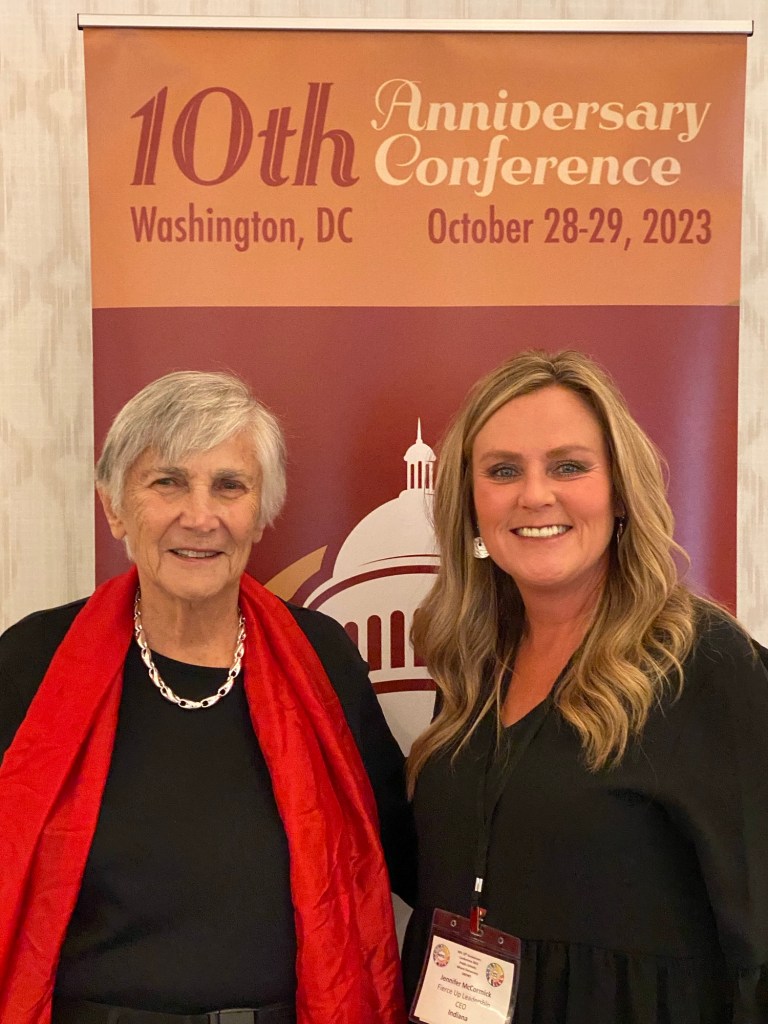
At the NPE conference in D.C. in 2023, JenniferMcCormick and me.