Archives for the month of: March, 2024

As the research has built up on the value of early childhood education, more states are directing money towards expanding access. Wherever money flows, the private equity industry turns its gaze and seeks to do what it does best: privatize and profit. In this age, private equity figures out how to maximize profit from services that used to be public.

The Atlantic has a story about private equity’s interest in childcare.

Last June, years of organizing in Vermont paid off when the state’s House and Senate passed landmark legislation—overriding a governor’s earlier veto—that invests $125 million a year into its child-care system. The bill expanded eligibility for state assistance to 575 percent of the federal poverty level, meaning that more than 7,000 new families are expected to receive money for child-care expenses. Funding will also become available to help day-care centers recruit and retain teachers and expand capacity; centers will also receive additional money for providing nonstandard hours of care.

But now advocates are worried that the wrong people stand to benefit from the program’s generosity. Any time there is a windfall of public money, with few strings attached, unintended consequences are nearly certain to follow. Thanks to the new law, more Vermont families will have more to spend on child care, and centers will receive additional money without explicit rules around how to spend it. Both of those facts will make child care an attractive target for private-equity groups looking for an industry with lots of incoming revenue.

Private equity’s interest in child care has been growing in recent years. “While there has been corporate for-profit child care since the 1970s, private equity only got in starting in the early 2000s,” Elliot Haspel, a senior fellow who studies early childhood education at the nonpartisan think tank Capita, told me. Now four of the top five for-profit child-care chains—KinderCare, Learning Care Group, the Goddard School, and Primrose Schools—are controlled by private-equity funds, and private-equity-backed centers represent 10 to 12 percent of the market.

Private investors are intrigued by child care for the same reasons they became interested in nursing homes and other health-care services: intense demand, government money, and relatively low start-up costs. “Their goal is not long-term sustainability; their goal is to try to turn a profit,” Haspel said.

Private equity’s foray into child care could go a number of ways, but its introduction has largely not worked out well for other sectors—and certainly not for many people who rely on those sectors’ services. In his book, Plunder: Private Equity’s Plan to Pillage America, Brendan Ballou, who investigated private-equity firms at the Department of Justice, posits that the private-equity business model has three basic problems. First, these firms buy a business with the intention of flipping it for a profit, not long-term sustainability, meaning that they are trying to maximize value in the short term and are less likely to invest in staff or facilities. Second, they tend to load businesses up with debt and extract a lot of fees, such as charging child-care providers for the privilege of being managed by the firm. And perhaps most important, their business structure insulates firms from liability.

In 2009, Annie Salley, a resident of a nursing-home chain purchased by the private-equity group Carlyle, died after an injury she sustained while going to the bathroom. Her family sued Carlyle, but a judge dismissed the case after the firm argued that it didn’t own the chain—instead, it said it advised a series of investment funds, such as Carlyle Partners V MC, L.P., that were the lone shareholders in the chain. Children get hurt in child care; children occasionally go missing from a care facility; every year, some children die in day cares. If private-equity firms can structure their relationship to day-care centers as they have nursing homes, families may have little recourse should they encounter a serious problem.

Though private-equity-backed child-care providers can—and often do—offer good services to families, their business model can also prove ruinous. In other sectors, private-equity groups have been notorious for extracting exorbitant fees from businesses they’ve acquired in leveraged buyouts; when they’ve had a chance to raise wages for workers or pay down their private-equity debts, they’ve regularly opted for the latter. Although Vermont’s bill sought to improve the wages of educators, it does not include a salary floor—which means that money that flows into centers may not necessarily go directly to staff—and without such a safeguard, what is stopping outside firms from taking the first, significant cut?

Miriam Calderón, the chief policy officer at Zero to Three, a nonprofit focused on babies, toddlers, and their families, hopes federal lawmakers consider these concerns as they begin to reimagine the federal footprint in child care. Calderón worked in the Biden administration during its first year and helped conceive the early-childhood-education components of the Build Back Better Act, which would have established a child-care entitlement program for a majority of families. Congress isn’t moving on the issue now, but Calderón and advocates told me it would be foolish to wait until Congress was working again to think about protections around public dollars. Private-equity-backed chains will likely continue to grow as a share of the market, and if they gain too much of it, they would have the power to fight back against policies that ensure that staff are fairly compensated and families aren’t paying even more exorbitant fees than they already are. “The work now is to really think through the right guardrails and the right policies so when we get to a moment, again, we’re ready,” Calderón said.

Open the link to finish the article. Or subscribe to The Atlantic.

The Capital Prep Charter chain was created by Dr. Steve Perry. Dr. Perry hates teachers’ unions. He boasts that all the students in his charters graduate and go to college. His chain won the Yass Prize as a semi-finalist for its accomplishments. Jeff Yass is a billionaire in Pennsylvania who supports Trump, opposes abortion, and funds charter schools and vouchers. You may recall that Yass gave Texas Governor Greg Abbott $6 million to pass voucher legislation.

Capital Prep in Harlem is a Perry school that had the partnership and financial support of rapper Sean “Diddy” Combs. Things are not going so well for the students.

Students and families affiliated with Capital Prep, co-founded by Diddy, claim the entertainment mogul’s charter school did a disservice to children who attended.

Diddy co-launched the East Harlem school with Dr. Steve Perry in 2016, and in 2018 pledged $1 million for its expansion into the Bronx. However, last November Capital Prep cut ties with him amid his ongoing sexual assault lawsuits. 

Now adding to the mounting controversy around the Bad Boy Records founder, a new report from The Cut reveals many issues with Capital Prep, including the accusation that Diddy had no involvement with the school beyond photo ops, guest appearances, and the school’s grand opening in 2016.

Fourteen sources told The Cut about alleged frequent violence at Capital Prep, along with “unstable” leadership, and frequent teacher resignation. These issues were most apparent at the height of the pandemic during both virtual learning and when students, including those who were unhoused, returned for in-person classes in 2021. According to The Cut, teachers began to not show up for virtual classes, and by the end of 2020, 80 percent of teachers had left Capital Prep altogether.

When students did return to school after quarantine, some were enrolled in courses they had previously taken, or were “sitting in the cafeteria receiving no instruction for hours.” Dysfunction among teachers reflected on the student body, especially upperclassmen who were unable to transfer their credits or enroll in college due to ineligible transcripts.

“Darnell’s transcripts had classes he’d never taken, passing classes that he never took, failing classes that he was never in,” one parent, Shirley Payne, said about inaccuracies found on her son’s transcripts.

“I thought if Diddy is funding and attaching his name to something, it would be run very tightly, that he was going to give our kids what he didn’t have at that age,” parent Shakemia Harris said. Harris’ daughter Madison was enrolled at Capital Prep as an 11-year-old in 2017.

In addition to the many academic issues, violence during the school day was reportedly ongoing. Fights were rampant when the school nearly doubled in size, expanding to include a tenth grade, and again when Capital Prep relocated to 129th and Madison. Not only was the area more violent than its previous East 104th Street address, but Capital Prep began locking out students who were late, ultimately causing families to protest the disorderly conditions. In addition it violence between students, cops were called on students for things like uniform violations.

Bob Shepherd, author, editor, assessment developer, story-teller, and teacher, read a book that he loved. He hopes—and I hope—that you will love it too.

He writes:

Like much of Europe between 1939 and 1945, education in the United States, at every level, is now under occupation. The occupation is led by Bill Gates and the Gates Foundation and abetted by countless collaborators like those paid by Gates to create the puerile and failed Common Core (which was not core—that is, central, key, or foundational—and was common only in the sense of being vulgar. The bean counting under the occupation via its demonstrably invalid, pseudoscientific testing regime has made of schooling in the U.S. a diminished thing, with debased and devolved test preppy curricula (teaching materials) and pedagogy (teaching methods).

In the midst of this, Gayle Greene, a renowned Shakespeare scholar and Professor Emerita at Scripps University, has engaged in some delightful bomb throwing for the Resistance. Her weapon? A new book called Immeasurable Outcomes: Teaching Shakespeare in the Age of the Algorithm.

OK. Maybe I’ve pushed the occupation/resistance metaphor to the edge of its usefulness. Let’s try another. If Gates’s test-and-punish movement, ludicrously called “Education Reform,” is a metastasizing cancer on our educational system, and it is, then Professor Greene’s book is a prescription for how to reverse course and then practice prevention to end the stultification of education and keep it from coming back. The book is a full-throated defense of the Liberal Arts and of traditional, humane, in-person, discussion-based education in a time when Liberal Arts schools and programs are being more than decimated, are being damned-near destroyed by bean counters and champions of ed tech. Here’s the beauty and value of this book: contra the “Reformers,” Greene details the extraordinary benefits of the broad, liberal educations that built in the United States people capable of creating the most powerful, vibrant, and diverse economy in history. She makes the case (I know. It’s bizarre that one would have to) for not taking a wrecking ball to what has worked. And best of all, she does so not at some high level of abstraction, but backs up any generalizations with concrete, vivid, fascinating, moving, delightful examples from her classrooms. How do you build a world-class human? Well, you give him or her the benefits of a broad, humane, liberal arts education that confers judgment, wisdom, vision, and generosity. Greene shows us, from her own classes over three decades, exactly how that happens.

And she shows us how, under the “standards”-and-testing occupation, all that is being lost.

Years ago, I knew a fellow who retired after a lucrative, successful career. But a couple months later, he was back at his old job. I asked him why he had decided not simply to enjoy his retirement. He certainly had the money to do so.

“Well, Bob,” he said, “there’s only so much playing solitaire one can do.”

I found this answer depressing. I wondered if it were the case that over the years, the fellow had given so much time to work that when he no longer had that to occupy him, he was bored to tears. Had he not built up the internal resources he needed to keep himself happy and engaged ON HIS OWN? Greene quotes, in her book, Judith Shapiro, former president of Barnard College, saying, “You want the inside of your head to be an interesting place to spend the rest of your life.” The French novelist Honoré de Balzac put it this way: “The cultured man is never bored.” Humane learning leads to engagement with ideas and with the world, to fulfillment, to flourishing over a lifetime, to what the ancient Greeks calledeudaimonia—wellness of spirit. Kinda important, that.

In a time when Gates and his minions, including his impressive collection of political and bureaucratic action figures and bobble-head dolls, are arguing that colleges should become worker factories and do away with programs and requirements not directly related to particular jobs, it turns out that the people happiest in their jobs are ones with well-rounded liberal arts educations, and are the ones who are best at what they do. And it turns out that people taught how to read and think and communicate and be creative and flexible, people who gain a broad base of knowledge of sciences, history, mathematics, arts, literature, and philosophy, are self-directed learners who can figure out what they need to know in a particular situation and acquire that knowledge. Philosophy students turn out to be great lawyers, doctors, politicians, and political operatives. Traditional liberal arts instruction creates intrinsically motivated people.

All this and more about the value of liberal arts education Professor Greene makes abundantly clear, and she does so in prose that is sometimes witty, sometimes hilarious, sometimes annoyed, sometimes incredulous (as in, “I can’t believe I even have to protest this shit”); always engaging, human and humane, compassionate, wise, authentic/real; and often profound. As much memoir as polemic, the book is a delight to read in addition to being important politically and culturally.

Gates and his ilk, little men with big money to throw around, look at the liberal arts and don’t see any immediate application to, say, writing code in Python or figuring out how many pallets per hour a warehouse can move. What could possibly be the value of reading Gilgamesh and Lear? Well, what one encounters in these is the familiar in the unfamiliar. As I have said numerous times elsewhere, all real learning is unlearning. You have to step through the wardrobe or fall down the rabbit hole or pass through the portal in the space/time continuum to a place beyond your interpellations, beyond the collective fantasies that go by the name of common sense. Real learning requires a period of estrangement from the familiar. You return to find the ordinary transmuted and wondrous and replete with possibility. You become a flexible, creative thinker. You see the world anew, as on the first day of creation, as though for the first time. Vietnam Veterans would often say, “You wouldn’t know because you weren’t there, man.” Well, people who haven’t had those experiences via liberal arts educations don’t know this because they haven’t been there, man.

Gayle Greene has spent a lifetime, Maria Sabina-like, guiding young people through such experiences. Her classroom trip reports alone are worth your time and the modest price of this book. At one point, Professor Greene rifs on the meaning of the word bounty. This is a book by a bounteous mind/spirit about the bountifulness of her beloved liberal arts. Go ahead. Buy it. Treat yourself.  

One of the top-rated shows on Netflix is The Program: Cons, Cults, and Kidnapping.

It’s a three-part docuseries that tells the story of the abuse suffered by young people sent to a facility for troubled teens in upstate New York called the Academy at Ivy Ridge. It was produced by a young woman who spent time there, accompanied by other of the program’s unwilling participants.

The facility, now closed, is part of a national chain of similar ones. The brochure advertises a camp-like atmosphere, but once there, the teens are not allowed to speak to one another or to go outside. They are incarcerated in a brutal prison where they experience brainwashing and physical and mental abuse.

When they try to tell their parents the truth, they are labeled manipulative liars.

The producer was taken from her home at 3 am in handcuffs, with her parents’ permission.

When boys break a rule—of which there are many—they are beaten by staff members.

If some of this sounds vaguely familiar, it may be because it sounds like a “no-excuses” school.

It turns out that Ivy Ridge is staffed by untrained, uncertified locals working for minimum wage. The school is part of a Utah-based organization called the World Wide Association of Specialty Programs (WWASP). It’s a very profitable business.

As the “troubled teen” industry has grown, it’s become politically powerful and fights efforts at regulation.

This expose is very important. You should see it.

Anand Giridharadas is a brilliant thinker who has a blog called The Ink. In his latest post, he prints whole sections of Trump’s incendiary campaign speech in Vandalia, Ohio, and gives a close reading to his language. (Something oddly appropriate about the location since Trump is the King of Vandals.)

Anand’s parsing of Trump’s words is incisive. I’m posting only part of it, and Anand has made this post available for free. I urge you to open the link and read it all.

He writes:

Former President Donald Trump’s fascist performance art this past weekend in Vandalia, Ohio, was ostensibly a stump speech for someone else. But you could be forgiven for forgetting that. In what was effectively his first real rally since clinching the GOP nomination, Trump offered a grim vision of America and a patchwork of unhinged tirades against his usual targets. Yet there was more to it than that.

There is little value in fact-checking the former president’s words, given that the great majority of them bore so little relationship to reality that you quickly realize their purpose could only be to destabilize reality altogether. They simply restate dozens of well-worn lies, from birtherism up through the Big Lie, interspersed with a smattering of playground insults, projection, and a stew of misunderstood economic schemes and xenophobic delusions that do the work of standing in for policy ideas. This is a hole of lies that cannot be filled with facts.

But that doesn’t mean the speech wasn’t worth paying attention to. And, being of the reading sort, we suggest there is value in reading the text, not just rage-consuming the viral videos everyone has been rehashing.

We think all Americans need to take Trump’s speech both seriously and literally as the what-you-see-is-what-you’ll-get messaging of a would-be dictator. These are things that are actually being said, in public, by a person who has already occupied the world’s most powerful position and seeks to occupy it again. It’s an advertisement for autocracy that — give it this at least — complies with the notion of truth in advertising. And as Masha Gessen has reminded us, “Rule no. 1 is to listen to and believe the autocrat.”

What we look at below is how Trump’s rhetorical performance works, how it functions. In many of these examples, the “meaning” isn’t important, and that’s why the goal here isn’t to question his command of the facts. He’s making these statements without much pretense to knowing the facts in the first place; rather, he’s looking for maximum emotional impact. He fights entirely on the battleground of emotion, and that, Ruth Ben-Ghiat has reminded us, is pretty much what autocrats have always done. 

Trump’s language here — from stabs in the back to dystopian visions of foreign nations seeking to flood the American body politic with their unwanted criminals — has plenty of precedent in the words of the strongmen of the past and present. He goes out of his way to praise Hungary’s Viktor Orbán, perhaps returning thefavor for Orban’s snub of the sitting U.S. government on his recent visit to the U.S. 

And it’s the fact that this speech follows that well-established playbook that demands we pay attention. His words may be murky. What he plans to do to us is clear.

We’ve made this piece free and open to all. We hope it will make you think about these critical issues in new ways, and give you a glimpse of the posts that go out to our supporting subscribers each week. We encourage you to join our community, and to share our work with yours! And we have a rare special offer to entice you: 20% off forever!

The Victim King

Because I’m being indicted for you and never forget our enemies want to take away my freedom because I will never let them take away your freedom.

I’m being persecuted. I think more than anybody, but who the hell knows? You know, all my life…you’ve heard of Andrew Jackson. He was actually a great general and a very good president. They say that he was persecuted as president more than anybody else. Second was Abraham Lincoln. This is just what they said. This is in the history books. They were brutal. Andrew Jackson’s wife actually died over it, they say, died of a broken heart, but she died over it. He was never quite the same.

But they say Andrew Jackson, they say Abraham Lincoln was second, but he had a, you know, in all fairness, he did have a civil war. So you would think that would cause a problem, right? So you could understand it. But nobody comes close to Trump. 

Elementary school historical analysis aside, this passage is a reminder that, more than anything, Trump relishes playing the role of the Victim King. He’s casting attacks on him as attacks on his subjects, and valiantly stepping into the breach to block the slings and arrows so his loyal supporters won’t suffer. It’s part of the personalization of leadership that’s always been at the center of cults of personality — the devotional, movement-building side of authoritarianism.

The notion that the leader acts as both weapon and human shield is a central rhetorical tool in the arsenal of autocrats. And of course he’s done this better — or maybe just “more” — than anybody. More than Lincoln; more than Jackson. 

Trump’s victimhood here is absolute. He’s devoted himself entirely to protecting his flock. An attack on him is an attack on them; a win for him a win for them.

We dig here more deeply into Trump’s pursuit of absolute power through his performance of weakness.

The Horst Wessel song

And you see the spirit from the hostages, and that’s what they are, is hostages. They’ve been treated terribly and very unfairly. And you know that. And everybody knows that. And we’re going to be working on that soon. The first day we get into office, we’re going to save our country, and we’re going to work with the people to treat those unbelievable patriots, and they were unbelievable patriots and are. You see the spirit, this cheering. They’re cheering while they’re doing that. And they did that in prison. And it’s a disgrace, in my opinion. 

Here Trump returns the favor, in a sense, to his shock troops. The speech opened with a playback of “Justice for All,” the MAGA fundraising release by the “J6 Prison Choir” that interpolates Trump reciting the Pledge of Allegiance over a backing track of the inmates singing “The Star-Spangled Banner.” 

The track is meant as a legal defense effort for the January 6 insurrectionists, but the role it plays here is to define those insurrectionists as true patriots, and to link Trump’s own persecution with that endured by his most devoted followers — the ones who’ve demonstrated their willingness to go into battle on his account. It’s a barter of martyrdoms.

This, as with the rest of the rhetoric here, is a classic authoritarian strategy. If you consider the insurrectionists cast in the role of Sturmabteilung(“SA,” the original paramilitary forces of the Nazi Party) martyr Horst Wessel (Ashli Babbitt specifically, though the group as a whole plays the same part generally here), this patriotic mashup recalls the Nazi anthem.

The Big Lie

I happen to think we won most of the country. You want to know the truth. If the voting…if the voting were real, I actually think we won most of the country.

Central to Trump’s identity is infallibility, and, given that, his mass popularity is without question. Again, this is classic autocratic positioning. Thus his obsessions with ratings, with polls, with casting primary victories that were never in doubt as fantastic triumphs.

Jokes about huge numbers aside (and the speech is rife with riffs on poll results), there is simply no way that he could have lost a legitimate electoral contest, and any such contest he might have lost would be, by definition, illegitimate. One need only look to Vladimir Putin’s “landslide” victory this week for an example of the way elections function in an authoritarian state.

The Big Lie is Trump’s truth, and it’s not just a boast. It’s key to the story he’s trying desperately to sell to the crowd, the story of a guy who can’t lose.

I was asking Jim Jordan about it because he was commenting that we have the largest crowds in the history of politics. Nobody comes close. If Ronald Reagan came to a place called Dayton, Ohio — have you heard of it? If he came to Dayton, Ohio, honestly, J.D., if he had three or 400 people in a ballroom, that would be great. We get 25-30,000 people for a small rally…We had 88,000 people show up in South Carolina.

An addendum: In his bid for recognition as the greatest of all Republicans, Trump is even willing to throw Ronald Reagan under the bus if it helps make the case.

Not even people

They’re very smart, very streetwise. And I would do the same thing. If I had prisons that were teeming with MS-13 and all sorts of people that they’ve got to take care of for the next 50 years, right? Young people, they’re in jail for years. If you call them people, I don’t know if you call them people. In some cases, they’re not people, in my opinion. But I’m not allowed to say that because the radical left says that’s a terrible thing to say…

We have so many people being hurt so badly and being killed. They’re sending their prisoners to see us. They’re sending and they’re bringing them right to the border and they’re dropping them off and we’re allowing them to come in. And these are tougher than anybody we’ve got in the country. These are hardened criminals. And we’ve got hundreds of thousands of them. 

If you take Trump at his word here — and we think you should — the leaders of countries around the world are conspiring to conduct an organized invasion, deploying their criminals to the United States in order to submerge it in violence. On one level, there’s nothing here but racism and xenophobia, but this works on the level of the conspiratorial ideas of mysterious foreign threats to the body politic that have long been part and parcel of the autocrat’s appeal. 

Migrants, in this account, aren’t fleeing refugees or people looking for a better life against all odds, but have been mobilized and directed against the U.S., a superhuman and yet subhuman army, “dropped off” by a shadowy cabal of foreign interests who aren’t content merely to sell us cheaper cars and fentanyl precursors.

Just insert “bankers” or “Jews” or “capitalist roaders” or even “globalists” here and you’re on the right track towards understanding what Trump’s trying to do.

Migrant crime

These are the roughest people you’ve ever seen. You know, now we have a new form of crime. I call it Biden migrant crime, but it’s too long. So let’s just call it migrant crime. We have a new category. You know, you have vicious crimes. You have violent crimes. You have all these. Now we have migrant crimes, and they’re rough. They’re rough. And it’s going to double up. And you see what’s happening. 

You know, throughout the world right now, I don’t know if you know this. Crime is way, way down. You know why? Because they sent us their criminals. That’s why. It’s true. It’s true. They sent, you know, Venezuela is down 66 percent because they sent us their gang members and gangsters. They sent us their drug dealers and their murderers. They’re all coming into our country. And Venezuela now, their crime is down 66 percent.

The supposed statistics here are just a “gish gallop,” in which the speaker simply overwhelms the opponent (or in this case the audience) with a flurry of inaccurate statements, knowing that the very attempt to correct them will both derail any reasonable argument and delay a response until the time has run out.

But this, again, is the story of the alien threat, here described as entering at the behest of their domestic collaborator, Joe Biden. It’s a “stab-in-the-back” accusation (there are several in the speech), in which a leader is identified as a secret traitor, betraying the nation to foreign interests.

The truth is that crime rates are down worldwide, and these statistics are pulled out of the air. The fear people have of the loss of control of the border, and of what it means to be “American” is real, however — even if Trump’s helped in its creation — and that’s what he’s playing to so effectively.

Please open the link and continue reading this insightful exegesis of Trump’s rhetoric. He is a talented orator. So was Hitler.
The legislature in Florida passed a bill to allow school districts to hire religious chaplains to help students in need of counseling. The bill awaits DeSantis’ signature. Pastors, priests, imams, ministers, rabbis, and other spiritual counselors are standing by.

The Miami Herald reports:

Gov. Ron DeSantis has yet to sign a bill that would allow chaplains to offer counseling in public schools, but one colorful religious figure says he is already eager to volunteer.

He’s a self-described “Hindu statesman” from Nevada who says he would like to bring “the wisdom of ancient Sanskrit scriptures” to students — perhaps not exactly what Florida lawmakers had in mind when they approved a bill that supporters tout as a way to make up for a shortage of mental health counselors in many schools.

The offer from Rajan Zed, president of the Universal Society of Hinduism, may amount to just his latest effort to raise his organization’s profile, but it also underlines concerns from critics. Mainly, that the bill’s vague definition of “counseling” will invite religious groups — whether they are Hindu, Christian or otherwise — to use it as a door to teaching their beliefs in secular school systems.

Florida has a shortage of guidance counselors, and the religious chaplains are supposed to replace the missing counselors.

“This is the beginning … of them trying to implement religion in some type of capacity back into our schools,” said Sen. Shevrin D. “Shev” Jones, D-Miami Gardens, referring to lawmakers who support the bill. “It just opens up the gate for other things.”

Jones, whose father is a pastor, said he’s concerned that the bill may lead to some schools allowing chaplains to preach to students who may not hold the same beliefs, putting them in uncomfortable situations. 

“In the words of one of my colleagues on the floor, ‘We need God back in our schools.’ But what about the child who doesn’t believe in God? What if some of the chaplains don’t resonate with the lives of those kids?” Jones said. 

He used an example of a chaplain dealing with an LGBTQ child or a child battling depression. “Has the chaplain been trained enough? Once they hear those concerns, where do they direct that child to go to?”

There have been stories in the press recently suggesting that the culture war issues are fading away. Such stories are premature.

Jason Garcia is an investigative reporter in Florida who keeps watch over the daily corruption in politics in his blog “Seeking Rents.” In this post, he tracks the bills that were passed. If you think the Republican majority is moderating its ideology, read this.

Garcia writes:

Two weeks into this year’s session of the Florida Legislature, one of the Big Business lobby’s top priorities seemed to be in trouble.

Republican leaders in the Florida House of Representatives were muscling a bill through their chamber that would, among other things, stop cities and counties across the state from enforcing local laws that require government contractors to pay higher wages or businesses with outdoor workers to follow heat-safety rules.

But the legislation — House Bill 433, which records show was written at least partly by lobbyists for the Florida Chamber of Commerce— faced a more difficult path forward in the Florida Senate.

To have any hope of passing, the Senate version of the bill first had to clear the chamber’s Commerce and Tourism Committee, where Republicans held a slim, 4-2 majority. And one of the Republican members was Sen. Ana Maria Rodriguez of Miami, where more than 28,000 workers were facing potential pay cuts under the bill. Rodriguez is also one of four Republican senators in Tallahassee elected to swing districts with help of spoiler-candidate schemesorchestrated by GOP political strategists using Big Business money.

Even if Senate Bill 1492 somehow survived that stop, it would then have to get through the Senate’s Community Affairs Committee. And the chairperson of that committee — the person who, at least ostensibly, decides which bills to put on the agenda and which to let die without a hearing — was Sen. Alexis Calatayud, another Republican from Miami sitting in a possible tossup seat.

So the Senate sponsor — Sen. Jay Trumbull (R-Panama City) — offered a compromise. He agreed to remove the part of his bill that would have wiped out living wage laws in places like Miami. The scaled-back version of the bill would only stop communities from establishing their own heat-protection rules, which wasn’t something that any city or county had done yet (though Miami has been considering one).

“I felt that for our purposes— in this committee, on this particular bill, today — that it would be better just to have us just talk about the heat issues in the bill,” Trumbull told the committee that day.

The compromise was enough to get SB 1492 through the Senate Commerce and Tourism Committee by a single vote.

The compromise was also enough to get the bill onto the agenda of the Senate Community Affairs Committee — where it once again survived by a single vote.

The compromise was also a fraud.

Because seven weeks later — on the final day of the Legislature’s 60-day session — Republican leaders in the Senate decided to take up the House version of the bill anyway. Just two hours before gaveling this year’s session to a close, the Florida Senate voted 24-15 to pass HB 433, which, though it had been tweaked, largely resembled the legislation that senators had seemingly abandoned before.

(The House bill is actually even worse for workers, because it would also prohibit local communities from passing “fair work week” laws that require businesses to give hourly workers advance notice of their weekly schedules.)

The bait-and-switch ultimately accomplished two goals for Senate Republican leaders.

It helped them sidestep a couple of tough committees in order to pass a priority bill for the Florida Chamber of Commerce, which records show gave more than $400,000 last year to a fund controlled by Senate GOP leadership. 

But it also helped them protect their potentially vulnerable incumbents. Because both Rodriguez and Calatayud were ultimately allowed to vote against the bill — but only after their votes no longer mattered. 

Garcia then lists the other bills that were passed by the Legislature before it recessed.

They included:

Loosening child labor laws (having banned undocumented immigrants, the Legislature had to make it easier for businesses to hire teenagers)

Permit school districts to hire religious chaplains to counsel students in school

Lower the standards for teachers in “classical schools,” the charter schools based on the Hillsdale College curriculum

Extend Florida’s “Stop Woke Act,” which limits teaching about racism or sexism, to education-preparation courses

Reduce regulations on natural gas pipelines, prohibit offshore wind energy, and erase most mentions of climate change from state law.”

Moderation? No.

Between January 2017 and January 2021, Trump stacked the federal courts with rightwing ideologues. Three were added to the U.S. Supreme Court. Many more were approved for federal District Courts and Appellate Courts. We are now seeing the results of putting extremists in charge of consequential decisions. Women’s reproductive rights, a 50-year-old precedent, were overruled and left to the states. Some have imposed bans that prevent abortions even in cases of rape, incest, and to protect the life of the mother.

In the current instance, the U.S. Supreme Court gave Texas approval to implement Senate Bill 4, a state law that takes precedence over federal law in regulating the international border with Mexico. For at least a century, federal courts have ruled that federal law governs international borders.

To complicate matters, the Fifth Circuit Court of Appeals has issued a stay on implementation of SB 4. Decades ago, the Fifth Circuit was one of the most liberal appeals courts, and it took the lead in enforcing desegregation. It is now one of the most conservative courts.

The Washington Post described the conflicting court decisions as “whiplash:

The law’s fate is yet another flash point in the nation’s polarized debate over immigration, which Republican candidate and former president Donald Trump has made a central theme of his campaign against Biden. Whatever the 5th Circuit decides, the status of the law is likely to end up back before the Supreme Court.
The high court’s order Tuesday afternoon set off a fast-moving round of legal maneuvering in the lower court that has kept the law’s status in limbo.

The Supreme Court urged the 5th Circuit to decide quickly whether the law would remain in effect while litigation continues, and hours later a three-judge panel said it would convene a hearing by Zoom on Wednesday morning.
Then, in a highly unusual move, just after 11 p.m. Tuesday, two of the judges on the 5th Circuit panel blocked enforcement of the law in advance of the Wednesday hearing.

The brief order did not explain the reasoning of the two judges — Priscilla Richman, a nominee of George W. Bush, and Irma Carrillo Ramirez, a Biden nominee. The dissenting judge — Andrew Oldham, a Trump nominee — said only that he would have allowed the law to remain in effect before Wednesday’s hearing.

“It’s Ping-Pong,” Efrén C. Olivares, director of strategic litigation and advocacy at the Southern Poverty Law Center, said in a phone interview, describing the back-and-forth rulings.

Olivares said it is unclear whether the three-judge panel will rule immediately, since a preliminary injunction from a lower court remains in place, and the state law is not in effect. Texas conceivably could ask the full circuit court to review the panel’s decision blocking the law temporarily, he said, but he noted that is uncommon.

The law makes it a state crime for migrants to illegally cross the border and gives Texas officials the ability to carry out their own deportations to Mexico.

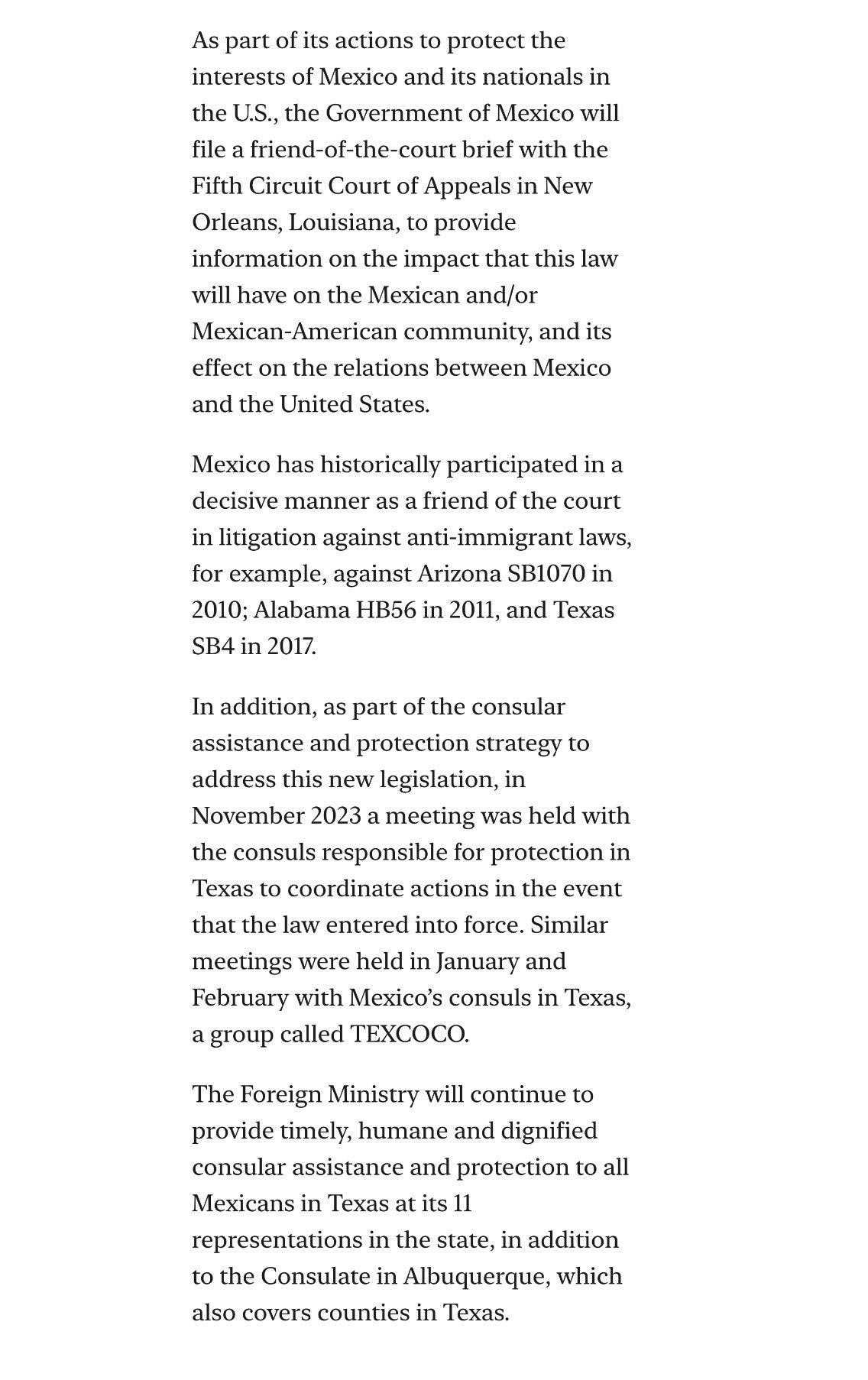
How they will do so remains unclear. The Mexican government said Tuesday that it would not accept anyone sent back by Texas and condemned the law as “encouraging the separation of families, discrimination and racial profiling that violate the human rights of the migrant community.”

Mexico President Andres Manuel Lopez Obrador on Wednesday referred to the Texas law as Draconian.

“It disrespects human rights, it’s a completely dehumanizing law, it’s anti-Christian, unjust, it violates precepts and norms of human co-existence, Lopez Obrador said. “It doesn’t just violate international law but [the teachings of] the Bible. I say this because those who are applying these unjust, inhumane measures go to church, they forget that the Bible talks about treating the foreigner well, and of course, loving your neighbor.”

The Texas law was passed last year as part of Republican Gov. Greg Abbott’s push to expand the state’s role in immigration enforcement — historically the purview of the federal government and its jurisdiction over international borders.

The Supreme Court’s decision drew dissent from the three liberal justices, two of whom said the majority was inviting “further chaos and crisis in immigration enforcement.”

“This law will disrupt sensitive foreign relations, frustrate the protection of individuals fleeing persecution, hamper active federal enforcement efforts, undermine federal agencies’ ability to detect and monitor imminent security threats, and deter noncitizens from reporting abuse or trafficking,” wrote Justice Sonia Sotomayor, joined by Justice Ketanji Brown Jackson…

Luis Miranda, a spokesman for the Department of Homeland Security, said federal immigration agencies do not have the authority to assist Texas with the implementation of the state law. The only deportations that U.S. agents are allowed to conduct must involve federal orders, he said.


“Immigration is within the exclusive purview of the federal government,” Miranda said in a statement.


U.S. District Court judge David A. Ezra temporarily blocked the Texas law last month, saying it was probably unconstitutional and “could open the door to each state passing its own version of immigration laws.” Ezra said the law intruded into federal matters even more than an Arizona immigration law that the Supreme Court partially struck down in 2012.


But the 5th Circuit quickly froze Ezra’s decision without explanation and said the Texas law could be enforced, at least temporarily, unless the Supreme Court weighed in.

The Supreme Court did weigh in, allowing Texas to control the border. And a panel of 5th Circuit judges froze the law’s implementation.

Think about it. The U.S. Supreme Court recently decided that one state (Colorado) couldn’t disqualify an oath-breaking insurrectionist because each state would write its own rules. Now the SCOTUS allows one state to control its international border. This makes no sense.

Here is some additional background.

LoneStarLeft, a Texas blogger named Michelle Davis, was horrified by the SCOTUS approval of SB 4. She wrote yesterday:

Today, the Supreme Court ended the pause on SB 4’s implementation and allowed this blatantly unconstitutional law to be enforced while litigated in court. This ruling does not indicate that the law is constitutional; only Texas can implement it while it is being challenged. This is terrible news for many of Texas’ residents. 

SB4 would grant Texas Law Enforcement Officers the authority to deport undocumented immigrants independently, bypassing due process and federal oversight. This move by Texas Republicans aims for quick political gains. The bill would allow officers and state agencies to escort individuals to ports of entry to guarantee adherence. Should immigrants resist compliance with a directive to return, they could be accused of a second-degree felony, risking up to 20 years of incarceration.

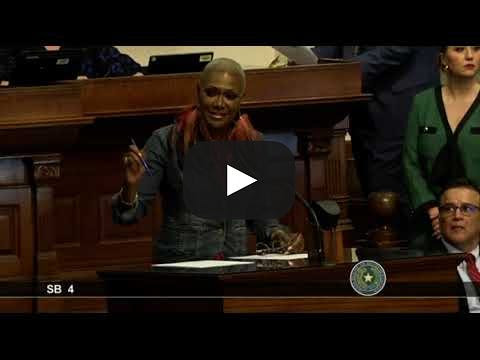
Watch Representative Jolanda Jone (D-Harris County) blast this SB4 as it went through the House: 

…Now, under Texas law, any Keystone Cop can decide to drive a person they deem undocumented to the international border and demand they go back into Mexico (even if they are not from Mexico). If the person doesn’t walk across the bridge, they are arrested and imprisoned for up to twenty years.

The Constitution of the United States of America states that the Federal Government’s job is to manage international treaties, our borders, and citizenship issues. SB4 crosses a major line.

Here is a statement put out today by the Mexican Government: 

This bill will even remove people who have been here for decades, living lawfully and paying taxes.

Within SB4, the term “alien” is defined as an individual who is neither a citizen nor a lawful permanent resident. Thus, a person who was once denied a visa but presently holds a valid visa (for example, tourism or marriage) is STILL considered committing an offense, even though they are lawfully present in the country.

Cruelty is the point.

SB4 passed straight down party lines. Every single Republican voted for it, and every single Democrat voted against it. When they tell you who they are, you need to listen. A lot of non-voters need to become voters, the GOP’s authoritarian laws are on our door step…

ALL Latinos should be very concerned right now. 

This immigration law will allow any brown person to be rounded up for any possible violation. SB4 will allow any law enforcement agent in Texas (even school resource officers) the ability to demand a brown person prove they are a citizen (“Show Me Your Papers”). If that person can’t prove their citizenship, they risk deportation to Mexico, no matter their origin. 

The law’s implementation will lead to racial profiling, separate families, and harm Black and brown communities across the state, regardless of immigration status. 

That directly conflicts with the United States Constitution, which states that everyone, regardless of race or immigration status, has the freedom to move and thrive.

Republicans have already committed to opening up shuttered prisons to make room for 80,000 immigration prisoners. Under SB4, police will act as immigration agents and arrest people who “look” like they’re undocumented. Half of Texans are Latino and could “look” undocumented to a racist cop.

Two Brits have a website called Josh & Archie. Being audacious pranksters, they hatched a scheme to trick Tucker Carlson. One sent Carlson’s office an email claiming that he was the employee of the Royal family who doctored the photo of Kate Middleton and her three children. He said he was fired.

He soon heard from the booker for the Tucker Carlson show, who asked for the original photo and proof that he worked for the Royal family.

Josh and Archie created a document proving that he worked for the Royals. It had a fake Latin motto that happened to be the motto of a supermarket chain. And his employment contract included a clause saying that if his work was unsatisfactory, he agreed that one of his limbs would be amputated.

Apparently no one scrutinized his evidence with care, and he scored an interview with Tucker Carlson. Carlson was delighted with the interview.

But before it aired, Josh and Archie went public. They said they didn’t want to cause any further trouble for the Royals.

The editorial board of Cleveland.com and the Plain-Dealer were taken aback by the facts reported about vouchers by their reporter Laura Hancock (posted in previous time slot). The Ohio legislature expanded vouchers so almost every family is eligible, even if they never sent their child to public school. The editorial board believed that vouchers were supposed to help poor kids escape low-performing schools, and they urge the legislature to return to the original purpose.

What is disappointing about this editorial is that it fails to recognize that the original purpose of vouchers has already proven to be a disaster. In the only statewide evaluation of vouchers, sponsored by the choice-friendly Thomas B. Fordham Institute, poor children who took vouchers fell even farther behind their peers in the public schools they left. (See summary, on p. 7, concluding that students who left public schools for voucher schools performed worse than if they had remained in their public school).

This finding—that voucher students who leave public schools perform worse—has been replicated in every voucher program. Voucher students don’t go to elite private schools. Typically they go to voucher schools that do not have certified teachers and that are allowed to discriminate on any grounds.

Voucher scholar Josh Cowen of Michigan State University has assembled the powerful negative effects of vouchers on kids who transfer from public schools. The results in Ohio are the worst.

I wish the editorial board of Cleveland.com and the Plain-Dealer had seen these data before they wrote the following editorial. The facts are in: Vouchers don’t help poor kids who leave struggling public schools.

The editorialists wrote:

Last June, when the Ohio House passed Amended Substitute House Bill 33, the two-year state budget, sending it to Gov. Mike DeWine’s desk for his signature, House Majority leadership celebrated the “landmark” expansion of EdChoice school vouchers, loosening income caps to make voucher benefits available to all Ohio families.

“Along with funding public education, the budget makes a landmark investment in school choice with a universal voucher program,” the statement from House Republican leadership said. “This program is designed to safeguard lower-income families and offers options beyond traditional public schools. By expanding access to vouchers, Ohio ensures parents can make the best decisions for their children’s education.”

But data from implementation of this “landmark investment in school choice … designed to safeguard lower-income families” suggest it did very little to provide school choice or to help low-income families.

Instead, parents in affluent communities like Rocky River, Westlake and Bay Village with kids already in private and parochial schools appear to have taken immediate advantage of the new eligibility rules. Families of four up to 450% of poverty levels (that is, earning up to $135,000 a year) now qualify for full taxpayer-funded vouchers, and those making more money qualify for partial vouchers.

Ohio’s legislature, to be true to its stated school-choice motive, should rewrite the rules to guarantee that this money goes to children in underperforming schools, possibly relying on state report cards to set the standard.

Cleveland.com’s Laura Hancock looked at before-and-after numbers and found that students on EdChoice vouchers shot up from 16 to 309 in the Rocky River school district; 41 to 581 in Westlake; and 13 to 229 in Bay Village.

Hancock then compared public-school enrollment trends to judge if this was primarily a move out of public schools, or a subsidy for kids already in private and parochial schools.

The evidence points strongly to the latter. Rocky River public school enrollment dropped by only 22 students, not 309. Bay Village enrollment dropped by 30 students, not 229. Westlake schools recorded 19 fewer students this year compared with last academic year — not 581. Similar patterns were seen in other affluent school districts, from Strongsville and North Royalton to Brecksville-Broadview Heights.

By contrast, in the Cleveland public schools, where more than 8,000 students now get school vouchers through the much-older Cleveland school voucher program, which dates to 1996, those on EdChoice vouchers increased only slightly, from 9 to 28.

In even more impoverished East Cleveland, EdChoice recipients dropped from 12 last academic year to less than 10 this year.

And the money is now almost gone.

“The legislature budgeted $397.8 million for EdChoice-Expansion this year,” Hancock reports. “As of Feb. 26, the state had spent $387.5 million.”

Advocates of the universal voucher program suggested to Hancock that, as word gets out, more people will use the vouchers as intended next school year, to switch from low-performing public schools to a private or parochial option.

But it seems unlikely those now on the EdChoice expansion vouchers would be displaced to make room for lower-income students.

In other words, lacking conscious, targeted efforts to make sure low-income Ohioans in poor-performing schools primarily benefited, Ohio’s EdChoice expansion as implemented was not the school-choice program Statehouse leaders promised.

The data suggest instead it became just a big taxpayer subsidy for those students already in private schools.

That should outrage every Ohio taxpayer — and every parent of students in struggling districts who were supposed to benefit.

Also raising red flags were the absence of reciprocal obligations on the part of private and parochial schools taking these taxpayer-funded vouchers to show they are a higher-quality alternative to public schools.

The lack of transparency and data-reporting guardrails forces parents making “school choice” for academic reasons, rather than out of religious or other motivations, to blindly assume that a private or parochial school is the best choice, without actual data on educational performance.

This is particularly troubling given Ohio’s history of funding for-profit charter schools without such guardrails. That’s how the now-shuttered Electronic Classroom of Tomorrow managed to make off with $117 million in wrongly paid taxpayer funds, based on a 2022 state audit — mostly for falsely reporting students ECOT never had.

The General Assembly needs to revisit its universal vouchers program to ensure that this nearly $400 million in Ohio taxpayer money is buying true school choice as promised for students mired in poor-performing public schools who most need quality alternatives.