Archives for the month of: June, 2023

A reader who signs in as CarolMalaysia described the latest education-related laws passed in Indiana:

She writes:

These are some of the new Indiana laws that will take effect on Saturday. [Indiana is run by the GOP and they have NO respect for public schools or teachers.] Gary is a poverty area and they cannot vote for their school board members. 87% of Hoosier children attend public schools and they are continuously underfunded.

Book bans — Every public school board and charter school governing body is required to establish a procedure for the parent of any student, or any person residing in the school district, to request the removal of library materials deemed “obscene” or “harmful to minors.” School districts must also post a list of the complete holdings of its school libraries on each school’s website and provide a printed copy of the library catalogue to any individual upon request. (HEA 1447)

Charter schools — The proceeds of each new voter-approved school funding referendum in Lake County must be shared with local charter schools in proportion to the number of children living in the school district who attend charter schools. Beginning July 1, 2024, all incremental property tax revenue growth at Lake County school districts must be shared on a proportional basis with local charter schools. (SEA 391, HEA 1001)

Gary schools — A five-member, appointed school board is reestablished for the Gary Community School Corp. to eventually replace the Indiana Distressed Unit Appeals Board as the governing body for the formerly cash-strapped school district. Gary’s mayor and the Gary Common Council appoint one member each, and the three others are chosen by the Indiana secretary of education, including at least one Gary resident, one resident of Gary or Lake County, and a final member from anywhere. (SEA 327)

Yesterday I reviewed Nicholas Kristof’s enthusiastic endorsement of Mississippi’s reading program, which has raised test scores in fourth grade without reducing class size, spending more on education, or reducing child poverty. Kristof seems to believe that the so-called “science of reading,” allied with third grade retention and pre-school is the no-cost silver bullet to change American education. It should certainly appeal to those who don’t want to raise taxes or reduce economic inequality. The one study cited by Kristof in support of third grade retention was funded by Jeb Bush’s foundation; Florida enacted third grade retention and saw its fourth grade scores rise (but not scores in eighth grade).

Kristoff quoted a study that reached favorable conclusions about the efficacy of third-grade retention. He said that 9% of third-graders in Mississippi had been held back. I said that might be sufficient to explain the impressive fourth grade scores on NAEP: eliminate the lowest-scoring kids and scores go up.

Nancy Bailey, retired teacher, summarizes some of the research on third-grade retention: it’s bad.

She writes:

How can anyone who claims the Science of Reading is real think it’s OK to retain a third-grade child based on one test or for any reason?

If ever evidence or science existed involving education, understanding the rottenness of retention would be it. Yet some of the same people who believe using phonics (and more) is the one-size-fits-all scientific reading miracle seem fine with retention.

This is a crack in the glass for SoR science because it makes it look political. Retaining third graders because of a test may drive parents to leave public schools.

Children are devastated by retention. Once a child is retained, it changes their world. In Student Ratings of Stressful Experiences at Home and School, Anderson, Jimerson, and Whipple (2008) found that it rated high with various stressors.

Across grade levels, those events rated as most stressful by children were: losing a parent, academic retention, going blind, getting caught in theft, wetting in class, a poor report card, having an operation, parental fighting, and being sent to the principal.

When a child is kept back, they are more likely to be more physically developed in middle school than their peers. This certainly causes a child to rethink school and want to drop out.

In 2001, that’s right, 2001, Shane R. Jimerson’s Meta-analysis of Grade Retention Research: Implications for Practice in the 21st Century summarized studies of a previously published literature review about retention between 1990 and 1999, comparing this research with studies about retention done in the 1970s and 1980s.

Jimerson concludes:

In isolation, neither social promotion nor grade retention will solve our nation’s educational ills nor facilitate the academic success of children. Instead attention must be directed toward alternative remedial strategies. Researchers, educators, administrators, and legislators should commit to implement and investigate specific remedial intervention strategies designed to facilitate socioemotional adjustment and educational achievement of our nation’s youth.

Some SoR enthusiasts say if children had been given evidence-based instruction with phonics, no child would need to be retained. But even if this were true, why would they be on board for retention today when science is more confident of the problems with retention, especially third-grade retention based on one test, than the SoR?

It’s hard to believe Floridians ever permitted retention, since its researchers identified its harmfulness years ago. Many students have been retained in third grade throughout the years.

It’s perplexing to see legislators in other states endorsing it, like it’s a good thing, when the research about it is clear. It’s good that Michigan will no longer do it, but many other states continue to practice grade retention.

Furman professor Paul Thomas, who has written extensively about the SoR, describes retention here and presents a map showing the states currently subscribing to holding third graders back.

The same promoters of the SoR seem to love retention and are trying to connect it to Mississippi, where they appear to have higher test results in fourth grade.

The promoters of third-grade retention seem connected to former Governor Jeb Bush, who, for some strange reason, hitched his education star to third-grade retention based on a test. How sad that he didn’t promote lowering class sizes in K-3rd grade instead.

This is a very moving story about a young couple who were raised by very strict parents and home-schooled. Their parents taught them that public schools were evil. They also taught them the importance of obedience and corporal punishment. But the parents did not want to inflict corporal punishment on their babies. When they began to question the cardinal principle of “spanking” their children, using the rod for discipline, they started questioning other articles of their faith. Read on. This link should give you free access to the Washington Post for this story.

In a wonderful example of long-form journalism, Peter Jamison writes:

ROUND HILL, Va. — They said goodbye to Aimee outside her elementary school, watching nervously as she joined the other children streaming into a low brick building framed by the foothills of the Blue Ridge Mountains. Christina and Aaron Beall stood among many families resuming an emotional but familiar routine: the first day of full-time, in-person classes since public schools closed at the beginning of the pandemic.

But for the Bealls, that morning in late August 2021 carried a weight incomprehensible to the parents around them. Their 6-year-old daughter, wearing a sequined blue dress and a pink backpack that almost obscured her small body, hesitated as she reached the doors. Although Aaron had told her again and again how brave she was, he knew it would be years before she understood how much he meant it — understood that for her mother and father, the decision to send her to school was nothing less than a revolt.

Aaron and Christina had never attended school when they were children. Until a few days earlier, when Round Hill Elementary held a back-to-school open house, they had rarely set foot inside a school building. Both had been raised to believe that public schools were tools of a demonic social order, government “indoctrination camps” devoted to the propagation of lies and the subversion of Christian families.

At a time when home education was still a fringe phenomenon, the Bealls had grown up in the most powerful and ideologically committed faction of the modern home-schooling movement. That movement, led by deeply conservative Christians, saw home schooling as a way of life — a conscious rejection of contemporary ideas about biology, history, gender equality and the role of religion in American government.

Christina and Aaron were supposed to advance the banner of that movement, instilling its codes in their children through the same forms of corporal punishment once inflicted upon them. Yet instead, along with many others of their age and upbringing, they had walked away.

Like all rebellions, this one had come with consequences. Their decision to send Aimee to the neighborhood elementary school — a test run to see how it might work for their other kids — had contributed to a bitter rift with their own parents, who couldn’t understand their embrace of an education system they had been raised to abhor. And it had led Christina, who until that summer day had home-schooled all of their children, into an existential crisis….

Across the country, interest in home schooling has never been greater. The Bealls could see the surge in Virginia, where nearly 57,000 children were being home-schooled in the fall of 2022 — a 28 percent jump from three years earlier. The rise of home education, initially unleashed by parents’ frustrations with pandemic-related campus closures and remote learning, has endured as one of the lasting social transformations wrought by covid-19.

But if the coronavirus was a catalyst for the explosion in home schooling, the stage was set through decades of painstaking work by true believers like those who had raised Aaron and Christina. Aided by the Home School Legal Defense Association (HSLDA) — a Christian nonprofit that has been dubbed “the most influential homeschool organization in the world,” and is based less than five miles from the Bealls’ house in Northern Virginia — those activists had fought to establish the legality of home schooling in the 1980s and early 1990s, conquering the skepticism of public school administrators and state lawmakers across the country.

Through their influence, a practice with roots in the countercultural left took on a very different character. Among conservative Christians, home schooling became a tool for binding children to fundamentalist beliefs they felt were threatened by exposure to other points of view. Rightly educated, those children would grow into what HSLDA founder Michael Farris called a “Joshua Generation” that would seek the political power and cultural influence to reshape America according to biblical principles.

Home schooling today is more diverse, demographically and ideologically, than it was in the heyday of conservative Christian activism. Yet those activists remain extraordinarily influential.

Over decades, they have eroded state regulations, ensuring that parents who home-school face little oversight in much of the country. More recently, they have inflamed the nation’s culture wars, fueling attacks on public-school lessons about race and gender with the politically potent language of “parental rights.”

But what should be a moment of triumph for conservative Christian home-schoolers has been undermined by an unmistakable backlash: the desertion and denunciations of the very children they said they were saving.

Former home-schoolers have been at the forefront of those arguing for greater oversight of home schooling, forming the nonprofit Coalition for Responsible Home Education to make their case.

“As an adult I can say, ‘No. What happened to me as a child was wrong,’” said Samantha Field, the coalition’s government relations director….

Farris said it is not uncommon for children who grow up in oppressively patriarchal households to reject or at least moderate their parents’ beliefs. However, he said such families are a minority in the home-schooling movement and are often considered extreme even by other conservative Christians.

“I view this as the fringe of the fringe,” Farris said. “And every kid that I know that has lashed out at home schooling came out of this.”

Christina, 34, and Aaron, 37, had joined no coalitions. They had published no memoirs. Their rebellion played out in angry text messages and emails with their parents, in tense conversations conducted at the edges of birthday parties and Easter gatherings. Their own children — four of them, including Aimee — knew little of their reasons for abandoning home schooling: the physical and emotional trauma of the “biblical discipline” to which they had been subjected, the regrets over what Aaron called “a life robbed” by strictures on what and how they learned.

Aaron had grown up believing Christians could out-populate atheists and Muslims by scorning birth control; Christina had been taught the Bible-based arithmetic necessary to calculate the age of a universe less than 8,000 years old. Their education was one in which dinosaurs were herded aboard Noah’s ark — and in which the penalty for doubt or disobedience was swift. Sometimes they still flinched when they remembered their parents’ literal adherence to the words of the Old Testament: “Do not withhold correction from a child, for if you beat him with a rod, he will not die….”

n a religious community led by Gary Cox, an evangelical pastor and pioneer of Maryland’s home-schooling movement. Christina was a graduate of Cox’s home education network, Walkersville Christian Family Schools, while Aaron began attending Cox’s church in rural northern Maryland as a teenager. The minister exerted a powerful influence over his congregation and students, teaching that children live in divinely ordained subjection to the rule of their parents.

Cox — who still operates a home-schooling organization, now called Wellspring Christian Family Schools — declined repeated interview requests. Last year his son, Dan Cox, a home-schooled Maryland state delegate who denied the legitimacy of the 2020 presidential election, won the Republican gubernatorial primary. He went on to lose in a landslide to Democrat Wes Moore.

During Aaron and Christina’s “courtship” — a period of chaperoned contact that served as a prelude to formal engagement — they seemed ready to fulfill their parents’ hopes. Eating calamari in Annapolis or touring Colonial Williamsburg, they talked about what their future would include (home schooling) and what it would not (music with a beat that can be danced to). But signs soon emerged of the unimaginable rupture that lay ahead.

On a spring afternoon in 2012, the couple sat in a small church in Queenstown, Md. In preparation for marriage, they were attending a three-day seminar on “Gospel-Driven Parenting” run by Chris Peeler, a minister whose family was part of Gary Cox’s home-schooling group. The workshop covered a range of topics, including the one they were now studying: “Chastisement.”

“The use of the rod is for the purpose of breaking the child’s will,” stated the handout that they bent over together in the church. “One way to tell if this has happened is to see if they can look you in the eyes after being disciplined and ask for forgiveness….”

Aaron actually shared Christina’s qualms. He knew that the term parents in the movement casually used for discipline, “spankings,” did not capture the childhood terror of being struck several times a week — sometimes more, sometimes less — with what he describes as a shortened broomstick for disobeying commands or failing to pay attention to his schoolwork.

The memory of waiting as a small child outside his parents’ bedroom for his mother to summon him in; the fear that his transgressions might be enough to incur what he called “killer bee” spankings, when the rod was used against his bare skin; his efforts to obey the order to remain immobile as he was hit — all these sensations and emotions seeped into his bones, creating a deep conviction that those who fail to obey authority pay an awful price.

“For a long time, I’ve wondered why I was so unable to think for myself in this environment,” he says today, attributing the shortcoming to “learning that even starting to think, or disagree with authorities, leads to pain — leads to physical and real pain that you cannot escape…”

“When it came time for me to hit my kids, that was the first independent thought I remember having: ‘This can’t be right. I think I’ll just skip this part,’” he says.

But if that seemingly inviolable dogma was false, what else might be? Aaron gradually began to feel adrift and depressed.

“It’s like having the rug pulled out from under your feet,” he says. “All of reality is kind of up for grabs.”

He scoured Amazon for books about evolution and cosmology. Eventually, he found his way to blog posts and books by former Christian fundamentalists who had abandoned their religious beliefs. He watched an interview with Tara Westover, whose best-selling memoir, “Educated,” detailed the severe educational neglect and physical abuse she endured as a child of survivalist Mormon home-schoolers in Idaho.

And in the spring of 2021, as he and Christina were struggling to engage Aimee in her at-home lessons, he suggested a radical solution: Why not try sending their daughter to the reputable public elementary school less than a mile from their house?

Christina could think of many reasons. They were the same ones Aaron had learned as a child: Public schools were places where children are bullied, or raped in the bathroom, or taught to hate Jesus.

But she also suspected that Aimee could use the help of professional educators. Just as important, she had learned all her life that it was her duty to obey her husband. She was confounded and angry, at both Aaron and the seeming contradiction his suggestion had exposed.

“I guess I’m just honestly confused and wonder what you think,” she wrote in an email to her father in May 2021. “I’m supposed to submit to Aaron, he wants the kids to go to public school. … You think that’s a sin but it’s also a sin to not listen to your husband so which is it?”

At first, Christina’s and Aaron’s parents reacted to the news that they were considering public school for Aimee with dazed incomprehension. Did Christina feel overwhelmed, they asked? Did she need more help with work around the house? As long as Aimee was learning to read, she would be fine, Aaron’s mother assured them. Christina’s father sent a YouTube video of John Taylor Gatto, a famous critic of America’s public education system…

Aimee, meanwhile, was thriving at Round Hill Elementary. By the third quarter, her report card said she was “a pleasure to teach,” was “slowly becoming more social and more willing to participate in class” and showed “tremendous growth” in her reading skills, which had lagged below grade level at the beginning of the year.

For several months after that first week of classes — when she had come home wearing a paper hat, colored with blue crayon and printed with the words “My First Day of First Grade” — Aimee had had a stock response when her parents asked her how she liked school: She would suppress a grin, say she “hated it,” and then start laughing at her own joke.

“You should have asked to go to school,” Aimee, who knew her mom had been educated at home, would eventually tell Christina. “It affects your whole life.”

Now it was Christina’s turn to question her belief — not in Christianity, but in the conservative Christian approach to home schooling. She began to research spiritual abuse and the history of Christian nationalism. Ideas she had never questioned — such as the statement, in a book given to her by her dad, that it “would be a waste of her time and her life” for a woman to work outside the house no longer made sense…

Despite Aimee’s positive experience, Aaron and Christina were anxious, both for their children and about how their parents would react. One afternoon in June, Christina sent a text message to her mother.

“I need to tell you that all three kids are going to school in the fall. I’m sorry, because I know this will be upsetting and disappointing to you and dad,” Christina wrote. “I figured you should hear it from me first.”

Three hours later, her mother texted back.

“Dearest Christina, it is not at all upsetting or disappointing to me,” Catherine Comfort wrote. “You and Aaron are outstanding parents and I’m sure you made the decision best for your family.”

Even Aaron’s parents budged from their hostility to public schools. They showed up at a school performance of “The Lion King,” where Ezra played a wildebeest. Afterwards they gave him a big hug.

The Bealls began a process of self-education, trying to make up for what they had missed. They wanted their children to have the opportunities for learning that were closed to them.

They were doing so in Loudoun County, one of the hotbeds of America’s culture wars over public instruction about race and gender. To the Bealls, who truly knew what it was like to learn through the lens of ideology, concerns about kids being brainwashed in public schools were laughable.

“People who think the public schools are indoctrinating don’t know what indoctrination is. We were indoctrinated,” Aaron says. “It’s not even comparable.”

There were still moments when they were condemned by an inner voice telling them that they were doing the wrong thing, that both they and their children would go to hell for abandoning the rod and embracing public schools. But the voice was usually silenced by their wonder and gratitude at the breadth of their children’s education.
Writing in The Daily Yonder, which covers the rural South, Skylar Baker-Jordan writes about Governor Andy Beshear’s selection of Silas House as the state’s poet laureate and about his own painful childhood in Kentucky.

Kentucky is usually a red state, but Governor Beshear is a popular Democrat. While the Republican-dominated legislature has passed bills that are anti-gay, Governor Beshear boldly selected House, an openly gay man, for the prestigious honor. Republicans are furious because House, a highly regarded author, insulted them with a tweet.

Baker-Jordan writes:

After Kentucky Governor Andy Beshear announced Silas House as the new poet laureate of Kentucky, there has been a significant backlash against his appointment from Republicans who claim that House “hates” Kentucky.

The Republican Governors Association called him a “radical” who thinks most Kentuckians are “bigots.” Meanwhile, a gay Republican activist wrote in the Louisville Courier-Journal that he has “no respect for Mr. House, nor should Republican Kentuckians,” arguing that it was Mr. House (as opposed to his own party, which recently passed a slate of anti-LGBTQ laws) which is standing in the way of LGBTQ rights. That’s because House once dared to tell Trump voters to “kiss [his] gay country ass” in a tweet.

I can understand Silas House’s sentiment. Sometimes, to paraphrase my friend and fellow Appalachian Neema Avashia, it is very hard to love a place that does not always love you back. Just like me, Silas House is from Leslie County, Kentucky. He loves his home state, but his home state does not always love him back.

On the one hand, Kentucky truly is the “land of milk and honey” early white settlers described: Verdant forests atop rugged mountains giving way to rolling hills of the richest soil that in turn become the most beautiful wetlands as the muddy waters of the Ohio meander ever closer to the Mississippi. There is hardly an inch of that commonwealth, a name which doubles as a promise, I haven’t tread upon.

Kentucky’s hollows raised me. Its rivers saved me. Its backroads take me home, for better or for worse.

For there is another side to Kentucky. As the only openly gay student in my high school at the dawn of the 21st century, I suffered what I have often described as “a daily crucible of homophobia.” Slurs were hurled, threats were made, and hellfire was preached – all before the morning bell had tolled.

You might be tempted to tell someone to kiss your gay country ass, too. Indeed, if that is the worst thing you say to them, no less than Job would be impressed.

As you drive into Leslie County, you see signs bragging about the accomplished individuals who have called that hidden corner of southeastern Kentucky home: Tim Couch, who played in the NFL; the Osborne Brothers, legendary bluegrass performers; a Miss Basketball from the last century; and, of course, Mary Breckinridge, who revolutionized nurse-midwifery. I often joke that they will never put up a sign claiming me as one of their own. It’s just that – a joke – but it is tinged with a painful truth: no matter how much I accomplish, Leslie County will never claim me.

I know this because they do not claim Silas House. There is no sign proudly proclaiming the county as home of the acclaimed award-winning novelist, even though he has based at least one of his books in a fictionalized version of the county. House is one of the most accomplished sons of Leslie County, but because he does not fit the narrow definition of acceptability, he goes unacknowledged. His name is verboten. Other names, though, are immortalized on a green highway sign.

Perhaps this will change now that he is the commonwealth’s poet laureate. I hope so. House reminds me of the best of Kentucky, of all the reasons why despite the pain it has caused me, I long to move back. He reminds me of Johnny Cummings, who as the first openly gay mayor of Vicco, Kentucky, ushered through a fairness ordinance to protect LGBTQ people from discrimination. He reminds me of Georgia Davis Powers, who defied racism and misogyny to become the first Black woman in the state senate. He reminds me of Loretta Lynn, who clawed her way from poverty to the top of the music charts. He reminds me of all of the countless kindhearted and decent people I have met in every corner of the commonwealth who do believe that I belong, who understand that “y’all” means all, and who work every single day to make sure the rest of the commonwealth understands that too.

Please open the link and read the rest of the article.

Then go to Amazon and look for books by Silas House. You might be tempted to buy one.

Nicholas Kristof is a columnist who is terrific on many issues but consistently wrong when he writes about education. As far back as 2009, I criticized Kristoff for a column in which he called American education “our greatest national shame,” citing Eric Hanushek’s since-discredited work on teachers (the best get students to produce high test scores, bad teachers don’t). Peter Greene took Kristoff to task in 2015 for being an educational tourist, making quick visits and issuing pronouncements that are wrong. I also chastised him in 2017 for endorsing for-profit schools in Africa.

Now, he has outdone all of his previous gaffes. He has discovered the amazing, miraculous, astonishing transformation of Mississippi.

Based on the impressive rise of 4th grade reading scores on NAEP, Kristof proclaims that Mississippi has lessons for the nation.

With an all-out effort over the past decade to get all children to read by the end of third grade and by extensive reliance on research and metrics, Mississippi has shown that it is possible to raise standards even in a state ranked dead last in the country in child poverty and hunger and second highest in teen births.

In the National Assessment of Educational Progress, a series of nationwide tests better known as NAEP, Mississippi has moved from near the bottom to the middle for most of the exams — and near the top when adjusted for demographics. Among just children in poverty, Mississippi fourth graders now are tied for best performers in the nation in NAEP reading tests and rank second in math.

Its success wasn’t because of smaller classes. That would cost money.

It wasn’t because of increased funding.

It wasn’t because Mississippi reduced child poverty.

It wasn’t because of desegregation.

It was because Mississippi embraced the “science of reading,” strict discipline, relentlessly focusing on test scores, and using behavioral methods that sound akin to a “no excuses” charter school.

In 2000, Mississippi received a gift of $100 million from a Mississippi-born tech entrepreneur to launch a statewide reading initiative. In 2013, the legislature invested in full-day pre-K, where children got a start on letters, numbers, and sounds.

The 2013 legislation also enacted third-grade retention. Any child who didn’t pass the third-grade reading test was retained. Most researchers think retention is a terrible, humiliating policy. But Kristof assures readers that failing students get a second chance to pass. 9% of students in third grade flunked. He considers this policy to be a great success, inspiring third graders to try harder, citing a study funded by Jeb Bush’s foundation (Florida also practices third grade retention, which lifts its fourth grade reading scores on NAEP).

Kristof writes:

“Mississippi is a huge success story and very exciting,” David Deming, a Harvard economist and education expert, told me. What’s so significant, he said, is that while Mississippi hasn’t overcome poverty or racism, it still manages to get kids to read and excel.

“You cannot use poverty as an excuse. That’s the most important lesson,” Deming added. “It’s so important, I want to shout it from the mountaintop.” What Mississippi teaches, he said, is that “we shouldn’t be giving up on children.”

The lessons: it’s okay to forget about poverty; forget about segregation; forget about funding. Rely on “the science of reading” and third-grade retention. It’s cheap to follow Mississippi’s lead, which Kristof considers an advantage.

But!

Kristof minimizes Mississippi’s eighth-grade scores on NAEP. He writes: “One challenge is that while Mississippi has made enormous gains in early grades, the improvement has been more modest in eighth-grade NAEP scores.

That’s an understatement.

Eighth grade reading scores in Mississippi have gone up over the past two decades, but scores went up everywhere. In the latest national assessment (NAEP), 37 states had scores higher than those of Mississippi on the NAEP eighth grade reading test. Only one state (New Mexico) was lower. The other 13 were tied. In Mississippi, 25% of the state’s students in 2019 (pre-pandemic) were at or above proficient, compared to 20% in 2003. Nationally, in 2019, 29% of students were at or above proficient*.

In 2019, 42 states and jurisdictions outperformed Mississippi in percentage of students at or above proficient in eighth grade math, eight were tied, and only two scored below Mississippi. 24% were at or above proficient in 2019, a big increase over 2009 when it was 15%. But Mississippi still lags the national average, because scores were rising in other states.

Has Mississippi made progress in the past decade? Yes. Is it a model for the nation? No. When impressive fourth grade scores are followed by not-so-impressive scores in eighth grade, it suggests that the fourth grade scores were anti Oakley boosted by holding back the 9% who were the least successful readers. A neat trick but not an upfront way to measure progress.

It seems fairly obvious that the big gains in NAEP in fourth grade were fueled by the policy of holding back third graders. Jeb Bush boasted of the “Florida Miracle,” which was based on the same strategy: juice up fourth grade scores by holding back the lowest performing third graders.

In 2019, fourth graders in Florida scored 7th in reading and 5th in math on NAEP, by scale scores. However, Florida’s eighth grade scores, like those of Mississippi, are middling, compared to other states. Florida eighth graders ranked #35 in eighth grade math. In eighth grade reading, 21 states and jurisdictions ranked higher than Florida, 21 are not significantly different, and 10 were below Florida.

Florida’s eighth grade reading scores have been flat since 2009; so have its its eighth grade math scores. Florida is a state that has gamed the system. Mississippi is following its lead.

Mississippi has made progress, to be sure. But it is not a national model. Not yet.

What’s worrisome about this article is that Kristof asserts that poverty doesn’t matter (it does); funding doesn’t matter (it does); class size doesn’t matter (it does). In his account, states that want to improve test scores can do it without raising teachers’ salaries, without upgrading buildings, without spending a nickel to improve the conditions of the schools or the well-being of children. Children who are hungry, lack medical care, and are homeless or ill-housed are not likely to learn as well as those who have advantages.

Does this explain why so many rightwingers love “the science of reading”? Publishers are rolling out new programs. Education can be reformed in the cheap. Can’t expect taxpayers to foot the bill, can you?

Kristof’s fundamental error is his determination to find miracles, silver bullets, solutions that fix everything. He did it again.

The U.S. Department of Education appends this disclaimer to every NAEP publication.

*NAEP achievement levels are performance standards that describe what students should know and be able to do. Results are reported as percentages of students performing at or above three achievement levels (NAEP Basic, NAEP Proficient, andNAEP Advanced). Students performing at or above the NAEP Proficient level on NAEP assessments demonstrate solid academic performance and competency over challenging subject matter. It should be noted that the NAEP Proficient achievement level does not represent grade level proficiency as determined by other assessment standards (e.g., state or district assessments). NAEP achievement levels are to be used on a trial basis and should be interpreted and used with caution. Find out more about the NAEP reading achievement levels.

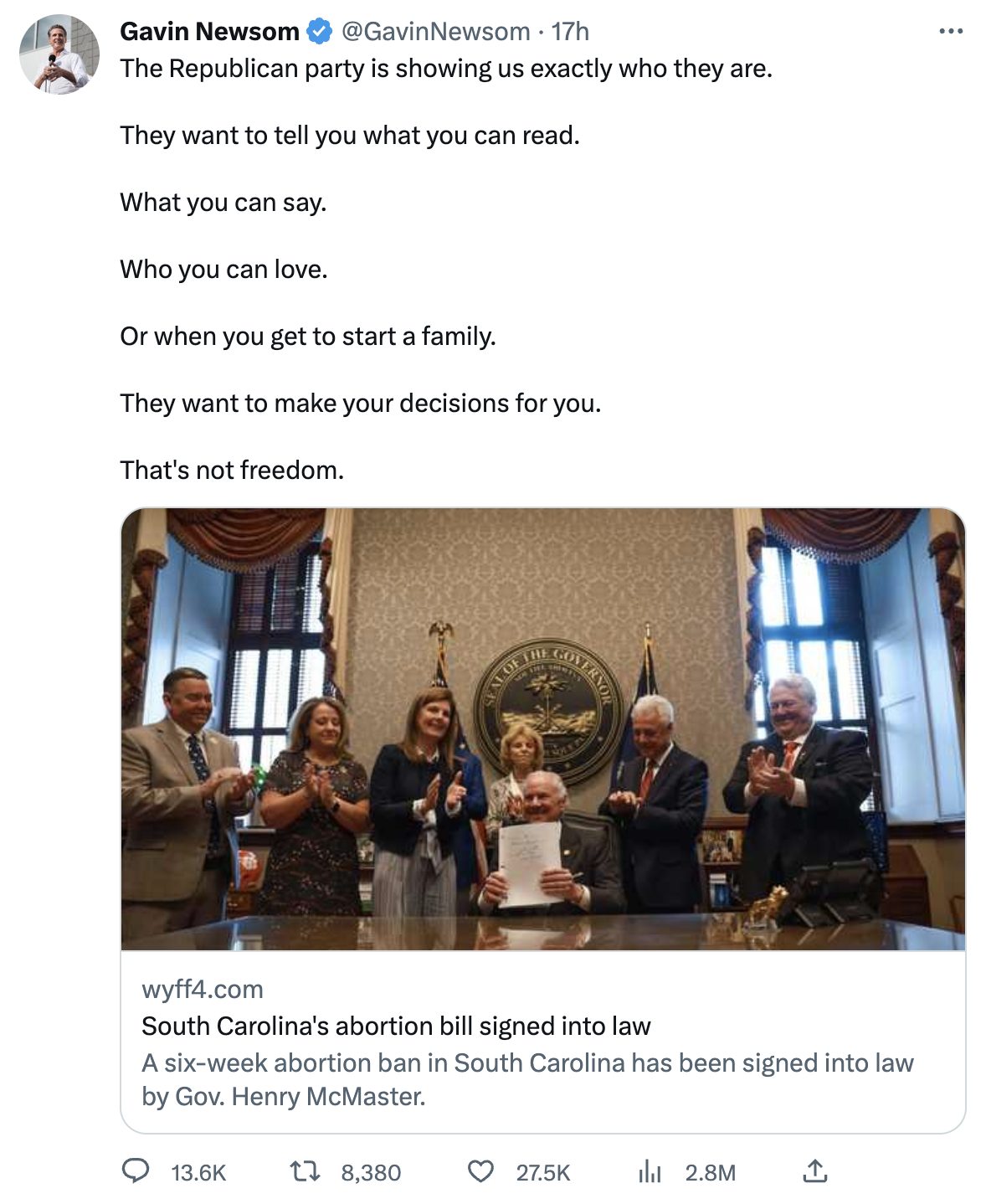
Gavin Newsom, Governor of California, regularly sends out emails pointing out the errors and hypocrisies of Republicans in other states. I enjoy them.

South Carolina, Diane…

Where the Republican governor just signed a six-week abortion ban, which he says will “begin saving lives.” All while that very same governor refuses to do anything about the fact South Carolina has one of the highest homicide rates in the country — more than 2x the rate of California.

Tweet from Gavin Newsom: 'The Republican party is showing us exactly who they are. They want to tell you what you can read. What you can say. Who you can love. Or when you get to start a family. They want to make your decisions for you. That's not freedom.'

You can’t make this up.

Today’s Republican party refuses to regulate assault weapons while gun violence is the leading cause of death of kids in America, but will champion the regulation of women’s bodies and take away reproductive freedom.

This is what Republicans want to do nationally.

And worse.

Be outraged.

Gavin

Michelle Goldberg, a regular columnist for the New York Times, writes that the views of the Oklahoma City terrorist Timothy McVeigh are now in the mainstream of the Republican Party. He was a gun lover. He killed 168 people to strike a blow for his convictions. Now, almost the entire Republican Party embraces his vision of free access to guns.

She writes:

Timothy McVeigh, the right-wing terrorist who killed 168 people in the 1995 Oklahoma City bombing, cared about one issue above all others: guns. To him, guns were synonymous with freedom, and any government attempt to regulate them meant incipient tyranny.

“When it came to guns,” writes Jeffrey Toobin in “Homegrown,” his compelling new book about the Oklahoma City attack, “McVeigh did more than simply advocate for his own right to own and use firearms; he joined an ascendant political crusade, which grew more extreme over the course of his lifetime and beyond.”

Reading Toobin’s book, it’s startling to realize how much McVeigh’s cause has advanced in the decades since his 2001 execution. McVeigh, who was a member of the K.K.K. and harbored a deep resentment of women, hoped that blowing up the Alfred P. Murrah Federal Building would inspire an army of followers to make war on the government. This didn’t happen immediately, although, as the historian Kathleen Belew has written, there was a wave of militia and white supremacist violence in the bombing’s aftermath. But today, an often-inchoate movement of people who share many of McVeigh’s views is waging what increasingly looks like a low-level insurgency against the rest of us…

Mass shootings have become so frequent that we are no longer shocked when one happens. They have become background noise.

The reason that America endures a level of gun violence unique among developed countries, and that we can often do little about it, is so many politicians have views on guns that aren’t far afield from McVeigh’s. As Representative Jamie Raskin, a Democrat from Maryland, has pointed out, it’s become common to hear Republicans echo McVeigh’s insurrectionary theory of the Second Amendment, which holds that Americans must be allowed to amass personal arsenals in case they need to overthrow the government. As the MAGA congresswoman Lauren Boebert once put it, the Second Amendment “has nothing to do with hunting, unless you’re talking about hunting tyrants.”

The Republican Party’s fetishization of guns and its fetishization of insurrection — one that’s reached a hysterical pitch since Donald Trump’s presidency — go hand in hand. Guns are at the center of a worldview in which the ability to launch an armed rebellion must always be held in reserve. And so in the wake of mass shootings, when the public is most likely to clamor for gun regulations, Republicans regularly shore up gun access instead.…Today’s Republican Party can scarcely tolerate anything getting between an eager buyer and a deadly weapon.

It’s hard to think of a historical precedent for a society allowing itself to be terrorized in the way we have. The normalization of both right-wing terrorism and periodic mass shootings by deranged loners is possible only because McVeigh’s views have been mainstreamed. “In the nearly 30 years since the Oklahoma City bombing, the country took an extraordinary journey — from nearly universal horror at the action of a right-wing extremist to wide embrace of a former president (also possibly a future president) who reflected the bomber’s values,” wrote Toobin.

As it happens, in the hours after the Oklahoma City bombing, before the authorities knew who McVeigh was, he was pulled over during a routine traffic stop and then arrested for carrying a gun without a permit. In 2019, however, Oklahoma legalized permitless carry. Under the new law, McVeigh would have been let go.

Ron DeSantis wants to make America just like Florida, where the maximum leader (Ron DeSantis) has a docile legislature that lets him decide what everyone else is allowed to do and punishes those bold enough to ignore his orders.

That’s why he is running for President. He thinks the whole nation needs and wants a maximum leader with a reactionary view of behavior and morality.

Florida is where you are free to do whatever Ron DeSantis tells you to do and free to think what he believes. If you disagree, you are no longer free.

The Miami Herald editorial board says DeSantis has turned Florida into a mean state. No, you don’t want to make America Florida.

Florida, under Gov. Ron DeSantis and Republican Legislature, is increasingly hard to recognize. It’s an intolerant and repressive place that bears scant resemblance to the Sunshine State of just a few years ago.

The 2023 legislative session cemented those appalling setbacks. Florida is now a state where government intrusion into the personal lives of Floridians is commonplace. What will it take for citizens to push back on this unprecedented encroachment on their rights? And, more broadly, what if Desantis supporters get what they want, which is to “make America Florida”?

The latest round of laws makes Florida sound more and more dystopian — something voters in the rest of the nation should note if they are considering what a DeSantis presidency could look like. The state has new rules for who can use which bathroom, what pronouns can be used in schools, which books can be taught and when women can get an abortion (almost never.) There are measures to strip union protections from public employees, keep transgender children and their parents from choosing to seek medical treatment, prevent universities from discussing diversity or inclusion and ban talk of gender identity or sexuality in schools all the way through 12th grade.