Archives for the month of: August, 2022

Trump’s lies never end.

The New York Times reported:

Even as former President Donald J. Trump invoked the Fifth Amendment in a New York inquiry into his business practices, he and his allies began an effort to discredit another investigation, suggesting without evidence, that federal agents may have planted incriminating materials before searching his residence in Florida on Monday.

In a post on Wednesday morning on his social media app, Truth Social, Mr. Trump said that the agents who showed up at Mar-a-Lago would not let anyone, including his lawyers, observe their work, which was authorized as a by a federal magistrate judge.

Mr. Trump — who has not released the search warrant provided by the agents to his lawyers or the manifest his team was given of the materials the agents gathered and removed — baselessly suggested that the F.B.I. might have acted inappropriately.

“Everyone was asked to leave the premises, they wanted to be alone,” he wrote, “without any witnesses to see what they were doing, taking or, hopefully not, ‘planting.’”

Mr. Trump’s effort to sow doubts about the F.B.I.’s search before the results are known was in keeping with his history of trying to head off news by seeking to turn the tables on his accusers. The former president’s first line of attack against adversaries is often to mount a campaign in advance to discredit them and their work.

Around the same time that his message appeared on social media, The New York Post published an article about the F.B.I. search, noting in the third paragraph that “a source close to the former president” had expressed concern that federal agents or prosecutors could have “planted stuff” in the 128-room building.

The unfounded allegations seem to have first emerged on Tuesday morning when Christina Bobb, a lawyer for Mr. Trump who was present during the search, was asked during an interview on the right-wing TV station Real America’s Voice about whether it was possible that federal agents could have planted evidence.

“There is no security that something wasn’t planted,” Ms. Bobb said before quickly admitting that she did not know if anything improper had occurred.

Huh? No one was present during the search except his lawyer Christina Bobb.

This might be one of the tricks he learned from his mentor Roy Cohn, who advised Mafia dons.

Donald Trump said many times when he was running for president in 2016 that anyone who takes the Fifth Amendment is guilty.

Yesterday, when questioned by New York state investigators about the practices of the Trump Organization, he repeatedly took the Fifth.

The state is investigating whether he manipulated the value of his properties to lower his taxes, then inflated their value to sell them.

The Boston Globe offered Trump’s explanation for his silence:

NEW YORK (AP) — Donald Trump invoked the Fifth Amendment and wouldn’t answer questions under oath in the New York attorney general’s long-running civil investigation into his business dealings, the former president said in a statement Wednesday.

Trump arrived at state Attorney General Letitia James’ offices in a motorcade shortly before 9 a.m., before announcing more than an hour later that he “declined to answer the questions under the rights and privileges afforded to every citizen under the United States Constitution.”

“I once asked, ‘If you’re innocent, why are you taking the Fifth Amendment?’ Now I know the answer to that question,” the statement said. “When your family, your company, and all the people in your orbit have become the targets of an unfounded politically motivated Witch Hunt supported by lawyers, prosecutors and the Fake News Media, you have no choice…”

James, a Democrat, has said in court filings that her office has uncovered “significant” evidence that Trump’s company “used fraudulent or misleading asset valuations to obtain a host of economic benefits, including loans, insurance coverage, and tax deductions.”

James alleges the Trump Organization exaggerated the value of its holdings to impress lenders or misstated what land was worth to slash its tax burden, pointing to annual financial statements given to banks to secure favorable loan terms and to financial magazines to justify Trump’s place among the world’s billionaires.

The company even exaggerated the size of Trump’s Manhattan penthouse, saying it was nearly three times its actual size — a difference in value of about $200 million, James’ office said.

Trump has denied the allegations, contending that seeking the best valuations is a common practice in the real estate industry. He says James’ investigation is politically motivated and that her office is “doing everything within their corrupt discretion to interfere with my business relationships, and with the political process.” He’s also accused James, who is Black, of racism in pursuing the investigation.

PBS ran a special about the love affair between America’s far-right extremists and Hungary’s authoritarian leader Viktor Orban. Here is the transcript. It’s worth reading to understand the extremism and not-so-latent fascism embedded in America’s right wing.

In 2013, I visited Cuba with my partner and two old friends. It was legal. It is still legal.

We had a spectacular trip arranged by a Cuban-born travel agent. Her name is Myriam Castillo. You can contact her here:

mcastillo@bespoke-cct.com

She is thorough, efficient, and thoughtful.

We stayed in a beautiful hotel in Havana. We visited excellent restaurants. We had tour guides wherever we went. We visited museums, artists’ homes, and historical sites.

We flew nonstop from Miami. I understand there are nonstop flights now from other cities.

The most exciting moment of the trip for me was when I got the ticket stub that said “Miami-Havana.” After 63 years of non-contact, it was thrilling.

The food was wonderful. The people were welcoming. The sight of 1950s American automobiles, in perfect condition, with leather seats, all in vibrant colors, was fabulous.

Myriam had an agent waiting for us at Jose Marti Airport. The agent helped us check into the hotel. An SUV drove us to places outside Havana.

If you want the thrill of a lifetime, this is the vacation to plan.

I was thinking of titling this post “Libertarian Crackpots Take Charge of School Funding in New Hampshire” but decided to bite my tongue.

Garry Rayno, a writer for InDepthNH.org, reports that the Koch-funded plan to defund public schools in New Hampshire is a “success.” Not because most parents want to put their children in private or religious schools, but because the overwhelming majority of students using the new education freedom accounts are already enrolled in nonpublic schools. Thus, public funds are now underwriting private education. At some point, the public schools will shrink to be just one among many choices even though the people of New Hampshire never voted to abandon their community public schools. This is a theft of public dollars for private use.

By GARRY RAYNO, InDepthNH.org 

The new education freedom account program is a success judging by the number of students participating in the first year.

More students are expected to participate in the second year and state education officials predict it will continue to grow into the future.

One of the most expansive school choice programs in the country, it was sold as a way for students and parents to find the best educational avenues to fit their student’s individual learning needs.

That would be wonderful and would fulfill the education department’s long-standing goal of individualized student pathways, but that is not what happened for a majority of students.

Instead the program has increased the state’s education spending while few students changed their learning environment.

The vast majority of students — around 85 percent — participating in the first year, did not attend public schools the year before. Instead they were in private or religious schools, or home schooled, or too young for school.

That does not change the learning environment for that 85 percent of students.

What did change under the program was the parents’ financial obligations, which were reduced thanks to the influx of state taxpayers’ money.

Department of Education Commissioner Frank Edelblut, a program advocate, told lawmakers the first year of freedom accounts would cost the state’s Education Trust Fund about $300,000 and the second year about $3.2 million. Instead the cost was close to $9 million this year.

Why the increase? Edelblut’s estimates were for students leaving traditional public schools to participate in alternative programs, not for those already in other programs applying for state help to cover the costs of private and religious schools, or home schooling.

Essentially most of the state money flowed through the parents to private and religious schools and for homeschooling costs all previously paid for by the parents or religious institutions.

When the program was first debated this term, the nonpartisan Legislative Budget Assistant’s office estimated the state’s exposure could be as high as $70 million if all the students in private or religious schools applied for grants.

The program provides grants to parents of students who earn no more than 300 percent of the federal poverty level or about $80,000 a year for a family of four.

You only have to qualify once, so if the next year your family makes $125,000, you still qualify and if you double that the next year, you still qualify.

Grants range from about $4,500 to $8,000 per student with the average the first year a little under $5,000 per student.

The money can be spent in any number of ways, for tuition, books and instructional programs, supplies, computers, individual instruction on a musical instrument, etc.

The money to pay for the freedom accounts comes from the Education Trust Fund established more than 20 years ago when the state overhauled its funding system after the Claremont II Supreme Court decision saying the then current system of relying on local property taxes with widely varying rates to pay for public education was unconstitutional because it violated the proportional and reasonable clause of the state constitution.

For most of its early years, the trust fund ran a deficit and state general fund money had to be added to meet the state’s education aid obligations.

In recent years the fund has had a surplus including this biennium. The state budget passed last year estimates a $54.4 million surplus at the end of last fiscal year June 30 and a $21 million surplus at the end of the 2023 fiscal year.

The surplus at the end of last fiscal year is much larger than that as the overall state revenue surplus is more than $400 million, but most of that has already been spent through legislation this year such as the $100 million settlement fund for the children abused at the Youth Detention Center.

The law establishing the freedom accounts has a provision if the education fund does not have enough money to cover the cost of the grants, the needed money will be withdrawn from general fund revenue without any action needed from the legislature or the governor.

Such a provision is extremely rare as lawmakers like to be able to determine how general funds are spent.

The number of students participating in the program the first year would probably not be so large if not for the American for Prosperity, an “education organization” funded by the Koch network and other like thinking libertarians who have longed advocated that public education tax money also pay for private and religious schools, homeschooling and charter schools.

The New Hampshire affiliate had a campaign ready to go when the freedom account legislation passed as part of the budget package last year. The group helped parents enroll their students in the program, many who were in private or religious schools or home schooled.

Last week the same organization held an “education fair” for parents to meet representatives of some of the organizations and groups approved to other alternative education programs under the freedom account program.

The fair was promoted by Education Commissioner Frank Edelblut who tweeted a photo from the fair, and the department had a booth there to promote its 603 Moment campaign on social media.

Others touting the fair included members of the House freedom caucus and others in the free state/libertarian wing of the GOP.

The fair is intended to help grow the program, meaning more state money will be drawn from the Education Trust Fund and ultimately the state’s general fund.

This is a well planned operation that only required the state to agree to a school choice program with few guardrails to begin taking the state down the road to greater educational “freedom” and less traditional public education.

The Koch network has recently developed a proposal to “reform” public education with one of its officials calling public education the “low hanging fruit.”

The reform would look a lot like what the freedom account program looks like and would shift resources as it does away from traditional public education to alternative pathways.

As the freedom account program grows, observers of the legislature know what will happen eventually.

As more and more education trust fund money is allocated, there will be pressure to reduce the amount of money going to traditional public education and, depending on which party is in control, to charter schools.

That is how public education becomes the low hanging fruit.

The education commissioner and others talk about the achievement gap between students from well off areas and minority students and those from low-income families.

Edelblut maintains that gap has not changed in 50 years despite numerous efforts on the federal and state level and says that is why education needs to change.

He downplays what the recent education funding commission made the centerpiece of its work, that the achievement gap is due to the resources available to students.

Students from property poor communities perform below students from property wealthy communities.

The economic disparity gap between students from property wealthy and property poor communities is larger now than it was when the Claremont lawsuit was filed 30 years ago.

Proponents of alternative education programs say it is not about spending more money, and the education funding commission said the same thing.

But the commission said the resources needed to be distributed differently, while the advocates for freedom accounts say it is about finding the right fit for a student.

Those advocates are saying the issue is not economic disparity.

Ultimately their goal is to make government smaller and they can accomplish that by disrupting traditional public education with lower cost, less regulated alternative programs.

Eventually traditional education will be small enough to be just one more alternative pathway for students among many.

That is why public education is the low-hanging fruit and freedom accounts are just the beginning.
Ryan Grim wrote this post before the final passage of the mini-Build Back Better Bill. But the point is still on target. The bill is good because it’s the best we can hope for in a Senate where Democrats have only 50 votes, and two of those votes are precarious. In a perfect world, the Democrats would have 62 votes in the Senate and could pass a perfect bill. But we don’t live in a perfect world. The Republicans are unanimously opposed to any legislation to address climate change or to curb the costs of health care. This, for now, is the best that can be done. Do not scoff at half-measures. They are way better than nothing, and the Republicans strongly prefer nothing. They want to go into the mid-terms with a battered Biden presidency that accomplished nothing. They are not thinking of the people they claim to represent. Biden needed this victory, but so do the American people. Think of it as a first step.

In the Texas governor’s race between the vile Gregg Abbott and challenged Beto O’Rourke, the candidates are fighting for rural votes on the issue of vouchers. Rural Republicans have a strong allegiance to their public schools, which are often the heart of the community and its biggest employer. Many rural communities do not have any other schools.

Yet Governor Abbott has supinely sought the approval of Betsy DeVos’s American Federation of Children.

The Texas Tribune summed up the conflict:

A battle over school vouchers is mounting in the race to be Texas governor, set into motion after Republican incumbent Greg Abbott offered his clearest support yet for the idea in May.

His Democratic challenger, Beto O’Rourke, is hammering Abbott over the issue on the campaign trail, especially seeking an advantage in rural Texas, where Democrats badly know they need to do better and where vouchers split Republicans. O’Rourke’s campaign is also running newspaper ads in at least 17 markets, mostly rural, that urge voters to “reject Greg Abbott’s radical plan to defund” public schools.

Abbott, meanwhile, is not shying away from the controversy he ignited when he said in May that he supports giving parents “the choice to send their children to any public school, charter school or private school with state funding following the student.” He met privately last week with Corey DeAngelis, an aggressive national school choice activist who had previously criticized Abbott as insufficiently supportive of the cause.

“School choice” tends to refer to the broad concept of giving parents the option to send their kids to schools beyond their local public school, while vouchers would allow parents to use state tax dollars to subsidize tuition for those other options, including private schools. Opponents of vouchers say they harm public school systems by draining their funding. In the Legislature, vouchers have long encountered resistance from Democrats and rural Republicans whose public schools are the lifeblood of their communities.

O’Rourke is leaning into the bipartisan salience of the issue.

“For our rural communities, where there’s only one school district and only one option of public school, he wants to defund that through vouchers, take your tax dollars out of your classroom and send it to a private school in Dallas or Austin or somewhere else at your expense,” O’Rourke told a rural audience recently.

As usual, the voucher vultures are pushing the lie that money taken away from your public school will allow children to attend elite private schools.

It can’t be said often enough: voucher funds are never enough to pay for elite public funds. It is a lie. Voucher funding ranges from $4,000 to $8,000. The tuition at elite private schools ranges from $30,000 to $70,000.

Elite private schools don’t have vacancies. When they do, they don’t seek to enroll poor kids.

After 25 years of vouchers, the research is clear: kids who leave community public schools for voucher schools lose academic ground. Large numbers return to their public schools.

Meanwhile public schools are grievously harmed by the withdrawal of funding. They must lay off teachers and cut programs.

If the Devil designed a program to hurt the public schools, he would call it vouchers. And it would be funded by the American Federatuon for Chiildren.

The FBI executed a search warrant approved by a federal judge and searched Trump’s home in Florida in search of government documents that were illegally removed from the White House when Trump grudgingly left office.

It is a felony to remove classified documents from the White House or other government offices. We like to think that “no man is above the law,” but we have seen too many exceptions. For example, it is obvious that Trump incited the attack in the U.S. Capitol. He even wanted to join the mob as it ransacked the building. Yet he says the mob acted on its own and his followers insist the mob was really Antifa. Too bad he didn’t join the mob so he couldn’t disclaim any responsility. Isn’t it a crime to incite an insurrection? But no man is above the law.

Trump issued a statement in which he whined that the FBI raid on his manor was no different from the break-in to the DNC headquarters at Watergate.

But historian Michael Beschloss explained the difference last night on MSNBC. The Watergate break-in was a criminal act. The raid on Mar-A-Lago was authorized by a federal judge and carried out lawfully in search of documents that Trump took with him from the White House. All presidential documents are supposed to be turned over to the National Archives. They are the property of the federal government, not the president’s personal property. Refusing to return them is a felony.

Trump’s loyal supporters in Congress are outraged. They believe that he is above the law.

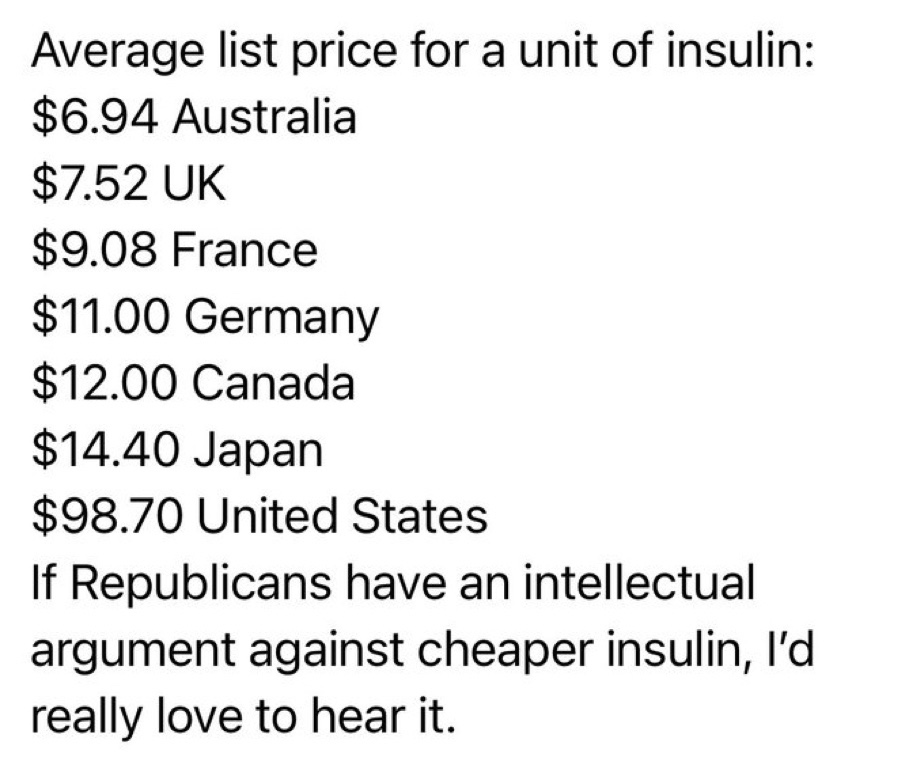
Democrats needed 60 votes to pass a $35 monthly cap on the price of insulin. Republicans, led by Senator Lindsey Graham, made sure that there would not be 10 Republican votes for the measure.

The Washington Post reported:

Republican lawmakers on Sunday successfully stripped a $35 price cap on the cost of insulin for many patients from the ambitious legislative package Democrats are moving through Congress this weekend, invoking arcane Senate rules to jettison the measure.

The insulin cap is a long-running ambition of Democrats, who want it to apply to patients on Medicare and private insurance. Republicans left the portion that applies to Medicare patients untouched but stripped the insulin cap for other patients. Bipartisan talks on a broader insulin pricing bill faltered earlier this year.

The Senate parliamentarian earlier in the weekend ruled that part of the Democrats’ cap, included in the Inflation Reduction Act, did not comply with the rules that allow them to advance a bill under the process known as reconciliation — a tactic that helps them avert a GOP filibuster. That gave the Republicans an opening to jettison it.


“Republicans have just gone on the record in favor of expensive insulin,” said Sen. Ron Wyden (D-Ore.). “After years of tough talk about taking on insulin makers, Republicans have once against wilted in the face of heat from Big Pharma.”


Some Republicans did support the price cap in the 57-43 vote for the measure, but not enough joined Democrats in support of it to meet the threshold for passage.


More than 1 in 5 insulin users on private medical insurance pay more than $35 per month for the medicine, according to a recent analysis from the Kaiser Family Foundation.


Some 7 million Americans require insulin daily. A Yale University study found that 14 percent of those insulin users are spending more than 40 percent of their income after food and housing costs on the medicine.

The seven Republicans who voted with the Democrats were: Senators Susan Collins of Maine, Josh Hawley of Missouri, Cindy Hyde-Smith of Mississippi, Lisa Murkowski and Dan Sullivan of Alaska, and John Kennedy and Bill Cassidy of Louisiana.

Mary Trump tweeted that Josh Hawley, a fierce partisan, must have a relative with diabetes. Or maybe the Republicans drew straws to see who would cast a futile vote against a popular measure.

Tweet by @toylsome

Question: Will Republican voters remember in November?

Senators Joe Manchin and Kyrsten Sinema were the two Democrats whose support for the Inflation Reduction Act was in doubt until the very end. Manchin won protection for the fossil fuel industry. Sinema killed taxes that would hit the hedge fund industry. The Washington Post explains here:

Senate Democrats agreed Sunday to protect firms owned by the private equity industry from a new minimum tax on billion-dollar corporations, bowing to pressure from Sen. Kyrsten Sinema (D-Ariz.), who insisted on making the change to the Democrats’ sprawling climate, health-care and tax package.

The decision came as Democrats tried to hold their caucus together through nearly 19 hours of debate over the Inflation Reduction Act of 2022, which the 50-50 Senate approved Sunday with the help of a tiebreaking vote from Vice President Harris.


The package proposes hundreds of billions of dollars in fresh spending, financed in part through new taxes, including a corporate minimum tax that would require firms with more than $1 billion in annual profits to pay a tax rate of at least 15 percent. As originally written, the provision would have required private equity firms to tally profits from their various holdings and pay the tax if the total exceeded the $1 billion threshold.


Sinema, who for over a year has blocked Democratic ambitions to raise taxes, raised objections on Saturday, according to two people with knowledge of the matter, who spoke on the condition of anonymity to discuss private talks.

The senator argued that, without changes to the bill, small and medium-sized businesses that happen to be owned by private equity firms would be exposed to the tax, violating a Democratic pledge to hike taxes only on the largest firms. A Sinema spokeswoman said several Arizona small businesses, including a plant nursery, had raised concerns.

The senator’s objections came days after she persuaded Democrats to abandon a different effort to raise taxes on private equity managers by closing the so-called “carried interest loophole,” which permits investment managers to pay lower rates on certain portions of their income.
In a statement, Sinema’s office said her goal is to “target tax avoidance, make the tax code more efficient, and support Arizona’s economic growth and competitiveness.”


“At a time of record inflation, rising interest rates, and slowing economic growth, Senator Sinema knows that disincentivizing investments in Arizona businesses would hurt Arizona’s economy’s ability to create jobs, and she ensured the Inflation Reduction Act helps Arizona’s economy grow,” the statement said.


The last-minute changes mark a significant victory for the private equity industry and an estimated savings of $35 billion over the next decade. Private equity represents a roughly $4 trillion industry in the United States, and as the sector has grown markedly over the past decade, it has flexed its considerable political muscle repeatedly in Washington.


From the start, the unusual way private equity businesses are structured posed a challenge for Democrats crafting the new minimum tax. Typically, large conglomerates are formed as “C corporations” under the tax code and pay corporate taxes. The new minimum tax would clearly apply to them. But private equity firms are legally formed as partnerships, which typically pay taxes on the individual returns of their owners. Senate Democrats say they crafted the legislation to ensure that wealthy investment managers who own numerous C corporations and other business entities collectively worth more than $1 billion would be subject to the tax.

But the tax was never intended to hit the smaller subsidiaries that make up private equity portfolios, said Ashley Schapitl, a spokeswoman for Senate Finance Committee Chairman Ron Wyden (D-Ore.), who called industry claims to that effect “nonsense.”


Independent analysts largely agreed with that reading of the provision. “The language in the bill was intended to make sure they are treated the same way,” said Steve Wamhoff, a tax expert at the Institute on Taxation and Economic Policy, a left-leaning think tank. “The idea that billion-dollar private equity funds must be protected to save small businesses is absolutely absurd.”