Archives for the month of: July, 2022

After a consistent flow of decisions tearing down the wall of separation between church and state, readers have proposed that the U.S. Supreme Court should henceforth be known as the Supreme Christian Court of the United States. Others call it the Supreme Christian Taliban Court.

In every decision involving religion, the Christian Court makes no effort to balance freedom of religion and the Constitutional prohibition against establishment of religion.

This Court agreed that a baker open to the public may refuse to bake a cake for a gay couple because gay marriage violates his religious beliefs.

This Court requires Maine to fund two evangelical schools in Maine that openly discriminates against those who do not share their beliefs. The state is thus compelled to subsidize discrimination that federal and state law forbid.

This Court supports a school coach’s right to pray in public while he is working and influencing students to follow his lead. Will they next support teachers who are moved to pray in their classrooms?

What next, a revival of school prayer?

This Court, in true Taliban style, allows states to revoke women’s reproductive rights, the decision to control their own bodies.

The Court is drunk with its unchecked power. With a certain majority of 5 hard-core extremists, and the likely vote of a powerless Chief Justice, this Court is set to remake American society, to roll back the rights and freedoms that most Americans take for granted.

Do they want to take us back to 1868, as Justice Thomas wrote, when people of color and women could not vote?

Or do they want to transport us to an imaginary world where father knows best, women know their place, Black people quietly acquiesce to indignities, and everyone is forced to pray the same prayers?

A new study by University of Kentucky Dean Julian Vasquez. Heilig and Professor David G. Martinez demonstrates the inequity built into school funding., to the disadvantages of the poorest communities.

A newly published analysis of how dollars are distributed to schools in the U.S. posits that funding allocation models continue to disadvantage those in low-income communities, despite long-standing evidence that equitable funding is critical to students’ capacity to learn and achieve.

The article, authored by University of Kentucky College of Education Dean Julian Vasquez Heilig, Ph.D., and Davíd G. Martínez, Ph.D., an assistant professor at the University of South Carolina, appears in the latest issue of the Minnesota Journal of Law & Inequality.

Due to the reliance on local property values to fund schools, property poor districts are prevented from increasing or equalizing school revenue to the level of wealthier districts. This poverty is unequally distributed across racial and ethnic backgrounds. Recent peer-reviewed research has shown that in gentrifying urban communities, as the proportional intensity of white students increases in schools, so do the resulting resources and demands for schools, the authors write.

“Education is a human right and a civil right, but our school finance policies are failing to treat it as such,” Martínez said. “Access to quality education is necessary for communities to thrive. When there are major educational disparities that exist between communities, it impacts everyone. This is demonstrably true if those educational disparities are predicated on community wealth, or race and ethnicity. Policy makers must do more to understand the history of school finance disparity in their community, and take steps to ameliorate its impact.”

Martínez and Vasquez Heilig say in their analysis that, despite countless attempts to reform school finance policy, the U.S. has historically been unable to improve school funding inequity and injustice. Without creating a more equitable system, resolving challenges for marginalized students will continue to be difficult.

“We looked at numerous studies showing increases in funding resulted in greater academic success for marginalized students. For instance, when more resources were put into majority LatinX urban schools, reading and math achievements increased,” Vasquez Heilig said. “Quite simply, money does matter and investing in education early and often matters in the everyday life of a student.”

The authors suggest federal policymakers adopt a framework known as Opportunity to Learn that would put in place a set of minimum standards for equitable learning in U.S. schools. These standards would include well-trained and certified teachers and administrators, timely curriculum and texts, up-to-date facilities and wrap-around services to support neuro-divergent learners and the health, nutrition, housing and family wellness of students. As a civil right, the authors argue for complete and differentiated levels of service for every student and funding that allows for the provision of those services.

After these standards for learning are set, it would enable state policymakers to raise revenue to proper levels of fiscal support for meeting the standards. The authors say this model deviates from past school reform and finance models that have focused on test scores and the need for increased student achievement. They, instead, support a model where success is determined by how policymakers are supporting high-quality educational access and availability in every community, promoting alternatives to the historical resource disparity that has oppressed BIPOC students and families.

“Ultimately, as a civil right, we need to support students through the P-20 pipeline, which includes high school completion and earnings later in life, with the ultimate goal of reducing adult poverty,” Vasquez Heilig said.

I had not planned to write anything more about the child who was raped in Ohio, became pregnant with the rapist’s semen, but had to go to Indiana for an abortion. But then someone wrote a comment here implying that the whole story sounded like fake news. As I showed in my original post, there have been many reports of children who were raped and impregnated. Some got abortions. Others did not.

I’m old-fashioned. I don’t think children should be raped. If they are, they should not bear a child. It’s monstrous. The rapist should be found and punished. In my limited view, those who want a 10-year-old child to have a baby are sadists.

In the Ohio case, Republicans jumped all over the story and called it fake news. It was not. The right showed themselves to be heartless, cruel fools.

Michelle Goldberg of the New York Times reports how the Right humiliated themselves in their eagerness to discredit the story and the child.

She writes:

Not long after the Supreme Court overturned Roe v. Wade, an Indiana obstetrician and gynecologist named Caitlin Bernard told The Indianapolis Star about a call she’d gotten from a doctor in Ohio. The Ohio doctor had a 10-year-old patient who was six weeks and three days pregnant. An Ohio law banning abortion after fetal cardiac activity can be detected — usually around the sixth week of pregnancy — had just gone into effect, so the girl needed to cross state lines for care. The report, being illustrative of the ghoulish impact of abortion prohibitions, went viral, and Joe Biden mentioned it in a speech.

The right, however, quickly convinced itself that the tale was dubious and probably false. The conservative website PJ Media claimed, last Friday, that the account had “many of the elements of a hoax.” On Monday, Ohio’s Republican attorney general, Dave Yost, went on Fox News to say that he knew of no police reports about a 10-year-old rape victim. “The more you learn about this, the more unbelievable it becomes,” said the host, Jesse Watters.

A Wall Street Journal editorial on Tuesday described the report as “fanciful,” noting that “no one has been able to identify the girl or where she lives,” as if that information should be public. “Hey, so did they catch the guy who raped the Ohio ten year old yet?” the National Review writer Michael Brendan Dougherty tweeted last week, seemingly sarcastically.

The answer to Dougherty’s question is now yes. Officials say that a 27-year-old named Gerson Fuentes was arrested on Tuesday and has confessed. The children’s services department in Columbus alerted the police about the rape in June. Rather than apologize to Caitlin Bernard for calling her a liar, many on the right have started attacking her for not reporting the rape herself, even though the police already knew about it by the time she saw the girl.

On Wednesday, Watters displayed a photograph of Bernard and said, “According to reporting from PJ Media, she has a history of failing to report child abuse cases.” Then Indiana’s attorney general, Todd Rokita, appeared on Watters’s show, describing Bernard as an “abortion activist acting as a doctor,” and announcing she was under investigation.

It looks like the only thing Bernard did wrong, though, is to embarrass Republicans. On Thursday afternoon, The Star reported that Bernard reported the abortion to the Indiana Department of Health and the Department of Child Services, as state law requires. In a statement, her lawyer said she’s considering legal action against Rokita and others who have “smeared” her.

This whole hideous episode has demonstrated the extent to which conservatives are unwilling to grapple with the reality of the abortion regime they are imposing on much of the country. There is nothing wrong with seeing a single-source news report and deciding you want to withhold judgment until more information emerges. But that’s not what happened here. Instead there was sneering incredulity, as if a raped 10-year-old being denied an abortion wasn’t an inevitable consequence of an abortion ban without a rape exception.

Surely right-wingers, who love to accuse their enemies of pedophilia, understand that children are raped in America. The Columbus Dispatch, which broke the news of Fuentes’s arrest, reported that there were 52 abortions performed on children 15 and under in Ohio in 2020, roughly one a week in just one state.

In countries that have banned abortion, there have been a number of high-profile cases of very young pregnant rape victims. In Nicaragua in 2003, feminist activists fought to help a 9-year-old obtain a therapeutic abortion. When it emerged that she’d been raped by her stepfather, the activists faced legal harassment over accusations that they’d helped cover up the crime.

Just this year, a judge in Brazil tried to block an abortion for an 11-year-old who had been raped. “Do you want to choose the baby’s name?” he asked her. “Would the baby’s father agree to give it up for adoption? Would you bear it a little longer?” Why would anyone think that similar laws won’t lead to similar results here?

It’s been especially maddening to see people on the right smugly insist that the girl in Ohio could have had a legal abortion in her state. In a New York Post column casting doubt on the story, the law professor Jonathan Turley wrote, “Ohio says abortions are allowed ‘to prevent a serious risk of the substantial and irreversible impairment of a major bodily function of the pregnant woman,’ which would certainly be the case for a 10-year-old.”

His certainty is entirely unearned. The Ohio law actually saysthat abortion is permitted only in cases of “medical emergency” requiring the “immediate performance or inducement of an abortion” in order to prevent death or irreversible bodily harm that “delay in the performance or inducement of the abortion would create.” This language is vague and open to interpretation. It’s obvious to me that a pregnant 10-year-old is an immediate medical emergency. But if you were an abortion provider in Ohio, would you stake your career, and perhaps your freedom, on prosecutors like Yost giving you the benefit of the doubt?

“If states write laws that are completely vague about what the requirements are, they can still have abortion on the books, but have an environment in which no physician is willing to provide it,” said the N.Y.U. law professor Melissa Murray.

Roe has been gone for less than three weeks, and the utterly predictable outcomes are already apparent. Today.com reportedon a woman in Arizona who learned at 21 weeks that her wanted pregnancy was unviable, but whose doctor is unable to induce an early delivery because of the Supreme Court’s decision. “I really can only describe it as feeling trapped,” she said.

As The Los Angeles Times reported, some patients are being denied methotrexate, a drug used to treat certain cancers and autoimmune conditions, because it’s an abortifacient. Medical professionals aren’t necessarily wrong to worry; according to the newspaper, “In Texas, dispensing methotrexate to someone who uses it to induce a miscarriage after 49 days of gestation is a felony.”

Abortions after about six weeks have been illegal in Texas since S.B. 8, the so-called abortion bounty law, took effect last year, and women have come forward to speak about the trauma they’ve had to endure. NPR reported on a woman named Anna whose water broke on her wedding day, when she was 19 weeks pregnant. The fetus had no chance of surviving, and Anna was at high risk of hemorrhaging or developing sepsis. But doctors said they couldn’t terminate the pregnancy until either the fetus’s heart stopped or her condition worsened. She ended up spending thousands of dollars to fly to Colorado for an abortion, sitting in the front row so she could reach the bathroom quickly in case she had to deliver.

If none of this is what anti-abortion lawmakers intended, nothing is stopping them from amending their laws. Ohio’s statute includes examples of medical emergencies in which abortion is permitted, including pre-eclampsia and prematurely ruptured membranes. If Republicans think “being a child rape victim” ought to be included as well, they should add it.

But they’re unlikely to, because the anti-abortion movement would object. On Thursday, James Bopp, general counsel for the National Right to Life Committee, told Politico that under model legislation he’s written, the Ohio girl would have been forced to carry her pregnancy to term. “She would have had the baby, and as many women who have had babies as a result of rape, we would hope that she would understand the reason and ultimately the benefit of having the child,” he said.

This is, at least, honest. The fury directed at Caitlin Bernard suggests other conservatives aren’t as willing to admit what their laws do.
Ian Millhouser, one of our best legal commentators, wrote at Vox about Justice Neil Gorsuch’s blatant misrepresentation of the facts in the case of the coach who was exonerated by the Supreme Court for praying at the 50-yard line after the game. Gorsuch’s factually inaccurate description of the case leaves a mess for educators and courts who want to know what sort of prayers are okay and which are forbidden. My personal hunch is that Gorsuch and his extremist allies intend to overrule the 1962 ban on prayer in public schools.

Millhouser begins:

Kennedy v. Bremerton School District is a big victory for the religious right, but only because Gorsuch misrepresents the facts of the case.

But Justice Neil Gorsuch’s opinion for himself and his fellow Republican appointees relies on a bizarre misrepresentation of the case’s facts. He repeatedly claims that Joseph Kennedy, a former public school football coach at Bremerton High School in Washington state who ostentatiously prayed at the 50-yard line following football games — often joined by his players, members of the opposing team, and members of the general public — “offered his prayers quietly while his students were otherwise occupied….”

Moreover, because Gorsuch’s opinion relies so heavily on false facts, the Court does not actually decide what the Constitution has to say about a coach who ostentatiously prays in the presence of students and the public. Instead, it decides a fabricated case about a coach who merely engaged in “private” and “quiet” prayer.

If the facts of Kennedy actually resembled the made-up facts laid out in Gorsuch’s opinion, then Kennedy would have reached the correct result. Even under Lemon, a public school employee is typically permitted to quietly pray while they are not actively engaged with students….

In the real case that was actually before the Supreme Court, Coach Kennedy incorporated “motivational” prayers into his coaching. Eventually, these prayers matured into public, after-game sessions, where both Kennedy’s players and players on the other team would kneel around Kennedy as he held up helmets from both teams and led students in prayer.

After games, Kennedy would also walk out to the 50-yard line, where he would kneel and pray in front of students and spectators. Initially, he did so alone, but after a few games students started to join him — eventually, a majority of his players did so. One parent complained to the school district that his son “felt compelled to participate,” despite being an atheist, because the student feared “he wouldn’t get to play as much if he didn’t participate.”

When the Bremerton school district learned of Kennedy’s behavior, it told him to knock it off — though it did offer to accommodate Kennedy if he wanted to pray when he wasn’t surrounded by students and spectators. And Kennedy did end some of his most extravagant behavior, such as the prayer sessions where he held up the helmets while surrounded by kneeling students.

But Kennedy also went on a media tour, presenting himself as a coach who “made a commitment with God” to outlets ranging from local newspapers to Good Morning America. And Kennedy’s lawyer informed the school district that the coach would resume praying at the 50-yard line immediately after games.

At the next game following this tour, coaches, players, and members of the public mobbed the field when Kennedy knelt to pray. A federal appeals court described this mob as a “stampede,” and the school principal said that he “saw people fall” and that, due to the crush of people, the district was unable “to keep kids safe.” Members of the school’s marching band were knocked over by the crowds.

And, contrary to Gorsuch’s repeated claims that Kennedy only wanted to offer a “short, private, personal prayer,” Kennedy was surrounded by players, reporters, and members of the public when he conducted his prayer session after that game. We know this because Justice Sonia Sotomayor includes a picture of the scene in her dissenting opinion.

The religious right won a big case. Where will schools draw the line? Will every religion be free to have its own prayers at school?

My prediction: The Supreme Court is building a path to restore prayer in the schools, reversing Engel v. Vitale (1962). Will every religion get its own prayers? Or will there be a single religion imposed on everyone? Or a nonsectarian religious prayer?

Peter Greene reports the selling of heavily clad bunkers for classrooms to protect children against killers.

We have a problem. There are 400 million guns owned by the population. One of our major political parties is adamantly opposed to any restraint on buying and selling more guns.

Other societies insist on background checks, proof of training, safes for guns, and a dozen other ways to minimize the misuse of these deadly weapons. Even the most tepid effort to limit gun ownership will be loudly opposed in this country. The recent bipartisanship deal on gun control won’t change any of that.

The recent assassination of the former Prime Minister of Japan, which has rigid limits on gun ownership, was held up by gun lovers as proof that gun control doesn’t work. Japan had a total of ten gun deaths last year.

So, Greene points out, since we do nothing to restrict gun ownership, we create a response to the problem. Buy bunkers for children in classrooms. This could be a billion-dollar business.

PS: then there’s the case of the Uvalde elementary school. Just-released videotape showed that the police, fully armed, stayed out of the classrooms where the killer was, for 77-78 minutes. As children and teachers died, the police held back. Why? They didn’t need a key. They didn’t need more weapons. They didn’t need more armor. They needed courage.

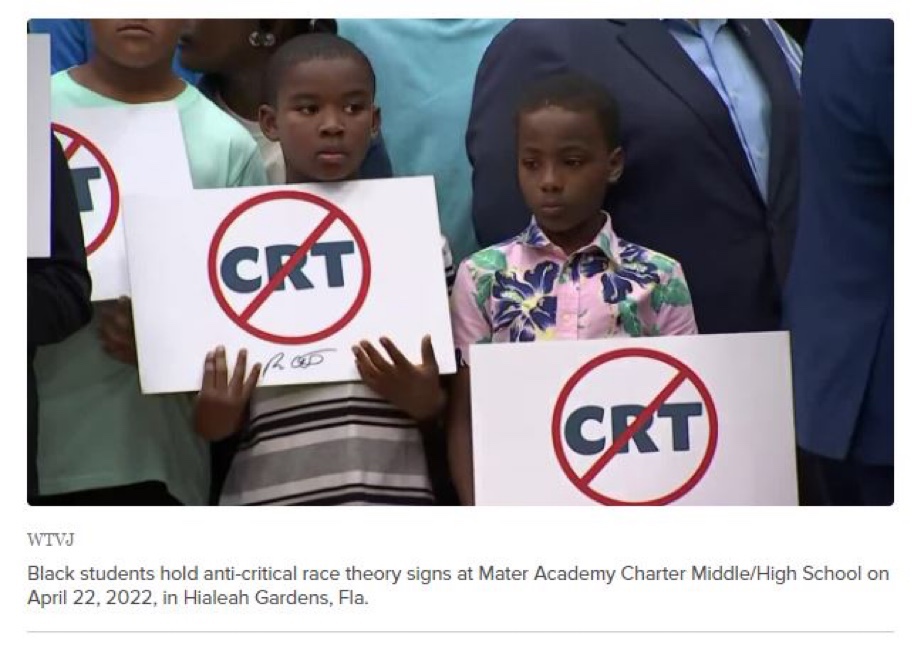
Blogger Carl Petersen posted this photo on Twitter.

Do you sincerely believe that any Black student opposes teaching about the history of racism? Isn’t it amazing to see this photograph of Black students attending the for-profit Mater Academy in Florida , holding up signs opposing critical race theory? CRT means an analysis of the roots of racism in our history, our laws, and our politics.

Governor Ron DeSantis signed the anti-CRT bill at the same charter school. He believes that teaching the truth is hateful.

Do you think these children actually oppose CRT?

Or were they indoctrinated?

Maurice Cunningham wrote in the Tampa Bay Tribune about “Moms for Liberty.” It seems to be a Dark Money front for some familiar billionaires.

Is it Koch? DeVos? Waltons? Or another billionaire?

It is good to report some positive news from Texas, instead of news of guns, death, and hatred, the specialties of Governor Abbott and Lt. Gov. Patrick.

Billionaire Charles Butt, owner of the H-E-B grocery chain, has pledged $10 million to build a new elementary school in Uvalde to replace the Robb Elemebtary School, site of a massacre.

The Uvalde school district on Tuesday announced that it had secured signature support from donors to build a new school to replace Robb Elementary, site of a mass shooting in May that killed 19 children and two teachers.

The Butt family and H-E-B grocery stores have pledged a combined $10 million in funding, officials announced. In addition, Huckabee, a Fort Worth-based architectural firm, and Joeris General Contractors, which will assist in the design and construction of the school, will waive the fees for their architectural work and contracting services.

“Public schools are the foundation of a community,” says Huckabee CEO Chris Huckabee in a statement. “Our team is honored to partner with Joeris construction, the Butt family, H-E-B, and so many others to design a new facility that will honor Uvalde and serve its future generations.”

Charles Butt is a good friend of the five million children in Texas public schools, as well as Pastors for Texas Children.

Kathryn Joyce is an investigative reporter for Salon. In this article, she shows how the Republican leaders of Arizona have decided to end the teacher shortage by reducing standards for teachers. They have decided that teaching is not a profession. Anyone, they think, can do it.

She writes:

Last week, just days after the Arizona legislature passed the most expansive school voucher law anywhere in the nation, Gov. Doug Ducey signed into law another education measure decreeing that public school teachers are no longer required to have a college degree of any kind before being hired. Instead of requiring a masters degree — which has long been the norm in the profession — Arizona teachers will only have to be enrolled in college in order to begin teaching the state’s public school students.

The law, SB 1159, was pushed by conservatives on the grounds that Arizona has faced a severe teacher shortage for the last six years, which, by this winter, left 26% of teacher vacancies unfilled and nearly 2,000 classrooms without an official teacher of record. That shortage has led supporters of the bill, including business interests such as the Arizona Chamber of Commerce, to claim that loosening teacher credential requirements will help fill those staffing gaps. Opponents of the bill, however, point to the fact that Arizona has the lowest teacher salaries in the country, even while boasting a budget surplus of more than $5 billion.

“Arizona’s teacher shortage is beyond crisis levels,” tweeted Democratic state Rep. Kelli Butler this March. “Instead of offering real solutions (like increasing pay & reducing class sizes) the House Education Committee passed a bill to reduce the requirements to teach.”

“With Arizona trying to get education monies to parents directly to pay for schooling — including homeschooling — you see more evidence that the state doesn’t care who teaches its kids,” said David Berliner, an education psychologist at Arizona State University and former president of the American Educational Research Association. “Charters and private schools for years have not needed certified folks running schools or teaching kids — as long as the voucher for the kids shows up.” Combined with its new law creating a universal voucher system, Berliner added, “Arizona may now be the most radical state in terms of education policy.”

Please open the link and read the article in full.

Arizona doesn’t care about its children.

Dana Milbank is a wonderful columnist for the Washington Post. He writes here about the death of state decisis, the legal principal of respecting precedent. The six-person majority on the Supreme Court have thrown away precedent. They are drunk with power. They are free to do whatever they want with no restraint, and they are rolling back decades of social progress. They are not conservatives. They are radicals.

Milbank writes:

Now begins the era of stare indecisis.
Respect for precedent — known by the Latin stare decisis, “to stand by things decided” — had been a centuries-old cornerstone of the rule of law, necessary so “the scale of justice” doesn’t “waver with every new judge’s opinion,” as the 18th-century legal philosopher William Blackstone wrote.


But — et tu, Alito? — the Supreme Court’s radical right put the knife in stare decisis in its decision overturning Roe v. Wade and destroying 50 years of precedent upon precedent.

The dissenting justices wrote that “the majority abandons stare decisis,” an act that “threatens to upend bedrock legal doctrines,” “creates profound legal instability” and “calls into question this Court’s commitment to legal principle.”


The majority protested that it didn’t abandon stare decisis — then explained why it did: “Stare decisis is not an inexorable command. … Stare decisis is not a straitjacket.”


The burial of stare decisis leaves us, ipso facto, with a void: Which Latin phrase best describes the legal doctrine of this new era, in which judges rule by whim, not precedent? Well, thank your lucky stares, because my classics consultant, Vanessa (she asked that her surname not be used in order to speak Latin frankly), has many options.


Labels such as “judicial modesty,” “judicial restraint” and “originalism” were trashed along with stare decisis. For this radical majority to claim “restraint” now would be the very definition of stare mendaciis — to stand by lies. Other better labels for the court majority’s new philosophy are stare deviis (to stand by inconsistent things), or perhaps stare fetore (to stand by a foul odor), in honor of the question Justice Sonia Sotomayor posed during oral arguments: “Will this institution survive the stench that this creates?”

But maybe most accurate is stare sodalitate — to stand by your political party. To the Romans, this meant either “electioneering gang” or “religious fraternity,” apt descriptions both of this court’s right wing.


There are other potential principles being thrown about. This week’s Jan. 6 committee hearing revealed that President Donald Trump, upon receiving displeasing information (such as his attorney general’s refusal to bless his election lies), would hurl his meal at the wall. This would be stare cibo iacto — to stand by thrown food (although other scholars use stare vasis fractis — to stand by broken dishes).


The Republican Party, even now, remains steadfastly loyal to Trump, adhering to something called the Wynette Doctrine, stare homine tuo — stand by your man.


Sen. Susan Collins (R-Maine) is claiming she was deceived by Justices Brett Kavanaugh and Neil Gorsuch into thinking they wouldn’t overturn Roe — an instance of stare credulitate, to stand by gullibility.


At a Trump rally, Rep. Mary Miller (R-Ill.) practiced stare hominibus albis — to stand by White people — when she called the abortion decision a “victory for White life.” (She said she misspoke, although the crowd cheered.)


Congressional candidate Yesli Vega, the GOP nominee to replace Rep. Abigail Spanberger (D-Va.) said “it wouldn’t surprise me” if it were difficult for a woman to get pregnant from rape, “because it’s not something that’s happening organically,” according to an Axios recording. That’s called stare rapina legitima — to stand by legitimate rape — affirming the precedent set by Senate candidate Todd Akin (R-Mo.), who said in 2012: “If it’s a legitimate rape, the female body has ways to try to shut that whole thing down.”

Texas Attorney General Ken Paxton is reviving the doctrine of stare contra pedicandum (to stand against sodomy) by saying he would defend a 1973 anti-sodomy law struck down two decades ago. Justice Clarence Thomas has invited challenges to that decision, as well as others protecting same-sex marriage and contraception.


Texts show that Thomas’s wife, Ginni, meanwhile, urged the Trump White House to “release the Kraken” of false election-fraud allegations — a philosophy known as stare monstris, to stand by sea monsters.


The court’s right-wing majority might also share the belief of Rep. Lauren Boebert (R-Colo.) who said she’s “tired of this separation of church and state junk,” which she said came from a “stinking letter” by Thomas Jefferson, not the Constitution. Demonstrating stare templo — to stand by the church — Boebert decreed that “the church is supposed to direct the government.”


Another creed comes from Sen. Ted Cruz (R-Tex.) who attacked Elmo because Sesame Street encouraged coronavirus vaccination. That’s stare contra pupas — stand against Muppets.


The court’s recent rulings invite many other Latin descriptors: stare atrocitate (to stand by cruelty), stare decuriatione (to stand by intimidation), stare deminutione capitis (to stand by the loss of liberties). But ultimately a court that has abandoned precedent stands for nothing (stare nullis) except for the raw exercise of power — stare imperio. And that leads to one place: stare ruina, to stand by destruction.