Archives for the month of: December, 2021

Nora de la Cour is a high school social worker and a former teacher. In this article, which appeared in Jacobin, she provides a trenchant overview of the strains and pressures that drive dedicated teachers away from a profession they love.
She writes:

This school year has been marked by a flood of reports of dire school staffing shortages, including stories about schools shutting down because there are simply not enough adults in the building to keep kids safe. The seemingly ubiquitous theme of educators resigning mid-year has even become its own TikTok genre.

Kristin Colucci, who teaches English in Lawrence Public Schools in Massachusetts, described the situation at her high school to Jacobin: “One teacher quit, another retired, and there have been no teachers assigned to those classes. Students are literally sitting there by themselves. The message being sent: the class and the students are not worthy of this education.”

Edu-conomists who warn against teacher pay increases like to point out that shortages are district-specific and that overall teacher turnover may actually be lower right now than in recent years. That’s not saying much.

Teacher turnover has been on the rise in the United States since the mid-1980s. In the last decade, we’ve seen a growing crisis of teacher vacancies and declining enrollment in teacher preparation programs. Due to racialized problems like high student debt and poor working conditions, people who are not white are less likely to enter the profession and more likely to leave it, meaning students are deprived of the significant benefits of exposure to a diverse teaching workforce.

Shortages of qualified teachers interfere with learning, inflicting outsize harm on special education students and students in high-poverty districts and racially isolated schools. But the hardships that disproportionately impact marginalized groups of students and teachers are indicative of broad underlying ills that make it harder for all kids to experience the learning conditions they deserve.

When educators accumulate years on the job, they acquire invaluable knowledge about how to gain students’ respect and make high-level scholarship possible. Unfortunately, circumstances stemming from chronic disinvestment and a corporate reform model that punishes poverty make it untenable for many teachers to remain in the classroom.

Teaching is a hard job. Planning and executing lessons that will motivate students with divergent interests and skill sets takes a great deal of time, research, and imagination. Then there’s the labor of evaluating and thoughtfully responding to work from up to ninety students across multiple different classes, providing tailored instruction for English learners and special education students, building rapport with shy or angry kids, fairly dividing one’s attention, maintaining order and ensuring safety, collaborating with colleagues and families, and staying abreast of new developments in the subjects one teaches and the field of education generally.

Nevertheless, many teachers are eager to meet these challenges. The very fact that anyone pursues teaching when, with comparable education, they can earn significantly more money in other fields demonstrates that people are willing to give up a great deal because they are drawn to the vocation of nurturing young minds.Every step of the way, teachers are prevented from actually performing their vocation.

The trouble is that, at every step of the way, teachers are prevented from actually performing this vocation. Their “other duties as assigned” include playing nonteaching roles like bus and lunch cop, because districts are unable or unwilling to hire more staff. Teachers are required to attend meetings at which they playicebreaker games and watch clips of cartoon animals so their administrators can get credit for giving professional development. They may have a single forty-minute preparation period in which to plan and grade for four or five different classes (which is laughable). But they frequently find they can’t use that time for planning and grading because paperwork is piled on them, often at the last minute. In addition to myriad clerical and administrative tasks, they must document instructional interventions and, at many schools, submit detailed weekly lesson plans designed to satisfy their bosses’ checklists rather than excite and challenge learners.

The teacher exodus has coincided with the rise of a culture of micromanagement, as government presses administrators to watch teachers, measure their output, collect data about them, and see if they meet goals. District leaders, state leaders, federal leaders send teachers a demoralizing message: we don’t trust you. If no one watches, you might be a shirker. If kids get low test scores, it’s not because they were absent or didn’t do their homework, but because they have bad teachers. You.

All that data collection moves up the chain of command, to be reviewed by someone who never was a teacher.

I became an English teacher because I wanted to help students explore thrilling story-worlds, weave airtight arguments, and unravel sophistical rhetoric. Like an alarming number of my peers, I left the profession after just five years, finding I wasn’t allowed to teach in a way that could inspire my students. Instead of facilitating deep inquiry and lively debate, I was forced to make rushed deposits of scripted curriculum in order to meet standards written by Bill and Melinda Gates–funded reformers.Like an alarming number of my peers, I left the profession because I wasn’t allowed to teach in a way that could inspire my students.

I was willing to work weekends and ten-hour weekdays for shabby pay in the service of my students — but not in the service of my administrator’s need to convince her bosses we’d “covered” RI.11-12.1 through SL.11-12.6. I was told it didn’t matter if my classes only got to experience fiction through decontextualized excerpts; my job was to “teach the standard, not the book.” But I wanted to teach the books: whole, breathing texts can fascinate young people and ignite their genius. State standards grids make them yawn and pull out their phones, or boil over with justified indignation.

The pressure to raise test scores has undermined teaching and learning. It has produced ”play deprivation,” which is not developmentally appropriate and leads to students acting out. Over-testing has driven joy out of the classroom.

President Joe Biden’s Department of Education could address this problem by attempting to follow through on Biden’s campaign commitment to end the use of standardized testing in public schools. Instead, the department has opted for business as usual. Never mind that under corporate education reform and state disinvestment, business as usual has been steadily draining K-12 classrooms of the vibrant, beautiful things that make students and teachers want to wake up in the morning and come to school.

De la Cour insists that the teaching profession could be revived and restored. She summarizes the few but vital steps that are necessary to restore the dignity and prestige of teaching.
Open the link to find out what they are.

Karen Francisco is editorial page editor of The Fort Wayne Journal-Gazette. Before that, she was a member of the editorial board. After 40 years in journalism, she is retiring.

Francisco has been a stalwart supporter of public schools and an eloquent critic of privatization.

Indiana was once a state known for its devotion to its public schools, which are the heart of their communities.

Karen Francisco upheld that proud tradition when she exposed entrepreneurs, grifters, religious groups eager for public funding, and other looters of public funding.

Although it is a small gesture, I add Karen Francisco to the blog’s Honor Roll.

I met her when I visited Fort Wayne about ten years ago, and we sat down for a long and animated conversation about the invasion of Indiana by privatizers intent on ripping off taxpayers and communities. My dear friends, retired teachers Phyllis Bush and Donna Roof, first brought us together.

In her last editorial, she urged readers not to fall for the extremists running for office, but to vote for “the quiet and thoughtful voices” that want to bring people together.

Indianans will miss her.

All of us who believe that public schools belong to the public will miss her too!

In April, when I was scheduled to have open heart surgery, I asked a number of friends to write something original for the blog to keep it alive in my absence.

Karen Francisco wrote this one, which I scheduled on the day of my surgery, April 8, called “Why I Fight to Save Public Schools.”

Why I fight to save public schools

Karen Francisco, editorial page editor, The Fort Wayne (Ind.) Journal Gazette

There’s an episode of “The Twilight Zone” in which an airplane passenger looks out the window to see a monster dismantling the aircraft engine. His terror escalates when he realizes he’s the only one who can see it happening.

There have been many occasions over the past two decades where I have felt like William Shatner’s character in that classic episode: Why don’t people realize public education is being dismantled in front of their own eyes?  

That’s my motivation for fighting for public schools.  People must understand what’s at risk.

It was as a parent that I had my first glimpse of the destruction underway. On a back-to-school night in September of 2000, I listened as a middle school math teacher complained that he would not be introducing any new material until the state’s standardized tests were administered.  He had been instructed by the administration to spend the first six weeks of the school year reviewing fifth-grade math lessons to bolster performance on the tests.  I instantly knew why my then-sixth-grader was, for the first time ever, complaining he was bored in school.

As an opinion journalist, I have opportunities other parents don’t have to question elected officials. When our editorial board met the next week with the Indiana superintendent of public instruction, I recounted how my children were spending so much time reviewing past lessons, and I asked Dr. Suellen Reed why so much emphasis was being placed on standardized testing.  

She launched into the accountability talking points I could eventually recite by heart. It was my first clue that not everyone saw the damage I sensed was beginning to occur. A costly scheme to label public schools with failing grades would help convince taxpayers and parents that children from low-income households needed vouchers to escape those schools. 

To her credit, Reed would be among the first of Indiana’s elected officials to acknowledge where high-stakes testing was headed, but her resistance cost her the position she held for four terms.  The governor wanted a superintendent supportive of his privatization agenda, so he tapped Tony Bennett, an affable high school basketball coach with a newly earned superintendent’s license. Together, they pushed through massive charter school expansion and a voucher school program. When he signed the bill, Gov. Mitch Daniels literally gave it a kiss.

I am fortunate to work for a publisher who is a strong supporter of public education, so our editorial pages became a persistent voice challenging Indiana’s unbridled rush to privatization, and I was eager to write editorials and bylined columns about what was happening all around us. The governor’s press secretary called my editor to complain after I served on a panel at a public education advocacy event. On a visit to our newsroom, Bennett told me he thought of me as one of those angry parents screaming at the coach from the stands. 

Unfortunately, our editorial voice was about as effective as one of those basketball parents. The vast majority of our readers and area lawmakers were either supportive of the far-ranging privatization effort or silent.  It would have been easy to give in to the complaints from some readers that our editorial board was wrong to oppose school vouchers, if not for the voices of educators and academics.  

“The Death and Life of the Great American School System,” by the esteemed proprietor of this blog, was a revelation. I had the opportunity to interview Diane about the book and later to meet with her when she delivered a lecture at our regional university campus. Her address energized a growing community of ed reform critics. including Phyllis Bush, a retired Fort Wayne teacher who galvanized a group of educators under the Northeast Indiana Friends of Public Education. In West Lafayette, Indiana, Superintendent Rocky Killion teamed with Steve Klink, a staunch public education supporter, to produce  “Rise Above the Mark,” a 2014 documentary that was an early warning cry about the growing obsession with testing and its detrimental effects on education. The Indiana Coalition for Public Education joined the fight. Its board now includes three of the four former Indiana state superintendents, with Bennett being the exception.

I wish I could say Indiana has seen some success in fighting off the privatization monster, but that’s far from the truth. More than $1 billion has now flowed to private and parochial schools through the voucher program, with no accountability.  A scandal involving a virtual charter school cost taxpayers at least $85 million, with seemingly no concern from lawmakers or taxpayers. In the current legislative session, the Republican supermajority is throwing everything at school choice: income limits that make vouchers available to wealthy families, ESAs, full funding for online-only schools and more.

There was a time when newspaper editorial boards could move mountains. As my industry has withered, that is no longer the case. But I’m taking heart this year in a growing number of voices questioning the support of private and parochial schools at the expense of Indiana public schools. It seems like there are now many of us aware of the destruction and determined to stop the monster before it sends public education crashing to the ground. 

Maurice Cunningham is a retired professor of political science in Massachusetts who specializes in following the trail of Dark Money into school issues. He was a major influence in turning the public against a state referendum to expand charters in 2016; he revealed the Dark Money behind the charter advocacy and that revealed the lies behind the rosy rhetoric.

In this post, he describes the role of Koch money behind “parent groups” harassing educators in Newton, Mass.

He writes:

On Friday Travis Anderson of the Boston Globe reported that two Black principals in Newton had received “racist and confrontational” messages for doing their jobs: to help their students process the verdicts in the Kyle Rittenhouse and Tracy McMichael, Gregory McMichael, and William Bryan Jr. (murderers of Ahmaud Arbery) trials. The hate came rolling in after the educators’ teaching methods were blown up in the right wing media network. Yes it’s terrible but it’s also deliberate.

The Globe reported that the hateful messages came after the radical right Breitbart News ran a heated misrepresentation about the Newton educators. Similar bulldust was published by conservative provocateurs Daily Caller, Washington Examiner, and The Federalist.

The generator of the story to the right wing propaganda network was Parents Defending Education. PDE is run by veteran Koch operative Nicole Neily, who refuses to discuss who funds the outfit (she can’t; it’s bad for business). PDE has ties to the Council for National Policy (CNP) which, as Anne Nelson has shown in Shadow Network, manages and coordinates strategy and tactics for an array of radical billionaire funders and Christian nationalist activists.

PDE is working on a model Koch and CNP have long used to attack college professors. Isaac Kamola explains how it’s done in “Dear Administrators: To Protect Your Faculty from Right Wing Attacks, Follow the Money.” Some information is received (PDE encourages anonymous tipsters) and then twisted or taken out of context. This works best if the educator is a woman, person of color (like the Newton principals), or LGBTQ. Then fringe outlets like Breitbart, Daily Caller, Federalist pick it up and publicize it. (With a little luck and the CNP’s connections, it might get on Fox). Post it online for the lip reading haters who act on this garbage and just sit back. The racist hate mail, phone calls, and social media posts will flow.

It’s depressing right? But it’s also intentional. This is part of a coordinated right wing attack on public schools (Critical Race Theory, anti-vaxxers, anti-maskers, billionaire funded “parent” groups) and an assault on our government and American democracy. Parents Defending Education, Campus Reform, Moms for Liberty, Breitbart, Federalist—they all know what they’re doing and they know the results that eventuate from their tactics.

This is a hard story for daily journalism to tell, but it has to find a way. American democracy doesn’t have much time left.

We all need to stand up for our democracy and our public schools.

Cunningham recently published a new book, Dark Money and the Politics of School Privatization.

The New York Times reports that the Proud Boys, the white nationalist group of the far-right, is now using its members to protest mask mandates at local school board meetings and other local events. Their presence will probably cause some people to leave their school board position or not to run. But their presence makes it all the more imperative that concerned parents and other citizens run for school board, show up for school board meetings, and support candidates who want to make local schools better.

They showed up last month outside the school board building in Beloit, Wis., to protest school masking requirements.

They turned up days later at a school board meeting in New Hanover County, N.C., before a vote on a mask mandate.

They also attended a gathering in Downers Grove, Ill., where parents were trying to remove a nonbinary author’s graphic novel from public school libraries.

Members of the Proud Boys, the far-right nationalist group, have increasingly appeared in recent months at town council gatherings, school board presentations and health department question-and-answer sessions across the country. Their presence at the events is part of a strategy shift by the militia organization toward a larger goal: to bring their brand of menacing politics to the local level.

Michael Moore grew up in Michigan, not far from Oxford, the site of the most recent school shootings. He writes in this post about what happened there, and he includes the full text of the fan letter that Ethan Crumbley sent to President Trump when he was elected. Reading it provides some insight into the climate in which Ethan was raised.
He begins:

In a nation born and built on violence, where there are now more guns in homes than there are people, a parent buys the son a gun as a gift. A Sig Sauer 9mm.

But the son is disturbed. Nonetheless, she takes him to the gun range. She wants him to be a good shot. She wants to spend time with him. She loves these mom-and-son days shooting guns. 

Then he wakes up one December morning, walks into his mother’s bedroom and blows her head off. He has four of her guns including the Sig Sauer 9mm she gave him as a gift. 

That did not happen this past week in Oxford, Michigan (about 19 miles as the crow flies from where I went to high school). It’s what took place on December 14, 2012, when the 20-year-old Adam Lanza took those guns his mother gave him to use when they went to the gun range together in Newtown, Connecticut — and after he killed her, he took them to Sandy Hook Elementary School, where he murdered 20 first-graders and 6 teachers and staff before he killed himself. The only gun he didn’t use in this bloody massacre was the Sig Sauer 9mm.

Open the link to read what Mrs. Crumbley wrote to Trump. She’s thrilled to have someone in the White House who supports her rights as a gun owner. But that’s not all.

This very important story appeared in the Washington Post.

She had seen her grandson’s red, spiral-bound notebook before that night, but now, as Catherine O’Connor sifted through its pages for the first time, what she read astonished her.

“School Shootings,” Joshua O’Connor had titled the first page, above a reconstruction of the Columbine High School massacre that left 13 people dead. In the pages that followed, Joshua, who’d just turned 18, described a detailed plan to carry out his own massacre: the shotguns, pistols, assault rifle and ammunition he would buy and the bombs he would build; the doors he would zip-tie “so bitches can’t escape”; the spot by the bleachers where he would set off the first explosion; the route he would take on his killing spree; the moment, when it was over, that he would end his own life.

“I Need to make this shooting/ bombing… infamous,” he wrote in early 2018. “I Need to get the biggest fatality number I possibly can.”
Catherine O’Connor, a retired probation officer who was Joshua’s guardian, showed the journal to her husband, who was equally disturbed. The next day, after O’Connor dropped her grandson off at school, she searched his room and found a semiautomatic rifle in a guitar case. Then she did what many parents of school shooters never do: called the police to report that a child she loved posed a threat to his classmates, his community and himself.

Last week’s shooting at Oxford High School in Michigan, which left four students dead and seven other people wounded, has focused unprecedented attention on the responsibility parents bear when their children fire shots on campuses.

For decades, mothers and fathers have overlooked clear warning signs that their teens were capable of violence, but adults are almost never held accountable when their negligence leads to bloodshed. That’s what makes Jennifer and James Crumbley, the parents of the 15-year-old charged with the shooting, so unusual. They each face four counts of involuntary manslaughter, almost certainly the most serious charges ever brought against an alleged school shooter’s mother or father.

Since 1999, children have committed at least 175 school shootings, according to a new Washington Post analysis. Among the 114 cases in which the weapon’s source was identified by police, 77 percent were taken from the child’s home or those of relatives or friends. And yet, The Post discovered just five instances when the adult owners of the weapons were criminally punished because they failed to lock them up. Another three cases in which adults were charged, including the one against the Crumbleys, are pending.
[More than 278,000 students have experienced gun violence at school since Columbine)

In Michigan, Oakland County Prosecutor Karen McDonald has argued that the facts justify the felony charges against the couple, alleging “unconscionable” negligence.

Four days before the shooting, McDonald said, James Crumbley bought a 9mm Sig Sauer, which their son, Ethan, later posted a photo of on Instagram, writing, “Just got my new beauty today.” Three days before the shooting, Jennifer Crumbley posted that she and Ethan were at the gun range “testing out his new Christmas present.”

One day before the shooting, a teacher caught Ethan searching online for ammunition, but when the school alerted his mother, authorities say she instead texted her son: “Lol. I’m not mad at you. You have to learn not to get caught.”On the day of the shooting, McDonald said, a teacher found a note on which Ethan drew a person shot dead, along with “blood everywhere” and “The thoughts won’t stop. Help me.” When his parents were summoned to the school, the prosecutor noted, they refused to take him home — nor did they search his backpack for the gun. Less than three hours later, his rampage began.

The Crumbleys have pleaded not guilty, and their attorney denied the prosecutor’s allegation that the 9mm was kept in an unlocked drawer, saying “that gun was actually locked.”

School administrators also deny they did anything wrong, but the parents of two sisters who survived the shooting filed a pair of lawsuits, in federal court Thursday, accusing the district of negligence, too.


Regardless of who’s at fault, research shows that such deadly outcomes are not inevitable. In a report issued earlier this year, the Secret Service’s National Threat Assessment Center reviewed 67 “disrupted plots” targeting schools between 2006 and 2018. Every time, the report said, “tragedy was averted” when others came forward after seeing alarming behavior. In most cases, friends, classmates or other peers spoke up, but in eight instances — or about 1 in 9 — a parent or grandparent noticed and reported something, sometimes after going through a relative’s bedroom or, as O’Connor did, reading a journal.


She discovered that Joshua had scheduled the attack for April 19 — the day before Columbine’s anniversary. She found the list of his self-diagnosed mental illnesses and the pages with the will that he’d written, explaining what was to be done with his ashes. In the journal’s seventh entry, she read this: “So today I just bought a Hi-Point 9mm Carbine rifle. … I can’t wait for April, it will be a blast.”

The day after his arrest, on Feb. 14, 2018, O’Connor watched what happened when another attacker wasn’t stopped.

Just past 2 p.m., 3,300 miles away in Parkland, Fla., another angry teenager who had threatened to shoot up a campus did just that, killing 17 people during the deadliest high school shooting in American history.
‘Not impulsive acts’

She never feared her grandson, but Joshua’s horrifying plot made clear that he needed help she and her husband couldn’t give him.
“What’s the right next step?” she recalled thinking before alerting authorities. “I don’t know what other choice there was.”

Because she made that choice, her grandson never fired a shot or took a life. Police arrived soon after her 911 call and searched Joshua’s room, where they found a collection of bomb parts and confiscated his rifle and notebook. Within hours, he was taken into custody.

Four decades before the shooting at Marjory Stoneman Douglas and two decades before the shooting at Columbine, a teenager named Brenda Spencer opened fire on a San Diego elementary school on Jan. 29, 1979, killing two adults and wounding eight children and a police officer.
Spencer was 16, and her father, Wallace, had given her the .22-caliber rifle a month earlier. It was, just like Ethan Crumbley’s handgun, a Christmas gift.

Prosecutors never charged the man with a crime.

His potential culpability garnered little attention in the press at a time when school shootings were considered disturbing anomalies rather than a national crisis that demanded intensive training, expensive technology and armed officers to deter.
[‘Scared to death’: More than 4 million children endured lockdowns in the 2017-18 school year]

Not much had changed by 1998, when Kip Kinkel shot 27 people, killing two, at Thurston High in Oregon. He used three guns from home, including a Glock his dad had bought for the firearm-obsessed 15-year-old as a way to strengthen their relationship.

Kinkel had access to the weapons despite being an angry, violent, depressed and deeply delusional ninth-grader who had twice been suspended for attacking other students and, another time, was caught by police trying to buy a stolen firearm. Whether prosecutors would have charged his parents for their negligence is impossible to know; Kinkel killed them both the day before the school shooting.

Much of the country would not awaken to the threat of school shootings until the next year, when Eric Harris and Dylan Klebold killed 13 people and wounded more than 20 others at Columbine.

Klebold’s mother, Sue, has talked about her experience perhaps more than any other shooter’s parent, even writing a book about her son, the attack and its aftermath.

“Dylan did not learn violence in our home. He did not learn disconnection, or rage, or racism. He did not learn a callous indifference to human life,” she argued in “A Mother’s Reckoning: Living in the Aftermath of Tragedy.” “Dylan showed no clear and present danger, the way some children do.”


Harris’s parents, who have never given an interview, could not make the same claims, according to Peter Langman, a psychologist and the author of “Warning Signs: Identifying School Shooters Before They Strike.”
“Eric Harris’s parents knew he had anger management problems — they said he punched a wall about every four weeks — knew he had been suspended for hacking into the school’s computer system and stealing everyone’s locker combination, knew he had been arrested for breaking into an electrician’s van and stealing equipment, and also knew that he had built at least one pipe bomb,” Langman said. “They also knew he drank and smoked pot. This, of course, does not predict mass murder, but should have warranted at least conducting room searches to see what else might be going on.”

Mass shooters, experts have found, seldom kill without warning.
“These are definitely not impulsive acts,” said Matt Doherty, who used to run the Secret Service’s National Threat Assessment Center. “They are planned in advance, and that planning can occur over days, weeks or months or years.”

In 2017, parents in Maryland discovered such a plan in their 18-year-old daughter’s journal, where she laid out a “Columbine-type attack” on her high school, said Frederick County Sheriff Charles A. Jenkins.


The teen’s father also found materials for explosive devices, shotgun shells and a shotgun she had purchased, Jenkins said. The parents contacted school officials, who called the sheriff’s office. She later pleaded guilty to possessing explosive material.


“I wonder how parents cannot see signs that are developing in a home and in a family situation,” Jenkins said. “There are always signs somewhere.”

Few school shooters offered more warning signs than Nikolas Cruz, the Parkland gunman who pleaded guilty to the murders.

On the first day that the Marjory Stoneman Douglas High School Public Safety Commission gathered, one of their investigators presented a slide breaking down nearly 50 instances of threatening behavior that people knew about but didn’t report or that authorities knew about and didn’t act on. Instances in which Cruz tortured or killed an animal: seven. Times he was seen with a bullet, knife or firearm: 19. Declarations of hatred he made toward a group or person: eight. References he made about wanting to hurt or kill someone: 11. Threats that he would shoot up a school: three.

The commission’s chair, Pinellas County Sheriff Bob Gualtieri, called Cruz’s mother, Lynda, an “enabler.” She died a few months prior to the Parkland shooting.

“There’s no question about it,” he said in an interview, noting that she had taken her son to get a state ID card when he was 18 so he could buy a gun, despite knowing he was violent. Investigators learned that Cruz had once knocked out three of her teeth and, at least once, pointed a gun at her.

“There is no way she should not have known” what her son was capable of, Gualtieri said. “There is no way a reasonable, prudent person wouldn’t have recognized and identified it.”


‘A wake-up call’

Twenty-one years ago, in a town just 40 miles from Oxford, Mich., a first-grader found a handgun in a shoe box, took it to school and used it to kill a 6-year-old classmate. The 19-year-old man who owned the weapon later pleaded no contest to involuntary manslaughter and served 29 months behind bars.

No gun owners since have faced a harsher penalty for allowing their firearms to fall into the hands of a child school shooter.

Politics are often blamed for the lack of accountability. Three years ago, Commonwealth’s Attorney Mark Blankenship wanted to charge the stepfather of a 15-year-old boy who had used the man’s gun to kill two people and wound 14 more at Marshall County High, in a deeply conservative part of Kentucky.

But, just as in Michigan, state lawmakers in Kentucky had never passed a regulation mandating that adults prevent children from gaining access to their firearms, limiting Blankenship’s options. He lost reelection, blaming the failure, in part, on his comments about going after the stepfather.

Safety advocates now wonder whether the Crumbley case represents a broader shift in the way that the country assigns responsibility after school shootings. But its long-term impact may depend on the outcome. If the couple are convicted, will more prosecutors feel emboldened to go after negligent gun owners and, specifically, parents? If they’re exonerated, will the case have the opposite effect?

Regardless, some experts say, the charges could make a meaningful difference right away.


“My hope is that this will be a wake-up call for gun owners who are not safely storing their firearms,” said Allison Anderman, senior counsel at the Giffords Law Center to Prevent Gun Violence. “There are millions of teens and children who live in homes with unsecured guns.”

In fact, if the only change America had made after Columbine was to prevent children from obtaining firearms, hundreds of kids who accidentally shot themselves or each other would not have died or been maimed or suffered through the guilt of their mistake, at least 10,000 children might not have ended their own lives in suicide and more than half of the country’s school shootings wouldn’t have happened.

For Catherine O’Connor, the woman who reported her grandson to police in Washington state, doing the right thing came at a devastating cost. She pleaded with the court to show Joshua mercy, but he still received a 22-year prison term.


At a hearing, the judge called her a hero. O’Connor hated that. She just wanted to help her grandson.


The case has eroded her faith in the justice system, but she agreed with the Michigan prosecutor’s decision to charge the Crumbleys. O’Connor couldn’t comprehend why they hadn’t searched their son’s backpack during that meeting at the school.


“That’s so irresponsible, beyond belief,” she said. “That just outrages me.”
O’Connor said she had long been wary of allowing her grandson to go near unsecured firearms. She and her husband owned guns but said they were always hidden and equipped with trigger locks.

Of course, she could do nothing to stop Joshua from buying the semiautomatic rifle when he turned 18. But even her grandson came to a realization about America’s gun culture.


“Grandma,” he said the first time she saw him after this arrest, “guns are too easy to get.”
Steve Luxenberg, an editor at The Washington Post and the author of a 2019 book on racial separation and the Plessy case, Separate: The Story of Plessy v. Ferguson, and America’s Journey from Slavery to Segregation, wrote to correct important errors in my post about Homer Plessy.

Plessy, you may recall, was arrested in New Orleans for attempting to ride in an all-white train car, thus violating state law. His was a test case of a recently enacted segregation statute. When his case reached the U.S. Supreme Court, challenging the constitutionality of the racial segregation law, the Court issued a ruling in 1896 endorsing the law and the legality of “separate but equal.” This endorsement of de jure segregation remained intact until the Brown vs. Board of Education decision of 1954.

Now, here are the facts about Homer Plessy, as documented by Luxenberg. I am grateful to him for correcting my version (and errors in the article I quoted):

1. Plessy was not found guilty after his arrest (in 1892), and as a result, his lawyers did not appeal that conviction. The case went to the Supreme Court on entirely different grounds. Cutting to the chase for now: Judge Ferguson held off on a trial, instead issuing a ruling on the constitutionality of Louisiana’s Separate Car Act. That was a gift to Plessy’s legal team, because it meant that they could appeal Ferguson’s ruling (he said the Act was constitutional) rather than pursuing a habeas corpus strategy as planned. The Citizens Committee (the group that planned and arranged for Plessy’s arrest as a test case) did not want Plessy in jail while the appeal was wending its way through the courts.

2. Judge Ferguson never found Plessy guilty, and he wasn’t convicted in 1890. In January 1897, nearly eight months after the Supreme Court’s ruling, Plessy pleaded guilty, before a different judge, to close the case. The Citizens Committee paid his $25 fine.

That ruling—Plessy vs. Ferguson— okayed racial segregation statutes that locked millions of Black Americans into second-class status, since separate was never equal in a racist society. Separate but equal remained in place until it was overturned by the Supreme Court in 1954, a decision that was boldly resisted by the South for years.

Homer Plessy will be posthumously pardoned as a result of a sustained effort by his descendant Keith Plessy, and the descendant of Judge John Howard Ferguson.

Keith Plessy and Phoebe Ferguson created a foundation to honor Homer Plessy and to advance the cause of racial reconciliation. Plessy and Ferguson and their allies worked for the past 11 years to get a pardon for Homer Plessy, and they have just succeeded.

Keith Plessy and Phoebe Ferguson’s drive to right a terrible, devastating wrong came to full fruition last month, when they appeared before the Louisiana Pardon Board to ask the board to extend a pardon to Homer Plessy for his conviction in 1890 [this date is wrong]. The board swiftly agreed with the pair and voted unanimously on Nov. 12 to pardon Homer Plessy.

Keith Plessy said that his ancestor Homer was selected by a local group of activists to challenge the law.

Keith Plessy placed their crusade for justice in further historical context, pointing out that Homer Plessy was actually carefully selected by late-19th-century civil rights advocates to test the state’s segregation laws of that era.

The New Orleans organization called the Comite de Citoyens, or Committee of Citizens – a multi-ethnic group of activists dedicated to fighting the 1890 Separate Car Act – chose Plessy, a mixed-race Creole, to test the law by getting arrested and placing the matter in the courts.

Once in court, Plessy’s attorneys argued that the Separate Car Act, and as such Plessy’s arrest, violated his Constitutional rights under the 13th and 14th Amendments, an argument the court rejected with his conviction.

“I feel that working together, we have been trying to tell the whole story of the Citizens Committee and the Civil Rights Movement that continued after this case,” Keith Plessy said. “[The Plessy strategy] was the blueprint that was used over and over again [by Civil Rights advocates] in the 20th century.”

“New Orleans,” he added, “was the crucible of the Civil Rights Movement.”

Governor John Bel Edwards (a Democrat) declared that he would swiftly sign Plessy’s pardon.

I had the pleasure of meeting Phoebe Ferguson and Keith Plessy when I spoke at Dillard University, a historically Black university in New Orleans, in 2010. It was incredible to meet these two people who symbolized such an important and infamous event in American history. Thanks to these two persistent people for their fight to keep Homer Plessy’s legacy alive and to pursue Justice. We are still struggling to overcome the legacy of Jim Crow era legislation.


In this article, Marcus Baram of Capital & Main describes a surprising alliance between a veteran labor organizer and his chief nemesis, a man who was a master of union-busting.

He begins:

They were certainly an odd couple, the unlikeliest of allies: the union organizer and the notorious union buster. Bob Muehlenkamp, a stalwart of the modern-day labor movement, has coordinated hundreds of union organizing campaigns and was the organizing director of the Teamsters and SEIU 1199, the hospital workers union. Martin Jay Levitt, a master of corporate skulduggery, did everything he could as a consultant hired by hundreds of companies to intimidate workers into not joining a union. Once, during an organizing effort marked by threats of violence at one of the country’s biggest hospital systems, Muehlenkamp was handcuffed and arrested for trespassing, Levitt relishing another victory as employees voted not to join a union. They were on opposite sides, fighting tooth and nail, for close to 20 years.

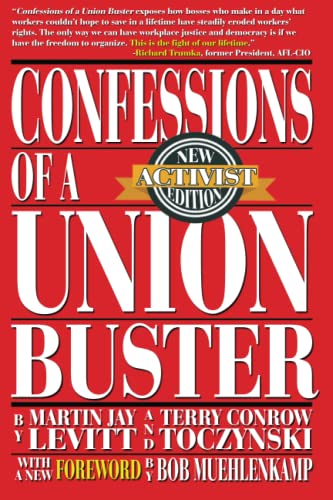
Until Levitt had a change of heart, and in the late 1980s reached out to Muehlenkamp about his desire to write a book exposing the dirty tricks of the union-busting industry. Levitt’s Confessions of a Union Buster was published in 1993 and immediately made waves, with Levitt appearing on 60 Minutesand giving lectures around the country to denounce his former colleagues and confess his sins. “Union-busting is a field populated by bullies and built on deceit,” he wrote. “The only way to bust a union is to lie, distort, manipulate, threaten and always, always attack.” He described how his former firm, Modern Management Methods, had developed a methodology for breaking down employee support for unions by using psychological tactics and turning managers into anti-union spokespersons.

His new career as a reformer earned him enemies on both sides — panicking his old colleagues in the union avoidance consulting industry and arousing skepticism among former nemeses in the labor movement, one of whom called him a “cheesy hustler.”

Levitt wrote about his insatiable greed, his alcoholism, a rap sheet that included forgeries, check fraud and arson, and multiple illegal activities on behalf of some of America’s biggest companies. Critics called him an opportunist, but some labor veterans, including Muehlenkamp, saw him as an important ally who could help them learn how to combat the union busters.

Levitt was a complicated penitent — just months after the book was published, he went to jail for obtaining credit by false pretenses — and he passed away in 2004 without having won over that many of his former antagonists.

https://e.infogram.com/047ec8bd-9d2b-43d6-9143-48a3cc2b5b73?parent_url=https%3A%2F%2Fcapitalandmain.com%2Finside-the-secretive-world-of-union-busting-the-story-of-an-unlikely-alliance&src=embed#async_embed

But his seminal book has served as a guide for union organizers and their allies. Levitt describes how his former industry benefited enormously from a 1950s-era loophole in labor law that allowed companies to hire anti-union consultants without disclosing those arrangements — one of the “enormous, gaping errors in the law that have left room for a sleazy billion-dollar industry to plod through,” Levitt wrote. That loophole was closed in 2016 by the Department of Labor, finally shedding light on an industry paid an estimated $340 million a year by companies. The labor victory was short-lived — just a few years later, the loophole was reopened by the Trump administration, and the Biden administration has yet to take action.

The book is being reprinted, with a new introduction and appendix by Muehlenkamp, who writes that “it documents the dirty underside of how U.S. corporations, who routinely bargain with unions in other countries, attacked and weakened American democracy. The question is, what can we do about it? We know how to have the best chance at beating the union busters. It starts with reading Levitt’s book. Know the enemy and take them as seriously as they take a union.”

Muehlenkamp talked to Capital & Main about his experiences in the movement, knowing Levitt as enemy and ally, and what he sees as the biggest challenges facing unions today.

Note: This interview has been edited for length and clarity.

To read the interview, open the link.

This part of Capital & Main’s examination of union busting reviews the targeting of academics who study labor by corporate critics. It was written by Jo Constantz.

Many scholars who study the history and economics of organized labor are sympathetic to the union cause. These academics often encounter threats, harassment, and defunding of their research.

It begins:

Throttled by both strong-arm tactics from anti-union interests and a chronic lack of support from universities, the field of labor studies has dwindled in the U.S. in recent years.

Researchers in the field have been the target of legal threats and lawsuits, onerous public records requests and misinformation campaigns from union avoidance consultants, business executives, corporate lawyers and conservative think tanks. It’s one aspect of the business lobby’s relentless war against unions in recent decades, which has seen companies spend more than $340 million a year on consultants to defeat organizing efforts by their employees and helped sink union membership.

Labor studies, an interdisciplinary field in academia that examines workplace issues and worker organizations, reveals working conditions that motivate people to want to join a union. Much of the scholarship has illuminated the central role that labor’s decline has played in exacerbating income inequality. In doing so, the field has aroused the ire of anti-union companies and their allies. The field has never been a major force in academia and many centers have been gradually shuttered due to lack of funding or merged with other departments. Only a handful of universities currently offer a major or minor in labor studies. Faculty are often untenured, vulnerable to layoffs and budget cuts, and they are often not replaced when they retire.

Open the link and read on.

This article in the Capital & Main series was written by Marcus Baram and is titled ”Inside the Secretive World of Union-Busting: Here’s How Much Corporations Pay to Bust Unions.” Subtitle: “U.S. companies spend hundreds of millions of dollars per year to ensure workers don’t organize.”

It begins:

A handful of workers at the Dollar General In the small Connecticut town of Barkhamsted had grown frustrated last September at being poorly treated by a district manager, amid allegations

The organizing effort involved just six workers (five after one said he was fired for his efforts to unionize) earning $13 an hour — so about $624 a day in total — but the company spent multiples of that to combat the union drive. Dollar General paid Labor Relations Institute, a firm known for its union avoidance consulting, a fee of $2,700 per day for each consultant it brought in, according to filings with the Department of Labor. LRI used five consultants, who reportedly held one-on-one meetings with workers and conducted group sessions to educate them on the risks of joining a union. In the end, the unionization effort failed and the company breathed a sigh of relief. The retail giant posted $33.7 billion in sales and $2.7 billion in profit in 2020, but remains convinced its future earnings might have been hurt if any of its 157,000 workers joined a union.

What do you say when a corporation cares more about profits than the lives of its workers?