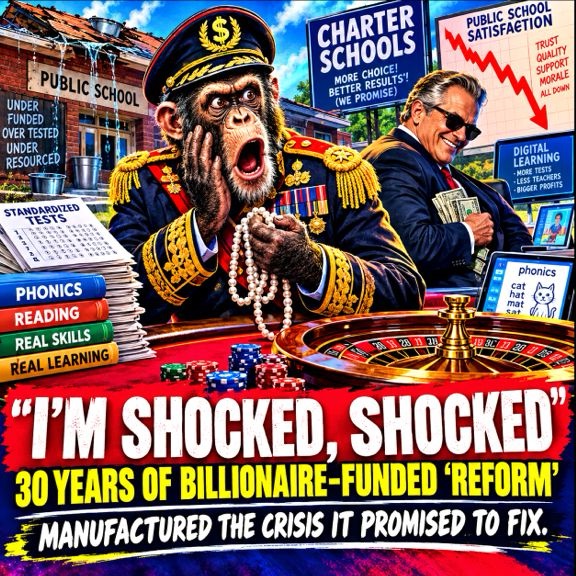
Archives for category: Corporate Reformers

Jennifer Berkshire, keen-eyed commentator on the nation’s schools and their detractors, writes that the doomsayers are up in arms again. After 25 (or 40) years of nonstop “reform,” their lamentations are once again in style. Note that the lamentors never blame the failure of the “reforms” they imposed. No. It’s the students, the teachers, the public schools, anyone else but not themselves.

Berkshire writes:

The kids are dumb and getting dumber. They can’t add or read the books they are no longer assigned, rousing themselves from their stupid stupors only to demand extra time on tests or another (now meaningless) A. The schools are collapsing, thanks to weakened standards and something called “cargo cult equity.” Just how bad is it out there? Today’s kids are the equivalent of the subprime mortgage-backed securities that blew up the economy in the lead up to the Great Recession. (Yes, somebody actually made this argument).

I could keep going, but you get where this is heading. Also, we are only a few days into the new year and I am already exhausted. The point, reader, is that we find ourselves in the throes of a full-blown public education panic. But why now? And why does this one feel different? I kick off 2026 with a look at a story that is all but guaranteed to keep telling itself in the months ahead.

America’s oldest pastime

If you’re new to the great American pastime of bemoaning the state of the nation’s schools then perhaps you’re unaware that we’ve been doing this since at least the ‘70’s. By which I mean the 1870’s. If the railroad collapse that triggered the Panic of 1873 feels startlingly familiar in our own bubbly AI economy, so too will feel the ensuing laments about the schools. They were too expensive. They used to teach reading well, but no longer. They had too many administrators. And if you’ve been following the ‘women ruin everything’ discourse, this was also the time when teaching became a female-documented occupation. Related? You tell me. Over the past 250 years, complaints “that the public schools of today are inferior to those of a generation or two ago” have resurfaced as reliably as measles or whooping cough.

Too many of the wrong kids are in college

Several years ago, education historian Jack Schneider and I wrote an op-ed in which we argued that the GOP was using education culture war to appeal to vastly different constituencies, including rural voters enflamed over CRT and litter boxes and affluent moderates obsessed with getting their kids into elite institutions. Alas, our bleak prediction about the realigning power of this emerging coalition turned out to be premature, but only in the K-12 world. Today, the powerful backlash movement that is upending higher education is based on just such an unlikely coalition, united in the belief that there are too many of the wrong kids in college. As one wry observer noted on X: “Half the education posts are like ‘my kid has a 5.3 GPA and invented $5 insulin and got rejected from DeVry’ and half are ‘60% of freshmen do not know enough math to read the numbers on their classroom doors.’”

Or how about this one? “The Atlantic is Fox News but for high SES liberals worried their kids spot at a UC will be taken by some Latino kid from the Central Valley.” Touché! As Trump et al continue to expand the definition of “wrong kids” [immigrants, non-white students, protestors, poor students, women], affluent parents with an eye on the Ivies, not to mention the pundit class, are proving all too willing to play footsie with them.

Billionaires gonna billionaire

Here’s a question for you, reader: what was your favorite example of a billionaire purchasing state-level education policy in 2025? Mayhaps it was hedge funder Ken Griffin’s purchase of the state legislature in Florida. Or hedge funder Jeff Yass’ purchase of Texas governor Greg Abbott. Or maybe you prefer a more bespoke intervention, like when billionaire Lauren Overdeck rented mobile billboards to warn New Jersey parents that their kids aren’t that smart.

Nobody knows anything

“I Don’t Know What to Think About America’s Declining Test Scores and Neither Should You” was the title of a great post last year by teacher and writer Michael Pershan. Digging into the surging remedial math program at University of California San Diego that fueled roughly one billion hot takes, Pershan patiently pointed out the contradictory nature of the data regarding student achievement in California. Even as student math skills were supposedly declining, state test scores were increasing. Or take Los Angeles, one of the few bright spots in the post-pandemic recovery landscape. During the last golden age of education reform, roughly 15 minutes ago, the progress of LA’s students would have merited its own fawning press treatment. No longer. Today, the story is decline and failure, and while this is a global phenomenon that includes adults, why let a little complexity get in the way of a hot take? The emergence of our ‘hot take’ economy, by the way, in which content entrepreneurs are handsomely rewarded for their “obtuse penchant for moral and ideological incuriousity” (and pay no price for 1) being wrong or 2) contradicting themselves) is a major driver of our current round of public education panic.

Neoliberalism is gone (but not forgotten)

Every year I ban myself from using the word “neoliberalism,” and, well, you can see how that’s going. The story of education decline and collapse that’s now sweeping the land typically goes something like this. Back when we had accountability, standards and choice, things were going great, but then [insert teachers, unions, progressives, lazy kids here] did [insert bad thing here] and the result is [insert calamity here.] But if you’ve been paying attention to education politics for more than 15 minutes then you know that that story is not just partial but wildly inaccurate.

For example, did you know that grassroots opposition to the Common Core standards on the right blew up, not just the era of bipartisan accountability, but helped deliver the current occupant into the White House? The result is that we’re now in an in-between-state, in which the vision of market-minded education reform that has held sway for the last THIRTY YEARS is exhausted while no clear alternative has emerged to take its place. For a compelling explanation of how the crack up of education policy relates to our larger political disintegration, check out this essay by Matt Wilka and Kent McGuire, “A Democratic Vision for Public Schools.”

The neoliberal paradigm has cracked, but it has not crumbled. And this instability marks our current transition period, which has brought much graver threats to American democracy. The confluence of economic pain, demographic change, and new media has proved fertile ground for authoritarian leaders to champion resistance to government.

Human capitalists vs. the chainsaw

Of all of the reading I’ve done in the last month, it was this piece that stopped me in my tracks. The author, a used-to-be copy writer now being replaced by AI, asks an AI chat bot for career advice, to which he is instructed to pick up a chainsaw. I’ll stop here as I want you to read it yourself, but suffice it to say that the author uses his experience to take aim at two sacred cows of the neoliberal era: 1) that more and better education is the answer to our economic woes and 2) that the remedy for worker dislocation is retraining. (For evidence of our muddled moment, consider that the New York Times ran, in addition to the chainsaw op-ed, a Sal Kahn ripped-from-the-time machine argument for worker re-training and a good old-fashioned education-as-boot-straps editorial, all in the same month.)

What does this have to do with our current round of public education panic? For the past three decades, bipartisan education reform has been pitched as an alternative to economic redistribution. Why impose higher taxes on the wealthy when going after the teachers unions is so much more satisfying? But as downward mobility comes for a larger and larger segment of the workforce, that sales pitch has officially run out of steam. The big question now is ‘whither the Democrats?,’ who, to paraphrase the great Tom Frank, have long seen every economic problem as an education problem. Will they seize the populist economic mantle, as even James Carville is prodding them to do? Or will the centrist zombie rise again, flogging the exhausted case that “[e]ducation reform is the seed corn of economic prosperity”? My money is on the chainsaw…

Race science is back

What single silver bullet would cause US test scores to soar like a SpaceX rocket? If you answered ‘kicking out all of the immigrants,’ you would be quoting Trump advisor Stephen Miller. While the claim is measurably preposterous, it’s indicative of the roaring return of race science during Trump 2.0. But Goebbels envy isn’t the only reason for the obsessive fixation on IQ these days. For a forthcoming essay on the Democrats’ populism bind, I’ve been revisiting education historian Michael Katz’s 1987 Reconstructing American Education. In his survey of 100 years of education reform promises and disappointment, Katz identified a familiar pattern. Once the hypes and hopes of addressing an astonishing array of societal ills through the schools inevitably fall short, “hereditarian theories of intelligence reemerge” like clockwork.

Here’s Katz:

As so often in American history, education had been deployed as the primary weapon to fight poverty, crime and social disorder, and, as before, schools were unable to alleviate these great problems whose structural origins lie in the distribution of power and resources.

Katz was surveying the wreckage of the War on Poverty era, its optimism curdling into mainstream social science claims that 1) because IQ was largely inherited and racially determined 2) efforts to boost achievement through the schools were doomed to failure. Today we’re in a similar moment, the exuberant claims of the last education reform era (see above) crashing into the chasm of economic inequality. Katz argued that the only way to challenge genetic arguments, by the way, was to acknowledge “the structural origins of social problems and the inherently ineffectual nature of the reforms that have been attempted.” Sound familiar?

Too many of the wrong kids are in college

Several years ago, education historian Jack Schneider and I wrote an op-ed in which we argued that the GOP was using education culture war to appeal to vastly different constituencies, including rural voters enflamed over CRT and litter boxes and affluent moderates obsessed with getting their kids into elite institutions. Alas, our bleak prediction about the realigning power of this emerging coalition turned out to be premature, but only in the K-12 world. Today, the powerful backlash movement that is upending higher education is based on just such an unlikely coalition, united in the belief that there are too many of the wrong kids in college. As one wry observer noted on X: “Half the education posts are like ‘my kid has a 5.3 GPA and invented $5 insulin and got rejected from DeVry’ and half are ‘60% of freshmen do not know enough math to read the numbers on their classroom doors.’”

Or how about this one? “The Atlantic is Fox News but for high SES liberals worried their kids spot at a UC will be taken by some Latino kid from the Central Valley.” Touché! As Trump et al continue to expand the definition of “wrong kids” [immigrants, non-white students, protestors, poor students, women], affluent parents with an eye on the Ivies, not to mention the pundit class, are proving all too willing to play footsie with them.

Billionaires gonna billionaire

Here’s a question for you, reader: what was your favorite example of a billionaire purchasing state-level education policy in 2025? Mayhaps it was hedge funder Ken Griffin’s purchase of the state legislature in Florida. Or hedge funder Jeff Yass’ purchase of Texas governor Greg Abbott. Or maybe you prefer a more bespoke intervention, like when billionaire Lauren Overdeck rented mobile billboards to warn New Jersey parents that their kids aren’t that smart.

THERE IS MORE! OPEN THE LINK TO FINISH THE ARTICLE. And open the link to see the links to sources.

Jeff Bryant, a veteran education journalist, dissects he plan to destroy public schools. Governor Ron DeSantis and the Legislature has unleashed the for-profit vultures to pick the bonds and funds of the state’s public schools. Not because the charges are better schools, but because the rightwingers have close ties to members of the legislature. Want to open a charter school? Want the state to pay all your expenses? Come on down to the Sunshine State!

This article was produced by Our Schools. Jeff Bryant is a writing fellow and chief correspondent for Our Schools. He is a communications consultant, freelance writer, advocacy journalist, and director of the Education Opportunity Network, a strategy and messaging center for progressive education policy. His award-winning commentary and reporting routinely appear in prominent online news outlets, and he speaks frequently at national events about public education policy. Follow him on Bluesky@jeffbinnc.

The letters started coming in October 2025. In the first wave, according to the Florida Policy Institute (FPI), “at least 22 school districts in Florida” got letters alerting them that charter school operators, including a for-profit charter school management company based in Miami, intended to use a state law recently enacted to open new charter schools on the campuses of existing public schools beginning August 2027.

In Broward County, a South Florida district that includes Fort Lauderdale, the Mater Academy charter school chain, operated by for-profit charter management company Academicaclaimed space in 27 public schools. Mater Academy claimed space in nearly 30 schools in Hillsborough County, home to Tampa Bay, “along with more than a dozen [schools] in Pinellas [County] and six in Pasco [County],” Tampa Bay Times reported. In Sarasota County, Mater claimed space in three public school campuses.

At least two more charter chains—New York-based Success Academy and New Jersey-based KIPP NJhave joined in the campaign.

“So far, 480 schools in 22 counties have received 690 ‘letters of intent’ from charter school organizations expressing their intent to occupy space in public school buildings,” FPI’s Norin Dollard told Our Schools in late November. When schools receive letters from multiple charter organizations, it’s first come, first served, she explained, and the timeline for schools to respond is incredibly short—just 20 days.

Once the charter occupies part of the public school, Dollard explained, it operates rent free, and the public school district becomes responsible for much of the charter’s costs, including those for services charters don’t customarily provide, such as bus transportation and food service, as well as costs for school support services like janitorial, security, library, nursing, and counseling. Even any construction costs the charters might incur have to be covered by the public school.

This new law will force some public schools to convert to charter schools, said Damaris Allen, “and that’s intentional.” Allen is the executive director of Families for Strong Public Schools, a public schools advocacy organization that is rallying opposition to the law.

The letters have caught the attention of national news outlets, including the Washington Post, which reported, “The Florida law is an expansion of a state program called ‘Schools of Hope,’ which was set up to allow certain charters to operate in areas with low-performing local public schools. The new law allows ‘Schools of Hope’ operators to take over space at any public school that’s under capacity, regardless of whether it is high- or low-performing.”

“The expansion of the Schools of Hope idea has been on a slippery slope,” Dollard explained, “much like school vouchers have been in the state.” Originally, in 2017, schools identified for Schools of Hope transition from public governance to charter management were very narrowly defined as persistently underperforming schools. That changed in 2019 when the legislature altered the definition of low-performing to target more schools and added schools in so-called opportunity zones—government-designated areas selected for economic development—as open territory for charters. Now, the new law allows charter schools to take over “underused, vacant, or surplus” space in traditional public schools and operate free of charge.

As the reach of the Schools of Hope idea morphed, so did its rationale. According to a 2025 op-ed by former Florida Governor Jeb Bush, the program was originally conceived as an “initiative that incentivizes high-quality charter operators to open schools for students trapped in failing ones.” The aim now, according to Bush, is to solve the “problem” of underutilized space in existing public schools.

With school enrollments in steep decline in nearly every district in the state, fear of a potential mass charter school industry takeover of public school spaces—along with the costs local districts will incur—looms over district leaders across the state and strikes them as a clear existential threat.

Other consequences of colocating more charters in public schools have not been well-thought-out, according to Allen. For instance, on the issue of school safety, public schools have undertaken a number of measures to protect against school shootings, such as converting buildings to single-point entry. Charter schools don’t have to do that. So what happens when a charter operation moves into a building and doesn’t comply with the single-point entry? Also, the state legislature created new rulesfor public school libraries in 2022. Charters don’t have to follow those rules. How is that going to work in a colocation?

Allen fears the daunting challenges of charter colocations will cause some school boards and communities to sell school buildings or convert them to district-operated charters rather than give in to charter schools run by outside, for-profit companies.

And while proponents of Florida’s Schools of Hope program see it as a way to expand education options for students and families, critics point to evidence that Florida charter schools, which one expert called “a shitstorm,” need stricter oversight rather than a free rein. And, regardless of the outcomes, they warn that the idea is sure to get promoted as an “education innovation” that other Republican-dominated states will likely adopt.

A warning sign, not a model

When Nancy Lawther, a retired college professor of French, got involved in public schools advocacy, she became very skeptical about the oft-told narrative about the need for more education options because “too many poor children are trapped in failing public schools.” After all, in Dade County, Miami, where she lives, the public system has an A rating by the state despite having a challenging student population that is overwhelmingly Hispanic, with many living in households earning less than the state’s median income.

Her skepticism only increased when she first heard about expanding the Schools of Hope program to more schools, especially when she saw the results from the first schools taken over.

The original “Schools of Hope” weren’t individual schools; it was a whole district. In 2017, the Jefferson County school board voted in favor of participating in a pilot project for the new Schools of Hope initiative. The board’s approval to join the pilot meant that the district was required to turn over the management of their schools to a “high-performing” charter management company, which, in this case, happened to be Somerset Academy, another charter chain managed by the for-profit Academica management company.

But the results of the pilot would be a warning sign about the abilities of charter management firms to improve the education outcomes of public schools. As a 2025 op-ed for the Orlando Sentinel recounted, “[T]axpayers saw higher costs, stagnant results, and constant staff churn. By 2022, the takeover collapsed. Local leaders called it ‘an absolute disaster.’ The state had to step in with a $5 million bailout just to get the district running again.”

A 2024 account of the pilot in the Tallahassee Democrat reported, “[F]rom 2017 to 2022,… [Jefferson County] remained troubled by students’ lagging academic performance and mounting disciplinary issues, like fighting that in one case led to the arrest of 15 students. … [And] the school district was still getting a D grade” from the state.

Nevertheless, after Florida lawmakers expanded the Schools of Hope program in 2019, which has cost more than $300 million as of 2025, “There are only about a dozen Schools of Hope in Florida. In 2024, eight of them got C or D grades,” pointed out the Bradenton Times.”

‘All about market share’

Given its track record of failure, Lawther suspects that expanding Schools of Hope has nothing to do with improving education outcomes or making better use of publicly funded school buildings.

Indeed, Sarasota County, one of the districts targeted for charter colocations, has been an A-rated system since the state created the grading system in 2004, according to the district website.

Also, in districts where there are enrollment slides, there are few signs that demand for charters will soak up excess building capacity. According to a 2025 analysis of Sarasota County by Suncoast Searchlight, “The number of charter schools has grown in recent years, but the share of students at charters has not shifted much.” And building utilization rates of the different sectors are nearly identical—82 percent for public schools and 84 percent for charters, WUSF stated. “Some of the lowest-performing charters are barely a third full.”

Mater Academy, the charter operator using the Schools of Hope law to claim space in Sarasota public schools, does not currently operate a school in the district.

“This is all about market share,” Lawther said. “It’s about getting an advantage over charter operators that are not Schools of Hope providers, and independent charters that can’t compete in a market geared to the large chains,” like those operated by Academica.

Further, while enrollments in Florida charter schools continued to grow, it has shown signs of slowing down—from 3.7 percent in 2024 to 2.6 percent in 2025—and the number of charter schools decreased, from 739 in 2023-2024 to 732 in 2024-2025.

Also, the charter industry in the state faces many more privately-operated competitors. “Expansions of voucher programs are creating a more competitive market for charter schools,” Lawther noted, “and private schools, microschools, and homeschooling are growing forms of school choice.”

Indeed, charter schools no longer appear to be the fastest-growing form of school choice in the state.

After the Republican-led Florida legislature passed a bill in 2023 that did away with income requirements for families to receive state-sponsored school vouchers, the share of state funding diverted from the public system—which, technically, includes charters—to private schools and homeschooling doubled from 12 percent in 2021 to 24 percent in 2025, WUSF reported. In the school year 2023-2024, the number of vouchers, often called “scholarships,” given out to help families pay for private school tuition and homeschooling increased by approximately 142,000 students, according to Next Steps, a school choice advocacy group.

Florida has also experienced a 46 percent increase in homeschooling over the past five years, WEAR statedin 2025. And the state has freed up 50,000 new community facilities to serve as microschools, according to the Center for American Progress.

It would seem that in this increasingly competitive education landscape, the Florida charter school industry could use a new competitive angle like the one offered by Schools of Hope. “Officially, charter school advocates say Schools of Hope is an amazing opportunity to expand parent choice,” Dollard said, “but unofficially, this is an incredibly lucrative business opportunity.”

An industry in decline?

The charter school industry’s desire for new business strategies that enable charter operators to seize public school classrooms—or even whole buildings—is not confined to Florida.

In Indiana, for years, public school districts have been required to notify the state, within 10 days, when one of their buildings becomes vacant and to make the building available to lease to a charter school for $1 per year or sell the building to a charter operator outright for $1.

In Ohio’s 2025 approved budget, a new provision allows the state to force school districts to close some public school buildings and sell those properties to charter or private schools “at below market value,” Ideastream Public Media reported.

Arkansas is also likely to adopt a Schools of Hope-like measure, Allen speculated, because its state secretary of education Jacob Oliva served in Florida. Oliva was Florida’s state education chancellor during the failed Schools of Hope pilot in Jefferson County.

One market condition that’s likely behind these increasingly aggressive charter school industry is land grab, as revealed in a 2025 analysis by the National Center for Charter School Accountability (NCCSA). According to the report, charter school closings have been accelerating nationwide, while the pace of new charter openings has slowed significantly during the same time.

“[T]he 2023-24 school year saw just 12 more open charter schools than during the previous year,” the report found. This is “a dramatic departure” from the heydays of industry growth when “[t]he number of charter schools increased by 421” between 2010 and 2011.

Charter school enrollment growth has also stalled, according to the report, increasing by 0.1 percentage point—from 7.5 percent to 7.6 percent of total charter enrollment—between 2020 and 2023.

In the most recent school years, based on official data from 2022-2023 and 2023-2024, NCCSA found, “Most states experienced declines or stagnation [in charter school market share], and preliminary indicators suggest that, once the 2024 data is finalized, the trend will likely worsen.”

North Carolina offers a clarifying example of the significant headwinds that the charter school industry now faces.

In the Tar Heel state, charter schools have enjoyed widespread support among state lawmakers and private investors. The state legislature has made dramatic changes to state laws regarding charters, including loosening regulations and fast-tracking approval of new schools. And a 2024 analysis by the Charlotte Observer found “at least $279 million in private equity investments in North Carolina charter schools since 2013.”

Despite this support, the number of charter schools in North Carolina declined in 2024-2025, from 211 to 208 in 2023-2024, according to an industry spokesperson. And many of the newest charter schools to open in the state have not fared well. “State data show that only about 26 percent of new charter schools in the past five years met or exceeded their enrollment projections,” NC Newsline reported, “and more than half of those that missed the mark are now closed or never opened.”

The report’s findings revealed that although charters tend to locate in low-income neighborhoods, they serve far fewer children from low-income families, fewer children who are English learners, and fewer children with disabilities, resulting in leaving traditional public schools with elevated needs and higher costs.

Critics of the Schools of Hope law noted that these industry shifts, as well as a historical tendency for education policies enacted in Florida to get picked up in other Republican-dominated states, will spur other states to adopt similar policies, regardless of any evidence that they might harm public schools.

“More generally,” Baker added, “Florida charter schools are a shitstorm, both underserving higher need populations and underperforming with those they do serve.”

‘A shitstorm’

Among the critics of Florida’s Schools of Hope legislation is Bruce Baker, a professor and chair of the department of teaching and learning at the University of Miami and an expert on charter schools and public school finances.

“I’m, of course, deeply concerned with granting preferential access to any charter operator, at the expense of a fiscally strapped school district,” Baker wrote in an email. “I’m more concerned when it may present a slippery slope regarding control over land and buildings that should—by the [state] constitution, which supersedes this regulatory change—be solely under the authority of the local boards of education elected by the taxpayers who financed those facilities and continue to maintain them. It becomes even more problematic if this eventually creates an avenue to transfer ownership. That would be a particularly egregious violation of local board authority and private taking of public assets. We aren’t there yet, but it’s a concern.”

Baker’s assessment of charter schools in the Sunshine State is evident in his 2025 report, which looks at the impacts of the industry on school funding adequacy, equity, and student academic outcomes across the state, and, more specifically, in the Miami-Dade district.

Also, charters, despite having an advantage of educating less challenging and less costly student populations, underperform public schools on state assessments while “serving otherwise similar student populations.” This finding holds statewide and in Miami-Dade.

The report concludes that Florida charters are “compromising equity, eroding efficiency, and producing poor educational outcomes for those it serves.”

Given these findings, the report recommends that state lawmakers “[i]mpose a moratorium on charter school expansion, including the Schools of Hope Program.” It also calls for “new regulations for evaluating existing charter operators,” stronger vetting of new charter operators, and stricter enforcement of regulations about charter school student outcomes.

Schools of nope

Several district school superintendents across Florida have urged their communities to oppose the state’s Schools of Hope charter school expansion in public school buildings. When the state’s current education commissioner defended the Schools of Hope law in his address at a 2025 conference for school board members and district leaders and suggested it could be used to shut down whole districts, the audience roundly booed him.

Grassroots groups such as Families for Strong Public Schools have held events to educate the public about the negative impacts of charter colocations. A coalition that includes the United Teachers of Dade, NAACP Miami-Dade Branch, the Miami-Dade County Council of PTA/PTSA, and others has formed to protest charter colocations. And a senator in the state legislature has introduced a bill to repeal the Schools of Hope expansion.

Much of the opposition has rallied under the banner of “Schools of Nope” and is organizing call-ins and an email campaign targeting state legislators.

Opposition organizers like Damaris Allen see this as a do-or-die moment in the state. “Either we win this fight, or it’s the death of public schools in Florida,” she said.

The National Governors Association is led this year by Colorado Governor Jared Polis, a cheerleader for charter schools who launched two of his own.

The NGA, at Polis’ instigation, chose K-12 education as its leading issue for the year, which is very bad news, considering his low opinion of public schools.

Mike DeGuire, former principal in Denver Public Schools and current public school activist, described the NGA meeting when Governor Polis invited Secretary of Education Linda McMahon, former wrestling entrepreneur, to discuss the needs and future of American education.

At the top of their concerns was the failure of public schools to prepare students for the workforce. Long ago, education leaders used to describe the purpose of education as preparation for citizenship in a democratic society. But that was then and this is now.

DeGuire described the cohort assembled by Governor Polis, all leaders of the corporate reform sector:

As the 2024-25 chair of the National Governors Association, Colorado Gov. Jared Polis, selected K-12 education as the priority of the NGA’s yearlong initiative. Titled “Let’s Get Ready! Educating all Americans for Success,” the project defined its purpose in its call to action: Identify solutions to address the belief that schools are not preparing graduates adequately for the work force today. 

The initiative had support from philanthropic foundations and companies that promote technology-related solutions, school choice, data-driven accountability, and other neoliberal market-based reforms in public education. One of the supporters, Stand Together Trust, founded by Charles Koch, provided millions to groups that back charter schools and other “alternatives to public education.” 

Many of the “project team” members were involved with organizations that prioritized “redesigning” the public education system. Polis has been a longtime supporter of expanding charter schools and workforce training as ways to address deficits in student outcomes, and eight of his staff worked on this project. Project team member Jen Walmer was on Polis’ staff in his first administration, and she worked previously as the Colorado director of Democrats for Education reform, which continues to call for Democrats to support school choice and charters.

The project team also included representatives from Watershed Advisors, All4Ed, Savi Advising, and the Urban Institute. Watershed’s CEO, Kunjan Narechania, was the CEO of the all-charter Recovery School District in New Orleans. Several Watershedand All4Ed staff either worked or trained in the Chiefs for Change program, which Jeb Bush founded to promote charter school models. All4Ed promotes online learning in both charter and district schools. 

Savi Advising’s founder, Archana Patel, worked for KIPP charter schools and was the senior director at the Broad Academy, a training ground for school leaders to promote charter schools. The Urban Institute published research that downplayed the effects caused by charter schools in exacerbating school segregation. The Institute received $11 million from the Walton Family Foundation and other foundations to identify “measures of students’ skills and competencies in prekindergarten (PK) through 12th grade that drive economic mobility.”  

Polis chaired seven “convening” sessions to determine the project’s outcomes. Featured “experts” at the sessions included Eva Moskowitz, founder of Success Academy Charter schools in New York; Sal Khan, founder of Khan Academy, a computer-based learning system; Geoffrey Canada, founder of Harlem Children’s Zone charter schools; John B. King, founder of the Uncommon schools charter chain; Angela Duckworth, co-founder with Dave Levin (KIPP charter school chain founder) of the now defunct Character Lab; and Steve Levitt, author of Freakonomics and a promoter of personalized AI tutoring. 

Secretary McMahon added her views about the needs of students today:

McMahon commented that a “return to shop classes” would serve some students better for their future job opportunities. She stated, “We have to rethink how we’re doing education … from beginning to end the goal is to get people into a productive job.” 

“Shop classes”? Really. That’s really turning the clock back!

At a time when major corporations are shedding tens of thousands of workers and executives, when AI poses a challenge to many current occupations, none of these neoliberal ideas seems relevant today.

DeGuire recommends a broader role for education today:

While workforce preparation is an important part of schooling, defining education primarily as a pipeline for economic productivity in the marketplace ignores the broader purposes of education. The Polis report neglects to focus on the essential role educators provide in developing positive relationships with students, and the benefits students gain through an emphasis on critical thinking, creativity, collaborative learning and exposure to the arts, social sciences and the humanities. Focusing primarily on charter schools as the answer to America’s problems in education negates the findings that 70% of parents are satisfied with their local public schools, as well as the research that charter schools have not proven to be the answer to America’s education problems. 

One of the defining characteristics of corporate reformers is that they cling to failed ideas. They have claimed for the past 35 years that school choice, high-stakes testing, competition, and incentives would drive school improvement. They refuse to admit that their ideas have been tried and didn’t work. NCLB, Race to the Top, and Common Core came and went. Of course, the “reformers” are dissatisfied because none of their promises was successful.

Rather than admit defeat, they keep repeating the same old same old.

Shop class indeed!

If you have been following this blog for a long time, you know that in my estimation one of the best (actually the best) education bloggers is Peter Greene. Peter taught high school students for 39 years in Pennsylvania. He knows more about teaching than all the experts at the elite universities.

Best of all, he has a keen eye for flimflammery and a great sense of humor. His is one of the few blogs that makes me laugh out loud. He pierces through BS and shysters with ease. And he’s more prolific than anyone I know. Some years back, I devoted every post on one day to Peter’s writings. I consider him to be one of my teachers.

So I was immensely grateful when I discovered that he reviewed my memoirs in both Forbes and, in a different voice, on his blog Curmudgacation.

Here is his blog review:

Over at Forbes.com, I’ve posted a piece about Diane Ravitch’s new memoir, An Education. That’s my grown-up fake journalist piece; but I have a few more blog-appropriate things to say. 

Most folks know the basic outline of the Ravitch career, that she was a recognized and successful part of the conservative ed reform establishment who then turned away from the Dark Side and joined the Resistance–hell, basically co-founded the Resistance. 

I have never heard her talk or write much about what that change cost her, and she doesn’t really talk about it in those terms in this book, but the early chapters show just how in that world she was. Connected to all the right people, welcome at all the right gatherings, in demand as a speaker, and the people–the names just keep coming. Ravitch was in the Room Where It Happens, and not just in it, but close friends with some of the folks in it with her. And she walked away from all that.

I don’t point to that to say we should feel sad for what she gave up, but as a sign of just how tough she is. She looked at the reality on the ground and concluded that she had to change some core beliefs, and having changed them, she had to act on them. If there was more of that kind of intellectual and ethical toughness in the world, the world would be a better place. It’s unusual enough that folks on the privatizer side have often assumed that someone must be paying her off, and a handful of people on the public school side were reluctant to fully trust her. 

There are other details in the book that attest to her guts and hard work. Her first book, The Great School Wars, was a history of the New York City public school system– a massive research project that Ravitch in her mid-thirties just assigned to herself, a project so thorough and well-constructed that she could use it as her PhD thesis. 

There are lots of fun details in the book– imagine the young Diane Ravitch swinging on a rope ladder outside a Wellesley dorm room where a formal dinner was in progress.

The book tells the story of how she got there, how she concluded that the policies that she had believed in were simply not so. And again– many another person would have at that point either kept going through the motions, or retreated to a quiet cave, but Diane instead became an outspoken critic of the very policies, organizations, and people who had been her professional world.

Back in the early 2010s, I was a high school English teacher in a quiet rural and small town corner of Pennsylvania. I knew things were happening in education that just felt really wrong, and I went searching for answers. What I found was Diane Ravitch’s blog, which was like a gathering place for many voices of advocacy for public school. It was where I found many writers who could help me make sense of things like Common Core and NCLB’s undermining of public education. 

There are several people who were responsible for my finding an audience (or the audience finding me) but it was Diane’s blog that got me my earliest connections to audiences. I didn’t know any of these folks, didn’t have any of the connections that hold together movements. At my first NPE conference, the most common question I got was some version of “Who the heck are you and where did you come from?” Diane’s network had made it possible for me to find my connections with a larger movement.

I’m just one example of how Diane’s extraordinary generosity in sharing her platform allowed all sorts of supporters of public education from all across the country to connect and support each other. It’s a notably different approach to leadership than, say, making a movement all about yourself in an attempt to collect personal power on the backs of followers instead of lifting everyone up to be a leader and activist in their own little corner of the world.

The book provides part of answer to where a person like Diane comes from, where that kind of intellectual and ethical courage and diligence come from. And it also provides a clear, compact explaining of where modern ed reform has gone wrong, from the toxic test-and-punish approach of NCLB to the billionaire-driven privatization push to the culture panic debates currently raging. If you want to hand someone a quick simple explainer of what has gone wrong, you can do worse than the last few chapters of this book.

At 223 pages, this is a brisk read but an illuminating one. I highly recommend it

Jennifer Berkshire is a veteran education journalist who understands the importance of public schools. She has a podcast called “Have You Heard?” She is the co-author of two books with historian Jack Schneider:

A Wolf at the Schoolhouse Door: The Dismantling of Public Education and the Future of School. And: The Education Wars: A Citizen’s Guide and Defense Manual.

Berkshire wrote the following brilliant article about the failure of the Democratic Party to recognize that most people send their children to public schools and don’t want them to be privatized. Some prominent Democrats support charter schools, which the radical right has used as a stepping stone to vouchers.

She wrote on her Substack blog “The Education Wars”:

And just like that, the Trump Administration has released the billions in funds for public schools it had suddenly, and illegally, frozen earlier this summer. The administration’s trademark combo of chaos and cruelty has been stemmed, at least temporarily. That Trump caved on this is notable in part because his hand was forced by his own party—the first time this has happened in the endless six months since his second term began. Make that the second time. Since I posted this piece, key senators from both parties decisively rejected the administration’s proposals to slash investments in K-12. Which raises an obvious question: of all of the unpopular policies being rolled out by the administration why would school funding be the one that forced a retreat?

“Do they really care more about public schools than about…Medicaid?” is how historian Adam Laats posed the question. In a word, yes. That’s because Medicaid is a program utilized by poor people, a constituency that however vast enjoys neither a forceful lobby nor the patronage of a friendly billionaire. Public education, despite the increasingly aggressive efforts to dismantle it, remains one of our only remaining institutions that serves rich and poor alike. (For an excellent and highly readable history of how this came to be, check out Democracy’s Schools: the Rise of Public Education in America by historian Johann Neem.)

This enduring cross-class alliance behind public schools, by the way, is a big part of why public education has been in the cross hairs of anti-tax zealots for so long. It’s also why school voucher programs keeps accidentally benefiting the most affluent families. Offering them a coupon for private school tuition is a nifty way to drive a stake through, not just this cross-class coalition that consistently supports things like more school funding and higher teacher pay, but the entire project of public education.

A winning issue

As David Pepper pointed out recently, the Trump Administration was forced to back down on school funding because of the bipartisan nature of support for public schools—part of what he calls a “clear and consistent pattern” that we’ve witnessed again and again in recent years.

Whether we’re talking about the overwhelming votes against vouchers in red states in November or the bottom-of-the-barrell poll numbers for the Trump education agenda, public education defies the usual logic of these hyper-partisan times. Which makes it all remarkable that so few Democrats seem to understand the potency of the issue. Whither the Democrats is a question that Pepper, one of our most astute political commentators, has been asking too:

I’m talking about an unflinching embrace of the value of public schools to kids, families and communities, and a blunt calling out of the damage being done to those schools by the reckless privatization schemes of recent years.

It’s not coincidence, I’d argue, that rising stars in the Democratic Party including Kentucky governor Andy Beshear or Texas state representative James Talarico played key roles battling vouchers in their states. And before Tim Walz was muffled by the Harris campaign, we heard him start to articulate a sort of prairie populist case for public education, in which rural schools are the centers of their communities and today’s school privatizers are the equivalent of nineteenth-century robber barrons. The master class on how Democrats should talk about education, though, comes via Talarico’s recent appearance on Joe Rogan’s podcast.

Clocking in at two hours and 44 minutes, the conversation shows why Talarico is ascendant. But it was handling of the school voucher issue that truly demonstrated his chops. He deftly explained to Rogan that Texas has essentially been captured by conservative billionaires, and that despite their deep pockets and political sway, the anti-voucher coalition had nearly won anyway.

Ultimately we didn’t win. [It] kind of came down to a photo finish, but it did to me provide a template for what happens if we actually loved our enemies, if we rebuilt these relationships. Like who could we take on if we did it together? Democrats and Republicans, conservatives and progressives. Like, I don’t know, sometimes I sound a little Pollyanna.

Rogan’s response was just as instructive. “It’s not us versus them. It’s the top versus the bottom.”

The dud brigade

Having interviewed countless Republicans who oppose vouchers over the past year, I remain utterly convinced that there is no other issue that both resonates across party lines and exposes the influences of billionaires behind school privatization. Which makes it all the more remarkable that Democrats like Talarico and Beshear remain such a minority in the party. Especially at the national level, candidates and commentators largely view public education with disdain. Indeed, as the endless battles play out over the future of the Democratic Party, we can look forward to a full-court press pressuring blue state governors to opt in to the new federal voucher program. And while the school choice lobby will be leading the charge, influential voices from within the party—like this guy or this guy—will be making the case that vouchers = ‘kids-first policy’ and that Democrats need to get on board or be left behind.

Part of what has been so refreshing about listening to Talarico, Beshear, Walz and other rising stars like Florida’s Maxwell Frost, is that they’re not just opposing school privatization but making a bold case for why we have public schools in the first place. They’re rising to the challenge that David Pepper throws down in which Democrats unflinchingly “embrace the value of public schools to kids, families and communities” and bluntly call out “the damage being done to those schools by the reckless privatization schemes of recent years.”

Now contrast that with the way that so many influential Democrats talk about education—the bloodless rhetoric of ‘achievement,’ ‘data,’ and ‘workforce preparation’ that resonates with almost no one these days. Here’s Colorado governor Jared Polis, for example, rolling out the National Governor’s Association’s Let’s Get Ready Initiative, an impossibly dreary vision of K-12 education that hinges on a “cradle-to-career coordination system that tracks how kids are doing, longitudinally, from pre-K through high school into higher education and the workforce.” If you want a bold case for why we have public schools, you won’t find it here. Deftly combining right-wing talking points (the kids are socialists!) with the same corporate pablum that centrist Democrats have been peddling for years (the skills gap!), this is a vision that is a profound mismatch for our times. I read a sentence like this one—“Competition between schools, districts and states will lead to more students being ready for whatever the future might hold”—and I die a little inside.

Back in 2023, Jacobin magazine and the Center for Working-Class Politics released a study called “Trump’s Kryptonite” about how progressives can win back the working class. Among its many interesting findings was this: the candidate best equipped to appeal to working class voters with a populist message was a middle school teacher. I’ve referenced this study endlessly in my writing and opinonating but it wasn’t until I listened to the Rogan episode with James Talarico that I really reflected on why a middle school teacher might make such an effective candidate. The exchange consists largely of Rogan peppering Talarico with the sorts of endlessly curious queries that a bright seventh grader might fire off. To which Talarico, an actual former middle school teacher, responds patiently and without condescension, largely steering clear of the sorts of policy weeds that are incomprensible to regular people.

In the coming months, we’ll be told endlessly that the future of the Democratic Party belongs to Rahm Emanuel, Cory Booker, Gina Raimondo or Jared Polis—all of whom represent the identical brand of ‘straight talk’ about the nation’s schools that Democrats have been trying—and failing—to sell to voters for decades. That same Jacobin study, by the way, found that the very worst candidates that Democrats can run are corporate executives and lawyers. I’d add one more category to this list: corporate education reformer.

The German data company Datapulse released a report showing the vast and growing power of billionaires in the U.S. The report confirms your and my suspicions about the rigging of our economy and our politics. Surely it’s no surprise that Trump’s Cabinet is packed with billionaires. Guess who they are looking out for? Not you.

They cheered on Elon Musk’s ignominious DOGS as they slashed vital government programs. They didn’t complain when Musk closed USAID, causing the ultimate deaths of millions of children and parents because of the halt in US food, medicine and health clinics.

They are thrilled to see Trump send in the troops to halt protests against ICE tactics.

A democracy is supposed to be of the people, for the people, by the people. We are rapidly devolving into an autocratic regime where the rich run the show.

Here is what Datapulse found:

The report, “The Rich Aren’t Just Getting Richer—They’re Running the Show” moves beyond familiar headlines to provide fresh, specific data points on wealth, power, and policy.

Key findings include:

  • The Myth of “Tax Flight”: Contrary to popular narratives, the mega-rich are not fleeing high-tax states. Our data shows that California and New York, states with progressive tax codes, are home to 40% of all U.S. billionaires.
  • Explosive Growth: The number of U.S. billionaires has nearly tripled since 2007, growing from 329 to 877 today. This trajectory is unique to America; China’s billionaire class, by comparison, is stalling.
  • The Rise of the Billionaire Political Class: In the post-Citizens United era, the top 10 political donors, all billionaires, contributed over $420 million in the 2024 cycle alone, directly translating wealth into political influence.
  • Policy for the Few: The study analyzes the direct impact of billionaire-backed policy, such as the House’s 2025 “Big Beautiful Bill,” which could see billionaires gain over $390,000 in annual after-tax income while households earning under $51,000 see their incomes shrink.
  • Concentrated Wealth: Tech and Finance now account for nearly half of all U.S. billionaires, with tech titans alone commanding 37% of total billionaire wealth.

The full study with all 10 interactive charts is available here:
https://www.datapulse.de/en/billionaires-usa/ 

This data provides a new lens through which to view the intersection of wealth and power in America.

The report was compiled by Datapulse.


https://www.datapulse.de/en/
(+49) 30-75437064

Tom Ultican, retired teacher of physics and mathematics, writes here about the recent decision by local officials to open a PUBLIC SCHOOL in New Orleans. This is a symptom of the failure of the “all-charter” idea.

He writes:

New Orleans Public Schools, aka Orleans Parish School District (OPSD), became America’s first and only all charter school district in 2017. After hurricane Katrina, the state took over all but five schools in the city. When management was transferred to charter organizations in 2017, OPSD officially became an all charter district. This August, the city will open district-operated Leah Chase K-8 School, ending the all charter legacy.

According to Superintendent Avis Williams, the infrastructure required for the district to run Leah Chase will make it easier to open future district-run schools. OPSD will become both a charter school authorizer and regular school district. There is hope that New Orleans, Louisiana (NOLA) is pulling out of an abyss and tending towards a healthy public school system….

All-Charter NOLA Doomed from the Beginning

Public investment in education is widely viewed as the key to America’s success. Since the 19thcentury, communities have developed around local public schools. This opportunity was taken from NOLA neighborhoods…

Louisiana’s state takeover law required schools scoring below average to be closed. If this were real, half of the schools in the state would be closed every year. Instead, arbitrary state performance scores based on testing data, attendance, dropout rates and graduation rates were established. Similar ratings are used to evaluate NOLA charter schools. The nature of privatized schools and testing results led to almost half of the charter schools created being closed.

The NOLA school enrollment system allows parents to research the 100 schools and apply for up to eight of them. The algorithm selects the school from one of the eight if space is available. It is not uncommon for students to ride a bus past schools within walking distance of their homes. This complicated system is driving segregation.

For many education professionals, this system looked like a sure failure from the beginning. Communities could not develop around their schools and the schools would not be stable; important aspects of quality public education….

The All Charter District is a Failure

In 2021, Secretary of Education Miguel Cardona visited OPSD. He heard first-hand the growing disillusionment with the all charter system. Four of the six parents told him they wanted to go back to neighborhood schools. Parents complained about Teach for America, placing unqualified teachers in schools and the One App process for not offering school choice.

Senator Bouie wrote a two-page paper, A Moral Imperative and Case For Action”, stating: After spending 6 Billion dollars of tax payers’ money to become the only all-Charter system in the State, a staggering 73% of our children are not functioning at grade level, compared to 63% in 2005, when the State took control of over 100 of our schools.”

He also shared:

“In other words, fellow citizens, this 15-year flawed experiment has yielded no best practices identified to improve student and school performance, no State protocol for Charter Law Compliance, and no student performance improvement. It has, however, yielded other devastating consequences for our children and our community.”

He mentioned the 26,000 students between the ages of 16 and 24 who went missing. The privatized charter school system was unable to account for them which is expected and natural for a public school district.

Bouieu They are transported past a neighborhood school to attend a failing school across town” and eliminating the ineffective One App central enrollment system claiming,It has created inequities by Race and Class and admissions by chance (lottery) and not choice.”

Raynard Sanders who has over forty years of experience in teaching, education administration and community development, said the charter experiment has “been a total disaster in every area.”He asserted NOLA had “the worst test scores since 2006, the lowest ACT scores, and the lowest NAEP (National Assessment of Educational Progress) scores.”

Based on a 2015 study by the Center for Popular Democracy, Sanders declared, “Charter schools have no accountability and, fiscally, charter schools in New Orleans have more fraud than existed in the OPSD (Orleans Parish School District).” The fraud claim was used by the state in 2003 against OPSD to begin taking schools.

Loyola University Law Professor Bill Quigley stated“NOLA reforms have created a set of schools that are highly stratified by race, class, and educational advantage; this impacts the assignment to schools and discipline in the schools to which students are assigned.”

He contended, “There is also growing evidence that the reforms have come at the expense of the city’s most disadvantaged children, who often disappear from school entirely and, thus, are no longer included in the data.”

Professor of Economics, Doug Harris, and his team at Tulane University are contracted to study school performance in New Orleans. Harris claims schools have improved since Hurricane Katrina. However Professor Bruce Baker of Rutgers University disagrees. He noted that the school system is not only smaller but less impoverished. Many of the poorest families left and never returned. So the slightly improved testing results are not real evidence of school improvement.

The latest testing data from 2023 saw NOLA public schools receive failing grades but based on Louisiana’s new progress indicator, the district received a C, meaning an F for assessments and an A in growth.

In a letter to the editor, former OPSD superintendent, Barbara Ferguson, stated:

“The state took over 107 of New Orleans’ 120 public schools and turned them into charter schools. Last year, 56 of New Orleans’ 68 public schools had scores below the state average. Thus, after nearly 20 years, over 80% of New Orleans schools remain below the state average. This charter school experiment has been a failure.”

Final Words

In 2006, with the school board out of the road and RSD in charge, philanthropists Bill Gates, Eli Broad and others were ready to help.

Naomi Klein’s 2007 book, The Shock Doctrine, labeled these school reforms, a prime example of “disaster capitalism”, which she described as “orchestrated raids on the public sphere in the wake of catastrophic events, combined with the treatment of disasters as exciting market opportunities.” She also observed, “In sharp contrast to the glacial pace with which the levees were repaired and the electricity grid brought back online, the auctioning-off of New Orleans’ school system took place with military speed and precision.”

Desires of New Orleans residents were ignored. Neoliberal billionaires were in charge. In all the excitement, few noticed that these oligarchs had no understanding of how public education functions. They threw away 200 years of public school development and replaced it with an experiment. The mostly black residents in the city were stripped of their rights.

Thousands of experienced black educators were fired and replaced by mostly white Teach For America teachers with 5 weeks of training. Instead of stable public schools, people were forced into unstable charter schools. Instead of professional administration, market forces drove the bus!

Clearly, the all charter school system is a failure.

Veteran teacher Nancy Flanagan explores the question of who is trying to destroy our public schools. She nails some of the loudest critics, who have personally benefitted from public schools. She doesn’t explore why they are trying to annihilate the schools that educated them, but that may because we know what the privatization movement has to offer: money. There is a gravy train overloaded with munificent gifts from Betsy DeVos, the Waltons, Charles Koch, Michael Bloomberg, and a boatload of other billionaires. They can endlessly underwrite anti-public school organizations that offer well-paid jobs.

On the pro-public education side, it’s hard to find big spenders or highly compensated jobs. The two big unions have resources, all of which come from the dues of their members. They do not have the funds to support the numerous grassroots groups that are found in every state. Most, if not all of the state and local groups, operate on a shoestring; typically, their employees are volunteers. They do not have six-figure jobs for someone who tweets and writes statements. No one who works for a state “Save Our Schools” group makes big money.

The Network for Public Education is the biggest pro-public education groups; it has 350,000 people who have signed up to support it, but there is no membership fee. NPE has one full-time employee and a few part-timers.

So, Nancy Flanagan asks, just who is trashing public schools?

She writes:

Get ready for a big dump–a deliberately chosen word–of anti-public education blah-blah over the next five months. It’s about all the right wing’s got, for one thing–and it’s one of those issues that everybody has an opinion on, whether they went to public school. have children in public schools, or neither.

Public education is so big and so variable that there’s always something to get exercised over. There’s always one teacher who made your child miserable, one assigned book that raises hackles, one policy that feels flat-out wrongheaded. There’s also someone, somewhere, who admires that teacher, feels that book is a classic and stoutly defends whatever it is—Getting rid of recess? The faux science of phonics? Sex education that promotes abstinence? —that someone else finds ridiculous or reprehensible.

Not to mention—teaching is the largest profession in the country, So many teachersso many public schools, so much opportunity to find fault.

In other words, public education is the low-hanging fruit of political calculation. Always has been, in fact.

A few years back, when folks were going gaga over Hillbilly Elegy, seeing it as the true story of how one could rise above one’s station (speaking of blahblah)—the main thing that irritated me about ol’ J.D. Vance was his nastiness about public education. Vance has since parlayed a best-seller that appealed to those who think a degree from Yale equates to arriving at the top, into a political career—and putting the screws to affirmative action, in case anyone of color tries to enjoy the same leg-up he did.

J.D. Vance’s education—K-12, the military, Ohio State—was entirely in public institutions until he got into Yale Law School. He doesn’t have anything good to say about public ed, but it was free and available to him, a kid from the wrong side of the tracks. When I read Rick Hess’s nauseating interview with Corey DeAngelis in Education Week, I had a flashback to ol’ J.D., intimating that he achieved success entirely on his own, without help from that first grade teacher who taught him how to read and play nice with others.

DeAngelis says:

I went to government schools my entire K–12 education in San Antonio, Texas. However, I attended a magnet high school, which was a great opportunity. Other families should have education options as well, and those options shouldn’t be limited to schools run by the government. Education funding should follow students to the public, private, charter, or home school that best meets their needs. I later researched the effects of school choice initiatives during my Ph.D. in education policy at the University of Arkansas’ Department of Education Reform.

So—just to clarify—Corey DeAngelis went to public schools K-12, for his BA and MA degrees (University of Texas), as well as a stint in a PUBLICLY FUNDED program at the notoriously right-focused University of Arkansas. That’s approximately 22 years, give or take, of public education, the nation-building institution DeAngelis now openly seeks to destroy.

I’m not going to provide quotes from the EdWeek piece, because anyone reading this already knows the hyperbolic, insulting gist—lazy, dumb, unions, low bar, failing, yada yada. He takes particular aim at the unions—although it absolutely wasn’t the unions—shutting down schools during a global pandemic. He paints schools’ turn-on-a-dime efforts to hold classes on Zoom as an opportunity for clueless parents to see, first-hand, evidence of how bad instruction is. He never mentions, of course, the teachers, students and school staff who died from COVID exposure.

Enough of duplicitous public school critics. My point is this:

The people who trash public education—not a particular school, classroom or curricular issue, but the general idea of government-sponsored opportunity to learn how to be a good, productive American citizen—have a very specific, disruptive ax to grind:

I got what I needed. I don’t really care about anybody else.

This goes for your local Militant Moms 4 Whatever on a Mission, out there complaining about books and school playsand songs and health class. It’s not about parents’ “rights.” It’s about control. And never about the other families and kids, who may have very different values and needs.

It’s about taking the ‘public’ out of public education. And it’s 100% politically driven.

OPEN THE LINK TO FINISH READING THE ARTICLE!

A group of scholars at Indiana University led by Christopher Lubienski developed a methodology for ranking organizations and individuals in the field of education.

It was disheartening to see that nine of the ten most influential organizations advocate for school privatization, for charter schools and vouchers. It was also disheartening to see that these nine organizations have revenues in the millions of dollars each year. They are heavily funded by rightwing organizations and billionaires.

It was exciting, however, to see that #3 on the list of the 10 most influential organizations was the Network for Public Education!

It also was the organization with the smallest budget!

Wow! Standing up for public schools without billionaire $$$!

Thom Hartmann has written a new book titled The Hidden History of Monopolies: How Big Business Destroyed the American Dream. He has decided to offer it for free, a chapter at a time, on his blog.

He writes:

Because the Founders set up America to be resistant to the coercive and corruptive influence of monopoly and vested interest, the monopolists didn’t have any direct means of taking over the American government. So, two processes were necessary.

First, they knew that they’d have to take over the government. A large part of that involved the explicit capture of the third branch of government, the federal judiciary (and particularly the Supreme Court), which meant taking and holding the presidency (because the president appoints judges) at all costs, even if it required breaking the law; colluding with foreign governments, monopolies, and oligarchs; and engaging in massive election fraud, all issues addressed in previous Hidden History books.

Second, they knew that if they were going to succeed for any longer than a short time, they’d need popular support. This required two steps: build a monopoly-friendly intellectual and media infrastructure, and then use it to persuade people to distrust the US government.

Lewis Powell’s 1971 memo kicked off the process.

Just a few months before he was nominated by President Richard Nixon to the US Supreme Court, Powell had written a memo to his good friend Eugene Sydnor Jr., the director of the US Chamber of Commerce at the time.32 Powell’s most indelible mark on the nation was not to be his 15-year tenure as a Supreme Court justice but instead that memo, which served as a declaration of war against both democracy and what he saw as an overgrown middle class. It would be a final war, a bellum omnium contra omnes, against everything FDR’s New Deal and LBJ’s Great Society had accomplished.

It wasn’t until September 1972, 10 months after the Senate confirmed Powell, that the public first found out about the Powell memo (the actual written document had the word “Confidential” at the top—a sign that Powell himself hoped it would never see daylight outside of the rarified circles of his rich friends). By then, however, it had already found its way to the desks of CEOs all across the nation and was, with millions in corporate and billionaire money, already being turned into real actions, policies, and institutions.

During its investigation into Powell as part of the nomination process, the FBI never found the memo, but investigative journalist Jack Anderson did, and he exposed it in a September 28, 1972, column in the Washington Post titled, “Powell’s Lesson to Business Aired.” Anderson wrote, “Shortly before his appointment to the Supreme Court, Justice Lewis F. Powell Jr. urged business leaders in a confidential memo to use the courts as a ‘social, economic, and political’ instrument.”33

Pointing out that the memo hadn’t been discovered until after Powell was confirmed by the Senate, Anderson wrote, “Senators . . . never got a chance to ask Powell whether he might use his position on the Supreme Court to put his ideas into practice and to influence the court in behalf of business interests.”34

This was an explosive charge being leveled at the nation’s rookie Supreme Court justice, a man entrusted with interpreting the nation’s laws with complete impartiality. But Anderson was a true investigative journalist and no stranger to taking on American authority or to the consequences of his journalism. He’d exposed scandals from the Truman, Eisenhower, Johnson, Nixon, and Reagan administrations. In his report on the memo, Anderson wrote, “[Powell] recommended a militant political action program, ranging from the courts to the campuses.”35

Powell’s memo was both a direct response to Franklin Roosevelt’s battle cry decades earlier and a response to the tumult of the 1960s. He wrote, “No thoughtful person can question that the American economic system is under broad attack.”36

When Sydnor and the Chamber received the Powell memo, corporations were growing tired of their second-class status in America. The previous 40 years had been a time of great growth and strength for the American economy and America’s middle-class workers—and a time of sure and steady increases of profits for corporations—but CEOs wanted more.

If only they could find a way to wiggle back into the minds of the people (who were just beginning to forget the monopolists’ previous exploits of the 1920s), then they could get their tax cuts back; they could trash the “burdensome” regulations that were keeping the air we breathe, the water we drink, and the food we eat safe; and the banksters among them could inflate another massive economic bubble to make themselves all mind-bogglingly rich. It could, if done right, be a return to the Roaring Twenties.

But how could they do this? How could they persuade Americans to take another shot at what was widely considered a dangerous “free market” ideology and economic framework that had crashed the economy in 1929?

Lewis Powell had an answer, and he reached out to the Chamber of Commerce—the hub of corporate power in America—with a strategy. As Powell wrote, “Strength lies in organization, in careful long-range planning and implementation, in consistency of action over an indefinite period of years, in the scale of financing available only through joint effort, and in the political power available only through united action and national organizations.” Thus, Powell said, “the role of the National Chamber of Commerce is therefore vital.”37

In the nearly 6,000-word memo, Powell called on corporate leaders to launch an economic and ideological assault on college and high school campuses, the media, the courts, and Capitol Hill. The objective was simple: the revival of the royalist-controlled “free market” system. As Powell put it, “[T]he ultimate issue . . . [is the] survival of what we call the free enterprise system, and all that this means for the strength and prosperity of America and the freedom of our people.”

The first front that Powell encouraged the Chamber to focus on was the education system. “[A] priority task of business—and organizations such as the Chamber—is to address the campus origin of this hostility [to big business],” Powell wrote.38

What worried Powell was the new generation of young Americans growing up to resent corporate culture. He believed colleges were filled with “Marxist professors” and that the pro-business agenda of Harding, Coolidge, and Hoover had fallen into disrepute since the Great Depression. He knew that winning this war of economic ideology in America required spoon-feeding the next generation of leaders the doctrines of a free-market theology, from high school all the way through graduate and business school.

At the time, college campuses were rallying points for the progressive activism sweeping the nation as young people demonstrated against poverty, the Vietnam War, and in support of civil rights. Powell proposed a list of ways the Chamber could retake the higher-education system. First, create an army of corporate-friendly think tanks that could influence education. “The Chamber should consider establishing a staff of highly qualified scholars in the social sciences who do believe in the system,” he wrote.39

Then, go after the textbooks. “The staff of scholars,” Powell wrote, “should evaluate social science textbooks, especially in economics, political science and sociology. . . . This would include assurance of fair and factual treatment of our system of government and our enterprise system, its accomplishments, its basic relationship to individual rights and freedoms, and comparisons with the systems of socialism, fascism and communism.”

Powell argued that the civil rights movement and the labor movement were already in the process of rewriting textbooks. “We have seen the civil rights movement insist on re-writing many of the textbooks in our universities and schools. The labor unions likewise insist that textbooks be fair to the viewpoints of organized labor.”41 Powell was concerned that the Chamber of Commerce was not doing enough to stop this growing progressive influence and replace it with a pro-plutocratic perspective.

“Perhaps the most fundamental problem is the imbalance of many faculties,” Powell pointed out. “Correcting this is indeed a long-range and difficult project. Yet, it should be undertaken as a part of an overall program. This would mean the urging of the need for faculty balance upon university administrators and boards of trustees.” As in, the Chamber needed to infiltrate university boards in charge of hiring faculty to make sure that only corporate-friendly professors were hired.

Powell’s recommendations targeted high schools as well. “While the first priority should be at the college level, the trends mentioned above are increasingly evidenced in the high schools. Action programs, tailored to the high schools and similar to those mentioned, should be considered,” he urged.

Next, Powell turned to the media, instructing that “[r]eaching the campus and the secondary schools is vital for the long-term. Reaching the public generally may be more important for the shorter term.” Powell added, “It will . . . be essential to have staff personnel who are thoroughly familiar with the media, and how most effectively to communicate with the public.” He advocated that the same system “applies not merely to so-called educational programs . . . but to the daily ‘news analysis’ which so often includes the most insidious type of criticism of the enterprise system.”

Following Powell’s lead, in 1987 Reagan suspended the Fairness Doctrine (which required radio and TV stations to “program in the public interest,” a phrase that was interpreted by the FCC to mean hourly genuine news on radio and quality prime-time news on TV, plus a chance for “opposing points of view” rebuttals when station owners offered on-air editorials), and then in 1996 President Bill Clinton signed the Telecommunications Act of 1996, which eliminated most media-monopoly ownership rules. That same year, billionaire Rupert Murdoch started Fox News, an enterprise that would lose hundreds of millions in its first few years but would grow into a powerhouse on behalf of the monopolists.

From Reagan’s inauguration speech in 1981 to this day, the single and consistent message heard, read, and seen on conservative media, from magazines to talk radio to Fox, is that government is the cause of our problems, not the solution. “Big government” is consistently—more consistently than any other meme or theme—said to be the very worst thing that could happen to America or its people, and after a few decades, many Americans came to believe it. Reagan scare-mongered from a presidential podium in 1986 that “the nine most terrifying words in the English language are: I’m from the government and I’m here to help.”

Once the bond between people and their government was broken, the next steps were straightforward: Reconfigure the economy to work largely for the corporate and rich, reconfigure the criminal justice system to give white-collar criminals a break while hyper-punishing working-class people of all backgrounds, and reconfigure the electoral systems to ensure that conservatives get reelected.

Then use all of that to push deregulation so that they can quickly consolidate into monopolies or oligopolies.