Archives for category: Florida

Trying to retain control of the House of Representatives, Trump urged states to redraw their Congressional districts, although this redistricting usually happens every 10 years, after the census is reported. Texas, led by ultra-MAGA Governor Greg Abbott, was first to redistrict, creating a likely four additional Republican seats. California countered with a referendum, in which voters approved a temporary redistricting. Other states followed.

Now Florida Governor Ron DeSantis has produced a new map, drawn to eliminate four Democratic members of Congress. If his map is approved (which is likely since Republicans have a supermajority in both legislative houses), the Florida delegation to Congress will have 24 Republicans and only 4 Democrats.

Forget the fact that Florida voters passed a state constitutional amendment to ban partisan gerrymanders in 2010. The State Constitution also bans funding for religious schools, which was reaffirmed by voters in 2008. Now, billions of dollars are spent by the state for religious schools. The State Constitution. Just a piece of paper.

Please note that DeSantis gave his new map to FOX News before sharing it with the legislature.

The New York Times reported:

Gov. Ron DeSantis of Florida proposed a redraw of the state’s congressional districts on Monday that could give Republicans as many as four new seats, an aggressive gambit that could also set the party up for some losses in the November midterms.

The map appears to eliminate two Democratic-held districts in South Florida, a third in the Tampa area and a fourth in the Orlando area, leaving Democrats with perhaps only four of the state’s 28 congressional seats. There are currently seven Florida Democrats in Congress; an eighth, former Representative Sheila Cherfilus-McCormick, resigned last week after being charged with embezzlement.

Florida, which does not hold primary elections until August, is the last state aiming to redraw congressional maps ahead of the midterms. A Supreme Court decision expected soon on a key provision of the Voting Rights Act could provide opportunities for other states to do so, but with many holding primaries in the next month or two, time is running out.

Mr. DeSantis’s map, initially made public without detailed county borders or other critical information, was first reported by Fox News, which received the map before the State Legislature did Monday morning. Lawmakers are scheduled to meet in a special redistricting session starting Tuesday, which means they have less than 24 hours to examine the proposal before they convene.

The short turnaround is likely to upset some state lawmakers, few of whom have expressed much interest in redistricting, as well as many members of the Florida congressional delegation, who will have to introduce themselves to new voters between now and the midterms. State lawmakers are not expected to propose any maps of their own, but rather to vote on Mr. DeSantis’s redraw as early as Wednesday. It is almost certain to pass, given the Republican supermajorities in the State House and Senate.

Should the map pass, it could give Republicans nationwide an edge of roughly two to four seats heading into the midterms. That would hardly be the multiseat advantage that President Trump and national Republicans envisioned when they kicked off the national redistricting battle in Texas last summer.

But should the fight for the U.S. House come down to a few districts, any seat that flips from Democrat to Republican could prove critical. Republicans currently control the chamber by just a handful of seats.

Any redistricting effort in Florida faces a significant legal hurdle. In 2010, voters in Florida passed the Fair Districts amendments, which effectively ban partisan gerrymandering in the state. Mr. DeSantis told Fox News that his proposed map — colored red and blue to indicate the expected political leanings of new districts — “more fairly represents the makeup of Florida today.”

Here is the current party registration in Florida, according to Florida government data:

Current proportions (≈ February–March 2026)

  • Republican: ~41%
  • Democrat: ~30%
  • No Party / Independent (plus minor parties): ~29%  

But DeSantis’ gerrymander awards 85% of Congressional seats to Republicans.

Success Academy (originally called Harlem Success Academy) wil open five charter schools in Miami. The board had the paperwork for only one day, but were pressured to make a decision or have the decision made by a special magistrate.

SA is run by Eva Moskowitz, a former New York City Council member. She has nearly 60 charter schools in NYC. The chain is amply funded by billionaires, including several Wall Street titans.

Her debut in Miami is facilitated by a gift of $50 million by billionaire Ken Griffin.

Under a law passed recently, SA is authorized to move into any school with empty classrooms. In NYC, this is called co-location. It inevitably creates bad feelings between the public school and the charter school, because the charter school–especially SA–is better funded than the public school and has better everything.

Moskowitz hopes to enroll 8,000-10,000 in Miami and then expand into other parts of Florida.

Board member Luisa Santos, who represents the district Homestead Senior High is in, expressed concern for what the co-location would mean for students with disabilities. 

“ On paper it may look like we have the seats, but in reality, once I started looking at how you implement this year one and year two, at the specific school in my district, the reality would be that you’re doubling and tripling up some of those highest need students into environments that frankly will become very chaotic,” Santos said.

SA is a “no-excuses” charter chain, which has strict rules about student behavior. It retains the power to oust students who don’t conform to its rules.

It has been controversial in NYC for multiple reasons. For high student attrition; for high teacher turnover; for accepting only students with the mildest disabilities; for ousting students who can’t comply or keep up; for bringing students to legislative meetings at the city or state levels to lobby for more funding for charter schools; for Moskowitz’s compensation (close to $1 million a year including bonuses); and for using a powerful, wealthy campaign PAC to support candidates who back charter expansion.

The students who survive 12-13 years of SA get very high test scores.

Jason Garcia, investigative reporter, explains how giant for-profit charter chain Academica plans to grab a bigger share of local property taxes. Academica long ago figured out the importance of working with the right lobbyists and contributing generously to the right politicians. Their efforts have paid off in bigger profits.

Garcia writes:

In late February, toward the end of this year’s regular legislative session, Republican leaders in the state Senate introduced a measure to make public school districts across Florida give a bigger share of local property taxes to privately run charter schools.
The idea seemed to catch some senators by surprise when it was presented to the Senate Finance & Tax Committee as part of a larger package of proposed tax cuts and changes. The charter school provision prompted an extended round of sometimes-confused questioning during the hearing; Sen. Ed Hooper, a Republican from Clearwater who is a part of the Senate GOP leadership team, confessed that even he did not fully understand it.
But there was someone who knew about the property tax plan in advance: Academica Corp., the charter school management giant that stands to profit from the change.
Records obtained by Seeking Rents show that the sponsor the Senate tax package shared a draft of the charter school language with a lobbyist for Academica the week before it was filed for the rest of the public to see. An aide to Sen. Bryan Avila (R-Miami Springs) emailed the still-secret tax-sharing scheme to Academica lobbyist Andreina Figueroa with a one-word subject line: “Review.”

Jason Garcia is an investigative reporter who focuses on Florida politics. His blog Seeking Rents should be read by every Floridian, as well as anyone who cares about government ethics.

In this post, he shows how corporations buy the votes they need to pass bills that hurt the public interest.

The votes are for sale. The public can’t compete with the corporations. Except at the ballot box.

Question: Why does the public re-elect these scoundrels?

Garcia writes:

Florida lawmakers banked $14 million in campaign contributions on the day before the start of the 2026 legislative session, according to a Seeking Rents review of first-quarter campaign finance reports.

The avalanche of donations recorded on Jan. 12was, in part, the result of an annual fundraising orgy that takes place in Tallahassee on the eve of every lawmaking session. Legislators are forbidden from raising money during their 60-day session, which means they — and the special interests seeking to buy access and influence in the state Capitol — must scramble to beat the opening gavel.

Much of that last-minute money was essentially laundered through intermediaries — like political committees controlled by lobbyists or campaign consultants — that make it difficult to the trace the true origins of many donations.

For example, one of the biggest session-eve spenders this year was “A Stronger Florida,” a political committee linked to the lobbying firm Rubin Turnbull & Associates, which records show doled out more than $500,000 to more than three dozen legislators. Recent large donors to the lobbyist-controlled committee include the billionaire-run insurance firm Ryan Specialty, for-profit hospital owner HCA, online casino operator ARB Interactive, and Outpost Brands, which sells loosely regulated products infused with an opioid-like extract

But two companies stand out for the amount of last-minute money they dropped on Florida’s Republican-controlled Legislature: Gun manufacturer Sig Sauer Inc. and home insurer Slide Insurance, both of whom, records show, showered nearly $500,000 on legislators on the final day of pre-session fundraising.

More than 30 lawmakers deposited a combined $480,000 in donations from Sig Sauer on Jan. 12— including House Speaker Danny Perez (R-Miami), Senate President Ben Albritton (R-Wauchula), incoming House Speaker Sam Garrison (R-Fleming Island), incoming Senate President Jim Boyd (R-Bradenton) and Sen. Jay Trumbull (R-Panama City), each of whom took $50,000 apiece via various fundraising committees they control.

The mass cash infusion came as Sig Sauer was lobbying those same lawmakers to pass a bill shielding the company from legal exposure related to a company-made pistol that can allegedly “ghost fire” without anyone pulling the trigger.

Emails and text messages obtained by Seeking Rents show lobbyists for Sig Sauer gave the original draft of the legislation to Trumbull and Rep. Wyman Duggan (R-Jacksonville), who received a $50,000 donation from the company in December.

Lobbyists for Sig Sauer emailed an aide to Sen. Jay Trumbull a draft of the legislation that became Senate Bill 1748.

The Sig Sauer bill passed the House of Representatives by a 75-29 vote but was unable to get through the Senate. The legislation could be resurrected in the future, though, particularly with the support of a legislator like Trumbull, who is in line to become president of the Senate after the 2028 elections.

Another text message obtained by Seeking Rents — sent by Eileen Stuart, a lobbyist for Sig Sauer, to Duggan, the House bill sponsor — shows that Sig Sauer representatives dined with Trumbull shortly before the session began. The lobbyist described the future Senate president as “firmly committed” to the legislation.

A text message from Sig Sauer lobbyist Eileen Stuart to Rep. Wyman Duggan.

Meanwhile, more than 40 lawmakers reported a combined $469,000 on Jan. 12 from Tampa-based Slide Insurance, which has become one of Florida’s more infamous insurance companiessince launching in 2021.

It’s not clear what specific bills or issues the now-publicly traded company lobbied lawmakers on this session.

But the House of Representatives attempted tolimit the ability of insurance companies to shift money between affiliates and subsidiaries in order to avoid state laws prohibiting excess profits. And Slide has been particularly aggressive in the past when it comes to using internal transactions to move money across its corporate structure.

The profit-stripping legislation breezed through the House by a 106-3 vote. But it was never given a single hearing in the Senate.

Senate leaders were, it turns out, the biggest beneficiaries of Slide’s session-eve contributions.

Records show that a fundraising committee chaired by Boyd, the incoming Senate president, took $170,000 from Slide — more than a third of all the money the company donated on Jan. 12.

The No. 2 recipient? Trumbull, who will follow Boyd as Senate president and who took $45,000 from Slide Insurance the day before session began.

Now, all the contributions that Sig Sauer and Slide made the day before session went to Republicans — which makes sense, since Republicans hold supermajorities in both chambers of the Legislature (as well as the Governor’s Office and all three statewide elected Cabinet posts) and have complete control over the agenda in the Capitol.

But to be very clear, plenty of corporate interests buying access in Tallahassee also make sure to spend a bit of money currying favor with some Democrats, too.

A particularly interesting example: The new campaign-finance reports show that the giant landowner behind the “Blue Ribbon Projects” bill gave $10,000 on Jan. 12 to a committee controlled by Rep. Christine Hunschofsky (D-Parkland), the incoming House Democratic Leader.

It could perhaps help explain how the legislation — which would have enabled the largest landowners in Florida to develop city-sized projects on rural tracts of land with minimal local oversight — managed to pick up a handful of Democratic votes in each of the three House committees it passed this session, despite opposition from environmental groups and local governments.

The Blue Ribbon Projects bill ultimately failed in the Senate — but just barely.

John Thompson, retired teacher and historian in Oklahoma, was stunned by some survey results released about parents’ opinions on education. He took a deep dive, read the raw data, and discovered that the survey was conducted by ExcelInEd, Jeb Bush’s organization. Excel promotes high-stakes accountability for public schools but no accountability whatsoever for voucher schools, which they also promote.

ExcelinEd has familiar game plan: they use inaccurate NAEP statistics to defame public schools, demand more accountability to crush the morale of principals, teachers, and parents, then insist that vouchers and charters are the way forward. As Josh Cowen showed in his book The Privateers, voucher schools get far worse results than public schools, and numerous studies have shown that charter schools are usually no better than public schools and often much worse.

Thompson writes:

Patricia Levesque, the executive director of ExcelinEd, recently wrote a commentary about a survey of 500 Oklahoma parents, claiming that more than 80% of them want “a state testing and accountability system to measure student achievement, and they expect honesty and accuracy about their children’s grade level performance.”  

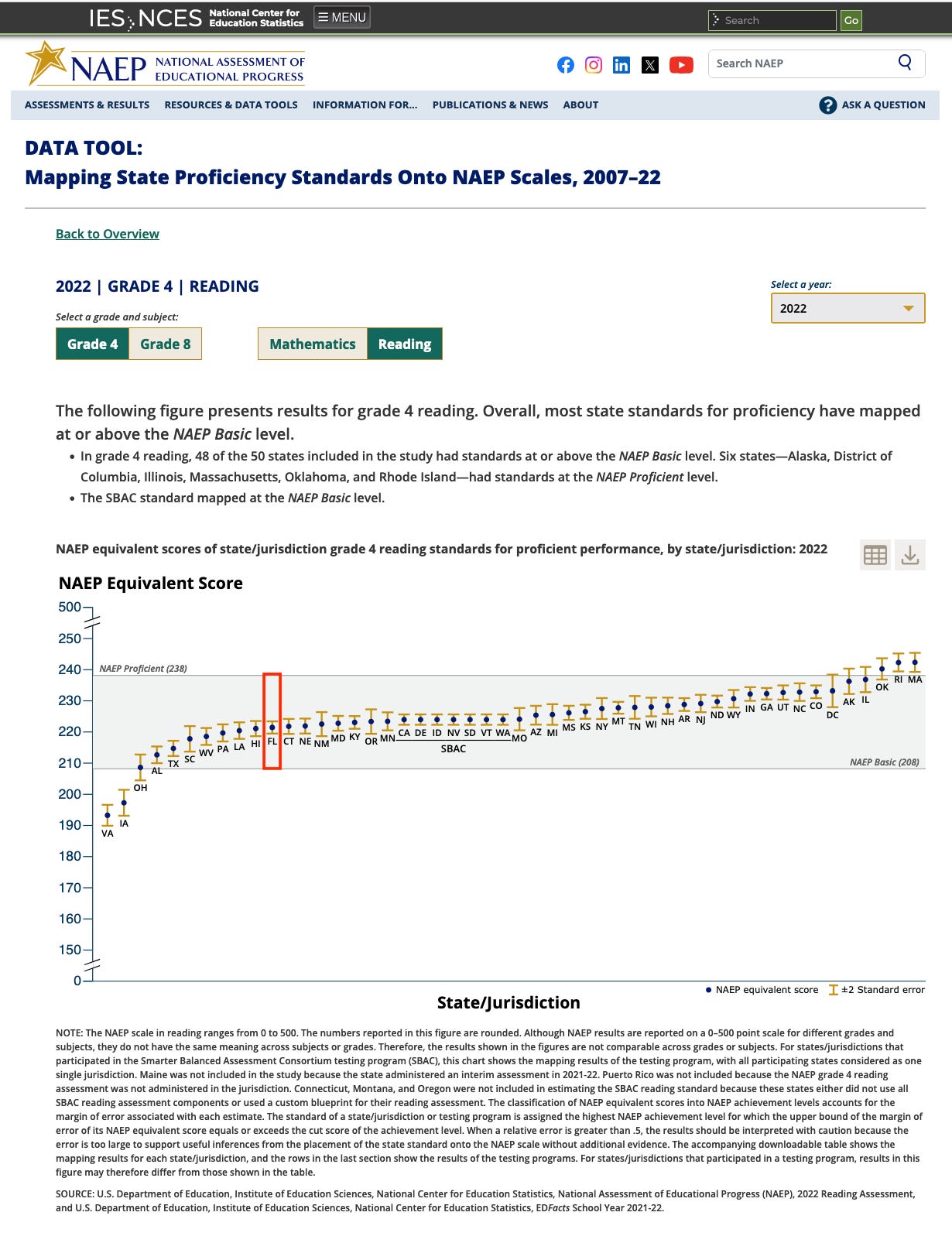
Her stressing honesty is ironic because ExcelinEd is known for spreading the falsehood that reliable NAEP Proficiency test scores correlate with “grade level.” That helps rightwing organizations like the Oklahoma Council of Public Affairs proclaim, “Just 14 percent of third-grade students in both the Oklahoma City and Tulsa districts tested proficient or better on state ELA tests.” In fact, NAEP Basic is closer to grade level.

So, I took a dive into the survey. My reading of it was very different than Levesque’s. 

In some ways, the survey she described  is consistent with the Education Department parent survey that State Superintendent Lindel Fields released. But Levesque’s interpretation of the results was very different than Fields’ analysis of the state’s parent feedback.

The survey Levesque cited found that 74% of parents want a pay raise for teachers, and another 74% say we spend too little on education. Her study found that 80% of parents were very or somewhat satisfied with their school but, for some reason, it adds, “While overall positive, this fails to hit the common 95% satisfaction sought in commercial endeavors.”

While 78% of parents support retention by 3rd grade of students who don’t read on “level,” parents estimate that about 83% students read at or above grade level; and 78% are confident in the way their schools teach reading.

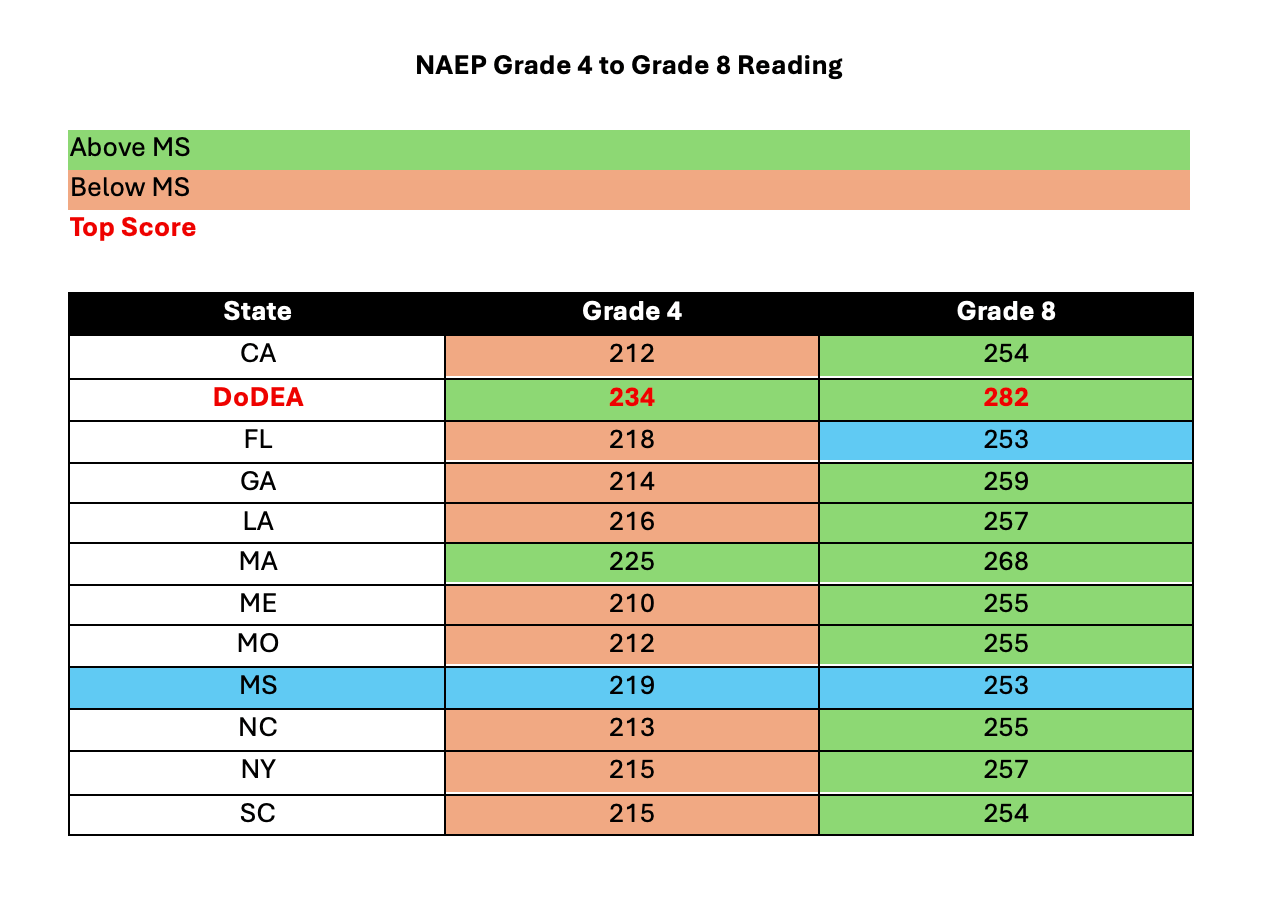
FYI, in 1998, 80% of Oklahoma 8th graders read at that level, but now about 59% do. My reading of the research, and classroom experience, attributes the subsequent decline to the way that No Child Left Behind and the Race to the Top undermined the teaching of History, Science, Arts, and of the background knowledge that is essential for reading comprehension; huge funding cuts; COVID; and Ryan Walters; as well as the rise of social media.

Yes, 83% of the survey are supportive of student testing, which is no surprise. But, the study doesn’t dig into the difference between testing for tracking student progress, as opposed to high-stakes testing. After all, there is great support for testing for diagnostic purposes, as opposed to the reward-and-punish testing that has been rampant since the NCLB was enacted.

Conversely, the Education Departments’ parent survey seems to be calling for schools to tackle the crucial issues that they were forced to ignore, as districts invested in high-stakes test-prep.

When Superintendent Fields explained that the results of statewide surveys of educators and parents, informed the budget priorities he is seeking. Superintendent Fields reported, “Early literacy, support systems to improve behavior and mental health resources and teacher recruitment and retention are among the top three concerns for all groups surveyed.”

The Education Department survey found that some parents called for a reduction of standardized testing, while others did not address it.  

The parents survey included repeated calls for teaching critical thinking skills, and media literacy; identifying misinformation; and early grade emphasis on literacy.

It explained that parents “highlighted the importance of both academic and life skills, emphasizing the need for students to be well-prepared for real-world challenges.” 

Parents said that misinformation is very prevalent, and children need to be taught how to tell fact from fiction. They understand that learning how to be critical consumers of information is “literally the foundation of a successful life.” They know that social media and A.I. can make kids “susceptible to conspiracy theories and propaganda.” 

What I didn’t see in the parents’ responses was calls for data-driven accountability; online, as opposed to personal tutoring for 3rd graders; or simple “miracles.”

What I saw was a desire to return to personal connections. I saw goals that would require more support for educators, as well as requiring cooperation with social workers, health providers, and mentors that are necessary for preparing children for a full life in the 21st century. 

Jason Garcia, an investigative reporter who writes, a blog called “Seeking Rents” uncovered a new Republican plan to shovel taxpayers’ money to charter schools. Under Ron DeSantis and a Republicanncontrolled legislature, Florida is determined to crush public schools by sending public money to charter schools and vouchers.

Here is a new twist: Republicans want school districts to share their funding with charter schools they did not authorize.

Garcia reports:

Five years ago, Republican leaders in Tallahassee gave the charter school industry something it had been seeking for years: A way around local voters.

The change — obscured inside larger education legislation that also included restrictions on the participation of transgender students in school sports — gave state colleges and universities the power to authorize new charter schools.

In other words, it enabled charter schools — public schools run by private management entities rather than public school districts — to bypass locally elected School Boards and work instead through the governor-appointed boards that control state colleges and universities.

The industry now wants to make local voters help pay for these state-imposed charters, too.

The idea is contained inside a package of tax cuts and tax-policy changes proposed last week by the Florida Senate. It would require school districts to split revenue from what’s sometimes called the “additional millage” — an optional property tax that county voters can levy via referendum in order to raise extra funding for their local schools — with every charter school in the area.

A school district currently only has to share proceeds from the additional millage with charters that the school district itself approved.

The immediate impact would be minor: There are currently only 12 charter schools across Florida that have been approved by an “alternate authorizer” like a college or a university.

But it could escalate quickly.

Just last month, for instance, the board of trustees at Miami Dade College signed off on six new charter schools — doubling, in one meeting, the number of charters in Florida approved without permission from the local school board.

They are the first of what could become a wave of new charters unleashed by the Miami college, which just launched a new authorization program late last year, according to WLRN Public Radio and Television.

WLRN reported in December that Dade College had begun pitching its authorization services to prospective charter operators. During one webinar, a college administrator told attendees that they could expect friendlier treatment from governor-appointed college boards than voter-elected school boards.

“I think one of the benefits of going to a college authorizer is that colleges are wanting to do this,” he said. “We’re going to be looking at the same types of things that the districts look at, but with the mindset that we really do want to make this a partnership, and we want to make it successful.”

It’s not the only potential accelerant that could lead to more charters sidestepping school boards.

Florida lawmakers last year approved a major expansion of the state’s “Schools of Hope” program, an incentive program through which charter school operators can get lucrative cash grants and low-interest loans if they open up new campuses in certain locations. The law was pushed through Tallahassee in part by lobbyists for Success Academy, the New York charter network that plans to open new schools in Miami.

The new law enables Schools of Hope charters to work through college and universities rather than solely through school districts.

Miami, Florida’s most populous county, certainly seems to be the focal point of this latest legislative proposal, too. 

Additional millage property taxes expire every four years unless extended by voters through. And Miami’s tax, which generates more than $400 million a year, is currently set to lapse on June 30, 2027 — which means the School Board may soon schedule another countywide referendum.

The provision requiring local school districts to share money with state-imposed charters would take effect just before that vote could happen. 

Andy Borowitz is America’s humorist. More than that, he is incisive and brilliant. He used to write for The New Yorker, but now has his own Substack blog called The Borowitz Report. I subscribe, and I recommend that you do so as well.

In this post, he gives insight into our notorious Attirney General, Pam Bondi, who has turned the Department of Justice into Trump’s personal law firm.

It’s important to remember that she was Attorney General of Florida from 2011 to 2019. She claimed that human trafficking was her #1 issue but somehow overlooked Jeffrey Epstein. As Attorney General, she is still shielding his crimes. Could it be that she is doing this to protect Trump?

Her obnoxious, aggressive, pugnacious appearance before the House Judiciary Committee showed the real Pam Bondi.

Borowitz writes:

Win McNamee/Getty Images

Can the attorney general of the United States go to prison? 

The answer, of course, is yes: John Mitchell, who served under Richard M. Nixon, later served 19 months behind bars for crimes related to the Watergate cover-up. 

Will the toxin known as Pam Bondi follow in his footsteps? 

It’s worth considering in light of her appearance before Congress on Wednesday, a performance that Kimberly Guilfoyle might call “too shouty.” 

Her testimony was unquestionably obnoxious. But was it criminal? 

When you examine the evidence, it doesn’t look good for Pam. 

This was the pivotal moment: responding to a question from California Rep. Ted Lieu about the Epstein scandal, Bondi snapped, “There is no evidence that Donald Trump has committed a crime. Everyone knows that.”

Lieu, who must have been tickled that Bondi was dumb enough to step into the weasel trap he set for her, responded that the attorney general might have just committed perjury. Which, as every Watergate superfan knows, is exactly what earned her Republican predecessor, John Mitchell, a trip to the pokey. 

When the Trump shitshow is finally over, two things must happen. First, there must be a solid month of dancing in the streets. Second, there must be a reckoning: ideally, Nuremberg-style trials of the corrupt quislings who enabled this unprecedented crime spree. With those enjoyable tribunals in mind, let us now consider the case of Pam Bondi.


Remember when Trump nominated Matt Gaetz to be attorney general? We were so much younger then—although, it should be added, not young enough for Matt Gaetz.

At the time, I observed that Gaetz’s nomination was not what QAnon had in mind when they said they wanted to bring pedophiles to justice. In the end, Matt turned out to be as reckless with Venmo as he was about the age of consent, and Trump quickly withdrew his name.

Pundits claimed that Trump never expected Gaetz to pass muster with the Senate. By their reckoning, he was a “sacrificial lamb”—an odd way to describe a man who, in his personal life, had consistently behaved like a wolf. But by shitcanning Gaetz, the theory went, Trump was sending a signal to his Senate toadies that they’d better confirm all his other nominees, no matter how idiotic, incompetent, or drunk. When it came to Pete Hegseth, Robert F. Kennedy, Jr., Tulsi Gabbard, Dr. Oz, Kash Patel, and myriad other passengers in Trump’s clown Cybertruck, the gambit seemed to pay off.

Matt Gaetz, peering into the gates of Hell. (Erin Scott-Pool via Getty Images)

As for the job of attorney general, Democrats and Republicans alike seemed relieved that it would not be filled by a summer-stock version of Jeffrey Epstein. Surely, whoever Trump named as Gaetz’s replacement would be an improvement.

Instead, Trump picked Pam Bondi.

In 2016, when she was Florida attorney general, Bondi secured her place in Trump’s heart with a speech at the Republican National Convention. Her bloodcurdling attack on Hillary Clinton inspired the GOP mob to break into a familiar chant, which prompted Bondi to comment, “Lock her up? I love that.” And so, by approving the incarceration of a woman who had never been charged with a crime, Bondi displayed an attitude towards due process that would someday serve her splendidly as the nation’s top law enforcement officer.

She would, of course, have another opportunity to assert her preference for imprisoning innocent people with the case of Kilmar Armando Abrego Garcia. On April 14, 2025, El Salvador’s President Nayib Bukele, Trump’s accomplice in the world’s most notorious administrative error, joined him in the Oval Office, receiving a much warmer welcome there than was offered Ukrainian President Volodymyr Zelenskyy. After chummily congratulating each other on the abduction and deportation of a non-criminal, the two men started workshopping how their brilliant strategy might be applied to innocent American citizens.

“The homegrowns are next, the homegrowns,” Trump told Bukele, who calls himself “the world’s coolest dictator”—a stroke of branding so cringe, it’s amazing it didn’t come from Elon Musk. “You’ve got to build about five more places,” Trump advised him.

Where did America’s attorney general stand on this flagrant nullification of a basic right enshrined in the Constitution? Trump added, “Pam is studying. If we can do that, it’s good.”

Pam, apparently, is a quick study. On Fox that evening, she was all in on Trump’s blatantly illegal idea, asserting, “These are Americans who he [Trump] is saying who have committed the most heinous crimes in our country, and crime is going to decrease dramatically.”

It’s not that Bondi is bad at her job—it’s that she’s outstanding at the exact opposite of her job, that is, using the DOJ to subvert justice whenever possible. Bondi’s Department of Injustice, a mutant creation worthy of George Orwell and Lewis Carroll, has proven inhospitable to career DOJ lawyers, who have struggled in court to defend the indefensible.

One such staffer, senior immigration attorney Erez Reuveni, committed what Bondi apparently considers a cardinal sin: uttering a truthful statement within earshot of a judge. After acknowledging what was obvious to any thinking person (but seemingly elusive to Messrs. Trump and Bukele)—that Abrego Garcia’s deportation was a mistake—Reuveni was put on indefinite leave and then fired.

Meanwhile, Liz Oyer, a longtime DOJ pardon attorney, was fired for refusing to restore gun rights to the actor Mel Gibson, who lost them after pleading no contest to domestic battery charges in 2011. Apparently, Trump believes Mel Gibson needs lethal weapons more urgently than Ukraine.

We shouldn’t be surprised to see Trump standing up for the rights of domestic abusers, since a sizable number of the January 6 rioters he pardoned fit that description. He doubled down on his support for this cohort by appointing a crony accused of domestic violence, Herschel Walker, ambassador to the Bahamas.

But what makes the Mel Gibson case particularly rich is that Trump has repeatedly claimed he is punishing universities for their “failure to combat antisemitism.” If Trump is serious about spanking antisemites, he need look no further than his pal Mel. 

After the actor’s 2006 drunk driving arrest in Malibu, the police report indicated, “Gibson blurted out a barrage of anti-semitic remarks about ‘fucking Jews’. Gibson yelled out: ‘The Jews are responsible for all the wars in the world.’ Gibson then asked: ‘Are you a Jew?'”

Mel Gibson after his 2006 drunk driving arrest (L) and his 2011 domestic violence arrest (R).

In the upside-down world of Pam Bondi, highly regarded DOJ lawyers are fired and Mel Gibson is rearmed. But do such perversions of justice make Bondi a candidate for worst attorney general ever? They most certainly do, when one considers how decisively and repeatedly she has violated her oath of office:

“I will support and defend the Constitution of the United States against all enemies, foreign and domestic; that I will bear true faith and allegiance to the same; that I take this obligation freely, without any mental reservation or purpose of evasion; and that I will well and faithfully discharge the duties of the office on which I am about to enter. So help me God.”

Rather than defend the Constitution, Bondi has used her time in office to tirelessly protect pedophiles—which should come as no surprise to anyone familiar with her tenure as Florida’s AG. The following campaign ad from that era, in which she vowed to “put human trafficking monsters where they belong—behind bars,” hasn’t aged well:

As Bloomberg’s Mary Ellen Klas wrote, “Bondi kept her distance from the state’s most prominent sex-trafficking case, even as Epstein’s victims pleaded with the courts to invalidate provisions of his non-prosecution agreement and filed lawsuits alleging that he abused them when he was on work release from jail.”

I am confident that Bondi’s misdeeds—including but not limited to her role in the Epstein cover-up—have more than earned her a Nuremberg-style tribunal. I am not, however, suggesting we chant, “Lock her up.” Unlike our current attorney general, I believe in due process.

The Network for Public Education reposted this analysis of school funding in Florida by Sue Kingery Woltanski. She was not surprised to discover that the state provides much more aid to students in non-public schools than to those in public schools. Imagine what a difference that money would make if it were directed to public schools, where it belongs. Florida now subsidizes the tuition of every student in private schools, religious schools, and home schools. Most of that state money goes to students who never attended public schools. Florida is underwriting the

In this post, Sue Kingery Woltanski breaks down the finances in just one Florida district to show how taxpayer-funded vouchers are actually resulting in more taxpayer dollars going to private schools than to public ones. Reposted with permission

What Monroe County’s numbers reveal about Florida’s broken school funding priorities
https://www.facebook.com/share/p/1UT3ALNtP1/

I saw this image today, and it prompted me to take a closer look at the numbers for my Florida school district: Monroe County.

SURPRISE! Here is the state funding breakdown for Monroe:

  • Monroe’s 8,457 Public School students (district and charter) receive $181.86 each from the state (for a total of  $1,537,924).
  • While Monroe’s 743 Family Empowerment Scholarship voucher recipients receive $6,786.03 each from the state (for a total of $5,040,326).

What if that $5,040,326 was used to fund Monroe’s public school students instead? Per pupil funding would be nearly $600 more per pupil, which could translate into teacher raises of $8,000/year or a reduction in class sizes, expanded electives,  richer learning experiences, or some combination of all of the above – all of which could directly improve classrooms and student learning

Jeff Bryant, a veteran education journalist, dissects he plan to destroy public schools. Governor Ron DeSantis and the Legislature has unleashed the for-profit vultures to pick the bonds and funds of the state’s public schools. Not because the charges are better schools, but because the rightwingers have close ties to members of the legislature. Want to open a charter school? Want the state to pay all your expenses? Come on down to the Sunshine State!

This article was produced by Our Schools. Jeff Bryant is a writing fellow and chief correspondent for Our Schools. He is a communications consultant, freelance writer, advocacy journalist, and director of the Education Opportunity Network, a strategy and messaging center for progressive education policy. His award-winning commentary and reporting routinely appear in prominent online news outlets, and he speaks frequently at national events about public education policy. Follow him on Bluesky@jeffbinnc.

The letters started coming in October 2025. In the first wave, according to the Florida Policy Institute (FPI), “at least 22 school districts in Florida” got letters alerting them that charter school operators, including a for-profit charter school management company based in Miami, intended to use a state law recently enacted to open new charter schools on the campuses of existing public schools beginning August 2027.

In Broward County, a South Florida district that includes Fort Lauderdale, the Mater Academy charter school chain, operated by for-profit charter management company Academicaclaimed space in 27 public schools. Mater Academy claimed space in nearly 30 schools in Hillsborough County, home to Tampa Bay, “along with more than a dozen [schools] in Pinellas [County] and six in Pasco [County],” Tampa Bay Times reported. In Sarasota County, Mater claimed space in three public school campuses.

At least two more charter chains—New York-based Success Academy and New Jersey-based KIPP NJhave joined in the campaign.

“So far, 480 schools in 22 counties have received 690 ‘letters of intent’ from charter school organizations expressing their intent to occupy space in public school buildings,” FPI’s Norin Dollard told Our Schools in late November. When schools receive letters from multiple charter organizations, it’s first come, first served, she explained, and the timeline for schools to respond is incredibly short—just 20 days.

Once the charter occupies part of the public school, Dollard explained, it operates rent free, and the public school district becomes responsible for much of the charter’s costs, including those for services charters don’t customarily provide, such as bus transportation and food service, as well as costs for school support services like janitorial, security, library, nursing, and counseling. Even any construction costs the charters might incur have to be covered by the public school.

This new law will force some public schools to convert to charter schools, said Damaris Allen, “and that’s intentional.” Allen is the executive director of Families for Strong Public Schools, a public schools advocacy organization that is rallying opposition to the law.

The letters have caught the attention of national news outlets, including the Washington Post, which reported, “The Florida law is an expansion of a state program called ‘Schools of Hope,’ which was set up to allow certain charters to operate in areas with low-performing local public schools. The new law allows ‘Schools of Hope’ operators to take over space at any public school that’s under capacity, regardless of whether it is high- or low-performing.”

“The expansion of the Schools of Hope idea has been on a slippery slope,” Dollard explained, “much like school vouchers have been in the state.” Originally, in 2017, schools identified for Schools of Hope transition from public governance to charter management were very narrowly defined as persistently underperforming schools. That changed in 2019 when the legislature altered the definition of low-performing to target more schools and added schools in so-called opportunity zones—government-designated areas selected for economic development—as open territory for charters. Now, the new law allows charter schools to take over “underused, vacant, or surplus” space in traditional public schools and operate free of charge.

As the reach of the Schools of Hope idea morphed, so did its rationale. According to a 2025 op-ed by former Florida Governor Jeb Bush, the program was originally conceived as an “initiative that incentivizes high-quality charter operators to open schools for students trapped in failing ones.” The aim now, according to Bush, is to solve the “problem” of underutilized space in existing public schools.

With school enrollments in steep decline in nearly every district in the state, fear of a potential mass charter school industry takeover of public school spaces—along with the costs local districts will incur—looms over district leaders across the state and strikes them as a clear existential threat.

Other consequences of colocating more charters in public schools have not been well-thought-out, according to Allen. For instance, on the issue of school safety, public schools have undertaken a number of measures to protect against school shootings, such as converting buildings to single-point entry. Charter schools don’t have to do that. So what happens when a charter operation moves into a building and doesn’t comply with the single-point entry? Also, the state legislature created new rulesfor public school libraries in 2022. Charters don’t have to follow those rules. How is that going to work in a colocation?

Allen fears the daunting challenges of charter colocations will cause some school boards and communities to sell school buildings or convert them to district-operated charters rather than give in to charter schools run by outside, for-profit companies.

And while proponents of Florida’s Schools of Hope program see it as a way to expand education options for students and families, critics point to evidence that Florida charter schools, which one expert called “a shitstorm,” need stricter oversight rather than a free rein. And, regardless of the outcomes, they warn that the idea is sure to get promoted as an “education innovation” that other Republican-dominated states will likely adopt.

A warning sign, not a model

When Nancy Lawther, a retired college professor of French, got involved in public schools advocacy, she became very skeptical about the oft-told narrative about the need for more education options because “too many poor children are trapped in failing public schools.” After all, in Dade County, Miami, where she lives, the public system has an A rating by the state despite having a challenging student population that is overwhelmingly Hispanic, with many living in households earning less than the state’s median income.

Her skepticism only increased when she first heard about expanding the Schools of Hope program to more schools, especially when she saw the results from the first schools taken over.

The original “Schools of Hope” weren’t individual schools; it was a whole district. In 2017, the Jefferson County school board voted in favor of participating in a pilot project for the new Schools of Hope initiative. The board’s approval to join the pilot meant that the district was required to turn over the management of their schools to a “high-performing” charter management company, which, in this case, happened to be Somerset Academy, another charter chain managed by the for-profit Academica management company.

But the results of the pilot would be a warning sign about the abilities of charter management firms to improve the education outcomes of public schools. As a 2025 op-ed for the Orlando Sentinel recounted, “[T]axpayers saw higher costs, stagnant results, and constant staff churn. By 2022, the takeover collapsed. Local leaders called it ‘an absolute disaster.’ The state had to step in with a $5 million bailout just to get the district running again.”

A 2024 account of the pilot in the Tallahassee Democrat reported, “[F]rom 2017 to 2022,… [Jefferson County] remained troubled by students’ lagging academic performance and mounting disciplinary issues, like fighting that in one case led to the arrest of 15 students. … [And] the school district was still getting a D grade” from the state.

Nevertheless, after Florida lawmakers expanded the Schools of Hope program in 2019, which has cost more than $300 million as of 2025, “There are only about a dozen Schools of Hope in Florida. In 2024, eight of them got C or D grades,” pointed out the Bradenton Times.”

‘All about market share’

Given its track record of failure, Lawther suspects that expanding Schools of Hope has nothing to do with improving education outcomes or making better use of publicly funded school buildings.

Indeed, Sarasota County, one of the districts targeted for charter colocations, has been an A-rated system since the state created the grading system in 2004, according to the district website.

Also, in districts where there are enrollment slides, there are few signs that demand for charters will soak up excess building capacity. According to a 2025 analysis of Sarasota County by Suncoast Searchlight, “The number of charter schools has grown in recent years, but the share of students at charters has not shifted much.” And building utilization rates of the different sectors are nearly identical—82 percent for public schools and 84 percent for charters, WUSF stated. “Some of the lowest-performing charters are barely a third full.”

Mater Academy, the charter operator using the Schools of Hope law to claim space in Sarasota public schools, does not currently operate a school in the district.

“This is all about market share,” Lawther said. “It’s about getting an advantage over charter operators that are not Schools of Hope providers, and independent charters that can’t compete in a market geared to the large chains,” like those operated by Academica.

Further, while enrollments in Florida charter schools continued to grow, it has shown signs of slowing down—from 3.7 percent in 2024 to 2.6 percent in 2025—and the number of charter schools decreased, from 739 in 2023-2024 to 732 in 2024-2025.

Also, the charter industry in the state faces many more privately-operated competitors. “Expansions of voucher programs are creating a more competitive market for charter schools,” Lawther noted, “and private schools, microschools, and homeschooling are growing forms of school choice.”

Indeed, charter schools no longer appear to be the fastest-growing form of school choice in the state.

After the Republican-led Florida legislature passed a bill in 2023 that did away with income requirements for families to receive state-sponsored school vouchers, the share of state funding diverted from the public system—which, technically, includes charters—to private schools and homeschooling doubled from 12 percent in 2021 to 24 percent in 2025, WUSF reported. In the school year 2023-2024, the number of vouchers, often called “scholarships,” given out to help families pay for private school tuition and homeschooling increased by approximately 142,000 students, according to Next Steps, a school choice advocacy group.

Florida has also experienced a 46 percent increase in homeschooling over the past five years, WEAR statedin 2025. And the state has freed up 50,000 new community facilities to serve as microschools, according to the Center for American Progress.

It would seem that in this increasingly competitive education landscape, the Florida charter school industry could use a new competitive angle like the one offered by Schools of Hope. “Officially, charter school advocates say Schools of Hope is an amazing opportunity to expand parent choice,” Dollard said, “but unofficially, this is an incredibly lucrative business opportunity.”

An industry in decline?

The charter school industry’s desire for new business strategies that enable charter operators to seize public school classrooms—or even whole buildings—is not confined to Florida.

In Indiana, for years, public school districts have been required to notify the state, within 10 days, when one of their buildings becomes vacant and to make the building available to lease to a charter school for $1 per year or sell the building to a charter operator outright for $1.

In Ohio’s 2025 approved budget, a new provision allows the state to force school districts to close some public school buildings and sell those properties to charter or private schools “at below market value,” Ideastream Public Media reported.

Arkansas is also likely to adopt a Schools of Hope-like measure, Allen speculated, because its state secretary of education Jacob Oliva served in Florida. Oliva was Florida’s state education chancellor during the failed Schools of Hope pilot in Jefferson County.

One market condition that’s likely behind these increasingly aggressive charter school industry is land grab, as revealed in a 2025 analysis by the National Center for Charter School Accountability (NCCSA). According to the report, charter school closings have been accelerating nationwide, while the pace of new charter openings has slowed significantly during the same time.

“[T]he 2023-24 school year saw just 12 more open charter schools than during the previous year,” the report found. This is “a dramatic departure” from the heydays of industry growth when “[t]he number of charter schools increased by 421” between 2010 and 2011.

Charter school enrollment growth has also stalled, according to the report, increasing by 0.1 percentage point—from 7.5 percent to 7.6 percent of total charter enrollment—between 2020 and 2023.

In the most recent school years, based on official data from 2022-2023 and 2023-2024, NCCSA found, “Most states experienced declines or stagnation [in charter school market share], and preliminary indicators suggest that, once the 2024 data is finalized, the trend will likely worsen.”

North Carolina offers a clarifying example of the significant headwinds that the charter school industry now faces.

In the Tar Heel state, charter schools have enjoyed widespread support among state lawmakers and private investors. The state legislature has made dramatic changes to state laws regarding charters, including loosening regulations and fast-tracking approval of new schools. And a 2024 analysis by the Charlotte Observer found “at least $279 million in private equity investments in North Carolina charter schools since 2013.”

Despite this support, the number of charter schools in North Carolina declined in 2024-2025, from 211 to 208 in 2023-2024, according to an industry spokesperson. And many of the newest charter schools to open in the state have not fared well. “State data show that only about 26 percent of new charter schools in the past five years met or exceeded their enrollment projections,” NC Newsline reported, “and more than half of those that missed the mark are now closed or never opened.”

The report’s findings revealed that although charters tend to locate in low-income neighborhoods, they serve far fewer children from low-income families, fewer children who are English learners, and fewer children with disabilities, resulting in leaving traditional public schools with elevated needs and higher costs.

Critics of the Schools of Hope law noted that these industry shifts, as well as a historical tendency for education policies enacted in Florida to get picked up in other Republican-dominated states, will spur other states to adopt similar policies, regardless of any evidence that they might harm public schools.

“More generally,” Baker added, “Florida charter schools are a shitstorm, both underserving higher need populations and underperforming with those they do serve.”

‘A shitstorm’

Among the critics of Florida’s Schools of Hope legislation is Bruce Baker, a professor and chair of the department of teaching and learning at the University of Miami and an expert on charter schools and public school finances.

“I’m, of course, deeply concerned with granting preferential access to any charter operator, at the expense of a fiscally strapped school district,” Baker wrote in an email. “I’m more concerned when it may present a slippery slope regarding control over land and buildings that should—by the [state] constitution, which supersedes this regulatory change—be solely under the authority of the local boards of education elected by the taxpayers who financed those facilities and continue to maintain them. It becomes even more problematic if this eventually creates an avenue to transfer ownership. That would be a particularly egregious violation of local board authority and private taking of public assets. We aren’t there yet, but it’s a concern.”

Baker’s assessment of charter schools in the Sunshine State is evident in his 2025 report, which looks at the impacts of the industry on school funding adequacy, equity, and student academic outcomes across the state, and, more specifically, in the Miami-Dade district.

Also, charters, despite having an advantage of educating less challenging and less costly student populations, underperform public schools on state assessments while “serving otherwise similar student populations.” This finding holds statewide and in Miami-Dade.

The report concludes that Florida charters are “compromising equity, eroding efficiency, and producing poor educational outcomes for those it serves.”

Given these findings, the report recommends that state lawmakers “[i]mpose a moratorium on charter school expansion, including the Schools of Hope Program.” It also calls for “new regulations for evaluating existing charter operators,” stronger vetting of new charter operators, and stricter enforcement of regulations about charter school student outcomes.

Schools of nope

Several district school superintendents across Florida have urged their communities to oppose the state’s Schools of Hope charter school expansion in public school buildings. When the state’s current education commissioner defended the Schools of Hope law in his address at a 2025 conference for school board members and district leaders and suggested it could be used to shut down whole districts, the audience roundly booed him.

Grassroots groups such as Families for Strong Public Schools have held events to educate the public about the negative impacts of charter colocations. A coalition that includes the United Teachers of Dade, NAACP Miami-Dade Branch, the Miami-Dade County Council of PTA/PTSA, and others has formed to protest charter colocations. And a senator in the state legislature has introduced a bill to repeal the Schools of Hope expansion.

Much of the opposition has rallied under the banner of “Schools of Nope” and is organizing call-ins and an email campaign targeting state legislators.

Opposition organizers like Damaris Allen see this as a do-or-die moment in the state. “Either we win this fight, or it’s the death of public schools in Florida,” she said.

Jason Garcia, a veteran investigative reporter in Florida, reports on the ongoing scandals in the Sunshine State. In this post, he describes a new law that would offer generous bounties to anyone who helped to prevent an abortion arranged in other states. The law hasn’t passed yet, but its purpose is to stop women from accessing abortion drugs via telehealth.

He wrote:

Florida’s Republican-controlled Legislature may turn husbands, fathers and brothers into bounty hunters who can block women from ending unwanted pregnancies.

A new bill filed in the Florida House of Representatives would dangle $100,000 prizes in front of private citizens who are willing to sue in order to stop a pregnant family member from obtaining abortion pills through the mail.

More specifically, House Bill 663 would allow a pregnant woman’s spouse, parents or siblings to sue anyone who tries to send her abortion medication — including doctors who prescribe the pills, drug companies that make them, shipping companies that transport them, even friends or other family members who help arrange delivery.

A successful lawsuit would come with a $100,000 payout — plus extra cash to pay lawyers and legal fees.

The Florida legislation is similar to a first-of-its-kind state law that just took effect in Texas. Right-wing groups have billed the Texas measure as a model for other anti-abortion states — like Florida, which bans most after just six weeks of pregnancy — that now want to stop women from accessing abortion services remotely from states where it is still permitted through telehealth and in-home medication.

Many abortion-supportive states around the country have in recent years enacted what are known as“shield laws.” These are laws that protect patients, doctors and others involved in reproductive healthcare from criminal prosecutions and civil lawsuits brought under laws passed in anti-abortion states — just like the kind envisioned in House Bill 663. 

But the new Florida bill tries to weaken other states’ shield laws, too.

Shield laws often contain “clawback” provisions that enable someone who provides legal abortion care in their home state — but is then criminally charged or held civilly liable under the laws of another state — to sue in order to recover damages and recoup any costs they incurred in their legal defense.

House Bill 663 would forbid state courts from recognizing or enforcing any judgement issued under another state’s clawback law. What’s more, it would enable someone in Florida who is sued under an out-of-state clawback provision to then countersue in this state. 

House Bill 663 wouldn’t enable a father to sue his daughter or a brother to sue his sister; the legislation specifically prohibits lawsuits against a woman trying to obtain abortion medication for herself.

But women are still the true target here. The ultimate goal of legislation like this is to scare providers out of sending abortion pills to women who want them.

As the executive director of the Texas Alliance for Life — one of the anti-abortion groups that supported the new bounty hunter law in Texas — wrote in a recent column, “The ‘chilling effect’ is precisely the point.”