Audrey Watters is one of the best–maybe the very best–writers about Ed-tech. As she has documented in her writings, including her book, Teaching Machines, the quest for a cheap and mechanical way to replace teachers with efficient devices has a long history. A few people dream of endless profits, but the promise of better teaching by machines has never been realized.

Watters believes that the Ed-tech industry is minting money for itself without delivering on its promises. In this article, which appears on her blog, Second Breakfast, she describes the current AI boom and the likely endgame.

She writes:

This morning I attended one of the new NYC Chancellor’s public “conversations,” his administration’s initiative to “engage directly with communities to reflect on what safety, academic rigor, and true integration look like in practice.” There were about one hundred folks in attendance, including members of the AI Moratorium for NYC schools, who were there to leaflet beforehand (and were vastly outnumbered, I should note, by the NYPD). 

As the aforementioned name suggests, this coalition of local organizations is asking for a two-year moratorium on AI in the city’s schools, pointing to the growing opposition to AI and (in their words) “to evidence that it represents substantial risk to student privacy, cognitive development and skills, critical thinking, creativity, mental health, and the environment.” I’d add that it represents substantial risk more broadly: to labor (teachers’, librarians’, translators’, social workers’) and to democracy itself.

And really, what’s the rush?! I mean, other than the desperate need of the tech sector to prove that the trillions of dollars invested in this endeavor will soon show some profit and that – unlike crypto and Web 3.0 – this isn’t just some giant fraud being perpetrated so executives can buy more private islands.

I’ve said repeatedly (but didn’t articulate into any open mic at the meeting because I still very much feel like a new New Yorker), this recent push for “AI” is yet another grandiose and grotesque experiment on children – one that no one asked for and few want. Another grandiose and grotesque experiment on all of us. 

We have lived through decades and decades now of repeated digital promises — we’ll be better, faster, stronger, more connected, what have you — and none of the computational fantasies have really come to fruition, certainly not for everyone. We are not more productive (despite now being asked to work so much more, clicking away on our devices at all hours of every day); we are not smarter; and most importantly, we are not better. (A tiny group of men are, on the other hand, now richer than any other humans have ever been in all of history. So there’s that.) Our public institutions are crumbling, in no small part because these men are fully and openly committed to the failure of democracy, having positioned themselves to profit mightily from years of neoliberalism. “AI” marks the further (and they hope, final) consolidation of their power – not just the privatization and monopolization of all information under their control, but the automation of the dissemination and replication of knowledge. These men are more than happy to sell a story, a system that trains all of us, but particularly young people, to become entirely dependent on and subservient to computational machinery; they are more than happy for us to sacrifice our cognitive capabilities, our creativity, our agency, our decision-making, our morality, to solidify their crude oligarchal dreams of total efficiency, total financialization, total domination.

Jennifer Berkshire writes about the back history to the growing backlash against not just “AI” but a lot of ed-tech and what she calls “the curious case of collective amnesia” (invoking one of Hack Education’s enduring contributions to “the discourse: “The 100 Worst Ed-Tech Debacles of the Decade” as well as Teaching Machines).

We should know by now that this stuff is almost entirely wretched – we do, right? I mean, at this stage, I’d be deeply embarrassed if I was out there, trying to argue that this stuff is any damn good. And yet here comes Silicon Valley and education reform, hand-in-hand once again, trying to peddle disruption and innovation and their long war on “one size fits all education,” armed with their algorithmic bullshit and billionaire board members.

It doesn’t help, I think, that there are several prominent technology journalists who keep falling for / perpetuating this stuff, who loudly insist in caps-lock-on prose that “THERE IS NO EVIDENCE!!!111” that devices are bad for children. (The irony, of course, is after they repeat this claim — and with such certainty — they turn around and point to dozens of stories of the most batshitcrazy news about the horrors of digital culture.)

And maybe part of the problem too is just that: we are so steeped in the insanity of techno-capitalism, the insanity of techno-capitalists that some folks are losing track of what aberrant behavior really is. Cory Doctorow writes a bit about this this week, offering “three more AI Psychoses” — a response, in part, to Samantha Cole’s excellent piece in 404 Media, “How to Talk to Someone Experiencing ‘AI Psychosis’.”

I wonder if it isn’t simply that “AI” delusions are ubiquitous (at this stage, I’m thinking these delusions are experienced by almost everyone, not just a tiny fraction of “AI” users); it’s that many of these delusions are unrecognizable as such because they reflect precisely the sort of sociopathy long embraced by Silicon Valley’s Ayn-Randian, libertarian set. “Here’s to the crazy ones” indeed.

[A] great embarrassing fact… haunts all attempts to represent the market as the highest form of human freedom: that historically, impersonal, commercial markets originate in theft. – David Graeber, Debt

If plagiarism is wrong and bad and theft is wrong and bad and schools are duty-bound to help instill these values in students, how can they justify adoption of a technology that is, at its core, built on stolen work and whose purpose is the extrusion of text to be passed off as one’s own thinking and writing?

I invite you to open the link and continue reading this thought-provoking article.

David Sanger of the New York Times comments on the mess that Trump created by making war on Iran.

Before the war, the chairman of the Joint Chiefs of Staff General Dan Caine warned Trump of the risks, including the likelihood of Iran shutting down the Strait of Hormuz, according to the Wall Street Journal. Trump ignored his warnings, because he thinks he’s the smartest person in every room. He had the experience of a swift victory in Venezuela, so he decided Iran would be a piece of cake. He thought Iran would capitulate in two or three days.

Make no mistake: the Iranian theocratic regime is led by cruel fanatics who tolerate no dissent. Only days ago, three men were executed on charges of murdering policemen during the January protests. One of those publicly hung was a teenage wrestling champion, who said his “confession” was coerced by torture.

Trump started the war ostensibly to free the Iranian people from their tyrannical leaders but quickly dropped that goal and said his purpose was to destroy Iran’s capacity to wage war , especially on Israel.

When Iran attacked shipping in the Strait of Hormuz, Trump called on our NATO allies to open the choke point for 20% of the world’s oil. They refused. He began blasting our allies for failing to help us; they did not want to get involved in a war that Trump and Netanyahu started. Trump forgot that he had been belittling our allies since he returned to office (as well as during his first term in office), even threatening to attack and seize Greenland, which is part of Denmark.

He has painted himself into a corner, even threatening to crash the world economy, because of his ignorance and stupidity.

Now, thousands of Marines are en route to the Middle East. The 82nd Airborne is on alert. The world waits to see how much more damage he will inflict before he declares victory and stops his war.

David Sanger, veteran national security reporter, wrote:

Ever since President Trump began what he now delicately calls his “excursion” into Iran, Washington has been consumed by the question of when he would call it a day — even if many of his war goals remain unaccomplished.

On Friday evening, as he headed to Florida, Mr. Trump seemed to be designing that much-discussed exit. But he clearly has not yet decided whether to take it.

And there is mounting evidence — average gas price approaching $4 a gallon, infrastructure in ruins across the Persian Gulf, a decimated Iranian theocracy digging in and American allies at first rebuffing and now struggling with demands to patrol hostile waters — that the repercussions of Mr. Trump’s excursion may outlast his interest in it.

As always, Mr. Trump’s messaging is inconsistent, which his critics cite as evidence that he entered this conflict with no strategy and his followers cheer as strategic ambiguity. With thousands of additional Marines headed to the region and the pace of American and Israeli attacks quickening, Mr. Trump told reporters on Friday he had no interest in a cease-fire because the United States was “obliterating” Iran’s missile stocks, navy, air force and defense industrial base.

Hours later, perhaps sensitive to a Republican base understandably nervous about the political effects, he posted on his social media site that “we are getting very close to meeting our objectives as we consider winding down our great Military efforts in the Middle East.”

But his latest list of those objectives left out a few of his previous goals and watered down others. He made no mention of defeating the Islamic Revolutionary Guards Corps, which appears to remain in power, along with Mojtaba Khamenei, who has succeeded his father as supreme leader, though he has yet to be seen or heard in public. Mr. Trump also omitted any message to the Iranian people, whom he told only three weeks ago: “When we are finished, take over your government. It will be yours to take.”

And after insisting in the failed negotiations that led up to the war that Iran had to ship all of its nuclear material out of the country — starting with the 970 pounds of enriched uranium that are closest to bomb-grade — he suggested a new goal. “Never allowing Iran to get even close to Nuclear Capability,” he wrote, “and always being in a position where the U.S.A. can quickly and powerfully react to such a situation.”

That is, essentially, where the United States was after it buried Iran’s nuclear program in rubble last June. The sites have remained under the watchful eye of U.S. spy satellites.

Mr. Trump ended the posting with a new demand for American allies, whom he had frozen out of his deliberations before starting the war, and gave no warning to prepare for its consequences. “The Hormuz Strait will have to be guarded and policed, as necessary, by other Nations who use it — the United States does not!” American forces would help, he said.

“Think of it as the new Trump Doctrine for the Middle East,” Richard N. Haass, the former president of the Council on Foreign Relations, who served on the National Security Council and at the State Department during the Persian Gulf War and the Iraq war, wrote on social media.

“We broke it, but you own it.”

Mr. Trump’s shifting goals continued into Saturday evening. Just a few days ago, he was calling on Israel to avoid targeting Iranian energy sites, for fear it would lead to an escalating round of retaliatory counter-strikes across the Gulf. But on Saturday, he threatened to hit Iran’s power plants if it did not “FULLY OPEN, WITHOUT THREAT, the Strait of Hormuz” within 48 hours.

He said that U.S. strikes on Iranian plants would start “WITH THE BIGGEST ONE FIRST.” Iran’s biggest plant appears to be its only operating nuclear power plant, at Bushehr. For decades, nuclear power plants have been considered completely off limits for strikes because of the obvious risk of environmental calamity.

This is not where Mr. Trump expected to be after three weeks of war.

Foreign leaders, diplomats and U.S. officials who have spoken with the president said that in the first week he voiced expectations that Iran would capitulate. That was clear in Mr. Trump’s demand on March 6 for Iran’s “unconditional surrender.”

The demand was mystifying, said one European diplomat with long experience dealing with Iran, given the country’s competing power centers, its national pride and a Persian state that has existed within the rough boundaries of modern-day Iran, enduring many rises and falls, since the days of Cyrus the Great around 550 B.C.

(That demand was also missing from his latest set of objectives. The White House has since said that the president does not expect a surrender announcement from Iran, but that Mr. Trump will determine when Iran has “effectively surrendered.”)

Iran’s refusal to “cry uncle,’’ as Mr. Trump termed it to reporters on Air Force One, has been only one of the surprises to the president in recent weeks.

The first was the crisis in the energy markets, which the International Energy Agency has called “the largest supply disruption in the history of the global oil market.” It has sent Mr. Trump and his aides scrambling. They have promised releases from the Strategic Petroleum Reserve, which was only 60 percent full, reflecting a lack of planning. Over the past week the Treasury Department has issued licenses for the delivery of Russian and Iranian oil already at sea. In other words, to calm the markets, the president has approved enriching an adversary that is at war with Ukraine, an American ally, and another that is at war with the United States.

So far, the effects are minimal. Brent crude closed at around $112 a barrel on Friday after the Treasury announcements, and Goldman Sachs warned on Thursday that if ships were reluctant to make their way through the Strait of Hormuz, prices could remain high into 2027.

The Iranians clearly understand that market chaos is their one remaining superweapon. On Saturday, Tehran warned it could set fire to other facilities in the Middle East. The United States believes the country entered the war with 3,000 or so sea mines — some of which are believed to have been destroyed — and the United States has focused on destroying small boats in the Iranian fleet that are targeting tankers associated with American allies.

“All it takes is for one of those things to get through to shut down traffic,” said John F. Kirby, who served as both Pentagon and State Department spokesman after retiring as a naval officer. “The fear alone can be paralyzing to the shipping industry, as we have already seen.”

Mr. Trump’s second surprise was his sudden need for allies. He didn’t imagine it at the beginning of the conflict, the defense minister of one Gulf nation said recently, because he thought the war would be short. But patrolling the strait, and other checkpoints, appears to be a task that could last months or years.

His third surprise was the absence of any uprising among either the Revolutionary Guards or ordinary Iranians. Treasury Secretary Scott Bessent said in the Oval Office this past week “we are seeing defections at all levels as they’re starting to sense what’s going on with the regime.” But American and European intelligence officials say they have no evidence of such defections — even after Israel targeted, and eliminated, Iran’s supreme leader, its top security and intelligence chiefs and many top military officials.

All that could yet come. Wars are not won or lost in three weeks. But Mr. Trump entered the Iran war after enjoying the fruits of quick victories. A bombing run over Iran’s three major nuclear sites in June was a one-evening expedition, essentially burying the country’s nuclear stockpiles and wiping out thousands of its centrifuges, which are used to enrich uranium.

The commando raid to seize Nicolás Maduro of Venezuela from his bed in Caracas was similarly swift. And so far, the government Mr. Trump left in place — essentially Mr. Maduro’s government — has been compliant. That operation has helped Mr. Trump destabilize Cuba, which has lost the Venezuelan fuel supplies that it has long depended on. The other day the electric grid in Cuba collapsed, and administration officials have been openly suggesting that the government will, too.

Perhaps those quick results encouraged Mr. Trump to believe the U.S. military was all-powerful, and that the mullahs and generals and militias that run Iran, a country of 92 million people, would crumble. Perhaps he rushed.

Military historians will be dissecting this conflict for a long time. But for now it is clear that Iran is a different kind of challenge. Mr. Trump started using the word “excursion” to suggest this is just a short trip, a brief diversion. But there is no real end in sight.

Brian Stelter of CNN is one of the very best reporters about the state of journalism. In his newsletter “Reliable Sources,” he reported Sunday morning that Secretary of Defense Pete Hegseth will appeal a ruling by a federal judge that prevents him from excluding mainstream journalists from covering the Pentagon. Hegeth wants to limit or ignore freedom of the press. He wants the Defense Department to be covered only by rightwing journalists.

Stelter writes at CNN:

Defense Secretary Pete Hegseth has been taking steps to thwart news coverage of the Pentagon for more than a year. Now he has finally met some resistance.

Friday’s ruling by a federal judge striking down Pentagon press limits was cheered by the news organization that sued over the policy, The New York Times, and by a wide range of First Amendment advocates.

“This is a great day for freedom of the press in the United States,” the Pentagon Press Association, which represents scores of journalists who regularly cover the military, said. “It is also hopefully a learning opportunity for Pentagon leadership, which took extreme steps to limit press access to information in wartime.”

Some beat reporters who were pushed out of the Pentagon complex last fall are now discussing how to get their credentials reinstated.

But Hegseth’s press office says, “We disagree with the decision and are pursuing an immediate appeal,” signaling that he will continue to pick fights with the news media.

At recent press briefings about the war in Iran, Hegseth has mirrored President Trump’s hyperbolic language about the media and made plainly false claims about news coverage.

More alarmingly, from the perspective of Pentagon correspondents, he has also hindered the free flow of information about the US military, in part through the restrictive press pass rules that The Times challenged in court.

The rules had the effect of replacing major news outlets like The Times and CNN with a handpicked group of relatively small and explicitly right-wing outlets.

But the rules veered into unconstitutional territory, senior US District Judge Paul Friedman wrote in Friday’s ruling.

The policy is “viewpoint discrimination,” Friedman wrote, “not based on political viewpoint but rather based on editorial viewpoint — that is, whether the individual or organization is willing to publish only stories that are favorable to or spoon-fed by department leadership.”

Tightening control over coverage

Governments routinely try to encourage favorable coverage, but Hegseth has gone much further since leaving Fox News for the Defense Department, which he has rebranded as the Department of War.

One of his first moves was to boot some news outlets, including CNN, from long-established media workspaces inside the Pentagon complex.

It was billed as a temporary “media rotation program,” boosting pro-Trump media outlets that never had a presence at the Pentagon before. For one year, Breitbart was meant to replace NPR, One America News Network to replace NBC News, and so forth.

But any argument about media diversity was undermined by the department’s inaccessibility.

Hegseth’s spokespeople declined to hold regular press conferences, effectively closed the Pentagon press briefing room, and made key parts of the Pentagon complex off-limits to journalists without an official escort.

By May 2025, the Pentagon Press Association was calling the restrictions “a direct attack on the freedom of the press and America’s right to know what its military is doing.”

It was apparent to many beat reporters that Hegseth wanted to prop up propagandistic outlets while punishing traditional media outlets.

He promoted himself on Fox, for instance, and gave access to right-wing content creators, while bashing what he called the biased “hoax press.”

In September, his press office circulated a new policy controlling the press credentials that grant physical access to the Pentagon complex.

The policy challenged the ability of reporters to freely gather information, for instance, through leaks from sources inside the military, by enabling the Pentagon to suspend or revoke credentials due to reporting.

Media lawyers said the revised rules criminalized routine reporting. So, rather than abide by the new policy, journalists from virtually every major American news outlet turned in their press passes en masse last October.

The Pentagon gave credentials to what it called “the next generation of the Pentagon press corps,” made up of staples of the MAGA media diet that are barely known to the rest of America.

Those media outlets were welcomed into the building’s workspaces, though the cubicles and offices are said to be largely empty nowadays. Before long, some of those outlets also began to complain about a lack of transparency from the Pentagon.

A handpicked ‘press corps’

When the US and Israel began strikes in Iran, and the Pentagon resumed somewhat regular press briefings, Hegseth called almost exclusively on MAGA-aligned outlets that were given front-row seats in the briefing room.

Representatives of bigger news outlets with decades of experience covering the US military — who were granted temporary access to the building — were seated in the back and generally ignored.

Furthermore, The Washington Post reported that the Pentagon “barred press photographers” from some briefings after the photographers published photos of Hegseth “that his staff deemed ‘unflattering.’”

Those photographers were allowed back inside for the most recent briefing on March 19.

But Hegseth added a new anti-media talking point to his repertoire that day, claiming that the “dishonest and anti-Trump press will stop at nothing — we know this, at this point — to downplay progress, amplify every cost, and call into question every step.”

He diagnosed them with “TDS,” short for Trump Derangement Syndrome, a favorite insult of MAGA loyalists.

Hegseth also said Iran wants “to put out fake AI-generated images, which, by the way, sometimes our press happens to fall for, like the Abraham Lincoln on fire.”

His assertion that the American press has fallen for the fake imagery is itself fake. As CNN’s Daniel Dale reported, “There is no evidence that mainstream US media outlets promoted fake videos of the Lincoln on fire.” In fact, several US outlets, including The Times, debunked the videos.

When it filed suit against the Defense Department last December, The Times said the press pass restrictions were “an attempt to exert control over reporting the government dislikes.”

When Friedman ruled in agreement on Friday, The Times treated it as front-page news, and a spokesperson said the ruling “enforces the constitutionally protected rights for the free press in this country.”

“Americans deserve visibility into how their government is being run, and the actions the military is taking in their name and with their tax dollars,” The Times said.

Julian Barnes, the Times reporter named as a plaintiff in the lawsuit, wrote on X, “This is a big win for the press, the public and the United States military, which fights better when observed by a robust press corps.”

Journalists at other news outlets are also monitoring the case closely. A CNN spokesperson said of the ruling, “This is an encouraging development and we are evaluating next steps and what this means for CNN.”

All the while, most original journalism about military matters has still been produced by the traditional outlets that lost access to the Pentagon complex last fall.

While Hegseth and his deputies have adopted a hostile approach toward the press corps, rank-and-file military officials have not.

When the ruling was handed down, beat reporters who had previously worked inside the Pentagon received messages from military personnel saying things like: “Does this mean we’ll see you Monday?”

Joyce Vance was US Attorney for northern Alabama.

She wrote today:

Former Marine, U.S.Attorney, FBI Director and Special Counsel Robert Mueller passed away Friday evening. He was a giant of a man whose commitment to justice and fairness was staunch. I met him for the first time during the investigation into the murder of my Father-in-Law shortly before I went to DOJ. His, was one of the good examples. Every prosecutor who came in contact with him was better off for it.

When the Mueller report was finished during Trump’s first term in office, Trump‘s Attorney General, Bill Barr, claimed it was a total exoneration. That, of course, was not the case. Once the entire, albeit redacted, report became available, it was clear that it was a stunning indictment of a sitting president—but one that respected constraints on prosecutors that prevented an actual indictment of a sitting president. It should’ve been a roadmap for Congress to impeach and convict, but they did not take up Muller’s invitation.

Trump shared his comments on the passing of an American hero this morning: “Robert Mueller just died. Good, I’m glad he’s dead.”

Trump is not a decent person and we should not expect decency from him.

Across the country, people who knew and worked with Mueller will be honoring his service to our nation as they remember him. But it’s not just a great man and a loss for the country that we should mourn today. It is also a loss of decency, honor, and integrity. We should have a president who is better than this.

We’re in this together,

Joyce

Addendum:

Professor Christopher Lamb at Indiana University tabulated the associates of Donald Trump who were arrested based on the Mueller Report.

Olivia Troye was Vice-President Pence’s national security advisor. She resigned in August 2020 and endorsed challenger Joe Biden. She now writes a blog where she comments on current issues. The blog is called Olivia of Troye.

In this post, she writes about open corruption and its danger to national security. Paying Trump family members to gain access to government policy.

She began:

I read this reporting twice. And then I sat with it.

Because once you strip away the crypto jargon, the shell companies, and the carefully lawyered denials, what’s left is something deeply unsettling—and profoundly dangerous for American governance.

Four days before Donald Trump was sworn back into office, lieutenants to an Abu Dhabi royal secretly signed a deal with the Trump family to purchase 49% of a Trump-linked company for $500 million. Not a hotel. Not a licensing deal. A major ownership stake in a company tied directly to the sitting president’s family.

The buyer wasn’t just a foreign investor. It was Sheikh Tahnoon bin Zayed Al Nahyan—the United Arab Emirates’ national security adviser, brother of the country’s president, and overseer of a vast intelligence, surveillance, and Artificial Intelligence (AI) empire that U.S. officials had already flagged as a national security risk.

Months later, the Trump administration approved unprecedented access for the UAE to hundreds of thousands of the most advanced American AI chips, technology that had previously been restricted over fears it could be diverted to China. This has been a concern inside national security circles for years. Now here we are.

Under the Biden administration, Tahnoon’s efforts to secure advanced U.S. AI chips were largely blocked. Intelligence officials and lawmakers, Republicans included, raised repeated concerns about his companies’ ties to Chinese firms, including Huawei.

After Trump’s election, the door reopened. Tahnoon met repeatedly with Trump, his Middle East envoy Steve Witkoff, and senior U.S. officials. He pledged massive investment in the United States. He was welcomed into the Oval Office and seated at White House dinners alongside cabinet members.

Two months later, the administration committed to giving the UAE access to roughly 500,000 advanced AI chips per year, enough to build one of the world’s largest AI data-center clusters. At this point, we have to stop pretending this is ambiguous. This is what corruption looks like in real time. 

Not a bag of cash. Not a secret memo. But a foreign intelligence-linked official quietly purchasing leverage over the family of a sitting U.S. president, and then watching U.S. policy move in his favor.

That isn’t coincidence. It’s influence.

And when influence can be bought this way, American decision-making no longer belongs to the American people. It belongs to whoever can pay the most, hide it the best, and wait it out.

As someone who has worked inside the national security system, I want to be very clear: the risk here is serious.

Advanced AI chips aren’t just commercial products. They underpin surveillance systems, military capabilities, cyber operations, and global intelligence dominance. Decisions about who gets access to them are supposed to be driven by national security risk assessments, not private financial entanglements with the president’s family.

When those lines blur, national security becomes transactional. And once that happens, the damage doesn’t stay contained. It ripples through alliances and corrodes intelligence-sharing. Furthermore, it shatters America’s credibility when we warn the world about corruption and foreign influence.

This isn’t just corruption. It’s governance by auction.

Trump says he knew nothing about this deal. That doesn’t make it better. It makes it worse.

Whether through direct knowledge or willful blindness, the outcome is the same: a presidency structurally exposed to foreign money, foreign leverage, and foreign interests. Modern bribery doesn’t arrive in envelopes, it arrives through access and leverage. And it is the exposure of this country: its policy, its security, its future, to the highest bidder.

The post doesn’t end here. Open the link and continue reading this alarming post.

Governor Ron DeSantis and the Florida legislature have zealously imposed censorship of race, gender, sexuality, and other topics they consider unmentionable.

The Guardian reports that professors of sociology are ignoring the state mandates or openly opposing state censorship. It is impossible, they say, to teach sociology while ignoring that the censored topics are the center of their field.

Brianna Holt of The Guardian reported:

Across Florida universities, some sociology professors are quietly choosing not to alter their courses in response to new state guidelines restricting how topics like racegender and sexuality can be discussed. Rather than rewriting syllabi or removing foundational material, as the new demands would call for, they say they are continuing to teach their classes as designed. The professors view the preservation of their curricula not as an act of defiance, but as a professional responsibility to provide students with a full and rigorous education.

In late January, Florida’s department of education introduced what many professors are calling a censored sociology textbook for use in the state’s public colleges and universities, along with a list of proposed guidelines at state schools, restricting various discussions related to systemic discrimination, gender and sexual identity, race-conscious remedies, and the structural causes of inequality. Faculty members say this move reflects a broader effort to narrow academic freedom in higher education and follows several years of legislation aimed at reshaping public university curricula under the banner of combating “woke ideology”.

“This is part of a coordinated assault on civil rights in the state, in the country, including censoring the nation’s history,” said Zachary Levenson, an associate professor of sociology at FloridaInternational University. “The warning is clear to professors: shut up or lose your job….”

Levenson pointed to a list of prohibited topics outlined in the proposed guidelines document, which bars course content that frames systemic or institutional discrimination as a driving cause of present-day inequality, suggests that bias is inherent among Americans or describes institutions as intentionally oppressive. The guidelines also restrict discussions that argue that most gender differences are socially constructed, that propose race-conscious remedies to address historical discrimination or that assert a causal relationship between institutional sexism and unequal outcomes. Even course material explaining how individuals understand or determine their sexual orientation or gender identity falls within the scope of what instructors are instructed to avoid. For sociologists, whose field often analyzes structural inequality through those very lenses, the language is unsettling.

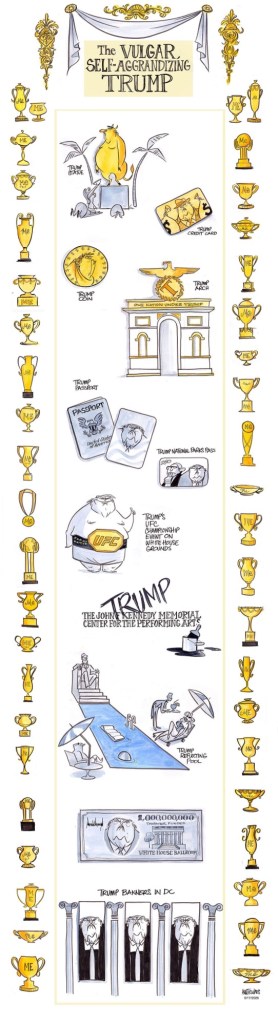
Republicans are eager to put Trump’s name and face wherever possible, both to please him and to acknowledge him as the Sun God of their party.

Two plans are under discussion. One, which appears likely to go into distribution, is to mint a $1 coin, whose image of Trump was approved by him, a handsome profile.

The other is a 24 karat gold coin that would be minted to mark the 250th anniversary of the nation. It would be sold for thousands of dollars and would be super-sized, as much as 3″ across.

However, the gold coin is controversial. It is supposed to be approved by two commissions. The first one rejected the idea because putting the face of a living President on a coin seemed to them akin to a king, not appropriate for a democracy.

The second commission, stocked with Trump allies, is enthisisstic about the gold coin.

Dan Diamond of The Washington Post wrote:

A federal arts commission on Thursday voted to approve a commemorative U.S. gold coin featuring Donald Trump, the administration’s latest effort to celebrate the president, even as Democrats and members of another federal committee say the idea is deeply inappropriate and potentially illegal.

The proposal calls for a 24-karat gold coin depicting Trump leaning on a desk with clenched fists, based on a photograph taken by his chief White House photographer and now displayed in the Smithsonian’s National Portrait Gallery. Such gold coins from the U.S. Mint typically sell for several thousand dollars. A Mint official told the panel that Trump had personally approved the design.

Members of the Commission of Fine Arts — composed entirely of Trump appointees, including a 26-year-old executive assistant whose only listed credential for the post was managing Trump’s portrait project — spent several minutes discussing potential changes to the coin, including how big to make it, before officially endorsing it.

“I think the larger the better, and the largest of that circulation, I think, would be his preference,” said Chamberlain Harris, Trump’s executive assistant. Harris also said that the image captured Trump looking “very strong and very tough” and that it would be “fitting” to have him on a coin to mark the nation’s 250th anniversary.

James McCrery II, who served as Trump’s first architect on his planned ballroom before wrangling with the president over its size, encouraged Treasury officials to make the coin “as large as possible, all the way to three inches in diameter” as he led the vote to approve it.

But new coin designs are supposed to receive approval from two panels — and that second panel, the bipartisan Citizens Coinage Advisory Committee, refused last month to consider the proposed gold coin. In interviews, members opposed putting a sitting president on currency, saying it would break with democratic norms and reek of subservience to royalty.

“It’s wrong. It goes against American culture and the traditions that drive what we put on our coinage,” said Michael Moran, a Republican coin collector who then-Senate Majority Leader Mitch McConnell (R-Kentucky) recommended for appointment. “I didn’t sign up for this.”

Several members of the coin committee said the Trump administration could seek to mint the coin without their panel’s approval but would probably face legal challenges.

The coin committee is composed of numismatists, or experts in coin collecting, as well as a historian and an artist who specializes in medallic arts. Its most famous former member — retired basketball star Kareem Abdul-Jabbar, a longtime coin collector — said he was disheartened because he believed well-designed coins could inform and inspire. He cited as examples a 1998 silver dollar that honored Crispus Attucks, who was enslaved, escaped and was killed in the Boston Massacre in 1770, and a 2017 gold coin that depicted Lady Liberty as an African American woman.

“I’m not enthusiastic about memorializing Mr. Trump on a coin because he has done so much damage to our country,” said Abdul-Jabbar, who served on the committee a decade ago. “It takes a huge consensus to get agreement on something like this, and I’m not inclined to be supportive of the president’s request.”

The White House did not respond to questions about the commemorative coin and whether it was appropriate to commission it. The Treasury Department, which oversees the Mint, said the commemorative coin was appropriate for this year’s anniversary.

“As we approach our 250th birthday, we are thrilled to prepare coins that represent the enduring spirit of our country and democracy, and there is no profile more emblematic for the front of such coins than that of our serving President, Donald J. Trump,” U.S. Treasurer Brandon Beach said in a statement.

Only one past president — Calvin Coolidge — was featured on a U.S. coin in his lifetime. Coolidge’s portrait appeared on a commemorative coin to mark the nation’s sesquicentennial in 1926, a year when he was president, with an image of George Washington overlaid. Coolidge’s inclusion sparked controversy, and most of the coins were later melted.

The Trump-themed gold coin marks the administration’s latest effort to shape U.S. currency. Officials last year proposed a separate $1 coin design featuring the president’s likeness, intended to honor the sesquicentennial and enter circulation, but the coin committee balked at taking up the proposal. Mint officials argue that because the committee declined to consider the coin, the administration is not bound by its review — a claim that current committee members dispute.

Meanwhile, the arts commission in January approved the Trump-themed $1 coin. The Treasury Department has not yet specified whether or when that coin will enter circulation.

A photograph of President Donald Trump, featured at the National Portrait Gallery, inspired the image used for the planned gold coin. (Maxine Wallace/The Washington Post)
Democrats have bristled at efforts to recognize Trump on currency and attempted to stop it. Sen. Catherine Cortez Masto (D-Nevada), one of several Democrats who introduced legislation last year intended to block any living or sitting president from being featured on U.S. currency, told The Washington Post that the Trump-themed gold coin was “embarrassing” and against the nation’s values.

“Monarchs and dictators put their faces on coins, not leaders of a democracy,” added Sen. Jeff Merkley (D-Oregon). Lawmakers and congressional staff have also cited past laws they say should constrain the administration, such as a 2005 law that restricted some $1 coins to honoring deceased presidents.

Donald Scarinci, a Democrat whom Senate Minority Leader Charles E. Schumer (D-New York) recommended to the coin committee, said that gold coins presented a “loophole” because the Treasury Department has the independent power, without congressional authority, to mint them.

“They can definitely make the coin without our review. But it would be an illegal coin,” Scarinci said. “It’s not about Donald Trump. It’s about whoever the president is. It’s not something done in a democracy.”

Trump has also sought to remake White House grounds, proposing a visitor screening center also under consideration Thursday and demolishing the White House’s East Wing to build his long-desired ballroom. His projects extend into Washington, with plans to construct a 250-foot triumphal arch along with other projects that would leave a physical imprint on the city.

The wrangling over the coin comes amid a bigger fight over how Trump and his allies are seeking to memorialize the 79-year-old president, with nearly three years remaining in his term. Trump’s deputies have put his name on buildings, such as the Kennedy Center and the U.S. Institute of Peace, drawing complaints from lawmakers and lawyers who say that only Congress can rename the facilities, and GOP lawmakers have proposed renaming Dulles International Airport after him.

Those efforts are generally unpopular, surveys have found. About two-thirds of Americans said they opposed efforts to rename Dulles Airport and the Kennedy Center after Trump, with about 15 percent in favor, according to an Economist/YouGov poll conducted last month. Majorities of Americans also said they opposed demolishing the East Wing to build the ballroom and erecting the triumphal arch, according to the poll.

Trump officials last year also scrapped designs for commemorative quarters that were approved in 2024 by the arts commission and coin committee, months before Trump took office, and would have honored Black Americans and notable women. Coin committee members said they were unhappy about the administration’s decision to instead issue quarters honoring the Mayflower Compact, Revolutionary War and the Gettysburg Address, calling the process flawed and the new designs lacking.

“The designs, the themes that they came up with for the quarters — that could have been done by a fifth-grade class on American history,” Moran said.

Coin committee members said they will continue to balk at considering currency with Trump’s face on it.

“I think all of us feel the weight of responsibility here,” Scarinci said. He noted that Trump fired holdovers on the arts commission and that the administration could do the same with the coin committee, whose members are appointed by the Treasury Department.

“They may fire us all,” Scarinci added. “They may replace us all to make this coin … but there’s a very high caliber of people on this committee, they know numismatics, and they know history, and they know this is wrong.”

Arts commissioners in January, at the first meeting of the reconstituted board, showed little compunction of their counterparts on the coin committee as they weighed the $1 coin and discussed Trump’s own preferences.

Two of the proposed designs “both remind me a little bit of that portrait that was done of the president, which he did not like,” said Roger Kimball, a critic that Trump named to the panel. But he praised another version that had “a statesmanlike quality, to the coif of the hair.”
The commission ultimately recommended that version.

Officials last year proposed a separate $1 coin design featuring the president’s likeness. The arts commission recommended this version in January. (U.S. Treasury)

Former KGB agent Vladimir Putin was hand-picked by Boris Yeltsin as his successor. Yeltsin was a drunk, and he miscalculated badly in picking Putin. Instead of building democratic norms and institutions, Putin embarked on a long-term plan to restore the USSR. After serving as president of Russia from 2000-2008, he was succeeded by a puppet (Dimitri Medvedev), then resumed the presidency in 2012. The national legislature extended his term to 2036. Anyone who seriously threatens him ends up in prison or dead.

In a startling development, one of Putin’s most strident sycophants abruptly turned against him. Ilya Remeslo, a lawyer, was known as a reliable lapdog for Putin. He regularly testified in trials against Alexei Navalny.

Pjotr Sauer wrote in The Guardian:

For years, Ilya Remeslo was a reliable pro-Kremlin operator, going after critics of the regime and smearing independent journalists, bloggers and opposition politicians.

Then the 42-year-old lawyer abruptly turned on the country’s most powerful man. Late on Tuesday, Remeslo posted a manifesto to his 90,000 Telegram followers titled: “Five reasons why I stopped supporting Vladimir Putin.”

In it, he accused the “illegitimate” Russian president of waging a “failing war” in Ukraine that had caused millions of casualties and wrecked the economy, and argued that Putin’s more than two decades in power illustrated how “absolute power corrupts”, calling on him to step aside….

Doubling down on his earlier remarks, he told the Guardian on Wednesday from his flat in St Petersburg: “Vladimir Putin should resign and be put on trial as a war criminal. His personalised, corrupt system is doomed to collapse, as we’re seeing now with the war in Ukraine and elsewhere.

“The army isn’t advancing in Ukraine, and the war is going nowhere. There are massive losses. We are fighting over tiny territories that will ultimately give Russia nothing.”

He went on to criticise Putin’s authoritarian rule, the state of the economy and Moscow’s recent push to shut down internet access. “This man [Putin] has destroyed everything he could lay his hands on. The country is literally falling apart,” Remeslo said.

Please open the link and finish reading this fascinating article.

I was delighted to see that the very popular Heather Cox Richardson invited Josh Cowen to talk about the ominous spread of vouchers. HCR made clear that public schools are an essential element in building a society that is educated to sustain democracy.

The voucher movenent, on the other side, has turned into a means of building a society that sustains the white Christian nationalism of its funders.

It’s a valuable discussion, and I hope you will watch and listen.

Here is the link.

The Century Foundation published an analysis of Trump’s federal voucher program, which explains why it is a hoax and a fraud. The authors are Kayla Patrick and Loredana Valtierra.

The promise it makes is that families and students will choose schools that are just right for them, but the reality is that schools choose the students they want.

The promise is that school choice will benefit black and brown children, as well as children with disabilities, but children abandon all civil rights protections when they enroll in private schools.

The promise is that schools of choice will produce better academic outcomes but typically they produce worse outcomes (see Josh Cowen, The Privateers).

The promise is that school choice represents accountability but it usually means no accountability at all, because nonpublic schools don’t take national or state tests.

Kayla Patrick and Loredana Valtierra write:

Modern school voucher programs are often framed as a response to declining academic achievement and a way to expand “parent choice” by enabling private educators to operate within the public system. But in practice, vouchers operate quite differently than advertised. It’s the private schools, not families, who ultimately decide who enrolls, and they do so outside the accountability systems that govern public education and public dollars and ensure every student has equal opportunity to learn.

The Federal Tax Credit Scholarship Program (FTCS), passed as part of the Republican Party’s “One Big Beautiful Bill” (OBBBA), scales this model for camouflaged privatization to the national level. Though branded as a tax incentive, it functions as a nationwide voucher system that diverts public dollars to private schools while allowing those schools to play by different rules than public providers—evading civil rights protections, academic oversight, and any requirement to provide meaningful evidence to the public of their students’ outcomes.

A National Voucher Program Disguised as a Tax Credit

The FTCS nationalizes a model that at least twenty states and counting –including Arizona, Georgia, Louisiana, and Pennsylvania – have already adopted, one which functions by siphoning public dollars through scholarship granting organizations (SGOs). Under this law, individual taxpayers can donate up to $1,700 annually to SGOs in exchange for a 100 percent federal tax credit, effectively turning private donations into reimbursed public expenditures.

SGOs then will distribute “scholarships” to K–12 students to use toward private school tuition, books, curriculum materials, tutoring or other educational classes, and educational therapies provided by licensed providers. While the program is optional for states, at least twenty-seven have already signaled their intent to participate.

[To see which states have expressed their intent to participate, open the link.]

Despite its branding, this design drains public revenue that would otherwise support public schools—which still educate roughly 90 percent of American students—and redirects it to private, religious, and largely unregulated providers. 

The program model also ignores what parents time and again have told us they want for their children. When given a direct choice at the ballot box, voters have repeatedly rejected school vouchers and related private-school subsidy measures. In the 2024 election, proposals to authorize or expand voucher-style programs in Colorado, Kentucky, and Nebraska were defeated, and historical ballot measure data show that voters have rejected every statewide private voucher or education tax credit initiative placed before them since 1970. This opposition is reflected in polling that shows nearly 70 percent of voters say they would rather increase federal funding for public schools than expand government-funded vouchers, including majorities across party lines.

[Open the link to see which states have held referenda on vouchers.]

Broad Eligibility, Few Quality Controls, and Limited Public Benefit

Even measured against its stated goal of affordability, the FTCS program misses the mark. But if the goal is to make education more affordable for families under real financial strain, this program is also ineffective. Private K–12 tuition averages nearly $13,000 per year nationwide, placing private schooling out of reach for many families even with a modest subsidy. Yet the tax credit is not targeted to families facing affordability pressures. It allows households earning up to 300 percent of area median income to qualify, a threshold that would make roughly 90 percent of U.S. households eligible. In high-income regions, families earning as much as $500,000 per year could receive publicly subsidized support for private education, while in a city like New York—where median income is about $81,000—families earning nearly $244,000 would qualify. At a time when families are struggling to afford groceries, housing, and child care, this program directs public dollars toward a limited use—private education subsidies for households that largely do not need the financial help—rather than toward measures that would help most families, like lowering child care or housing costs.

At a time when families are struggling to afford groceries, housing, and child care, this program directs public dollars toward a limited use—private education subsidies for households that largely do not need the financial help—rather than toward measures that would help most families, like lowering child care or housing costs.

At the same time, the program imposes no meaningful accountability requirements on participating schools. There are no academic performance standards, no transparency obligations, and no requirement to evaluate outcomes. In contrast to nearly every other federal program serving children, from Title I to Head Start, this is public spending without public oversight. Federal programs historically are monitored for fiscal, quality, and sometimes for safety compliance by the agency with charge over the program. In this case, U.S Department of Education (ED) expertise plays no role in oversight of new national policy for education.1

What State Leaders Can and Cannot Control

FTCS offers a tempting hook for well-intentioned state policymakers as well: Some governors and state legislatures may view the tax credit as a way to unlock new resources for priorities like tutoring or after-school programs. In practice, however, it offers no new, flexible funding for states and gives them little control over how public dollars are used. The law defines “scholarship-granting organizations” so broadly that states cannot meaningfully restrict eligibility, set standards, or influence whether funds flow primarily to high-cost private schools rather than unmet public needs.

Once a state opts in, its role is largely administrative and unfunded. States receive no resources to carry out oversight, cannot impose safeguards, and must submit eligible organizations to the U.S. Treasury without authority to shape program design or accountability. Far from being additional education funding that states need, opting in requires that states absorb the fiscal, administrative, and equity consequences of a federal program they are unable to direct or correct. It is not “free money” for states. The opt-in decision is therefore the only meaningful leverage states have—and governors should use their right to refuse to play along in order to protect their public education systems.

Why Oversight and Accountability Matters

Public funding should never function on a good-faith system. It’s very simple: in good policymaking, whenever taxpayer dollars are allocated, oversight measures are put in place to make sure those dollars are spent in the way intended. We already know from numerous examples in the school choice policy space itself that no accountability means that those who need the help the least receive the most benefit.

Eighteen states have a universal private school choice program. Unfortunately, states that have expanded vouchers or education savings accounts with minimal oversight have already seen waste, fraud, and abuse. Arizona’s universal Empowerment Scholarship Account (ESA) program, for instance, has minimal controls, audit practices that automatically approve reimbursements, and has been linked to purchases of non-educational items like diamond rings, televisions, and even lingerie with taxpayer funds, prompting investigations by the state attorney general. Rather than lowering costs for families, the program has generated ballooning expenses for the state and contributed to a growing budget crisis—with no measurable benefit to students at all.

Similarly, the federal Charter Schools Program has repeatedly been shown to lack meaningful accountability, with investigations and audits documenting hundreds of millions of dollars wasted on schools that never opened or closed prematurely, and charter networks facing conservatorship over financial mismanagement and self-dealing. These outcomes are the predictable result of public dollars flowing to private operators without meaningful oversight.

Decades of research on voucher programs show mixed or negative academic outcomes, particularly in math and reading, and no evidence that vouchers close opportunity gaps. In Louisiana, Indiana, and Ohio, studies found declines in student achievement following expansions in voucher programs. Students in Louisiana’s voucher program experienced drops in both math and reading in their first two years, while voucher students in Indiana and Ohio performed worse than comparable peers who remained in public schools. 

The program nationalizes an unproven experiment while insulating it from the very safeguards that exist to protect students and taxpayers alike.

Taken together, these examples underscore why oversight and accountability are not optional when public dollars are at stake. The FTCS program includes no meaningful accountability, evaluation, or research requirements to justify an estimated $26 billion cost to taxpayers. Without data on student learning, fiscal integrity, or long-term outcomes, the public has no way to assess whether this investment is helping students or simply reshuffling them across systems while diverting resources away from the public schools that serve most children and toward unknown corporate interests.2 In effect, the program nationalizes an unproven experiment while insulating it from the very safeguards that exist to protect students and taxpayers alike.

Who Profits When Public Dollars Become Private Subsidies?

Another consequence of turning public education dollars into private subsidies is that it creates a lucrative marketplace for the companies that manage these voucher systems. A handful of firms have seized on state voucher expansions to secure multimillion-dollar contracts, turning what was pitched as a cost-saving policy into a business opportunity for tech and finance intermediaries. These companies often have limited experience running education programs, and in some states have faced scrutiny over operational problems, questionable spending controls, and high administrative costs. 

This track record raises questions about whether families truly benefit from FTCS’s model. It would seem the opposite: it diverts taxpayer dollars into private profit streams instead of lowering education costs for struggling families. Instead of more wasteful government contracts, these dollars should be used to improve neighborhood schools by hiring high-quality educators, increasing after school programs, expanding pre-K, and hiring mental health professionals.

A Tax Policy Not Designed to Support Education

Congress gave sole interpretive authority for this program to the U.S. Treasury Department, deliberately excluding the U.S. Department of Education and its education-specific expertise. As a result, a major national education policy will be implemented through the tax code, with limited attention to accountability, equity, or educational impact. While advocates have urged the Treasury Department to include stronger transparency, safeguards, and state authority, it is unlikely those measures will be adopted to address the program’s core design flaws.

This use of the tax code stands in sharp contrast to prior policies that successfully supported children and families. The 2021 expanded Federal Child Tax Credit helped to lift more than 2 million childrenout of poverty and reduced the country’s child poverty level to a historic low of 5.2 percent. This program will likely do the opposite. Research shows that private school voucher programs disproportionately benefit wealthy families. Consistent with many other provisions in the law, Congressional Republicans have chosen to prioritize a tax break that disproportionately benefits the wealthy, over nearly every other form of charitable giving, such as donations to food pantries, hospitals, or community services.

By incentivizing families to exit public schools, the voucher tax credit also undermines the financial stability of those schools, particularly in rural and high-need communities. Because education funding is largely enrollment-based, even modest shifts can lead to school closures, consolidations, and reduced services. This leaves behind those families who don’t have the time or resources to navigate private systems, and asks taxpayers to reimburse private donations on top of existing public education costs.

Civil Rights Protections Are Excluded

Public schools that receive federal funding are required to comply with federal civil rights laws, including Title VI and Title IX of the Civil Rights Act, the Individuals with Disabilities Education Act (IDEA), and Section 504 of the Rehabilitation Act. In 2024, ED received 22,687 civil rights complaints, including about 8,400 related to disability discrimination, reflecting just how often students and families rely on these protections. 

These laws require schools to take corrective action to prevent and respond to discrimination, provide accommodations and services to students, investigate complaints, and offer families meaningful avenues for recourse. This is what public accountability looks like in practice, and its success depends on ED’s legal authority and the staff capacity to respond when families ask for help.

By contrast, the OBBA does not require scholarship-granting organizations or the private schools and programs they fund to comply with these federal civil rights protections, even though they benefit from publicly subsidized dollars. This means that if a student experiences harassment or discrimination based on race, national origin, sex, religion, or disability, families may have little or no ability to hold private schools accountable or seek remedies comparable to those guaranteed in public schools.

Evidence from state voucher programs shows why this gap matters. An investigation in North Carolina found that voucher funds flowed to private schools that were significantly whiter than the communities they serve, reinforcing racial segregation rather than expanding opportunity. In the absence of enforceable civil rights guardrails, public funding supports exclusionary practices that would be unlawful in public schools.

The Cost to Public Schools and Communities

Ultimately, this voucher/tax credit perpetuates a broader pattern of states, in addition to the federal government, stepping back from their responsibility to fully fund and strengthen public schools. Rather than address the systemic problems that perpetuate low-performing schools, it treats educational inequity as a series of individual problems to be solved by sending public dollars to private education. No matter how the administration spins it, these programs fail to prioritize students from lower-income families while simultaneously subsidizing private education for higher-income families. It invites taxpayers to feel as though they are helping children access opportunity, while leaving the underlying inequities in public education unresolved and, in many cases, deepened.

[Open the link to see data on source of insurance.]

This tax credit is projected to cost $26 billion, which is a high price tag that instead could be doing real good in public schools. If Congress instead invested this through Title I, that money would amount to roughly $1,238 per student in schools serving low-income communities. Research shows that investments of this size improve reading and math outcomes. In other words, we know how to use public dollars to help students succeed. This policy chooses not to.

Imagine putting that $26 billion, the lowest estimated cost of the tax credit over ten years, toward Title I, the federal program that benefits most public schools. That would more than double Title I’s current funding at $18.4 billion. Title I’s flexibility allows schools to meet their specific needs to improve student achievement: more teachers, aides, professional development, wraparound services, and more. 

IDEA is supposed to fund 40 percent of each student’s special education each year, but the federal government has never met that promise. Current funding at $14.2 billion amounts to less than 12 percent of the promise. However, adding $26 billion to IDEA would almost triple current funding and completely close the gap. 

We know that the unprecedented funding from the American Rescue Plan and other COVID relief packages will make a major return on investment: every $1,000 invested per student will be worth $1,238 in future earnings. That funding also required states to at least maintain their education budgets at prior funding so that the federal investment would not replace their responsibility and effort, but work together. The FTCS model completely disregards these precedents, and their values.

The Federal Tax Credit Scholarship Is a Heist Taken Straight from the Right’s Privatization Playbook

The Federal Tax Credit Scholarship program follows a familiar privatization strategy. It routes public dollars to private actors while stripping away the oversight, transparency, and civil rights protections that normally accompany public investment. Framed as generosity and choice, it instead creates a system in which taxpayers assume the cost while private schools and intermediaries operate largely beyond public accountability.

The program recreates many risks at a national scale. The schools and organizations receiving these publicly subsidized funds are not required to demonstrate academic results, comply with federal civil rights law, or provide transparency about how dollars are spent. Families are left without protections, taxpayers without accountability, and policymakers without evidence that the investment is improving student outcomes.

When public dollars are transformed into lightly regulated private subsidies, they invite exploitation. The Federal Tax Credit Scholarship is not an isolated policy choice: it follows a pattern of policies that weaken, and normalize weakening, public education while insulating private actors from responsibility. History shows where this path leads: higher costs, weaker safeguards, and fewer assurances that public investments serve the public good.

Notes

  1. The Trump administration has taken multiple actions to reduce the role of the U.S. Department of Education, including firing staff and reassigning education programs and staff to other agencies through interagency agreements (IAAs) without congressional authorization. Such actions raise legal and governance concerns and further erode the education-specific expertise, oversight, and accountability that Congress has historically vested in ED.
  2. Under the OBBA, the federal tax credit for contributions to SGOs applies to individual taxpayers. The law does not provide separate federal tax credit rules for corporate contributions; whether and how corporations might participate or benefit may depend on future Treasury and IRS regulations and state tax policies. Many states currently allow corporate contributions to SGOs.
Read more about Kayla Patrick

Kayla Patrick, Contributor

Read more about Loredana Valtierra

Loredana Valtierra, Contributor