The Meidas+ blog summarized the daily drama of the Trump administration:

Donald Trump woke up to a flurry of bad headlines and poll numbers that tell a story of political collapse and economic mismanagement. The latest Gallup poll found that Americans now trust Democrats over Republicans to “keep the country prosperous,” by a margin of 47% to 43%. Just a year ago, Republicans led that same question by 13 points. That’s a 17-point swing, a direct reflection of Trump’s disastrous leadership.

At the same time, the Wall Street Journal reported that the Treasury Department has quietly instructed its employees not to share photos of the ongoing “ballroom construction” at the White House, a project that has already led to the demolition of parts of the East Wing. Treasury officials, whose building sits adjacent to the White House, reportedly have a front-row view of what can only be described as desecration.

Then there’s the economy. Small businesses across the country are sounding the alarm over Trump’s tariffs, which economists have called “a massive warning for the economy.” The Chamber of Commerce has even sued the Trump administration over a new $100,000 H-1B visa fee, another policy that is crippling American companies while pretending to protect them. A coalition of businesses is also urging the Supreme Court to strike down Trump’s global tariffs, calling them an “illegal $3 trillion tax” on American industry.

Bloomberg published yet another damning report, this one declaring: “The U.S. has no China policy, no strategy, and no clue.” The analysis described the Trump administration’s foreign policy as “strategic schizophrenia.” I would remove the word “strategic.” It’s just schizophrenia. And it’s emblematic of why Trump bankrupted so many businesses before he ever entered politics.

Meanwhile, as the fragile ceasefire between Hamas and Israel unravels, Trump posted a rambling and incoherent statement on social media, boasting that “numerous of our now great allies in the Middle East… have explicitly and strongly with great enthusiasm” agreed to his plan to “straighten our Hamas” (yes, his post included that typo). The sentence barely makes grammatical sense, but it’s clear he’s once again playing geopolitical pyromaniac, praising autocrats, confusing facts, and stoking instability for his own image.

Even Trump’s running mate, JD Vance, couldn’t hide the corruption when asked about the ceasefire. “Well, Jared’s the investor,” Vance replied. Excuse me? That’s a stunning admission that Jared Kushner, Trump’s son-in-law, has personal financial stakes in the region. Just as we’ve been saying.

The chaos doesn’t stop there. While China builds the world’s largest solar farms, Trump has canceled approval for a 6.2-gigawatt clean energy project in Nevada, gutting American leadership in the global renewable market. The New York Times reported that Chinese companies now produce 60% of the world’s wind turbines and 80% of its solar panels — a direct result of Trump’s assault on climate policy.

And back in Washington, MAGA Republicans continue to hold the government hostage, refusing to fund healthcare subsidies for 20 million Americans. “We don’t have a strategy,” Speaker Mike Johnson admitted during a press conference. When confronted about the health care crisis, he even blamed the Affordable Care Act for existing, rather than the Republican sabotage that is threatening to bankrupt working families.

As if the day couldn’t get darker, news broke that a pardoned January 6 rioter, Christopher Moynihan, was arrested for threatening to assassinate House Democratic Leader Hakeem Jeffries. Trump personally pardoned him.

Yet amid this chaos, Trump has found time to announce $40 billion in U.S. funds to Argentina, a move that has already failed to stabilize that country’s currency, enriching Trump-aligned investors while Americans struggle to pay rent and afford groceries.

And now, he’s calling for the U.S. to import beef from Argentina, abandoning American cattle ranchers just as he’s betrayed soybean farmers.

This is what happens when corruption replaces competence. When narcissism replaces governance. When a con man mistakes the Oval Office for a casino floor.


Today is the official publication date of my memoirs. This evening, October 21, I will be in dialogue with Leonie Haimson at the Brooklyn Heights branch of the Brooklyn Public Library, at 286 Cadman Plaza.

I wrote stuff about my personal life that I have never shared with anyone. It seemed to be the right time; easier to write about than to say, even to my closest friends and relatives.

The Network for Public Education posted this information:

Diane’s new book, charter scandals, and more…

Diane Ravitch’s memoir is a moving chronicle of intellectual courage and deep care for public education. Once a leading conservative voice advocating testing, standards, charters, and vouchers, she had the humility to acknowledge when her beliefs failed in practice, recognizing that poverty—not “bad teachers” or “failing schools”—was the real crisis. With honesty and grace, Diane retraces her journey from her Houston childhood to her service in the government, including a stint in the conservative Department of Education, and her eventual transformation into one of our fiercest defenders of public schools. Blending personal reflection with a historian’s rigor, Diane explains how she came to embrace equity, professional teachers, and democratic public education, becoming an inspiring activist whose life’s work continues to uplift the promise of our public schools.

You can purchase An Education at your local independent bookstore, on Amazon, or directly from Columbia University Press. 

I have been to the White House on several occasions. I first went there for a State Dinner in 1965 when Lyndon B. Johnson was President. I was there as a guest on several other occasions. Every time, I was in awe, star-struck. I felt as though I was walking on hallowed ground. I tried to hold onto every minute, wishing I could stop time.

And now a coarse vulgarian lives there, who has horrible taste. He paved over the Rose Garden. He hung gold-sprayed shlock from Walmart all over the Oval Office.

And now he is demolishing the East Wing to replace it with a ballroom for 999 people. The ballroom will be larger than the White House.

Trump doesn’t understand that the White House belongs to the people, not to him.

He said that the ballroom would not interfere with the White House. He lied.

He has no respect for the White House or its history.

This makes me sad. It makes me sick.

He waited until after #NoKings Day to desecrate the People’s House.

Donald Trump is a vandal.

Trump and his administration are determined to impose their rightwing agenda on the nation’s colleges and universities. They have withheld federal funding for scientific and medical research, using that money to demand compliance.

Trump and Secretary of Education Linda McMahon, former wrestling entrepreneur, recently rolled out their “Compact for Academic Excellence in Higher Education.”

The Compact asked universities to pledge to do the following:

  1. When admitting students, institutions must not take such factors as “sex, ethnicity, race, nationality, political views, sexual orientation, religious associations, or proxies for any of the foregoing into account, unless they are institutions “solely or primarily comprised is students of a specific sex or religious denomination.”
    Therefore, no factor such as sex, ethnicity, race, nationality, political views, sexual orientation,
  2. Institutions shall have all undergraduate applicants take a widely-used standardized test (i.e. SAT,
    ACT, or CLT) or program-specific measures of accomplishment in the case of music, art, and other
    specialized programs of study. Universities shall publicly report anonymized data for admitted and rejected
    students, including GPA, standardized test score, or other program-specific measures of accomplishments,
    by race, national origin, and sex.
  3. To protect a vibrant marketplace of ideas, the signatories agree to foster ideological and political diversity and to “transform or abolish” institutional units that punish, belittle or spark violence against conservative ideas.
  4. In hiring faculty and administrators, signatories shall not take into account race, gender, nationality, etc.
  5. Women and men must be accorded separate and appropriate facilities, meaning trans people don’t exist.
  6. Universities must agree to accept no more than 15% of their students from foreign countries and no more than 5% from any one country. They must also screen them to be sure they are not “anti-American.”

There is much more. Read the text of the 10-page document. It represents a very large degree of government intervention in the affairs of universities. And raises the question: who will police all these requirements?

The administration asked nine institutions to sign on to the Compact. So far, seven of the nine said no. The seven recognized that they were being asked to give up academic freedom and institutional independence in return for a guarantee of future funding.

The administration initially invited nine universities (on or around early October 2025) to accept the Compact:

These are the nine:

Massachusetts Institute of Technology (MIT) 

Brown University 

Dartmouth College 

University of Pennsylvania (Penn) 

University of Southern California (USC)

University of Virginia (UVA) 

University of Texas at Austin (UT Austin) 

University of Arizona (UArizona) 

Vanderbilt University 

MIT was first to say no. Within a few days, the Compact was rejected by Penn, USC, Brown, Dartmouth, UVA, and–most recently– the University of Arizona.

Currently, only the University of Arizona and Vanderbilt are holdouts and are engaging in “dialogue.”

A group of scholars from different political perspectives explained their opposition to the Compact in an article that appeared in The Chronicle of Higher Education.

The article was co-written by Robert P. GeorgeTom GinsburgRobert C. PostDavid M. RabbanJeannie Suk Gersen, and Keith E. Whittington.

We write as scholars of academic freedom to respond to the proposed “Compact for Academic Excellence in Higher Education.” We are politically diverse and do not share common views about the wisdom of particular proposals contained in the compact. Nor do we agree on the extent or substance of the reforms needed in American higher education today. We are, however, united in our concern about key features of the proposed compact.

The compact’s demands that universities and colleges eschew foreign students with “anti-American values” and that they impose a politically determined diversity within departments and other institutional units are incompatible with the self-determination that colleges and universities must enjoy if they are to pursue their mission as truth-seeking institutions. So also is the compact’s demand that universities and colleges select their students only on the basis of “objective” and “standardized” criteria. Colleges may of course voluntarily elect exclusively to deploy objective criteria (such as standardized-test scores and high-school or college grade-point averages), but these standards should not be imposed on institutions which, operating within the law, wish to include consideration of nonquantifiable criteria in selecting students.

Furthermore, we believe that certain aspects of the compact violate core principles of academic freedom. Academic freedom comes with obligations and limitations, to be sure; its essence, however, involves the liberty of faculty within the bounds of professional competence to teach and to research as they choose. The architect of America’s public-private research partnership, Vannevar Bush, asserted that “scientific progress” requires “the free play of free intellects, working on subjects of their own choice, in the manner dictated by their curiosity for exploration of the unknown.” Some of us believe that colleges today are failing in important ways to promote independence of mind and protect academic freedom, but we are united in the conviction that an attempt to solve this problem by government intervention, even if in the form of conditions for eligibility for grants, will be counterproductive.

As recognized for over a century, faculty should be able to engage as individual citizens in extramural speech. Faculty should exercise these rights responsibly and professionally, but when they fail to do so, it is not the role of the government or the university to sanction them. Colleges that censor their faculty will quickly undermine the vibrancy and initiative so vital for teaching and research.

The power to punish extramural speech has been abused against both conservative and liberal speakers in the past. The requirement of the compact that universities and colleges censor students and faculty who voice support for “entities designated by the U.S. government as terrorist organization” imposes overly intrusive regulation of constitutionally protected speech.

Almost all colleges enshrine the basic principles of academic freedom in contractual agreements with faculty. Elements of the compact seek to use financial incentives to pressure colleges to break these contractual agreements. For a university to bend to this pressure and sacrifice the academic freedom of its faculty is to abandon constitutive institutional commitments essential to both education and the pursuit of knowledge.

Garry Rayno, veteran journalist, explains how New Hampshire’s politicians of both parties have failed to approve equitable taxes to educate the state’s children. The libertarians, who play a large role in the state legislature, would prefer to have no taxes at all. The Koch machine has funded candidates who oppose fair state funding. This does not bode well for the future of the state.

Rayno writes in IndepthNH:

The courts have spoken many times over the last three decades about the state’s public education system and its funding.

In the ensuring 30 years since the Claremont I and Claremont II decisions were released by the state Supreme Court, little has changed in a meaningful way.

The Claremont I decision simply said the state has a constitutional obligation to provide every child in New Hampshire with an adequate (or worthwhile) education and to fund it.

Claremont II was a tax decision that says the current funding system is unconstitutional because it relies on a tax that is not assessed on every property owner in the same way with the same rate. Under the New Hampshire Constitution state taxes have to be proportional and reasonable.

The Legislature has yet to address either of the two basic decisions — there have been others — in the most fundamental way.

In New Hampshire, property owners in a school district’s community or communities primarily pay for public education.

Property taxes of one kind or another pay about 70 percent of the cost of education, other state funding accounts for a little over 22 percent and federal money about 8.5 percent

The local property taxes pay for about 61 percent and the statewide education property tax for about 8 percent.

That does not all add up to 100 percent because there is other money raised through tuition, food and other local contributions and insurance settlements, etc..

The national average for state contributions to public education is about 47 percent or more than double what the state pays even with the statewide property tax.

What makes the state system unconstitutional and inequitable for both students and taxpayers is the over reliance on property taxes to pay for the bulk of the cost.

Local property taxes have varying rates across the state ranging from a little over $5 per $1,000 of valuation in New Castle and Moultonborough, to nearly $35 per $1,000 in Colebrook and Orford.

The statewide property tax is supposed to have the same rate for everyone in the state, but doesn’t because property wealthy communities retain the excess money they raise to pay for their students’ adequate education, and unincorporated places have negative local education property rates to offset what they would pay in statewide education property taxes.

That ought to be enough to acknowledge the system is broken, but it isn’t for lawmakers who frankly lack the political will to fix the system so that it is more equitable — I didn’t say fair — for both students and taxpayers.

Students whose parents are fortunate enough to live in a property wealthy community receive a more robust education than do those students whose parents live in a property poor community.

Likewise the parents and other property owners in the property wealthy communities pay far less in property taxes than those in property poor communities do to educate their children.

Judging from the bills filed for the upcoming session, most of the offered solutions tinker around the current system’s edges.

One interesting bill from Rep. Walter Spilsbury, R-Charlestown, proposes raising the statewide education property tax rate to $5 per $1,000 of equalized evaluation, producing more than $1 billion for public education to provide about $10,000 per student.

Currently the tax assessed for the 2025 tax year is $1.12 per $1,000 and the current per pupil state aid is $4,266.

His plan would have exemptions and offsets that essentially would mean the bulk of the collection would be on second homes and non-residential properties.

His plan would be very helpful to property poor communities that should see a significant reduction in their property taxes, but residents in property wealthy communities would see a hefty increase in their property taxes.

But like several other plans that use the statewide property tax as the base solution, it is still a property tax, which is the most regressive tax in the state’s quiver of levies.

Property taxes are not tied to a person’s income or resources, which can go up or down, while it does not. In fact, the trend is for property taxes to increase as the state downshifts more and more of its financial responsibilities to local government, which lawmakers do every time they have trouble balancing their budget, like they do now.

One shortfall of the state’s current tax system is it no longer has any mechanism to tax an individual’s wealth growth since it repealed the interest and dividends tax last year.

The tax was largely paid by individuals with investment income at the top 10 percent..

The state business profits taxes 7.5 percent of companies’ profits with multinational conglomerates paying the largest share.

The largest source of funds from the business enterprise tax comes from its assessment on all compensation paid or accrued, and also from the amount of interest paid and on its dividends.

But like property taxes, the BET has to be paid whether a company makes money or not.

Wealth generated by individuals is not taxed in New Hampshire, but it is for businesses and that is what makes New Hampshire an outlier to most other states and why billionaires and millionaires — or the oligarchs — want to use New Hampshire as an example for the rest of the country.

That is why the Koch Foundation and other similar organizations have poured millions into state elections over the last decade to place libertarian leaning Republicans in the State House in sufficient numbers to run the place.

The slogans are no new taxes at any cost which means much of the cost of public education has been shifted more and more to local property taxpayers.

At the same time, these oligarch-backed libertarians put a more than $100 million obligation on funds reserved for public education in the Education Trust Fund through the Education Freedom Account program.

That is money that could otherwise be used for public education.

Coming into the next session, the Republican leadership does not want to do what needs to be done if the state’s public education system is to be made more equitable for both students and taxpayers.

State lawmakers need to find another source of money to bring the state’s obligation to local children and property owners in line with what other states pay and provide.

That is what the New Hampshire legislature does not want to do and has not wanted to do — both parties — since the first two Claremont decisions were released three decades ago.

It is not as though New Hampshire cannot afford to live up to its constitutional obligation to its children and its property owners, it is one of the richest per-capita states in the country, it does not have the political will to live up to that obligation.

Until enough lawmakers are elected with a backbone, nothing will change. The state’s medium age will continue increasing, fewer and fewer children will call New Hampshire home, and more and more young adults will leave for greater opportunities elsewhere.

Under that scenario, New Hampshire is not a sustainable state going forward.

Garry Rayno may be reached at garry.rayno@yahoo.com.

Several days ago, Politico wrote about the scurrilous text messages shared by Young Republican leaders. When Vice President jD Vance was asked about the chat, he said in effect, “Boys will be boys.” Other GOP bigwigs had the same reaction. But the people in the chat group were not teenagers. They were adults in their 20s and 30s. The chat included racist, anti-Semitic, misogynistic, homophobic comments. One said “I love Hitler.”

It shows the attitudes that Trump has unleashed and encouraged among the younger generation of Republicans. They knew enough to worry what would happen if their chats ever went public. They knew.

But they also demonstrated what a fraud the Trump administration’s concern about anti-Semitism is. It’s a useful ploy, nothing more. People who actually care about anti-Semitism don’t make jokes about gas chambers.

Here’s an excerpt:

NEW YORK — Leaders of Young Republican groups throughout the country worried what would happen if their Telegram chat ever got leaked, but they kept typing anyway.

They referred to Black people as monkeys and “the watermelon people” and mused about putting their political opponents in gas chambers. They talked about raping their enemies and driving them to suicide and lauded Republicans who they believed support slavery.

William Hendrix, the Kansas Young Republicans’ vice chair, used the words “n–ga” and “n–guh,” variations of a racial slur, more than a dozen times in the chat. Bobby Walker, the vice chair of the New York State Young Republicans at the time, referred to rape as “epic.” Peter Giunta, who at the time was chair of the same organization, wrote in a message sent in June that “everyone that votes no is going to the gas chamber.”

Giunta was referring to an upcoming vote on whether he should become chair of the Young Republican National Federation, the GOP’s 15,000-member political organization for Republicans between 18 and 40 years old.

“Im going to create some of the greatest physiological torture methods known to man. We only want true believers,” he continued….

“Can we fix the showers? Gas chambers don’t fit the Hitler aesthetic,” Joe Maligno, who previously identified himself as the general counsel for the New York State Young Republicans, wrote back.

“I’m ready to watch people burn now,” Annie Kaykaty, New York’s national committee member, said.

The exchange is part of a trove of Telegram chats — obtained by POLITICO and spanning more than seven months of messages among Young Republican leaders in New York, Kansas, Arizona and Vermont. The chat offers an unfiltered look at how a new generation of GOP activists talk when they think no one is listening.

“I’m ready to watch people burn now,” Annie Kaykaty, New York’s national committee member, said.

The exchange is part of a trove of Telegram chats — obtained by POLITICO and spanning more than seven months of messages among Young Republican leaders in New York, Kansas, Arizona and Vermont. The chat offers an unfiltered look at how a new generation of GOP activists talk when they think no one is listening…

Together, the messages reveal a culture where racist, antisemitic and violent rhetoric circulate freely — and where the Trump-era loosening of political norms has made such talk feel less taboo among those positioning themselves as the party’s next leaders…

Mixed into formal conversations about whipping votes, social media strategy and logistics, the members of the chat slung around an array of slurs — which POLITICO is republishing to show how they spoke. Epithets like “f—-t,” “retarded” and “n–ga” appeared more than 251 times combined.

Vice President JD Vance laughed about the exchanges. Just the jokes that “kids” say, although these “boys” were adults.

The vice president suggested the real problem is the idea that an offensive joke can ruin a young person’s life.

“The reality is that kids do stupid things, especially young boys,” Vance said on “The Charlie Kirk Show.” “They tell edgy, offensive jokes. That’s what kids do. And I really don’t want us to grow up in a country where a kid telling a stupid joke — telling a very offensive, stupid joke — is cause to ruin their lives.”

Politico opined that the text message dust-up showed where the GOP is heading.

The hateful language has entered the GOP mainstream with no filters. One far-right blogger said the conversation was “tame” compared to the chatter on far-right sites. It’s no longer taboo to admire Nazis, Hitler, and gas chambers.

Peter Greene, the best education blogger ever, writes regularly for Forbes magazine. Hopefully, some of the nation’s business executives are learning about the for-profit entrepreneurs who have entered into the education “industry,”where they are profiting without doing much for students.

Greene recently wrote about the latest setback for the giant of the cybercharter industry. It’s now called Stride, but for many years it was K12 Inc. Top executives are paid millions of dollars. Profit, not learning, is its highest priority. Despite terrible academic results, low graduation rates, complaints about inflated enrollments, there are always school districts happy to host the cybercharter industry because the district gets a cut of the profits.

Greene writes:

Stride, a giant in the cyber charter school industry, was accused by a New Mexico school district of violating rules and regulations. Now a lawsuit alleges that Stride responded by mounting a coordinated attack on the district and its superintendent. 

In 2020, Gallup-McKinley County Schools contracted with Stride (formerly known as K12 Inc) to operate its New Mexico Destinations Career Academy. But the district alleges that the for-profit organization repeatedly cut corners, violated staffing rules, and inflated enrollment numbers. In May 2025, the school board voted to end the contract. 

“Our students deserve better,” said School Board President Christopher Mortensen in a press release.“This action is not sudden; it is the result of months of effort to address persistent issues with the contractor. We are taking this step to protect our students, uphold academic standards, and meet our obligations under state and federal law.”

Within months, the district had filed a complaint against Stride, charging them with fraud, unfair trade practices, civil conspiracy, and seven other counts. That lawsuit outlines the issues between Stride and the district. 

According to the complaint, Stride had continuing issues with meeting requirements for student-teacher ratios, having been notified as early as September 2023 that it was out of compliance. Special education teachers were over their permitted caseloads, and IEP students were not receiving their due process. Further, Stride failed to employ certified teachers, complete background checks, or provide state-mandated occupational and professional trainings to their staff. 

The district also alleges that Stride “retained nonexistent students on its rolls” and took school district funds for educating these ghost students. Stride failed to provide timely required communication with the district. Stride’s graduation rate, says the district, was “horrific,” with a graduation rate of 27.67% in 2024.

The district also claims that through it all, Stride has “ignored compliance requirements” and failed to produce a remediation plan. 

According to the suit filed by the district, a management representative of Stride came forward in May as a whistleblower, declaring that the increases in student-teacher ratios was “intentional… in order to increase profit margins.” The whistleblower reported that he made multiple attempts to inform upper management that Stride was out of compliance with state law, and asked for authority to hire the roughly 80 teachers needed. The Vice President of Finance, says the whistleblower, refused to authorize those hires. Instead, in a later meeting, the whistleblower was allegedly told that his “projected profit margin was too low.” He was directed to cut staff for the next year to meet projected profit margin.”

According to the whistleblower, Stride’s plans to deal with their troubles were not focused on meeting their obligations to the district. 

Instead, the whistleblower says, at an April meeting Stride’s Senior Vice President of School Development “Peter Stewart said the company should attack first publicly and Stride Inc. should develop a strategy for that” and that Stride CEO “James Rhyu said [to the group] that the Superintendent [for the School District] was in over his skis on this issue.” 

Alleges the district’s suit, ”Stride’s management, including the individual Defendants, engaged in and agreed to a civil conspiracy to cover up its misconduct and illegal activities acting, by and through its employees, agents and attorneys, in planning and engaging in a systemic public attack on the School District and its Superintendent of Schools to distract from its illegal activities and its breach of the contract with the Board of Education.”

And counter-attack they did. On April 22, the district sent Stride a letter charging it had “materially breached” its contract. On April 28, the company filed an ethics complaint against GMCS Superintendent Michael Hyatt, alleging that he had tried to leverage Stride’s contract with the district in order to secure a “lucrative position” with Stride. Hyatt had applied for a management position with Stride in 2024; the company declined to hire him.

The list of complaints by the district against Stride is long, but the theme is simple enough. 

Defendant Stride purposely and willfully disregarded the contractual requirements and the statutory and regulatory requirements in order to defraud the School District to increase its profits…

Defendant Stride, while obligated to provide a certain quality of education to students, disregarded its legal obligations with the sole intent to profit on the education of students that it was supposed to educate, and that profit was obtained illegally through the intentional 27 violations of State law, incomplete and false reporting of student data, withholding technical support and operating and manipulating student counts to include students who had been dropped, withdrawn or were excessively absent.

Asked for comment on the suit, a Stride representative directed me to the company’s suit-related web site which argues that the company has been working on an improvement plan, that their student-to-staff ratios are better than those reported by the district, and that “explosive growth” of NMDCA makes it hard to stay caught up with staffing. A reply to the district’s Aprill 22 letter contests virtually every point that the district has made about Stride’s performance. 

Since being cut loose from GMCS, Stride has re-opened NMDCA as a cyber charter school partnered with Charna Valley Independent Schools and Santa Rosa Consolidated Schools; a fact sheet from Stride says 3,000 students are enrolled, including 2,300 returning families. Those families, they say, are largely satisfied with the school. They also point out that many students enter the school short of credits, and that the majority of students are closing that gap. The Stride representative also sent a fact sheet alleging that GMCS is facing other legal problems. 

But Stride is no stranger to legal issues. It was founded in 2000 as K12 Inc by Ron Packard, former banker and Mckinsey consultant, and quickly became the leading national company for cyber schooling. One of its first big investors was Michal Milken. That investment came a decade after he pled guilty to six felonies in the “biggest fraud case in the securities industry” ending his reign as the “junk bond king.” Besides Milliken, Stride investors have included brothers Lowell and Larry Ellison, and BlackRock, founded by Larry Fink, whose brother Steve sits on the Stride Board of Directors.

In 2011, the New York Times detailed how K12’s schools were failing miserably, but still making investors and officers a ton of money. Former teachers wrote tell-alls about their experiences. In 2012. Florida caught K12 using fake teachers. The NCAA put K12 schools on the list of cyber schools that were disqualified from sports eligibility. In 2014, Packard turned out to be one of the highest paid public workers in the country, “despite the fact that only 28% of K12 schools met state standards in 2011-2012.”

In 2013 K12 settled a class action lawsuit in Virginia for $6.75 million after stockholders accused the company of misleading them about “the company’s business practices and academic performance.” In 2014, Middlebury College faculty voted to end a partnership with K12 saying the company’s business practices “are at odds with the integrity, reputation and educational mission of the college.”

In 2016 K12 got in yet another round of trouble in California for lying about student enrollment, resulting in a $165 million settlement with then Attorney General Kamala Harris. K12 was repeatedly dropped in some states and cities for poor performance.

In 2020, they landed a big contract in Miami-Dade county (after a big lucrative contribution to an organization run by the superintendent); subsequently Wired magazine wrote a story about their “epic series of tech errors.” K12 successfully defended itself from a lawsuit in Virginia based on charges they had greatly overstated their technological capabilities by arguing that such claims were simply advertising “puffery.”

The district is seeking compensatory and punitive damages from Stride. Four Stride executives are named in the suit in addition to Stride Inc itself. The court will decide who’s blowing smoke here. In the meantime, school districts continue to learn about the price of teaming up with aggressively for-profit partners. 

Apparently the earlier post was not live.

This is the YouTube version, showing Trump as a fighter pilot, literally dropping tons of excrement on #NoKings rallies. Note that Trump portrays himself wearing a crown.

Here is the CNN version, showing the peaceful rallies.

https://www.instagram.com/reel/DP-i6h1DoAa/?igsh=MWp2YXM5ZHAzdHZqYw==

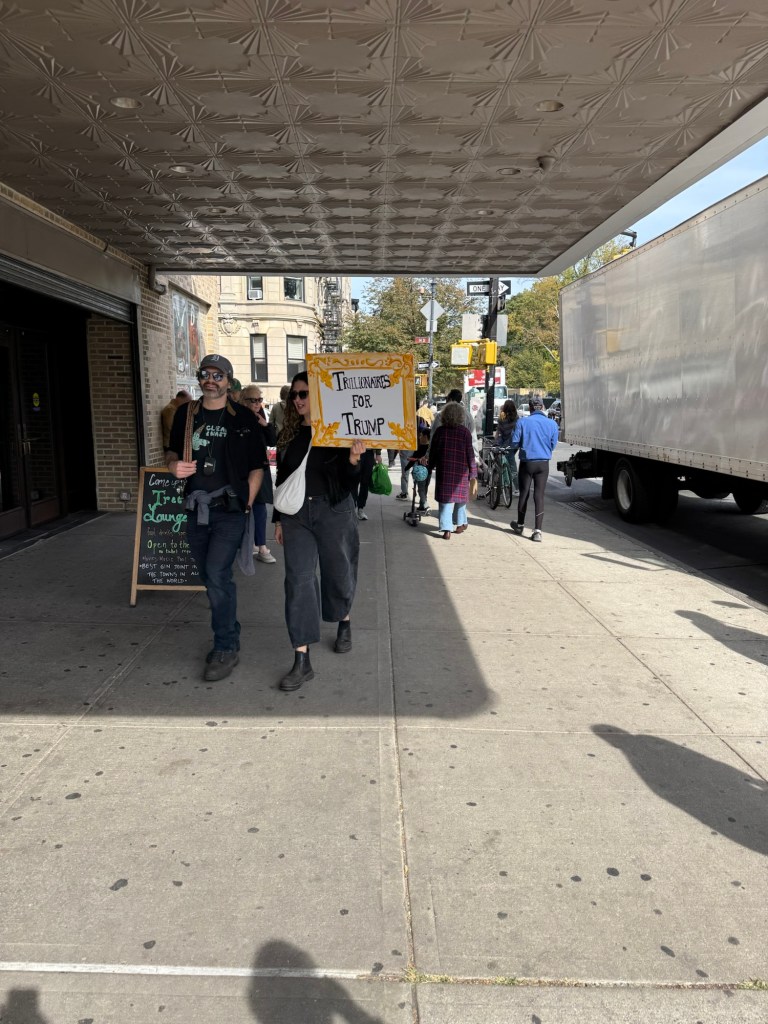
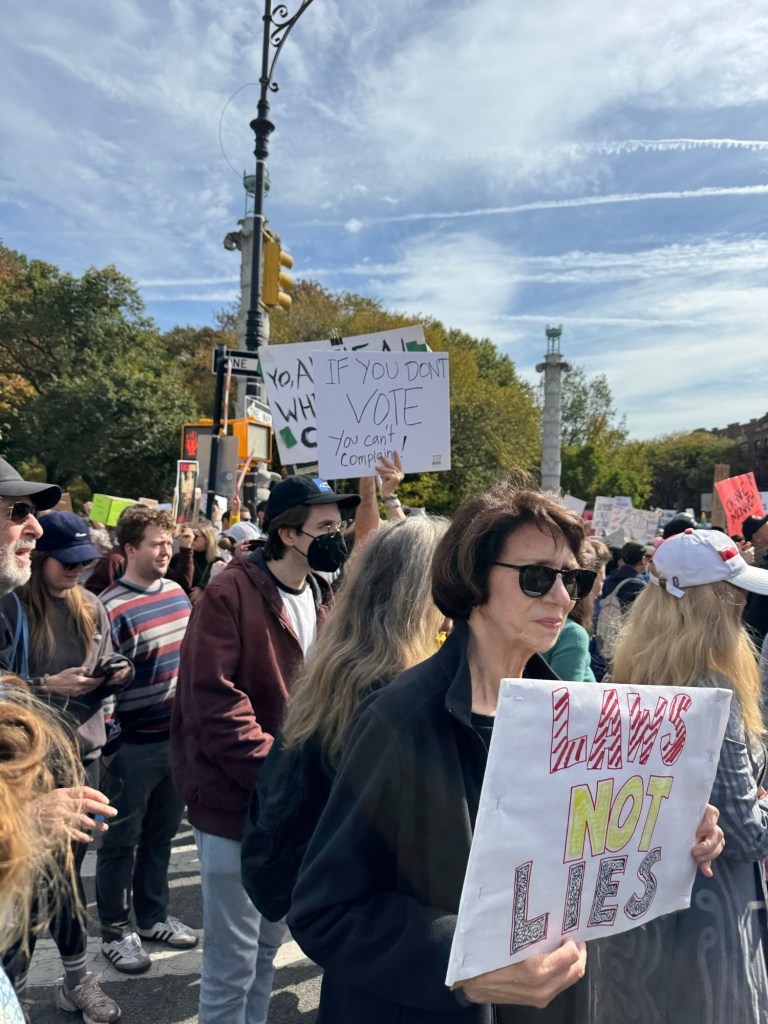
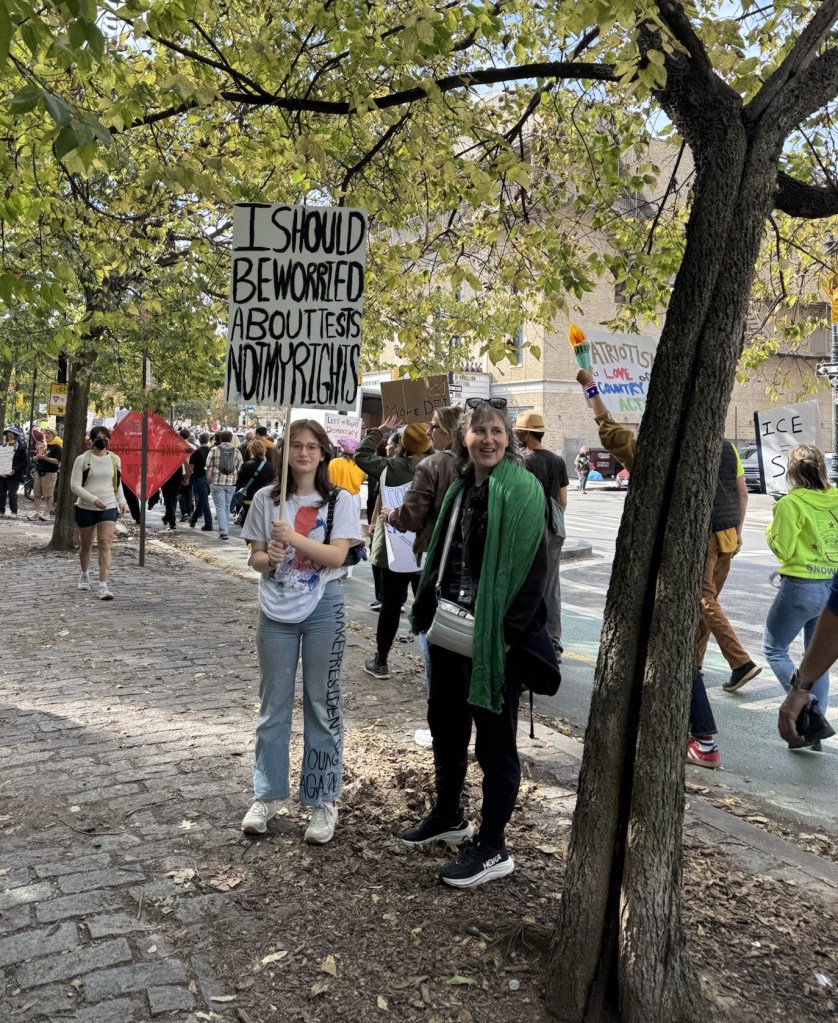
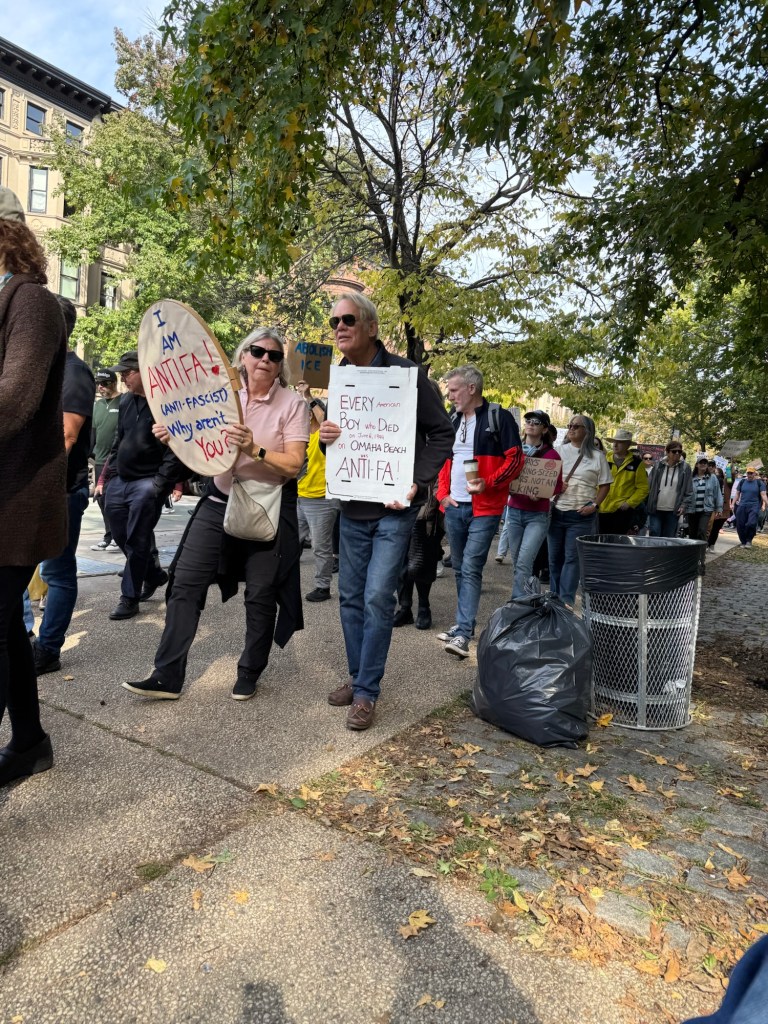
Thousands of people turned out to participate in the #NoKings March, which started at Grand Army Plaza and ended at the southern end of Prospect Park. We were surrounded by people carrying signs and chanting “Hey hey hi ho/Donald Trump has got to go.” Many signs were very clever. I couldn’t photograph them all.

I liked the little girl who had a sign that said, “I should be worried about tests/Not my rights.”