Ruth Ben-Ghiat is a history at New York University who specializes in fascism and authoritarian leaders.

She wrote:

Authoritarianism is about having the power to get away with crime, and waging a genocidal war against another country without othercountries intervening in ways that force a cessation of conflict counts as a big win in the autocrat world. In fact, from the minute they receive intelligence about a planned invasion, autocrats watch carefully to see what happens to transgressors of the international order–and adjust their own plans for aggression accordingly.

Allowing Russian President Vladimir Putin’s war of annihilation against Ukraine to continue by not giving Ukraine the arms it needs to definitively repel the Russian invaders increases the risk that other autocrats will ramp up their own imperialist aspirations. Autocrats interpret any ambivalence about shutting down their peers’ territorial expansions as license to proceed with similar aggressive acts.

History is clear about what happens in such cases. Most people are familiar with the folly of the September 1938 British and French-brokered Munich agreement, which allowed the Third Reich to annex the Sudetenland in Czechoslovakia six months after it annexed Austria.

Far fewer know about the earlier appeasement that set the stage for Hitler’s actions: Benito Mussolini’s war on League of Nations member Ethiopia, which started in October 1935. This was the biggest military operation since World War I, with Italy’s formidable air force dropping hundreds of tons of illegal chemical weapons on Ethiopians.

The weak sanctions levied on Italy by the League of Nations did not deter Il Duce from continuing to commit war crimes. He declared victory in May 1936, and occupied Ethiopia until the Allies drove the Italians out in 1941. “Was it ever likely to be effective?” Winston Churchill wrote critically of the sanctions in June. “Was it real or sham?” That same month, exiled Emperor Haile Selassie I denounced the war crimes to the League of Nations, but no action was taken against the Fascists.

By then, Mussolini’s admirer Hitler had all the information he needed about the consequences a despot might face for military aggression. In March 1936, while Mussolini’s war entered its sixth month, the Führer remilitarized the Rhineland, in violation of the Treaty of Versailles.

Twenty-first century autocrats watch their kindred spirits’ fates with equal interest. Since the start of Putin’s war on democratic Ukraine, the world has become far less safe. A few weeks before the Russians invaded, Putin and Chinese head of state Xi Jinping issued a joint statementabout the new “multipolar” era of international relations. The premise of this new era –unrestrained imperialism for Russia and China– has become all too clear.
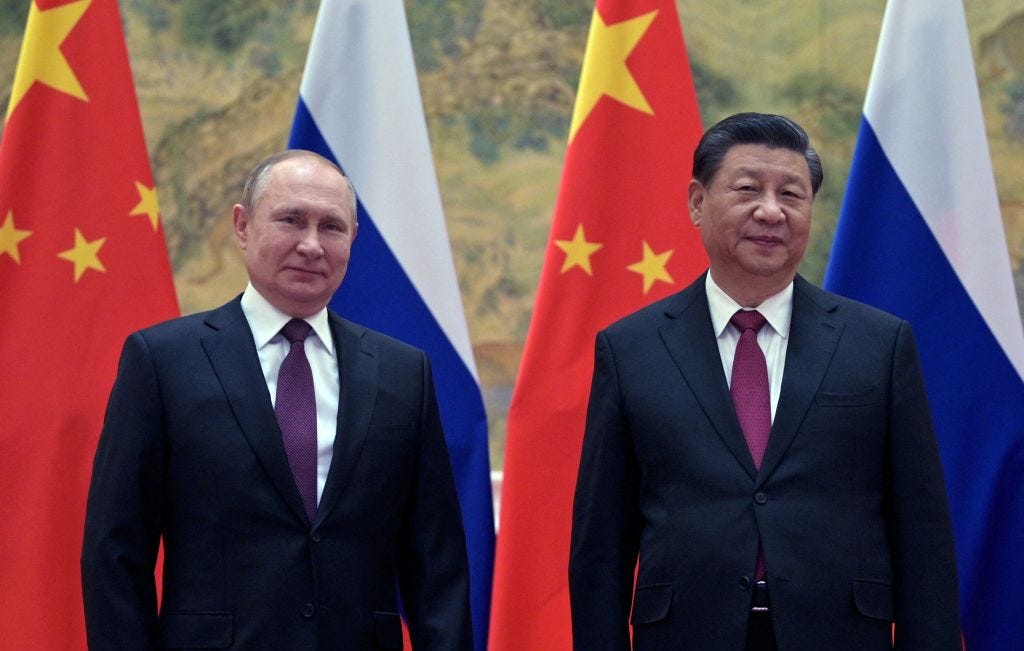
Russian President Vladimir Putin and Chinese President Xi Jinping together in Beijing, Feb. 4, 2022. Alexei Druzhinin/Sputnik/AFP/via Getty Images

Xi Jinping has since become far more aggressive towards the West. His government has increased its rhetoric about its imperialistic claims on Taiwan. He has consolidated his personal power with a third term, while further puffing up his personality cult in ways not seen among Chinese premiers since Mao Zedong.

Turkey has also ramped up its bellicose and expansionist rhetoric regarding Syria and Greece. It has also persecuted Armenians, through its ally Azerbaijan, in the disputedterritory of Nagorno-Karabakh.

Autocrats are transactional beings. You have a deal with an autocrat until you don’t, meaning no one should think that Putin will negotiate with or about Ukraine in good faith. That also holds for their relationships with each other (as Joseph Stalin discovered when Hitler invaded Russia despite signing the Molotov-Ribbentrop non-aggression pact).

Even as dictators cheer on lawlessness that goes unpunished by the democratic order, they also circle each other like vultures, looking for signs of weakness that they can exploit. And everyone knows that Putin is more vulnerable as a player in the sphere of influence game with his resources and attention focused on Ukraine. Turkey, along with China, will seek to fill any power vacuum Putin’s weakness opens up in Eurasia and beyond.

Turkish President Recep Tayyip Erdogan’s relationship with Putin has always been volatile. In the course of a few months in 2016 they went from almost going to war to being “best friends,” dining on plates that immortalized their friendship. I was skeptical of Erdogan’s early claims that he would be a “peacemaker” and mediator between Russia and Ukraine. Turkey intends to exploit this international crisis to increase its own power and prestige.

Now Serbian President Aleksandr Vucic has become the latest authoritarian to be galvanized by the possibilities created by the prolongation of Putin’s war. He has put his military on high alert, citing rising tensions with the Republic of Kosovo. Serbia does not recognize the sovereignty of Kosovo, which declared independence from Serbia in 2008.

All of these conflicts have long histories that are independent of the new climate created by Putin’s invasion of Ukraine. Yet democratic powers’ acceptance of a continuance of Putin’s war will only further destabilize the international order. It also increases the chances that democratic strongholds such as Taiwan will be targeted for “reunification” –the word of choice for autocrats since the days of Hitler to market their imperialism to their peoples and the world.

That’s why Ukrainian President Volodymyr Zelensky was right to state in his speech to U.S. Congress that supporting Ukraine is an investment in global security. He knows that when an autocrat gets away with an imperialist and genocidal war it only increases his megalomania and hubris, making it far more difficult to rein him in later on. It also increases the likelihood that other autocrats will commit their own aggressions toward targeted territories.

And it’s why the warning that economist Anders Aslund issued to his fellow Europeans should be heeded, not least because it builds on historical precedent. As an expert on Putin’s kleptocracy, Aslund knows the value and prestige impunity has among autocrats. “If you don’t deliver enough of arms & funds to Ukraine now,” he tweeted, “you might have to face Russian troops yourselves later on.”

Melanie Stansbury was elected to Congress in New Mexico to fill the seat of Deb Haaland after she was named Secretary of the Interior. Stansbury had one audacious goal: she wanted the federal government to fund the construction of a new school for a tribal school in her district.

Jennifer bender of Huffington Post explains the saga of one Congresswoman’s quest to keep her promise:

WASHINGTON — Buried in the 4,155-page omnibus spending bill unveiled in the Senate on Tuesday is a single sentence that’s likely to go unnoticed by almost everyone — except the first-term congresswoman who fought for it with everything she had for the last year and a half.

“For an additional amount for ‘Education Construction,’ $90,465,000, to remain available until expended for necessary expenses related to the consequences of flooding at the To’Hajiilee Community School.”

It’s the only line item in the bill under a section titled “Bureau of Indian Education, Education Construction.” It’s money to rebuild a K-12 school in TóHajiilee, New Mexico, a remote community about 35 miles west of Albuquerque.

This school was built on a floodplain. For decades, walls of water have poured down from a nearby canyon and drowned the campus. School officials here routinely pull children from their classes and race to get them onto a bus to shuttle them to safety. Teachers scramble to move their cars to higher ground before they get washed away.

The constant flash floods have left the buildings in appalling disrepair. In March, the high school was abruptly vacated and shut down because it was literally sinking into mud, and its foundation was crumbling. The walls had visible cracks. Water poured through the roof every time it rained. There was nowhere else for the high school students to go, so they went home, where their teachers, somehow, carried on teaching virtual classes that previously involved hands-on work in chemistry labs, culinary arts classes and in woodworking classrooms.

The To’Hajiilee Community School has been neglected and massively underfunded since its founding. It’s one of 183 K-12 schools overseen by the Bureau of Indian Education (BIE), responsible for providing education to more than 48,000 Native American children around the country. Of these schools, 86 are in “poor condition,” and 73 don’t have the money for needed repairs, according to BIE data from 2021. An additional 41 of these schools are in “fair condition.”

The school isn’t just substandard; it’s a site that carries historical trauma. Like many of today’s BIE schools, the To’Hajiilee Community School is also a former Indian boarding school. For about 150 years, the U.S. government forced tens of thousands of Indigenous children to attend these schools to try to assimilate them into white culture. As a result, these kids endured physical, psychological and sexual abuse. Some died. Others disappeared.

Despite having such few resources, the To’Hajiilee Community School has still managed to thrive culturally, said Rep. Melanie Stansbury (D-N.M.), who represents this district. School officials have reclaimed the space and built a strong community around it, grounding its activities in Indigenous language and cultural revitalization.

Stansbury has made it her number-one priority to find money for the school ever since she won a special election in June 2021 to fill the House seat vacated by now-Interior Secretary Deb Haaland. And if anyone knows how the congressional appropriations process works, it’s Stansbury.

The lawmaker previously worked on BIE’s budget at the Office of Management and Budget and was a staffer on the Senate Committee on Energy and Natural Resources. For the last 18 months, Stansbury has been aggressively, if desperately, lobbying anyone who has a say in tribal school funding — House appropriators, congressional leadership, White House officials, Interior Department officials — to fund the To’Hajiilee Community School adequately.

Over the past few weeks, as lawmakers scrambled to get their priorities into the $1.7 trillion year-end spending bill, Stansbury says she spent “every day, all day long,” dogging House and Senate appropriators, Hill leaders and administration officials to include money for the school. She didn’t know until Tuesday morning, when the bill was publicly released and she pored over its text, that her efforts had paid off.

“We’ve been working so hard on this, for so long, I literally woke up … and bawled my eyes out,” Stansbury told HuffPost in an emotional interview on Tuesday. “I invested everything I had to get funding for this school. The To’Hajiilee community is only a short distance from Albuquerque, but the people out there have so much need, and the community hasn’t had its needs and priorities met. It’s just so huge for this community.”

Good work, Cong. Stansbury. I’m pleased to add you to the honor roll of this blog at the urging of a member of our blog community.

Heather Cox Richardson shares news about the fissure in the Republican Party between Trump crazies and responsible elected officials.

Today, President Joe Biden signed into law the bipartisan year-end omnibus funding bill passed by the House and the Senate before lawmakers left town.

The $1.7 trillion measure addresses key goals of both parties. It funds the military and domestic programs. It funds public health and science, invests in law enforcement, and funds programs to prevent violence against women. It funds veterans’ services, and it provides assistance to Ukraine in its struggle to protect itself against Russia’s invasion. It updates the Electoral Count Act to prevent a president from trying to overturn a presidential election, as former president Trump did.

Biden said, “This bill is further proof that Republicans and Democrats can come together to deliver for the American people, and I’m looking forward to continued bipartisan progress in the year ahead.”

But on his social media platform, Trump took a stand against the bill that funds the government. “Something is going on with [Senate minority leader] Mitch McConnell [(R-KY)] and all of the terribly and virtually automatic ‘surrenders’ he makes to the Marxist Democrats, like on the $1.7 Trillion ‘Ominous’ Bill,” Trump wrote. “Could have killed it using the Debt Ceiling, or made it MUCH better in the Republican House. Nobody can be this stupid.” Then he went on to blame the deal on McConnell’s wife, Trump’s own Transportation Secretary Elaine Chao, using a racist slur.

This exchange reveals the dynamic dominating political leadership at the end of 2022. Biden and the Democrats are trying to show that the government can produce popular results for the American people. They are joined in that effort by Republicans who recognize that, for all their talk about liberty, their constituents want to see the government address their concerns. Together, they have passed the omnibus bill, as well as the CHIPS and Science Act, the bipartisan infrastructure law, and gun safety legislation.

This cooperation to pass popular legislation is an important shift in American politics.

But Trump and his cronies remain determined to return to power, apparently either to stop this federal action Trump incorrectly calls “Marxism” or, in the case of extremist Republicans, to use the government not to provide a basic social safety net, regulate business, promote infrastructure, or protect civil rights—as it has done since 1933—but instead to enforce right-wing religious values on the country. They reject the small-government economic focus of the Reagan Republicans in favor of using a strong government to enforce religion.

The determination of Trump and his team to dominate the government, and through it the country, has been illustrated powerfully once again today with the release of more transcripts from testimony before the House Select Committee to Investigate the January 6th Attack on the U.S. Capitol. Former White House director of strategic communications Alyssa Griffin recalled how Trump’s son-in-law, Jared Kushner, dismissed the idea that the Trump administration should coordinate with the incoming Biden officials over the coronavirus pandemic. “It was the first COVID… meeting that Jared led after [Biden won],” Griffin recalled, “& Dr. Birx… said, “Well, should we be looping the Biden transition into these conversations?” & Jared just said, ‘Absolutely not.’”

Similarly, in an extraordinarily petty exchange, the chief of staff to former first lady Melania Trump, Stefanie Grisham, recalled that Trump wanted to fire the chief White House usher, Tim Harleth, for being in contact with the Biden team about the presidential transition. (Secret Service agents told Trump about the contact, raising more questions about the role of the agents around Trump.) Melania Trump stopped the firing out of concern for the stories Harleth could tell about the Trump family, but he was let go just before Biden’s inauguration, leaving the Biden’s standing before the closed doors of the White House for an awkwardly long time when they entered for the first time.

This determination of far-right Republicans to bend the country to their will presents a problem for the Republican Party. Establishment Republicans came around to backing Trump in 2017 after he promised them lower taxes and less regulation, the goals they had embraced since the presidency of Ronald Reagan.

But Trump managed to stay in power by feeding the reactionaries in the party: those who reject the idea of American equality. Trump’s base is fiercely opposed to immigration and against the rights of LGBTQ Americans, while also in favor of curtailing the rights of women and minorities. Rejecting the equality at the heart of liberal democracy, many of them hope to enforce religious rules on the rest of the country and admire Russian president Vladimir Putin and Hungarian leader Viktor Orbán for replacing democracy with what Orbán has called “Christian democracy,” or “illiberal democracy” that enforces patriarchal heterosexual hierarchies. As Trump encouraged them to, many of them reject as “fraudulent” any elections that do not put their candidates in power.

Now, as Republican establishment leaders recognize that Trump’s star is fading and his legal troubles seem likely to get worse—his tax returns will be released tomorrow, among other things—they seem eager to cut Trump loose to resurrect their anti-tax, anti-regulation policies. But those Americans who reject democracy and want a strong government to enforce their values are fighting for control of the Republican Party.

The far right has turned against Republican National Committee chair Ronna McDaniel, whom Trump hand-picked and who helped arrange the false electors in 2020. Trump loyalist Mike Lindell, the pillow magnate, is challenging McDaniel. Of more concern to her is the challenge of Harmeet Dhillon, a prominent election denier who has provided legal counsel for Trump in his struggles against the January 6th committee, calling it “a purely political witch-hunt, total abuse of process & power serving no legitimate legislative purpose.” Orbán supporter and Fox News Channel personality Tucker Carlson and Turning Points USA founder Charlie Kirk are backing Dhillon.

Kirk, who is a prodigious fundraiser, has warned the RNC that the party must listen “to the grassroots, our donors, and the biggest organizations and voices in the conservative movement” or it would lose in 2024. “If ignored, we will have the most stunted and muted Republican Party in the history of the conservative movement, the likes of which we haven’t seen in generations.”

The far right is also challenging the bid of House minority leader Kevin McCarthy (R-CA) for House speaker, creating such havoc that today former Republican representative, senator, and secretary of defense William S. Cohen and former congressional staff director and presidential senior fellow emeritus at the Council on Foreign Relations Alton Frye published an op-ed in the New York Times warning that “the Republican caucus is dominated by campaigns and commitments that gravely encumber efforts to define common ground in the political center.” They urged House members to recruit a moderate speaker from outside the chamber and to “fortify those Republicans who seek to move the party beyond the corrosive Trump era.”

They called for a secret ballot, so Republican members won’t have to fear retaliation.

Cohen and Frye suggested that organization of the House by an outsider would allow for “meaningful coalition building,” but the Republicans about to take control of the House have so far indicated only that they intend to investigate the Biden administration before the 2024 election, a throwback to the methods party leaders have used since 1994 to win elections by portraying the Democrats as corrupt.

Representatives James Comer (R-KY) and Jim Jordan (R-OH), who are expected to take over the House Oversight Committee and the House Judiciary Committee, respectively, have already demanded records from the White House. When White House Special Counsel Richard Sauber said the White House would respond to those committees after the Republicans were in charge of them—a position administrations have as taken since the 1980s—Comer and Jordan took to social media today to complain that “at every turn the Biden White House seeks to obstruct congressional oversight and hide information from the American people.” (Jordan, of course, refused to respond to a subpoena from the January 6th committee.)

The year 2022 has seen an important split in the Republican Party. The party’s response to voters’ dislike appears to be either to reject democracy altogether or to double down on the old rhetoric that has worked in the past, although you have to wonder if they have gone to that well so many times it’s drying up.

In the meantime, the Democrats have worked with willing Republicans to demonstrate that lawmakers in a democracy really can accomplish big things for the American people, and for the world.

Which vision will win out will be a key political story of 2023.

—

Send us your thoughts on best/worst events for our schools in 2022 & your hopes for 2023 so @danielalicea & I can share them on @WBAI Sat. at 1 PM EST on #TalkoutofSchool w/special guest @dianeravitch! Instructions here; or DM me. nycpublicschoolparents.blogspot.com/2022/12/for-ou… Deadline: Fri at noon.

You can send your thoughts on the best and worst things that happened to schools this past year by writing a tweet @leoniehaimson

Or writing her directly at “leoniehaimson@gmail.com”

Timothy Snyder, a pre-eminent scholar of fascism, summarized the report of the January 6 Committee:

What did Trump know, and when did he lie about it? How did his Big Lie lead to specific actions to overturn and election and bring down the American system? What did the coup attempt of 2020-2021 look like from within the Trump administration itself?

Thanks to the excellent “Final Report of the Select Committee to Investigate the January 6th Attack on the United States Capitol,” we now know the answers to these and many other questions. I provide here just the briefest of summaries of the report’s recounting of the events of November 2020-January 2021.

It is very easy, when a long report is released, to underplay its basic findings. There is a temptation to act as if something is not shocking if we have heard part of it before, as though this were a mark of political sophistication. The American tendency to normalize threats to democracy is also present in retrospect.

What is described in palpable and convincing detail in the Final Report is indeed profoundly shocking: a planned and coordinated attempt by the president of the United States and his allies to carry out regime change in the United States of America on the basis of a Big Lie.

Here is my very brief summary of the factual part of the report, in fifteen quick points. I am deliberately understating here; the evidence, in the Final Reportitself, permits much broader conclusions.

1. Trump knew that he was likely to lose the 3 November 2020 election, and planned in advance to declare victory (to tell a Big Lie) if he lost.

2. On 3 November 2020, Trump knew that he was very unlikely to have won the election of that day, and declared victory anyway. In the days following, aware that he had lost, he continued to declare victory.

3. Over and over again in November, December, and January, Trump publicized specific claims of electoral fraud shortly after being informed that they were false.

4. Aware that his advisors, campaign officials, and cabinet knew his claims of fraud to be false, Trump promoted people, such as Rudolph Giuliani, who would lie for him in public.

5. In the full knowledge that he had lost the election and that his claims of fraud were false, Trump made several deliberate efforts to overturn the election results and thus American democracy.

6. In states he had lost, Trump personally pressured state officials to fraudulently and illegally alter the electoral outcome.

7. Informed that the Department of Justice had investigated and found no evidence of fraud, Trump nevertheless sought to use its powers, via Jeffrey Clark, to intimidate state officials to change electoral outcomes.

8. Knowing that he had lost the electoral college vote, Trump oversaw an effort to create fake slates of electors. These entirely bogus documents were then sent to the vice-president (who refused them).

9. Though aware that it was the vice-president’s role only to count the electoral votes, Trump pressured the vice-president not to do so, on the theory that the vice-president could, in effect, choose the president.

10. Even the person who devised the plan regarding the vice-president, John Eastman, knew it to be illegal.

11. Knowing by January 6th that all that remained was the formality of certifying Biden’s victory, Trump encouraged supporters he knew to be armed and angry to halt this procedure and violently overthrow our form of government.

12. Trump’s call to violence was successful because enough of his supporters believed his lies and understood what he wanted them to do: prevent a peaceful transition of power.

13. At a time when the Capitol was under attack, the vice-president was in flight, and the members of the vice-president’s security detail feared for their lives, Trump urged his supporters on to further violence.

14. After the failed coup attempt, a number of Republican legislators sought presidential pardons, thereby acknowledging their fears that they had acted illegally.

15. Even had Trump believed that he had won the 2020 election, which he did not, his coup attempt would remain a coup attempt, and his crimes would remain crimes.

These are some of the simple facts, as we now know them, two years on.

Two years ago, I wrote a long essay about the January 6 insurrection, entitled “American Abyss.” It could be published right after Trump’s supporters stormed the Capitol, because I had written it beforehand, as a study of the Big Lie and its consequences. Thanks to the work of some excellent reporters and editors, I could add details from the horrors of the day before the final text went to press in The New York Times Magazine.

Trump’s coup attempt itself was predictable, and I had been predicting it throughout the autumn of 2020. Indeed, since the publication of On Tyrannyin early 2017, I had been trying to make the case that something like this could happen in the United States, and in late 2020 I spent a lot of time saying that it would happen. I like to think that this helped to prepare some of us for the coup attempt when it did come.

Trump is obviously personally responsible. But the techniques he used are not unique to him, and could be perfected by others. The weaknesses he exploited are structural. Now that a coup attempt has taken place, and we know a great deal about how it happened, it is important for us to ask some of the deeper questions about why it could have happened, not least to make sure that nothing similar takes place in the future. In posts to come, I will be interpreting the report, returning to some of the themes I established these last few years, such as the Big Lie.

Heather Long is a member of the Washington Post editorial board. She pinpoints the reasons for the national teacher shortage: low pay, but also pandemic stresses, and the ongoing political attacks on the teaching profession by extremists who want to prevent any teaching about racism or sexuality.

Message: pay teachers as professionals and let them teach as professionals, without censorship or interference by busybodies.

Long writes:

The U.S. economy hit a milestone this year: All 22 million jobs lost during the coronavirus pandemic were fully recovered. But that doesn’t mean workers went back to the same jobs. One of the sectors struggling the most to rebound is K-12 public education, which is still down more than 270,000 employees.


There is an educator shortage in the United States, but it is crucial to understand the details. First, this is about more than teachers. That 270,000 figure includes a lot fewer bus drivers, custodians and other support staff. Second, education isn’t simply about getting enough warm bodies into classrooms; it’s about having effective and qualified teachers and staff. The best analysis of the situation this fall, from the Annenberg Institute at Brown University, indicates a teacher shortage of nearly 2 percent, but more than 5 percent of positions are currently held by under-qualified teachers. Third, the shortage isn’t nationwide. It’s much worse in some schools and in some subjects.

In October, nearly half of public schools were still struggling to fill at least one teacher vacancy, according to a recently released Education Department survey. But schools in high-poverty neighborhoods were significantly more likely to have unfilled positions. Similarly, school districts report having an especially hard time finding special education, computer science and foreign language teachers, and bus drivers and custodial staff.

This isn’t a new phenomenon, but many signs indicate it worsened during the pandemic. Teachers experienced extreme levels of burnout from Zoom classes and safety concerns during the early days of the pandemic. Then came the culture wars that put teachers and staff under constant scrutiny over any conversations involving history, racism and sexuality. Throw in the Great Resignation, a tight labor market and rapidly rising pay in other professions, and the net result has been some teachers and staff retiring early. Others have quit and gone to work in different professions. And some recent graduates have decided not to enter education at all.

A reader who signs as “Wait, What” left the following comment:

Dear Florida Woke Police:

You must ban these documents and prominent figures’ quotes from our schools’ textbooks and bookshelves immediately! They are clear examples of content woke schools teaching of “systemic injustices in our society”

Abraham Lincoln
“There is no greater injustice than to wring your profits from the sweat of another man’s brow.” –

George W. Bush
“Laura and I are anguished by the brutal suffocation of George Floyd and disturbed by the injustice and fear that suffocate our country.

We have often underestimated how radical that quest really is, and how our cherished principles challenge systems of intended or assumed injustice.” –

P.L. 94-142
“more than half of the handicapped children in the United
States do not receive appropriate educational services which
would enable them to have full equality of opportunity”

National Association Opposed to Woman Suffrage
They stated that the interests of women and men were generally the same, and that women were not “suffering from any injustice” that having the vote would change. They also believed that women and men had different duties in the government, as they did in the home, and that the woman suffrage movement was a “backward step in the progress of civilization.”

Attorney General Eric Holder – 2009 on The Matthew Shepard and James Byrd, Jr., Hate Crimes Prevention Act of 2009

It also creates a new federal criminal law which criminalizes willfully causing bodily injury (or attempting to do so with fire, firearm, or other dangerous weapon) when:

(1) the crime was committed because of the actual or perceived race, color, religion, national origin of any person or (2) the crime was committed because of the actual or perceived religion, national origin, gender, sexual orientation, gender identity, or disability of any person and the crime affected interstate or foreign commerce or occurred within federal special maritime and territorial jurisdiction.

Abraham Lincoln, speech on Repeal of the Missouri Compromise, 1854
This declared indifference, but as I must think, covert real zeal for the spread of slavery, I can not but hate. I hate it because of the monstrous injustice of slavery itself.*

And, the granddaddy of them all..
“We the People of the United States, in Order to form a more perfect Union, establish Justice…”

*Continuation of Lincoln’s statement on Missouri Compromise – HA! TAKE THAT GOP – ah, the foreshadowing of the last phrase about “self-interest”

“…I hate it because it deprives our republican example of its just influence in the world — enables the enemies of free institutions, with plausibility, to taunt us as hypocrites — causes the real friends of freedom to doubt our sincerity, and especially because it forces so many really good men amongst ourselves into an open war with the very fundamental principles of civil liberty — criticizing the Declaration of Independence, and insisting that there is no right principle of action but self-interest.”

The short answer is: Nothing. At least in Washington, D.C.

The story in New York is different.

Federal and local prosecutors are investigating whether his multiple lies broke any laws. Anne Donnelly, the local prosecutor in Nassau County, where he was elected, is a Republican, and she too has opened an investigation.

The New York Times, which broke the original story, reported last night:

Federal and local prosecutors are investigating whether Representative-elect George Santos committed any crimes involving his finances and lies about his background on the campaign trail.

Federal prosecutors in Brooklyn have opened an investigation into Mr. Santos that is focused at least in part on his financial dealings, according to a person familiar with the matter. The investigation was said to be in its early stages.

In a separate inquiry, the Nassau County, N.Y., district attorney’s office said it was looking into the “numerous fabrications and inconsistencies associated with Congressman-elect Santos” during his successful 2022 campaign to represent parts of Long Island and Queens.

It was unclear how far the Nassau County inquiry had progressed, but the district attorney, Anne Donnelly, said in a statement that Mr. Santos’s fabrications “are nothing short of stunning.”

Why are the Republicans in Congress silent?

Charlie Sykes, who used to be a conservative Republican, writes in The Bulwark that Kevin McCarthy needs Santos’ vote. End of story. His colleagues are saying “He’s learned his lesson,” although he remains defiant. Santos says “Everyone embellishes his resume.” But the proper word is not “embellish,” it’s “lie.” The Congressman-elect lied about his education, lied about his employment, lied about his religion, lied about his family. What part of his resume is true? No one knows.

Probably none of it except his name.

Sykes writes:

Of course, a political party with any sort of intact immune system would move quickly to send this sociopath back to ScamLand, whence he came.

But this is the GOP circa 2022, and so it faces a painful dilemma. With a narrow majority in the House, Republicans (and especially Kevin McCarthy) need his vote, of course.

But that’s not the real problem here, is it?

After years of ignoring, enabling, and rationalizing Big Lies and small ones, it will now be exceedingly difficult for the GOP to find their misplaced conscience that might morph into outrage and something like a moral standard. As Nick Catoggio writes:

Anyone willing to set aside their qualms about Trump for the sake of holding executive power logically should be willing to set aside their qualms about Santos for the sake of holding legislative power

So, not surprisingly, GOP leaders are either silent, or in a forgiving mood.

To deepen the puzzle of Santos, read this article in The Daily Beast about one of his big donors.

During the Trump administration, Congress appropriated billions of dollars for COVID relief, mostly to help small businesses survive by paying their employees. The main relief was the Payroll Protection Program, which dispersed nearly $800 billion. The program was run through the Small Business Administration, and there was little, if any, oversight. Some businesses that didn’t need financial aid applied for money and got it.

Millions of dollars were paid out to businesses, churches, synagogues, private schools, charter schools, religious schools, and all sorts of other enterprises. Charter schools, which never lost funding, received more than a billion dollars and received six times as much COVID relief as public schools. Public schools were not allowed to apply for the PPP program. ProPublica created a site where you can see who received PPP money in any zip code.

In Kansas, a former legislator was just convicted of COVID fraud. His case was noteworthy because his calling card was his alleged deep religious faith. Just as interesting is the publication in which the story appears. It’s called Only Sky, and it is pointedly a voice for secularism in a region where Elmer Gantry could get rich every day at tent revivals. The story was written by Hemant Mehta.

Michael Capps, a former Kansas lawmaker who once sponsored a bill to put the words “In God We Trust” in every federal building, has been found guilty of committing COVID relief fraud and money laundering.

His career wasn’t supposed to end this way. In 2018, the Republican was appointed to the Kansas State House and won his own election bid later that year. Like other members of his party, he used his time in office to push Christianity on everyone. That’s why, in addition to his anti-trans and anti-abortion bills, Capps sponsored a bill to put “In God We Trust” in public buildings, including public schools….

Capps was defeated in 2020.

After losing that race, he could have just faded away. Instead, in 2021, Capps was indicted by a federal grand jury on charges of COVID relief fraud and money laundering:

An indictment filed by the United States Attorney’s Office for the District of Kansas says Capps bilked federal, state and local agencies for more than $450,000 in COVID-19 business recovery funds.

…

… Capps inflated his payroll and applied for loans to pay employees who don’t exist, according to the indictment.

…

The federal indictment says Capps laundered hundreds of thousands of dollars in COVID relief funding through his businesses and charity between May and August 2020.

Why did Capps do it? Maybe because the words “In God We Trust” weren’t on the walls of his office building. Or maybe because criminals are criminals and Christianity makes for a great cover story to stop people from looking over you shoulder while you’re working on a scam.

Whatever the reason, a jury has now found Michael Capps guilty on 12 felony charges (out of a possible 18):

Capps defrauded Emprise Bank, U.S. Small Business Administration and Kansas Department of Commerce out of $355,550 in COVID-19 recovery funds, the jury found. He then transferred the money through business and personal accounts, including some money that went into investment funds.

Capps remains out on bond while he awaits his sentencing hearing, which is scheduled for March 10. He could face millions of dollars in fines and decades in prison.

He should be excited. That’s plenty of time to read the Bible over and over….

Again: This was a guy who spent his time in office pretending that Jesus made you a better person. He was a liar then. He’s a liar now. He’s a perfect example of why you should never trust a politician who takes the Bible more seriously than the Constitution.

Rich Lowry, editor-in-chief of conservative National Review, calls out Republicans for their reluctance to call out Trump by name. Instead, when confronted by his latest outrage, they issue statements condemning his actions without mentioning his name.

Part of his perceptive article:

The man who has spent a lifetime putting his name on everything can still keep it off the lips of people appalled by something he has said or done. It’s a GOP taboo that became so deeply ingrained during his presidency and the immediate aftermath that it will only lift slowly, if ever.

“The entire nation knows who is responsible for that day. Beyond that, I don’t have any immediate observations,” Mitch McConnell said in a statement after the Jan. 6 criminal referrals on Tuesday.

So, who exactly is responsible? Do we know anything about this person? Is there any description? Has he or she been seen since Jan. 6, 2021? In what direction did he or she flee afterward?

The Republican Jewish Coalition spoke out after the infamous dinner with Ye (better known as Kanye West): “We strongly condemn the virulent antisemitism of Kanye West and Nick Fuentes and call on all political leaders to reject their messages of hate and refuse to meet with them.”

“Political leaders”? Why not say the name of the man who dined with the two extremists?

The party leaders’ fear of naming Trump demonstrates his power. They are still afraid of him.

I recall Mel Brooks long ago explaining why he wrote The Producers, which includes a hilarious spoof of Hitler. He wanted to break Bitler’s power by making a joke of him.

Whether or not it worked, it is clear that Trump will retain his hold on Republicans until they feel free to call him out by name.