The City of New York wants to cut the cost of health benefits to retirees. The unions support the cuts. This is hard to understand. Many retirees worked for decades at low salaries, assuaged by the guaranteed benefits after retirement. The United Federation of Teachers has taken a leading role in pushing members, active and retired, to switch from Medicare to a for-profit Medicare Advantage plan. Some retirees have fought back, knowing that not all doctors are part of a MA network and that they will have to get pre-approval for major care.

This article was written by veteran New York City Arthur Goldstein and published in the New York Daily News and reposted on Fred Klonsky’s blog.

I have a personal stake in this issue. I am on Medicare. My secondary is my wife’s union healthcare plan. She worked for 35 years as a public school teacher, principal, and administrator in New York City. In 2021 I had open heart surgery. Neither my referring cardiologist nor my cardiac surgeon are part of the city’s MA plan. The total bill for the surgery and a month in the hospital was over $800,000. Medicare paid almost everything and probably negotiated a lower price. The secondary picked up whatever Medicare didn’t pay. The surgery and rehab and six weeks of at-home care cost me $300. Seniors like me who face serious health issues stand to lose a lot if the city sand the union force them off Medicare and into a for-profit Medicare Advantage plan.

Arthur Goldstein wrote:

There was a joke in the movie “Sleeper” about how UFT President Albert Shanker started World War III. Our current union president, Michael Mulgrew, won’t be starting any wars. In fact, Mulgrew is now battling to have the city pay less toward our health care. What’s next? A strike for more work and less pay?

Union can be a powerful thing. It empowers working people. It raises pay for union workers, which tends to raise pay for non-union workers as well. Union enables weekends, child labor laws and workplace safety regulations. There are reasons why wealthy corporations fight us tooth and nail. Without union, they can hire Americans at minimum-wage with no benefits.

Mulgrew wants to move all city retirees backward from Medicare to a distinctly inferior Advantage plan. Far fewer doctors take Advantage plans. If Mulgrew gets his way, retirees will have a NY-based plan like we working teachers have. Retirees, unlike working teachers, often live elsewhere. If they do, they’d better not get sick.

As a working teacher, I’m good in New York, but outside this area I’ll find few to no doctors that take my plan. In fact, while trying to persuade me that Advantage would not be so bad, a union official told me he lived in Jersey and had a hard time finding doctors who accepted our plan.

Then there are the pre-approvals. When you’re over 65 and having a health crisis, you probably don’t want CVS/Aetna deciding between your health and their profit. Mulgrew says there will be a quick appeal process. But what if you lose? Is dying quickly now a benefit?

It’s tough being union when your leaders actively campaign for management. You’d think they’d campaign for improved health care at a lower cost to us. Instead, they’ve gotten the City Council to hold hearings on changing the law so the city could contribute less.

This all stems from a 2018 Municipal Labor Committee deal. Rather than insist the city pay us cost of living raises, the MLC geniuses agreed to fund them ourselves, via health care cuts. On Oct. 12, 2018, Mulgrew told the UFT Delegate Assembly his deal would result in no additional copays. Time has proven that untrue. He also promised no significant costs to union membership. Yet any couple wanting to keep traditional Medicare, under Mulgrew’s plan, will pay almost $5,000 a year.

How can we trust our leaders when they clearly don’t know what they’re doing? Are they simply incompetent, or outright lying?

Rank and file had no voice in the MLC deal that was done behind closed doors. It seems the backroom dealing continues. Weeks ago, the Council was “lukewarm” about revising 12-126, which sets a minimum the city must meet for our health care. Now, they’ve done a rather sudden and spectacular turnaround.

What has changed? I can’t help but suspect my union leadership, along with others, quietly reached out. Maybe those union contributions would slow for Council members who voted to uphold health care contributions. After all, it isn’t us, but rather leadership holding union purse strings. And will Council members get funding from Mayor Adams for their pet community projects if they don’t vote his way?

Mulgrew wrote us an email saying we would have to pay $1,200 a year if we didn’t change the law and screw our retired brothers and sisters. This is a classic zero-sum game. America has never achieved universal health care because that’s how it’s presented. If we give those people health care, it will damage yours. Frequently based on racism, Americans accept these ideas and thus reject proposals that would improve things for all of us.

A fundamental notion of union is that a rising tide raises all boats. Rather than embrace that notion, Mulgrew threatened us. If we didn’t support diminished health care for retirees, our own health care would be diminished. By pitting one union faction against another, Mulgrew and other union leaders took a fundamentally anti-union position.

Union ought not to be in the business of abbreviating health care for its members. Union ought to be in the business of not only expanding our care, but also ensuring the rest of our community enjoys the same benefits we have. That’s why it’s sorely disappointing that Mulgrew opposes the New York Health Act, which would provide health care for all New Yorkers. Rather than work out differences with its sponsors, UFT takes shortcuts. In doing so, we hurt the most vulnerable of my union brothers and sisters.

First they came for the retirees. And if you don’t think they’re coming for current employees next, I have a lovely bridge in Brooklyn to sell you.
The Republican Party seems to be descending into barbarism. In New Hampshire, one of the first acts of the new Republican-led legislature was a vote to allow weapons in its meeting place.

CONCORD – The House of Representatives debated a rule that would limit deadly weapons in the crowded Representatives Hall chamber of 400 legislators at the State House.

House Rule 64 failed 177-197 on Convening Day Wednesday of the 2023 legislative session at the State House.

A Democratic leader and a father of a young potential visitor to the State House called the vote “irresponsible.”

Supporters of the rule argued that inadvertently, or in the heat of a debate, a weapon could discharge causing tragedy, noting that often children are in the gallery who could be hurt.

It was further argued that New Hampshire does not allow weapons to be carried into courtrooms and prisons and should not be allowed in these situations.

State Rep. Matt Wilhelm, D-Manchester, the minority leader, said the rule would “restore common sense.”
But opponents noted that when law enforcement is minutes away, a gun could be a way to keep the chamber safe.

Rep. Terry Roy, R-Deerfield, asked fellow legislators to imagine if they lived in a country where carrying a weapon was not a right.

“No House rule is going to stop a House member from defending themselves,” Roy said.

For decades until 2010, House Rules prohibited the possession of weapons in the House chamber.

Democrats reinstituted the provision in 2013-14 and again in 2019-20, and Republicans have voted to repeal the restriction in all recent terms that they have held the majority.

After the vote, Wilhelm issued the following statement:

“Prohibiting deadly weapons in the House Chamber is a common-sense policy to keep legislators, staff, and the public safe as we conduct the business of the State of New Hampshire.

“When Republicans have permitted guns in the legislature, there have been numerous incidents of dropped and mishandled firearms on House property. As the parent of a fourth grader, whom I hope will visit the State House on a field trip this spring, the public’s safety is particularly top of my mind,” Wilhelm said.

Josh Cowen, a professor of education policy at Michigan State University, has engaged in voucher research for two decades. Recently, he realized that the people and groups funding school privatization are the same as those funding other anti-democratic, extremist causes.

He writes:

There’s an old saying that “friends are the family we choose.”

The idea is that none of us played a part in the manner in whichwe were born or raised. We can’t help which city or state or country we grew up in, or whether we had two married parents or parents who divorced, whether one or both of our parents were straight or gay or whether we were only or adopted children. We can’t help which religious tradition—if any—we were raised in although we can decide for ourselves what we believe as adults.

Eventually we come to be known—and to know ourselves—by the company we choose to keep.

I spend a substantial amount of time these days talking to reporters about education policy—not just school privatization but other issues I work on like teacher retention or issues like the dreadful “read or fail” law that Michigan adopted during its Florida-mimicry days. I have a lot of experience trying to explain complicated policy areas to lay readers and writers.

By far and away the most difficult task in that activity has been explaining just how extreme, fringe and even dangerous much of the advocacy around school privatization and school vouchers actually is.

Others have reported at length how artificial the so-called “parents’ rights” groups are, but the drum that needs to be constantly tapped is that the real goal of a voucher system or its latest incarnation of “Education Freedom” is entirely radical.

Let’s walk through it.

First, when we talk about vouchers—or “scholarships” as they’re almost universally euphemized—we’re talking about a policy that’s had catastrophic impacts on student achievement. I’ve written about this here on Diane’s page and in media outlets across the country. You have to look to the COVID-19 pandemic’s impacts on test scores, or to Hurricane Katrina, to find comparable harm to academics. Vouchers are a man-made disaster, and yet the intellectual and political drivers, from Betsy DeVos to Jay Greene, are the same people who were pushing for these policies 25 years ago.

That’s one form of extremism. DeVos herself admitted the Louisiana voucher program—where voucher test score drops were nearly double what COVID did—was “not very well-conceived.” If spending decades and millions of dollars on a policy that did that kind of harm isn’t dangerously radical, I don’t know what is.

But that kind of idolatry-level obsession with a particular public policy begins to make more sense when we look at the other forms of fanatism that voucher activists have linked up with in their organizing.

There’s election denial, for one thing. Voucher activism and research is funded by groups like the Lynde and Harry Bradley Foundation—a key player in the Big Lie push to undermine confidence in the 2020 presidential outcomes. That foundation’s Board Secretary Cleta Mitchell has a starring role in the recently released January 6th Committee Report.

In a way that’s fitting. Vouchers work for kids like Donald Trump won the 2020 election. You have to suspend reality to believe either.

Next, there’s the extreme level of cruelty that voucher activists are increasingly embracing to push toward their goals. The Right-wing voucher-pushing Heritage Foundation has been pumping out screed after screed on topics ranging from book bans to diversity to transgender health care in its explicit exploitation of culture war divisions, and has all-but-encouraged the framing of public school educators as enemies to parents.

So right there that’s election denialism, anti-transgender, anti-diversity and book-banning marching arm and arm with school vouchers.

Add to that Greg Abbott’s busing of migrants to frigid northern cities on Christmas Eve and Ron DeSantis’s similar human trafficking this summer. Abbott is leading the privatization push in Texas with the help of Betsy DeVos staffers, and under DeSantis’s Don’t Say Gay policies, Florida voucher schools are newly empowered to reject LGBTQ kids and parents on the taxpayer dime.

Add further an opposition to reproductive rights. In Michigan for example, the DeVos-backed voucher initiative was led by the same political operatives running the campaign against our constitutional amendment to enshrine the right to choose, and an amendment against voter rights expansions all at the same time!

None of this is an accident. The push to privatize education isfundamentally an effort to discriminate against vulnerable children and to undermine civic institutions ranging from public schools themselves to democratic elections. It’s that extreme.

But really, none of this is new. Many of the younger reporters I talk to have no idea that the voucher movement actually began as part of the South’s “massive resistance” to integration ordered by the Brown v Board of Education decision.

In that sense, it’s hardly surprising that today’s voucher backers want to expel LGBTQ children and lean into book bans all in the name of “values.” As the author William Faulkner once said, “the past is never dead. It’s not even past.”

One of the tricks that advocates for school vouchers and other forms of privatization have been able to pull over the last two decades is to make the erosion of public education seem moderate—even reasonable.

But whether clinging for decades to a voucher policy failure that’s unprecedented in modern education, clinging in the same spirit to a failed presidential candidate’s baseless claims of an electoral victory, or a steadied push to stoke cruelty toward children as a means to an end, the school privatization movement and with it the Right’s attacks on public education are some of the most extreme forces operating today in American politics.

Extreme, and ultimately very dangerous. Defending public schools is becoming increasingly a movement to defend human rights.

Timothy Snyder is a historian at Yale University. He is author of numerous books on tyranny, fascism, and democracy. He is the author of On Tyranny, Bloodlands, and most recently, Road to Unfreedom. This post appeared on his blog “Thinking About…”

He wrote on his blog:

After he lost, Trump was lying to extend his political life. It wasn’t that he labored under a misapprehension about the election. He knew that he had lost. But he was lying not so much to deny the truth [but] to invite people into an alternative reality. In November and December of 2020, this gave him a certain advantage. Everyone else was waiting for the election results, then for the candidates’ reaction. Trump had already thought this through. He knew that he was likely to lose. And he knew what he was going to do. He was going to tell a Big Lie, declare victory, and try to stay in power illegally.

The report of the January 6th committee is enlightening in many ways. For the most part, its authors are concerned to establish the simple course of events, which is damning enough. It is quite clear that Trump, in the full knowledge that he had lost the election, engaged in several acts that were meant to culminate in the overthrow of constitutional rule, and in his installment as president by fraud and violence. For the committee, wishing to establish intention, it was important to show that Trump knew that he lost the election, and also knew that his specific claims of fraud were untrue. And that is all made abundantly clear.

Yet there is a deeper point to be made about the nature of politics, which is that it can be transformed by big lies issued from positions of authority. One of the more interesting sections of the January 6th report is a graph that demonstrates that Trump, time after time, lied about specific claims of fraud right after being informed that they were false. His big lie about the election, once believed, summoned forth countless smaller lies or fantasies that seemed to support it. Trump repeated these more specific lies because it was precisely fiction that he wanted. He couldn’t think them all up himself; he needed help. He waited for the various inventions to reach him, made sure that they were not true, and then repeated them to millions of people.

In Trump’s world, there is no true and false, there is only a kind of Darwinistic competition of belief. If a lie made it up to him on the food chain, then it must be a good one that people will believe.

So the lying by Trump was more than a deliberate falsehood. It was a preference for a Big Lie over reality, and then a search for smaller lies to promote that would cast basic elements of reality into doubt, and thereby create a sense of grievance. The coup attempt that resulted was, in this sense, entirely predictable. Big Lies demand violence, since they command the faith of some, but cannot overcome the common sense or lived experience of others. The smaller lies within the Big Lie, by generating distrust of institutions, create a sense that only violence can restore the righteous order of things. People who believe Big Lies act on the grievances the smaller lies generate. The January 6 committee demonstrates that Trump urged people to violence directly. But it is also important to understand that the deliberate generation of an alternative reality is itself incompatible with democracy.

The striving for an all-embracing fiction explains the deep affinity between Trump and Putin, which came out into the open in 2016. To be sure, Putin had a strategic interest in a Trump presidency, which could be counted upon to weaken the United States, as it did. But in the various Russian efforts to support Trump, there was something more than a calculation: there was also the recognition of a brother in the fraternity of fiction, of another man who understood lying as life.

The Russian backing of Trump in 2016 was based on the assumption that what Trump needed above all was the spread of lies. And so the Russians worked social media not to show any real virtue of Trump, but to pass on lies about Hillary Clinton that would appeal to certain demographics. It did not try to show that Trump had not sexually abused women, but rather changed the subject to an imaginary crime of Clinton. (One of the chief architects of that Russian campaign of 2016, Evgeny Prigozhin, is now a leading figure in the invasion of Ukraine, as the owner of the mercenary firm Wagner.)

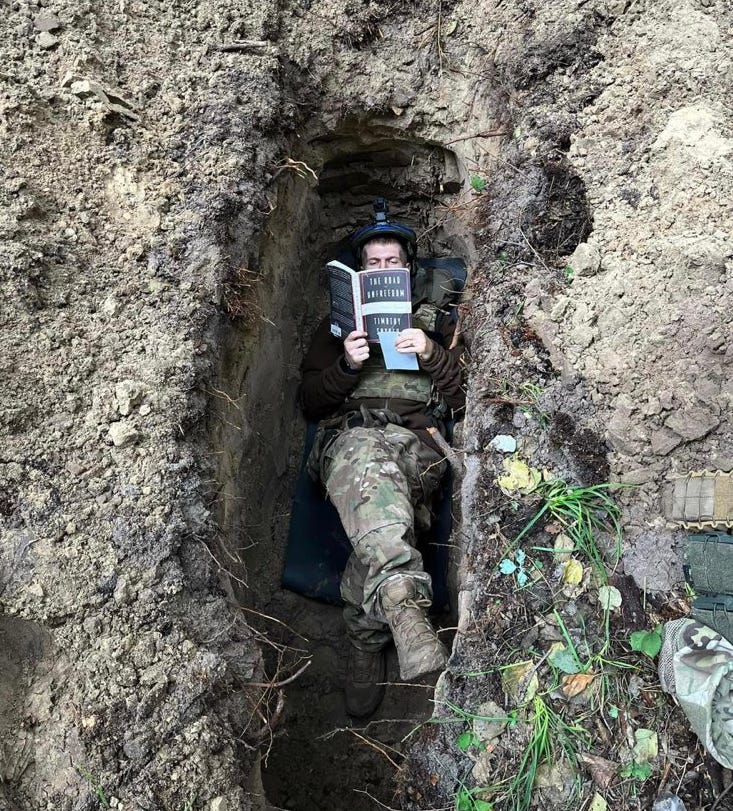
This is my book Road to Unfreedom, read by a Ukrainian soldier on the front. The book is about the turn towards post-truth fascism in Russia and the implications for Europe and the U.S. I am glad to have a reader, but can’t help thinking that he would not have to risk his life resisting Russian invasion if more of us had taken these issues seriously earlier on.

Putin also tells big lies, for example that Ukraine does not exist, that there is no Ukrainian society, no Ukrainian nation. Like Trump’s big lie about the election, Putin’s big lie about Ukraine then incubates smaller lies: If Ukraine does not exist, the war all be a plot of NATO! The people in charge of Ukraine must be Nazis! Or Jews! Or drug addicts! Or gays! Or gender theorists! Or Satanists! (All of these claims are made in the Russian information space; the official line is in fact at the moment that Russia is fighting Satan in Ukraine).

If Ukraine does not exist, then we, the Russian invaders, are the real victims. There should not be anyone there holding us back from what we think is right. This was the same sense of grievance expressed by the Americans who invaded the U.S. Capitol: we are the real victims, we are only restoring what should have been. No one should be holding us back from seeking justice with our own hands. Just as there was a natural affinity between Putin and Trump, there is a natural affinity between those who support Trump’s Big Lie and those who support Putin’s.

Newly-elected congressman George Santos took Trump’s approach to politics to its logical conclusion. Trump was a failed businessman and successful entertainer, who then used his entertainer skills to pretend to be a successful businessman and run for office. But no one could deny that he had careers. In the case of Santos, everything is just made up. He is not even a failed businessman (though he is a confessed thief). He is not even an entertainer (unless you count customer service). He is just a man who understands that lying for its own sake is a way to do politics, attract money and gain power. It will not take years to take apart his story; it will take weeks. (One thing that has emerged is a connection to Russia). And then the question arises: is alternative reality the future of America, or at least of its Republican Party?

Trump’s Big Lie opened the way for Santos, who repeats it, and who attended the rally to, in his own words, “overturn the election for Donald Trump.” Trump was a model of a man who came to power and gained money on little beyond mendacious schtick. Santos is following that lead. But it is also important to understand the new context in which Santos functions. By lying constantly during the first campaign and during the presidency, Trump set an example, one that is most relevant to members if his party. For two years now, Trump’s Big Lie has functioned the way that the Stalinist line used to function in the communist party. What Stalin said had to be treated as true, even if party members knew at some level that it was not. They had to engage constantly in what George Orwell called double-think, living in one lie, and preparing themselves for the next one, all the while imagining that somehow the process served some greater good.

Trump has trained Republicans, and a large part of the American people, in just these mental habits. Elected officials can say that elections don’t work, and no one really even notices the doublethink. Republicans claim that Democrats can alter electoral results, even as Republicans win control of the House of Representatives by a tiny margin. We ask ourselves: how can Russians continue to support the war in Ukraine? How do they handle obvious contradictions, like saying they are fighting a war against Nazis when the country they invade has an elected Jewish president? This is the answer: they have been trained that there is no truth, only the leader’s sheltering fiction, the comforting big lie, the line that comes down from above. We can all be trained like that, and too many Americans have been.

Once factual truth is no defense in politics, all that remains is spectacle and force. If Putin says there is no Ukraine, the war must prove it. If Trump says he won, his followers must storm the Capitol.

What follows from this, as students of democracy have argued since ancient times, is that the truth matters, and that truth needs defenses. Part of that defense is ethical. The truth cannot take revenge on a Santos (or whatever his name turns out to be) or a Trump or a Putin on its own. People have to care about it as a moral value. Democracy can only exist on the basis of such a moral commitment.

Aside from this, truth needs equality. When wealth is too unevenly distributed, as it is in this country, it is very hard to have a national conversation of any sort, and it is very easy for oligarchs to ride artificial spectacle to power (or fund others to do so — it will be interesting to learn who, aside from a sanctioned Russian oligarch’s cousin, funded Santos).

Perhaps most fundamentally, truth needs everyday champions. In every case I have mentioned — Putin’s war in Ukraine beginning in 2014, Trump’s 2016 campaign, Santos’s 2022 campaign — we simply lacked the foreign correspondents or investigative journalists. The only pre-election coverage of Santos’s lies was in a local newspaper, which contradicted his claims to great wealth. No larger medium picked it up in time. If we had more newspapers, and if we had more reporters, this story would likely have developed, and Santos would likely not have been elected.

This is the underlying sadness in the media brouhaha about Santos. Once a few facts were revealed (in a New York Times story on December 19), the television talk shows and social media could unleash a firestorm of indignation. But that was too late. The point of journalism is not to be outraged afterwards, but to prevent outrages from happening. It is not our role as citizens to be angry after an election. It is our role to vote calmly on the basis of what we should know. And we just don’t know what we should.

The problem is not that media are not alert. The problem is that the correct media are ceasing to exist. Talk shows can only talk about what someone else investigates. The internet can repeat, but it cannot report. We speak about the news all day, but pay almost no one to get out and report it. This rewards people who lie as a way of life. Every political career demands investigation at its beginnings, and most American counties lack a daily newspaper. That is where we are, and it has to change.

Paul Bonner is a retired educator who consistently posts wise comments here. I wholeheartedly endorse his view here.

Fundamentalism is a disease not limited to a particular faith. I highly recommend “The Battle for God: Fundamentalism in Judaism, Christianity and Islam” by Karen Armstrong. It is a political strategy imposed by a minority to handcuff any meaningful progress in nation states and beyond. Israel is now teetering on a precipice as a failed democracy due to the efforts of Jewish, Christian, and Muslim radicals. ISIS and AL Qaida are actually reincarnations of the Jewish Maccabean’s prior to the common era. Nazi Germany used such tactics as did Mussolini in his fascist one man as superior ruler dictum. Putin uses the Russian Orthodox Church for the same purposes. In the U.S, we experience this through the organization that runs the annual prayer breakfast and the rampant grift we call televangelism. What these have in common is the desire of a minority to have control and wealth. I wish we could divorce the conversation from the Christian moniker, but the goal of such corruption is to misrepresent a savior as the answer. This is the ongoing archetype of the “anti-christ” against salvation. In spite of our technological and intellectual advances we seem unable to escape this threat to mankind.

Anne Nelson writes in The New Republic about 10 people you probably never heard of. Each of them is intent on destroying democracy. At the center of this group is the Bradley Foundation, a major funder of vouchers since the 1990s. Vouchers play a central role in the effort to undermine democracy. If they can take down and privatize public schools, they can do the same to other public institutions.

Here are a few of the malefactors:

Larry Arnn
President, Hillsdale College

For decades, Michigan-based Hillsdale has served as an academic partner for the religious right. The college has had a close relationship to the Council for National Policy, the secretive Christian right umbrella organization that directs so much right-wing activism, through Arnn and his predecessor, George Roche III (who left in a cloud of scandal). Hillsdale’s major donors have constituted a who’s who of the radical right, including the Koch network and leading figures from the CNP. Arnn has expanded Hillsdale’s role as a platform for the CNP’s network of megadonors, fundamentalist activists, and media outlets, providing their policy prescriptions with a thin veneer of academic respectability. The college enrolls around 1,500 students, but its leaves an outsize footprint in political messaging. Its highly politicized publication Imprimis is sent to more than six million recipients. Hillsdale operates the Kirby Center in Washington, D.C., where it has groomed young conservatives at the Capitol Hill Staff Training School, run by the Leadership Institute (see Morton Blackwell, below). Hillsdale is also playing a role in the current disruption of public education, which has been used for political leverage in Virginia and beyond. In 2020, Donald Trump appointed Arnn chair of the 1776 Commission, to promote a “patriotic” rebuttal to the 1619 Project’s racially inclusive approach to U.S. history. Hillsdale has led an ongoing campaign to politicize public schools, promoting anti–critical race theory campaigns and assisting in the launch of “affiliate” charter schools in 11 states.


Joe Seales
CEO, Right Side Broadcasting Network

RSBN serves as the equivalent of a Trump-specific C-SPAN that has carried nearly every Trump speech, rally, and town hall since July 2015, as well as full coverage of the pro-Trump Conservative Political Action Conference (CPAC). It also broadcasts a show called The Right View, with Trump daughter-in-law Lara Trump. On January 6, it livestreamed Trump’s speech inciting the march on the Capitol, and it gave live coverage to the Florida “Freedom Rally to Show Support for President Trump and January 6th Political Prisoners” a year later. In July 2021, RSBN was temporarily suspended by YouTube, but the network looked to its own app and the new pro-Trump platform Rumble to continue to carry Trump’s rallies. The radical right has been assiduously constructing a parallel media system in recent decades. RSBN, Rumble, and Trump’s new Truth Social platform complement other media initiatives, ranging from traditional fundamentalist broadcasters like American Family Radio to social sites like Gettr and Parler, in the ongoing construction of an alternate political reality for millions of followers. In March 2022, after the height of the Ottawa truckers’ protests, RSBN promoted a truckers’ convoy roundtable hosted by Representatives Matt Gaetz and Marjorie Taylor Greene, and it has offered ongoing amplification of Trump’s false election fraud claims. We can be sure that whatever Trump fabricates for future news cycles, RSBN will be repeating it.

There are eight more. How many do you know?

David Frum was a speechwriter for George W. Bush. He writes for The Atlantic. He reminds us why Kevin McCarthy is as contemptible as the 20 members of the Chaos Caucus blocking his ascent to the Speakership.

The defeat of Kevin McCarthy in his bid for the speakership of the House would be good for Congress. The defeat of Kevin McCarthy would be good for the United States. It might even be good for his own Republican Party.

Because the people attempting to inflict that defeat upon McCarthy include some of the most nihilistic and destructive characters in U.S. politics, McCarthy is collecting misplaced sympathy from people who want a more responsible Congress. But the House will function better under another speaker than it would under McCarthy—even if that other speaker is much more of an ideological extremist than McCarthy himself.

McCarthy is not in political trouble for the reasons he deserves to be in political trouble. Justice is seldom served so exactly. But he does deserve to be in trouble, so justice must be satisfied with the trouble that he’s in.

McCarthy deserves to be in trouble because he refused to protect the institution he now seeks to lead. After the January 6, 2021, insurrection, he told fellow Republicans that he would urge President Donald Trump to resign immediately. When that vow became public, McCarthy denied he had ever made it, until a contemporaneous audio recording exposed his lie.

“I’ve had it with this guy,” McCarthy said after the January 6 attack—then voted in the impeachment proceedings to protect this guy. Eight days after Trump left office, McCarthy flew to Florida for a photo opportunity with the ex-president who had sent a mob to rampage through the Capitol and harm, abduct, or do worse to McCarthy’s own colleagues. Trump then released a statement boasting that he and McCarthy would be working closely together into the future, a statement McCarthy never contradicted.

McCarthy then enabled and supported a purge of every House Republican who had acted with the integrity that he himself had failed to muster. He endorsedthe primary opponent to Liz Cheney. He stripped committee assignments from Republicans who served on the committee to investigate the Capitol riot he had once condemned and now condoned.

For weeks after January 6, McCarthy denied that he’d telephoned Trump that day to blame him for the attack. When then–Representative Jaime Herrera Beutler exposed his denials as false, McCarthy brutally rebuked her.

“You should have come to me! Why did you go to the press? This is no way to thank me!”

“What did you want me to do? Lie?”

Well, yes, obviously. That’s what McCarthy did.

Herrera Beutler then lost the nomination in a primary battle against one of the most reactionary Republicans of the 2022-midterms slate—who then proceeded to lose a seat in rural Washington State to a Democratic newcomer.

There’s more but you have to subscribe to The Atlantic to read it.

Bob Shepherd was looking ahead a few months back and correctly predicted that Trump would run for president again. Little did Bob know that Trump would make his announcement right after the midterm elections, when most of his hand-picked candidates lost.

Bob drafted some campaign slogans for Trump’s race.

Please vote for me. Otherwise, I go to prison.

Why just documents in the toilet? Why not the whole country?

Making America Grate Again

TRUMP 2024: 20 for Obstruction of an Official Proceeding. 24 for Seditious Conspiracy

MAGA: Moscow’s Asset Governing America

The Man with No Plan and the Tan in the Can

Trump, the Relapse

Back to the Future! Way, way, way back!

Trump: For a Whiter House in 2025!

Vote for Trump or He’ll Stamp (or Stomp) His Foot, Hold His Breath, and Throw a Plate of Food

Grab ’em by the Ballot!

Cuckoo Coup Redo

If I Lose Again, Again, It’s Because It Was Rigged, Ha Ha

Because He Doesn’t Give a **** about You

No One Believes Any of This B***S*** I’m Saying, but People Vote for Me Anyway –Donald Trump

Governor DeSantis has pushed through laws that ban the teaching of “critical race theory” and gender studies. The effect of this law and his denunciation of anyone who dares to say that racism is real has been to silence academic freedom. This article in ProPublica (Read the story) shows how professors are dropping the courses they usually teach or changing their names. Untenured teachers— the majority of professors in higher education in Florida and elsewhere worry about being fired if they offend DeSantis’ thought police.

Ironically, the story includes a photograph of a truck owned by a rightwing group, festooned with the words “Freedom of Speech.” To be clear, DeSantis and his rightwing goons are silencing academic freedom and freedom of speech. They are the Thought Police, practicing “cancel culture.”

The article begins:

Jonathan Cox faced an agonizing decision. He was scheduled to teach two classes this past fall at the University of Central Florida that would explore colorblind racism, the concept that ostensibly race-neutral practices can have a discriminatory impact. The first, “Race and Social Media,” featured a unit on “racial ideology and color-blindness.” The second, “Race and Ethnicity,” included a reading on “the myth of a color-blind society.” An assistant sociology professor, Cox had taught both courses before; they typically drew 35 to 40 undergraduates apiece.

As recently as August 2021, Cox had doubted that the controversy over critical race theory — which posits, among other things, that racism is ingrained in America’s laws and power structure — would hamstring his teaching. Asked on a podcast what instructors would do if, as anticipated, Florida restricted the teaching of CRT in higher education, he said that they would need to avoid certain buzzwords. “What many of us are looking at doing is just maybe shifting some of the language that we’re using.”

But a clash with state law seemed inevitable, once Florida’s governor, Ron DeSantis, proposed what he called the strongest legislation in the nation against “the state-sanctioned racism that is critical race theory.” Last April, DeSantis signed the Individual Freedom Act, also known as the “Stop Woke Act,” into law. It bans teaching that one race or gender is morally superior to another and prohibits teachers from making students feel guilty for past discrimination by members of their race. And it specifically bars portraying racial colorblindness — which the law labels a virtue — as racist. A DeSantis spokesperson, Jeremy Redfern, told me in an email that the law “protectsthe open exchange of ideas” (italics in the original) by prohibiting teachers from “forcing discriminatory concepts on students.”

Whatever one thinks of critical race theory, the state’s interference limits the freedom of professors who are experts in their fields to decide what to teach their students. Cox worried, not without reason, that the law effectively banned him from discussing his ideas in class, and that teaching the courses could cost him his livelihood. Cox, who is the only Black professor in the sociology department, will not be considered for tenure until this fall. His salary was his family’s only income while his wife stayed home with their baby.

A month before the fall 2022 semester was set to start, he scrapped both courses. Students scrambled to register for other classes. “It didn’t seem like it was worth the risk,” said Cox, who taught a graduate course on inequality and education instead. “I’m completely unprotected.” He added, “Somebody who’s not even in the class could come after me. Somebody sees the course catalog, complains to a legislator — next thing I know, I’m out of a job.”

Cox’s decision, along with another professor’s cancellation of a graduate course because of similar apprehension, created an unusual gap in the sociology curriculum at UCF, which, with almost 69,000 students, is Florida’s largest university.


Cox’s department chair, Elizabeth Mustaine, said she went along with the professors’ wishes because “I thought: ‘I’m not going to stress anyone out about this. It’s crazy.’” Still, she added, “it’s an absolute tragedy that classes like this get canceled.” Of the 39 courses offered this past fall by a department that specializes in the study of human society, none focused primarily on race.

In just over two years, critical race theory has gone from a largely obscure academic subject to a favorite bogeyman for Republican candidates. Activists such as Christopher Rufo, a senior fellow at the conservative Manhattan Institute, conceived of targeting CRT to foment a backlash against measures enacted following George Floyd’s murder in May 2020. At that time, Rufo told me in an email, “school districts across the country suddenly started adopting ‘equity statements,’ hiring ‘diversity and inclusion’ bureaucrats, and injecting heavily partisan political content into the curriculum.” Black Lives Matter and the left were riding high, said Rufo, who denies that structural racism exists in America. In our email exchange, Rufo described “the fight against critical race theory” as “the most successful counterattack against BLM as a political movement. We shifted the terrain and fought on a vector the Left could not successfully mobilize against.”

The anti-CRT campaign quickly expanded from sloganeering to writing laws. Seven states, including Florida, have passed legislation aimed at restricting public colleges’ teaching or training related to critical race theory. Those laws face impediments. On Nov. 17, 2022, a federal judge temporarily blocked enforcement of the higher-education provisions of Florida’s Individual Freedom Act. “The First Amendment does not permit the State of Florida to muzzle its university professors, impose its own orthodoxy of viewpoints, and cast us all into the dark,” Judge Mark Walker wrote. The DeSantis administration filed a notice of appeal on Nov. 29 and is seeking to stay the injunction pending that appeal. The 11th Circuit, where most of the judges are Republican appointees, will hear the appeal, with briefs to be filed in the next few months and oral arguments potentially this coming summer.

Additionally, with DeSantis’ landslide reelection — after a campaign in which he repeatedly denounced “woke” education — and Republicans gaining a supermajority in both chambers of the state’s Legislature, they are likely to look for new ways to crack down on CRT and what they perceive as higher education’s leftist tilt. And at the federal level, conservatives are drafting a “potential suite of executive orders in 2024,” in case the next presidential election goes their way, to “disrupt the national network of left-wing ideological production and distribution,” according to Rufo.

It’s easy to dismiss the conservative crusade against critical race theory as political theater without real consequences. But most colleges and universities offer social science and humanities courses that address racial inequality and systemic racism, and the anti-CRT laws are already having repercussions for people who teach or take these classes in red states. Moreover, the push against CRT is hitting academia after decades of declines in the proportion of professors protected by tenure, meaning that most faculty members are not in positions secure enough to resist political pressure. Now, forced to consider whether they face any legal or career risk, some are canceling courses or watering down content, keeping quiet rather than sharing their expertise with students.

“When you implement a law like this, you’re asking professors to leave out things that clearly happen or have happened in the past,” Grace Castelin, a UCF undergraduate who plans to introduce a resolution in the student senate condemning the law, told me. “It’s making us more ignorant in this generation and generations to come.”


Fearful that legislators will retaliate by cutting their budgets, few top university administrators have publicly criticized the laws, which put institutions as well as individual teachers at risk. Indeed, UCF Provost Michael Johnson told faculty last July that the university would “have to take disciplinary action” against any faculty member who repeatedly violated the Individual Freedom Act because it couldn’t afford to lose a “catastrophic amount” — $32 million — in state funding linked to graduation rates and other metrics. (Johnson declined an interview request.)

Other states have left professors similarly undefended. In Tennessee, which passed a law much like Florida’s, the provost of the state university’s flagship Knoxville campus made clear to professors that the administration wouldn’t necessarily help them. If they were sued under the law, Provost John Zomchick told faculty, Tennessee’s Republican attorney general would decide whether the university would represent them in court. “People freaked out,” said Anne Langendorfer, a senior lecturer at UT Knoxville and the president of a union for campus workers at the state’s public universities.

A university spokesperson, Kerry Gardner, said that the attorney general makes the final decision in “any situation” where individuals are sued in their capacity as university employees. Administrators “wanted to be fully transparent about how the process works,” while assuring faculty that “we will take every step to defend them,” Gardner said. Zomchick, she added, “does not agree with the view of some faculty” that the law “infringes on the First Amendment or academic freedoms.”

With uncertain support from above, most full and associate professors at least enjoy the protection of tenure, which shields scholars whose insights or research are politically unpopular. Tenured professors can’t be fired without cause and a hearing by their peers. Other faculty typically work on contracts, which the university can decide not to renew without specifying a reason.

Some tenured professors in Florida have resisted anti-CRT pressure. The historian Robert Cassanello, the president of the UCF chapter of United Faculty of Florida, was comfortable becoming a plaintiff in one of the lawsuits contending that the Individual Freedom Act violates free speech. Cassanello, who keeps a life-size cutout of Karl Marx in his office window, told me that he’s less threatened by the law than his untenured colleagues are.

Robert Cassanello, a tenured professor, teaches history at the University of Central Florida and became a plaintiff in a lawsuit challenging a state law that restricts the teaching of critical race theory. (Tara Pixley, special to ProPublica and The Atlantic)

By contrast, Juan Salinas, an assistant sociology professor at the University of North Florida in Jacksonville, declined to be a plaintiff. “For me to stick my name out, I didn’t feel comfortable,” Salinas said. “If I had tenure, I would be more active.”

But even having tenure didn’t feel like “adequate protection” to Scott Carter, the other UCF sociologist who scrapped a course on race in the fall semester. “It’s very sad for students,” Carter told me. “They won’t get the experience of hearing from scholars on contemporary race relations.”

Darcie Cimarusti served on the school board of Highland Park, New Jersey, from 2013 to 2022. She is the communications director of the Network for Public Education. This article appeared in the Bedford Gazette.

She writes:

I have been a local school board member since my daughters, now 11th-graders, were in second-grade. In that time, I have been involved in education policy discussions at the local, state and national levels on issues related to the rights of LGBTQ+ students, standardized testing and the privatization of public education. The rise of the so-called “parental rights” movement in public education has been one of the thorniest, most perplexing issues I have encountered.

There is no doubt that parents play a crucial role in the education of their children. Who would dare argue that they don’t? But in the face of the anti-critical race theory, anti-LGBTQ+, anti-social emotional learning, anti-diversity equity and inclusion juggernaut unleashed by heavily funded, right-leaning astroturf parent groups such as Moms for Liberty, it has become imperative that we have an honest discussion about how much say parents should have in what is (or is not) taught in our public schools.

My district, unlike many, is racially, ethnically and socioeconomically diverse, with 31 languages spoken in the homes of our students. Educating such a diverse student body presents many challenges and requires a nuanced approach to policy and practice that ensures all students have equal opportunities to learn, thrive and grow. While it is easy for school leaders to say they embrace diversity, equity and inclusion, it’s far too challenging to implement policies promoting those principles.

I have spent my time on the school board helping to develop systems that ensure decisions are made collaboratively and with as many voices at the decision-making table as possible. This means making space not only for administrators, teachers, parents and students but also ensuring that historically marginalized groups are represented.

Decisions that affect students should never be based on the whims of those with the most privilege or power and indeed not on who has the loudest voice in the room.

However, the latter has become the hallmark of parental rights activists. They attend meeting after meeting, berating, shouting down and even making death threats against school board members. During the pandemic, battles over masks erupted at podiums at far too many school board meetings across the country and quickly morphed into demands to ban books, censor curriculum and muzzle “woke” teachers that parents accused of “grooming” their children.

In the 2022 midterm elections, parental rights activists were on the ballot in numerous states. With the support and endorsement of Moms for Liberty, they ran campaigns to become school board members in districts in red, blue and purple states. Moms for Liberty operates county chapters that aim to serve as watchdogs “over all 13,000 school districts.” Chapters empower parents to “defend their parental rights” and “identify, recruit & train liberty-minded parents to run for school boards.”

The “anti-woke” agenda espoused by Moms for Liberty endorsed school board candidates who had the greatest successes in Florida, where Gov. Ron DeSantis proudly declared the state being “where woke goes to die.” But in many other parts of the country, parental rights candidates lost their elections, with even conservative political operatives acknowledging that many of their campaigns were “too hyperbolic.”

Chaos has already erupted in several districts where they succeeded and won board majorities, with newly formed, inexperienced boards firing superintendents or forcing them to resign. One board voted to ban the teaching of critical race theory just hours after being sworn in.

After a decade of experience as a school board member, there’s one thing I can say for sure: The majority of parents, teachers and community members do not respond well to instability and disruption in their local public schools. When school boards run amok and rash decisions make headlines, communities work quickly to restore calm. If parental rights school board majorities continue to govern recklessly, they will undoubtedly face a backlash from voters.

Creating and implementing sound school policies and practices that respect and affirm all students requires collaboration. It does not allow for the divisive, polarizing rhetoric and impetuous, rash decision-making that have become the calling cards of the so-called parental rights movement.