This is good news. In multiple ways, the US News & World Report rankings of schools, colleges, and graduate schools are misleading. Harvard Law School and Yale Law School certainly don’t need to have the blessing of US News. I’m hoping that other schools and universities refuse to be ranked by an invalid and useless measure.
CNN reports:
Yale and Harvard law schools, two of the premier law schools in the country, announced they are parting ways with U.S. News & World Report’s rankings of best law schools. The schools are bowing out after criticizing the publication’s methodology, arguing that the list actively perpetuates disparities in law schools. Given the elite status of Yale and Harvard, the move is significant and could signal a greater shift away from college rankings. For years, policymakers and those working in higher education have dismissed the rankings, though they are still referenced by potential students and their families. The decisions have been met with praise, but some questioned whether the move, if followed by other schools, would make it more difficult for the average person to choose to which colleges to apply.
Colleges and universities have been critical of the U.S. News ranking system for decades, saying that it was unreliable and skewed educational priorities, but they had rarely taken action to thwart it, and every year almost always submitted their data for judgment on their various undergraduate and graduate programs.
Now both Yale and Harvard law schools have announced that they will no longer cooperate. In two separate letters posted on their websites, the law school deans excoriated U.S. News for using a methodology that they said devalued the efforts of schools like their own to recruit poor and working-class students, provide financial aid based on need and encourage students to go into low-paid public service law after graduation.
A tweet by Mark Wiggins, a pro-public education lobbyist in Texas, spread the news that the Republican-dominated State Board of Education came out against vouchers.
*NO VOUCHERS*
As one of its 2023 legislative priorities, majority Republican @TXSBOE urges #txlege to reject vouchers in all their forms. #txed
The “Regents Exams” in New York State were once a mark of accomplishment for students who chose to take them. They were considered rigorous and prestigious. But sometime in the 1990s, State Commissioner Richard Mills decided that all students should pass the Regents to get a high school diploma. The standards had to be lowered, so that there was not massive failure. Passing the Regents was no longer a badge of high accomplishment.
Now the Regents are debating whether to keep, change, or dump the high school exit exams. Research shows that high school exit exams lead to decreased graduation rates and dropouts. Not surprisingly.
ALBANY – Members of the Board of Regents debated the value of the Regents exams Monday as part of an overall planned examination of the state testing system and graduation requirements that had been delayed due to the pandemic.
“Maybe the Regents exams are not the be-all and end-all,” said Regent Roger Tilles during a meeting that also included a presentation about how students graduate high school in other states and countries. “We have kids that can’t pass a Regents exam but pass all their courses. Should they be denied a future because they can’t pass a Regents test in one area?”
But the rigorous exams get students prepared for the future, argued Regent Catherine Collins.
“I hope the state does not get rid of the Regents,” she said. “I was fortunate enough to have the Regents science diploma, which gave me the foundation to go into health care.”
The discussion comes after graduation rates increased during two years without Regents exams, due to the pandemic. For now, the Regents are back, but a Blue Ribbon Commission is expected to weigh in on new high school diploma requirements next year. The commission was announced in 2019, but the pandemic led to a slowdown and the commission wasn’t named until last year.
The state Education Department said in an email to the Times Union later Monday afternoon that “the Board was not debating whether to eliminate Regents exams. Rather, they were discussing a 166-page report that has been in the making for three years and heard a presentation based on (the) report’s literature review, policy scan and stakeholder feedback….”
In 2019, Education Commissioner Betty Rosa made it clear that she did not think the Regents exams are “working” for every student, and questioned whether the tests improved college readiness, among other factors. She has pressed for alternative paths to a high school diploma, including career and technical programs.
At Monday’s meeting, she urged the Regents to have an open mind.
“We really have to take into account not what worked for us, but what will work down the road,” she said. “At the end of the day, our job is to keep in mind what our students need for the future.”
Chancellor of the Board Lester Young, Jr. was adamant that the board make no decision right now.
Kherson was the first regional capital that the Russian army captured after the invasion of Ukraine. A few weeks ago, Putin declared that Russia had annexed four regions of Ukraine, including Kherson, and henceforth they would be “forever Russian.” That occurred at the same time that Russian troops were retreating before the Ukrainian forces. A few days ago, Russian troops abandoned Kherson, and Ukrainian troops arrived. They were greeted by jubilant crowds waving the Ukrainian flag and singing the Ukrainian national anthem.
But before the troops left, they carried out a special mission for V. Putin. They robbed the grave of Potemkin, who conquered Ukraine on behalf of Russia and Empress Catherine the Great in the 18th century. Simon Sebag Montefiore, a British historian of Russia, reports at the website Airmail that Putin is obsessed with Potemkin. Potemkin is Putin’s role model. His body was buried in St. Stephen’s Cathedral in Kherson. Before the Russians evacuated Kherson, they removed Potemkin’s bones and sent them to Moscow.
A Ukrainian tearing down a billboard with the slogan “We are together with the Russian government” in Kherson, Ukraine, on Sunday.Credit…Lynsey Addario for The New York Times
KHERSON, Ukraine — Iryna Dyagileva’s daughter attended a school where the curriculum included memorizing the Russian national anthem.
But teachers ignored it, instead quietly greeting students in the morning with a salute: “Glory to Ukraine!”
The occupation authorities asked Olha Malyarchuk, a clerk at a taxi company, to settle bills in rubles. But she kept paying in the Ukrainian currency, hryvnia.
“It just didn’t work,” she said of Russian propaganda, beamed into homes through televisions and plastered on billboards for the nine months of Russia’s occupation of Kherson. On Sunday, she was walking in a park, waving a small Ukrainian flag.
One roadside billboard proclaimed in bold text, “We are together with Russia!” But a teenager who offered only his first name, Oleksandr, had shimmied up the supporting pole on Sunday and was tearing the sign to pieces. Asked how he felt, he said, “free.”
The Ukrainian army has reclaimed hundreds of villages in towns in three major counteroffensives, north of Kyiv, in the northeastern Kharkiv region and now in the southern Kherson region.
But the city of Kherson stands out: it was the focus of a major Russian campaign to assimilate the citizenry and stamp out of the Ukrainian identity. Judging by his assertions that Ukrainians and Russians are one nation, it was a goal President Vladimir V. Putin had harbored for all of Ukraine, had his military been more successful.
After Russian forces captured Kherson in the early days of the war, Ukrainian national songs were banned in the city. Speaking Ukrainian could lead to arrest. Schools adopted a Russian curriculum, and young students were to be told that they were Russians, not Ukrainians.
In the first hours and days after the city’s recapture by the Ukrainian army, signs have emerged suggesting that the Russian attempt was a largely futile effort, at least among those who remained in the city.
Many pro-Russian residents had evacuated as Ukraine’s army advance on the city, and the Kremlin-installed authorities had encouraged residents to leave. Many local government officials had collaborated with the Russians.
Serhiy Bloshko, a construction worker, had lived at the homes of friends through the nine-month occupation, fearful he’d be arrested for joining anti-occupation protests in March that broke out soon after the Russian army arrived. Soldiers indeed went to his home, he said. Not finding him, they made off with his television and refrigerator, he said.
“They repressed the pro-Ukrainian population,” he said while waiting in a line for water on Sunday afternoon. Friends had been detained and vanished, he said. Of the cultural assimilation effort, he said, “what happened here was ethnic cleansing.”
The entry into his city of the two armies, one in February and the other last week, was telling, he said.
“When our soldiers drove in, their machine guns were pointed up, into the air,” Mr. Bloshko said. “When the Russians drove in, their guns were pointed at the people. That explains everything. And they said they were our liberators.”
Gary Rayno of InDepthNH shows how Republican gerrymandering has warped free and fair elections in the state. Its two Senators are Democrats but the state is controlled firmly by Republicans, who redrew the map to make sure that Republicans control the Legislature.
He writes:
The voting is over although the final outcome for control of the House will not be official until the 16 recounts are finished at the end of next week.
The Senate and Executive Council remain firmly in Republican control although the results would have been different had they not been gerrymandering more than they already were 10 years ago.
The redistricting plans approved down party lines for the Senate and Executive Council seats should give Republicans more Senate seats and four safe Executive Council seats for the next decade.
However, the residents of New Hampshire need to be congratulated for setting a non-presidential election year or midterm election record, breaking the one set four years ago….
The voter turnout Tuesday was somewhere near 70 percent of those on the checklist, which the Tuesday before the election had 883,035 names, with 278,681 registered as Democrats, 276,034 as Republicans and 328,320 undeclared….
In the 2018 election, with a greater number of voters on the checklist, the percentage of those who voted was 57.5 percent….
There were several huge issues for Democrats particularly reproductive rights and other fundamental rights like same sex marriage and contraception with the US Supreme Court overturning its earlier Roe Vs Wade decision making abortion a fundamental right.
Another major issue was preserving democracy as it has been in place since the days of Roosevelt’s New Deal, as well as combating misinformation about election frauds and voter suppression.
Republicans focused on the economy and inflation, and what they said was the Democrats’ slide toward socialism and issues like parental rights.
But when the smoke cleared Tuesday night — or almost cleared depending on recounts — Republicans were able to maintain control of the State House from governor to the House, while Democrats had total control of federal offices as they have had for the last six years….
Once again New Hampshire will send Democrats to Washington while Republicans will control the State House.
However, to say Republicans have a mandate would be very misleading as would talk of their policies being popular with New Hampshire voters.
The only clean Republican victory came in the governor’s race where incumbent Gov. Chris Sununu defeated Democrat Tom Sherman by a sizable margin.
In the Executive Council, state Senate and state House races, Democratic candidates received more votes than their Republican counterparts, but will still be in the minority.
Executive Council
All five current members won reelection to maintain the Republican’s 4-1 majority on the council.
This is the council that has refused to fund health contracts for poor families for Planned Parenthood, because four of the councilors reject a Department of Health and Human Services required report the organization and several others that provide abortion services that segregated state money from the money used to provide abortion services.
They have rejected the contracts a number of times along with once routine contracts to teach sex education to at-risk students in Manchester and Claremont. The same councilors have approved the contracts in the past.
The four Republicans also held up federal money to expand the state’s COVID-19 vaccination programs at a critical time when youngsters were about to receive their first shots and elderly their first boosters causing delays in rolling out those programs according to the commissioner of the Department of Health and Human Services.
Yet when you add the votes for the five Republican executive council candidates the total is 301,743, and the total for the five Democratic candidates is 303,238, a difference of 1,495 in favor of the Democrats.
If the five districts were drawn more fairly, the make up of the council should probably be 3-2 in one or the other party’s favor, not 4-1.
To see how badly gerrymandered the Executive Council is look at the 2nd district, which saw incumbent Democrat Cindi Warmington of Concord beat her Republican challenger, former state Sen. Harold French by 24,679 votes 74,107 to 49,428.
In essence, that result indicates 24,678 Democratic votes are wasted and could have gone elsewhere.
If you add up the margin of victory for the four Republican candidates, it is 23,179, or 1,500 less votes than Warmington won by.
If those 24,679 votes were spread in the other four districts, it would be a very different picture.
No wonder Warmington mentioned the gerrymandering in her statement Tuesday about her victory saying “Our outstanding candidates ran the best races possible, but unfortunately couldn’t overcome the effects of deeply gerrymandered districts.”
State Senate
With the new political boundaries in the Senate, there are fewer competitive seats and what would appear to be a consistent 15-9 or 16-8 partisan breakdown favoring Republicans.
Districts were altered to make Republican held districts safer while concentrating more Democrats into fewer districts with few contested seats….
When the election was over, the partisan breakdown was the same as it has been the last two years, 14 Republicans and 10 Democrats….
The Republican votes were 293,304, while Democrats received 299,327 votes, or a difference of 6,023 votes.
Yet Republicans hold a 14-10 advantage in the Senate and some of their leaders touted their hard work and agenda as the reason for the continued control.
But the real reason is the Senate is gerrymandered in a significant way to pack Democrats into a few districts while increasing the number of districts where Republican registrations outnumbers Democratic registrations…
The current plan is much more restrictive for Democrats and more favorable to Republicans.
In the House, the number of votes for Democratic candidates outnumber those for Republicans candidates as well.
The Democratic candidates received 1,089,577 votes or 50.8 percent and the Republicans 1,055,843 or 49.2 percent.
When determined by the 400 seats, Democratic candidates received 482,192 votes or 52.8 percent while the Republican candidates received 432,039 votes or 47.2 percent, again showing the House was gerrymandered.
The trouble with gerrymandering it does not reflect the will of the majority of voters and currently diminishes the value of Democratic votes versus Republican votes.
Gerrymandering disenfranchises partisan groups and prevents them from having a representative who reflects their interests.
And despite a superior court judge ruling there is nothing in law or the state constitution that makes partisan gerrymandering illegal, it truly is minority rule.
And with the state’s gerrymandered districts, it is difficult to see how the current plans adhere to the state constitution’s “free and fair elections” clause.
While it is clear the Republicans gave themselves a significant advantage in redrawing the state’s political boundaries, it should be noted Sununu vetoed two bills that had bipartisan agreement in 2019 and 2020 that would have created an independent redistricting commission to redraw the maps.
The legislature would have had to give final approval.
But the state’s “blue wave” in last week’s election would have been more apparent if an independent commission had drawn the political boundaries instead of special committees controlled by Republicans.
And the results will be apparent for the next two years if not the rest of the decade.
Tony Evers was the Wisconsin Superintendent of Public Instruction when he first ran for Governor and was elected. His first election was a triumph, because he succeeded the rightwing extremist Scott Walker, who hated unions, public schools, and public higher education, three of the jewels in Wisconsin’s crown. The celebrated “Wisconsin Idea” was centered on those policies, policies that advanced opportunity and equity.
Evers brought that rightwing extremism in the governor’s office to a halt, but he still had to deal with a Republican legislature, intent on frustrating everything he hoped to do.
Despite Republicans’ smear campaign, Evers was re-elected by a margin of 51-47, while his Lt. Governor Mandela Barnes lost to Republican Senator Ron Johnson, a reprehensible Trumper, by 1%.
This post is so important that it is the only one I have scheduled today. Please read it and share it with your friends, your local newspaper, your local radio station, your elected representatives, social media, anyone who cares about the future of our society. This is not a reprint. The author, Josh Cowen, wrote this post for this blog.
Josh Cowen, a professor at Michigan State University, has been studying vouchers for more than 20 years. He has been a member of the teams conducting major studies of vouchers. When I read his article in The Hechinger Report, where he declared that he was convinced that vouchers were disastrous for students who use them, I wanted to know more about him and his experience. I wanted to ask him, “Why did you change your mind?” That’s the question that’s been asked of me hundreds of times. I have a simple answer and a complicated answer: the simple answer is “I was wrong.” The complicated answer is contained in my recent books, starting with The Death and Life of the Great American School System: How Testing and Choice Are Undermining Education.
I invited Josh to explain his views for my blog, and he graciously accepted. I consider this piece to be one of the most important statements I have posted in the decade this blog has been live. Please note two points he makes:
One, vouchers harm the children who leave public schools to use them.
Two, most of the early voucher research was conducted by researchers who were partisan supporters of vouchers.
Josh Cowen writes:
It’ll be a few more days for the final election results to be tallied nationwide, but it seems clear that with midterm wins by voucher supporters in places like Oklahoma, Texas and even Pennsylvania—where even the Democratic gubernatorial victor is on record in cautious favor—voucher opponents are going to have to keep working hard to block public funding of private and religious schools.
School vouchers have devastating effects on student outcomes. Full stop. That’s something even the nation’s voucher advocate-in-chief Betsy DeVos has had to admit, because the data are so stark.
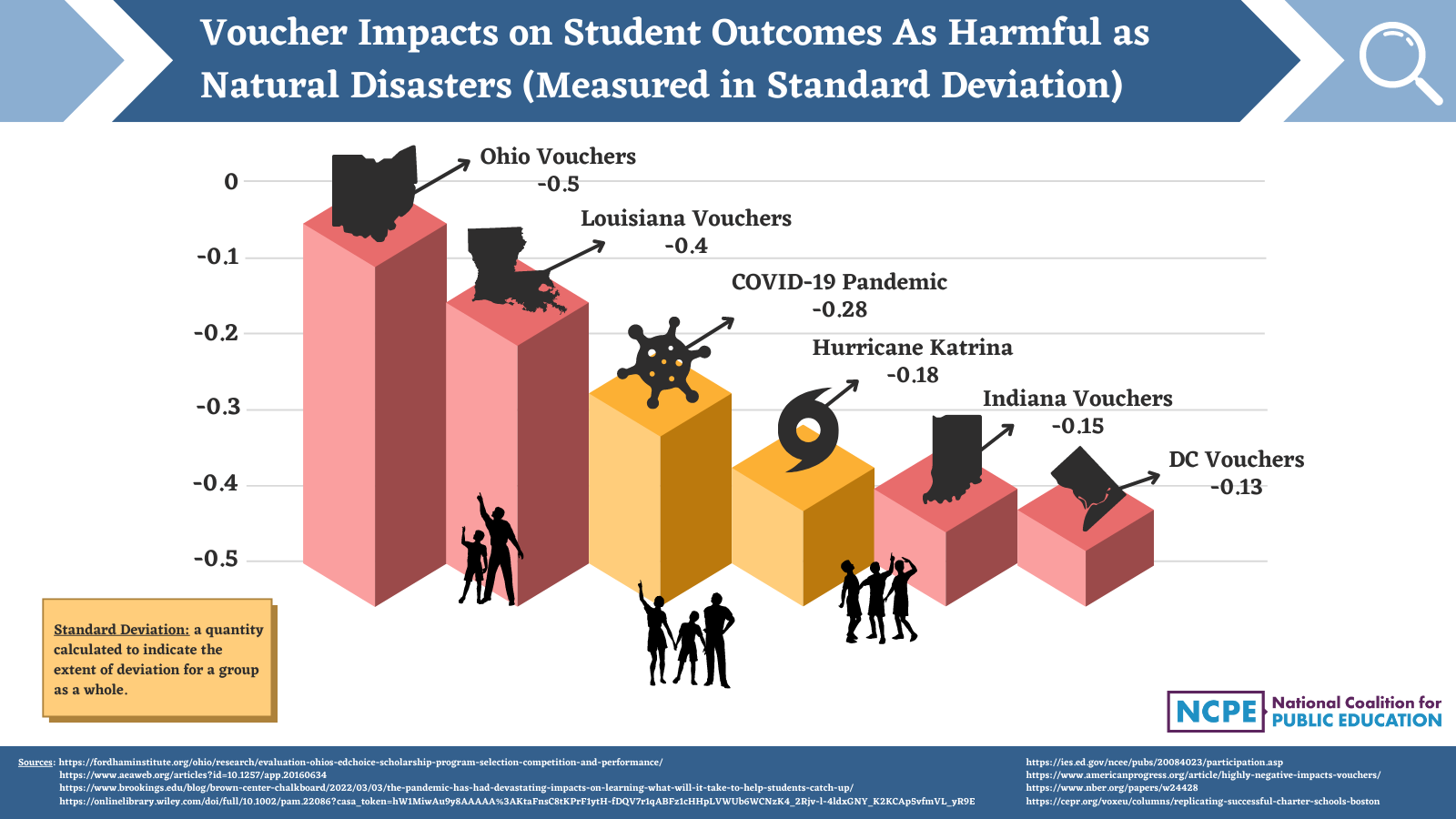
Large-scale independent studies in D.C.,Indiana, Louisiana, and Ohio show that for kids who left public schools, harmful voucher impacts actually meet or exceed what the pandemic did to test scores. That’s also a similar impact in Louisiana to what Hurricane Katrina did to student achievement back in 2005.
Think about that next time you hear a politician or activist claim we need taxpayer support for private schools to offset what the pandemic did to student learning. Here, their cure would in test score terms be quite literally worse than the disease.
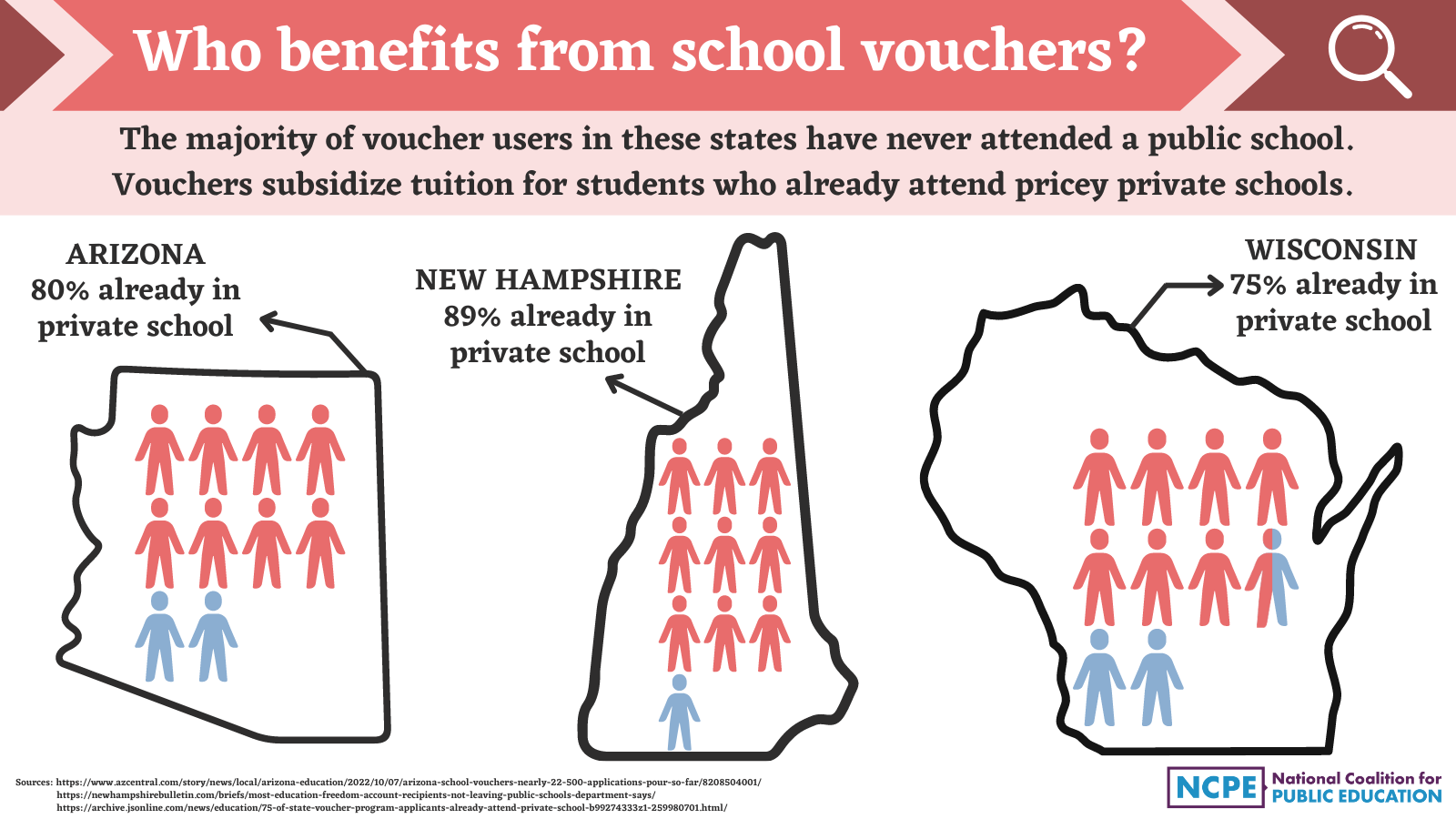
There’s another data point you need to know up front: vouchers overwhelmingly fund children who were already in private school without them. In states that have released those numbers—Arizona, New Hampshire, and Wisconsin—we know more than 75% of voucher applicants came from private schools.
The bottom-line: most kids using vouchers didn’t need them to go to private school, and the few kids who actually did use vouchers to transfer sectors schools suffer average test score drops on par with what a once-in-a-generation pandemic did to test scores too.
If you’re a picture person, our friends at the National Coalition for Public Education were kind enough to put their considerable talents into two graphics based on these data I provided to them.
Notice the citations these graphs include. They’re the same as the hyperlinks above. These data come from independent sources and from non-partisan journalists. That’s a critically important part of this story.
And then there’s this, before we get into the details: the same people pushing vouchers are the same people working to undermine fair elections and the right to vote.
None of these are metaphors, and this is not a drill.
So how did we come to this?
1. A Quick History of Voucher Research
First let’s talk about the evidence.
I came into the school voucher research community early. It was around 2001 or so, as a young graduate student assistant for a study of privately funded vouchers led by the conservative professor Paul E. Peterson who was based at both Harvard and the conservative Hoover Institution at Stanford (never heard of Hoover? Think Condoleeza Rice.)
Peterson and his protégé Jay Greene had already done one study of Milwaukee’s publicly funded voucher program, as well as the one in Cleveland that was about to be the subject of the U.S. Supreme Court’s first favorable ruling on voucher funding. That work generally showed positive results for vouchers. As did the research of a young academic named Cecilia Rouse, who is now President Biden’s chief economist.
But they were small programs. What policymakers and researchers call a “pilot phase.” Back then when both parties cared at least nominally about evidence, you wouldn’t expand a program like vouchers without testing it. So those early tests seemed somewhat positive.
The first research I joined was Peterson and team’s next project: multi-site studies in Dayton, New York City, and Washington D.C. Those programs were also pilot-size. And the New York site in particular showed some limited evidence of voucher success. But overall the lead researchers focused as much on things like parental satisfaction and measures of civic engagement as metrics. That work resulted in a book called The Education Gap. You can find my name in the credits if you own a copy. If you don’t own one, don’t waste your money.
No one knew it at the time, but the mixed results documented in The Education Gap were to be the best vouchers were ever going to do—and ever have done since by an academic based team looking at voucher test scores.
Just a short time later in 2005, I joined a new voucher evaluation led by Patrick Wolf, another Peterson protégé and contributor to The Education Gap. Wolf was by then ensconced with Jay Greene at the University of Arkansas Department of Education Reform, a Walton Family-funded academic group that was about to train a new generation of voucher advocates. Most notably Corey DeAngelis, now at Betsy DeVos’s 501(c)4 voucher lobbying group American Federation for Children.
The Milwaukee evaluation, which was officially done for the state of Wisconsin, lasted from 2005-2010. We found no evidence in five years that voucher kids outperformed public school kids. Two exceptions: we found limited evidence that graduation rates and college enrollment were somewhat higher for the voucher kids. We also found that voucher kids improved when the state required private schools to participate in the same No Child Left Behind-style accountability systems as public schools. In particular once voucher schools knew their performance would be made public they—shockingly!—improved their outcomes.
At the same time as the Milwaukee evaluation, Patrick Wolf and other Arkansas colleagues were working on a new evaluation of Washington D.C.’s federally funded voucher program. That study showed no difference in test scores, but large positive graduate results.
That pattern of “no test score benefits, some attainment benefits” has stuck in the research narrative even among voucher skeptics. But as I recently explained in a piece for the Brookings Institution, it’s just that: a narrative. Other studies in New York, Louisiana and Florida all show no real advantages for vouchers on educational attainment.
And certainly nothing to offset the cataclysmic results that began to come out after the early-stage evaluations I just described. The newer D.C.,Indiana, Louisiana, and Ohio studies that took place after 2013 and have showed pandemic and Katrina-sized harm to student test scores are all of at-scale voucher programs.
What do I mean by “at scale?” I mean that despite limited evidence in those pilot programs, vouchers have been steadily expanding across the country, and within states. So those D.C., Indiana Louisiana and Ohio studies represent our best understanding to date of what happens when you expand vouchers beyond the initial test phase. The answer: horrific impacts on student outcomes.
There are a number of reasons this could be, but I tend to argue we need not overthink this. Vouchers just don’t work. The kids who stand to gain from private schooling were and are already there. For the vast majority of kids, they’re better off in public schools. That’s what the latest voucher research shows.
As an example of what I mean: consider that in Wisconsin (which has not had a statewide study since ours ended in 2010), 41% of voucher-receiving schools have opened and then closed and failed since public funding began in the early 1990s.
That’s what happens when policymakers divert tax dollars to private schools: it’s like venture capitalism for education. It’s like Theranos but for private schooling. New providers race to gobble up new taxpayer money, but most of them have no business near kids.
Now, to fully understand why these terrible policies exist and in fact have never spread faster and further than they are today, we need to understand the politics. And to understand the politics, we need to understand the money.
On the one hand it’s pretty simple. Once you understand that the same people pushing vouchers are the same people funding groups that insist Donald Trump won the election and are now organizing a similar “Big Lie” for 2022’s results, you understand a lot. But read on.
2. Funding Vouchers, Funding Election Lies
It’s difficult to tell how much money has been spent to advocate for school vouchers over the years. But we know perhaps the biggest single funder—perhaps even larger than Betsy DeVos herself—is the Lynde and Harry Bradley Foundation. The Bradley Foundation is a little-known group based in Wisconsin and they’ve given tens of millions of dollars to voucher activism over the years.
Bradley not only funds voucher activism, it funds voucher research too. It was a major funder of the Milwaukee evaluation I was part of and described above. I don’t think they directly influenced our results, but generally speaking you don’t want activism and research funding to mix. Think about it this way: should the Sackler family fund research on the addictive properties of oxycontin? Should Exxon fund studies about the existence of climate change?
For me though, the real problem today is that the Bradley Foundation is hardly limiting itself to supporting research and political advocacy for private schooling. As the New Yorker’s Jane Mayer has meticulously documented in her reporting on financing behind Big Lie activism sowing doubts about President Biden’s 2020 victory, the Bradley Foundation is the convening funder around those activities—the “extraordinary force”, in Mayer’s words, funding and coordinating the Big Lie and other efforts to undermine the integrity of democratic elections.
Bradley is not alone. The Heritage Foundation, a right-wing organization known for its pro-voucher advocacy is, according to Mayer, “working with the American Legislative Exchange Council (ALEC)—a corporate-funded nonprofit that generates model laws for state legislators—on ways to impose new voting restrictions.”
In recent months, Heritage has also distributed talking points that under the guise of objective research attack school diversity and inclusion and directly question health care support for LGBTQ children. Heritage has recently released a report-card style rubric rating state laws on a so-called “Education Freedom” index for tax-supported private tuition. That report card includes the extent to which issues like diversity or sexual preference are components of public school teaching curricula.
The author of each of these documents is a Heritage Senior Fellow named Jay P. Greene. The same Jay Greene who while a conservative scholar at the University of Arkansas was co-director of that Bradley-funded voucher project that hired me back in 2005.
Greene is not alone in the Heritage-Bradley nexus. Cleta Mitchell, a lawyer who participated in Donald Trump’s infamous phone call to the Georgia Secretary of State demanding evidence that would overturn the state’s election results, was actively training poll watchers to question voters leading up to the 2022 midterms in places like my own state of Michigan. The night before the election, the New York Times even ran a story about Mitchell’s work in Michigan. The headline read: “Fueled by Falsehoods, a Michigan Group is Ready to Challenge the Vote.”
Mitchell is a known elections conspiracy theorist, according to CNN, and figures prominently in Mayer’s New Yorker reporting on broader election-related organizing. In her spare time Mitchell is on the Board of Directors of—wait for it!—the Lynde and Harry Bradley Foundation. She’s actually an officer on the Board too.
Michigan is important because we have a voucher proposal waiting to go to the state legislature—even though voucher opponent Gretchen Whitmer has won reelection. That proposal, backed by billionaire and privatization advocate Betsy DeVos, exploits a quirk in the state law allowing lame-duck Republicans to pass the voucher plan without the governor’s signature.
The spokesman for the DeVos voucher campaign is a man named Fred Wszolek. Wszolek is also the strategist for a group that tried unsuccessfully to prevent abortion access from becoming enshrined in the Michigan state constitution. And he heads a political action committee (PAC) called Michigan Strong, which has worked to elect now-defeated DeVos-backed GOP gubernatorial candidate Tudor Dixon.
Also working for Dixon was Kyle Olson of the Education Action Group, an entity devoted to right-wing education reform that’s received money from Charles Koch, the DeVos Family and Harry Bradley—he of the Bradley Foundation.
That’s just one example, but you get the idea: the same people working to push school vouchers are the same people working to undermine elections. And in some cases even reproductive rights.
3. So Why Now?
I’ve spent the last six months writing column after column in opinion pages across the country trying to warn ordinary readers who aren’t education lifers about the dangers of vouchers. You can read samples here or here or here or here if you like. There are more than 10 in all.
Because of my long career working in the middle of all these voucher advocates and researchers, I’ve been asked multiple times what changed my mind. Or, more specifically, why am I speaking out today?
I hope the story I’ve told you above answers some of that. But the reality is, I was also doing other things. I had a young family, other research interests, and other professional tasks like editing the country’s premier education policy journal.
Most of all I had a naïve sense that the facts would speak for themselves. Remember, those pandemic-sized voucher failures began appearing back in 2013. I was an associate professor then, newly arrived at Michigan State University after receiving tenure at the University of Kentucky.
To me, after a decade of mixed-at-best results that I outlined here, I assumed that catastrophic results like those in Louisiana—and then confirmed in Indiana, Ohio, and D.C.—would have killed vouchers a thousand times over.
It’s sort of quaint now, that assumption of mine. In my research community, which is centered in the Association for Education Finance and Policy, we talk a lot about using evidence to inform policy. It’s a nice idea, but vouchers are the big, glaring and alarming counterpoint. We have never seen such one-sided, consistently negative research results as we have for school vouchers in the education research community.
And yet they thrive.
To me, the piece to that puzzle is politics. Negative voucher results aren’t the only thing to happen since 2013.
2016 happened. Donald Trump happened. January 6th happened. Dobbs v. Jackson happened.
Voucher advocates are overwhelmingly on one side of those events. And they’ve racked up some wins.
We know voucher programs exist today not for how they might help some kids, but for how they might exclude others. We know private schools taking public money can and often do discriminate against certain children. In Florida for example, one private school barring LGBTQ kids has received $1.6 million so far in taxpayer funding. In Indiana, more than $16 million has gone to schools refusing to admit LGBTQ kids—or even kids with LGBTQ parents!—or about 1 out of every 10 private schools on the taxpayer dime.
I wish I had come around earlier to the level of alarm I’m raising today. Others have even without having to take a kind of road to Damascus like I did.
I’m a tenured full professor now. I’ve had a successful career working hard to bring evidence to public policy. I firmly believe that school vouchers are a fundamental threat not just to student learning, but also to democracy and to human rights.
So on vouchers I’ve come to the same view any number of us would if we stumbled onto a massive fraud in our workplace, or if we saw a young child being bullied simply for being who they are. None of it is okay.
And if you see something, you have to say something.
We have been following the activities of various rightwing groups that purport to represent parents. Many if not all are funded by Dark Money, meaning their funders are anonymous. “Parents Defending Education” is now active in Massachusetts, suing districts for events related to race, gender, and sexual orientation. As the article notes, PDE has a staff of 13, some with a Koch background, and is represented by a Trump-connected lawyer. The goal of such groups is to undermine public confidence in public schools and in the judgment of professional educators. The ultimate goal is to heighten the teacher shortage and encourage privatization of schools.
The Boston Globe story begins:
An increasingly active right-leaning non-profit called Parents Defending Education filed a federal civil rights complaint against Newton North High School last month, alleging that a student-led theater production broke the law by limiting auditions to people of color only.
The same group sued Wellesley Public Schools last year for alleged illegal discrimination when Wellesley High School hosted a forum for Asian students and students of color to discuss a mass shooting at an Asian massage parlor in Atlanta. The teacher who organized the session wrote that it was “not for students who identify only as White.”
So far, the national group has identified 43 “incidents” in which they say Massachusetts schools inappropriately – or even illegally – taught students about race, sexual orientation or gender, setting school districts across the Commonwealth on edge that they might be sued next.
“I’ve never seen anything like this before in all my years here,” said Wellesley School Superintendent David Lussier, who settled the lawsuit with the organization in February. “They try to go after superintendents and get people fired.”
Parents Defending Education did not return repeated requests for comment, but supporters say the group offers a vital counterweight to an education system steeped in liberal values.
“I think it’s good because, for a long time, education has been very one-sided,” said Jennifer McWilliams, a consultant to Parents Defending Education who runs her own advocacy group in Indiana. “Schools have decided that they need to teach children morals, values, attitude and worldview over academics.”
The two-year-old organization, based in Washington D.C., urges parents across the country to report incidents in which they believe schools are dividing students on racial lines or inappropriately teaching students about sex or gender roles. The group states on its website that education must be based on “scholarship and facts” and says ethnic studies divides “children into oppressor and ‘oppressed’ groups,” while teaching white students “guilt and shame.”
And the organization has a sizable, well-connected staff to promote their agenda. Parents Defending Education’s website lists 13 staff members including Nicole Neily, former president of an organization affiliated with the Koch Brothers called Speech First and Aimee Viana, a former Trump Administration appointee.
Schools have long been battlegrounds in the nation’s culture wars, but experts say Parents Defending Education marks something new: an attempt to nationalize the agenda. The group has been promoting conservative values across the country, enlisting local groups with names like Moms for Liberty and No Left Turn in Education along the way.
“We see increased coordination, national coordination among groups of all political stripes and partisan stripes, thanks to social media,” said Meira Levinson, a professor at Harvard’s Graduate School of Education. “The right more than the left seems to have mastered techniques of developing language that then can be replicated in legislation, or policy across different municipalities and state governments.”
For Massachusetts educators facing criticism from Parents Defending Education, it suddenly feels like the group is everywhere. The group criticized Brookline schools in April after teachers organized a walkout to protest a Florida measure opponents have characterized as the “Don’t Say Gay” bill. In June, the organization condemned Milton for teaching a lesson about the country’s first openly gay politician Harvey Milk and the importance of the letters LGBTQ.
“Who the hell wants to go into this profession anymore if this is going to be the type of community that we’re serving and the type of pressure that we’re going to experience,” Wellesley Educators Association President Kyle Gekopi said. “It’s really been forcing a lot of people to question their choices.”
Most recently, Parents Defending Education filed a federal civil rights complaint on Oct. 4 against Newton North High School.
The group alleged to the United States Department of Education that the school violated the Civil Rights Act of 1964 and the Equal Protection Clause of the 14th Amendment. Both are meant to protect people from discrimination based on race, color or national origin in programs or activities that receive federal financial assistance. That protection extends to white students, they say.
Parents Defending Education claims the school’s student-led production, “Lost and Found: Stories of People of Color by People of Color,” restricted auditions to only students of color. The show, which organizers described as “a no-cut, cabaret-style show for students of color,” was meant to “provide a safe community space for students of color to express themselves through the performing arts.”
But Newton Public Schools put out a statement stressing that “no one is turned away or excluded from participating” in the play.
Educators far beyond Newton are nervously watching the case unfold. Brian Fitzgerald, president of the Plymouth County Education Association, said Parents Defending Education remind him of activists in past decades who have fought to curtail sex education, making it difficult to teach students about health.
“My fear is that they’re going to impact the ability of a student to learn,” Fitzgerald said.
Republicans across the country are eying Florida Governor DeSantis as the new Trump, who will lead them to victory in 2024.
Given his hard-right politics, it’s hard to understand the breadth of his victory as similar hardliners across the country were losing.
The Miami Herald wrote:
What forecasters predicted would be a “red wave” did make landfall in Florida on Tuesday night, but it washed over so much of the state that it sent only a “ripple” in races across the country as Democrats had a better-than-expected showing up and down the ballot.
Shortly after polls closed on election night, Ron DeSantis quickly and overwhelmingly won a second term as governor, with a margin of victory that reached nearly 20 percentage points statewide. The Republican governor made gains in each of Florida’s 67 counties, managing to flip eight of the 13 counties he had lost in his first election in 2018.
One of those counties — Miami-Dade — is where DeSantis saw his biggest gain, with a 16-point improvement over his 2018 performance. He also improved by nearly 16 points in Hendry County and by more than 14 points in Osceola County.
Those three counties, not coincidentally, are also the three most Hispanic counties in the state, and DeSantis’ ability to win a larger share of Hispanic voters was a key driver of his remarkable victory. The governor also narrowly won the vote in majority white precincts and more than doubled his vote share in majority Black precincts, capturing more than 16% of the vote in those areas.
DeSantis’ decisive victory, contrasted with Republicans’ lackluster performance elsewhere in the country, have become fodder for conservatives, who are increasingly wondering if DeSantis may make a more effective party leader than former President Donald Trump.
☝️ You can watch highlights from DeSantis’ victory speech at our TikTok.
As DeSantis works to raise his influence at the national level, back in Florida, he is likely to double down on his conservative policy agenda. Republican legislative leaders have signaled they intend to keep moving Florida forward under his vision, including whether to further restrict access to abortion.
Why was abortion a crucial issue in other states, but not in Florida? Why did usually Democratic districts turn red?
Gary Rubinstein is a high school math teacher and blogger. He has been following Success Academy charter chain, which has been nationally acclaimed for its high test scores. In his latest post, Rubinstein examines the case of a student who thrived at Success Academy until the pandemic, but struggled when the school switched to remote learning. Read the story and answer the question, was she treated fairly by her school?
Success Academy is known for its high 3-8 standardized test scores and its extreme rigidity. In a way, the rigidity is part of what causes them to have such high test scores. They demand compliance from their students and from the families of those students. When a student or the family of a student is not conforming to the expectations of the school, that student or family are going to be harassed, humiliated, and punished until they either fall into line or ‘voluntarily’ transfer to another school.
The heartbreaking saga of a girl I will call ‘Carla’ began pleasantly enough eight years ago when she was accepted into Success Academy Springfield Gardens as a kindergartener. From kindergarten through fourth grade, she thrived at the school. Her fourth grade report card grades were mostly the highest or second highest category, except for writing where she was struggling….
In fifth grade, she started having problems academically, though not catastrophically, and then as we all know, the pandemic hit and schools in New York went remote for the next year and a half. For the end part of fifth grade and all of sixth grade, Carla struggled to learn remotely. She had various connection issues and would wait in zoom waiting rooms endlessly. She was really traumatized by the pandemic year and was eager to return to in person classes for her seventh grade year.
But she was still suffering the effects of the 18 months of remote learning. She was having mental health issues and was seeing a therapist about them. At school she was failing several classes. Carla is a very hard working student and someone who really tries her best and her parents work very hard to support her needs and to keep on top of what assignments Carla was missing. Everyone knows that Success Academy has one trick in their playbook which is to make students repeat grades for failing courses. So Carla managed to improve most of her grades but she still failed two subjects, writing and science and was told that she would have to pass those two courses in summer school or she would have to repeat the entire seventh grade.
How Success Academy can make such a threat is incomprehensible to me. For elementary school grades it makes more sense, but in a secondary school setting, why not just retake the courses that you failed? But that wasn’t the threat, it was that she had to pass both courses with a 70 or higher or she would be repeating the entire seventh grade, including all the classes that she had passed.
Please read the rest of the post to learn what happened to Carla? Was it fair? Was it just? What do you think?



 Diane Ravitch's blog