I was happy to discover this post on the Network for Public Education, which is curated by teacher-blogger Peter Greene. It was written by South Carolina teacher Steve Nuzum.

A South Carolina think tank has issued a “report” that connects every organization in sight to an indoctrination conspiracy in the state. It would be easier to dismiss if the head of the think tank weren’t the state’s newly elected superintendent of education. Teacher Steve Nuzum looks into the work.

This week, incoming Superintendent of Education Ellen Weaver’s “think tank” dropped a crazy “dossier”. Or sometimes it’s “a report”— one without citations for most of its central and most outrageous claims. And sometimes it’s a “handbook”— one without much in the way of advice, except some version of support us and be mad at those teacher unions in NC and VA).

The document, and especially its accompanying graphics, are breathtakingly stupid. Aligning yourself with Aristotle on education policy— a philosopher who, on the one hand, explicitly called for public funding of education1 and, on the other hand, believed some human beings are physically and mentally designed to be slaves2— is quite a look for a pro-voucher think tank that doesn’t want people to think about “segregation academies” every time they hear “school choice”. Openly labeling “progressives” as “villains” is another. This thing was clearly cobbled together hastily by political hacks masquerading as scholars, in the vein of the 1776 Commission Report from the Trump Administration, and they clearly thought lots of colors and graphics would keep us dumb South Carolinians from thinking too hard about any of it.

Even a quick gloss over the “dossier” reveals claims that are unfounded and contrary to the general argument (privatization is good; Leftist woke indoctrinator teachers are “villains”). For example, the report claims that grassroots teacher advocacy group SC for Ed (I’m a board member) was primarily founded to oppose “schools of innovation” legislation. This seems to be a garbled reference to SC for Ed’s opposition to the education omnibus bill H. 3759, a legislative beast with a few good ideas glued to a lot of bad, often ALEC-drafted ideas. There is no citation provided, of course, because it isn’t true— I was there at the rally the “dossier” mentions, which was centered around many educational issues, and I was also there as a member of the group when the bill was just a twinkle in Jay Lucas’ eye. The omnibus bill, thankfully, did not pass, and the “schools of innovation” legislation that did pass, although not supported by SC for Ed, was certainly not some kind of major motivating factor for starting the group. The “dossier” goes on to use the “public-private partnership” Meeting Street Schools as its sole example of why the “schools of innovation” legislation was a good move. This is a weird rhetorical move during a week when, on “almost every criterion, Meeting Street Schools fell below both district and state performance,” according to Nick Reagan of WCSC.

But the thing is, it doesn’t need to make sense.

Read the full post here for more details.

You can view the post at this link : https://networkforpubliceducation.org/blog-content/steve-nuzum-palmetto-promises-conspiracy-corkboard/

Last week, the Supreme Court of Kentucky declared a voucher program unconstitutional. The legislature is controlled by Republicans, the Governor is a Democrat. The ruling was met with delight by friends of public schools.

A Kentucky Supreme Court judge struck down the state’s so-called school choice program Thursday.

The state’s highest court unanimously ruled House Bill 563, officially called the Education Opportunity Account Act, as unconstitutional.

The legislation creates an almost dollar-for-dollar tax credit for Kentuckians who donate to scholarship-granting educational nonprofit organizations.

The measure sparked controversy last year and narrowly passed the Kentucky General Assembly with a 48-47 vote in the House. Kentucky Gov. Andy Beshear (D) vetoed the bill, but both the state House and Senate overrode the veto.

Opponents of the bill argued the measure would divert tax money from Kentucky public schools, while supporters said the measure would help open up new educational opportunities for families.

In the ruling, judges agreed with the bill’s critics, stating that the substance of the bill was “obvious.”

“The Commonwealth may not be sending tax revenues directly to fund nonpublic schools’ tuition (or other nonpublic school costs) but it most assuredly is raising a ‘sum… for education other than in common schools,” the ruling states.

Eddie Campbell, president of the Kentucky Education Association, a labor group that represents thousands of educators in the state, applauded the court’s decision, calling the ruling a “victory” for the state’s public schools and public school students.

“It’s always been clear to the plaintiffs and their supporters that the Kentucky Constitution prohibits any attempt to divert tax dollars from our public schools and students without putting the question to voters,” Campbell said in a statement.

“We simply can’t afford to support two different education systems — one private and one public — on the taxpayers’ dime, and this ruling supports that concern. This decision is proof that the courts continue to serve as an important check against legislative overreach,” he added.

Arthur Camins, a retired science educator, poses a question that everyone should answer.

He asks: What if our basic needs were met, as they are in some other countries?

He writes:

Step back from the day-to-day slog to meet your pressing needs. Put aside the daily onslaught of depressing bad news. Take a deep breath to take five away from the insecurity of its all.

Imagine what life would be like if the needs of you, your family, friends, and community were met. What if you didn’t have to worry about any of it?

Step back from the day-to-day slog to meet your pressing needs.  Put aside the daily onslaught of depressing bad news. Take a deep breath to take five away from the insecurity of its all.

Imagine what life would be like if the needs of you, your family, friends, and community were met. What if you didn’t have to worry about any of it?

What would it change if ….

  • the cost of high-quality health care was not an issue for anyone?
  • no one had to choose between going to work and taking care of themselves and their families when sick?
  • a decent place to live was assured to everyone?
  • all schools got the same resources as upper middle-class schools?
  • public post-secondary education was free to all?
  • paying for food, clothing, and care were not an issue for any seniors?
  • all work was respected and was paid with a living wage?
  • clean energy was assured in the near future for our children and grandchildren?

What if we were not alone in dealing with all of it?

Pie in the sky? It’s not possible? Not so, fast. A lot of folks in a lot of other countries get some, most, or all these needs met. In the U.S. none of it is assured.

It’s not just that. Unmet needs fester, driving insecurity, toxic resentment, and helplessness.

Shifting that dynamic is all about organizing to shift who has voice and power. It is all about a shift perspective from, “I wish I had that,” to “That is my right!” And then, “We demand it.”

To achieving it, we need to know what we are up against. A recent example: Dismissing the voices of workers, Congress just preemptively stepped in to settle a private labor dispute ahead of a potential strike–undermining the only leverage unions have, withholding their labor–without even stipulating the modest demand for seven paid sick days. Railroad owners won. Railroad workers lost. Elected Democratic and Republican lawmakers regularly prioritize the voice and power of corporations and the wealthy over that of workers and their families.

Another: With a writ of certiorari, the Supreme Court appears to be preemptively poised to take up a case that may block President Biden’s modest student-debt relief program ahead of the customary wait for lower court rulings. Lenders will win. Students will lose.

The list of such examples is just too long. Why? Campaign contributions, surely. But not only.

Please open the link and read on.

RonnDeSantis rewards losers, if they agree with him.

The Miami Herald reported that he gave a promotion to an anti-abortion judge who was rejected by voters.

Jared Smith, the Hillsborough circuit judge whom voters ousted in August after his controversial ruling in an abortion case, won’t have to hang up his judicial robe after all. Gov. Ron DeSantis appointed Smith to fill one of the three vacancies Tuesday on the newly created 6th District Court of Appeal, which will be based in Lakeland. Smith’s appointment will take effect Jan. 1.

Smith lost the August election for his judicial seat to Tampa attorney Nancy Jacobs.

The unusually contentious race saw abortion loom as a key issue.

Smith became a target of criticism from reproductive rights advocates after an appeals court overturned his decision in a case involving a 17-year-old girl who sought a judicial waiver to obtain an abortion without her parents’ consent.

He’d concluded that the girl did not demonstrate the maturity, intelligence and other qualities necessary to make the decision. In a 2-1 ruling, a three-judge panel found that Smith abused his judicial discretion.

Read more at: https://www.miamiherald.com/news/politics-government/state-politics/article270280807.html#storylink=cpy

Gary Rubinstein is a mathematics teacher but also a close observer of boasting about miracle schools. He watches the charter sector closely and has exposed many hoaxes. He was first to report that Tennessee’s highly praised Achievement School District never achieved any of its goals. Here, he reviews the attrition rate at Success Academy, which has attained high test scores by curating its students. Success Academy has received national acclaim for its “miraculous” scores. Rubenstein explains what is behind the curtain.

Rubenstein writes:

Success Academy is the largest charter network in New York City. With 40 schools and 20,000 students, Success Academy is known for its high 3-8 standardized test scores and their rigid rules. Success Academy also celebrates the annual 100% college acceptance rate among its graduates.

Success Academy is a K-12 program and, until recently, the only time that you could enter the school was either in kindergarten, 1st, 2nd, or 3rd grade. The size of the first graduating cohort in 2018 was 16 students. The answer to the natural question of how many students started that cohort originally was 73 which meant that approximately 25% of the students who started with Success Academy eventually graduated from there. I say ‘approximately’ because it isn’t fully accurate to just divide 16/73=22% and conclude that 78% of the cohort left the school for one reason or another. Not counted in the 16 is the students who were still in the school but had been left back one or more years. It seems that about 6 more of the students from that cohort graduated a year later so maybe the true number is 22/73=30% is more accurate. But there’s another factor that, until now, has been impossible to factor in. Some of those 22 students are students who transferred into the school after the first year so you would have to subtract those students from the 22 to get the actual attrition rate. The only way to get that kind of data is to do a FOIL request which is exactly what I did.

Success Academy had 315 Kindergarteners in 2008. The graduating class of 2021 had 110 students. Without this new data, it would seem that their persistence rate is about 35%. But this new data I received shows that only 69 of the graduating class had started with the school as kindergarteners. So a more accurate estimate is 69/315=22% which is a little lower than the 25% I had originally estimated.

It is also interesting that 41/110=37% of the graduating class were from the backfills even though the backfills were from a pool of about 100 students. So about 41% of the backfills graduated vs 22% of the original cohort. A reason for this discrepancy could be explained by the way that Success Academy manipulates their backfill students to guarantee that the backfilled students are ‘better’ than the students they replaced. As I reported previously, lower performing students applying to be backfill students are often told that they have to repeat the grade they just graduated from which surely discourages some of them from accepting their backfill offer while higher performing students are not required to repeat the grade.

Please open the link and read the post.

We saw this coming. The charter movement, widely praised in the press, opened the door to school choice and consumerism. Now, as we see in Oklahoma, the state may soon have its first Catholic school charter. When the charter movement started, it promised that charter schools would be innovative, accountable, cost less than public schools and be transparent. As we have repeatedly seen, charter schools are not innovative, avoid accountability, demand the same or greater funding than public schools, and are not transparent.

Oklahoma shows where the charter movement is heading: charter schools are becoming a pathway to vouchers.

A Catholic charter school funded by taxpayer dollars is likely coming to Oklahoma soon, based on a recent ruling of the state’s outing attorney general, with support from the re-elected governor and off newly elected state superintendent of public education.

For decades, Baptists have fought against public funding of parochial schools of all kinds, but a recent series of rulings by the United States Supreme Court appears to have opened the door to that very reality. And Oklahoma’s strongly Republican leaders appear ready to walk through that door.

John O’Connor

On Dec. 1, Attorney General John O’Connor — who is Catholic — and Solicitor General Zach West wrote a non-binding legal opinion that says a current state law blocking religious institutions and private sectarian schools from state funding of public charter school programs is unconstitutional and should not be enforced.

Already, the Roman Catholic Archdiocese of Oklahoma City “states it is willing to adhere to every jot and tittle of state law and intends to apply for a charter,” reported Andrew Spiropoulos, the Robert S. Kerr Professor of Constitutional Law at Oklahoma City University and the Milton Friedman Distinguished Fellow at the Oklahoma Council of Public Affairs.

That means for the first time, government funding for public schools could also flow to Catholic schools and other faith-based schools.

And that’s not good news to Charles Foster Johnson, who helped found the group Pastors for Oklahoma Kids.

“It’s perfectly fine for those Oklahoma charter schools to become religious schools if they no longer receive public tax dollars from the people of Oklahoma,” he said. “But the last thing the devout religious folks of Oklahoma need is for their state to entangle itself in the establishment of religion through the funding of religious schools masquerading as public charter schools. All true religion, whether in congregation or class room, is voluntary and free. It must remain unencumbered by state intrusion.”

Charles Foster Johnson

Pastors for Texas Kids has noted that Oklahoma ranks 48th in the nation for per-student spending on public education. The state’s public schools serve 703,650 students, accounting for 93% of the school-age population.

Stephen Dyer is a very insightful and reliable analyst of school issues in Ohio. He used to be a legislator. He reads bills and budgets. He keeps everyone informed about the intellectual fraud that perpetuates the diversion of public funds to failing charters and voucher schools. In this post, he dissects a recent paper by the Fordham Institute, which is an outspoken advocate of school privatization. Fordham, writes Dyer, said the quiet part out loud. A few years ago, Fordham funded a study by David Figlio on vouchers in Ohio that showed their negative effects, but they try to ignore their own study.

Dyer writes:

There’s been some news coverage today of Fordham’s latest foray into fantasy — a study they claim proves EdChoice vouchers are perfectly fine and dandy for kids and taxpayers.

However, tucked away in one of their “findings” is a kind of startling admission — that EdChoice forces local school districts to rely more on property taxes to pay for educating the students in public schools.

“Combined with the decrease in enrollments, this dynamic led to a 10-15 percent increase in local revenue per pupil.”

I’m sure the study’s author(s) had no idea what they had just done. But those of us who have been saying the same thing for years sure did. This is an admission that EdChoice means that students not taking EdChoice vouchers have to rely more on local, voter approved property taxes to pay for their educations — the exact thing that the Ohio Supreme Court ruled four different times made Ohio’s school funding system unconstitutional.

“The overreliance on local property taxes is the fatal flaw that until rectified will stand in the way of constitutional compliance,” ruled Justice Alice Robie Resnick in the 4th and final DeRolph decision in 2002.

So it was nice of Fordham to admit this. However, the report went on to spend a lot of time trying to minimize the potentially existential lawsuit Ohio’s voucher program faces, as well as mocking me and others as “Chicken Littles” (because those with a winning argument always use ad hominem attacks to strengthen their position).

The study blows minimal to zero impacts on student success into enormous justification for increasing taxpayer subsidies for private school tuitions. As Michigan State’s Josh Cowen put it: “First and most important: the study presents a ton of zero impacts and tiny effects. Mostly this is a #schoolvouchers report about statistical noise, packaged as a win.”

Exactly.

Take the information on segregation. The study compares the racial makeup of voucher students with the statewide racial makeup of Ohio students. The study’s author, Stephane Lavertu of Ohio State University (who taxpayers paid $132,968 in 2019 to educate students) was very careful to only compare the racial makeup of EdChoice recipients with public school students “statewide”.

Because he knows that EdChoice voucher students don’t come from every district. They come from majority-minority districts.

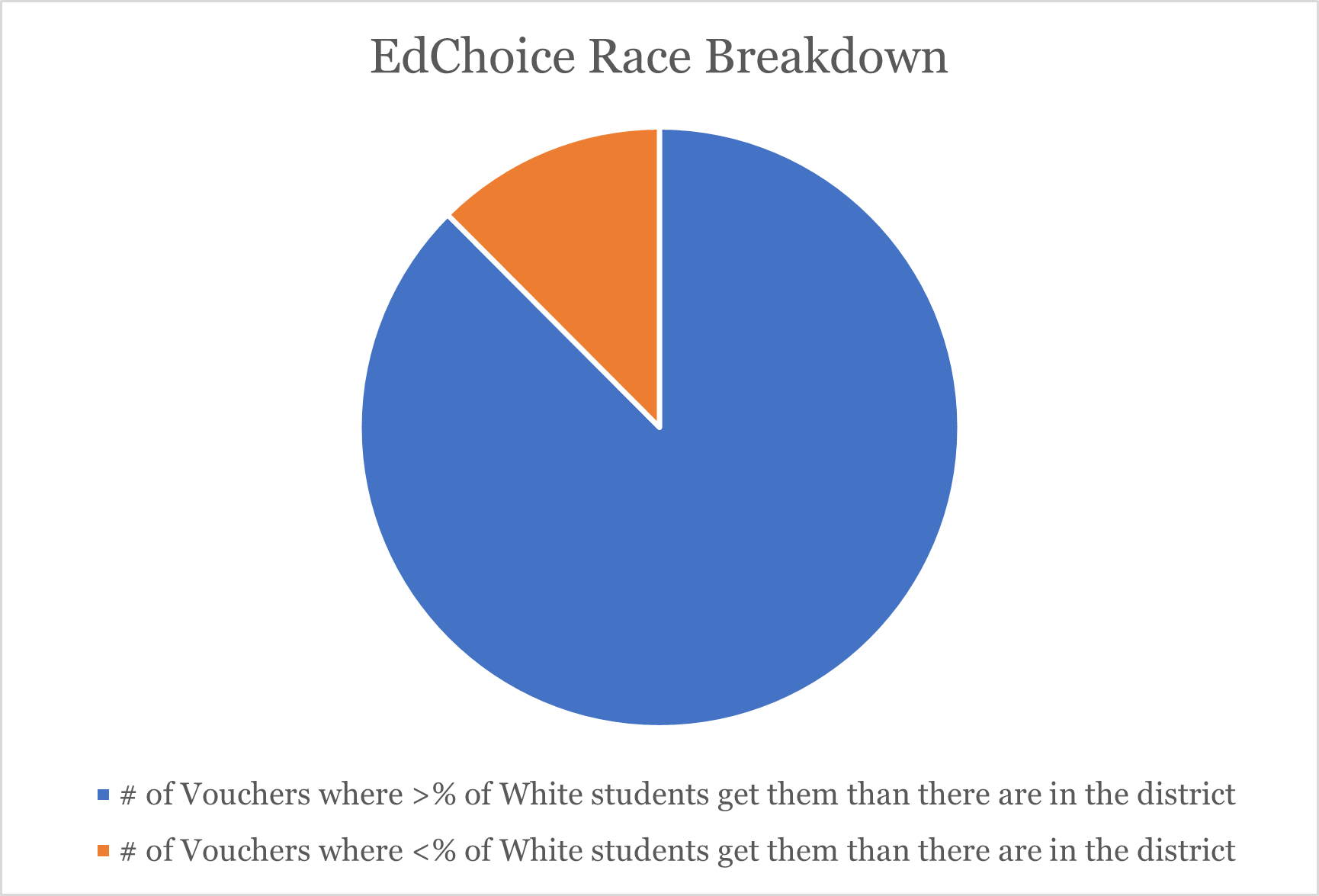
There are 95 districts that lose 10 students or more to EdChoice. In 76 of those districts, accounting for 87% of all vouchers given through the program, a higher percentage of white students take vouchers than there are in that district.

The average difference between white students taking vouchers and white students in those 76 districts was 76.2%. That means that in the districts where 87% of voucher students come from, voucher recipients are 76.2% more likely to be white than their public school counterparts.

My friends, that’s White Flight. Like, obvious White Flight.

Dear reader, do these data suggest — as Huffman wants you to think — that these segregation issues are “isolated examples”?

If 87% of voucher recipients are more likely to be white than the districts they come from, is that really “isolated”? Or is it “systemic”?

I mean in Huffman’s own district of Lima, Temple Christian takes 100% white voucher students. From a district that’s 35% white….

The vouchers worsen segregation. The students in voucher schools do worse on state tests than the public schools they left. What is more, “voucher students do worse on state tests the longer they take the voucher.”

A lose-lose, for students, for public schools, and for the state.

Nonetheless, despite failure, the state Teoublican legislature wants more vouchers and more failure!

Please open the link and keep reading this important post.

Jan Resseger, as always wise and compassionate, reviews the impact of the billionaire-funded culture wars on children and families. The particular focus on erasing the histories of children of color and demonizing LGBT families is harmful to them.

She writes:

Conversations about public schooling have been utterly sidetracked this year by fights about Critical Race Theory, “Don’t say gay!” laws, and whether somebody is “grooming” children at school? Where did these culture wars come from?

A NY Times analysis earlier this week tracks book banning in public schools as part of an epidemic of culture war disruption: “Traditionally, debates over what books are appropriate for school libraries have taken place between a concerned parent and a librarian or administrator, and resulted in a single title or a few books being re-evaluated, and either removed or returned to shelves. But recently, the issue has been supercharged by a rapidly growing and increasingly influential constellation of conservative groups. The organizations frequently describe themselves as defending parental rights. Some are new, and others are longstanding, but with a recent focus on books. Some work at the district and state level, others have national reach. And over the past two years or so, they have grown vastly more organized, interconnected, well funded — and effective. The groups have pursued their goals by becoming heavily involved in local and state politics, where Republican efforts have largely outmatched liberal organizations in many states for years.”

The reporters track research from PEN America: “(T)here are at least 50 groups across the country working to remove books they object to from libraries. Some have seen explosive growth recently: Of the 300 chapters that PEN tracked, 73 percent were formed after 2020. The growth comes, in part, from the rise of ‘parental rights’ organizations during the pandemic. Formed to fight COVID restrictions in schools, some groups adopted a broader conservative agenda focused on opposing instruction on race, gender and sexuality, and on removing books they regard as inappropriate.”

How is the culture war uproar affecting public schools? In a recent newsletter, the National Education Policy Center (NEPC) trackedresearch concluding: “Preparing students to participate in civil and respectful ways in our diverse democracy has long been a core mission of public schools.” Today, “U.S. high schools are struggling to fulfill this mission as they increasingly encounter hyper-partisan efforts. Those efforts have sought to spread misinformation, to encourage harassment of LGBTQ+ students, and to limit opportunities for productively discussing controversial topics. Such challenges are particularly pervasive in politically diverse areas where one party does not dominate.” The researchers surveyed 682 public high school principals and subsequently followed up by interviewing 32 of those principals. NEPC reports:

  1. “Public schools increasingly are targets of political conflict. Nearly half of principals (45 percent) reported that the amount of conflict in their community was higher during the 2021-2022 school year than it was pre-pandemic… Teaching about race and racism was the area where principals were most likely to report challenges from community members, followed closely by LGBTQ+ content.”
  2. “Political conflict undermines the practice of respectful dialogue. A majority of high school principals report that students have made demeaning or hateful remarks toward classmates for expressing either liberal or conservative views and that strong differences of political opinion among students have created more contentious classroom environments.”
  3. “Conflict makes it harder to address misinformation. Misinformation—much of it tied to partisan organizations and causes—makes it more challenging to encourage productive and civil dialogue. After all, it is difficult to develop a shared sense of how to move forward when different people are working from different sets of ‘facts.’ Nearly two thirds of principals (64 percent) say parents or community members have challenged information used by teachers at their schools. The share of principals saying parents or community members challenged teachers’ use of information three or more times nearly doubled between 2018 and 2022.”
  4. “Conflict leads to declines in support for teaching about race, racism, and racial and ethnic diversity. High schools increasingly struggle to teach students about the full spectrum of American experiences and histories, especially when it comes to issues related to racism and race… ‘My superintendent told me in no uncertain terms that I could not address issues of race and bias etc. with students or staff this year,’ said a principal in a red community in Minnesota. ‘We could not address the deeper learning.'”
  5. “Principals report sizable growth in harassment of LGBTQ+ youth. The survey results also suggest that schools are increasingly facing challenges related to teaching students to treat one another with dignity and respect… Fewer than half of principals said school board members or district leaders made statements or acted to promote policies and practices that protected LGBTQ+ student rights.”

“Parents’ rights” are the rallying cry for many of today’s culture warriors who want to protect the dominant culture and shield their children from uncomfortable controversy. But in a recent and very personal Washington Post column, “When Children Ask About Race and Sex, We Have No Choice But to Answer,” Danielle Allen, a political theorist and the Director of the Edmond and Lily Safra Center for Ethics at Harvard University, and an African American mother, explains the point of view of many other parents and children. Allen examines why it is so urgently important for teachers to be able to respond to children’s own observations and questions when the students themselves initiate conversation about the same fraught subjects the NEPC researchers describe organized parents trying to ban from the schools.

Allen describes a conversation her own two-year-old daughter launched about race, while the child sat in seat of the grocery store cart as they were in the midst of shopping. The child declared, “Mommy, I think it’s not good to be Black.”

Allen reflects upon what her toddler had already observed about race in America: “My daughter’s statement was a question. Its subtext went like this: ‘I’ve noticed something, Mommy. It seems like it’s not good to be Black. But can that be right? You’re Black. I love you. How can these things fit together? And what does this mean for me?'”

Allen continues: “What I can assure you of is that even before any of our kids, of any racial or ethnic background, get to school, every Black family in the United States is having to teach its children about race and the history of enslavement and stories of overcoming that have played out generation after generation. The same must be true for kids raised in LGBTQ families, with regard to the history and contemporary experience of gender and sexuality… This means that the only way you can keep knowledge and questions about these histories, experiences and perspectives out of the school curriculum in early grades is to keep Black people or members of LGBTQ families out of school.”

Or, according to NEPC’s research, many school districts are enrolling Black and Brown children and children from LGBTQ families while the school districts may be imposing policies to silence such children, to make their realities invisible to other students, and to refuse to help them answer their own hard questions.

Public schools are required by law to serve all the children whatever their race, ethnicity, religion, or sexual orientation. It is not the business of school board members, school superintendents, school principals, or teachers to cater to any one group of parents’ rights advocates, no matter how well organized or well funded is their lobby.

Here, writing for The Progressive, is retired high school teacher, Peter Greene, who understands educators’ obligation to protect the interests of all the students who fill our nation’s public school classrooms: “Schools must balance the needs and concerns of all of their many stakeholders. Parents absolutely have rights when it comes to public schools, but so do non-parents, taxpayers and other community stakeholders. It’s up to the school district to balance all of these concerns, while also depending on the professional judgment of its trained personnel. It is a tricky balance to maintain, requiring nuance and sensitivity. It is correct to argue that ‘schoolchildren are not mere creatures of the state.’ But framing the issue as parents versus school has served some folks with a very specific agenda.”
Donna Mace recently died, unexpectedly, and the public schools of the United States and Florida lost a dear friend.

Sandy Stenoff wrote this tribute to Donna, who taught elementary school students for 35 years, then became an outspoken activist for public schools and against the overuse of standardized testing. Of course, she was a BAT.

She concluded:

Donna Mace made the world a better place by being a force for good. She was a class act, approaching life’s challenges with courage, grace, humility, humor, and optimism, We all benefited from Donna’s wisdom, gained from her experience as a lifelong educator and a life well lived. She really was the best of us.

To the Mace family: Our thoughts are with you now and we send you love, gratitude, and a wish that your fondest memories will bring you peace and comfort.

I am sadened that we have lost Donna Mace. Many were inspired by her and will follow in her footsteps, never abandoning the struggle to do what is right for children. I hereby add her name to the honor roll, a list of distinguished fighters for public schools and children.

Bill Phillis, leader of the Ohio Coalition for Equity and Adequacy, reports good news in the battle against the state’s expensive and ineffective voucher program.

Private School Voucher Lawsuit Given Green Light to Go to Trial

Effort by Attorney General and Out-of-State Interest Groups to Dismiss Foiled

COLUMBUS – The lawsuit challenging the constitutionality of the harmful private school voucher program was given the green light on Friday to go to trial sometime in 2023.

Franklin County Common Pleas Judge Jaiza Page dismissed motions by Ohio Attorney General Dave Yost and out-of-state pro-private school interest groups like the Institute for Justice to dismiss the case, and instead gave the go ahead to the coalition of public schools suing the state to present their case.

“We are one step closer to proving that private school vouchers are unconstitutional, and hurt Ohio, our public school students, educators, parents, taxpayers and our communities,” said William L. Phillis, Executive Director for the Ohio Coalition for Equity & Adequacy of School Funding. “Facts matter in the court of law. The Ohio Constitution is clear. There shall be a single system of public schools, not a separate and unequal system of schools that can apply a discriminatory litmus test against students based on race, religion, income, or any disqualifying factor that strikes their fancy.”

“School board members like me owe it to our taxpayers to bring this lawsuit because my district, like so many others, has been forced to increase our property taxes with local levies to make up for the public tax dollars lost to private school vouchers. We know the vast majority of these parents are using the voucher as a refund or a rebate and they never intended to enroll their children in public schools,” said Dan Heintz, a school board member with plaintiff district Cleveland Heights-University Heights.

To read the Motion for Judgement on the Pleadings click here.

To read the Motion to Dismiss click here.

The Ohio Coalition for Equity & Adequacy of School Funding is working with Vouchers Hurt Ohio, a growing coalition of public school districts that have come together to sue the state over the unconstitutional and harmful private school voucher program.