I have never been on the Danube before. We are on a river cruise that goes very slowly to interesting places in Austria and Germany. The photo here is Durnstein, a beautiful Austrian village. Here’s news: the Danube is not blue. It’s green. We expected cool weather but it has been 75-80 degrees every day (so far). Because of prolonged drought, our cruise will not make it to Nuremberg because the water levels are low. Today we went to Salzburg, which is a beautiful town with immaculate streets, beautiful churches, and lots of attention to native son Mozart. 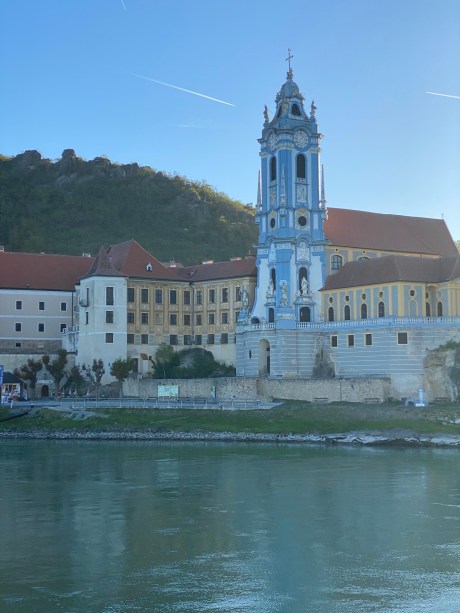
Several authors have filed suit against Meta (Zuckerberg), Bloomberg, and other tech corporations for violating the copyright on their books. Alex Reisner has written three articles in The Atlantic about how the developers of Artificial Intelligence (AI) have used 183,000 books to train AI how to write.
Two of those 183,000 books are mine: The Death and Life of the Great American School System: How Testing and Choice Are Undermining Education and Reign of Error: The Hoax of the Privatization Movement and the Danger to America’s Public Schools. As an author, I am outraged that huge tech corporations used my books as training fodder for their profiteering.
Reissner writes:
This summer, I acquired a data set of more than 191,000 books that were used without permission to train generative-AI systems by Meta, Bloomberg, and others. I wrote in The Atlantic about how the data set, known as “Books3,” was based on a collection of pirated ebooks, most of them published in the past 20 years. Since then, I’ve done a deep analysis of what’s actually in the data set, which is now at the center of several lawsuits brought against Meta by writers such as Sarah Silverman, Michael Chabon, and Paul Tremblay, who claim that its use in training generative AI amounts to copyright infringement.
Since my article appeared, I’ve heard from several authors wanting to know if their work is in Books3. In almost all cases, the answer has been yes. These authors spent years thinking, researching, imagining, and writing, and had no idea that their books were being used to train machines that could one day replace them. Meanwhile, the people building and training these machines stand to profit enormously.
Reached for comment, a spokesperson for Meta did not directly answer questions about the use of pirated books to train LLaMA, the company’s generative-AI product. Instead, she pointed me to a court filing from last weekrelated to the Silverman lawsuit, in which lawyers for Meta argue that the case should be dismissed in part because neither the LLaMA model nor its outputs are “substantially similar” to the authors’ books.
It may be beyond the scope of copyright law to address the harms being done to authors by generative AI, and the point remains that AI-training practices are secretive and fundamentally nonconsensual. Very few people understand exactly how these programs are developed, even as such initiatives threaten to upend the world as we know it. Books are stored in Books3 as large, unlabeled blocks of text. To identify their authors and titles, I extracted ISBNs from these blocks of text and looked them up in a book database. Of the 191,000 titles I identified, 183,000 have associated author information. You can use the search tool below to look up authors in this subset and see which of their titles are included.
The article contains a search tool that anyone can use to see whether their copyrighted work was fed into the AI training process.
As an author whose works were used, I feel aggrieved. I think that all of us whose works were utilized without our knowledge or consent should be compensated.
AI is the latest iteration of big-tech’s efforts to make human beings irrelevant. AI may “learn” how to write well, but AI can never “learn” the wisdom, experiences, memories, fears, hopes, and emotions that lie behind every book.
The National Education Policy Center issued a report about the likely fiscal impact of vouchers, which finds that vouchers are a risky venture with no proven benefits. NEPC is noted for its peer-reviewed reports.
An NEPC Review funded by the Great Lakes Center
Key Takeaway: Tax-credit scholarship programs probably incur more costs than savings for state and school districts, placing financial strain on state budgets and driving the need for future budget cuts.
GRAND RAPIDS, MI (September 26, 2023) – A recent report from the Georgia Department of Audits and Accounts examines the monetary costs and benefits of the state’s Qualified Education Expense Tax Credit (QEEC), a voucher policy that provides a public subsidy for families to pay for private school tuition. A review of the report, however, contradicts its claim that the policy provides a net fiscal benefit to the state budget.
David Knight of the University of Washington reviewed Qualified Education Expense Tax Credit: Economic Analysis, and he found several methodological challenges that undermine the report’s conclusions and its usefulness.
One key claim in the report is that the tax credit results in $81 million of forgone state tax revenue per year. Another key claim is that the vouchers incentivize almost 20,000 students per year to choose private schools instead of public, thus removing the cost of educating those students from state and local budgets. Based largely on these two claims, the report concludes that QEEC provides a net fiscal benefit for Georgia’s state budget.
Professor Knight points to a lack of data about how many students per year do actually switch from public to private schools because of the voucher subsidy and incentive. In fact, existing private-school families have extremely strong incentives to accept the public subsidies. And if most of the vouchers are provided to support these students who were already planning to attend a private school, then the policy only subsidizes private school students with funding that could otherwise be returned to taxpayers or invested in the state’s public education system, which is open to all students.
While these calculations are all necessarily grounded in some speculation because of the unregulated elements of the voucher policy and the resulting lack of hard data, the most likely result of tax credit scholarship programs like QEEC is that the state and school districts incur more costs than savings, placing financial strain on state budgets that could require future cuts.
Because the report relies on unrealistic assumptions, its suggestion that program benefits outweigh costs is tenuous and risks misleading state education leaders. Instead, state leaders should invest educational dollars in policies that have a positive return on investment and therefore help, rather than harm, state and local budgets.
Find the review, by David Knight, at:
https://www.greatlakescenter.org
Find Qualified Education Expense Tax Credit: Economic Analysis, written by Greg S. Griffin and Lisa Kieffer, and published by the Georgia Department of Audits and Accounts, at:
https://www.audits.ga.gov/ReportSearch/download/29827
NEPC Reviews (https://nepc.colorado.edu/reviews) provide the public, policymakers, and the press with timely, academically sound reviews of selected publications. NEPC Reviews are made possible in part by support provided by the Great Lakes Center for Education Research and Practice: https://www.greatlakescenter.org
NBCT high school teacher Justin Parmenter has a great story to tell to launch Banned Books Week. The local leader of Moms for Liberty in Charlotte asked the local school board to ban five books from a high school. The board debated her request and rejected it. But they did say she could request that her own child be excused from reading the books she objected to. A brilliant resolution!
He writes:
Here’s some excellent news to kick off Banned Books Week.
An attempt by the Charlotte Mecklenburg Moms for Liberty chair to have five books banned from the Ardrey Kell High School media center has failed.
The school’s School Media Advisory Committee determinedthat all five books will be retained in the media center, and the objecting parent is free to restrict their own child’s access to those titles as permitted by district policy.
Students in Charlotte Mecklenburg Schools were not allowed to check out books for the first two weeks of school while the district waited to hear objections. The library pause came in response to Republicans in the North Carolina General Assembly passing a “Parents Bill of Rights” law which, among many other things, requires superintendents to create a process for objections and provide parents with access to student library records.
After two weeks with more than 140,000 students at 181 schools having no access to media centers, only five objections were lodged.
According to WSOC, all the objections were filed at one school (Ardrey Kell High School) by the same parent. Unsurprisingly, she also happens to be the chair of the local Moms for Liberty chapter, Brooke Weiss. (Moms for Liberty has embarked on a nation-wide crusade to ban books from school libraries.)

Committee meeting notes requested by Weiss and posted to the CMS public records request page show that, after thoughtful consideration and robust discussion, the committee decided to retain all five books in the Ardrey Kell media center. The committee noted that the objecting parent “may use policy to restrict access for their student by request.”
Open the link to read the board’s discussion notes.
CNN asked for and received a statement from John Kelly, retired general and Trump’s former chief of staff. Kelly confirmed Trump’s worst comments about veterans.
“What can I add that has not already been said?” Kelly said, when asked if he wanted to weigh in on his former boss in light of recent comments made by other former Trump officials. “A person that thinks those who defend their country in uniform, or are shot down or seriously wounded in combat, or spend years being tortured as POWs are all ‘suckers’ because ‘there is nothing in it for them.’ A person that did not want to be seen in the presence of military amputees because ‘it doesn’t look good for me.’ A person who demonstrated open contempt for a Gold Star family – for all Gold Star families – on TV during the 2016 campaign, and rants that our most precious heroes who gave their lives in America’s defense are ‘losers’ and wouldn’t visit their graves in France.
“A person who is not truthful regarding his position on the protection of unborn life, on women, on minorities, on evangelical Christians, on Jews, on working men and women,” Kelly continued. “A person that has no idea what America stands for and has no idea what America is all about. A person who cavalierly suggests that a selfless warrior who has served his country for 40 years in peacetime and war should lose his life for treason – in expectation that someone will take action. A person who admires autocrats and murderous dictators. A person that has nothing but contempt for our democratic institutions, our Constitution, and the rule of law.
“There is nothing more to be said,” said Kelly. “God help us.”
Indiana blogger Steve Hinnefeld reviews the damage left behind when charter schools close, often mid-year. The possibility of a sudden closing is an unadvertised disadvantage of charters. If they don’t have enough students, if there’s a financial scandal, if lots of other things, the school abruptly closes, leaving students and parents to find another school. Charter school advocates think it’s commendable when the schools close, as that is the market at work. Not so good for the students.
He writes:
Regardless of what you think about charter schools, it’s bad news when one closes unexpectedly. It’s bad for the staff. It’s bad for the people who were committed to the project. It’s especially bad for the students, who will have to find a new school, learn their way around and make new friends.
And it’s not a rare occurrence here in Indiana. A list provided by the Indiana Department of Education includes 50 charter schools that have closed or merged since Indiana began allowing charters in 2002. An analysis by Chalkbeat Indiana found at least 29 charter schools in Marion County have closed.
The latest to fold was Vanguard Collegiate, an Indianapolis middle school that opened with big plans in 2018 but struggled to enroll students. It had only 71 students in grades 5-8 last year, according to Indiana Department of Education data, and was down to about 40 this fall.
Vanguard announced two weeks ago in a letter to parents that it would close Oct. 1. “Please know that we fought hard for you, our beloved school community,” executive director Robert Marshall wrote.
In January, another Indianapolis charter school, HIM by HER, closed abruptly, sending its 200 students scrambling with three months left in the school year. The school, which launched during the COVID-19 pandemic, was authorized by Ball State University and operated for 2½ years.
One charter-school supporter commented online that Vanguard Collegiate shouldn’t have been allowed to open in the first place, Ball State shouldn’t have extended its charter last year, and it shouldn’t have been allowed to close mid-semester. Certainly, the situation could have been handled better.
The fact that the school, over five years, never managed to enroll 100 students should have been a red flag. It reported good attendance rates for a high-poverty school, but its academic performance wasn’t stellar: Only two of 61 test-takers scored proficient on both the math and English/language arts ILEARN assessments in 2023. It’s not clear what the school’s board was doing about this; board minutes haven’t been posted to the school’s website since June 2022.
Then there was the school’s most recent posted audit, covering the 2020-21 school year and submitted to the State Board of Accounts in March 2022. The audit concluded that “substantial doubt continues to exist about the ability of the school to continue as a going concern.”
Nevertheless, the school’s authorizer, the Indiana Charter School Board, approved a 5-year extension of its charter late last year. If the board had rejected the renewal request, the school could have shut down in May in an orderly fashion and its students would have had the summer to find a new school. On the other hand, it might have gone shopping for a different authorizer. That’s what happened with HIM by HER: the Indiana Charter School Board rejected its initial application, but Ball State approved it.
What happens to students when their schools close unexpectedly? Research is mixed, but there’s strong evidence that switching schools has negative academic and behavioral impacts, especially on students of color and students from low-income families – like those at Vanguard and HIM by HER.
Please open the link and finish the post.
The U.S. Department of Education awarded $35 million to St. Louis from the federal Charter Schools Program despite the city’s checkered history with charters. The public schools sure could have used that money to reduce class sizes and improve their offerings. Republicans and DFER-funded Democrats protect the federal charter money from cuts, even though charter expansion harms public schools. (DFER=Democrats for Education Reform, a group of hedge fund managers who support charters, high-stakes testing and other corporate “reforms,” but never support public schools).
ST. LOUIS — The Opportunity Trust education reform group has been awarded a $35.6 million federal grant to expand and open new charter schools across Missouri over the next five years.
The money will be used for 16 charter schools to serve 5,000 additional students, according to the group’s application to the U.S. Department of Education. The federal agency granted a total of $147 million to education departments and reform groups in 10 states for more charter school seats…
The Opportunity Trust launched in 2018 and has helped fund the Leadership School and several other new charters, including Atlas, Kairos Academies and Voices Academy, which opened this fall in downtown St. Louis.
Charters have had a mixed record since they first opened in the city in 2000 with a promise to improve student performance through innovation and independence. More than half of the 37 charter school operators that came to the city have folded due to financial or academic failures, including La Salle and Hawthorn schools this year.
Alan Singer is a professor of secondary education at Hofstra University in New York. He is a consistent defender of the right to read. He writes here about Banned Books Week. This recognition is of extraordinary importance this year because of the surge in book banning, fueled by Governor Ron DeSantis in Florida, Governor Greg Abbott in Texas, and extremist groups like Moms for Liberty.
He writes:
This year Banned Books Week is October 1 – 7, 2023. The theme is “Let Freedom Read!” Banned Books Week draws national attention to the harms of censorship. The ALA Office for Intellectual Freedom (OIF) compiles lists of challenged books as reported in the media and submitted by librarians and teachers across the country.
Sixty percent of all banned book demands come from just eleven people who are virtually prurient porn purveyors who see pornography everywhere, but especially in any book that includes homosexual characters or where teenagers have sex. An article in The Washington Post focused on a woman from Spotsylvania County, Virginia who purchases “suspect” books on Amazon, bookmarks pages with color-coded post-it notes, highlights the “disgusting” passages she doesn’t like, and has filed 71 complaints with the local public school board. Based on her complaints, two members of the board recommended burning the books.
Banned Books Week was launched in 1982 in response to a surge in the number of challenges to books in libraries, bookstores, and schools. The annual event highlights the value of free and open access to information and brings together the entire book community — librarians, educators, authors, publishers, booksellers, and readers of all types — in shared support of the freedom to seek and to express ideas.
Reading advocate, writer, and television and film star LeVar Burton is the honorary chair of Banned Books Week. Burton will headline a live virtual conversation with Banned Books Week Youth Honorary Chair Da’Taeveyon Daniels about censorship and advocacy at 8:00 p.m. ET on Wednesday, October 4. The event will stream live on Instagram (@banned_books_week). Visit BannedBooksWeek.org for more details.
Saturday, October 7 is “Let Freedom Read Day,” a day of action against censorship. Call community decision-makers, write them letters, and buy a banned book. For information about ways to participate and resources, visit bannedbooksweek.org/let-freedom-read-day/.
PEN America is calling on supporters to email to their Congressional Representative urging them to support House Resolution 733 introduced by Congressman Jamie Raskin (D-MD) and Senator Brian Schatz (D-HI). The resolution recognizes Banned Book Week and expresses concern about “the spreading problem of book banning and the proliferation of threats to freedom of expression in the United States.”
Heather Cox Richardson wrote about President Biden’s homage to democracy and his tribute to the Late Senator John McCain. Biden traveled to Arizona to speak at a librarian named in honor of the Senator McCain. Biden took the opportunity to praise democracy and warn about the threats we are with facing.
Biden recalled that when McCain was dying, he wrote a farewell letter to the nation that he had served in both war and peace. “We are citizens of the world’s greatest republic, a nation of ideals, not blood and soil,” McCain wrote. “Americans never quit…. We never hide from history. We make history.”
In Tempe, Arizona, today, President Joe Biden spoke at the dedication ceremony for a new library, named for the late Arizona senator John McCain, who died in 2018. Biden used the opportunity not only to honor his friend, but to emphasize the themes of democracy and to call out those who are threatening to overturn it. While Biden has made the defense of American democracy central to his presidency, he has never been clearer or more impassioned than he was today.
Biden reiterated the point he makes often: that the United States is the only nation founded on an idea, articulated in the Declaration of Independence, that we are all created equal and have the right to be treated equally before the law. While “[w]e’ve never fully lived up to that idea,” he said, “we’ve never walked away from it.” Now, though, our faith in that principle is in doubt.
“[H]istory has brought us to a new time of testing,” Biden said. “[A]ll of us are being asked right now: What will we do to maintain our democracy? Will we, as John wrote, never quit? Will we not hide from history, but make history? Will we put partisanship aside and put country first? I say we must and we will. We will. But it’s not easy.”
Biden laid out exactly what democracy means: “Democracy means rule of the people, not rule of monarchs, not rule of the monied, not rule of the mighty. Regardless of party, that means respecting free and fair elections; accepting the outcome, win or lose. It means you can’t love your country only when you win.”
“Democracy means rejecting and repudiating political violence,” he said. “Regardless of party, such violence is never, never, never acceptable in America. It’s undemocratic, and it must never be normalized to advance political power.”
“Today,” he warned, “democracy is…at risk.” Our political institutions, our Constitution, and “the very character of our nation” are threatened. “Democracy is maintained by adhering to the Constitution and the march to perfecting our union…by protecting and expanding rights with each successive generation.” “For centuries, the American Constitution has been a model for the world,” but in the past few years, he noted, the institutions of our democracy—the judiciary, the legislature, the executive” have been damaged in the eyes of the American people, and even the eyes of the world, by attacks from within.
“I’m here to tell you,” Biden said: “We lose these institutions of our government at our own peril…. Democracy is not a partisan issue. It’s an American issue.”
“[T]here is something dangerous happening in America now,” Biden said. “There is an extremist movement that does not share the basic beliefs in our democracy: the MAGA Movement.” After high praise for his Republican friend McCain, and recollections of working with Republicans to pass bipartisan legislation throughout his career, Biden made it clear that he does not believe “every Republican,” or even “a majority of Republicans” adheres to the MAGA extremist ideology. But, he said”
“[T]here is no question that today’s Republican Party is driven and intimidated by MAGA Republican extremists. Their extreme agenda, if carried out, would fundamentally alter the institutions of American democracy as we know it.”
The MAGA Republicans, Biden said, are openly “attacking the free press as the enemy of the people, attacking the rule of law as an impediment, fomenting voter suppression and election subversion.” They are “banning books and burying history.” “Extremists in Congress [are] more determined to shut down the government, to burn the place down than to let the people’s business be done.” They are attacking the military—the strongest military in the history of the world—as being “weak and ‘woke’.”
They are “pushing a notion the defeated former President expressed when he was in office and believes applies only to him: This president is above the law, with no limits on power. Trump says the Constitution gave him…’the right to do whatever he wants as President.’ I’ve never even heard a president say that in jest. Not guided by the Constitution or by common service and decency toward our fellow Americans but by vengeance and vindictiveness.”
Biden accurately recounted the plans Trump has announced for a second term: expand presidential power, put federal agencies under the president’s thumb, get rid of the nonpartisan civil service and fill positions with loyalists. Biden quoted MAGA Republicans: “I am your retribution,” “slitting throats” of civil servants, “We must destroy the FBI,” calling the Chairman of the Joint Chiefs of Staff a “traitor” and suggesting he should be executed. These extremists, he said, are “the controlling element of the House Republican Party.”
“This is the United States of America,” Biden said. “Did you ever think you’d hear leaders of political parties in the United States of America speak like that? Seizing power, concentrating power, attempting to abuse power, purging and packing key institutions, spewing conspiracy theories, spreading lies for profit and power to divide America in every way, inciting violence against those who risk their lives to keep America safe, weaponizing against the very soul of who we are as Americans.”
“The MAGA extremists across the country have made it clear where they stand,” Biden said. “So, the challenge for the rest of America—for the majority of Americans—is to make clear where we stand. Do we still believe in the Constitution? Do we believe in…basic decency and respect? The whole country should honestly ask itself…what it wants and understand the threats to our democracy.”
Biden knew his own answers:
“I believe very strongly that the defining feature of our democracy is our Constitution.
“I believe in the separation of powers and checks and balances, that debate and disagreement do not lead to disunion.
“I believe in free and fair elections and the peaceful transfer of power.
“I believe there is no place in America…for political violence. We have to denounce hate, not embolden it.
“Across the aisle, across the country, I see fellow Americans, not mortal enemies. We’re a great nation because we’re a good people who believe in honor, decency, and respect.”
Pointing to the fact that the majority of the money appropriated for the Bipartisan Infrastructure Law has gone to Republican-dominated states, he added: “I believe every president should be a president for all Americans” and should “use the Office of the President to unite the nation.”
The job of a president, he said, is to “deliver light, not heat; to make sure democracy delivers for everyone; to know we’re a nation of unlimited possibilities, of wisdom and decency—a nation focused on the future.”
“We’ve faced some tough times in recent years, and I am proud of the progress we made as a country,” Biden said, “But the real credit doesn’t go to me and my administration…. The real heroes of the story are you, the American people.” Now, he said, “I’m asking you that regardless whether you’re a Democrat, Republican, or independent, put the preservation of our democracy before everything else. Put our country first…. We can’t take democracy for granted.”
“Democracies don’t have to die at the end of a rifle,” Biden said. “They can die when people are silent, when they fail to stand up or condemn the threats to democracy, when people are willing to give away that which is most precious to them because they feel frustrated, disillusioned, tired, alienated.”
“I get it,” Biden said. But “[f]or all its faults…, American democracy remains the best…[path] forward to prosperity, possibilities, progress, fair play, equality.” He urged people not to sit on the sidelines, but “to build coalitions and community, to remind ourselves there is a clear majority of us who believe in our democracy and are ready to protect it.”
“So,” he said, “let’s never quit. Let’s never hide from history. Let’s make history.” If we do that, he said, “[w]e’ll have proved, through all its imperfections, America is still a place of possibilities, a beacon for the world, a promise realized—where the power forever resides with ‘We the People.’”
“That’s our soul. That’s who we truly are. That’s who we must always be.”
Charlotte County in Florida is following Governor Ron DeSantis’s “Don’t Say Gay” law with zeal. School officials instructed school librarians to remove all books that have gay characters, even if the books have no sexual content. This is a deliberate effort to make gay people invisible, to erase them. Students may see gay characters in movies or television, but not in school.
Librarians in public schools in Charlotte County, Florida, were instructed by the school district superintendent to remove all books with LGBTQ characters or themes from school and classroom libraries.
Judd Legum at Popular Information reported:
Charlotte County school librarians sought guidance from the school district about how to apply an expansion of the Florida Parental Rights in Education Act, better known as the “Don’t Say Gay” law, to all grades. “Are we removing books from any school or media center, Prek-12 if a character has, for example, two mothers or because there is a gay best friend or a main character is gay?” the librarians asked. Charlotte County Superintendent Mark Vianello answered, “Yes.”
The guidance by Vianello and the school board’s attorney, Michael McKinley, was obtained by the Florida Freedom to Read Project (FFTRP) through a public records request and shared with Popular Information. FFTRP requested “electronic records of district and school decisions regarding classroom and library materials.” In response, FFTRP received a document memorializing a July 24 conversation between Vianello and district librarians, known in Florida as media specialists.
The guidance made clear that all books with LGBTQ characters are to be removed even if the book contained no sexually explicit content. The librarians asked if they could retain books in school and classroom libraries with LGBTQ characters “as long as they do not have explicit sex scenes or sexual descriptions and are not approaching ‘how to’ manuals for how to be an LGBTQ+ person.” Vianello responded, “No. Books with LBGTQ+ characters are not to be included in classroom libraries or school library media centers.”

 Diane Ravitch's blog