This short film was shown to me and my classmates in 1950 to encourage racial and religious tolerance. This is the Library of Congress version.
There is a slightly longer version that begins with Sinatra rehearsing a song in a sound studio. He takes a break, steps outside, and finds a bunch of kids picking on a Jewish boy. He stops the fight and sings this song.
A teacher at DeWitt Clinton High School in New York City, Meeropol and his wife had a strong sense of outrage about racism. They were blacklisted because of their membership in the Communist Party. They eventually quit the party. When Julius and Ethel Rosenberg were arrested, convicted and executed, the Meeropols adopted their two young sons.
Scott Maxwell, opinion columnist for The Orlando Sentinel, wrote about the state’s effort to silence speech, even a silent protest. It is heartening to know that there are students in Florida willing to dissent. It is disheartening to learn that state officials never heard of the First Amendment to the Constitution.
Back in March, a handful of students at Florida International University stood up at an event where the school president was speaking and showed off their T-shirts.
They didn’t say anything to interrupt the program or speakers.
Instead, they simply revealed shirts that said they wanted the state school to stop coordinating with ICE on immigrant crackdowns on campus via the slogan: “ICE OFF FIU.”
Now, months later, the school is trying to discipline the students — even threatening to withhold their diplomas — if they don’t apologize for expressing their opinions.
In one of the creepiest twists, the school told the students that the only way they can escape punishment and “receive a diploma” would be to make a two-minute “video reflection” swearing they now understand what they did wrong.
It sounds like a hostage video. Except in this case, the hostages are being forced to apologize for free thought and expression.
Such is life in the “Free State of Florida.”
Once upon a time, college students were encouraged to be free-thinkers. That is, in fact, what Gov. Ron DeSantis and Florida’s other GOP leaders claim to believe … when they’re renaming roads after Charlie Kirk anyway.
But what they really mean is that Florida students should think the way they do or else shut the hell up.
And this is just the latest attack on speech by DeSantis and his fellow Republican lawmakers. There was also the state’s infamous “Stop WOKE” bill where the governor and lawmakers tried to make it illegal for private companies to hold diversity training sessions that offended these bro-flakes’ fragile sensibilities. (That part of the law was, of course, ruled unconstitutional.)
There have been multiple cases where the state tried to fire employees who said things the politicians disliked about Charlie Kirk. (The firings have been repeatedly challenged, with the state already agreeing to pay one fired biologist $485,000 for her wrongful termination.)
And a few years ago, DeSantis signed a law that would’ve allowed the state to actually imprison Floridians who donated more than $3,000 to citizen-led efforts to get amendments on the state ballot. Yes, imprison. (A federal judge appointed by Donald Trump struck down that law as well, declaring the politicians’ attempt to arrest citizens who donated to causes the governor disliked as “wholly foreign to the First Amendment.”)
It’s tempting to go numb to this constant and casual assault on your rights. And to the steady stream of public money spent on these losing legal battles with attorney bills at $675 and $725 an hour.
But this Independence Day weekend seems like a good time to remember that truly patriotic Americans don’t support government trying to suppress speech.
You don’t have to agree with the FIU students’ anti-ICE sentiments. Many Floridians certainly don’t.
But if you claim to call yourself a patriot, you’d damn well better support their right to express it. As Supreme Court Justice Oliver Wendell Holmes Jr. famously said, the First Amendment wasn’t created to protect viewpoints everyone likes, but specifically for “freedom for the thought that we hate.”
In the FIU case, Community Justice Project attorney Adam Saper, who’s representing the students pro bono, said: “This prosecution is the most clear violation of the constitution’s constitutional rights. They’re trying to silence these particular students who were speaking up against a policy of this school.”
That sentiment was echoed by the national free speech group, the Foundation for Individual Rights and Expression (FIRE), which honed in on the fact that the targeted “speech” involved words on a T-shirt — which the university obviously doesn’t crack down on with any regularity.
“Since this case involves clothing, would a student be prohibited from wearing a Malcolm X T-shirt in a university building under the same policy?” asked FIRE attorney Garrett Gravley.
“What about a Palestinian keffiyeh or an Israeli flag lapel pin? If a student wore purple for Domestic Violence Awareness Month, would that be actionable?”
Of course not. Even if the students had the audacity to … um … stand.
According to emails from university officials obtained by Axios and other news outlets, even school officials conceded that the students’ actions “did not disrupt the event.”
Basically, as far as protests go, this one seemed about as tame as it gets. Just a thoughtful, brief and silent statement of opinion. But apparently that was too much for Florida.
The school has said little about the case. But in correspondence with the students, FIU cited its policies on “student conduct” and “expression.” Those rules are a lengthy, self-contradicting mess. They attempt to place a bevy of restrictions on students expressing their viewpoints while also stressing that none of the school’s rules “should be interpreted” as abridging anyone’s Constitutional rights, including “the freedom of expression protected by the First Amendment.”
It’s like a prosecutor telling you that you’re not entitled to a speedy trial or access to an attorney … while acknowledging that the United States Constitution says you’re guaranteed to precisely that.
Interestingly, the students staged their silent protest in March without much hubbub. It wasn’t until weeks later that the school told the kids they were in trouble.
It almost looks like someone told school president Jeanette Nuñez — DeSantis’ former lieutenant governor, one of many DeSantis allies rewarded with cushy, high-paying university jobs — that she’d better get these critically thinking kids in line.
I sent Nuñez and some of her staffers an email this past week, asking if anyone in Tallahassee had told her she needed to crack down on the students. She did not respond.
She also didn’t answer another question I posed: Whether she’d ever attended her own school’s class on the First Amendment — one that says it explains why “the rights of conscience” are protected in this nation.
As a citizen of New York City, I am pleased to have voted for Zohran Mamdani. I am not a Democratic Socialist. I am a Democrat.
I like his determination to deliver on his promises. I like his zestfulness. I like his idealism and his determination to protect the weak and vulnerable.
The other day, he jumped into a public swimming pool, fully clothed, in Harlem, surrounded by children. No shoes, but a suit and tie. He makes people happy. He has a great smile.
I don’t agree with him about everything, but I have never agreed with any elected official about everything.
I feel that he is a good man who wants to keep his promises and make life affordable.
He’s a Muslim, I’m a Jew.
Remember during the Knicks championship series, someone posted on social media:
“My mayor is Muslim,
My bagel is Jewish,
My Christian’s Dior,
The Knicks win in four.”
Okay, they won in five but the point is that we all live together. We work together. Today we will watch dozens of Tall Ships from all over the world parade up the Hudson River. And we cheer together.
That’s New York City. That’s America.
Happy Fourth of July!
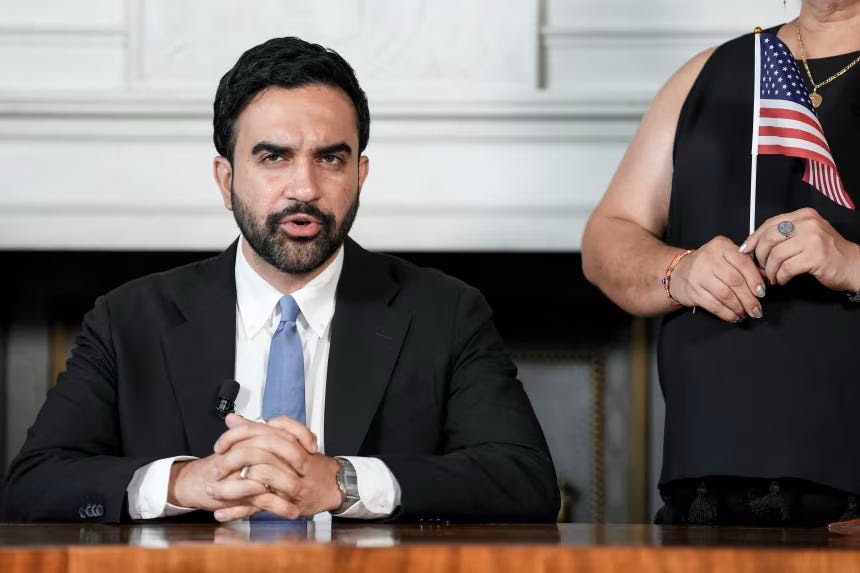
Mayor Zohran Kwame Mamdani: Good morning, my fellow Americans. Season after season, year after year, the tides have come in and out of New York Harbor. Long before the name “New York” had ever been spoken, Lenape dugouts crossed these currents. It was on these waters that tall masts crested the horizon, captained by explorers like Verrazzano and Hudson after whom we’ve named our bridges and rivers. And ever since, ships full of travelers weary from long journeys have passed through the Narrows, the winds of the Atlantic at their backs.
When those passengers lifted their heads to glimpse what lies just beyond the waves, what did they see? They saw land, lush and teeming with life. They saw men waiting at the docks to take them into bondage. They saw tenements rife with squalor. They saw industry rumbling with activity, steam and smoke rising, a city on the move. They saw a towering monument to freedom, her torch glowing world-wide welcome. They saw New York City. They saw America.
Tomorrow, our nation marks 250 years since we declared our independence. Two hundred and fifty years of a grand experiment in self-governance — an experiment so audacious that some in 1776 doubted it would last more than a few years, let alone a quarter of a millennium. From Lexington to Los Angeles, Selma to Seneca Falls, Morrisania to Midwood, Americans will come together for a day, just as we do each year. Families will gather around the grill. Fireworks will fill the night sky. This will be no ordinary day of celebration. Two hundred and fifty years presents a rare opportunity for more than 340 million people to turn together — both towards one another and towards ourselves, to take measure of who we are as a nation. When we look at America, what do we see?
Here at City Hall, as I sit behind George Washington’s desk, alongside new Americans who came to this country, I cannot see all of America. But like so many who came before, I can see New York City.
The city I see today looks very different than the one that greeted George Washington. In July of 1776, our city simmered under the yoke of oppression. The British had imposed a colonial rule so repressive that 250 years ago, 80 miles south, a small group of newspaper editors, farmers, and soldiers signed their names on a document declaring truths that feel self-evident now but were revolutionary then, establishing the ideals our nation still strives to fulfill.
The British did not take it well. War broke out. And that August, as the largest battle of the Revolutionary War unfolded in Brooklyn, batteries on Governors Island took aim at British ships anchored just offshore. We were outgunned, we were outmanned and we were soundly defeated. After only a few months, it appeared our fledgling attempt at democracy was on the precipice of collapse.
But that night, with the moon overhead, thousands of our soldiers silently climbed into ferries and flat-bottomed boats and escaped to Manhattan. The Continental Army survived to fight another day. Independence may have been declared in Philadelphia, but it was rescued in New York City. George Washington was the last to leave Brooklyn. As he waited at the river’s edge, the sun beginning its rise, he would have looked out over New York City’s waters and seen what so many have seen in the 250 years since — an opportunity to begin anew. Those opportunities — like everything in New York City — are not given. They are won.
In 1838, 11 years after New York outlawed slavery, a recently emancipated Black man by the name of James Weeks sought to begin anew as well — and to help hundreds of others do the same. He bought property in Brooklyn, won himself the right to vote, and sold lots to others newly freed. When they landed in New York Harbor, they knew they had something waiting for them that they had never had before: a home. Weeksville still stands today — a living, breathing testament to what we know America to be: a place each of us has the power to make.
The Harbor was busy those years, as ships poured in from around the world. Hundreds of thousands of Irish immigrants arrived with stomachs aching from a famine manufactured by imperial cruelty. Chinese sailors settled in what is today, Chinatown. Millions more traveled under the Statue of Liberty and through Ellis Island — Jewish people escaping pogroms, Italians fleeing poverty, Syrians seeking economic opportunity.
Each of these new arrivals peered through portholes onto a city that was changing as fast as the nation. They saw merchants peddling their wares on the docks, streets being laid out on a grid, buildings rising into the clouds. They could not yet see the nativism they would face — the jobs they would be refused, the landlords who would not rent to them, and the abject labor and living conditions they would withstand. But no matter how much smog hung over the harbor, they still saw an opportunity to begin anew.
Over the years that followed, despite laws enacted by the federal government to bar their entry, despite sweatshop fires that killed hundreds of women, despite riots aimed at their very existence, immigrants made homes here in New York City, and they helped to make New York City. That legacy of every generation of Americans insisting that the right to life, liberty and the pursuit of happiness extends to them, too, is no relic of the past. It carried millions of Black Americans north during the Great Migration; it drew hundreds of thousands of Puerto Ricans to New York City after the Second World War; it invited countless others from the West Indies, and South Asia, and West Africa, and across the world. And it is what brought my family to this city when I was seven years old.
My family did not arrive by boat, although we saw the Statue of Liberty from the window of the plane. Even from the air, we could make out the promise of America — the promise of the beautiful, patriotic work of rendering America, year after year, a little more faithful to its founding ideals. There is a term so often used to describe our nation and those who have shaped it: American exceptionalism. American exceptionalism, the conventional wisdom tells us, makes our freedom a little more free, is how we dug the Erie Canal and irrigated the West, is why children in faraway lands grow up dreaming of one day moving here.
And yet the irony is that the story of America has so often been written by those who were told by others with power and influence and wealth that they were anything but exceptional. For generation after generation, we have been told that when the world has sent its people to our shores, it has not sent its best. It sent Puritans and Sikhs and Quakers and Muslims and Jewish people who were banished for praying the wrong way, worshipping the wrong Gods, angering the wrong people. It sent peasants and serfs from slums and shtetls who were treated as less because they hardly owned clothes, let alone land. It sent immigrants for whom power was something someone else had. We are told that America is exceptional because we are richer, stronger, more powerful than everyone else.
The truth, my friends, is that America is exceptional because here, nothing is fixed into place. The frontier may be closed, we may have walked on the moon, but the work of fulfilling the values first enshrined in the Declaration of Independence — that work endures, my friends, and it belongs to us all. It belongs too to our newest Americans, those standing here with me today, all of whom were recently naturalized. Nearly a decade ago, I too felt what you feel — the joy of no longer being just a New Yorker, but an American too. You each hold a special power. The power to determine what America means.
The powerful have always known their answer. America, in their view, is an arena of supremacy, where only a select few are allowed freedom, where not all are created equal. America, if you ask them, becomes less the more people it welcomes. America, they will tell you, belongs only to those with the right accent or the right shade of skin. The rest of us, they insist, should be grateful for merely being allowed to visit.
How small they are, how weak, how unoriginal. At every moment in our past, those who led through exclusion and isolation have tried to win power and enrich themselves by turning us against one another. Division is the oldest trick in politics, and the cheapest. But time and again — including 250 years ago — those forces of division have been vanquished by the forces of progress. As Thomas Paine once wrote, “this new world hath been the asylum for the persecuted lovers of civil and religious liberty […] hither have they fled.” And yet today, too many of our leaders do not believe in a vision of this nation as an asylum for the persecuted — but rather as one that persecutes those seeking asylum. As we mark 250 years, what do we see?
We see a city of contradictions within a nation of contradictions. We see the wealthiest country in the history of the world — one where children go to sleep hungry while the world’s first trillionaire hungers for more. We see monopolies that dominate every industry and oligarchs who buy elections. We see masked agents terrorizing our streets, eating food cooked by our undocumented neighbors before spiriting them away in unmarked vans. We see a nation whose immense wealth has been built by those with calloused, dirt-streaked hands — those who toil on factory floors and chisel into stone — and we see a nation that has allowed so much of that wealth to be held instead in the soft hands of a precious few.
Yes, we see America in a health insurance industry that exploits the sick, but that is not all I see when we look for America. We see it too in the nurse who works a double shift and then stops on her way home to check on an ailing neighbor.
Yes, we see America in corporate landlords for whom negligence is a business model. We see it too in the father who tucks his children into bed beneath a ceiling stained with leaks, who wakes before dawn to go to work and still believes his country can do better by his family.
Yes, we see America when we spend our tax dollars on bombs and bailouts, when we sell our elections to the highest bidder. Yet we see it just as clearly in every American who still believes this country belongs to we, the people.
We see America each time neighbors link arms with neighbors — without asking how long they have lived here, or what papers they have — as ICE invades our neighborhoods.
We see America each time those young and old stand in the beating rain or the stifling heat to cast their ballots.
We see America each time working people demand more — not just for themselves, but for their fellow Americans.
There are some who respond to those who ask for more from America with a simple refrain: “Love it or leave it,” they say. But patriotism has never been about pretending our nation is without flaws. Patriotism is every act of righteous dissent, it is every march led under the heavy sun, it is every protest held a decade before its time. It is precisely because we love this nation that we will not leave it. After all, who loves America more than those who have sacrificed so much to make it free?
Today, I think not only of the Fourth of July — I think too of the ninth of July. Five days after the Declaration of Independence was signed, it arrived here in New York City. Redcoats had disembarked on Staten Island. More than a hundred British ships loomed just offshore. Across this city, the Continental Army prepared for an invasion. George Washington commanded his brigades to assemble just a few feet from this building. It was known then as the Commons — today, we call it City Hall Park.
There, within range of British guns, Washington ordered his generals to read the Declaration aloud. And with the world’s mightiest empire poised to attack, Washington told the people of New York City what we will celebrate tomorrow — that we had declared our independence. That freedom was within reach. That evening, danger loomed. Conflict was not a question but a certainty. And yet when those early New Yorkers marched toward the statue of King George III that stood in Bowling Green, a statue they would melt down into bullets for their young army, they walked in unison — grounded not in the pursuit of plunder, but in ideals that for the first time had a name: America.
Those ideals upon which our nation was built — they are strong enough to endure any authoritarian regime, but only if we reach for them. Ours is a nation working each day towards the perfection in which it was conceived. A nation striving each day to better itself. Therein lies the work of America — the striving, the bettering, the reaching towards perfection.
What a privilege each of us has, to live in a nation that every one of its inhabitants can shape. What a responsibility each of us possesses, to prove ourselves worthy of all those who came before. What power each of us holds, to bring America ever-closer to the greatness so many have seen when they looked upon these shores — the greatness that, for 250 years, has been America.
Thank you. God Bless America, God Bless New York City, and happy Fourth of July.
Rhode Island welcomed charters under former Governor Gina Raimondo. When she left to become President Biden’s Secretary of Commerce, lieutenant governor Dan McKee took her place. He was widely viewed as a strong supporter of charter schools. He was closely associated with the creation of Rhode Island’s mayoral academies, especially the Blackstone Valley Prep network. But this year, he signed legislation pausing the approval of new charter schools for three years. He said that declining enrollment and funding challenges warranted the pause.
This was awkward for the National Alliance for Public Charter Schools (sic), which had honored him in 2009 as a Charter School Champion. Taken aback, the Alliance did something unprecedented. It withdrew his award!
Today, the National Alliance for Public Charter Schools withdrew its recognition of Rhode Island Governor Dan McKee as a Charter School Champion, marking the first time in the organization’s 21-year history this award has been rescinded.
This happened after McKee signed a bill “that enacts a moratorium on public charter schools for three years, lowers the statewide cap from 35 to 28, and prohibits already approved schools from opening.”
Think about it: 9.9% of Rhode Island’s students are enrolled in charter schools. Some are in private and religious schools. Probably 80-85% attend public schools. Where should the Governor’s priorities lie?
This is a rare and unusual move in the U.S. given how aggressively neoliberals have been imposing school privatization on the nation for the last few decades. It is also noteworthy that both chambers of the State’s legislature overwhelmingly approved the three-year moratorium on these privately-operated schools. Opposition to charter schools has been steadily growing across the country over the years.
Not surprisingly, many business groups, charter school advocates, and even some democrats tried to pressure the Governor and legislature not to approve such a moratorium. The fact that many democrats still support privately-operated charter schools goes against the mainstream narrative that it is mostly or only republicans who support school privatization.
Whether this moratorium decision by Governor McKee and the state legislature is based on principle or cynical maneuvering by certain factions of the rich against other competing factions, the moratorium is still a positive step forward for the public interest and public schools. More charter schools always means more problems.
The Fairbanks North Star Borough School Board has made some charter fans big mad, and now the courts will be involved.
FNSBSD last fall dealt with a request to open a charter school in the district, to be the Pearl Creek Steam Charter School. The board voted unanimously to deny the request. They had plenty of reasons– 52 pages worth, in fact. Those reason included a lack of a facility plan, lack of a clear enrollment projection, a mess of a contract, no transportation plan, an inadequate instructional plan that doesn’t fully address state standards, no student lunch plan, no professional development plan, an admission plan that is probably illegal, an error-filled and incomplete budget, and the fact that this would have a big financial impact on the district. FNSBSD has already been closing schools to deal with dropping enrollment and funding. “Hey, the district is financially strapped, so let’s open a new building,” said no responsible school board ever. The Pearl Creek proposal is to reopen one of the closed schools as a charter school.
Also, said the FNSBSD board, this school is probably going to fail. “The plans in the application do not demonstrate likelihood of success,” is how the board put it. Again, 52 pages of details covering the above.
The charter crew offers an estimate of $830,000 cost to the district. The district COO says it’s more like $2.8 million. Coverage of the “controversy” has been extensive, especially from reporters Patrick Gilchrist and Shyler Umphenour at KUAC and Corinne Smith at the Alaska Beacon.
But Governor Mike Dunleavy would really like to see more charters, and so would Education Commissioner Deena Bishop, and so would the Dunleavy-appointed members of the Alaska State Board of Education, which has the power to overrule local school boards.
So in April, the state board went ahead and approved the charter over the objections and explanations of the duly-elected local school board. The state board declared that, essentially, the charter board had filled out all the paperwork, and that was good enough. Took them a whole fifteen pages to say it.Bobby Burgess, the president of the FNSBSD Board of Education, had a comment for KUAC.
“Basically, my read of the state’s decision is that, if the application is filled out in full, the contents don’t really matter, even if the plan described is impossible to execute,” Burgess said. “It kind of seems like a lower standard than we hold students to on homework assignments.”
Now, in the newest twist, Acting Attorney General Cori Mills has filed an emergency petition to force the district to get that school opened. Because nothing says “We do too have an adequate plan for this charter school” than insisting you can get it up and running in two months. (Mills is Acting AG because the legislature rejected Dunleavy’s first choice.)
Meanwhile, Pearl Creek STEAM Charter is still announcing that it will be open in the fall on both its website and Facebook page.
There are other issues at play here. Veteran reporter and columnist Dermot Cole points out that Pearl Creek will widen the gap between the haves and the have-nots, part of a larger charter trend in Fairbanks:
I believe that nearly all of the charter schools in the Fairbanks area have tended to attract enrollment from families with higher incomes or families where the parents have the time, energy and ability to be directly involved in their children’s education…
There are far fewer economically disadvantaged students in Alaska charter schools than neighborhood schools. There are also fewer students for whom English is a second language. Most charter schools do not have bus transportation for students, school lunch programs or other features that would make them more accessible to poor families.
I’m guessing, based on what I know about Fairbanks, that most charter school families have more flexibility built into their lives, whether it’s because of economic status, help from extended family members or the sense of mission that the best parents share.
Beyond all that, Fairbanks now has the bizarre situation of a district that has tried to cut costs by closing a school now being told by the state that they must reopen the building and pay for someone else to run a school there, reversing the decision of the elected local school board.
It’s not the most extreme version of state governments usurping the power of local school boards (take Ohio, where school districts can get in legal trouble for failing to hand buildings over to charters). But it is one more literal example of how running multiple parallel school districts costs the taxpayers extra. If only choice fans were honest enough to say, “We want choice, so we are going to levy a new School Choice Tax to pay for it.” Good luck, Fairbanks.
We have read all about the scandals of Graham Platner. We know about the women he dated, the women he texted, and his tattoo. The media has written about all of them in detail.
What we don’t know is about the financial scandals of his opponent, Senator Susan Collins. Her husband is a lobbyist, and she has lovingly taken care of his business.
The Founding Fathers had a finely honed sense of the corroding power of corruption. They wrote prohibitions on self-enrichment and the pull of bribery directly into the Constitution on three separate occasions, banning foreign and domestic gifts, changes to presidential compensation during one’s period in office, and appointments for members of Congress that could be remunerative. They believed that someone treated well by a foreign potentate or stateside special interest would be naturally inclined to benefit them, if even unconsciously, and that a wall needed to be constructed to guard against this.
That the Supreme Court has directly or indirectly nullified these one by one is a tragedy. But the court of public opinion, at least as mediated by gatekeepers of information, has also separated what counts as corruption from what counts as a political scandal. Donald Trump personally earning $1.4 billion from a family cryptocurrency business that benefits from his administration’s lenient crypto policies (much of those crypto purchases coming directly from a foreign government) is less well known to the public than whatever wild thing he said on his personal social media site the night before.
By the same token, Marjorie Taylor Greene is a household name, and Darializa Avila Chevalier will soon be, because of what they say, or once said. Thomas Daffron is not a household name.
Daffron is Susan Collins’s husband. He was also a registered lobbyist and eventually became chief operating officer of a K Street consulting firm named Jefferson Consulting, prior to and after marrying Collins. This firm received $76 million in government contracts for acquisition and improvement consulting during Daffron’s tenure from 2006 to 2016. Much of it came after he became COO, and especially after Collins wrote a contracting reform bill in 2007, parts of which boosted Jefferson Consulting.
Some of the connections appeared rather clear. To use one example, the Collins bill required a strategic plan for acquisition at the Federal Acquisition Institute, and Jefferson billed the Federal Acquisition Institute for its strategic plan. This pattern repeated; the bill put in rules mandating precisely the services Jefferson Consulting provided.
This is not a new revelation. It was released on the eve of Collins’s last re-election campaign six years ago. Collins’s response was that Daffron, the man she has been married to since 2012 and has known since the 1970s, never officially lobbied her. Collins won re-election and that was that, until her Democratic opponent for Senate this year, Graham Platner, brought it up as part of an anti-corruption agenda he released a week ago. He proposed the “Collins Rule”: Any senator whose spouse or the firm where they work receives government contracts should have to recuse themselves from voting or oversight work on that contract.
Collins was apoplectic. She tweeted that the claim was “outrageous and false,” and that she was defamed as a criminal. (Platner replied that he didn’t say it was criminal, but that it should be.) She sent her campaign manager to stand outside Platner’s press event and rebut the charges. The campaign manager said that money is delivered to contractors through the executive branch and not the Senate, eliding the fact that the bill Collins wrote benefited the firm her good friend and future spouse worked at.
For six years, this has been a nonstory, because we don’t have a political culture that imprints this kind of financial machination and leveraging of political power as a scandal. It’s either too complicated or just politics, and people move on.
Scandals are reserved for old internet comments and personal failings. Of these, Platner has plenty. When I talked to him last week, I mentioned that he’s become like a figure in Homer’s epics who is always preceded with an epithet: the “scandal-plagued” Graham Platner.
He’s talked about these scandals countless times, and I don’t need to rehash them here. But you can believe both that personal character is important in assessing elected officials and make room within that definition of character to cover how their actions in office affect their personal bank accounts.
“We’ve been working within a political system that for so long now, this form of self-dealing and self-enrichment has become intrinsic to the system itself,” Platner told me. “A lot of people who cover this stuff have created this framework in which that kind of thing is not even worthy of discussion … We write off actual scandal, legalized corruption, because we’ve been so immunized to it.”
This may seem solely like a media critique, and yes: It’s partially that. Headlines like “Platner Tests Democrats’ Tolerance for Scandal” are rarely matched by ones like “Collins Tests Republicans’ Tolerance for Self-Dealing.” But that takes everyone but the media off the hook.
Platner and Collins are locked in a virtually tied race, according to recentpolling. Other statewide Maine races show the Democrat comfortably in front. Part of Collins’s still being in the game is due to her experience and durability, but part of it is the way in which this definition of political scandal is massaged and shaped.
In her career, Susan Collins hasn’t faced a drumbeat of questions about her consistent violations of the congressional stock trading disclosure laws that she co-authored. She hasn’t had to answer many queries about a net worth that has more than doubled since 2012, after her marriage to Daffron. She doesn’t respond to reporters about her family stock holdings in Amazon and UnitedHealth and Visa, and the votes she makes affecting those businesses.
She isn’t forced to explain why she switched her vote to allow a tax break for private equity managers to stand, and how now private equity managers are supporting her re-election with millions of dollars. She hasn’t said much about the 100 billionaires who are funding a super PAC on her behalf (run by a lobbyist whom Daffron recently consulted for) that has spent $9 million in attack ads just through the end of last month. There’s been little about how one of the billionaires is a private equity mogul who destroyed paper mills in Maine and put residents out of work.
We all know chapter and verse about Platner’s Totenkopf tattoo, his texts to women other than his wife early in his marriage, and allegations of misconduct from former girlfriends (that one he vociferously denies). These are the kinds of revelations that are grist for gossip. We don’t have a mentality that puts financial scandal and personal scandal on the same plane. Old tweets are easy to cover, but they’re also easy to understand and to render judgments in ways not applied to things that take more consideration.
The people who decide what does and doesn’t matter in politics also don’t speak the language of no-bid contracts, pay-to-play deals, and family benefits from contractswith the same zeal reserved for putting an old tweet on a screen. Maybe that’s because corruption hits both ways and can blow back on one’s own party, and maybe that’s because personal peccadilloes are a shortcut and time-saver.
Either way, this dearth of consideration has saddled us with this myopic definition of scandal that contributes to a disaffection with politics. If graft is seen as normal, the ability for reform and even progress feels remote.
Please open the link to finish reading this examination of the media’s double standards.
Appalled by low scores in math, California is thinking of testing kindergartners to see what they know about math and to help them learn it. Many kindergartners don’t know how to hold a pencil. Most are likely unfamiliar with math. If the state doesn’t have the funding for smaller classes and extra support for students, testing won’t solve the problem.
Confronted with math test scores showing that 68% of California public school third-graders do not meet grade-level standards, state lawmakers are considering one way to potentially reverse the trend: Give kindergartners a math test to find out if they are ready for the rigors of first grade. Do they have a sense of what numbers mean? Can they group items? Can they compare quantities? Do they know the difference between a square and a circle?
By discovering what the state’s youngest students know about early, foundational math concepts, teachers can better target weaknesses before their skills sink, said supporters of the early tests.
Senate Bill 1067, authored by Sen. Akilah Weber Pierson (D-La Mesa), would require every public school to assess students in kindergarten through second grade for early math difficulties and provide additional support to those who are struggling.
The law aims to address sobering data. California ranks 43rd in the country in fourth-grade math achievement. Only about 38% of public school students test at or above grade level when testing begins in third grade. And early scores are the start of a steady decline in standardized math assessments through high school.
The bill passed the California Senate unanimously in May and is slated to be heard by the Assembly on Wednesday.
Recent amendments to be considered include assessing a kindergartner’s math knowledge rather than screening for math deficiencies, something that would help identify students who need additional support. Parents would be notified of the results and schools would be required to report the results to the California Department of Education.
The proposed law shares similar goals with California’s early literacy screening program — signed into law by Gov. Gavin Newsom in 2023 and rolled out this school year — which assesses kindergartners, first- and second-graders for reading difficulties.
The math bill calls for the State Board of Education to establish criteria for selecting assessments and then the education department would develop a recommended list of tests that meet those standards for schools. Assessments would be required by the 2028-29 school year.
Researchers say the assessments focus on what’s known as early number sense: a child’s ability to count sets of objects, and grasp basic addition and subtraction. In kindergarten, that means manipulating objects rather than written numerals.
Beginning in kindergarten, children’s knowledge of numbers becomes more formal and symbol-based, according to Alice Klein, a developmental psychologist who studies early math screening and intervention. This means a child should be able to count a set of 10 or 15 tokens or blocks, recognize numerals up to 10 and match a set of objects with the correct numeral.
In the Compton Unified School District, for example, educators show kindergartners a photo of 10 cows and ask students to count them. It looks simple, but if a child miscounts, counts one cow twice or skips one, it reveals they need to work on their number sense.
“Early number sense is the single best predictor of academic success in elementary school,” Klein said. By first and second grade, problems become more symbolic, are presented verbally and use numerals.
The bill proposes for around $106 million over four years after approval to cover the work of the expert panel, district preparation and teacher training before the 2028-29 test mandate would take effect.
Some point out that there is no dedicated funding for what is most needed: Intervention plans for a child if the assessment reveals students aren’t on track.
Los Angeles Unified school board member Nick Melvoin said he supports the spirit of early math identification, but has reservations about whether a statewide assessment mandate is the right mechanism.
“When you’re a kindergartner, especially depending on where you went to preschool, or because kindergarten is not mandatory in California, you can come to first grade and never have had any formal math,” Melvoin said.
L.A. Unified schools and teachers, at their discretion, already use math assessment tools. California Teacher Assn. President David Goldberg agrees that simply mandating a new test is not enough and a clear pathway to address challenges identified by the assessment is needed.
“In California, funding for math instruction, assessment and educator professional development is far below what is spent on literacy,” Goldberg said. “SB 1067 does not address that disparity or provide more support for students and educators to overcome ongoing learning challenges in math.”
One education expert said the bill targets early math intervention incorrectly, putting the burden on districts without giving teachers the tools to act on what the assessment finds.
“It basically just says: Test kids, figure out which ones are having difficulty — and in many school districts that’s going to be over 50% — and then fix it,” said Deborah Stipek, a professor emeritus at Stanford University specializing in early childhood and elementary education. “Among teachers it’s going to get you a lot of anger and anxiety, because their kids keep testing poorly and they don’t know what to do differently.”
Stipek says a assessment won’t capture what learning math looks like in its entirety — and some teachers tend to agree.
“Math, so much of it, especially in the primary grades is hands-on,” said Nicole Estrada, a first-grade teacher at Lucille J. Smith Elementary in Lawndale. “It’s them touching things, counting them, drawing things. I think a screener would be really difficult for kids like that.”
Administering the one-on-one assessment is also time-consuming, pulling teachers away from instructional time.
But Pierson said there is a real sense of urgency, warning that delaying intervention has lasting costs.
“When we wait and see, we are losing more students,” Pierson said. “We’ll look up and 10 years have gone by, we’ve lost a whole other generation of students.”
Pierson said she expects the bill to reach the governor’s desk before the legislative session ends in late August. But some districts aren’t waiting for a law to act.
Compton Unified has been screening students for math difficulties three times a year for students in kindergarten through eighth grade, according to Jennifer Moon, Compton Unified’s executive director of educational services for K-8. If a student scores below 80%, they are placed in an intervention group.
William Kristol had a storied career as a conservative and neoconservative. His father Irving Kristol (a friend of mine) was considered “the father of neoconservativism,” that is, disillusioned liberals. Bill Kristol was chief of staff to Vice-President Dan Quayle. He founded The Weekly Standard, a magazine of cutting-edge neoconservative commentary.
But he couldn’t tolerate Trump. When Trump was elected in 2020, Bill changed his party registration from Republican to Independent. In 2026, he registered as a Democrat. He is now an editor and writer at The Bulwark. What a transformation! As you will read in this article, his change of mind is more than skin-deep.
He wrote, in the same post that carried Jim Swift’s piece, the following about the indifference and arrogance of the elites:
America today has lots of hard-working immigrants, and plenty of native-born citizens who accept and respect them. But there are also plenty of Americans these days who were born on third base and think they hit a triple.
I hasten to say there’s no fault in being born on third base. Indeed, all of us, whether rich or poor, who were born in today’s America might be said, in the grand historical scheme of things, to have been born on third base. A healthy American patriotism begins with acknowledgment of our good fortune, and with gratitude for what our forebears—most of whom were not born on third base—did to make our privileged lives today possible.
Of course there’s nothing wrong with also taking pride in what we and our contemporaries have accomplished. And if we sometimes overestimate our own achievements and underrate those of our predecessors—and therefore underrate our simple good fortune in being born here—well, that’s human nature, and it’s probably not worth getting all worked up about.
But what is worth getting worked up about is those who have no sympathy for others who didn’t happen to enjoy good fortune. What’s worth getting worked up about is those who have contempt for and who revel in cruelty toward the less fortunate.
There are lots of those people in America today. They include our president. They include many in his administration. They include many in the world of MAGA.
And they include Megyn Kelly, who was so proud of what she said on her show yesterday after the Supreme Court’s TPS decision that she then posted the clip on X:
Megyn sends a message to the Haitians who lost their TPS today:
“Go home! Get out! We know our country is better than yours. That’s because we filled it with our work ethic, culture, and values. You being here only dilutes it for us . . . GO BACK TO FUCKING HAITI!”
Kelly thinks that “we” made America great with “our work ethic, culture, and values.” But most Americans of Kelly’s generation—and, to be clear, of mine—have had to do little in the way of heavy lifting to make America great. And is it clear that today’s culture and values are so exceptionally wonderful?
It was our forebears who made America great. Many of them were immigrants and refugees, whom earlier generations of nativists treated with hostility, bigotry, and cruelty.
The rhetoric of yesterday’s Court ruling is not itself bigoted or cruel. But the policies it permits are bigoted and cruel. They are the policies of people who found themselves, mostly by good fortune, standing on third base. Many of them aren’t particularly good hitters or fast runners. But they’ve decided to protect their status by making sure no one else—especially no one else of a different skin color or background—will have a chance to get up to bat.
During the Presidential campaign of 2024, Trump claimed that Haitian immigrants in Springfield, Ohio, were eating the cats and dogs of the local white people. He heard this from J.D. Vance, who was then a Senator from Ohio. It was such a stupid claim that it became a huge joke and the source of many memes and parodies.
What remained was Trump’s enmity towards Haitians, whom he wanted to deport.
Bill Kristol of The Bulwark posted this article by Jim Swift about the reaction in Springfield, Ohio, to the U.S. Supreme Court’s decision to revoke their Temporary Protected Status.
As Swift notes, the Haitian immigrants to Springfield had revitalized the city. The local white people wanted them to stay, not to be deported.
SPRINGFIELD, OHIO—What organizers had hoped would be an evening of celebration was instead an interfaith prayer service. Ministers, immigration lawyers, community organizers, Haitian families, and hundreds of their neighbors gathered in front of Springfield City Hall beneath the city’s motto, “Forward Together,” alternating between English and Creole as they decried the Supreme Court’s decision and prepared for what many fear could become mass deportations.
Thursday morning, after the Supreme Court cleared the way for the Trump administration to end temporary protected status for Haitians, the people who helped revive Springfield, Ohio, were trying to figure out how long they could keep their jobs and their driver’s licenses, and whether they should start preparing for deportation. Pastor Carl Ruby captured the mood: “We had hoped this would become a time of celebration . . . but it has become a time of lament.”
Fleeing gang violence and what has become a de facto civil war, thousands of Haitians have helped reverse decades of decline in Springfield since 2010. They filled factory jobs, opened businesses, started churches, and helped stabilize the city’s population after years of shrinkage. But that growth stopped after JD Vance amplified a pernicious lie about Haitians in Springfield eating dogs and cats.
Now the Trump administration is set on removing many of the very people who helped bring Springfield back.
Yesterday’s 6–3 ruling by the Supreme Court cleared the way for the Trump administration to end TPS, meaning that although litigation may continue, many Haitians here in Ohio and all across America under TPS are subject to deportation immediately.
On a live zoom press conference earlier yesterday held by Springfield G92, a volunteer-led group of churches and faith advocates that focus on immigrant rights and mutual aid, Geoff Pipoly, a lead attorney on the TPS case, Mullin v. Doe, explained that while they’re reviewing what’s left of the case to determine whether any further legal appeals from his plaintiffs were tenable, the situation for Haitians here varies by their status.
Haitians here under TPS could consider filing asylum claims—if they can find an immigration lawyer to help them. The immigration court system is, to put it mildly, a shitshow right now. Donald Trump is purging judges who don’t deport a lot of people, the New York Times reported this week.
The data say the purge is having its desired effect: In Fiscal Year 2025, the denial rate for asylum claims more than doubled—from 14.3 percent to 30.8 percent—while the grant rate fell from 12.0 percent to 9.9 percent, its lowest level since 2017.
Those here under TPS alone are facing a lot: Their state-issued driver’s licenses are set to expire on July 6, as Ohio provided them with temporary extensions due to the uncertainty of their TPS status. Before the stay, Haitians were unable to renew their driver’s licenses because DHS made it clear that Trump wanted to end their protected status. Their expiry in ten days will make driving illegal, not that many are going to be venturing out due to the chance that ICE could stop them and deport them. And, unless they have another legal basis to remain, they won’t have jobs to drive to: the end of TPS will mean the end of their work authorization.
Biassou Pierre, a community organizer from Haiti, told the crowd: assembled in front of city hall, “Today many people call me asking, ‘How will I feed my children if I lose my job? What will happen to my family if I get detained by ICE?’ Unfortunately, we don’t have a good answer.”
But even if one had the money and could find an immigration lawyer with availability to take up their case, that doesn’t mean a quick return to work. “People who have pending asylum applications may be eligible to apply for a work permit after their application has been pending for 180 days,” Katie Kersh, a senior attorney with Advocates for Basic Legal Equality in Dayton, told reporters. “But the administration is trying to extend the required waiting period to one year.”
At the rally last night, Kersh put this avoidable tragedy in these terms: “These individuals followed the law. They followed the law and applied for TPS, and often asylum. The law abandoned them.”
There is some hope in Congress in the form of H.R. 1689, which would extend TPS until the end of the Trump administration. By some small miracle, it passed the House in April on a bipartisan basis, with ten Republicans, including Ohio’s Mike Carey and Mike Turner (who represents Springfield), supporting it. But Haitians here now have to depend on the Senate, and Ohio’s senators are notably silent.
Sens. Moreno, an immigrant himself, and Jon Husted, who is up for election this fall, having been appointed to fill Vance’s seat, do not have a position on the bill. Outgoing Gov. Mike DeWine, who grew up in the area and has done charitable work in Haiti with his wife, has supported extending TPS and called Thursday’s ruling a mistake that was “not in the best interest of the United States nor Ohio.”
This has the potential to become a big campaign issue for both Husted and Vivek Ramaswamy, the controversial Republican candidate for governor. As Jonathan Cohn reported in these pages earlier this week, Haitian immigrants are a bedrock in multiple industries around the country, most notably healthcare.
Former Sen. Sherrod Brown, running against Husted, has been vocal in his support for the Haitian community, calling on both Husted and Moreno to support an extension of TPS for Haiti. Amy Acton, the Democratic nominee for governor, has been more careful in her wording, saying: “Law enforcement should be keeping people safe by going after dangerous criminals, not terrorizing communities.”
Viles Dorsainvil is a Haitian pastor and co-founder of the Haitian Support Center, which has been helping with utility bills, rent assistance, legal services, and transportation for Haitians who have been looking over their shoulder since Trump and Vance propagated heinous lies about them.
“Everything has changed in the community” Dorsainvil told reporters early Thursday, “And the worst thing now is that the employers will terminate workers immediately. . . . It was predictable that our community will be in trouble and that the decision will amplify the humanitarian crisis that we’ve already had here. That’s the reality. So as a center, we’ll continue to do our best, but we don’t know how long we’ll be able to survive.”
Viles Dorsainvil (L) and Carl Ruby (R) talk to the press after the rally. (Photo by Jim Swift)
What awaits these Haitians in Springfield? Pastor Ruby, who welcomed me into Springfield Central Christian in February to talk and show me the preparations they had made to provide this community sanctuary, said, “We have had to think about issues of civil disobedience. We’ve had to think about the issue of providing sanctuary, and when there’s a conflict between man’s laws and God’s laws, we have an obligation to side with God’s laws.”
The situation in Haiti remains bleak. The State Department doesn’t advise Americans to travel there, as it’s one of the “most dangerous places on earth right now” Ruby says. He recounts a conversation with a young boy, about his life before coming to America:
I was talking with a 12-year-old boy . . . we were talking about farm animals. And he started talking about seeing huge pigs. . . . I said, “What were the huge pigs doing?” And he said, “The huge hog was eating bodies.”
He added:
So that’s what Haitian children have observed. They’ve all been traumatized. This is gonna re-traumatize them. I can’t imagine the fear that they’re experiencing right now. There’s another person in our church . . . the decapitated body of a friend was left in front of his house. That’s what Haiti is like right now, and our justices knew that.
Springfield residents console each other. (Photo by Jim Swift)
Dorsainvil, for his part, is appreciative of the support his center has gotten from around the country. “We are grateful for people who’ve been standing in solidarity with us . . . because you understand our struggle . . . We will continue to count on you to stand in solidarity with our community here in Springfield.”
“I am no different from other folks.” he told reporters, “I just have a pending asylum. . . . Everything is in limbo now. I don’t know how that will be.”
Pierre, speaking to an audience beyond those assembled in front of him, pleaded: “We are not just immigration cases or statistics. We are your neighbors, your coworkers, and members of your church.”
“Please don’t forget us.”
You can donate to the Haitian Support Center here and other local charities here.
Dan Froomkin writes a blog called Press Watch. He calls out reporters who fudge the facts or distort the story by omission or commission. In this post, he critiques the press for refusing to acknowledge that Trump is racist and wants to expel 350,000 Haitians because they are Black.
This issue is important because it played an important role in the Supreme Court decision about whether to cancel the Haitians’ Temporary Protected Status. Lawyers for Haitians argued that his actions were motivated by his racism. The Supreme Court disagreed.
Froomkin believes that the press took the familiar stance of bothsiderism. Some think he’s racist, others think he’s not.
Justice Elena Kagan, who wrote the dissent for the three liberal judges, argued that Trump’s racism was undeniable, and she cited numerous vile and racist statements he had made.
The legal and moral question at the heart of Thursday’s 6-3 Supreme Court opinion giving Donald Trump the go-ahead to deport over 350,000 mostly Haitian immigrants was a simple one: Was Trump’s decision motivated even in part by racial animus?
And that, in turn, came down to the question: Were Trump’s past statements about Haiti racist?
That is not a tough one.
Trump has accused Haitians of eating their neighbor’s pets. He has called Haiti a “shithole” country and has said he preferred immigrants from “nice” predominantly white countries. He has said that most Haitian immigrants “probably have AIDS.” He has said nonwhite immigrants are “poisoning the blood of our country.”
Even the mainstream political journalists who bend over backwards not to call Trump a racist outright have acknowledged that some of his comments about Haiti in particular qualify as racist smears and as elements of a racist and inflammatory narrative.
But after Justice Samuel Alito wrote in the majority opinion that none of Trump’s statements about Haiti were “overtly racial,” I had a bad feeling that our top political journalists would wimp out and treat Alito’s assertion as debatable –- as one of two plausible sides of a political argument –- rather than as the bald-faced, ridiculous lie that it is.
I was worried that rather than state the obvious, they would throw up their hands and say, effectively, “You decide whether what Trump said is racist or not. You decide whether his statements on race represent reasonable, legitimate political discourse. We’re not going to judge.”
Readers, I was right to worry.
Our elite political media is now bothsidesing racism.
Most of the coverage of Thursday’s Supreme Court decision -– to the extent that it raised the issue of racial animus at all — consisted of, literally, both sides. Reporters briefly quoted Alito’s opinion, briefly quoted Justice Elana Kagan’s blistering dissent, and left it at that. Jump ball.
The Supreme Court on Thursday confronted two questions that have also confounded many Americans for the past decade: How seriously should people take President Trump’s wild, coarse and ugly statements? And are some of them marred by racial animus?
Like the country itself, the court was deeply divided on both.
This is pure poppycock. The question about Trump’s racial animus has not “confounded” many Americans. His animus is on display almost daily.
Who thinks Trump’s “wild, coarse and ugly statements” are some sort of joke? Nobody.
Indeed, everybody in touch with reality knows very well that Trump holds “racial animus.” Even Alito and the five other Trump acolytes on the high court know that, they just choose to lie about it.
To the extent that the country is “deeply divided,” it is between a minority of people who share Trump’s views and an overwhelming majority (I hope) who don’t.
And that shouldn’t be a “both sides” issue. Journalists should have the integrity to call out racist language and racist acts by name, and to cast racism as a societal ill.
The coverage should have made it clear that Alito was making an indefensible argument.
Here’s what the top of my “news analysis” would have looked like:
The six hard-right justices who control the Supreme Court on Thursday gave Donald Trump the go-ahead to deport hundreds of thousands of legal Haitian and Syrian immigrants, insisting – against a mountain of evidence – that Trump’s decision-making was not even slightly motivated by racial animus.
The Opinion
If you haven’t read the key sections of Alito’s opinion and Kagan’s dissent, they are really worth your time. The opinion approves the termination of Temporary Protected Status (TPS) for immigrants from Haiti and Syria, taking away their legal status and making them subject to deportation.
In his discussion of Trump’s comments, Alito split hairs:
The President’s comments fall into four main categories. First, many express strong objections to the immigration that this country has experienced in recent decades and to many of the immigrants who have come here, particularly those who have come to or stayed in the United States illegally. These statements associate these immigrants with crime and other social ills. Second, some statements express great displeasure with TPS. They note, among other things, that TPS designations have often been far from temporary and that aliens who are allowed to stay in the United States under the program are not vetted like other aliens who seek admission. Third, some statements broadly denigrate the countries for which TPS designations have been granted—including Haiti—portraying them as hellish places in which to live. And fourth, some statements malign Haitians who have come to the United States.
Then he concluded:
None of the cited statements by either the President or the Secretary was overtly racial, and in substance all expressed policy views that could rest on race-neutral justifications. For example, one may oppose TPS and favor tighter restrictions on immigration for economic or other reasons that have nothing to do with race. And a person without racial bias can provide a harshly unfavorable description of living conditions in some of the countries with TPS designations. The criteria for TPS designations guarantee that many, if not most, designated countries have such characteristics.
Alito casually shrugged off Trump’s “heated language” as the new normal. (The case, Mullin v. Doe, was formerly known as Trump v. Miot):
In offering the cited statements as proof that the termination of Haiti’s TPS termination was motivated by race, Miot respondents seek to capitalize on the statements’ heated language. Political discourse by prominent public figures is increasingly couched in terms that would have scandalized the public just a short time ago, and the statements cited by Miot respondents—especially those concerning Haiti and Haitian immigrants to this country—exemplify this development. But whatever one may think of the cited statements, they are insufficient to show that the termination of Haiti’s TPS designation was based on the race of the Haitian people.
Interestingly enough, Alito personally distanced himself from Trump’s statements, expressing empathy for Haitians and writing that “there is no justification for denigrating the character of Haitians who suffer from and bear no responsibility for their country’s ills.”
I agree that there is no justification. But there is an explanation. And that explanation is that Trump is racist.
The Dissent
Kagan, in dissent, wrote that the Haitian plaintiffs had provided clear evidence that race played a role in Trump’s decision:
The evidence they have offered includes statements by the President so repellent and racially inflected that the majority declines to put them in print. (Indeed, one measure of the President’s way of speaking about Haitians is to compare it with the majority’s, which is unfailingly respectful.)
So here are some of those statements. Haitians are “eating the dogs . . . . They’re eating the cats. They’re eating—they’re eating the pets of the people that live [in Springfield, Ohio].” And: Haitians are also eating “other things too that they’re not supposed to be.” And: Haitians in the United States “probably have AIDS.” And:Haiti is a “shithole country,” which is “filthy, dirty, [and] disgusting.” And: Haitian immigration is “like a death wish for our country.” And: Haitians, along with some others, are “poisoning the blood” of our country. And: “Why is it we only take people from shithole countries” like “Haiti [and] Somalia”? “Why cannot we have some people from Norway [and] Sweden?”
The majority briefly replies that those remarks are not “overtly racial,” but it is hard to know what that means. Haitians are Black. (Norwegians and Swedes not so much.) The references—of filth, disease, and primitiveness—are shot through with racial stereotypes and tropes. It is hard to imagine the statements being made today of any White community. No very “sensitive inquiry” …. is needed to see them for what they are; judges, as we often say, are “not required to exhibit a naiveté from which ordinary citizens are free.”
The statements fairly shout, in their racial undertones and overtones alike, that race entered into the President’s resolve to remove Haitians from this country.
No reasonable person could read Kagan’s dissent and take Alito’s opinion at face value.
Alito and the other Republicans on the Supreme Court have given constitutional protection to the openly racist and white supremacist policies of the Trump administration.
And he concluded:
The decision to ignore Trump’s racism means that the Republicans on the Supreme Court are racist. I don’t claim to know what’s in their hearts, but more to the point, I don’t care. I can see their racist actions. And their actions affirm, time and again, Trump’s own overt racial biases. It has been clear for a long time that that affirmation must be interpreted as an endorsement.
He wrote that “the court effectively blessed Trump’s bigotry toward Haitians and dealt potentially catastrophic damage to federal civil rights laws.” He called attention to the “echoes of Nazi Germany when the president says that a minority group is ‘poisoning the blood’ of our country.” And he concluded:
In the end, it comes as no real surprise that the Supreme Court’s conservative majority takes no issue with Trump’s description of Haiti as a “shithole country,” nor that it finds no racist motivation in describing Haitians as eating people’s pets or poisoning the blood of the American Volk. They don’t see Trump’s remarks or actions as racist because they apparently agree with him.
It’s the Whole Party
If you’re going to write about politics and racism, one of the most important stories to tell is that not just Trump, but the entire Republican Party – inspired and liberated by Trump — is becoming more and more overtly racist. And that includes the Republicans on the high court.
As I wrote in October, “It’s becoming increasingly clear that white supremacy is one of the core animating principles of the Republicans who control all three branches of government.”
Case in point, Rep. Tom Emmer of Minnesota, who as majority whip is the third-ranking Republican in the House, proudly acknowledgedovertly racist views on Thursday at a Faith and Freedom Coalition event on Capitol Hill.
“Minnesotans are so afraid that you’re gonna call us a racist, you’re gonna call us an Islamophobe…. You know what?… I’m done being careful, even the least bit careful,” he said. Somalis “don’t assimilate,” he said, “And if they don’t assimilate, then they should go the hell back to where they came from.”
This is a change. Ten years ago, Emmer was bragging about how quickly Somalis assimilated and saying he supported them “wholeheartedly.”
Racism is now rampant in one of our two political parties. But that’s not an excuse for journalists to treat it like an issue with two legitimate sides -– or to cover it up.