Trump wants to close the U.S. Department of Education. He thinks the Department of Education has been indoctrinating Americans to accept DEI and “radical gender ideology.” He’s wrong.
Trump’s education goals were laid out in Project 2025. During the campaign, Trump pretended he knew nothing about Project 2025, but he was lying. Of course. The organizer of Project 2025, Russell Vought, was recently confirmed as Trump’s Budget Director (Office of Management and Budget).
Trump and his Secretary of Education-designate Linda McMahon think that the Department of Education is a hotbed of DEI and that it is imposing “woke” policies on the nation’s schools.
As someone who served in the Department of Education in the administration of President George H.W. Bush, I can state without qualification that they are wrong.
The career civil servants at the Department of Education are not educators, although there might be a few exceptions. They review and process grants and contracts. They organize peer reviews. They supervise authorized activities. They have multiple responsibilities, but writing curriculum is not one of them.
The Department of Education does not tell schools what to teach. It is illegal for any officer of the government to attempt to influence the curriculum of the nation’s schools. It has been illegal to do so since 1970.
The law states: “No provision of any applicable program shall be construed to authorize any department, agency, officer, employee, of the United States to exercise any direction, supervision, or control over the curriculum, program of instruction, [or] administration…of any educational institution…or over the selection of library resources, textbooks, or other printed or published instructional materials.“
The law is P.L. 103-33, General Education Provisions Act, section 438.
The ideas of diversity, equity, and inclusion are generally and broadly accepted by the public. They were not hatched by the Department of Education. They are baked into our American ideals of fairness and justice and opportunity for all.
The fact is that our nation is diverse. Banning the word doesn’t change the reality. We are a nation whose population includes people of every race, religion, and ethnicity. We are a nation of men and women, as well as people who are LGBT. Yes, we do have transgender men and women, and not even Trump can erase them.
Equity is a necessity if we are serious about reducing the vast economic and social gaps in our society. Here is one definition of equity, as compared to equality, as offered by the Annie E. Casey Foundation:
Well-meaning people often use the terms “equity” and “equality” interchangeably when discussing matters related to race and social justice. While both terms have to do with “fairness,” there are key differences as the application of one over the other may lead to drastically different outcomes. Equality requires that everyone receives the same resources and opportunities, regardless of circumstances and despite any inherent advantages or disadvantages that apply to certain groups. Equity, on the other hand, considers the specific needs or circumstances of a person or group and provides the types of resources needed to be successful.
Equality assumes that everybody is operating at the same starting point and will face the same circumstances and challenges. Equity recognizes the shortcomings of this “one-size-fits-all” approach and understands that different levels of support must be provided to achieve fairness in outcomes.
A highly circulated image seeks to provide a visual illustration of the differences between equality and equity. The image depicts three people standing behind a fence, watching a baseball game. The three individuals are all different heights, with the tallest of the three being able to see over the fence without any help. The other two are not tall enough to see over. Equality provides each of these people with identical boxes to stand on to peer over the fence. The tallest person, who didn’t need the box in the first place, now stands even higher, continuing to enjoy a perfect view of the game. The second person can now see over the fence, and the third person, even with the help of the box, is still too short to see over.
The image also depicts what equity would look like in this same scenario. In the equity version, the tallest person does not receive a box and is still able to enjoy the game. The second person is given one box to stand on, and the third person is given two boxes to stand on. Now, all three can enjoy the same view of the game.
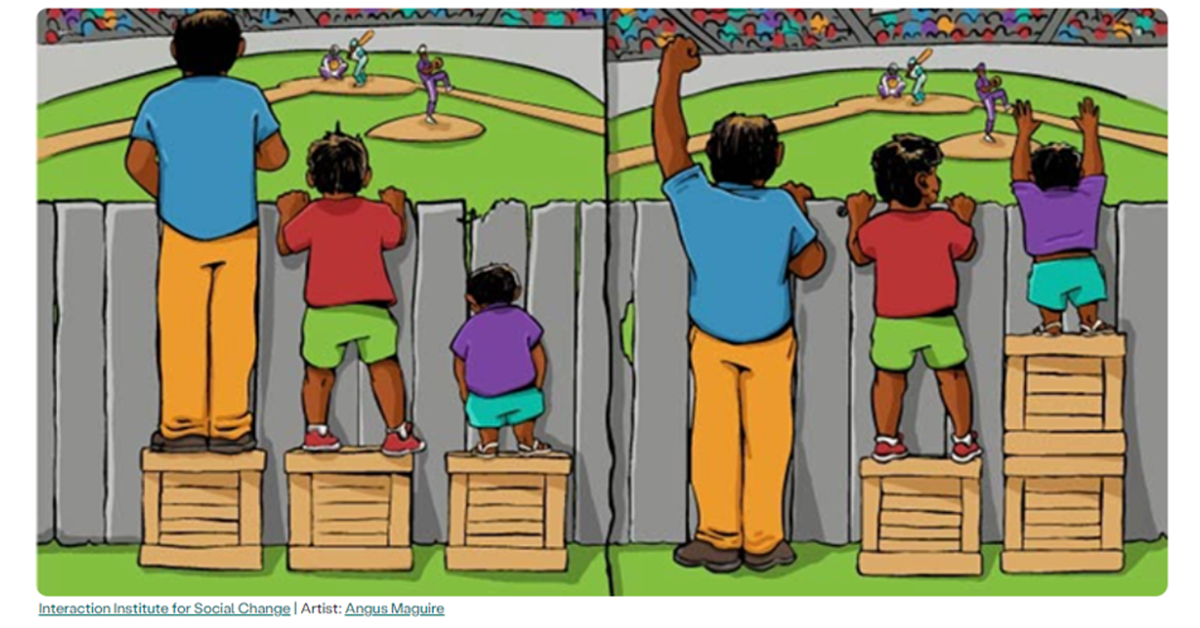
The most classic definition of equity in my lifetime was contained in a speech that President Lyndon B. Johnson gave at Howard University in 1965.
He said:
Freedom is not enough. You do not wipe away the scars of centuries by saying: Now you are free to go where you want, and do as you desire, and choose the leaders you please.
You do not take a person who, for years, has been hobbled by chains and liberate him, bring him up to the starting line of a race and then say, “you are free to compete with all the others,” and still justly believe that you have been completely fair.
Thus it is not enough just to open the gates of opportunity. All our citizens must have the ability to walk through those gates.
This is the next and the more profound stage of the battle for civil rights. We seek not just freedom but opportunity. We seek not just legal equity but human ability, not just equality as a right and a theory but equality as a fact and equality as a result.
For the task is to give 20 million Negroes the same chance as every other American to learn and grow, to work and share in society, to develop their abilities–physical, mental and spiritual, and to pursue their individual happiness.
To this end equal opportunity is essential, but not enough, not enough. Men and women of all races are born with the same range of abilities. But ability is not just the product of birth. Ability is stretched or stunted by the family that you live with, and the neighborhood you live in–by the school you go to and the poverty or the richness of your surroundings. It is the product of a hundred unseen forces playing upon the little infant, the child, and finally the man.
The speech was written by LBJ’s White House aide, Daniel Patrick Moynihan. A brilliant Harvard professor, he later was Ambassador to the UN and elected to the US Senate in New York.
As for “inclusion,” it’s a word that means nothing more nor less than all. We commonly speak of equal opportunity for all, not for some. The Pledge of Allegiance refers to “liberty and justice for all,” not for some. All means all. All means inclusion.
Pete Hegseth recently said, “Diversity is not our strength.” What a stupid thing for the Secretary of Defense to say in light of the diversity of our military. Does he want to oust everyone from the military except white nen?
When the U.S. team walks into the Olympic Stadium, it is the most diverse team in the world. I feel proud when I see them.
The fact is, my friends, we are led by a team of idiots. They are simpletons who want to turn the clock back many decades, at least to the 1950s, when the country was run by straight white men. Many barriers have fallen, allowing the rise of people who are not straight white men. (Trump actually has an out gay man in his Cabinet, the Secretary of the Treasury, but he is most certainly an outlier). Trump wants to restore the barriers that kept women and nonwhites out of leadership roles.
We have to push back every day. Don’t let Trump’s seething hatred and bigotry become normalized. Don’t let him wipe out 60 years of civil rights legislation.
At a reader’s suggestion, here is an even better graphic to define “equity.”


