A tweet by Mark Wiggins, a pro-public education lobbyist in Texas, spread the news that the Republican-dominated State Board of Education came out against vouchers.
*NO VOUCHERS*
As one of its 2023 legislative priorities, majority Republican @TXSBOE urges #txlege to reject vouchers in all their forms. #txed
This post is so important that it is the only one I have scheduled today. Please read it and share it with your friends, your local newspaper, your local radio station, your elected representatives, social media, anyone who cares about the future of our society. This is not a reprint. The author, Josh Cowen, wrote this post for this blog.
Josh Cowen, a professor at Michigan State University, has been studying vouchers for more than 20 years. He has been a member of the teams conducting major studies of vouchers. When I read his article in The Hechinger Report, where he declared that he was convinced that vouchers were disastrous for students who use them, I wanted to know more about him and his experience. I wanted to ask him, “Why did you change your mind?” That’s the question that’s been asked of me hundreds of times. I have a simple answer and a complicated answer: the simple answer is “I was wrong.” The complicated answer is contained in my recent books, starting with The Death and Life of the Great American School System: How Testing and Choice Are Undermining Education.
I invited Josh to explain his views for my blog, and he graciously accepted. I consider this piece to be one of the most important statements I have posted in the decade this blog has been live. Please note two points he makes:
One, vouchers harm the children who leave public schools to use them.
Two, most of the early voucher research was conducted by researchers who were partisan supporters of vouchers.
Josh Cowen writes:
It’ll be a few more days for the final election results to be tallied nationwide, but it seems clear that with midterm wins by voucher supporters in places like Oklahoma, Texas and even Pennsylvania—where even the Democratic gubernatorial victor is on record in cautious favor—voucher opponents are going to have to keep working hard to block public funding of private and religious schools.
School vouchers have devastating effects on student outcomes. Full stop. That’s something even the nation’s voucher advocate-in-chief Betsy DeVos has had to admit, because the data are so stark.
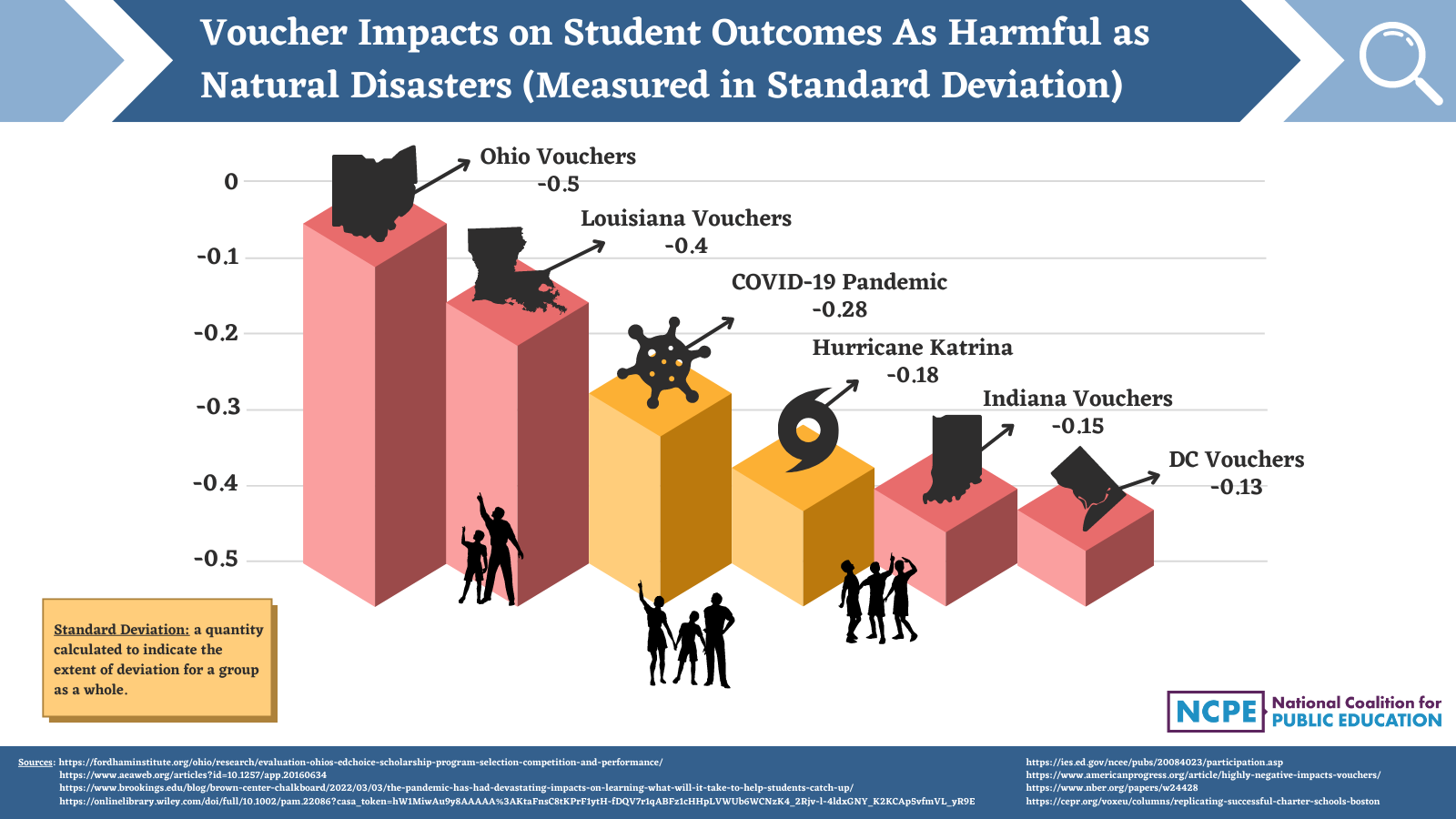
Large-scale independent studies in D.C.,Indiana, Louisiana, and Ohio show that for kids who left public schools, harmful voucher impacts actually meet or exceed what the pandemic did to test scores. That’s also a similar impact in Louisiana to what Hurricane Katrina did to student achievement back in 2005.
Think about that next time you hear a politician or activist claim we need taxpayer support for private schools to offset what the pandemic did to student learning. Here, their cure would in test score terms be quite literally worse than the disease.
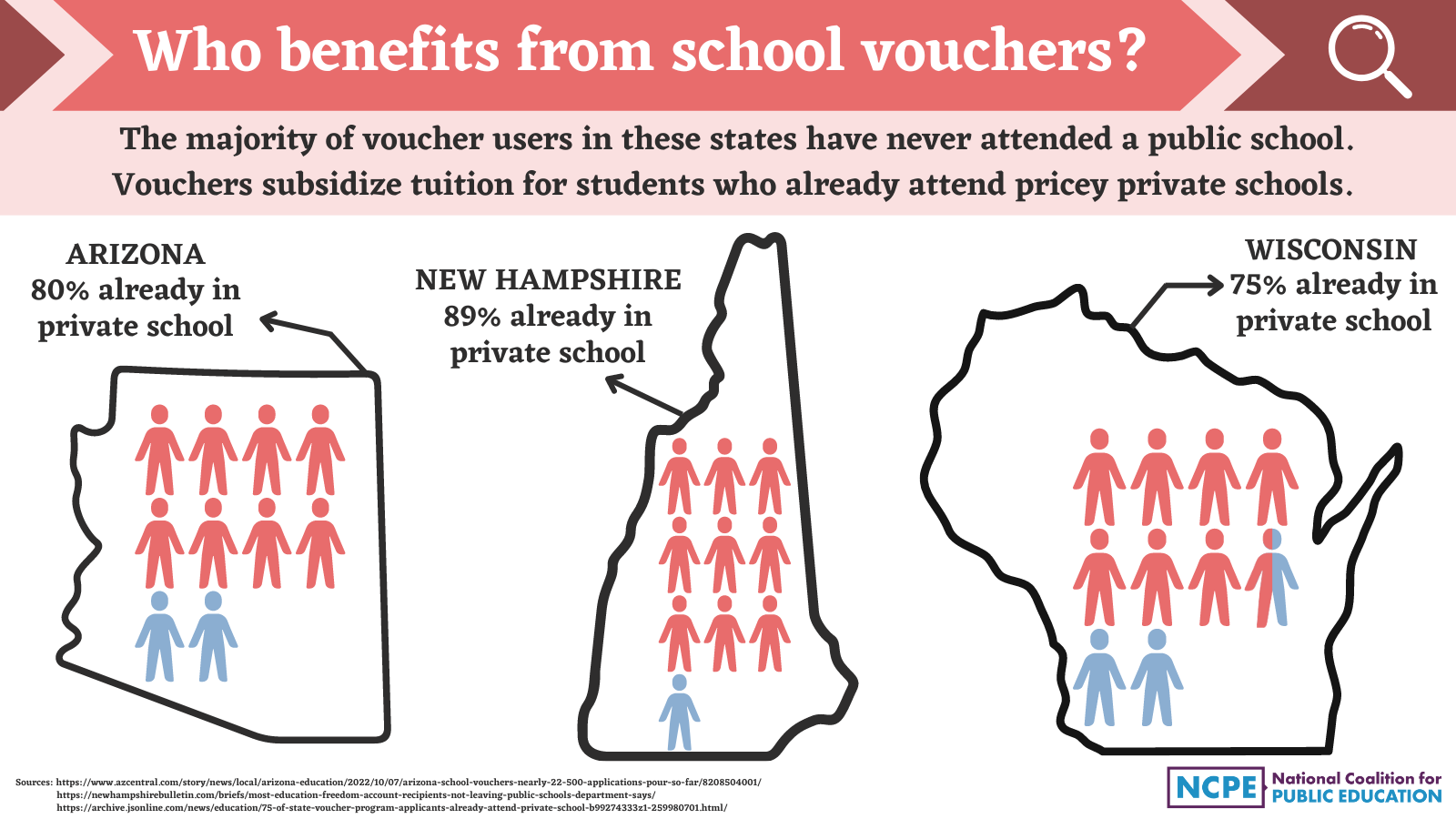
There’s another data point you need to know up front: vouchers overwhelmingly fund children who were already in private school without them. In states that have released those numbers—Arizona, New Hampshire, and Wisconsin—we know more than 75% of voucher applicants came from private schools.
The bottom-line: most kids using vouchers didn’t need them to go to private school, and the few kids who actually did use vouchers to transfer sectors schools suffer average test score drops on par with what a once-in-a-generation pandemic did to test scores too.
If you’re a picture person, our friends at the National Coalition for Public Education were kind enough to put their considerable talents into two graphics based on these data I provided to them.
Notice the citations these graphs include. They’re the same as the hyperlinks above. These data come from independent sources and from non-partisan journalists. That’s a critically important part of this story.
And then there’s this, before we get into the details: the same people pushing vouchers are the same people working to undermine fair elections and the right to vote.
None of these are metaphors, and this is not a drill.
So how did we come to this?
1. A Quick History of Voucher Research
First let’s talk about the evidence.
I came into the school voucher research community early. It was around 2001 or so, as a young graduate student assistant for a study of privately funded vouchers led by the conservative professor Paul E. Peterson who was based at both Harvard and the conservative Hoover Institution at Stanford (never heard of Hoover? Think Condoleeza Rice.)
Peterson and his protégé Jay Greene had already done one study of Milwaukee’s publicly funded voucher program, as well as the one in Cleveland that was about to be the subject of the U.S. Supreme Court’s first favorable ruling on voucher funding. That work generally showed positive results for vouchers. As did the research of a young academic named Cecilia Rouse, who is now President Biden’s chief economist.
But they were small programs. What policymakers and researchers call a “pilot phase.” Back then when both parties cared at least nominally about evidence, you wouldn’t expand a program like vouchers without testing it. So those early tests seemed somewhat positive.
The first research I joined was Peterson and team’s next project: multi-site studies in Dayton, New York City, and Washington D.C. Those programs were also pilot-size. And the New York site in particular showed some limited evidence of voucher success. But overall the lead researchers focused as much on things like parental satisfaction and measures of civic engagement as metrics. That work resulted in a book called The Education Gap. You can find my name in the credits if you own a copy. If you don’t own one, don’t waste your money.
No one knew it at the time, but the mixed results documented in The Education Gap were to be the best vouchers were ever going to do—and ever have done since by an academic based team looking at voucher test scores.
Just a short time later in 2005, I joined a new voucher evaluation led by Patrick Wolf, another Peterson protégé and contributor to The Education Gap. Wolf was by then ensconced with Jay Greene at the University of Arkansas Department of Education Reform, a Walton Family-funded academic group that was about to train a new generation of voucher advocates. Most notably Corey DeAngelis, now at Betsy DeVos’s 501(c)4 voucher lobbying group American Federation for Children.
The Milwaukee evaluation, which was officially done for the state of Wisconsin, lasted from 2005-2010. We found no evidence in five years that voucher kids outperformed public school kids. Two exceptions: we found limited evidence that graduation rates and college enrollment were somewhat higher for the voucher kids. We also found that voucher kids improved when the state required private schools to participate in the same No Child Left Behind-style accountability systems as public schools. In particular once voucher schools knew their performance would be made public they—shockingly!—improved their outcomes.
At the same time as the Milwaukee evaluation, Patrick Wolf and other Arkansas colleagues were working on a new evaluation of Washington D.C.’s federally funded voucher program. That study showed no difference in test scores, but large positive graduate results.
That pattern of “no test score benefits, some attainment benefits” has stuck in the research narrative even among voucher skeptics. But as I recently explained in a piece for the Brookings Institution, it’s just that: a narrative. Other studies in New York, Louisiana and Florida all show no real advantages for vouchers on educational attainment.
And certainly nothing to offset the cataclysmic results that began to come out after the early-stage evaluations I just described. The newer D.C.,Indiana, Louisiana, and Ohio studies that took place after 2013 and have showed pandemic and Katrina-sized harm to student test scores are all of at-scale voucher programs.
What do I mean by “at scale?” I mean that despite limited evidence in those pilot programs, vouchers have been steadily expanding across the country, and within states. So those D.C., Indiana Louisiana and Ohio studies represent our best understanding to date of what happens when you expand vouchers beyond the initial test phase. The answer: horrific impacts on student outcomes.
There are a number of reasons this could be, but I tend to argue we need not overthink this. Vouchers just don’t work. The kids who stand to gain from private schooling were and are already there. For the vast majority of kids, they’re better off in public schools. That’s what the latest voucher research shows.
As an example of what I mean: consider that in Wisconsin (which has not had a statewide study since ours ended in 2010), 41% of voucher-receiving schools have opened and then closed and failed since public funding began in the early 1990s.
That’s what happens when policymakers divert tax dollars to private schools: it’s like venture capitalism for education. It’s like Theranos but for private schooling. New providers race to gobble up new taxpayer money, but most of them have no business near kids.
Now, to fully understand why these terrible policies exist and in fact have never spread faster and further than they are today, we need to understand the politics. And to understand the politics, we need to understand the money.
On the one hand it’s pretty simple. Once you understand that the same people pushing vouchers are the same people funding groups that insist Donald Trump won the election and are now organizing a similar “Big Lie” for 2022’s results, you understand a lot. But read on.
2. Funding Vouchers, Funding Election Lies
It’s difficult to tell how much money has been spent to advocate for school vouchers over the years. But we know perhaps the biggest single funder—perhaps even larger than Betsy DeVos herself—is the Lynde and Harry Bradley Foundation. The Bradley Foundation is a little-known group based in Wisconsin and they’ve given tens of millions of dollars to voucher activism over the years.
Bradley not only funds voucher activism, it funds voucher research too. It was a major funder of the Milwaukee evaluation I was part of and described above. I don’t think they directly influenced our results, but generally speaking you don’t want activism and research funding to mix. Think about it this way: should the Sackler family fund research on the addictive properties of oxycontin? Should Exxon fund studies about the existence of climate change?
For me though, the real problem today is that the Bradley Foundation is hardly limiting itself to supporting research and political advocacy for private schooling. As the New Yorker’s Jane Mayer has meticulously documented in her reporting on financing behind Big Lie activism sowing doubts about President Biden’s 2020 victory, the Bradley Foundation is the convening funder around those activities—the “extraordinary force”, in Mayer’s words, funding and coordinating the Big Lie and other efforts to undermine the integrity of democratic elections.
Bradley is not alone. The Heritage Foundation, a right-wing organization known for its pro-voucher advocacy is, according to Mayer, “working with the American Legislative Exchange Council (ALEC)—a corporate-funded nonprofit that generates model laws for state legislators—on ways to impose new voting restrictions.”
In recent months, Heritage has also distributed talking points that under the guise of objective research attack school diversity and inclusion and directly question health care support for LGBTQ children. Heritage has recently released a report-card style rubric rating state laws on a so-called “Education Freedom” index for tax-supported private tuition. That report card includes the extent to which issues like diversity or sexual preference are components of public school teaching curricula.
The author of each of these documents is a Heritage Senior Fellow named Jay P. Greene. The same Jay Greene who while a conservative scholar at the University of Arkansas was co-director of that Bradley-funded voucher project that hired me back in 2005.
Greene is not alone in the Heritage-Bradley nexus. Cleta Mitchell, a lawyer who participated in Donald Trump’s infamous phone call to the Georgia Secretary of State demanding evidence that would overturn the state’s election results, was actively training poll watchers to question voters leading up to the 2022 midterms in places like my own state of Michigan. The night before the election, the New York Times even ran a story about Mitchell’s work in Michigan. The headline read: “Fueled by Falsehoods, a Michigan Group is Ready to Challenge the Vote.”
Mitchell is a known elections conspiracy theorist, according to CNN, and figures prominently in Mayer’s New Yorker reporting on broader election-related organizing. In her spare time Mitchell is on the Board of Directors of—wait for it!—the Lynde and Harry Bradley Foundation. She’s actually an officer on the Board too.
Michigan is important because we have a voucher proposal waiting to go to the state legislature—even though voucher opponent Gretchen Whitmer has won reelection. That proposal, backed by billionaire and privatization advocate Betsy DeVos, exploits a quirk in the state law allowing lame-duck Republicans to pass the voucher plan without the governor’s signature.
The spokesman for the DeVos voucher campaign is a man named Fred Wszolek. Wszolek is also the strategist for a group that tried unsuccessfully to prevent abortion access from becoming enshrined in the Michigan state constitution. And he heads a political action committee (PAC) called Michigan Strong, which has worked to elect now-defeated DeVos-backed GOP gubernatorial candidate Tudor Dixon.
Also working for Dixon was Kyle Olson of the Education Action Group, an entity devoted to right-wing education reform that’s received money from Charles Koch, the DeVos Family and Harry Bradley—he of the Bradley Foundation.
That’s just one example, but you get the idea: the same people working to push school vouchers are the same people working to undermine elections. And in some cases even reproductive rights.
3. So Why Now?
I’ve spent the last six months writing column after column in opinion pages across the country trying to warn ordinary readers who aren’t education lifers about the dangers of vouchers. You can read samples here or here or here or here if you like. There are more than 10 in all.
Because of my long career working in the middle of all these voucher advocates and researchers, I’ve been asked multiple times what changed my mind. Or, more specifically, why am I speaking out today?
I hope the story I’ve told you above answers some of that. But the reality is, I was also doing other things. I had a young family, other research interests, and other professional tasks like editing the country’s premier education policy journal.
Most of all I had a naïve sense that the facts would speak for themselves. Remember, those pandemic-sized voucher failures began appearing back in 2013. I was an associate professor then, newly arrived at Michigan State University after receiving tenure at the University of Kentucky.
To me, after a decade of mixed-at-best results that I outlined here, I assumed that catastrophic results like those in Louisiana—and then confirmed in Indiana, Ohio, and D.C.—would have killed vouchers a thousand times over.
It’s sort of quaint now, that assumption of mine. In my research community, which is centered in the Association for Education Finance and Policy, we talk a lot about using evidence to inform policy. It’s a nice idea, but vouchers are the big, glaring and alarming counterpoint. We have never seen such one-sided, consistently negative research results as we have for school vouchers in the education research community.
And yet they thrive.
To me, the piece to that puzzle is politics. Negative voucher results aren’t the only thing to happen since 2013.
2016 happened. Donald Trump happened. January 6th happened. Dobbs v. Jackson happened.
Voucher advocates are overwhelmingly on one side of those events. And they’ve racked up some wins.
We know voucher programs exist today not for how they might help some kids, but for how they might exclude others. We know private schools taking public money can and often do discriminate against certain children. In Florida for example, one private school barring LGBTQ kids has received $1.6 million so far in taxpayer funding. In Indiana, more than $16 million has gone to schools refusing to admit LGBTQ kids—or even kids with LGBTQ parents!—or about 1 out of every 10 private schools on the taxpayer dime.
I wish I had come around earlier to the level of alarm I’m raising today. Others have even without having to take a kind of road to Damascus like I did.
I’m a tenured full professor now. I’ve had a successful career working hard to bring evidence to public policy. I firmly believe that school vouchers are a fundamental threat not just to student learning, but also to democracy and to human rights.
So on vouchers I’ve come to the same view any number of us would if we stumbled onto a massive fraud in our workplace, or if we saw a young child being bullied simply for being who they are. None of it is okay.
And if you see something, you have to say something.
With the help of the teachers’ unions, the people of Ohio elected three new members of the state board of education who support public schools. This is great news because the politicians in the State House and the Legislature have been frantically diverting public funds to charter schools and vouchers, as well as endorsing extremist policies on race and gender. The state constitution explicitly authorizes a system of public schools and forbids public funding of religious schools. Ohio’s charter schools are among the lowest-performing in the nation and are lower performing than the state’s public schools. Half of those authorized by the state have closed.
Anti-culture war candidates win three seats on Ohio State Board of Education, with big boost from teachers’ unions
COLUMBUS, Ohio – Voters elected three candidates to the Ohio State Board of Education on Tuesday who oppose fights over LGBTQ students in bathrooms and attempts to control how American racism is discussed in social studies classes. The Ohio Federation of Teachers and the Ohio Education Association contributed tens of thousands of dollars to help the campaigns of former state senator Teresa Fedor of Toledo, Tom Jackson of Solon and Katie Hofmann of Cincinnati, who each won their races against more conservative candidates. Candidates the unions did not support, including one who ran unopposed, won races in two districts.
The unions were involved in recruiting the three candidates. Fedor and Hofmann are each former teachers and members of OFT. Jackson, a businessman, is a volunteer coach at Solon High School and serves on the Solon City Schools Strategic Planning Team. Their members volunteered to knock on doors and spread the word about the candidates.
They also gave their candidates a big fundraising boost. In addition to writing checks for each candidate’s campaign — OEA gave $13,700 to each candidate’s campaign and the OFT gave $12,000 to Fedor and Jackson and $13,700 to Hofmann — the unions spent at least $100,000 to get them elected through an independent super PAC called Educators for Ohio. The PAC is normally controlled by OEA, but OFT this year was also involved in it, said Melissa Cropper, president of the OFT.
The super PAC spent money only on the three state school board candidates, said Scott DiMauro, president of the OEA. “The three individuals who won those contested races are all strong advocates of public education, they have strong records on that,” DiMauro said. “I would anticipate they would work closely with other members of the state board who have been pushing back on some of those (culture wars) attacks. How everything is going to play out still remains to be seen, because you still have an extremist faction that is pushing some of those resolutions. Some of those members are still there.”
Fedor defeated Sarah McGervey, a Catholic school teacher who talked about parental rights against perceived liberal bias in education and keeping LGBTQ protections out of Title IX. Jackson defeated incumbent Tim Miller and Cierra Lynch Shehorn, who was ran further to the right of Miller. Hofmann defeated conservative incumbent Jenny Kilgore.
Hoffman, Jackson and Fedor vastly outraised their opponents. Kilgore individually raised $5,800 in 2022. Hofmann raised nearly $44,000. Jackson raised $53,000 this year, compared to Miller’s $7,600 and Lynch Shehorn’s $4,800.
Fedor’s and McGervey’s campaign finance reports are more complicated. McGervey ran for the Ohio House in August. After she lost that race she ran for the state board. Her total fundraising haul was $15,000. Fedor was a sitting senator in 2021, the beginning of the two-year funding cycle, and she raised $95,000 during the two-year period.
Other candidates who won but were not supported by the unions include incumbent member John P. Hagan, a conservative on the board, who beat a challenge from Robert R. Fulton. Neither candidate in that race received the unions’ endorsement. Ohio State Board of Education President Charlotte McGuire won reelection unopposed. Ohio Value Voters, a conservative Christian organization, backed the conservative slate of candidates, including Hagan.
As Ohio students fell academically behind from remote learning during the pandemic and Ohio has been without a permanent state superintendent for more than a year, conservatives on the state school board pressed to take on several controversial issues over the last year.
More recently, conservatives on the board have been pushing a resolution that would urge local school districts to defy Title IX protections for LGBTQ students that are being proposed by President Joe Biden’s administration, potentially putting federal money for free and reduced lunch and special education in jeopardy. The resolution remains under consideration. Board members have spent 10 hours taking public testimony and discussing it since September.
Most of the state school board campaigning and fundraising took place in just the past two months, Cropper said.
“Remember, this election cycle, no one knew what the lines were going to be,” she said. Every 10 years, the boundaries for the Ohio State Board of Education shift when Ohio Senate boundaries are redrawn. Gov. Mike DeWine changed state school board boundaries Jan. 31, a move panned by critics as gerrymandering. DeWine didn’t change the school board map, even as state mapmakers shifted the Senate’s boundaries found to violate the Ohio Constitution, and on July 14, Ohio Secretary of State Frank LaRose notified county boards of election to use the Jan. 31 changes DeWine made. Candidates for the state school board, which are nonpartisan, had to file to run for the seats Aug. 10, which left just a few months to campaign.
“It really was a crunch in trying to get quality candidates to run,” Cropper said. “We had incumbents we know that were not pro-public education, who were in my opinion, pushing these culture war issues at the state board level. And it was just critical to us that we could get them out of there. So we definitely were looking for people who understand public education, who have been engaged in conversations about equity, social-emotional learning, the whole child approach, all the things that are really important to us.”
The whole child approach refers to the state board’s 2019-2024 strategic plan that says the state is concerned with the “whole child,” not just academics but stressors children experience at home that can influence learning. In 2019, the Ohio Department of Education unveiled social-emotional learning standards that aim to help children become successful in their interactions with others, to establish positive relationships, manage their emotions, and make healthy, drug-free choices in life.
“My estimation is that people rejected extremists and the extreme issues that they’re bringing to the table and children are caught in the middle,” Fedor said Wednesday. “I believe this is an overall rejection of using our children as political fodder.” Fedor had the most name recognition among the state school board candidates. In addition to her legislative career, she was on the Democratic gubernatorial ticket this spring with former Cincinnati Mayor John Cranley. Fedor said that as she campaigned, she talked about reducing the number of standardized tests kids have to take. She talked about her own time in the classroom, when she worked an additional part-time job at the Toledo Zoo to make money for classroom materials.
She said she learned that people were horrified that Hill led Ohioans to the Jan. 6 rally. “There was a flood of different ideas and thoughts about what’s going on,” she said. “And they did not support the extremists who are bringing the extreme issues forward. The culture wars in the classrooms have to end so we can get to the business of educating our children with quality public education.”
Billionaires have been pouring millions of dollars into state and local school board races for at least the last dozen years. These elections are often flooded with money from out-of-state billionaires who support expansion of charter schools and invalid ways of evaluating teachers.
It’s great to see the unions step up and support state school board members who care about public schools and teachers and care about issues that matter, rather than divisive conflicts that don’t help anyone. The amount of money spent by the unions was small compared to what the billionaires spend, but it made a difference.
Republican Ellen Weaver, one of the state’s foremost champions of private school choice, has been elected South Carolina’s next superintendent of education.
A non-educator who has spent her career working in Republican politics and leading a conservative think tank, Weaver defeated Democrat Lisa Ellis, a veteran teacher and founder of grassroots teachers group SC for Ed, by nearly 13 points, according to unofficial election results.
South Carolina voters seem determined to undermine their low-performing public schools and allow students to go to any religious or private school that will take them, at public expense.
Voucher researcher Josh Cowen of Michigan State University says, after 20 years of studying them, that they set children back academically and that learning loss for vulnerable children at voucher schools is greater than the loss caused by the pandemic.
Oklahoma voters re-elected Governor Stitt and elected Ryan Walters as Superintendent of Education. Both support school choice and have attacked public schools for “indoctrinating students” with left wing ideas and teaching about race and gender. Stitt defeated former State Superintendent of Education Joy Hofheimer, who briefly led in the polls. Walters’s opponent Jena Nelson is a strong advocate for public schools.
The evidence about vouchers after three decades is that they subsidize children in private schools, and they inflict enormous learning loss on low-income children. Oklahoma’s leaders and voters want to educate their children for the 19th century.
Walters received 57.29 percent of votes cast, and Nelson obtained 42.71 percent with 1,887 out of 1,984 precincts reporting, according to unofficial results. Walters defeated April Grace for the Republican candidacy in the August runoff elections.
“What you’re gonna see is a commitment to ensure that every child is empowered through parents’ options,” Walters said. “You’re gonna see a push for more transparency and accountability and you’re never again going to see a superintendent that doesn’t bring transparency to you, the taxpayers. Folks, thank you so much. We will continue to make Oklahoma great.”
Gov. Kevin Stitt appointed Walters to secretaryof eduction in 2020. He was endorsed by Sen. Ted Cruz (R-TX) and Frank Keating, chairman for the OU Board of Regents and former Oklahoma governor. Walters’ campaign focused on banning certain race and gender conversations from public school classrooms and supporting school vouchers. Walters also previously expressed he would reject federal funding for Oklahoma public schools, if elected.
“Public education saves lives,” Nelson said during her concession speech. “While I may not be your superintendent, I will continue to be an advocate for all of Oklahoma.”
Vouchers were originally sold as a way to “save” poor children of color from failing schools. We now know that this claim is not true. Poor kids who use vouchers typically fall behind their peers in public school. In state after state, vouchers are subsidizing students who are already enrolled in private schools and never attended public schools. The funding of vouchers takes money away from the public schools attended by most students, meaning larger classes, fewer resources.
Nearly Half of Universal Voucher Applicants are from Wealthier Communities
Total State Private School Subsidies Reach $600M
Dave Wells, Research Director
Curt Cardine, Research Fellow
Distribution of Universal ESAs vs. Distribution of Students
Key Findings:
45% of universal Empowerment Scholarship Account (ESA) applicants come from the wealthiest quarter of students in the state. Their families live in zip codes where the median household income is $80,000 or more, more than 30% greater than the state’s median income.
32% of universal ESA applicants are from families with a median income less than $60,000, which comprise just over half the students in the state.
80% of universal ESA applicants are not in public school, meaning these students are already attending private schools, being home schooled, or just entering schooling. At a cost of about $7,000 per voucher this equates to potential new cost to the state of $177 million.
Arizona will spend more than $600 million on private school subsidies—universal ESAs and Student Tuition Organization Scholarships—in the 2022-23 school year.
Only 3.5% of all applicants came from zip codes that had a district high school or 2 K-8 district schools with a D or F grade. No zip codes with a median income above $80,000 had a district high school or 2 K-8 district schools receiving a D or F grade.
There will be an increased risk of fraud with lax oversight to ensure that families don’t double dip by using both ESA and STO scholarship funds.
Now that the October 15, 2022 deadline to apply has passed, the Grand Canyon Institute (GCI) has analyzed the zip code distribution of applications for the new universal Empowerment Scholarship Account (ESA) voucher program that Gov. Ducey signed into law in July. GCI’s analysis finds that the program’s primary beneficiaries are students from wealthier families, similar to its previous analysis before the deadline, and that 92.5% of those students have access to well-performing schools.
Zip codes were provided by the Arizona Dept. of Education for universal voucher applicants. The total number of universal voucher applicants numbered 31,750. From that number GCI deducted 69 that were either out of state or had left the zip code blank. This report updates an earlier GCI analysis published on October 6. In September, GCI evaluated details of the program, including the inability to measure academic impacts of the program due to the absence of accountability measures in the legislation. Academic impacts were also part of a 2018 GCI report regarding Arizona’s private school subsidy programs.
GCI compared the distribution of applications to both the median household income as well as the distribution of K-12 students in the zip codes of applicants using data from the 2020 American Community Survey by the U.S. Bureau of the Census.
As noted in the graphs below, about 45% of all applications come from parents or guardians residing in zip codes that have a median household income of $80,000 or more, more than 30% greater than the state’s median household income.($61,529) These represent the wealthiest quarter of students in the state (gold and silver parts of the graphs). This is similar to GCI’s October analysis.
By contrast, parents or guardians in zip codes with a median household income less than $60,000 which comprise just over half the students in the state, represent not quite one-third of all applications (blue section). This is also similar to GCI’s October analysis.
Gov. Ducey in his press release after signing the universal voucher expansion noted, “This is a monumental moment for all of Arizona’s students. Our kids will no longer be locked in under-performing schools.” GCI examined this claim by identifying zip codes that either contained a district high school with a D or F grade OR had at least two K-8 district schools with a D or F grade. One school with a D or F grade hardly speaks poorly for a zip code. For instance, one Kyrene District elementary school in 85284 (South Tempe) received a “D,” but that is not indicative of the very highly rated schools in that relatively affluent zip code. Zip codes typically have many schools, so even in the D or F zip codes, most schools (district or charter) did not receive a D or F. Consequently, GCI’s D or F zip code identifier understates school grades within those zip codes.
GCI found only 3.5% of all applicants came from zip codes that had a high school or 2 K-8 schools with a D or F grade. No zip codes with a median income above $80,000 had a high school or 2 K-8 schools receiving a D or F grade.
These results belie the claim that the program was primarily designed for average and lower income families. Rather, similar to the flat tax passed by the legislature, the primary beneficiaries of this government policy are wealthier families.
Total Private School Subsidies $600 Million
($180 Million from Universal ESAs)
Arizona has extensive subsidy programs for private schools. Dollar-for-dollar tax credit donations to private Student Tuition Organizations amounted to $250 million in FY2021 from individuals and corporations. In addition, the existing ESA program which serves a large number of students with disabilities was on track to cost the state at least $190 million plus administrative costs for FY2023 based on program growth. Collectively private school subsidies likely cost at least $440 million since tax credit data was less current.
Universal voucher access looks to add up to $180 million to that number taking the total cost of private school subsidies to in excess of $600 million dollars.
The Arizona Department of Education reports that about 80% of universal ESA applicants are not in public school, meaning these students are already attending private schools, being home schooled, or just entering schooling. At a cost of about $7,000 per voucher this equates to a cost of $177 million.
The remaining 20% of applicants are currently attending public district or charter schools. The voucher formula provides 90% of the state’s per pupil funding formula for charter schools plus charter additional assistance. While students moving from charters to private schools represent a net savings of about $700, vouchers to students who attended district schools represent a net cost to the state’s general fund. The voucher exceeds what the state is currently paying because district additional assistance is significantly less than charter additional assistance. Charter additional assistance is between $2,000 and 2,300 per pupil while district additional assistance is between $500 and $550. The difference exceeds the 10% overall reduction from charter payments for vouchers. In addition, students moving from wealthier district schools cost the state even more. Under the state’s education equalization formula their districts rely primarily on local property taxes, not state funding.
Movement from charter schools is more likely to occur, from GCI’s past analysis. However, the loss from district movement is significantly more, such that it’s likely to be an overall net cost to the state.
An unknown number of these students may already be using the STO private school scholarship program, so some parents may switch to ESAs which would reduce the net cost to the state. Likewise, not every applicant may qualify.
The estimated total cost of up to $180 million is significantly higher than the $33.4 million projected by the Joint Legislative Budget Committee for FY2023. The 31,7500 applicants are more than five times what the Joint Legislative Budget Committee projected of about 5,800 applicants in the first year of the program. The JLBC estimate though was very rough and saw the program doubling in year two.
STO scholarship award amounts are likely to increase in order for them to stay more competitive with the universal ESAs and because the number of of STO scholarship applicants may decline. Keep in mind, STO scholarships are administered by privately-run organizations that can take up to 10% of tax credit donations to cover administrative costs. Universal ESAs represent competition for their business. Some past STO scholarship awardees may switch to the universal ESA program, which could reduce contributions to STOs (it was common for STO donors to contribute on behalf of a particular recipient), but since the tax credit costs contributors nothing, they may persist.
Many of the new applicants are likely homeschooled students, which the JLBC had estimated at 38,000 who are now eligible for state funding.
Risk of Misuse Rises Significantly
Two potential issues arise with universal vouchers that might fall under the general category of fraud-whether pursued civilly or more likely with internal enforcement-relates to violations of the ESA contract. These occur if an ESA recipient were to misspend monies or double dip by receiving an STO scholarship simultaneously in violation of the ESA contract. Since ESAs go through the Department of Education, students are well tracked. An audit process is designed to prevent misspent dollars.
As GCI noted in September, already a number of permitted ESA expenses are questionable. But with a wider program that expands to homeschool, such oversight may be more challenging. Parents or guardians accepting ESAs sign a contract where they also agree not to accept an STO scholarship. However, the state does not track recipients of STO scholarships outside broad aggregate reporting to the Arizona Department of Revenue. It has been evident for a number of years that many parents or guardians seek and receive scholarships from multiple STOs, such that in 2019-2020 about 90,000 scholarships were awarded to around 50,000 private school students who were not receiving an ESA voucher (see diagram above). While some parents or guardians may not currently be in compliance with this restriction, the narrower scope of ESA eligibility limited that opportunity. However, with universal vouchers, the potential that a parent or guardian might attempt to double dip from both the ESA and STO scholarship programs rises significantly and an effective mechanism to catch when that occurs does not appear to exist.
For more information, contact: Dave Wells, Research Director dwells@azgci.org, 602.595.1025, Ext. 2
The Grand Canyon Institute (GCI) is a nonpartisan, nonprofit organization dedicated to informing and improving public policy in Arizona through evidence-based, independent, objective, nonpartisan research. GCI makes a good faith effort to ensure that findings are reliable, accurate, and based on reputable sources. While publications reflect the view of the institute, they may not reflect the view of individual members of the board.SUPPORT US
Steve Hinnefeld, Indiana blogger, writes about the political donations of billionaires who claim to be “liberal Democrats.” First and worst is Reed Hastings, who is CEO of Netflix. Hastings claims to be a supporter of women’s reproductive rights, but he has funded Republicans in Indiana who passed one of the most restrictive abortion bans in the nation. Why? Because these same conservative Republicans support charter schools. Hastings has said that he looks forward to the day when there are no more school boards, and every school is a charter. So, his passion for charter schools is stronger than his commitment to women’s reproductive rights. His allies in Indiana also loosened restrictions on guns. Michael Bloomberg, who favors abortion rights and gun control, also bankrolled the same Republicans.
Indiana Republicans are spending several million dollars to protect and extend their supermajority status in the state House and Senate in Tuesday’s election. If they succeed, they may want to thank a California billionaire. One who’s usually described as a liberal Democrat.
Reed Hastings is a CEO of Netflix. Politically, he’s known for donating to Democratic politicians, nationally and in California. Netflix supports liberal causes, like abortion rights. But in Indiana, his campaign contributions go almost entirely to Republicans, who trample on his supposed principles.
It’s possible Hastings has given more money to the Indiana House and Senate GOP campaigns than any other individual in the past couple of years. Not directly. The money is funneled through a political action committee called Hoosiers for Great Public Schools. The PAC, headed by former Democratic Indianapolis Mayor Bart Peterson, was founded in 2020 to promote charter schools.
Almost all its direct support for candidates goes to Republicans.
Hastings has given the group $1.4 million, half of it in 2020 and half this year. It also got $200,000 from John Arnold, a Texas billionaire. That’s all the money it has raised.
Hoosiers for Great Public Schools has made campaign contributions totaling $926,000. Some $400,000 went to RISE Indy, a PAC that has supported charter-friendly candidates for the Indianapolis Public Schools board. Another $100,000 went to Hoosiers for Quality Education, which promotes school choice, including vouchers and education savings accounts, and gives exclusively to Republicans.
Of the remaining $426,000 that Hoosiers for Great Public Schools contributed, nearly all went to GOP candidates and groups. It has given $190,000 to the House Republican Campaign Committee, $45,000 to the Senate Majority Campaign Committee, and $75,000 to House Speaker Todd Huston, along with four- and five-figure donations to individual Republicans.
That’s who Reed Hastings is helping elect in Indiana.
A similar story can be told about Michael Bloomberg, the billionaire former mayor of New York City. He’s known for supporting liberal causes, including gun control and abortion rights. In recent years, Bloomberg has given $550,000 to Stand for Children Indiana, which supports charter schools. All of Stand for Children’s state-level contributions this year have gone to Republicans.
There’s a cynical argument for such behavior: If you have money and you want to influence Indiana politics, you give to Republicans, because they have the power.
Peterson, CEO of Christel House International, which operates charter schools in Indianapolis, told me in 2020 that the purpose of Hoosiers for Great Public Schools was to support charter schools. But Indiana Republicans are no longer in love with charter schools. In 2021, they gave charters a modest funding increase. In 2022, they did nothing. They have moved on to favoring a more radical form of school choice in which state money “follows the child,” including to private and religious schools.
What did Hastings get with his support of the Indiana GOP? For one thing, a new law that says Hoosiers don’t need a permit to carry a handgun in public. For another, a discriminatory anti-trans law that bars transgender students from school sports teams. Republicans also tried to restrict what schools could teach about “divisive topics” – i.e., racism and slavery – but fell short.
The 1% understand very well that the Republican Party is dedicated, first and foremost, to cutting the taxes of the rich. How else to explain the billionaires who don’t like Trump but spent millions on candidates who repeated The Former Guy’s Big Lie?
Of course, they want low taxes. But they have another goal: School choice. Somehow these billionaires became convinced that charters and vouchers are superior to public schools, and they want to make sure that those in public office agree with them, regardless of ample evidence that school choice has proven to be a failure over the past three decades.
Maggie Severns reports at GRID:
Some of the biggest Republican megadonors don’t support former president Donald Trump — but have wound up supporting his candidates.
Ken Griffin, the founder of hedge fund Citadel and currently the third-biggest donor to the 2022 midterms, is a business leader and repeat critic of Trump. Earlier this year, he publicly called on Republicans to abandon the idea that the election was stolen, saying, “It’s really important that we end the rhetoric in America that elections can be rigged.” He maintains the Republican Party should “move on” from Trump in 2024.
When it came time for this year’s midterms, Griffin went big, becoming a top contributor to super PACs helping Republicans win back the House and Senate. But those super PACs are supporting the very politics that Griffin has shunned: He gave $10 million to a PAC that has aired ads for Blake Masters, the Republican Senate candidate in Arizona, a Peter Thiel acolyte who has falsely claimed Democrats are trying to “import” immigrants to help them win elections; Mehmet Oz, the Republican Senate nominee in Pennsylvania who recently said “lots more information” is needed to determine if Trump won the 2020 election; and Adam Laxalt, the Republican nominee in the Nevanda senate race, a former state attorney general who held press conferences and filed lawsuits alleging widespread voter fraud in 2020….
Jeffrey Yass, the richest man in Pennsylvania and the fourth-largest donor of the midterms, didn’t give money to Trump’s campaign during the 2020 election, but he has poured $47 million into federal politics this cycle, much of it to the conservative Club for Growth and an affiliated PAC, which have supported candidates who espouse conspiracy theories and challenged the 2020 election results. Yass is also focused on education policy, working to advance charter schools and school choice with his political money. Republican financier Paul Singer, another major super PAC donor who did little support to Trump, has spent $20 million this cycle.
Texas Republicans have been longing to pass a voucher bill, but they have been stymied by grassroots opposition and by our friends, Pastors for Texas Children, who believe in separation of church and state.
NBC News reported the story of the big money behind vouchers:
Texas Republicans bankrolled by Christian conservative donors are hoping to ride a wave of parental anger over the teaching of race and sexuality in schools to achieve what has long been an unattainable goal: state funding for private education.
Groups committed to giving parents the option of sending their children to private schools using taxpayer dollars — sometimes known as “school choice” or “vouchers” — have given millions of dollars to Republican candidates in Texas this year, helping to win key races and pushing some establishment lawmakers further to the right on the issue. Republican Gov. Greg Abbott recently pledged to make school choice a priority in the next legislative session if he wins re-election over Democratic challenger Beto O’Rourke.
As a result, political observers say, public school funding is effectively on the ballot Tuesday.
The push for private school vouchers has been funded in large part by Defend Texas Liberty, a Christian nationalist-aligned political action committee led by a former far-right Republican state lawmaker and bankrolled by a pair of West Texas billionaires. The PAC has spent nearly $10 million this year, largely backing candidates who support public funding for private education and attacking those who oppose it, according to an NBC News analysis of Texas Ethics Commission campaign finance reports and data compiled by the nonprofit OpenSecrets.
Defend Texas Liberty did not respond to messages requesting interviews with PAC leaders.
Brandon Rottinghaus, a political scientist at the University of Houston, said big spending by groups like Defend Texas Liberty and local fights over the way schools address racism, history and LGBTQ identities have “softened the ground” for school privatization — in Texas and nationally.
“These groups have been demonizing what is being taught in public schools, and that’s the fastest way to erode faith that public schools work,” Rottinghaus said. “Whether it’s true or not is irrelevant. If people believe that it’s true, then it’s politically potent.”
Defend Texas Liberty gave $3.6 million to former state lawmaker Don Huffines, an Abbott primary challenger who ran a campaign promising to crack down on medical care for transgender children, require the teaching of creationism in public schools and give parents government money to send their children to private schools. (Abbott publicly came out in support of private school vouchers two months after winning the primary with 66.5% of the vote.)
The PAC also spent $168,000 supporting Republican Nate Schatzline, a former pastor running for a seat in the Texas House of Representatives on a campaign to give parents more freedom to decide how and where their children are educated. Schatzline won a competitive GOP primary in a solidly conservative North Texas district in part by painting his Republican opponent as an advocate for teaching “leftist, woke ideologies” in schools.
“It’s time to outlaw the sexualization of our children!” Schatzline wrote on his campaign website. “It’s time to outlaw racist ideologies that seek to divide our children, not unify them. It’s time to teach our children to love America, not hate it!”
Defend Texas Liberty donations accounted for more than a third of Schatzline’s campaign funding. He initially agreed to speak with a reporter for NBC News, but later did not return phone calls or text messages.
And this fall, Defend Texas Liberty spent $100,000 to put up dozens of billboards along Texas highways, including some that showed a photo of O’Rourke next to a baseless allegation about “grooming” children, an anti-LGBTQ attack that’s become popular among conservatives this year.
In a statement, Tori Larned, a spokesperson for O’Rourke’s campaign, said, “Abbott is now calling to defund public education with his voucher program that takes tax dollars out of public school classrooms across the state and sends them away to private schools.”
Abbott has denied that vouchers would harm public education.
“We can fully fund public schools while also giving parents a choice about which school is right for their child,” he said during a May campaign event in San Antonio. “Empowering parents means giving them the choice to send their children to any public school, charter school or private school with state funding following the student.”
Defend Texas Liberty is led by former state Rep. Jonathan Stickland, a Republican who earned a reputation as the state’s most conservative lawmaker before leaving the legislature in 2021. Nearly 90% of the PAC’s funding this year has come from Tim Dunn and the family of Farris Wilks, a pair of billionaire oil and fracking magnates who have expressed the view that Texas state government should be guided by Biblical valuesand run exclusively by evangelical Christians. Combined, they’ve spent tens of millions of dollars over the past decade funding far-right Texas candidates and a network of nonprofits and advocacy groups that push conservative policy ideas. Stickland, Wilks and Dunn did not respond to interview requests.
Please open the link and read the rest of the story. There are five million children in the public schools of Texas. The schools have been underfunded since 2011, when Republicans cut their budget by more than $5 billion. Where does Governor Abbott get the idea that the state can fund Evangelical schools (and Catholic and Muslim and Jewish and all other private schools) without taking more money away from public schools?
The race for governor in New York State should not be close but it is. Governor Kathy Hochul has been a responsible governor who tries to improve the lives of New Yorkers.
Her opponent Lee Zeldin is a lackey for Trump. He has supported everything Trump advocated. hHecsupports charters and vouchers. He opposes gun control.
The NYC Kids PAC outlined the differences between them:
Dear all:
An important election is happening right now for Governor and other statewide and local races. Early voting is being held today and Sunday, and then election day is Tuesday. You can check out your ballot and your voting sites here.
NYC Kids PAC strongly urges you to vote for Gov. Kathy Hochul, who has fully funded the CFE decision that is sending another $1.3 billion to NYC public schools, signed the class size bill that will lead to smaller class size caps phased in starting next fall, and supports strong gun control measures, including banning guns from schools.
In contrast, her opponent, Lee Zeldin, is an extremist who is a proponent of school privatization, announced his education platform outside of a Success charter school, and supports voucher-like “tax credits” to pay for tuition to private schools. He even opposes “red flag” laws to remove weapons from individuals deemed to be a threat and is against the ban against carrying guns in schools — all of which would make our children less safe.
So please vote for Kathy Hochul, if you haven’t already; the choice between her and Zeldin is crystal clear.



 Diane Ravitch's blog