Archives for category: Vouchers

Texas has several billionaire bullies who want the state to keep their taxes low, cut benefits to needy people, and enact vouchers so that more students can attend religious schools on the public’s dime.

Russell Gold writes in the Texas Monthly about Tim Dunn, a billionaire who has used his money to purge the Republican Party of moderates. In addition to being an oilman, Tim Dunn is a pastor and a devout Christian nationalist. He has funded numerous organizations that act as pass-throughs for his political contributions, such as Defend Texas Liberty PAC, the Texas Public Policy Foundation, the First Liberty Institute, Empower Texans, Texas Scorecard, Ballotpedia, Stand for Freedom PAC,

Gold writes:

You may not think about Tim Dunn. Indeed, unless you’re a close observer of Texas politics, it’s likely you haven’t heard of him. But Dunn thinks a lot about you.

For two decades he has been quietly, methodically, and patiently building a political machine that has pushed Texas forcefully to the right, sending more and more members of the centrist wing of the Republican Party into exile. A 68-year-old oil billionaire, Dunn seeks to transform Texas into something resembling a theocracy. If you ever wonder why state laws and policies are more radical than most Texans would prefer, the answer has a lot to do with Dunn and his checkbook. If you question why Texas’s elected officials no longer represent the majority of Texans’ views, the reason can be traced to the tactics employed by Dunn and the many organizations and politicians he funds and influences. He has built his own caucus within the Legislature that is financially beholden to him. And despite his Sunday school pleas for comity, Dunn has deepened Texas’s political divisions: there are the Democrats and what remains of the mainstream conservative Republican Party. And then there are Dunn and his allies….

In the past two years Dunn has become the largest individual source of campaign money in the state by far. Until recently his main tool for exerting influence has been the Defend Texas Liberty PAC, to which he has given at least $9.85 million since the beginning of 2022. This is nearly all the money he contributed to Texas races over that span and the majority raised by the committee. The political action committee targets Republicans, many of them quite conservative, whom it deems insufficiently loyal to the organization’s right-wing agenda. Dunn is not a passive donor who will dole out a few thousand dollars after a phone call and some flattering chitchat. The funding machine he has built is designed to steer politics and control politicians. 

Its methods are deceptively simple. A Dunn-affiliated organization lets lawmakers know how it wants them to vote on key issues of the legislative session. After the session, it assigns a number, from zero to one hundred, to each lawmaker based on these votes. Republicans who score high, in the eighties or nineties, are likely to remain in Dunn’s good graces. But those who see their scores drift down to the seventies or even sixties—who, in other words, legislate independently? Their fate is easy to predict. 

They’ll likely face a primary opponent, often someone little known in the community, whose campaign bank account is filled by donations from Dunn and his allies. This cash provides access to political consultants and operations that can be used to spread false and misleading attacks on Dunn’s targets, via social media feeds, glossy mailers, and text messages. “They told you point blank: if you don’t vote the way we tell you, we’re going to score against you,” said Bennett Ratliff, a Republican former state representative from Dallas County. “And if you don’t make a good score, we’re going to run against you. It was not a thumb on the scale—it was flat extortion.” Ratliff lost in 2014 to a Dunn-backed right-wing candidate, Matt Rinaldi, who scored a perfect one hundred in the next two sessions and quickly amassed power: Rinaldi now serves as the combative and divisive chair of the state GOP

Dunn’s influence goes well beyond campaigns and politics. His résumé is lengthy. He is vice chairman of the Texas Public Policy Foundation, a right-wing think tank located a couple of blocks south of the Capitol. TPPF generates policy proposals—from severe property tax cuts to bills that impede the growth of renewable energy—that are often taken up by the Texas Legislature and emulated in other red states. He has served for years on the board of the First Liberty Institute, a legal powerhouse that has won Supreme Court cases to advance Christianity’s role in public life. ..

In the past several years Dunn has become involved with multiple online media operations. “You can’t trust the newspapers,” he wrote in a 2018 letter to voters. But apparently you can trust Texas Scorecard, a political website that is often critical of politicians who don’t support his agenda. Texas Scorecard was published by Empower Texans, a group largely funded by Dunn that then became a separate organization in 2020. It continues to publish articles that are generally critical of candidates Dunn opposes.

He has also been an officer with Chicago-based Pipeline Media, which maintains a network of websites designed to look like independent local media outlets but that churn out often-partisan articles that amplify stances taken by special interest groups. The Tow Center for Digital Journalism at Columbia University found that this network has attacked renewable energy and advocated for property tax cuts. Further, Dunn is a longtime board member of the Lucy Burns Institute, publisher of the website Ballotpedia, which provides information on federal, state, and local elections. It recently launched an “ultra-local” initiative, publishing updates on candidate positions and endorsements in areas that have become news deserts after the closures of local newspapers. The site reported more than a quarter billion page views in 2022…

Dunn has a few key powerful officials in his pocket, including Lieutenant Governor Dan Patrick (a job considered more powerful than the governor) and Attorney General Ken Paxton, who escaped an effort to impeach him thanks to Dunn’s largesse.

Dunn is up-front about his desire to use politics to pave the way for a “New Earth,” in which Jesus Christ and his believers will live together. (“When heaven comes to earth and God dwells with his people as the King,” Dunn has said.) Until then, he remains a key player in the growing Christian nationalism movement, which rejects the importance of pluralism to American identity. Instead it contends that only devout Christians are good Americans. 

Back in 2010, Dunn met with Joe Strauss, the Republican Speaker of the Texas House of Representatives. Strauss represented San Antonio. He is Jewish. Dunn told Strauss that only Christians should be in leadership roles.

Considering that Jesus was Jewish, that’s not a very Christ-like sentiment. Unless you are a Christian nationalist.

Public school parents and concerned citizens in North Carolina have hoped that the General Assembly (legislature) would fully fund the Leandro decision of 2022, which requires full funding of public schools. The original Leandro case was decided thirty years ago!

But the leaders of the General Assembly, which has a veto-proof majority, went to court to ask the new members of the court to overturn the Leandro decision.

The GOP majority is committed to charter schools and vouchers, not public schools, even though the vast majority of children in the state are enrolled in public schools.

The North Carolina Supreme Court is weighing whether to reverse a 2022 decision that allows judges to order the transfer of hundreds of millions — and potentially billions — of dollars to fund public schools. In November 2022, the Supreme Court’s former Democratic majority ruled that the courts can order state officials to transfer funds to try to provide students their constitutional right to a sound basic education. During oral arguments Thursday, an attorney for Republican legislative leaders Sen. Phil Berger and House Speaker Tim Moore asked the court’s current 5-2 GOP majority to overturn that 2022 ruling. “The court has recognized time and time again that if a decision is wrongly decided, if it conflicts with the constitution, if it conflicts with prior precedent …. then it should be overturned and corrected at the next possible moment,” said attorney Matthew Tilley. “This is the next possible.” WILL COURT OVERTURN PRECEDENT? But attorneys representing school districts, the State Board of Education and the state urged the justices to stand by the 2022 decision. “It has been the rule of this court for over 100 years that the court will not disturb its prior holding in the same case, even if it would have overturned that holding on a properly presented petition for rehearing,” said attorney Melanie Dubis. “We do not have a properly presented petition for rehearing in this case.

“Nevertheless, that is what the defendant-intervenors are blatantly asking this court to do, to go back and overturn Leandro IV, which is binding precedent cited merely 14 months ago.” That view was echoed Thursday at a rally held across the street from the court hearing and in statements from Democratic Gov. Roy Cooper and the state’s Democratic legislative delegation. “Public school children are at the most important crossroads in our history,” Cooper said in a statement Thursday. “Will our Supreme Court be courageous enough to protect those children, or will it once again protect the power of the politicians who would rather give billions in tax breaks and private school vouchers for the wealthy?” The court is expected to issue a ruling this year.

This week’s court hearing is the latest chapter in the now 30-year-old Leandro school funding lawsuit that was initially filed in 1994 by low-wealth school districts to get more state funding. Over the years, the state Supreme Court has ruled that the state constitution guarantees every child “an opportunity to receive a sound basic education” and that the state was failing to meet that obligation. In November 2021, Superior Court Judge David Lee ordered the state treasurer, controller and budget director to transfer $1.75 billion to fund the second and third years of an eight-year plan developed by a consultant. The plan is meant to try to provide every student with high-quality teachers and principals. The eight-year plan is estimated to cost at least $5.6 billion. Just days before the 2022 midterm elections flipped the court from Democratic to Republican control, the Supreme Court upheld Lee’s order. The Democratic justices said that the courts had deferred long enough for the state to implement a plan to provide a sound basic education. Soon after taking control, the court’s GOP majority blocked enforcement of Lee’s order.

Read more at: https://www.newsobserver.com/news/local/education/article285710266.html#storylink=cpy

Read more at: https://www.newsobserver.com/news/local/education/article285710266.html#storylink=cpy

Read more at: https://www.newsobserver.com/news/local/education/article285710266.html#storylink=cpy

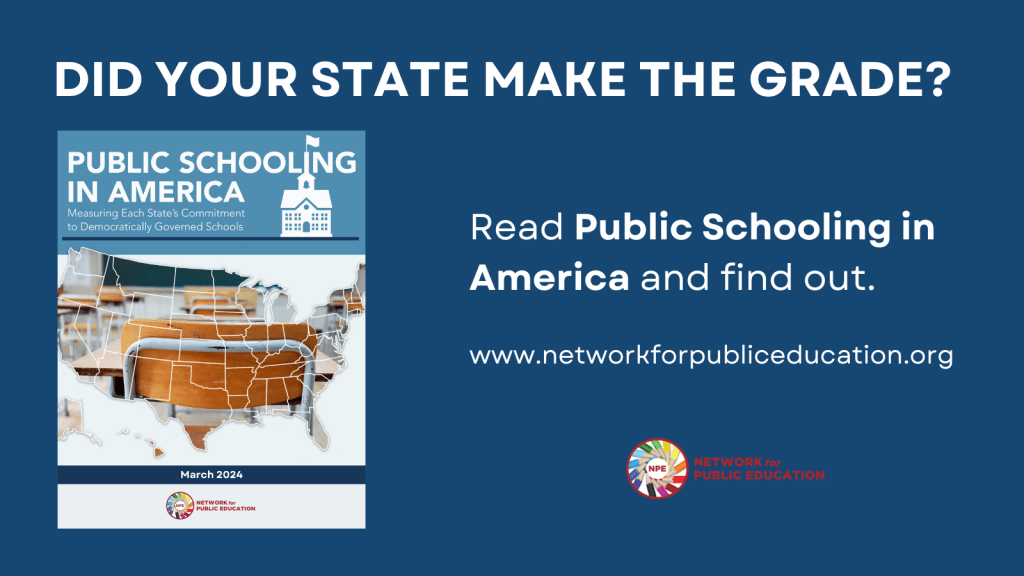
The Network for Public Education released a report card today grading the states on their support for democratically-governed public schools. Which states rank highest in supporting their public schools? Open the report to find out.

Measuring Each State’s Commitment to
Democratically Governed Schools

EXECUTIVE SUMMARY


Neighborhood public schools remain the first choice of the overwhelming majority of Ameri-
can families. Despite their popularity, schools, which are embedded in communities and gov-
erned by elected neighbors, have been the target of an unrelenting attack from the extreme
right. This has resulted in some state legislatures and governors defunding and castigating
public schools while funding alternative models of K-12 education.

This 2024 report, Public Schooling in America: Measuring Each State’s Commitment to
Democratically Governed Schools
, examines these trends, reporting on each state’s commit-
ment to supporting its public schools and the children who attend them.

What We Measure

We measure the extent of privatization in each state and whether charter and voucher laws
promote or discourage equity, responsibility, transparency, and accountability. We also rate
them on the strength of the guardrails they place on voucher and charter systems to protect
students and taxpayers from discrimination, corruption and fraud.

Recognizing that part of the anti-public school strategy is to defund public schools, we rate
states on how responsibly they finance their public schools through adequate and equitable
funding and by providing living wage salaries for teachers.

As the homeschool movement grows and becomes commercialized and publicly funded,
homeschooling laws deserve public scrutiny. Therefore, we rate states on laws that protect
children whose families homeschool.

Finally, we include a new expansive category, freedom to teach and learn, which rewards
states that reject book bans, and the use of unqualified teachers, intolerance of LGBTQ stu-
dents, corporal punishment, and other factors that impinge on teachers’ and students’ rights.

How does your state rank?

Pamela Lang, a journalist and graduate student in Arizona, wrote for The Hechinger Report about her futile search for a school that would enroll her son, who has special needs. Despite Arizona’s budget-busting voucher program, she and he were turned away again and again. It’s time for her to check out her local public school, where her son would get the services he needs and he could not be rejected.

Please read her account.

If you live in Arizona, school choice may be coming to your neighborhood soon. As someone who has had more school choice than I know what to do with, I can tell you what may feel like a shocking surprise: Private schools have the power to choose, not parents.

I live in Phoenix, where the nearby town of Paradise Valley is getting ready to offer the privatization movement’s brand of choice to families. The district has indicated that it will likely vote to close four public schools due to insufficient funds. If this happens, other districts will probably follow: The state’s recent universal voucher expansion has predictably accelerated the diversion of money from public to private schools.

Arizona approved use of school choice vouchers, called Empowerment Scholarship Accounts, or ESAs, in 2011 on the promise that they were strictly for children with special needs who were not being adequately served in the public school system. The amount of funds awarded to qualified students was based on a tiered system, according to type of disability.

Over the years, the state incrementally made more students eligible, until full expansion was finally achieved in 2022. For some students, the amount of voucher money they qualify for is only a few thousand dollars, nowhere near enough to cover tuition at a private school. Often, their parents can’t afford to supplement the balance. However, my son, who is autistic, qualified for enough to cover full tuition.

I took him out of public school in 4th grade. Every school I applied to seemed to have the capability to accommodate his intellectual disability needs but lacked the willingness. Eventually, I found a special education school willing to accept him. It was over an hour from our home, but I hoped for the best. Unfortunately, it ultimately was not a good fit.

I then thought Catholic schools would welcome my son, but none of them did. One Catholic school principal who did admit him quickly rescinded the offer after a teacher objected to having him in her class.

The long list of general, special-ed, Catholic and charter schools that turned my son away indicate how little choice actually exists, despite the marketing of ESA proponents.

There was a two-year period where I gave up and he was home without social opportunities. I was not able to homeschool, so a reading tutor and his iPad became his only access to education.

I then tried to enroll him in private schools for students with disabilities.

These schools were almost always located in former office suites in strip malls with no outdoor access. My son’s current school shares space with a dialysis center in a medical building, while a former school was located in a small second-floor suite in a Target plaza.

Once a private school admits your child, they can rescind admission without cause. Private schools are at leisure to act as virtual dictatorships, and special-ed schools in particular are notorious for keeping parents at a distance…

Education is a human right, and public schools, open to all, are the guardians of this right. What privatizers call choice does not really exist.

Please open the link and read the article in full.

In the Public Interest is an excellent source of information about privatization in every sphere of life, wherever privatizers see a chance to turn a public service into private profit. Its latest post is about the citizens’ fight to overturn a new voucher plan in Nebraska.

Open the link to see the cost of vouchers in Arizona, New Hampshire, North Carolina, and Ohio. Count on costs to go up every year, as legislators expand eligibility and raise income limits.

In early 2023, the Nebraska legislature passed LB753, which created a new private school tax-credit voucher program. The bill allows a dollar-for-dollar tax credit to individuals and corporations that donate to a scholarship granting organization (SGO), which would issue the vouchers to families to pay for private school. Eligibility requirements are broad, allowing, for example, any child entering either kindergarten or 9th grade at a private school, or any student who has spent at least one semester in a public school to apply for a voucher. The bill would divert up to $25 million annually from the state, but that figure could go up to $100 million.

The bill includes a standard “hands off clause,” which prevents the state from exercising any authority over the school and how it operates.  It’s basically a license to discriminate.

Shortly after the bill was passed, public school supporters launched a referendum petition drive to put repeal of the new law on the November 2024 ballot. In fewer than 90 days, the repeal campaign gathered nearly double the number of required signatures from across the state. The effort was led by Support Our Schools Nebraska, a coalition that includes, among others, the Nebraska State Education Association, OpenSky Policy Institute, Parent-Teacher Association of Nebraska, Stand for Schools, League of Women Voters of Nebraska, Omaha NAACP, ARC of Nebraska, Nebraska Farmers Union, and the Nebraska Civic Engagement Table.

In Nebraska, 84% of private schools are religiously affiliated. Many, if not most of these schools are legally permitted to discriminate against applicants based on their gender orientation, religious affiliation, or other characteristics. The Nebraska OpenSky Policy Institute has estimated that state aid distributed to public schools could decrease by almost $12 million in response to the new voucher program.

Forces aligned against the repeal include the usual suspects, like the American Federation for Children, founded by anti-public-education zealot Betsy DeVos, which donated $583,000 along with $103,000 of in-kind services to the pro-voucher effort, on top of money DeVos spent to influence Nebraska state senate races in the last cycle. The Nebraska Catholic Conference, whose coffers stand to gain from LB753, has also thrown its weight and reach behind the anti-public education side. Jeremy Ekeler left his job as associate director of education policy at the Conference in November to become the executive director of Opportunity Scholarships of Nebraska, a state-approved scholarship granting organization helping to implement LB753. They’re not only working to defeat the ballot measure, they’re trying to keep it off the ballot entirely, following a playbook the right has used to subvert a variety of citizen-led, petition-driven initiatives around the country.

As we have pointed out before and as the chart above illustrates, vouchers bleed public school districts of needed funds, allow for discrimination, lower educational standards (by not necessarily having many), and lead to resegregation.

As if that weren’t enough, they turn out to be budget busters for states.

In the Public Interest will keep an eye on this fight because it may be the clearest indication that, while conservative politicians have thrown their support to various schemes that divert public funds from public schools, the public opposes these efforts and will show up at the polls to make their feelings felt.

Several readers told me they were unable to access my conversation with Todd Scholl of the South Carolina Center for Educatot Wellness and Learning.

We talked about attacks on public schools, standardized testing, and privatization.

Todd sent these links:

The video can be found on the CEWL website at www.cewl.us. A direct link to the video can be found at https://youtu.be/Zm0Vi3S3RLM.

I will be in conversation with Todd Scholl of the Center for Educator Wellness & Learning in South Carolina tonight February 15 at 7 pm EST.

We will talk about privatization of public schools and the attacks on public schools.

The conversation will be livestreamed on Facebook.

Tonight February 15 at 7 pm.

Tanisha Pruitt, Ph.D., wrote the following statement on behalf of Policy Matters Ohio last June. She urged the legislature not to expand vouchers. Her plea was ignored. The legislature decided to raise the cap on vouchers to 450% of the federal poverty level. Given research that shows the failure of vouchers in Ohio and elsewhere, the only conclusion that can be drawn is that the Republican dominated legislature doesn’t care about the state’s children or their future.

Regardless of race, neighborhood, or how much money is in their parents’ bank account, every child should be able to attend an excellent school that has everything they need to learn and grow. Every dollar spent on vouchers makes this vision less achievable. Vouchers take public money and give it to private schools, with real consequences for the 90% of our kids who attend Ohio’s public schools.

With their recent budget proposal, Senate leadership has shown they are willing, even eager, to sacrifice Ohio’s kids to ram through a universal voucher scheme they’ve been planning for years. The Senate plan would make EdChoice vouchers — worth $8,407 a year for students in grades 9-12, and $6,165 a year for those in grades K-8 — available to households with incomes up to 450% of the federal poverty rate. (For a family of four, that’s about $135,000 a year.) And they wouldn’t stop there: Senate leadership would also allow households making more than that to get 10% of the value of EdChoice vouchers, subsidizing a discount on private school tuition for the children of the wealthiest Ohioans.

<<< And that’s just one of the ways the Senate proposal will disproportionately benefit the rich while hurting the rest of us.>>>

Kids bring their whole selves to the classroom. To succeed they need well-funded schools — and they need good food, health care, and quality child care to build a solid foundation. Senate leadership would make it very easy to qualify for vouchers, while Ohio already makes it very difficult to qualify for other, more fundamental public programs. Legislators impose tight caps on family income to participate in SNAP, Medicaid, publicly funded child care and free school meals. Compare those income limits to the proposal for limitless access to private school vouchers and you get a good sense of where the Senate majority’s priorities and loyalties lie.

Public schools in Ohio are responsible for educating 1.6 million students. The Senate proposal cuts their funding by $245.6 million in FY 2024 and by $295.8 million in FY 2025. At the same time, Senate leadership would increase funding for vouchers by $182 million in FY 2024 and $191 million in FY 2025 — pushing the total annual cost to more than a billion dollars by the end of this budget cycle. That’s $1 billion of Ohio taxpayers’ money being funneled to unaccountable private schools, many of which are operated by churches and other religious entities.

The budgetary choices that we see in the Senate proposal begs the question of where our legislators’ priorities lie when it comes to funding our education system. How we fund our schools now will impact education — and our workforce and economy — for years to come. Ohio is currently ranked near the bottom at 46th in the nation when it comes to equitable distribution of funding in schools. By proposing massive new spending on vouchers, Ohio legislators would only make things worse.

In the last budget, we won the Fair School Funding Plan, with the promise to fully and fairly fund schools so every child in Ohio gets what they need to set them on the path to a good life. Now we need legislators to live up to that promise and finish the job. State leaders have a constitutional duty to protect public schools. Ensuring a “thorough and efficient system of common schools” — as Ohio’s constitution requires — means correcting disparities created by bad policies of the past, which still harm kids today. We do that by prioritizing public schools, cutting spending on vouchers, and paying teachers what they’re worth, so every student in every district in every school can thrive.

This report was written by Tanisha Pruitt, Ph.D., for Policy Matters Ohio in April 2023. It provides a comprehensive review of the funding of K-12 education in the state. The state has 1.6 million students. The state Constitution says (Article 6, section 2):

The General Assembly shall make such provisions, by taxation, or otherwise, as, with the income arising from the school trust fund, will secure a thorough and efficient system of common schools throughout the state; but no religious or other sect, or sects, shall ever have any exclusive right to, or control of, any part of the school funds of this state.

The legislature and governor of Ohio apparently believe that the state Constitution does not mean what it says. The Republican leadership has steadily increased the funding of charter schools (which are not “common schools,” but are privately managed schools, some for-profit) and vouchers, which go primarily up religious schools.

The report was written before the legislature lifted income caps on vouchers, agreeing to subsidize the tuition of all students regardless of family income.

Please open the link to see the graphs.

The Policy Matters Ohio report begins:

School is a place where childhood happens. Ohio’s public educators teach children of all races and backgrounds basic skills, but also challenge and inspire them to follow their dreams. For many students, school is a safe place to learn, develop and grow.

Ohio currently educates 1.6 million children attending school in our cities, suburbs and small towns. For years, almost no one was happy about how the state of Ohio funded public schools. The system pitted communities against each other and private and charter schools against public schools. We were living in the K-12 version of the “Hunger Games”: The wealthier your district, the stronger your chances of success.

Most state lawmakers signed off on a system that relied too heavily on local property taxes,[1] so communities where many residents have low incomes struggled to pay for the basics like updated resources and teaching materials. The state capped the funding it sent to some districts, often leaving those districts feeling cheated. In others, state funding failed to keep up with changing costs and student needs. Since 2005, lawmakers have been systematically sending more resources to the wealthiest Ohioans by cutting the state income tax, which accounts for nearly one-third of the state’s spending on schools. Meanwhile, lawmakers have diverted almost $1 billion a year from local levies to private and charter schools.[2]

These policy choices have taken a toll on Ohio’s educational outcomes. Education Week ranks Ohio 46th in the nation for equitable distribution of funding.[3] The performance metrics included: (1) state spending by examining per-pupil expenditures adjusted for regional cost differences, the percent of students in districts with per-pupil spending at or above the national average, spending index, and percent of total taxable resources spent on education and (2) Equity, by examining the degree to which education funding is equitably distributed across the districts within the state.[4]

The pandemic has contributed to a decline in test scores, which could have an impact on our overall ranking, if we do not get students caught up.[5] Over nearly two decades, we can draw a straight line between the racial and economic achievement gaps and the lack of funding to provide Black, brown, economically disadvantaged students[6] and students with disabilities what they need to succeed in school.

Ohio’s schools are becoming more racially and ethnically diverse; the Hispanic[7]population (a close proxy for Latinx) alone has more than doubled over the last 10 years.[8] Student poverty is also on the rise with 51% of students considered economically disadvantaged and the homeless student population doubling over the last decade.[9]

COVID-19 created unstable and even chaotic learning environments across Ohio. The elevated stress and social isolation caused by the move to virtual learning[10]exacerbated students’ need for mental health services.[11] The pandemic continues to take a toll on educators as well. COVID and other outbreaks are making educators sick. Moreover, increased stress and low pay cause many educators to leave the profession. Districts across the state have grappled with unprecedented staff shortages. For example, Columbus City Schools (CCS) had 800 employees absent every day during the height of the pandemic.[12] Hamilton City School officials were forced to cancel classes when 170 staff members were out due to illness.[13]

COVID has especially hammered school districts in communities that can’t raise enough money through local property taxes — especially in big cities, where Black, brown and economically disadvantaged students are more likely to live.[14] Schools in these communities often have fewer resources for COVID mitigation efforts like improving ventilation.[15]

Long before COVID, many policymakers neglected public schools, siphoning away their funding for tax giveaways[16] to corporations and undercutting them with schemes that send public money to charters and private schools. Combined with the effects of COVID, Ohio’s legacy of inadequate and inequitable funding has weakened the role school plays as a foundational public service for families and communities. For our state to be a vibrant place where people want to live, we need fully and fairly funded schools in all districts, no matter what students look like, or how much money their families have.

This report describes how the state funds public K-12 education and some key investments proposed in the 2024-25 Executive Budget, the legacy of unconstitutional funding, the role private school vouchers play in harming public schools, and how the Fair School Funding Plan — when fully funded and fully implemented, including weights and cost corrections — can provide districts with more resources to prepare Ohio’s children to succeed.

A brief history of Ohio school funding

The framers of Ohio’s constitution obligated the state to provide a “thorough and efficient system of common schools” for all students.[17] In 1991, the Ohio Coalition for Equity & Adequacy of School Funding, representing more than 500 school districts in Ohio, filed suit in the Perry County courts against the State of Ohio for failing to uphold this constitutional requirement.[18] In DeRolph vs. The State of Ohio — named for Perry County school district student Nathan DeRolph — plaintiffs argued the state was failing to live up to its obligation due to over-reliance on local property taxes for school funding: In wealthy communities, high property values generated revenues needed to provide students with more resources for cutting-edge technology, advanced classes, and extracurricular activities; the opposite was true in poor communities. This left schools in cities, rural areas and many low-income communities severely under-resourced, significantly harming outcomes for their students.

The litigation dragged on until 1994 when Perry County Court Judge Linton Lewis, Jr. ruled that “public education is a fundamental right in the state of Ohio” and that the state legislature must provide a better and more equitable means of financing education.

The DeRolph case was the start of a foundational shift in the school funding system in Ohio, but the fight for constitutional and equitable funding continued for decades following the ruling. By failing to keep up with inflation and by diverting public funds to charter schools[19] and vouchers (i.e., scholarships to private schools), lawmakers in fact cut state aid to traditional public schools over time.[20] As a result, public schools have increasingly relied even more on local resources, which exacerbates the problem of unequal funding and quality across districts,[21] a problem that persists today….

Public dollars, private benefits

Two smaller education systems run alongside Ohio’s traditional public schools: charters and private schools. When legislators redirect funding from traditional public schools to pay for charters and vouchers (which pass public dollars through parents and into private schools), the vast majority of Ohio students who attend traditional public schools have to make do with less.

In Ohio charter schools have been branded “community schools” and are considered “public” because they cannot charge tuition and they are supposed to accept all students. However, charter schools do not necessarily serve the public good. Charter school sponsors may contract with for-profit companies to operate the schools. In 2020, Ohio had 313 charter schools serving 102,645 students and 178 (57%) of them were operated by for-profit entities.[48]These “operators” have been the source of much scandal in Ohio. Simply put: The charter system in Ohio has lots of loopholes for private, profit-seeking companies to siphon off public dollars.

In FY 2022 the state sent $1.45 billion to charter schools — up from nearly $620 million in 2007.[49] During that time, Ohio’s legislators earned our state a reputation as “the wild west of charter schools” by failing to hold charters and their operators accountable.[50] Problems with Ohio’s charter school system came to a head with the ECOT scandal: A for-profit online charter school, the Electronic Classroom of Tomorrow squandered millions in public money by inflating enrollment numbers.[51] Other charter scandals have prompted rounds of legislative reform to reduce self-dealing, prevent the state from paying for students who were not actually attending school, and stop attempts at double-dipping by selling state-purchased materials back to the state for even more public dollars.[52]

The Ohio Charter School Accountability Project, a joint effort of the Ohio Education Association (OEA) and Innovation Ohio, using data primarily from the Ohio Department of Education (ODE), created a tool to help Ohioans know the state of publicly funded charters and private schools that accept public vouchers, and how they compare to traditional school districts. Analysis includes state report card rankings, classroom expenditures, and state aid deductions to charter schools. This system is intended to provide transparency so that parents, teachers, students and advocates can hold charter schools accountable.[53]

Based on the recent Annual Community Schools report conducted by the Ohio Department of Education (ODE),[54]community schools in Ohio are receiving more funding through the Quality Community School Support Grant (QCSS). Eligibility requirements for these grants are based on performance standards and overall academic achievement. In the current budget lawmakers increased funding to QCSS to $54 million for FY 2022, a $24 million increase from 2021. This increase includes a per-pupil increase of $1,750 for economically disadvantaged students and a $1,000 per-pupil increase for all other students.[55]

Vouchers eat up state funding for K-12 schools

As problematic as under-regulated charter schools can be, the proliferation of private school vouchers has had the most serious consequences for public schools and the vast majority of Ohio students who attend them. Since the Cleveland Voucher Program for low-income students in Cleveland City Schools launched in 1996, policymakers have expanded voucher programs across the state. Ohio currently has four main school voucher programs: the Educational Choice (EdChoice) Scholarship Program, the Cleveland Scholarship and Tutoring Program (CSTP), the Autism Scholarship Program, and the Jon Peterson Special Needs (JPSN) Scholarship Program. The EdChoice program is split into two types: the Traditional EdChoice Scholarship, also known as performance-based EdChoice, and the EdChoice Expansion Scholarship, also known as income-based EdChoice.

Policymakers introduced the Traditional EdChoice scholarship program in 2005 and continue to expand it. The EdChoice Expansion program was introduced in 2014 and has also expanded in scope. The performance-based EdChoice program is available to students in underperforming school districts, while the income-based EdChoice program is available to low-income students. The Cleveland Scholarship is for all K-12 students in the Cleveland Metropolitan School District. The other two scholarships, Autism and JPSN, are for autistic students and students with any disability, respectively.

What started as a program to provide alternative education options for students in what the state perceived to be underachieving schools has now expanded to include students from public schools with high achievement grades. According to a brief by the Northwest Local School District, 47.7% of the buildings on the current list of Ohio schools eligible for vouchers have overall grades of “A,” “B,” or “C” under the state’s report card system. The number of eligible schools has also grown rapidly. During the 2018-19 school year Ohio had fewer than 300 school buildings that were considered eligible; by 2020-21, 1,200 school buildings were eligible: a 300% increase in just two years.[56] Similarly, income-based vouchers are now being proposed for families earning up to 400% of the federal poverty level. This expansion would be a costly and needless expansion, subsidizing private education for families that need no help. A family of four could earn up to $120,000 and be considered income eligible. This expansion will make vouchers nearly universal, by providing an additional handout to upper-middle-class families at the expense of public schools.

Vouchers in the state budget

After years of tax cuts for the wealthy and corporations that have drained resources from public schools, and as COVID has created new pressures, the state further undercuts public schools by pumping hundreds of millions of public dollars into private schools.[57]

The 2022-23 biennial budget expanded funding of private schools, especially through EdChoice and other voucher programs. Traditional, performance-based EdChoice received $212.5 million, and the income-based EdChoice Expansion program received close to $103 million, a combined 61.4% of voucher payments statewide in FY 2022. The Autism and JPSN scholarships received $116.5 million and $76.6 million, respectively, making up 17% and 12.4% of distributed scholarship funds. The Cleveland Scholarship program received $46 million and only makes up 9.1% of distributed scholarship funds.[58]

Legislators have increased voucher payments from state funds since 2014, as illustrated in Figure 6.[59]

Figure 6
https://datawrapper.dwcdn.net/7sKMh/2/

The FSFP funds vouchers directly instead of allowing them siphon away districts’ state funding. Lawmakers increased total voucher allocations from $395.4 million in FY 2020 to $635.1 million in FY 2022.[60]They also increased direct state aid to private schools, though not as dramatically. Policymakers increased funding for “auxiliary services” to private schools from $149.9 million in FY 2021 to $154.1 in FY 2022 and just under $156 million in FY 2023. Meanwhile, “nonpublic administrative cost reimbursement” aid — which reimburses charter schools for the cost of mandated administrative and clerical activities such as preparation, filing and records keeping[61] — increased from $68.9 in FY 2021 to $70.8 in FY 2022 and $71.6 in FY 2023.[62]

Lawmakers have increased spending on vouchers by increasing the amount families can receive. For income-based EdChoice Expansion vouchers for FY 2022-23 the state now awards qualifying K-8 students $5,500 per year and high school students $7,500 per year for tuition at non-public schools, up from previous award amounts in FY 2020-21 which provided $4,650 for K-8 students and $6,000 for students grades 9-12.[63]….

Voucher expansion threatens our public schools

Because of the General Assembly’s continued expansion of voucher programs, more Ohio families are enrolling in them — up from 52,000 in 2019 to 69,991 in 2021. Even accounting for this growth, most voucher students were already attending private school before receiving vouchers.[64] Further, the number of vouchers is a fraction of the number of students served in public schools. When students use state-funded vouchers to attend private schools, even if they were never enrolled in traditional school districts, it means less money in the state budget that could otherwise be spent creating great public schools, which must serve all students.

The Ohio Coalition for Equity and Adequacy of School Funding, a coalition of over 100 school district and 20 education and community groups, took the state of Ohio to court, claiming that EdChoice Expansion violates the constitutional requirement that the state provide a “thorough and efficient system of common schools.” Coalition advocates believe that state lawmakers’ growing investment in vouchers could lead to a school funding system that privileges private education even more in years to come.[65]

Many proponents of voucher expansion have painted it as the state simply supporting parents’ right to choose where their child will be educated, but choice is not the problem, priorities are. The state has not fulfilled its constitutionally mandated responsibility to fairly fund public schools. Key components of the FSFP are still outstanding. Allocating close to $1 billion in public funds for students to take vouchers to private schools is a huge disservice to the 90% of students who attend our public schools.

Ultimately, the way the executive budget proposes to distribute foundation aid over FY 2024-25 will further erode the share going to traditional public schools by allocating a greater share to charters. The proposed budget would send 77.9% of foundation funds to traditional schools, compared to 79.1% in the last budget. Charters would take 10.8%, up from 9.9%. Voucher programs stay at 7.1%, and joint vocational school districts increase to 4.2% from 3.8%.

Recommendations & conclusion

Ohio has underfunded public schools and other essential public services for years.[66] Ohio lawmakers have cut state income taxes since 2005, reducing our ability to provide an equitable education system for all our students, and giving huge windfalls to the wealthiest Ohioans and little or no benefit to people with middle or low incomes.

Policymakers have a constitutional duty to protect public schools. Ensuring a thorough and efficient system of common schools means correcting disparities generated from over-reliance on property taxes by fully implementing the FSFP, with accurate estimates of how much it really costs to educate our kids.

Lawmakers in Ohio need to invest in developing an educator workforce of qualified teachers who are paid fairly for their essential work and strongly supported while doing it. Other pressing issues include a bussing crisis,[67] fewer 5-year-olds prepared for kindergarten,[68]lowered reading and math proficiency scores,[69] chronic absenteeism,[70] and a persistent digital divide.[71]

The state has sufficient revenue to meet these challenges, so long as legislators make public schools and kids a priority. Ohio has the money to fully commit to the FSFP in this budget. Instead of phasing in funding piece by piece, year after year, lawmakers should fully fund it right now. Ohioans must come together to demand lawmakers live up to the promise of the FSFP in the next biennium and beyond.
Republicans in the Ohio legislature love vouchers. They don’t love public schools. First, they created vouchers for Cleveland in 1995 as part of a budget bill. The ACLU challenged the program, and the Supreme Court upheld it in a 5-4 decision called Zelman Vs. Simmons-Harris.

Here is a summary at Case Western Reserve University’s website:

On June 27, 2002, the court ruled 5-4 in favor of vouchers, with Justices Sandra Day OConnor, Antonin Scalia, Anthony Kennedy, and Clarence Thomas joining Chief Justice William Rehnquist in delivering the majority opinion. Rehnquist argued that the program is “entirely neutral with respect to religion.” He explained, “It permits genuine choice among options public and private, secular and religious. The program is therefore a program of true private choice.” Justice David H. Souter offered a harsh dissent, joined by Justices John Paul Stevens, Ruth Bader Ginsburg, and Stephen G. Breyer. Souter called the ruling “potentially tragic” as a “major devaluation of the establishment clause.”

Souter was right. Cleveland has had its voucher program in place since 1996. Almost 30 years later, it’s clear that it did not improve academic achievement. Cleveland has participated in the NAEP testing since 2003. It is one of the nation’s lowest scoring urban districts, outperforming only Detroit (a city with many charter schools). Vouchers didn’t make education better in Cleveland and may have made it worse by reducing civic investment in the public schools.

Lots of choices—public, charter, and vouchers—no improvements.

Despite the clear evidence of failure in Cleveland, the Ohio legislature created multiple statewide voucher programs. Initially, they were targeted towards specific high-needs groups, including low-income children.

Now, however, the legislature has raised the income cap again. Students are eligible if their family income is 450% of the federal poverty level.. Enrollment more than tripled, from 24,000 to 82,000, and costs are ballooning. But that won’t slow down the rush to universal vouchers, where the state gives a voucher to every student regardless of family income.

The only statewide evaluation of Ohio vouchers was released in 2016. It was sponsored by the Thomas B. Fordham Institute, a rightwing think tank that supports school choice The findings were negative. Vouchers depressed achievement. But no one cared.

Laura Hancock at Cleveland.com reported:

COLUMBUS, Ohio – The number of applications for Ohio-funded scholarships for private schools has more than tripled this school year over the last after the state legislature increased both the cash amount of the vouchers and family income eligibility, according to new figures.

So far, the state has paid out $166.9 million for private school tuition this year in one of the voucher programs that the legislature expanded.

But that amount will continue to rise. Most private schools collect tuition on a monthly basis, and not all applications to the program have been granted or even submitted. Parents have until the end of the June to submit voucher applications…

According to the latest figures from the Ohio Department of Education and Workforce, the state’s new K-12 agency:

– Thus far in the 2023-2024 school year, 82,610 students have been awarded scholarships to private schools in the one of the five voucher programs that the legislature expanded. In the 2022-2023 school year, families of 24,320 kids received vouchers.

-An additional 8,582 applications had been received as of Jan. 25 but were in need of a correction or were otherwise incomplete.

DEW has changed the way it’s reporting the dollar amount, as reporters have published dozens of stories about the controversial growth in private school vouchers this year. Previously, it reported how much money the state had committed to private school vouchers in the 2023-2024 school year, based on approved student applications.

For instance, in late October, it had committed $239.8 million for 41,120 students whose applications had been approved at the time. That figure raised eyebrows because it suggested the state could go well over the $397.8 million the General Assembly had budgeted for vouchers this school year.

Since then, the number of applications approved has more than doubled, but the state agency is reporting only how much it has paid out rather than its total commitments to date. Calculating that number is difficult without detailed data because the state awards scholarships based on a sliding income scale.

That means the state spend reported now is about $73 million lower than what the state said in October. However, by the end of June, the amount of state money spent is almost guaranteed to be higher.

In the two-year state budget bill passed over the summer, lawmakers expanded voucher eligibility to all families. Among the changes:

-The General Assembly raised the full voucher award from $5,500 to $6,165 this school year for students in K-8 and from $7,500 to $8,407 in 9-12.

-For the full voucher, lawmakers expanded family income eligibility to 450% of the federal poverty level, or $135,000 for a family of four, from the previous 250% of the federal poverty level, or $75,000 for a family of four.

-Lawmakers removed income caps for all families this year, meaning high-income families also can receive scholarships, but the award decreases the wealthier a family is. For instance, families at 451% to 500% of the poverty level are eligible for $5,200 for K-8 and $7,050 for 9-12.

The state has five private school voucher programs. Some are for children with special needs or for families who live in the boundaries of the Cleveland Metropolitan School District. The program with explosive growth this year is Education Choice, which is based on income eligibility. (That is different from an EdChoice program for families who live in the boundaries of low-performing public schools.)

So far this school year, 146,544 Ohio students are receiving a scholarship for one of the five voucher programs, costing the state $428.5 million to date.

A Wednesday report about Ohio’s private school vouchers by ProPublica found that parents with kids in private schools were being pressured to apply for vouchers, even if they were against it on principle. Schools pressured lower-income parents to obtain the scholarships first before asking for financial aid. Some schools appeared prepare to raise tuition, because the increase could be absorbed by parents, now that the state was paying a large chunk of their tuition, the reporting found.

What is more, Ohio’s voucher program enables the revival of discrimination that federal law forbids.

Journalist Marylou Johanek writes:

Public financing of parochial school prejudice is the law in Ohio. Take a minute to process, I’ll wait. The state has opened its coffers to Catholic schools that discriminate. The overwhelming amount of Ohio’s voucher money — free taxpayer money to offset private and religious school tuition — goes to Catholic schools.

The Catholic Diocese of Cleveland receives a ton of voucher funding. It just announced a new anti-LGBTQ+ policy in its 84 private religious schools that is blatantly discriminatory. Your tax dollars at work. Against the LGBTQ+ community. Against highly vulnerable LGBTQ+ youth.

Turns out the Church’s “all are welcome” spin is a conditional precept based on strict adherence to unchristian bigotry. Church leaders in Cleveland put their flock on notice that the universal invitation of acceptance may be rescinded to those who “openly express disagreement with Church teaching on matters of sex, sexuality, and/or gender in an inappropriate or scandalous way.”

The way Jesus turned nonconformists away.

From here on out, Catholic policy in Cleveland elementary and high schools — that rake in millions in taxpayer-funded vouchers — states that every person is expected “to present and conduct themselves in a manner consistent with their God-given biological sex” or face disciplinary action. Apparently, inclusive, affirming, nonjudgmental love is overrated.

The Catholic Diocese of Cleveland aligned itself with “culture war” extremists attacking people who can’t fight back. When an institution as influential as the Cleveland diocese rolled out sweeping prohibitions on LGBTQ+ expression and support in its diocesan-run and parish schools, it effectively blessed the record wave of hateful anti-LGBTQ+ bills being introduced by right-wing politicians in Ohio and Republican statehouses across the country (500 and counting).

Open the link and read it.