LINCOLN — Voters on Tuesday resoundingly rejected Nebraska’s new school voucher or scholarship program, steering public dollars spent to public schools.
Supporters of using state tax dollars to offset the costs of a private K-12 education have argued that families unhappy with their public schools need more options.
But rural and urban supporters of public schools, the Nebraska State Education Association and private foundations supporting public schools won the day.
Tim Royers, president of the Nebraska State Education Association, said he was proud to see right- and left-leaning counties agree that vouchers were the wrong choice.
“It confirms what we knew, the majority of Nebraskans don’t want public dollars going to private schools,” Royers said. “What really stood out to me is the consistency.”
Royers hopes state senators move on
Royers said he is hopeful that state senators will follow the will of the voters and move onto other more pressing issues in education that teachers and parents can work on together.
Support Our Schools argued that diverting even small amounts of public money toward private K-12 schools with a scholarship program or vouchers risked long-term support for public education.
They pointed to the experiences in other states with voucher programs, including neighboring Iowa, which has seen the national rankings of its public schools slide since that program began.
They argued that school choice programs typically end up largely benefiting the people already making the choice to send their children to private schools.
And they said such programs risked creating greater concentrations of poverty in some schools by draining them of students who often act as stabilizing force
It’s hard to notice something that is invisible, but it is indeed obvious that there has been no discussion of education in the Presidential campaign.
It’s not as if education is unimportant: education is a path to a better life and to a better society. It is the road to progress.
The differences between the two candidates are like night and day. Trump supports dismantling public education and giving out vouchers. Harris is committed to funding schools and universities.
Project 2025 displays Trump’s goals: to eliminate the Department of Education, to turn the programs it funds (Title 1, IDEA for students with disabilities) and turn them into unrestricted block grants to states, which allows states to siphon off their funding for other purposes. At the same time that the Trump apparat wants to kill the Ed Department, it wants (contradictorily) to impose mandates on schools to stop the teaching of so-called critical race theory, to censor books, and to impose rightwing ideology on the nation’s schools.
It’s too bad that the future of education never came up in either of the high-profile debates. The American people should know that Kamala Harris wants to strengthen America’s schools, colleges, and universities, and that Donald Trump wants to destroy them.
As an educator for 30 years, I’ve watched teachers work very hard at helping all students regardless of background or the help they receive from parents. It is an insult to teachers to say that in an under performing school is the teachers’ fault and therefore we’re going to let the private and parochial schools do the job. It won’t happen. Those schools will cherry pick the best students and will not be able to serve those who have disabilities both mental and physical. They simply do not have the resources.
You can support the religion of your choice by giving to that particular religious school as a donation, but don’t ask others, a.k.a. taxpayers, to support that particular religion when it is contrary to their beliefs. We have a little document called the Constitution which guarantees the government will not establish a religion.
You want your children to go to private or parochial school and that’s your choice and you pay for it. Our system of public education is the backbone of the future of this nation and not fully supporting it with our time, resources, and money will fall back on a nation with too many ignorant people. It would be nice to believe that a public or parochial school can do the job better but in truth and in fact and statistically relevant, they do no better job than our great public schools.
This post appeared originally in the Louisville Courier-Journal. It has since been posted by The Network for Public Education, whose contents are curated by Peter Greene.
Liam Amick is a senior at Trinity High School, a Catholic school in Kentucky, where vouchers are on the ballot next week in Amendment 2, a proposed amendment to the state constitution that would okay vouchers. Trinity has made support of the Amendment mandatory. Amick would like to disagree, and does so in the Courier Journal.
Every day when I drive into school, I’m greeted by yard signs blazing with the message “YES on 2!” To see these put up at Trinity, a school that generally requests little political discussion at school, was quite a shock.
I’m a “private school kid.” I went to St. Francis of Assisi for first through eighth grades, and I am now a senior at Trinity High School. I will always be indebted to those schools for providing me with fantastic educations and experiences in the most formative years of my life. But to say I am disappointed with Trinity’s stance on Amendment 2 — a Kentucky ballot measure that would allow public tax funding to be used for private schools — would be an understatement.
An even bigger disappointment has been Trinity’s and the Archdiocese of Louisville‘s responses to criticism of their position. When both Trinity’s Student Government and Faculty Senate asked if the “YES on 2!” signs could be taken down, they were told that the archdiocese had asked us to put them up and there was absolutely no chance of them being taken down. Also, the administration doesn’t allow our school journalism program to report on any political topics and or criticisms of Trinity and its policies, so I felt that to share my views I had to look outside of the school.
In my opinion, the desire of non-public schools to support Amendment 2 is logical, but closed-minded. What’s important to remember is that, in Kentucky, 65% of non-public schools are found in Louisville, Lexington and the general Northern Kentucky area. Out of 120 counties in Kentucky, 89 have no access to a non-public school, and well-run, accredited non-public schools aren’t going to magically appear in those counties after the passage of Amendment 2. So, the “school choice” amendment would in fact offer students in these areas no “choice” to go to a different school.
Supporters of Amendment 2 often bring up Kentucky’s 2023 $1 billion budget surplus, claiming that that money will be used to provide funding to public schools and said schools will lose no money. However, that surplus money already has a destination. According to House Appropriations and Revenue Chair Jason Petrie, the extra money has “provided the opportunity to invest more than $2.7 billion over the next two years to improve road, rail, river, air, and water infrastructure.” Although Petrie claims they are also making “targeted investments in school facilities,” the bottom line is that significantly fewer tax dollars would go to public schools, leaving no replacement funding in their wake.
What struck me as most bizarre about Project 2025 was not its efforts to block-grant all federal funding of schools, nor its emphasis on privatization of K-12 schools. (Block-granting means assigning federal funding to states as a lump sum, no strings attached, no federal oversight).
No, what amazed me most was the split screen between the report’s desire to hand all power over education to states and communities, and the report’s insistence on preserving enough power to punish LGBT students, especially trans students and to impose other far-right mandates, like stamping out critical race theory. You know, either you let the states decide or you don’t. The report wants it both ways.
It’s also astonishing to realize that the insidious goal of the report is eventually abandon federal funding of education. That’s a huge step backward, taking us to 1965, before Congress passed the Elementary and Secondary Education Act, whose purpose was to raise spending in impoverished communities. I essence, P2025 says that decades of pursuing equitable funding “didn’t work,” so let’s abandon the goal and the spending.
Here is the Brookings analysis:
Project 2025 outlines a radical policy agenda that would dramatically reshape the federal government. The report was spearheaded by the right-wing Heritage Foundation and represents the policy aims of a large coalition of conservative activists. While former President Trump has attempted to distance himself from Project 2025, many of the report’s authors worked in the previous Trump administration and could return for a second round. Trump, himself, said in 2022, “This is a great group, and they’re going to lay the groundwork and detail plans for exactly what our movement will do.”
In other words, Project 2025 warrants a close look, even if the Trump campaign would like Americans to avert their gaze.
Project 2025’s education agenda proposes a drastic overhaul of federal education policy, from early childhood through higher education. Here’s just a sample of the Project 2025 education-related recommendations:
Dismantle the U.S. Department of Education (ED)
Eliminate the Head Start program for young children in poverty
Discontinue the Title I program that provides federal funding to schools serving low-income children
Rescind federal civil rights protections for LGBTQ+ students
Undercut federal capacity to enforce civil rights law
Reduce federal funding for students with disabilities and remove guardrails designed to ensure these children are adequately served by schools
Promote universal private school choice
Privatize the federal student loan portfolio
It’s an outrageous list, and that’s just the start of it.
We’ve reviewed the Project 2025 chapter on education (Chapter 11), along with other chapters with implications for students. We’ve come away with four main observations:
1. Most of the major policy proposals in Project 2025 would require an unlikely amount of congressional cooperation
Project 2025 is presented as a to-do list for an incoming Trump administration. However, most of its big-ticket education items would require a great deal of cooperation from Congress.
Proposals to create controversial, new laws or programs would require majority support in the House and, very likely, a filibuster-proof, 60-vote majority in the Senate. Ideas like a Parents’ Bill of Rights, the Department of Education Reorganization Act, and a federal tax-credit scholarship program fall into this category. Even if Republicans outperform expectations in this fall’s Senate races, they’d have to attract several Democratic votes to get to 60. That’s not happening for these types of proposals.
The same goes for major changes to existing legislation. This includes, for example, a proposal to convert funding associated with the Individuals with Disabilities Education Act (IDEA) to no-strings-attached block grants and education savings accounts (with, presumably, much less accountability for spending those funds appropriately). It also includes a proposal to end the “negotiated rulemaking” (“neg-reg”) process that ED follows when developing regulations related to programs authorized under Title IV of the Higher Education Act (HEA). The neg-reg requirement is written into HEA itself, which means that unwinding neg-reg would require Congress to amend the HEA. That’s unlikely given that HEA reauthorization is already more than a decade overdue—and that’s without the political baggage of Project 2025 weighing down the process.
The prospect of changing funding levels for existing programs is a little more complicated. Programs like Title I are permanently authorized. Eliminating Title I or changing the formulas it usesto allocate funds to local educational agencies would require new and unlikely legislation. Year-to-year funding levels can and do change, but the vast majority of ED’s budget consists of discretionary funding that’s provided through the regular, annual appropriations process and subject to a filibuster. This limits the ability of one party to make major, unilateral changes. (ED’s mandatoryfunding is more vulnerable.)
In sum, one limiting factor on what an incoming Trump administration could realistically enact from Project 2025 is that many of these proposals are too unpopular with Democrats to overcome their legislative hurdles.
2. Some Project 2025 proposals would disproportionately harm conservative, rural areas and likely encounter Republican opposition
Another limiting factor is that some of Project 2025’s most substantive proposals probably wouldn’t be all that popular with Republicans either.
Let’s take, for example, the proposed sunsetting of the Title I program. Project 2025 proposes to phase out federal spending on Title I over a 10-year period, with states left to decide whether and how to continue that funding. It justifies this with misleading suggestions that persistent test score gaps between wealthy and poor students indicate that investments like Title I funding aren’t paying off. (In fact, evidence from school finance reforms suggests real benefits from education spending, especially for students from low-income families.)
The phrase “Title I schools” might conjure up images of under-resourced schools in urban areas that predominantly serve students of color, and it’s true that these schools are major beneficiaries of Title I. However, many types of schools, across many types of communities, receive critical support through Title I. In fact, schools in Republican-leaning areas could be hit the hardest by major cuts or changes to Title I. In the map below, we show the share of total per-pupil funding coming from Title I by state. Note that many of the states that rely the most on Title I funds (darkest blue) are politically conservative.
[Open the link to see the map.]
Of course, the impact of shifting from federal to state control of Title I would depend on how states choose to handle their newfound decision-making power. Given that several red states are among the lowest spenders on education—and have skimped on programs like Summer EBT and Medicaid expansion—it’s hard to believe that low-income students in red states would benefit from a shift to state control.
What does that mean for the type of support that Project 2025 proposals might get from red-state Republicans in Congress? It’s hard to know. It’s worth keeping in mind, though, that the GOP’s push for universal private school voucher programs has encountered some of its fiercest resistance from ruralRepublicans across severalstates.
3. Project 2025 also has significant proposals that a second Trump administration could enact unilaterally
While a second Trump administration couldn’t enact everything outlined in Project 2025 even if it wanted to, several consequential proposals wouldn’t require cooperation from Congress. This includes some actions that ED took during the first Trump administration and certainly could take again.
Here are a few of the Project 2025 proposals that the Trump administration could enact with the authority of the executive branch alone:
Roll back civil rights protections for LGBTQ+ students
Roll back Title IX protections against sex-based discrimination
Dismantle the federal civil rights enforcement apparatus
Eliminate current income-driven repayment plans and require higher monthly payments for low-income borrowers
Remove protections from predatory colleges that leave students with excessive debt
Federal education policy has suffered from regulatory whiplash over the last decade, with presidential administrations launching counter-regulations to undo the executive actions of the prior administration. Take, for example, “gainful employment” regulations that Democratic administrations have used to limit eligibility for federal financial aid for colleges that leave students with excessive loan debt. A second Trump administration would likely seek to reverse the Biden administration’s “gainful employment” regulations like the first Trump administration did to the Obama administration’s rules. (Then again, with the Supreme Court striking down Chevron, which provided deference to agency expertise in setting regulations, the Trump administration might not even need to formally undo regulations.)
Other Project 2025 proposals, not explicitly about education, also could wreak havoc. This includes a major overhaul of the federal civil service. Specifically, Project 2025 seeks to reinstate Schedule F, an executive order that Trump signed during his final weeks in office. Schedule F would reclassify thousands of civil service positions in the federal government to policy roles—a shift that would empower the president to fire civil servants and fill their positions with political appointees. Much has been written about the consequences of decimating the civil service, and the U.S. Department of Education, along with other federal agencies that serve students, would feel its effects.
4. Project 2025 reflects a white Christian nationalist agenda as much as it reflects a traditional conservative education policy agenda
If one were to read Project 2025’s appeals to principles such as local control and parental choice, they might think this is a standard conservative agenda for education policy. Republicans, after all, have been calling for the dismantling of ED since the Reagan administration, and every administration since has supported some types of school choice reforms.
But in many ways, Project 2025’s proposals really don’t look conservative at all. For example, a large-scale, tax-credit scholarship program would substantially increase the federal government’s role in K-12 education. A Parents’ Bill of Rights would require the construction of a massive federal oversight and enforcement function that does not currently exist. And a proposal that “states should require schools to post classroom materials online to provide maximum transparency to parents” would impose an enormous compliance burden on schools, districts, and teachers.
Much of Project 2025 is more easily interpretable through the lens of white Christian nationalism than traditional political conservatism. Scholars Philip Gorski and Samuel Perry describe white Christian nationalism as being “about ethno-traditionalism and protecting the freedoms of a very narrowly defined ‘us’.” The Project 2025 chapter on education is loaded with proposals fitting this description. That includes a stunning number of proposals focused on gender identity, with transgender students as a frequent target. Project 2025 seeks to secure rights for certain people (e.g., parents who support a particular vision of parental rights) while removing protections for many others (e.g., LGBTQ+ and racially minoritized children). Case in point, its proposal for “Safeguarding civil rights” says only, “Enforcement of civil rights should be based on a proper understanding of those laws, rejecting gender ideology and critical race theory.”
These types of proposals don’t come from the traditional conservative playbook for education policy reform. They come from a white Christian nationalist playbook that has gained prominence in far-right politics in recent years.
At this point, it’s clear that the Trump campaign sees Project 2025 as a political liability that requires distance through the election season. Let’s not confuse that with what might happen during a second Trump administration.
Marta W. Aldrich reported in Chalkbeat that Governor Bill Lee will make universal vouchers his top priority in education this coming year. Tennessee currently has a voucher program that is limited to three urban districts and is not fully enrolled. The Governor, who is a graduate of public schools, wants all students, rich and poor alike, to have a public subsidy to pay for private and religious schooling.
Republicans have made universal vouchers a high priority, knowing that it will drain students and funding from their local public schools.
Governor Lee’s effort to pass universal vouchers failed last year because of opposition by urban Democrats and rural Republicans. However, some of the Republican opponents were defeated with the help of out-of-state money spent to elect voucher-friendly Republicans who were willing to undercut their local public schools.
From what we already know about vouchers, we can predict that the great majority of them will be used by affluent families whose children are already enrolled in nonpublic schools. In his recently published book, The Privateers, Josh Cowen of Michigan State University has shown that the low-income students who transfer to nonpublic schools do not make academic gains and frequently experience “catastrophic” declines in their outcomes.
A new universal school voucher proposal will be the first bill filed for Tennessee’s upcoming legislative session, signaling that Gov. Bill Lee intends to make the plan his No. 1 education priority for a second straight year.
Senate Majority Leader Jack Johnson said this week that he’ll file his chamber’s legislation on the morning of Nov. 6, the day after Election Day. He expects House Majority Leader William Lamberth will do the same.
The big question is whether House and Senate Republican leaders will be able to agree on the details in 2025. The 114th Tennessee General Assembly convenes on Jan. 14 as Lee begins his last two years in office.
During the 2024 session, the governor’s Education Freedom Scholarship proposal stalled in finance committees over disagreements about testing and funding, despite a GOP supermajority, and even as universal voucher programs sprang up in several other states….
Similar to last year’s proposal, the new bill would provide about $7,000 in taxpayer funds to each of up to 20,000 students to attend a private school beginning next fall, with half of the slots going to students who are considered economically disadvantaged. By 2026, all of Tennessee’s K-12 students, regardless of family income, would be eligible for vouchers, though the number of recipients would depend on how much money is budgeted for the program.
“This story was originally published by Chalkbeat. Sign up for their newsletters at ckbe.at/newsletters”.
The state’s so-called Education Savings Accounts (or Empowerment Scholarship Accounts) were enacted by the Legislature in 2011. Whatever they are called, they are vouchers, which violate Arizona’s Constitutional ban on public funds for religious schools. They initially contained restrictions as to which students qualified to receive a voucher. The usual claim for vouchers was that they would “save poor kids from failing public schools.” However, that never happened.
From the start, the Republicans in control wanted vouchers for all students, not just those from low-income families. Even though there was a state referendum in which voters overwhelmingly rejected voucher expansion in 2018, the Legislature ignored the vote and passed universal vouchers in 2022. Any student, whatever their family income, is entitled to use public money for tuition in a private or religious school or for home schooling.
The result: few students from low-income families use vouchers.
The article in ProPublica explains why.
Vouchers don’t cover the cost of most private schools.
Most private schools are not located in low-income neighborhoods.
Low-income families can’t afford the cost of transportation to and from private schools.
In Arizona, as in other states, most students who take vouchers were already enrolled in no public schools. Their parents can afford to pay the tuition. Now the state subsidizes them. And in many cases, the schools raise their tuition in response to the state subsidy.
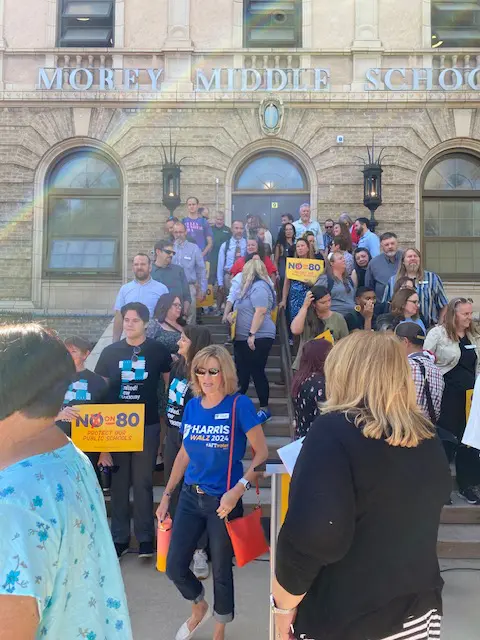
Colorado voters, beware! On the November 5 ballot: an amendment to the State Constitution to protect school choice.
If you want to support public schools and a raid on the state’s treasury by privatizers, defeat it!
This proposed amendment is weird. Ever since the founding of this nation, states have had explicit pledges in their constitution to protect public schools, open to all. Colorado’s state Constitution includes such language as well as language explicitly rejecting public funding for religious schools.
Article 9, Section 2 of the Constitution says:
Section 2. Establishment and maintenance of public schools. The general assembly shall, as soon as practicable, provide for the establishment and maintenance of a thorough and uniform system of free public schools throughout the state, wherein all residents of the state, between the ages of six and twenty-one years, may be educated gratuitously.
Article 8, Section 7 of the Constitution says:
Section 7. Aid to private schools, churches, sectarian purpose, forbidden. Neither the general assembly, nor any county, city, town, township, school district or other public corporation, shall ever make any appropriation, or pay from any public fund or moneys whatever, anything in aid of any church or sectarian society, or for any sectarian purpose, or to help support or sustain any school, academy, seminary, college, university or other literary or scientific institution, controlled by any church or sectarian denomination whatsoever; nor shall any grant or donation of land, money or other personal property, ever be made by the state, or any such public corporation to any church, or for any sectarian purpose.
Now, the privatizers want to cancel that language and replace it with language chartering what was previously forbidden.
On November 5, 2024, Colorado voters will weigh in on a hot topic in education today: school choice. Amendment 80 would make the concept of “school choice” a guaranteed right in the Colorado constitution. The text of the amendment reads as follows:
(1) PURPOSE AND FINDINGS. THE PEOPLE OF THE STATE OF COLORADO HEREBY FIND AND DECLARE THAT ALL CHILDREN HAVE THE RIGHT TO EQUAL OPPORTUNITY TO ACCESS A QUALITY EDUCATION; THAT PARENTS HAVE THE RIGHT TO DIRECT THE EDUCATION OF THEIR CHILDREN; AND THAT SCHOOL CHOICE INCLUDES NEIGHBORHOOD, CHARTER, PRIVATE, AND HOME SCHOOLS, OPEN ENROLLMENT OPTIONS, AND FUTURE INNOVATIONS IN EDUCATION. (2) EACH K-12 CHILD HAS THE RIGHT TO SCHOOL CHOICE.
According to University of Southern California Professor Guilbert Hentschke, “school choice has become a catch-all label describing many different programs that offer students and their families alternatives to publicly provided schools.” Since school choice covers many options, it can be confusing, and it is often the “subject of fierce debate in various state legislatures across the United States.” The critical distinction to make regarding school choice is often whether it affects public or private schools.
School choice has been the mantra for voucher-systems currently enacted in at least twenty states. School choice with voucher-type legislation entails using taxpayer dollars for education savings accounts, opportunity scholarships, tax credits, or actual vouchers so families can choose any type of schooling for their child — private, public or home schooling. This idea represents an emphasis on “funding students instead of funding school systems.”
The focus on school choice has resulted in increased enrollment in charter schools, private schools, and home schooling. At the same time, the school choice movement has also created instability, competition, ideological curricula, resource inequities, increased segregation, loss of community, and reduced funding for public neighborhood schools. In Colorado, of all eligible school-age children, about 76% attend public schools, 15% attend charter schools, 8 percent are in private schools, and 1% are homeschooled.
Advance Colorado is the conservative think tank organization that developed the language for Amendment 80, and they coordinated the expensive signature gathering to secure approval for the measure, originally titled Initiative 138. The backers acknowledge that parents already have the right in state statute to “send their kids to a neighborhood school, charter school, private school, home school, or across district lines.”
Advance Colorado’s solution to the “problem” of legislators promoting charter accountability is to put “the right to school choice in the Colorado Constitution” which they assert will give school choice “legal advantages a normal statute does not have.” Over fifty highly paid lobbyists were assigned to kill the charter accountability bill which was publicly opposed by Governor Polis, and was defeated in the House committee.
Even though Advance Colorado states its goal is to protect the charter schools from future legislative interference, Amendment 80 encompasses “private and home schooling” options. Including “private schools as a guaranteed right” is a plan promulgated by Americans for Prosperity and other conservative think tanks in several red states where voucher bills have been passed or expanded. Fields said he thinks “parents should be in charge of education,” adding “I think it’s easier when they have resources to send their kid to the school that they want to.”
Colorado State board of education members Lisa Escárcega and Kathy Plomer wrote in a September 11 op-ed that Amendment 80 is “not just about school choice.” They cautioned that “Amendment 80, brought by wealthy, in and out-of-state organizations, is part of a nationally coordinated master plan to go around voters in states where voucher proponents have been unsuccessful in passing state voucher laws.” They pointed out that in Colorado, “voters turned down three education voucher ballot initiatives in the 1990s.Voucher and private school proponents then tried the legislative route. The Colorado legislature has turned down any type of voucher or education savings account 18 times just since 2016.” While the amendment doesn’t mention vouchers, the state board members expressed their concern that “If parents have a right to send their children to private schools, then shouldn’t the state pay for it?”
Using public taxpayer dollars for children to attend private schools or for home schooling is not legal in Colorado, nor is it currently popular. (They can get some indirect support.) Kevin Welner of the National Education Policy Center stated that “it would be hard to persuade voters or politicians that Colorado should join the ranks of states that provide taxpayer subsidies for private schools or homeschooling.”
Even though Fields insists this amendment “is not paving the way for a voucher program in Colorado,” the far-right conservative groups providing the money to promote Amendment 80 have tried to enact vouchers in Colorado for years.
Vouchers are not necessarily an effective system to improve student learning and according to recent research, they can hinder state budgets significantly. Josh Cowen, senior fellow at the Education Law Center, pointed to decades of evidence showing private school vouchers have led to some of the steepest declines in student achievement on record. He added that measures similar to Amendment 80 passed in Arizona, Florida and Ohio have led to serious budget cuts.
Who is funding this effort to enshrine “school choice” in the state constitution?
In an op-ed about Advance Colorado last year, Colorado Newsline editor Quentin Young wrote that “Coloradans don’t know who’s supplying its money or their true motivations, because nonprofits don’t have to disclose their donors.” Advance Colorado is the same “dark money group” that gathered signatures for Initiative 108, which would have forced over $3 billion in cuts to services to citizens.
Advance Colorado started as “Unite for Colorado” in 2019, which bankrolled almost every major Republican effort in Colorado in 2020. Unite for Colorado spent over $17 million in 2020 on Republican candidates, and they have “become the most important fundraising entity for conservatives and for Republicans,” said Dick Wadhams, a former chairman of the Colorado GOP. Unite for Colorado changed its name to Advance Colorado Action in 2021 due to questionable conflicts over its spending practices, which are still in litigation.
As a “dark money group,” Advance Colorado receives grants from many sources, most of which are unknown, yet there is evidence that connects Advance Colorado to several conservative organizations. There are also reports that tie the group to Phillip Anschutz, Colorado’s richest billionaire. According to Cause IQ, between 2020-2023, over $28 million was funneled to Unite Colorado/Advance Colorado from the Colorado Stronger Alliance.
Colorado Dawn was formed in 2021 to “support organizations who further the efforts to educate the public about western values and economics,” and it has received over $3 million from Unite Colorado (Advance Colorado). Tax records from the Colorado Dawn’s 2022 990’s list state Board of Education member Steve Durham as chairman, Senator Paul Lundeen as Vice-chairman, and Michael Fields as Treasurer. Lundeen announced in 2022 his hopes that Colorado would enact a voucher program after the Supreme Court “cleared the way for public dollars in a Maine tuition assistance program to flow to private religious schools.” The Colorado Secretary of State’s office indicates that Colorado Dawn spent over $1.3 million to collect signatures for Amendment 80.
On Sept 13, 2024, the CEA announced its opposition to Amendment 80 at a press conference in Denver. A coalition of various representatives from across the state, the National Education Association, and the ACLU described their main reasons for opposing Amendment 80.
The speakers at the press conference emphasized that the amendment is unnecessary because school choice is already protected in law and has been for 30 years. In addition, they stated that the amendment opens the door to taking money from public schools to fund private schools. Speakers stressed that funding private schools would drain money away from rural public schools, private schools pose significant civil rights concerns, and they don’t belong in the Constitution.
In interviews with Chalkbeat, several education experts weighed in on the wording in Amendment 80, indicating it could create years of “litigation” order to interpret the amendment’s misleading language, which Kristi Burton Brown also acknowledged in her interview with KOA radio.
Currently, the following groups are opposing the measure: ACLU of Colorado, AFT Colorado, Colorado Fiscal Institute, CEA, The Colorado Association of School Executives (CASE), AFSCME, Advocates for Public Education Policy, Business and Professional Women of Colorado, Colorado Immigrant Rights Coalition, League of Women Voters Colorado, Soul 2 Soul Sisters, Bell Policy Center, Colorado PTA, One Colorado, United for a New Economy, Colorado Democratic Party, American Association of University Women, Colorado WINS, Colorado AFL-CIO, Stand for Children, and New Era Colorado Action Fund.
Colorado voters will need to decide which rationale they support regarding this school choice amendment. Will they agree with Advance Colorado that a constitutional amendment is necessary to ensure that the legislature will not update current charter school laws? Or will they believe that Colorado does not need to go the route of other states and create a pathway to use public funding for private and home schools?
************************************
Mike DeGuire, Ph.D., has been a teacher, district level reading coordinator, and a principal in the Denver metro area for most of his education career.
Jennifer McCormick was the last elected state superintendent of schools. She switched parties because of the Republicans’ hostility to public schools.
She is running for Governor of Indiana against Senator Mike Braun, who is a far-right Republican. Braun and his running mate, an evangelical extremist, want to get rid of public schools.
The 74 reports:
U.S. Sen. Mike Braun, a conservative Republican, is still ahead in the state’s gubernatorial race but his lead among Indiana voters over Democrat Jennifer McCormick has shrunk in recent weeks.
Polling released this week by the Democratic Governors Association shows Braun just three points in front of McCormick, 44% to 41%. That’s a dropoff from the Sept. 17 results of an Emerson College Polling/The Hill voter survey that had Braun with roughly 45% of the vote and McCormick with 34. Libertarian candidate Donald Rainwater also picked up more support but less dramatically so, going from 5.8% to 8%.
Indiana has not elected a Democratic governor since 2000 and Republican presidential candidate Donald Trump holds a comfortable 14 percentage point lead, 57% to 43%, over Democrat Kamala Harris, according to an ActiVote poll released Tuesday.
If elected to succeed Republican Gov. Eric Holcomb, Braun and his running mate, pastor, podcaster and far-right Christian nationalistMicah Beckwith, have pledged universal school choice for every Indiana family while focusing on parental rights and school safety.
McCormick, a career educator, was the last person elected to the superintendent of public instruction’s office before it became an appointed position in 2021. She seeks to expand affordable child care, fight what she believes is excessive state-mandated testing and call for an equitable school funding formula.
She also wants to place limits on the state’s private school voucher initiative: The program grew to encompass more than 70,000 children in 2023-24, a 31% increase from the year before. The state allocated $439 million in tuition grants to private parochial or non-religious schools last year — up from nearly $312 million the year before.
McCormick said the program, which might have been intended for lower-income children, is often utilized by white suburban families and is too expensive.
“We can’t afford it,” she told The 74, “and it is sucking the resources out of our traditional schools.”
Braun, 70, wants to expand school choice by removing the $220,000 annual family income cap from the voucher program, known as the Choice Scholarship Program, and doubling the $10 millionallocated to the state’s Education Scholarship Account Program. The program, which has also seen tremendous growth in participation, gives special education students and their siblings funds for tuition and support services.
Braun did not make himself available for an interview and attempts to reach various supporters were not successful.
“School choice programs put parents in the driver’s seat, allowing them to choose schools that prioritize their children’s needs,” he states in his education plan. “Providing universal school choice will ensure every Hoosier family has the same freedom to choose their best-fit education.”
A former school board member, Braun also wants to create an Indiana Office of School Safety to streamline the efforts of several departments, including the state police — and implement age-appropriate cyber training for students regarding online safety. He said, too, that the state should limit cellphone use on campus.
Braun wants to increase Indiana’s public teacher base salary — and financially reward educators whose students perform well.
Keith Gambill, president of the Indiana State Teachers Association, said his group endorsed McCormick, 54, because of her commitment to funding traditional public schools.
He noted she did not have the group’s endorsement when she initially ran for the state superintendent’s office as a Republican. But, Gambill said, after filling the role and understanding the state’s educational needs, she switched parties and her values more closely aligned with the union’s.
“She really stood up to members of — at that time — her own party in working toward what was best for our schools,” he said, speaking of her time in office. “And, of course, as soon as they were challenged, they didn’t like that. She realized that if she was going to make a difference in public education, she would have to move in a different direction.”
McCormick aims to secure a minimum base salary of $60,000 for pre-K-12 educators, and adjust veteran teacher salaries to reflect their non-educator peers. She wants to increase academic freedom, safeguard university tenure and protect the ability of teachers unions to collectively bargain for wages and benefits.
Her running mate, Terry Goodin, a former state representative, was a teacher, assistant principal and public school superintendent at Crothersville Community Schools.
Braun, in his education plan, said he wants schools to notify parents about their child’s request to change their name or use different pronouns on campus. He has denounced gender-affirming surgery for minors and opposes transgender students playing on girls’ sports teams. Braun has the backing of Americans for Prosperity and CPAC — and maintains high ratings from the NRA.
Braun was endorsed by Trump in 2023 and won his party’s nomination for governor in May after beating out a crowded field of GOP contenders. He acknowledged last month, according to Axios, that Harris’s presence at the top of the presidential ticket has complicated down-ballot races, including his own.
“I think that’s had an impact,” he said, “but I’m going to plow through that because this is a lot about kitchen table issues once you’re starting to run for governor.”
The Economic Policy Institute is a nonpartisan think tank that leans left, which is a rarity in D.C., where billionaires shower their largesse on rightwing think tanks like the Heritage Foundation and the Cato Institute. This is the EPI analysis of the devastating effect of vouchers on public schools. This is their purpose: the privatization of public funding for education.
Here is the EPI report:
Since the early 2000s, many states have introduced significant voucher programs to provide public financing for private school education. These voucher programs are deeply damaging to efforts to offer an excellent public education for all U.S. children—and this is in fact often the intention of those pushing these programs. In this post we argue that:
Public education is worth preserving—it should be seen as one of the most important achievements in our country’s history and crucial for the social and economic welfare of future generations.
The economic logic behind voucher programs is weak; it rests on ideological commitments to markets over public provision of goods and services, even in realms of activity where the virtues of markets do not hold—like public education.
Most damagingly, introducing significant voucher programs has gone hand in hand with steep declines in public school spending relative to states that have not adopted these policies.
This spending stagnation has had profound effects in generating larger “adequacy gaps” in school funding in voucher states.
Paradoxically, even while they take resources away from public schools, many newly introduced voucher programs could result in more total state spending in coming years.
This would be a particularly perverse result given the expansive research literature showing that vouchers do not improve educational outcomes. In essence, states that have introduced large-scale voucher programs are looking to substitute a more expensive and less effective system for educating kids than public education. The only reason for this policy thrust is ideology rooted in hostility to public education.
Background on public education and the voucher debates
Universal public education was perhaps the most important reason why the United States became the richest country in the world in the 20th century. As Claudia Goldin, the most recent Nobel Prize winner in economics, has written:
At the dawn of the twentieth century the industrial giants watched each other cautiously. The British sent high-ranking commissions to the United States and the United States sent similar groups to Britain and Germany. All were looking over their shoulders to see what made for economic greatness and what would ensure supremacy in the future… Earlier delegations focused on technology and physical capital. Those of the turn-of-the-century turned their attention to something different. People and training, not capital and technology, had become the new concerns…For the twentieth century to become the human capital century required vast changes in educational institutions, a commitment by governments to fund education, a readiness by taxpayers to pay for the education of other people’s children, a belief by business and industry that formal schooling mattered to them, and a willingness on the part of parents to send their children to school (and by youths to go). The transition occurred first in the United States and was accompanied by a set of “virtues” or principles, many of which can be summarized by the word “egalitarianism.”
In the 21st century, unfortunately, too many policymakers seem determined to squander this legacy by starving public education of money and legitimacy, often in the name of “school choice.” Their central claim (when they bother to make one with any clarity) is that public provision of goods or services is ineffective by definition and that a dose of private, market-like competition will lead to better schooling outcomes for the nation’s children.
This claim is weak on its logical face, as the conditions needed for market competition to lead to better outcomes clearly do not exist in the educational realm. Take just three obvious examples. First, unlike other goods and services, there is no option to forego education entirely. In other markets, if the private sector is doing a poor job at offering attractive options for a good or service, people can just consume other things. But the United States—rightly—mandates basic education for all kids. Second, competition works well when the cost of switching providers is small. If you get tired of prices or goods at Whole Foods, you can shop at Giant. By contrast, switching schools is an extraordinarily costly decision in time, administrative burden, and severed social networks. Third, competition works well in markets when a transaction only affects the buyer and seller—and not unrelated third parties. But if third parties are affected by a transaction (think of pollution affecting third parties when I decide to buy gasoline for my car), then private markets will fail to match costs and benefits. Universal schooling generates positive spillovers to society at large, meaning that individuals would be inclined to underinvest in education relative to the full benefits it provides.
The easiest way to boost educational outcomes is providing more public resources
To the degree any evidence is mobilized in support of the view that public education needs market-like disruption through “school choice” instruments like vouchers, it generally relies on outdated research claiming that public schools already have “enough” funding, and that additional resources would not generate better outcomes. If one believed that the level of public education resources was sufficient, then strategies aimed at changing the composition of these resources or how they were mobilized—say through privatization via vouchers—might make some sense.
But this is wrong on several fronts.
First, newer research with better methods confirms that more money for public schools does improve educational outcomes. And not only does more money improve schooling outcomes for children, it also has the largest beneficial effects on the performance of particularly disadvantaged students.
Such spending is not random and depends on a number of factors that are correlated with student success. For example, spending in a given district might rise as higher-income families move into the area and property values increase. These higher-income families might also be able to provide greater in home resources that will aid their children’s academic performance. Simple correlations between the level of district spending and student success might hence show a positive relationship, but the causality would not necessarily be running from district spending decisions to student success; both might instead be driven by a third variable, which is simply the level of family resources on average across the district.
Running the opposite direction, much school funding is explicitly compensatory, targeting students facing greater socioeconomic disadvantage to attempt to even out total resources (both in home and public) available to students for academic success. But if this greater spending targets students with fewer in home resources, it could show a negative relationship between levels of spending and student performance, but again will not be reflecting the causal effect of this spending.
The new research has overcome this key challenge in empirical assessments of the relationship between school spending and student outcomes: It found natural experiments that allow truly exogenous changes in school spending to be identified, and hence the effects on student achievement to reflect the causal effect of this spending. The exogenous changes that allowed for these examinations were largely court-ordered school finance reforms (SFRs).
For example, Jackson, Johnson, and Persico (2016)examined the impact of school finance reforms between 1972 and 2010, and found that a 10% increase in school spending for 12 years lead to increases in high school graduation rates, 7% higher wages, and 10% higher family incomes in adulthood for children from districts that saw the spending increase. Gains were concentrated among students in high-poverty households. Lafortune, Rothstein, and Schanzenbach (2018)similarly found that a $1,000 increase in per-pupil spending for low-income districts would reduce the test score gap between low- and high-income school districts within a state by roughly 0.18 standard deviations (SDs) following court-ordered SFRs, or by nearly 40% of the baseline gap.
In short, the evidence indicates that public schooling in the United States simply needs more resources to deliver even better student achievement—not some radical disruption in how it is delivered and by what institutions.
Second, vouchers don’t lead to better student achievement. Several high-quality studies have investigated the impact of recent voucher programs and have found notably worse outcomes for student achievement. In the first two years following Louisiana’s Scholarship voucher program, student achievement in language arts and math both decreased by as much as 0.34 SDs. In Ohio, under the Ed Choice program, students who went to private schools with a voucher performed worse than they would have had they remained in public schools. In Indiana, students that used the Indiana Choice Scholarship voucher program experienced an average achievement loss of 0.15 SDs in mathematics.
The promise of vouchers improving educational outcomes rests on assumptions that the private sector is always and everywhere more efficient than public providers of goods and services. But the private schools that expand or are created in response to the introduction of voucher programs are often of very poor quality. In the case of Milwaukee’s longstanding voucher programs, for example, researchers found that 40% of private voucher schools failed or closed down within the program’s first 25 years. Parents often belatedly realize that these schools are no improvement relative to public schools; this has lead a large share of students that took vouchers to return to public schools shortly after. In Milwaukee, nearly 20% of kids left voucher programs every year, with most coming back to public school.
Vouchers reduce public school resources, but introduce large new fiscal obligations overall
It would be bad enough if the introduction of vouchers simply funneled some students into poorly performing private schools for a stretch of time. But vouchers also affirmatively drain resources from the entire public education system—resources that would reliably produce better outcomes for children if they had stayed in public schools. Paradoxically, while vouchers are associated with significant drains from public school resources, they could actually boost the total fiscal cost of state support for education over time by shoveling more and more resources to (poorly performing, on average) private schools.
Arizona provides a cautionary tale. Arizona’s 2023 universal voucher program was forecast to cost $33 million in the first year and $65 million in the second. Instead, the program ended up costing $587 million in the first year and is projected to cost upwards of $708 million in 2024 fiscal year. Even smaller programs tend to be dramatically underestimated.
Part of this unexpected cost was the subsidy offered to parents who had already enrolled their kids in private schools: 75% of the first wave of applicants to the Arizona program were parents of students with no history of public school attendance, who could now tap taxpayer money to pay for their children’s private schools. Much of the cost of vouchers is essentially a subsidy for parents (many of them affluent) who never intended on using the public school system.
Other states have followed this pattern of introducing programs promised to be small and seeing them balloon in size. New Hampshire’s 2021 Educational Freedom Account was estimated to cost $300,000 in the first year and $3 million in the second, but in reality the bill cost $8.1 million in the first year, $14.6 million in 2022, and $25 million in the 2023-24 school year.
The rise of vouchers in the past 15 years represents an affirmative effort to erode public education by starving it of needed funding. Voucher proponents often want voters to think these programs simply broaden the suite of options enjoyed by parents and students. But the data tell a different story: Where significant voucher programs have been instituted, the resources available to public school children have decreased. Again, highly persuasive recent research shows that public school resources are crucial on the margin, and that more public resources reliably improve student achievement and economic outcomes later in life—while fewer public resources reliably harm education. Voucher programs that starve public resources for education are therefore deeply damaging.
Figure A shows state and local per-pupil funding levels in 2007 and 2021 (expressed in 2020 dollars) for states that passed substantial voucher programs during the period (defined as having >1% of enrolled students using vouchers by 2021) as well as for states without any voucher programs. In 2007, the average difference in per-pupil spending between these two groups of states was around $900 (higher in states that did not subsequently pass significant voucher programs). Between 2007 and 2021, voucher programs grew significantly in one set of these states. By 2021, states without voucher programs were spending $2,800 more per-pupil—essentially more than tripling the spending advantage they had before the rise of voucher programs in the 2010s and early 2020s.
The failure to increase per-pupil funding leads to the erosion of public education services in all forms: everything from school meals, extracurricular activities, mental health and counseling services, vocational and technical programs, and investments in teacher quality and pay. It is also worth noting that flat per-pupil educational spending—even in inflation-adjusted terms—is effectively a decline in the quality of education over time. Take the example of teachers: In a growing economy, simply keeping real pay constant for teachers means that their pay, relative to other skilled and credentialed professionals, is declining. This decline in relative teachers’ pay (even with absolute pay levels flat) will put downward pressure on the quality of the teaching labor pool, as more and more people who could have been excellent teachers decide to choose higher-pay occupations.
Stagnant spending in states with significant voucher programs has also left education funding in those states substantially below measures of funding adequacy. In school finance research, adequacy is defined as the level of funding needed in a district to ensure students reach an average level of student achievement. For the measure of adequacy used below, the outcome is achieving the national average of test scores. Adequacy measures account for needs that differ by district depending on influences like the socioeconomic status of the student population.
FIGURE A
Per-pupil state and local education spendingBy voucher program status, 2007 and 2021
States without voucher programsStates with voucher programs2007$11,211$10,3242021$12,820$10,054
Notes: States with substantial voucher programs, defined as having >1 percent of all students enrolled in 2021, include Arizona, Florida, Georgia, Indiana, Louisiana, North Carolina, Ohio and Wisconsin. States with smaller voucher programs are excluded from analysis.
State constitutions mandate sufficient education funding for students to have access to an adequate education, regardless of students’ economic or social circumstances. For example, students in high-poverty districts will need more education funding than students in low-poverty districts to achieve the same outcome because they live in neighborhoods where there are fewer resources available to help them succeed. Several court cases in recent decades have found a constitutional responsibility for states to provide such adequate funding.
Figure B relies on total per-pupil spending data from the School Finance Indicator Database to assess the adequacy of school spending for states with large voucher programs and states without any voucher program, comparing the gap for students in medium-, high-, and highest-poverty districts in our two groups of states in 2021. A negative gap implies that state spending is inadequate, and students are not receiving the resources required to meet average academic achievement levels. Regardless of poverty status, states with substantial voucher programs in 2021 are not spending enough to meet students’ needs.
FIGURE B
Funding gap for adequate per-pupil spendingBy voucher program status, 2021
States without voucher programsStates with voucher programsMedium Poverty-$249-$4,000High Poverty-$2,202-$5,429Highest Poverty-$8,490-$11,859
Notes: States with substantial voucher programs, defined as having >1 percent of all students enrolled in 2021, include Arizona, Florida, Georgia, Indiana, Louisiana, North Carolina, Ohio and Wisconsin. States with smaller voucher programs are excluded from analysis. Medium poverty is defined as district neighborhood poverty in the 3rd quintile (40-60th percentiles). High poverty is defined as district neighborhood poverty in the 4th quintile (60-80th percentiles). Highest poverty is defined as district neighborhood poverty in the 5th quintile (80-100th percentile).
For medium-poverty districts, the adequacy gap is negative, but quite small in schools without a voucher presence (roughly $220 per pupil). In medium-poverty districts of states with a significant voucher presence, however, the adequacy gap is negative and very large—with actual spending lagging adequacy measures by $3,750 per pupil. In high-poverty districts, even states without vouchers have large adequacy gaps—roughly $2,200 per pupil. But these gaps are double the size in states with significant voucher programs—roughly $5,400 per pupil. Finally, adequacy gaps are shamefully large in both states without vouchers ($8,500 per pupil) and in states with significant vouchers ($11,900), but the difference remains quite high.
These results clearly show that school financing is far from perfect in states without voucher programs, but is far worse in states that have introduced these programs.
Conclusion
Vouchers are not a cost-free policy that simply adds on another education option for children—they are instead an intentional attack on universal public education, one of the crown jewels of U.S. society. Vouchers make no coherent economic sense, and the evidence shows that vouchers harm student achievement and expose state budgets to large future obligations that are hard to forecast, even while they divert spending away from public education. Our analysis shows that states that have introduced significant voucher programs over the past decade and a half have experienced significant declines in per-pupil spending relative to states without voucher programs. In short, the data clearly show that choosing to implement vouchers programs takes funding away from public education. The public spending declines associated with the introduction of vouchers will reliably cause significantly worse educational outcomes and will harm kids in high-poverty neighborhoods more than kids in low-poverty neighborhoods.
The rise of vouchers is especially damaging given that we now know what does boost educational outcomes: more spending on public education. Leaving these potential gains on the table and promoting voucher programs instead of investing in public education demonstrates that kids’ education is not a priority.


 Diane Ravitch's blog