Archives for category: Unions

Good news in Wisconsin! A local court overturned a notorious piece of anti-union legislation that was passed in 2011, at the instance of then-Governor Scott Walker. At the time, union protestors encircled the Statehouse to protest. Walker was unmoved. He celebrated the defeat of the state’s unions (excluding police and firefighters).

The Guardian writes:

As the labor movement braces for a second Trump term, union members and their leaders are celebrating a major victory over a controversial law that stripped public sector unions of collective bargaining rights.

In response to a lawsuit alleging that a notorious law passed by the former Republican governor of Wisconsin Scott Walker in 2011 is unconstitutional, a county judge ruled on Monday that more than 60 sections of the law and several sections of a follow-up law in 2015, Act 55, are unconstitutional.

Walker called the decision “brazen political activism at its worst” and Republicans plan an appeal.

Thousands protested the introduction of the law, which crippled unions’ funding and powers. Following the passage of Act 10, several Republican-dominated states pushed to pass similar legislation, including Florida which passed a similar law in May 2023 targeting public sector unions, and Iowa, which passed legislation that took away collective bargaining rights from many state employees in 2017.

Act 10 stripped collective bargaining rights from thousands of state employees in Wisconsin, limiting their ability to bargain solely on wage increases that cannot exceed inflation. It also forced public sector labor unions to annually vote, with a majority of members participating and voting, to maintain certification.

“We were kind of just demonized, not just teachers, but public sector workers in general,” said John Havlicek, a high school Spanish teacher in La Crosse, Wisconsin and former president of the La Crosse Education Association which represents teachers in the school district. “Teachers don’t go into it for the money but I also have groceries to buy and bills to pay and stuff like that. A lot of public sector workers, in my experience teachers, really felt like we were being scapegoated. It was really bad.”

The act has had a significant impact on union membership, pay and benefits. In 2010 Wisconsin had a union density rate of 15.1%. That number dropped to 8.4% in 2023.

The law also forced public sector workers to pay more for healthcare and retirement benefits, resulting in around an 8.5% decrease in their pay for workers making $50,000 a year.

An April 2024 report by the Wisconsin department of public instruction found teacher pay had declined from 2010 to 2022 by nearly 20% and about four out of every 10 first year teachers either leave the state or the profession after six years.

Public school funding also drastically declined in Wisconsin after Act 10 was enacted. Per pupil spending in Wisconsin out paced the national average by around $1,100 per student in 2011 and was $327 per pupil lower than the national average in 2021.

The verdict could be overturned on appeal. Stay tuned.

Thirteen years ago, Republican Governor Scott Walker and the legislature of Wisconsin enacted Act 10, which banned collective bargaining for public employees, except for public safety employees. Teachers, social workers, and other public employees were outraged. They encircled the State Capitol for days. Walker became a star, and his sponsors, the Koch brothers, were happy.

But today, Act 10 was declared unconstitutional. Time will tell whether the decision is upheld.

A Dane County judge on Monday sent ripples through Wisconsin’s political landscape, overturning a 13-year-old law that banned most collective bargaining among public employees, consequently decimating the size and power of employee unions and turning then-Republican Gov. Scott Walker into a nationally known political figure.

But there’s been a revival of hope in Wisconsin:

The effort to overturn Act 10 began in November 2023 when several unions representing public employees filed the lawsuit, citing a “dire situation” in workplaces with issues including low pay, staffing shortages and poor working conditions. 

In July,  Dane County Circuit Judge Jacob Frost ruled provisions of Act 10 unconstitutional and denied a motion filed by the Republican-controlled Legislature to dismiss the case.

The lawsuit argued the 2011 law violated equal protection guarantees in the Wisconsin Constitution by dividing public employees into two classes: “general” and “public safety” employees. Public safety employees are exempt from the collective bargaining limitations imposed on “general” public employees.

Is it an accident? Trump made a good choice for Secretary of Labor. The NEA said good things about her. Let’s hope he doesn’t notice.

The NEA issued this press release:

National Education Association President Becky Pringle released the following statement reacting to the selection of Lori Chavez-DeRemer as Labor Secretary:

“Across America, most of us want the same things – strong public schools to help every student grow into their full brilliance and good jobs where workers earn living wages to provide for their families. 

“During her time in Congress, Lori Chavez-DeRemer voted against gutting the Department of Education, against school vouchers, and against cuts to education funding. She cosponsored the Public Service Freedom to Negotiate Act, the PRO Act, and other pro-student, pro-public school, pro-worker legislation.  

“This record stands in stark contrast to Donald Trump’s anti-worker, anti-union record, and his extreme Project 2025 agenda that would gut workplace protections, make it harder for workers to unionize, and diminish the voice of working people.  

“During his first term, Trump appointed anti-worker, anti-union National Labor Relations Board members. Now he is threatening to take the unprecedented action of removing current pro-worker NLRB members in the middle of their term, replacing them with his corporate friends. And he is promising to appoint judges and justices who are hostile to workers and unions.  

“Educators and working families across the nation will be watching Lori Chavez-DeRemer as she moves through the confirmation process and hope to hear a pledge from her to continue to stand up for workers and students as her record suggests, not blind loyalty to the Project 2025 agenda.” 

-###-

The National Education Association is the nation’s largest professional employee organization, representing more than 3 million elementary and secondary teachers, higher education faculty, education support professionals, school administrators, retired educators, students preparing to become teachers, healthcare workers, and public employees. Learn more at www.nea.org


Media Matters has done a thorough review of the contents of Project 2025, which was written as a playbook for the next Trump administration. It was released and posted on the web in 2023, without fanfare. As more people read it and expressed their indignation, Trump claimed he knew nothing about it. Ever heard of it. Didn’t know who wrote it.

But the authors of the plan included 140 people who had worked in the Trump administration. The plan was developed by the rightwing Heriage Foundation, whose president is Kevin Roberts, a friend of Trump’s.

He knew.

It’s the roadmap for the second Trump term in office.

For education, the main feature of Project 2025 is its strong support for school choice, especially vouchers. It is a formula for directing federal funds to public funding of private and religious schools, as well as home schooling. It’s the Betsy DeVos model. Its purpose is to end public schools.

Both Trump and Harris sought the endorsement of the International Brotherhood of Teamsters. Its board decided, no endorsement. This surprised many people, because the Biden administration was the most pro-union presidency in decades, and the Trump administration was loudly anti-union.

The Teamsters were set to endorse Biden, but withheld their endorsement from Kamala Harris. Why? Was it racism? One of the readers of the blog pointed to a story in The Guardian about Teamster leader Sean O’Brien paying $2.9 million for racial discrimination.

Teamsters in battleground states are endorsing Harris, ignoring the lead of their national union. The Washington Post reported Kamala endorsements by Teamsters in Michigan, Pennsylvania, New York, Nevada, and Wisconsin. And added: “As of Thursday, at least eight regional councils, covering active Teamsters members in some 14 states, as well as 10 union locals, had endorsed Harris. The regional councils alone represent more than 500,000 Teamsters members.

No regional or local Teamsters organizations have endorsed Trump.”

Harold Meyerson of The American Prospect has a different take.

Inside the boardroom, it was no endorsement. Outside, some of the board members endorsed Harris.

Yesterday’s headline, of course, was that the Teamsters had decided to make no endorsement in this year’s presidential race. That depended, however, on which Teamsters you’re talking about, and whether or not they were still in a meeting chaired by union president Sean O’Brien.

To be sure, the international’s general board voted by a 14-to-3 margin to affirm O’Brien’s clear preference for a position that would require the union to avoid having to campaign for Kamala Harris and against Donald Trump. O’Brien had previously given Trump a boost by delivering the prime-time address on the first night of the Republican National Convention.

But almost as soon as the general board adjourned, some of those 14, including New York’s Gregory Floyd and the West Coast region’s Chris Griswold made clear that their own regional bodies were endorsing Harris. Indeed, within 24 hours of the union proclaiming its neutrality, regions and locals representing more than 500,000 of the Teamsters’ 1.3 million members (of whom a little more than 100,000 are in Canada) announced that they were backing Harris.

Before yesterday’s meeting, the Teamsters General Board had met with Harris, Trump, and Robert Kennedy Jr. Commendably, a group of eight Teamster rank-and-filers also were allowed to attend all of those meetings, and asked questions of the candidates. After the last of those meetings, which was with Harris, those eight unanimously stated that they favored her. Their judgment, apparently, didn’t filter up to the General Board members (at least when convened as the General Board, though it was clearly in accord with a number of those members once they’d left the meeting).

In fairness, none of those eight rank-and-filers nor any General Board members save O’Brien attended his one-on-one meeting with Trump at Mar-a-Lago earlier this year.

What could have prompted the rank-and-filers and so many regional Teamster leaders to support Harris? Herewith, a few plausible reasons.

First, of course, is the general record of the Biden-Harris administration, which has been the most pro-union in American history. Both Biden and Harris have walked picket lines with striking union workers.

Second, Harris voted in favor of the PRO Act, which neither any Republican member of Congress, nor Trump himself, supported. The act would levy actual penalties on employers who illegally violate the National Labor Relations Act by routinely firing workers seeking to organize their workplace. It would also require a mediator to impose a first contract at companies where the workers have won union recognition but the employer refuses to come to terms on a contract—a very frequent occurrence, says John Palmer, one of the three General Board members who voted to endorse Harris rather than join the room’s no-endorsement majority, and has declared that he’ll run against O’Brien in the Teamsters’ next presidential election.

Third, last year, the Biden appointees on the National Labor Relations Board reinstated the “joint employer” rule, under which the major companies that employ contractors to do their core work are liable for those contractors’ labor law violations. Trump’s appointees on the NLRB had struck that rule down in 2020. Just last month, following the reinstated ruling of the Biden NLRB, an administrative judge ruled that Amazon was responsible for inflicting a host of illegal labor practices on its delivery drivers in Palmdale, California, even though those drivers (who were required to wear Amazon uniforms and drive Amazon trucks) were nominally employed by a company that had contracted with Amazon to deliver its goods. Such contractors, called Delivery Service Partners (DSPs), employ 280,000 Amazon drivers, according to a Teamster press release that hailed the administrative judge’s ruling. The release went on to note that the ruling would encourage other such drivers to vote to join the Teamsters, as the Palmdale drivers had.

And in the several weeks since then, hundreds of drivers in the New York area have done just that. Had the Trump appointees to the NLRB still constituted the majority on the Board (i.e., had Trump been re-elected), Amazon would be immune to such pressures. As O’Brien has repeatedly stated, Amazon is the union’s primary target of organizing, which might suggest that having a majority of NLRB members appointed by Harris rather than by Trump would be a matter of considerable concern to Teamsters who wanted their union and workers in their industry to thrive.

Perhaps surprisingly, one group that has not been heard from since the no-endorsement decision is Teamsters for a Democratic Union, a generally progressive group that has been around for nearly half a century. TDU first arose in opposition to the union’s then-mobbed-up leaders and has been a voice for a more democratic union since then. Well over a year before O’Brien ran and won an insurgent campaign for the Teamster presidency in 2022, he secured TDU’s endorsement, even though he had frequently attacked the group in previous years.

Since he took office, however, a number of TDU former leaders, including Tom Leedham, who was TDU’s candidate for the Teamster presidency in 1998, 2001, and 2006, and Dan La Botz, who was one of TDU’s founders in 1976, have expressed concern that TDU has become an O’Brien cheering section in return for having been given staff and secondary leadership positions. As Leedham and La Botz wrote in CounterPunch, they are “disturbed and concerned to see TDU’s recent change over the last few years as it has subordinated itself to Sean O’Brien’s administration.”

“Beyond that,” they added, “O’Brien’s gestures of support for Donald Trump and other MAGA Republicans, suggest a turning away from the democratic, egalitarian, and inclusive values that inspired TDU.”

In fairness, the current leaders of TDU have never claimed that their primary mission requires them to be Teamsters for a (small-d) democratic America.

~ HAROLD MEYERSON

Michael Hiltzik writes about business for The Los Angeles Times. In this column, he reviews Trump’s record on issues involving working people and unions. Although he is now positioning himself as a friend of workers, Hiltzik demonstrates that his record shows otherwise.

It is exceedingly odd that the Teamsters Union refused to endorse either candidate. One is a friend to organized labor; the other is hostile to unions. The difference between Trump and Harris is stark. What’s with the Teamsters? Be it noted that the Black Caucus of the Teamsters broke ranks and endorsed Harris, as did a Teamsters local in Chicago. West Coast teamsters also endorsed Harris. Other locals may follow those defections. But the crucial locals are in battleground states like Michigan and Pennsylvania.

Hiltzik wrote:

Donald Trump, in his determined effort to claim the mantle of friend of the working man and woman, unveiled a proposal the other day to make overtime pay tax-exempt. 

“People who work overtime are among the hardest-working citizens of our country, and for too long, no one in Washington has been looking out for them,” he told a rally in Tucson

Let’s be blunt about something here: Anyone who buys Trump’s pose about this is the mark in a con game. Trump’s claim that no one in Washington has been looking out for overtime workers was never as true as it was during the Trump administration, which slashed overtime protections for more than 8.2 million workers. 

Trump’s Department of Labor was a black hole for worker rights. The agency abandoned an Obama administration policy that would have favored more than 4.2 million workers. The Biden administration restored the Obama rule and went further. 

And that was just on overtime. As president, observed economic commentator Pedro Nicolaci da Costa in 2019, Trump pursued “the most hostile anti-labor agenda of any modern president.”

Before exploring Trump’s manipulation of overtime regulations, let’s examine his overall record on workers’ rights.

In 2019, Trump appointed as his Secretary of Labor Eugene Scalia, son of the late Supreme Court Justice Antonin Scalia. The new labor secretary had made his career as a corporate lawyer fighting pro-worker policies. In 2012, the Wall Street Journal had labeled him one of the financial industry’s “go-to guys for challenging financial regulations.”

Scalia had helped Walmart overturn a Maryland law mandating minimum contributions by big employers for workers’ healthcare, defended SeaWorld against workplace safety charges after a park trainer was killed by an orca (he lost that case), and had written extensively against a federal regulation expanding ergonomic safety requirements. 

He had written that the latter rule, proposed by the Occupational Safety and Health Administration, “would require businesses to slow the pace of production, hire more workers, increase rest periods and redesign workstations or even entire operations.”

No legitimate candidate for secretary of Labor would have regarded that policy as a bad thing, but Scalia condemned it in print as “the most costly and intrusive regulation in [OSHA’s] history.”

Scalia’s predecessor as secretary, Alexander Acosta, had gone to Congress to oppose measures to raise the federal minimum wage, which has been stuck at $7.25 an hour since 2009 to $15 in steps. It shouldn’t need mentioning that this was an extraordinary position for a secretary of Labor to take. 

(Acosta, it may be remembered, lost his job after revelations about his role in soft-pedaling sex-trafficking charges against Jeffrey Epstein produced a political uproar.)

Trump remade the National Labor Relations Board along the same lines. In a key move, his NLRB scrapped the effort under Obama to expand the definition of “joint employer,” which would have made big franchisers such as McDonald’s jointly liable with their franchisees for violations of employees’ wage and hour rights. 

The Trump NLRB’s proposed definition would narrow the joint-employer standard “to the point at which many workers would find it nearly impossible to bring all firms with the power to influence their wages and working conditions to the bargaining table,” according to the labor-oriented Economic Policy Institute.

Put it all together, and Trump had turned the Department of Labor into the “Dept. of Employer Rights,” I wrote.

Now to the overtime rules. As my colleague James Rainey reported Sunday, Trump’s proposal to make overtime pay tax-exempt was part of a passel of purported tax cuts for the working class, including tax exemptions for tips and Social Security benefits, all of which economists saw as “gimmicks” and “shams.”

In 2016, Obama had raised the ceiling making salaried workers eligible for time-and-a-half overtime — that is, working hours exceeding 40 hours per week — to $47,476 in annual wages, up from $23,660. The ceiling would be adjusted regularly to overall wage growth. Hourly workers typically get overtime after 40 hours, but salaried workers receive overtime pay if their wages are below the ceiling. 

The Obama administration’s idea was to narrow the practice of low-wage employers to designate workers as “managers” to exempt them from the OT rule while paying them an hourly wage. (That’s why fast-food restaurants are always suspiciously loaded with “general managers, assistant managers, night managers, managers for opening and closing and delivery,” as former New York prosecutor Terri Gerstein observed in 2019.)

It was estimated that the new rule would give 4.2 million workers new overtime protection.

The Obama rule was blocked by a federal judge in Texas. When Trump came into office, his Labor Department refused to defend the rule in court. Instead, the agency proposed a new rule reducing the wage ceiling to only $35,568. That was nearly $20,000 below the level that would have been reached by the Obama rule, as it was adjusted for wage inflation. The Trump rule was not indexed.

Some 8.2 million workers who would have gained OT protection under Obama were left behind by the Trump rule, Heidi Shierholz of the pro-labor Economic Policy Institute calculated. They would be deprived of a combined $1.4 billion in pay annually.

The 8.2 million workers left behind, Shierholz estimated, included “4.2 million women, 3.0 million people of color, 4.7 million workers without a college degree, and 2.7 million parents of children under the age of 18.”

The Biden administration restored the Obama rule, and then some. The new rule set the ceiling at $844 per week, or $43,888 for a full-time hourly worker, as of July 1. 

On Jan. 1, the salary ceiling will rise to $1,128 per week, or $58,656 annually. After that, it will be indexed every three years. The new rule will benefit an estimated 4.3 million workers, more than half of whom are women and about one-fifth workers of color. 

Among the largest groups of affected workers, EPI estimates, are those in healthcare and social services.

Whether Trump has sat down to map out a pro-worker policy is doubtful in the extreme — it’s not a concern he has ever displayed in the past. He appears to have blurted out the overtime policy as part of what the Irish writer Fintan O’Toole aptly describes as “the surreal bricolageof his rally speeches.”

But a clue can be found in “Project 2025,” a road map for a second Trump term drafted by the right-wing Heritage Foundation. (Trump claims to have nothing to do with this 900-page tome, but no one really believes him.)

Project 2025 would shrink overtime coverage materially. It advocates cutting the compensation subject to time-and-a-half to salary only, excluding pay for such benefits as healthcare, retirement, education, child care or paid meals. Under existing law, the only compensation that can be excluded from the calculation is pay for expenses a worker pays on the employer’s behalf, discretionary bonuses, gifts on special occasions, and vacation and sick pay.

The Project also advocates indexing the ceiling once ever five years rather than three years, which would slow its rate of growth, and index the ceiling to consumer inflation, which tends to grow slower than wage inflation, the current index. 

The Project also advocates allowing employers to calculate overtime hours over two or four weeks rather than weekly, which would allow them to require workers to put in more than 40 hours some weeks and make it up in others. That sounds like an open invitation to employer manipulation of work schedules.

Trump’s record on worker rights is clear as day. Do you really think he’ll be looking out for the men and women in the rank and file? 
Senator Sanders of Vermont is leading a campaign to restore collective bargaining rights. [CORRECTION!]

He wrote today:

As we celebrate Labor Day, 2024, there is some very good news. 

Public approval of labor unions, at 70%, is higher today than it has been in decades. Over the last year major unions like the UAW have won some highly publicized strikes, while many other unions have negotiated trail-blazing contracts for their members. Young people at Starbucks and on college campuses are now more involved in labor organizing than ever before. And, for the first time in American history, a president of the United States, Joe Biden, walked a picket line with striking workers.

It is not an accident as to why we are now seeing more militancy and growth in the labor movement. The working people of our country are increasingly aware of the unprecedented level of corporate greed and power we are now experiencing, and the outrageous level of income and wealth inequality that exists. They understand that never before in American history have so few had so much, while so many continue to struggle. And they are fighting back. They know that workers in unions can negotiate contracts that give them better wages, working conditions and benefits than non-union workers. They appreciate that when you’re in a union you have some power against the arbitrary decisions corporate bosses. 

Working people today are more than aware that, over the last 50 years, there has been a massive transfer of wealth from the bottom 90% to the top 1%. They are disgusted that, despite huge increases in worker productivity, real inflation-accounted for wages for the average American worker are lower now than they were over 50 years ago as 60% of Americans live paycheck to paycheck. They are insulted that CEOs of major corporations make almost 350 times as much as their average employee. They are concerned that the American dream is ending and that their kids may have an even lower standard of living than they do. And they worry that with the rapid growth of Artificial Intelligence and robotics, they have no power as to what will happen to their jobs as the economy undergoes major transformations.

The average American worker also understands that his/her political power has been significantly diminished as billionaires pour huge amounts of money into both political parties as they undermine our democracy. It is no great secret as to who now has the clout in Congress. It is the billionaires, the corporate CEOs, the campaign donors and their well-connected lobbyists.

Bottom line: The average American worker is sick and tired of status quo economics and politics. He/she knows that in the richest country on earth we can and should have an economy and political system that works for all, and not just the wealthy few, and that a strong union movement is the vehicle for bringing about the changes that we need.

On this Labor Day, as we reaffirm our support for the trade union movement and for labor solidarity throughout the world, as we continue to fight the day to day struggles against corporate greed, it’s important that we not lose sight of our vision for the future and what kind of country we want to become. Here, in my view, are just a few components of the agenda we need to fight for. 

We must establish a vibrant democratic political system. One person, one vote. We must end the disastrous Citizens United Supreme Court decision and the billionaire funding of campaigns through super-PACs. We need to move to the public funding of elections and give political power back to ordinary Americans. 

We need to pass the PRO Act and end the ability of companies to illegally intimidate and fire workers who want to join a union. Corporate interests spend an estimated $400 million a year on anti-union consultants who do everything possible, legal and illegal, to fight the right of workers to join unions.

We need to end starvation wages in America and raise the $7.25 an hour federal minimum wage to a living wage. People should not have to work two or three jobs just to pay the bills for their families.

We need trade policies that benefit workers in the U.S. and abroad, not just the CEOs and stockholders of major conglomerates. We need to rebuild our manufacturing sector and create good paying jobs here.

We need to join the rest of the industrialized world and guarantee health care to all people as a human right through a Medicare for All, single payer system. No one should go bankrupt because of a hospital stay. Everyone in America, regardless of income, should have the right to see a doctor. 

We must finally guarantee paid family and medical leave to every worker in America. New moms and dads should be able to spend the first few months after delivery with their newborn child. Family members should be able to care for a loved-one who is sick without having to worry about missing a paycheck. 

Like health care, education and job training must be considered a human right from childcare to graduate school. At a time when, in a highly competitive global economy, we need the best-educated workforce in the world, no one should be forced to go deeply in debt to get the education and training they need to be productive members of our society. 

At a time when 50% of older workers have nothing in the bank for retirement, and 25% of seniors are trying to live on $15,000 a year or less, we must re-establish Defined Benefit Pension plans and increase Social Security benefits. Workers are entitled to a secure and dignified retirement.

And finally, we must address the unprecedented and outrageous level of income and wealth inequality that currently exists. No. It is not acceptable that three multibillionaires own more wealth than the bottom half of American society. It is not acceptable that many billionaires pay an effective tax rate that is lower than truck drivers or nurses. We need a progressive tax system that demands that the wealthiest people in our country finally start paying their fair share of taxes. 

Let’s be clear. None of these progressive concepts are “radical.” While they are opposed by the Big Money interests and marginalized by the corporate media and the political establishment, they are strongly supported by a majority of the American people. Most of these ideas, in one form or another, are already in place in other wealthy countries around the world.

So, on this Labor Day, let us redouble our efforts to grow trade unionism in America and create the kind of grassroots movement we need to take on the power of the Oligarchy. Let us, in the wealthiest nation in the history of the world, create an economy that provides a decent standard of living for all, and not just massive and obscene income and wealth inequality. 

As we enter the last two months of the election season, please contribute $54 to my campaign. I will use the donations we receive to travel the country with trade union and progressive leaders to defeat Donald Trump and to elect the most progressive Congress possible this November. We’ve already had great events in Wisconsin, Minnesota, New Hampshire, Maine and New York. But much more needs to be done. 

If you’ve stored your info with ActBlue, we’ll process your contribution instantly:CONTRIBUTE $54CONTRIBUTE OTHER

And let us never forget: When we stand united, and not let authoritarians and bigots divide us up, there is nothing that we cannot accomplish.

Happy Labor Day! 

Bernie

Today is an ironic holiday. The nation recognizes the day and most offices are closed to honor the dignity of labor. But it was not created in the late nineteenth century to honor labor in general but to honor labor unions.

Why ironic? Because right wingers have always hated labor unions. Today, unions represent about 10-11% of workers. Most unionized workers belong to public sector unions. In the 1950s, about one-third of private-sector workers belonged to a union; now only 6% do. Most people think that the decline in union membership has been bad for the country. They are right.

Why does it matter? Because unions were crucial in building the middle class. Because they have always been a stepping stone from low-wage jobs to better-paying jobs with benefits, including healthcare and pension. Because they promote better working conditions and higher salaries. Because unions are the answer to closing the vast gap between rich and poor. Without unions, there will be more super-billionaires and more living in poverty.

We need more unionized workers and workplaces.

The Department of Labor has a page about the day’s history.

The first Labor Day holiday was celebrated on Tuesday, September 5, 1882, in New York City, in accordance with the plans of the Central Labor Union. The Central Labor Union held its second Labor Day holiday just a year later, on September 5, 1883.

By 1894, 23 more states had adopted the holiday, and on June 28, 1894, President Grover Cleveland signed a law making the first Monday in September of each year a national holiday.

A Nationwide Holiday

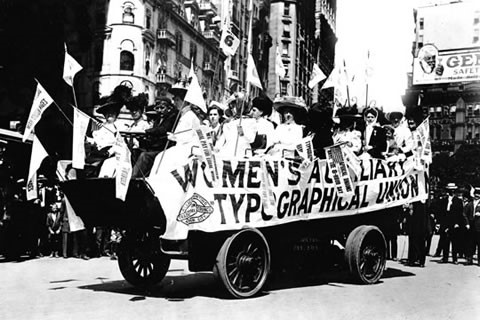
Women's Auxiliary Typographical Union

Many Americans celebrate Labor Day with parades and parties – festivities very similar to those outlined by the first proposal for a holiday, which suggested that the day should be observed with – a street parade to exhibit “the strength and esprit de corps of the trade and labor organizations” of the community, followed by a festival for the recreation and amusement of the workers and their families. This became the pattern for the celebrations of Labor Day.

Speeches by prominent men and women were introduced later, as more emphasis was placed upon the economic and civic significance of the holiday. Still later, by a resolution of the American Federation of Labor convention of 1909, the Sunday preceding Labor Day was adopted as Labor Sunday and dedicated to the spiritual and educational aspects of the labor movement.

American labor has raised the nation’s standard of living and contributed to the greatest production the world has ever known and the labor movement has brought us closer to the realization of our traditional ideals of economic and political democracy. It is appropriate, therefore, that the nation pays tribute on Labor Day to the creator of so much of the nation’s strength, freedom, and leadership – the American worker.

Peter Greene critiques the conservative idea that states should support public schools and all sorts of choice. Greene explains why this idea erodes the quality of public schools, which enroll the vast majority of the nation’s students. Conservatives blame teachers’ unions for whatever they dont like about pibkic schools, but Greene denonstrates that they are wrong. Open the link to read the full article.

He writes:

In the National Review, Michael Petrilli, Thomas Fordham Institute honcho and long-time reformster, poses the argument that folks on the right don’t need to choose “between expanding parental options and improving traditional public schools.” Instead, he asserts, they “can and should do both.”

On the one hand, it’s a welcome argument these days when the culture panic crowd has settled on a scorched earth option for public schools. As Kevin Roberts, Heritage Foundation president, put it in his now-delayed-until-after-it-can’t-hurt-Trump-election-prospects book, “We don’t merely seek an exit from the system; we are coming for the curriculums and classrooms of the remaining public schools, too.” For many on the right, the education policy goal is to obliterate public schools and/or force them to closely resemble the private christianist schools that culture panickers favor. 

Pertrilli is sympathetic to the “let’s just give parents the money and be done with it” crowd. 

We’ve inherited a “system” that is 150 years old and is saddled with layers upon layers of previous reforms, regulations, overlapping and calcified bureaucracies, and a massive power imbalance between employees and constituents, thanks to the almighty teachers unions.

Sigh. Reforms and regulations, sure, though it would be nice for Petrilli to acknowledge that for the last forty-ish years, those have mostly come from his own reformster crowd. And I am deeply tired of the old “almighty teachers unions” trope, which is some serious baloney. But his audience thinks it’s true, so let’s move on. 

Petrilli’s point is that conservatives should not be focusing on “school choice” alone, but should embrace an “all of the above” approach. Petrilli dismisses Democrats as “none of the above” because of their “fealty to the unions,” which is, again, baloney. Democrats have spent a couple of decades as willing collaborators with the GOP ; if they are “none of the above” it’s because they’ve lost both the ability and authority to pretend to be public education supporters. The nomination of Tim Walz has given them a chance to get on the public education team, but let’s wait and see–there’s no ball that the Democratic Party can’t drop.

Petrilli sits on a practical point here (one that Robert Pondiscio has made repeatedly over the years)– public schools are a) beloved by many voters, b) not going away, and c) still educate the vast, vast majority of U.S. students. Therefore, folks should care about the quality of public education.

Petrilli then floats some ideas, all while missing the major obstacle to his idea. There are, he claims, many reforms that haven’t been tried yet, “including in red states where the teachers unions don’t have veto power.” I believe the actual number of states where the union doesn’t have veto power is fifty. But I do appreciate his backhanded acknowledgement that many states have dis-empowered their teachers unions and still haven’t accomplished diddly or squat. It’s almost as if the unions are not the real obstacle to progress.

His ideas? Well, there’s ending teacher tenure, a dog that will neither hunt nor lie down and die. First of all, there is no teacher tenure. What there is is policy that requires school districts to follow a procedure to get rid of bad teachers. Behind every teacher who shouldn’t still have a job is an administrator who isn’t doing theirs. 

Tenure and LIFO (Last In First Out) interfere with the reformster model of Genius CEO school management, in which the Genius CEO should be able to fire anyone he wants to for any reason he conceives of, including having become too expensive or so experienced they start getting uppity. 

The theory behind much of education reform has been that all educational shortfalls have been caused by Bad Teachers, and so the focus has been on catching them (with value-added processing of Big Standardized Test scores), firing them, and replacing them with super-duper teachers from the magical super-duper teacher tree. Meanwhile, other teachers would find this new threatening environment inspirational, and they would suddenly unleash the secrets of student achievement that they always had tucked away in their file cabinet, but simply hadn’t implemented.

This is a bad model, a non-sensical model, a model that has had a few decades to prove itself, and has not. Nor has Petrilli’s other idea– merit pay has been tried, and there are few signs that it even sort of works, particularly since schools can’t do a true merit pay system and also it’s often meant as a cost-saving technique (Let’s lower base pay and let teachers battle each other to win “merit” bonuses that will make up the difference).

Petrilli also argues against increased pay for teacher masters degrees because those degrees “add no value in terms of quality of teaching and learning” aka they don’t make BS Test scores go up. He suggests moving that extra money to create incentives for teachers to move to the toughest schools. 

Petrilli gets well into weeds in his big finish, in which he cites the “wisdom of former Florida governor Jeb Bush” and the golden state of Florida as if it’s a model for all-of-the-above reform and not a state that has steadily degraded and undercut public schools in order to boost charter and private operations, with results that only look great if you squint hard and ignore certain parts(Look at 4th grade scores, but be sure to ignore 8th and 12th grade results). And if you believe that test results are the only true measure of educational excellence.

So, in sum, Petrilli’s notion that GOP state leaders should support public education is a good point. What is working against it?

One is that his list is lacking. Part of the reform movement’s trouble at this point is that many of its original ideas were aimed primarily at discrediting public education. The remaining core– use standardized tests to identify and remove bad teachers– is weak sauce. Even if you believe (wrongly) that the core problem of public education is bad teaching, this is no way to address that issue. 

Beyond bad teachers, the modern reform movement hasn’t had a new idea to offer for a couple of decades. 

Petrilli also overlooks a major challenge in the “all of the above approach,” a challenge that reformsters and choicers have steadfastly ignored for decades.

You cannot run multiple parallel school systems for the same cost as a single system. 

If you want to pay for public schools and charter schools and vouchers, it is going to cost more money. “School choice” is a misnomer, because school choice has always been available. Choicers are not arguing for school choice–they’re arguing for taxpayer funded school choice. That will require more taxpayer funds. 

You can’t have six school systems for the price of one. So legislators have been left with a choice. On the one hand, they can tell taxpayers “We think school choice is so important that we are going to raise your taxes to pay for it.” On the other hand, they can drain money from the public system to pay for charters and vouchers all while making noises about how the public system is totes overfunded and can spare the money easy peasy. 

I can offer a suggestion for conservatives who want to help public schools improve.

Get over your anti-union selves.

Please open the link to finish the article.

Laura Meckler and Hannah Natanson wrote about Governor Tim Walz’s record on education in Minnesota. In making decisions, Walz relied on his own knowledge as a veteran public school teacher and very likely on research, but The Washington Post misleadingly attributed his views to “the teachers’ union,” the bugbear of the far-right.

The article is saturated with bias against teachers unions and presents the pro-education Walz as a tool of the union, not as a veteran educator who knows the importance of public schools. Walz grew up and taught in small towns. They don’t want or need “choice.” They love their public schools, which are often the central public institution in their community.

The 2019 state budget negotiations in Minnesota were tense, with a deadline looming, when the speaker of the House offered Gov. Tim Walz a suggestion for breaking the impasse.

They both knew that the Republicans’ top priority was to create a school voucher-type program that would direct tax dollars to help families pay for private schools. House Speaker Melissa Hortman, a Democrat, floated an idea: What if they offered the Republicans a pared-down version of the voucher plan, some sort of “fig leaf,” that could help them claim a symbolic victory in trade for big wins on the Democratic side? In the past, on other issues, Walz had been open to that kind of compromise, Hortman said.

This time, it was a “hard no.”

He used his position’s formidable sway over education to push for more funding for schools and backed positions taken by Education Minnesota, the state’s teachers union of which he was once a member. His record on education will probably excite Democrats but provide grist for Republicans who have in recent years gained political ground with complaints about how liberals have managed schools.

Teachers and their unions consistently supported Walz’s Minnesota campaigns with donations, records show. And in the first 24 hours after he was selected as Vice President Kamala Harris’s running mate, teachers were the most common profession in the flood of donations to the Democratic ticket, according to the campaign.

During the chaotic 2020-21 pandemic-rattled school year, Walz took a cautious approach toward school reopening that was largely in line with teachers, who were resisting a return to in-person learning, fearful of contracting covid.

Critics say that as a result, Minnesota schools stayed closed far too long — longer than the typical state — inflicting lasting academic and social emotional damage on students.

As a former teacher, Walz knew that teachers were reluctant to return to the classroom until safety protocols were in place.

Walz also advanced his own robust and liberal education agenda. He fought to increase K-12 education spending in 2019, when he won increases in negotiations with Republicans, and more dramatically in 2023, when he worked with the Democratic majority in the state House and Senate. He won funding to provide free meals to all schoolchildren, regardless of income, and free college tuition for students — including undocumented immigrants — whose families earn less than $80,000 per year. He also called out racial gaps in achievement and discipline in schools and tried to address them…

And as culture war debates raged across the country in recent years, Walz pushed Minnesota to adopt policies in support of LGBTQ+ rights…

In the 2022 elections, Walz was reelected, and Minnesota Democrats took control of the Senate. Democrats now had a “trifecta” — governor, House and Senate — and a $17.6 billion budget surplus.

After taking his oath of office in January 2023, Walz said Minnesota had a historic opportunity to become the best state in the nation for children and families. His proposals included a huge increase in K-12 education spending.

“Now is the time to be bold,” he said.

The final budget agreement in 2023 increased education spending by nearly $2.3 billion, including a significant boost to the per-pupil funding formula that would be tied to inflation, ensuring growth in the coming years. Total formula funding for schools would climb from about $9.9 billion in 2023 to $11.4 billion in 2025, according to North Star Policy Action. The budget also included targeted money for special education, pre-K programs, mental health and community schools.

Walz also signed legislation providing free school meals for all students — a signature achievement — not just those in low-income families who are eligible under the federal program…

In his 2023 State of the State address, Walz drew a pointed contrast between the culture wars raging in states such as Florida and the situation in Minnesota.

“The forces of hatred and bigotry are on the march in states across this country and around the world,” Walz said. “But let me say this now and be very clear about this: That march stops at Minnesota’s borders.”

Through his tenure, he repeatedly took up the causes of LGBTQ+ rights and racial justice.

He signed a measure prohibiting public and school libraries from banning books due to their messages or opinions, and another granting legal protection to children who travel to Minnesota for gender-affirming care.