Archives for category: Unions

Today is an ironic holiday. The nation recognizes the day and most offices are closed to honor the dignity of labor. But it was not created in the late nineteenth century to honor labor in general but to honor labor unions.

Why ironic? Because right wingers have always hated labor unions. Today, unions represent about 10-11% of workers. Most unionized workers belong to public sector unions. In the 1950s, about one-third of private-sector workers belonged to a union; now only 6% do. Most people think that the decline in union membership has been bad for the country. They are right.

Why does it matter? Because unions were crucial in building the middle class. Because they have always been a stepping stone from low-wage jobs to better-paying jobs with benefits, including healthcare and pension. Because they promote better working conditions and higher salaries. Because unions are the answer to closing the vast gap between rich and poor. Without unions, there will be more super-billionaires and more living in poverty.

We need more unionized workers and workplaces.

The Department of Labor has a page about the day’s history.

The first Labor Day holiday was celebrated on Tuesday, September 5, 1882, in New York City, in accordance with the plans of the Central Labor Union. The Central Labor Union held its second Labor Day holiday just a year later, on September 5, 1883.

By 1894, 23 more states had adopted the holiday, and on June 28, 1894, President Grover Cleveland signed a law making the first Monday in September of each year a national holiday.

A Nationwide Holiday

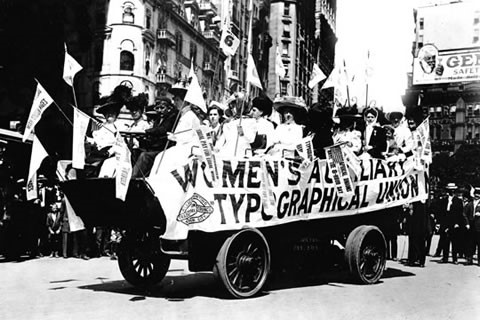
Women's Auxiliary Typographical Union

Many Americans celebrate Labor Day with parades and parties – festivities very similar to those outlined by the first proposal for a holiday, which suggested that the day should be observed with – a street parade to exhibit “the strength and esprit de corps of the trade and labor organizations” of the community, followed by a festival for the recreation and amusement of the workers and their families. This became the pattern for the celebrations of Labor Day.

Speeches by prominent men and women were introduced later, as more emphasis was placed upon the economic and civic significance of the holiday. Still later, by a resolution of the American Federation of Labor convention of 1909, the Sunday preceding Labor Day was adopted as Labor Sunday and dedicated to the spiritual and educational aspects of the labor movement.

American labor has raised the nation’s standard of living and contributed to the greatest production the world has ever known and the labor movement has brought us closer to the realization of our traditional ideals of economic and political democracy. It is appropriate, therefore, that the nation pays tribute on Labor Day to the creator of so much of the nation’s strength, freedom, and leadership – the American worker.

Peter Greene critiques the conservative idea that states should support public schools and all sorts of choice. Greene explains why this idea erodes the quality of public schools, which enroll the vast majority of the nation’s students. Conservatives blame teachers’ unions for whatever they dont like about pibkic schools, but Greene denonstrates that they are wrong. Open the link to read the full article.

He writes:

In the National Review, Michael Petrilli, Thomas Fordham Institute honcho and long-time reformster, poses the argument that folks on the right don’t need to choose “between expanding parental options and improving traditional public schools.” Instead, he asserts, they “can and should do both.”

On the one hand, it’s a welcome argument these days when the culture panic crowd has settled on a scorched earth option for public schools. As Kevin Roberts, Heritage Foundation president, put it in his now-delayed-until-after-it-can’t-hurt-Trump-election-prospects book, “We don’t merely seek an exit from the system; we are coming for the curriculums and classrooms of the remaining public schools, too.” For many on the right, the education policy goal is to obliterate public schools and/or force them to closely resemble the private christianist schools that culture panickers favor. 

Pertrilli is sympathetic to the “let’s just give parents the money and be done with it” crowd. 

We’ve inherited a “system” that is 150 years old and is saddled with layers upon layers of previous reforms, regulations, overlapping and calcified bureaucracies, and a massive power imbalance between employees and constituents, thanks to the almighty teachers unions.

Sigh. Reforms and regulations, sure, though it would be nice for Petrilli to acknowledge that for the last forty-ish years, those have mostly come from his own reformster crowd. And I am deeply tired of the old “almighty teachers unions” trope, which is some serious baloney. But his audience thinks it’s true, so let’s move on. 

Petrilli’s point is that conservatives should not be focusing on “school choice” alone, but should embrace an “all of the above” approach. Petrilli dismisses Democrats as “none of the above” because of their “fealty to the unions,” which is, again, baloney. Democrats have spent a couple of decades as willing collaborators with the GOP ; if they are “none of the above” it’s because they’ve lost both the ability and authority to pretend to be public education supporters. The nomination of Tim Walz has given them a chance to get on the public education team, but let’s wait and see–there’s no ball that the Democratic Party can’t drop.

Petrilli sits on a practical point here (one that Robert Pondiscio has made repeatedly over the years)– public schools are a) beloved by many voters, b) not going away, and c) still educate the vast, vast majority of U.S. students. Therefore, folks should care about the quality of public education.

Petrilli then floats some ideas, all while missing the major obstacle to his idea. There are, he claims, many reforms that haven’t been tried yet, “including in red states where the teachers unions don’t have veto power.” I believe the actual number of states where the union doesn’t have veto power is fifty. But I do appreciate his backhanded acknowledgement that many states have dis-empowered their teachers unions and still haven’t accomplished diddly or squat. It’s almost as if the unions are not the real obstacle to progress.

His ideas? Well, there’s ending teacher tenure, a dog that will neither hunt nor lie down and die. First of all, there is no teacher tenure. What there is is policy that requires school districts to follow a procedure to get rid of bad teachers. Behind every teacher who shouldn’t still have a job is an administrator who isn’t doing theirs. 

Tenure and LIFO (Last In First Out) interfere with the reformster model of Genius CEO school management, in which the Genius CEO should be able to fire anyone he wants to for any reason he conceives of, including having become too expensive or so experienced they start getting uppity. 

The theory behind much of education reform has been that all educational shortfalls have been caused by Bad Teachers, and so the focus has been on catching them (with value-added processing of Big Standardized Test scores), firing them, and replacing them with super-duper teachers from the magical super-duper teacher tree. Meanwhile, other teachers would find this new threatening environment inspirational, and they would suddenly unleash the secrets of student achievement that they always had tucked away in their file cabinet, but simply hadn’t implemented.

This is a bad model, a non-sensical model, a model that has had a few decades to prove itself, and has not. Nor has Petrilli’s other idea– merit pay has been tried, and there are few signs that it even sort of works, particularly since schools can’t do a true merit pay system and also it’s often meant as a cost-saving technique (Let’s lower base pay and let teachers battle each other to win “merit” bonuses that will make up the difference).

Petrilli also argues against increased pay for teacher masters degrees because those degrees “add no value in terms of quality of teaching and learning” aka they don’t make BS Test scores go up. He suggests moving that extra money to create incentives for teachers to move to the toughest schools. 

Petrilli gets well into weeds in his big finish, in which he cites the “wisdom of former Florida governor Jeb Bush” and the golden state of Florida as if it’s a model for all-of-the-above reform and not a state that has steadily degraded and undercut public schools in order to boost charter and private operations, with results that only look great if you squint hard and ignore certain parts(Look at 4th grade scores, but be sure to ignore 8th and 12th grade results). And if you believe that test results are the only true measure of educational excellence.

So, in sum, Petrilli’s notion that GOP state leaders should support public education is a good point. What is working against it?

One is that his list is lacking. Part of the reform movement’s trouble at this point is that many of its original ideas were aimed primarily at discrediting public education. The remaining core– use standardized tests to identify and remove bad teachers– is weak sauce. Even if you believe (wrongly) that the core problem of public education is bad teaching, this is no way to address that issue. 

Beyond bad teachers, the modern reform movement hasn’t had a new idea to offer for a couple of decades. 

Petrilli also overlooks a major challenge in the “all of the above approach,” a challenge that reformsters and choicers have steadfastly ignored for decades.

You cannot run multiple parallel school systems for the same cost as a single system. 

If you want to pay for public schools and charter schools and vouchers, it is going to cost more money. “School choice” is a misnomer, because school choice has always been available. Choicers are not arguing for school choice–they’re arguing for taxpayer funded school choice. That will require more taxpayer funds. 

You can’t have six school systems for the price of one. So legislators have been left with a choice. On the one hand, they can tell taxpayers “We think school choice is so important that we are going to raise your taxes to pay for it.” On the other hand, they can drain money from the public system to pay for charters and vouchers all while making noises about how the public system is totes overfunded and can spare the money easy peasy. 

I can offer a suggestion for conservatives who want to help public schools improve.

Get over your anti-union selves.

Please open the link to finish the article.
Laura Meckler and Hannah Natanson wrote about Governor Tim Walz’s record on education in Minnesota. In making decisions, Walz relied on his own knowledge as a veteran public school teacher and very likely on research, but The Washington Post misleadingly attributed his views to “the teachers’ union,” the bugbear of the far-right.

The article is saturated with bias against teachers unions and presents the pro-education Walz as a tool of the union, not as a veteran educator who knows the importance of public schools. Walz grew up and taught in small towns. They don’t want or need “choice.” They love their public schools, which are often the central public institution in their community.

The 2019 state budget negotiations in Minnesota were tense, with a deadline looming, when the speaker of the House offered Gov. Tim Walz a suggestion for breaking the impasse.

They both knew that the Republicans’ top priority was to create a school voucher-type program that would direct tax dollars to help families pay for private schools. House Speaker Melissa Hortman, a Democrat, floated an idea: What if they offered the Republicans a pared-down version of the voucher plan, some sort of “fig leaf,” that could help them claim a symbolic victory in trade for big wins on the Democratic side? In the past, on other issues, Walz had been open to that kind of compromise, Hortman said.

This time, it was a “hard no.”

He used his position’s formidable sway over education to push for more funding for schools and backed positions taken by Education Minnesota, the state’s teachers union of which he was once a member. His record on education will probably excite Democrats but provide grist for Republicans who have in recent years gained political ground with complaints about how liberals have managed schools.

Teachers and their unions consistently supported Walz’s Minnesota campaigns with donations, records show. And in the first 24 hours after he was selected as Vice President Kamala Harris’s running mate, teachers were the most common profession in the flood of donations to the Democratic ticket, according to the campaign.

During the chaotic 2020-21 pandemic-rattled school year, Walz took a cautious approach toward school reopening that was largely in line with teachers, who were resisting a return to in-person learning, fearful of contracting covid.

Critics say that as a result, Minnesota schools stayed closed far too long — longer than the typical state — inflicting lasting academic and social emotional damage on students.

As a former teacher, Walz knew that teachers were reluctant to return to the classroom until safety protocols were in place.

Walz also advanced his own robust and liberal education agenda. He fought to increase K-12 education spending in 2019, when he won increases in negotiations with Republicans, and more dramatically in 2023, when he worked with the Democratic majority in the state House and Senate. He won funding to provide free meals to all schoolchildren, regardless of income, and free college tuition for students — including undocumented immigrants — whose families earn less than $80,000 per year. He also called out racial gaps in achievement and discipline in schools and tried to address them…

And as culture war debates raged across the country in recent years, Walz pushed Minnesota to adopt policies in support of LGBTQ+ rights…

In the 2022 elections, Walz was reelected, and Minnesota Democrats took control of the Senate. Democrats now had a “trifecta” — governor, House and Senate — and a $17.6 billion budget surplus.

After taking his oath of office in January 2023, Walz said Minnesota had a historic opportunity to become the best state in the nation for children and families. His proposals included a huge increase in K-12 education spending.

“Now is the time to be bold,” he said.

The final budget agreement in 2023 increased education spending by nearly $2.3 billion, including a significant boost to the per-pupil funding formula that would be tied to inflation, ensuring growth in the coming years. Total formula funding for schools would climb from about $9.9 billion in 2023 to $11.4 billion in 2025, according to North Star Policy Action. The budget also included targeted money for special education, pre-K programs, mental health and community schools.

Walz also signed legislation providing free school meals for all students — a signature achievement — not just those in low-income families who are eligible under the federal program…

In his 2023 State of the State address, Walz drew a pointed contrast between the culture wars raging in states such as Florida and the situation in Minnesota.

“The forces of hatred and bigotry are on the march in states across this country and around the world,” Walz said. “But let me say this now and be very clear about this: That march stops at Minnesota’s borders.”

Through his tenure, he repeatedly took up the causes of LGBTQ+ rights and racial justice.

He signed a measure prohibiting public and school libraries from banning books due to their messages or opinions, and another granting legal protection to children who travel to Minnesota for gender-affirming care.

The United Federation of Teachers worked closely with NYC Mayor Eric Adams to persuade municipal union workers to give up Medicare and accept enrollment in a for-profit Medicare Advantage plan.

Many municipal retirees opposed the changeover. Unhappy retired municipal workers formed an organization which they called the NYC Organization of Public Service Retirees. They concluded that the quality of their healthcare would decline if they accepted enrollment in a Medicare Advantage plan. MA might not accept their preferred doctors, and they would run the risk of being denied permission for treatment that their own doctor recommended. The retirees fought the city and their unions to block the switch to MA. They won in the state courts, and they won control of the retirees’ sector of the UFT.

Following the retirees’ victory in the courts and in the union elections, Michael Mulgrew announced that he would no longer support MA. Now the retirees are asking for the active help of the UFT.

Arthur Goldstein, retired high school teacher, wrote the following open letter to Michael Mulgrew, president of the UFT.

He wrote:

Dear President Mulgrew:

As you know, we’ve been fighting for years to preserve our health care. The recent Retired Teacher Chapter election showed a healthy majority of our members want to continue with our current premium and co-pay free Medicare/Medigap plan. We were all encouraged that you dropped your support of the Medicare Advantage plan into which the city wishes to place us.

That said, we are still in trouble. As you know, Mayor Adams is fighting for the MA program, and appealing our recent victories to the NY State Court of Appeals. As you are no doubt aware, they are the highest court in the state and have the power to overturn our thus-far unbroken string of victories. 

There are two ways we can prevail. One would be to win in court. Since UFT now opposes this plan, we need an Amicus brief from UFT. That’s quite important. If you oppose this plan, you need to demonstrate this to the court, and show that UFT is a force to be reckoned with. Mayor Eric Adams is, in fact, our contractual adversary, and we need to treat him as such.

This, of course, is not our only court battle. Mayor Adams also wants us to pay co-pays with our Medigap plan. That is unprecedented, and co-pays have a way of increasing endlessly. We need to halt this now. 

I heard you say at a meeting that co-pays were intended only as a temporary stopgap measure. Given your statements about how the city is interested only in saving money at our expense, I think it’s fair to assume we can no longer trust the city to make any such measures temporary. Therefore, UFT needs to file an Amicus brief in our battle against additional expenses for retirees on fixed incomes. As you know, many of our retired brothers and sisters in DC37 are just getting by as is.

In 2016, MLC effectively suppressed the HIP rate, via so-called HIP/HMO Preferred. This resulted in additional costs for 40% of enrolled city employees. Obviously, it’s an error to tie this to the base rate, because I’m sure you want our members, and all city workers, compensated at the highest rate possible. This needs to be corrected, and we need your support to do so. I’m sure you don’t want retired UFT paraprofessionals paying co-pays, higher deductibles, and/or premiums. We will need UFT support in the upcoming Campion case so as to preclude this.

Our other avenue of protection is via the legislature. As you know, there are bills, set to be reintroduced, both in the city and state protecting Medicare and Medigap for retirees. Union support could make the key difference, particularly in the state. I’m told the state bill would have passed but for “union opposition.” I don’t know who in the union opposes this, but the recent RTC election shows our retirees overwhelmingly support it. In fact, I’d argue the overwhelming majority of city retirees do as well.

This brings me to my final point. Since unions, for whatever reason, have not been in the habit of protecting our current health care, the group NYC Retirees was formed. This group, entirely on donations, has been protecting us in court for years. The recent election demonstrates that UFT retirees support the goals of this group.

Therefore, it’s high time the UFT, perhaps through COPE, made a sizable donation. This is clearly the will of our chapter, and it’s time we honored that will with something more than words. 

Sincerely

Arthur Goldstein, Vice Chair RTC

Last year, the extremist Florida legislature passed a law that requires unions to apply for recertification if their membership drops below 60% of eligible workers. The long-term goal was to drive unions out of the state. So far, the law has caused a drop in 50,000 union members. If you are a Republican, that’s good news. If you are a Democrat or just someone who believes workers should have rights, that’s bad news. This law is the product of Ron DeSantis’ hatred of unions.

The article was written by McKenna Schueler, an investigative labor, housing and government reporter.

A new teachers “union” that is reportedly financed at least in part by the anti-union Freedom Foundation will soon appear on the ballot with the United Teachers of Dade, an existing teachers union in Miami-Dade County that represents nearly 24,000 public school educators and school staff. 

United Teachers of Dade, the largest local teachers union in the state, was recently forced to petition the state for an election to recertify — essentially, to remain formally recognized as a bargaining agent — due to consequences of a state law in Florida approved last year.

Specifically, the union was forced to petition for recertification after reporting less than 60% dues-paying membership in annual paperwork—a threshold they’re now required to meet under Florida law to remain certified. The new “union” — the Miami Dade Education Coalition — boasts itself as a viable alternative that wants to replace United Teachers of Dade.

State records show the organization officially registered with the state Public Employees Relations Commission (PERC) in February, with the backing of the Freedom Foundation, a right-wing think tank based in Washington that’s funded by billionaires. Brent Urbanik, a social studies teacher in a public magnet school in Miami-Dade County, is reportedly the new union’s president.

Unlike United Teachers of Dade, which was required gather cards in support of recertification from at least 30% of the thousands of school staff they represent, state law only requires “intervenors” like the Miami-Dade Education Coalition to gather 10% of signed cards to appear on the ballot with them. 

According to state records, the new “union” failed to even do that…on the first try…

So, MDEC tried again. 

This time, the organization only submitted 11 invalid or duplicate cards. 

But, sure, they made the cut…

Broadly speaking, there are dozens of unions across Florida that have petitioned for recertification following the passage of last year’s Senate Bill 256, a sweeping anti-union bill that was over a decade in the making. 

The law essentially makes it harder for workers to pay union dues, by prohibiting payroll dues deductions, while requiring more workers to do so in order for a union to remain certified. Membership information has to be reported to PERC annually…

So far, more than 50,000 public sector workers have lost their union representation following the passage of the new law. The Freedom Foundation, which lobbied in favor of last year’s law and sent mailers to union members telling them to ditch their unions, hasn’t been shy in sharing its delight. 

On X, formerly known as Twitter, the organization shared a screenshot of my recent article for In These Times on this fallout, declaring that these workers had “been freed from union bondage.”

“[W]e’re just getting started,” the organization added in a June 7 post.

Peter Greene, who taught for 39 years in Pennsylvania, wrote recently in The Progressive about Corey DeAngelis, who travels the nation to trash public schools and to advocate for vouchers. If you hate public schools and unions, he’s your guy. If you adore Betsy DeVos and her plans to destroy local communities and to get more children into discriminatory religious schools, he’s your guy.

Greene writes:

Corey DeAngelis is an influential, if not the most influential, voice in the rightwing campaign to demonize public schools and privatize public education. The guy’s résuméhits all the bases in the libertarian gameplan. After earning a doctorate at the University of Arkansas’s education reform program (funded bythe pro-school choice Walton family), DeAngelis helped found the Education Freedom Institute, became a senior fellow at the Reason Foundation, worked as an adjunct scholar at the CATO Institute, took up an appointment as a senior fellow at the Hoover Institution, and was hired on as a senior fellow at Betsy DeVos’s American Federation for Children.

He still holds all of those jobs, but his more common title is “school choice evangelist.” As the recent school voucher wave has surged in state after state, DeAngelis has been there to spread the word. While on tour in support of his new book, he distills the current pro-voucher argument.

In a recent talk at the Heritage Foundation, DeAngelis touched on most of the main arguments for vouchers (many of them false) and revealed a few truths about the pro-voucher strategy.

1. The Evil Unions and COVID

The villainy of the teachers union is a thread that runs through much of DeAngelis’s argument, especially related to the COVID-19 pandemic narrative. DeAngelis blames the unions (and American Federation of Teachers president Randi Weingarten) for “fear mongering” and accuses them of extorting ransom payments by holding schools hostage. The unions, he charged, used the pandemic to empower themselves and the “government schools” that he calls “a jobs program for adults.”

There’s no recognition that teachers had a legitimate fear during the pandemic or that hundreds of educators died of COVID-19. Nor did he mention the many private and non-union charter schools that also closed their doors. Every problematic decision that he cited from pandemic times is blamed on the union, with no mention that Betsy DeVos’s Department of Education provided little or no guidance to districts facing difficult decisions in an evolving situation.  

DeAngelis’s narrative argues that parents viewing Zoom school were appalled and awakened by what they saw. That oft-repeated tale stands in contrast to polls that show the vast majority of parents were satisfied with how their schools handled COVID-19. A 2022 Gallup poll found that, while the general public’s opinion of public schools is “souring,” parents’ favorable opinion of their own school matched pre-pandemic levels. The common sense conclusion to draw from this data is that people who don’t have first-hand experience with public schools are developing a low opinion of them based on some other source of information.

DeAngelis’s argument has other flaws. He claimed that the unions extracted a huge ransom from schools. But he also argued that pandemic relief funds given to schools never reached teachers and were, instead, soaked up by administrative bloat, which would seem to be a big tactical blunder on the unions’ part.

2. The Evil Unions and the Democratic Party

DeAngelis made the unusual claim that Democrats aren’t having kids, but Republicans are. But that, he said, won’t save conservatives because schools are fully “infiltrated by radical leftist union teachers.” The left uses schools as a way to control other people’s children. The Democratic Party, he added, is a fully owned subsidiary of the teachers’ union.

DeAngelis also repeated a false narrative of the National School Board Association’s supposed campaign to muzzle parents. In fall 2021, local school boards found their usually sleepy meetings had turned into wild, threatening, and even violent chaos. The NSBA turned to the Biden Administration for help, calling some of the actions “the equivalent of a form of domestic terrorism or hate crimes.” This was quickly and inaccurately cast as the Democratic administration calling parents domestic terrorists.

The resulting controversy caused the NSBA to lose some members, which DeAngelis seemed happy about. “Play stupid games, win stupid prizes,” he said.

This narrative that smears public school-friendly groups fits a general pattern of conservative attacks on groups seen as Democratic Party supporters.

Open the link to read more about the DeVos-funded public school hater who is spreading his propaganda across the nation.

There’s an old saying that “you can’t fight City Hall.” Public service retirees in New York City just proved that you can fight City Hall and win. You can fight City Hall and your own union and win. With a passionate leader and small donations from retirees (mostly teachers), the retirees prevailed because they had the law on their side and they never gave up.

For the past three years, New York City retirees have been fighting a plan hatched by City government and some union leaders to compel retirees to leave Medicare and enroll in a for-profit Medicare Advantage plan. The retirees, led by Marianne Pizzitola, a retired EMT in the NYC Fire Department, have won multiple lawsuits and won control of the UFT Retiree Caucus (the first time in its 64-year-old history that the Unity Caucus that controls the UFT ever lost an internal election.) This story appeared in City & State, a publication about public employees.

Yesterday, UFT President Michael Mulgrew announced that the UFT was dropping out of the effort to push retirees into an MA plan. He blamed the city, not the retirees’ objections to MA.

In a dramatic reversal, Michael Mulgrew, president of the United Federation Teachers, notified the Municipal Labor Committee on Sunday that it was withdrawing its support of a controversial Medicare Advantage plan as well as from “the current healthcare negotiations for in-service and pre-Medicare retirees” with the Adams administration.

The bombshell news came in the form of a letter that Mulgrew sent to Harry Nespoli, the chair of the Municipal Labor Committee and leader of the city’s largest Department of Sanitation union. 

“It has become apparent that this administration is unwilling to continue this work in good faith,” Mulgrew wrote in the letter. “The city has delayed our current in-service and pre-Medicare retiree healthcare negotiations for months, and we no longer feel that it is in the interest of our members to be part of that process. This administration has proven to be more interested in cutting its costs than honestly working with us to provide high-quality healthcare costs to city workers.”

Mulgrew also sent a separate letter to retired UFT members explaining his decision.

“The city’s losses in the courts and the needless anxiety created among retirees has made it clear to us that our support for this initiative cannot continue … You did not deserve the angst and fear you went through as we worked toward our goal of improving our health care in an increasingly difficult national landscape,” he wrote in the letter. “I have heard your voices. And as we have all grown increasingly frustrated with this process, we will use our strength in the MLC to push for a new strategy moving forward.”

Following the news, a spokesperson for the city’s Law Department defended the city’s Medicare Advantage plan.

“We have been clear: the city’s plan, which was negotiated closely with and supported by the Municipal Labor Committee, would improve upon retirees’ current plans and save $600 million annually. This is particularly important at a time when we are already facing significant fiscal and economic challenges,” the spokesperson said.

Going back several years to the de Blasio administration, the Municipal Labor Committee – which includes representatives of every municipal union – had been working collaboratively with the City of New York to try to reduce the city’s health care costs while maintaining the quality of coverage and ensuring that city workers would still not have to pay health insurance premiums.

As part of that grand bargain during the de Blasio era, the Municipal Labor Committee agreed to shift New York City ‘s 250,000 retired civil servants from their current Medicare plans to a Medicare Advantage plan managed by a private, for-profit health insurance company. Boosters of the controversial Medicare Advantage plan that insisted that it would save the city $600 million annually.

Almost instantaneously, a racially and economically diverse coalition led by retired FDNY EMT Marianne Pizzitola formed the NYC Organization of Public Service Retirees. With close to 50,000 members, Pizzitola’s organization helped fund a successful legal challenge to the plan that has already won several rounds in the courts. State court judges have consistently ruled in favor of the retirees, finding that under the legal doctrine of promissory estoppel, the city’s past commitments to its retirees as active employees were still binding….

In his letter to the Municipal Labor Committee announcing UFT’s withdrawal from the Medicare Advantage plan, Mulgrew did not mention the recent leadership election for the Retired Teachers chapter – a fact that upset Bennett Fischer, who won that election by running on an anti-Medicare Advantage platform.

“President Mulgrew should have acknowledged that he is changing his position because elections have consequences,” Fischer wrote in a statement. “He could have acknowledged that he is taking these steps because Retiree Advocate wrested control of the 70,000+ Retired Teachers Chapter from his Unity caucus, and because he sees that his control of the UFT is slipping away. … Until now, Michael Mulgrew and Mayor Adams have been on the same page.”

In a free-ranging interview with City & State, Mulgrew said that the decision to pull the plug had been coming long before the recent electoral rebuff by his retirees, though he conceded it was part of his  final calculus.

“About eight weeks ago, I started talking to people at the MLC that this was ridiculous with the courts clearly saying over and over again through all the appeals that this [Medicare Advantage] was not going to work,” Mulgrew said. “And when I read this latest decision out of the Court of Appeals of New York State, half of the decision was about the incompetence of the city’s attorneys.”

Mulgrew continued. “At the same time, we were getting nowhere, I mean nowhere with the negotiations for health care for our in-service active members,” he said, adding that when some of the unions wanted to meet with Mayor Adams to jump start the talks, they were rebuffed by management’s representatives at the table.

“This has got to stop – the members have spoken, the courts have spoken – so why are we continuing to do this?” Mulgrew asked. “Why would the city continue to put its retirees through this process anymore?”…

Pizzitola, the president of the NYC Organization of Public Service Retirees, said that the city should finally give up on its attempt to force retirees to Medicare Advantage plans.

“For three years, an ad-hoc coalition of retirees has been fighting this illegal scheme in the courts and in the City Council,” she wrote in a statement. “And while retirees have been continuously successful – winning 9 victories over three separate lawsuits and thwarting an attempt to change the law  – the City still can’t seem to get the message: enough is enough!”

Pizzitola continued. “It is time for the City to come to its senses and end its senseless, illegal war on retirees. If retirees are forced off of traditional Medicare and into the City’s new Medicare Advantage plan, thousands will be denied access to the doctors they depend on and the medical care they desperately need. And, as the director of the NYC Independent Budget Office testified, City taxpayers will not save a dime.”

The United Federation of Teachers in New York City is the largest chapter in the American Federation of Teachers. The UFT was created in 1960. It represents nearly 200,000 city employees, including about 60,000 retirees.

Since 1960, the UFT has been run by the Unity Caucus, which controls the officers, the executive committee and the delegate assembly. The president of the UFT is a powerful figure in New York City, New York State, and national politics. Its best known leaders were and are Albert Shanker and Randi Weingarten (Sandra Feldman served between their tenures, first as UFT president, then AFT president; she died of cancer at age 65). Shanker was president of the UFT from 1964 to 1985, then president of the AFT from 1974 until his death in 1997. Randi Weingarten was president of the UFT from 1998-2008 and became president of the AFT in 2008. The NEA has term limits, the AFT does not.

Weingarten was succeeded as president of the UFT by Michael Mulgrew. Since the union’s founding, the Unity Caucus has won every internal union election by large margins. Splinter groups came and went. Some persisted, but none ever won an election.

Until last week. Until June 15.

The UFT retirees rebelled. At the union’s annual internal elections, a dissident faction called Retiree Advocate upset the Unity slate. The retirees are angry because Michael Mulgrew made a deal with former Mayor DeBlasio to switch the city’s 250,000 retirees from Medicare to the for-profit Medicare Advantage. This switch was supposed to save the city $600 million a year.

The city government and the UFT told the retirees that the MA plan was better than Medicare.

The retirees were skeptical. How does a for-profit deliver make a profit while delivering better care than Medicare, many wondered. The answer, they soon discovered, were these two tactics: One, the person cannot use a doctor who is out of network; but even more important, the healthcare company may deny services. MA is very profitable for its executives.

Medicare accepts all licensed doctors and does not require the patient to get prior approval before they can get the treatment or surgery recommended by their doctor.

The retirees found a leader in a retired Emergency Medical Technician in the Fire Department named Marianne Pizzitola. She began posting videos on YouTube against the switch and collected a large number of retirees who agreed with her. She founded the NYC Organization of Public Service Retirees, Inc. She posted more videos, explaining that the city had broken its promise to retirees. Their contract promised Medicare, not MA. She argued that the city and some (but not all) unions were collaborating to deceive retirees. The city’s two largest unions—UFT and DC 37, which represents the city’s lowest paid workers—agreed with the city.

Marianne and her allies met with elected officials, organized rallies, and most consequentially, filed lawsuits to block the switch from Medicare to MA. All this activity was funded by retirees’ donations. Despite the huge disparity in resources, the NYC Organization of Public Service Retirees won every lawsuit. Judges agreed with them that the city had broken its promises to provide Medicare and a low-cost secondary plan.

The Retiree Advocate slate won 63% of the vote at the June 15 meeting. A majority of the retirees voted against the Unity Caucus slate because of the Medicare/MA issue. They poked a hole in the ironclad dominance of the Unity Caucus (which still has all the officers, 94 of the 100 members of the executive committee, and the vast majority of the delegates. But the retirees now control the retiree caucus.

I have a personal connection to this battle. I wrote an affidavit for the court case. In 2021, I was told by my cardiologist that I had to have open heart surgery to repair a damaged valve. People with this condition are walking time-bombs. I arranged to have my surgery done at New York Presbyterian-Weill Cornell by an excellent surgeon. I got a second and third opinion. I did not need prior approval because I was covered by Medicare and my wife’s secondary (she is a retired NYC teacher, principal, and administrator). If I had been on Medicare Advantage, I would have been denied coverage because I was asymptomatic. I had no pain, no shortness of breath, none of the symptoms associated with a serious heart problem. But without surgery, I would have died. (P.S.: Al Shanker was a close personal friend. Randi Weingarten is a close personal friend.)

I wrote about the retirees’ most important victory in court here. Just a month ago, the NYC Organization of Public Service Retirees won a unanimous decision in the New York Appellate Division. The city will likely appeal to the State Court of Appeals, the state’s highest court. I wrote “The NYC retirees’ group sued the City, on the grounds that the City was withdrawing benefits that were promised to its members when they were hired. Many had accepted lower pay because of the excellent benefits, especially the healthcare.”

The NYC Organization of Public Service Retirees summarized their victory:

NEW YORK, May 21, 2024 — Today, the New York Appellate Division issued a unanimous decision holding that the City of New York cannot force its roughly 250,000 elderly and disabled retired municipal workers off of their
longstanding Medicare insurance and onto an inferior type of insurance called
“Medicare Advantage.” Unlike Medicare—a public program that has protected City retirees for the past 57 years—the City’s proposed new Medicare Advantage plan was a private, for-profit endeavor that would have limited
retirees’ access to medical providers, prevented retirees from receiving care prescribed by their doctors, and exposed retirees to increased healthcarecosts.


The Court confirmed what retirees have been arguing for months: that they are entitled to the healthcare they were promised for over 50 years. The Court wrote: “The City has made clear, consistent, unambiguous representations – oral and written – over the course of more than 50 years, that New York City municipal worker-retirees would have the option of receiving health care in the form of traditional Medicare with a City-paid supplemental plan. Consequently, the City cannot now mandate the proposed change eliminating that choice.”

The Court permanently enjoined the city from forcing the retirees to leave traditional Medicare and to transfer to a MA plan.

Here is a brief explanation of why the retirees fought against privatization of their healthcare.

Arthur Goldstein, who worked as a high school teacher for 39 years, celebrated the victory in a post called A New Dawn. He followed up with a description of the meeting where Randi spoke and the Retiree Advocate group won control of their caucus. He is a long-time critic of Unity; he’s now vice-president of the UFT Retiree Caucus.

The members and leaders of the Retiree Advocate group are passionately pro-union. They wanted their voices to be heard. The UFT’s acquiescence in the Medicare-to-MA was the straw that broke the proverbial camel’s back. They could not believe that the Union would join with the city government to save money by puttting them into a for-profit plan.

Here is Marianne Pizzitola rejoicing on the day of the Retiree Advocate in the UFT meeting.

Here is Marianne Pizzitola talking about the ramifications of this victory on “Medicare for All.” About half of the nation’s retirees are in Medicare Advantage plans. MA represents the privatization of Medicare and will block Medicare for All.

It’s a shame that the retirees had to fight their own union to preserve their health care. It’s rumored that the city (and the unions?) might go to Albany to try to change the law. The unions should pay attention to their retirees. They may be old, but they are smart and relentless. They will not give up. And I will be with them every step of the way.

Harold Meyerson is an editor at The American Prospect. He ranks out Elon Musk in this article for his maniacal greed. At a moment like this, I think of the book The Spirit Level, which argues that the happiest societies are those with the most equality. Tesla stockholders apparently approved the $50 billion payday.

Meyerson writes:

It’s election season near and far. Voting begins today, and continues through Sunday, for the European Parliament, in which parties of the far right are expected to pick up seats. India’s just-completed election demonstrated the limits of Hindu nationalism, with lower-class (and -caste) Hindus joining Muslims to put the brakes on Prime Minister Modi’s Hindu-über-alles policies. Mexico’s incoming president is a female progressive climate scientist—a trifecta breakthrough for our southern neighbor. And on July 4, U.K. voters will go to the polls, likely to reject the continued misrule of the Etonian twits and LizTrussian libertarians who lead the Tory party.

But the most ridiculous and outrageous of this month’s elections will take place one week from today in our very own United States. On June 13, Tesla shareholders will vote on whether to grant founder and CEO Elon Musk a bonus worth roughly $50 billion (estimates range from $45 billion to $56 billion).

This is the first time in recorded history that the proposed pay level of a single person has been so large that it’s actually a macroeconomic issue.

Over the past several months, we’ve seen shareholder fights over various CEO compensation packages, including the reward of $30 million to the outgoing head of Boeing. The proposed Musk bonus, however, is more than 1,000 times the amount proposed for Boeing’s ex. No remotely comparable paycheck appears ever to have existed. The Musk bonus is more in line with the amount of money that Congress appropriated for Ukraine—$61 billion—earlier this year after months of legislative and political maneuvering. Moving this amount of money is customarily a question before nations, not shareholders or banks, and only very wealthy nations at that.

The tale begins in 2023, when Musk purchased Twitter through some bank loans secured by his Tesla holdings, as well as $20 billion that Musk put up himself through the sale of some of his Tesla stock. His moves caused Tesla’s share value to plummet, costing him roughly another $20 billion or thereabouts. In consequence, Musk fell from his perch as the planet’s wealthiest person all the way down to the planet’s third-wealthiest person. By granting Musk $50 billion in stock, Tesla shareholders could push him back up to where Musk believes he belongs: not just Earth’s wealthiest human, but also a guy worth more than the GDP of numerous small countries.

This isn’t the first time Musk’s cronies on Tesla’s board of directors have asked shareholders to reward him with a bonus of this size, but the reward that those shareholders approved was struck down by a chancery judge in Delaware, where Tesla, like most major U.S. corporations, is incorporated. On June 13, shareholders will not only have the opportunity to rectify that judge’s mistake, but also to move the company’s incorporation from Delaware to Texas, where law and the Texas Rangers have always favored the rich. 

Several of the leading companies that advise shareholders on how to vote, including ISS and Glass Lewis, have recommended that shareholders reject granting the bonus, noting that the value of Tesla’s stock ain’t what it used to be, and that other companies have now entered the market that Tesla effectively had to itself for the past decade. Musk himself has lobbied for the bonus on X (the new name for Twitter) and issued dark hints that he might redirect his energies to some of the other companies he owns, such as SpaceX, if he’s not suitably rewarded. (His redirected energies to X, I’m compelled to report, have not necessarily helped that company.) Indeed, just this week, Musk ordered Nvidia to redirect AI chips that Tesla had ordered to two of his other companies, X and xAI.

In both speech and action, Musk has made clear that he abhors unions, telling one New York Times DealBook forum that he’s opposed to the very idea, and refusing to bargain with the Tesla mechanics in Sweden—where 90 percent of the workforce is unionized and employer acceptance of unions is the norm—who’ve joined a union. But by withholding those AI chips from Tesla and redirecting them to his other concerns, and by threatening to all but abandon Tesla unless he gets his greater-by-orders-of-magnitude-than-anything-in-human-history bonus, Musk has become the one-man equivalent of a protesting union: Give me a raise or I’ll walk off the job.

Let it not be said, then, that Elon Musk is against all unions. When it comes to the Union of Elon Musk, he’s a total fanboy.

~ HAROLD MEYERSON

Follow Harold Meyerson on Twitter

Remember when reformers were going to make Newark a model district transformed by charter schools and Teach for America? Mark Zuckerberg gave $100 million. Charter leaders arrived. Chris Cerf and Cami Anderson took charge. Senator Corey Booker advocated charters, even vouchers. The reformers gave up.

Newark Teachers Union Members Ratify New Five-Year Contract

NEWARK, N.J.—Newark Teachers Union members ratified a new five-year contract tonight that gives them a voice on classroom and district policies as well as a significant pay raise for each year of the five-year contract.

“NTU members voted to approve the transformational contract that makes them a true partner with the Board of Education on classroom and district policies. The negotiations and the contract itself are an example of labor-management collaboration at its best,” said NTU President John Abeigon. 

The contract provides all NTU members with a significant raise over the course of the five-year contract, depending on the person’s step level, longevity and degrees they have earned. The new starting salary will be $65,000 and in the fifth year of the contract, it will be $74,000. In addition, the contract includes salary increases for non-instructional staff, substitutes and hourly-pay employees.

Teachers will be able to select or even design curriculum, provide professional development that matches the standards-based curriculum, and receive support if their evaluations show they are underperforming. 

# # #