Archives for category: Trump

Michael Hiltzik, the business columnist of the Los Angeles Times, read a recent report by the Committee for a Responsible Federal Budget. The report said that Harris’s plans would add $3.5 trillion to the federal debt and Trump’s would add $7.5 trillion. I certainly don’t have the expertise to analyze these numbers, but Hiltzik does. That’s what this column is about. He explains why Trump’s policies would “crater the economy.”

He writes:

If you are wired into the flow of campaign news — as I am, for my sins — you will be inundated this week with reports of a new analysis of the fiscal impact of the economic proposals of Donald Trump and Kamala Harris.

Long story short: Trump’s would be much worse in terms of increasing the federal debt than Harris’. According to the study issued Monday by the Committee for a Responsible Federal Budget, Harris’ policies would expand the debt by $3.5 trillion over 10 years, Trump’s by $7.5 trillion.
These are eye-catching figures, to be sure. They’re also completely worthless for assessing the true economic effects of the candidates’ proposals, for several reasons.

One is the committee’s single-minded — indeed, simple-minded — focus on the direct effects of the proposals on the federal deficit and national debt. That’s not surprising, because (as I’ve reported in the past) the CRFB was created to be a deficit scold, funded by the late hedge fund billionaire Peter G. “Pete” Peterson.

For instance, the CRFB has been a consistent voice, as was Peterson, in campaigns to cut Social Security and Medicare benefits on the preposterous grounds that the U.S., the richest country on Earth, can’t afford the expense. (Peterson’s foundation still provides a significant portion of the committee’s budget.)

This focus on the national debt and the federal deficit as a linchpin of economic policy dates back to the 1940s among Republicans and the 1970s among Democrats. Throughout that period it made policymaking more austere and left the country without the resources to address real economic needs such as poverty while increasing inequality.

The harvest, as economist Brad DeLong of UC Berkeley has noted, was the rise of a policy that failed everyone but the rich. Trump would continue that policy; Harris would continue the Biden administration’s effort to return the U.S. to a government that serves all the people.

The worst shortcoming of the CRFB’s analysis is that it’s hopelessly narrow. Its focus is on the first-order effects of the individual proposals on federal income and spending, without paying much attention to the dynamic economic effects of those policies. Would the policy spur more growth over time, or less?

Another problem with the analysis is that the candidates’ proposals are inchoate — as the committee acknowledges. The committee cobbled together their purported platforms from written policy statements, social media posts and dubious other sources and then absurdly claimed that its effort helped to “clarify [the] policy details.”

The committee estimates the direct cost of Harris’ proposal to extend and increase the health insurance subsidies created by the Affordable Care Act and improved by the Biden administration at $350 billion to $600 billion over 10 years; but what would be the gains in gross domestic product from reducing the cost of healthcare for the average household?

The committee barely even acknowledges that this is a salient issue. It says that in some of its estimates it accounts for “dynamic feedback effects on revenue and spending,” but also says, “we do not account for possible changes in GDP resulting from the candidates’ policies.”

The committee’s treatment of Trump’s tariff proposals demonstrate the vacuum at the heart of its analysis. It treats the income from Trump’s proposal — a 10% to 20% tariff on most imported goods and 60% on Chinese imports — as a revenue gain for the federal budget. Economists are all but unanimous in regarding tariffs as a tax on American consumers, however — in other words, a tax transferring household income to the Treasury.
The committee writes: “Such a significant change to trade policy could have economic and geopolitical repercussions that go beyond what a standard tax model would estimate.” As a result, “the true economic impact is hard to predict.” Thanks for nothing.

Uncertainties about the details of the candidates’ proposals resulted in laughably wide ranges in the committee’s fiscal estimates. The effect on the deficit and debt of Harris’ proposals is estimated at zero to $8.1 trillion over 10 years. For Trump’s plans, the range is $1.45 trillion to $15.15 trillion. What are voters or policymakers supposed to do with those figures?

The CRFB also reports a “central” estimate for both — $3.5-trillion expansion of debt for Harris, $7.5 trillion for Trump — but doesn’t say much about how it arrived at those figures, other than to say that sometimes it just split the difference between the high and low estimates, and sometimes relied on estimates of the individual proposals by the Congressional Budget Office and the congressional Joint Committee on Taxation.

I asked the CRFB to comment on the shortcomings listed above, but haven’t received a response.

Despite all that, the CRFB analysis showed up on the morning web pages of major newspapers and other media coast to coast on Monday, as though its conclusions were credible, solid and bankable. (Here at The Times, we passed.)

Consider the CRFB’s treatment of Trump’s deportation policy, which he has called the “largest deportation program in American history,” affecting at least 11 million undocumented immigrants and millions more who are in the U.S. legally.

The committee says that might increase the deficit by anywhere from zero to $1 trillion over a decade, with a middle-of-the-road estimate of $350 billion — “chiefly,” it said, “by reducing the number of people paying federal taxes.” It also cites unspecified “additional economic effects of immigration.”

The CRFB might have profited from reading an analysis of the deportation proposal produced in March by the Peterson Institute for International Economics, which was also funded by Pete Peterson but, staffed by economic eggheads with a wider intellectual horizon, tends to take a more intelligent approach to economic policy.

“The immigrants being targeted for removal are the lifeblood of several parts of the US economy,” the institute observed. “Their deportation will … prompt US business owners to cut back or start fewer new businesses, … while scaling back production to reflect the loss of consumers for their goods.”

The institute cited estimates that a deportation program in effect from 2008 to 2014 cost the jobs of 88,000 U.S. native workers for every 1 million unauthorized immigrant workers deported. Arithmetic tells us that, in those terms, deporting 11 million immigrants would cost the jobs of about 968,000 U.S. natives.

“The disappearance of migrant workers … dries up local demand at grocery stores, leasing offices, and other nontraded services,” the institute reported. “The resulting blow to demand for all workers overwhelms the reduction in supply of foreign workers.”

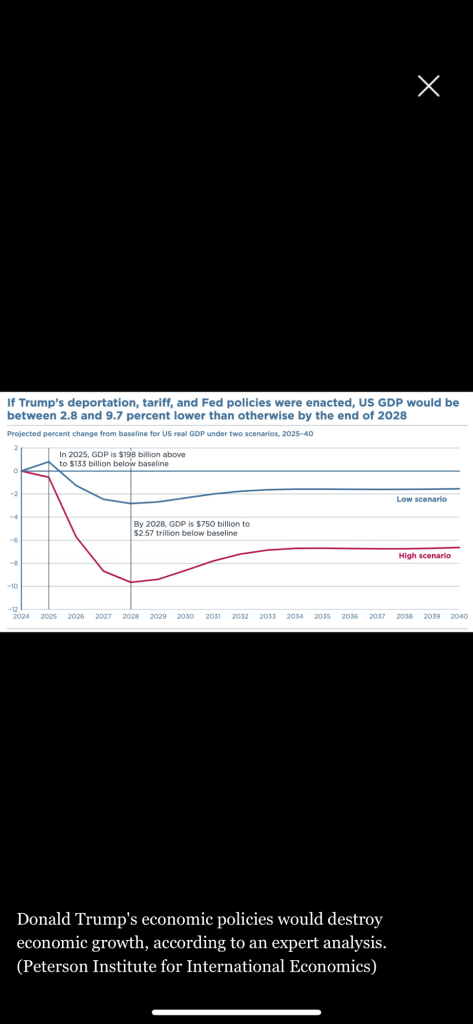
The institute was a lot more free-spoken than the CRFB about the effect of Trump’s proposed policies on economic growth. Considering only the deportations, tariffs and Trump’s desire to exercise more control over the Federal Reserve System, it concluded that by the end of Trump’s term, U.S. GDP would be as much as 9.7% lower than otherwise, employment would fall by as much as 9%, and inflation would climb by as much as 7.4 percentage points.


An overly sedulous focus on deficit reduction as economic policy has caused “real harm [for] the nation’s most vulnerable groups, including millions of debt-saddled and downwardly mobile Americans,” economic historian David Stein of the Roosevelt Institute and UC Santa Barbara wrote last month. When it became Democratic orthodoxy under Presidents Carter and Clinton, the party pivoted to “‘Reagan Democrats’ and suburban white voters at the expense of the labor and civil rights movements.”

As the federal government pulled back, “state budgets were ravaged,” Stein wrote. State and local services were slashed. The efforts to control federal debt forced households to take on more debt.

The deficit scolds are still at it and still have vastly more credibility than they deserve. That’s clear from the CRFB’s analysis and the alacrity with which it was republished as “news” Monday. Efforts to turn policy back to the point that it benefits everyone, not just the rich, still have a long way to go in this country.

Trump is weird. He says outrageous things whenever he speaks, and no one is shocked anymore. He lies and makes things up, and it’s another day on the campaign trail. It’s just Trump being Trump.

Trump was furious at CBS “60 Minutes” for allegedly editing Kamala Harris’s comments about Israel. He called it “election interference” and demanded that the FCC strip away CBS license to broadcast. The first question that occurred to me was, how did he know what she said before the conversation was edited (which is customary)?

The Washington Post pulled no punches in its story, pointing out Trump’s authoritarian bent.

Former president Donald Trump said Thursday that CBS News should lose a broadcasting license over how it edited a “60 Minutes” interview with Vice President Kamala Harris, even though the federal government does not issue licenses for such television networks.

It was the latest example of Trump calling for media outlets that have angered him to lose their rights to broadcast — a push that evokes government control of media, which is a hallmark of authoritarianism.

Federal Communications Commission Chairwoman Jessica Rosenworcel denounced Trump’s latest call targeting CBS, flatly rejecting an idea the independent agency has ruled out under both the Biden and Trump administrations.

“While repeated attacks against broadcast stations by the former President may now be familiar, these threats against free speech are serious and should not be ignored,” Rosenworcel said in a statement. “As I’ve said before, the First Amendment is a cornerstone of our democracy. The FCC does not and will not revoke licenses for broadcast stations simply because a political candidate disagrees with or dislikes content or coverage.”

CBS declined to comment.

Trump has been fixated for days on Harris’s interview with “60 Minutes,” which came after he backed out of sitting for his own interview with the show, according to the network. Since Harris’s interview aired Monday night, Trump has focused on how it featured a shorter version of Harris’s answer to a question about Israel than was shown in a clip previewing the interview.

It is standard for television networks to edit interviews for broadcast, especially to fit time restraints.

“Her REAL ANSWER WAS CRAZY, OR DUMB, so they actually REPLACED it with another answer in order to save her or, at least, make her look better,” Trump claimed in a post on his social media platform Thursday morning. “A FAKE NEWS SCAM, which is totally illegal. TAKE AWAY THE CBS LICENSE.”

Trump went on to baselessly accuse Democrats of making CBS “do this,” calling it “Election Interference” and saying the party should be forced to concede the election.

He later suggested that all broadcast licenses “should be bid out to the Highest Bidder.”

Trump raised the issue again during an afternoon speech in Detroit, claiming the edited Harris interview “will go down as the single biggest scandal in broadcast history.”

The FCC says on its website that its “role in overseeing program content is very limited.” The agency licenses individual broadcast stations, not networks in their entirety.

“We do not license TV or radio networks (such as CBS, NBC, ABC or Fox) or other organizations that stations have relationships with, such as PBS or NPR, except if those entities are also station licensees,” the FCC website says.

It is not the first time Trump has called for a network to lose its broadcasting license because he was not happy with what aired or with how he was portrayed. Trump last month suggested ABC should lose its license over its moderating of the debate between him and Harris. Rosenworcel also rejected that suggestion at the time.

Even the FCC head during Trump’s presidency, Ajit Pai, had dismissed Trump’s talk of targeting broadcast licenses.

“I believe in the First Amendment,” Pai said in 2017 after Trump suggested NBC should face consequences for critical coverage of his administration. “The FCC, under my leadership, will stand for the First Amendment. Under the law, the FCC does not have the authority to revoke a license of a broadcast station based on the content of a particular newscast.”

Democrats have long criticized Trump over his authoritarian tendencies, both in his public comments and in his affinities for certain foreign leaders. He said last year that he would not be a dictator if he wins the November election — “except for Day 1,” a comment that Harris has continued to highlight through the final weeks of their race.

The “60 Minutes” episode broadcast Monday — a special pre-election episode — sparked controversy in the days before it aired. CBS said Trump pulled out of an interview with the show because it would be fact-checked, per usual. Trump’s campaign said Trump never fully committed to the interview but also acknowledged that fact-checking was an area of dispute.

Jane Mayer interviewed the author of “The Art of the Deal,” Tony Schwartz, in July 2016. The story was published in The New Yorker, where Mayer is a staff writer and has written many brilliant exposes.

She begins:

Last June, as dusk fell outside Tony Schwartz’s sprawling house, on a leafy back road in Riverdale, New York, he pulled out his laptop and caught up with the day’s big news: Donald J. Trump had declared his candidacy for President. As Schwartz watched a video of the speech, he began to feel personally implicated.

Trump, facing a crowd that had gathered in the lobby of Trump Tower, on Fifth Avenue, laid out his qualifications, saying, “We need a leader that wrote ‘The Art of the Deal.’ ” If that was so, Schwartz thought, then he, not Trump, should be running. Schwartz dashed off a tweet: “Many thanks Donald Trump for suggesting I run for President, based on the fact that I wrote ‘The Art of the Deal.’ ”

Schwartz had ghostwritten Trump’s 1987 breakthrough memoir, earning a joint byline on the cover, half of the book’s five-hundred-thousand-dollar advance, and half of the royalties. The book was a phenomenal success, spending forty-eight weeks on the Times best-seller list, thirteen of them at No. 1. More than a million copies have been bought, generating several million dollars in royalties. The book expanded Trump’s renown far beyond New York City, making him an emblem of the successful tycoon. Edward Kosner, the former editor and publisher of New York, where Schwartz worked as a writer at the time, says, “Tony created Trump. He’s Dr. Frankenstein.”

Starting in late 1985, Schwartz spent eighteen months with Trump—camping out in his office, joining him on his helicopter, tagging along at meetings, and spending weekends with him at his Manhattan apartment and his Florida estate. During that period, Schwartz felt, he had got to know him better than almost anyone else outside the Trump family. Until Schwartz posted the tweet, though, he had not spoken publicly about Trump for decades. It had never been his ambition to be a ghostwriter, and he had been glad to move on. But, as he watched a replay of the new candidate holding forth for forty-five minutes, he noticed something strange: over the decades, Trump appeared to have convinced himself that he had written the book. Schwartz recalls thinking, “If he could lie about that on Day One—when it was so easily refuted—he is likely to lie about anything.”

Please open and read.

In case you need to be reminded of what a great speaker looks and sounds like, watch President Obama. He spoke yesterday about the race for the Presidency. He explains: Trump is an untrustworthy buffoon: can you imagine him changing a tire? Kamala Harris is ready for the Presidency. Vote!

Thom Hartmann writes that Jill Stein is determined to help elect Trump, as she did in 2020. Her votes in swing states were enough to give Trump the electoral college. She’s pushing the same strategy now, aiming to tip the balance in crucial states towards Trump. As Hartmann points out, Stein has a relationship with Putin. NBC noticed that she sat Putin’s head table with Mike Flynn in 2015. Cozy. Why is a Green Party leader dining with Vlad?

Hartmann writes:

Jill Stein doesn’t give, as the old saying goes, a flying f*ck about democracy. Instead, she’s all about how famous she can become and how much money she can grift off her repeated presidential campaigns. It’s a damn dangerous game.

Fresh off her 2016 political quacksalvery, in which she handed that year’s election to Donald Trump, this professional grifter — who’s been doing real damage to the Green Party for over a decade — is trying to get Trump back into the White House.

As her Wisconsin campaign manager, Pete Karas, told Politico:

“We need to teach Democrats a lesson.”

Arguably, Democrats have already learned that lesson. 

In 2016, Hillary Clinton lost Wisconsin to Trump by 22,748 votes; Stein carried 31,072 votes. In Michigan the story was similar: Clinton lost to Trump by 10,704 votes while Stein carried 51,463. Ditto for Pennsylvania, where Trump won by 44,292 votes and Stein pulled in 49,941 votes.

Had Clinton carried those three states she would have become president. 

Those slim margins may be a distant memory, however, given how hard Stein is pounding on Wisconsin, Michigan, and Pennsylvania Democrats against President Biden’s unfortunate support of Israel’s brutal bombing campaign in Gaza. As Newsweek reported last week:

“In Michigan, a battleground state where the Greens are campaigning hard, and which has a large Arab American community, 40 percent of Muslim voters backed Stein versus just 12 percent for Harris and 18 percent for Trump, according to a late August poll by the Council on American-Islamic Relations (CAIR).

“Michigan has more than 200,000 Muslim voters and 300,000 with Middle Eastern or North African ancestry. Biden won there in 2020 by 154,000 votes, while Trump carried the state with a victory margin of just 10,700—or 0.23 percent—in 2016.

“In Wisconsin, the CAIR poll showed Stein on 44 percent and Harris on 29 percent, while she also leads the Democrat candidate among Muslims voters in Arizona.”

moderated the 2012 presidential debate between Stein and Libertarian Gary Johnson; she and Johnson both had the smell of cheap political hustlers to me then, a feeling that’s only been reinforced in the years since.

Stein certainly hasn’t done much to advance the stated goals of the Green Party. Back in the day, it was the Greens leading the charge against climate change and in favor of instant runoff voting, having considerable success with the latter.

David Cobb, a Texas environmental attorney, ran on the Green ticket in 2004 and was a regular on my radio program that year. He explicitly told people listening to my show in swing states to vote for John Kerry instead of him, calling it his “safe states” strategy.

He refused to campaign or even appear in battleground states, a statement of both high integrity and real patriotism.

Stein has neither. This is her third run for president (Howie Hawkins was the Green candidate in 2020 and was not on the ballot in most swing states.)

Instead, she’s bragging about how she’s going to hand the 2024 election to Donald Trump. Presumably, since her dinner with Putin, she’ll be spared the imprisonment that Trump says he’s preparing for the rest of us in politics and the media. As Stein boasted to Newsweek:

“Third Way found that, based on polling averages in battleground states, the 2020 margin of victory for Democrats would be lost in four states — Georgia, Michigan, North Carolina and Wisconsin — because of third party support.

“So they can’t win. There’s a fair amount of data now that suggests the Democrats have lost. Unless they give up their genocide.

“We’re doing outreach all the time to a lot of different groups, but it’s really been the Muslim Americans and Arab Americans who have really taken this campaign on like it’s theirs — like they have enormous ownership over this.”

Running for president and keeping an iron grip on the once-noble Green Party has become Stein’s singular mission. And she’s killing the Party — and its once-sterling reputation — in the process. As Alexandria Ocasio Cortez said:

“If you run for years in a row, and your party has not grown, has not added city council seats, down ballot seats and state electives, that’s bad leadership. And that to me is what’s upsetting.”

As Peter Rothpletz wrote for The New Republic in an article titled Jill Stein Is Killing the Green Party:

“As of July 2024, a mere 143 officeholders in the United States are affiliated with the Green Party. None of them are in statewide or federal offices. In fact, no Green Party candidate has ever won federal office. And Stein’s reign has been a period of indisputable decline, during which time the party’s membership—which peaked in 2004 at 319,000 registered members—has fallen to 234,000 today.”

Stein brought along a Fox “News” film crew when she crashed the 2016 Democratic National Convention in Philadelphia, cementing her reputation as a hustler who’ll hook up with anybody who’ll provide her with fame or fortune.

There are, apparently, no Democrats in America clean or pure or virginal enough for Stein; as Rothpletz reports, she even attacked Bernie Sanders for being a “DC insider” and “corrupted” by corporate money. 

Meanwhile, her campaign, theoretically opposed to giant monopolies and defense contractors, has taken money from Google, Lockheed Martin, Amazon, Microsoft, Apple, and McKinsey.

Stein is working hard to win the votes of disaffected Muslims in Michigan and Wisconsin, among other swing states, and could well deny Harris the White House this year just like she so proudly did to Clinton in 2016.

The unfortunate reality is that our system of democracy — created way back in 1789 — essentially requires a two-party system because we have first-past-the-post, winner-take-all elections. The result is that third parties alwaystear votes away from the major party with which they are most closely philosophically aligned.

And the Electoral College, by creating swing states, amplifies the problem.

Most other advanced democracies use a parliamentary or proportional representation system where the party that gets, for example, 12 percent of the votes gets 12 percent of the seats in Parliament. This allows for multiple parties and a more vibrant democracy.

However, it wasn’t until the year the Civil War started, 1861, that British philosopher John Stuart Mill published a how-to manual for multi-party parliamentary democracies in his book Considerations On Representative Government.

It was so widely distributed and read that nearly all of the world’s democracies today — all of them countries that became democracies after the late 1860s — use variations on Mill’s proportional representation parliamentary system.

The result for those nations is a plethora of parties representing a broad range of perspectives and priorities, all able to participate in the daily governance of their nation. Nobody gets shut out.

Governing becomes an exercise in coalition building, and nobody is excluded. If you want to get something done politically, you have to pull together a coalition of parties to agree with your policy.

Most European countries, for example, have political parties represented in their parliaments that range from the far left to the extreme right, with many across the spectrum of the middle. There’s even room for single issue parties; for example, several in Europe focus almost exclusively on the environment or immigration.

The result is typically an honest and wide-ranging discussion across society about the topics of the day, rather than a stilted debate among only two parties.

It’s how the Greens became part of today’s governing coalition in Germany, for example, and are able to influence the energy future of that nation. And because of that political diversity in the debates, the decisions made tend to be reasonably progressive: look at the politics and lifestyles in most European nations.

But until America adopts proportional representation nationwide (which would require a constitutional amendment) or instant runoff voting (which could be done by law), a vote for a third-party candidate will always damage the party most closely aligned with it. Jill Stein understands this well, but chooses to ignore (or to intentionally exploit) its consequences.

The Green Party — that I safely voted for in 2000 when I lived in non-swing-state Vermont — deserves a candidate who’ll work to produce real change rather than simply run repeated vanity campaigns that cripple our admittedly flawed electoral system.

It’s time to say “good bye” to Jill Stein and rescue — and then improve — our democratic republic.

Well, by now, we have all grown accustomed to Trump’s mad ravings, so they are no longer newsworthy. So says Michael Tomasky, editor of The New Republic. Some readers of this blog will say that he suffers from NY Times‘ derangement syndrome, but hear him out. To be fair, Tomasky almost forgave the New York Times after he read Peter Baker’s article about Trump’s incoherence and cognitive decline, which appeared soon after he wrote this piece, titled “The Media Is Finally Waking Up to the Story of Trump’s Mental Fitness.”

He wrote:

It’s a pretty sad commentary on the way our mainstream media cover Donald Trump that if you really want to know what Trump said at a given rally, you would be wasting your time going to The New York Times or The Washington Post and you really need to read Aaron Rupar.

He writes:

Who is Rupar? He’s a liberal Substacker and prolific tweeter who prints all the news The New York Times doesn’t deem fit to print. The latest case in point is Trump’s weekend rally at Prairie du Chien, Wisconsin—an appropriately named venue for a speech in which Trump was barking out hatred and bile like a mad dog.

If you’re the sort of person really steeped in campaign coverage, you may have read about what went down; if you missed it, spoiler alert: Trump said something at this rally so insane and offensive that even the Times finally roused itself to cover it. Trump called Kamala Harris “mentally disabled” and added: “Joe Biden became mentally impaired; Kamala was born that way.”

That statement, whatever else we might call it, was obviously news, so the Times couldn’t help leading with it. Ditto the Post, which decided to produce a story that emphasized Trump’s violation of politically correct manners. The Post piece quoted a mental health advocate scolding Trump for his insensitive language—as if what he said was offensive only to people struggling with mental illness!

Meanwhile, here are some other things Trump said at the rally, which you had to read Rupar’s X feed to know about.

 “These people are animals” (referring to migrants).

“I will liberate Wisconsin from this mass migrant invasion of murderers, rapists, hoodlums, drug dealers, thugs, and vicious gang members. We’re going to liberate our country.”

“You gotta get these people back where they came from. You have no choice. You’re gonna lose your culture.”

And, finally, this gem: “They will walk into your kitchen, they’ll cut your throat.”

Let’s tarry over that last one for a bit. Here’s a man who wants to be the president of the United States saying of immigrants—all immigrants: women, children, old people, everyone—that they will invade your home and attack you in one of the most violent and painful (and terrifying) ways possible. They will cut your throat.

Maybe it’s just me, but I find that shocking, even coming from Trump. It’s one thing to say that Mexico is “sending rapists,” as he infamously did in 2015. Even making a general statement about how these people come here and commit crimes, while bad enough, isn’t nearly as bad as this. This is saying directly to every American that they will break into your house and cut your throat.

That sure seems like news to me. Yet it didn’t appear in either the Times or the Post account. The Times piece did have a sentence noting that Trump “continued to vilify” migrants and called them “stone-cold killers,” so let’s give them that, at least. But the plain implication of Trump’s statement here is that migrants are an imminent threat to one’s safety. This is an unambiguous incitement to preemptive violence. How can such a vicious statement not be thought of as news?

Here’s how. If your definition of “news” is simply that which is new, then OK, maybe. Calling his opponent who happens to be the sitting vice president of the United States “mentally disabled” was new, and ergo it was news. That I get.

But Trump attacking migrants isn’t new. Obviously, I would argue that a candidate for president raising the specter of people breaking into people’s homes and cutting their throats is new. Perhaps reasonable minds can differ on that, I guess. And if it isn’t new, it isn’t news…

Why is age fair game for discussion but mental infirmity taboo? Is it because of basic human emotional responses to each matter—that is, we all see people age, it’s familiar, we’re comfortable talking about it—whereas with respect to mental health, talking about it makes us uncomfortable? If so, that’s a pretty lousy excuse. It’s journalism’s job to raise uncomfortable questions.

My commentary:

As for me, I don’t think that the issue is Trump’s mental health, although he is apparently suffering cognitive decline as video clips of his meanderings demonstrate.

The fact is that his campaign is based on demonizing immigrants, without regard to facts. He has launched a hateful campaign against them, making them targets of fear. It seems as though he is encouraging his followers to beat them up.

If he carried out his proposed mass deportation of millions of immigrants, not only would it be an act of inhumanity, but it would cripple important sectors of our economy: agriculture, tourism, meat and seafood processing, construction, restaurants, and more.

John Thompson an an historian and a retired teacher in Oklahoma. Here he reviews Max Boot’s new book, Reagan. He wrote this review for this blog.

He writes:

In 2018, Max Boot recounted “his extraordinary journey from lifelong Republican to vehement Trump opponent.” Although Boot once idolized Ronald Reagan, his Reagan: His Life and Legend tells the story how Reagan planted the seeds of “Trumpism.” Boot concluded that “Reagan was both more ideological and more pragmatic than most people realize–or that I realized before starting this book project more than a decade ago.” But, even when retelling Reagan’s success stories, such as working with Gorbachev, Boot exposes his weaknesses, such as those that could have led to nuclear war.

Boot starts with the way Reagan’s rhetoric and falsehoods led to Trumpism. For instance, his advertising for General Electric led to a “convergence of conservatism in the 1950s.” Boot recalls a number of Reagan’s statements that were “all false,” and how they helped “inure the Republican Party to ‘fake news.’” 

First, Reagan’s false mythology about preventing a communist takeover of Hollywood contributed to his political rise, as he “avoided becoming tarred with the excesses of McCarthyism,” even though he “served as an FBI informant and an arbiter of the blacklist.”

Moreover, Reagan called John F. Kennedy a “fellow traveler.” He also said America was adopting “temporary totalitarian measures” such as social services and federal regulation, and “we have ten years … to win or lose –by 1970 the world will be all slave or all free.”

But, Boot adds that the press wouldn’t call him out for lying, supposedly because he was sincere in believing his falsehoods. As his spokesman, Larry Speakes, said with a shrug, when asked about Reagan’s repeated lies, “If you tell the same story five times, it’s true.”

Similarly, Reagan’s allies remained silent about what they really believed about him. After visiting Reagan in the White House, Margaret Thatcher “pointed to her head and said, “There’s nothing there.”  Thatcher later criticized his war in Grenada, saying, “The Americans are worse than the Soviets.” President Nixon called Reagan a “man of limited mental capacity” and Henry Kissinger said he was “a pretty decent guy” with “negligible” brains.

Reagan said similar things about his allies, for instance, he defended Nixon’s staff that drove Watergate because they were “not criminals at heart.”

However, Reagan’s spin and lies also had more disgusting components, which were not adequately exposed. When he launched his 1980 presidential campaign in Neshoba County, where the band played “Dixie,” his aide acknowledged that, in every election, “race played a role.” There is evidence that, privately, Reagan “shared the rightwing view of (Martin Luther) King as a dangerous subversive.” And, as Tom Wicker, the New York Times journalist, said, Reagan moved racial politics “from a lack of interest in fighting racial discrimination to an active promotion of it.”  

And when opposing the anti-apartheid movement, Reagan said that South Africa had already “eliminated the segregation we once had in our own country.”

By the end of his campaign, Reagan’s advisers used President Carter’s stolen debate briefing books to prepare him for his famous victory, using the words, “There you go again.” But Boot concludes, “What has gotten lost – both at the time and subsequently was that Carter was right on the facts and Reagan was wrong”

Then, in regard to efforts to prevent an “October Surprise,” Boot concludes that “credible evidence” later emerged that his campaign reached out to delay a hostage release.

Boot explains that when Reagan took office, plenty of his staff were incompetent and/or wanted to dismantle government. He also had adult conservatives in the room who sometimes succeeded in convincing Reagan to back away from the most outrageous policy proposals. Even so, “Few if any presidents have ever been so totally isolated even from their most senior cabinet members.”  

In his first pivotal policy battle, over cutting taxes for the rich to reduce rampant inflation and unemployment, Reagan lacked curiosity and knowledge about economic facts. He once asked Federal Reserve Chairman Paul Volker, who took the lead in fighting inflation, “Why do we need the Federal Reserve?”

After his detailed account of the ignorance Reagan showed when passing his economic plan, Boot concluded that his administration “reached its high water mark in 1981 with its massive Economic Recovery Tax Act.” 

But, “Now the nation would have to reckon with its consequences.”

Those consequences included inflation over 9%, and unemployment over 10%; the loss of 1.9 million jobs; a 45% cut in school lunch funding; 45% of jobless persons not receiving unemployment insurance; a 1983 budget deficit of $200 billion; and shrinking the middle class, increasing profits for the rich, and increasing suffering for the poor. Long-term effects included an increase in the death gap between lower and higher income persons of 570%; and by 2020, an inequality gap was wider that those of almost any developed nation.

The same pattern held for Reagan’s foreign affairs decision-making. Boot explained that Reagan apparently believed that he ordered the invasion of Grenada (which was based on falsehoods) because “he had acted as an instrument of God.” Reagan also quoted a U.S. pilot who noted that Grenada produced nutmeg, an ingredient in eggnog. The “Russians were trying to steal Christmas,” the pilot insisted. “We stopped them.” 

And, according to Boot, Reagan’s opposition to Cuba could have gone nuclear. Secretary of State Al Haig said about Cuba, “Just give me the word and I’ll turn that f____ island into a parking lot.” But, fortunately, some of his aides settled Reagan down.

And the same behaviors, when Reagan ratcheted up Cold War paranoia, “could have resulted in a nuclear war that neither side wanted.” During his years-long negotiations with Gorbachev, Reagan was sometimes restrained by his professional staff, but sometimes not. And often his absurd beliefs kept reappearing. 

Mostly due to Gorbachev’s efforts, an arms reduction treaty was eventually passed. But Boot reminds us that in 1986, “Reagan and Gorbachev nearly agreed to a ten-year plan for total nuclear disarmament, but Reagan wouldn’t abide limits on U.S. outer-space defenses.” Because Reagan had faith in that missile defense system, which other participants knew was impossible and dangerous, he “scotched the deal with Gorbachev over them.” So, now “the United States and Russia collectively possess more than ten thousand nuclear warheads. And, despite Trump’s promises to build ‘a great Iron Dome over our country,’ satellite defenses against nuclear attacks remain unviable.”

By the way, Reagan’s few sources included the 1939 movie “Confessions of a Nazi Spy,” and, perhaps, a movie he was in, “Murder in the Air” (1940). 

And Reagan’s baseless beliefs also drove his commitments to mass murderers in Central American. He supported the “psychopath” in El Salvador behind the assassination of Bishop Oscar Romero because he was a favorite of the racist Sen. Jesse Helms.

Reagan’s support for the Contras grew out of a plan to “1. Take the War to Nicaragua. 2. Start killing Cubans.” 

And this post doesn’t have room to recount the downing of two airlines, costing 579 lives, during chaos spread by the Reagan administration. Neither is there time to appropriately cover the punch line he told over an open microphone,   “My fellow Americans, I’m pleased to tell you today that I’ve signed legislation that will outlaw Russia forever. We begin bombing in five minutes.”

Even before Reagan’s dementia took control, his mental acuity was in severe decline, and he apparently forgot that he was briefed on the arms for hostages deal with Iran. Boot reports, in 1987, the Iran/Contras investigations’ “harsh conclusions” were that Reagan knew about the arms for hostages deal, but it wasn’t proven that he knew about the funding of the contras;  “Independent Counsel Lawrence Walsh concluded that Reagan had known about the diversion of funds, … but he could never prove it.” 

Even so, the Reagan spin on the investigation was that it was “the lynching that failed”

During this time when Reagan was increasingly disoriented, his administration was burdened by the Housing and Urban Development ( HUD) scandal; the banking and the savings and loans collapses which were due to his deregulation; and the AIDS epidemic, which Reagan ignored, even though his administration did not. Boot then concluded, “It is damning with faint praise to say that Reagan’s record on AIDS was not as bad as it could have been.”

I believe, the same could be said in terms of most, if not all, of Reagan’s “successes.” 

Boot’s conclusions include: 

While Reagan exaggerated the credit he deserved for the economic recovery, he ducked the blame for the recession.

Even if he read more than Trump and even if “he uttered fewer falsehoods than Trump,” Reagan’s “Often-shocking ignorance of public policy,” and his “repeated false statements” paved the way for Trump. 

Reagan “mishandled a pandemic, just as Trump did”

Like Trump, Reagan “catered to white bigotry.”

Reagan “empowered Christian Nationalism” and a “growing white backlash”

Reagan “helped hollow out the middle class, thereby creating the conditions for Trump’s populist movement.” 

But, there is more to worry about. Trump’s first term was similar to Reagan’s two terms, in that Trump’s aides sometimes managed to thwart or redirect his ambitions. A second Trump term would likely be more dangerous, and with fewer or no reasonable aides to settle him down. 

Media Matters has done a thorough review of the contents of Project 2025, which was written as a playbook for the next Trump administration. It was released and posted on the web in 2023, without fanfare. As more people read it and expressed their indignation, Trump claimed he knew nothing about it. Ever heard of it. Didn’t know who wrote it.

But the authors of the plan included 140 people who had worked in the Trump administration. The plan was developed by the rightwing Heriage Foundation, whose president is Kevin Roberts, a friend of Trump’s.

He knew.

It’s the roadmap for the second Trump term in office.

For education, the main feature of Project 2025 is its strong support for school choice, especially vouchers. It is a formula for directing federal funds to public funding of private and religious schools, as well as home schooling. It’s the Betsy DeVos model. Its purpose is to end public schools.

Timothy Snyder, history professor at Yale University, expresses his alarm about Trump’s turn toward fascistic rhetoric in this post. Trump knows how to excite his base by repeating conspiracy theories and blaming the Jews if anything he wants goes wrong. Snyder does not invoke the reference to Hitler lightly. He knows European history.

He writes:

Trump just had quite a Hitlerian month.

But before broaching the subject of Trump and Hitler I have to say a with a word about the American taboo on “comparisons.” 

Anyone who refers to Trump’s Hitlerian moments will be condemned for “comparison.”  Somehow that “comparison” rather than Trump’s deeds becomes the problem.  The outrage one feels about the crimes of the 1930s and 1940s is transferred from the person who resembles the criminal to the person who points out the resemblance.  

This cynical position opposing “comparisons” exploits the emotional logic of exceptionalism.  Americans are innocent and good (we would like to believe).  We are not (we take for granted) like the Germans between the world wars.  We would never (we imagine) tolerate the stereotypes German Nazis invoked.  We have learned the lessons of the Holocaust. 

Since we are so innocent and good, since we know everything, it just cannot be true — so runs the emotional logic — that a leading American politician does Hitlerian things.  And since we are so pure and wise, we never have to specify what it was that we have learned from the past.  Indeed, our our goodness is so profound that we must express it by attacking the people who recall history. 

And so, in the name of our capacity to remember great evil, we make it impossible to actually remember great evil.  A taboo on “comparison” becomes a shield for the perpetrator.  Those who invoke the past are the true villains, the real source of the problem, or, as Trump says about journalists, the “enemy of the people.”  Indeed, the more Trump resembles Hitler, the safer the man is from criticism on this point.

I hope that the irony of all of this is clear: the idea that “comparison” is a sin rests on the notion of the inherent and unimpeachable virtue of the American Volk, who by definition do nothing wrong, and whose chosen Leader therefore must be beyond criticism.  In this strange way, outrage about “comparison” reinforces fascist ideas about purity and politics.  We should hate the dissenters.  We should ignore whatever casts doubt on our sense of national virtue.  We should never reflect.

Democracy, of course, depends on the ability to reflect, and that reflection is impossible without a sense of the past.  The past is our only mirror, which is why fascists want to shatter it.  In fascist Russia, for example, it is a criminal offense to say the wrong things about the Second World War.  The reason why we keep alive the memory of Nazi crimes is not because it could never happen here, but because something similar can always happen anywhere.  That memory has to include the details of history, or else we will not recognize the dangers. 

“Never again” is something that you work for, not something that you inherit.

Before we think about this past month, we also have to consider the past four years.  This entire election unfolds amidst a big lie.  It was Hitler’s advice to tell a lie so big that your followers would never believe that you would deceive them on such a scale.  Trump followed that advice in November 2020.  His claim that we actually won the election in a landslide is a fantasy that opens the way to other fantasies.  It is a conspiratorial claim that opens the way to conspiratorial thinking generally.  It prepares his followers for the idea that other Americans are enemies and that violence might be needed to install the correct leader.

This year we have seen that explicit Nazi ideas are tolerated in the Trump milieu.  The vice-presidential candidate shares a platform with Holocaust deniers, and defends Holocaust denial as free speech.  This is a fallacy people should see through: yes, the First Amendment allows Nazis to speak, but it does not ennoble Nazi speech.  The fact that people say fascist things in a country with freedom of speech is how we know that they are fascists — and that, if they themselves comes to power, they will end freedom of speech and all other freedoms.

Which brings us to North Carolina and to the gubernatorial candidate Trump once called the country’s hottest politician.  No one is denying that Mark Robinson has the right under the First Amendment to call himself a Nazi or to praise Mein Kampf.  The question is what we do about this.  Trump will not intervene here because he believes that Robinson is more likely to win than a substitute candidate would be.  Consider that for a moment: for Trump, the reason not to distance himself a self-avowed Nazi is that he hopes that the self-avowed Nazi will win an election, take office, and hold power. 

This is not surprising.  Trump and Vance are running a fascist campaign.  Its main theme in September was inspired by a lady in Springfield, Ohio, who lost her cat and then found it again.  For J.D. Vance, who knew what happened, this became the basis for the lie that Haitian immigrants were eating domestic animals.  For Donald Trump, that became a reason to promise that Haitians in Springfield would be deported.  He had found people who were both Blacks and immigrants, who could serve as the “them” in his politics of us-and-them.

It is fascist to start a political campaign from the choice of an enemy (this is the definition of politics by the most talented Nazi thinker, Carl Schmitt).  It is fascist to replace reason with emotion, to tell big lies (“create stories,” as Vance says) that appeal to a sense of vulnerability and exploit a feeling of difference.  The fantasy of barbarians in our cities violating basic social norms serves to gird the Trump-Vance story that legal, constitutional government is helpless and that only an angry mob backed by a new regime could get things done. 

It is worth knowing, in this connection, that the first major action of Hitler’s SS was the forced deportation of migrants.  About 17,000 people were deported, which generated the social instability that the Nazi government the used as justification for further oppression.  Trump and Vance plan to deport about a thousand times as many people….

In international politics, the key moment concerns Ukraine and its head of state.  Since February 2022, the Ukrainian president, Volodymyr Zelens’kyi, has been rightly understood and admired as a symbol of physical and political courage.  When Russia began its full-scale invasion that month, the American consensus was the Ukraine would crack within days and that Zelens’kyi would (and should) flee.  Instead, he stayed in Kyiv despite the approach of Russian assassins and the Russian army, rallied his people, and oversaw the successful defense of his country.  He has since visited the front every few weeks. 

This is how Trump characterized Zelens’kyi in September, echoing comments that he has made before: “Every time he came to our country, he’d walk away with $100 billion. He’s probably the greatest salesman on Earth.”  Trump seems threatened by Zelens’kyi.  As Trump has made clear numerous times, his first and only impulse is to give Putin what Putin wants.  The idea of taking risks to defend freedom from the Russian dictator is well beyond the pinprick-sized black hole that is Trump’s moral universe. 

And of course the claim itself is false.  The number is too big.  And the money does not go to Zelens’kyi himself, obviously.  That Zelens’kyi does personally profit is a favorite idea of Vance, who repeats Russian propaganda to this effect.  The money does not even, for the most part, go to the Ukrainian government.  Most of the military aid does to American companies who build new weapons for American stockpiles.  We then send old weapons to Ukraine, to which we assign a dollar value.

The essential thing, though, is the antisemitic trope Trump chose to express himself.  It goes like this.  Jews are cowards.  Jews never fight wars.  Jews stay away from the front.  Jews only cause wars that make other people suffer.  And then Jews make vast amounts of money from those wars.  Volodymyr Zelens’kyi, the Ukrainian president, is Jewish.  And thus “the greatest salesman on earth” for Trump.  And the corrupt owner of “yachts” for Vance.  A war profiteer, as in the antisemitic stereotype, not a courageous commander, as in reality. 

Indeed, most of what Trump says about Zelens’kyi, Ukraine, and and the war itself makes sense only within the antisemitic stereotype.  Trump never speaks about the Russian invasion itself.  He never recalls Russian war crimes.  He never mentions that Ukrainians are defending themselves or their basic ideas of what is right.  He certainly never admits that Zelens’kyi is the democratically-elected president of a country under vicious attack and who has comported himself with courage.  The war, for Trump, is just a scam — a Jewish scam. 

And that, of course, is why he thinks he can end it right away: he thinks he can just shoulder the Jew aside and deal with his fascist “friend” Putin, who for him is the “genius” in this situation, and who must be allowed to win.  Despite the evidence, Trump says that Russia always wins wars, dismissing both history (regular Russian losses such as the Crimean War, the Russo-Japanese War, the First World War, the Polish-Bolshevik War, the Afghan War) and the actual events of the ongoing Russian invasion, in which Ukraine has taken back half the territory it lost and driven the Russian fleet from the Black Sea.  Russia is counting on Trump.  They need him in power to win their war, and they know it. 

It need hardly be said that if Trump throws American power on the Russian side, the “deal” that follows will not end the war.  It will only mean that Russia is able to kill more Ukrainians faster.  Trump will then claim that the deal itself was beautiful and perfect — and try to change the subject from the slaughter he brought about through his antisemitic hubris and admiration of Russian fascism.

And, of course, Snyder explains, Trump has warned Jewish groups that if he loses, it will be the fault of Jews. Anti-Semitism will be Trump’s legacy.

Retired FBI agent Frank Figliuzzi writes on the MSNBC website about the internal dangers to America. It’s not from immigrants, who are typically more law-abiding than the native-born, but from Neo-Nazi gangs.

He writes:

The federal indictment of 68 defendants accused of being members of (or being associated) with a criminal gang driven by race-based hate followed an investigation that led to the seizure of Nazi paraphernalia, including Adolf Hitler posters, and 97 pounds of fentanyl, federal officials said Wednesday. U.S. Attorney Martin Estrada, who announced the charges, called it one of the “largest takedowns in the history of the Department of Justice against a neo-Nazi, white supremacist, violent extremist organization.”

That announcement landing in the final weeks of a presidential election prompts us to contrast the facts of our crime problem with the fiction that Republican presidential nominee Donald Trump and his running mate, Sen. JD Vance, would have us believe.

The dismantlement of the group that called itself the Peckerwoods, a San Fernando Valley arm of the notorious Aryan Brotherhood white supremacy organization, came in the form of charges for allegedracketeering, firearms trafficking, drug trafficking and financial fraud. If convicted as charged, some members, who adorn themselves with tattoos of swastikas and other hate symbols, could face life behind bars. The group was so heavily armed and so violent that the FBI deployed its elite Hostage Rescue Team from Quantico, Virginia, to support the arrests. According to the U.S. attorney for the Central District of California, the Peckerwoods, a derogatory name historically used against white people, “has as its mission to plan attacks against racial, ethnic, religious minorities.”

Agents seized an arsenal of illegal guns, “bomb-making components” and dozens of kilograms of fentanyl, methamphetamine and heroin, according to law enforcement officials.

The details of this multifaceted investigation reveal a significant component of America’s crime problem: hardened, U.S.-born criminals who traffic in the drugs, guns and violence plaguing our country. This contrasts with the fact-free fearmongering fabrications being sold to MAGA believers. It’s not that minorities don’t commit crimes; nor is that migrants never murder or rape. But Trump and Vance want voters to believe our gun, drug and violence problems are being driven by migrants when the opposite is true…

During the vice presidential debate, Vance claimed the vast majority of illegal guns used in crimes here come from Mexican cartels. The truth is quite different; it’s the U.S. that’s arming Mexican cartels. We have detailed data demonstrating the extent to which American weapons are fueling the violence in Mexico, right down to the make and model of the guns found at crime scenes across the border.

Please open the link to read more about crime statistics and Trump-Vance’s hateful and phony war against immigrants.