Archives for category: Students

New Hampshire reporter Garry Rayno says that the state legislature has its priorities upside down. Writing at IndepthNH.org, Rayno describes a Republican state government led by “moderate” Governor Chris Sununu that’s determined to destroy public schools while expanding vouchers eventually to cover all students’ private school tuition, including the children of the richest residents. Sununu appointed a homeschooling parent, Frank Edelblut, as the State Commissioner of Education. Edelblut is hostile to public schools and eager to divert funding from them.

The Republican legislature refused to renew a program to feed hungry children. As Rayno notes, they are “pro-life,” but don’t care much about living children.

Rayno writes:

From the new proposed rules for education minimum standards to alternative education opportunities, the state legislature and the executive branch appear to have their priorities upside down.

Call it culture wars, call it the war on public education or whatever you want, but much more attention is being paid to about 3 or 4 percent of the state’s school-age students — mostly in private and religious schools or home-schooled — while about 24 percent of public school students with food insecurity do not receive the same attention.

While there is ample evidence a hungry student is not a student fully focused on his or her studies, and is less likely to succeed academically than those who aren’t hungry when they come to school, the House last week by the slimmest of margins, said the food insecure kids could go hungry in this, one of the wealthiest per-capita states in the country.

House Bill 1212 supporters were willing to trim the cost by reducing the income cap from 350 percent of the federal poverty level to 250 percent or about $17 million annually from the Education Trust Fund instead of $50 million.

But that failed to induce enough Republican support to take the bill off the table where a near party line vote had put it, effectively killing it for this year.

The Republican majority also did not want to spend $150,000 of federal pandemic money to hire a coordinator to help about 1,500 homeless students who do not qualify for state homeless services because they do not live with their parents.

Many of the 1,500 students are in the LGBTQIA+ community.

Many of the same people who did not want to spend state or federal money to feed the hungry and help the homeless children and youths favor greater restrictions on abortions or are “pro-life.”

What they are saying with their votes, is we want you to have babies whether you want them or not or whether you can afford them or not, but once they are born, you’re responsible for taking care of them with no help from us.

Pro-life may not be the best term for anti-abortion proponents who voted not to feed the hungry children nor help find them a place to live…

Yet this week two public hearings will be held on bills to expand the eligibility for the Education Freedom Account program now in its third year, and every year well over its budgeted appropriation.

The bill would increase the income cap for the program from 350 percent of the federal poverty level to 500 percent which is $156,000 for a family of four and $102,000 for a parent and child household based on federal 2024 figures.

The current rate would limit family income to $109,200 for a family of four and $71,540 for a family of two.

The cost of the program since its inception has steadily increased from $8.1 million the first year, to $15 million the second and $25 million for the current school year.

The bill barely passed the House and the House Finance Committee chair waived fiscal review of the increase although many more students would be eligible — well above 50 percent of the families in New Hampshire and greatly increasing the cost, but bill proponents did not want to give Democrats another shot at killing the bill.

The money for the program comes from the Education Trust Fund which also provides the adequacy grants to public schools and the larger grants to charter schools, along with special education, building aid and other educational activities…

The bill will increase the income threshold from 350 percent to 400 percent with the threshold for a family of two $81,760 and a family of four at $124,800.

Reaching Higher Education estimates this increase will bring the cost for next school year to $53.4 million.

That is about a quarter of the current surplus in the Education Trust Fund.

The ultimate goal for supporters of the EFA program is universal eligibility or having no income cap so every family in the state would be eligible which would cost $90 million to $100 million if all the students in private or religious schools and homeschool programs sought and received some grants.

About 10 states have universal or near universal voucher programs, but the two states that have attracted the most attention because of their impact on state budgets have been Arizona and Ohio and both have gone well over estimated costs as they have here in New Hampshire.

The program is bankrupting Arizona and the Democratic governor is trying to limit its reach, but the Republican-controlled legislature has refused to go along.

Ohio faces a lawsuit over its program claiming it is hurting public schools while the vast majority of the new participants are students already in private or religious schools or homeschooling programs.  

Sound familiar.

As one Texas state senator said when Gov. Greg Abbott was pushing for school vouchers, “it is nothing but a subsidy for the wealthy.”

And there are the new rules for the state’s minimum standards for public schools.

Two public hearings were held in the past two weeks and the proposed rules were universally trashed by almost everyone testifying causing state Board of Education chair Drew Cline to chastise those focusing on the rules presented to the board in February while a newer, updated version will come before the board soon, although that updated proposal is not available to the public.

The rules are aimed at clarifying and adding details to the state’s competency-based education model, but they also have been criticized for lowering the existing minimum standards, removing limits on class size, making many standards optional and not mandatory, and no longer requiring certified teachers and professionals.

Other concerns were the proposal would do away with local control, a hallmark for public education in the state, and move toward privatizing education and away from what one person called the great equalizer “public education.”

Education Commissioner Frank Edelblut proposed bills in the last few sessions that would have eliminated many current standards to focus only on the core areas of English, math and science, but without much success with the legislature.

Many saw the plan as a way to lower the state’s share of the cost of education and to make public school alternatives more attractive to students and parents.

Say what you will about Edelblut and his opinions about public education, he is tenacious.

The state is at a crossroads that will determine what public education will be for the next decade and on whether or not the state is willing to take care of its most vulnerable so they can fully participate in that education.

The end of the 2024 session and ultimately the next election should provide a vision of the future for New Hampshire and its children.

Garry Rayno may be reached at garry.rayno@yahoo.com.

Jan Resseger reports on dramatic changes in Chicago, which has been a Petri dish for corporate school reform for at least two decades. The last mayoral election pitted Paul Vallas, an Uber reformer against Brandon Johnson, a teacher and member of the Chicago Teachers Union. Johnson is now beginning to unravel the damage done by Arne Duncan, Rahm Emanuel, and the business leadership.

Resseger writes:

Right now we are watching in real time as Chicago tries to figure out how to undo the consequences of a catastrophic, two-decades long experiment in marketplace school reform.

Chicago’s Board of Education has voted to implement an important first step in Mayor Brandon Johnson’s proposed school district overhaul: the elimination of student based budgeting.

Mayor Johnson seeks to restore equal opportunity across a school district that has become marked by magnet schools, charter schools, elite and selective public schools, struggling neighborhood schools, and neighborhoods without a a public high school or even a traditional public elementary school.

Johnson has prioritized major changes in the Chicago Public Schools, whose problems became especially obvious in June of 2013, when Mayor Rahm Emanuel closed 50 neighborhood public schools because, as he claimed, they were under-enrolled. Eve Ewing, a University of Chicago sociologist explains that, “80 percent of the students who would be affected were African American… and 87 percent of the schools to be closed were majority black.” (Ghosts in the Schoolyard, p. 54)

Chicago was an early experimenter with school reform. Brandon Johnson, the city’s elected mayor, leads Chicago’s schools as part of the 1994 mayoral governance plan imposed on the public schools by Mayor Richard M. Daley and the Illinois legislature. The Chicago Public Schools adopted universal, districtwide school choice, and the launch in 2004 of Renaissance 2010 (led by Arne Duncan) that involved the authorization of a mass of new charter schools and the subsequent closure of so-called failing neighborhood public chools. Chicago adopted a strategy called “portfolio school reform,” described in a National Education Policy Center brief: “The operational theory behind portfolio districts is based on a stock market metaphor—the stock portfolio under the control of a portfolio manager. If a stock is low-performing, the manager sells it.  As a practical matter, this means either closing the school or turning it over to an charter school….”

Then in 2014, Mayor Emanuel added a districtwide funding plan called student based budgeting. In a 2019 report, Roosevelt University professor Stephanie Farmer explained: “Student Based Budgeting fundamentally remade the approach to funding public schools. Student Based Budgeting is akin to a business model of financing public schools because funds are based on student-consumer demand and travel with the student-consumer to the school of their choice.  (The plan contrasts with)… the old public good approach to financing public schools that ensured a baseline of education professionals in each school.”

Because it is known that aggregate school test scores correlate primarily with poverty and wealth, it was predicable that student based budgeting would put schools in Chicago’s poorest neighborhoods on a race to the bottom, leading to schools with tragically limited programming for the city’s most vulnerable students and more school closures.  Farmer concludes: “Our findings show that Chicago Public Schools’ putatively color-blind Student Based Budgeting reproduces racial inequality by concentrating low budget public schools almost exclusively in Chicago’s Black neighborhoods. The clustering of low budget schools in low-income Black neighborhoods adds another layer of hardship in neighborhoods experiencing distress from depopulation, low incomes, and unaffordable housing.”

In late March of this year, WBEZ’s Sarah Karp reported that the Board of Education voted to launch a new plan to determine how much each school has to spend on teachers and programming: “Chicago Public Schools is officially moving away from a school funding formula that pitted schools against each other as they competed for students… District officials… announced (on March 21, 2024) they are implementing a formula that targets resources for individual schools based on the needs of students, such as socioeconomic status and health. They will abandon student based budgeting—a formula unveiled a decade ago under former Mayor Rahm Emanuel that provided a foundational amount of money based on how many students were enrolled…. Under the needs-based formula, every school will get at least four foundation positions, including an assistant principal, plus core and ‘holistic teachers.’… Schools will then get additional funding based on the opportunity index, which looks at barriers to opportunity including race, socioeconomic status, education, health and community factors.”

While undoing a market-based scheme for school funding and operations is clearly a moral imperative, the challenges appear daunting.  Karp continues: “This change was expected as Mayor Brandon Johnson and others have sharply criticized student based budgeting. However, it was unclear how it would play out, especially as the district faces a $391 million deficit for the next school year.  The shortfall is the result of federal COVID relief funds running out… District officials offered no information at a Board of Education meeting… on how the district will fill the budget hole.”

In addition to the threat of a serious financial shortfall, another challenge is the outcry from parents who have over the past two decades become a constituency for charter schools, magnet schools and selective high schools.  Mayor Johnson has tried to reassure parents: “(L)et me assure people that—whether its a selective enrollment school or magnet school—we will continue to invest in those goals… (A)ll I’m simply saying is that where education is working in particular at our selective enrollment schools and our magnet schools, my position is like any other parents in Chicago: that type of programming should work in all of our schools. And that has not been the case. Neighborhood schools have been attacked, they have been demonized, and they’ve been disinvested in, and Black and brown parents overwhelmingly send their children to those schools. So it’s not just demonizing and disinvesting in Black and brown schools, it’s demonizing and disinvesting in Black and brown people—and not under my administration.”

Although school choice plans like Chicago’s were originally premised on the idea of providing more choices for those who have few, in her profound book, Ghosts in the Schoolyard, Eve Ewing explains that families in Chicago do not have equal access in today’s school system based on school choice: “While choosing the best option from a menu of possibilities is appealing in theory, researchers have documented that in practice the ‘choice’ model often leaves black families at a disadvantage. Black parents’ ability to truly choose may be hindered by limited access to transportation, information, and time, leaving them on the losing end of a supposedly fair marketplace.” (Ghosts in the Schoolyard, p. 23) Families dealing with poverty and its challenges are more likely to select a neighborhood school within walking distance of their home.

Mayor Johnson and his school board are facing a fraught political battle in the midst of severe budget challenges. Chicago school reform has exacerbated inequality. The families whose children remain in traditional neighborhood schools that have been undermined by school choice and student based budgeting have watched their their schools lose staff and programs their children need. At the same time, families who have benefited from charter schools, magnet schools and selective-enrollment high schools have now become strong supporters of the programs they have come to take for granted.

Mayor Johnson has been very clear, however, about what the past two decades of portfolio school reform, school choice and student based budgeting have meant for Chicago: “What has happened in the city of Chicago is selective enrollment schools go after students who perform academically on paper.  It’s a very narrow view of education. Let’s also ensure that other areas of need are also highlighted and lifted up.  That’s arts, our humanities, technology, trades…  It’s not like we’re asking for anything radical. We’re talking about social workers, counselors, class sizes that are manageable. We’re talking about full wraparound services for treatment for families who are experiencing the degree of trauma that exists in this city.”

Two different juries in Michigan convicted the parents of a school shooter. James and Jennifer Crumbley were both found guilty of involuntary manslaughter and were sentenced to 10-15 years in prison. Their son Ethan murdered four other students and wounded several others and a teacher at Oxford High School in Oxford, Michigan.

CNN reported:

James purchased the firearm for his son on Black Friday, four days before the shooting. The next day, Jennifer took her son to the firing range for target practice. “Mom & son day testing out his new Xmas present,” she wrote afterward on social media. The parents failed to properly secure the firearm, as James Crumbley hid it in their bedroom but did not use any locking device, the prosecution argued.

In addition, the trials focused on a pivotal meeting between school employees, Ethan and his parents on the morning of the shooting. Ethan had been called into the school office after he made disturbing writings on a math worksheet, including the phrases “blood everywhere” and “my life is useless” and drawings of a gun and bullet.

The school employees recommended the parents immediately take him out of class and get him mental health treatment, but they declined to do so, saying they had work. The Crumbleys also did not mention to the school the recent gun purchase. Afterward, Ethan was sent back to class. About two hours later, he took the gun out of his backpack and opened fire at the school.

This was apparently the first time that parents have been held accountable for their child’s crimes.

Do you approve? I do.

Do you think other parents might be more responsible in the future? I wish so but I doubt it. I recall that the mother of the Sandy Hook murderer bought him an AR-15, took him to target practice to teach him how to use it. He was mentally ill. She was the first one he killed on the day of the massacre. He shot her in the face while she was still in bed. He then went to Sandy Hook Elementary School and killed 26 people, including 20 children, ages 6 and 7, and six staff members.

Nonetheless, parent accountability for the crimes of their minor children is a step forward. In a sane country, access to deadly weapons would be restricted. In most of this country, there are no limits on buying and carrying guns, thanks to the Republican Party and the Supreme Court, the NRA and the Federalist Society.

Human life is cheap in a fun-loving society.

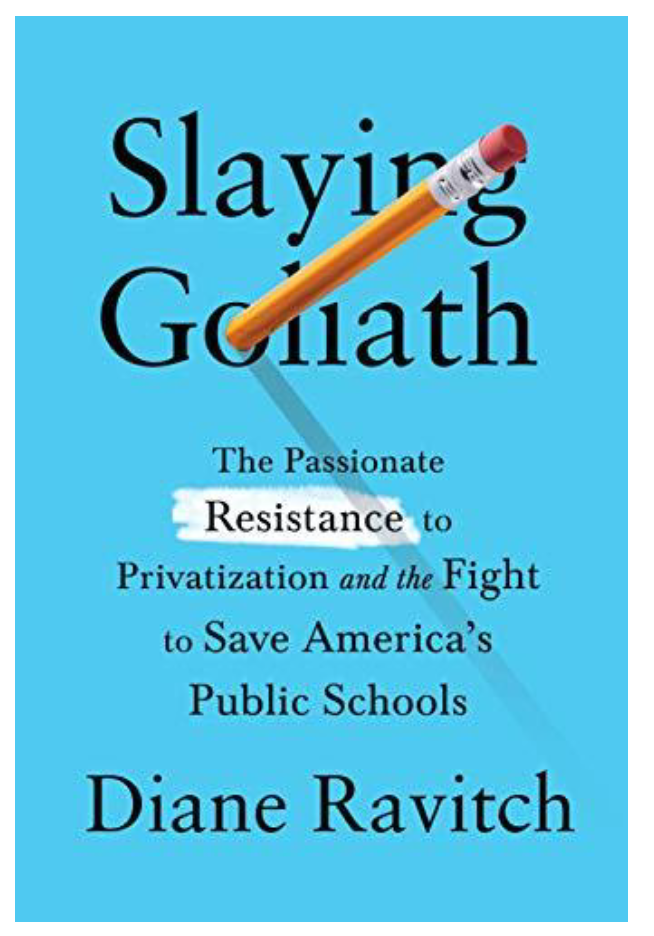
I am almost four years late in discovering this review by two scholars for whom I have the greatest respect: David C. Berliner and Gene V. Glass.

I was happy to read this review because Slaying Goliath had a checkered fate. It was published in mid-January 2020. I went on a book tour, starting in Seattle. By mid-February, I made my last stop in West Virginia, where I met with teachers and celebrated the two-year anniversary of their strike, which shut down every school in the state.

As I traveled, news emerged of a dangerous “flu” that was rapidly spreading. It was COVID; by mid-March, the country was shutting down. No one wanted to read about the fight to save public schools or about its heroes. The news shifted, as it should have, to the panicked response to COVID, to the deaths of good people, to the overwhelmed hospitals and their overworked staff.

To make matters worse, the New York Times Book Review published a very negative review by someone who admired the “education reform” movement that I criticized. I thought of writing a letter to the editor but quickly dropped the idea. I wrote and rewrote my response to the review in my head, but not on paper.

Then, again by happenstance, I discovered that Bob Shepherd had reviewed the review of my book in The New York Times. He said everything that I wish I could have said but didn’t. His review was balm for my soul. Shepherd lacerated the tone and substance of the review, calling it an “uniformed, vituperative, shallow, amateurish ‘review.’” Which it was. His review of the review was so powerful that I will post it next.

Then, a few weeks ago, I found this review by Berliner and Glass.

The review begins:

Reviewed by Gene V Glass and David C. Berliner Arizona State University, United States

They wrote:

In a Post-Truth era, one must consider the source. 

In this case, the source is Diane Rose Silvers, the third of eight children of Walter Silverstein, a high school drop-out, and Ann Katz, a high school graduate. The Silvers were a middle-class Houston family, proprietors of a liquor store, and loyal supporters of FDR.

After graduation from San Jacinto High School, she enrolled in Wellesley College in September, 1956. Working as a “copy boy”for the Washington Post, Diane met Richard Ravitch, a lawyer working in the federal government and son of a prominent New York City family. They married on June 26,1960, in Houston, two weeks after Diane’s graduation from Wellesley. The couple settled in New York City, where Richard took employment in the family construction business. He eventually served as head of the Metropolitan Transit Authority and Lieutenant Governor in the 2000s, having been appointed by Democratic Governor David Paterson.

 Diane bore three sons, two of whom survived to adulthood. Diane and Richard ended their 26-year marriage in 1986. She had not been idle. For a period starting in 1961, Diane was employed by The New Leader, a liberal, anti-communist journal. She later earned a PhD in history of education from Columbia in 1975 under the mentorship of Lawrence Cremin.

Diane was appointed to the office of Assistant Secretary of Education, in the Department of Education by George H. W. Bush and later by Bill Clinton. In 1997, Clinton appointed her to the National Assessment Governing Board (NAGB), on which she served until 2004. 

Ravitch worked “… for many years in some of the nation’s leading conservative think tanks.

Read the full pdf here.

I am a native Texan. I was born and raised in Houston. I attended Houston public schools from kindergarten until my high school graduation. The public schools of Texas gave me a strong foundation, and I will always be grateful to my teachers and my schools.

The public schools in Texas will be harmed by vouchers. Yet Governor Greg Abbott is demanding that the Legislature endorse vouchers, so that the public will subsidize every student who goes to private and religious schools. No wonder he campaigned for vouchers by visiting private and religious schools.

Some Republican legislators know that vouchers will hurt their public schools.

Governor Abbott has spent millions of dollars to defeat those brave Republican legislators who oppose vouchers.

The primary is March 5.

Funded by oil and gas billionaires and by Jeff Yass, a Pennsylvania billionaire, Abbott has tried and repeatedly failed to pass a voucher bill. He failed because these Republican legislators stood up for their communities and their public schools.

These legislators know their local teachers. They are friends and neighbors. The legislators know they are hard-working dedicated teachers. They teach the children; they don’t “indoctrinate” them, as Governor Abbott falsely claims. Many have taught in the same schools for decades, raising up the children in the way they should go.

The teachers are underpaid, and the school buildings need upgrades. But the Governor won’t put another penny into paying teachers and funding public schools unless he gets his vouchers.

In every state that has vouchers, most of them are used by students who never attended public schools. Vouchers are nothing more than a public subsidy for students already attending private and religious schools.

Voucher schools are free to discriminate and are excused from all accountability.

These heroic and principled legislators deserve your thanks and your vote on March 5:

  • Steve Allison, District 121, San Antonio
  • Ernest Bailes, District 18, Shepherd
  • Keith Bell, District 4, Forney;
  • DeWayne Burns, District 58, Cleburne;
  • Travis Clardy, District 11, Nacogdoches
  • Drew Darby, District 72, San Angelo
  • Jay Dean, District 7, Longview
  • Charlie Geren, District 99, Fort Worth
  • Justin Holland, District 33, Rockwall
  • Ken King, District 88, Canadian
  • John Kuempel, District 44, Seguin
  • Stan Lambert, District 71, Abilene
  • Glenn Rogers, District 60, Mineral Wells
  • Hugh Shine, District 55, Temple
  • Reggie Smith, District 62, Sherman
  • Gary VanDeaver, District 1, New Boston

For their courage in defending their community schools, their teachers, their parents, and their students, I place them on the blog’s Honor Roll.

Now get out there and vote for them!

Pamela Lang, a journalist and graduate student in Arizona, wrote for The Hechinger Report about her futile search for a school that would enroll her son, who has special needs. Despite Arizona’s budget-busting voucher program, she and he were turned away again and again. It’s time for her to check out her local public school, where her son would get the services he needs and he could not be rejected.

Please read her account.

If you live in Arizona, school choice may be coming to your neighborhood soon. As someone who has had more school choice than I know what to do with, I can tell you what may feel like a shocking surprise: Private schools have the power to choose, not parents.

I live in Phoenix, where the nearby town of Paradise Valley is getting ready to offer the privatization movement’s brand of choice to families. The district has indicated that it will likely vote to close four public schools due to insufficient funds. If this happens, other districts will probably follow: The state’s recent universal voucher expansion has predictably accelerated the diversion of money from public to private schools.

Arizona approved use of school choice vouchers, called Empowerment Scholarship Accounts, or ESAs, in 2011 on the promise that they were strictly for children with special needs who were not being adequately served in the public school system. The amount of funds awarded to qualified students was based on a tiered system, according to type of disability.

Over the years, the state incrementally made more students eligible, until full expansion was finally achieved in 2022. For some students, the amount of voucher money they qualify for is only a few thousand dollars, nowhere near enough to cover tuition at a private school. Often, their parents can’t afford to supplement the balance. However, my son, who is autistic, qualified for enough to cover full tuition.

I took him out of public school in 4th grade. Every school I applied to seemed to have the capability to accommodate his intellectual disability needs but lacked the willingness. Eventually, I found a special education school willing to accept him. It was over an hour from our home, but I hoped for the best. Unfortunately, it ultimately was not a good fit.

I then thought Catholic schools would welcome my son, but none of them did. One Catholic school principal who did admit him quickly rescinded the offer after a teacher objected to having him in her class.

The long list of general, special-ed, Catholic and charter schools that turned my son away indicate how little choice actually exists, despite the marketing of ESA proponents.

There was a two-year period where I gave up and he was home without social opportunities. I was not able to homeschool, so a reading tutor and his iPad became his only access to education.

I then tried to enroll him in private schools for students with disabilities.

These schools were almost always located in former office suites in strip malls with no outdoor access. My son’s current school shares space with a dialysis center in a medical building, while a former school was located in a small second-floor suite in a Target plaza.

Once a private school admits your child, they can rescind admission without cause. Private schools are at leisure to act as virtual dictatorships, and special-ed schools in particular are notorious for keeping parents at a distance…

Education is a human right, and public schools, open to all, are the guardians of this right. What privatizers call choice does not really exist.

Please open the link and read the article in full.

Tim Slekar has been active in the fight against privatization of public education for more than a decade. He has created videos, written articles, posted on blogs, and recently he has run a regular radio show. He’s always fighting for public schools, teachers, and students against the long and ugly arm of corporate reform.

He writes:

Dear Advocates for Democracy and Education,

As BustEDpencils expands to a daily radio show on Civic Media, we’re not just talking about education; we’re championing the cornerstone of a healthy democracy—robust public schools. Our show is a clarion call to defend and rejuvenate public education, the bedrock of informed citizenship and democratic engagement.

By tuning in daily, you’re not just listening; you’re actively participating in safeguarding our public schools. Each episode is a step towards a more informed, democratic society, where public education is celebrated and protected as a vital public good.

And we’re not stopping at the airwaves. We’re planning to bring the heart of our message into your communities with live appearances. These events will be more than just talks; they’ll be rallies for public education, celebrating its critical role in maintaining a thriving democracy.

Join this urgent mission. Tune in, engage, and prepare to welcome us into your community. Together, let’s ensure that public education remains a pillar of our democratic society.

In Solidarity for Public Education and Democracy,

Tim and Johnny

P.S. Every listener, every conversation, every community we visit is crucial in our fight to preserve and enhance public education. This journey is about more than just a radio show; it’s about nurturing the very roots of our democracy.

Timothy D. Slekar PhD
412-735-9720
timslekar@gmail.com
https://civicmedia.us/shows/busted-pencils

One big reason to feel hopeful about the future is that our youth seem to have figured out how to organize for change. After the massacre of students at Marjorie Stoneman Douglas High School in Florida, survivors organized a huge protest demanding gun control. They haven’t won so far but they are not likely to give up.

The grownups are not doing enough to address climate change, and Republicans keep insisting that climate change is a hoax.

But a group of Montana kids banded together to file a lawsuit against the state for failing to take action to reverse climate change. The Christian Science Monitor reports how they did it.

The story says:

In June 2023, the hottest June ever recorded in a summer that would break global heat records, 16 young people walked into a courthouse in Helena, Montana, and insisted that they had the right to a stable climate.

The moment was, in the United States, unprecedented.

For years, youth around the world had been suing governments – state, regional, federal – and demanding more action by policymakers to address what scientists worldwide agree is an environmental crisis directly caused by human behavior. By 2022 there had been 34 global climate cases brought on behalf of plaintiffs ages 25 and younger – part of a global climate litigation explosion, according to Columbia University’s Sabin Center for Climate Change Law.

In the courtroom that day, the young people were asking not for any financial reward, but for the government of Montana to uphold its Constitution, one of a handful in the U.S. that explicitly protects both current and future citizens’ right to a healthful environment. There was Rikki Held, the oldest of the Montana youth plaintiffs at 22, whose name was on the lawsuit and whose family’s ranch was increasingly threatened by fires and floods. There were Lander and Badge Busse, teenage brothers whose schoolmates taunted them about this case, but who’d decided they needed to be part of this lawsuit to protect the wilderness where they loved to fish and hunt. And there was Grace Gibson-Snyder, a Missoula 19-year-old. Her ancestors had come to this big-sky state in a covered wagon. But Ms. Gibson-Snyder worried about whether this land would be habitable for her own children – if she felt it were morally appropriate to have any. She wore her favorite boots to trial, for good luck.

And in some places, young people had begun to make headway. A German court in 2021, for instance, agreed with youth that the government needed to do more to reduce emissions. Colombia’s Supreme Court agreed with young plaintiffs in 2018 that officials needed to better protect the Amazon rainforest, in part because of climate concerns.

But in the U.S., the country that has sent more heat-trapping gases into the atmosphere than any other nation, young people had failed to get courts to rule in their favor.

That was about to change.

In the courtroom that day, the young people were asking not for any financial reward, but for the government of Montana to uphold its Constitution, one of a handful in the U.S. that explicitly protects both current and future citizens’ right to a healthful environment. There was Rikki Held, the oldest of the Montana youth plaintiffs at 22, whose name was on the lawsuit and whose family’s ranch was increasingly threatened by fires and floods. There were Lander and Badge Busse, teenage brothers whose schoolmates taunted them about this case, but who’d decided they needed to be part of this lawsuit to protect the wilderness where they loved to fish and hunt. And there was Grace Gibson-Snyder, a Missoula 19-year-old. Her ancestors had come to this big-sky state in a covered wagon. But Ms. Gibson-Snyder worried about whether this land would be habitable for her own children – if she felt it were morally appropriate to have any. She wore her favorite boots to trial, for good luck.

They and their fellow plaintiffs were represented by an Oregon-based law firm called Our Children’s Trust, which has helped young people across the country bring constitutional climate cases.

Opposing them was the state of Montana, represented by an attorney general whose spokesperson had called the lawsuit “outrageous” and “political theater” – a case of well-intentioned children exploited by an outside interest group.

For the better part of the next two weeks, the two sides presented their cases. 

Then youth and legal experts waited anxiously for the judge’s decision. Held v. Montana, many said, was a crucial moment in what they saw as a legal transformation building around the world. Members of the Climate Generation – as we’re calling the cohort born since 1989, when the world became both climatically unstable and increasingly focused on children’s rights – were working to define what it meant to have rights as a young person. And in particular, they were working to define what it meant to have rights while looking at a future that scientists agree will be shaped by what older people have done to the atmosphere. A ruling in Montana could dramatically impact this global effort.  

“The Montana case is incredibly important,” says Shaina Sadai, the Hitz fellow for litigation-relevant science at the Union of Concerned Scientists. Young people involved with climate action, she adds, “are very internationally connected. They are very much in touch with each other. … A win anywhere for any of them is a win for all of them. It’s that global youth solidarity.”

Which is why Dallin Rima, a 19-year-old plaintiff in a different climate lawsuit, turned up the radio when he heard that Montana District Judge Kathy Seeley had released her verdict.

Mr. Rima is part of a group of Utah youth who have sued their state, arguing that its promotion of fossil fuels violates their constitutional rights to life, health, and safety. He’d been following what was going on in Montana, the same way young climate plaintiffs from Oregon to the South Pacific to Portugal had been keeping track. While he knew firsthand about the challenges of the legal system, about the delays and disappointments, he had allowed himself to hope.

He was driving to his grandmother’s house outside Salt Lake City, listening to NPR, when the news came on. It was a good thing nobody else was in the car, Mr. Rima says. Because as he listened to the newscast, he began to “express himself,” as he puts it. Loudly.

The judge had ruled in the young plaintiffs’ favor. Specifically, this meant that Montana policymakers had violated the young people’s constitutional rights by ignoring the climate impacts of their energy decisions. But Mr. Rima understood that there were far broader implications. 

By siding with the young Montanans, Judge Seeley explicitly connected the right to a clean environment with the right to a stable climate. She gave a judicial stamp of approval to climate science. And she proved that, in the face of what many young people see as politicians’ ineptitude in addressing climate change, the judiciary is a branch of government that might still be able to protect their futures.

“I’ve learned not to get my hopes up. But I was just shocked, ecstatic to hear that they had won,” Mr. Rima says. “It was a really powerful moment. … It feels like our work isn’t in vain.”

John Thompson, historian and retired teacher, write about what matters most to students today: learning to pay attention in a world of screens and distractions.

He writes:

D. Graham Burnett, Alyssa Loh, and Peter Schmidt begin their New York Times opinion piece, “Powerful Forces Are Fracking Our Attention. We Can fight Back,” with an eloquent version of a statement that should have long been obvious:

We are witnessing the dark side of our new technological lives, whose extractive profit models amount to the systematic fracking of human beings: pumping vast quantities of high-pressure media content into our faces to force up a spume of the vaporous and intimate stuff called attention, which now trades on the open market. Increasingly powerful systems seek to ensure that our attention is never truly ours.

Then Burnett, Loh, and Schmidt use equally insightful language to explain why “We Can Fight Back” against “the little satanic mills that live in our pockets.” They recall that “for two centuries, champions of liberal democracy have agreed that individual and collective freedom requires literacy.” Today we face widespread complaints that reading is being undermined by “perpetual distraction,” due to commercial use of digital technologies. They add, “What democracy most needs now is an attentive citizenry — human beings capable of looking up from their screens, together.”

“Powerful Forces Are Fracking Our Attention. We Can Fight Back” calls for a “revolution [which] starts in our classrooms.” They explain, “We must flip the script on teachers’ perennial complaint. Instead of fretting that students’ flagging attention doesn’t serve education, we must make attention itself the thing being taught.” They draw upon the work of “informal coalitions of educators, activists and artists who are conducting grass-roots experiments to try to make that possible. Burnett, Loh, and Schmidt call it “attention activism.

Due to these worldwide efforts, “common ground is rediscovered in the weave of collective attention.” They seek ways “to create, beyond the confines of our personalized digital universes, something resembling a shared world.” One set of starting places, museums, public libraries, universities, as well as classrooms, remind me of a time when I was a student, and the first half of my teaching career, when field trips were widely celebrated, and before critical thinking was subordinated to test prep.

“Powerful Forces Are Fracking Our Attention. We Can fight Back” recommends another practice that I’ve long struggled with, “observations of absolutely whatever unfolds in the world,” in order pay “particular attention to the supposedly mundane … events that might under normal circumstances have gone unnoted.” It reminded me of a conversation with a student where we agreed that we don’t want to depend on beer or marijuana in order to fully appreciate a sunset. It was hard for me to later realize that I also took that shortcut in order to slow down and fully appreciate such beauty.

Next, I left my computer, and my dog and I got into our complicated new hybrid car to take a short ride to the park for a walk. Of course, the irony of driving to the walk is obvious. Then I figured out how to push the buttons for defrosting the window, rather than scrape the ice off. But then, technology taught me a new skill for paying attention to “normal circumstances” that had “gone unnoted.” I became enthralled the bubbles that broke loose from the coat of ice as it melted and dripped down the windshield. (Perhaps due to that experience, the park’s beautiful fall colors were even more awesome.)

Burnett, Loh, and Schmidt also reminded me of conversations I had had as a young Baby Boomer with family members, neighbors and other mentors. So many adults coached me on developing “inner directedness,” not “outer-directedness,” and to not be “like the Red River, a mile wide and a foot deep.” I was taught that my real goal shouldn’t be higher grades, but “learning how to learn.” And I’ll never forget the elementary school principal who took us to the junior high to watch Edward R. Murrow interviewing John Maynard Keynes, about the real purpose of school – which was not getting a job. Our goal should be learning how to learn how to be creative after technology reduced the workweek into 15 hours.

Of course, that hopefulness seems laughable today, but it brings us back to Burnett, Loh, and Schmidt and their diagnosis of why today’s technology has become so destructive. They linked to ATTENTION LIBERATION MOVEMENTS(or ALMS) that resist the “powerful new financial, commercial, and technological system that is commodifying human attention as never before.” It promotes “RADICAL HUMAN ATTENTION” to nurture “unrivaled access to the goodness of life;” and second, “that present circumstances present new and imperiling obstacles to human attentional capacities.” For instance, these bottom-up efforts seek to educate young people how, “We operate in a world in which attention is increasingly bought and sold. Bought and sold by powerful interests, pursuing wealth — pursuing ‘eyeballs,’” on screens.

And, of course, the subsequent undermining of inner-directedness, social ties, and critical thinking paved the way to today’s rightwing assault on democracy.

Although I was never as eloquent as Burnett, Loh, and Schmidt, but I’ve unsuccessfully advocated for their type of approach for a quarter of a century. My first encounter with a cell phone occurred the day after a gang-related murder when my students affiliated with the “Crips” stared at a new student, a “Blood,” who was secretly typing into a gadget I’d never seen before, who was requesting armed backup. Given the way that cell phones, predictably, increased violence and, predictably, undermined classroom instruction, I lobbied for our school to commit to regulating phones and engaging in cross-generational conversations about digital literacy and ethics.

Although I personally communicated with my students about “using digital technology,” but “not being used by it,” our school system refused to touch these issues. Before long, watching students who were glued to their phones, it seemed obvious we were also facing a crisis of loneliness, made much, much worse by screen time.

My personal experience thus gives me reasons for both hope and pessimism. Burnett, Loh, and Schmidt build on the same human community strengths that were crucial for me, and embraced by students in our phone-free classroom. But I can’t ignore the three decades of refusals by the systems I’ve worked with to tackle the challenge.

Then again, on the same day that the New York Times commentary was published, National Public Radio reported that California “joins a growing movement to teach media literacy.” The next day, the Washington Post called on parents to support a ban on smartphones. So, maybe the time is right for the wisdom of Burnett, Loh, and Schmidt, who make the case for “what democracy most needs now is an attentive citizenry — human beings capable of looking up from their screens, together.”

The Florida State Education Department applauded the superintendent of schools in Broward County for taking swift and stern action when he learned that a transgender girl was allowed to play on the girls’ volleyball team at Monarch High School. The superintendent received an anonymous tip about the student and reacted by removing the principal, the assistant principal, and members of the athletic staff.

When the word got out, students staged a protest by walking out.

Following the removal of a Broward County high school principal and four employees in response to “allegations of improper student participation in sports,” Florida education officials on Tuesday said they expect “serious consequences for those responsible” and accused them of violating state law.

The comments came hours after Broward County Public School officials confirmed the reassignments of the Monarch High School employees occurred because a transgender female athlete played volleyball at the high school during the fall season and after hundreds of students staged a peaceful walkout during school hours to protest the decision. The students, who gathered on the football field and walked to the parking lot on the north end of the school, shouted, “Let her play,” “Trans rights are human rights” and “Free Cecil now,” referring to Monarch principal James Cecil, who was among the employees reassigned. Kenneth May, the assistant principal; Dione Hester, the athletic director; Jessica Norton, the girls’ volleyball coach; and Alex Burgess, a temporary athletic coach, were also reassigned.

The reassignment of the five staff members is “ridiculous,” said Alexandra Almeida, a senior at Monarch, who participated in the walkout to support her friends. She hoped the walkout, which she heard about through social media Monday, would “bring more awareness to the situation so that people see what’s happening in our Florida schools.”

Safe Schools South Florida in a statement said it is “appalled” by the district’s decision. The organization works with LGBTQ students to promote inclusivity and diversity within the education system “The reassignment of faculty is a measure typically reserved for the gravest of infractions. In this case, it is not only an overreaction but also a glaring misjudgment,” the statement read. “Furthermore, the potential inadvertent outing of a minor, who may not have publicly disclosed their transgender status, is deeply troubling.”

But state officials, in response to a Miami Herald inquiry, said department officials “instructed the district to take immediate action” upon being notified of the issue “since this is a direct violation of Florida law.” During a brief news conference Tuesday, Broward County schools Superintendent Peter Licata said officials spoke to the Florida Department of Education on Monday.

“Under Governor DeSantis, boys will never be allowed to play girls’ sports. It’s that simple,” said Cailey Myers, communications director for the state Department of Education.

There was no mention of the win-loss record of the girls’ volleyball team.

Read more at: https://www.miamiherald.com/news/local/education/article282411498.html#storylink=cpy