Archives for category: Students

Arnold and Carol Hillman spent their careers as educators in Pennsylvania. When they retired, they decided to live in a retirement community in South Carolina. But while other retirees were playing golf or relaxing at the pool, they decided to get involved in rural schools. They wanted to be helpful. After nine years in South Carolina, they decided to move closer to their children, so they moved to Massachusetts. I invited them to write about their experiences in South Carolina. And Arnold wrote this account, edited by Carol.

We have always been compulsive people. On a cold winter’s day in February of 2015, we decided to move to a senior community (Sun City) in Bluffton, South Carolina. We did have some friends there who encouraged us to join them. So, on July 31st of that year, we moved there— lock, stock and barrel.

It wasn’t more than a week or two, after disposing of our many boxes, that we decided to go to a local school board meeting. We lived in an especially wealthy area of SC. The reason for its wealth were the many grey heads that retired to SC because of the meager taxes that one had to pay. 

We were very surprised at the board meeting. There were issues that were foreign to us. Although much of the meeting revolved around educational issues, the tone of the meeting was not to our liking. For one thing, they never mentioned the students or education. The superintendent acted as if he was the school district attorney. He was later fired because of ethics violations. An elderly member of the board spoke about books that he did not like and made no sense. The meeting seemed disorganized from our perspective. We came away from the meeting with the idea of finding out more about education in South Carolina.

Since we were familiar with the superintendent’s organization in Pennsylvania, we discovered that the then Superintendent of Education in South Carolina was the former executive director of the SC organization of superintendents. We called her, Molly Spearman, and invoked our PA connection and got to speak with her. 

We said that we had been advocates for rural schools and communities for many years and would like to see if we could be of some assistance to them here in South Carolina. She told us of five rural school districts around the area in which we lived and suggested that we give them a call.

We called all five and only one returned our call. Dr. Vashti Washington, Superintendent of the Jasper County School District, one of the poorest districts in the state, said that she would be happy to see us and work out some things that we could do in the district.

We eventually began a program called “Roso” – Reach one Save one. It was already in the works at the Ridgeland Hardeeville High School. The assistant principal, L.R. Dinkins, had been looking for someone to help him get it started, and we were the ones.

The program involved mentoring 10 young men and 10 young women and having them mentor fifth graders who were having trouble in school. The program lasted from 2015-2021. It ended when Covid began. However, the students that we worked with are still in touch with us and many have been successful in their lives. Others have not had that kind of success.

During the time we were working at Ridgeland Hardeeville, we decided that we would try to visit as many rural school districts as we could. We wound up visiting 21 districts out of about 35 (consolidation has made that 30 rural districts).

We were astonished at what we saw in each of those districts. What we saw was the equivalent of shoveling against the tide. Administrators and teachers do their best without the proper resources. 

In some districts the buildings were dilapidated. One in particular startled us when we saw sewage seeping into the hallways. Fortunately, that school was closed and replaced by a new building.

Many school districts lacked teachers of science, math, and special education. Many rural districts recruited foreign teachers to fill vacancies, but these teachers often had difficulty communicating in English. Those who stayed for more than a year became more fluent in English and more successful as teachers. Nonetheless, rural districts often lacked the courses available in economically advantaged districts.

Most rural districts lacked student services. Guidance counselors and psychologists were in short supply, as were career counselors and STEM counselors.

Like many other rural areas across the country, Internet connections are not readily available in rural South Carolina. Thus many schools were unable to produce online coursework for their students during the pandemic.

Some of the outcomes were spectacular, but in the end the children did not get all that they needed for success in life.

As we have learned during our time in South Carolina, and over the past year, the children in the rural areas of South Carolina must climb mountains to gain the same kind of success that their brothers and sisters have in the well-resourced school districts.

Some statistics will show the differences. At the beginning of the 2024-25 school year there were 1,043 open positions for educators in South Carolina. Most of these vacancies were in rural school districts. From January 2020 till now, of the 75 school districts in SC, only 21 school districts have retained their school superintendents. Of those 72% that have left, many of them are from rural school districts.

South Carolina’s legislature and administration have succeeded in raising teachers’ salaries. However, their priorities have not addressed the problems with resources for rural schools. The new Superintendent of education is a right-wing conservative, with a former Heritage Foundation background and a less than stellar resume in education. She has instigated a program in cooperation with Prager University that will provide school districts with videos that rewrite American history to minimize the underside of the past..

The legislature and the administration have viewed budget surpluses as a means of getting votes from their constituents. Although state taxes are low, they have consistently rebated taxes to taxpayers. In the 2022 legislative session they rebated almost one billion dollars. This was done when school districts and other parts of the state could have used those funds to improve the number of children and other needy folks.

South Carolina does not fare well in comparison with other states in the nation when it comes to education. Looking at 4 differing rating agencies, SC ranks 44th, 43rd, 41st and 41st. You may not agree that these are the most accurate numbers, but a number of agencies use many variables to come to these conclusions.

And how is South Carolina doing in comparison to other states and the nation on national tests such as the ACTs? According to the South Carolina Department of Education and their statistics, the average of all states using an ACT composite is 19.4. South Carolina’s composite score is 18.4. The ACT is widely used in Southern and Mid-Western states. There are 24 states that use it primarily and of the 24, two states switched to the SATs, but still use the ACTs. Many of the rural school districts are far below the 18.4 mean.

To counter some of these negative things about South Carolina education, Carol and I, along with several rural school superintendents, created an organization called SCORS (South Carolina Organization of Rural Schools). Its purpose was to alert South Carolinians to the plight of rural schools and communities. We did research, wrotearticles, and even interviewed gubernatorial candidates. Most of what we did may have helped a small bit, but not enough to move either the legislature or the administration.

It will take many years and the rise of a new generation before anything changes in South Carolina. We still are in contact with many of the young people whom we mentored. 

Most of the students that we mentored came from very economically depressed backgrounds. Their parents sometimes worked two or three jobs. The students also worked to supplement family incomes. They were wonderful youngsters who would have had many more opportunities if they lived in different states.

We called the groups that we mentored Jasper Gentlemen (they all lived in Jasper County). The young ladies were named Diamonds and Pearls. As you suspect, I worked with the young men and Carol the young ladies. There were about 25 students in all. We took them to colleges in South Carolina and even sent some of them up to Howard University in Washington on bus trips set up by a friend who was the head of the Howard alumni association of South Carolina. Of all the students we mentored, none of them dropped out of high school. They all graduated.

I believe only about 30% of them went on to college. Many of the parents wanted the youngsters to stay home and did not want them to leave the area. Money was the biggest problem. The cost of college, even the state schools, was too much for the family to fund. Even with Pell grants and other scholarships it was just too much.

We did offer them some scholarships that we funded personally. Some of the students dropped out after their freshman year. We even had some athletes who got partial scholarships that did not last. Some of the South Carolina colleges, both public and private, had terrible 4-year graduation rates. One of them, a state school, had a 4-year graduation rate of 14.5%.

The “Corridor of Shame” refers to the rural school districts in South Carolina along route 95. It was part of a short documentary about education in South Carolina by Pat Conroy, whose book is about his teaching in Daufuskie Island. Most of the school districts in that area were predominantly African American.

It is difficult to describe the pervasive racism in South Carolina. It is not hidden. It is all on the surface. As members of the NAACP, Carol and I saw it everywhere–from gerrymandering of voting districts to the daily treatment of the African-American community. The neglect of human capital in South Carolina is astounding. Those in charge do not see education as an important economic development tool. Nor do they consider the tragic waste of human potential that is the result of neglecting education.

Here is an example of the blatant racism we saw. A good friend of ours–a person with a doctorate who teaches at a university—would always ask us to call to make restaurant reservations. She also asked that we call stores to get information about products. The rude treatment she received at car dealerships and local stores was beyond our comprehension. Of course, she is Black.

The children had to climb huge barriers compared to most students in the United States to get to college. It is a wonder to Carol and me that any of them were able to do it. We are so proud of some of them who not only got through school but went on to get master’s degrees. We are still not sure if we made a difference, but we tried. 

We are proud of our mentees. Some have climbed over the barriers to achieve success. Jeremiah comes from a wonderful family with few resources. He is the first of his siblings to go to college. He is a phenomenal football player and an even better student. He hopes to play in the NFL in a few years. He graduated from Hampton University and is studying for his master’s degree in logistics at Alabama State. He has one year of football eligibility. To complete his college degree, he took 21 credits in his final semester and was saddened when he got one B+ instead of all As.

Irvin was the valedictorian in his senior year at Ridgeland Hardeeville High School. He was also the drum major in the band, among many extracurricular activities. He went to Embry-Riddle Aeronautical University in Daytona, Florida. He applied for a job at Boeing. It took a year and some to get his security clearance. While he was waiting, he worked in construction. He now works at Boeing in Virginia on things he cannot tell me about.

Rashamel is closer to us than any of the other students. We have known him for 10 years. He is not only a fine student but a wonderful basketballl player. When he was in high school, he wrote for the local newspaper. They seem to have been written by a professional. His post-high school years were confounded by advice he got from his coaches to go to a community college in Rochester, New York. The school was set up for basketball. Since Rashamel was not an inner-city African American, his coach had no clue about how to approach him. He was placed in remedial courses. He got As and A+s. However, since these courses were non-credited, he was behind 15 credits when he left. He spent two years at South Carolina State, an HBCU, and did well academically. He did not enjoy playing there. He finally left and had a great year at Pfeiffer University in North Carolina. He is now taking his master’s degree in sports psychology and working two jobs in Augusta, Georgia.

Lakiasa entered the service because she did not know what she wanted to do in college. She enlisted in the Army where she was trained to help military personnel deal with financial problems. In the Army, she realized that she had grown up very poor. Her Army experience taught her how to handle money. In the three years that she has been in the Army, she has purchased her first car and is the only one in her family who has bought a house. Because she likes to help people, she has made plans to study and become a radiology technician.

Lataye went to a leadership camp between her sophomore and junior year in high school, sponsored by Clemson University. It was the first time she had seen a waterfall, went swimming in a lake, and sat around a campfire singing songs. As a result of that experience, she was determined to go to college. She was studying to be a teacher when she was invited to be a volunteer in the college’s lab school, where she taught math to fifth graders and followed them through their eighth grade year. She made the honor society’s

Geovana was her family’s interpreter. She was expected to go to college. She thought seriously about becoming an attorney. She now wants to be a peduatrician. She is working in a dermatologist’s office for the summer. She will spend a post-college year working while studying for the MCATS.

In the Fall of 2023, I was afflicted with chronic kidney disease. It came to a point where I was about to have dialysis. The only good hospital in the state was in Charleston. They invented a procedure that allowed me to get back to normal.

However, our children insisted that we move closer to them. We went up to Massachusetts to look around for a place that was close to our daughter. We found a continuous care community and moved in on October 23, 2024. We have been there ever since.

As I said, we are still in contact with many of the students we mentored and try and help out any way that we can. We are also in contact with a number of families. Many of them are still not doing well. We hope that the future holds more positive results for them. We miss them all.


Scott Maxwell, opinion columnist for The Orlando Sentinel, wrote about the unusual public protest against the Legislature’s plan to cut funding for AP classes in public schools. For years, Republicans who run the state have inflicted blow after blow on the public schools, preferring to divert billions of public dollars to private and religious schools. But not this time. This time, the public organized fought back and blocked the latest effort to inflict damage on the state’s public schools.

Maxwell writes:

Chalk one up for the Floridians who are willing to stand up and make themselves heard.
Tallahassee politicians were forced last week to abandon their plans to gut funding for AP classes in public schools after they ran into something they rarely encounter in this state — a wall of public opposition.

GOP lawmakers have been pulling the rug out from under public education for the better part of two decades, driving away teachers, injecting political wars into classrooms and diverting public money to private schools. But their plan to cut funding to AP, IB and dual enrollment programs was a bridge too far.

Why? Because this plan to sabotage public schools would’ve impacted a population beyond the marginalized families that these insulated politicians are usually happy to short-change. Legislators were trying to undercut the college prospects of kids who go to high school in Windermere and Winter Park — the children of parents who normally write campaign checks.

And everyone banded together to object.
“I was getting emails from people asking: ‘What do I do? How do I help? Who do I email?’” said Orange County School Board member Stephanie Vanos. “And before long, we started hearing legislators saying: ‘Please make the parents stop emailing us. Please, just make it stop.’”

My thanks to those of you who did not relent, because this idea was as bone-headed as it was backwards.

Basically, Republican lawmakers in both chambers wanted to cut funding allocated for AP (Advanced Placement), IB (International Baccalaureate), AICE (Advanced International Certificate of Education) and even dual enrollment programs at places like Valencia College for students who want to get ahead.

One of the most nonsensical parts about this attack was that it targeted a program that awarded funding based on students who passed these courses. In other words, one that only paid for successful results.

The politicians were also targeting one of the few things Florida really does well in public schools. While Florida’s scores for the SAT and other tests have plummeted in recent years, Florida’s AP test scores have historically been quite good. The College Board ranked Florida in the Top 5 for passage rate in 2021, largely because of this successful and aggressive funding model.

So Republican lawmakers were attacking something that was both successful and popular, affecting more than 110,000 students.
There was no valid reason for this funding cut, other than trying to make public schools less attractive.

See, AP classes are one of the advantages public schools have over many private schools, especially the fly-by-night voucher ones that hire uncertified teachers and can’t even think about offering classes like AP calculus, Chinese and 3-D art and design.

“These are the programs that are among the most popular in our high schools,” Vanos said. “Families come back to our high schools specifically for these programs.”

So parents and supporters of public education banded together and spoke up.

I sensed a revolt brewing as soon as I published a column on the topic a few weeks ago entitled: “Cutting AP classes would dumb down Florida schools.”

House Republicans had just advanced their defunding plan by a vote of 22-6 in a subcommittee, and I urged anyone who thought this was a rotten idea to let their lawmakers know. Boy, did they.

One reader said she and her sister, a retired teacher, were gathering as many others as possible to get “riled up to action.”

Another said she sent Gov. Ron DeSantis an email that asked him a simple question: “Are you TRYING to drive us out of the Republican Party?”
Conservatives objected alongside liberals.

Seniors alongside teens. I heard from everyone from fired-up retirees in Osceola County to a genuinely perplexed Eagle Scout in Maitland.
Even Florida TV stations that usually pay more attention to car crashes than legislative subcommittees carried stories about Floridians who were up in arms.

Local elected officials noticed the widespread discontent and decided to weigh in as well. Jacksonville’s large and heavily Republican city council voted 16-1 to tell GOP lawmakers to back off their plan to sabotage AP classes.

The pressure ultimately worked. When leaders from both chambers went behind closed doors last week to hash out their final budget proposal, they ditched this latest attack on public schools in quiet, unceremonial fashion.

Imagine for a moment if Floridians used their voices more often.

Not just to protect public education, but to support other issues that the vast majority of Floridians on both sides of the aisle support.
We might not live in a state where more than 20,000 families grappling with special needs are stuck on a years-long waiting list for services.

Or a state that has allowed so much pollution to kill so many manatees that two rounds of federal judges had to step in to tell the state it had to stop allowing the slaughter of the state’s official marine mammal.

It’s often said that we get the government we deserve. But we also get the government we demand.

In this case, Floridians demanded that the politicians take their stinkin’ hands off a successful educational program that has helped countless students get a head start in college, careers and life.

Imagine if we all did that more often.
“Advocacy works,” Vanos said. “It’s all about people power.”

The Grand Canyon Institute has been tracking the growth and cost of vouchers and charter schools in Arizona for several years. The vast majority of students who take vouchers (almost 3/4). But this year, a larger share were drawn from district schools and charter schools.

The report contains a number of excellent graphics. Open the lin to see them.

This is the Grand Canyon Institute release:

FOR IMMEDIATE RELEASE

Cost of Universal ESA Vouchers

Contact: Dave Wells, Research Director, dwells@azgci.org or 602.595.1025 ex. 2.

Summary of Findings

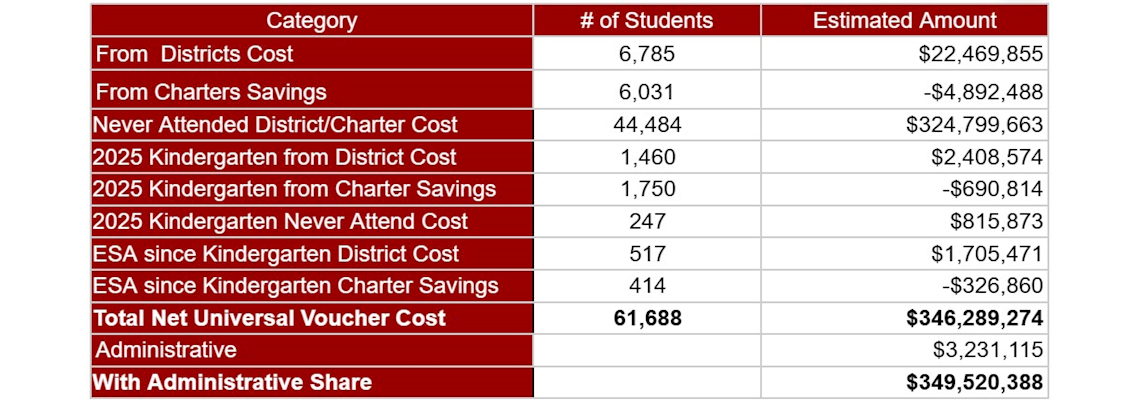
  • 73% of Universal ESA voucher enrollees have never attended district or charter schools (including adjustments for students entering Kindergarten).
  • In FY2025, however, net new Universal ESA voucher enrollees primarily came from charter and district schools.
  • While the total cost of the overall ESA program in FY2025 is expected to be $872 million, the net cost after adjusting for where students would have otherwise attended is $350 million for those in the universal ESA voucher program. This represents a slight increase from the $332 million estimated by the Grand Canyon Institute last year.

The Grand Canyon Institute (GCI) estimates a $350 million net cost to the state’s General Fund in FY2025 (July 2024-June 2025) for the universal component of Arizona’s Empowerment Scholarship Account (ESA) voucher program based on a student’s school of origin. This represents a slight increase over the estimated FY2024 cost of $332 million. The estimate assumes basic student funding weights. 

The Joint Legislative  Budget Committee currently estimates the total annual cost of the ESA program to be $872 million, which includes the original targeted program and the universal component. Because student-level data on the universal program is not separated out by the Arizona Dept. of Education, GCI must estimate the origin of universal program enrollees. GCI’s estimate reflects the net cost the state would have incurred if the universal ESA voucher program did not exist. Almost every single child in the original targeted program had to attend a district or charter school for at least 45 days before enrolling in the program. GCI uses historical data on where the targeted students had come from previously, dating back to FY2017, along with current data on where all ESA students have left district or charter schools to estimate the distribution of students across district and charter schools for the original targeted program and the remainder are allocated to the universal program. 


In FY2025, the net growth in the universal ESA vouchers was 7,660 of the total enrollment of 61,688. GCI estimates that 73% of ESA universal voucher recipients never attended a district or charter school, slightly lower than the rate of 80% in FY2025. This includes estimates for kindergarten students using ESA universal vouchers. 

The primary driver of the change in FY2025 was a significant increase in the portion of net new enrollees from district and charter schools. GCI examined the marginal changes since last year and estimates that nearly half the net gain in universal participants of 7,660 from FY2024Q2 to FY2025Q2 came via Kindergarten. Analyzing changes in the portion of students previously attending a district or charter school, GCI estimates that less than 10% never attended (or would have never attended for Kindergarten) while half came from charter schools and just over 40% came from districts.

This change helped lessen the growth of the net cost of the program. GCI presumes that Kindergarten students do not have a record of prior attendance but would mirror the same distribution.  Given that charter school enrollment is about one-fourth of district enrollment, charter schools have been significantly disproportionately impacted by the Universal ESA program.

Despite the change in FY2025, the majority of participants in the universal ESA program never attended a district or charter school should be self-evident. For FY2025, the Quarter 3 Executive and Legislative ESA report identifies that of the total 87,602 students enrolled in the ESA voucher program (targeted and universal), regardless of when they first enrolled, only 33,942 students  moved from charter or district schools to an ESA. Virtually all targeted participants must first enroll in a district or charter school first. The universal program does not require prior attendance. 

Access the full report here.

The Grand Canyon Institute, a 501(c) 3 nonprofit organization, is a centrist think tank led by a bipartisan group of former state lawmakers, economists, community leaders and academicians. The Grand Canyon Institute serves as an independent voice reflecting a pragmatic approach to addressing economic, fiscal, budgetary and taxation issues confronting Arizona.

Republicans have wanted to gut the National Endowments for the Arts and Humanities for many years. In the past, they targeted the National Endowment for the Arts by focusing on artists whose work offended them. Somehow the Endowments managed to survive. But not this year. Elon Musk’s DOGS eliminated their funding. One victim of the cuts was National History Day, a competition that encourages the study of history.

Allison Dentzel of MSNBC reported:

This week, thousands of students traveled to the University of Maryland for the annual National History Day contest. However, this year’s competition celebrating America’s history almost didn’t happen after the Trump administration abruptly gutted the organizing nonprofit’s funding in April.

The organization received termination letters for its four-year grant totaling $650,000.

For more than 50 years, students at middle and high schools across the country attempt to qualify for the competition by submitting a historical research project based on that year’s theme. Students can write papers, prepare exhibits or performances, produce documentaries or create a website. After qualifying at the local and state levels, contestants are invited to take part in the national competition in College Park, Maryland.

But in April, the event was put in jeopardy after the Department of Government Efficiency terminated more than 1,000 National Endowment for the Humanities grants, including money for National History Day. The organization received termination letters for its four-year grant totaling $650,000, USA Today reported.

Without the government’s assistance and the competition just weeks away, the executive director of National History Day turned to social media. “We need your help,” Cathy Gorn said in a video posted to Instagram in early April. “We need to raise in the next few months about $132,000 to make History Day happen in June.”

Gorn’s public plea worked: NHD raised the money it needed, and about 3,000 students were able to present their projects on this year’s timely theme, “Rights and Responsibilities in History.”

“They are very in tune to what’s happening in the world, and they’re concerned, and they want to know more,” Gorn told USA Today. “And they’re drawn naturally to topics of fairness. So you’ll see a lot of civil rights, human rights, justice-type of topics here, but that’s so natural for a young person to kind of gravitate in that direction.”

While this year’s competition survived, the future of National History Day remains uncertain.

“Everybody is here, but I don’t know what next year is going to look like,” Gorn told USA Today. “It’ll be a horrible, horrible shame for kids and teachers not to be able to participate.”

Even though the fate of the 2026 competition is up in the air, NHD has selected its theme: “Revolution, Reaction, Reform in History.”

Aaron Tang, a law professor at the University of California, Davis, explains how the U.S. Supreme Court is more dangerous to the future of public schools than Trump’s policies.

He writes in Politico:

The greatest threat to public education in America isn’t Donald Trump.

Yes, he’s moving to dismantle the Department of Education, and yes, he’s trying to restrict what schools can teach about race. But the most dangerous attack on the horizon isn’t coming from the president, it’s coming from the Supreme Court.

This is a particularly disheartening reality because the Supreme Court has often been one of public education’s greatest champions. As far back as 1954, in Brown v. Board of Education, the court described public schooling as “the very foundation of good citizenship” and the “most important function of state and local governments.” Just four years ago, in an 8-1 opinion involving a Snapchatting cheerleader, the court proudly declared that “Public schools are the nurseries of democracy.”

Later this month, however, the court will hear oral argument in a pair of cases with the potential to radically destabilize public schools as we know them. And there is reason to be deeply worried about how the conservative majority will rule.

The first case, Oklahoma Statewide Charter School Board v. Drummond, poses the question of whether the 46 states with charter schools must offer public funds to schools that would teach religious doctrine as truth. The second case, Mahmoud v. Taylor, involves the claim that religious parents should have a right to opt their children out of controversial public school curricula.

Takentogether, Drummond and Mahmoud threaten the twin cornerstones of the American education system that Brown affirmed six decades ago: Since Brown, America’s public schools have operated under a norm of inclusive enrollment, and they’ve offered all children a shared curriculum that reflects the values that communities believe are essential for civic participation and economic success.

If the court tears down these foundational norms, the schools that remain in their wake will be a shell of the democracy-promoting institution the court itself has long lionized — and that healthy majorities of parents continue to support in their local neighborhoods. And although there’s a way to avoid the worst outcome in both cases, the path ahead is uncertain: It will require the court to follow history in an evenhanded manner (in Drummond) and progressives to accept a middle ground (in Mahmoud).

The legal challenges presented in Drummond and Mahmoud did not arise out of thin air. They are part of a long-term conservative movement strategy aimed at eroding public education.

A major component of this strategy has been a consistent call to fund school choice, a broad umbrella term that encompasses various programs such as school vouchers and educational savings accounts that channel taxpayer dollars away from traditional public schools and into private ones. Drummond’s call for a constitutional right to taxpayer-funded religious education can thus be thought of as a major front in Project 2025’s “core principle” of “significantly advanc[ing] education choice.”

Conservatives have likewise sought to brand public schools as purveyors of “woke” ideology rather than facilitators of a shared set of community values. The claim at issue in Mahmoud — a parental right to opt out of curricular choices that some find religiously objectionable — is accordingly another salvo in the broader culture wars, and one in which conservatives are asking the court to grant them a legal trump card.

Ultimately, to a significant cross-section of the Republican Party, public schools are now the “radical, anti-American” enemy. And viewed from that perspective, Drummond and Mahmoud may represent the greatest chance for delivering a knockout blow.

Drummond and Inclusive Enrollment

Technically, the Drummond case is just about Oklahoma. That’s because it arose out of Oklahoma’s refusal to fund a religious charter school named the St. Isidore of Seville Catholic Virtual School. (According to St. Isidore’s handbook, “the traditions and teachings of the Catholic Church and the virtue of Christian living permeate the school day.”)

But make no mistake: It is blue states that have the most to lose in this case. For if St. Isidore has a right to public funding in Oklahoma, that same right would exist for religious charter schools in California and New York — places where, until now, taxpayer funds have never been used to teach religion as truth to K-12 students.

It is hard to overstate how big a sea change this would be. Nonreligious charter schools currently receive more than $26 billion in public funds and educate some four million children. So a ruling in favor of religious charter schools could mean billions of dollars for religious education — a prospect that one Catholic school executive called “game-changing” for how it would enable religious schools to “grow [their] network.”

But the implications are far more than monetary. They strike at the very vision of public schools as places where children come together from all walks of life to learn what the Supreme Court once called the “values on which our society rests.” Bankrolled by taxpayer dollars, Drummond would transform the American education system into a taxpayer-funded mechanism for transmitting each family’s preferred religious tenets.

What is more, religious charter schools will likely argue that they have a further Free Exercise right to restrict enrollment only to adherents of their particular faith (indeed, a religious private school in Maine has already advanced this claim). At the end of that argument is a publicly funded K-12 education system that tribalizes the American people at a time when we need to be doing exactly the opposite: forging bonds of connection across our differences.

Justice Thurgood Marshall once cautioned that “unless our children begin to learn together, there is little hope that our people will ever learn to live together.” If the court rules for the religious charter schools in Drummond, we will come one giant — and regrettable — step closer to the world Marshall feared.

Mahmoud and the Attack on Curriculum

The Mahmoud case emerged out of a 2022 Montgomery County, Maryland, school board policy that introduced a new set of LGBTQ-inclusive storybooks into its pre-K through 12th-grade language arts curriculum. In general, the books aimed at instilling respect and civility for people from different backgrounds. In practice, though, the books led to controversy. One of the books, entitled Pride Puppy, was directed at pre-K students and invited students to search for images of a lip ring and a drag queen.

Montgomery County initially permitted parents to opt their children out of reading these new books. But the district soon changed course, which is what led the Mahmoud family to sue. Their argument was that the Free Exercise Clause grants parents like them the “right to opt their children out of public school instruction that would substantially interfere with their religious development.”

This is a truly difficult case, even for someone who, like me, holds an unyielding commitment to ensuring that all LGBTQ students feel safe at school. But one can hold that commitment while also acknowledging that the choice to force children as young as five years old to read books like Pride Puppy over their parents’ objection is not an obvious one. Indeed, Montgomery County has since removed Pride Puppy from its curriculum — a reasonable concession.

The great danger in this case, though, is not about the parental right to opt 5- and 6-year-olds out of controversial curricula. It’s that a decision recognizing a parental opt-out right would be difficult to contain via a sensible limiting principle. Would parents of middle or high school children enjoy a similar right to opt their children out of any assignment or reading that espouses support for LGBTQ rights? How about a right to opt out of science classes that teach biology or evolution? And what of history classes that some religious parents may find too secular for their liking?

In all of those contexts, lower federal courts had unanimously rejected the contention that simply because a parent finds something to be religiously objectionable, they can excuse their child from a shared curricular goal. Mahmoud could upend that settled consensus and replace it with a world in which public schools are forced to offer bespoke curricula to all different families based on their particular religious commitments.

That’s a recipe for an education system that would certainly teach some values to our children. But this much is for sure: They would no longer be shared ones.

How to Save Public Education at the Court

The plaintiffs in both Drummond and Mahmoud may be optimistic that the 6-3 conservative supermajority will side with them. After all, religious litigants have fared remarkably well at the Supreme Court of late.

But a surprising obstacle exists in the Drummond case — and Maryland officials, if they are smart, may yet have the final word in Mahmoud.

In Drummond, the best argument against the claimed Free Exercise right to taxpayer-funded religious schools comes from the very place that the conservative Supreme Court has lately looked to move the law right on abortion and guns: history and tradition.

As Ethan Hutt, a leading historian of education, and I show in a forthcoming paper, it turns out the denial of funding that St. Isidore complains of today is something that happened routinely during the founding era. Yet no one — no parent, no religious leader, not even a religious school that was denied funds on equal terms with its nonsectarian counterparts — ever filed a lawsuit (much less won one) arguing that the right to Free Exercise demanded otherwise.

This is precisely the historic pattern that the Supreme Court relied on to reject the right to abortion in Dobbs: “When legislators began to [ban abortion in the 19th century], no one, as far as we are aware, argued that [they had] violated a fundamental right.”

If the absence of legal contestation in the face of government action 200 years ago shows that the Constitution’s original meaning does not encompass a claimed right to abortion, it’s hard to see why that logic should differ when the claimed right involves religious school funding. Put simply, the court can be consistently originalist, or it can recognize the religious charter school funding right claimed in Drummond. But it can’t do both.

The legal argument to protect public education is less clear in Mahmoud. But in that case, there is another way to steer clear of a Supreme Court ruling that would imperil evolution, biology, history and LGBTQ-inclusive lessons in the upper grades: Maryland officials can override the Montgomery County policy and extend an opt-out choice to parents of young children like the Mahmouds.

There would be clear precedent for such an action by the state. After New York officials took a similar step to eliminate a policy dispute in a major gun case in 2020, the court dismissed that case as moot — putting off a dangerous ruling for at least the time being.

Of course, doing so would require lawmakers in Maryland to accept parents of young children choosing to withdraw their children from reading controversial LGBTQ-inclusive books. But perhaps lawmakers can see a principled distinction between the desire to make schools a safe space for LGBTQ children — a nonnegotiable, core value — and the desire to use elementary school classrooms as a tool for changing hearts and minds on controversial topics more generally.

In truth, progressives were probably never going to win that battle in kindergarten classrooms, especially with the present political climate. Progress on social attitudes concerning the transgender community was always more likely through the same mechanisms that produced rapid change for the gay and lesbian community — mainstream media, social media and the critical realization that our friends, family and other loved ones are members of these different communities and deserve equal respect.


In the end, the Supreme Court may choose simply to ignore history and tradition in Drummond, where it is inconvenient for a movement conservative cause. And a policy change in Maryland could simply delay the inevitable, as new cases could always be brought advancing

The bigger takeaway, then, is about the war against public education and its likely toll. Public schools were a major part of what made America great. So in seeking public education’s demise, the Drummond and Mahmoud cases could portend staggering consequences: less social tolerance, reduced international competitiveness and continued inequality along economic and racial lines.

But the greatest cost may be for our democracy. After all, the Supreme Court reminded us just four short years ago that public schools are where our democracy is cultivated. That’s why the timing of these cases could not be any worse. In a moment when American democracy is being tested like never before, the court should be the last institution — not the leading one — to dismantle our public schools.

After nearly a year of bargaining, the Chicago Teachers Union reached a landmark agreement with the City of Chicago and the school board. Karen Lewis, the late President of the Chicago Teachers, was a champion for the city’s children, their teachers, and the public schools. She must be smiling in heaven to see what the CTU has accomplished.

The CTU announced:

Chicago Teachers Union

NEWS ADVISORY: 
For Immediate Release

April 2, 2025

CONTACT:312-329-9100
Communications@ctulocal1.org

CTU to Hold Press Conference to Announce Results of Special House of Delegates Meeting

Union to announce results of next step to transform Chicago Public Schools after the 60+ rank and file members of the Big Bargaining Team sent tentative agreement to the House of Delegate members for approval.

What: Press conference announcing results of House of Delegates vote

Where: Chicago Teachers Union, 1901 W Carroll Ave; enter through the East entrance off Wolcott; parking will be available for camera trucks in the South lot (on Fulton)

When: Immediately following House of Delegates meeting (Meeting starts at 4:45pm and we will alert press once the media is adjourned)

Who: CTU officers, big bargaining team members, and elected delegates

In the next step toward ratifying a contract that represents a major leap forward in the process of transforming Chicago Public Schools started by CTU in 2012, the union will hold a special House of Delegates meeting on Wednesday, April 2nd. At the meeting, the elected delegates of the union will vote on whether or not the tentative agreement landed by the 60 rank and file members of the Big Bargaining Team shall be sent to the full membership for a vote as early as next week.

The union will hold a press conference immediately following the meeting to announce whether the tentative agreement that creates smaller class sizes, a historic investment in sports, grants recess students were being denied, and enshrines protections for Black history and academic freedom – among more than 150 other items – is going to a full membership vote or back to the bargaining table for improvements.

BACKGROUND

After more than eleven months of bargaining, working without a contract throughout the entire school year, and for the first time in more than 15 years of doing so without a strike or strike vote, the Chicago Teachers Union announced their big bargaining team made up of rank and file members approved a tentative agreement with Chicago Public Schools.

The tentative agreement will go to CTU’s House of Delegates Wednesday which will decide whether or not to advance it to CTU’s 30,000 members for a ratification vote. If accepted, it will represent a major leap forward in the transformation of a district that is still recovering from the gutting and financial irresponsibility carried out by Trump’s Project 2025 style efforts under Rahm Emanuel, Arne Duncan, Paul Vallas, and other privatization forces that closed over 200 public schools between 2002 and 2018.

Despite the efforts of right wing actors like Paul Vallas, The Liberty Justice Center, and Illinois Policy Institute, and the MAGA forces that seek to deny the investments Chicago’s students deserve, this proposed contract builds upon the past several contracts won by CTU in 2012, 2016, and 2019. It charts a new direction of investment, expansion of sustainable community and dual language schools, increased staffing, and a focus on reparatory equity to provide the educational experience Chicago students deserve no matter what neighborhood they live in.

The 2012 strike won the air conditioning that kept CPS open during the back-to-school heatwave at the beginning of the school year. 2016 established the model of 20 sustainable community schools, a program that helped to stabilize and resource schools like Dyett High School whose boy’s basketball team won the state championship this year. 2019 won social workers and nurses in every school and established the sanctuary status that protected CPS students from Trump’s federal agents earlier this year.

In 2025, some highlights of the Chicago Teachers Union contract include:

  • Doubles the number of libraries and librarians for our schools
  • Enforceable and smaller class sizes for all grade levels
  • Ensuring social workers and nurses serve students in every school, every instructional day
  • Doubles the bilingual education staffing supports for students 
  • Additional staffing, curricular and enrollment supports for Early Childhood education students and programs. 
  • Creates 215 more case manager positions district-wide to support students with disabilities. 
  • A cost of living adjustment of 17-20% compounded (tied to inflation) over the four years of the contract
  • Provide new steps that compensate veteran educators for their experience
  • Increases in prep time for clinicians, elementary and special education teachers so students arrive to classrooms ready for them
  • Expanded benefits for dental, vision, infertility and abortion care, gender-affirming care, hearing aids, speech therapy, physical therapy, occupational therapy, chiropractic services
  • A more than tripling of the number of Sustainable Community Schools, from 20 to 70, over the course of the agreement. 
  • Provides CTU, CPS, City and sister agency coordination for the first time to provide housing support, section 8 vouchers, rental assistance and affordable units to CPS families in need. 
  • Enshrines 12 weeks paid parental leave, equal parental, personal illness, and supplemental leave rights for PSRPs to teachers
  • A Green Schools initiation of additional resources and collaboration to remediate lead, asbestos and mold in aging school buildings while upgrading to green energy with environmentally sustainable technology, materials and practices. 
  • Protections for academic freedom, Black history, and culturally relevant curriculum for the first time in the contract. 
  • An additional $10 million annual investment in sports programming
  • Protections for academic freedom that enshrine educators’ ability to teach Black, indigenous, and other history
  • Continuation of Sanctuary School procedures
  • A new article that creates LGBTQIA+ safe schools

See the full list of tentative agreements at https://www.ctulocal1.org/movement/contract-2024.

“Our union is bargaining for what every parent wants for their child in our school communities. It shouldn’t be a fight for children to get access to arts, sports, wrap around supports, and libraries. It’s what should already exist,” explains CTU Local 1 President Stacy Davis Gates. “We’re proud to have landed a transformative contract that turns away from decades of disinvesting in Black children and turns toward creating the world-class education system for every single student in CPS no matter their zip code. If the contract is ratified by our members, we will be one major leap forward toward the educational experience Chicago’s children and the mainly women workers who serve them in our schools deserve.”

Additional Information:

###

The Chicago Teachers Union represents nearly 30,000 teachers and educational support personnel working in schools funded by City of Chicago School District 299, and by extension, more than 300,000 students and families they serve. The CTU is an affiliate of the American Federation of Teachers and the Illinois Federation of Teachers and is the third-largest teachers local in the United States. For more information, please visit the CTU website at www.ctulocal1.org.

Carol Kocivar is former President of the California State PTA. She has worked as an attorney, journalist, and ombudsperson and is the parent to two children who graduated from the San Francisco public schools

She posts on Substack, where this appeared.

She writes:

Scary as this may seem, it is time to talk with your children about how our democracy is threatened.

I know.  I know. Those are strong words.  I certainly am not suggesting that we ask first graders whether the president should have more power than the Congress or the Supreme Court.
But I am looking at this through the lens of history– with the knowledge that Hitler and Mussolini strengthened their hold through the indoctrination of youth.

Our children are not born with democracy in their DNA.  It is our responsibility to ensure that each generation has the knowledge and skills to support and preserve our democracy.

Political outreach to children is already underway. Below is an example of a Kid’s Guide on the internet. 

“With the triumphant return of President Trump to the White House, Americans everywhere are celebrating his return and what it means for our nation. And, as our kids are the future of our country, it’s important for them to understand how Trump will make America great again. That’s why we created The Kids Guide to President Trump, and right now we’re giving it away for FREE!”


Kids are taught about the Constitution in school
In elementary school, students should already have some basic knowledge about how our government is supposed to work. By the time they have completed the 8th grade, they should know the basics of our constitutional democracy. 
For example, the California History/ Social Science frameworks provides that 8th graders should be taught about separation of powers, checks and balances, the nature and purpose of majority rule, and the ways in which the American idea of constitutionalism preserves individual rights.

  • They should know, for example, that the president is not a king.  
  • They should know that the Congress passes laws, not the president.  
  • They should know that the President and his staff cannot refuse to follow court orders.
  • They should know the president does not have the right to refuse to implement spending decisions of Congress.
  • They should know their rights include freedom of speech.

What can parents do?

In age appropriate language, discuss current events with them.   I was going to say discuss it at the dinner table but you probably have a better shot at their attention as you drive to and from sports events.

Seek out incidents that challenge the basic principles of our democracy and discuss them.

What do they think? How does that square with what they know about the constitution?

Explain why you think it is important that they understand what is happening in the country.

Discuss money for schools.  Does their public school need more or less money?  What do they think about cutting funding for their school? 

Talk about the importance of voting.  Can voting change public policy?

Ask what would help them become more involved in issues that affect their school? Their community? Their country?

It’s up to us to preserve democracy for our children.

Olga Lautman is a fearless defender of democracy. She keeps close tabs on authoritarian regimes and has had many reasons to should the alarm since the return of Trump. Now that Trump controls the executive branch, Congress, and usually the Supreme Court (where he occasionally loses when Barrett and Roberts dissent), he is on a path to tyranny.

She warns that his crackdown on dissent is a decisive step towards full-fledged authoritarianism. Let me add as a personal that not all forms of dissent are legal, even by the most liberal definition. As Justice Oliver Wendell Holmes wrote, you can’t shout “Fire!” in a crowded theater. While I support student protests, there are reasonable limits defined by time, place, and manner. If students prevent others from learning by disrupting their classrooms or closing the library, that’s out of line, in my view. You are free to disagree. That’s your right, as it is mine.

Lautman writes:

Trump’s Crackdown: Silencing Dissent and Censoring the Press

While Trump floods the zone with chaos, I am watching a deeply disturbing pattern emerge. Recently, he has targeted universities under the guise of combating antisemitism, threatening to cut funding, open investigations, and deport foreign students involved in what he deems “illegal protests.” This move to silence student voices is part of a broader strategy—Trump is systematically laying the groundwork to criminalize dissent. Concurrently, he has continued to invoke emergency powers over immigration, granting himself sweeping authority with minimal oversight. 

Adding to this concerning trend, Trump is weaponizing the Federal Communications Commission to suppress media freedom. Under his regime, the FCC has initiated investigations into major news organizations like NPR and PBS, scrutinizing their content and funding. The White House has also barred Associated Press reporters from covering presidential events, citing disagreements over “terminology.” Furthermore, the regime has taken control of the White House press pool, deciding which journalists can cover presidential activities, effectively beginning the process of sidelining independent media voices.

Today, the targets are “antisemitism” and “immigration.” Tomorrow, it could be any form of resistance to the regime. This pattern mirrors tactics employed by autocratic governments, where laws and regulations are manipulated to suppress opposition and control public discourse. It is imperative to recognize and challenge these encroachments on our democratic freedoms before dissent becomes a criminal act, and that is why I felt it was important to bring it to everyone’s attention.

The Playbook of Repression

Trump’s attacks on universities have nothing to do with stopping antisemitism. If they did, there would be a serious, balanced approach to addressing hate across the board. Instead, he’s selectively using it as a pretext to punish colleges, strip funding, launch investigations, and lay the groundwork for broader crackdowns on protests. These moves, along with the threat to deport foreign students who participate in protests, are a classic authoritarian tactic—silencing youth movements before they become a real threat.

In Russia, we have seen this exact strategy play out. Putin started by using the language of “public order” to justify suppressing protests. Then, he expanded it to clamp down on journalists, opposition figures, and universities. Today, any form of public dissent in Russia is met with immediate arrests, long prison sentences, or exile.

Trump is following the same playbook. First, redefine what qualifies as a legal protest. Then, frame all opposition as a national security threat. Finally, implement policies that criminalize resistance. Let’s not forget—during his first term, Trump wanted the military to shoot protesters, but guardrails stopped him. Now, with those guardrails gone and loyalists installed in key positions, he is laying the groundwork to justify an all-out assault on free speech and assembly, using the rhetoric of “law and order” to disguise repression as a “necessary” security measure.

The Danger of Emergency Powers

Trump’s continuing invocation of emergency powers on immigration is another red flag. Emergency powers are not inherently undemocratic, but in the wrong hands, they are a tool for consolidating unchecked authority. In Russia, Putin used emergencies—terrorist attacks, economic crises, and foreign threats—to justify expanding his power. Each crisis became an excuse to centralize control and dismantle any resistance to the regime.

Trump is testing the limits of emergency powers to override legal norms. He has already deployed the military on U.S. soil for immigration enforcement—what stops him from escalating further? With the Insurrection Act looming in the background, he is laying the groundwork to use military force against civilians under the pretense of a “national emergency.”

This is Just the Beginning

We are witnessing the early stages of a full-blown authoritarian shift. The selective targeting of student protesters, the abuse of emergency powers, and the push to redefine “illegal protests” are all interconnected. Today, it’s about silencing students. Tomorrow, it will be about crushing unions, blacklisting journalists, or jailing political opponents.

This is not alarmism—it’s a pattern seen time and again in authoritarian regimes. And it’s why we must sound the alarm now.

What Can We Do?

Expose and Document – Share information, track developments, and call out every attempt to silence dissent. Authoritarians thrive on people looking the other way.

Support Targeted Groups – Defend students, journalists, unions, and activists under attack. Legal funds, advocacy groups, and independent media need resources to fight back.

Pressure Lawmakers – Demand that Congress and state governments put up real resistance. Emergency powers must be challenged, and unconstitutional crackdowns must be met with legal action.

Mobilize and Protest – Peaceful mass protests and civil resistance are essential. Authoritarianism collapses when people refuse to comply.

Prepare for Escalation – The time to organize networks and alternative platforms is now and will be critical to keeping resistance alive.

The question is not whether Trump will attempt to consolidate power—it’s whether Americans will resist before it’s too late.

Jess Piper lives on a farm in Missouri. She has been fighting for years against the mean-spirited policies of the Republicans in her state. She’s also pushed hard to persuade the Democrats to run candidates in rural counties, which they have written off.

In this post, she calls on parents, teachers, and decent folks to speak out against the lawsuit to kill Section 504, which protects the rights of people with disabilities.

She writes:

I loved my Kentucky-born grandma. She was one of 12 kids who lived in a small cabin in a valley next to a creek in Harlan. She made bologna gravy and fried chicken, but every time I visited, she made potato soup and a German Chocolate Cake. She knew they were my favorites.

She called me Jessie and I loved to sit and listen to her talk. You had to pry the stories out, but once she started, her narratives always kept me laughing or crying. 

I miss her.

My grandma pictured with her siblings and parents. Harlan, Kentucky — 1930 something.

I was one of the first on that side of my family to graduate from college. When I received my MA in Education, my grandparents came all the way down to Arkansas to celebrate the day with me. They were very proud, but especially Grandma. She was proud to have a teacher in the family.

One day, years later, she asked me a question, “Jessie, what happened to education? The kids I went to school with could all read and write. Now, there are so many in school who can’t read well or do math.”

Grandma wasn’t trying to berate me or public schools — she did watch Fox News though and was getting some ideas in her head that didn’t live in reality. Fox regularly ran stories on kids in urban areas falling behind and that part isn’t necessarily untrue, but you and I both know why they focused on urban kids and not rural kids.

I reminded her of a few things about schools back in the 30s and 40s in Kentucky. Her school was poor but not nearly as poor as the Black schools in surrounding counties. I also asked her if she could remember any kids with disabilities in her class or school. She did not remember anyone with a disability, but she did say there were quite a few boys who couldn’t read well and they always dropped out by 6th or 8th grade to go to work on the farm or in a coal mine.

There you go, Grandma. There it is.

I will never forget that scene in “Forrest Gump” when Forrest’s mom had to have sex with the local Principal so her child could be enrolled in school. I know that is likely a stretch, but how far of a stretch?

There were no accommodations back then. If a child presented with a disability, they were most often turned away. Children could legally work on a farm at any age and they could work in a mine by 14. 

The poor kids went to work and the kids with disabilities were shut out.

Grandma understood immediately after our talk…she just hadn’t thought about it much.

Fast forward to 2025 and Missouri is under the boot of a GOP supermajority and an Attorney General with few morals but a lot of hate that he directs at women, minorities, and folks with disabilities…even children.

Missouri AG Andrew Bailey was appointed in 2022 when Eric Schmitt won his Senate race. Don’t get me wrong — Eric Schmitt was nearly as bad and sued Missouri schools to force them to remove mask mandates in 2020. You know, when folks were dying from a global pandemic. 

But, in my opinion, Andrew Bailey is the worst AG we have had in recent memory and that’s saying a lot because Josh Hawley was also a Missouri AG. 

We have scraped the bottom of the barrel with Andrew Bailey.

Bailey is suing China for failing to supply our state with masks during COVID though Bailey has repeatedly said that masks didn’t prevent the spread of COVID.

Bailey is suing Costco for their DEI policies, saying that the private company should be forced to hire more white men because hiring women and people of color is discriminatory.

Bailey is suing Starbucks because he argues that, “Starbucks diversity initiatives have caused higher prices and longer lines,” and that, “Starbucks workforce is more female and less white.” 

Yes, you read that right. I mean, it’s as condescending and racist as it sounds, but his first statement also goes against the Republican mantra of the “free market.” If folks don’t like a line or think the coffee is too high, they can just run over to a Scooter’s or McDonald’s. 

But, it only goes downhill from there…Missouri’s AG has joined a suit to gut the 504 program.

What is Section 504 in plain language?

Section 504 is an important law that protects people with disabilities. 504 says you can’t discriminate against disabled people if you get money from the United States government. Section 504 says you cannot mistreat people because of their disabilities. 

Section 504 has rules that explain what disability discrimination is. The rules say that schools, hospitals, and doctors’ offices have to include people with disabilities. 

In the suit, my AG and sixteen other state AGs are suing because they want to eliminate gender dysphoria from a protected status under 504 — a Biden era addition to protect trans kids. But, the suit asks the court to get rid of all the updated rules – and to get rid of Section 504 altogether. The lawsuit says that Section 504 goes against the United States Constitution.

This will impact so many students in the country. The point is to offer no accommodations for any disability. For any child. 

This is what they meant when they said Make America Great Again. They meant Kentucky in the 1930s.

There are a few things you can do: Call your AG if you live in Alaska, Alabama, Arkansas, Florida, Georgia, Indiana, Iowa, Kansas, Louisiana, Missouri, Montana, Nebraska, South Carolina, South Dakota, Texas, Utah, or West Virginia. Demand that they drop from the lawsuit.

The bright side of this suit is that it is bringing disability and accommodations in front of everyday Americans. Folks who may not understand DEI, understand a 504 — they should know diversity, equity, and inclusion efforts include disability.

Another positive note: my AG has rarely won any suit he has filed or joined. He is very bad at his job because he doesn’t seem to understand the Constitution. I hope this suit ends like most of them do…Bailey, with his tail tucked between his knees, running from cameras.

You can help get the word out by sharing this post or the others I will list at the bottom of this post. 

Tell everyone you know and then start calling. We can’t do everything, but we can do one thing. 

Every day.

~Jess

Sources:

Plain Language Explainer: Texas v. Becerra Section 504 Under Attack: https://www.bazelon.org/wp-content/uploads/2025/01/Plain-Language-Explainer_Texas-v-Becerra.pdf

The Attorneys General in 17 states have sued in federal court to eliminate Section 504, which guarantees the rights of people with disabilities.

If you are a parent of a child with disabilities, you should become active to inform others and to contact your elected representatives.

Here are the states that are involved in this lawsuit:

Here is a fact sheet that should be helpful.

Section 504 assures that every institution that receives federal funds includes people with disabilities.

This is what the Office of Civil Rights of the U.S. Department of Education said about Section 504.

I should warn you, however, that the Office of Civil Rights may not exist anymore. It will probably be transferred to the Civil Rights Division of the Justice Department. The person nominated to lead that office is hostile to many of the civil rights protections that have been law for many years.

Here is a plain language explanation of the lawsuit, prepared by the Disability Rights Education and Defense Fund.

If the suit is successful, it would affect students and everyone else in every state, not just those where the suit was launched.

Wherever you live, join with other parents to protest. Contact all organizations that defend disability rights. Call your local officials.

Don’t let them get away with this attack on the disability rights of your child, which have been the law since 1973.