Archives for category: School Choice

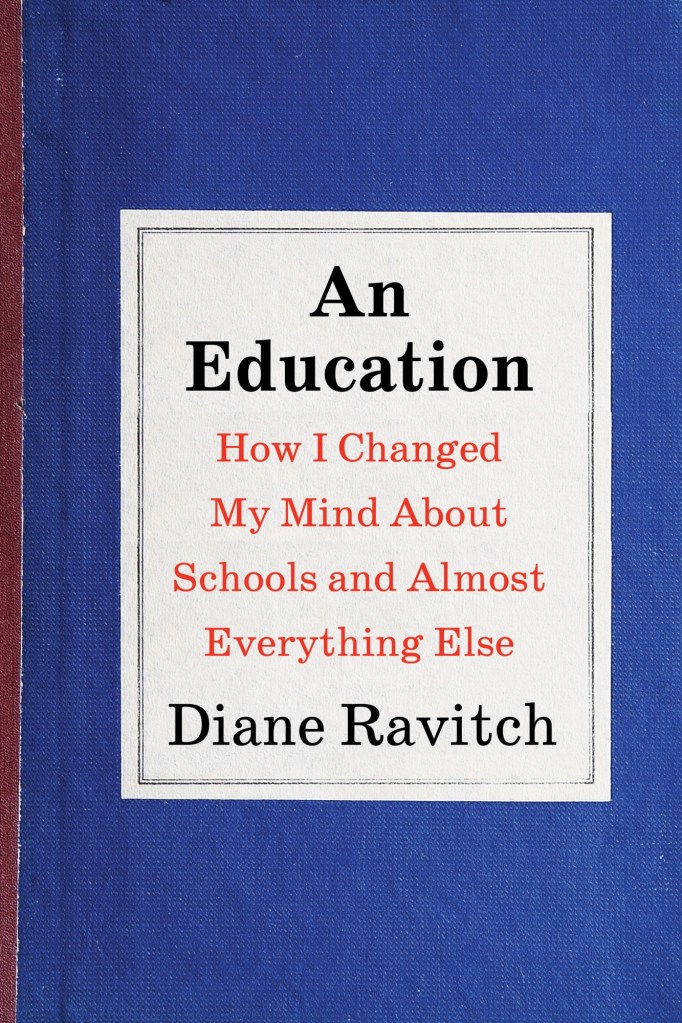
John Thompson, historian and retired teacher in Oklahoma, wrote this thoughtful review of my memoirs, An Education: How I Changed My Mind About Schools and Almost Everything Else.

He writes:

Diane Ravitch’s An Education: How I Changed My Mind About Schools and Almost Everything Else is dedicated to her wife Mary; her sons, Joe, Michael, and Steven; her grandsons Nico, Aidan, Elijah, and Asher; and her ex-husband Richard. An Education intertwines deeply emotional personal and family experiences with the history of how she became such a transformative education leader. Although Diane denies it, I believe she’s the most influential education advocate of the last century.

I’ve been reading Diane Ravitch’s work for decades, but An Education is my favorite book. And my favorite passage started with Diane’s citation of Robert Hutchins who said, “We have to learn to live with those whose opinions differ from our own. After all, they may turn out to be right.”

Then she wrote about Hutchins statement, “for three decades I didn’t realize that it was intended for me.”

Being from Oklahoma, I was captured by the first part of her book, about growing up in Texas. I especially loved her story about meeting Roy Rogers at the Rodeo when she was 9 years old. After Rogers slapped her hand, Diane said, “I determined on the spot that I would never wash that hand again!”

Diane was a tomboy who loved horses and dogs. But she experienced sexism and trauma. She said she “did not have an idyllic adolescence. No one ever does.”  But her teenage years were “destroyed by my father abusing me.” 

During the middle of her book, she recalled her complicated marriage to Richard Ravitch and, then, her wonderful wife, Mary. Mary worked with the progressive educator Deborah Meier and opened a progressive small school in New York City. 

I was especially impressed by Diane’s communication with Al Shanker. He sought to allow teachers to start schools within schools to turnaround kids “in the back of the classroom with their heads on their desks.” Back in the late 1980s, it seemed like he might be able to bring diverse factions together. But, by 1994, charters had been high-jacked by corporate reformers and their winners and losers ideology.

In the middle of An Education. Diane revealed in so much detail the inside stories of her years as a conservative.  Back then, when I was an academic historian, I learned the most about Diane when reading her 1983 book, “The Troubled Crusade: American Education, 1945 – 1980.” Although I couldn’t yet read her work through the eyes of a teacher, I was exceptionally taken by her calls for teaching background knowledge so students could develop reading comprehension skills so they could “read to learn,” and her placing education pedagogies in a broad historical context.

Diane recalls her support for meritocratic, standardized testing, and color-blind policies, when she questioned bilingual education, and even the benefit of the Equal Rights Amendment. This was the time when she made friends with Bill Bennett, President Reagan’s Secretary of Education, and Chester Finn, and Tennessee Governor Lamar Alexander. I knew she had ties to Daniel Patrick Moynihan, but I too thought that progressives’ criticism of him was too politically correct. And, until I read An Education, I knew little about the two sides of James Coleman’s research, whose earlier research had seemed persuasive to me.

Neither would I have thought that Chester Finn was like a “sibling” to Diane.

When explaining her then-conservative beliefs, I sometimes felt that Diane was too hard on herself. For instance, she was far, far from alone in failing to understand the wisdom of Gov. Ann Richards, who said, “If there ever is school choice in Texas, the hard-right Christians will get the money to indoctrinate children.”

Moreover, as An Education schooled me on the propaganda behind the so-called “Texas Miracle” it did more than foreshadow the “New York City Miracle,” the “Harlem Miracle,” and the “Mississippi Miracle.”  It brought me back to the decades-long Oklahoma reality when our curriculum and policies were based on Texas’ accountability systems.  During most of my career, our policies were informed by one Texas trick after another to jack up accountability metrics.

Diane served as member of the National Assessment Governing Board from 1997 to 2004, and she would dig deeply into the numbers and the methodologies behind NAEP. But, as she explained, few journalists read the fine print of the research and they wrote “breathlessly” about supposedly dismal results in traditional public schools. They certainly didn’t report properly about the way that students’ outcomes were linked to family income.

When serving in the Education Department, Diane took a lead in establishing national standards for every school subject. Drawing upon excellent historians, multicultural History standards were set. She hoped standards like those would remain voluntary and “unify their respective fields and establish a common ground for a curriculum without telling teachers how to teach.” 

But the conservative Lynne Cheney “published a scathing denunciation of them.” Cheney said the History standards focused too much on people like Joe McCarthy and the Ku Klux Klan, and not enough on Ulysses S. Grant, and Robert E. Lee. This launched the modern wars over curriculum that have become especially destructive under President Trump. 

Even so, in 2002, Diane hoped that Mayor Mike Bloomberg and Joel Klein (who knew nothing about education) would succeed in improving New York City Schools. Klein reorganized schools from top to bottom, with multiple schools per building drawing on funding by the Gates Foundation. (By the way, I saw the chaos Klein created when visiting dozens of hurriedly opened school, especially in Bedford–Stuyvesant. Usually, leaders of the new schools didn’t even know how many new schools were being opened in their building.)

And, even worse, Jack Welch CEO of General Electric pushed 20-70-10 “stack ranking,” meaning 70% of teachers would be in the middle in terms of effectiveness, and 10% should be “removed,” even if it took the use of invalid and unreliable metrics to evaluate all teachers.

Especially after Diane engaged in a seven-year debate with Deborah Meier, which further “broadened her perspectives,” she became an invaluable leader of the grass-roots opposition to corporate school reforms. She objected to top-down mandates on teaching reading. Diane was among the first to explicitly link in a detailed manner the reforms to the wider privatization movement. And she nailed it when identifying them as the “Billionaires Boys Club.”

Diane analyzed the public relations campaigns which sold “reforms” as the “New York City Miracle.” Drawing upon her insights from serving on the National Assessment Governing Board, she clearly explained why NYC schools flipped back and forth between A and F grades.  Then, she linked President Obama’s flawed $5 billion RTTT experiment with the problems with Common Core curriculum and tests that were years above students’ reading levels.

Diane then quotes John Maynard Keynes who said, “When the facts change, I change my mind. What do you do, sir?”

Today, Diane changes minds by clearly explaining the interconnections between Free Market ideology, and profits, and the mindsets of elites that push privatization. She also reports daily on the interconnected attacks on schools throughout the nation. And now she’s sharing the same wisdom when spreading the word about Trumpism and today’s attacks on democracy.

I always read Diane’s daily blog posts. And I so very much appreciate An Education, even if it briefly pulled me away from reading everything in the Diane Ravitch Blog.
Jeff Yass is one of the richest people in the world. He is the richest person in Pennsylvania. He is #25 or #27 on Bloomberg’s Billionaires’ Index, depending on which day you check. His net worth is about $65 billion. He co-founded the Susquehanna International Group, which is based in Pennsylvania. He is also a major investor in TikTok and is widely believed to have persuaded Trump not to ban it. In the last decade, he has given hundreds of millions to political campaigns, including the 2024 Trump campaign.

Yass was recently interviewed by The Washington Post, where he talked about his passion: Vouchers. The writers of the article were Laura Meckler, Beth Reinhard, and Clara Ence Morse.

Yass thinks the public should pay for students to go wherever their parents want them to go: to private schools, religious schools, charter schools, any kind of school, including public schools. He thinks all students should get vouchers, regardless of family income.

He believes the public schools are failing and that universal vouchers will turn American education into a great success.

Yass provided $6 million to Texas Governor Greg Abbott to run pro-voucher Republicans against moderate Republicans who supported public schools. Abbott ran a campaign of lies against the moderate Republicans, asserting that they opposed more funding for public schools and that they supported open borders.

With Yass’s money and Abbott’s lies, they managed to knock off enough moderate Republicans to finally pass a voucher bill. The voucher program is currently costing nearly $1 billion, and most of the voucher money pays the tuition of students previously enrolled in private and religious schools.

The strange part of Yass’s devotion to charter schools and vouchers for religious and private schools is that Jeff is a graduate of the New York City public schools. He graduated from Bayside High School in Queens. He then attended Binghamton University in New York, where he spent most of his time playing poker, betting on horse races, and honing a keen ability to calculate the odds and winning.

As a young man, he read Milton Friedan’s Capitalism and Freedom and became a Friedman devotee. He met Friedman several times; when he asked the great conservative economist which philanthropy he should support, Friedman said “school vouchers.”

Yass jumped in to support school choice. His ideological commitment to them is so strong that he ignores that show that most vouchers are taken by kids already enrolled in non-public schools. He thinks all students should get vouchers, including those whose families are wealthy.

Yass confidently told The Post that studies of voucher programs show “overwhelmingly” positive results. Several early studies of targeted voucher programs have indeed shown positive results on standardized tests, and some research shows positive impacts on other metrics such as college enrollment.

But most research over the past decade or so shows either no effect or a negative impact on test scores for larger-scale programs. Some charter schools struggle with low test scores just like traditional public schools do. That’s at least partly because educating children with many needs and few advantages is a challenging task

Yass maintains that these programs help children. But he also says he doesn’t really care what the studies say or how children perform on tests. He takes the libertarian point of view that all parents should be empowered to choose the school — public or private — that they want for their children, no matter what.

“If the mother or the parent wants the kid to go from one school to another, who the hell is anyone to tell them not to?” he told The Post. “I don’t care what the studies say.”

Yass has spent many millions in his home state of Pennsylvania, but thus far has failed to get sweeping voucher legislation passed.

He has a a starry-eyed and warped view of the U.S. economy.

In a 2021 conversation sponsored by the Adam Smith Society, part of a free-market think tank, he said that the U.S. is almost to the point where “no one” is hungry, cold or lacks basic health insurance.

“What’s the difference between a billionaire and a guy who’s making $100,000 a year? They’re both at home watching Netflix. And they’re both on their iPhones,” he said then. “The disparity between how rich people live and how poor people live in America has never been smaller.”

Government data shows that in 2024, there were 27 million uninsured Americans and in 2023, 18 million households were uncertain if they would have enough food. Wealth inequality has been rising for decades, with the richest families increasing their wealth at a faster rate than everyone else.

Despite Yass’s multi-million dollar contributions to candidates in Pennsylvania, his candidates have frequently lost. Yass has been singled out by protest groups who resent his efforts to buy elections and determine the future of the state.

Critics say his giving represents an absurd amount of influence for one person, who can press his political agenda simply because he is rich….

“Hey hey! Ho ho! Billionaires have got to go!” chanted about 50 protesters marching to Susquehanna’s front door. The group outside Yass’s office in late September wasn’t an unusual sight. All Eyes on Yass, a coalition of education, labor and civil rights groups, has worked to turn Yass into the state’s prime villain, creating an online “Yass tracker” that allows voters to look up whether their state elected officials have received money from Yass-funded PACs.

The protestors organized in response to Yass’s efforts to change the composition of the State Supreme Court.

In the last election, he supported three Republican candidates trying to defeat three Democratic judges on the State Supreme Court. All three of his candidates lost.

It was the 12th demonstration since 2022 organized by All Eyes on Yass. In a year when Musk’s role at the White House prompted intense criticism of billionaires in politics, this group stands out in its singular and persistent focus on Pennsylvania’s richest man.


“We’re here with a simple message: Billionaires like Jeff Yass can’t steal our elections,” said Raquel Jackson-Stone, 32, who works for a civil rights group called One Pennsylvania. “They don’t care about the same things we care about, like housing affordability and making our public schools better…”

Yass rarely if ever interacts with people he disagrees with on this subject. He volunteered to The Post that in business, he advises his employees to seek out alternative points of view. “I always say, ‘Go find the smartest person who disagrees with you,’” he said.

But he said he has never had a personal conversation with a public education advocate to try to understand their point of view. “I would love to do that,” he said….

In the interview with The Post, Yass stood by his comments. He said the divide in America is not about money but about how much satisfaction people get from their work. “That’s the inequality. Wealthy, educated people enjoy their jobs. Lower-income people don’t enjoy their jobs.”

His confidence feeds his opponents but also his conviction to keep spending. If the criticism bothers him, he doesn’t let it show. He sees no problem with one man using money made on Wall Street to press a personal agenda. And he compares his influence not against that of other individuals but to teachers unions and other large interest groups that represent thousands of people each.

As Yass sees it, he’s the one fighting for the underdog — a billionaire speaking up for those who don’t have billions.

“It’s David versus Goliath,” he said. “I represent David.”

So Jeff Yass has never talked to a public education advocate to test his views. I volunteer.

I was interviewed by Brian Lehrer of WNYC, public radio about my latest book, probably my last. He is a great interviewer. He asks good questions, followed by people who called in to disagree with me.

It’s an excellent interview.

I apologize if I’m browbeating you with stuff about my book, but the book is really good; I worked on it for two years; the mainstream media has ignored it; and I think you will enjoy reading it.

In case you haven’t noticed, the title is:

An Education: How I Changed My Mind About Schools And Almost Everything Else (Columbia University Press). You can buy it from Columbia University Press, your local independent bookstore, or Amazon.

Republicans opposed the creation of the U.S. Department of Education. In 1979, President Jimmy Carter promised the NEA that he would push it through. Republicans fought it but he had the votes, and it was created. While NEA wanted the Department, Albert Shanker of the AFT was against it. He feared that the federal government would exert too much control over schools and that education might be politicized, with each party pushing its agenda. He preferred a department of education, labor, and social services.

Now, the Trump administration is dismantling the U.S. Department of Education. They have not sought Congressional approval, which is necessary to eliminate an authorized Department. Instead, they are eliminating it by layoffs and shifting programs to other departments. There may be a “Departnent of Education,” but the building will be empty. No one will be enforcing laws protecting the rights of children with disabilities. The Office of Civil Rights will likely go to the Justice Departnent, where it will not enforce the civil rights of women and racial minorities, but will make sure that schools stamp out DEI and deny any protections to transgender students.

Peter Greene writes:

The continued dismantling of the federal Department of Education is both a con and a lie, one more piece of a quilt of patchwork policies all built around a simple idea– some people are better than others, and the uppity lessers really ought to learn their place. And the rhetoric being used to sell the dismantling is a lie.

The over-simplified version of the department’s origin comes in two parts. First, Congress created some major funding streams meant to level the playing field for students and families, and with those funding streams, some civil rights laws to make sure states leveled their own playing fields for schooling and education. Second, Jimmy Carter, who had promised a cabinet-level ed department (and who wanted to be re-elected) proposed the department as a way to collect, organize, and administer the various policies.

The department’s job was never supposed to be to determine what an excellent education should be. It was supposed to make sure that whatever a good education was presumed to be in your state, everybody got one. So even if a child was presumed to be a poor Lesser, a future meat widget, a child whose special needs made them harder to educate– no matter what, the district and state were supposed to have the resources to meet the challenge. The quality of a child’s education was not supposed to depend on their zip code. 

This does not fit well with the current regime’s conception of civil rights, a conception rooted in the notion that the only oppressed group in this country is white guys, or their conception of democracy, a conception rooted in the notion that some people really are better than others and therefor deserve more power and privilege. (Nor does the regime love the idea of loaning people money for college and not collecting it).

So they’ve undone the second step of the department’s creation, and parceled out a bunch of programs to other departments, a move that philosophically advances the idea that education has no point or purpose in and of itself, but exists only to serve other interests.

For example, as Jennifer Berkshire points out, now that the Department of Labor exists to serve the interests of bosses, its interest in education centers on producing more compliant meat widgets to serve boss’s interests. Meanwhile, the ed programs now farmed over to the Department of Health and Human Services can be reorganized around RFK Jr.’s interest in eugenics and identifying those lessers whose proper place in society is, apparently, on a slab. 

That unbundling of education programs from the department only undoes the second phase of the department’s origin. But Secretary Linda McMahon’s assertion that these interagency agreement will “cut through layers of red tape” or “return education to the states” is thinly sliced baloney. It’s a lie.

“Instead of dealing with this government department, you will deal with this other government department” does not even remotely equal “You will now have less red tape.” In fact, given that you may have to track down the correct department and then deal with people who don’t have actual expertise and knowledge in education may spell even more red tape.

“We moved this from one government department to another government department” is definitely not the same as “we sent this back to the states.” 

Some programs may be sent back to the states in the sense that the feds would like to zero out the budget entirely which means the states that want to continue those programs will have to create and fund the programns on their own. If you tell your kids, “I’m not making you supper tonight,” I guess that’s kind of like saying “I’m sending the supper program to you.”

But the big ticket items, like IDEA and Title I will still be operating out of DC until such day as Congress decides to rewrite them. And given Dear Leader’s shrinking political capitol, I’m not sure that gutting IDEA is high on his To Do list right now. 

Matt Barnum suggests that gutting the department is largely symbolic and that actual schools won’t feel that much of a difference. On the one hand, that’s true-ish. “What is less clear,” Barnum writes, “is the Trump administration’s longer-term ambitions.” I’m not sure that’s all that mysterious. The far right’s goal, often in tandem with the modernn ed reform movement, is to get government entirely out of the education business while turning education into a get-it-yourself commodity. If government is involved in education at all, it would be 1) to provide a school-shaped holding tank for the difficult students that private schools don’t want and 2) to provide taxpayer funding for schools that deliver the “correct” ideological indoctrination. 

The parcelling-out of the department may only be a small step in that direction, but its long-seething right wing critics can see it as a means of shushing those annoying voices that keep bringing up rules and civil rights and stuff.

The best hope at this point is for a chance to build a new version of the department under a new administration (in an imaginary world in which the Democrats don’t face plant in 2028). But one of the worst things about the department has been the irresistable urge to use those massive grants to force DC-based education ideas on states, and this attack on the department doesn’t really address that problem at all. 

What this latest move clearly does not do is send education back to the states, which is, after all, where education responsibility already rested. The regime may be trying to hamstring and privatize education, but they aren’t sending it anywhere. It’s an unserious lie from unserious people. Stay tuned. 

In this post, Carol Burris reviews the latest challenge to separation of church and state. A religious school has applied for public funding as an online charter school. But that’s not all: the religious school is a tentacle in the vast for-profit empire of the Florida-based Academia charter chain.

Carol Burris is the executive director of the Network for Public Education (NPE). She was a teacher and principal in New York State and was designated as Principal of the Year. She is an expert on the charter school sector. She follows the money, studying federal records, state records, and financial reports. She has posted numerous reports, which can be found on the website of NPE.

Burris writes:

After the first bid for an online religious charter failed in Oklahoma, we were told it would not be the last. True to that promise, the National Ben Gamla Jewish Charter Foundation has informed Oklahoma’s statewide charter board that it plans to seek public funding for an online high school serving roughly 40 students to start. According to Peter Deutch, who filed the letter of intent, a complete application is expected to be submitted before the end of the year. While owning a residence in Florida, Deutsch has lived in Israel for more than a decade.  

Ben Gamla Charter Schools were founded in 2007 by Deutsch under the nonprofit umbrella of the National Ben Gamla Charterschool Foundation Inc. Students receive instruction in Hebrew language and learn about Israeli culture and Jewish history during school hours. Religious teachings (such as prayers or Torah study) are offered as optional programs after school hours. According to this 2013 article in the Jewish Telegraphic Agency (JTA),

About 150 students mill around for a few minutes before heading back to the classrooms. They are followed by Orthodox rabbis with dangling tzitzit fringes and black-velvet yarmulkes pushing carts laden with prayer books and snacks.

Within a few minutes, the kids are chanting morning prayers — even though it’s afternoon and until a few minutes earlier, the classrooms had belonged to a taxpayer-funded public school.

That’s because Ben Gamla’s lease on the building lapses at about 2:15 p.m. Mondays through Thursdays. For the next two hours, the classrooms are taken over by a religious Jewish after-school program.

From the beginning, it was widely understood that Peter Deutsch’s goal in launching Ben Gamla was to create a publicly funded alternative to Jewish day schools, which charge tuition and are often financially out of reach for many families. Deutch is not shy about using his charters to promote Jewish communal purposes. He made it clear to the Times of Israel that, “He wants to give Jewish kids who otherwise would attend public school an opportunity to be in a Jewish environment and develop a Jewish identity — at taxpayer expense. The Hebrew curriculum includes Israel education and Jewish history, and most of the schools are located on Jewish community campuses. Some 85 percent of the students are Jewish. Supplementary after-school religious programs take place onsite or nearby.”

Now, Deutsch appears to be abandoning even the pretense of maintaining a secular framework, creating a new nonprofit that includes “Jewish” in the foundation name. His new vision would effectively erase the boundary between public education and religious instruction, pushing the model well beyond the constitutional line that Ben Gamla once claimed to walk carefully around.

But Ben Gamla’s story is even more complicated than above. Since its beginning, Ben Gamla charter schools have been run by a for-profit corporation—the largest for-profit charter management corporation in the United States—Academica.

Ben Gamla and the For-Profit Academica

To understand how deeply Academica’s involvement with Ben Gamla reaches, one need only examine the network’s earliest tax filings. The first available IRS Form 990—filed in 2009 for the 2008 school year, when the original Hollywood, Florida campus was the only Ben Gamla school open—lists the organization’s address as 6361 Sunset Drive in Miami, the location of Academica’s offices at the time. By the 2011 submission, Academica had moved to 6340 Sunset Drive, Miami. That address then appears as the Ben Gamla address on the Foundation’s subsequent 990s.

The overlap goes beyond shared office space. Those early tax forms were signed and submitted by Academica’s longtime Chief Financial Officer, underscoring that from the very beginning, Academica was not merely a vendor or service provider—it functioned as the operational and administrative engine behind the Ben Gamla charter school network.

The Ben Gamla Foundation’s address at 6340 Sunset Drive is still listed on the latest public 990.According to the latest Foundation audit, Academica provides both “academic and administrative services, including, but not limited to, facility design, staffing recommendations, human resource coordination, regulatory compliance, legal and corporate upkeep, maintenance of the books and records, bookkeeping, budgeting, financial reporting, and virtual education services.” Personnel in the school work for another for-profit ADP, which appears as the personnel vendor for many Academica-run schools. 

But that is not all. The audit lists the following Academica-related corporations as having received finance lease agreements and lease liability payments for its Hollywood and North campuses in 2023: North Miami Lakes Campus, LLCVan Buren Facility, LLC, and Hollywood Educational Annex, LLC. These corporations, located at the same address as Ben Gamla and Academica companies and affiliated charter chains, are three of scores of real estate arms of the for-profit. 

During the 2023-24 school year alone, the Ben Gamla Charterschool Foundation, Inc. paid Academica and what the audit terms as “its affiliates” $3,413,317.00.

The relationship between the for-profit Academica and charter schools is repeated across the nation: Academica’s “brands” are nonprofits that hold charters and get taxpayer funds, including federal CSP grants, while Academica, for all intents and purposes, runs the schools. 

Other Academica-affiliated charter brands beyond Ben Gamla include:

• Somerset Academy, Inc. – A large charter school network (founded 1997) that partners with Academica. It encompasses roughly 80 schools across Florida, Nevada, Texas, and Arizona, with a small international presence inSpain.

• Mater Academy, Inc. – A Florida-based chain (founded 1998) supported by Academica, and started by Academica’s owner, Francisco Zulueta. Mater Academy has grown to 44 charter schools in 3 states (primarily Florida and Nevada, with recent expansion to Texas). 

• Doral Academy, Inc. – A charter school network (founded 1999) affiliated with Academica and originating in Doral, FL. It operates 16 schools across six states – Florida, Nevada, Colorado, Idaho, North Carolina, and Texas. 

• Pinecrest Academy, Inc. – A charter network under Academica’s umbrella, founded in 2000. Pinecrest Academy operates 26 schools in Florida, Nevada, and Idaho.

• Sports Leadership & Management (SLAM) – A specialized charter school network focusing on sports-themed academics, co-founded by artist Pitbull in partnership with Academica. Since the first SLAM opened in Miami (2013), the network has expanded to multiple campuses. SLAM schools are located in Florida, Georgia, Nevada, and Texas. 

• CIVICA – A newer Academica-affiliated charter network focused on career and civic leadership academies. It began with the City of Hialeah Educational Academy (COHEA) in Florida and has grown into the CIVICA Network operating schools in Florida, Nevada, and Colorado.

• International Studies Charter Schools, Inc. – A boutique network of multilingual college-prep charters in South Florida supported by Academica in Florida. 

• Independence Classical Academy: Academica’s latest brand of classical virtuous charter schools, with schools opening in Colorado and Nevada.

Nearly all of these chains have an Academica-supported online school. In addition, Academica provides both national and international for-profit virtual education. And it operates colleges associated with its charter chains in Florida. All of this is tied together neatly by the for-profit here.

Implications for Religious Charter Schools

To believe that Peter Deutsch—who resides in Israel—and the National Ben Gamla Jewish Charter Foundation, which he created, are seeking approval to open a virtual religious charter school in Oklahoma without the quiet support and coordination of Academica is simply naïve. Fewer than 0.1% of Oklahomans identify as Jewish. No one launches a niche virtual religious charter in that context unless a far more powerful operator is standing behind it. 

And Academica is nothing if not opportunistic. When CTE schools became trendy, Academica created the Civica chain. When “classical education” surged in conservative states, it launched the Independence charter network. Whenever a new market emerges—no matter how small, remote, or ideologically charged—Academica is there to plant a flag.

Academica likely brings in billions each year through its vast ecosystem of charter schools, real-estate deals, management fees, and related-party businesses. But for Academica, enough is never enough. The possibility of religious charter schools—publicly funded, lightly regulated, and ideologically branded—is not just appealing. It’s a gold mine. 

Some will insist this new online religious charter will be “independent.” It will not be. The pattern is already documented. As far back as 2013, the Fordham Institute—itself a charter school authorizer—admitted as much. When a Ben Gamla governing board attempted to fulfill its legal duty to operate independently from the Foundation and Academica, it was swiftly shut down. The Institute’s candor in its commentary confirmed what insiders already knew: independence is tolerated only until it interferes with the chain and its operator’s control. From that report:

“But it seems this local board took its job too seriously. Peter Deutsch, the founder of the Ben Gamla network and a former Congressman from South Florida, told the Tampa Bay Times that the local board ended up making all the decisions about the school. The foundation, he said, wanted more control.”

If the Oklahoma Virtual Charter Board approves this application when filed and the case ultimately reaches the U.S. Supreme Court, the challengers won’t just be arguing before a bench that includes Amy Coney Barrett. They will also confront the power behind an established charter chain whose own governance and for-profit entanglements make the point more clearly than any brief could: charter schools—despite what their advocates claim—are not truly public schools in most states at all.

Department after department, agency after agency, in the Federal government has been killed or destroyed by the Trump administration. Foreign aid, which had decades of bipartisan support, was virtually eliminated, meaning certain death for hundreds of thousand of children and families who count on the U.S. for food and medicine. The Department of Defense is now called the Department of War, without Congressional approval. The Consumer Financial Board is gone. The Department of Education has been eviscerated. Civil rights enforcement has been turned upside down, to exclude vulnerable groups for which it was intended.

Jan Resseger is a brilliant, thoughtful analyst of education. I encourage you to sign up for her blog. Here she takes a deep dive into what this chaos means for public schools and students:

Despite that the federal government shutdown has ended, SNAP funds are being distributed, and airplanes are returning to their expected schedules, many of us are feeling disoriented and troubled by the way the federal government seems to be operating under Donald Trump’s leadership. We have been observing the Trump administration violating core principles we learned in civics class are at the heart of our democratic society. And we thought the Constitution was supposed to protect every one of us. In today’s post, I’ll try to name and explore some of the principles that President Trump seems to be violating as he attempts to dismantle the U.S. Department of Education. On Thursday, in Part 2, I’ll explore three serious constitutional violations. All of this is undermining the well-being of our nation’s massive institution of K-12 public schools, the leaders of 13,000 public school districts, over three million public school teachers, and more than 50 million students enrolled.

NY Times economic reporter Tony Romm reflects on the deeper meaning of the recent federal government shutdown: “(T)he president has frequently bent the rules of (the) budget, primarily to reap political benefits or exact retribution. He has found new and untested ways to spare certain Americans, like the military, from the pain of the government closure, while claiming he has no power to help others, including low-income individuals who rely on benefits like SNAP. The result is a shutdown unlike any other, one that has posed disparate and debilitating risks for those unlucky enough to depend on the many functions of government that Mr. Trump has long aspired to cut… At the heart of Mr. Trump’s actions is a belief that the president possesses vast power over the nation’s spending, even though the Constitution vests that authority with Congress. Mr. Trump and his budget director, Russell T. Vought have dismantled entire agencies, fired thousands of workers and canceled or halted billions of dollars in federal spending—all without the express permission of lawmakers.” Romm is not writing about public education, but you will recognize that his concerns apply to public schools and all the rest of our society’s primary institutions.

Trump Seizes the Power of the Purse

The NY Times Editorial Board enumerates three ways the President has grabbed power from Congress  by violating “the power of the purse” granted to Congress in the Constitution: “First, he has refused to spend money that Congress allocated… Second, Mr. Trump has spent money that Congress has not allocated… Third, the president has taken steps that effectively overturn Congress’s spending decisions. In these cases, he has not added or subtracted federal funds, but he has taken other steps that make it so an agency cannot carry out the mission that Congress envisioned for it.”

All year, and at a new and radical level during the recent federal shutdown, President Trump has ordered Education Secretary Linda McMahon and his other appointees in the Department of Education to usurp the power of the purse primarily by slashing the expenditure of Congressionally appropriated funds to staff the department, along with announcing the goal of eliminating the department and its federal role altogether.  The administration’s imposition of permanent layoffs during the federal shutdown focused on firing the professionals responsible for carrying out the very reason a U.S. Department of Education was established back in the fall of 1979, during President Jimmy Carter’s administration: to gather together and administer programs that equalize opportunity for students across the states, where there had historically been unequal protection of students’ rights depending on children’s family income, race, primary language, immigrant status, sexuality or disability.  Huge grant programs like Title I and IDEA and myriad smaller programs ensure that public schools, no matter where a student lives, meet the specific learning needs of all students including those whose primary language is not English and students with disabilities.

During the shutdown, the Trump administration appeared intent on violating the power of the purse at the U.S. Department of Education by radically reducing the staff who do the work—impounding funds congressionally appropriated for paying the staff who enable the Department of Education to fulfill its primary mission.  For example, Education Week‘Brooke Schultz examines the implication of the shutdown staff cuts for the Office for Civil Rights, on top of massive staff cuts last spring: “Though the latest layoffs are on hold, an enforcement staff that had 560 members spread across 12 offices… will shrink by more than 70% if they go through… Experts worry that without federal enforcement, a fractured interpretation of civil rights laws and protections could take shape across the country—leading to conflicting and politicized handling of cases depending on where students live and what laws are on the books. They worry students in one state might not have the same protections at school as students in another… (S)ome state lawmakers are worried about civil rights complaints not being handled at all.”

During the shutdown, the Trump administration also eliminated most of the remaining staff in the Office for Elementary and Secondary Education who administer the huge and essential Title I grants for school districts serving concentrations of students living in poverty. Trump and McMahon also reduced staff in the Office of Special Education Programs, which oversees IDEA grants, from around 200 to five.  Everyone has understood those proposed shutdown layoffs as the Trump administration’s threat to move special education programming from the Department of Education to the Department of Health and Human Services, despite that the mission of that department emphasizes treatment instead of education. During the shutdown, Federal District Court Judge for the Northern District of California, Susan Illston temporarily blocked the proposed permanent staff layoffs and their implications for undermining the mission of the U.S. Department of Education, though, of course her pause on the staff firings had no effect while the shutdown continued.

The end of the shutdown did temporarily end all the shutdown layoffs. We shall have to wait a couple of months to see what happens. K-12 Dive‘s Kara Arundel explains: “The continuing resolution signed into law Wednesday funds federal education programs at fiscal year 2025 levels. This temporary spending plan expires Jan. 30, unless Congress agrees to a more permanent budget before that deadline.  The deal nullifies the reduction-in-force notices sent to 465 agency employees on Oct. 10. The Education Department is also prohibited from issuing additional RIFs through the end of January and must provide back pay to all employees who did not receive compensation during the shutdown.” Clearly Trump and Vought’s power grab to eliminate much of the staff in a department established and funded by Congress has been blocked only temporarily.

Education Week‘Mark Lieberman addsthat prior to the shutdown, “The Government Accountability Office, a nonpartisan federal watchdog funded by Congress, had been investigating more than 40 instances of the Trump administration potentially violating the Nixon-era federal law that prohibits the executive branch from impounding… funds appropriated by Congress… The GAO had already published decisions before Oct. 1 finding that the administration broke the law by withholding funding from programs supporting school infrastructure upgrades, library and museum services, Head Start, and disaster preparation.”

Supreme Court Gives Trump Power through the Shadow Docket

We have also watched all year as Federal District Court judges have temporarily blocked Trump’s executive orders, but lacked the power to declare them permanently unconstitutional or in violation of federal law. Only the U.S. Supreme Court can do that. These cases then become part of “the shadow docket”— cases decided temporarily on an emergency basis but awaiting a full hearing and final decision. The number of these cases derailed to “the shadow docket” has grown rapidly in this first year of Trump’s second term.

In March, the Department of Education fired nearly 2,200 of its 4,133 staff.  After a Federal District Court judge blocked the layoffs temporarily, the case was subsequently appealed. On July 15, Diane Ravitch reported in her blog: “Yesterday, the Supreme Court ruled 6-3 that the President could continue to lay off the employees of the Department of Education while leaving aside the legal question of his power to destroy a Department created by Congress 45 years ago… If the Supreme Court ever gets around to deciding whether Trump has the legal authority to abolish the Department of Education, it will already be gone.”

After a Federal District Court case is appealed, the Supreme Court releases a temporary, emergency decision, putting off a formal hearing, oral arguments, and what the NY Times‘ Adam Liptak calls, “an explanation of the court’s rationale” until some future time when the case could be scheduled for hearings on what Liptak calls the Supreme Court’s “merits docket.” Liptak explains: “The question of whether the nation’s highest court owes the public an explanation for its actions has grown along with the rise of the ’emergency docket,’ which uses truncated procedures to produce terse, provisional orders meant to remain in effect only while the courts consider the lawfulness of the challenged actions. In practice, the orders often effectively resolve the case.” His implication here is what Diane Ravitch worries about. By the time the Supreme Court fully considers and decides the case, perhaps years from now, it may be too late.

The shutdown has ended, but it is not clear what will happen to the U.S. Department of Education and the many federal programs that support public school equity across our nation.  Part 2 of this post on Thursday will explore what appear to be serious constitutional violations as they impact children and public schools.

The National Governors Association is led this year by Colorado Governor Jared Polis, a cheerleader for charter schools who launched two of his own.

The NGA, at Polis’ instigation, chose K-12 education as its leading issue for the year, which is very bad news, considering his low opinion of public schools.

Mike DeGuire, former principal in Denver Public Schools and current public school activist, described the NGA meeting when Governor Polis invited Secretary of Education Linda McMahon, former wrestling entrepreneur, to discuss the needs and future of American education.

At the top of their concerns was the failure of public schools to prepare students for the workforce. Long ago, education leaders used to describe the purpose of education as preparation for citizenship in a democratic society. But that was then and this is now.

DeGuire described the cohort assembled by Governor Polis, all leaders of the corporate reform sector:

As the 2024-25 chair of the National Governors Association, Colorado Gov. Jared Polis, selected K-12 education as the priority of the NGA’s yearlong initiative. Titled “Let’s Get Ready! Educating all Americans for Success,” the project defined its purpose in its call to action: Identify solutions to address the belief that schools are not preparing graduates adequately for the work force today. 

The initiative had support from philanthropic foundations and companies that promote technology-related solutions, school choice, data-driven accountability, and other neoliberal market-based reforms in public education. One of the supporters, Stand Together Trust, founded by Charles Koch, provided millions to groups that back charter schools and other “alternatives to public education.” 

Many of the “project team” members were involved with organizations that prioritized “redesigning” the public education system. Polis has been a longtime supporter of expanding charter schools and workforce training as ways to address deficits in student outcomes, and eight of his staff worked on this project. Project team member Jen Walmer was on Polis’ staff in his first administration, and she worked previously as the Colorado director of Democrats for Education reform, which continues to call for Democrats to support school choice and charters.

The project team also included representatives from Watershed Advisors, All4Ed, Savi Advising, and the Urban Institute. Watershed’s CEO, Kunjan Narechania, was the CEO of the all-charter Recovery School District in New Orleans. Several Watershedand All4Ed staff either worked or trained in the Chiefs for Change program, which Jeb Bush founded to promote charter school models. All4Ed promotes online learning in both charter and district schools. 

Savi Advising’s founder, Archana Patel, worked for KIPP charter schools and was the senior director at the Broad Academy, a training ground for school leaders to promote charter schools. The Urban Institute published research that downplayed the effects caused by charter schools in exacerbating school segregation. The Institute received $11 million from the Walton Family Foundation and other foundations to identify “measures of students’ skills and competencies in prekindergarten (PK) through 12th grade that drive economic mobility.”  

Polis chaired seven “convening” sessions to determine the project’s outcomes. Featured “experts” at the sessions included Eva Moskowitz, founder of Success Academy Charter schools in New York; Sal Khan, founder of Khan Academy, a computer-based learning system; Geoffrey Canada, founder of Harlem Children’s Zone charter schools; John B. King, founder of the Uncommon schools charter chain; Angela Duckworth, co-founder with Dave Levin (KIPP charter school chain founder) of the now defunct Character Lab; and Steve Levitt, author of Freakonomics and a promoter of personalized AI tutoring. 

Secretary McMahon added her views about the needs of students today:

McMahon commented that a “return to shop classes” would serve some students better for their future job opportunities. She stated, “We have to rethink how we’re doing education … from beginning to end the goal is to get people into a productive job.” 

“Shop classes”? Really. That’s really turning the clock back!

At a time when major corporations are shedding tens of thousands of workers and executives, when AI poses a challenge to many current occupations, none of these neoliberal ideas seems relevant today.

DeGuire recommends a broader role for education today:

While workforce preparation is an important part of schooling, defining education primarily as a pipeline for economic productivity in the marketplace ignores the broader purposes of education. The Polis report neglects to focus on the essential role educators provide in developing positive relationships with students, and the benefits students gain through an emphasis on critical thinking, creativity, collaborative learning and exposure to the arts, social sciences and the humanities. Focusing primarily on charter schools as the answer to America’s problems in education negates the findings that 70% of parents are satisfied with their local public schools, as well as the research that charter schools have not proven to be the answer to America’s education problems. 

One of the defining characteristics of corporate reformers is that they cling to failed ideas. They have claimed for the past 35 years that school choice, high-stakes testing, competition, and incentives would drive school improvement. They refuse to admit that their ideas have been tried and didn’t work. NCLB, Race to the Top, and Common Core came and went. Of course, the “reformers” are dissatisfied because none of their promises was successful.

Rather than admit defeat, they keep repeating the same old same old.

Shop class indeed!

If you have been following this blog for a long time, you know that in my estimation one of the best (actually the best) education bloggers is Peter Greene. Peter taught high school students for 39 years in Pennsylvania. He knows more about teaching than all the experts at the elite universities.

Best of all, he has a keen eye for flimflammery and a great sense of humor. His is one of the few blogs that makes me laugh out loud. He pierces through BS and shysters with ease. And he’s more prolific than anyone I know. Some years back, I devoted every post on one day to Peter’s writings. I consider him to be one of my teachers.

So I was immensely grateful when I discovered that he reviewed my memoirs in both Forbes and, in a different voice, on his blog Curmudgacation.

Here is his blog review:

Over at Forbes.com, I’ve posted a piece about Diane Ravitch’s new memoir, An Education. That’s my grown-up fake journalist piece; but I have a few more blog-appropriate things to say. 

Most folks know the basic outline of the Ravitch career, that she was a recognized and successful part of the conservative ed reform establishment who then turned away from the Dark Side and joined the Resistance–hell, basically co-founded the Resistance. 

I have never heard her talk or write much about what that change cost her, and she doesn’t really talk about it in those terms in this book, but the early chapters show just how in that world she was. Connected to all the right people, welcome at all the right gatherings, in demand as a speaker, and the people–the names just keep coming. Ravitch was in the Room Where It Happens, and not just in it, but close friends with some of the folks in it with her. And she walked away from all that.

I don’t point to that to say we should feel sad for what she gave up, but as a sign of just how tough she is. She looked at the reality on the ground and concluded that she had to change some core beliefs, and having changed them, she had to act on them. If there was more of that kind of intellectual and ethical toughness in the world, the world would be a better place. It’s unusual enough that folks on the privatizer side have often assumed that someone must be paying her off, and a handful of people on the public school side were reluctant to fully trust her. 

There are other details in the book that attest to her guts and hard work. Her first book, The Great School Wars, was a history of the New York City public school system– a massive research project that Ravitch in her mid-thirties just assigned to herself, a project so thorough and well-constructed that she could use it as her PhD thesis. 

There are lots of fun details in the book– imagine the young Diane Ravitch swinging on a rope ladder outside a Wellesley dorm room where a formal dinner was in progress.

The book tells the story of how she got there, how she concluded that the policies that she had believed in were simply not so. And again– many another person would have at that point either kept going through the motions, or retreated to a quiet cave, but Diane instead became an outspoken critic of the very policies, organizations, and people who had been her professional world.

Back in the early 2010s, I was a high school English teacher in a quiet rural and small town corner of Pennsylvania. I knew things were happening in education that just felt really wrong, and I went searching for answers. What I found was Diane Ravitch’s blog, which was like a gathering place for many voices of advocacy for public school. It was where I found many writers who could help me make sense of things like Common Core and NCLB’s undermining of public education. 

There are several people who were responsible for my finding an audience (or the audience finding me) but it was Diane’s blog that got me my earliest connections to audiences. I didn’t know any of these folks, didn’t have any of the connections that hold together movements. At my first NPE conference, the most common question I got was some version of “Who the heck are you and where did you come from?” Diane’s network had made it possible for me to find my connections with a larger movement.

I’m just one example of how Diane’s extraordinary generosity in sharing her platform allowed all sorts of supporters of public education from all across the country to connect and support each other. It’s a notably different approach to leadership than, say, making a movement all about yourself in an attempt to collect personal power on the backs of followers instead of lifting everyone up to be a leader and activist in their own little corner of the world.

The book provides part of answer to where a person like Diane comes from, where that kind of intellectual and ethical courage and diligence come from. And it also provides a clear, compact explaining of where modern ed reform has gone wrong, from the toxic test-and-punish approach of NCLB to the billionaire-driven privatization push to the culture panic debates currently raging. If you want to hand someone a quick simple explainer of what has gone wrong, you can do worse than the last few chapters of this book.

At 223 pages, this is a brisk read but an illuminating one. I highly recommend it

I am reposting this article because I posted it before I had finished preparing it, omitting the name of the author and the publication.

Trump decided long before the 2024 election to close the Department of Education. Like many others, I predicted that Congress would not allow him to close the Department. I said, even Republicans will oppose closing the Department. What I did not anticipate was that Trump would destroy the Department by firing its employees and transferring its functions to other agencies.

Warning: if Trump turns funding for special education into block grants to states without strings, the money could be used for charters and vouchers, not for children with disabilities.

Kathleen Romig of the Center on Budget and Policy Priorities wrote this valuable analysis:

Earlier this month, the Trump Administration took aim at a vital program with deep bipartisan support that provides screening, accommodations, and interventions for 7.5 million disabled children each year, imperiling their access to the accommodations and services they need to succeed at school. The Administration announced that it intends to fire nearly all the staff responsible for distributing federal funding and ensuring states use it to provide disabled students the supports and services they need to succeed in school, from assistive technology to specialized teachers. Their work makes it possible for students with disabilities to get the free, appropriate public education they are guaranteed by the Individuals with Disabilities Education Act (IDEA).

Gutting the staff who administer IDEA not only threatens the quality education disabled children need, but also undermines Congress’s constitutional authority — and underscores why legislators must enact safeguards to ensure that the Administration follows the laws Congress passes.

This reckless and illegal action is another step toward the Administration’s goal of dismantling the Department of Education, which started with firing nearly half its staff in March, including the legal staff in the Office of Special Education Programs (OSEP), who protect disabled students’ rights. With this latest action, the Trump Administration is effectively shuttering OSEP, which distributed $15 billion in federal grants to schools in 2025. These grants pay for special education teachers and aides, speech and occupational therapists, assistive technology, screening and early intervention for infants and toddlers, and other critical services and supports that millions of families rely upon.

IDEA requires that the Education Department verify that states are lawfully supporting students with disabilities before granting funds, and to require states to take corrective action if they are not. Without OSEP staff, it is unclear who will review and certify states’ grant applications and ensure funds are lawfully distributed and that states are using them appropriately.

OSEP staff use a system of reporting, analysis, and auditing to ensure children’s needs are being met. They intervene if a school district systematically isn’t providing an accommodation that students need — for example, not hiring enough speech therapists or purchasing devices that allow non-verbal students to communicate. These cuts come as funding for public schools and the students they serve is already under threat from a growing list of sources, including state tax cuts, private school vouchers, and other federal actions.

About 15 percent of students receive services under IDEA. They have conditions such as vision and hearing impairments, speech and language delays, learning disabilities, and developmental disabilities such as autism, Down Syndrome, and intellectual disability. Meeting their needs requires not only funding, but continual oversight and assistance, because school districts often struggle to comply with the law’s requirements. OSEP gives states and school districts the assistance and assurance they need to avoid penalties or prevent a loss of federal funds in the future and, most importantly, to meet the needs of their disabled students.

IDEA has a long history of bipartisan support. Congress and President George H.W. Bush enacted the law on an overwhelmingly bipartisan basis in 1990. In 2004, President George W. Bush and Congress reauthorized IDEA with substantial amendments, again with strong bipartisan approval. Despite President Trump’s call during the shutdown to end “Democrat programs,” federal IDEA funding benefits students and families in every state and across all political affiliations.

The Administration has been vocal about its desire to dismantle the Education Department, but it lacks the legal authority to make such a change. The President issued an executive order calling for the dissolution of the department, and he has spoken about moving IDEA administration to the Department of Health and Human Services. Office of Management and Budget Director Russell Vought’s Project 2025 proposed turning IDEA into a block grant with “no strings attached.”

But an act of Congress is required to dismantle the Department of Education or undo the statutory requirements for the department to administer IDEAand maintain an Office of Special Education and Rehabilitative Services. The Administration has not requested these changes, including as part of its 2026 budget request. And Congress has shown no interest in either ending the Department of Education or moving the special education office. The 2026 education funding bills approved by the House and Senate Appropriations Committees would not defund the Department of Education nor change its legal responsibility to implement IDEA.

This latest harmful and unlawful action by the Trump Administration will cause needless uncertainty and turmoil: they have fired the staff tasked with overseeing special education programs with no plan for fulfilling their statutory responsibilities. This is another illustration of why Congress must assert its authority to ensure that the Administration faithfully execute the laws it passes, including on federal agency structure, functions, and personnel. Congress should not let the Trump Administration take yet another step that undermines their role, at the expense of disabled children and their families.

Long ago, back in the 1990s, the idea of vouchers was proposed as a brand new idea. Its advocates said that vouchers would “save poor kids trapped in failing public schools.” They presented themselves as champions of poor and needy kids and predicted that vouchers would change the lives of these children for the better. Eminent figures proclaimed that school choice was “the civil rights issue” of our time.

Of course, as many writers have explained, vouchers were not a brand new idea. They were popular among segregationists after the 1954 Brown decision. Several Southern states passed voucher laws in that era that were eventually knocked down by federal courts as a ploy to maintain all-white schools.

Trump’s first Secretary of Education Betsy DeVos –never considered a leader of civil rights–championed vouchers. So does Trump’s current Secretary of Education Linda McMahon.

But guess who’s getting vouchers? Not the poor kids. Not the neediest kids. Mostly the kids who were already enrolled in religious and private schools.

The story is the same in every state but accentuated in states where every student can claim a voucher, regardless of family income, as in Florida and Arizona.

Now the numbers are available in Arkansas: 88% of students who use vouchers never attended public schools.

Benjamin Hardy of The Arkansas Times reports:

On Oct. 3, the Arkansas Department of Education released its annual report on school vouchers (or as the state calls them, “Educational Freedom Accounts”). The voucher program, which was created by Gov. Sarah Sanders’ Arkansas LEARNS Act in 2023, gives public money to private school and homeschool families to pay the cost of tuition, fees, supplies and other expenses.

Among the takeaways of the new report: Just one of every eight voucher participants in Year 2 of the program was enrolled in a public school the year before. (Year 2 was the 2024-25 school year; we’re currently in Year 3.)

This matters because Sanders and other school choice supporters often frame vouchers as a lifeline for poor families to escape failing public schools. Opponents of voucher programs say the money tends to mostly go to existing private school and homeschool families. 

Private school families as a whole tend to be higher income. And because the Arkansas program is open to everyone, regardless of how wealthy they are, the voucher program puts money in the pockets of many households that could already afford private school.