Archives for category: School Choice

The Grand Canyon Institute has been tracking the growth and cost of vouchers and charter schools in Arizona for several years. The vast majority of students who take vouchers (almost 3/4). But this year, a larger share were drawn from district schools and charter schools.

The report contains a number of excellent graphics. Open the lin to see them.

This is the Grand Canyon Institute release:

FOR IMMEDIATE RELEASE

Cost of Universal ESA Vouchers

Contact: Dave Wells, Research Director, dwells@azgci.org or 602.595.1025 ex. 2.

Summary of Findings

  • 73% of Universal ESA voucher enrollees have never attended district or charter schools (including adjustments for students entering Kindergarten).
  • In FY2025, however, net new Universal ESA voucher enrollees primarily came from charter and district schools.
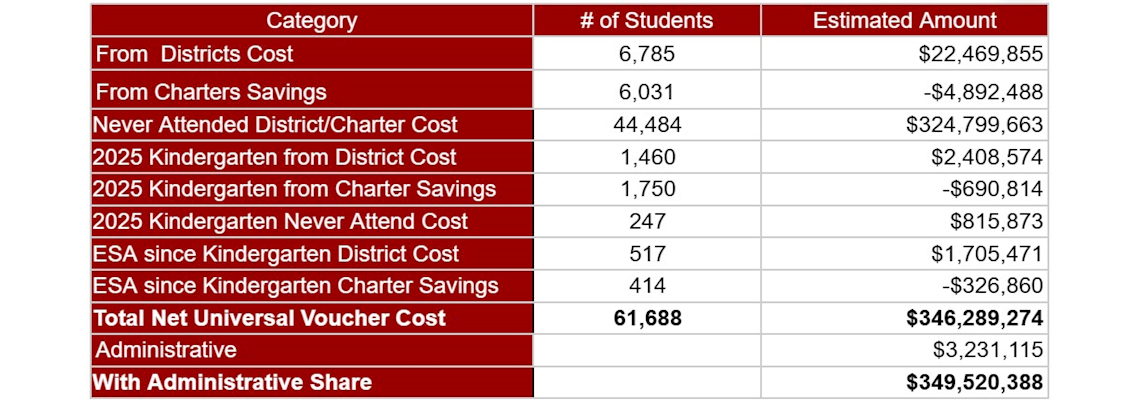
  • While the total cost of the overall ESA program in FY2025 is expected to be $872 million, the net cost after adjusting for where students would have otherwise attended is $350 million for those in the universal ESA voucher program. This represents a slight increase from the $332 million estimated by the Grand Canyon Institute last year.

The Grand Canyon Institute (GCI) estimates a $350 million net cost to the state’s General Fund in FY2025 (July 2024-June 2025) for the universal component of Arizona’s Empowerment Scholarship Account (ESA) voucher program based on a student’s school of origin. This represents a slight increase over the estimated FY2024 cost of $332 million. The estimate assumes basic student funding weights. 

The Joint Legislative  Budget Committee currently estimates the total annual cost of the ESA program to be $872 million, which includes the original targeted program and the universal component. Because student-level data on the universal program is not separated out by the Arizona Dept. of Education, GCI must estimate the origin of universal program enrollees. GCI’s estimate reflects the net cost the state would have incurred if the universal ESA voucher program did not exist. Almost every single child in the original targeted program had to attend a district or charter school for at least 45 days before enrolling in the program. GCI uses historical data on where the targeted students had come from previously, dating back to FY2017, along with current data on where all ESA students have left district or charter schools to estimate the distribution of students across district and charter schools for the original targeted program and the remainder are allocated to the universal program. 


In FY2025, the net growth in the universal ESA vouchers was 7,660 of the total enrollment of 61,688. GCI estimates that 73% of ESA universal voucher recipients never attended a district or charter school, slightly lower than the rate of 80% in FY2025. This includes estimates for kindergarten students using ESA universal vouchers. 

The primary driver of the change in FY2025 was a significant increase in the portion of net new enrollees from district and charter schools. GCI examined the marginal changes since last year and estimates that nearly half the net gain in universal participants of 7,660 from FY2024Q2 to FY2025Q2 came via Kindergarten. Analyzing changes in the portion of students previously attending a district or charter school, GCI estimates that less than 10% never attended (or would have never attended for Kindergarten) while half came from charter schools and just over 40% came from districts.

This change helped lessen the growth of the net cost of the program. GCI presumes that Kindergarten students do not have a record of prior attendance but would mirror the same distribution.  Given that charter school enrollment is about one-fourth of district enrollment, charter schools have been significantly disproportionately impacted by the Universal ESA program.

Despite the change in FY2025, the majority of participants in the universal ESA program never attended a district or charter school should be self-evident. For FY2025, the Quarter 3 Executive and Legislative ESA report identifies that of the total 87,602 students enrolled in the ESA voucher program (targeted and universal), regardless of when they first enrolled, only 33,942 students  moved from charter or district schools to an ESA. Virtually all targeted participants must first enroll in a district or charter school first. The universal program does not require prior attendance. 

Access the full report here.

The Grand Canyon Institute, a 501(c) 3 nonprofit organization, is a centrist think tank led by a bipartisan group of former state lawmakers, economists, community leaders and academicians. The Grand Canyon Institute serves as an independent voice reflecting a pragmatic approach to addressing economic, fiscal, budgetary and taxation issues confronting Arizona.

Jan Resseger is a social justice warrior who fights for the underdog. She describes here how Trump’s budget enacts the fever dreams of evangelicals and billionaires. He would change federal aid from its historic purpose–equitable funding–and turn it into school choice, diverting funds from the poorest children to those with ample resources. Since 1965–for 70 years–federal education funding for public schools has enjoyed bipartisan support. Trump ends it.

She writes:

Earlier this week, Education Week‘s Mark Lieberman released a concise and readable analysis of the likely impact for public education of two pieces of federal funding legislation: the “Big, Beautiful” tax and reconciliation bill currently being debated in the U.S. Senate to shape public school funding beginning right now in FY 2025, and also President Trump’s proposed FY 2026 federal budget for public schooling in the fiscal year that begins October 1st.

Trump’s  FY 2026 budget proposal saves Head Start.

Lieberman shares one important piece of positive news about Trump’s treatment of Head Start in next year’s federal budget: “Some programs survived the cut—including Head Start.” In early May, the Associated Press‘s Moriah Balingit reported: “The Trump administration apparently has backed away from a proposal to eliminate funding for Head Start… Backers of the six-decade-old program, which educates more than half a million children from low-income and homeless families, had been fretting after a leaked Trump administration proposal suggested defunding it… But the budget summary… did not mention Head Start. On a call with reporters, an administration official said there would be ‘no changes’ to it.”

Federal funding for U.S. public schools looks bleak.

Lieberman’s assessment of federal public education funding is not so encouraging.  Overall, “The administration is aiming to eliminate roughly $7 billion in funding for K-12 schools in its budget for fiscal 2026, which starts Oct. 1. Several key programs will be maintained at today’s funding level, without an increase: “Flat funding amounts to a de-facto cut given inflation. The administration is proposing to maintain current funding levels for key programs like Title I-A for low-income students ($18.4 billion), the Individuals with Disabilities Education Act, Part B for special education ($14.2 billion) and Perkins grants for K-12 and postsecondary career and technical education ($1.4 billion).”

What has been historically a key purpose of federal public education funding—to compensate for vast inequity in the states’ capacity and the states’ willingness to fund public education—is being compromised.  Lieberman explains that much of federal funding, “is currently geared toward supporting special student populations including English learners, migrants, students experiencing homelessness, Native students, and students in rural schools. Longstanding federal programs that support training for the educator workforce; preparing students for postsecondary education; reinforcing key instructional areas like literacy, civics, and the arts… would disappear. A new K-12 grant program would offer a smaller pool of funds to states and let them decide whether and how to invest in those areas. And for the first time, all federal funding for special education would flow to states through a single funding stream…. Experts view Trump’s budget as part of an effort to roll back a half-century of effort by the federal government to help make educational opportunities more consistent and equitable from state to state and district to district.”

The “Educational Choice for Children Act,” an alarming federal school voucher bill, is hidden inside the “Big Beautiful” bill.

Lieberman worries about the enormous tuition tax credit voucher plan embedded deep in the weeds of the “Big, Beautiful” tax and reconciliation bill now being considered in the U. S. Senate: “Separate from the federal budget process, Congress is currently advancing a massive package of tax changes, including a proposal for a new tax-credit scholarship program that fuels up to $10 billion a year in federal subsidies for private K-12 education. Annual spending on that program could approach the amount the Trump administration is proposing to cut from elsewhere in the education budget.”  The voucher proposal is called the Educational Choice for Children Act (ECCA).

In a separate analysis of the “Big, Beautiful” bill as the House passed it in late May, Lieberman describes this proposed ECCA tuition-tax-credit voucher program: “House lawmakers narrowly approved a sweeping legislative package with $5 billion in annual tax credits that fuel scholarships and related expenses at K-12 private schools. The federal subsidies would come in the form of dollar-for-dollar tax credits for individuals and corporations that donate to largely unregulated state-level organizations that give out scholarship funds for parents to spend on private educational options of their choosing. Any student—even in states that have resisted expanding private school choice—from a family earning less than 300 percent of the area median gross income would be eligible to benefit from a scholarship paid for with a federally refunded donation.”

Lieberman adds: “No other federal tax credit is as generous. The Internal Revenue Service doesn’t currently supply tax credits worth the full donation amount for any cause, as the private school choice scholarship credit would do. The federal government currently offers tax credits on donations for disaster relief, houses of worship, veterans’ assistance groups, and children’s hospitals at roughly 37 percent of the donated amount.  A $10,000 donation to those causes would yield a tax credit of $3,700.  By contrast, under the proposed legislation, if a taxpayer donates $10,000 to a scholarship (voucher)-granting organization, the IRS would give them a tax credit of $10,000.”

The Institute for Taxation and Economic Policy’s Carl Davis explains that because these federal school vouchers are primarily a tax shelter, they might appeal to wealthy people who are not even supporters of school privatization: “The tax plan…  includes a provision granting extraordinarily generous treatment to nonprofits that give out vouchers for free or reduced tuition at private K-12 schools. While the bill significantly cuts charitable giving incentives overall, nonprofits that commit to focusing solely on supporting private K-12 schools would be spared from those cuts and see their donors’ tax incentive almost triple relative to what they receive today. On top of that, the bill goes out of its way to provide school voucher donors who contribute corporate stock with an extra layer of tax subsidy that works as a lucrative tax shelter. Essentially, the bill allows wealthy individuals to avoid paying capital gains tax as a reward for funneling public funds to private schools.” “We estimate the bill would reduce federal tax revenue by $23.2 billion over the next 10 years as currently drafted, or by $67 billion over the next ten years if it is extended beyond its four-year expiration date… As currently drafted, the bill would facilitate $2.2 billion in federal and state capital gains tax avoidance over the next 10 years.”

The Brookings Brown Center on Education Policy’s Jon Valant warns that the vouchers are so deeply buried in the “Big, Beautiful” bill that lots of people would not be aware of the plan’s existence until after it is passed: “The Educational Choice for Children Act (ECCA) continues to move, quietly, towards becoming one of America’s costliest, most significant federal education programs. Now part of the One Big Beautiful Bill, ECCA would create a federal tax-credit scholarship program that’s unprecedented in scope and scale.  It has flown under the radar, though, and remains confusing to many observers…  ECCA’s stealthiness is partly due to the confusing nature of tax-credit scholarship programs. These programs move money in circuitous ways to avoid the legal and political hurdles that confront vouchers.”

Valant explains how tax-credit vouchers work: “Tax-credit scholarship programs like ECCA aren’t quite private school voucher programs, but they’re first cousins. In a voucher program, a government gives money (a voucher) to a family, which the family can use to pay for private school tuition or other approved expenses. With a tax-credit scholarship, it’s not that simple. Governments offer tax credits to individual scholarship granting organizations (SGOs). These SGOs then distribute funds… to families.”

Valant creates a scenario that shows how this tax credit program could help the wealthy and leave out poorer families. A rich donor, Billy, donates $2 million in stock to an SGO: “Billy’s acquaintance, Fred, lives in the same town as Billy, which is one of the wealthiest areas in the United States. In fact, Fred set up the SGO, looking to capture ECCA funds within their shared community… Like Billy, Fred doesn’t particularly care about K-12 public education… It might seem that Fred’s SGO couldn’t distribute funds to families in their ultra-wealthy area, since ECCA has income restrictions for scholarship recipients. That’s not the case. ECCA restricts eligibility to households with an income not greater than 300% their area’s median income. In Fred and Billy’s town, with its soaring household incomes, even multimillionaire families with $500,000 in annual income are eligible… So, Fred is looking to give scholarship money to some wealthy families in his hometown.”

Valant summarizes the result if the “Big, Beautiful” bill is enacted: “This bill would introduce the most significant and costliest new federal education program in decades. It has virtually no quality-control measures, transparency provisions, protections against discrimination, or evidence to suggest that it is likely to improve educational outcomes. It’s very likely to redirect funds from poor (and rural) areas to wealthy areas.”

The National Education Association analyzed Trump ‘s proposed budget and finds that it contains deep cuts and massive support for privatization by promoting vouchers and charter schools. The proposal mirrors Project 2025 by turning Titl 1 for low-income students and IDEA funding into block grants that can be converted to vouchers. The overall goal is to undermine public schools and cut funding.

FY2026 Budget Request Slashes Education Funding, Shortchanges Students

…………………………………………………………………….……….

President Trump’s FY2026 “skinny” budget request to Congress, released on May 2, cuts non-defense domestic spending by 22.6%.  The Department of Education sustains a $12 billion reduction, a cut of approximately 15.3%. 

! Since the President’s budget does not list specific funding requests for every federal program, the 46-page document is a “skinny” budget. Congress ultimately has the power of the purse, but the proposal is a clear signal of the White House’s priorities: a massive 24 percent cut to U.S. domestic spending, and, privitazing our nation’s public education system.  


 The narrative says the budget “maintains full funding for Title I,” but the numbers tell a different story. Title I and 18 unidentified programs are combined to create a single block grant, dubbed the “K-12 Simplified Funding Program,” then that block fund is cut by $4.535 billion cut.


 All seven Individuals with Disabilities Education Act (IDEA) programs are combined to create a single block grant called the “Special Education Simplified Funding Program.” The approach perpetuates the current shortfall—the federal government now covers 13% of special education costs, far short of the 40% Congress promised when the law was passed. 


 Programs slated for elimination include English Language Acquisition (Title III) and the Teacher Quality Partnership, which addresses the teacher shortage through deep clinical practice. 


 The budget shifts costs to states and institutions of higher education to reduce the federal investment in today’s students—our nation’s future leaders and workforce—as much as possible.  


 Regrouping specific, separate programs into block grants, in theory gives states more flexibility on how the money is spent. In reality, block grants usually lead to less funding and less accountability for our most vulnerable students. As the strings attached to the funding are cut, many states could maneuver block grant funds over to private school voucher programs. 


 Amidst these cuts, the proposal calls for investing $500 million, an increase of $60 million, to expand the number of charter schools across the country. Charter schools, along with private school vouchers, drain scarce resources for traditional public schools. 


May 2025

Every once in a while, I read an article that is so important and so powerful that I want to give it as much attention as possible. This is such an article. Please read it and share it. Post the link on every social media site. Send it to school board members and journalists.

The article was written by Dr. Maurice Cunningham, a retired Professor of Political Science at the University of Massachusetts. Cunningham has been studying “dark money” in education for years. It was published by “Our Schools” and “Independent Media Institute.”

If you want to understand the attacks on public schools, on teachers, and on teachers’ unions, read this article. If you want to understand how the organized groups that smear public schools got started, read this article. If you read a story about two or three “moms” sitting around their kitchen table and worrying whether the teachers at the local public school are indoctrinating their children, read this article. If those “moms” raised over $1 million in their first year, read this article.

They have fooled many journalists. Don’t let them fool you!

Cunningham warns:

“These groups are the creation of deep-pocketed conservative networks, not “grassroots” advocates.

By Maurice Cunningham

“If your mother says she loves you, check it out” is a bromide drilled into every journalist. So it is baffling why, if an interest group includes the words “moms” or “parents,” it is just taken at its word, especially when a little digging can reveal that many of these groups are the creations of billionaires out to destroy public education.

As the author of Dark Money and the Politics of School Privatization, I have been following billionaire-backed education interest groups for more than a decade. Since big money lacks public credibility, it often masquerades as organizations claiming to represent the interests of “parents,” “moms,” “educators,” and “families.” The concocted stories about how these groups were created are often repeated by an incurious press, which misses the opportunity to tell its readers a more interesting story: how billionaires and right-wing activists pour money into upbeat-sounding organizations to further their aim of privateering our public school system.

These astroturf operations have been proliferating resulting in serious negative impacts. Consider the havoc wreaked on some school boards by Moms for Liberty (M4L). M4L even got into presidential politics in 2024, boosting Donald Trump, at the behest of the donors, who co-founder Tina Descovich termed as M4L’s “investors.”

Consider a November 2024 Washington Post story on Linda McMahon’s nomination to be secretary of education. The article contrasted remarks from National Education Association (NEA) President Becky Pringle with an alternative view from Keri Rodrigues, founding president of the National Parents Union (NPU), which the reporter Laura Meckler called “a grassroots group,” thus giving the impression that NEA and NPU are similar organizations.

They are not. NEA is a well-established teachers’ union that credibly claims 3 million members and is governed by a democratic structure. NPU appeared on the scene in 2020, surfing in on millions of dollars from the foundations of American oligarchs, including the Walton family, Mark Zuckerberg, and Charles Koch.

In 2024, Rodrigues, a fixture at education privateering groups, told the Boston Globe that NPU could get its message to “250,000 families to vote against” a ballot question sponsored by the teachers’ union and would “put that network to work.”

There is zero evidence that this extensive network exists or that it did anything on the ballot question. There is also no proof to validate Rodrigues’s claimthat the organization has 1.7 million members nationally.

A 2021 Washington Post article introducing Moms for Liberty chronicled its claimed rapid rise without raising questions about how it grew so fast. The story simply provided the M4L narrative of its creation story, centered around former Florida school board members Descovich and Tiffany Justice. It omitted M4L’s third co-founder Bridget Ziegler, though it did quote her husband, Christian Ziegler, about the group’s political potency.

Bridget Ziegler served briefly on the M4L board and was replaced by GOP campaign consultant Marie Rogerson. Christian Ziegler was then the powerful vice-chair of the Florida Republican Party and a key Trump supporter. (In 2023, the Zieglers became famous for a threesome scandal. She quickly resigned from her executive position with the Leadership Institute, an established training institution for right-wing activists. Christian was removed from his perch as chair of the Florida Republican Party.)

The Post October 2021 story featured a photo of Descovich pulling aside, Superman style, a white jacket to reveal the group’s logo t-shirt while posing next to an American flag. The questions about the group’s ties to the Republican Party and suspicious financing were laughed off by the founders of M4L. The Post followed up a month later by printing an op-ed by Descovich and Justice.

NPU, M4L, and similar groups organize as nonprofit corporations under sections 501(c)(3) and 501(c)(4) of the Internal Revenue Service Code. As nonprofits, their Form 990 tax returns are made public but only in November, following the tax year. The information is skimpy but valuable. Journalists can access the Form 990s by requesting them directly from the nonprofits or from the ProPublica Nonprofit Explorer, which helps trace donors as well.

These groups leave clues that no reporter can miss:

  1. Don’t buy the phony origin stories: These organizations all claim to be about moms joining together to improve education. But in no time, they have access to millions of dollars in donations and have the services of elite law firms, pollsters, media consultants, and often, ties to the Republican Party.
  2. Follow the money: It isn’t easy in the first two years of a nonprofit’s existence, but there are signs: easy access to right-wing media, hiring expensive consultants, and big-budget conferences.
  3. Watch how these groups work: The founding leadership usually consists of veteran right-wing operatives or communications professionals with years of experience in privateering organizations.
  4. Get the big picture: Right from the beginning, M4L had obvious ties to Republican and right-wing organizations that often went unreported.
  5. Keep following the money: When nonprofit tax forms finally become public, they’ll reveal how much was donated and can help identify the top contractors and how much they were paid.

Let us expand on these insights to show how these secretive operations can be exposed right from the beginning by using Form 990.

Don’t Buy the Phony Origin Stories

The typical “moms” or “parents” creation story goes something like this: outraged by some aspect of their children’s public school education, two or three “moms” band together to attract other like-minded parents to cure the deficiencies of the system, which are always the fault of the teachers’ unions. In truth, the “moms” are agents of far-right billionaires often tied—like M4L and Parents Defending Education (PDE)—to the secretive Council for National Policy, which seeksto privateer K-12 for profit, expand Christian education, and promote homeschooling.

According to the billionaire-funded online publication the 74, NPU “is the brainchild of two Latina mothers,” Keri Rodrigues and Alma Marquez, who “had disappointing experiences with education, both as parents and students, and with advocacy groups.”

To its credit, the 74 was candid about the funding of NPU: the foundations of billionaires, including Bill Gates, the Walton family, the late Eli Broad, and Michael and Susan Dell, and organizations like the City Fund, which gets its money from Reed Hastings, John Arnold, and Walton family members, inheritors of the Walmart fortune.

Nonetheless, the tenor of the story was of a grassroots moms’ start-up. Other news outlets ignored the 74’s detailing of billionaire funding. An online search through the New York Times website supplemented with a library search through Gale OneFile showed 13 NYT stories or columns that mention the National Parents Union since the group’s public launch on January 1, 2021. Only one column by Michelle Goldberg noted that “The National Parents Union is funded by the pro-privatization Walton Family Foundation.” The Waltons are, however, the only funders Goldberg mentioned.

The New Yorker came closest to the truth in a June 2021 piece: “The Walton foundation set up the National Parents Union in January 2020, with Rodrigues as the founding president.” A review of Form 990s for NPU and the Walton Family Foundation from 2020 through 2023 that I reviewed shows that NPU accepted more than $11 million in contributions. The Walton Family Foundation donated around $3 million of that amount.

The media is failing to cover the single most important fact the public needs to know about “parents” and “moms” groups: who is supplying them with millions of dollars in funding.

As for M4L, although a few media outlets wrote it had three founders, most followed the practice of CNN, which in December 2021 omitted Bridget Ziegler and described “the two women behind Moms for Liberty, a group of conservatives that came together in January,” downplaying the fact that at that time, the state GOP vice-chair’s wife was also one of the co-founders. By January 9, 2021, soon after its incorporation, M4L’s online store was offering magnets, t-shirts, and hats, and a “Madison Meetup” package of right-wing materials.

While mainstream media was valorizing M4L’s origin story, right-wing outlets produced a steady stream of propaganda about the organization. Later in January 2021, Descovich appeared on the Rush Limbaugh Show (guest-hosted by Todd Herman). Media Matters for America found that, by July 2022, M4L “representatives have been regulars on right-wing media, appearing on Fox News at least 16 times and Steve Bannon’s “War Room” at least 14 times.”

Another supposedly grassroots parents’ group that has an origin story grounded in deception is PDE. In lodging a civil rights complaint against the Columbus, Ohio, public schools in May 2021, PDE President Nicole Neily told the Columbus (Ohio) Dispatch, “We just all work from home… We’re all working moms.”

In fact, Neily is a well-compensated political operativein the Koch network. According to the Koch-connected Speech First’s Form 990 for 2019, which was available after November 2020 and thus before PDE was founded in 2021, Neily was paid $150,000 in 2019.

Follow the Money

Due to the barriers to tracing the funding of such groups, it can be hard to follow the money, especially in the first two years of operation. But in 2021, an article in the New Yorker described how the VELA Education Fund, a partnership of the Walton Family Foundation and the Charles Koch Institute, had given NPU $700,000 in 2020 to “help people with fewer resources,” including promoting homeschooling during COVID-19. This is despite the fact that NPU was not familiar with homeschooling.

Press outlets have also overlooked funding sources of M4L. In 2021, co-founder Descovich told CNN that M4L had raised more than $300,000 through t-shirt sales, small donors, and fundraising events. However, one such event was a gala featuring former Fox News personality Megyn Kelly in June 2021, six months into M4L’s first year. The top tickets went for $20,000. The Celebrity Speakers Bureau pegged Kelly’s speaking fee as between $50,000 and $100,000. The event raised at least $57,000.

In July 2021, Descovich appeared at a Heritage Foundation virtual town hall on “Preserving American History in Schools.” By October 29, 2021, M4L was referring members to the Leadership Institute for training and sending members to the Heritage Foundation for events and other resources. Both these organizations have been part of the right-wing political firmament since the 1970s. A bit of digging showedthat M4L was deeply embedded in far-right politics. But most press accounts ignored that evidence and the public remained largely in the dark.

In April 2021, PDE headed by Neily, brought on Elizabeth Schultz as a “senior fellow,” who had worked under Trump’s Education Secretary Betsy DeVos during his first term and was a vocal anti-LGBTQ activist.

Watch How These Groups Work

These groups can be intertwined. PDE, M4L, and another faux-grassroots group, No Left Turn in Education (NLTE), all came on the scene around the same time, with NLTE being founded in 2020. PDE’s website includes a map called “IndoctriNation” with lists of affiliates across the nation. The April 15, 2021, listings (the website appears to have gone live only in March 2021) showed that most of its allies were chapters of M4L and NLTE with few actual members, according to my research in 2021.

Media reports seemed content to accept the “moms working from home” creation story despite the obvious early support from well-resourced groups.

NPU held its organizing meeting, which it claims drew representatives from all 50 states, in New Orleans in January 2020. To promote the event, NPU employedMercury Public Affairs, an international public relations firm. To draw press attention, NPU also commissioned polling from Echelon Insights, a Republican pollster that has also worked for the Walton family.

In the same year of its founding, in 2021, PDE published detailed plans, such as “How to Create ‘Woke At’ Pages,” that instruct parents on how to use secrecy to attack “woke activists” in the education system. PDE also began initiating lawsuits against local school boards, represented by the Republican law firm of Consovoy McCarthy.

William Consovoy, who passed in 2023, was in the Federalist Society, the nationwide network of conservative lawyers that helped form Trump’s picks for the U.S. Supreme Court. Consovoy had been a law clerk to Justice Clarence Thomas and represented Donald Trump during a congressional investigation. The firm also represented Trump in 2020 as he tried to intervene before the Supreme Court to stop the vote count in Pennsylvania. When PDE’s 2021 Form 990became available, it showed PDE paid Consovoy McCarthy $800,000 in legal fees.

Get the Big Picture

The clues kept coming, only to be ignored by the press.

In 2022, M4L held its first national summit in Tampa, Florida. In its reporting of the event, NBC portrayedthe group as a political powerhouse, reporting that attendees “browsed booths set up by conservative groups, including Turning Point USA, the Leadership Institute and Heritage Action, and the evangelical Liberty University” without describing these organizations for what they are—the critical infrastructure of Christian nationalism.

Media reports on the event generally ignored who the sponsors of the summit were or the amounts of their donations. The Leadership Institute donated $50,000. The Heritage Foundation and Heritage Action for America provided $10,000 each. And PDE chipped in $10,000. Meanwhile, Descovich was still peddling the story that M4L was getting by on t-shirt sales, even though an aide to Leadership Institute’s Morton Blackwell bragged about how the institute had provided the relevant training to help the group “become a national force.”

When there were questions raised about how M4L could fund such a lavish event with t-shirt sales, M4L denied any connections to deep-pocketed right-wing groups, and most news reporters presented a simple “he said, she said” account and moved on. Reporters generally missed the bigger story that the institutional right was creating and passing off phony “moms” and “parents” operations.

Keep Following the Money

Once Form 990s were filed, the deception became obvious, but that didn’t mean it got covered by big media outlets.

The 2022 Form 990 for NPU showed that Keri Rodrigues was paid $410,000 from NPU and a sister organization. She paid her husband, the chief operating officer of both organizations, $278,529. Yet, in August 2024, CBS Morning News presented Rodrigues as a typical parent worried about back-to-school shopping.

PDE’s Form 990 for 2021 was even more revealing, as exposed by True North Research’s Lisa Graves and Alyssa Bowen for Truthout in 2023. Graves and Bowen showed that PDE is deeply tied with far-right Supreme Court fixer Leonard Leo, even paying $106,938 to his for-profit consulting firm.

PDE, a brand-new operation, raised $3,178,272 in its first year in 2021. It paid Neily, who is also on the board, a total compensation of $195,688 for her 40-hour work week.

According to Speech First’s Form 990 for 2021, Neily put in an additional 20-hour week for Speech First, earning another $86,117 and a total of $281,805 from both Koch- and Leo-funded operations combined. In 2023, PDE pushed Neily’s base salary and other compensation up to $341,400. This is quite an income for a stay-at-home working mom.

The trail from NPU leads back to the Walton family and billionaire allies who have been working to undermine teachers’ unions and siphon public money to charter schools for years.

Scratch the surface of groups like M4L and PDE, and you find the Heritage Foundation, the Leadership Institute, and Leonard Leo—the elite of far-right politics who work to replace public schools with for-profit schools, religious schools, and homeschooling. These details make for a very important story that most journalists have overlooked.

Stop Being Fooled

Reporters should not be fooled by the techniques used by these fake “mom” and “parent” groups on behalf of their extremist overseers. As Naomi Oreskes and Erik M. Conway show in Merchants of Doubt: How a Handful of Scientists Obscured the Truth on Issues from Tobacco Smoke to Global Warming, these techniques have been used by “scientific” nonprofits created by the same conservative groups, including the Heritage Foundation, to contest climate change.

Many have tracked the origin of these techniques back to the tobacco industry’s fight to protect their profits from the growing body of research linking their products to cancer and other health problems.

In 1994, tobacco giant RJ Reynolds created the industry front group Get Government Off Our Back to advance a “smokers’ rights” campaign to fight against the tsunami of scientific evidence exposing the health risks of tobacco. Reynolds kept its backing a secret while promoting it as a movement of “grassroots” smokers.

Meanwhile, in his farewell address, former President Joseph R. Biden warned about how the wealthy are a big threat to democracy:

“Today, an oligarchy is taking shape in America of extreme wealth, power, and influence that literally threatens our entire democracy, our basic rights and freedoms, and a fair shot for everyone to get ahead.”

For years, the same oligarchy that threatens basic rights has been threatening our freedom to have access to a high-quality system of public education. There is no reason they should be aided by credulous reporters from trusted news sources. If we can question our moms on whether they really love us, we can question the authenticity of these moms and parent groups.

Maurice Cunningham PhD, JD, retired in 2021 as an associate professor of political science at the College of Liberal Arts, University of Massachusetts, Boston, and is the author of Dark Money and the Politics of School Privatization.

John Thompson is a historian and retired teacher in Oklahoma. He keeps watch over the Red state politics of Oklahoma and follows the national education scene closely, He writes here about author Robert Pondiscio. I was at one time good friends with Pondiscio. We were on the same wave-length. But things changed. Curiously, as I moved from right to left in my views, he moved in the other direction.

John Thompson writes about him and his ideological journey here:

Since the American Enterprise Institute’s (AEI) Robert Pondiscio agreed to join the Oklahoma State Superintendent Ryan Walters’ Executive Review Committee, I’ve wondered how he could collaborate with Russell Vought and the founders of Project 2025 in order to turn Oklahoma’s teaching standards into rightwing propaganda. (I should note that because of a scheduling problem, he wasn’t able to remain on the committee.)

Years ago, when I first met Pondiscio, he was focused on high quality curricula; the person I knew would have been horrified by Walters’ silently imposed standards, that, for instance: 

Would require that high school students “identify discrepancies in 2020 elections results’ including”‘ sudden halting of ballot-counting in select cities in key battleground states, sudden batch dumps, an unforeseen record number of voters and the unprecedented contradiction of ‘bellwether county’ trends.’”

After reading Pondiscio’s “The Last Days of Public School,” I’ve wondered what corporate school reformers would have thought if, in 2010, he had written the same things about the “Risks and Rewards” of school privatization. My reading of it is that Pondiscio now makes mostly the same statements about test-driven school privatization, as he did back then. But he’s switched sides, allying with both the Billionaires Boys Club and MAGAs in order to advance his personal agenda. 

Pondiscio has long supported Core Knowledge, but he and E.D. Hirsch sought tests for diagnostic purposes, not reward-and-punish. Pondiscio agreed with Hirsch that high-stakes tests “are fundamentally unfair to disadvantaged children, particularly low-income children of color.”

When being interviewed by Larry Ferlazzo, Pondiscio denounced the corporate reformers, who were non-educators, who believed that improving teacher quality and lifting charter school caps was a simple solution. They believed their “reforms” could overcome the extreme poverty and multiple traumas that his and my students endured. Moreover, he was repelled by stories about “Rubber Rooms” in order to engage in “bashing teachers.”

And, rather than blame public schools for wasting money, he pointed out the huge amounts of money spent for implementing the hunches of corporate reformers seeking disruptive and transformative change.

By 2018, however, Pondiscio seemed fully committed to his new test-driven, competition-driven allies. For instance, he enthusiastically supported New Orleans’ Superintendent John White, who was a true-believer in school privatization, Teach for America, and high-stakes testing. When debating Diane Ravitch about school choice, he “retorted that school choice was not a ‘rightwing agenda,’ it was a ‘moral agenda.’”

Even today, when explaining how public schools (which he confusingly calls the “legacy system”) are doomed, Pondiscio seems to acknowledge that punitive, market-driven policies have failed in the ways we defenders of public schools predicted. He acknowledges that student outcomes were declining before Covid hit. But it contributed to “mounting challenges: historic declines in student achievement, chronic absenteeism, discipline crises, and plummeting teacher morale. Even as schools return to normal, confidence in public education has suffered hammer blows.”

To his credit, Pondiscio also cites the challenges of the  “baby bust”—a decline in the birth rate that will reduce the number of school-age children by an estimated two to three million over the next decade.

It is to his discredit, I believe, that he doesn’t mention the damage done by the Trump administrations, and the extreme anti-public school propaganda funded by the “Billionaires Boys Club.”

Pondiscio now writes that “the zip code–driven default mode of educating our children is unlikely to disappear entirely. It will remain a common mode for a significant number of children if only because of habit and inertia. But we have hit and passed peak public education. Its influence and dominance can only wane.”

While remaining on the AEI team and being open to working with the Heritage Foundation effort to dismantle public education, Pondiscio writes, “In practice, this means almost any parent can opt out of public education and redirect funds to offset the cost of private school, pay for tutoring, and purchase textbooks, technology, and almost any conceivable service they deem necessary to meet the educational needs of their child.”

While supporting this outcome, Pondiscio writes:

While public schools have largely failed to be the “great equalizer of the conditions of men” Mann envisioned, they have at least aspired to provide a shared foundation of civic knowledge and literacy. In a world where education is fully customizable, we risk losing the common civic framework that binds a diverse nation together. Schools transmit not just knowledge but shared values, norms, and narratives.

Moreover:

School choice does not guarantee better schools—only different ones. The same market forces that produce elite private schools could also create a “long tail” of low-quality options. Moreover, as more middle-class and engaged families exit public schools, the legacy system risks becoming the school of last resort for the most disadvantaged students—further intensifying educational inequality. 

Why would Pondiscio, who makes such acknowledgements, seem to go along with the destruction of public education in order to defeat educators who disagree with him on curriculum and other aspects of instruction? 

Reading his AEI posts, I’m struck by the anger he spews about educators who “worship to excess at the altar of student engagement.” I’m struck by his repeatedly blaming “Wokism.” Why does he invest so much in attacking schools as “Ideological Boot Camps?”  At a time when Elon Musk and President Trump are trying to destroy the Education Department, why is Pondiscio doubling down on its administrators who he says order schools to “Comply with our enlightened vision or risk a civil rights probe that could cost you your federal funding?”

In other words, why is Pondiscio focusing more on defeating advocates for hands-on learning and civil rights, than defending the poor children of color that he and I taught?

Peter Greene, veteran teacher, master writer, the voice of wisdom and experience, sets the record straight about the purpose of the U.S. Department of Education. Contrary to what wrestling-entrepreneur Linda McMahon (Trump’s Secretary of Education) says, the Department was not created to raise test scores. The Department was created to promote equal access to educational opportunity. That equalization of resources has not yet been achieved, but Trump intends to abolish the goal altogether. In his thinking, everyone should pull themselves up by their bootstraps, unlike him, who was born into wealth and privilege.

Peter Greene writes:

The official assault on the Department of Education has begun.

If it seems like there’s an awful lot more talking around this compared to, say, the gutting of the IRS or USAID, that may be because the regime doesn’t have the legal authority to do the stuff that they are saying they want to do. The executive order is itself pretty weak sauce– “the secretary is to investigate a way to form a way to do stuff provided it’s legal.” And that apparently involves sitting down in front of every camera and microphone and trying to make a case.

A major part of that involves some lies and misdirection. The Trumpian line that we spend more than anyone and get the worst results in the world is a lie. But it is also a misdirection, a misstatement about the department’s actual purpose.

Likewise, it’s a misstatement when the American Federation of Children characterizes the “failed public policy” of “the centralization of American education.” But the Department wasn’t meant–or built–to centralize US education.

The department’s job is not to make sure that American education is great. It is expressly forbidden to exert control over the what and how of education on the state and local level.

The Trump administration is certainly not the first to ignore any of that. One of the legacies of No Child Left Behind is the idea that feds can grab the levers of power to attempt control of education in the states. Common Core was the ultimate pretzel– “Don’t call it a curriculum because we know that would be illegal, but we are going to do our damnedest to standardize the curriculum across every school in every state.” For twenty-some years, various reformsters have tried to use the levers of power in DC to reconfigure US education as a centrally planned and coordinated operation (despite the fact that there is nowhere on the globe to point to that model as a successful one). And even supporters of the department are speaking as if the department is an essential hub for the mighty wheel of US education.

Trump is just working with the tools left lying around by the bipartisan supporters of modern education reform.

So if the department’s mission is not to create central organization and coordination, then what is it?

I’d argue that the roots of the department are not the Carter administration, but the civil rights movement of the sixties and the recognition that some states and communities, left to their own devices, would try to cheat some children out of the promise of public education. Derek Black’s new book Dangerous Learning traces generations of attempts to keep Black children away from education. It was (roughly) the 1960s when the country started to grapple more effectively with the need for federal power to oppose those who would stand between children and their rights.

The programs that now rest with the department came before the department itself, programs meant to level the playing field so that the poor (Title I) and the students with special needs (IDEA) would get full access. The creation of the department stepped up that effort and, importantly, added an education-specific Civil Rights office to the effort.

And it was all created to very carefully not usurp the power of the states. When Trump says he’ll return control of education to the states, he’s speaking bunk, because the control of education has always remained with the states– for better or worse.

The federal mission was to make the field more level, to provide guardrails to keep the states playing fair with all students, to make sure that students had the best possible access to the education they were promised.

Trump has promised that none of the grant programs or college loan programs would be cut (and you can take a Trump promise to the… well, somewhere) but if all the money is still going to keep flowing, then what would the loss of the department really mean?

For one thing, the pieces that aren’t there any more. The Office of Civil Rights is now gutted and repurposed to care only about violations of white christianist rights. The National Center of Education Statistics was the source of any data about how education was working out (much of it junk, some of it not). The threat of turning grants into unregulated block grants, or being withheld from schools that dare to vaccinate or recognize diversity or keep naughty books in the library.

So the money will still flow, but the purpose will no longer be to level the playing field. It will not be about making sure every child gets the education they’re entitled to– or rather, it will rest on the MAGA foundation, the assumption that some people deserve less than others.

That’s what the loss of the department means– a loss of a department that, however imperfectly, is supposed to protect the rights of students to an education, regardless of race, creed, zip code, special needs, or the disinterest and prejudice of a state or community. Has the department itself lost sight of that mission from time to time? Sure has. Have they always done a great job of pursuing that mission? Not at all. But if nobody at all is supposed to be pursuing that goal, what will that get us?

The Trump administration plans to roll out a massive voucher program that will be available in every state.

We know from the statistics of every voucher program that most vouchers will be claimed by students who never attended public schools. The voucher recipients are already attending religious and private schools. Their parents are able to pay tuition, but will gladly accept a government subsidy to lower their costs. In every state with universal vouchers, most are taken by students already in nonpublic schools.

We also know that vouchers will not help the poorest kids, who are likely to be rejected by good private schools and end up losing ground in substandard schools. Vouchers have not improved education in any state that adopted them. One of the nation’s most expansive voucher programs is in Florida; that state just posted its worst NAEP score in two decades. To learn more, read Josh Cowen’s The Privateers.

Nonetheless, Laura Meckler reports in The Washington Post, the Trump administration is prepared to dole out billions of federal dollars to pay for tuition at nonpublic schools, most of them religious.

Meanwhile, the public schools, which enroll nearly 90% of all K-12 students in the U.S., would receive less funding, have larger class sizes, and less money for teachers’ salaries.

Vouchers have been tested in state referenda repeatedly and have consistently, often by huge margins.

Meckler writes:

The school voucher movement has scored victories in conservative states in a quest to send public dollars to private schools, with tax money following the child. Now backers see their best chance yet to go national.


Congressional Republicans, backed by the White House, are pushing for a new tax credit that would direct billions of dollars a year to school voucher programs — and not just in conservative states.


The program would be fueled by a powerful, never-before-tried incentive: Taxpayers who donate to voucher programs would get 100 percent of their money back when they file their taxes. That means the tax break for giving to voucher programs would dwarf tax incentives for giving to churches, hospitals, food banks and every other charity.


Taxpayers who donate to other charities might qualify for a tax deduction — meaning they would not pay taxes on the dollars they contribute. But donors to voucher programs would get a dollar-for-dollar tax credit, meaning they could subtract the full value of the donation from their bottom line tax liability.

The goal is to give more families more options for their children’s education. Too many children, supporters say, are stuck in public schools that do not serve them well but cannot afford other options. A federal program would give more children in more states the opportunity to make a different choice for their education. The tax credit, they say, would encourage and allow taxpayers who want to help to do so.


One version of the plan would cost the federal government $5 billion a year in lost revenue; another version, $10 billion. At $10,000 per student, $5 billion would be enough to pay for about 500,000 vouchers, which families could use to send their children to private schools or to pay for home schooling expenses. Under a version of the bill approved by the House Ways and Means Committee last fall and a new version introduced this year, all but the wealthiest families would be eligible to receive vouchers.

“It would be transformational,” said Jim Blew, co-founder of the Defense of Freedom Institute, which advocates for school choice programs. [Blew worked for Betsy DeVos when she was Secretary of Education.] “Although the numbers are very small in the federal context, in the context of the school choice movement, these are huge numbers.”

About 46 million American children — nearly nine in 10 — attend public schools; about 5 million are enrolled in private schools, according to federal data.

But opposition is fierce from those who say these plans drain resources from public schools, which are required by law to take all children. Public school advocates are mobilizing publicly and privately against the plan, lobbying Republicans who might oppose it based on the merits or the cost.

“We’re making sure the public understands this is the greatest threat to public education we’ve ever had at the federal level,” said Sasha Pudelski, director of advocacy for AASA, the School Superintendents Association, who helps lead a coalition of more than 60 groups opposed to the voucher plan.

Pudelski noted that unlike public schools, private schools can reject students based on their religion, test scores, disability or ability to pay tuition. The vast majority of vouchers in existing state programs go to religious schools.

“It would be the first time the federal government is choosing to subsidize a secondary private system of education that can pick and choose the students it educates over the one that welcomes all,” she said.

Voters, too, have opposed these plans. In November, ballot measures to allow vouchers in Kentucky and Colorado failed, while voters in Nebraska voted to repeal a voucher program put into place by the legislature.

But the federal plan enjoys robust support from the most powerful people in today’s Republican Party. President Donald Trump has repeatedly vowed to create a federal school choice program. House Speaker Mike Johnson (R-Louisiana) and Senate Majority Leader John Thune (R-South Dakota) have both co-sponsored versions of the voucher legislation.

There goes the separation of church and state. There goes common sense. Voucher programs don’t help students. They hurt public schools, which enroll the vast majority of students. Vouchers are a huge drain on the budget.

Why should taxpayers pay tuition for wealthy families? Why should taxpayers underwrite tuition at schools that discriminate against students for any reason they want, be it race, religion, disability status, sexual orientation, or low test scores? If public schools did that, their test scores would be sky-high, but it would betray the promise of public schools: equal educational opportunity. Not for only those we choose to admit.

ProPublica has created a database where anyone can check out where the segregation academies are. The database shows the demographics of public and private schools.

Bear in mind that highly segregated private schools are subsidized by taxpayers in states that have enacted universal vouchers. The politicians today are fulfilling the fever dreams of segregationist governors in the South in the 1950s.

ProPublica reports:

Private schools in the United States are, on the whole, whiter than public schools, with fewer Black, Hispanic or Latino students. This may not be a surprising statistic because private schools can often be expensive and exclusionary, but it’s not a simple one to pin down. There is no central list of private schools in the country, and the only demographic data about them comes from a little-known voluntary survey administered by the federal government.

While reporting our project on Segregation Academies in the South last year, we relied on that survey to find private schools founded during desegregation and analyzed their demographics compared to local public school districts. Our analysis of that survey revealed, among other things, Amite County, Mississippi, where about 900 children attend the local public schools — which, as of 2021, were 16% white. By comparison, the two private schools in the county, with more than 600 children, were 96% white.

In the course of our reporting, we realized that this data and analysis were illuminating and useful — even outside the South. We decided to create a database to allow anyone to look up a school and view years worth of data.

Today, we are releasing the Private School Demographics database. This is the first time anyone has taken past surveys and made them this easy to explore. Moreover, we’ve matched these schools to the surrounding public school districts, enabling parents, researchers and journalists to directly compare the makeup of private schools to local public systems.

Until now, much of this data was difficult to analyze: While the National Center for Education Statistics, which collects the data, provides a tool to view the most recent year of Private School Universe Survey data, there was no easy way to examine historical trends without wrangling large, unwieldy text files.

As debates over school choice, vouchers and privatization of education intensify, making this repository of private school data accessible is more important than ever. The information is self-reported, but we have attempted to flag or correct some obvious inaccuracies wherever possible.

How to Use the App

Searching: You can search for private schools or public school districts by name and drill down on results using several filter options.

For schools, you can filter results by state, religious affiliation, school type and enrollment range. For some schools, you can also filter by founding year. By default, we only show results for schools that have responded to the survey at least once in the last few years, but you can turn off this filter to also include older data in your search results.

For public school districts, users can filter by state and sort results to see where the most students are attending private schools, as well as the gap between the district’s largest racial group and the school’s share of those same students. Because private schools can draw students from different districts, comparing their racial composition to a single district’s public schools is imperfect. Still, these comparisons can offer valuable insights into broader patterns of segregation and access.

Please open the link to finish reading.

Before the inauguration of Trump, The New York Review of Books invited me to write about his education agenda. I read three important documents in which his views and goal were spelled out: the education chapter in Project 2025; Agenda 47, Trump’s campaign document; and the website of the America First Policy Institute, the organization led by Linda McMahon, Trump’s choice for Secretary of Education. The three documents overlap, of course. Trump intends to privatize education; he despises public schools. He wants to eliminate the Department of Education. He and his supporters are obsessed with “radical gender ideology,” and they blame public schools for the very existence of transgender students. The election of Trump, it was clear, would mean the end of civil rights protections for LGBT students and a determined effort to defund and destroy public schools.

I posted the article yesterday.

The NYRB invited me to participate in an interview.

This article is part of a regular series of conversations with the Review’s contributors; read past entries here and sign up for our e-mail newsletter to get them delivered to your inbox each week.

In “‘Their Kind of Indoctrination,’” published on the NYR Online shortly before Donald Trump’s second inauguration, Diane Ravitch writes about the troubling future of American public education. Referring to the president’s infamous remark from his first campaign—“I love the poorly educated”—Ravitch warns that his second term is likely to lead to “more of them to love.”

A historian of education, Ravitch worked on education policy in both George H. W. Bush’s and Bill Clinton’s administrations. She has spent her career analyzing the national and state policies that reshape public schools, like laws that implement high-stakes testing or that divert taxpayer money to charter schools. In addition to writing nearly two dozen books—including The Troubled Crusade: American Education, 1945–1980 (1983), Reign of Error: The Hoax of the Privatization Movement and the Danger to America’s Public Schools (2013), and, most recently, Slaying Goliath: The Passionate Resistance to Privatization and the Fight to Save America’s Public Schools (2020)—Ravitch posts regularly about American education policy on her widely read blog. Her memoirs will be published later this year by Columbia University Press.

I reached out to Ravitch to discuss the current state of American education, the forces threatening it, and her vision for how public schools can better fulfill their democratic promise.


Regina Martinez: How did you start writing about education? Were you influenced by your time in public schools in the South? 

Diane Ravitch: I started writing about education when I was in college. The first paper I ever wrote was for a political science class in my freshman year at Wellesley in 1956. It was about the politics of the Houston public school system in the early 1950s, when I was a student there. Voters elected a new school board every two years, and control went back and forth between a group of far-right extremists, who saw Communists lurking everywhere, and moderates who just wanted to make sure that the schools were running well. At one point, books about Russia were removed from the high school library’s shelves. Under the moderates, we heard assembly speakers who spoke of racial and religious tolerance; under the Minute Women, the female wing of the John Birch Society, we were warned to beware of Communist influence. Also, while I was attending them, the schools were racially segregated.

In “Their Kind of Indoctrination,” you write, “One can only imagine the opprobrium that will be visited upon teachers who are not certified as patriots.” How do you imagine this will impact the teaching profession? What might it mean for teacher recruitment in the future?

The threat of political surveillance is chilling, as it would be in every profession. In many states, especially “red” states, teachers have to be careful about what they teach, what reading they assign, and how they handle topics related to race and gender. Trump recently issued an executive order stating that he would cut off the funding of schools that “indoctrinate” their students by teaching about “radical gender ideology” and racism. His effort to impose thought control is illegal but that hasn’t stopped him from trying. 

This sort of political censorship is happening in K–12 schools but also in higher education. The number of people choosing to prepare to be teachers plummeted in the wake of the Bush-Obama emphasis on standardized testing. The threat of political loyalty screening can only make matters worse.

One of President Trump’s recent executive orders reauthorized federal agents to detain children at schools. What actions if any can schools, families, and students take to resist the incursion of the security state into schools?

The determination of the Trump administration to raid schools is terrifying for children and for their teachers, whose job it is to protect their students. Imagine a child being arrested in his or her classroom. It is indeed frightening. Many districts have urged teachers to get legal advice from the district legal officers. At the very least, educators should demand to see a warrant. If ICE agents are armed, resistance may be futile. Elected leaders will have to develop contingency plans, if they have not done so already.

You worked on education policy under both President George H. W. Bush and President Bill Clinton. What, if anything, was different about your work between a Republican and a Democratic administration? How do you think the Department of Education—and federal education policy more generally—has changed since the early 1990s?

I served as assistant secretary for education research and improvement under President Bush. Then President Clinton appointed me to the national testing board, known as the National Assessment Governing Board. There was a continuity of policy from the first President Bush to Clinton, and then from Clinton to the second President Bush to President Obama.

The first President Bush wanted to reform American education through voluntary measures. He convened a meeting of the nation’s governors in 1989, and they agreed on a set of six goals for the year 2000. He thought that the goals could be reached by exhortation, at no cost. The goals were indeed aspirational (they hoped, for example, that American students would be first in the world in mathematics and science by the year 2000), but no one had a plan for how to reach them, nor was there any new funding. President Clinton got credit for drafting them, so he and Bush shared that commitment. He was willing to spend real money to help states improve their schools, and added two more goals (one about teacher training, another about parent participation). He also believed that the nation should have national standards and tests. None of the goals was reached by the year 2000, except for having 90 percent of students graduate from high school. But that goal was a matter of definition. If it meant that 90 percent should graduate high school in four years, we did not meet that goal. If you counted the students who graduated in five or even six years, we surpassed it.

Since you launched your education blog in 2012, it has become a popular forum for discussions about education and democracy. Looking back, are there any positions you’ve shared on the blog that you would reconsider or approach differently today? Are there positions you took or predictions you made that you’re particularly proud of?

I started blogging two years after publication of The Death and Life of the Great American School System: How Testing and Choice Have Undermined Education. In that book, I renounced views that I had advocated for decades: competition between schools, relying on standardized testing as the measure of students, merit pay, and many other policies connected to accountability and standardization.

What I have learned in the past fifteen years has made me even more alarmed than I was then about the organized efforts to destroy public education. That book has a chapter about “The Billionaire Boys Club.” I focused on the venture philanthropy of the Bill and Melinda Gates Foundation, the Eli and Edythe Broad Foundation, and the Walton Family Foundation. These billionaires used their philanthropy strategically to fund privately managed charter schools, high-stakes standardized testing, and a system that evaluates teachers by the test scores of their students and closes schools where students got low scores. I opposed all of these measures, which were endorsed by both the second Bush administration and the Obama administration. I demonstrated in that book and subsequent books that these strategies have been failures and are enormously demoralizing to teachers. They also turned schools into testing factories, crushing creative thinking and the joy of teaching and learning.

In the years since, I have learned that “the Billionaire Boys Club” is far larger than the three families that I mentioned. In my last book, Slaying Goliath, I tried to make a list of all the billionaires and the foundations that support charter schools and vouchers, and it was long indeed. Even now, I continue to come across billionaires and foundations that should be added to the list. What I suspected was that charter schools paved the way for vouchers by treating schooling as a consumer good, not a civic responsibility. What I did not realize was that the voucher movement is even more powerful than the charter movement. Its constituency is not just right-wing billionaires like the Koch brothers and the DeVos family, but Christian nationalists, white supremacists, extremist organizations like the Alliance Defending Freedom and the American Legislative Executive Council, affluent parents who want the state to subsidize their private school tuition, and Catholic leaders who have always believed that the state should underwrite Catholic schools.

There has been a lot of discourse recently about declining rates of literacy due to AI, the pandemic, phones, or a host of other causes. How significant do you think this risk is? What might be done to reverse the trend? 

I too am concerned about declining rates of literacy, as well as declining interest in literature. In my field of study, I believe that standardized testing has been a culprit in shortening the attention span of children of all ages. Students are expected to read short snippets, then to answer questions about those limited passages. In the early decades of the twentieth century, the College Board sponsored college entrance examinations in which students were assigned works of literature in advance, then asked to write about what they had read. Teachers and professors read their essays and graded them. Now the exam answers may be read by a machine or by a person hired off Craigslist to read swiftly, giving only a minute or two to each written answer.

In my dreams, I would change expectations and ask high school teachers to assign books that are worth reading, then require students to write three or four pages about why they did or did not like the book.

While I welcome the expansion of the canon to include works by women and by people of color, I would also welcome a revival of interest in the great works that were once considered the classics of Western literature. In too many high schools, the classics have not just been marginalized, they have been ousted. That is as grave an error as ignoring the works of those who are not white men.

Given the increasing momentum behind the privatization of education, how do you envision the next generation advancing public school advocacy? What do you anticipate will be their greatest challenge?

Public schools are one of the most important democratic institutions of our society. In many states, they enroll 90 percent of all students. They have always enabled children and adolescents to learn together with others who come from backgrounds different from their own. There is a major movement today, funded by right-wing billionaires, to destroy public schools and to replace them with religious schools, private schools, and homeschooling. It is called “school choice,” but the schools choose, not the students or families. Private schools are allowed to discriminate on any grounds and are not bound by federal laws that prohibit discrimination and that protect those with disabilities. Racial and religious segregation will increase. More students will attend schools whose purpose is indoctrination, not building a democratic society.

The greatest challenge facing those who believe in the value of public education is that the money behind privatization is enormous, and it is spent strategically to win political allies. To my knowledge, there is no billionaire funder for public education as there are for privatization. In the world of public education advocacy, there are no equivalents to the Koch money, the DeVos money, the Walton money, the Texas evangelical billionaires Tim Dunn and Farris Wilks, the Pennsylvania billionaire Jeff Yass. I have been president of an organization called the Network for Public Education since 2013, and our annual budget is a pittance compared to the privatizers’ organizations. One pro–school choice organization spent as much on their annual dinner party as our entire annual budget.

The other side of this struggle to save public education is the reality that important Democrats still believe that school choice helps poor Black and Hispanic kids, despite overwhelming evidence that this claim is not true and is in fact part of the hustle. Representative Hakeem Jeffries, Senator Cory Booker, Governor Jared Polis, and Senator Michael Bennett are a few of the Democrats who have dampened the interest of their party in fighting for public schools.

What makes me hopeful is that the reality is becoming clearer with every passing day: those who are concerned for the common good must support public schools, not undertake to pay the tuition of every student who chooses not to attend public schools. Privatization benefits some, not all, not even most. Public money should pay for public schools. Private money should pay for private schools.

Annie Martin and Leslie Postal of the Orlando Sentinel have repeatedly exposed the fraud baked into Florida’s voucher program. It began in 1999 with the modest ambition of offering choice to low-income students in “failing schools.” It expanded to provide vouchers for students with disabilities. In past articles, they surveyed voucher schools and identified academic deficiencies, such as uncertified teachers and principals, and Bible-based textbooks. Now, they report on what happened after the state removed all income limits in 2023. Florida now offers money for all students, regardless of family income.

Most of the students getting the voucher money are not low-income, do not have disabilities, and are not escaping bad public schools.

The students getting vouchers are already enrolled in private schools. They don’t need the extra money but they are happy to take it.

They write:

A block from Winter Park’s tony Park Avenue sits St. Margaret Mary Catholic School, where tuition can top $14,000 a year for a K-8 education.

But at this school in the heart of one of Central Florida’s wealthiest communities, about 98 percent of students used taxpayer-funded scholarships worth roughly $8,000 to help pay tuition last year.

Only three percent of St. Margaret Mary’s students got that state financial aid just one year earlier.

The change – repeated at schools around the state – is one powerful measure of how a 2023 Florida law has supercharged a school voucher initiative that was already the nation’s largest.

Once reserved for low-income students and those with disabilities, state scholarships, often called vouchers, are now available to all – and they’re fueling an unprecedented pipeline of public money, estimated at $3.4 billion this year, into private, mostly religious schools across the Sunshine State.

All that money is doing more than just expanding Florida’s voucher program. The new rules are transforming it.

Since their emergence as a conservative educational talking point four decades ago, vouchers have been pitched as a way to provide “school choice” – the opportunity for families who couldn’t otherwise afford private education to escape a substandard neighborhood public school.

But when lawmakers dropped the income limits on Florida’s programs, the key element of the 2023 law, the system became something else:

Choice for lower-income families plus a wide-open taxpayer subsidy for the better off.
More than 122,000 new students started using vouchers for the first time in the 2023-24 school year, and nearly 70 percent were already in private school, many in some of Florida’s priciest institutions, according to data from Step Up For Students, the nonprofit that administers most of the state’s scholarships. About 40 percent came from families too wealthy to have qualified previously.

So in many cases the new law did not expand these new families’ options. Instead, it provided state subsidies for the choices they had previously made and were able to afford on their own.

The implications of that shift are vast, an Orlando Sentinel analysis has found.

• Voucher use has jumped by 67% since the new law was approved.
• Individual private schools are seeing even bigger surges, creating new reliance on taxpayer funding. The Sentinel found nearly 250 schools where the number of students using vouchers jumped by at least 100 children in the first year after the law changed. At St. Margaret Mary, the growth pushed total annual voucher funding from $65,000 to $3.5 million – in just one example of the multi-million dollar windfalls.
• A significant amount of the money is flowing to Florida’s most expensive private schools, many of which served few voucher students in the past: Campuses that advertise annual tuition of $15,000 or more added more than 30,000 voucher students last year.
• The proportion of private school students with state scholarships has topped 70% this school year. Ten years ago it was less than a third.
• More Florida students use vouchers — a total of 352,860 — to attend private campuses than are enrolled in public schools in Osceola, Orange and Seminole counties combined.

Program critics say Florida is now spending an inordinate amount of its education resources on the wrong people – rather than focusing on system improvements that would be good for all students.


“This is just a subsidy for wealthier people — people who already have the advantage,” said state Rep. Kelly Skidmore, a Democrat from Boca Raton who voted against the expansion.


Skidmore is among those who fear the impact of the voucher explosion on public schools – which are losing money as students shift to private education – and the implications of handing millions in taxpayer dollars to private schools over which the state has little control.


These schools are free, as the Sentinel has reported previously, to hire teachers without college degrees, teach history and science lessons outside mainstream academics and discriminate against LGBTQ students and staff. They do not face the same accountability requirements as their public counterparts, whose students’ test scores and graduation rates are publicly reported. Without such numbers for private schools, it’s difficult to assess the impact of Florida’s voucher program on the quality of education students receive.

Nevertheless, the voucher push shows no signs of abating, with more than 10% of all K-12 students in Florida now receiving the subsidy.

On Jan. 10, Gov. Ron DeSantis celebrated Florida’s “choice revolution” at Trinity Christian Academy in Jacksonville, which now enrolls more than 1,200 voucher students.

“The debate about school choice I think is over. Clearly you’re better offering choice than not offering choice,” DeSantis said.

An Orlando mother of four sent them to The First Academy, affiliated with First Baptist Church of Orlando, where high school tuition is more than $24,000 a year. Nearly 90% of the students use vouchers now, up from about 20% two years ago. She paid the full cost for her two oldest, who graduated, and can afford to pay for her two youngest, but is delighted to take the state subsidy.

Florida is spending $3.4 billion annually to subsidize the state’s most affluent families.

Is it surprising that Florida’s NAEP scores fell to their lowest point in 20 years? The state is not investing in its public schools, which enroll the overwhelming majority of its students.